On the 19th of Thargelion, an Athenian festival for the Thrakian Goddess Bendis (Βενδις) was held. This festival, which went on into the night of the 20th of the month, was designed especially for Bendis, who was introduced to Attika by Thrakian métoikoi who took the opportunity to introduce their Goddess into the Athenian pantheon after the Oracle of Dodona decreed that Thrakian worshippers should be granted the right for ground to build a sanctuary on. Their shrine to Her was built on the hill Mounykhia, near to the temple of Artemis Mounikhia, with whom She was identified. The temenos was completed somewhere before 429 BC, and at least one Thrakian festival to the Goddess was held before the Athenians got involved. Would you like to involve yourself with Her worship as well? Elaion is hosting a PAT ritual for Her, Artemis and Hekate on the 16th of May at the usual 10 am EDT.


The Goddess Bendis originated in Thrake, to the north of Hellas. Her cult was imported into Athens around 432 BC, at the outbreak of the Peloponnesian War between Athens and Sparta. Athens had always had close ties with Thrake, but besides the oracle's decree, it seems that the acceptance of the foreign cult into the city at this time was probably connected with Athens' military alliance with the Odrysian Thrakians, who supplied mercenaries throughout the war.

The Bendideia (Βενδίδεια) itself was celebrated in the port town of Peiraeeus. At first, only the Thrakians honored Her, but within a few years, the Athenians held their own procession alongside the Thrakians, theirs winding down from the Prataneion (Πρυτανεῖον)--the seat of government in ancient Hellas--in the morning  to the sanctuary of the Goddess in the Peiraios, while the Thrakian procession was entirely within the port town. The six-mile procession of the Athenians was so unusual, that a decree called for basins, water and sponges to bathe after it, and garlands. It seems obvious to place a meal here in the timeframe, followed by a period of rest until it became dark enough to perform the most telling of cult worship to the Goddess: an evening torch race on horseback; a true novelty. Plato, in his 'Republic' tells us a little it about this race:

"Polemarchus said to me: I perceive, Socrates, that you and our companion are already on your way to the city.
You are not far wrong, I said.
But do you see, he rejoined, how many we are?
Of course.
And are you stronger than all these? for if not, you will have to remain where you are.
May there not be the alternative, I said, that we may persuade you to let us go?
But can you persuade us, if we refuse to listen to you? he said.
Certainly not, replied Glaucon.
Then we are not going to listen; of that you may be assured.
Adeimantus added: Has no one told you of the torch-race on horseback in honour of the goddess which will take place in the evening?
With horses! I replied: That is a novelty. Will horsemen carry torches and pass them one to another during the race?
Yes, said Polemarchus, and not only so, but a festival will he celebrated at night, which you certainly ought to see. Let us rise soon after supper and see this festival; there will be a gathering of young men, and we will have a good talk. Stay then, and do not be perverse.
Glaucon said: I suppose, since you insist, that we must.
Very good, I replied."

What, exactly, Bendis presided over to either the Thrakians or the Athenians is unclear. She was identified mostly with Artemis, but not equated with Her, as She received a temple of Her own. Due to a connection with grain and the growth cycle of plants, she was identified with Demeter, and sometimes Persephone and/or Hekate. She was thus also associated with Selene.  Mostly, however, she was equated with Artemis Mounikhia.

In the Classical literature and in later traditions, Artemis was portrayed as a huntress; a savage and wild deity of nature, and a virgin maiden. Artemis Mounikhia, however, differed from this Classical image. The characteristics of this particular epithet of Artemis were in fact more similar to the cult of the moon Goddess Hekate. In Classical tradition, the holy day of Artemis was on the 6th day of the month, but the Mounikhia festival was instead held on the 16th day of Mounikhion, under the full moon, an element of the cult of Hekate. During the Mounikhia procession, round cakes with little torches were offered to the Goddess, corresponding directly to the torch races of the neighboring cult of Bendis.

It appears that Artemis Mounikhia was seen as a deity of protection, one connecting women with the moon cycle, and one which represents marriage, fertility and the protection of human life and nature. The physical proximity of the Bendis temple to that of Artemis Mounikhia, and the similarity of festival activities (such as the torch use in relation to the moon cycle) suggests their cults were similar and prehaps even linked. And through Artemis, Bendis is also linked to Hekate.

The worship of Bendis outside of Thrake and Athens never caught on; she was revered almost solely at these places. Yet, the Athenians seemed to have held Her in high regard for a Goddess not of their pantheon.

Will you be honoring Bendis with us on the 16th of May, at 10 am EDT? You can find the ritual here and the community page here.
A sacrifice to Menedeios was performed by the Attic deme Erkhia on the 19th day of the month Thargelion. Menedeios was an entirely local deitified hero and sacrifices to him seems to have been performed only at Erkhia. Because he was most likely a war hero, however, we will honour Him with the Theoi he would have prayed to for guidance and strength: Athena, Ares and Niké. Will you join us in honouring these Theoi and this hero on the 16th of May, 10 am EDT?


Heroes and heroines have a special place in Hellenismos, as they had in ancient Hellas. These were humans--most with at least a part divine heritage--who were considered so brave, so skillful, so extraordinary in their lifetime that they became revered. Some were priests or priestesses of a temple, some excelled in battle, others were skilled healers or good rulers. Once they passed to the realm of Hades, their names were remembered at least once a year on a special occasion, because the ancient Hellenes believed that if the name and deeds of a person were remembered, they would live forever and potentially look out for those they had looked out for before.

We, unfortunately, know very little about Menedeios. We know he must have been local to the Erkhian area. He received a ram that was to be consumed on site. His name means 'the One who Stands his Ground' and as such, he was most likely a war hero, famed for bravery, skill and his ability to protect his home town. For us, this is enough to honour him with sacrifices.

You can find the ritual for the event here and join the community page here. As a note, the ritual calls for an offering of barley cake (shaped like a sheep) with ash placed into a pit in the ground. If you don't have the time or means to make a barey cake, try to at least give sacrifice in an offering pit or on an altar lower than your usual one.
In my Constellation Series, I talked about all constellations discussed by Hellenic astronomer Ptolemy. Ptolemy set out forty-eight constellations, based in Hellenic myth, of which some are still recognized to this day, and others got broken up or otherwise rearranged or added in the years that followed. As a addendum, I also made a post on the major planets and the stories from Hellenic mythology behind them. Then, yesterday, I posted about what minor planets are and how Hellenic mythology influenced the classification of them. I promised then that I would discuss some of my favorite Hellenic themed minor planets.

Did you know that there are 516 other planets named after people from Hellenic mythology known to us today? The ancient Hellenes weren't aware of these minor planets--they've been discovered with deep space telescopes and other technological advances far beyond those of the ancient Hellenes, but it's definitely worth a look through the list. Is your favorite hero or heroine there? Some of my favorites:


82 Alkmene - a main-belt asteroid named after Alkmene, the mother of Herakles. Alkmene is located in our Earth orbit.

36 Atalante - a large, dark main-belt asteroid named after the heroine Atalanta (of which Atalante is the French and German form). Atalante is located in Earth orbit.

172 Baucis - a large main belt asteroid named after a Baukis in the myth of Baukis and Philemon, which is my favorite Hellenic myth. Baucis is located in our Earth orbit.

1865 Cerberus - a stony asteroid named after Kerberos, the three-headed dog that guards the entrance to Hades, the Underworld. It's a near-Earth object of the Apollo asteroids group and makes close approaches to Mars and Venus.

1870 Glaukos - a Jupiter trojan from the Trojan camp, named after Glaukos, captain in the Lycian army during the Trojan War who was killed by Ajax, after whom the minor planet 1404 Ajax is named. Obviously located in Jupiter's orbit.

100 Hekate - a large main-belt asteroid named both after the Goddess Hekate and the Greek term "hekaton", meaning "hundred", as Hekate was the 100th asteroid in history to be discovered, on July 11, 1868. It orbits in the same region of space as the Hygiea asteroid family, and is listed as a member of the Hecuba group of asteroids that orbit near the 2:1 mean-motion resonance with Jupiter.

121 Hermione - a very large asteroid discovered named after Hermione, daughter of Menelaus and Helen. It orbits in the Cybele group in the far outer asteroid belt of Earth. In 2002, a small moon was found to be orbiting Hermione.

2759 Idomeneus - a Jupiter Trojan named after the Hellenic hero Idomeneus, who fought during the Trojan War. It's located in the "Greek Camp" of Trojan asteroids surrounding Jupiter.

431 Nephele - a large Themistian asteroid named after the cloud nymph of the same name Zeus created in the image of Hera to trick Ixion, king of the Lapiths, to test his integrity after displaying his lust for Hera during a feast as a guest of Zeus. Nephele is also the Goddess of hospitality. The Themistian asteroid family is found in the outer portion of the asteroid belt, between the orbits of Mars and Jupiter.

7066 Nessus - a centaur named after the famous centaur who was killed by Herakles, and whose tainted blood in turn killed Herakles. During its orbital period of 122.4 years, it moves between the Sun and Uranus and out well beyond the orbit of Neptune.

3200 Phaethon - an Apollo asteroid with an unusual orbit that brings it closer to the Sun than any other named asteroid. For this reason, it was named after the Phaëton, son of the sun god Helios, who stole his father's chariot and burned up everything in his path before Zeus struck him down with a thunderbolt.

55701 Ukalegon - a Jupiter Trojan named after Ukalegon, one of the Elders of Troy, whose house was set on fire by the Achaeans when they sacked the city.
In my Constellation Series, I talked about all constellations discussed by Hellenic astronomer Ptolemy. Ptolemy set out forty-eight constellations, based in Hellenic myth, of which some are still recognized to this day, and others got broken up or otherwise rearranged or added in the years that followed. As a addendum, I also made a post on the major planets and the stories from Hellenic mythology behind them. Did you know, though, that much more in the sky is named after Hellenic mythology? Today we talk about the categories of minor planets and their Hellenic mythological roots.

A minor planet is an astronomical object in direct orbit around the Sun that is neither a planet nor exclusively classified as a comet. Minor planets can be dwarf planets, asteroids, centaurs, trojans, Kuiper belt objects, and other trans-Neptunian objects. You probably know what a dwarf planet is (a tiny planet, basically), and an asteroid (a space rock) is probably also familiar. A trans-Neptunian object is (basically) anything big in space that is farther away from the Sun than Neptune. Like Pluto. A Kuiper belt object is basically a very large asteroid belt and it has nothing to do with Hellenic mythology. The others, however, do. These are the ones you perked up at if you're like me. Let's run by them, shall we?


Centaur
A centaur is a small body that orbits the Sun between Jupiter and Neptune and crosses the orbits of one or more of the giant planets. Centaurs are among the most mysterious objects in the Solar System. They share characteristics with planets, asteroids and comets, and astronomers have struggled to find one classification that fits them all. That's also where the name comes from: they are a mix of things and thus a class apart. Centaurs were part horse, part human. Centair minor planets have characteristics of planets, asteroids and comets but are none of those. They also "jump" between planets, making them unstable, "wild" entities.

Trojan
A trojan is a minor planet or moon that shares the orbit of a planet or larger moon, wherein the trojan remains in the same, stable position relative to the larger object. Did your brain fog up? Let's drop the science words. Every planet revolves around the Sun in an endless loop. Planets do that but almost all other things in the orbit of something else rotate as well. Moons, like our one moon, revolve around the planet they belong to, for example. Trojans don't move. They stay relatively in the same spot between a planet and the Sun.

While a planet rotates around the Sun (and usually around its own axis), it always holds a "line of sight" to the Sun, so to speak. You can always draw an imaginary line from the Sun to a planet. By doing so, you automatically divide the area into two parts, like the two sides of a soccer field--or a battle field. Around Jupiter, these areas are called "L4" and "L5". Here's a diagram to make things a little clearer:


L4

Sun ----------------------- planet


L5


The L4 region is known as the Hellenic "camp", while the L5 region is known as the Trojan "camp". Jupiter is the planet that named the Trojans as this is where they were first discovered. It was long believed Jupiter was the only planet to have Trojans (it has about 6000), but there are others. Mars has four, Neptune has seventeen, and our humble planet has a single one.

There are a lot of minor planets known to us, and a lot of them were named after famous people and creatures from Hellenic mythology. Tomorrow I'll list a few of my favorites.
On the 13th of May, which coincides with 16 Thargelion in 2016, Elaion will hold a PAT ritual to Zeus Epakrios as was done on this day in ancient Erkhia. Will you be joining us at the usual 10 AM EDT?


Zeus Epakrios (Ἐπάκριος) is an epithet of Zeus derived from 'epi akrios', literally 'on the height' or 'upon the high place'. Zeus Epakrios had an altar on Mount Hymettos (Υμηττός), along with an altar to Zeus Hymettios (overseer) and Zeus Ombrios (of the rain). The cult to Zeus Epakrios seems to have been separate from the cults of Zeus Hymettios and Zeus Ombrios, with the altars of Zeus Epakrios and Ombrios located on the very summit of the mountain and the altar to Zeus Hyettios further down the slope. The altar of Zeus Epakrios lay unused for a while, even though the altar of Zeus Hymettios remained in use. The altar to Zeus Ombrios remained in use well into the 8th-7th centuries BC. All ancient remains of the altar to Zeus Epakrios have been obliterated by recent military building operations.

The Princeton Encyclopedia of Classical Sites tells us about Mt. Hymettos:

"Separating the southern end of the plain of Athens from that of the Mesogaia to the east is the mountain range of Hymettos. In antiquity Hymettos was famous for honey and marble, and the scars of the worked-out quarries can be seen concentrated for the most part on the western slopes for a distance of 3 km south from Kaisariani. The bare summit performed a different function: even as today, it gave the Athenians a reliable indication of weather by the presence, or absence, of threatening clouds."

We are not entirely certain of the funtion of the sacrifice or the epithet. 'On the height' speaks for itself when taken together with the location of the altar, but it says nothing of its function. We do know that the altar was only visited once a year, for this sacrifice. It stands to reason that Zeus Epakrios oversaw the weather, as did Zeus Ombrios and Zeus Hymettios. In this time of year, sacrifices would have called for good weather for the continuation of the agricultural cycle and perhaps the herding of sheep and other grazers on the mountain who were presumably used to keep the area open for herbs and flowers for the honey creating bees to feast on.

The sacrifice was nephalios (wineless) and au phora (not carried – totally consumed (on site)).

The ritual for the event can be found here and you can join the community page on Facebook here.
"I was wondering if you could answer a question. How did the ancient Hellenes swear and/or insult, how would they have sworn an oath and on what."


The above is a reader question I've received and I had to admit it had me scratching my head a bit. Swear or insult? Well, there were a couple of 'bad words' to call another if you were an ancient Hellenic person that would have mortally offended another. Things like:

- blakas - idiot
- koprophage - dung eater
- kuna - female dog, also known as a bitch
- methusa - "old woman" (used as an insult agains men)
- mhtrokoitos - "motherfucker"
- morosoph - a "learned fool"
- skatophage - another word for "dung eater"
- suagros - someone sexually attracted to pigs
- xanthodontous - yellow-toothed

Curses were often things like: "go to the crows!", "damn your eyes!", "you sack of wine!", "by the Gods!"

The ancient Hellenes tended to swear oaths by the Gods. In different places different deities were more important than others and were more likely to sworn by. Women were more likely than men to swear by female deities, and vise versa. Part of the choice most likely also had to do with the amount of kharis they'd built up with that particular God. Perhaps the situation that made you swear had an effect on the choice of God they swore by as well.

When you swear an oath to the Theoi, hold up your right hand, bend your pinkie and ringfinger down to your palm and extend all other fingers up. An example of an oath sworn is the following from the 'Argonautica' by Apollonius Rhodes:

"I swear by Leto's Son [Apollon], who of His own accord taught me prophetic lore; by my own ill-starred fate; by the dark cloud that veils my eyes; by the Powers below [presumably Haides, Persephone and the Erinyes] – and may They blast me if I die forsworn – that you will not incur the wrath of Heaven by helping me." [2.259]
For Thargelion 2017, Pandora's Kharis has three great causes to choose from, submitted by our members. One focusses on animal wellbeing, one on mental health aid, and one on human and religious aid. Let's have a look!


Sea Shepherd Conservation Society
Sea Shepherd Conservation Society (SSCS) is an international non-profit, marine wildlife conservation organization. Established in 1977, their mission is to end the destruction of habitat and slaughter of wildlife in the world's oceans in order to conserve and protect ecosystems and species. They use innovative direct-action tactics to investigate, document, and take action when necessary to expose and confront illegal activities on the high seas. By safeguarding the biodiversity of our delicately balanced ocean ecosystems, Sea Shepherd works to ensure their survival for future generations.

Sea Shepherd has a long and rich history protecting animals and the ocean environment. The animals and environments they protect are located across the globe, so they need your support to send help when it is needed.


NAMI, the National Alliance on Mental Illness, is the nation’s largest grassroots mental health organization dedicated to building better lives for the millions of Americans affected by mental illness. What started as a small group of families gathered around a kitchen table in 1979 has blossomed into the nation's leading voice on mental health. Today, they are an association of hundreds of local affiliates, state organizations and volunteers who work in your community to raise awareness and provide support and education that was not previously available to those in need.

NAMI relies on gifts and contributions to support their work. They educate, advocate, listen to sufferers through the toll-free NAMI HelpLine, and lead awarenesscampaigns through public awareness events and activities, including Mental Illness Awareness Week and NAMIWalks, successfully fight stigma and encourage understanding. All in order to make sure America understands how important mental health is.


Struggle for Hindu Existence
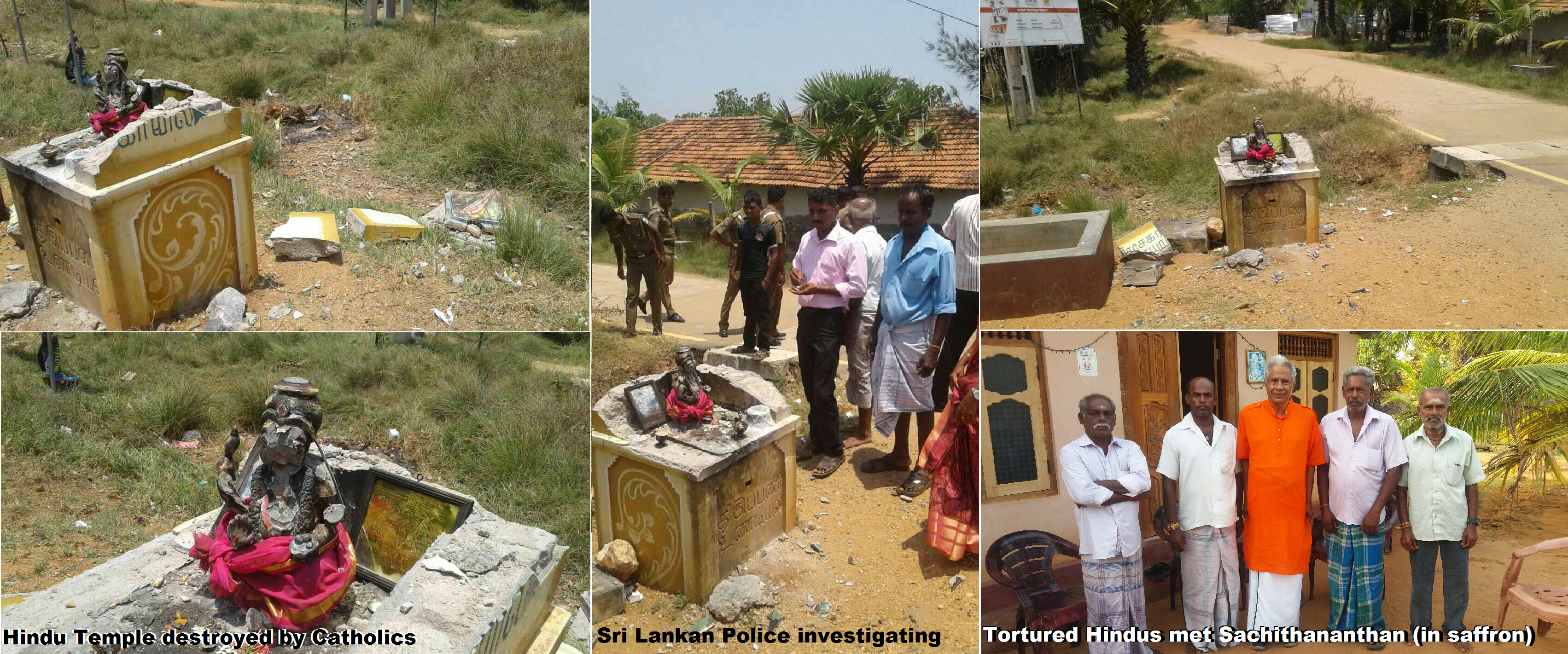
Recently a temple in Sri Lanka was vandalized by, apparently, Christians. In this article, the attack is laid out: "Catholic priest in charge of the parish Devanpiddy, a village to the west of Vellankulam towards the coastline, led the vandals at midnight on 23rd/ 24th April to destroy the Pillayar temple and attack the Hindu residents causing extensive damage to Hindus and their properties." Things between the two religious groups have been escalating for a while now, starting in 2007 when the priest planted a tall cross in the village without permission. The Hundu's removed it, then the attacks started.

Struggle for Hindu Existence accepts donations to strengthen their fight for marginal Hindus in India, specially in South Bengal. According to their website, the donation will be used for "the fundamental research of Dharma and strategy making for the existence of most ancient Hindu Dharma and its role to save Humanity."


Do you have a favorite out of these three? Vote for it in our poll until May 17th. We will announce this month's winner on May 18, 2017.