There is little to see today of Helike, just a few walls and artefacts scraped clean by archaeologists. The great Greek city, famed across the classical world, sunk into the coastal mud of the Gulf of Corinth in 373 BC during a terrible earthquake. Writers still recalled its fate hundreds of years later.


The traveller Pausanius in the 2nd century AD reported:

"The sea advanced together with the earthquake, and the wave dragged down Helike with all its people, the ruins of Helike are still visible, but not so plainly now as they were once."

Had there been travellers about two million years earlier, the journey north from the temples of Helike to those at Delphi would have been quick and along a simple path. At that time, there was no Gulf of Corinth to separate them. That only started to open up in the crust as tectonic forces pulled the Peloponnese peninsula away from the Greek mainland.

Today the gulf is 100km east to west, from Corinth to Patras, and over 20km north to south. More impressive is its 3·5km maximum depth, a crevice opened up by thousands of tremors over the millennia. Much of that depth is filled by sediments washed down from the surrounding hills. It is into those sediments that members of the International Ocean Discovery Program (IODP) have drilled—to recover a history of the local environment and of the seismic jolts that sculpted this southern Greek landscape.

Professor Lisa McNeill, of the University of Southampton and co-Chief Scientist of the expedition, says:

"The Corinth rift zone is opening up and pulling apart at some of the highest rates on Earth. A magnitude six or larger earthquake occurs on average every 10 years in the area, and today events can impact the populous coastal and tourist communities, including Patras, as well as the large city of Athens."

Helike perished in one such event. More recently, in 1981, three strong jolts hit the eastern end of the gulf in quick succession over a period of eight days, the first killing 22, and destroying 8,000 buildings.

The recent seismic history of the region is well told by written accounts and geophysical studies and recordings. The numerous fault lines, where future events will happen, are quite well known. With GPS measurements experts can tell how fast the Peloponnese peninsula is creeping southwards, creating the tension to fuel the next shudder. But to understand the past seismic and geological history, it is into those submarine sediments the team must dig.

Lisa McNeill co-led an international team that drilled into the gulf's bed in three locations, chosen for the detail they would reveal. The layers of sediments contain geochemical markers, fossil plankton and magnetic properties that reveal their age, as well as pollen, laid down over time. Shaking from earthquakes under or near the basin will have caused landslides and driven sediments into the gulf, along with eroded mountain sediments carried by rivers, as happened at Helike. Professor McNeill explained:

"We can use the ages of the sediments to work out how fast the tectonic processes are occurring."

When tectonic plates move, this creates fractures in the Earth's surface that shift over time. This is interesting not simply for the earthquake hazard it poses, but also because of how oceans start to form. Like the Atlantic 90 million years ago. Or in East Africa's Rift Valley and the Gulf of Corinth right now.

The waterway is landlocked at the eastern end, apart from a spectacular deep shipping canal dug through the Isthmus of Corinth at the end of the 19th century. And, at the west end, Patras was connected to the Greek mainland 15 years ago by an earthquake-resistant road bridge, which is too low for the JOIDES Resolution, the IODP's main drilling ship, to pass under with its tall drilling derrick.

But the team was also able to use commercial research vessels, calling in this instance on the Fugro Synergy, a ship mostly used in oil exploration, but well suited to the task. The schedule onboard was punishing—no time even to visit the nearby resorts which were visible from the deck. But in the two months before Christmas 2017, the crew had hauled up 1·6km of sediment core, spanning millions of years of geological history.

Once the team split open the cores, quickly apparent were the major fluctuations in climate conditions over the age of the Gulf of Corinth: the sedimentary record spans several ice ages, during which Professor McNeill says that erosion increased up to sevenfold because there were fewer plants on land. The evidence also shows that the gulf was cut off from the Mediterranean during the cold spells as a result of the lower sea level: fresher water organisms took the place of marine ones during these periods.

The hard work on reconstructing the tectonics story has only just started. It will matter, says Professor McNeill, because the results will allow the team to reassess which earthquake faults pose the greatest hazard to local populations.

"The slip rates we measure, and fault lengths, can be used to estimate maximum likely earthquake magnitudes and the likely level of shaking."
Congratulations to the Acropolis Museum! The award-winning Acropolis Museum in Athens is organizing a number of events for all as part of the celebrations for its 10th anniversary on June 20.
Since its grand opening in 2009, the museum has received 14.5 million visitors from Greece and abroad.


Dimitris Pantermalis, the director of the Acropolis Museum, spoke at a press conference.


"During the museum’s first years of operation, which coincided with the economic crisis, the number of visitors reached 1 million [annually]. In 2018 however, the museum received 1.8 million visitors, which is a significant increase." 

The Acropolis Museum covers a total area of 25,000 square meters, with exhibition space of over 14,000 square meters, which is 10 times more than the exhibition area of the old museum on the Acropolis Hill. It houses over 4,000 exhibits while its top floor is dedicated to the Parthenon, the monument’s friezes and sculptures. The museum has been included among the world’s five most significant museums by ICOM, the International Council of Museums.

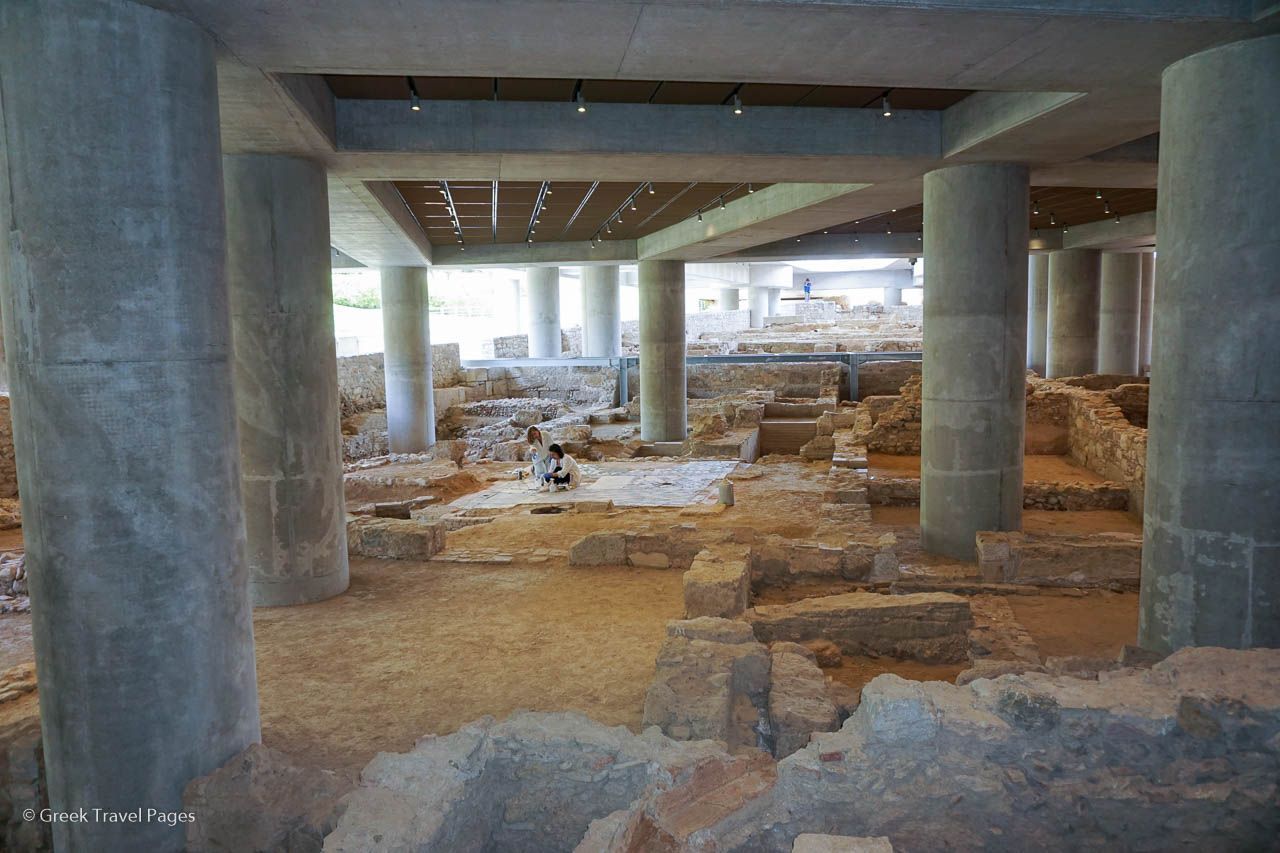
To mark its 10th birthday,  on June 21, the museum will officially open its underground excavation site, which is currently visible through the glass floor at its entrance. The excavations have revealed an area of 4,000sq.m. which includes the ruins of an ancient Athens neighborhood, dating from the Classical period through to Byzantine times, and includes houses, streets, workshops and bathhouses.
The site will also be enriched with the most significant mobile findings of the excavation, which offer valuable information on the everyday life in ancient Athens. The museum’s underground collection will be accessible with the general admission ticket.

The museum’s 10th anniversary will also be marked by a number of events including concerts, lectures and exhibitions. More specifically, aiming to shed light on the Acropolis restoration process, the Acropolis Museum on June 11, will open the exhibition titled, “Chisel & Memory”, which features selected photos from the archives of the Committee and the Service for the Restoration of the Acropolis Monuments.

The impressive photos have captured the craftsmen’s techniques and efforts to embody centuries-old expertise, as well as cutting edge technology to their work. The exhibition will remain open until October 31.

Furthermore, on June 13, at 7pm, the museum will host a lecture by Italian professor and expert Giovanni Verri on the “True colors of the Parthenon marbles.”

Then, on June 19, visitors will have the chance to enjoy a concert conducted by renowned composer Stavros Xarchakos, with some of his best known songs, as well as works of Mikis Theodorakis, Vasilis Tsitsanis and Manos Chatzidakis.

On June 20, the museum will celebrate its birthday by offering visitors free admission to all its collections and exhibitions. Opening hours will be from 8am until 10pm.
Proklos (Πρόκλος) was a Greek Neoplatonist philosopher, one of the last major Classical philosophers. He was alive from 8 February 412 AD to 17 April 485 AD, and amongst other things, he wrote five beautiful hymns about the Roman Gods, which can be interpreted for the Hellenic ones as well. The surviving works consist of two hymns to Venus (Aphrodite), one to the Sun (Helios), one to the Muses, and one to Minerva (Athena). Today, you are getting his hymn to the Muses, because I pray they give my mind and words wings today. Today, because one can never have enough love in their life, I'm sharing his hymn to Aphrodite (or Venus).


A CELEBRATED royal fount I sing,
From foam begotten, and of Loves the spring,
Those winged, deathless powers, whose gen'ral sway
In diff'rent modes all mortal tribes obey.
With mental darts some pierce the god-like soul,
And freedom rouse unconscious of control;
That anxious hence the centre to explore
Which leads on high from matter's stormy shore,
The ardent soul may meditate her flight,
And view their mother's palaces of light.
But others, watchful of their father's will,
Attend his councils and his laws fulfil,
His bounteous providence o'er all extend,
And strengthen generation without end.
And others last, the most inferior kind,
Preside o'er marriage, and its contracts bind,
Intent a race immortal to supply
From man calamitous and doomed to die.
While all Cythera's high commands obey,
And bland attention to her labours pay.
O venerable goddess! hear my prayer,
For nought escapes thine universal ear:
Whether t'embrace the mighty heav'n is thine,
And send the world from thence a soul divine;
Or whether, seated in th'aetherial plain
Above these seven-fold starry orbs you reign,
Imparting to our ties, with bounteous mind,
A power untamed, a vigour unconfined;—
Hear me, O goddess, and my life defend,
With labours sad, and anxious for their end;
Transfix my soul with darts of holy fire,
And avert the flames of base desire.

A campaign of underwater archaeological excavations has uncovered 17 amphorae dating from the 3rd century BC at a depth of twenty metres, not far from the Lérins islands off the Bay of Cannes.


According to Anne Joncheray, archaeologist and director of the Saint-Raphaël Museum of Archaeology, the 2,300-year-old amphorae are remarkably well-preserved and were likely used to transport locally produced wine to the Greek trading posts of the Mediterranean.

"Bringing these objects to the surface was not an easy task, as everything was entangled in a mixture of sand and organic matter, which also preserved them for more than two millennia."

However, there is no trace of the ship that carried them and the arrangement of the scattered amphorae suggests three possible scenarios: either the boat had capsized without sinking and part of the cargo fell out, or it ran aground further afield, or the objects were simply thrown overboard.

One thing is certain: such a deposit is extremely rare as the Mediterranean basin was far from peaceful in the 3rd century BC and the infrequent trade was controlled by the Greek trading posts.

Only four wrecks dating back to this period of history have been discovered to date.
The amphorae will be preserved and then exhibited to the public in a museum in the Alpes-Maritimes department.

David Jaffe (and TSA, to a lesser extent) are on my shit list. They are on my shit list because of this: "God of War’s Kratos revealed to be bisexual as a joke." You might not know who David Jaffe is, and you might never have played God of War. I haven't. You don't have to in order to be....annoyed. Let's call it that.

Short version: David Jaffe is the director of God of War, a mythology-based action-adventure video game franchise. The story is about Kratos, a Spartan warrior tricked into killing his wife and daughter by his former master, the Greek God of War Ares. Kratos seeks to rid himself of the nightmares by serving the other Olympian gods, but soon finds himself in confrontation with them due to their machinations.

Now, it's pride month, which is historically my least favorite month because it's the month straight people go all "We want a straight pride month too!" and idiots like Jaffe open their mouth and put their foot in it. He tweeted:

"Not to get all JK Rowling but when I was working on the origins of Kratos for the first games I knew he was a raging bi-sexual until he settled down with his wife. So Kratos is officially bi. Oh and the Oracle from GOW1? Lesbian, straight up! Boom!"

Only, he isn't:
Then Jaffe got annoyed because he's being accused of queer bating and generally sucking for both forced representation and what actually is queer bating. ( Definition: When a politician, pundit, or other public figure brings up the completely irrelevant detail about a person's sexuality, true or untrue, as a way of subtly channeling homophobia to attack them.). It's 2019, can we stop doing this already?

TSA seems annoyed about the whole thing, which makes me happy, but then they (and many news outlets picking up the story) throw in a bunch of untrue "facts" about ancient Hellenic society that are now doing their round across the interwebz, namely that being homosexual in ancient Hellas was completely accepted and blah, blah, blah.

Here are some facts.

Homosexuality is defined as: 'of, relating to, or characterized by a tendency to direct sexual desire toward another of the same sex', or 'of, relating to, or involving sexual activity between persons of the same sex'.

All three of the greatest Hellenic philosophers, Socrates, Plato, and Aristotle, regarded homosexual conduct intrinsically immoral. Plato went so far as to deny that homosexual behavior occured in nature and thus considered the practice of men (very few of the ancient philosophers ever considered or wrote about women) as especially unnatural. He actively criticised any man who looked at the male form not just as something aesthetically pleasing but sexually arousing. These believes were founded upon the following three theses:

- the commitment of a man and a woman to each other in the sexual union of marriage is intrinsically good and reasonable, and is incompatible with sexual relations outside of marriage
- homosexual acts are radically and peculiarly non-martial, and for that reason intrinsically unreasonable and unnatural.
- homosexual acts have a special similarity to solitary masturbation, and both types of radically non-martial act are manifestly unworthy of the human being and immoral

Hellenic society revolved around the household, and the household was founded upon the husband and wife. The ancient Hellenes knew of no other household foundation as this combination alone produced children. As many children died of illness, accidents and war and the continuation of the family line was one of the--if not the--most important desire and responsibility of every citizen. This was also why adultery was frowned upon so greatly: birth control was available in ancient Hellas, but rarely applied. To bring an illegitimate child into the household was a terrible offense, and one for which the male was blamed. that said, a man could only commit legally punishable adultery if he had sex with a married woman, and even then she had to be a citizen for the full punishment to be enacted upon them--often death. Husbands were free to find pleasure with any woman who was not married. As such, prostitution (with women, male prostitution was actually punishable by death) was common and men tended to have concubines. Some even lived at the house. Plato, Socrates and Aristotle were against this practice, too.

Now, the ancient Hellenes seemed to have viewed all social interactions (so male-male, female-female and even male-female interactions) not only through a gender filter but also through a power filter. Male citizens had more power than slaves, for example, and female citizens had more power than male slaves, even though women were bound by other social structures than any man was. Older men had more power than younger men and the same held true for women. Married people even had more power than unmarried people. Gender was, if you will, merely a factor in the equation of who had more power during the exchange.

The one with more power was the active party and he (or she) was to be obeyed. When it came to the law, this partner was punished less severely for a crime both partook of (like adultery)--the complete opposite of how we'd view it today. The passive party was usually younger, a slave or a woman. This power equation also dictated sexual relations. The ancient Hellenes viewed male-female relationships not solely as defined by gender that but as a relationship of active vs passive and applied that theorum to male-male (and most likely female-female) relationships as well. One partner was always the clear submissive and became, through that, the 'female' while the other always assumed the active role and through that became the 'male'. They equated any relationship that applied these roles and rejected (heavily!) any that did not. And they did not consider these relationships true relationships in a marriage sense because, as I said above, a household could not be formed around it as the union could not provide children--which was the main function of a marriage.

So if that was the case, what's with all the artwork of men giving each other gifts and having sexual intercourse? They portray a very specific type of relationship known as pederasty. Pederasty was a socially acknowledged but illegal erotic relationship between an adult male and a younger male usually in his teens, which was practiced mostly in the Archaic and Classical ages of Hellenic history. Due to the age difference and the societal function the practice served, this type of relationship was accepted and not considered homosexual. The younger partner was always the passive party and performed to role of 'woman' in the exchange, thus making it a heterosexual relationship between two men (as contradictory as that may sound).

In ancient Hellas, what mattered was the role you played in bed. The males, especially when older or higher up in the hierarchy, were supposed to be the dominant ones, the active ones, while the women, the young and those lower in the hierarchy, the passive ones. Because of the age difference and the difference in social standing, the young male assuming a passive role was permitted in pederasty, but a grown man assuming that role was a social and sexual taboo. A wife who took charge in the bedroom would have been frowned upon as well. Especially within the marriage, sex served to make babies, nothing more. Prostitutes and concubines were still supposed to assume a passive, female, role, even if they were male. Prostitutes were lower in power than citizen women, though, and they performed the lowliest and most frowned upon of sexual acts--like fellatio--that even wives were not allowed (or required) to perform. For a husband to force his wife to perform these acts would have been considered extremely shameful upon the husband.

So, to conclude this very long and complicated post: yes, men had sex with men. In that way homosexuality existed. But there were strict social and even legal rules against it and it was only barely condoned--and only under very specific circumstances. It was not an accepted practice at all. Sadly, I suppose, but not surprisingly: even today homosexuality is only barely accepted socially, let alone legally.


I'm gay. I've been with the same woman, very happily so, for over 14 years now and as far as I am concerned, this is the woman I'll die with. She is my oikos, my definition of home. I'm an advocate for LGBTQI+ rights and I take responsibility in speaking up for the hundreds of thousands of people who can't speak up for themselves because they are surrounded by hate. As such, representation matters to me. A lot. Every year, thousands of LGBTI+ people are murdered simply because they chose to come out for their personal truth. If you take the piss or play along with ridiculing or harming LGBTQI+ people, or if you downplay the very real struggle the community faces on a daily basis, then you are complicit in those deaths. LGBTQI+ issues are not a joke, they are a matter of life and death. Don't be an asshole about them.
On the day of the Hene kai Nea (or sometimes, like this month, the day after), I post a monthly update about things that happened on the blog and in projects and organizations related to it. I will also announce Elaion's coming PAT rituals.

Statistics:
PAT rituals for Skirophorion:
  • Skirophorion 3 - June 7Sacrifice to Kourotrophos, Athena Polias, Aglaurus, Zeus Polieus, Poseidon & possibly Pandrosos at Erkhia
  • Skirophorion 12 - June 16Skirophoria - festival in honor of Athena, Poseidon, Apollon & Demeter; the Tritopatores were worshipped at Marathon on the eve of this festival
  • Skirophorion 14 - June 18- Dipolieia/Bouphonia - festival in honor of Zeus Poleius
  • Skirophorion 29n - July 3 - Disoteria - Sacrifice to Zeus the Savior and Athene the Savior

Anything else?
Are you looking for an online shop to buy incenses and other Hellenistic basics from? Try The Hellenic Handmaid on Etsy.

Would you like to support me? Buy me a coffee.


A group of academics from the University of Exeter in England and ”The Politics Project”, which is an educational charity, created a series of games and workshops based on Ancient Greece and the political figures of Greece.


The new innovative project aims to help British students understand the basics of modern-day politics by acquiring valuable knowledge through a series of fun games and workshops that use Thucydides’ work. The academics hope that this could help the younger generation understand the complexity of politics in such a turbulent time for British politics.

Professor Neville Morley from the University of Exeter managed to develop a series of games after studying the father of historiography, Thucydides.

The workshops, including the innovative games, are divided into four sessions. During the first session, students will have to play an ancient Greek version of the popular ”rock, paper, scissors” game, where they will have to figure out how their Greek city-states will survive in an environment of anarchy that defines the fate of their cities; something similar to today’s anarchic status quo in global affairs.

The second session involves the famous ”Melian Dialogue” of Thucydides. The pupils will learn what it feels like being in a weak position in global politics, something that was perfectly depicted by the Melian Dialogue, where Athenians demanded that the people from the island of Melos surrender.
The third session of the workshop incorporates elements of societal groupings and how these shape politics and politicians.

During the final session, which takes advantage of all the knowledge students gained playing and learning through ancient Greek experiences, pupils are asked to ”interrogate” local and national British politicians to understand their ways of conduct and their motivations.

This innovative project has already started being trialed in the town of Crediton in Devon with students from Queen Elizabeth’s Community College and aims to become a nation-wide teaching method.