There are many household Gods in the Hellenic religion and without some background knowledge about how ancient Hellenic houses are built up, it can become a bit of a conglomerated mess when trying to worship all in modern times.  Which God watches out over which area? And where should you place your shrines in a perfect world? And in a realistic world? Why don't we try to suss things out today, hm?


Ancient Hellenic homes were simple structures, made from clay, wood, and stone. The roofs were covered with tiles, or reeds, and the houses had one or two stories. Most houses were small, just a few rooms, with a walled garden or yard in the middle. Others, like the house above, were much larger. They were not solely homes, but often doubled as offices, shops, entertainment areas, and as a place of worship. In many cases, a large wall with a single door connected the house to the street, while insuring maximum privacy tot he occupants of the house. Rooms at the front of the house often served as store rooms or work shops. Other rooms in the house served as bedrooms, as a kitchen, bathroom, and smaller store rooms. Symposia were held in special rooms, reserved only for men. The only women who entered the male-only rooms were serfs. These rooms were called 'andron' (ανδρών). Female-only rooms were called 'gynaikon' (γυναικῶν).

The courtyard of the home often held a bômos, a free standing, raised, altar where the majority of household worship took place. Some houses also had a wall niche, an indoor worship area, either in a room especially designated for worship, or in the main family room. These altars were used to worship the Ephestioi (Εφεστιοι), the most personal of the household Theoi. These almost always included: Hestia, Zeus Ephestios (Overseer of the Hearth), Zeus Kthesios, and Agathós Daímōn. Worship of these deities was highly personal, and many other Theoi could be added to this worship list.

Hestia was represented by the hearth fire that was always kept burning. If it went out, the male head of household would go to the prytaneion (Πρυτανεῖον), the structure where state officials met and where the city kept a fire for Hestia burning day and night, for a new flame. All fires in the house were lit from this one fire, so Hestia would watch over everything and everyone inside the house. Zeus Ephestios was and is a more active defender of the home. He shields the actual structure of the house. Where Hestia watches over the occupants, Zeus Ephestios guards the very walls, the roof, the floor, and any possessions inside the structure. He was worshipped at the main altar.

Zeus Kthesios guards the pantry, and was honored there as well, where he had his own shrine, often adorned with a kathiskos. Agathós Daímōn and the ancestors were also worshipped at the main altar, although they may have had small shrines to themselves, especially in the case of wall niches.

In the courtyard of the house, the Herkeioi (Ἑρκειοι) were honored: those of the herkos or front court. Most notably, this was Zeus Herkeios (Ἑρκειος), protector of the enclosure of the house.

Just outside the house, and especially near the gate to the street, small shrines and altars were placed in honor of the less personal protectors: Apollon (sometimes in his epithet of 'Aguieus' (Ἀγυιεύς), protector of the streets, public places, and the entrances to homes), Hermes Propylaios, Hekate, and especially in Sparta, the Dioskouroi. Hēraklēs sometimes took the place of Apollon.

Zeus Herkeios' altar stood in the courtyard and He, from the inside of the house, protected against anyone wanting to harm the house or the family living in it. These altars were most often pillars, on or around which the offerings could be placed. Hermes, Apollon, and Hekate were represented by a pointy four-sided post. The top was reserved for Apollon, the bottom often held a niche where Deipnon offerings could be placed to Hekate, and Hermes' face (and sometimes his genitalia) was sometimes carved into the post. Hermes sometimes got his own post, called a 'herm', which was a rectangular post, with His face carved on top, and his genitalia carved out on the front.

So how does this translate to modern worship? The structure of houses has changed--many people don't even live in a house but in an apartment without a garden. So, how are the areas divided then? Let's start with a picture of a house with a garden, leading to the street:


The house itself is 'circle' one. It's the realm of the Ephestioi. Their influences reaches right up to the walls. If you live in an apartment, this circle encompasses your entire home. This is where your bômos is, where you might have a pantry shrine to Zeus Kthesios, where you might have a shrine for Hestia if you don't have a fireplace, and so on. This is the main circle of worship.

Then we move out to the garden: anything from the house onward that still belongs to you. In an apartment, this would be the balcony if you have one and arguable also the elevator or staircase and hallway leading to your apartment door. This is the domain of the Herkeioi. You could set up a small shrine near the front door to pour out some libations into. Do you live in an apartment? A flowerpot or plant is a perfect way to hide your little shrine. Do you want to bring things together even more? Zeus is whom is honored here most, and his sacred tree is the oak. Why not plant some acorns and water them with libations of water? This second 'circle' spans the area from the house to the street.

The third 'circle' is not a circle at all: it's a barrier. Just like ancient Hellenic cities often had gated walls, so does the home. There where the driveway, garden fence or building door meets the street, Hekate, Apollon and Hermes (amongst others)  stand tall to guard against any harmful influence from outside. It thus stands to reason that your shrine for Them belongs at that spot.

This third is of course the most tricky of shrines. It's a very visible spot and if you live in an apartment complex, you might not even have the option to put anything of yourself there. I have a friend who lives in an apartment in New York. She has a little mailbox in the entry hall, close to the outer door. At the back of it, she'd put a little bowl and leaves small offerings there whenever she goes to collect her mail. Inventive, hm? Another option would be to 'pull back' this barrier to the door of your house and make a shrine just inside or outside of it. That's what I did when I still lived in an apartment.

I hope this makes things a little clearer and you have a few more handholds to base your worship on.
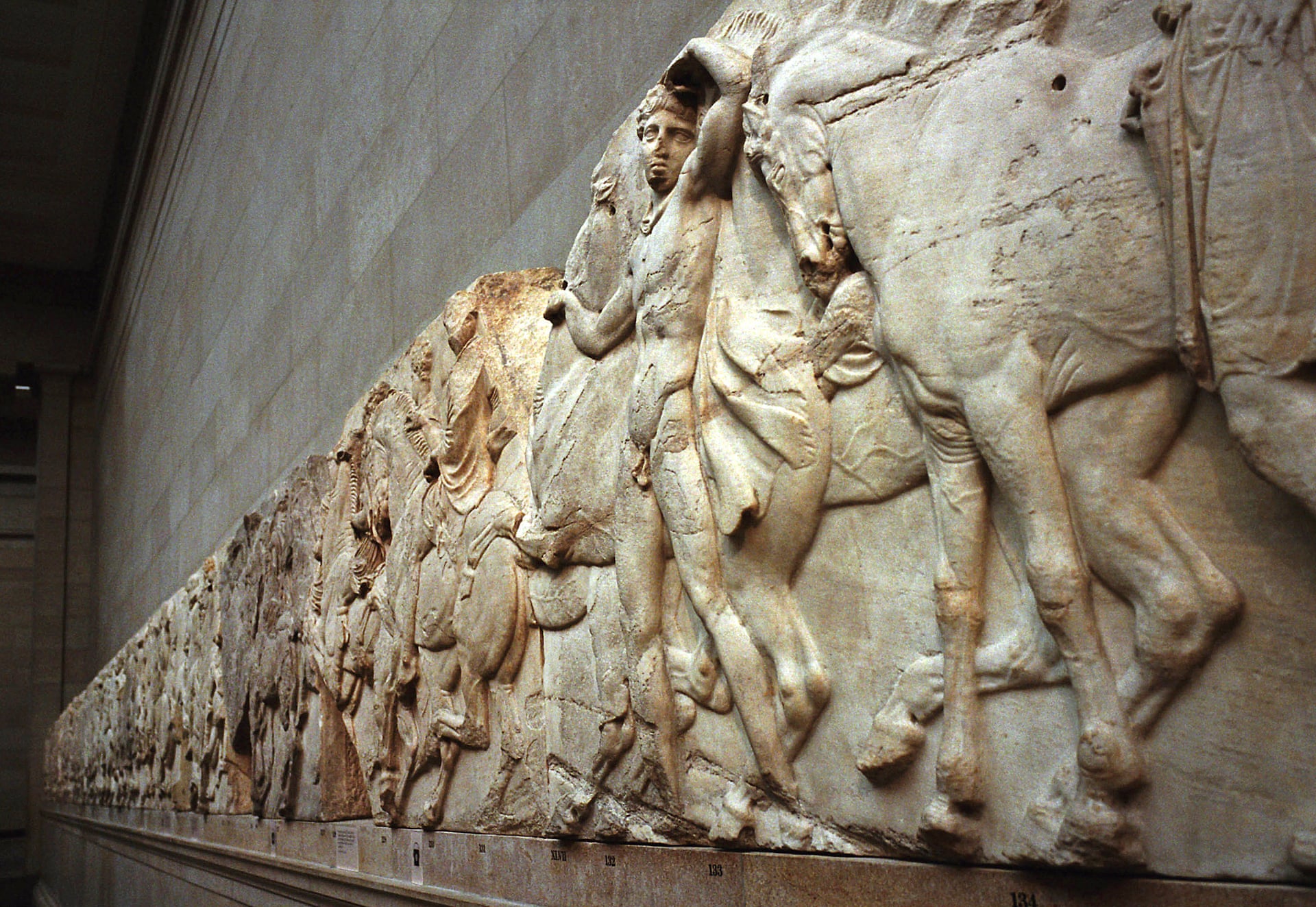
As the man who removed many of the Parthenon marbles in circumstances that are still disputed, Lord Elgin’s association with the world famous sculptures remains controversial, to say the least.
But the British aristocrat’s work at the site in the early 19th century was not merely acquisitive. As well as taking away about half of the surviving sculptures before eventually selling them to the British Museum, Elgin also employed specialist craftsmen to create detailed plaster casts of many of the artworks that he left behind on the great Athens monument.


Now analysis of those casts has revealed details that have since been lost on the original sculptures, casting fresh light on an almost forgotten technique that could reveal further insights about some of the most celebrated monuments in classical art.

Research by Dr Emma Payne, a specialist in classics and archaeological conservation based at King’s College London, shows that in 1802, when Elgin’s men made their casts, the sculptures of the west frieze of the Parthenon were in markedly better condition than they are today.

By comparing the casts with present-day 3D scans of the west frieze – which was removed from the monument in 1993 and is now in the Acropolis Museum in Athens – she revealed features that are now lost, including the faces of some of the sculptures, and chisel marks showing they had intentionally been chipped away by Victorian-era vandals.

While it has long been known that the casts preserve some lost sections, Payne’s research showed that the copies were more accurate than expected, with most of the casts deviating by barely a millimetre from the originals. As a result, she showed that Elgin’s copies are the best-preserved 3D record of what Dr Ian Jenkins, a senior curator of ancient Greece at the British Museum, says came to be considered “the most beautiful manmade sculptures on earth”.

Payne also analysed a second set of casts, commissioned by the British Museum in 1872. She was able to show that more damage was caused in the intervening seven decades than in the 120 years that followed, meaning that a century of traffic pollution did less harm than Victorian vandals. Her research is published in Antiquity magazine.

Payne told the Guardian she had been surprised by how accurate her computer-aided analysis had shown the copies to be.

"Certainly the results very much emphasise the skill of the casters, and it shows that there is still information that we can potentially learn about the Parthenon sculptures from these 19th-century studies that haven’t really been looked at in detail."

Notably, she said, other large excavations of the period, including at Delphi and Olympia, had also made moulds of the artworks they uncovered – which could potentially yield their own secrets.
Payne said:

"This work helps us to understand the important role that such casts can still play as 3D time capsules, but we need to study them very closely to understand exactly what it is they preserve."

Asked if a fresh recognition of the casts’ value might lessen the controversy around Elgin’s involvement, Jenkins said:

"I am all in favour of Lord Elgin’s rescue of the sculptures, and I do think that this recording of the west frieze is all part of a great sense of reverence for the ancient past."

Unusually, he said, the names of the cast-makers had been recorded where those of other skilled craftsmen were not “because they were seen to be producing something which was essentially art”.
Awww, this is pretty cute! According to a myth by the comic playwright Aristophanes, recounted in Plato’s Symposium, humans were once two-bodied creatures until they challenged the gods. Zeus, angered by humans overstepping their bounds, sliced them all in two, leaving us destined to yearn for partnership. Here is a video describing the alternative creation myth. Read more about it below.


"Aristophanes professed to open another vein of discourse; he had a mind to praise Love in another way, unlike that either of Pausanias or Eryximachus. Mankind; he said, judging by their neglect of him, have never, as I think, at all understood the power of Love. For if they had understood him they would surely have built noble temples and altars, and offered solemn sacrifices in his honour; but this is not done, and most certainly ought to be done: since of all the gods he is the best friend of men, the helper and the healer of the ills which are the great impediment to the happiness of the race. I will try to describe his power to you, and you shall teach the rest of the world what I am teaching you. In the first place, let me treat of the nature of man and what has happened to it; for the original human nature was not like the present, but different. The sexes were not two as they are now, but originally three in number; there was man, woman, and the union of the two, having a name corresponding to this double nature, which had once a real existence, but is now lost, and the word "Androgynous" is only preserved as a term of reproach. In the second place, the primeval man was round, his back and sides forming a circle; and he had four hands and four feet, one head with two faces, looking opposite ways, set on a round neck and precisely alike; also four ears, two privy members, and the remainder to correspond. He could walk upright as men now do, backwards or forwards as he pleased, and he could also roll over and over at a great pace, turning on his four hands and four feet, eight in all, like tumblers going over and over with their legs in the air; this was when he wanted to run fast. Now the sexes were three, and such as I have described them; because the sun, moon, and earth are three;-and the man was originally the child of the sun, the woman of the earth, and the man-woman of the moon, which is made up of sun and earth, and they were all round and moved round and round: like their parents. Terrible was their might and strength, and the thoughts of their hearts were great, and they made an attack upon the gods; of them is told the tale of Otys and Ephialtes who, as Homer says, dared to scale heaven, and would have laid hands upon the gods. Doubt reigned in the celestial councils. Should they kill them and annihilate the race with thunderbolts, as they had done the giants, then there would be an end of the sacrifices and worship which men offered to them; but, on the other hand, the gods could not suffer their insolence to be unrestrained.

At last, after a good deal of reflection, Zeus discovered a way. He said: "Methinks I have a plan which will humble their pride and improve their manners; men shall continue to exist, but I will cut them in two and then they will be diminished in strength and increased in numbers; this will have the advantage of making them more profitable to us. They shall walk upright on two legs, and if they continue insolent and will not be quiet, I will split them again and they shall hop about on a single leg." He spoke and cut men in two, like a sorb-apple which is halved for pickling, or as you might divide an egg with a hair; and as he cut them one after another, he bade Apollo give the face and the half of the neck a turn in order that the man might contemplate the section of himself: he would thus learn a lesson of humility. Apollo was also bidden to heal their wounds and compose their forms. So he gave a turn to the face and pulled the skin from the sides all over that which in our language is called the belly, like the purses which draw in, and he made one mouth at the centre, which he fastened in a knot (the same which is called the navel); he also moulded the breast and took out most of the wrinkles, much as a shoemaker might smooth leather upon a last; he left a few, however, in the region of the belly and navel, as a memorial of the primeval state. After the division the two parts of man, each desiring his other half, came together, and throwing their arms about one another, entwined in mutual embraces, longing to grow into one, they were on the point of dying from hunger and self-neglect, because they did not like to do anything apart; and when one of the halves died and the other survived, the survivor sought another mate, man or woman as we call them, being the sections of entire men or women, and clung to that. They were being destroyed, when Zeus in pity of them invented a new plan: he turned the parts of generation round to the front, for this had not been always their position and they sowed the seed no longer as hitherto like grasshoppers in the ground, but in one another; and after the transposition the male generated in the female in order that by the mutual embraces of man and woman they might breed, and the race might continue; or if man came to man they might be satisfied, and rest, and go their ways to the business of life: so ancient is the desire of one another which is implanted in us, reuniting our original nature, making one of two, and healing the state of man.

Each of us when separated, having one side only, like a flat fish, is but the indenture of a man, and he is always looking for his other half. Men who are a section of that double nature which was once called Androgynous are lovers of women; adulterers are generally of this breed, and also adulterous women who lust after men: the women who are a section of the woman do not care for men, but have female attachments; the female companions are of this sort. But they who are a section of the male follow the male, and while they are young, being slices of the original man, they hang about men and embrace them, and they are themselves the best of boys and youths, because they have the most manly nature. Some indeed assert that they are shameless, but this is not true; for they do not act thus from any want of shame, but because they are valiant and manly, and have a manly countenance, and they embrace that which is like them. And these when they grow up become our statesmen, and these only, which is a great proof of the truth of what I am saving. When they reach manhood they are loves of youth, and are not naturally inclined to marry or beget children,-if at all, they do so only in obedience to the law; but they are satisfied if they may be allowed to live with one another unwedded; and such a nature is prone to love and ready to return love, always embracing that which is akin to him. And when one of them meets with his other half, the actual half of himself, whether he be a lover of youth or a lover of another sort, the pair are lost in an amazement of love and friendship and intimacy, and would not be out of the other's sight, as I may say, even for a moment: these are the people who pass their whole lives together; yet they could not explain what they desire of one another. For the intense yearning which each of them has towards the other does not appear to be the desire of lover's intercourse, but of something else which the soul of either evidently desires and cannot tell, and of which she has only a dark and doubtful presentiment. Suppose Hephaestus, with his instruments, to come to the pair who are lying side, by side and to say to them, "What do you people want of one another?" they would be unable to explain. And suppose further, that when he saw their perplexity he said: "Do you desire to be wholly one; always day and night to be in one another's company? for if this is what you desire, I am ready to melt you into one and let you grow together, so that being two you shall become one, and while you live a common life as if you were a single man, and after your death in the world below still be one departed soul instead of two-I ask whether this is what you lovingly desire, and whether you are satisfied to attain this?"-there is not a man of them who when he heard the proposal would deny or would not acknowledge that this meeting and melting into one another, this becoming one instead of two, was the very expression of his ancient need. And the reason is that human nature was originally one and we were a whole, and the desire and pursuit of the whole is called love. There was a time, I say, when we were one, but now because of the wickedness of mankind God has dispersed us, as the Arcadians were dispersed into villages by the Lacedaemonians. And if we are not obedient to the gods, there is a danger that we shall be split up again and go about in basso-relievo, like the profile figures having only half a nose which are sculptured on monuments, and that we shall be like tallies.

Wherefore let us exhort all men to piety, that we may avoid evil, and obtain the good, of which Love is to us the lord and minister; and let no one oppose him-he is the enemy of the gods who oppose him. For if we are friends of the God and at peace with him we shall find our own true loves, which rarely happens in this world at present. I am serious, and therefore I must beg Eryximachus not to make fun or to find any allusion in what I am saying to Pausanias and Agathon, who, as I suspect, are both of the manly nature, and belong to the class which I have been describing. But my words have a wider application-they include men and women everywhere; and I believe that if our loves were perfectly accomplished, and each one returning to his primeval nature had his original true love, then our race would be happy. And if this would be best of all, the best in the next degree and under present circumstances must be the nearest approach to such an union; and that will be the attainment of a congenial love. Wherefore, if we would praise him who has given to us the benefit, we must praise the god Love, who is our greatest benefactor, both leading us in this life back to our own nature, and giving us high hopes for the future, for he promises that if we are pious, he will restore us to our original state, and heal us and make us happy and blessed."  [189c onwards]

Aristophanes' speech is an alternative creation myth which accounts for homosexuality (although not polyamory), as well a why people in love say they feel "whole" when they have found their love partner. He says that, before the Gods separated us, we had four hands, four arms, and two heads. There were three sexes: the all male, the all female, and the androgynous--who was half male, half female. The males were said to have descended from the sun, the females from the earth and the androgynous couples from the moon. The creatures tried to overtake Olympus, so Zeus devised a plan to cut their power but not deprive himself of their devotions and offerings. He decided to separate them from each other.

Apollon pulled the two heads to the side and let Zeus chut tem in two before stitching them up to form the navel, which he chose not to heal so Man would always be reminded of this event. The women who were separated from women became lesbians, the men split from other men and became homosexuals and those that came from androgynous beings became heterosexuals. From this point forward, mankind would always be looking for the other half of them, and thus not thinking of overthrowing the Gods.

Aristophanes admits readily that this is just a thought, a theory, and that it is not--in fact--myth at all. It would, however, explain the sensation of never wanting to be separated from the person you love. It's a cautionary tale of the price disrespecting the Gods can cost us, but also a way of trying to explain the human emotion of 'love'.

I adore this passage in the Symposium, although, obviously, it has it's flaws in the treatment of homosexuality. It's a brave speech to make, however, and I'll be damned if it does not explain a couple of things about this incredibly complicated thing called love.
Manchester Museum recently returned items taken from Australia more than 100 years ago to Aboriginal leaders, the latest move in an ongoing debate over calls to repatriate museum artifacts to their countries of origin. It's part of a wider discussion over to what degree museums need to reform and "decolonize" away from displaying collections that were gathered or stolen from other countries during the colonial era, in a way that portrays foreign cultures as strange or inferior and other nations as unsuitable possessors of the world's cultural heritage and knowledge. Major institutions including the British Museum and the Victoria & Albert Museum have been caught up in the debate.


One way forward may be found in digital technologies that can enable people to access representations of other cultures in fair, interesting ways, without cultural institutions needing to hold on to controversial artifacts. For example, with 3-D imaging and 3-D printing we can produce digital and physical copies of artifacts, allowing visitors to study and interact with them more closely than ever before.

Copying artifacts has a surprisingly long history. Many ancient Greek statues that we have today are actually Roman copies made hundreds of years after the originals. Famous Renaissance artists' workshops regularly produced copies of artwork. In the 19th century, museums produced copies through processes that involved making a mold of the original item, such as casting and electrotyping. The famous diplodocus skeleton "Dippy" actually exists as a number of copies in museums all over the world.

Today, digital technology has democratized the art of copying so it isn't limited to big museums with generous budgets or top experts with specialist knowledge. Accessible digitization technologies, such as photogrammetry and 3-D scanning, can digitally record the shape of objects to a good degree of accuracy. And 3-D printing and cutting machines can physically reproduce this digital information at an affordable cost.

 3-D copies can be touched and handled by visitors and can also be customized in shape, material and size. What's more, digital files of artifacts can be shared online and replicas can be printed in other parts of the world. And most importantly, physically printing a copy from a digital image doesn't depend on whether the original artifact still exists or not.

Some governments and institutions have supported the creation of copies by adopting these technologies. These include, just to name a few, the prehistoric cave engravings in Lascaux IV in France, Jackson Pollock's 3-D poured painting Alchemy, and the 900-year-old Signing Oak Tree from Windsor Great Park near London.

Once the digital information from an artifact is produced and shared, the knowledge the artifact represents is no longer locked up in a single museum and can potentially be accessed by many more people. Sceptics might argue that the value of the artifact cannot be reproduced by these means. But 3-D technologies open up the possibility for democratizing cultural heritage and creating alternative meanings by different groups of people.

3-D technologies can also support museums to adapt to changing social, political, financial, environmental and other challenges. For instance, creating physical copies allows museums to repatriate artifacts to their communities of origin, or to display objects without having to transport them across the world. It can also be a starting point for talking to different communities about repatriation and decolonization. All these actions can support museums through their transformation from colonial institutions to more modern and open organizations, helping them to become less bound to "original" artifacts.

For example, the Smithsonian National Museum of Natural History in the US has worked closely with the Tlingit native community of southeast Alaska, which requested the repatriation of several objects that were sacred to them. One of the most important objects was the Killer Whale clan crest hat, which the museum digitized and made an accurate replica of, before returning the original to the community.

3-D copies have even been deployed in repatriation activism without the official involvement of museums or their approval. For the project Nefertiti Hack, artists Nora Al-Badri and Jan Nikolai Nelles claimed that they secretly scanned the bust of Egyptian queen Nefertiti, held by the Neues Museum in Berlin, and freely released the 3-D data online. A 3-D replica of Nefertiti's bust was also 3-D printed and exhibited in Cairo. The artists argued their intention was to return Nefertiti to her homeland and criticized the colonialist practices of Western museums.

The repatriation debate is forcing museums to rethink what and who they are for and how they can best serve society. Some museums have taken decisions to return artifacts to their homeland, others to organize exhibitions dedicated to indigenous voices. Yet, in most cases, these efforts are scattered, or one-off events still infused with colonialist spirit. A more concerted effort to use 3-D copying technologies could help overcome this.

Some might argue that original artifacts have an "aura" that is impossible to recreate, and that looking at a copy just isn't the same. But simply visiting a museum or a cultural heritage site is an authentic experience in its own way. And this doesn't always have to depend on seeing "original" objects, as long as the museum is honest about its exhibitions and purposes. In future, museums will focus more on the experience of cultural heritage, while promoting universal values, regardless of where the artifacts are.
The Oxyrhynchus Papyri are a group of texts that were discovered at Oxyrhynchus (known today as el-Bahnasa). The city of Oxyrhynchus (meaning ‘sharp-nosed’ in Greek) is located in the Minya Governorate in Upper Egypt, 160 km (99 mi) to the southwest of Cairo. This city lies on the Bahr Yussef (‘Canal of Joseph’), which is a branch of the Nile situated to the west of the main river. For over a millennium, the inhabitants of the city would throw away their rubbish in a number of sites in the desert beyond the city limits. Amongst these items were texts written on papyri that the people of Oxyrhynchus no longer wanted. I found a lovely translation of fragments recently. 

“Don’t try to do injustice nor to return injustice done
Avoid murders and avoid battles, don’t deign to argue—
Then you will hurt only a short time and you won’t think about it later.

Play a song for me.

You saw the spring, winter, the summer. These are eternal.
Even the sun has set and night is taking what’s owed her.
Don’t try to find where the sun comes from or where the water’s home,
But where you can buy some fragrance and wreaths.

Play a song for me.

I used to want to have three free-flowing honey springs,
five milk rivers, ten of wine, twelve of perfume
two from clear fountains and three from snow.
I used to want a boy and a girl near a fountain.

Play a song for me.

The Lydian pipe and the Lydian games of the lyre work for me.
The Phrygian reed and the leather-topped drum work for me too.
As long as I live I love to sing these things and when I die
Put a flute above my head and a lyre near my feet.

Play a song for me.

Who has ever discovered how to measure wealth and poverty?
Or who again has ever found how much gold human beings need?
Today, still, whoever has money always wants more of it
And the wretch is tortured like the poor even though he’s rich.

Play a song for me.

If you ever see a corpse or walk by quiet graves,
That’s when you look into the mirror we all share: the dead expected this.
Time is on loan and life’s lender is a prick.
Whenever he demands repayment, you must pay the bill by grieving.

Play a song for me.

It was the king Xerxes who said he shared everything with god,
But he crossed the Lemnian water in defeat with a single rudder.
Midas was rich; Kinyras was triply blest,
But who has ever gone to Hades with more than a single coin?

Play a song for me.,.”
[P. Oxy. xv. 1921, no. 1795, p. 113 [Anonymous = LCL Anonymous Hexamers 125]]
On December 21th or the night of the 20th, Elaion will organize a PAT ritual for the Poseidea. During this festival, Poseidon as savior of ships, protector of those who voyage in ships, and God of the lapping waters both salt and fresh important for agriculture, is thanked for the many gifts that came from faraway places that were likely given at that time. Will you join us at 10 am EST on the 21th or your evening on the 20th?


The most complete account of the festival is Noel Robertson's article Poseidon's Festival at the Winter Solstice, The Classical Quarterly, New Series, Vol. 34, No. 1. (1984), pp. 1-16:

"The record shows that Poseidon was once worshipped in every part of Greece as a god of deneral importance to the community. [...] The festival falls near the winter solstice, and the ritual business marked by jollity and license, belongs to the general type of solstice festival known the world over.  At Poseidon’s festival, however, the sportive conduct has a definite purpose; this purpose arises from the fundamental agrarian background if Mediterranean society, and may bring us close to the origin of solstice festivals.

It has scarcely been noticed that festivals of Poseidon, more than those of any other Greek deity, fall at just this time of year; yet the evidence is extensive. [...] The festival Poseidea and some of the rites in question are often claimed for Poseidon the sea-god, but at this season sailing is furthest from one’s mind, and fishing on the shore is by no means an overriding concern.  Such details as we have point elsewhere, to Poseidon as the god of fresh water who fructifies Demeter’s fields."

One of Poseidon’s epithets is prosklystios, 'of the lapping water'. He is also invoked as Poseidon phytalmios which implies natural fertility and human procreation. There are also implications in the legends that imply bonfires at the winter solstice.

Noel Robertson concludes:

"…the celebrants feast to satiety, then turn to lascivious teasing. What is the ritual purpose of such conduct?  It obviously suits Poseidon’s mythical reputation as the most lustful of gods, who far surpasses Apollo and Zeus in the number of his liaisons and his offspring. Poseidon the seducer is the god of springs and rivers; his women typically succumb while bathing or drawing water; the type of the river god is a rampant bull. But the ritual likewise treats Poseidon as a procreant force; witness the epithets phytalmios, genesios, pater, etc. as interpreted above. The myths and the ritual reflect the same belief. The rushing waters are a proponent male power, just as the fields which they fertilize are a prolific female.  Both water and the fields, both Poseidon and Demeter, can be made to operate by sympathetic magic.  The rites of our winter festival rouse Poseidon and bring the rushing waters."

It is interesting that that Theophrastus tells us that the silver fir was important in ship building, especially for masts. The ‘tannenbaum’ is a silver fir. It is also interesting to compare with the Roman Saturnalia which may very well have borrowed from the Poseidea.

Celebrating Poseidon's Festival seems to be lost in modern practice. It likely entailed bonfires, feasting, cutting of trees (probably decorated), and very likely gift giving. As God of begetting, that aspect was not forgotten. We'll bring at least the ritual for Poseidon back on December 21, at 10 am EST, or your evening on the 20th. You can find the community page here and the ritual here.
All right, we're going to tackle this before it gets picked up and you, as a Hellenist, find yourself without an answer. A summary of the issue at hand: A group of students at the University of Texas are calling for the firing of a classics professor who has written extensively on pederasty in ancient Hellas. Students claim Thomas Hubbard’s academic work “advocates for violent crime against teen boys” and is being celebrated in online communities that promote pedophilia. Read a whole, long article summarizing it all here.


So, pederasty. Yes, it existed. Yes, it often included sex between an adult male and a teenage male. Yes, technically, that makes it pedophilia. Do I condone it? No. Was it part of ancient Hellenic culture? Yes. Is it something any true Hellenist should want to bring back? Hell no! And if anyone ever uses ancient Hellenic culture as an excuse to break a modern law, they are missing the point of Hellenism.

So, now, let me explain pederasty so you can explain it to others, and tell you how modern Hellenist views these practices.

Hellenic society revolved around the household, and the household was founded upon the husband and wife. The ancient Hellenes knew of no other household foundation as this combination alone produced children. As many children died of illness, accidents and war and the continuation of the family line was one of the--if not the--most important desire and responsibility of every citizen. 

The ancient Hellenes seemed to have viewed all social interactions (so male-male, female-female and even male-female interactions) not only through a gender filter but also through a power filter. Male citizens had more power than slaves, for example, and female citizens had more power than male slaves, even though women were bound by other social structures than any man was. Older men had more power than younger men and the same held true for women. Married people even had more power than unmarried people. Gender was, if you will, merely a factor in the equation of who had more power during the exchange.

The one with more power was the active party and he (or she) was to be obeyed. When it came to the law, this partner was punished less severely for a crime both partook of (like adultery)--the complete opposite of how we'd view it today. The passive party was usually younger, a slave, or a woman. 

This power equation also dictated sexual relations. The ancient Hellenes viewed male-female relationships not solely as defined by gender but as a relationship of active versus passive and applied that theorum to male-male (and most likely female-female) relationships as well. One partner was always the clear submissive and became, through that, the 'female' while the other always assumed the active role and through that became the 'male'. They equated any relationship that applied these roles and rejected (heavily!) any that did not. And they did not consider these relationships true relationships in a marriage sense because, as I said above, a household could not be formed around it as the union could not provide children--which was the main function of a marriage.

Pederasty was a socially acknowledged erotic relationship between an adult male and a younger male usually in his teens, and was practiced mostly in the Archaic and Classical ages of Hellenic history. The courtship of the younger male (although the age difference could be neglectable in some cases) started with a ritual abduction of the younger male. The older male selected a youth and enlisted the chosen one's friends to help him, and carried off the object of his affections to his andreion, a sort of men's club or meeting hall. The whole group spent one or two months out in the countryside where they feasted, hunted and simply spent time together, enjoying life.

The next step in the process was to court the youth with gifts. Three gifts were traditional: military attire, an ox, and a drinking cup, but the youth most certainly received more expensive gifts. When the youth returned to the city, the ox was sacrificed to Zeus and the youth and his friends feasted. The young man also received special clothing that in adult life marked him as kleinos, 'famous, renowned.' The young man was called a parastatheis, 'he who stands beside', and served as cup bearer for the older male, the philetor, during meals in the andreion. Sex was part of this relationship, although the younger male rarely carried any love for the older male. Semen was said to transfer wisdom, so this is why younger boys accepted the practice. The rise in status also helped. There was a female version of this practice, but it's much less documented.

In ancient Hellas, what mattered was the role you played in bed. The males, especially when older or higher up in the hierarchy, were supposed to be the dominant ones, the active ones, while the women, the young, and those lower in the hierarchy, the passive ones. Because of the age difference and the difference in social standing, the young male assuming a passive role was permitted in pederasty, but a grown man assuming that role was a social and sexual taboo. 

Taboos say a lot about a culture and the people in it. The boundaries of what is, and what is not, socially accepted bind people together. They also give clues about Hellenistic Reconstruction. I have said before that reconstruction separates religion from culture, but when reconstructing a religion where religion defined the culture, one is invariably bound to it by some extend. While pederasty was a big thing in ancient Hellas, no one is saying we need to bring it back today. There are laws against it, and those are justly in place.

Pederasty played a social role in ancient Hellas. It provided boys with a mentor, it allowed them to make friends in high places, for many, a pederastic relationship was the only way to qualify for military service, which was an all but mandatory part of being a citizen. None of these reasons exist today and so there is absolutely no reason to bring the practice back. Anyone who uses the ancient practice of it as a cover for sexual wrongdoings today is not a member of our tradition.