It's back, it's back, it's finally back! BBC's Atlantis is back! Although I am a little sad about it (we're counting down to cancellation now), I am also very happy to have my favourite 'moderately inspired by Hellenic mythology'-heroes are back. Since it's been a while since Atlantis was on, let me give you the basics: this season, Ariadne has found herself made queen after her father's sudden (and yet-unexplained) passing. Pasiphaê has been waging war against Atlantis to claim the throne for herself, but so far to no avail. Medea--Pasiphae's ally and fellow sorceress--stabs Ariadne and leaves her for dead, but Jason battles the Grey Sisters and comes out victories: Ariadne lives and Jason is free to take his revenge on his mother Pasiphaê and Medea, his (half?) sister. Oh--and a bunch of Jason's friends know that if Jason finds out that Pasiphaê is his mother, the world is pretty much going up in flames, but it's getting unlikelier by the episode that that secret's going to keep for long. Tricky little things, prophecies... Speaking of prophecies... somewhere in a cave with ocean view, Medusa is still waiting for her promised rescue. Ariadne, meanwhile, has asked Jason to marry her and he accepted.


The second Pasiphaê hears of the upcoming wedding, she hardens her heart and decides Jason needs to die. After all, if he takes the throne, 'Atlantis will be lost to her forever'. she's not the only one against the wedding; Ariadne's general Delmos (Emmett J Scanlan) is also not happy about the prospect. Since Jason is supposedly not of royal blood, everyone and their mother is going to make a fuss if he marries the queen. Ariadne enjoys lala-land far too much to let that disturb her, though. She is going to ask the Gods.

The oracle agrees to see Ariadne and Jason for a blood offering (*sigh* I really wish these shows would stop throwing human blood around in sacrifice) to the Gods. The ceremony itself is quite beautiful. Jason is led to the steps of the palace by guards, and Ariadne by her own. The Oracle cuts their palms (another thing I really wish people in series would stop doing) and takes their blood to the sacred groves of Dodona. They will have their answer by morning.

History lesson: Dodona (Δωδώνᾱ (Doric) or Δωδώνη (Ionic and Attic)) was located in Epirus in northwestern Hellas. It was an oracle devoted to a Mother Goddess identified at other sites with Rhea or Gaia, but here called Dione, who was joined and partly supplanted in historical times by Zeus. The shrine of Dodona was regarded as the oldest Hellenic oracle, possibly dating to the second millennium BCE according to Herodotus. Situated in a remote region away from the main Hellenic poleis, it was considered second only to the oracle of Delphi in prestige. Priestesses and priests in the sacred grove interpreted the rustling of the oak (or beech) leaves to determine the correct actions to be taken. According to a new interpretation, the oracular sound originated from bronze objects hanging from oak branches and sounded with the wind blowing, similar to a wind chime. The more you know, huh? Let's see how accurate Atlantis' portrayal is.


Jason, Hercules and Pythagoras nervously drink wine as they wait for dawn while the Oracle makes it to Dodona in record time. She pours the collected blood on an altar, burns leaves and lets the remnants of the leaves fall onto the blood as she prays, hoping for a sign. The wind picks up and obviously a sign is given. The Oracle and her guards return home. Meanwhile, in Atlantis it's a bad day to be a guard because assassins are crawling through the streets, taking out guards and infiltrating what I assume to be the palace.

the Oracle returns to the temple and is very, very happy: the omens were good! The Gods bless the union! That would be about the time when a bunch of assassins pounce on her. Jason finds the remnants of a scuffle and fight and rushes out to rescue the unconscious Oracle from the ninjas. Too bad he gets punched in the face and goes out like a light. The Oracle is gone.

Ariadne is quite convinced that not even Pasiphaê would be stupid enough to kill a servant of the Gods, and Pythagoras logically deduces that it's more likely she will just keep her prisoner so she can't proclaim that the marriage is blessed. Hercules does his own deducing and comes to the conclusion that someone in the palace helped the assassins. It's true, but I don't think it's the general--unlike the boys.


Pasiphaê has, indeed, captured the Oracle and she goes to visit her in her cell. I love these two together on screen; they are both brilliant actresses and their characters have so much history. They throw insults at each other, take stabs at each other's virtue and emotional well-being, and the Oracle is getting through to Pasiphaê on one front: Pasiphaê loves her child. Angered by the conclusion to their verbal cat-fight, Pasiphaê wraps her hand around the Oracle's throat and backs her up against a pillar. She makes a bunch of threat and--finally remembering that a) she actually likes this woman and b) that she is a servant of the Gods--releases her. the Oracle watches her go with a mixture of fear and worry on her features.

Medea has made it to a fort under guard escort. She must go in alone, she tells Goran. Assumingly, it's a magic thing. Ariadne and Melas, The Oracle's assistant/priest of Poseidon, agree that there must be someone in the palace working for Pasiphaê.

Pasiphaê tries to torment the Oracle with food and harsh words. She's not buying it, but she is starting to get worried--Pasiphaê is threatening to kill her. She won't do it herself, so the Oracle tells her to bring whomever Pasiphaê has gotten to kill her into the cell so she can tell him about the terrible things that will happen to him if he kills an oracle of the Gods. Pasiphaê plays coy. She taunts the Oracle because she can't see her own future, and sneers at her over laughing at all the (bad) prophecies the Oracle has proclaimed about Pasiphaê. It's a brilliant and dark exchange that leaves the Oracle truly afraid for the first time since this started.


Medea goes into the fort with an empty crate and returns with a filled one. Goran tries to sneak a peek but Medea magics him away just in time. Some things are best left unseen, she tells him and I am quite sure I know what is in that crate. Jemima Rooper, I have missed you more than words can describe! Please kick Hercules' ass for putting you through all of this crap. He deserves it.

Speaking of which: Hercules, Pythagoras and Jason are back in the woods with the Stymphalian birds and pondering the timing of events. Why wait to kidnap the Oracle until she got back to the city? Why not take her while in the woods? Pythagoras can't figure it out and it's bugging him.

The Medusa-express arrives at the palace and all the men are told to leave the building. It seems, by the way, that Medusa's powers don't work on Pasiphaê and Medea which is very handy because Medusa is dying for a talk, for companionship. She was abandoned in that cave and when she was promised salvation by Pasiphaê, she took the chance with two hands. It's Medusa who will kill the Oracle, and in return, Pasiphaê will 'end her suffering'. She looks broken, scared, and out of her mind with loneliness. My poor, poor Medusa... I hadn't forgotten about you, I promise! I've been ranting about you for over a year.


As the boys sneak closer to the temple, they come upon the encampment of soldiers. They decide to go around as they wonder why the heck everyone has left their comfy beds for twigs and ants. Pasiphaê, meanwhile, shows Medusa to the Oracle's cell. The Oracle knows something's up and slowly gets up, telling Pasiphaê the Gods will have their vengeance. She hears Medusa's snakes and slowly--slowly she turns. At that moment, Medusa realizes whom she is about to kill.

The boys wisely catch on that they are walking into a trap. They're not--well, the soldiers weren't put out as a lure for them--but it's still good they realize they are not exactly being restrained from rescuing the Oracle. It wouldn't matter anyway: the Oracle is too busted up to serve even as a garden ornament. Goodbye Juliet Stevenson! I will miss you!


Pythagoras is the one who draws the obvious conclusion: only Medusa could have done this. Hercules says she would never do that and rushes out to follow her while I mentally rip him a new one for being the idiot he is.

Jason is having a hard time with the Oracle's death. She was always there for him--and he vows to avenge her.

Hercules searches for Medusa and finds her--eventually. She's gott her regular hair back; Pasiphaê kept her word. She explains to Hercules what she did and why she did it, that she couldn't stand another moment alone in that cave. She wanted to be with him again. She only found out it was the Oracle she was supposed to kill when she laid eyes on her. Hercules blames himself and she says there was nothing he could have done. I'll not repeat what I said to my screen. Hercules sends her away because somehow Jason and Pythagoras have turned into Neanderthals out for blood. Uhhh... guys? Remember who the real enemy is? Victim blaming does not look good on anyone, I promise you.

Back in the palace, Jason breaks the bad news to Ariadne, who nearly crumbles. Like Jason, the Oracle was very close to her and not only has she lost her, but without the Oracle, chances of their marriage not causing war are slim to none. Jason has to tell Ariadne about Medusa's involvement and I need to take a moment because even Ariadne decides to blame her. I will spare you another rant. Hercules is shocked and heartbroken, and hopefully consumed with shame and guilt.


Back at the oikos, Pythagoras is trying to get Hercules to eat and give up on Medusa; both to no avail. Medusa must be punished for what she did, he feels, and Hercules refuses to see Medusa as anything less than a victim, even though he doesn't realizes how big his share is in this killing--none of them do. Pythagoras says she must have changed, that Hercules is not to blame. I... never mind.

Jason, meanwhile, is on his own guilt trip (that Pythagoras tries to talk him out of, too): if he hadn't agreed to marry Ariadne, none of this would have happened. He goes out to stop the ripples from spreading any further and tries to get Ariadne to reconsider the marriage. Ariadne says that if they give up now, the Oracle gave up her life for nothing. They love each other with all their heart, but everyone feels responsible for everyone else's heart, too. Long story short: the marriage is on. Melas is not amused when Ariadne tells him to go ahead and prepare for the big day, but he's just a lowly servant. He agrees to do it.

Hercules is packing a bag with food and supplies. Pythagoras catches him but Hercules waves him off. He's on his way to the cabin he told Medusa to wait for him back in the temple.

In the palace, we find out the identity of the mole: it's Melas, who has been talking to Cilix (Lorcan Cranitch), whom I think I forgot to mention in the recap of last episode because he added absolutely nothing to the plot but mope about and tell Ariadne the noblemen would never accept their marriage. Since everyone was already saying that, adding him did not feel like a great addition. Now, though, it's very clear he's on the side of the queen-in-exile, and that Melas is working with him. Killing the Oracle? He didn't know about that part, by the way. Oh sweet summer child... It's now up to you to stop the wedding.


Back at the oikos, Hercules returns sans supplies and Pythagoras knows something is up. He doesnt have a chance to get to the bottom of it, though: a bunch of guars led by Cilix burst in. Jason is arrested and accused of murdering the Oracle. Pythagoras realizes what is going on: Pasiphaê only needed to take the Oracle if the Gods' verdict was positive, and in order to find that out, she needed to return to the city and tell someone--namely Melas. Melas then told Pasiphaê's men and got the Oracle kidnapped.

Jason is dragged into the palace and Delmos informs the queen hat Jason has been charged with murder by Melas. She falls out of bed, dresses, and rushes to the chamber where Melas is holding court. She demands to hear his reasoning and Melas tells her that the Oracle said the oracles did not look favourable on the union. Jason found out and murdered her to keep her silent so he could still marry Ariadne and become king. Needless to say, Jason says it's a lie, but it's his word against a witness of the attack and Poseidon's high priest. 

Ariadne tries to stop all of this from happening, but Melas goes on and on about how she dares to speak for the Gods while he is the priest. Now, I have a question: wasn't it stated specifically that Ariadne is a priestess of Poseidon? It might be an honorary title tied to her royal blood and the royal house, but still. Wouldn't she--technically--hold as much power as Melas when it comes to speaking for Poseidon and a little more even because she is queen...? Never mind, carry on.

Melas manages to talk Aridane into a corner and she has to concede to sentencing Jason to death--but she makes a few unveiled threats at Melas' address while she is at it.


Next time on Atlantis: Ariadne agrees to put Jason into the bull and Hercules returns to Medusa. Saturday on BBC One, recap on Monday.
It was a very close call this month, but Naoto Matsumura has won out over the other candidates as Elaphebolion 2015 cause for Pandora's Kharis. He got 40% of the votes while Feeding America got 30%, The Donkey Sanctuary 20%, and The Greek Archaeological Committee (UK) 10%.


Naoto Matsumura is the only human brave enough to live in Fukushima’s 12.5-mile exclusion zone. He is known as the ‘guardian of Fukushima’s animals’ because of the work he does to feed the animals left behind by people in their rush to evacuate the government’s exclusion zone. He is aware of the radiation he is subject to on a daily basis, but says that he “refuses to worry about it.” He does take steps, however, by only eating food imported into the zone. “They also told me that I wouldn’t get sick for 30 or 40 years. I’ll most likely be dead by then anyway, so I couldn’t care less”.

He fled at first but returned to take care of the animals that were left behind. He returned for his own animals at first, but realized that so many more needed his help, too. Matsumura discovered that thousands of cows had died locked in barns, and he also freed many animals that had been left chained up by their owners. Many of them now rely on him for food. Matsumura relies solely on donations from supporters to work with and feed the animals, and we can help him do that.

You can make your donations to this very honourable cause until 20 April, 2015, by clicking the 'donate' button to the side of the Pandora's Kharis website, or by transferring the funds directly to baring.the.aegis@gmail.com with PayPal. Thank you in advance.
Ha! Okay, so I will give you something serious tomorrow, but I saw the video below yesterday and I cannot withhold this from you. It is a very well researched rap battle between Zeus and Thor as created by ERB, as part of the Epic Rap Battles of History.

The record-breaking digital series 'Epic Rap Battles of History' (ERB), created by Peter Shukoff (aka Nice Peter) and Lloyd Ahlquist (aka EpicLLOYD), features comedic rap battles between historical and/or pop culture figures—such as Albert Einstein vs. Stephen Hawking, Mozart vs Skrillex, Steve Jobs vs. Bill Gates and Moses vs Santa Claus. The series, which airs on the YouTube channel /ERB, is currently the most viewed format on YouTube on a per episode basis.


The series has over 1.2 billion views and more than 7 million subscribers and due to its popularity has spawned an additional channel — /ERB2 — which features behind-the-scenes content. You can watch the tree (!) behind-the-scenes videos of the rap battle between Zeus and Thor.
 
  
The ERB official website is another hub for the series while also allows fans to vote for who they think won each battle, but of course we don't need a vote to know who won this round, right? Go Zeus!
I get a lot of questions from readers, and most of the time, the answers are fairly short. When I feel the question or the reply would be valuable to others as well, I make a post with a collection of them and post them in one go. Today is one of those posts.


"Quick question, what is the greek name of the process in which barley groats are scattered around the temple/shrine area in order to not only acknowledge this area as sacred space, but also to purify? Would ground barley groats be used, crushed or whole form?"

I am actually not sure about the ancient Greek term. What is the words for 'strewing', or even 'sowing'? Do any of my readers know the correct term in ancient Greek? That is what they were doing, by the way by strewing barley groats. It was a part of purification (katharmos), but more importantly, it was the start of the process of kharis, where the strewing of barley groats on and around the altar of the Theoi was like a spiritual sowing to reap the benefits of later (asked for through prayer later on in the rite). As such, the barley that was used was whole form, just like it would be for actual sowing of the crop.


"I'm worried about the credibility of the scholarly books that were released during the 19th and early 20th century. I've tried to read a few, but the scholars seem to perceive Ancient Greek religion through the lens of their Judeo-Christian beliefs. What's your opinion on the older scholarly books?"

I think that it depends an awful lot on the book. To be honest, beyond Grote's 'History of Greece', I don't have any books from that period. Most of the books I refer to regularly date from about 1970 to now. Even those sometimes have the 'Christian problem' you refer to, but the good scholars either acknowledge their bias or simply present facts.

Now, it's important to remember that every scholar writes with the knowledge they have available to them at the time of writing. And with that knowledge comes an understanding that is limited by the information available. We have made huge leaps in information and knowledge, in understanding, ancient Hellas and the ancient Hellenic religion over the last few decades. As such, I research ancient Hellas in the older books, and I find much valuable information, but I do check if there is no new(er) information available on the subject, as published in new scholarly work. In discussions, I tend to defer to the newest information available, if presented in a way that makes sense in the picture that has been painted by scholars along the years.

As for dealing with biases in scholarly work (there are more than Judeo-Christian ones, including sexist ones, cultural ones, and even sensationalism): read anything you can get your hands on, check sources against each other and if you have more than three who say the same thing, try to understand why it says this, try to built up the world frame and if you don't understand how this new information fits in, you research more, you talk to other people, until you figure it out. Don't accept information just because it's in a book. Always think for yourself.


"Do you have to be ethnically Greek to worship the Greek gods? Does this belief have any precedent in Ancient Greece? My ancestry is Germanic, so it was suggested to me that I look into Ásatrú. I have no problem with Ásatrú, but I don't believe that the religion is right for me. I desire a close and intimate relationship with the gods, and their gods feel distant to me."

No, I don't think you have to be ethnically Greek to worship the Hellenic Gods. It might give you a bit of an advantage when it comes to the language and finding people to practice with, but that is about it. The Theoi call on whom they call. I'm not ethnically Greek, and it does not hold me back from worshipping the Hellenic Gods at all.

You know, I have the same feeling about the Norse Gods, although my Ásatrú friends tell me that is complete BS ;-) We all have religions we feel at home in and neither skin colour, nor ethnicity, not gender, nor sexuality, nor anything else can change that.
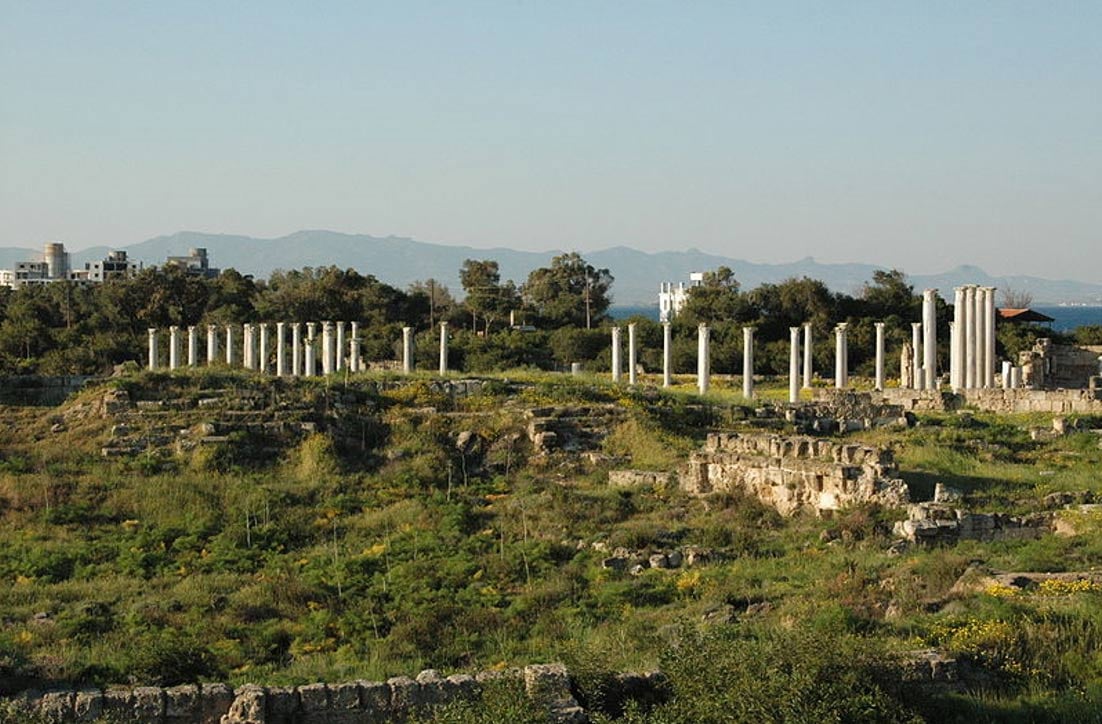
Ancient Origins recently posted a really nice piece about Salamis, a large port city located on the island of Cyprus. According to Homeric legend, Salamis was founded by archer Teucer (or Teukros)from the Trojan War. Salamis was believed to have been the capital of Cyprus as far back as 1100 B.C. Located on the eastern side of the island of Cyprus, it was considered a very important port city. Ships arrived from all over the world, making it a major hub of activity.


Teucer was the son of King Telamon and his wife Hesione, who was the daughter of King Laomedon of Troy. This lineage made Teucer the cousin of the legendary Hector and Paris of Troy, but Teucer fought against all of them, as he was an opponent of Troy in the Trojan War. It is said Teucer fought in the War as an archer, but his shots at Hector were deflected by Apollo. At one point Hector threw a large rock at Teucer, injuring him. While his injury prevented him from fighting for a time, he was said to be one of the individuals who invaded Troy in the Trojan horse. Teucer’s half-brother, Ajax committed suicide, for which King Telamon disowned Teucer, leading him to flee to Cyprus, where he founded Salamis. Some say that the legendary tale of Teucer coincides with occupation of Cyprus by the Sea People.

The city of Salamis has a rich past. It was recorded as founded by inhabitants of Cyprus known as Enkomi around 1100 B.C. In 525 B.C., Persians took control of the city. The city was destroyed during the Jewish revolt in 115 A.D., during which time an estimated 250,000 Greeks were killed. Destruction of the city also occurred as a result of many earthquakes in the area, with cumulative damage over time. Ultimately, the city of Salamis was rebuilt by Christian emperor Constantius II, who reigned from 337-361 AD. The city was ultimately destroyed after the Arab invasions under the control of Muʿāwiyah in 648 A.D., after which the city was permanently abandoned.

For some beautiful archaeological finds from the city, and much more information about its history, head over to Ancient Origins. I found it a lovely piece about a city I admittedly knew very little about.
I am not in the habit of linking to other people's blogs for today's post but this one is really good. It was written by Christos Pandion Panopoulos for his blog and deals with the subject of blood sacrific in modern times. Rathamanthys Madytinos translated the piece into English and the post can be found here.

Blood sacrifice (or animal sacrifice) is a hot button issue in the Hellenic community. We either can't or do not want to practice it, and those who do face both judicial and social obstacles. What I appreciate about Christos' piece is that it highlights something I have been pondering a lot lately as well, that the ancient Hellenes almost solely partook in the eating of meat from scarified animal, and that if we do not sacrifice animals, we--as Hellenists--should thus not eat meat.

I eat meat. I could probably do without if I manage to find food supplements that would support it, but it would mean limiting an already limited diet due to intolerances even more. I eat as little meat as possible, though. Once or twice a week, just to get the necessary nutrients. I used to eat even less meat but had to start again once my intolerances manifested. I dislike it because I dislike the meat industry (even organically raised meat, which is the only meat I eat), and because I am aware that I am breaking tradition; after all, I agree with Christos.

More than this point, I would like to share another point he makes, namely that if we are truly serious about our religion, that if we truly want to reclaim it, we need to start cultivating the conditions in modern society to prepare for a revival of blood sacrifice, as it was one of the fundamental cornerstones of the ancient tradition. These would include: 
  • The drastic reduction in meat consumption for non-religious reasons,
  • The identification and direct link of that consumption with the sacrificial act,
  • The identification and link of the act with its main religious intent and context,
  • The raising and the selection of appropriate animals by polytheists,  which will re-establish the value and respect for life by observing proper animal farming methods.
I don't have a well-defined viewpoint on this. I would be open to bringing animal sacrifice back if we could do it properly: if the sacrifice could be made with enough people to use all of the animal and to make the sacrifice count if we had temples, a Hellenic village square, or another open and accepting environment to conduct these rites, then yes. Yes, I would 100% join in and I have been saying for years I would rather be butchering my own meat for consumption and of course, I would sacrifice the animal to the Theoi.

Practically speaking, though, I live in an apartment complex with people who would very much disagree with the killing of an animal on their lawn. I live hours away from the nearest Hellenist. I am not licensed to butcher an animal, nor do I possess the skill to do so. So it becomes a matter of 'what counts'.

Say a Hellenistic community in Germany started a meat selling business where the guarantee is that every animal they butcher and sell has been sacrificed to the Gods, would that qualify? Is that meat I could in good conscience buy? There is precedence of this in ancient Hellenic practice, so technically the answer should be 'yes', but does it have any more of an impact on my home practice than buying meat at the local butcher? Christos ends with the following:

"In closing, it is well to take note and keep in mind, that it is not desirable to make reductions to the essence of the religion, forcing these alternatives and getting used to and accepting practices which should only be used as temporary substitutes. We must seek to restore the appropriate conditions for the proper expression of our religious beliefs. The same of course applies to anything which forces us to deviate from traditional harmony in the modern world and thus prevents contact with nature and the gods."

I agree with the essence of this, and the fact that it speaks to the notion that we as Hellenists deserve more than to be forced into the predominantly Christian ethical systems prevalent in Western societies. I am, however, not sure how feasible it is, but that, perhaps, is what upcoming debates on this subject should be about.
Taurus is a large and prominent constellation in the northern hemisphere's winter sky. It is one of the oldest constellations, dating back to at least the Early Bronze Age when it marked the location of the Sun during the spring equinox. It's located in the northern hemisphere's winter sky, between Aries to the west and Gemini to the east; to the north lie Perseus and Auriga, to the southeast Orion, to the south Eridanos, and to the southwest Cetus. This constellation forms part of the zodiac, and hence is intersected by the ecliptic. This circle across the celestial sphere forms the apparent path of the Sun as the Earth completes its annual orbit. As the orbital plane of the Moon and the planets lie near the ecliptic, they can usually be found in the constellation Taurus during some part of each year.


In Hellenic mythology, Taurus was identified with Zeus, who assumed the form of a magnificent white bull to abduct Europa, a legendary Phoenician princess. In illustrations of Hellenic mythology, only the front portion of this constellation are depicted; this was sometimes explained as Taurus being partly submerged as he carried Europa out to sea. From Apollodorus' 'Library':

"...But some say that Europa was a daughter not of Agenor but of Phoenix. Zeus loved her, and turning himself into a tame bull, he mounted her on his back and conveyed her through the sea to Crete. There Zeus bedded with her, and she bore Minos, Sarpedon, and Rhadamanthys; but according to Homer, Sarpedon was a son of Zeus by Laodamia, daughter of Bellerophon. On the disappearance of Europa her father Agenor sent out his sons in search of her, telling them not to return until they had found Europa. With them her mother, Telephassa, and Thasus, son of Poseidon, or according to Pherecydes, of Cilix, went forth in search of her. But when, after diligent search, they could not find Europa, they gave up the thought of returning home, and took up their abode in divers places..." [3.1.1]

A second Hellenic myth portrays Taurus as Io, a mistress of Zeus. To hide his lover from his wife Hera, Zeus changed Io into the form of a heifer. From Hyginus' 'Fabulae':

"Jupiter [Zeus] loved and embraced Io, and changed her to heifer form so that Juno [Hera] would not recognize her. When Juno found out, she sent Argus, who had gleaming eyes all around to guard her. Mercury, at Jove’s command, killed him. But Juno sent a fearful shape to plague her, and out of terror of it she was driven wildly and compelled to cast herself into the sea, which is called Ionian. Thence she swam to Scythia, and the Bosporus is named from that; thence she went to Egypt where she bore Epaphus. When Jove realized that for his sake she had borne such suffering, he restored her to her own form, and made her a goddess of the Egyptians, called Isis." [145]

Greek mythographer Acusilaus marks the bull Taurus as the same that formed the myth of the Cretan Bull, one of The Twelve Labours of Hēraklēs.

There are two more myths linked to this constellation, one that relates to the Hyades, and one to the Pleiades. The Hyades were daughters of Atlas (by either Pleione or Aethra, one of the Oceanides) and sisters of Hyas in most tellings, although one version gives their parents as Hyas and Boeotia. The Hyades are sisters to the Pleiades and the Hesperides. They are a sisterhood of nymphs that bring rain. These five nymphs whose stars outline the face of the bull Taurus. They were nurses of the god Dionysus who were awarded for their service with a place amongst the stars of heaven. Their rising heralded the onset of the rainy season in Greece. Some say they were teary nymphs placed in the heavens following the death of their brother Hyas, who was killed by a lion. Presumably this Hyas and the lion were represented by the constellations Aquarius and Leo. According to Hyginus in his 'Astronomica':
"It faces towards the East, and the stars which outline the face are called Hyades. These, Pherecydes the Athenian says, are the nurses of Liber [Dionysos], seven in number, who earlier were nymphae called Dodonidae. Their names are as follows: Ambrosia, Eudora, Pedile, Coronis, Polyxo, Phyto, and Thyone. They are said to have been put to flight by Lycurgus and all except Ambrosia took refuge with Theits, as Asclepiades says. But according to Pherecydes, they brought Liber to Thebes and delivered him to Ino, and for this reason Jove expressed his thanks to them by putting them among the constellations." [II.21]

The seven nymphs whose stars form the 'tail' of the bull Taurus are called the Pleiades. The sisters were placed amongst the stars by the Zeus, after the lustful giant Orion had pursued them across the earth for seven years. Orion was also set in heaven, but doomed to continue a futile chase for all eternity. Again from Hyginus:

"The Pleiades were so named, according to Musaeaus, because fifteen daughters were born to Atlas and Aethra, daughter of Ocean. Five of them are called Hyades, he shows, because their brother was Hyas, a youth dearly beloved by his sisters. When he was killed in a lion hunt, the five we have mentioned, given over to continual lamentation, are said to have perished. Because they grieved exceedingly at his death, they are called Hyades. The remaining ten brooded over the death of their sisters, and brought death on themselves; because so may experienced the same grief, they were called Pleiades. Alexander says they were called Hyades because they were daughters of Hyas and Boeotia, Pleiades, because born of Pleio, daughter of Ocean, and Atlas.
 
The Pleiades are called seven in number, but only six can be seen. This reason has been advanced, that of the seven, six mated with immortals (three with Jove, two with Neptune, and one with Mars); the seventh was said to have been the wife of Sisyphus. From Electra and Jove, Dardanus was born; from Maia and Jove, Mercury; from Taygete and Jove, Ladedaemon; from Alcyone and Neptune, Hyrieus; from Celaeno and Neptune, Lycus and Nycteus. Mars by Sterope begat Oenomaus, but others call her the wife of Oenomaus. Merope, wed to Sisyphus, bore Glaucus, who, as many say, was the father of Bellerophon. On account of her other sisters she was placed among the constellations, but because she married a mortal, her star is dim. Others say Electra does not appear because the Pleiades are thought to lead the circling dance for the stars, but after Troy was captured and her descendants through Dardanus overthrown, moved by grief she left them and took her place in the circle called Arctic. From this she appears, in grief for such a long time, with her hair unbound, that, because of this, she is called a comet.
 
But ancient astronomers placed these Pleiades, daughters of Pleione and Atlas, as we have said, apart from the Bull. When Pleione once was travelling through Boeotia with her daughters, Orion, who was accompanying her, tried to attack her. She escaped, but Orion sought her for seven years and couldn’t find her. Jove, pitying the girls, appointed a way to the stars, and later, by some astronomers, they were called the Bull’s tail. And so up to this time Orion seems to be following them as they flee towards the west. Our writers call these stars Vergiliae, because they rise after spring. They have still greater honour than the others, too, because their rising is a sign of summer, their setting of winter - a thing is not true of the other constellations." [II.21]
 
The constellation Taurus is visible at latitudes between +90° and −65°, and best visible at 21:00 (9 p.m.) during the month of January.