It has been a while since I did a labours of Hēraklēs series installment. When we left off at the end of the ninth labour, Hēraklēs had obtained Hippolyta's belt, at great cost to the Amazons. He returned to Eurystheus with it,  and was promptly sent on another journey: to obtain the cattle of the monster Geryon.
 

Geryon (Γηρυών) was the son of Khrysaor and Kallirrhoe and grandson of Medusa, was a fearsome giant who dwelt on the island Erytheia of the mythic Hesperides in the far west of the Mediterranean. A more literal-minded later generation of Hellenes associated the region with Tartessos in southern Iberia. Flavius Philostratus in his 'The Life of Apollonius' says:

"Now the city of Gadeira is situated at the extreme end of Europe, and its inhabitants are excessively given to religion; so much so that they have set up an altar to old age, and unlike any other race they sing hymns in honor of death; and altars are found there set up to poverty, and to art, and to Heracles of Egypt, and there are others in honor of Heracles the Theban. For they say that the latter advanced against the neighboring town of Erythea, on which occasion he took captive [the mythological giant]Geryon and his cows; the other, they say, in his devotion to wisdom measured the whole earth up to its limits." [5.4]

Geryon was described as a monster with human faces. According to Hesiod, Geryon had one body and three heads, whereas the tradition followed by Aeschylus gave him three bodies. A lost description by Stesichoros said that he has six hands and six feet and is winged; there are some mid-sixth-century Chalcidian vases portraying Geryon as winged. Apart from these bizarre features, his appearance was that of a warrior. He owned a two-headed hound named Orthrus, which was the brother of Cerberus, and a herd of magnificent red cattle that were guarded by Orthrus, and a herder Eurytion, son of Erytheia. From Apollodorus' 'Library':

"As a tenth labour he [Hēraklēs] was ordered to fetch the kine of Geryon from Erythia. Now Erythia was an island near the ocean; it is now called Gadira. This island was inhabited by Geryon, son of Chrysaor by Callirrhoe, daughter of Ocean. He had the body of three men grown together and joined in one at the waist, but parted in three from the flanks and thighs. He owned red kine, of which Eurytion was the herdsman and Orthus, the two-headed hound, begotten by Typhon on Echidna, was the watchdog. " [2.5.10]

Before he could get the cattle of Geryon, though, he had to take care of the journey, and it would be quite a hard one at that as he had to travel from Krete to Libya, to Egypt, and then finally to the lands Geryon roamed. He met quite a lot of trouble and quite a lot of death on the way, but I am going to let Diodorus tell you that part in his 'Library of History':

"Heracles, realizing that this task called for preparation on a large scale and involving great hardships, gathered a notable armament and a multitude of soldiers such as would be adequate for this expedition. For it had bee noised abroad throughout all the inhabited world that Chrysaor, who received this appellation because of his wealth, was king over the whole of Iberia, and that he had three sons to fight at his side, who excelled in both strength of body and the deeds of courage which they displayed in contests of war; it was known, furthermore, that each of these sons had at his disposal great forced which were recruited from warlike tribes. It was because of these reports that Eurystheus, thinking any expedition against these men would be too difficult to succeed, had assigned to Heracles the Labour just described.
 
But Heracles met the perils with the same bold spirit which he had displayed in the deeds which he had performed up to this time. His forces he gathered and brought to Crete, having decided to make his departure from that place; for this island is especially well situated for expeditions against an part of the inhabited world. Before his departure he was magnificently honoured by the natives, and wishing to show his gratitude to the Cretans he cleansed the island of the wild beasts which infested it. And this is the reason why in later times not a single wild animal, such as a bear, or wolf, or serpent, or any similar beast, was to be found on the island. This deed he accomplished for the glory of the island, which, the myths relate, was both the birthplace and the early home of Zeus.
 
Setting sail, then, from Crete, Heracles put in at Libya, and first of all he challenged to a fight Antaeus, whose fame was noised abroad because of his strength of body and his skill in wrestling, and because he was wont to put to death all strangers whom he had defeated in wrestling, and grappling with him Heracles slew the giant. Following up this great deed he subdued Libya, which was full of wild animals, and large parts of the adjoining desert, and brought it all under cultivation, so that the whole land was filled with ploughed fields and such plantings in general as bear fruit, much of it being devoted to vineyards and much to olive orchards; and, speaking generally, Libya, which before that time had been uninhabitable because of the multitude of the wild beasts which infested the whole land, was brought under cultivation by him and made inferior to no other country in point of prosperity.
 
He likewise punished with death such men as defied the law or arrogant rulers and gave prosperity to the cities. And the myths relate that he hated every kind of wild beast and lawless men and warred upon them because of the fact that it had been his lot what while yet an infant the serpents made an attempt on his life, and that when he came to man’s estate he became subject to the power of an arrogant and unjust despot who laid upon him these Laboures.
 
After Heracles had slain Antaeus he passed into Egypt and put to death Busiris,49 the king of the land, who made it his practice to kill the strangers who visited that country. Then he made his way through the waterless part of Libya, and coming upon a land which was well watered and fruitful he founded a city of marvelous size, which was called Hecatompylon, giving it this name because of the multitude of its gates. And the prosperity of this city continued until comparatively recent times, when the Carthaginians made an expedition against it with notable forces under the command of able generals and made themselves its masters." [4.17.1]

When Heracles reached Erytheia, no sooner had he landed than he was confronted by the two-headed dog, Orthrus. With one huge blow from his olive-wood club, Heracles killed the watchdog. Eurytion the herdsman came to assist Orthrus, but Heracles dealt with him the same way. On hearing the commotion, Geryon sprang into action. He pursued Heracles at the River Anthemus but fell victim to an arrow that had been dipped in the venomous blood of the Lernaean Hydra, shot so forcefully by Heracles that it pierced Geryon's forehead. Apollodorus:

"And having reached Erythia he lodged on Mount Abas. However the dog, perceiving him, rushed at him; but he smote it with his club, and when the herdsman Eurytion came to the help of the dog, Hercules killed him also. But Menoetes, who was there pasturing the kine of Hades, reported to Geryon what had occurred, and he, coming up with Hercules beside the river Anthemus, as he was driving away the kine, joined battle with him and was shot dead. And Hercules, embarking the kine in the goblet and sailing across to Tartessus, gave back the goblet to the Sun." [2.5.10]

Of course, the journey back was as complicated as the journey to Erythia. Diodorus again:

"And after Heracles had visited a large part of Libya he arrived at the ocean near Gadeira,51 where he set up pillars on each of the two continents. His fleet accompanied him along the coast and on it he crossed over into Iberia. And finding there the sons of Chrysaor encamped at some distance from one another with three great armies, he challenged each of the leaders to single combat and slew them all, and then after subduing Iberia he drove off the celebrated herds of cattle.
 
He then traversed the country of the Iberians, and since he had received honours at the hands of a certain king of the natives, a man who excelled in piety and justice, he left with the king a portion of the cattle as a present. The king accepted them, but dedicated them all to Heracles and made a practice each year to sacrifice to Heracles the fairest bull of the herd; and it came to pass that the kine are still maintained in Iberia and continue to be sacred to Heracles down to our own time.
 
But since we have mentioned the pillars of Heracles, we deem it to be appropriate to set forth the facts concerning them. When Heracles arrived at the farthest points of the continents of Libya and Europe which lie upon the ocean, he decided to set up these pillars to commemorate his campaign.
 
And since he wished to leave upon the ocean a monument which would be had in everlasting remembrance, he built out both the promontories, they say, to a great distance; consequently, whereas before that time a great space had stood between them, he now narrowed the passage, in order that by making it shallow and narrow he might prevent the great sea-monsters from passing out of the ocean into the inner sea, and that at the same time the fame of their builder might be held in everlasting remembrance by reason of the magnitude of the structures. Some authorities, however, say just the opposite, namely, that the two continents were originally joined and that he cult a passage between them, and that by opening the passage he brought it about that the ocean was mingled with our sea. On this question, however, it will be possible for everyman to think as he may please." [4.18.2]

So, a simple labour, but a hell of a journey. Another one off of the list, and just two more to go. Next, he will be asked to steal the apples of the Hesperides, and to capture and bring back Kerberos from Hades.
A news roundup today as I am incredibly pressed for time. Lots happening in the world, after all!


Green light to archeologists exploring the Antikythera Shipwreck
Protothema reports that the Greek Central Archeological Council (KAS) gave the green light for the Antikythera Shipwreck in southern Greece and will continue its investigation into the area for the next five years. The test excavations are to focus on areas where numerous metal objects and pottery has been discovered and where archeologists have discovered evidence of one or two more shipwrecks.

The last expedition launched in 2012 was a joint effort between the Hellenic Ephorate of Underwater Antiquities and the American Woods Hole Oceanographic Institute (WHOI). During their endeavours, archeologists discovered a segment of an anchor and a lead joint from a Roman anchor among other findings. In 2013, information of a second Roman shipwreck close to the first one was discovered.

Last year, archeologists used new robotic diving equipment known as the Exosuit and captured a digitized 3D location of the wreck and pulled out sections of a bed decoration and bronze spear. The excavation is led by Dr. Angeliki Simosi and WHOI’s marine archeologist Brendan Foley.

Two thousand year old Mercury figurine found in Yorkshire
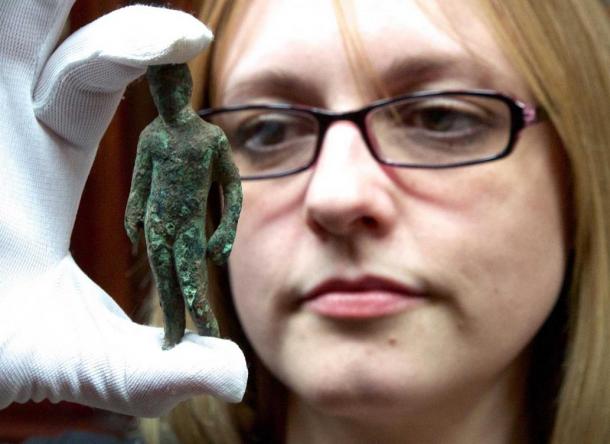
Ancient Origins reports that a metal detector enthusiast has discovered a 2000-year old figurine depicting the Roman god Mercury in a field near Selby, Yorkshire, UK. The Mercury figurine found in Yorkshire is made of copper alloy. Although it depicts the god wearing a cap, this garment has lost its famous wings. It is just one of many similar figures that have been found across the UK, according to the Yorkshire Post.

The York Museums Trust regularly receives artifacts found by the general public. According to Rebecca Griffiths, the Finds Liaison Officer for the Portable Antiquities Scheme at the York Museums Trust:

“Every year thousands of archaeological objects are discovered. While the majority of these come from metal-detector users, we also see many finds from people field-walking, gardening, renovating houses and even those out walking particularly inquisitive dogs.”

Ms Griffiths added that every year, she and her team of volunteers add more than 2,000 items to the museum’s collection, ranging from Roman coins to medieval buckles, to stone tools and post-medieval toys.


Vandalism at Athenian Long Walls
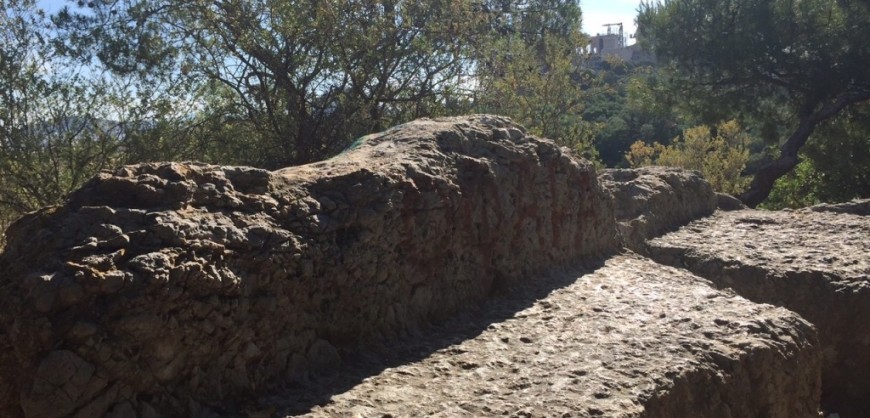
Football supporters defaced the ancient Athenian Long Walls with graffiti. The walls, originally erected in the 5th century BC, were destroyed by Sparta in 403 BC and were rebuilt with the help of the Persians during the Corinthian War.

Vandals also defaced the prison cell in the Acropolis where philosopher Socrates is believed to have been held prior to being made to kill himself in 399 BC by drinking hemlock for corrupting the youth of Athens.

Staff of the Greek Ministry of Culture removed the graffiti. The incident comes as the Greek state granted 24-hour access to major archeological sites. Staff are worried that the new hours coupled with the short-staffed personnel will lead to greater vandalism.

Designs for cutting-edge museum for underwater artifacts unveiled
A presentation of designs for a new state-of-the-art museum for underwater antiquities at the port of Piraeus took place this week at the site where the new museum will be transformed from a current industrial site, Protothema reports. The presentation took place aboard a Liberty-class freighter now also serving as a floating museum.

The current site served as a grain storage facility complete with silo, constructed in 1936, itself an example of industrial design. The new facility is expected to house nearly 2,000 antiquities and artifacts found at the bottom of seas around Greece. Most of the exhibits are currently in storage, the product of nearly 40 years of archaeological research. Total exhibition space will be 6,500 square meters within the 13,500 sq. meter building.

Another highly-anticipated facet of the new museum is the opportunity to finally salvage and preserve several ancient, medieval and more contemporary shipwrecks still languishing at the bottom of the sea.
Another round of pitches has completed and once more, two worthy causes have been selected by the members of Pandora's Kharis to donate to.


Fundraiser for the Bakcheion
Bakcheion (Βακχεῖον) is a sacred guild honoring Dionysos Bakcheios, the God of ecstatic deliverance. Formed with the sole intent of hosting a Dionysian ritual at Many Gods West 2015, the Bakcheion includes members from all over the United States and the polytheist and pagan spectrums. The ritual will be held on the 1st of August at the conference hotel. The ritual will be open to registered participants and conference members. It will include a devotional performance, music and offerings in honour of Dionysos and His retinue.

The Bakcheion consists of volunteers with members offering their services for free and out of their own pockets. As some relief, we're calling for donations to help cover member travel expenses, accommodation and performance costs; including props and materials, libations / offerings and whatever other expenses may surprise us. If donations exceed the asking amount, it will be distributed back into supporting the polytheist community.


The League Against Cruel Sports
The League Against Cruel Sports is the leading UK charity helping to prevent cruelty to animals associated with sports such as fox hunting, game bird shooting and wildlife crime. Over nine decades of campaigning, the League has developed effective ways to thwart such sports through calling form and bringing about, legislative change; educating the general public and gaining public support for the issues at hand; and causing difficulty for the people inflicting cruelty. All these actions help animals on a day-to-day basis. But there is always more to do.

They rely on public support to carry out their work, which includes campaigning to keep the Hunting Ban and preventing illegal hunting with dogs which, despite the Hunting Act, is still happening around the UK.


You may cast your vote here or in the comments until June 10, 2015. Thank you!
I am of the firm belief that our religion is not a nature religion. We do not worship nature--trees are not sacred, waves are not, what makes them sacred are the beings who move them, guide them, or are represented by them. Titans. Gods. Nymphs. But that does not mean that our religion ignores the beauty of nature and the natural world. If anything, we are made aware of our Gods by the world They inhabit.

My spot, between the trees


I write this, sitting at the water's edge, listening to birds and bees, soaking up Helios' bright rays. I'm watching mosquitos dance over the surface of the water and marvel at the intricate chain of codepence nature is as I see them get gobbled up by fishes, jumping high. I'm sitting on soft moss and grass, between two strong trees. Beatles and ants crawl over my pants and shirt and there is no one around me. It are these moments when I feel the presence of the Gods the most. Not because they are here with me, not because I am giving them sacrifice, but because I feel like I am a natural part of the world they have created.

I used to run, and I'd run by the same spot I am sitting now a few times a week. I loved to run. When my knee gave out, I had to stop--even had to stop taking long hikes--and I missed it. I still do. I missed the exersize, the physical strain, but mostly I missed feeling like a part of the world. I missed being aware of the birds, of the splashing frogs, of the sun. I am outside more often than just when I used to run, but I am never so aware of it as when running or hiking.

A few months have passed and especially if I wear a knee brace, I can go on hikes again. Running is still out: my new training routine involves a home trainer and squats and as much as I hate to admit it, those two already put the maximum strain on my knee. So now I take shorter walks sometimes, when I get the urge. I rest at beautiful spots to remind myself of all the many ways in which I am sustained by the Gods--physically but also mentally and emotionally. The food I eat, the home I live in, the entertainment I relax with, the beauty around me, is all part of the divine tapestry that we are all part of. It connects us. It connects us to each other and to the Gods.

The ancient Hellenes didn't have a word for religion. Their relationships with the Gods was as much a part of life as nature was. You can work or be free, that's why both need words. You can run or walk or stand still, and they all mean something different. The ancient Hellenes didn't have a word for religion because there was nothing to offset it with. The Gods were there and there was no two ways about it. When I sit here, at the water's edge, I feel like that: like 'religion' and 'religious' as words are falacies: the Gods are, and They are beautiful.
I get a lot of questions from readers, and most of the time, the answers are fairly short. When I feel the question or the reply would be valuable to others as well, I make a post with a collection of them and post them in one go. Today is one of those posts.


"Do you know anyone with UPG into the personality of the river god Achelous or even who works with Greek river gods in general? Also, a popular source on Achelous says his worship was once widespread. I can't anymore detail on this though. I also can't find the source which speaks of the numerous wives and descents of this god. "

I don't think I do, but here is a shout-out to anyone reading this who does! Please get in contact with me so I can link you two...? Thanks! As for His children, Apollonius Rhodius, in the 'Argonautica', ascribes the sirens to Him as offspring:

"And soon they saw a fair island, Anthemoessa, where the clear- voiced Sirens, daughters of Achelous, used to beguile with their sweet songs whoever cast anchor there, and then destroy him. Them lovely Terpsichore, one of the Muses, bare, united with Achelous; and once they tended Demeter's noble daughter [Persephone]still unwed, and sang to her in chorus; and at that time they were fashioned in part like birds and in part like maidens to behold. And ever on the watch from their place of prospect with its fair haven, often from many had they taken away their sweet return, consuming them with wasting desire; and suddenly to the heroes, too, they sent forth from their lips a lily-like voice." [4.885]

Naiad nymphs of springs along the Gulf coast, such as Kastalia at Delphoi, and Peirene in Korinthos, were described as his daughters, as described by Pausanias in his 'Description of Greece':

"You reach, on the right of the way [to the sanctuary of Delphoi, Phokis] the water of Kastalia, which is sweet to drink and pleasant to bathe in . . . Panyassis [epic poet C5th B.C.] who composed an epic poem on Herakles, says that Kastalia was a daughter of Akheloios. For about Herakles he says:--`Crossing with swift feet snowy Parnassos he reached the immortal water of Kastalia, daughter of Akheloios.'" [10.8.9.]

As the largest of the rivers of southern Hellas Achelous was worshipped in many of the countries bordering the Gulf as the God of fresh-water springs. His largest cults were in Athens, Oropos, and Thespia:

Plato, in 'Phaedrus':
"Here, a fair resting-place, full of summer sounds and scents. Here is this lofty and spreading plane-tree [on the banks of the Ilissos river in Attica], and the agnus cast us high and clustering, in the fullest blossom and the greatest fragrance; and the stream which flows beneath the plane-tree is deliciously cold to the feet. Judging from the ornaments and images, this must be a spot sacred to Akheloios and the Nymphai. How delightful is the breeze:--so very sweet; and there is a sound in the air shrill and summerlike which makes answer to the chorus of the cicadae. But the greatest charm of all is the grass, like a pillow gently sloping to the head."

Pausanias, in his 'Description of Greece':
"[In the sanctuary of Amphiaraus in Oropos, Attika :] The altar shows parts . . . the third is to Hestia and Hermes and [the hero] Amphiaraus and the children of Amphilokhos . . . The fifth is dedicated to the Nymphai and Pan, and to the rivers Akheloos and Kephisos." [1.34.3.]

Philostratus the Elder, in 'Imagines':
"A youth [Narkissos] just returned from the hunt stands over a pool . . . The cave is sacred to Akheloos and the Nymphai, and the scene is painted realistically. For the statues are of a crude art and made from a local stone; some of them are worn away by time, others have been mutilated by children of cowherds or shepherds while still young and unaware of the presence of the god [i.e. Dionysos]." [1.23]

I would also like to point you to this page on Theoi.com about the cult of the Potamoi, the river Gods.


"I read your blog and found a blog post containing a video and information about ancient hellenic clothing. I would like to make a new himation as I am unhappy with my short one I made. I would like to wrap it around my body and, if I like to, even be able to cover my head with a piece of it, so I want to ask how large and how broad the piece of cloth should be to do this."

Let me give you the base measurements of all clothing items: the cloth for the chiton has to be your own height. For a peplos, the cloth has to be your height plus at least 18" (this will be the part you fold over). Both clothing items need to be twice your 'wingspan' in width. The himation was a rectangle of various sizes--in essence, if it's long or short enough for you to do with what you want, it is correct. For me, I try to choose a piece of cloth that reaches below my ass once I have pulled it up over my head. Again, this depends on your height.


"Have you heard about the great Hellenic mystic, Neopythagorean and possibly the prototype of Jesus Christ, Apollonius of Tyana?"

As far as I am aware, Neo-Pythagoreanism was a school of Hellenistic philosophy which revived Pythagorean doctrines. Ancient Hellenic philosophy is not my strongest knowledge base, but if I remember well, it focussed on spiritual purity and 'mind over matter'-type of behaviour in order to reach it. Religiously, I think its biggest influence/difference with mainstream thought was that prayer was more important than outward actions like sacrifice in worshipping the Theoi.
 
Apollonius of Tyana was a Roman philosopher and a Neo-Pythagorean. As he lived at the time of Christ and his teachings were partly similar, the two were compared by (Christian) writers from about the 4th century AD on. Both figures fit the mythic hero archetype, after all, and that archetype, specifically, is found in much of (Hellenic) mythology. Other examples include Theseus, Perseus, and Zeus himself. Outside of Hellenic mythology, Robin Hood comes to mind.
 
So yet, I have heard of both, but both are just a little outside of my usual time period of interest :)
 
 
"Could people like Hypatia (a wondorous Alexandrian female philosopher, mathematician and astronomer) or emperor Julian be considered the defenders of our faith or even martyrs, as some, like Hypatia, died in the name of ancient wisdom, culture and the gods from the hands of the Christians?"
 
I have trouble answering this question, and I will tell you why. Hypatia was definitely murdered by Christians, but she was murdered for her social associations, not for trying to re-institute Hellenic worship or life. In a feud between Orestes, the prefect of Alexandria and Cyril, the Bishop of Alexandria over the regulation of Jewish dancing exhibitions in Alexandria, she was blamed for influencing Orestes not to reconcile with Cyril after one of 500 monks who resided in the mountains of Nitria, and who sided with Cyril,  struck Orestes in the head with a rock. Whether she had was besides the point. The backlash was on the Christians, as the actions by the Christian mob that killed her was widely criticized.
 
Emperor Julian did try to reconcile Christianity and Paganism. It's important to realize though that in the Roman empire during his two years of ruling (361-363 AD), there was no consensus about a state religion. Followers of many religious traditions lived together, creating a religious melting pot. Julian was a follower of the ancient ways and he tried to push for a broader adoption of those. During his lifetime, neither pagan nor Christian ideology won out, and the merits of all were greatly debated. What Julian did accomplish--and that was a major shift--was that he made Paganism a religion, where previously it had been a collection of traditions. As such, it could be 'pitted' against Christianity. Emperor Julian was committed to fostering religions other than Christianity, and that included Judaism. Because of this, the Jews came to call him 'Julian the Hellene', as in that time the term 'Hellene' was given the meaning of 'pagan' by the early Christian church. Julian died during the war with the Persians in an effort to further the rule of the Roman empire.
 
Yes, these people were heavily influenced by either Hellenic thought or Hellenic tradition (logical for the time they lived in). They were also some of the later people we know of who did so. That said there are probably many people we haven't heard of who believed the same. These people were not people who spent 24 hours a day, seven days a week promoting Hellenic thought. They promoted Hellenic thought, but it was just the way they lived their lives. I think anyone can be a personal hero, or even one of a tradition, if their actions are inspiring to people who hear their story or live it up close. As such, yes, I think Hypatia and Julian can be heroes. Are they martyrs...? Per definition, a martyr is somebody who suffers persecution and/or death for advocating, renouncing, refusing to renounce, and/or refusing to advocate a belief or cause of either a religious or secular nature. Neither qualifies per definition, but if you want to view them as symbols of exceptional leadership and heroism, then you are free to do so. They did live with the principle teachings of ancient Hellenic thought and religion, so in that way, they can definitely be seen as inspirational. All I would ask is to not forget about all the regular people no one wrote about but who lived their life in the same way.
The black market for ancient items is huge. No one knows quite how huge but it is obviously a multi million dollar industry. Thankfully not all items destined for this market get there--sometimes they are found and brought back to light. I would like to share two triumphant stories today.


Four arrested trying to sell priceless Minoan statuette
The Archaeological News Netword rapports that Greek authorities have announced the arrest of four people in Iraklio, Crete, on charges of attempting to sell a priceless 3,500-year-old statuette of a young man, dated to the mid-Minoan era for the princely sum of one million euros. The 30 centimeter high bronze statuette is of a young man in worship, his hands folded across his chest, making it a unique find of its type throughout the island of Crete. The figure has long hair, a gold-plated belt and remains of gold leaf on its calves and left knee. At the base is a peg indicating that it was probably set on a pedestal in an area of worship. Archaeologists at the Lasithi Antiquities Ephorate have dated the statuette to the 16-15 century B.C.

The case was cracked as a result of a coordinated Hellenic Police (ELAS) operation that culminated in the arrests of four men, two aged 35 and two aged 41 years old. Police initially stopped one of the 35-year-olds driving a car, in which they found an ancient bronze artifact. The other three men were following behind in two private trucks and also arrested. The police inquiry revealed that the suspects had illegal possession of the statuette and that two of them had shown this to unknown prospective buyers, while the other two were acting as lookouts along the route. The statuette was handed over the antiquities ephorate and the car confiscated as evidence, while police are continuing the inquiry. The four suspects were led to the Lasithi misdemeanors' court prosecutor.


Bulgarian police seize rare classical Greek vase
Bulgarian police officers have confiscated a unique 5th century BC ancient Greek krater, a special vessel used for mixing wine, from a treasure hunter in the southern town of Susam, Haskovo District. A 33-year-old man has been arrested after the local police were tipped off, and searched his home and car. The extremely rare ancient krater was found in the man’s car, the press center of Bulgaria’s Ministry of Interior has announced. The ceramic vessel features a ritual scene from ancient Greek mythology.
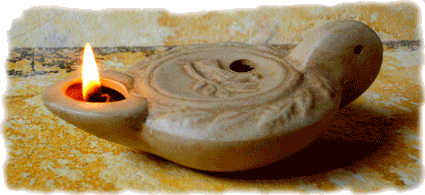
I came upon an older, but very interesting article on Ancients Origins today, about ever burning lamps, which were used in many of the temples of the Theoi--they were lamps that were kept burning throughout the year, and usually only refilled once a year (such is the tale, anyway) in an elaborate ceremony.


As the article mentions, ever burning lamps have been recorded by writers from various parts of the world at different points of time. In the ancient world, for instance, the writer Plutarch mentions in his work ‘De Defectu Oraculorum’ that a lamp that burned over the door of the temple of Jupiter [Zeus] Ammon in Egypt. According to Plutarch, the priests of the temple claimed that the lamp stood in the open air, and neither wind nor rain put it out.  Similar accounts are given for the altar of the Temple of Apollo Carneus, at Cyrene. Pausanias wrote about a gold lamp in the temple of Minerva [Athena] Polias in Athens. This lamp, which was built by the scholar Callimachus, was said to have been able to maintain a flame steadily for a year without needing refuelling or having its wick trimmed.

We have very, very little knowledge about these lamps and the practices around them, but we know that fire was very important in ancient Hellas. Back in ancient Hellas, most religious activities surrounding the household revolved around the central hearth, which was seen as the physical manifestation of Hestia. All the household fires were lit with a flame from the prytaneion (Πρυτανεῖον), the structure where state officials met and where the city kept a fire for Hestia burning day and night. Every single heart fire in the city or town was linked to that central one. This network of fires, which were never allowed to go out, brought all Hellenes together. It would not be odd to think that temples took part in that practice as well.
There is still a lot to discover about ever burning lamps, their purpose, and how they functioned, but for now, we can imagine how beautiful their presence would have been in a large, dark temple--a focal point of worship that would always have been there. Hopefully in years to come new archaeological proof will be found to explain this practice, and scholars will pay more attention to it. For us Hellenists, dreaming of building temples, an eternal flame would be a beautiful addition to them.