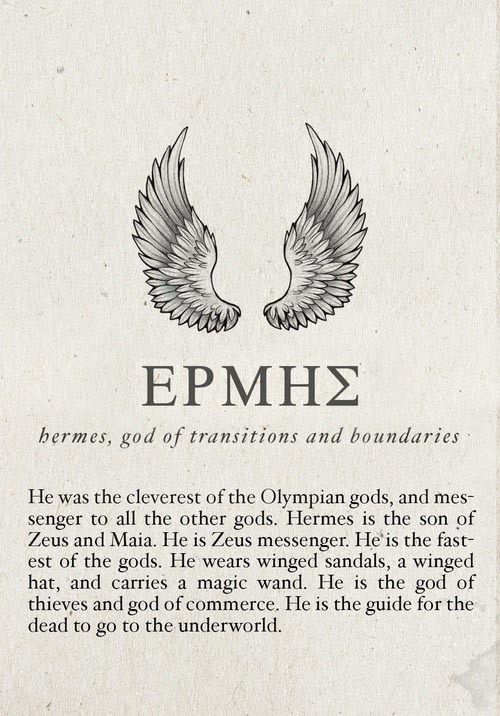
My girlfriend's grandmother has passed away. It was an emotional affair and the days have been rough but filled with love. I need some rest, and I need to give praise to Hermes Psychopompos. Psychopompos (ψυχοπομπός) literally means the "guide of souls". Psycholompoi escort newly deceased souls from Earth to the afterlife. Their role is not to judge the deceased, but simply to provide safe passage. In Hellenic mythology, Hermes and Hekate are both Psycholompoi.


"Hermes Kyllenios (of Mt Kyllene) began to summon the suitors' ghosts [at dawn's first light]; he held in his hand the golden rod that he uses to lull men's eyes asleep when he so wills, or again to wake others from their slumber; with this he roused them and led them on, and they followed him, thinly gibbering. As in a recess of some eerie cave a chain of bats may be hanging downwards from the rock, but one of them drops from the clinging cluster and then all the rest flit squeaking round, so did these ghosts travel on together squeaking, while easeful Hermes led them down through the ways of dankness. They passed the streams of Okeanos, the White Rock (leukas petre), the Gates of the Sun (pylai helion) and the Land of Dreams (demos oneiron), and soon they came to the Field of Asphodel (leimon asphodelon) where the souls (psykhai), the phantoms of the dead (eidola) have their habitation . . .

Hermes the Radiant One (Argeiphontes) drew near [to the gathering of the ghosts of heroes], leading down the souls of the suitors who had fallen by Odysseus' hand. Amazed to see this, the two heroes [Akhilleus and Agamemnon] moved straight towards them [and queried the newly arrived shades]."
-- Homeros, Odysseia 24. 1 & 99

"Zeus himself . . . commanded that glorious Hermes . . . only should be the appointed messenger to Haides, who, though he takes no gift, shall give him no mean prize [perhaps meaning that, in return, Haides and Persephone send grass up from the earth for the grazing of herds]."
-- Homeric Hymn 4 to Hermes

"It is said that after death, the tutelary genius (daimon) of each person, to whom he had been allotted in life, leads him to a place where the dead are gathered together [i.e. the daimon guide is Plato's equivalent of Hermes, Guide of the Dead]; then they are judged [i.e. by the Judges of the Dead] and depart to the other world with the guide whose task it is to conduct thither those who come from this world [i.e. the spirit Iakkhos]; and when they have there received their due and remained through the time appointed, another guide [probably Dionysos] brings them back after many long periods of time [i.e. they are reincarnated].

And the journey is not as Telephos says in the play of Aiskhylos; for he says a simple path leads to Haides (the lower world), but I think the path is neither simple nor single, for if it were, there would be no need of guides, since no one could miss the way to any place if there were only one road. But really there seem to be many forks of the road and many windings; this I infer from the rites and ceremonies practiced here on earth [i.e. the Mystery cults]. Now the orderly and wise soul follows its guide and understands its circumstances; but the soul that is desirous of the body, as I said before, flits about it, and in the visible world for a long time [i.e. as a haunting ghost], and after much resistance and many sufferings is led away with violence and with difficulty by its appointed genius (daimon)." [N.B. "led away with violence" cf. the story of the runaway ghost Sisyphos and Hermes.]
-- Plato, Phaedo 107c

"Now when the dead have come to the place where each is led by his genius (daimon) [i.e. by Plato's equivalent of Hermes, Guide of the Dead], first they are judged and sentenced [i.e. by the Judges of the Dead], as they have lived well and piously, or not. And those who are found to have lived neither well nor ill, go to the Akheron and, embarking upon vessels provided for them [i.e. the equivalent of Kharon's skiff], arrive in them at the lake; there they dwell and are purified [i.e. by the equivalent of the Erinyes], and if they have done any wrong they are absolved by paying the penalty for their wrong doings, and for their good deeds they receive rewards, each according to his merits."
-- Plato, Phaedo 112e

"Hermes, I call, whom fate decrees to dwell near to Kokytos, the famed stream of Haides, and in necessity's (ananke) dread path, whose bourn to none that reach it ever permits return. O Bakkheios Hermes, progeny divine of Dionysos, parent of the vine, and of celestial Aphrodite, Paphian queen, dark-eyelashed Goddess, of a lovely mien: who constant wanderest through the sacred seats where Haides' dread empress, Persephone, retreats; to wretched souls the leader of the way, when fate decrees, to regions void of day. Thine is the wand which causes sleep to fly, or lulls to slumberous rest the weary eye; for Persephone, through Tartaros dark and wide, gave thee for ever flowing souls to guide. Come, blessed power, the sacrifice attend, and grant thy mystics' works a happy end."
-- Orphic Hymn 57 to Khthonian Hermes
The months of late fall and early winter are relatively light on the festival agenda--Maimakterion, the month we are in now, wasn't even on the sacrificial calendar of Erkhia, for example. This could have at least three reasons: It's getting cold and wet out and the ancient Hellenes held their rituals outdoors, most of the harvesting was done so food was assured or there was nothing that could be done to decrease the shortage, and with the fall of winter, warfare came to a halt; the seas were too rough to go on campaigns and it would soon be too cold to exist comfortably in a war camp. Seeing as these two latter two reasons were the major ones to have festivals, these months are quiet ones. Elaion will host a PAT ritual for the Pompaia November 9, at the usual 10 AM EST.


Let start with something obvious we do not know about the Pompaia: the actual date of the festival. Parke (in 'Festivals of the Athenians', page 96) states that the Pompaia in honor of Zeus Meilichios was held during the last third of Maimakterion which would be on or after 20 Maimakterion. Parke cites the treatise on the Pompaia by Polemon of Ilion so we're fairly confident he is correct on the date.

What we do know is that the Pompaia was not originally celebrated by the people of Athens, but solely by its priests. Potentially, it was only celebrated by the priests of Zeus. It was linked to purification. It was one of the festivals that, by Classical times, had already lost much of its original meaning, but which was repeated year after year because it had always been repeated year after year--and in general these had been good years. Not having the rite on the calendar could have devastating effects, so it was performed.

The Pompaia followed the Maimakteria during which a sheep was most likely sacrificed and the fleece collected and cleaned. During the Pompaia a second procession took place with the fleece. The fleece--the 'Diòs Koidion', as it was called--was said to have purifying and other magical qualities that would rub off on he who interacted with it, if he stood on it with his left foot. In fact, a sheep skin was used in the Eleusinian Mysteries in this fashion to absolve those who had a lot of guilt to carry around--or a lot of grief. The Homeric Hymn to Demeter mentions her sitting down in a chair covered by a fleece, and there is also artwork of initiates shrouded in a fleece.

The sheep skin was most likely not connected to Zeus at the start of the practice; as we have seen, it had much stronger ties to other deities. The Pompaia rite simply called for a sheep skin. The connection with Zeus most likely happened through assimilation: the rite fell in a month where people prepared for winter and where the weather got harsher. As such, Zeus had a major impact on the inhabitants of Athens; he controls the weather after all. The sheep from which the skin was used became sacrificed to Him as an appeasement, and then the ritually charged skin made its way through the city.

In the same fashion, the kērukeion (κηρύκειον)--better known as the caduceus--the snake-entwined staff that was the symbol of Hermes, was carried through the city. Most likely Hermes was not part of the actual rite; the kērukeion, like the Diòs Koidion, was a powerful symbol which was used to offer protection and purification to the city now winter was upon them. After all, the kērukeion was said to ward off all evil--and the cold, dark, days of winter most certainly had those. Hermes was added through the procession solely by association, but it is doubtful that He also received an animal sacrifice.

The Pompaia--meaning 'to exorcise'--was not popular, and in general these minor festivals were performed by the priests, for the city, without its inhabitants taking part. A small group of priests most likely walked the city with the objects and those who came upon the group would have said their prayers, spoke their wishes, and paid their respects. Yet, they were not included in the ceremony. This rite fell to the priests, so they could ask the Gods to continue placing their blanket of protection over the city.

As we have no ancient priests of Zeus hanging around, we take this responsibility upon ourselves instead. Will you join us on November 9, at 10 AM EST? You can join the community here and download the ritual here.
I'm sorry, everyone. Yesterday, we got the very sad news that my better half's grandmother--who has been as much of a grandmother to me--who was already ill has taken a turn for the worst and is not expected to live for much longer. We've been at her bedside and I'm emotionally not capable of putting something more together than these few words. Regular scheduling will resume tomorrow. For today, have this video of the 2018 Olympics ceremony. It might not be in any way authentic, but the scenery and dresses are lovely.

Apologies, everyone. I have no time at all to put something together, so I'm calling in some help from a graphic artist. They're pretty, aren't they?


The Maimakteria is one of those festivals not a lot has survived about. We know it was in honor of Zeus Maimaktes, the Blustering, and that it was connected to the weather and protection of crops. Protecting our crops is a desire we have to this day so we will celebrate the Maimakteria, regardless. Will you join us on November 5th, at the usual 10 am EDT?


The months of late fall and early winter are relatively light on the festival agenda. This could have at least three reasons: It's getting cold and wet out and the ancient Hellenes held their rituals outdoors, most of the harvesting was done so food was assured or there was nothing that could be done to decrease the shortage, and with the fall of winter, warfare came to a halt; the seas were too rough to go on campaigns and it would soon be too cold to exist comfortably in a war camp. Seeing as these two latter two reasons were the major ones to have festivals, these months are quiet ones. In the Athenian calendar, only two festivals are attested to take place this month: the Maimakteria and the Pompaia.

Most likely, the Maimakteria was connected to the Pompaia, which took place at a later date in the month. I say 'a later date' because we are not sure of the dating. Parke (in 'Festivals of the Athenians', page 96) states that the Pompaia in honor of Zeus Meilichios was held during the last third of Maimakterion which would be on or after 20 Maimakterion. Parke cites the treatise on the Pompaia by Polemon of Ilion so we're fairly confident he is correct on the date. He also states that the Maimakteria took place 'mid-month'. The sixteenth is as viable a date as any other around this time.

The Pompaia was linked to purification. During this rite a white sheep's fleece--the 'Diòs Koidion', as it was called--was placed on the ground and the priests who took part in the rite stood on it with their left foot to be purified and blessed. We believe the Maimakteria was when this sheep was sacrificed.

If the rite followed the standard practice of Hellenic ritual, the sheep was led to the altar--most likely that of Zeus--in procession and then sacrificed. The animal was skinned and the fleece cleaned. The Diòs Koidion was said to have purifying and other magical qualities that would rub off on he who interacted with it, if he stood on it with his left foot.

The sheep skin was most likely not connected to Zeus at the start of the practice. The connection with Zeus most likely happened through assimilation: the rite fell in a month where people prepared for winter and where the weather got harsher. As such, Zeus had a major impact on the inhabitants of Athens; he controls the weather after all. The sheep from which the skin was used became sacrificed to Him as an appeasement, and then the ritually charged skin made its way through the city.

We hope you will join us for the Maimakteria on November 5. You can download the ritual here and join the community for the event here.
The ancient Hellenes were warriors as well as philosophers and scholars. Territory was to be claimed and defended, then often lost and reclaimed. Many battles were immortalized with festivals that carried on sometimes even hundreds of years after the actual battle. We all know war is not to be glamorized--it's literally a lethal activity. The ancient Hellenes did everything in their power not to die, and a large part of those measures was trying to have the tightest tactics, the largest army...and perhaps most of all, to have the best weapons. I'd like to share some of those today.


Dory (δόρυ)

The dory was the primary weapon of the ancient Hellenes. It was a spear about 3 meters in length consisting of a wood shaft with an iron tip. It was wielded single-handedly so the user could hold a shield in the other hand. The dory enabled the hoplite (soldier) to keep an enemy at a distance and was effective in phalanx (shield-wall) formation, allowing the first two lines to attack.


Xiphos

The primary weapon of ancient Hellenes was the dory, but if it broke they used a short single hand sword known as a Xiphos. The Xiphos had a double-edged blade that rarely measured longer than 20 inches which made it useful in close range combat. It was more martially versatile than the other prominent sword, the single edged Kopis.


Kopis - Ancient Greek SwordKopis (κοπίς)

The Kopis was a one-handed, single-edged sword that measured around 36 inches with the blade curving forward and widening near the tip. It was longer than the Xiphos, and thus more useful to the cavalry.


Makhaira (μάχαιρα)

Homeros mentions the makhaira, but as a domestic knife of no great size. In period texts the term has a variety of meanings, and can refer to virtually any knife or sword, even a surgeon's scalpel, but in a martial context it frequently refers to a type of one-edged sword; a sword designed primarily to cut rather than thrust. Some modern scholars distinguish the makhaira from the kopis (an ancient term of similar meaning) based on whether the blade is forward curved (kopis), or not (makhaira). 


Sarissa (σάρισα)

Introduced by Alexander’s father, Philip II of Macedon, Sarissa was a 4 to 7 meters long spear which was used instead of the dory. It was made of tough cornel wood and weighed around 5 kilograms. The sarissa was considerably longer than its predecessor and this made it very effective in the Macedonian phalanx which was considered invulnerable from the front and could be only defeated if the formation was broken. Invention of Sarissa greatly helped Philip II and his son Alexander the Great in their conquests.
I often describe the pantheon of Hellenic Gods like a tapestry. The major displays woven into it are undoubtedly of Zeus and Hera, of Their brothers and sisters, of Their parents and well-known children like Apollon and Artemis. But the fringes of the tapestry are just as colorful as the main display. They hold the "minor" Gods and Goddesses who rule over our emotions, the weather, the stars, rivers and other bodies of water, and literally everything else in your environment. Without these minor Gods and Goddess, the tapestry would not only be plain, it would be threadbare.

I realize that this can be a somewhat theoretical statement. As such, I would like to give you an example of how the ancient Hellenes filled in a part of this tapestry and how the Gods work together to provide us with all we need. The text comes form Porphyry's "On Images". Porphyry of Tyre (Πορφύριος, Porphyrios) lived from 234 to 305 AD. He was a Neoplatonic philosopher who was born in Tyre, in the Roman Empire. He wrote many works on a wide variety of topics.


"The ruling principle of the power of earth is called Hestia, of whom a statue representing her as a virgin is usually set up on the hearth; but inasmuch as the power is productive, they symbolize her by the form of a woman with prominent breasts. The name Rhea they gave to the power of rocky and mountainous land, and Demeter to that of level and productive land. Demeter in other respects is the same as Rhea, but differs in the fact that she gives birth to Kore by Zeus, that is, she produces the shoot from the seeds of plants. And on this account her statue is crowned with ears of corn, and poppies are set round her as a symbol of productiveness.

[...]

But since there was in the seeds cast into the earth a certain power, which the sun in passing round to the lower hemisphere drags down at the time of the winter solstice, Kore is the seminal power, and Pluto the sun passing under the earth, and traversing the unseen world at the time of the winter solstice; and he is said to carry off Kore, who, while hidden beneath the earth, is lamented by her mother Demeter.

The power which produces hard-shelled fruits, and the fruits of plants in general, is named Dionysus. But observe the images of these also. For Kore bears symbols of the production of the plants which grow above the earth in the crops: and Dionysus has horns in common with Kore, and is of female form, indicating the union of male and female forces in the generation of the hard shelled fruits.
But Pluto, the ravisher of Kore, has a helmet as a symbol of the unseen pole, and his shortened sceptre as an emblem of his kingdom of the nether world; and his dog indicates the generation of the fruits in its threefold division - the sowing of the seed, its reception by the earth, its growing up. For he is called a dog, not because souls are his food, but because of the earth's fertility, for which Pluto provides when he carries off Kore.

Attis, too, and Adonis are related to the analogy of fruits. Attis is the symbol of the blossoms which appear early in the spring, and fall off before the complete fertilization; whence they further attributed castration to him, from the fruits not having attained to seminal perfection: but Adonis was the symbol of the cutting of the perfect fruits.

Silenus was the symbol of the wind's motion, which contributes no few benefits to the world. And the flowery and brilliant wreath upon his head is symbolic of the revolution of the heaven, and the hair with which his lower limbs are surrounded is an indication of the density of the air near the earth.
Since there was also a power partaking of the prophetic faculty, the power is called Themis, because of its telling what is appointed and fixed for each person.

In all these ways, then, the power of the earth finds an interpretation and is worshipped: as a virgin and Hestia, she holds the centre; as a mother she nourishes; as Rhea she makes rocks and dwells on mountains; as Demeter, she produces herbage; and as Themis, she utters oracles: while the seminal law which descends into her bosom is figured as Priapus, the influence of which on dry crops is called Kore, and on soft fruits and shellfruits is called Dionysus. For Kore was carried off by Pluto, that is, the sun going; down beneath the earth at seed-time; but Dionysus begins to sprout according to the conditions of the power which, while young, is hidden beneath the earth, yet produces fine fruits, and is an ally of the power in the blossom symbolized by Attis, and of the cutting of the ripened corn symbolized by Adonis.

Also the power of the wind which pervades all things is formed into a figure of Silenus, and the perversion to frenzy into a figure of a Bacchante, as also the impulse which excites to lust is represented by the Satyrs. These, then, are the symbols by which the power of the earth is revealed."