
So, there is this art project. It might be too feminist for you. If so, all good. I'm on the edge because of the appropriation of the myth, but I stand by the sentiment. This project is MWTH, short for Medusa With The Head.
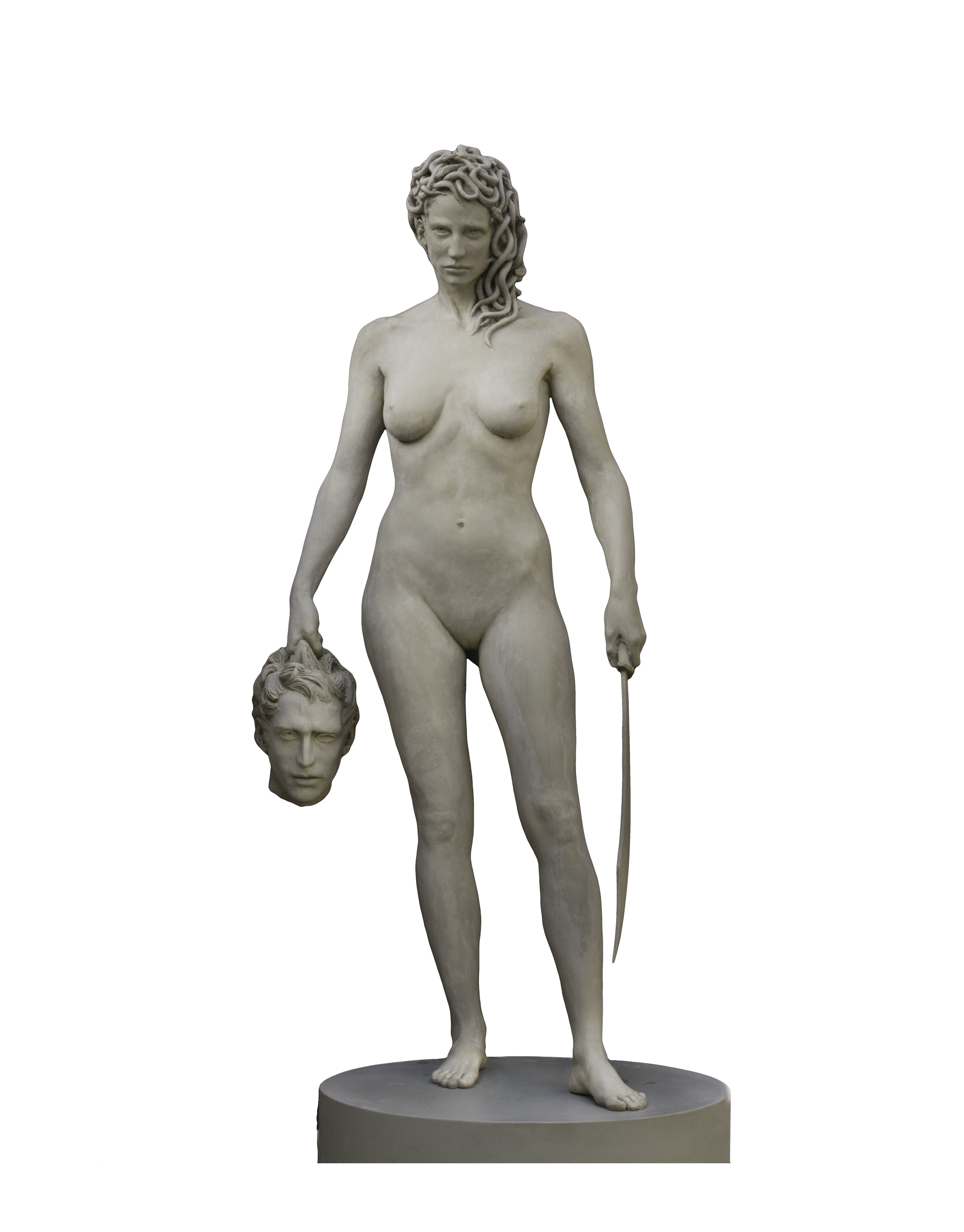
From the site:
"MWTH (Medusa With The Head) is a project entangled in the narrative habits of classical imaginaries, their foundational role in present culture and visions of the future. MWTH seeks to reorient androcentric lore, to queer iconography, to re-reformulate antiquity’s heroic center and its modes of (re)production.
MWTH Project was (immaculately) conceived by Bek Andersen in the immediate wake of the Kavanaugh hearings. The day Kavanaugh was confirmed to the highest court of the land, we were feeling pretty low. Bek came across the viral image of Medusa with the Head of Perseus by Luciano Garbati, an inversion of Cellini’s Perseus With the Head of Medusa. She was inspired to contact the artist in Argentina and bring the sculpture to New York. "
For the record, I love the sentiment, and I love the statue. If I had a spare $750, I'd buy one. I might get the shirt. I just don't like the appropriation.
The legend of Médousa (Μέδουσα) is one of the hardest myths to deal with out of ancient Hellenic mythology. It tells the story of a beautiful woman, who got raped by Poseidon, and gets transformed into a hideous monster who can turn people to stone just by looking at them, by Athena, because of it. She spends the rest of her life trapped on an island, in isolation, while brave warriors try to kill her for her head, which will still turn people to stone once cut off. Perseus eventually does so and gives the head to Athena to place on her shield. The circle is complete and Médousa is dead, after a lifetime of horror which was not her fault to begin with. It's one of the best known Hellenic myths, and the movies, series, books, comics and other mediums which feature it--or Médousa--are endless. Percy Jackson comes to mind, and Clash of the Titans, but there are many others. What's less well known is that this particular myth doesn't date back to ancient Hellas, but ancient Rome: it was written by the Roman poet Ovid, in 8 B.C., in his Metamorphosis.
Yet, Médousa was a well known figure in ancient Hellas, so well known that the images of her cut off head adorned everything from armors to stoves. Her name meant 'guardian', and her head frightened off enemies as well as little children who would otherwise have burned their hands. The blood from the veins on the left side of Médousa's head was allegedly capable of killing, but Asclepius, a great healer, used the blood from the veins on the right side of the head for saving lives.
In ancient Hellenic mythology, Médousa was one of three sisters, Khthonic daímōns called Gorgons. They were named Médousa, Stheno (Σθεννω), and Euryale (Ευρυαλη), and were born to the ancient marine deities Phorkys (Φόρκυς) and Keto (Κητώ), his sister. They were part of the Phorcides (Φόρκιδες), the offspring of Phorkys. Their sisters were Echidna (Ἔχιδνα, half woman, half snake), the Graiai (Γραῖαι, 'old women', sharing one tooth and one eye), and Ladon (Λάδων, the dragon serpent who guarded the golden apples in the garden of the Hesperides). This view comes from Hesiod:
"And to Phorkys, Keto bore the Graiai, with fair faces and gray from birth, and these the gods who are immortal and men who walk on the earth call Graiai, the gray sisters, Pemphredo robed in beauty and Enyo robed in saffron, and the Gorgones who, beyond the famous stream of Okeanos, live in the utmost place toward night, by the singing Hesperides: they are Sthenno, Euryale, and Medousa, whose fate is a sad one, for she was mortal, but the other two immortal and ageless both alike. Poseidon, he of the dark hair, lay with one of these, in a soft meadow and among spring flowers. But when Perseus had cut off the head of Medousa there sprang from her blood great Khrysaor and the horse Pegasos so named from the springs (pegai) of Okeanos, where she was born."
According to Apollodorus, Médousa and her sisters came into the world with snakes on their heads, instead of hair, with yellow wings and brazen hands. Their bodies were also covered with impenetrable scales, and their very looks had the power of killing or turning to stones. Médousa was the only mortal of the three, and in nearly all versions of the myth, has her head cut off by Perseus, who gifts it to Athena. The big difference? In the Hellenic version of the myth, Médousa was never a beautiful maiden who served as a priestess to Athena and was punished for being raped.
There is a third version of the myth, inspired, it seems, by Hesiod, in which Médousa was a very beautiful maiden who lived far to the north where the sun did not reach. She begged Athena to allow her to leave and see the sun, but Athena refused. Médousa got angry and shouted at Athena that she was only disallowing her request because she was jealous at her beauty. Athena, angered, turned her into the monster she is so famous as today. There is a variation of this myth where Médousa tells the sculpture of a statue of Athena that he would have done better making a sculpture of her, because she was far more beautiful. The result is the same; Athena takes her beauty and forces her into isolation as punishment for her hubris (and was thus a valuable lesson/example for humans to remember their place. Same goes for Ariadne and Niobe, for example). Apollodorus, interestingly enough, also confirms this:
"It is affirmed by some that Medousa was beheaded because of Athene, for they say the Gorgon had been willing to be compared with Athene in beauty."
Archaeologists suspect that Athena, Médousa and Poseidon found their origins in Libya. They came to Hellas through Crete at the dawn of Hellas. In the beginning of Her rein, Athena may have been a snake and fertility Goddess--a trait she shared with her Libyan counterpart, who had Her own cult--and may have either had a priestess who fit the Médousa myth or--and this is more likely--Médousa had her own cult as a snake, fertility and (menstrual) blood Goddess. Especially the latter may be linked to the myths concerning Médousa's blood.
Athena's role as a snake and fertility Goddess is still visible in the myth about the child she had with Hēphaistos; Erichthonios (Ἐριχθόνιος), who was half man, half snake. It's even posed that in the early days, Athena was married to Hēphaistos and had His child willingly. As Athena was stripped of Her roles as a fertility and snake Goddess, Médousa's myth came into being, where Athena distances Herself from sex and snakes, by punishing an epithet of herself (Athena Tritogeneia, perhaps: 'born of Trito', a lake which was supposedly located in Libya), or the Libyan snake Goddess Médousa, who may have still been attached to Her worship. By placing Médousa's head on Her breastplate or shield, Athena's mythology is continuously linked to Her Libyan heritage, but harmlessly so, to Her new image of a virginal warrior.
Few references remain to Médousa's Libyan cult. There's vague reference to Médousa being a patron of Libya as a whole, or that she was the Goddess most worshipped by the Amazons. She was linked to protection, snakes, menstrual blood, blood, fertility, and femininity in general. If this is true, it's understandable why her worship did not match the Hellenic religion: for one, she's most likely a very powerful female deity. This did not match the hierarchy of the ancient Hellens, and so, Médousa became a monster, and was dealt with accordingly. Blood was one of the fluids that caused serious miasma, and menstrual fluid wasn't even spoken of in ancient Hellas, let alone revered. Not a single Goddess would have it in their portfolio.
I don't like Ovid's version of the Médousa myth. In my view, it's an embellished version of the myth which overshoots its purpose. It also puts both Poseidon and Athena in a very bad light, and takes a lot away from Médousa. It also introduces an element to the story that has nothing to do with Hellenic mythology and that makes no sense within the context of ancient Hellenic society.
The Roman empire came up about a thousand years after the rise of the Hellenes. the Hellenes valued physical prowess, but it were poets and scholars who were held in the highest regards. For Rome, it were the warriors who received the most attention. This reflected in the Gods of both people as well: the Roman Gods resemble the Hellenic Gods, but they are stricter, harder, and possess more bloodlust. At the same time, they were also pruder when it came to excesses of any kind. Ares, temperamental God of War, has his Roman counterpart in Mars, yet, Mars is a much stabler God, who is also in charge of agriculture and fertility. Baccus, the Roman equivalent of Dionysos, lost all ecstatic rites that made the worship of Dionysos so famous. Romans tried becoming Gods their whole lives, while the Hellens accepted their lot as mortals, and respected the Theoi as all-powerful and all-ruling. A frame of mind like that shows in Gods that get neatly packaged, made non-threatening and can be rivaled by mortals. Yet, because of the warrior mentality of the Romans, the Gods that became more predictable and less formed, also became harder. They punished socially unacceptable behavior more severely and myths from the Hellenic period got retold from the viewpoint of a warrior's society. Médousa's myth is one of the most classical examples of this shift.
I think I've lost most of my trail of thought at this point, but let me end by saying that I don't condone rape, and while we can frown upon the Roman empire for the more brutal depiction of violence against women, it really serves no purpose to get retroactively angry over something that happened nearly 2000 years ago. So many years later, our attitudes have changed. Women's rights have come a long way, and with them, the criminalization and social rejection of rape. The current resurgence of male-driven legislation can trigger anger at the ancient sources, but it's important to note that those stories came to fruition in a society where this practice was accepted, and were told in myths that were cautionary. Rape is not accepted in modern society, and anger should be directed that way, not towards the ancient stories that (except for one Roman example) didn't even include rape.
From the site:
"MWTH (Medusa With The Head) is a project entangled in the narrative habits of classical imaginaries, their foundational role in present culture and visions of the future. MWTH seeks to reorient androcentric lore, to queer iconography, to re-reformulate antiquity’s heroic center and its modes of (re)production.
Through stories that are told and retold over centuries, our iconography shapes our ideology.
MWTH is an artist run project. We are working in collaboration with artist Luciano Garbati, to share his sculpture, Medusa With The Head of Perseus, with the world.
MWTH Project was (immaculately) conceived by Bek Andersen in the immediate wake of the Kavanaugh hearings. The day Kavanaugh was confirmed to the highest court of the land, we were feeling pretty low. Bek came across the viral image of Medusa with the Head of Perseus by Luciano Garbati, an inversion of Cellini’s Perseus With the Head of Medusa. She was inspired to contact the artist in Argentina and bring the sculpture to New York. "
For the record, I love the sentiment, and I love the statue. If I had a spare $750, I'd buy one. I might get the shirt. I just don't like the appropriation.
The legend of Médousa (Μέδουσα) is one of the hardest myths to deal with out of ancient Hellenic mythology. It tells the story of a beautiful woman, who got raped by Poseidon, and gets transformed into a hideous monster who can turn people to stone just by looking at them, by Athena, because of it. She spends the rest of her life trapped on an island, in isolation, while brave warriors try to kill her for her head, which will still turn people to stone once cut off. Perseus eventually does so and gives the head to Athena to place on her shield. The circle is complete and Médousa is dead, after a lifetime of horror which was not her fault to begin with. It's one of the best known Hellenic myths, and the movies, series, books, comics and other mediums which feature it--or Médousa--are endless. Percy Jackson comes to mind, and Clash of the Titans, but there are many others. What's less well known is that this particular myth doesn't date back to ancient Hellas, but ancient Rome: it was written by the Roman poet Ovid, in 8 B.C., in his Metamorphosis.
Yet, Médousa was a well known figure in ancient Hellas, so well known that the images of her cut off head adorned everything from armors to stoves. Her name meant 'guardian', and her head frightened off enemies as well as little children who would otherwise have burned their hands. The blood from the veins on the left side of Médousa's head was allegedly capable of killing, but Asclepius, a great healer, used the blood from the veins on the right side of the head for saving lives.
In ancient Hellenic mythology, Médousa was one of three sisters, Khthonic daímōns called Gorgons. They were named Médousa, Stheno (Σθεννω), and Euryale (Ευρυαλη), and were born to the ancient marine deities Phorkys (Φόρκυς) and Keto (Κητώ), his sister. They were part of the Phorcides (Φόρκιδες), the offspring of Phorkys. Their sisters were Echidna (Ἔχιδνα, half woman, half snake), the Graiai (Γραῖαι, 'old women', sharing one tooth and one eye), and Ladon (Λάδων, the dragon serpent who guarded the golden apples in the garden of the Hesperides). This view comes from Hesiod:
"And to Phorkys, Keto bore the Graiai, with fair faces and gray from birth, and these the gods who are immortal and men who walk on the earth call Graiai, the gray sisters, Pemphredo robed in beauty and Enyo robed in saffron, and the Gorgones who, beyond the famous stream of Okeanos, live in the utmost place toward night, by the singing Hesperides: they are Sthenno, Euryale, and Medousa, whose fate is a sad one, for she was mortal, but the other two immortal and ageless both alike. Poseidon, he of the dark hair, lay with one of these, in a soft meadow and among spring flowers. But when Perseus had cut off the head of Medousa there sprang from her blood great Khrysaor and the horse Pegasos so named from the springs (pegai) of Okeanos, where she was born."
According to Apollodorus, Médousa and her sisters came into the world with snakes on their heads, instead of hair, with yellow wings and brazen hands. Their bodies were also covered with impenetrable scales, and their very looks had the power of killing or turning to stones. Médousa was the only mortal of the three, and in nearly all versions of the myth, has her head cut off by Perseus, who gifts it to Athena. The big difference? In the Hellenic version of the myth, Médousa was never a beautiful maiden who served as a priestess to Athena and was punished for being raped.
There is a third version of the myth, inspired, it seems, by Hesiod, in which Médousa was a very beautiful maiden who lived far to the north where the sun did not reach. She begged Athena to allow her to leave and see the sun, but Athena refused. Médousa got angry and shouted at Athena that she was only disallowing her request because she was jealous at her beauty. Athena, angered, turned her into the monster she is so famous as today. There is a variation of this myth where Médousa tells the sculpture of a statue of Athena that he would have done better making a sculpture of her, because she was far more beautiful. The result is the same; Athena takes her beauty and forces her into isolation as punishment for her hubris (and was thus a valuable lesson/example for humans to remember their place. Same goes for Ariadne and Niobe, for example). Apollodorus, interestingly enough, also confirms this:
"It is affirmed by some that Medousa was beheaded because of Athene, for they say the Gorgon had been willing to be compared with Athene in beauty."
Archaeologists suspect that Athena, Médousa and Poseidon found their origins in Libya. They came to Hellas through Crete at the dawn of Hellas. In the beginning of Her rein, Athena may have been a snake and fertility Goddess--a trait she shared with her Libyan counterpart, who had Her own cult--and may have either had a priestess who fit the Médousa myth or--and this is more likely--Médousa had her own cult as a snake, fertility and (menstrual) blood Goddess. Especially the latter may be linked to the myths concerning Médousa's blood.
Athena's role as a snake and fertility Goddess is still visible in the myth about the child she had with Hēphaistos; Erichthonios (Ἐριχθόνιος), who was half man, half snake. It's even posed that in the early days, Athena was married to Hēphaistos and had His child willingly. As Athena was stripped of Her roles as a fertility and snake Goddess, Médousa's myth came into being, where Athena distances Herself from sex and snakes, by punishing an epithet of herself (Athena Tritogeneia, perhaps: 'born of Trito', a lake which was supposedly located in Libya), or the Libyan snake Goddess Médousa, who may have still been attached to Her worship. By placing Médousa's head on Her breastplate or shield, Athena's mythology is continuously linked to Her Libyan heritage, but harmlessly so, to Her new image of a virginal warrior.
Few references remain to Médousa's Libyan cult. There's vague reference to Médousa being a patron of Libya as a whole, or that she was the Goddess most worshipped by the Amazons. She was linked to protection, snakes, menstrual blood, blood, fertility, and femininity in general. If this is true, it's understandable why her worship did not match the Hellenic religion: for one, she's most likely a very powerful female deity. This did not match the hierarchy of the ancient Hellens, and so, Médousa became a monster, and was dealt with accordingly. Blood was one of the fluids that caused serious miasma, and menstrual fluid wasn't even spoken of in ancient Hellas, let alone revered. Not a single Goddess would have it in their portfolio.
I don't like Ovid's version of the Médousa myth. In my view, it's an embellished version of the myth which overshoots its purpose. It also puts both Poseidon and Athena in a very bad light, and takes a lot away from Médousa. It also introduces an element to the story that has nothing to do with Hellenic mythology and that makes no sense within the context of ancient Hellenic society.
The Roman empire came up about a thousand years after the rise of the Hellenes. the Hellenes valued physical prowess, but it were poets and scholars who were held in the highest regards. For Rome, it were the warriors who received the most attention. This reflected in the Gods of both people as well: the Roman Gods resemble the Hellenic Gods, but they are stricter, harder, and possess more bloodlust. At the same time, they were also pruder when it came to excesses of any kind. Ares, temperamental God of War, has his Roman counterpart in Mars, yet, Mars is a much stabler God, who is also in charge of agriculture and fertility. Baccus, the Roman equivalent of Dionysos, lost all ecstatic rites that made the worship of Dionysos so famous. Romans tried becoming Gods their whole lives, while the Hellens accepted their lot as mortals, and respected the Theoi as all-powerful and all-ruling. A frame of mind like that shows in Gods that get neatly packaged, made non-threatening and can be rivaled by mortals. Yet, because of the warrior mentality of the Romans, the Gods that became more predictable and less formed, also became harder. They punished socially unacceptable behavior more severely and myths from the Hellenic period got retold from the viewpoint of a warrior's society. Médousa's myth is one of the most classical examples of this shift.
I think I've lost most of my trail of thought at this point, but let me end by saying that I don't condone rape, and while we can frown upon the Roman empire for the more brutal depiction of violence against women, it really serves no purpose to get retroactively angry over something that happened nearly 2000 years ago. So many years later, our attitudes have changed. Women's rights have come a long way, and with them, the criminalization and social rejection of rape. The current resurgence of male-driven legislation can trigger anger at the ancient sources, but it's important to note that those stories came to fruition in a society where this practice was accepted, and were told in myths that were cautionary. Rape is not accepted in modern society, and anger should be directed that way, not towards the ancient stories that (except for one Roman example) didn't even include rape.


