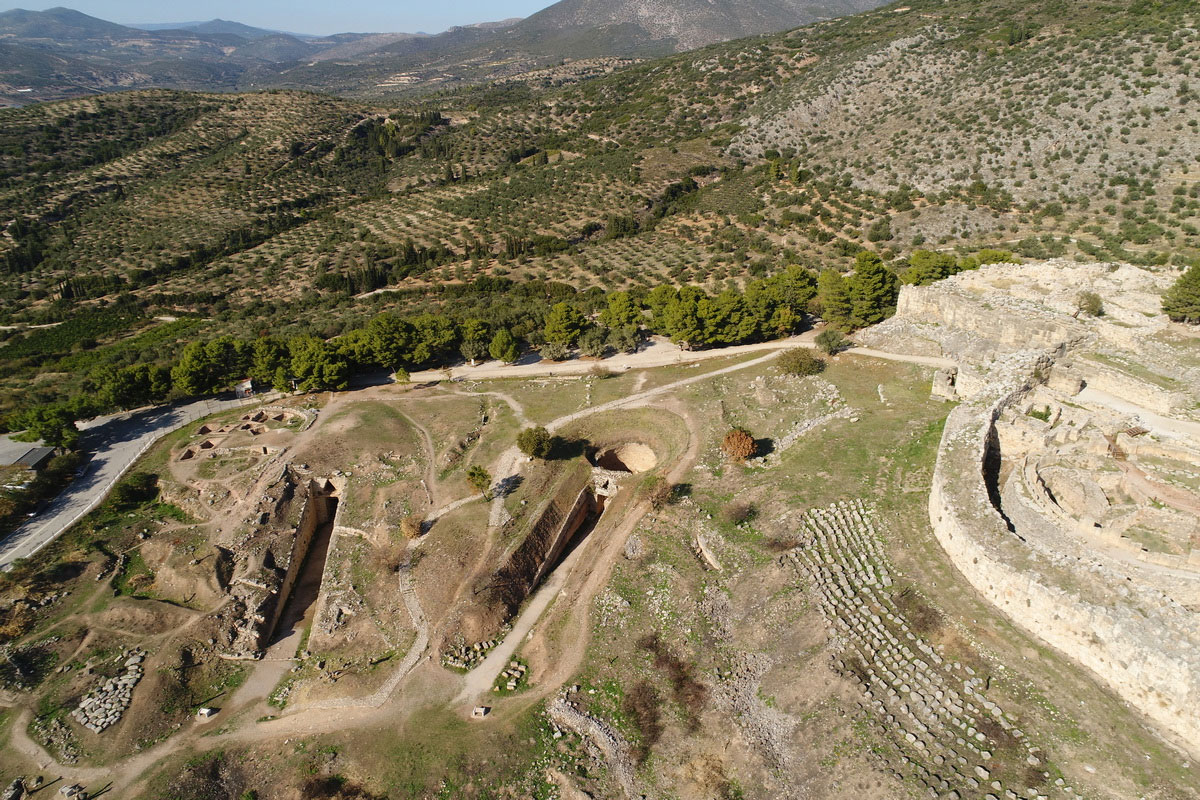
A final solution has been given for the fire protection of Mycenae by installing a complete fire extinguishing system at the archaeological site. Yesterday morning, Minister of Culture and Sorts Lina Mendoni and Regional Governor of the Peloponnese Panagiotis Nikas signed a €650,000 Contract Programme to upgrade the existing fire protection infrastructures. The archaeological site of Mycenae has recovered its appearance with grass covering the area once again. The Ministry of Culture and Sports announced that Mycenae was visited by 8,340 people in September and 9,172 in October.

During Lina Mendoni’s meeting with Mr Nikas, a second Contract Programme was signed for the restoration of the Koumoundouros Tower – owned by the Public Properties Company – as an honour due to the late Alexandros Koumoundouros who served as Prime minister ten times.  The deserted tower is situated in the municipality of West Mani, on the the plain of Avia. The Contract Programme provides for a study to be conducted by the services of the Ministry of Culture, for the project subsequently to be included in a funding programme.

The ancient Greeks built vast public temple complexes, but it has taken up to the 21st century for the nation to begin meeting modern disabled accessibility standards. For the first time in its long history the ancient Greek buildings that represent Athens’s Acropolis will be made completely accessible to disabled locals and tourists.

Comprising uneven cobblestone streets and broken curbs, the Greek Ministry of Culture and Sports announced today that they will “improve the visiting conditions of the monuments at the Acropolis.” While other nations have viewed access to historic and public sites for the disabled as a civil right for decades, as evidenced by the passage of the Americans with Disabilities Act in 1990 in the United States of America or EU accessibility standards implemented throughout Europe, for the first time in history the ancient site will be “completely accessible not only to the disabled, but also to citizens with mobility or other health problems.”

Up to now disabled folk visiting the Acropolis had to dangerously traverse uneven pathways. Now this new project proposes paving the main paths. However, according to Greek Reporter some leading archaeologists have “blasted” the Ministry’s decision to reassess the paving of the pathways at the Acropolis.

Disabled visitors until now faced the embarrassing ordeal of having to use a freight elevator to get to the top. But now, a state-of-the-art slope lift will offer disabled people the same view over the monuments as was enjoyed by the ancient Greeks. 

The Parthenon temple on top of the Athenian Acropolis is one of the most recognizable buildings remaining from the ancient Greek world. A special elevator was installed back in 2004 ahead of the Athens Olympics to assist disabled visitors wanting to ascend to the site. However, even with this disabled access, the often steep pathways made this a hazard-loaded location for disabled people. So much so that Trip Advisor advises any disabled visitors to bring with them “a strong person to push them.”

An article on Greece.Com openly states that “ Greece was not designed for people in wheelchairs.” Furthermore, visitors suffering from “invisible disabilities” are advised to “carry documents attesting their disability status.” However, this situation extends far beyond any ideas you might have about ancient Greek builders lacking in compassion for the disabled. Long before the uneven streets and steps were created at the Acropolis, the natural topography of Greece was exceptionally mountainous and rocky.

If everything goes as planned, the new accessibility options will be ready on December 3rd 2020

 Yeah, you're getting more politics from me today, and no, I'm not sorry. I'm going to quote Thucydides at you today and go back to watching the news. May the odds be ever in your favor, America. 


"The truth is that because you live without fear day-to-day and there is no conspiring against one another, you think imagine your ‘allies’ to live the same way. Because you are deluded by whatever is presented in speeches you are mistaken in these matters or because you yield to pity, you do not not realize you are being dangerously weak for yourselves and for some favor to your allies.

You do not examine the fact that the power you hold is a tyranny and that those who are dominated by you are conspiring against you and are ruled unwillingly and that these people obey you not because they might please you by being harmed but because you are superior to them by strength rather than because of their goodwill.

The most terrible thing of all is  if nothing which seems right to us is established firmly—if we will not acknowledge that a state which has worse laws which are unbendable is stronger than a state with noble laws which are weakly administered, that ignorance accompanied by discipline is more effective than cleverness with liberality, and that lesser people can inhabit states much more efficiently than intelligent ones.

Smart people always want to show they are wiser than the laws and to be preeminent in discussions about the public good, as if there are no more important things where they could clarify their opinions—and because of this they most often ruin their states. The other group of people, on the other hand, because they distrust their own intelligence, think that it is acceptable to be less learned than the laws and less capable to criticize an argument than the one who speaks well. But because they are more fair and balanced judges, instead of prosecutors, they do well in most cases. For this reason, then, it is right that we too, when we are not carried away by the cleverness and the contest of intelligence, do not act to advise our majority against our own opinion."
[Thucydides, 3.37]

 The right to vote, in ancient Hellas, was reserved for only a hand full of people. In order to be eligible to vote on anything, you had to fulfill a good couple of criteria:

  • You had to be male
  • Both of your parents had to be Greek citizens
  • You had to be a landowner
  • You had to be an adult
  • In Athens, you needed to have completed your military training as ephebes
  • Also in Athens, your right to citizenship could not be under suspicion
This means that children, women, slaves, foreigners and landless men were not allowed to vote on any decision put in front of the assembly. Around 10 to 20 percent of the whole of the citizens of Athens could vote. this number gives a fair idea about the voting in ancient Hellas as a whole. But despite the limited voters, ancient Hellas, and especially Athens, was definitely a democracy. The word 'democracy' (δημοκρατία) is made up of two, Greek, words: dêmos (δῆμος), meaning 'people' and krátos (κράτος) meaning 'power' or 'force'. 

The right to vote, either looking at it from a modern or ancient perspective, is exactly that; a right, a privilege. Besides children, most of us now have the right to vote. We have a right to voice our opinion and make a stand. 

Make a stand today, America. The fate of the world depends on it. 

 I pulled up my election day post from four years ago. This is what the first paragraph read:

"So, today you Americans are going to decide how badly your country is going to get messed up in the coming four years. I won't lie, I am not a fan of either candidate, but I will state for the record that I would vote for Clinton if I could. If Trump becomes president, I truly fear for you all--and especially if you are a woman, POC, under thirty and anything below super wealthy. There will be war, there will be economic crisis, there will be social crisis and there will be a healthcare crisis. That is my soapbox speech. Vote wise, America, vote and vote wise!"

Guess I wasn't far off. 

America is in the progress of voting. I'm going to extend the same words of advice today as I did four years ago: Vote and vote wise. Over the course of the past four years I've only come to loath Trump more. I've seen the damage he's done to my friends, the fear he's cost, the death toll that's on his hands, the crushing blow he has dealt to the American economy and the world with it. I was subtle about it four years ago, but I'm over that today. VOTE HIM OUT!

In ancient Athens, sovereign power was held by the ekklesia, and only by the ekklesia. Every citizen in ancient Hellas who was eligible to vote had the right to vote on new or changing laws and was thus required to be aware of them and have an opinion on them; a direct democracy. Very roughly measured, about a quarter of the inhabitants of ancient Athens were eligible to vote (we're not sure about the rest of ancient Hellas). At the height of ancient Athens, this would have constituted about 25,000 men. 6,000 were needed before any vote even went up. On slow days, serfs who were part of the Scythian Guard literally wrangled citizens (!) into the halls, with a rope smeared with red ochre--called a 'miltos'--to get enough bodies in the seats.

Getting 25,000 people--or even 6,000--to do anything in union is a very daunting task, so the ancient Athenians formed a 'boule' (βουλή), who met at the 'bouleterion'. The term comes from the ancient Greek word for 'citizens': bouleutai (βουλευταί). Every citizen in Athens had to belong to one of the ten tribes, eight of which were named after its mythical kings. The boule was assembled from 50 men, chosen from each tribe, for a total of 500 men. They oversaw the daily workings of the city, administered justices, looked after the placement of orphans, etc.

The boule still consisted of far too many people to get anything done in an orderly fashion. The next step was to dilute an even smaller group from the 500 members of the boule. Five men from each of the ten tribes represented in the boule were chosen to form a subgroup called the 'prytaneis' (πρυτάνεις), for a total of fifty. Membership of the prytaneis was rotated each tenth of a year. This meant that if you were a member of the boule, you would serve roughly 36 days as a prytanis (πρύτανις).

During their days as prytanis, members of the prytaneis ate at public expense in the 'Tholos' (θόλος), a circular edifice constructed for them next to the bouleterion. In effect, they lived there for the duration of their time as prytanis. My guess as to why, is because they would be easy to find that way. Prythaneis were the only people who could summon the ekklesia in case of emergencies so, in case of emergencies, they needed to be locatable.

In short: ancient Athens was ruled by the ekklesia of about 25,000 voting citizens. The ekklesia, in turn, was managed by the boule of 500 citizens, taken from the ranks of the ekklesia. The boule, finally, was managed by 50 members of the boule, called the prytaneis. Everyone in the ekklesia voted, but their votes were tallied by the boule-members of their tribe, who related the votes to the prytanis of their tribe, who then tallied and proclaimed the votes.
The right to vote, in ancient Hellas, was reserved for only a part of the population. In order to be eligible to vote on anything, you had to fulfill a good couple of criteria:

- You had to be male
- Both of your parents had to be Hellenic citizens
- You had to be a landowner
- You had to be an adult
- In Athens, you needed to have completed your military training as ephebes
- Also in Athens, your right to citizenship could not be under suspicion

This means that children, women, slaves, foreigners and landless men were not allowed to vote on any decision put in front of the assembly. But despite the limited voters, ancient Hellas--and especially Athens--was definitely a democracy. The word 'democracy' (δημοκρατία) is made up of two, Greek, words: dêmos (δῆμος), meaning 'people' and krátos (κράτος) meaning 'power' or 'force'. In fact, in ancient Hellas, no one voted on a person to represent them; they represented themselves.
I greatly encourage everyone to exercise their right to vote. The right to vote, either looking at it from a modern or ancient perspective, is exactly that; a right, a privilege. Besides children, most of us now have the right to vote. We have a right to voice our opinion and make a stand. It may be difficult, confusing and it may even seem like your vote won't matter, but if you don't voice your preference and those who would vote opposite of you, do... well... you can only blame yourself if your candidate doesn't win, right?
 
So go out, America. Vote. Vote wise. And I will say this: I truly believe that if you are a Hellenist, if you live and breath the Delphic Maxims, if you read the mythology and study the society that wrote them down, you cannot vote for Trump. Ponder that and go out to vote.

 F

HomeAbout UsDonationContact UsRSSRecent Comments

Breaking News

29/10/2020Pterosaurs undergo dental examination to reveal clues about diets and lifestyles29/10/2020Study of ancient dog DNA traces canine diversity to the Ice Age28/10/2020Bison engravings in Spanish caves reveal a common art culture across ancient Europe28/10/2020Cracking the secrets of dinosaur eggshells28/10/2020Giant lizards learnt to fly over millions of years29/10/2020Denisovan DNA in the genome of early East Asians


The Archaeology News Network


ARCHAEOLOGYANTHROPOLOGYPALAEONTOLOGYEVOLUTIONEXHIBITIONSNATURAL HERITAGEASTRONOMY

Rheneia, The Other Delos

 10/20/2020 08:00:00 PM 

Email This

BlogThis!

Share to Twitter

Share to Facebook

Share to Pinterest


Rheneia, a small island next to Delos, associated with the history of the births and deaths of its famous neighbouring island, but which also served as a place of quarantine up to the 19th and early 20th centuries, is the focus of the five-year fieldwork programme of the Cyclades Ephorate of Antiquities, which began in 2019.

Rheneia (or “Megales Deles” / “Great Deles” as it is called by the people of Mykonos, a name indicating the timeless link between the two islands) is nowadays divided into “lots,” ie into rural areas which the Municipality of Mykonos leases to Mykonians for agricultural and livestock use.

In antiquity Rheneia had been a place with a strange history. Also known as Ortygia, according to legend it was the birthplace of Apollo’s twin sister Artemis. The southern part, (“Kato Deles”) belonged to the territory of ancient Delos and functioned as its inhabitants’ place of birth and death. 

In the same part, the sanctuary of Delios Apollo owned agricultural land that was leased to private individuals, making large profits, according to Delian inscriptions. It also had a sanctuary dedicated to Artemis. In the northern part of Rheneia (today’s “Epano Deles”), was the city of Rheneia, with its cemeteries, farmhouses, numerous sources of wealth and its sanctuaries.

Limited but important excavations on Rheneia, were made in the late 19th and early 20th century by the first two Curators of Cyclades Antiquities, Dimitrios Stavropoulos and Dimitrios Pippas, who, however, did not manage to complete the documentation of their findings. On the spot excavations and works in the Delian necropolis and the city of Rheneia were later carried out by the former 21st Ephorate of Prehistoric and Classical Antiquities as well as the French School of Archaeology.

Stavropoulos began exploring the east coast of southern Rheneia in 1898. The antiquities had been looted for centuries by gravediggers, so that today one can find Rheneian grave steles not only in Greek museums but also in museums and collections abroad; Venice, Verona, London, Oxford, Cambridge, Paris, Vienna, Oslo, Odessa, St. Petersburg and Copenhagen.

Stavropoulos excavated tombs, revealing part of “this unique city of births and deaths”. His guide was the famous passage from the third book of Thucydides’ Histories which describes how the Athenians, in the winter of 426/5 BC, proceeded with a complete cleansing of Delos (a first, partial cleansing had already been carried out by Peisistratos) “lifting all the dead and their coffins from Delos, ordering from now on that no one should die or be born on the island, but that the dying and the women about to go into labour should be transported to Rheneia”.

Stavropoulos hoped to find the old Delian burials in Charoneia, the ancient necropolis of Delos as named by the inscriptions and he was justified when the famous “purification pit” was located in the bay of Agia Kyriaki. The hundreds of vases that came to light and belonged to burials of at least 4 centuries (8th-5th century BC), along with the numerous burial steles, led to the founding of the Museum of Mykonos, one of the oldest in Greece.

120 years after the first excavations, the Cyclades Ephorate of Antiquities with the means offered by modern technology, returns to Rheneia both to complete the documentation of the old excavations and the centuries-old looted remains of the ancient Delian necropolis and to conduct a rigorous surface survey throughout the island, to locate, document and analyse all archaeological sites and ruins, geologically recognize Rheneia and excavate a site on its southern part. Rheneia’s limited area combined with its lack of human habitation over such long periods and the abundant information provided by Delian inscriptions make the island ideal for such research.

Near the Delian necropolis, the field was cleared where the big sarcophagus of the Roman matron Tertia Horaria and the large lion of Rheneia are situated, so as to document the numerous visible burial structures and the many marble architectural members, altars, sarcophagi etc. Further north, the already excavated, large underground funerary building with niches (columbarium) was cleaned and mapped, as well as the remains of a domed tomb finial that bears great similarities with the single dome of the Agora of the Competaliasts on Delos. 

All the antiquities were documented by orthophotography and the visible remains were registered in a programme of geographical information with a prospectus in each monument, while for security reasons small sections mainly of steles in relief were collected and taken to Delos.

As part of the surface survey, the ruins of ancient farmhouses belonging to the sanctuary of Delios Apollo as well as an unknown ancient road were located and documented. At the same time, excavations began at Chomasovouni, an important place on the edge of the Delian necropolis, with visible impressive marble architectural members and foundations of a building, in direct visual contact with Delos. This is probably the site of the Artemision “on the island,” the important Delian sanctuary. 

According to accounts of the Delians in charge of the sacred rites, an uphill path led to the sanctuary, which apart from the temple included an altar, a dining hall and houses. Cleaning of the site was carried out as were orthophotography, topography and mapping of the architectural remains, while at the same time the clearing of trees and shrubs and an intensive surface survey were conducted all over the hill. Near the top, where the site of the temple is thought to be, part of a foundation was unearthed, probably that of a large altar. Remarkable fragments of sculptures were collected from the same place, mainly parts of bird statues, which were taken to Delos.

A geological map of the island was made as part of the same research, aiming among other things to locate the quarry sites. The research yielded very interesting results relating to the origin of the buildings’ structural material, not only of Rheneia but of Delos also, such as e.g. the foundations of the temple of Apollo.

An important aspect of the research is the documentation of all the remains of Byzantine, post-Byzantine and modern times (farmhouses, “pits”, dry stone walls, chapels, etc.). Among them, relevant today, are the ruins of the public quarantine station of Delos (Rheneia) on the beach, with the eloquent toponym Karantina/Quarantine or Lazaretto. From the mid 19th to the early 20th century during outbreaks of cholera and plague epidemics, both infected and non-infected ships sailing from Mediterranean to Greek ports remained there in quarantine (preventive or real), mandatory for 5-40 days. In fact, Konstantinos Cavafy spent two days there in 1901 on his first trip to Greece. 

The documentation facts are included in Rheneia’s cartographic background and combined with the recording of toponyms and information on modern traditions as well as interdisciplinary research into the archive of the Municipality of Mykonos, the Historical Archive of the Service and the General State Archives, provide extremely useful material for land uses through history in a landscape barely built up since antiquity, further documenting  both the special importance of Rhineia and the need for it to remain untouched by newer interventions.

The research programme is realized by the Cyclades Ephorate of Antiquities, under Dr. Dimitris Athanasoulis, Dr. Zozi Papadopoulou and Dr. Maria Sigala and financially supported by the Municipality of Mykonos.

The economics of the illicit trade in antiquities is no different from standard market economics—the price of commodities in relation to demand and supply govern the market. Leila Amineddoleh, a lawyer who deals with art crime, in her paper titled “The role of museums in the trade of black market cultural heritage property”, sums this up as follows: “The market for illegal goods is driven by buyers’ wants, as the trade in looted antiquities is a demand-driven crime. 


There is a well-documented link between the demand for looted items and museums. To eliminate black market demand, legislation is necessary to prosecute and regulate buyers, such as museums.” What is often conveniently forgotten is the fact that most source nations (as culture-rich countries are called) have passed legislations in the late 19th-20th century nationalising their cultural property (yes, even those that are still inside the ground), which eventually culminated in the 1970 UNESCO convention—meaning there is no “fresh” supply.

However, even 50 years after the UNESCO convention, there is a thriving market for antiquities, creating an unsatiated demand for sacred objects. The main supply valve has been closed but yet for 50 years, the tap continues to dispense! The New Indian Express [October 17, 2020] examines one of the key consumers of this miracle tap—museums—and studied their major acquisition routes and policies connected to those. They divided this into two main categories: 1. Direct museum purchases and 2. Gifts and donations, and focus here on the second route—via cases that throw up serious concerns on the ethics, responsibility and legitimacy of such acquisitions by museums.

How do you measure competence when there are no extant benchmarks? There have been feeble attempts at proposing guidelines, for example by the AAMD (Association of Art Museum Directors) in the past for the US and for ICOM (International Council of Museums) recently.

Gary Vikan, former director of the Walters Art Museum and columnist, in his piece ‘Why US museums and the antiquities trade should work together’, starts off rather interestingly: 

“For years, the AAMD required of its members that they only ‘not knowingly’ acquire or accept as gifts works of art that had been exported from their country of origin in violation of national laws. This put a premium on ignorance of the truth, and invited museum directors not to ask those difficult questions for which they did not want to hear the answers. A decisive blow to America’s antiquities-collecting ecosystem came in 2008 with the rewrite of the AAMD’s acquisition guidelines, which now includes this critical passage: ‘AAMD members normally should not acquire a work unless research substantiates that the work was outside the country of probable modern discovery before 1970.’” 

I would like to critically analyse this.

Though the AAMD revised guidelines move from “don’t ask, don’t tell” to “research”, parking the goalpost at 1970 has lulled major museums and collectors into a false sense of security. It doesn’t take a legal brain to understand laws relating to ownership and possession pale in comparison to clear title and no amount of passage of time vests good title to a stolen object. In our context, this is especially true. India has had its antiquities law from 1878.

And it was India and Italy, faced with looting on such a drastic scale, that championed the UN to come up with the 1970 Convention. So the AAMD guidelines seem to hint that a pre-1970 provenance would miraculously wash clean a stolen object and secure good title? Let us now look at a particular sculpture originally from Madhya Pradesh, the 11th century Chandela period Celestial Dancer currently housed in The Metropolitan Museum of Art (MMA), New York.

This “extraordinary rendering of a heavenly celebrant performing in honour of the Gods”, as the museum labels it, hides a rather shady past. The current provenance (record of past ownership) shared by the MMA is interesting: “Gift of Florence and Herbert Irving, 2015”. The devil is however in the details. The Apsara’s acquisition detail is split into two parts: bust and lower torso, which were joined by the MMA in 1992. We shall come to this aspect shortly but more interestingly, the bust’s provenance presented by the museum does not extend to 1970 even as per the revised guidelines.

Further, soon after buying the bust in 1986, the Irvings seem to have loaned it to the MMA. Now comes the interesting detail, the lower torso’s acquisition in fine print [“Art of the Past, Inc., New York, until 1992, sold to the Irvings”]. Yes, the same Art of the Past gallery of the arrested Subhash Kapoor! Again, the lower torso was immediately offered as loan to the MMA by the Irvings.

Now, for those studying the illicit trafficking of antiquities, having seen the multitude of cases of artefacts being deliberately sawn off and shipped as different sections to obscure their origin and fool customs, this innocuous line in the MMA’s website makes it self-evident: “The work was acquired by Florence and Herbert Irving in two parts, bust and lower torso, and joined by MMA in 1992”.

Kapoor was arrested in Germany via an Interpol Red Corner Notice in the September of 2011 and the press release by Homeland Security Investigations, US, dated 12/04/2012, said: “Investigators urge collectors and museums to further scrutinise their collections and contact HSI with any additional information.” 

Despite all these obvious red flags, the MMA went ahead and accepted the donation in 2015! The MMA has so far not released any research of the bust provenance prior to 1970 and the lower torso’s prior to 1992, has not revealed information of how the MMA/Irvings realised the lower torso and the bust matched (something not easy to do unless you have prior knowledge) or detailed conservation photos on whether the breakage was induced or accidental!

It is important to mention that the MMA still continues to display unprovenanced antiquities from Chandraketugarh in West Bengal as gifts directly received from Kapoor in honour of his daughter, mother, etc. It’s pertinent here to mention that despite the extent of pan-India looting by Kapoor and his associates, only the state of Tamil Nadu has filed cases against him In the next column, we will look at a more sinister and dangerous aspect of these gifts— something that archaeologist and criminology professor Donna Yates elaborates in her paper “Museums, collectors, and value manipulation: tax fraud through donation of antiquities”.