On the day of the Hene kai Nea (or sometimes the day after, like this month), I post a monthly update about things that happened on the blog and in projects and organizations related to it. I will also announce Elaion's coming PAT rituals.


Statistics:
PAT rituals for Anthesterion:

Anything else?
Are you looking for an online shop to buy incenses and other Hellenistic basics from? Try The Hellenic Handmaid on Etsy.

Would you like to support me? Buy me a coffee.

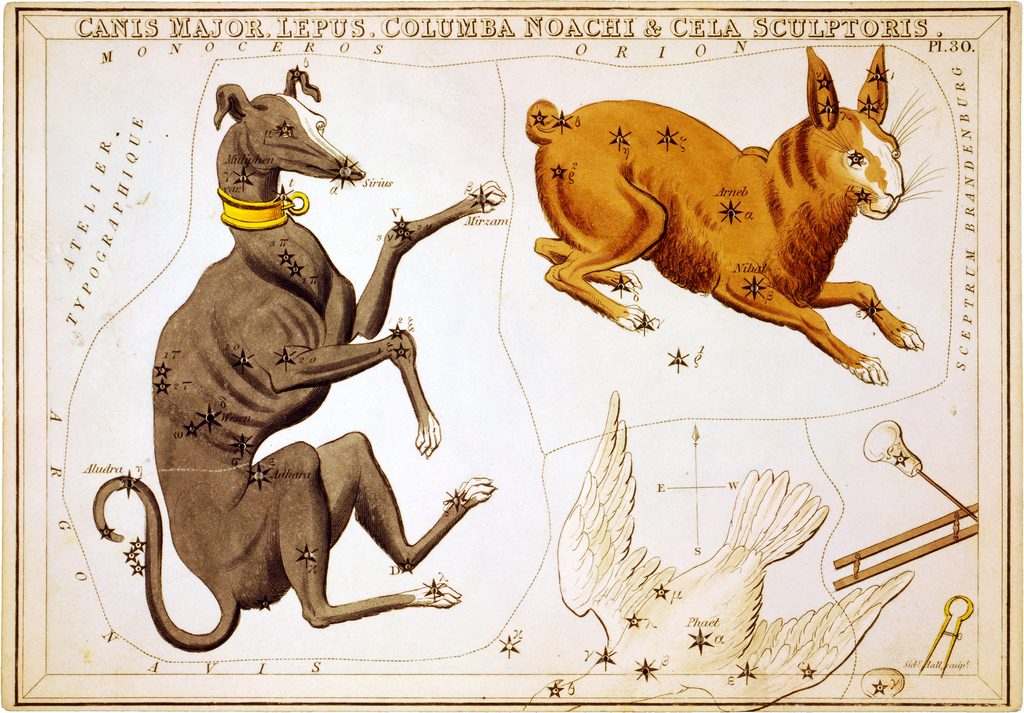
This is not the first time I wrote about dogs on this blog. I wrote about guard and hunting dogs before, in relation to ancient Hellenic society, as well as mythology. Yet, none of the myths I tackled in that post, relate to the constellation of Canis Major.

Canis Major might represent a number of different hounds. The first is Laelaps (Λαῖλαψ), the dog who was gifted to Eurṓpē (Ευρώπη) by Zeus to protect her from mortal and immortal danger as He hid her away, waiting for Hera to give up the scent of His adultery. The same dog, or a namesake of his, was gifted or passed down to Kephalos, who decided to use the hound to hunt the Teumessian fox, a fox that could never be caught. Laelaps was a dog who would always catch his prey and the fox was a pray that could never be caught. Zeus, stunned by the display, rewarded them both and placed them in the sky.

Another explanation is that the dog was one of Orion's hunting dogs. Orion (Ὠρίων) was a famed hunter who has a lot of mythology to his name. He is also included in a lot of existing mythology. The constellation Canis Major might represent his entire pack or one of them, who are/is eternally pursuing Lepus the Hare or helping Orion fight Taurus the Bull. Aratos, Homer and Hesiod support this theory. In the prime of his life, Orion joined with the Goddess Artemis and Her mother Leto, for an epic hunt in which Orion threatened to kill every beast on Earth. Gaea revolted and sent a giant scorpion to kill Orion. Orion, although very powerful, was overcome by the creature, but Artemis and Leto requested to Zeus he'd be immortalized in the night's sky. The Scorpion was admitted into the heavens as well.

That having been said, Sirius was considered a dog in its own right, and even more so, in early Hellenic mythology Sirius was the second head of a two-headed dog. This dog may be the fabled two-headed guard dog Orthus, who guarded the cattle of Geryon and whom Hēraklēs had to surpass for his tenth labor. Sad to say, Hēraklēs batted Kerberos' brother away pretty easily. As a reward for a valid try, Orthus was placed into the sky.

Canis Major is visible at latitudes between +60° and −90°, and best visible at 21:00 (9 p.m.) during the month of February.

PAT ritual for the Theogamia

Around Valentine's day, us Hellenists honour a beautiful festival of love and social stability: the Theogamia, also known as the Gamelia or Hieros Gamos. This festival celebrates the anniversary of the marriage (gamos, γάμος) of Zeus Teleios (Τελειος, Of the Marriage Rites) and Hera Teleia (Τέλεια, same). Zeus Teleios and Hera Teleia are considered the patron Gods of marriage. To celebrate this divine marriage and ask for blessings upon the romantic ties we may have in life, Elaion is organising a PAT ritual on 10 February. The time is set for 10 AM EST. Will you join us?


We know very little about the actual Theogamia festival. In ancient sources it's sometimes called 'hieros gamos', the sacred marriage, and was referred to as a domestic festival. A day to spend at home, with your wedded partner. Hera Teleia was the primary deity of the festival, with Zeus Teleios being of secondary importance. It was celebrated for sure in Athens, and most likely also in city-states around Athens. It included a shared dinner, and presumably lovemaking, between husband and wife. Unmarried men were most likely free of religious obligations, and were free to dine out.

There seems to be a suggestion that the gamos of Zeus and Hera was enacted as part of the rituals of a hieros gamos festival, but there is no concrete evidence for this. The closest we get to a Hellenic 'Great Rite' is a ritual performed near Knossos in Krete, but the details are so very vague that we can't be sure about anything.

It doesn't take much imagination to fill in how to best celebrate this festival. If you are married or have a partner, have a nice dinner together, have some romance, spent the night together and bond. Think about ways in which you will help, honor and love your partner in the year to come. And, of course, join our ritual! I want to leave you with a quote from the Ilias that has nothing to do with the Theogamia itself but does describe the eternal love between Zeus and Hera so very beautifully.

“Zeus, the Cloud-Driver, saw her, and instantly his sharp mind was overwhelmed by longing, as in the days when they first found love, sleeping together without their dear parents’ knowledge. [...] ‘Hera, [...] let us taste the joys of love; for never has such desire for goddess or mortal woman so gripped and overwhelmed my heart, not even when I was seized by love for Ixion’s wife, who gave birth to Peirithous the gods’ rival in wisdom; or for Acrisius’ daughter, slim-ankled Danaë, who bore Perseus, greatest of warriors; or for the far-famed daughter of Phoenix, who gave me Minos and godlike Rhadamanthus; or for Semele mother of Dionysus, who brings men joy; or for Alcmene at Thebes, whose son was lion-hearted Heracles; or for Demeter of the lovely tresses; or for glorious Leto; or even for you yourself, as this love and sweet desire for you grips me now.’” (Iliad XIV)

The ritual can be found here and you can join the community here. Enjoy the Theogamia, everyone!


PAT ritual for the Kourotrophos, Hera, Zeus Teleios & Poseidon

On the Erkhian calendar, Kourotrophos, Hera, Zeus, and Poseidon are all sacrificed to on 27 Gamelion, at the same location: the temple of Hera. Also, as Kourotrophos Herself was often honored first with other deities and especially on this occasion, it seems to make sense that it was one ritual with four sacrifices as listed on the calendar. Will you join us for this sacrifice on February 10, after the ritual for the Theogamia? We've set the time at 11 AM EST.


The Kourotrophoi are mostly female deities who watch over growing children. Specific offerings to Them are known from the demos Erkhia (or Erchia), but duplicate similar offerings on the Acropolis of Athens. Especially at Erkhia, it varied per sacrifice which Kourotrophos was/were sacrificed to. In this case, where no specific deity is listed, none of the above were most likely honored. The deity in question was Kourotrophos Herself, a deity whose main function was to watch over nursing children and their mothers.

You can find the ritual here and join the community here.

We had our first snow yesterday, a nice pack that insulated the house and brought on cravings of cosy fires and hot chocolate. I'm not the greatest fan of snow (I am a bit of a spaz and tend to fall flat on my face when it snows), but I do really enjoy the sight.

Not many people would relate snow with ancient Hellas, but it did snow there, just as it does in the area today. Sparta, being in the south, would have seen very little snow, but in northern Hellas, it most likely snowed several times a year. It seems that eating snow with honey and fruits was a delicacy around the fifth century B.C., and Hippocrates instructed his patients to consume ice. Mount Olympus, home of the Theoi, located on the border between Thessaly and Macedonia, is described as 'snow-topped' by Hómēros in the Iliad:

"And when the lame god had wrought the armour, he took it and set it down in front of Thetis. Then she swooped like a falcon, from snow-topped Olympus, bearing Hephaestus’ gleaming gift."

The ancient Hellens even worshipped a Theia of snow: the lovely Khionê (χιών), daughter of Boréas (Βορέας), the Northern wind, and Ōreithuia (Ὠρείθυια), daughter of King Erechtheus (Ἐρεχθεύς) of Athens and his wife, Praxithea (Πραξιθέα). Khionê is a nymph and her name bears a direct link with the ancient Hellenic word for snow: khiôn.

Following my own little tradition, I offered sacrifice to Khionê yesterday, welcoming her to my part of the world and thanking her for the insulating layer over the ground that will offer protection to the younglings growing under it. She may have been a little late for Christmas, but who can blame her? It isn't as if Christmas was a holiday the ancient Hellenes celebrated. 

I get a lot of questions from readers, and most of the time, the answers are fairly short. When I feel the question or the reply would be valuable to others as well, I make a post with a collection of them and post them in one go. Today is one of those posts.


"In a video about Khernipd you talked about that you're supposed to have a shelf. Can i ask you why that is? I'm new to Hellenismos :)"

Ah, yes, the famous shelve. As far as I can tell, the shelve is a much-used item in Hellenismos. In 'Oh My Gods!', a recent documentary on Hellenismos, the shelve makes an appearance, for example. It's reminiscent of the niche in the wall that was used in ancient Hellas and serves to elevate the worship of the Theoi from the ground.

In ancient Hellas, an altar was called a 'bômos' (βωμός)--properly signifying any elevation--with an 'epipuron' (ἐπίπυρον)--a movable pan or brazier--used on top of the bômos so it could serve as an altar for burnt-offerings. The household hearth was used to make sacrifices as well, and thus served as an altar of sorts.

These altars were used for sacrifices to the Ouranic Theoi, but were rarely--if ever--used for sacrifices for the Khthonic Theoi. An 'eschára' (ἐσχάρα) is the term for a low-lying altar used in burnt-offerings for heroes, demi-Gods and (nature) spirits. It was sometimes located under the bômos. For Khthonic Theoi, an offering pit--'bothros' (βόθρος) in Greek texts--sufficed, although They were sometimes worshipped at an eschára as well.

Personally, I think a shelve works fine to worship to the Olympic Gods, but so does a table, chest, or anything else that you have handy. There is traditional and there is practical, and unfortunately when it comes to altars these days, what is practical is not traditional.

So, short answer: you use a shelve to elevate your worship off of the ground. Can you elevate your worship any number of other ways? Yes. This depends on personal preference.


"Would you say the orphic and eleusinian mysteries are a necessary part of hellenic polytheism? Im scared that I dont know anything much about them."

Let me start off by linking you to a very extensive introduction on the Eleusinian Mysteries I wrote a while ago. You can find it here. Orphism--a mystery cult or religious philosophy which claimed descent from the teachings of the mythical hero Orpheus--was mostly connected to Demeter, Persephone, Dionysos, life after death, and reincarnation.

As with all mystery cults, participation was optional. Many people took part because it assured some semblance of safety surrounding the afterlife, but definitely not everyone was initiated in the Eleusinian Mysteries, and while Orphism was widespread as well, it most certainly was not universal.

Personally, I am hesitant about engaging in mystery cults. The whole idea of them was to follow a very strict set of guidelines to achieve a very particular goal. Since huge portions of these guidelines were lost to us, it seems futile to engage in the practice. That said, these cults have brought forth beautiful works of poetry, have introduced concepts that resonate easily with me and many others today, and there is certainly wisdom in them.

You do not have to follow mystery traditions to be a Hellenist. I know people, however, who try to reconstruct them. They do this because they feel drawn to this way of worshipping, and that's wonderful. Personally I believe everyone should feel free to worship in the way they want, and if that includes mystery traditions, then so be it. It's not for me, however, and it doesn't have to be for you either, if you don't want to.

"I'm interested to hear your feelings on using wine in ritual when you or someone in your group has issues with substance abuse. What would you use as a replacement?"

I grew up in a household where substance abuse was a big issue and I have always refused to drink alcohol, do drugs, smoke, or even drink coffee. Wine is the traditional libation liquid; as drinking water was often stagnant, wine was used to purify it, and mask the taste. All men, women and children drank water which had some wine added to it. Wine was believed to be a healer--and it is--so everyone drank it, sometimes more when they were sick. Now, that is the Traditional side of it; what you do as a modern Hellenist is allowed to differ due to the complications of our current society. One part of that is finding substitutes if wine is not something you want to consume--or can't consume.

I would never force anyone to drink wine if they have addiction issues. As wine pretty much was the ancient Hellenic equivalent of water, water is a good replacement. That said, it may feel a little to plain and personally I enjoy the fact that I libate wine because it has ties to the grape vine and Dionysos. So, as a replacement, I would suggest plain grape juice--as pure and sugarless as you can find it. It still has the same ties to the Gods, but without the alcohol. This is also what I used to do in my Eclectic Religious Witchcraft rituals when minors were around, or recovering alcoholics.

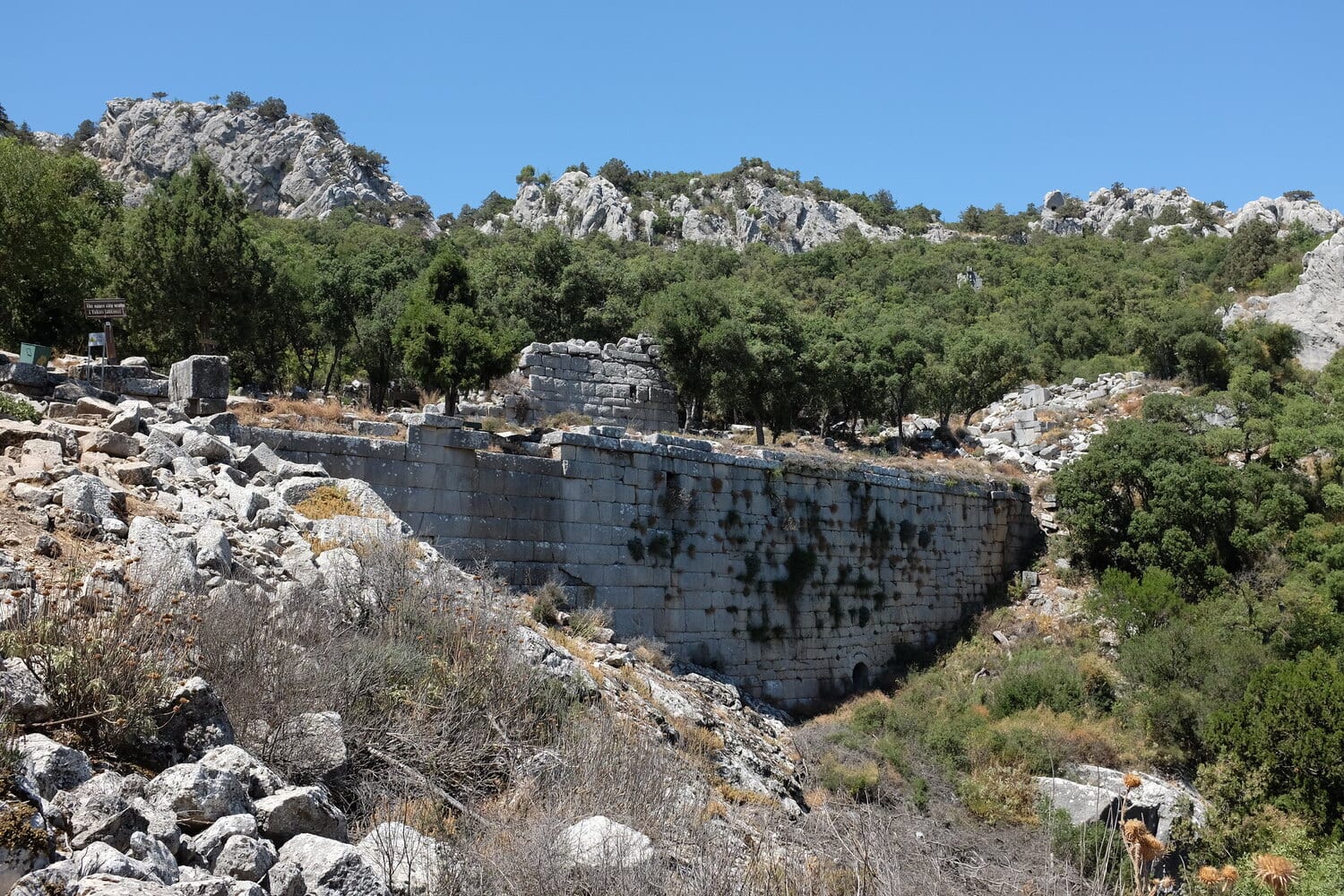
Termessos was a fortified city, founded by Pamphylian tribes called the Solymi (also called the Solims) near the peak of the Solymos (Güllük Dağı) mountain, in the Taurus mountain range in present-day Turkey. According to the Greek philosopher and historian Strabo, the Solymi derived their name from Solymeus, an Anatolian God who was later identified with Zeus, giving rise to the cult of Zeus Solymeus.

Little is known about the historical context of Termessos, but the earliest encounter with the city comes from text called the Anabis of Alexander by Arrian of Nicomedia, who describes the conquests of Alexander the Great. In the Anabis, Alexander surrounded Termessos in 333 BC, where Alexander likened the city to an “eagle’s nest”, failing to take the city.

An inscription found in the Lycian city of Araxa gives the next mention of Termessos, citing a war with the league of Lycian cities in the 2nd century BC, and again in conflict with its Pisidian neighbour Isinda.

In 71 BC, Termessos allied with Rome and was granted independent status, ensuring the freedoms of its citizens to have autonomy (documented in the minting of coins which bear the title “Autonomous”). Rome’s influence is apparent within the city’s monuments that show elements of Greek and Roman architectural features, and with the construction of a triumphal arch in dedication to the Emperor Hadrian.

At its peak, Termessos had an estimated population of 150,000 inhabitants, with the city consisting of a royal palace, a gymnasium, an odeon, six temples of varying sizes, an agora, a bouleuterion (council house), and a theatre with a seating capacity of some 4-5,000 spectators. To the south, west and north of the city, mostly within the city walls, there are large cemeteries containing rock-cut tombs.

Termessos, after a gradual decline, was abandoned in the 5th century AD, when an earthquake destroyed the primary aqueduct cutting off vital water to the inhabitants.

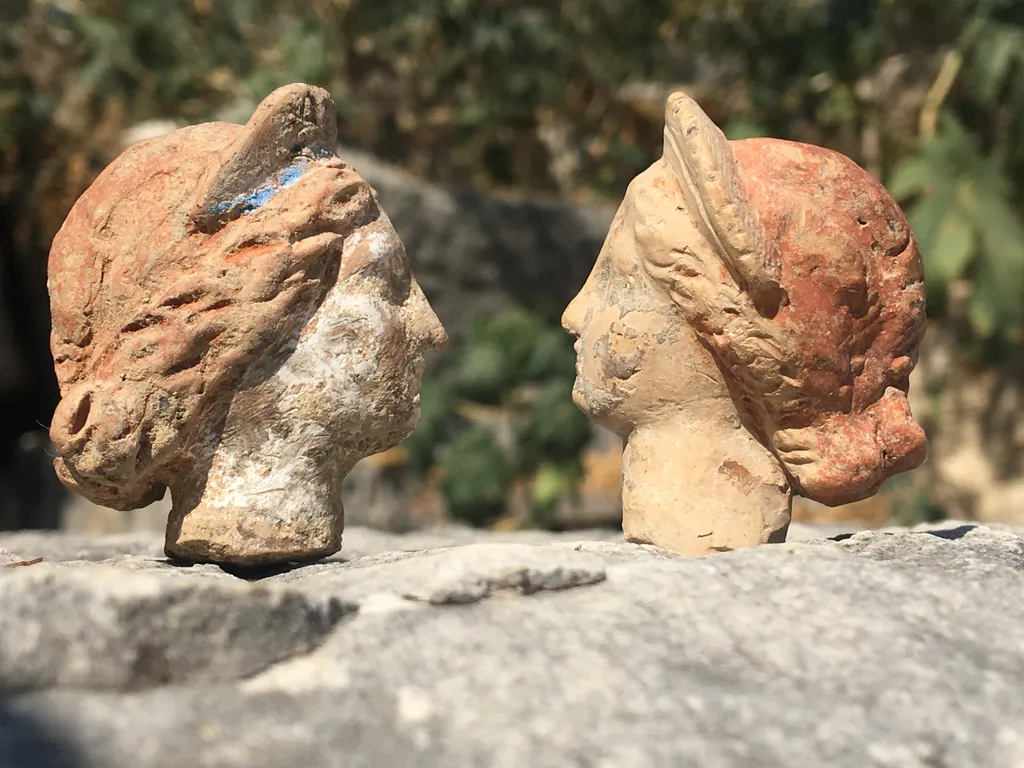
Archaeologists have discovered dozens of terracotta figurines that are over 2,000 years old, including ones that depict Gods, Goddesses, men, women, cavalry and animals. Some of the figurines still had paint on them and some had inscriptions — and all opened a window into life in the ancient town of Myra, in what is now modern-day Demre in Turkey. 

This collection of figurines, "gives us rich clues about what existed in the mysterious Myra under a thick silt layer in the first and second centuries B.C.," said Nevzat Çevik, a professor of archaeology at Akdeniz University in Turkey who led the excavation. Myra, is "one of the most important ancient settlements in Lycia," an important maritime region along the Mediterranean Sea.

Myra's port was once one of the largest harbors in the ancient Mediterranean; it is famous for its rock-cut tombs jutting from  the hills, the church of Saint Nicholas, who was Myra's bishop in the fourth century and its 11,000-seat Roman-era theater.

Çevik and his team were excavating parts of this theater between June and October 2020 when they unearthed a second, smaller theater below the Roman remains. The older structure dates back to the Hellenistic period, from 323 B.C. when Alexander the Great died to to the beginning of the Roman Empire in 30 B.C. 

They expected to find the Hellenistic theater, but the terracotta figurines scattered in it were "an unexpected big surprise," Çevik told Live Science. "It is as if the people of ancient Myra were resurrected and ran through the time tunnel all together and came to our day," Çevik remembers telling his team when they found the figurines. 

The figurines, that are 2,100 to 2,200 years old included mortal men and women as well as divine figures such as Artemis, Heracles, Aphrodite, Leto and Apollo; they also included figurines depicting  a woman and a child, a boy with a fruit, a horseman and a woman carrying hydria (an ancient Greek water vessel). Because of the "collective coexistence" of the figurines and the fact that the collection included divine figurines, votive plates and incense containers, the researchers think that the figurines may have been brought in from a cult area and thrown here.

Some of the statues had partially preserved paint on them. Red, blue and pink were used "intensely in different shades" in the clothes of the figurines, he said. The inscriptions on the backs of some of the figurines could be the name of a master or workshop. The fact that the team discovered more than 50 terracotta heads that are missing their bodies suggests there are more figurines in the area to be found. 

The team also discovered a variety of ceramic, bronze, lead and silver objects around the terracottas. They plan to continue excavating the area this year. In the meantime, the excavation team is working to preserve, repair and assemble the hundreds of small pieces that make up the terracotta collection. They plan to publish their findings and display the terracottas at the Andriake Lycian Civilizations Museum in Antalya, Turkey.

The excavations were led on behalf of Akdeniz University and Turkey's Ministry of Culture and Tourism.