Many Greeks were angered by the apparent misspelling of the name of the Greek goddess Nike on the newly launched sneakers by the American multinational of the same name. Nike, meaning “victory” in Greek, celebrated the goddess by releasing a new pair of footwear called “The Winged Goddess Of Victory” with the Air Force 1 Low. Greek-speakers were quick to spot, however, that at the heel of the left sneaker, an inscription in Greek which was apparently supposed to read ΝΙΚΗ Air, i.e. “NΙΚΕ Air”, was misspelled. The way it looks now, it would be more like “PIKS Air.”

Many were left wondering what exactly “ΠΙΚΣ” means. Is it a colossal mistake, some unknown initials, or a made-up word that just looks Greek for marketing purposes? Some took to the social media to complain about the apparent blunder. Others started a petition to make the American multinational retract the sneakers.

“We are demanding Nike to retract and recall the Air Force 1 “Goddess of Victory” sneakers from the marketplace. Nike has misused the Greek alphabet on the back of the sneakers misrepresenting the spelling of the Greek Goddess NIKE. Currently the sneakers spell PIKS and not NIKE – this is cultural appropriation. We are asking Nike to preserve and respect the Greek culture and history by accurately using the Greek alphabet when writing and referring to the Goddess NIKE.”

The Air Force 1 “Goddess of Victory” sneakers have a clean white base, supposedly replicating the robes of ancient Greek gods. Keeping its look monochromatic, the low-top shoe has replaced its smooth leather with ribbed Epi leather, adding texture to its forefoot and heel overlays. A silver mesh peeks out from underneath white laces, hinting at the Greek’s devotional marble statues, or perhaps, a medal. To specify which deity the sneakers celebrate, however, the shoes bear an extended sheer tongue akin to a wing.

Towards the heel of the sneaker, traditional Nike branding has been swapped out for thematic motifs. One shoe reads “PICS Air” in silver Greek lettering, while the other boasts a metallic palm branch graphic — the symbol of victory — embroidered into its heel tab. The dedication continues within the sneaker, where a figure of Nike the goddess has been imprinted onto the insoles alongside the definition of the Nike name.

Dubbed the “Goddess of Victory,” these Air Force 1 Lows have yet to receive a release date, though their official imagery suggests they’ll hit the Nike website in the coming weeks. Each pair is expected to retail for $130. 

As a business communication major, I assume the lettering is marketing, but is that a good enough excuse?

When seen through the eyes of Manolis Korres, the architect who has long presided over the restoration of the Parthenon, the Acropolis needs no improvement at all. In the face of such architectural mastery, he thinks of himself more as a maestro of order, making a monument that has survived explosions, fire, looting and earthquakes more understandable to the public.

“Many generations of scholars have tried to bring order to this chaos, myself included,” he said, while taking in the maze of marble slabs and scaffolding-encased ruins around him. “The issue is to safeguard what is here. In a hospital you have to take care of patients, for me the patients are stones.”

The wiry professor, a world-renowned authority on the fifth century BC site and current head of the Acropolis Monuments Conservation committee, is regarded as a national treasure in Greece. No man, say supporters, knows more about the Periclean treasure, or the sacred rock on which it stands. But at 73, 70 years after he was first taken as a child on the shoulders of an uncle to visit the temples, the architect has also come under criticism for interventions conducted during lockdown and deemed to have gone too far.

The installation of a new pathway paved in reinforced concrete across much of the hill’s open space in the name of facilitating people with disabilities has been met with dismay. So, too, has Korres’ proposed plan to overhaul the ancient citadel’s majestic gateway, or Propylaia, by reinstating a Roman staircase that would both broaden the entrance, correct previous erroneous interventions and return it to some of its original form.

In the six months that the temples were closed to the public on account of Covid-19, a new lift capable of carrying two wheelchairs at a time was also installed on the rock’s northern flank, replacing an older elevator that had ceased to operate years ago. That, too, has been criticised as a modernist eyesore.

The alterations – the most significant on the site for more than a century – replace an older pathway that followed the ancient Panathenaic way and was much narrower in size. Opposition has been fierce. More than 3,500 signatories have endorsed an open letter on the online activist network Avaaz calling for the pathways to be removed and other projected changes to be cancelled. Following the completion of the corridors on the northern and eastern area of the site, plans are afoot to extend the walkways west and south.

“It’s as if the Parthenon itself has been lowered to street level and surrounded by a cement pavement,” said Despoina Koutsoumba, president of the Association of Greek archaeologists. “There has been a great deal of pressure, especially from the cruise industry, to increase visitor capacity so that even larger crowds can be accommodated.”

Dr Tasos Tanoulas, until recently director of restorations at the Propylaia, also deplored the decision to cover so much of the rock’s face with reinforced concrete, saying the move would lead inexorably to “degradation of the natural landscape and a devaluation of the rock as a natural monument in its own right, as a natural fort”. In a letter to World Heritage Watch – the Berlin-based body established to ensure that prime sites are not sacrificed to economic interests – Tanoulas argued the alterations appeared to “compete with and diminish” the architectural and sculptural splendour of the monuments.

Yannis Hamilakis, a professor of archaeology and modern Greek studies at Brown University, went further, saying the changes amounted to “a scandal of global proportions” given the monument’s significance as a world heritage site.

“The most scandalous thing, perhaps, is that these works have been carried out without prior systematic study,” he said. “They’re clearly an attempt to recreate an imagined fifth century BC Acropolis, a neo-classical colonialist and nationalist dream which converges with the government’s agenda for further commercialisation of the site.”

If proof were needed, he said, the French designer Christian Dior will be among the first to take advantage of the new expanded pathways with a fashion shoot on the Acropolis next week. But Greece’s culture minister, Lina Mendoni, a respected archaeologist herself, defended the measures, saying they had been ratified at multiple levels, including the powerful central archaeological council Kas. “They’ve all been approved by people whose credibility cannot be disputed,” she said during a tour of the site. “Since 2004 [when Athens held the Olympic Games] we’ve been talking about improving access for people with disabilities.”

Each year about 150 people are seriously injured negotiating the outcrop’s slippery limestone surface, she said. “Many break legs. Each incident is recorded in the site’s logbooks. Whatever you do on the Acropolis ignites debate. If you don’t do anything, you’re criticised; if you do, you’re criticised.”

Tour guides gathered around the monument’s ticket booths on Wednesday agreed the new pathways were overdue. “There are ambulances up here at least four times a week,” said Athina Pitaki who has been guiding visitors around the site since 1978. “I’ve been up here long enough to see all the changes and in reality it’s much better now. It hasn’t affected the monuments. They’re still as impressive as ever and for the first time people can enjoy them without always fearing they’re about to fall.”

Korres knows he is in for a fight. Flooding at the site described as “a predictable consequence” of the new paving following heavy rains last December has intensified the outcry. But it is controversy he appears to relish. “A hilltop can’t flood,” he smiles. “Any intervention raises the issue of aesthetics and is a controversial process. It’s always about weighing what is gained and what is lost.”

 I get a lot of questions from readers, and most of the time, the answers are fairly short. When I feel the question or the reply would be valuable to others as well, I make a post with a collection of them and post them in one go. Today is one of those posts.


"Which theoi can be invoked in regards to friendship? Has Dionysus got any connection with friendship?"

There is actually a Goddess in charge of friendship (and sexual intercourse): Philotes (or Philia). Not much is known about Her, but you can pray to Her for sure. Theoi.com has a small article about Her. Not surprisingly, 'philia' is also the word used by the ancient Hellenes to denote friendhsip. As for Dionysos... He does not have a direct link to Philotes, but when there is drinking involved, friendship tend to be easily born (and broken!), so I would not be surprised if Dionysos would be open to listen to issues concerning friendships.

~~~

"I managed to watch the documentary. While its very interesting, many things bother me. About the fact they keep saying our gods are archetypes, for example. And at one point it's said that in ancient Greek religion 'we say we created the gods at our image'. That made me cringe. Am I wrong in thinking this?"

That would be this documentary. The woman who explained these things, explained them very simplisticly. She ditched all 'minor' Gods and put all major domains with the dodekatheon. She also integrated ancient Hellenic philosophy into her story when she spoke of mankind creating the Theoi. Her thought process is largely influenced by Socrates, and later Plato and Xenophanes (him especially). These philosophers, in turn, were influenced by the Jewish prophets Jeremiah and Ezekiel, who interpreted parts of the Old Testament to reflect the idea that man created the Gods as a way to feel safer (simplifying here).

During the sixth and fifth centuries BC, the traditional Olympian religion began to lose its hold on some aristocratic Athenian citizens. A small number of poets and philosophers began to question popular views of the Gods (Socrates, famously, was put to death for that). They shifted their interest away from the role of Gods in mythical stories, supernatural events, and everyday life and instead towards the search for a single rational principle at the heart of the universe. They pushed religion from deities to divinity, from divine interventions to physical causes, and from tangible images to invisible forces. Xenophanes (570-478 BC) famously said:

"Ethiopians make their gods snub-nosed and black; the Thracians make theirs blue-eyed and red-haired ... Mortals imagine that the gods are begotten, and that the gods wear clothes like their own and have language and form like the voice and form of mortals. But if oxen or lions had hands and could draw and do the work with their hands that men do, horses would have drawn the form of gods like horses and oxen gods like oxen and they would represent the bodies of the gods just like their own forms."

Plato had much the same idea:

"The gods are human contrivances, they do not exist in nature but only by custom and law, which moreover differ from place to place according to the agreement made by each group when they laid down their laws."

As did Athenian playwright-poet Critias (460-403 BC), who had the leading character in his play Sisyphus, promoting a related idea:

"... a man of shrewd and subtle mind invented for men the fear of the gods, so that there might be something to frighten the wicked even if they acted, spoke or thought in secret. From this motive he introduced the notion of divinity. There is, he said, a spirit enjoying endless life, hearing and seeing with his mind, exceeding wise and all-observing, bearer of a divine nature. He will hear everything spoken among men and can see everything that is done."

Xenophanes and Plato believed in the Gods, though, and questioned only Their form--most ancient philosophers did. So the views expressed in the documentary definitely have ancient foundations. I don't agree with this way of thinking as the roots of my religious view lie earlier, with writers like Hesiod and Homeros. But to view the Gods as archetypes and created by humanity is definitely a valid form of thought and worship within Hellenismos. That said, I think philosophy and religion are not the same thing and while they influence each other, you can have one without the other as well. For more on that, please see here. I hope this puts your mind to rest a little.

~~~
 
"Hello Elani! I have a devotional necklace I wear constantly for Apollon. Is there a time when I shouldn't wear it? Like sex or sleeping or working or showering?"

Personally, I do not feel that a devotional necklace or anything you wear to show your dedication to the Theoi needs to be taken off for anything. It's a personal gesture that--while very important to you--is not tied directly to the Theoi, nor does it automatically draw Their gazd. It's something that shows other people what (and who) you stand for--it's not an extention of the Theoi.

~~~

"Do you have any resource on Oracle of Delphi?"

What sort of resources are you looking for? I have quite a few posts up on the subject on my blog?
I hope this helps!

~~~

"Do you speak/read ancient Greek? If so how did you learn and how would you recommend others learn? Have you ever been to Greece?"

I don't, actually. I would love to learn, but I suck at languages. English and Dutch is about all I can manage. I hope to one day get the hang of it, though. I have been to Greece, though. As a child, but still. I went there twice. Would you like to see pictures?

2020 was, admittedly, not a very awesome year, but some great discoveries were still made! The Greek Reporter put together a top ten that I wanted to share with you today. 

Home to some of the most spectacular finds on earth, the country offered up yet more treasures from its brilliant past in digs from the bottom of a well in Athens to artifacts found under the pumice at Akrotiri on the Greek island of Santorini.

While all the nation’s archaeological sites were forced to shut down during the two lockdown periods — and suffered tremendous losses of revenue due to global travel restrictions even when they were open — the ancient Greek city of Mycenae experienced yet another shock when a wildfire tore through the site.

However, the damage there was thankfully slight, and important archaeological work was still being carried out at many other sites around the country, with many new Greek archaeological discoveries coming to light.

Another significant milestone of 2020 was the new lighting scheme for the Athens Acropolis, with energy-saving LED lighting and new spotlights showing the Parthenon’s many features to great effect. A new lift and paved walkways also greatly improved access to the iconic site.

Another historical site of enormous importance to Greece is the shipwreck off the tiny Northern Sporades island of Peristera, offering such a hoard of underwater treasures that it is often called the “Parthenon of Shipwrecks” for its stellar importance to the understanding of Greece’s past. This underwater site was opened to scuba divers for the first time ever in the summer of 2020, with those who prefer to stay on land able to visit a nearby museum on the nearby island of Alonnisos, which exhibits artifacts and dioramas of the site.


1. Ancient Greek Head of Hermes, a stellar archaeological discovery under the pavement of Athens

The recent construction work on Aeolus Street in Athens has uncovered some astounding archaeological treasures from ancient Greece, on which the Ministry of Culture has now begun restoration (top photo).

The news of the recent discovery of the head of the Greek god Hermes, lying since antiquity at a depth of just 1.3 meters (4 feet 4 inches) under the feet of Athenians as they went about their daily business, was reported around the world.

This was perhaps the most spectacular find of all this year due to its location, with the priceless treasure lying just under the pavement of the busy Athens thoroughfare.


2. Archaeological Greek Discover at Athens in July: Ancient Aqueduct and Artifacts Unearthed

One artifact stands above all others discovered this year in the Piraeus dig: A headless statue from the Hellenistic period, which was discovered at the bottom of an ancient well. Credit: Greek Ministry of Culture

Greek archaeologists unearthed an ancient aqueduct and thousands of objects and artifacts dating from Hellenistic and Roman times during the excavations for the expansion of the Athens metro line to Piraeus.

Many of the objects were made of wood and were preserved in water at the bottom of a well. The household objects, including wooden furniture, are extremely unusual finds considering the carbon-based material of which they were made.

Some of the artifacts will frame the permanent exhibition that will be set up in the metro station called “Municipal Theater” in Piraeus, which is currently under construction.

Foremost among all the treasures found was an exquisite headless statue — which was found at the bottom of an ancient well (pictured above). Archaeologists posit that the destruction of the objects may have occurred during the Roman invasion of the area.

The exhibition will include other ancient artifacts, in addition to the Hermes, along with a model copy of the aqueduct, and an authentic pebble floor from the classical / Hellenistic era which was found during the excavations.


3.    Archaeological treasures of the Minoan Civilization from Akrotiri, Santorini

Exquisite pottery was unearthed at Akrotiri, the ancient settlement on the Greek island of Santorini, early in 2020. Most of the Greek archaeological discoveries at the site are related to the everyday life of the people who lived on the island before the volcanic explosion which destroyed most of the island — and subsequently, the Minoan civilization on Crete.

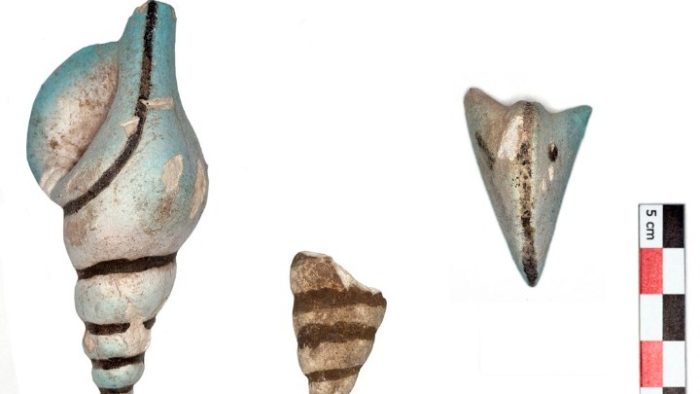
A perfectly-preserved shell-shaped vessel demonstrated the high level of artistic achievement in that civilization, in what was perhaps the most endearing find of all, showing that art was made for art’s sake even on the remote island in the days of antiquity.

Among dozens of other new findings, the Ministry of Culture noted that an inscription, consisting of Linear A syllables and an ideogram, was found written in ink on an object which is most likely related to the use of a building, also uncovered in the Akrotiri dig.


4.  Curse Tablet Discovered in Athens Well

Showing another side of Greek history, a curse tablet, showing imprecations against an unfortunate man called Pytheas, was unearthed at the bottom of a well in Athens’ downtown neighborhood of Kerameikos (Ceramicus) by archaeologists from the German Archaeological Institute of Athens.

A total of thirty well-preserved curse tablets dating back to the Classical period (2,500 years ago) were found in an ancient well which was originally discovered back in 2016, when other everyday objects — but not the tablets — were found.

The ancient tablets have curses engraved on them which Athenian citizens would pay to have made against other people, a practice which was relatively common in ancient Greece.


5.   Eight graves Unearthed in Ilia, near Olympia in September

Four of these rectangular grave sites in Ilia, all lined with rocks, and three extremely large funerary containers, called pithoi, were found at the site, as well as an individual coffin covered by ceramic tiles and a marble grave stele.

Inside one of the pithoi, which were so large that they were often used as coffins themselves, archaeologists discovered an ornately decorated bronze urn, together with its base

The urn features a floral design on its handles and lion heads fill the space between its handles and its rim. A bronze mirror with a relief was also found in the funerary container.


6. New Findings, Remains Discovered At Theopetra Cave

Theopetra Cave in Thessaly, Central Greece, was formed in the Upper Cretaceous period, 137,000,000 – 65,000,000 years before the present time. The cave that was created in the limestone there has been inhabited since the Middle Paleolithic period, and new findings give new insight into the lives of those early peoples.

According to archaeologists, the cave is likely to be the place of the oldest human construction on earth, as findings indicate that the shelter was inhabited as early as 130,000 years ago.

Neolithic residents of the cave ate wheat and cultivated barley, olives, lentils and wild pear, among others. They ate some meat, mostly from domesticated sheep and goats (which account for 60 percent of the bones found), and also kept cattle, pigs and at least one dog.

About 11 percent of the bones found at the cave belong to deer, wild boars, bears, hares, wildcats and badgers, all of which were hunted. Bones from a bear, for example, astoundingly still bear knife marks.

The community also made its own jewelry, drilling holes into deer-like teeth and shells from the nearby river. The remains of beeswax were also found in the community. The newest findings show that an estimated 43 people lived in Theopetra Cave during the Neolithic era.


7.  Byzantine-era skull shows signs of complex surgery

A proto-Byzantine-era skull which was discovered by anthropologists in the Paliokastro area on Thasos island shows signs of complicated surgery, in one of the more shocking examples of what was discovered this year in all of Greek archaeology.

The skull, which dates from the early Byzantine period — the fourth to the seventh century AD — bears traces of surgery that are “incredibly complex,” according to researcher Anagnostis Agelarakis, Ph.D., who teaches at Adeplhi University.

The discovery was made by an Adelphi University research team led by Agelarakis. A total of ten skeletons, of four women and six men, were found and studied. They are likely to be persons of high social status.

“According to their skeletal-anatomical features, both men and women lived physically demanding lives…The very serious trauma cases sustained by both males and females had been treated surgically or orthopedically by a very experienced physician/surgeon with great training in trauma care. We believe it to have been a military physician,” the report says.


8. Building from Sixth century BC discovered at Epidaurus

Archaeological excavations conducted in July of 2020 revealed the remains of an even older temple building found at the shrine to Asclepius, the god of medicine, in the vicinity of the Tholos at the ancient site of Epidaurus, outside Athens.

The partially-excavated building, which is dated to about 600 BC, consists of a ground floor with a primitive colonnade and an underground basement chipped out of the rock beneath. The floor is an intact pebble mosaic, which is one of the best-preserved examples of this rare type of flooring to survive from this era.

The find is also considered significant because it predates the impressive Tholos building in the same location, whose own basement served as the chthonic residence of Asclepius, and which replaced the newly-discovered structure after the 4th century B.C.

This shows that the worship of Asclepius at Epidaurus began much earlier than previously thought and had the same chthonic features, while altering what is known about the history of the region in general.


9. Countless inscriptions and artifacts found on Vryokastraki

Archaeologists from the Department of Archaeology at the University of Thessaly discovered yet more important artifacts this summer on Vryokastraki, the small rocky islet near the Greek island of Kythnos, once home to a significant city in the early Byzantine period.

Well-preserved ceramics, jewelry, and female figurines were discovered in the sanctuary, leading experts to believe that there was an important cult to a female deity there.

The finds, only recently released in an announcement by the Greek Ministry of Culture, also include many epigraphical remains that detail the history of the island, which was continuously inhabited from the 12th century BC until the 7th century AD.

One of the inscriptions, which are considered “very important” by scholars, describes a pirate named Glafketis who took control of Kythnos in the 4th century BC.

According to the recently discovered artifact, Glafketis had support from the Macedonians, but was eventually forced out of power by the Athenians.


10. Oldest Greek Archaeological Discovery of 2020: Eighteen Million Year-old Petrified Trees on Lesvos

Finally, in a find that far predates human history but is nevertheless just as fascinating, fourteen petrified trees were found as a result of excavations for rainwater drainage pipes  in an area near Sigri and in the region of Lesvos island’s Petrified Forest this year.

The area was declared as a Protected Natural Monument in 1985 but the additional trees that were found this year were extremely old, dating back to 18 million years ago.

The trees were killed by blasts of gas from the volcanic explosions and then covered by ash. Extensive heavy rains then flooded the area, sweeping away both the ash and sections of tree trunks. The giant mudflows blocked valleys, and the tree trunks piled up in successive layers, where they became fossilized.

Professor Nikos Zouros, director of the Petrified Forest of Sigri Museum said of the summer 2020 discovery, “The trunks were in a very good state of preservation – they are impressive logs laid on successive strata, one above the other.”

 I have already written quite a lot about the Hellenic hero Hēraklēs, whose name was later Romanized as 'Hercules'. In fact, I am writing a continuing series about his labours. That said, this post will not be just about him, because there were others associated with the myth, despite the name.


The name of the constellation in ancient Hellas was Ἐγγόνασιν, The Kneeler, or On His Knees. That said, the ancient Hllenes already associated the myth with the hero Hēraklēs. Hyginus, for example, in his 'Atronomica' describes:

"Eratosthenes says he is Hercules, placed above the dragon we have already mentioned, and prepared to fight, with his left hand holding his lion skin, and his right the club. He is trying to kill the dragon of the Hesperides, which, it is thought, never was overcome by sleep or closed its eyes, thus offering more proof it was placed there as a guard. Panyassis in the Heraclea says of the sign that Jupiter, in admiration of their struggle, placed it among the stars; for the dragon has its head erect, and Hercules, resting on his right knee, tires to crush the right side of its head with his left foot. His right hand is up and striking, his left extended with the lion skin, and he appears to be fighting with all his strength.

Aeschylus, in the play entitled Prometheus lyomenos, says that he is Hercules, fighting not with the dragon, but with the Ligurians. For he says that at the time Hercules was driving away the cattle of Geryon, he journeyed through the territory of the Ligurians. They joined forces in trying to take the herd from him, and pierced many of the beasts with arrows. But after Hercules’ weapons failed, worn out by the number of the barbarians and lack of arms, he fell to his knees, already suffering from many wounds. Jove, however, out of pity for his son, provided that there should be a great supply of stones around him. With these Hercules defended himself and put the enemy to flight. And so Jove [Zeus] put [t]he image of his fighting form among the constellations." [II.6]

Yet, Hyginus also mentions other possibilities and other noteworthy people who have an opinion on the matter; Araethus, for example, who calls this figure Ceteus, son of Lycaon, and father of Megisto:

"He seems to be lamenting the change of his daughter to bear form, kneeling on one knee, and holding up outstretched hands to heaven, asking for the gods to restore her to him." [II.2]

For those who these names are unfamiliar, Megisto is in some writers another form for Kallistô, the mother of Arcas, who is also called Themisto. I have discussed the happenings with this family before, for the constellation Boötes, but will recap for the unity of this post. Arcas (Ἀρκάς), son of Zeus and Kallistô (Καλλιστω). After Arcas was born, Hera caught wind of the affair and turned Kallistô into a bear. Alternatively, Kallistô was a priestess of Artemis, and Artemis punished her for losing her virginity by turning her into a bear. Because of the metamorphosis, the boy was raised by his maternal grandfather Lycaon, who would later kill and serve up his grandson to the Theoi as dinner, for which he was turned into a (were)wolf. When Arcas grew up, he went out to hunt and found a beautiful bear. He chased her through the woods. The bear--his transformed mother Kallistô--ran towards him as soon as she recognized her son. Arcas was terrified and raised his bow to shoot her. Zeus intervened swiftly and placed Kallistô and her son in the sky. Kallistô became Ursa Major and Arcas either Ursa Minor or Boötes.

Hyginus goes on to quote Hegesianax, who says that:

"...he is Theseus, who seems to be lifting the stone at Troezene. Aegeus is thought to have put [corrupt] and a sword under it, and warned Aethra, the mother, not to send him to Athens until he could lift the stone by his own strength and bring the sword to his father. And so he seems to try to lift the stone as high as he can. In this connection, too, some have said that the Lyre, placed nearest this sign, is the lyre of Theseus, for he was skillful in all the arts and seems to have learned the lyre as well. This, too, Anacreon says: Near Theseus, son of Aegeus, is the Lyre." [II.6]

Theseus was fathered by Aegeus and Poseidon, whom had both slept with his mother Aethra, and was thus destined to become a hero. In order to claim his rightful place as ruler over Athens, he had to uncover his father's sandals and sword from under a stone in his mother's birth land where Theseus grew up, and bring it to his mortal father. Theseus lifting the stone at Troezene would have been his first heroic act, and thus worthy of immortalization in the stars.

Hyginus offers a few more options:

"Others call him Thamyris, blinded by the Muses, kneeling as a suppliant; others, Orpheus, killed by the Thacian women because he looked on the rites of Father Liber. Again, some have said that he is Ixion with his arms bound, because he tried to attack Juno. Others say he is Prometheus, bound on Mt. Caucasus." [II.6]
 
I have written about the affairs with Ixion and Prometheus, so for reference, please visit those posts. I have also written about Orpheus, but with a different constellation: Cygnus: the swan. In it I describe how Orpheus wanders the world after loosing his wife for good, and stumbles upon revelers who rip him apart. His lyre is placed into the sky and Plato describes that Orpheus is turned into the constellation Cygnus because he does not want to be reincarnated as a woman, a risk he would run if he stayed in human form. It seems others thought he was put into the sky as a man regardless, and near his lyre at that.

Thamyris  (Θάμυρις) is new to this blog. He was the son of Philammon and the nymph Argiope, and a Thracian singer who was so proud of his skill that he boasted he could outsing the Muses. He competed against them and lost. As punishment for his presumption they blinded him, and took away his ability to make poetry and to play the lyre. Hómēros outlines the tale in the Iliad:

"From Pylos, and lovely Arene; from the ford of the Alpheius at Thryum, from well-built Aepy, from Cyparisseis, and Amphigeneia, Pteleos, Helos, and Dorium, where Thamyris the Thracian met the Muses, as he came from Eurytus’ house in Oechalia, and they put an end to all his singing: he who had boasted he would win his contest with those aegis-bearing daughters of Zeus, they blinding him in anger, robbing him of his sweet gift of song, so he forgot the cunning of his harp; in their fleet of ninety hollow ships the warriors came, led by Nestor the Gerenian charioteer." [II: 581-644]

It seems there is great variety in the interpretation of the person the constellation depicts, but whomever it is, they are visible at latitudes between +90° and −50°, and best visible at 21:00 (9 p.m.) during the month of July.

Pindar, Nemean Ode 11

"Daughter of Rhea, guardian of parliaments, Hestia, sister of all-highest Zeus, and of Hera who shares his throne, welcome with goodwill to your sacred hall."

Pseudo-Apollodorus, Bibliotheca

"He [Kronos] then married his sister Rhea. Because both Ge and Ouranos had given him prophetic warning that his rule would be overthrown by a son of his own, he took to swallowing his children at birth. He swallowed his first-born daughter Hestia, then Demeter and Hera, and Poseidon and Haides... When Zeus was grown, he engaged Okeanos' daughter Metis as a colleague. She gave Kronos a drug, by which he was forced to vomit forth first the stone and then the children he had swallowed. With them Zeus fought a war against Kronos and the Titanes." [1. 4 - 7]

Homeric Hymn 5 to Aphrodite

"Nor yet does the pure maiden Histia love Aphrodite's works. She was the first-born child of wily Kronos (Cronus) and youngest too, by will of Zeus who holds the aigis,--a queenly maid whom both Poseidon and Apollon sought to wed. But she was wholly unwilling, nay, stubbornly refused; and touching the head of father Zeus who holds the aigis, she, that fair goddess, sware a great oath which has in truth been fulfilled, that she would be a maiden all her days. So Zeus the Father gave her a high honour instead of marriage, and she has her place in the midst of the house and has the richest portion. In all the temples of the gods she has a share of honour, and among all mortal men she is chief of the goddesses. Of these three Aphrodite cannot bend or ensnare the hearts."

Homeric Hymn 24 to Hestia

 "Hestia, you who tend the holy house of the lord Apollon, the Far-shooter at goodly Pytho, with soft oil dripping ever from your locks, come now into this house, come, having one mind with Zeus the all-wise--draw near, and withal bestow grace upon my song."

Orphic Hymn 84 to Hestia

 "To Hestia, Fumigation from Aromatics. Daughter of Kronos (Cronus), venerable dame, who dwellest amidst great fire's eternal flame; in sacred rites these ministers are thine, mystics much blessed, holy and divine. In thee the Gods have fixed their dwelling place, strong, stable basis of the mortal race. Eternal, much formed, ever florid queen, laughing and blessed, and of lovely mien; accept these rites, accord each just desire, and gentle health and needful good inspire."

Plato, Phaedrus 246

 "Zeus, the mighty lord, holding the reins of a winged chariot, leads the way in heaven, ordering all and taking care of all; and there follows him the array of gods and demigods, marshalled in eleven bands; Hestia alone abides at home in the house of heaven; of the rest they who are reckoned among the princely twelve march in their appointed order."

Aristonoos of Corinth, one to Hestia and to the Pythian Apollon. They were recorded in the fourth century BC. I'd like to share the hymn to Hestia today, as I'm feeling particularly in need of a quiet and warm home today.

Aristonoos of Corinth - Hymn to Hestia

Holy Queen of Sanctity,
we hymn you, Hestia, whose abiding realm
is Olympus and the middle point of earth
and the Delphic laurel tree!
You dance around Apollo’s towering temple
rejoicing both in the tripod’s mantic voices
and when Apollo sounds the seven strings
of his golden phorminx and, with you,
sings the praises of the feasting gods.
We salute you, daughter of Kronos
and Rhea, who alone brings firelight
to the sacred altars of the gods;
Hestia, reward our prayer, grant
wealth obtained in honesty: then we shall always
dance around your glistening throne.


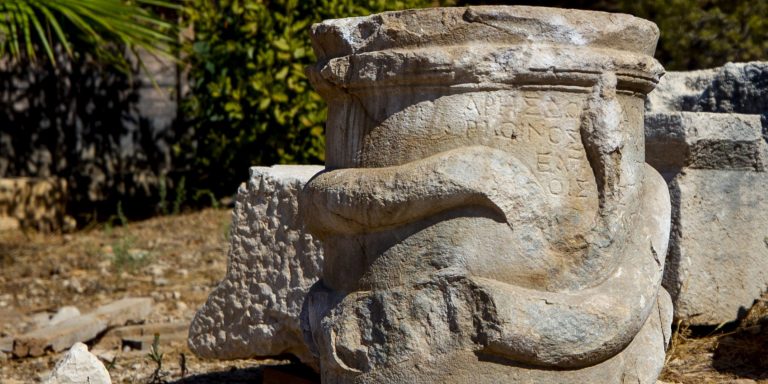
A marble altar with an ancient Greek inscription has been discovered at the site of Patara, close to the south-west coastal city of Antalya in Turkey. The ancient Hellenic altar, which features a relief of a snake wrapped around the ancient stone with a Greek inscription, is thought to be over 2,000 years old.

Speaking to Turkish media, Mustafa Koçak, an archaeologist working at the site, noted that such an altar has never been found in the area, but similar finds have been discovered at other ancient sites. He hypothesized that the snake motif relates to the worship of the Gods, as people would make sacrifices and give offerings to the gods at altars like this one.

Koçak added that archaeologists have encountered sculptural forms of large snakes throughout their excavations that resemble the one found on the altar, and theorized that they may have also been others present in the city during ancient times.

Further study and translation of the Greek inscription may reveal more information about the use and historic context of the altar. However, in descriptions of the impressive find, the Turkish press has not even mentioned the presence of the ancient Hellenic inscription on the column.

Antalya, now known as a Mediterranean resort destination on Turkey’s southern coast, was once home to a prominent ancient Hellenic city. The ancient city of Patara, located in Lycia, where the altar was found, was a hub for commerce and maritime activity in antiquity.

Taking its name after its mythological founder Patarus, son of Apollon, Patara served as an important site in Hellenic and Roman antiquity. In 333 BC, Alexander the Great conquered the city, and it was governed by a series of emperors throughout its long history.

Patara’s strategic location in modern-day southwest Turkey helped it preserve its economic and cultural importance through the Byzantine period as well, and it has significance to Christians, since it was the birthplace of St. Nicholas, the bishop of Myra, in 270 AD. With its ancient history, and because it was continually inhabited for so many centuries, the site is home to many Hellenic and Roman ruins, including an impressive Roman-era theater.

There is an almost uncountable number of ancient Hellenic and Byzantine archaeological and historical sites in Turkey, many of which attract hundreds of thousands, even millions, of visitors every year. These countless sites in not only Turkey but around the world, serve incontrovertible evidence of the Hellenic people’s long, rich history and contributions to world civilizations.