Exorcisms have a long and varied history, and the best known version of it is the 'Major Exorcism' as performed by a Catholic priest. This rite is recorded in the Rituale Romanum which seems to date from around 1600 AD. How old the ritual itself is, I am not sure, but the concept of possession is most certainly ancient. The idea of the Major Exorcism is to establish that a demon has taken possession of a person--which should be measurable by certain signs like speaking in tongues and convulsing--and then to drive out the possessor by reciting ritual texts and presenting the creature with holy iconography. I was asked if there was something like an exorcism in Hellenismos.
The question makes a few assumptions that need to be addressed before answering your question:
- Did the ancient Hellenes believe in possession?
- Did they believe it was a bad thing?
- Did the ancient Hellenes believe creatures which classically possess humans and/or animals existed?
- Did they believe these creatures would, indeed, possess humans and/or animals?
- Was it possible to cast out these creatures through religious (or even secular) rites?
As you can see, it leave a lot of room for interpretation. While the actions of the Maenads might fit part of the bill, it is more interesting to look at oracles as subjects of possession, as they tended to speak in tongues or riddles, divulge hidden events, and would often show physical signs of not being in control of their bodies. The oracle at Delphi is a classic example, and indeed, the ancient Hellenes believed the oracle possessed--not by an evil entity, but by a God; in this case, Apollon (for the majority of history anyway).
As such, I don't believe possession in these forms was considered a bad thing; it was the way the Theoi spoke to or through their followers, and in general, it was a much sought-out and desired skill of both mystery cults and divination.
Classical creatures who possess people according to the church are mostly demons, malevolent beings sent by the Devil or acting on their own accord. In general, their only goal is to bring pain and suffering to humanity. The word 'demon' comes from the ancient Greek root 'δαίμων'--'daímōn'. Hesiod gives us our first glimpse into daímōns as he writes about the five Ages of Man in 'Works and Days'. He gives us the following references:
Hesiod's Ages speak of only one race who became daímōns; those of the Golden Age, yet those of the Silver and Heroic Age also received many honors after their passing, and they were held in high regard. Hesiod makes clear distinction between the Theoi and daímōns: the Theoi are Gods, daímōns are members of the Gold Age who gained immortality. This differentiation is much less pronounced in the writings of Hómēros, where God and daímōn are used virtually interchangeably.
This difference led to a misinterpretation of the nature of the race of the Silver Age: they became dangerous daímōns in the eyes of later writers (like Plato), and eventually the demons of Christianity. Yet, neither Hómēros or Hesiod ever intended them to be so: all daímōns were pure and Deathless; they acted as a policing force for humanity. Especially through Neo-Platonics comes the placement of daímōns between the Theoi and mankind. They are less powerful than the Theoi, with lesser domains; more concerned with the daily happenings of life than the Theoi are, but they, too, are immortal, and deserve honors. Daímōns fulfill an important role in mythology and life: all aspects of life can be overseen by Deathless beings, without taking away from--or needlessly adding to--the portfolio of the Gods.
A daímōn could also be a personal guardian spirit or the personification of a person's conscious--or even their muse--this idea seems to be a Neo-Platonic evolution of Hesiod's classical daímōns, popularized by Socrates (and his followers), who described his personal daímōn in his trial. From Plato's 'Apology':
Daímōns had been separated from their Hesiodic cousins by then, but they were still considered positive forces. The later corruption of the term came from the Christians. The ancient Hellenes did not know demons in the way we know them now; the earliest mention I know of is from the Papyri Graecae Magicae, which also includes an exorcism rite. Note that this document can be dated anywhere from the 2nd century BC to the 5th century AD, and that it was Graeco-Roman/Egyptian in origin. It was a rather obscure document even in its time, but for this search, it might suffice. Note that it is in essence a Christian rite, though, and adresses the Christian God and pantheon.
Now, I would like to focus a moment on 'evil' entities the ancient Hellenes did believe in: ghosts. Ghosts were the people who could not find the entrance to the Underworld or who didn't have the money to pay Kharon for their passage. Those who were not properly buried were also doomed to wander the Earth for a hundred years. Interestingly enough, Hellenic heroes were also considered ghosts and were honored in the same type of rites as other types of ghosts.
The ancient Hellens held festivals in honor of ghosts, and the Theoi that presided over them, so they would be sated and appeased and would not haunt them. Most of these festivals included a holókaustos--a sacrificial offering given in its entirety to the Gods--and were solemn affairs, conducted at night and without an offering of wine.
This fear of spirits and other supernatural entities was named 'deisidaimonia' (δεισιδαιμονία). The ceremonies of riddance were known to the Hellenes as apopompai (ἀποποπμαί), 'sendings away'. There isn't a single word in the English language that conveys the practice. Closest would be, indeed, 'exorcism'.
It is important to note here that these 'exorcisms' weren't performed on people, but on the ghosts themselves and in short, they consisted of rites to ask the Gods (especially Hekate) to keep these unfortunate souls away from their homes and families, because the ghosts could bring misery down upon them. Possession was not part of the fear. Many rites in the ancient Hellenic religion--including monthly ones like the Deipnon--were apotropaic. Many of these rites were also linked to miasma.
Within Hellenic practice, miasma describes the lingering aura of uncleanliness in regards to a person or space through which contact is made with the Gods. Next to piety, being ritually clean is one of the most important things to adhere to within Hellenismos. Severe miasma needs to be cleansed by the Gods, and these rites were apotropaic in nature.
The answer to the question at hand is thus that it depends on the time period and your definition. Strictly speaking, the ancient Hellenes in general did not believe in possession, but did have specific rites to ward off the evil and miasmic. Later on, especially in cult worship, some forms of demon possession became a known issue, but by and large, demon possession did not occur until the Roman empire and the rise of Christianity. Perhaps it was a different understanding of the same thing, but the concept would have been foreign to the ancient Hellenes. By extension, exorcisms were too.
-
Monday, August 30, 2021
ancient Hellenic culture Apollon Christianity Delphi Dionysos Hekate Hekate's Deipnon holókaustos miasma Myth of the Five Ages Pan requested post Roman
On 12 Metageitnion, two separate rites were held, one in Erkhia and one in Athens. The first was in honor of Demeter, the other in honor of Zeus Polieus, Athena Polias, and Apollon Lykeios. On 21 August, so today, at 10:00 AM EDT, we will combine both rites into a single PAT ritual.
-
Friday, August 20, 2021
Apollon Apollon Lykeios Athena Athena Polias current affairs Demeter Elaion PAT Zeus Zeus Polieus
I greatly enjoy watching the Olympics. I enjoy watching sport in general, but this is a competition which started in Greece, by the people who worshipped the same Gods as I do, people whose lives I'm trying to reconstruct. Watching the Olympics is religious for me. Did you know all of this about the Olympics?
- The Olympic Games were held every four years, like they are now, from 776 B.C. to A.D. 394. They were, however, part of a cycle of sports events, known as the Panhellenic Games. The Olympic Games were dedicated to Zeus, were held in Olympia, Elis, and were held every four years. The Pythian Games were dedicated to Apollon, were held in Delphi and were held every four years, starting three years after the Olympic Games. The Nemean Games were dedicated to Zeus also, were held in Nemea, Corinthia, and were held every two years. Lastly, the Isthmian Games were dedicated to Poseidon, were held in Corinth, and were also held every two years.
- The most important events at the Olympic Games weren't the sport events; they were the sacrifices, offerings and other dedicatory practices which were continually performed during the five day event. There were also artistic happenings; writers, sculptures and painters showed what they could do in their given trade. Palmistry was practiced, wine flowed freely and there were a lot of prostitutes, who made more money in these five days than in the whole of a year without the sporting event. The Olympics were a festival unlike any other and every four years Hellas went nuts for it.
- The opening ceremony was as spectacular as it is today, but in an entirely different manner; athletes filed into the arena and were presented to the audience. Then, they were presented to a towering statue of Zeus, who carried a thunderbolt and a heft scowl. They swore on a bloody slice of boar's meat that they would obey the rules of the competition and not cheat to gain victory.
- The torch relay I take great joy in, was not practiced in Ancient Greece. In fact, it was introduced in 1936 by Hitler in response to an idea by Carl Diem to further the reign of the Nazi's and, in their eyes, glorify the Aryan super race, the Spartans.
- Not everyone was allowed to participate in the games; non-Hellenics and women were unable to compete. There were exceptions made for non-Hellenics, like Roman Emperor Nero, when the situation called for it, but women were never allowed to compete. Married women weren't even allowed to enter the arena. There was, however, a secondary series of sporting events held in honor of Hera where women competed.
- The Olympic sport events back then were: chariot racing, wrestling, boxing, pankration, foot races, and the pentathlon which consisted of wrestling, stadion, long jump, javelin throw, and discus throw. Pankration was a fighting sport in which everything went. It was a kind of mixed martial-arts event in which broken bones were the norm, choke holds were encouraged and the only thing that you really couldn't do was gauge someone's eyes out. Everything else went. You won when the other guy went K.O.
- Except the chariot races, all Olympic sports were performed naked. This included the Pankration, so you can imagine where most of the pain was inflicted. The woman weren't completely naked, but participated with one breast exposed, in honor of the Amazonian women who were said to be so incredible at sports and warfare alike.
- Over 40.000 people came to watch the Games. Olympia was in the middle of nowhere. If you came from Athens, it meant a 340 kilometer (210 mile) long walk just to get to Altis. Because of the festival and the presence of the Gods, all these people traveled the distance anyway.
- The end of the Olympic Games is guestimated to 394 A.D. after a decree to cease all pagan festivals by Christian emperor Theodosius I.
- Winners of the Olympic Games got rather minor rewards; Olympic winners received a garland of olives, Pythian winners received a laurel wreath, Nemean winners received a wild celery garland and the Isthmian winner received a pine garland. There was no runner-up; you won or you lost. All athletes were bathed in fame and glory until they lost, but the winner was brought home to his polis a king. He would never have to work again, was covered in riches and women, and his name and family name would be forever remembered and honored.
-
Friday, July 23, 2021
ancient Hellenic culture Apollon current affairs Hera Olympic Games Poseidon Zeus
Time for another bit of ancient beauty! I love little gems like this. It is not truly a hymn as such, but more an invocation: a short work that is meant to supplicate. This one is to Apollon and the muse Kalliope, the muse who presides over eloquence and epic poetry. It was written by Mesomodes.
Mesomedes of Krete (Μεσομήδης ὁ Κρής) was a Roman-era Greek lyric poet and composer of the early 2nd century AD. Two epigrams by him in the Greek Anthology are extant, and a hymn to Nemesis as well as one to Helios. The hymn is one of four which preserve the ancient musical notation written over the text. A total of 15 poems by Mesomedes are known. Prior to the discovery of the Seikilos epitaph in the late 19th century, the hymns of Mesomedes were the only surviving written music from the ancient world. The hymns to Nemesis, the muse Kalliope, and Helios can be read here and listened to here.
This version was reconstructed by Christodoulos Halaris and has been recorded on his album 'Music of Ancient Greece'. Greek composer and scholar Christodoulos Halaris is a leading expert on the study and reconstruction of ancient Greek and Byzantine music. He turned to musicology and composing after studying mathematics in Paris. Taking his cues from religious iconography and traditional popular Greek music, Halaris began reconstructing fragmentary (and sometimes nonexistent) old Greek music documents. He has published more than fifty CD's of this music and helped create the Museum of Thessalonica, devoted to Greek music. The English translations are from Ancient Greek Music by M. L. West, Oxford University Press, 1992.
begin my tuneful strain;
a breeze blow from your groves
to stir my listless brain.
leader of the delightsome Muses,
and skilful instructor,
son of Leto, Delian Paian,
favour and be with me.
It had been a long journey. Hermes had kept him safe through most of it, so he was not mugged, nor killed. His feet hurt from his blisters as he walked the final steps into the temple. He had arrived four days ago and was housed in one of the guesthouses by the priests of Delphi. He was asked to wait with the other petitioners until the Oracle was ready to receive him. He was lucky; he had only had to wait four days. Others had been here for weeks.
This is how archeologists think a petition at the Oracle of Delphi could have gone, combined with some dramatization on my part. The Oracles of Delphi are, by far, the best known oracles but there were many, many more. Some were stationary, holding office in their hometown. Amphiaraus in Oropus, for example. Others traveled the country, providing the voice of the Gods in family disputes, fights over land and cattle ownership, and any other number of disputed that they could help with. They often walked a very thin line, as they often had to pick a side in disputes and the losing party often did not appreciate it.
Oracles given directly, like at Delphi, were rare and called chesmomancy. All other forms of divination practiced in ancient Hellas were performed by seers, not oracles. Seer staples were divination through the spotting of birds (ornithomancy and augury), dream interpretation (oneiromancy) and animal sacrifice (hieromancy, haruspicy, empyromancy and extispicy) but other forms of divination were definitely used, including cledonomancy (listening to words spoken by a crowd), oneiromancy (divination through the reading of birthmarks) and Phyllorhodomancy, the reading of the sound rose petals make when slapping them together with your hands. The biggest difference between oracles and seers was that oracles gave long answers which usually needed some for of interpretation while seers usually answered yes-or-no questions.
Divination of any kind was rarely turned to, to predict the future. To desire knowledge of the future was considered hubris. Instead, oracles and seers were petitioned to help answer questions about the present or to advice on a decision which had to be made in the very near future. 'Shall I go to war?', ' Shall I put my sheep out on the high pasture?'. Most often, oracular questions were posed in a way which made it easy for the God(dess)--and the seer--to answer; they did not ask 'Shall I go to war?', they asked 'Don't you think I ought to go to war?'. Most likely, the answer of seers (and perhaps even oracles) depended on the offertory; if it was large enough, the answer was 'yes', if the offertory was dissatisfactory, the answer would be 'no'.
Divination played a fairly large role in Hellenic every day life, but it played an even greater role in mythology. many of the epic stories, like those written by Hómēros, feature signs given by the Gods and interpreted by humans. The eagles, sent by Zeus, in the Odysseia, for example:
Many divinatory practices remain today but most modern Hellenics divine differently than the Hellens of old. Tarot has become a staple in divination. I have my Olympus Tarot deck for readings. Yet, I also practice cledonomancy when I have access to a crowd and no access to my tarot cards, and I absolutely believe in the prophetic powers of dreams.
The Greek Herald has put together a list of five facts you need to know about music in Ancient Hellas, so I thought I'd share!
1. Music as a gift of the Gods:
In Ancient Hellas, music was seen as a gift of the Gods and they considered that music could have a valuable effect on both body and mind of the listener.
The invention of musical instruments was attributed to specific deities including the lyre to Hermes, the flute to Athena and the panpipes to Pan.
2. Music and Education:
According to historical evidence, Hellenes started studying the theory of music from the 6th century BC. The earliest surviving text on music is the Harmonic Elements of Aristoxenos, which was written in the 4th century BC.
Music developed into an important element in the studies of philosophy by the followers of Pythagoras, the Hellenic philosopher and mathematician, who supposed that music was a mathematical expression.
3. The first school of musical education:
According to Plato, the first school of musical education was founded from the people of Crete followed by the music schools of Athens, where students were taught to sing and play the lyre. In Ancient Hellas, they believed that music taught order and discipline while allowing the educated to appreciate better the musical performance.
4. Music and Religion:
Music was associated with religious occasions in Hellenic cities including the Panathenaia and the Dionysia festivals in Athens.
Music contests in athletic competitions had a religious nature in honour of the Gods and the earliest such competitions were held in Argos, Paros and Sparta.
5. Musicians and Social Class:
The musicians of Hellas, also known as the makers of songs or melopoioi, were often regarded as composers and lyricists of the music they performed.
In Ancient Hellas, musicians had an elevated society status, indicated from robes and their presence on the lists of the royal household.
Coming of age ceremonies are prevalent in most cultures and are often linked to the religious views of the people performing it. Famous examples are the bar mitswa's and bat mitswa's of the Jewish. The ancient Hellenes had coming of age rituals as well, and like almost everything else in ancient Hellenic life, these rituals were tied into deity worship. Today, I'm going to talk about these coming of age ceremonies, but because the differences are so great between girls and boys, I'm going to describe their coming of age ceremonies separately.
Girl to woman
In ancient Hellas, a girl's coming of age ceremony was linked to her wedding day. As soon as she got married, she would move out, into her new husband's oikos, and commit to the task she was born to fulfill: gift her husband legitimate offspring--boys, preferably. It won't come as a surprise that in preparation for this entirely new role in life, a girl's coming of age ceremony was focussed almost entirely on ending her own childhood, and petitioning the Theoi for help in her life as an adult. As such, fertility and womanhood were big parts of the rituals.
Young girls rarely had a role to play in household worship. The family only had them with them for thirteen to fifteen years, on average, after that, she joined her rightful place at the oikos of her husband, where she carried more (religious) responsibility. There were religious roles young girls could fulfill outside of the home, however, most notably as 'Arrephoros' (Ἀρρήφορος)--year long handmaidens of Athena Polias (Πολιάς)--in Athens, and as 'Arktos' (αρκτος), bear, a service in the following of Artemis Brauronia (Βραυρωνια) at Brauron (Βραυρών).
During the Arkteia festival, celebrated every four or five years alongside--or as a part of--the Brauronia, named and in honor of the epithet of Artemis. Every Athenian girl, as well as many other girls from all over Attika, had to take part of the festival before they could marry. The girls were brought to Brauron, a temple of Artemis with a rich history in both myth and history. Some versions of the myth of Iphigeneia have her taken from the sacrifice and dropped in Brauronia, where she established a temple to the Theia in gratitude. Otherwise, an oracle might have told the ancient Hellenes to build a temple to the Theia at Brauron after a terrible plague or famine plagued the land following the killing of a bear by two hunters.
The symbolism of the bear might refer to the bear which was slain by the hunters, or the clothes Iphigeneia might have left at her 'sacrifice'. It's also possible that the bear reference refers to Kallisto, who was transformed into a bear by the Theia.
During the festival young girls, and it seems that on occasion young boys, would gather to celebrate Artemis Brauronia with races, and dances. They would don bear masks and dance a dance known as the 'Arkteia', which was made up of slow, solemn steps meant to imitate the movements of a bear and was performed to a tune from a diaulos (double flute). They might have carried baskets of figs. Up until as far back as the 5th century, the girls might have worn actual bear skins, but bears soon became scarce, so they wore yellow dresses called 'krokoton', which they 'shed' instead of the skins to signal their coming adulthood.
The actual reason for the 'bear' ritual has been lost. It's possible that the ritual served to exorcise 'the wildness' out of little girls, but it's more likely that it was simply a way to procure kharis for the young girls who would soon call on Artemis during childbirth. In the same spirit, young women on the threshold of marriage made an offering to Artemis of their childhood toys and other paraphernalia that represented childhood, as with an offering of one drachma (roughly $ 60,-) at the temple of Aphrodite. Most likely, the bride also honored Hera Teleia and Zeus Teleios in some way.
A young woman came of age during her wedding and the subsequent wedding night, but became a woman when she gave birth for the first time. Especially during the latter, they desperately needed the support of the Theia Artemis. Aphrodite and Hera Teleia would support her through her marriage, and help her make it a success. With the help of the Theoi, a girl could become a woman.
Boy to man
Young boys had a very different life to young girls when it came to life in ancient Hellas. Because it was very important for a man to have legitimate children, the child's paternity was attested to on multiple occasions. In Athens, this was done the first time shortly after being named, and the second time when he reached sixteen years of age. Both times, the child was presented at the 'phratria' (φ(ρ)ατρία)--brotherhood--of his father. The system of brotherhoods, four in total, was the system that preceded the system of tribes. The brotherhoods largely fades, except for the registration of male offspring, and the vetting of such with testimonials and tests. The brotherhoods were overseen by Zeus Phratrios and Athena Phratria, who were honored yearly in a three-day festival called the 'Apoutouria'.
During a son's presentation to the brotherhood, Zeus Phratrios and Athena Phratria during the Apoutouria, boys sacrificed a lock of their hair to the patron Theoi and Hēraklēs, their father an animal. If one of the phratria contested that the father was, indeed, the father of this child, he could take the animal from the father before they reached the altar, and drag it away. Doing so would have been a very serious thing to do, and very shocking for a young boy to witness, not to speak of the father. The claim would then be put to a vote. When the phratria ruled in favor of the father, the animal was sacrificed and the meat distributed to the members of the brotherhood. The son became a full member.
At sixteen, a boy was considered a young man, and he entered one or two years of public service, either to mature, or to show he had matured enough to take part. This was called his 'ephebeia', which literally means 'young man'. On completion of this public service, a young man could enter the military and became a voting member of the Ekklesia. He became a citizen. Although young man were now considered adults, he only truly became an adult at age thirty, when he could serve in the boule, and get married.
Young men swore an oath upon completion of their ephebia, which has largely been preserved. It read as follows:
With this oath, the world opened up for young men; they would now be held divinely accountable for any trespassing upon the law and common sense. Political life would become important for men, as well as military service. They had roughly ten years to dedicate to these before he took a wife, so young men tended to fulfill much of their obligation to the city in these ten years. After his marriage, he became the one who presented sons to the phratria, and he got to experience the entire proceedings from the spot his father once held. This--most likely--created strong familial ties that continued through family lines for centuries.
In conclusion
There is much that remains to be said about coming of age ceremonies in ancient Hellas, more to be said about coming of age ceremonies in ancient Athens, even, but that is talk for another day. For now, I hope you have a basic idea of the youth and religious focal points of an Athenian child's life. Personally, I have a soft spot for coming of age rituals, and I strongly suggest creating or adapting ceremonies for the second (or even third) generation of Hellenists. What this would look like will be left for another post, but it would surely be beautiful.
I get a lot of questions from readers, and most of the time, the answers are fairly short. When I feel the question or the reply would be valuable to others as well, I make a post with a collection of them and post them in one go. Today is one of those posts.
By all means, make yourself pretty and good smelling! the ancient Hellenes sure did! This whole shower-as-part-of-katharmos is a modern invention. Katharmos, or the act of getting ritually clean, starts the second you walk into the area you have designated as sacred with the intent of performing ritual. Your shower happens way before, as does any primping. Then, you prepare your mind and start your procession into the area. this is when katharmos starts. You wash your hands with khernips–lustral water, which you prepare there and then, or you could possibly have stored–sprinkle the area with the water and strew barley groats as if sowing them. That’s your purification. As you can see, all of the things you worry about happen long before!
You use khernips every single time you perform a rite for the Gods. This includes (daily) sacrifice, festival celebrations, etc. The only exception for the ancient Hellenes would have been the drops of wine tipped on the ground during a symposium (a social gathering where wine was consumed and philosphical talk was indulged in) or before a meal. In general, though, if you plan of getting in contact to the Gods, get ritually clean with khernips. Praying, really, is not an act that befits Hellenismos if partaken in as a standalone activity: you pray during ritual. The two are synonymous. I hope this helps!
The only one that comes to mind is Apollon. For a variety of reasons, Hermes is often associated with these birds as well, but there is no ancient evidence for this. Apollon, on the other hand, has a long history with the birds. It seems odd that a deity associated with light is also associated with an animal with an image as negative as the raven. Ravens are often associated with battlegrounds, cemeteries, and death, with the rotting of carcasses, and funerals. In Hellenic myth, they are also associated with vision beyond that which is present. With oracular visions, and with spotting that which can not, or should not, be spotted.
One myth that associates ravens with Apollon is the myth of Koronis (Κορωνίς). Koronis was Apollon's lover, and was pregnant with His son, when she fell for another man, a mortal man, Ischys (Ἰσχύς). A raven--then white--had been assigned by Apollon to watch over His lover, and when the raven returned to tell Apollon of Coronis' betrayal, Apollon was furious the raven had not pecked out the eyes of the mortal whom his lover fell in love with. In a fit of rage, Apollon turned its feathers black.
I think there is an easy source of your confusion: there is a huge difference between an altar and a shrine. An altar is one of those basic necessities within Hellenismos, and it differs from a shrine. Where an altar is a ‘work space’, dedicated not so much to a specific deity, but used to do the bulk of the (daily) rituals, a shrine is a devotional area where an altar might be located. In ancient Hellas, the shrine was usually a temple, the altar an actual altar, standing outside of it. Household worship took place at a multitude of shrines. Labelling something a shrine does not mean you can’t sacrifice at these spots in your home. In general, you decorate a shrine but leave the altar rather bare.
As for your statues: I put them up on my shrines, not my altar. That’s why it’s bare-ish ;-)
-
Wednesday, June 16, 2021
Apollon Hellenismos 101 katharmos khernips personal Question Collections Post requested post
It's time for part three of the series-within-a-series featuring the myth of Apollon and the raven. The previous parts were the constellation Corvus: the Raven, and the Constellation Crater: the Cup. This third installment is about the longest constellation we still recognize as a constellation today: Hydra, or the sea-serpent.
To recap the story of Apollon and the raven: the raven (or crow) was in service to Apollon, and was sent out on an errant for the Theos. He was asked to bring water to Him, but instead, he paused in his quest. Most commonly it is assumed is that he stopped for a meal of figs. When the raven returned without water, Apollon questioned him. Instead of giving a straight answer, the raven lied, and said he had been kept from the water by a snake. In some accounts, he actually had a snake in his talons as he said this. Apollon, however, saw that the raven was lying, and flung the raven, the krater with which the raven was supposed to collect water, as well as the snake into the sky, where they remain to this day.
Roman author Gaius Julius Hyginus (64 BC - 17 AD) talks about the serpent's continued function in his Astronomica:
Another hydra the constellation is associated with is the Hydra vanquished by Hēraklēs as his second labour. After his victory over the Nemean lion, Hēraklēs is send off to handle another sticky problem: the Lernaean Hydra, who was raised from the earth by Hera just to end the life of Hēraklēs. The Lernaean Hydra (Λερναία Ὕδρα) was the offspring of Typhon, and layered in the swampy lake of Lerna. He realized he would need help for this labour, and asked it of his nephew Iolaus (Ἰόλαος). Together they devised a plan: Hēraklēs would cut off the heads, and Iolaus would sear the stumps shut, in this way, the heads could not regenerate. When Hēraklēs returns to Eurystheus after completing the labour, the king decrees that, because Hēraklēs could not have completed the labour without the help of Iolaus, the labour will not count against his total, and he will have to do an extra one to fulfill his debt.
On the hydra, Pausanias writes in his 'History of Greece'. He speaks of the birth place of the hydra, and of his alleged number of heads:
Constellations are often associated with the constellations they are surrounded with, and with no constellation this is clearer than with Hydra. Aratos, a Hellenic poet who flourished in Macedonia in the early third century BC, speaks best of Hydra in regards to his surrounding constellations in his 'Phaenomena':
The constellation Hydra is visible at latitudes between +54° and −83°, and best visible at 21:00 (9 p.m.) during the month of April.
-
Monday, June 14, 2021
Apollon Aratos astronomy Constellation series Hēraklēs Hyginus Mythology 101 Pausanias Ptolemy
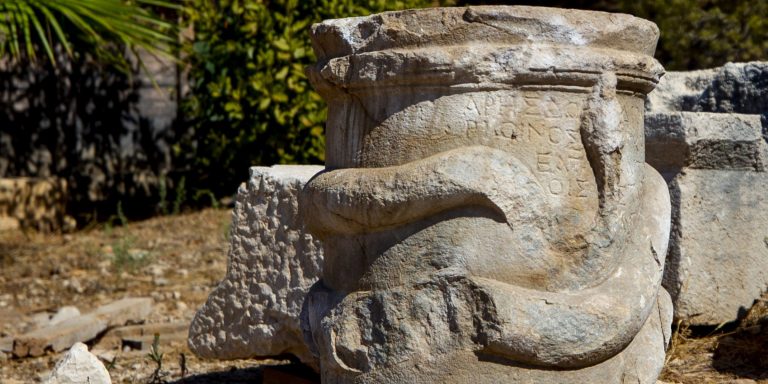
A marble altar with an ancient Greek inscription has been discovered at the site of Patara, close to the south-west coastal city of Antalya in Turkey. The ancient Hellenic altar, which features a relief of a snake wrapped around the ancient stone with a Greek inscription, is thought to be over 2,000 years old.
Speaking to Turkish media, Mustafa Koçak, an archaeologist working at the site, noted that such an altar has never been found in the area, but similar finds have been discovered at other ancient sites. He hypothesized that the snake motif relates to the worship of the Gods, as people would make sacrifices and give offerings to the gods at altars like this one.
Koçak added that archaeologists have encountered sculptural forms of large snakes throughout their excavations that resemble the one found on the altar, and theorized that they may have also been others present in the city during ancient times.
Further study and translation of the Greek inscription may reveal more information about the use and historic context of the altar. However, in descriptions of the impressive find, the Turkish press has not even mentioned the presence of the ancient Hellenic inscription on the column.
Antalya, now known as a Mediterranean resort destination on Turkey’s southern coast, was once home to a prominent ancient Hellenic city. The ancient city of Patara, located in Lycia, where the altar was found, was a hub for commerce and maritime activity in antiquity.
Taking its name after its mythological founder Patarus, son of Apollon, Patara served as an important site in Hellenic and Roman antiquity. In 333 BC, Alexander the Great conquered the city, and it was governed by a series of emperors throughout its long history.
Patara’s strategic location in modern-day southwest Turkey helped it preserve its economic and cultural importance through the Byzantine period as well, and it has significance to Christians, since it was the birthplace of St. Nicholas, the bishop of Myra, in 270 AD. With its ancient history, and because it was continually inhabited for so many centuries, the site is home to many Hellenic and Roman ruins, including an impressive Roman-era theater.
There is an almost uncountable number of ancient Hellenic and Byzantine archaeological and historical sites in Turkey, many of which attract hundreds of thousands, even millions, of visitors every year. These countless sites in not only Turkey but around the world, serve incontrovertible evidence of the Hellenic people’s long, rich history and contributions to world civilizations.
It's time for a new constellation, and this one is entirely dedicated to two brothers. While there are many twins in Hellenic mythology--Artemis/Apollon, Iphikles/Hēraklēs, Amphion/Zethos, etc., this constellation is almost solely connected to one set of them: Kastor and Polideukes. In fact, the main stars of the constellation are named after them.
Hyginus briefly describes the constellation in his Astronomica, and focusses almost solely on the Dioscuri:
The twins were born from Leda, Zeus, and mortal king Tyndareus. One of the twins was mortal, the other immortal, and both hatch from an egg. Accounts vary about who was the mortal one, and who was the immortal one; in some accounts they were even both mortal or immortal. During their lifetimes, the Dioscuri became great heroes, joining Iásōn in securing the Golden Fleece, and they both fought the Calydonian Boar.
I will discuss their mythology better another time, but for now, let me suffice in saying that eventually, they aspired to marry Phoebe and Hilaeira, who were already betrothed to cousins of the Dioscuri, a second set of twin brothers named Lynceus and Idas of Thebes, sons of Tyndareus's brother Aphareus. This sparked a feud between the cousins that left Polideukes the only one standing. He was given the choice by Zeus of spending all his time on Mount Olympus or giving half his immortality to his mortal brother. He opted for the latter, and thus the two divided their time between Olympos and the Underworld.
The Dioscuri were regarded as helpers of mankind and held to be patrons of travelers and sailors. Because they excelled in horseback riding and boxing, they were regarded as the patrons of athletes and athletic contests, and in all capacities, they had shrines throughout Hellas, and were worshipped well into the Roman era. As the twins lived on after death, they became emblems of the Eleusinian Mysteries, and were said to have been initiated into it during their lifetimes.
Hyginus also mentions a few other duos connected to the constellation:
Hēraklēs and Apollon earned this honor because, when Apollon commanded that Hēraklēs be sold into slavery to atone for the murder of his family, Hēraklēs became enraged and wrestled the Theos for the Delphic tripod. Their match was memorialized amongst the stars as the constellation Gemini.
Triptolemos and Iasion are the last candidates. The two were favorites of the Goddess Demeter. Triptolemos was a hero who first instructed mankind in the art of agriculture, while Iasion was said to be Her lover on the island of Samothrace. Demeter must have immortalized them out of love.
Gemini is visible at latitudes between +90° and −60°, and best visible at 21:00 (9 p.m.) during the month of February.
-
Monday, May 31, 2021
Apollon astronomy Constellation series Demeter Hēraklēs Hyginus Iasion Iásōn Iphikles Kastor and Polideukes Mythology 101 Ptolemy Triptolemos
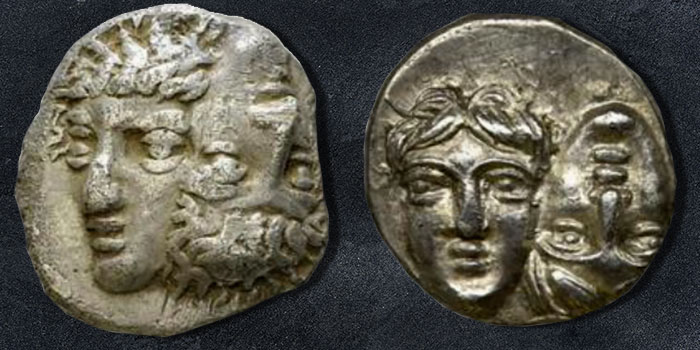
Istros, also known as Histria, was an ancient Hellenic colony located on the western Dobrudja coast of the Black Sea. Situated approximately 300 miles north of Byzantium, this small city was founded by Miletian traders around 657 or 656 BCE. As the oldest Hellenic colony on the Black Sea, Istros survived for some 14 centuries before its eventual abandonment in the mid-seventh century CE. It is unsurprising, therefore, that such a long-lasting settlement would produce several interesting and important numismatic types. Perhaps the most recognizable Istrian coin is the “unique” anti-parallel Apollonian silvers.
Struck in both drachmai and the associated fractional denominations, these coins portray “essentially identical” dual portraits of Apollon on their obverse. The inverted heads set these coins apart as a rarity not seen anywhere else in the ancient world. The only real design differences on the obverse come from the engravers’ skill level and artistry. Some of the obverses are finely engraved with highly realistic features, while others are rather crude, as demonstrated below. This design would not change during the entire span of this type’s production, from 434 BCE to approximately 300 BCE.
Similarly consistent, the reverse design shows an eagle in flight with wings outstretched as it clutches a dolphin in its talons. Since dolphins were, and still are found in the Black Sea, it is rather common to see them on Thracian and other Black Sea coins. Historians believe that the eagle represents Zeus and the dolphin the Black Sea. Due to the dolphin’s position as prey, it is logical to assume that the reverse image symbolizes either some unspecified military victory or Hellenic domination over the region and its vital trade routes.
But unlike the reverse imagery, the obverse has been a matter of interest and study for a long time. In all, numismatists and historians have suggested six possible meanings. The first and least likely is that the two heads represent the east-west trade routes along the River Danube and into Asia. This does not acknowledge the more important north-south trade routes into Hellas and the Mediterranean.
Another unlikely theory is that the Apollonian heads represent dual wind Gods. While possible, with their cheeks not puffed out and with their mouths open instead of closed, the obverse imagery does not match that of contemporary wind Gods.
The next theory is that the dual-headed imagery represents multiple branches of the Ister river, later to be known as the Danube. While these tributary branches no longer exist, it is possible that this interpretation is correct. Similar to the last theory, however, the iconography does not match. River Gods are usually depicted in profile, not facing forward, with beards and long flowing hair. With their short hair and beardless faces, these coins do not match this standard iconography.
A more “attractive” interpretation is that the two heads depict the rising and setting sun. Since the two Apollonian portraits are similar to those with radiate crowns from Rhodes, this is not an implausible idea. However, the “uniqueness” of the Istros imagery proves this false. The rising and setting of the sun is not a uniquely Istrian phenomenon and should therefore be seen on many coins around the ancient world, and not solely of coins from a small trading center on the periphery of the Hellenic world.
The most common theory about this interesting design is that the two heads represent Kastor and Polydeukes, the mythical Dioskuri. These identical twin brothers, sons of the princess Leda, participated in some of the most famous Hellenic mythical adventures and are known today as the Gemini twins. While this theory fits in broadly, and there are many numismatic examples of the Dioskuri being pictured on ancient coins, the Istrian type does not include many of the specific details. For example, the brothers are usually shown as full figures, and sometimes on horseback with their signature conical Dioskuri caps. More importantly, they are “seldom identical, never inverted and sometimes with stars above them.” The standard iconography is displayed on this quadrigatus from Bruttium.
We are forced to concede that while this theory is a partial fit, it cannot fully explain the enigmatic design.
In 2005, William Saslaw and Paul Murdin, noted academics at the Cambridge Institute of Astronomy, authored an influential article that argued that the double-headed Istrian coins were actually the earliest commemoration of a solar eclipse in numismatic history. Astronomers are able to predict the date and time of both future and past eclipses to within minutes. After searching for an eclipse that would have been visible from Istros between 450 and 300 BCE, Saslaw and Murdin discovered that at 6:30 am on the fourth of October, 434 BCE, there was a partial eclipse. Initially, the sun would have risen as a crescent with the two points facing up, like a bull’s horns. The sun and moon would have risen at differing speeds, thus as the sun gained altitude the horns would have “flipped” with the horns later facing down. “Clearly the Sun God was up to something astonishing.” This would have been “memorable” and “worth recording”. Since “solar eclipses are rare in both space and time,” it would not be unusual for it to be commemorated on a coin.
In fact, in the following centuries, many societies commemorated such events on their coins. The Roman emperor Vespasian included a “star” on the reverse of a denarius to commemorate the eclipse of January 5, 75 CE, and Hadrian’s mint produced the “Star and Crescent” series after the September 3, 118 CE eclipse. Hundreds of years later, the English king John included a crescent sun after there were eclipses in 1201 and 1207 CE, just to name a few.
Not only are partial eclipses “relatively rare”, a once-in-a-century phenomenon, but Istros happened to have witnessed two of them within three years. This dual occurrence should be considered “sufficient to initiate the coinage.” Since as I have discussed in past articles, coins were used to “spread news or propaganda,” it would be logical that the Istrian authorities would include “an emblem advertising Apollon’s favor” as a result of these two astronomical events. Why wouldn’t the locals take “these events as signs of good times”?
A century later on the 14th of July, 337 BCE, there was a third celestial event: a much rarer total eclipse. However, by this time, the city was beginning to decline in economic and cultural importance. Though full eclipses occur every 375 years on average at any given location, the double-headed coinage was already thought mainly to have been discontinued. There are some examples that are believed to have been struck later, but this is disputed, and they are given a date range of between 313 and 280 BCE.
One reason these dates are disputed is the general difficulty in dating this series. Unlike many other ancient coins, this Apollonian series is “never dated specifically, nor is there any datable historical reference.” Usually, there is one of these factors or the other to help numismatists date a specific example. Numismatists must therefore rely on a four-step process to date these coins.
The first step is to analyze their alloy and weights. Before the discovery of the lunar connection, this was used to date the beginning of the series to 480 to 430 BCE. The next step is to look at their production method. In the earlier issues, the mint workers employed a narrow incuse die for the reverse. This was common in Hellas during the fifth century BCE but fell out of use around 340 BCE in Istros. Another dating tool is the reverse lettering font. Between 359 and 336 BCE, it morphed to closely resemble the text on Phillip of Macedonia, the regional hegemon’s, coinage. Lastly, numismatists can use hoard membership to help date specific examples. For example, coins from the Orgamé-Argamum Necropolis Hoard were found in a ceramic pot dated to between 380 and 360 BCE. Therefore, the 39 coins inside were all struck before those dates.
Despite the difficulty in dating and the unsettled iconography, these interesting coins are fairly common and enjoyed a “relatively long run” of 150 years. They must have been intended for circulation beyond the city walls because the “variations in weight, size, and purity of the coins were small.” We can therefore infer that they were “important and reliable for commerce.”
If a collector were interested in acquiring an example of this type, they are very affordable. Examples of the full drachmai can cost as little as $80 USD and as high as $750. Fractional examples also fall within this range, with examples valued between $100 and $500.
Elaion is proud to announce that on the sixth and seventh of Thargelion, 18 and 19 May, we will be hosting another PAT ritual, this time for the Thargelia. The Thargelia (Θαργήλια) was, as said, held over the course of two days. It was an agricultural festival as well as a kathartic one. The purpose was to purify the city in order to please the Theoi and ensure a successful harvest come harvesting time. It also celebrates the birth of the divine twins Apollon and Artemis.
-
Saturday, May 15, 2021
ancient Hellenic culture Apollon Artemis current affairs Demeter Elaion festivals PAT Thargelia
It's time for another constellation in the series. I am happy to announce we have reached the 'D's! This post makes number twenty-three in the series, with twenty-six more to go. Nearly half way there. Today's constellation is connected to several myths I have spoken about before, but also to a new account, one that is said to be an actual event that took place in ancient Hellas.
The first dolphin myth Delphinus is linked to is to Poseidon's courtship of Amphitrite, Queen of the sea., and mother to all dolphins. I have written about her before, and the myth goes as follows:
The second dolphin the constellation is connected to is Apollon Delphinios. I have written about this myth before as well, when I discussed the Delphinia festival. In the Homeric Hymn to Apollon, Apollon shows the Kretan colonists the way to Delphi, while riding on a dolphin or metamorphosing Himself into a dolphin.
In the other myth, it was again Apollon who placed the dolphin among the constellations, this time for saving the life of Arion of Methymna, a poet and musician born on the island of Lesbos, whose skill with the lyre made him famous in the 7th century BC. He was also the first to invent the dithyrambic measure, to give it its name, and to recite in it at Corinth. During the journey home from a tour, there was a mutiny. Arion was allowed to sing one last song, and drew dolphins to the ship. One of them took Arion home. Herodotos described the story:
Herodotos' version does not include the addition that Apollon placed the dolphin in the sky for saving one of the best musicians alive at the time, but Roman author Gaius Julius Hyginus (64 BC - 17 AD) does, in his Atronomica. He also describes the creation of the dolphins:
-
Friday, April 30, 2021
Amphitrite Apollon Apollon Delphinios Arion astronomy Constellation series herodotos Mythology 101 Ptolemy
On Mounuchion 6, the Athenian festival of the Delphinia (Δελφίνια) starts in honor of Apollon and Artemis. To celebrate this festival, Elaion is hosting a PAT ritual at 10 am EDT on April 18. Will you be joining us?
-
Friday, April 16, 2021
ancient Hellenic culture Apollon Delphinia Elaion festivals Mythology 101 PAT Theseus