Showing posts with label Menelaus. Show all posts

It's the season of gift-giving! Even while socially distanced, this is possible, and of course encouraged. Who doesn't like gifts? And spreading some joy? Order online and have it delivered, or drop gifts off at the door. Why not buy someone a subscription to a service they might enjoy? Options galore! But where does the practice come from and is it important in Hellenism?

Giving gifts to friends, family members, or even acquaintances and complete strangers is a long standing tradition. It existed long before ancient Hellas, but was, indeed, a vital part of its culture. It was tied to both kharis and xenia. Gifts were exchanged between monarchs of city-states to create good will, and were thus an important part of diplomacy. All votives, thank-offerings, and pinakes were gifts from mortals to Theoi. Athletic competitions always concluded with a price--a gift--awarded to the winner. Gifts were given to the submissive partner in a pederastic relationship, and to favored prostitutes and serfs. Gifts played a much more significant role in ancient Hellenic society as a whole than they do in ours today. The giving of gifts in ancient Hellas was not just a social event, however. There was far more to the practice than one might assume, and today, we will look at the tradition of gift giving in greater detail.
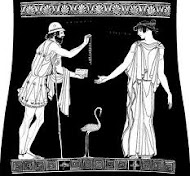

I have spoken of the importance of gifts in xenia before. A gift given as part of ritual hospitality was called a xenion (ξεινήιον). This xenion was expected to be expensive, and was presented to the guest upon departure. Needless to say, this practice was mostly executed by nobility, or at least the elite, and happened mostly when a man of equal social standing from another nation or city-state came to visit. In the Odysseia, Telemachos, son of Odysseus, receives from Menelaus a cup made by Hēphaistos Himself:

"But stay here in the palace, till the eleventh or the twelfth day, and I will send you off with honours, and fine gifts, a shining chariot with a trio of horses, and a glorious cup with which to pour libations to the deathless gods, while remembering me all your days."

The practice of gift giving to someone of another nation whom you might never see again, might seem counter-intuitive, but it's actually quite the opposite. By presenting a foreign equal with a great gift, not only do you establish kharis between the two of you, you also indebt the other person to you: they can not repay your kindness at this time, but they will compensate you for it when you visit, or when you are in need. On top of that, the recieving party will go home with tales of your hospitality, and your wealth, providing a boost in stature to the family and the land. It increases the honor of both, something very important to the ancient Hellenes. Gifts, in this context, functioned as a means of communication, legitimization, and mediation between benefactors and cities.

Beyond the elite, gift-giving was still very important, especially between men. The practice was a feature of the symposion, where it was displayed between men in a pederastic relationship, as well as between men of equal standing. Pederasty was where a mature male would take a young boy as his pupil and lover. The relationship was not about love: it was a social construct that allowed to boy time to get to know influential men, and to work himself up into their ranks. Because of this, there were many ritual acts connected to the practice, amongst which the giving of gifts, from mentor to pupil. Three gifts were traditional: military attire, an ox, and a drinking cup, but the youth most certainly received more expensive gifts.

One of the places the young lover would have been taken was the symposion. By allowing the young boy into the symposion it enabled the adults to prepare them for adult life and war in particular. Once the boys grew up, they became one of the men, taking young boys as lovers themselves, and teaching them the ropes of adult malehood. Gift giving in this context allows for a community to become closer, and for a young boy to prepare for his life as a man. Giving gifts--to their young lovers, as well as to those of equal age and standing--allowed men to teach the importance of equal distribution and redistribution of wealth, which was a founding factor of (mostly Athenian) society. It was also a status symbol: if one had time to visit the symposia, and give expensive gifts, they were not only citizens, but wealthy citizens, a clear mark that they were fit for greater responsibility within the political landscape of the city.

Most of these examples are from wealthy city-states like Athens, but there is evidence of gift-giving in other city-states as well. Sparta, for example, greatly frowned upon the flaunting of wealth, but they, too, gave gifts. These, however, were mostly practical in nature between the citizens themselves--fresh game, honey, perhaps a hunting dog--and were honors bestowed upon the person in the case of big events, or an a-symmetrical relationship. A Spartan winner of important sporting events, for example, would be allowed a place in the royal guard of the King, where Athenian winners would be set up for life, including food, housing, and status.

Another form of gift-giving was from a wealthy citizen to the community. This practice was dubbed 'Euergetism', from the Hellenic 'εὐεργετέω': 'I do good things'. While the money spent this way was, indeed a voluntary action on the part of the citizen, he was socially obligated to participate in the practice. Many roads and public buildings were funded this way, and thus bore the name of the citizen that had donated the funds--something we find archeological evidence for to this day.

Gift giving was of vital importance in the Archaic and Early Classical times, most notably in a social, ethical, economic, and political context. In the Classical period--which witnessed the development of elaborate monetary and law systems--the giving of gifts, and the associated benefits, became less prominent in economic and political contexts, though it did remain central in social and religious systems. Gift-giving and reciprocity did return to the Athenian stage, however, in the Hellenistic age, when much of the previously described took place.

Gift giving was of unparalleled important to the ancient Hellenes, but has lost much of its standing today. For those who reconstruct the ancient Hellenic religion, it might be a good exercise to examine these practices, and implement a symbolic exchange. Lavish gifts would not be necessary, but a parting gift by the host on days then the group comes together might make a nice, ritualistic, reminder that the contributions of the group were welcomed, and the effort to travel to the meeting place recognized--after the pandemic, of course!

This Christmas, we'll do door drop-offs with the family and then we're all meeting on Zoom from the safety of our own homes to unwrap the gifts we've gotten and read the poems we write along with them out loud to one another. You make do in a pandemic! 

Stay safe this season and stay smart. It's just one Christmas, the risks are not worth it.

Image taken from: Sparta Reconsidered
Every day, the average human utters about 16.000 words. A good portion of those are idioms and figures of speech--the use of a word or words diverging from its usual meaning--or sayings. Today, I wanted to share some of the figures of speech and sayings that can be traced back to ancient Hellas and/or Hellenic myth. Some of these I have posted before, but I've collected another few in the mean time. These are marked with a *.


"A Herculean Effort"
Meaning: a great effort.
Source: Hēraklēs, son of Zeus and the mortal Alcmene--who was a bane in Hera's life, simply for being born--was stricken mad by the Queen of the Gods and killed his five sons by his wife Megara, oldest daughter of Kreōn of Thebes. When he was released from his madness by a hellebore potion--provided by Antikyreus--and realized what he had done, he cried out in anguish, and went on a long journey to cleanse himself of the miasma caused by these killings. First, he visited the oracle at Delphi, who, unbeknownst to him, was whispered to by Hera. The Oracle told Hēraklēs to serve the king of Tiryns, Eurystheus, for ten years and do everything Eurystheus told him to do. Eurystheus gladly provided Hēraklēs with these labors--ten of them, one for each year--and eventually ended up adding two more, resulting in the Twelve Labors of Hēraklēs. Hēraklēs was told to: slay the Nemean Lion, slay the nine-headed Lernaean Hydra, capture the Golden Hind of Artemis, capture the Erymanthian Boar, clean the Augean stables in a single day, slay the Stymphalian Birds, capture the Cretan Bull, steal the Mares of Diomedes, obtain the girdle of Hippolyta, Queen of the Amazons, obtain the cattle of the monster Geryon, steal the apples of the Hesperides, and to capture and bring back Kerberos. All of these tasks were incredibly hard, and required every ounce of strength Hēraklēs possessed.

"A Sisyphean task"
Meaning: (performing) an endless or repetitive task.
Source: Sísyphos was a scheming and conniving king, who tried to pull a fast one on the Gods many times over. He betrayed Zeus, tried to trick Thanatos, Persephone and Hades, and killed innocent travelers on his roads--an offense against xenia. For all these offenses, Sísyphos was sentenced to push a boulder uphill for all eternity, as the boulder would roll down the slope again the second he reached the top.

"Achilles' heel"
Meaning: one's weakness or weak spot.
Source: Achilles was a great warrior, destined to live one of two lives: a long and boring one, or a short but heroic one. Knowing her son would choose the latter, his divine mother Themis tried to limit the risk of Achilles dying a premature death by dipping him in the river Styx. As such, Achilles became impenetrable to harm, save for his heel, where his mother had held him as she dipped him in the water. This spot eventually became his downfall, and Achilles died on the battlefield of Troy. The stories of his invulnerability were a later invention, around the first century AD. Before that, the myth simply stated that Achilles was shot in the heel with an arrow, and he eventually died of that wound, because it would not heal.

"Bearing the weight of the world (on one's shoulders)" *
Meaning: a very heavy burden of worry or responsibility.
Source: This is a reference to Atlas, the Titan who was forced to carry the heavens on his shoulders after he and his brethren rebelled against Zeus in the Titanomachy. Depending on the source, however, it was actually a great honour to be asked to protect the whole of the earth from being crushed under the weight of the sky.

"Beware of Greeks bearing gifts"
Meaning: be weary of those with something to offer, they may have ulterior motives.
Source: In the war for Troy, the Hellenes needed a way to conquer the walls of the city. They tried to fight for it, but were unable to. In Virgil's Aeneid, it is written that the Hellenes built a wooden horse, and hid away in it. The horse was offered to the Trojans as a gift, and the structure was accepted into the city. At night, the Hellenes snuck out of the horse, attacked the city, and conquered Troy.

"Caught between a rock and a hard place"
Meaning: making a hard choice; choosing between two undesirable options.
Source: During Odysseus' travels to get home, he must run his ship through a narrow passage. One the one side are rocks with a cavern. In this cavern, Skylla, sea monster with six heads, lived, and she would take one of Odysseus' men with each of her heads. On the other side lay Kharybdis, a great whirlpool which would suck in any ship that came too close. It is up to Odysseus to choose one or the other. Eventually, he chooses Skylla, and looses many brave men, his ship, however, is in tact. As such, Odysseus had to choose between a rock and a hard place.

"Cupid's arrows" *
Meaning: rapidly falling in love--as if struck.
Source: The ancient Hellenes were just as mystified by love as we are today--more so, perhaps, because a least we know what happens chemically in our bodies when it happens. Their answer to the mystery of falling in love was that the arrow of Eros struck. Eros had two types of arrows: the golden-tipped arrow brought love and attraction, the lead-tipped arrow brought hate and repulsion. Cupid is the Roman version of Eros.

"Dog is man's best friend"
Meaning: the loyalty of dogs is undisputed
Source: In the Odysseia, Odysseus finally returns home after many, many long years of travel, and long years of war. He is in disguise when he reaches his house, which is overrun by suiters of his wife. His fateful hunting dog, Argos, has waited for him all these years, and recognizes his master right away. Finally reunited with his master, the old dog dies, happy, and at peace.

"Food of the Gods"
Meaning: food so delicious, it is almost divine
Source: Nectar--the drink of the Gods--and ambrosia--the food of the Gods--are the dish of choice on Olympos. If a mortal man or woman would eat or drink either of the two, they, too, would become immortal, or at least their aging would stop for a while.

"Gordian knots"
Meaning: an extremely perplexing puzzle or problem.  
Source: It seems that king Gordius of Phrygia laid out a task for whomever wanted to be the ruler of Asia Minor: he tied a know so complex, no one managed to untie is. Eventually, Alexander the Great came to the land, and cut the know with his sword, thus 'passing' the test. 'Cutting the knot' became a saying for taking something by force, or making a decisive action. 

"Having the Midas touch"
Meaning: a fortunate person, someone able to make everything a success.
Source: In Hellenic mythology, Midas was the king of Pessinus. It seems some of the peasants under Midas' commands brought the king the unconscious satyr Seilenos, who had drunk himself into a stupor. Alternatively, Seilenos toppled over in Midas' garden. No matter how he got there, Midas took good care of him, and as a token of appreciation, Dionysos--Seilenos' student--offered Midas a wish. Midas wished that everything he touched, turned to gold. This is where the saying comes from.

"Hounds of Hell"
Meaning: something frightening, or evil.
Source: Guarding the entrance to Underworld is a great dog, either with just one head, or three, or fifty. His name is Kerberos, and you can pass him once, on your way in, but never again, as there is no way out.

"Leave No Stone Unturned"
Meaning: search everywhere.
Source: The catch-phrase was first recorded by Euripides in his tragedy 'Heracleidae'. The play focusses on King Eurystheus, who hunts the children of Hēraklēs after he passes away. The actual quote comes from the line: "Now, after he was taken hence, was I not forced, by reason of these children's hatred, and because I was conscious of an hereditary feud, to leave no stone unturned by slaying, banishing, and plotting against them?"

"Oedipus Complex"
Meaning: a child's unnatural desire of their parent of the opposite sex, and jealousy of the parent of the same sex. Freudian theory.
Source: Oedipus was born to King Laius and Queen Jocasta. King Laius was fortold his son would kill him and marry his mother, and so he left him to die on a mountainside. The child was found, however, and raised by King Polybus and Queen Merope. Oedipus eventually heard of the prophecy about him and fled, not wanting to hurt his adoptive parents, who he believed to be his biological ones. Fate would have him end up on the same road as King Laius, and in an argument over whom would step out of the way, Oedipus killed his father. He then traveled on and eventually met and married his mother. The myth continues on, but this is the part where the figure of speech comes from.

"Pandora's box"
Meaning: to perform an action that may seem small or innocuous, but that turns out to have severe and far-reaching consequences.
Source: I've written quite a bit about Pandôra on this blog. Pandôra was created by the Theoi as punishment on humanity after Prometheus stole fire from the Gods. Pandôra showed up on the doorstep of Prometheus' brother Deukalion, with a pithos she was told never to open. Eventually, curiosity got the better of her,a nd she opened the jar. In some versions of the myth, all evils of the word flew out, but Pandôra managed to trap hope in the jar. There are many, many inconsistencies in the myth, but the figure of speech stuck.

"Pregnant with thought" *
Meaning: to be about to put forth a (great) idea.
Source: Potentially, this idiom comes from Greek mythology--namely the birth of Athena from the head of Zeus. Athena, as Goddess of wisdom represents a literal birth of ideas--which is pretty much the meaning.

"Siren's song" *
Meaning: an alluring utterance or appeal, especially one that is seductive or deceptive.
Source: In the Odysseia, Circe warned Odysseus not to listen to the Sirens--mythological mermaids--because their haunting music would drive him mad. Or if he did, at least have his sailors tie him to the mast to keep him from throwing himself overboard, and to plug his rowers ears’ with beeswax so they would be impervious to the sweet high song.

"Stygian darkness" *
Meaning: pitch black, sometimes dreary, darkness.
Source: The river Styx was the boundary between the upper world of the living and the underworld of the dead. It was so inky black that anything under its surface disappeared from sight.

"The face that launched a thousand ships"
Meaning: one person causing a terrible event.
Source: One fateful day, three Goddesses got into an argument about whom was most beautiful. Hera, Aphrodite, and Athena, all laid claim to a golden apple tossed into the crowd at a banquet held on honor of Peleus and Thetis. Eris had thrown the apple, which was labeled 'for the most beautiful'. The Goddesses could not decide who was the fairest, and so They asked Zeus. Zeus appointed Paris, A Trojan mortal, to choose in his stead. All three Goddesses undressed for Paris when asked, and all offered him gifts, if he would choose them. Aphrodite, however, promised him the most beautiful of wives, and PAris chose Her. Aphrodite picked Helen of Sparta as Paris' new wife, but Helen was already married, to Menelaus, who would eventually bring war down upon Troy to reclaim the wife he lost. Helen became the woman whose face 'launched a thousand ships' in war.

"To rise from the ashes"
Meaning: to be reborn
Source: No singular myth about the famous bird survives, but the phoenix was know to the ancient Hellenes. It was a mythical bird that lived its life, immolated, and was reborn from the ashes of its previous incarnation.
Sometimes, I think pop culture helps us relate far better to the ancient writings than any in-depth discussion ever could. Of course, I would encourage one of those discussions after getting the basics from pop culture, but the point here is: pop culture does one thing very well: filter out the basics. I've been reading the Odysseia again, as a homage to Athena for the Panathenaia and while looking something up, I stumbled upon the TVTropes.org versions of the Iliad and the Odysseia. From Wikipedia:

"TV Tropes, also known as Television Tropes and Idioms, is a wiki that collects and expands on various conventions and devices (tropes) found within creative works. Since its establishment in 2004, the site has gone from covering only television and film tropes to also covering those in a number of other media such as literature, comics, video games, and even things such as advertisements and toys. It is known for approaching topics in a casual and humorous tone—cyberpunk author Bruce Sterling once described its style as a "wry fanfic analysis.""

I love TVTropes, and browse there regularly. I just never realized they had also taken on the Iliad and Odysseia. One thing TVTropes does very well is remove the grey and ambiguous; they put labels on everything and give a reason for that. I know some people will find this incredibly annoying, because a lot of nuance is lost, but it also brings to the foreground a couple of points you might otherwise have missed. I'll give you a few examples for both tomes and then you decide: useful or not?

The Iliad
  • Anti-Hero: At the time of the tale's origin, Achilles was definitely not an antihero, but due to Values Dissonance, many readers see Achilles as a colossal Jerk Ass and are more sympathetic to Hector, who is not a nice guy either.
  • Armor Is Useless: Played with. Oddly enough, whether a warrior's armor protects him or not depends on how much Plot Armor he has; in a sense, the real armor is used as a Handwave for Plot Armor. At any rate, this is a Defied Trope in-universe, considering that every time a warrior dies there is a fight over who gets to keep the armor.
  • Big Brother Instinct: Agamemnon to Menelaus. Seriously, don't hurt his little brother.
  • Bond One-Liner: After spearing Cebriones and causing him to backflip out of his chariot, Patroclus remarks that he'd make a good oyster diver. Of course, this being The Iliad, it's a bit longer than one line.
  • Did You Just Flip Off Cthulhu?: Early on, Helen gives Aphrodite a piece of her mind. Aphrodite puts her in her place shortly afterward, but damn, girl!
  • Due to the Dead: Proper respect towards corpses is very, very, very important in The Iliad. Fights over corpses are common, with the fallen man's allies striving to give the corpse a proper burial and the enemy wanting to desecrate it. There are also occasional truces to allow both sides to recover their dead.
  • Good Cop/Bad Cop: Odysseus and Diomedes were on a night raid and captured the hapless but useful Dolon. Bad cop Diomedes said to stand still or die. Good cop Odysseus said, "Fear not, let no thought of death be in your mind." It went on like that for awhile until Diomedes "struck him in the middle of his neck with his sword and cut through both sinews so that his head fell rolling in the dust while he was yet speaking."
  • Loads and Loads of Characters: And roughly 70% of them get killed off.
  • Sacred Hospitality: One of the more famous examples in literature. Paris steals Helen while he's a guest in her and Menelaus' home. While the act has plenty of political ramifications, it's the breach of hospitality that causes such an uproar, and is used to rouse the entire army of Greece to sack Troy in response.
  • Shipper on Deck: Agamemnon becomes exponentially funnier if you view him as a Helen/Menelaus shipper. It's not even inaccurate.
  • We Are As Mayflies: Homer returns to this idea repeatedly, expressing it through a metaphor likening human beings to leaves as autumn approaches.
  • What Happened to the Mouse?: Aeneas. Just as Achilles is about to kill him, the Gods save his life and declare that after the war, he shall be the leader of all future Trojans. He's rarely mentioned again, and then only in passing. 800 years later, Virgil decided to make this a Brick Joke.
  • Why Don't You Just Shoot Him?: The Trojans could have just given Helen back to avoid total annihilation, but this would have gone completely against Greek culture, and certainly would have made a lousy story. The Trojans are actually ready to do this after Menelaus beats Paris in their duel, but an archer on the Trojan side shoots at Menelaus during the intervening truce, restarting the war.
The Odysseia
  • Accidental Pornomancer: On his way home, Odysseus spends years as the bedmate of two beautiful women: the Hot Witch, Circe, and the sea nymph, Calypso. Neither options were by choice, and Odysseus is typically justified in that he never stopped loving or wishing to return to his wife.
  • Bolt of Divine Retribution: Athena threatens one of these in the last book when Odysseus tries to go to war again.
  • Brains: Evil; Brawn: Good: While Greeks valued Odysseus' cleverness, the rigid he-men Romans hated his deceitfulness and portrayed him much less sympathetically. It helps that he fought against the Trojans, whom Romans believed were forerunners to their own culture.
  • Hachiko: Odysseus' dog predates the trope namer, waiting faithfully for his master before dying shortly after his return. In some interpretations he dies happy, but according to Homer Odysseus is forced to pretend he doesn't know the dog, making this a Tear Jerker.
  • Happiness in Slavery: As described in the epic, slaves and masters were not as far apart as in other ages, for instance the swineherd Eumaios was raised by Odysseus' mother Anticleia almost like a son alongside her daughter Ktimene, and became wealthy enough to buy a slave of his own. And Menelaos makes Megapenthes, his son by a slave, his heir.
  • I Am A Humanitarian: Not only Polyphemus, but also the Lestrigonian, who ate several of Odysseus crewmembers.
  • Impossibly Delicious Food: We know, we know, never refuse free food, but it's probably not a good idea to accept handouts from the Lotus-Eaters.
  • Nice Job Breaking It, Hero: Odysseus and his remaining crew escape from the cyclops, when Odysseus has a fit of hubris and mocks the injured cyclops along with revealing his true identity. Sure, the mountaintop that is thrown at the ship misses. The raging storms, however, do not.
  • Random Events Plot: Odysseus' actual voyage, which is the most famous part of the story. By contrast, the parts about Ithaca, Telemachus, the suitors, etc. have a normal plotline to them.
  • Rocks Fall, Everyone Dies: Helios sics Zeus on your ass, lightning falls, everyone dies.
  • The Thing That Would Not Leave: The suitors, for three years at least.
  • Who's on First?: Possibly the oldest example in the book. Odysseus told Polyphemus his name was "Nobody" (μη τις). When the Cyclops started screaming that he had been blinded, his brothers asked who had done this foul deed. The Cyclops replied that "Nobody has blinded me", so his brothers told him to shut up with the screaming over things that hadn't happened. As an added bit of wordplay, μητις (one word) meant "cunning" in Ancient Greek.
  • You Can't Fight Fate: What we would call an Overused Running Gag.
Giving gifts to friends, family members, or even acquaintances and complete strangers is a long standing tradition. It existed long before ancient Hellas, but was, indeed, a vital part of its culture. It was tied to both kharis and xenia. Gifts were exchanged between monarchs of city-states to create good will, and were thus an important part of diplomacy. All votives, thank-offerings, and pinakes were gifts from mortals to Theoi. Athletic competitions always concluded with a price--a gift--awarded to the winner. Gifts were given to the submissive partner in a pederastic relationship, and to favored prostitutes and serfs. Gifts played a much more significant role in ancient Hellenic society as a whole than they do in ours today. The giving of gifts in ancient Hellas was not just a social event, however. There was far more to the practice than one might assume, and today, we will look at the tradition of gift giving in greater detail.

I have spoken of the importance of gifts in xenia before. A gift given as part of ritual hospitality was called a xenion (ξεινήιον). This xenion was expected to be expensive, and was presented to the guest upon departure. Needless to say, this practice was mostly executed by nobility, or at least the elite, and happened mostly when a man of equal social standing from another nation or city-state came to visit. In the Odysseia, Telemachos, son of Odysseus, receives from Menelaus a cup made by Hēphaistos Himself:

"But stay here in the palace, till the eleventh or the twelfth day, and I will send you off with honours, and fine gifts, a shining chariot with a trio of horses, and a glorious cup with which to pour libations to the deathless gods, while remembering me all your days."

The practice of gift giving to someone of another nation whom you might never see again, might seem counter-intuitive, but it's actually quite the opposite. By presenting a foreign equal with a great gift, not only do you establish kharis between the two of you, you also indebt the other person to you: they can not repay your kindness at this time, but they will compensate you for it when you visit, or when you are in need. On top of that, the recieving party will go home with tales of your hospitality, and your wealth, providing a boost in stature to the family and the land. It increases the honor of both, something very important to the ancient Hellenes. Gifts, in this context, functioned as a means of communication, legitimization, and mediation between benefactors and cities.

Beyond the elite, gift-giving was still very important, especially between men. The practice was a feature of the symposion, where it was displayed between men in a pederastic relationship, as well as between men of equal standing. Pederasty was where a mature male would take a young boy as his pupil and lover. The relationship was not about love: it was a social construct that allowed to boy time to get to know influential men, and to work himself up into their ranks. Because of this, there were many ritual acts connected to the practice, amongst which the giving of gifts, from mentor to pupil. Three gifts were traditional: military attire, an ox, and a drinking cup, but the youth most certainly received more expensive gifts.

One of the places the young lover would have been taken was the symposion. By allowing the young boy into the symposion it enabled the adults to prepare them for adult life and war in particular. Once the boys grew up, they became one of the men, taking young boys as lovers themselves, and teaching them the ropes of adult malehood. Gift giving in this context allows for a community to become closer, and for a young boy to prepare for his life as a man. Giving gifts--to their young lovers, as well as to those of equal age and standing--allowed men to teach the importance of equal distribution and redistribution of wealth, which was a founding factor of (mostly Athenian) society. It was also a status symbol: if one had time to visit the symposia, and give expensive gifts, they were not only citizens, but wealthy citizens, a clear mark that they were fit for greater responsibility within the political landscape of the city.

Most of these examples are from wealthy city-states like Athens, but there is evidence of gift-giving in other city-states as well. Sparta, for example, greatly frowned upon the flaunting of wealth, but they, too, gave gifts. These, however, were mostly practical in nature between the citizens themselves--fresh game, honey, perhaps a hunting dog--and were honors bestowed upon the person in the case of big events, or an a-symmetrical relationship. A Spartan winner of important sporting events, for example, would be allowed a place in the royal guard of the King, where Athenian winners would be set up for life, including food, housing, and status.

Another form of gift-giving was from a wealthy citizen to the community. This practice was dubbed 'Euergetism', from the Hellenic 'εὐεργετέω': 'I do good things'. While the money spent this way was, indeed a voluntary action on the part of the citizen, he was socially obligated to participate in the practice. Many roads and public buildings were funded this way, and thus bore the name of the citizen that had donated the funds--something we find archeological evidence for to this day.

Gift giving was of vital importance in the Archaic and Early Classical times, most notably in a social, ethical, economic, and political context. In the Classical period--which witnessed the development of elaborate monetary and law systems--the giving of gifts, and the associated benefits, became less prominent in economic and political contexts, though it did remain central in social and religious systems. Gift-giving and reciprocity did return to the Athenian stage, however, in the Hellenistic age, when much of the previously described took place.

Gift giving was of unparalleled important to the ancient Hellenes, but has lost much of its standing today. For those who reconstruct the ancient Hellenic religion, it might be a good exercise to examine these practices, and implement a symbolic exchange. Lavish gifts would not be necessary, but a parting gift by the host on days then the group comes together might make a nice, ritualistic, reminder that the contributions of the group were welcomed, and the effort to travel to the meeting place recognized.

Image taken from: Sparta Reconsidered
Every day, the average human utters about 16.000 words. A good portion of those are figures of speech--the use of a word or words diverging from its usual meaning--or sayings. Today, I wanted to share some of the figures of speech and sayings that can be traced back to ancient Hellas and/or Hellenic myth.


"A Herculean Effort"
Meaning: a great effort.
Source: Hēraklēs, son of Zeus and the mortal Alcmene--who was a bane in Hera's life, simply for being born--was stricken mad by the Queen of the Gods and killed his five sons by his wife Megara, oldest daughter of Kreōn of Thebes. When he was released from his madness by a hellebore potion--provided by Antikyreus--and realized what he had done, he cried out in anguish, and went on a long journey to cleanse himself of the miasma caused by these killings. First, he visited the oracle at Delphi, who, unbeknownst to him, was whispered to by Hera. The Oracle told Hēraklēs to serve the king of Tiryns, Eurystheus, for ten years and do everything Eurystheus told him to do. Eurystheus gladly provided Hēraklēs with these labors--ten of them, one for each year--and eventually ended up adding two more, resulting in the Twelve Labors of Hēraklēs. Hēraklēs was told to: slay the Nemean Lion, slay the nine-headed Lernaean Hydra, capture the Golden Hind of Artemis, capture the Erymanthian Boar, clean the Augean stables in a single day, slay the Stymphalian Birds, capture the Cretan Bull, steal the Mares of Diomedes, obtain the girdle of Hippolyta, Queen of the Amazons, obtain the cattle of the monster Geryon, steal the apples of the Hesperides, and to capture and bring back Kerberos. All of these tasks were incredibly hard, and required every ounce of strength Hēraklēs possessed.

"A Sisyphean task"
Meaning: (performing) an endless or repetitive task.
Source: Sísyphos was a scheming and conniving king, who tried to pull a fast one on the Gods many times over. He betrayed Zeus, tried to trick Thanatos, Persephone and Hades, and killed innocent travelers on his roads--an offense against xenia. For all these offenses, Sísyphos was sentenced to push a boulder uphill for all eternity, as the boulder would roll down the slope again the second he reached the top.

"Achilles' heel"
Meaning: one's weakness or weak spot.
Source: Achilles was a great warrior, destined to live one of two lives: a long and boring one, or a short but heroic one. Knowing her son would choose the latter, his divine mother Themis tried to limit the risk of Achilles dying a premature death by dipping him in the river Styx. As such, Achilles became impenetrable to harm, save for his heel, where his mother had held him as she dipped him in the water. This spot eventually became his downfall, and Achilles died on the battlefield of Troy. The stories of his invulnerability were a later invention, around the first century AD. Before that, the myth simply stated that Achilles was shot in the heel with an arrow, and he eventually died of that wound, because it would not heal.

"Beware of Greeks bearing gifts"
Meaning: be weary of those with something to offer, they may have ulterior motives.
Source: In the war for Troy, the Hellenes needed a way to conquer the walls of the city. They tried to fight for it, but were unable to. In Virgil's Aeneid, it is written that the Hellenes built a wooden horse, and hid away in it. The horse was offered to the Trojans as a gift, and the structure was accepted into the city. At night, the Hellenes snuck out of the horse, attacked the city, and conquered Troy.

"Caught between a rock and a hard place"
Meaning: making a hard choice; choosing between two undesirable options.
Source: During Odysseus' travels to get home, he must run his ship through a narrow passage. One the one side are rocks with a cavern. In this cavern, Skylla, sea monster with six heads, lived, and she would take one of Odysseus' men with each of her heads. On the other side lay Kharybdis, a great whirlpool which would suck in any ship that came too close. It is up to Odysseus to choose one or the other. Eventually, he chooses Skylla, and looses many brave men, his ship, however, is in tact. As such, Odysseus had to choose between a rock and a hard place.

"Dog is man's best friend"
Meaning: the loyalty of dogs is undisputed
Source: In the Odysseia, Odysseus finally returns home after many, many long years of travel, and long years of war. He is in disguise when he reaches his house, which is overrun by suiters of his wife. His fateful hunting dog, Argos, has waited for him all these years, and recognizes his master right away. Finally reunited with his master, the old dog dies, happy, and at peace.

"Food of the Gods"
Meaning: food so delicious, it is almost divine
Source: Nectar--the drink of the Gods--and ambrosia--the food of the Gods--are the dish of choice on Olympos. If a mortal man or woman would eat or drink either of the two, they, too, would become immortal, or at least their aging would stop for a while.

"Gordian knots"
Meaning:an extremely perplexing puzzle or problem.  
Source: It seems that king Gordius of Phrygia laid out a task for whomever wanted to be the ruler of Asia Minor: he tied a know so complex, no one managed to untie is. Eventually, Alexander the Great came to the land, and cut the know with his sword, thus 'passing' the test. 'Cutting the knot' became a saying for taking something by force, or making a decisive action. 

"Having the Midas touch"
Meaning: a fortunate person, someone able to make everything a success.
Source: In Hellenic mythology, Midas was the king of Pessinus. It seems some of the peasants under Midas' commands brought the king the unconscious satyr Seilenos, who had drunk himself into a stupor. Alternatively, Seilenos toppled over in Midas' garden. No matter how he got there, Midas took good care of him, and as a token of appreciation, Dionysos--Seilenos' student--offered Midas a wish. Midas wished that everything he touched, turned to gold. This is where the saying comes from.

"Hounds of Hell"
Meaning: something frightening, or evil.
Source: Guarding the entrance to Underworld is a great dog, either with just one head, or three, or fifty. His name is Kerberos, and you can pass him once, on your way in, but never again, as there is no way out.

"Leave No Stone Unturned"
Meaning: search everywhere.
Source: The catch-phrase was first recorded by Euripides in his tragedy 'Heracleidae'. The play focusses on King Eurystheus, who hunts the children of Hēraklēs after he passes away. The actual quote comes from the line: "Now, after he was taken hence, was I not forced, by reason of these children's hatred, and because I was conscious of an hereditary feud, to leave no stone unturned by slaying, banishing, and plotting against them?"

"Oedipus Complex"
Meaning: a child's unnatural desire of their parent of the opposite sex, and jealousy of the parent of the same sex. Freudian theory.
Source: Oedipus was born to King Laius and Queen Jocasta. King Laius was fortold his son would kill him and marry his mother, and so he left him to die on a mountainside. The child was found, however, and raised by King Polybus and Queen Merope. Oedipus eventually heard of the prophecy about him and fled, not wanting to hurt his adoptive parents, who he believed to be his biological ones. Fate would have him end up on the same road as King Laius, and in an argument over whom would step out of the way, Oedipus killed his father. He then traveled on and eventually met and married his mother. The myth continues on, but this is the part where the figure of speech comes from.

"Pandora's box"
Meaning: to perform an action that may seem small or innocuous, but that turns out to have severe and far-reaching consequences.
Source: I've written quite a bit about Pandôra on this blog. Pandôra was created by the Theoi as punishment on humanity after Prometheus stole fire from the Gods. Pandôra showed up on the doorstep of Prometheus' brother Deukalion, with a pithos she was told never to open. Eventually, curiosity got the better of her,a nd she opened the jar. In some versions of the myth, all evils of the word flew out, but Pandôra managed to trap hope in the jar. There are many, many inconsistencies in the myth, but the figure of speech stuck.

"The face that launched a thousand ships"
Meaning: one person causing a terrible event.
Source: One fateful day, three Goddesses got into an argument about whom was most beautiful. Hera, Aphrodite, and Athena, all laid claim to a golden apple tossed into the crowd at a banquet held on honor of Peleus and Thetis. Eris had thrown the apple, which was labeled 'for the most beautiful'. The Goddesses could not decide who was the fairest, and so They asked Zeus. Zeus appointed Paris, A Trojan mortal, to choose in his stead. All three Goddesses undressed for Paris when asked, and all offered him gifts, if he would choose them. Aphrodite, however, promised him the most beautiful of wives, and PAris chose Her. Aphrodite picked Helen of Sparta as Paris' new wife, but Helen was already married, to Menelaus, who would eventually bring war down upon Troy to reclaim the wife he lost. Helen became the woman whose face 'launched a thousand ships' in war.

"To rise from the ashes"
Meaning: to be reborn
Source: No singular myth about the famous bird survives, but the phoenix was know to the ancient Hellenes. It was a mythical bird that lived its life, immolated, and was reborn from the ashes of its previous incarnation.
One of the most important practices within Hellenismos and ancient Hellenic orthopraxy is kharis (xάρις). Kharis is--to give an incredibly limited definition--the act of giving to the Gods so They might give something in return. It's religious reciprocity. It's also so much more.

Kharis is an important word. It means everything from beauty to joy, delight, kindness, good will, grace, favor, benefit, boon, charm, attraction, appeal, elegance, gracefulness, pleasure, cheerfulness, wit, gratitude, thankfulness and gratification. It's the name of a Goddess as well; the Goddess of Grace and Beauty. This seems to complicate matters, but it actually ties in pretty well.

When we, in Hellenismos, petition the Gods for aid, we always do so with an offering. This offering can be incense, a libation, a food offering or anything else. It must be something tangible. Good thoughts and intentions don't count. This offering is given freely, joyfully, with pleasure, out of respect and love for the Gods. We ask what we feel we need--sometimes that's a new job, sometimes just a vague sentiment like honor and prosperity to the household--and never expect to be granted this request. Petitions aren't bribery. We give to the Gods and should They feel inclined to grand us our request, we thank Them by offering to them again, to which the Gods might respond, to which we will sacrifice, and so on. This circular practice of voluntary giving is called kharis.

Kharis is one of the pillars of Hellenismos, together with xenia and katharmos. Those who practiced kharis properly in ancient Hellas were seen as humble, grateful and good people in general. Kharis is the base of a good few words we use to describe related acts and characteristics to this day; charisma, for instance, and charity. To word it differently; kharis represents your reputation with a specific Deity.

Building a relationship with the Theoi was vital for the ancient Hellens and it's vital in Hellenismos today. It's the foundation of daily practice, of the large-scale festivals of old, of Xenia, katharmos and the whole of Hellenismos. You can't practice Hellenismos without striving for a reciprocal relationship with the Gods. This means investing in the Theoi; living with Them every day and learning as much about Them as you can. It means leaving bread for the Nymphs, it means upholding your household shrines, it means practicing, even when limited, it means assuming that, when good things happen, it's by the hands of the Gods you have been given this bout of good luck, and thanking Them with offerings.

Petitions were said to have a greater chance of being granted when the sacrifice was grand and--more importantly--done correctly and to the right Deity. While ancient Hellens often petitioned the Gods they had good kharis with, often Gods ruling over certain domains were also appeased. An example from Hómēros' Odysseia as Menelaus is prevented from leaving Pharos;

"Though I was anxious to return, the gods kept me in Egypt, because I failed to offer the right sacrifice, and they want men ever to remember their commandments. Now there is an isle in the sea-surge off the mouth of the Nile, that men call Pharos, a day’s run for a hollow ship with a strong wind astern. There’s a good anchorage there, a harbour from which men launch their trim ships into the waves, when they have drawn fresh black water. The gods kept me there for twenty days, with never a sign of wind on the sea to speed our ship over the wide waters. All my stores, and my crew’s strength would have been lost, if a divinity had not pitied me and saved me. Eidothee, it was, the daughter of mighty Proteus, Old Man of the Sea, because I stirred her heart most of all. She met me as I walked alone, far from my men, who, pinched by hunger, roamed the shore fishing with barbed hooks.

She approached me, saying: “Stranger, are you a fool and slow-witted, or willingly trapped, and happy to suffer? You have been penned here so long you can see no end to it, and your men are losing heart.” So she spoke and I replied: “Whichever of the goddesses you are, I assure you I am not willingly trapped here, but it seems I have sinned against the deathless ones who hold the wide heavens. Tell me, since you gods know everything, which of the immortals holds me here, hindering my path, and tell me how to return over the teeming sea."

Menelaus is prevented from leaving because he has not appeased the right Deity. The appeasing of Deities, ghosts and Daímons is part of Hellenismos as well, and related to kharis. Kharis is build with appeased Gods, ghosts, Daímons as well as petitioned Gods. It was--and is--not uncommon to proclaim 'If I have offered to You once, please, grant my request' when petitioning the Gods for aid. This way, kharis is invoked and the petition has a better chance of being granted.

I need to make a note here, again, to say that the granting of a petition was not expected. It was appreciated, yes, but no one found fault with the Gods if the petition was not fulfilled. They would look into themselves to see if they had done something incorrectly and else assume that by not granting the request, the Gods helped them along anyway. They might seek out oracles for guidance on how best to approach the Gods with this or another problem and offer offerings of gratitude none the less.

Kharis is continuously build with the Deities we petition and honor. Simply reading to Them Their hymns or myths helps build kharis. Offerings of any kind helps build kharis. Dedicating events or activities to a certain God builds kharis; a campfire meeting to Hestia, for example, or the victory in a soccer match to Nikè. There are countless of ways to involve the Theoi in your daily life and build a relationship with Them. One of the most fundamental ways is to be ever-mindful of your kharis with a certain deity and to build upon the foundation you have. 
I was actually going to save this subject for a Pagan Blog Project post--as the ancient Hellenic word for hospitality is Xenia and, really, how many words starting with an 'X' are there that apply to Hellenismos and/or Paganism?--but the X's are still a long way away and I think the subject is important. I'm therefor deciding that I'll find a new X to discuss when the time comes and will be talking about hospitality in relation to ancient Hellenic culture, religion and Hellenismos today.

Hospitality in ancient Hellenic was a complicated ritual within both the host and the guest has certain roles to fill and tasks to perform. Especially when someone unknown to the host came to the door, the ritual held great value. This ritual practice of hospitality was called 'xenia' (ξενία) and is described a lot in mythology. This, because any unknown traveler at the door could be a Theos or Theia in disguise or they could even be watched over by a Theos who would pass judgement on the host. 

Hómēros, in the Odysseia, gives the following description of a guest being received at the door to the house; in this case by Athena, who is disguised as Mentes, as greeted by Telemachos, son of Odysseus.

"...Godlike Telemachus, sitting troubled among the suitors, imagining how his noble father might arrive from somewhere, throw the suitors from the palace, win honour and rule his own again, was first to see her. Thinking of it, sitting among the suitors, he saw Athene, and went straight to the doorway, ashamed a stranger should wait so long at the gates. Approaching her, he clasped her right hand, took her spear of bronze, and spoke to her winged words: ‘Welcome, stranger, here you will find hospitality, and after you have eaten you may tell us why you are here.’

At this, he led the way, and Pallas Athene followed. Once inside the high hall, he took the spear and set it in a polished rack by a tall pillar, with other spears that belonged to loyal Odysseus. He led Athene herself to a handsome, richly carved chair, spread a linen cloth over it, and seated her there with a footstool for her feet. He drew up on ornate stool for himself, as well, away from the Suitors, lest the stranger should shun the food, annoyed by the din, finding himself in a crowd of insolent men: and so he might ask news of his absent father. Next a maid brought water in a fine gold jug, and poured it over a silver basin, so they could rinse their hands: then drew up a polished table. The housekeeper silently brought them bread, and various delicacies, drawing liberally on her store. And a carver lifted plates of different meats, and set them down with gold cups beside them, while a steward, constantly walking by, poured the wine."

There are several things of interest to note in these passages; a guest should not have to wait to be greeted, they must always be accepted into the house and offered the best of everything, an inquiry as to the nature of the visit is delayed until the guest has eaten, recovered from the journey and sometimes--as found in other sources--has bathed and/or slept. Often, everything is set aside to help the guest with his or her quest because it was assumed no man or woman left their home unless they really had to.

Next to this, there are two other important rules concerning Xenia; the guest is expected to be courteous and not be a burden to the host and, and this is very important, the host must give the guest a parting gift--a xenion (ξεινήιον). The more valuable the gift, the better. In fact, Telemachos receives from Menelaus a cup made by Hēphaistos Himself:

"But stay here in the palace, till the eleventh or the twelfth day, and I will send you off with honours, and fine gifts, a shining chariot with a trio of horses, and a glorious cup with which to pour libations to the deathless gods, while remembering me all your days."

Mythology has a lot of examples of Theoi disguising themselves as beggars or undesirables. The host is judged on the hospitality offered. Good things befall those who treat guests with respect, very bad things befall those who do not. One of my favorite Hellenic myths shows this in great detail; it's the story of how Baucis and Philemon received some unexpected visitors. You can read a long version of the myth here but it comes down to this: 

"Zeus and His son Hermes descended to earth to test the hospitality of the little town that is home to the elderly couple of Baucis and Philemon, who live in a run down hut a little ways away from the small, rural village. The Gods are dressed as simple travelers, weary from their long journey on foot. They knock on the doors of all of the houses in the village but find no one willing to open the door and take them in. With every house the Gods pass, the anger of the Gods rises, but before They punish this town for their despicable ways, They decide to test the last house in the village as well; the house of Baucis and Philemon. 

It is Philemon who opens the door after the first knock and begs the travelers to enter. The hut is tiny and the two, who have been together for almost all of their long years, have not much to give. Still, the two bustle around the hut to repair enough stools for all to sit, to find enough food for all to eat and, as the night progresses, enough places for all to sleep. Neither Baucis nor Philemon realizes the true nature of their guests until they realize the small jug of wine has not run out, betraying the divinity of their guests.

Both Baucis and Philemon throw themselves down in front of the Gods, begging for forgiveness for such a sorry welcome but the Gods, who have not been offended in the least, beg them to rise and walk out with Them, to the top of the hill. There, Zeus turns to the village and floods the valley completely, killing all residents. He spares the hut that belongs to Baucis and Philemon and even transforms it into a temple. He then asks what favor the pair would want from the Gods, as they have truly deserved one. The pair asks to honor the Gods for their remaining eyars in the temple created below and ask that, when their dying day comes, that they may go together so they will never be without the other. This, the Gods grant happily."

With stories like this, it's easy to see why hospitality was so important in ancient Hellas, and holds a vital role in Hellenismos today. Not only do the Gods punish those who do not show proper Xenia, They reward those who do--handsomely, I might add. 

One God in particular watches over guests and the practice of xenia; Zeus Xenios, an epithet of Zeus. It was to him, libations were poured when a guest arrived. Two example from the Odysseia; the first as Odysseus washes ashore Phaeacia and declares himself to Nausicaa, the second as he meets Nausicaa's father Alcinous.

"...With this she called to her lovely maids: ‘Stop, girls, why do you shun the sight of a man? Surely you don’t imagine he’s unfriendly? There will never be mortal man so contrary as to set hostile feet on Phaeacian land, for we are dear to the gods. We live far-off, over the turbulent sea, the remotest of races, and deal with no other peoples. This man must instead be some luckless wanderer, landed here. We must care for him, since all strangers and beggars come from Zeus, and even a little gift is welcome. So bring him food and drink, girls, and bathe him in the river wherever there’s shelter from the wind."

"With this he sat down in the hearth’s ashes, close to the fire, and all remained silent. At last one of the Phaeacian elders, noble Echeneus, eloquent and wise, spoke to them. Helpfully, he addressed the gathering, saying: ‘Come, Alcinous, it is not right and proper that a stranger should sit there in the ashes of the hearth, while we all hold back awaiting your lead. Raise the stranger to his feet, and seat him on a silver-embossed chair, and let the heralds mix the wine, so that we may pour libations to Zeus as well, who hurls the lightning and follows the footsteps of holy suppliants. And let the housekeeper feed him supper from her store.'"

In contemporary culture, hospitality has lost much of its meaning and practice. Gifts are brought for the host these days, refills are in the fridge, staying for dinner is only possible if you have and appointment, etc. Bringing back some of the old hospitality customs might not be a bad thing at all. It would sure bring us closer as a community and, really, it would be wonderful to knock on the door of a house when you're in need and know that you would receive all the help the host can possibly give.