Showing posts with label Mēdeia. Show all posts

There are many well known chariots and charioteers in ancient Hellenic mythology. All of the Theoi have one, and Helios and Apollon use one to bring light to the world. Hades kidnapped Persephone with His. Kastor and Polideukes were very skilled at driving the fast, light, open, two-wheeled conveyance drawn by two or more horses. Helios lost a son when he let his son Phaethon (Φαέθων) drive his chariot for its morning track through the sky. Phaethon flew too close to the earth and scorched it all; Zeus then cast him down with a lightning-bolt. Yet, these are not the charioteers the constellation is associated with. In this next installment of the constellation series, we will look at the Divine child the constellation refers to... and a few others, because the constellation Auriga has had many interpretations over the years.


For a very long time, war chariots were pulled by two horses only. The charioteer of the constellation is therefor most likely Erichthonios (Ἐριχθόνιος), child of Hēphaistos and Athena, through Gaea, as he invented a chariot pulled by four horses. 

As the myth of his birth goes; Athena went to Hēphaistos' workshop for weaponry, but Hēphaistos--overcome with lust--tried to rape Her instead. Athena fled, but could not flee fast enough. Hēphaistos caught up to Her. Athena fought off Her attacker, but could not prevent Hēphaistos from ejaculating on Her thigh. She wiped Hēphaistos' semen away with a scrap of wool (ἔριον, erion) and flung it to the earth (χθών, chthôn). From it was born Erichthonios, who was part man, and part snake.

In my post about the many legends of Médousa, I posed the following about Athena and the source of Erichthonius' myth and birth as part-snake:

"Athena's role as a snake and fertility Goddess is still visible in the myth about the child she had with Hephaestus; Erichthonios (Ἐριχθόνιος), who was half man, half snake. It's even posed that in the early days, Athena was married to Hephaestus and had His child willingly. As Athena was stripped of Her roles as a fertility and snake Goddess, Médousa's myth came into being, where Athena distances Herself from sex and snakes, by punishing an epithet of herself (Athena Tritogeneia, perhaps: 'born of Trito', a lake which was supposedly located in Libya), or the Libyan snake Goddess Médousa, who may have still been attached to Her worship. By placing Médousa's head on Her breastplate or shield, Athena's mythology is continuously linked to Her Libyan heritage, but harmlessly so, to Her new image of a virginal warrior."

No matter the source, Erichthonios was born, and placed in a box by Athena. She placed the box in the care of three of Her attendants at the Acropolis, with clear instructions not to open the box. They did, of course, and were scared so by the sight of either a snake in the box, or Erichthonios' deformities, they cast themselves off of the Acropolis in terror. Yet, despite his deformities, Erichthonios became king of Athens and ruled it long and well.

He married Praxithea (Πραξιθέα), a naiad, and had a son, Pandion I. He founded the Panathenaiac Festival in the honor of Athena, and set up a wooden statue of her on the Acropolis. He taught his people to yoke horses and use them to pull chariots, to smelt silver, and to till the earth with a plough. His deformities and lameness inspired him to invent the quadriga--or four-horse chariot--to get around easier. He was very skilled as a charioteer, and won many games. Zeus was said to have been so impressed with his skill that he raised him to the heavens to become the constellation Auriga after his death.

There are also other charioteers to whom the constellation could refer; Myrtilus (Μυρτίλος), for example, who was Hermes's son and the charioteer of Oenomaus. Myrtilus's chariot was destroyed in a race intended for suitors to win the heart of Oenomaus's daughter Hippodamia. Myrtilus earned his position in the sky when Hippodamia's successful suitor, Pelops (Πέλοψ), killed him, although he helped him win the woman's hand. After his death, Myrtilus's father Hermes placed him in the sky. 

The constellation could also represent Theseus's son Hippolytos who was rejected from Athens after he refused the romantic advances of his stepmother Phaedra, who committed suicide as a result. He was killed when his chariot was wrecked, but revived by Asklepios. Another possibility is that the constellation does not represent a whole person at all, but is a limb of Mēdeia's brother after she killed and dismembered him.

Occasionally, Auriga is also seen as the Charioteer but as Bellerophon (Βελλεροφῶν), the mortal rider of Pegasus who dared to approach Mount Olympus. In this version of the tale, Zeus pitied Bellerophon for his foolishness and placed him in the stars.

Whomever--or whatever--it represents, Auriga reminds us that the chariot had an important place in ancient Hellenic society. As for the constellation, it is visible at latitudes between +90° and −40°, and best visible at 21:00 (9 p.m.) during the month of late February to early March.

The fifth constellation Ptolemy made famous was the constellation Aries: the ram. Obviously, this constellation is still recognized by modern astronomers. For the story of the constellation Aries, we have to go back to the Argo Navis: the ran the constellation resembles was the very same ram that carried the young king Phrixos to the palace of Helios before he could be killed in a plot by his step-mother.


The myth of the ram with the golden wool is part of the myth of Iásōn. Phrixos (Φρίξος) was the son of Athamas, king of Boiotia, and Nephele (a goddess of clouds). His twin sister Helle and he were hated by their stepmother, Ino. So hated, in fact, that Ino burned the local crops and asked for an oracular message to see if the Theoi were angry at her husband's people. She bribed the messengers to tell her husband that the Theoi were, indeed, angry at him. To appease Them, Phrixos and Helle had to be sacrificed. Pious Athamas did as he was told, but just before they could be killed, a ram with golden wool appeared by order of Nephele, and carried the children off.

The ram flew over the ocean and Helle looked down. Spooked by the height, she fell off of the back of the ram, leading to her death. The stretch of water she fell into was called the Hellespontos (Ἑλλήσποντος), literally 'Sea of Helle', a narrow strait in northwestern Turkey connecting the Aegean Sea to the Sea of Marmara. It was later renamed Dardanellia (Δαρδανέλλια).

The ram, unfortunately did not get to live a long, healthy life. As soon as the ram delivered Phrixos to the palace of King Aeëtes--the son of the sun god Helios--on Colchis, it was sacrificed to Zeus. It's golden fleece was hung from a tree in a sacred grove of Ares, guarded night and day by a dragon that never slept. Iásōn eventually slew the dragon with Mēdeia's help and took the fleece back to Iolkos. The ram, after being sacrificed, was placed into the sky by Zeus.

The constellation Aries is visible at latitudes between +90° and −60° and is best visible at 21:00 (9 p.m.) during the month of December.

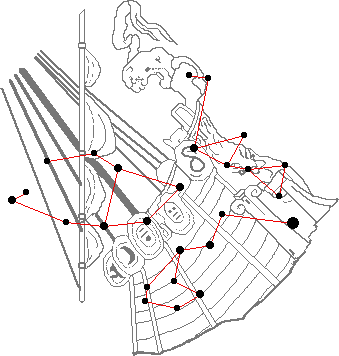
Welcome to another installment of the constellation series. As the fourth constellation, I have for you Argos Navis, a collection of constellations which together form the ship Argo, on which the Argonauts (Argonautai, Ἀργοναῦται) sailed to find the Golden Fleece.


The Argo Navis was an ancient constellation which has since been disband. It was a huge constellation, the largest in existence.  In 1752, the French astronomer Nicolas Louis de Lacaille subdivided it into Carina (the keel of the ship), Puppis (the stern), and Vela (the sails). Back in ancient Hellas, it was still one, large, constellation and it represented the ship on which one of Hellas' greatest heroic journeys was undertaken: Iásōn's (Ἰάσων, Jason) quest for the Golden Fleece.

The Argo (Ἀργώ), meaning 'swift', was built by the shipwright Argus. He was a member of the Argive royal house, and his fmily was favored by Hera. Becasue of this, anyone who sailed on the Argo, would have Her aid. Argus was aided in the planning and construction of the Argo by Athena, and possessed in its prow, a magical piece of wood from the sacred forest of Dodona, which could speak and render prophecies.

The tale of the Argonautai is long, and complicated. As so many kings in ancient Hellas, Pelias (Πελίας) unrightfully laid claim to his half-brother's throne. He became the king of Iolkos in Thessaly, and fell in disfavor of the Theoi because of his actions. It was prophesied that a member of the rightfully royal bloodline would one day punish him, and he was likewise warned to watch out for a man with only one sandal.

Pelias didn't believe in half measures and murdered every prominent descendant of Aeolus he could, but spared his mother Tyro's youngest son, Aeson. Instead, he imprisoned him and forced him to renounce his claim to the throne. Aeson complied, and eventually was set free. He married  Alcimede, who bore him a son named Diomedes. Alcimede successfully saved her son from certain death by having her nursemaids keen as if the boy had been stillborn. She secretly packed him off to Mount Pelion, where he was raised by the kéntauros Kheiron (Χείρων), who changed the boy's name to Iásōn.

From Kheiron, Iásōn learned the arts of combat, sports, medicine and music. When he reached adulthood, he was send back to Iolkos with proof of his royal birth. On the way there, he had to cross a river and found an old woman on the bank of it, who begged everyone who passed by to carry her through the water. All but Iásōn ignored her. He took her onto his back and he helped her across, although he found the journey tougher than he had ever thought possible. He also lost one of his sandals in the mud. As he put down the old woman, she turned into the magnificent Hera, of whom he would continue to receive support now he had passed her test.

As soon as Pelias laid eyes on the youth with one sandal, he knew what would happen now. And thus, he devised a plot to get rid of Iásōn. As Iásōn presented him with an offer to keep some farms and cattle, while Iásōn claimed his rightful place on the throne, Pelias happily accepted, but warned Iásōn that one task had to be completed first: the proper burial of king Phrixos.

Phrixos, thus told Pelias, Iásōn, had been saved from being sacrificed to the Theoi by a ram with golden wool. The Theoi had not demanded this sacrifice, but his step-mother Ino had paid off messengers from the oracle of Delphi to demand so of her husband out of hatred for the boy. The ram had carried him off to Helios' palace, where he was accepted into the household. The ram was sacrificed to Zeus, and the fleece was hung from a tree in a sacred grove of Ares, guarded night and day by a dragon that never slept. Pelias was haunted by Phrixos, and swore to Iásōn Phrixos would not rest until his ghost was taken back to Iokos, along with the Golden Fleece. If Iásōn did this, he swore by Zeus, to relinquish his throne to him.

Iásōn jumped at the chance. Kheiron had taught him well, and a chance to prove himself was all he desired. And so, he hired Argus to build him a ship, and send out messages to the various royal families to send them their young heroes for this voyage. Many jumped at the chance, although it's unclear how many, exactly. Argus may have undertaken the journey himself, as did Atalanta, Bellerophon, Kastor and Polideukes, Hēraklēs, Nestor, Orpheus, Perseus and Theseus. The number of Argonautai lay somewhere between forty and fifty.

The journey would take the brave Argonautai to many dangerous places. The first was Lemnos, where the women had been struck with madness by Aphrodite for failing to properly honor her. they had killed all men on the island, and all slave women as well. When the Argonautai reached the island, Aphrodite enchanted the women to seduce them, and thus halt their journey. Hēraklēs was the only one who did not go off of the ship, so he was able to convince the others to ship out after a long, long wait.

The next challenge came in the form of the Gegeines; Earthborn giants with six arms. The Argo sailed to Doliones where king Cyzicus ruled. In search of supplies, he allowed then to look for supplies on Bear Mountain, but failed to warn the crew of its inhabitants. When most of the crew left for the mountains, the Gegeines attempted to raid the ship, but Hēraklēs, along with a few others, held them off long enough for Iásōn and his men to return. They set sail int he dead of night but got turned about. They ended up on the same shore where the Argonautai and the people of king Cyzicus failed to recognize each other and many of them were killed, the king amongst them. When morning came, the Argonautai were shocked and ashamed, and organized a burial for the dead king. Hēraklēs took his leave here, as his tasks were not yet completed.

For twelve, long, days, the weather was so bad that the Argo could not set sail. The crew waited and grew hungry and thirsty. Mopsos, a bird auger, eventually deduced that the men should sacrifice to Rhea, mother of the Theoi. They did, and food and drink came to them by way of animals and low hanging fruit. The wind also died down, and the expedition was saved.

Next, they reached Bebryken, where they were challenged to a fist fight by king Amykos. He was so strong, he killed every opponent with one hit, and tossed those who refused to fight into the sea to die there. It was Pollux, son of Zeus, who accepted the challenge. He managed to win his fight gloriously, but the followers of the king were furious and wanted revenge. They fought the Argonautai, but were no match.

Soon they reached the court of Phineus of Salmydessus in Thrace. The king had been blessed with the gift of prophecy, but had shared too much of Zeus' secrets. For that, Zeus send Harpies to his door every day to take his food. The starving king begged the Argonautai for help, and received it. The Harpies were killed (or, in some versions of the myth, chased off) and the expedition continued.

The only way to reach their destination was to sail through the Symplegades, or Clashing Rocks. These huge rock cliffs came together and crushed anything that traveled between them. Phineas told the crew to release a dove when they approached these islands, and if the dove made it through, to row with all their might. If the dove was crushed, he was doomed to fail. Iásōn released the dove as advised, which made it through, losing only a few tail feathers. They went for it and, with the aid of Athena, made it through with only minor damage to the stern of the Argo. The clashing rocks were forever joined, leaving the way free for others to travel.

Before reaching Kolchis, their destination, the Argonautai would halt twice more. Once in the land of the Mariandyn, where they lost their navigator to illness, and Hera just barely saved the expedition by making Ankaios speak winged words of confidence that he could steer the ship. And he did. The second wait came in the form of a terrible storm for which the Argo needed to be protected. When the storm died down, they found the shipwrecked nephews of Iásōn, who had been on their way back from Kolchis, and were accepted into the Argonautai right away.

Once the Argonautai reached Kolchis, their struggle wasn't over. King Aeetes was unwilling to part with the Fleece, as it had brought great prosperity to his lands. He devised three tasks for Iásōn: to plow a field with fire-breathing oxen, to sow the teeth of a dragon into the field, and to overcome the sleepless dragon guarding the Fleece. Aided by Mēdeia (Μήδεια)--who was made to fall in love with Iásōn by Athena and Hera, who convinced Aphrodite to convince Eros to shoot his arrow--Iásōn completed his tasks and fled with Mēdeia and her younger brother Absyrtus, aboard the Argus.

As king Aeetes' war fleet hunted them down, Mēdeia did the unthinkable: she killed her brother and, in some versions of the myth, dismembered him, throwing his body parts into the sea one by one. His father made sure all parts were recovered and the Argo was able to get away. In all versions of the myth, Iásōn is shocked by this act, as well as the magick she implored to aide him in his other quests, but in some, he takes Mēdeia onto dry land to allowed her to cleanse herself of the miasma incurred by the murder she had committed.

After this, the Argo makes it home safely, after first passing by the Sirens who are so well known from the Odysseia--harmless because of Orpheus' louder and more beautiful music--and the boulder throwing Taltos, a bronze man with one blood vessel which ran from his neck to his toe. The blood vessel was held closed by a single nail. Mēdeia practiced her magick again, and put the giant to sleep. Then, she removed the nail, and Taltos bled to death.

Again, it was Mēdeia who saved the expedition, as Pelias refused to give in. Yet, he had become an old man in the time Jason had been gone, and when Mēdeia offered to make him young again, his daughters jumped at the chance. Mēdeia told the women that they should kill and cut up their father and put them in her cooking pot. This way, she would be able to perform her magick and the king would be reborn in his prime. The girls did as told but Mēdeia did not add the magickal herbs needed to complete the spell, and Pelias remained quite dead. Iásōn and Mēdeia were exiled for their crime by Pelias' son.

Yet the story of the Argo is not quite over. According to playwright Euripides, Iásōn betrayed Mēdeia, and wedded Kreousa (Κρέουσα), daughter of king Kreon of Korinth, instead of her. Mēdeia recounted all the help she had given him, and reminded him of his vow to marry her, but he told her that she should not be angry at him, but at Aphrodite, who had made her fall in love with him. Angered and ashamed, Mēdeia enchanted the dress Kreousa would wear for her wedding, and it caught fire as soon as she put it on. The fire killed both her and her father. Out of fear for retaliation, or out of a desire to hurt Iásōn even further, Mēdeia killed the two sons she had with Iásōn and fled.

Iásōn was punished for his treachery: Hera abandoned him and the mast of the Argo squashed him as he lay sleeping on the Argo one night late into his lonely and tortured life. The Argo was consecrated to Poseidon in the Isthmus, and was later placed into the sky and turned into the constellation of Argo Navis. The constellation has fallen apart over the years. Carina is visible at latitudes between +20° and −90°. It is best visible at 21:00 (9 p.m.) during the month of March. Puppis is visible at latitudes between +40° and −90°, and is best visible at 21:00 (9 p.m.) during the month of February. Vela is visible at latitudes between +30° and −90° and is best visible at 21:00 (9 p.m.) during the month of March.

 I don't write enough about Hellenic tragedies (or comedies, for that matter). In fact, in nearly two hundred posts, I don't think I've gone in depth on any of the plays, besides a cursory retelling of Euripides' adaption of Mēdeia's myth. I think the reason for this is that tragedies are, firstly, an extension of the ancient rites performed in honor of Dionysos... and while I worship Dionysos as a member of the Hellenic pantheon, I am not drawn to His Mysteries and cults at all. Before I begin this post, I therefor need to give the basics of tragic, Hellenic, theater before I get get to the point of this Pagan Blog Post, namely the Year-Daímōn, or Eniautos-Daímōn.


How tragic theater came to be is unknown. It's an old practice, dating back to the earliest foundations of Hellas. What we do know is that the tradition became intrinsically linked to the the Greater Dionysia, which was celebrated in the month of Elaphebolion; around March. Tragedies were plays--usually sung in their entirety by the chorus, but later also partly spoken--which were often pitted against each other in a contest, with the price for the winner being a goat. The word 'tragus día (τραγῳδία) has its roots in the ancient Hellenic words for 'goat' (tragos, τράγος) and 'sing' (á(i)dô, ᾄδω), which, combined, would be 'song for the goat'.

The name may also stem from 'bleating like a goat' or 'bleating like a child', and indicate that the name was given to the practice to indicate that the actors threw their voice to perform the parts. There are many other explanations, and the inclusion of the goat may simply refer to a goat being sacrificed at the festivals that included the performance of tragedies, or refer to satyr-like behavior as identified with Dionysos and His following.

This satyr-like behavior was most often seen in satyr plays, which are a third form of Hellenic theater, next to comedies and tragedies. Satyr plays were based on Hellenic mythology, and were chock full of mock drunkenness, sexuality, phallic props, pranks, and general merriment. After three days of tragedies, the fourth day of the Greater Dionysia was celebrated with satyr plays.

Like satyr plays, tragedies always focussed on mythology. Favorites were the myths surrounding Demeter, Persephone, and Hades; the 'death' and 'rebirth' of Dionysos; heroes like Herakles, Ajax, and Philoktētēs; and women like Mēdeia, Helèktra, Iphigeneia, and Antigone.

Tragedies often revolved around a central theme: dark versus light, good versus evil, or other variations of the duality. They were always about making ethical decisions. They also had a central structure: Contest (agon), Tearing-asunder/death/defeat (pathos), Messenger (angelos), Lamentation (threnos), Discovery (anagnorisis), Recognition (theophany), and Resurrection (apotheosis). Not all parts had to be included, although the plays were rated higher if they were.

An example: Euripides' Mēdeia starts after Iásōn tells her he will marry Kreousa, daughter of king Kreon of Korinth instead of her. There is a heated discussion, and Mēdeia flees to Athens, vowing to get her revenge (agon). She sends her children to Iásōn and Kreousa with an enchanted dress that kills both Kreousa and her father (pathos). A messenger runs to tell her of this event (angelos), and Iásōn grieves over the woman he has lost and his situation (threnos). Mēdeia returns to kill her two sons, and is discovered by Iásōn. Mēdeia explains her actions to the audience and Iásōn (theophany) and rises above the situation in Helios' chariot, which carries her off (a form of apotheosis). Mēdeia's play is straight-forward, without anagnorisis, something usually interpreted as a plot twist. In this case, Mēdeia knew the children were hers when she killed them. If she hadn't know, the play would have been completely different, and would probably have garnered Euripides more than third place.

With this introduction done, we can move on to the core of this post: the Year-Daímōn and its sacrifice. The Year-Daímōn is a title given to any Theos or hero, whose death and rebirth are tied to the turning of the seasons. These scapegoats 'die' with the old year and are 'reborn' with the new year, setting in motion a cycle of renewal for the plant life that forms the basis of the Hellenic food supply. Dionysos is the prime Eniautos-daímōn, but Theseus, Herakles, Apollon, Odysseus, and Orpheus qualify as well, as They are--in some way--linked closely to death and rebirth, either from visiting the Underworld and leaving it, or experiencing a 'second birth' of sorts.

To stay with Dionysos; for those unaware, there are about a bazillion stories on His birth, but two are of importance to this post. In one, he is born from Semele and Zeus, and while Semele is pregnant with Him, Hera plants seeds of doubt in her mind about the father of the child truly being Zeus. Semele asks Zeus to reveal Himself to her in his true form, and when he is left with no other option, He does so, killing her in the process. Zeus takes pity on His child, and takes Him into either His thigh or testicle, where He is eventually born from.

In the other version of the myth, stemming from Crete, Dionysos is the child of Zeus and Persephone (or Demeter). In this version, Dionysos is born, but ripped to pieces by Titans, under orders of a jealous Hera. Zeus smites the Titans, but is too late to save anything of Dionysos but His heart, which He gets implanted into His thigh like the first myth, or implants in Semele.

In both versions of the myth, Dionysos is twice-born, hence his epithet 'Dimêtôr' (Διμητωρ). Dionysos was considered a fertility God, but also closely related to nature's eternal cycle of birth and death. The ancient Hellens considered the moment a plant--especially the grape--began to grow for the first time after being planted its first birth, and counted its second birth when it became laden with ripened fruit. As Dionysos is so closely related to to the grape vine, it was Dionysos Himself that was considered being born once from the earth and again from the vine.

Dionysos' cult focussed heavily on this part of His mythology, and during the Dionysia, this thought pattern returned heavily, especially within the context of tragedies. From Harrison's pre-Olympic themed 'Themis: a Study of the Social Origins of Greek Religion' comes the following reflection on a procession exhibited by Ptolemy Philadelphos in honour of Dionysos:

"The procession was headed by Silenoi clad, some in purple, some in scarlet, to keep off the multitude; next followed twenty Satyrs bearing lamps; next figures of Nike with golden wings; then Satyrs again, forty of them, ivy-crowned, their bodies painted some purple, some vermilion. So far it is clear we have only the ministrants, the heralds of the god to come. After these heralds comes the first real personage of the procession, escorted by two attendants. His figure will not now surprise us.

"After the Satyrs come two Sileni, the one with petasos and caduceus as herald, the other with trumpet to make proclamation. And between them walked a man great of stature, four cubits tall in the dress and mask of a tragic actor and carrying the gold horn of Amaltheia. His name was Eniautos. A woman followed him, of great beauty and stature, decked out with much and goodly gold; in one of her hands she held a wreath of peach-blossom, in the other a palm-staff, and she was called Penteteris. She was followed by four Horai dressed in character and each carrying her own fruits."

Of note are two things: the reference to Eniautos as linked to Dionysos, and the inclusion of the Horai (the Goddesses of the Seasons). Eniautos, here, is the personification of something we now identify as 'a year' but which in ancient Hellas would have been linked to any pre-defined period of time. In this case--as can be seen with the link to the Horai--the persona identified with the cycle of the seasons we deal with on earth. This procession did not take place during the (Greater) Dionysia, but it does--once more--show the link between Dionysos and Eniautos, and affirm His worship as a Year-Daímōn.

And so, the Year-Daímōn is the personification of the yearly cycle, and is superimposed on existing mythology. To stay with Dionysos--because to include the mythology of the other Theoi and heroes who were considered linked with the Year-Daímōn would make this post even longer than it already is--Dionysos' mystery cult (which eventually grew into (or branched off into) Orphism) saw Dionysos as an Immortal Theos, who took on a Khthonic form--Dionysos Khthonios (Διονυσος Χθονιος)--during the winter months. Dionysos Khthonios took on an oracular role at Delphi while Apollon was 'visiting the Hyperboreans'. Wether this was a result of, or a reason for, His link to the Year-Daímōn is unclear. So he was not 'dead' as we may understand the term, but like the ground on which nothing grew, so Dionysos lay dormant as well. From Murray:

"The ordinary Year-Daimon arrived, grew great and was slain by his successor, who was exactly similar to him. But Dionysos did not die. He seemed to die, but really it was his enemy, in his dress and likeness, it was Pentheus or Lycurgus who died while Dionysos lived on in secret. When the world seemed to be dead and deprived of him, he was there in the ivy and pine and other evergreens; he was the secret life or fire in wine, or other intoxicants. By this train of ideas Dionysos comes to be regarded not as a mere vegetation-spirit, or Year-Daimon, but as representing some secret or mysterious life, persisting through death or after death."

King Lycurgus of Thrance, to clarify, was a mythical figure, who bitterly opposed Dionysos' new religion. After a first encounter, Dionysos retreated into the sea, only to come back and imprison Lycurgus in a rocky cave. Dionysos planned to let him reflect and learn from his mistakes, but Zeus did not care to have the Gods insulted, and blinded, then killed Lycurgus.

More telling; Pentheus was the king of Thebes, and cousin to Dionysos. Pentheus did not believe Dionysos was a new Theos, and ordered His drunken and loud following imprisoned. Dionysos freed them and He tried to explain His worship to His cousin. Yet, Pentheus would not listen, so Dionysos left him to his anger. He took His followers--including many local women, including Pentheus' mother and sister--to the hills. When Pentheus pursued Him, He drove the women mad. To them Pentheus appeared to be a moutain lion. In a berserk rage, they attacked him, and his mother--who was first to reach him--ripped his head off, while the others tore off his limbs.

This myth reach back to  much older--possibly pre-Hellenic--'primitive' tribes which worshipped Dionysos or a God similar to Him with animal and human sacrifices which were torn apart, either before they were killed, or as a means to kill them. The God worshipped this way was also a God of life and death, and these sacrifices were conducted to ensure a good harvest in the coming year. This is the very same culture mentioned in the second paragraph as having founded the basics of tragic plays. This may also explain one of the retellings of the birth of Dionysos where He was torn apart by Titans.

How involved the worship of the Eniautos-Daímōn was, or how far-spread it was, is unclear. Sacrifices for a good harvest were very common, and it's not odd to imagine that the 'first birth' would have fallen somewhere around the Greater Dionysia (as it was celebrated roughly around the Spring Equinox). If all sacrifices to the Year-Daímōn were linked to Dionysos is also unclear, although He did play a huge role in the formation of the ritual style, which often included ecstatic rites brought on by wine, dancing and other aids.

For (Neo-)Pagans reading this, the Year-Daímōn seems to be a reflection of the Horned God's yearly cycle, and there are definitely similarities. The cycle of non-death and rebirth can be found in many Gods throughout the pantheons. Immediately to mind comes Osiris, but also Shiva. The two may, indeed, be linked and as an Eclectic-turned-Recon, it would be easy for me to superimpose the mythology of the Horned God onto Dionysos (and for non-Recons to do it the other way around). But the differences are glaring--as I hope I have explained with this post--and as easy as it would be to link Christmas to the Lesser Dionysia, or the Greater Dionysia to a fertility festival like Ostara, at their base, neither is true.

The Year-Daímōn is a spirit of growth, or renewal, and of life's continuation. Different but the same, every year--year in, year out. The Eniautos-Daímōn formed the basis of life for a civilization which relied heavily on  agriculture for survival, and to see homage and sacrifice in his name during major festivals is hardly surprising.  If the cycle stopped, so did life. And so, the Year-Daímōn's worship continued on and the Hellens were rewarded. Just one more thing to think about now the Lesser Dionysia is nearly upon us and the Greater Dionysia's is coming only a few months away.
Doing a weekly series sure makes you realize how fast the week goes by. With the latest recap just done, we are already back for a new one. Again, there was no 'previously on', so for those needing a reminder: Jason dove from our world/time into Atlantis, made friends with Pythagoras and Hercules, saved the city or at least those in it a couple of time, and helped out a bunch of girls they have promptly fallen for. Hercules is up to his eyeballs in love with Medusa, and Jason carried a torch for Ariadne. Also, the Oracle of Poseidon has made many predictions thus far and all were ominous. On to the fun!

In today's episode, the fun starts with a shot of a half naked Hercules being scrubbed down and oiled up by Pythagoras. Is anyone shipping these two? Because I still have minor Jason/Pythagoras feels. Anyway, there is not enough oil to fully cover Hercules' impressive body, but Hercules doesn't care: he is about to fight Lysis, who looks like he'd make an awesome WBA fighter (the actor who plays him, David Garrick, has been an amateur boxer for most of his life and was in the Special Forces) and he is not the least bit worried. Not even because the guy's nickname is 'The Destroyer'. Medusa is plenty worried for him, though, and when they try to figure out a nickname for Hercules, she volunteers 'The Hero'. Cough.


Anyway, the 'Horrid Smelling' one eventually fights The Destroyer and while he makes it through the first few rounds of wrestling quite nicely, eventually gets destroyed. Medusa is shouting wonderful encouragements along the way like 'rip his head off', but it's no good. Hercules looses and has a nasty shoulder injury to boot. The friends rush to his side and Medusa tells him it was noble to let the other guy win. Hercules' heart soars for a minute, but then The Destroyer swoops Medusa up like she weighs nothing (and as if the loser's girlfriend automatically becomes yours when you beat him, which I am assuming is not the case) and Medusa laughs while Hercules asks his buddies to take him home. Enough stabs to the ego for the day.

Once at the oikos, Jason and Pythagoras wonder if there isn't an easier way for Hercules to get Medusa's attention; ones that do not involve the risk of bodily harm. Hercules says that was not at all why he did it, but no one believes him. While Hercules rests, the boys quietly discuss the situation: they had hoped Hercules' infatuation would pass, but Hercules is like a bull; he's not giving up so easily. They both feel Medusa is out of his league, and they hate it. Hercules, unfortunately, overhears.

 
In the morning, Jason is out on the town when the Oracle's right hand man finds him. He asks Jason to come with him to visit the Oracle, and he does. There is more chicken blood in water divining and the Oracle is annoyed because the dreams and visions she has been having for the last couple of days aren't clear enough for her to tell Jason more than that a powerful woman will come into his life, and it won't be a good thing. Jason wonders if the woman is Queen Pasiphaê, but while the Oracle warns him about her as well, that is not the woman from her visions. Jason is worried.

Back at the oikos, Hercules wakes up in a suspiciously good mood and indicates to Pythagoras he overheard last night's discussion. Pythagoras tried to apologize but Hercules will have none of it. He's far too chipper to listen. Instead he heads out to the temple, making a small offering, but not before eating all of Pythagoras' breakfast except for a single black olive. Those he doesn't like apparently. Once he comes out, a vendor who seems to know Hercules pretty well warns him that with his lack of appealing offerings to women, Aphrodite may never answer his prayers. Unless, of course, he is willing to try something different... One moment here to say that ancient Hellas had arranged marriages, so that while Medusa may not have been in the cards for Hercules, a wife surely would have been.

The salesman, named Elias (Jeffery Kissoon) tells him about the witches of Colchis, who create enchantments for the right price: the person's most prized possession. And one of their numbers can currently be found in the nearby mountains, living in a cave. I am fairly certain this is the woman Jason was just warned about, but who knows.

Jason returns to the oikos to find that Pythagoras has bought and made Hercules a proper I'm-sorry-for-talking-behind-your-back-meal, but Hercules has no intention of coming home: He's out in the hills, looking for a cave. Which he finds. Along with Circe of Colchis (Lucy Cohu) who not only promises not to hurt him, but knows his name. This--rightfully--freaks Hercules out. He's sticking with his quest, though, and declares he wishes to capture the heart of the woman he loves. She says she can't help him with that but he offers her a gift: the last remaining link to his father, a tooth from Cerberus ('or so he said'). Circe accepts the offering but questions why Hercules came here alone. Circe--who lets Hercules see the disfigured right side of her face--offers Hercules a jar that holds 'the song of the Sirens' (which she conveniently has on hand next to her cooking utensils). The sound will make Medusa fall for the first person she sees. She warns him, though; the enchantment is a powerful one.


A short time-out for the mythological Circe--or in the Greek: Kirkê--who was a pharmakeia, a sorceress, on the island of Aiaia. If her name sounds familiar, it's probably because she plays an important role in the Odysseia by Hómēros, where she turned Odysseus' men into pigs and forces Odysseus to stay with her for a year before he can convince her to turn them back. She is most often regarded as the daughter of Helios by the Oceanid Perse, but may have been the daughter of Hyperion as well, or even Hekate. The Argonauts on their way home also encountered her and she prayed to Zeus in their name to get the miasma of murder off of Iásōn and Mēdeia. By Roman times, her actions became a lot more spiteful and she was often depicted as jealous and petty--a view not share by Hellenic predecessors. Just something to keep in mind.

Hercules returns to Atlantis and his home, and digs into his still available meal, still happy. Korinna (who I really like, by the way) allows Hercules to visit Medusa in the palace of king Minos. This sounds like the absolute worst of plans, by the way. Why not visit her at home? Or drag her into some dark alley on the way to it? Chances are, both locations would be a lot more private than the palace kitchens. Anyway... Medusa is making bread in a conveniently abandoned kitchen and Hercules releases the Siren song. He steps into the kitchen and into her field of vision. She doesn't fall instantly into his arms--which throws Hercules quite a bit--so he has to find a way to answer her question of why he came here. He warns her about a storm that is most likely not coming and then asks her out. She agrees and Hercules becomes a rambling idiot, which Medusa seems to find endearing. He lays her hand on Hercules' cheek for a moment, leaving a flour stain, and he rushes out of the kitchen, happy as a clam.

That night, Hercules prepares for his big date while Jason and Pythagoras fuss over him. Hercules blames them for his nerves so it's only right one of them sniffs his armpits. Pythagoras gets drafted for that one, and Jason looks on in horror. Hercules' scent must be quite nice, though, because Pythagoras rattles off a list of herbs and fruits to describe the scent. Huh, good on Hercules. Medusa shows up on the doorstep looking lovely with her hair down and a dark dress on, and Pythagoras and Jason are shocked beyond words at the current turn of events.


Out on the town, Medusa twirls the flower she has gotten from Hercules and asks after his injuries. He assures her he is fine and she is relieved to hear it. They banter back and forth for a while and then visit the (walls of the) palace courtyard, completely deserted at night. In the distance, the sea can be seen. They're bonding and it's cute in a very mind bending a la Willow sort of way. Jemima Rooper delivers some of the strongest acting to date as she relates how lonely she has been in the city and how she almost didn't stay. Her ability to convey Medusa's vulnerability as spurned on by the enchantment is wonderful to watch, and Mark Addy's performance is spot on as the guy whose dreams have just come true while trying to convince himself he did not do something awful to make it so. This is especially true after the two share a kiss in front of Medusa's home.

In the morning, Jason is rudely awoken by Medusa, who is pounding on the door. I have a feeling Helios has barely left the gates at this point. She's carrying the world's largest basket of food and soon the gang is gathered about the table where Hercules eats like a king, Medusa fawns over him in fan girl fashion and the boys are trying to decide if they are actually awake or not. It seems Medusa stole the food from the palace and also has a rash on her hands. Both are not exactly good signs. An even worse sign is when Medusa and Hercules are out on the town and Medusa collapses. The rash has spread to her shoulders and chest and Hercules takes her home so Pythagoras can have a look at her. She's still completely out--never a good sign.


Pythagoras is worried, but not as worried as Hercules whom Pythagoras sends on an errand for herbs. By the time night falls, Medusa is still sick--perhaps even sicker--and the boys are devastated. Hercules sits by her bedside throughout the night and Pythagoras shares his fears with Jason: she is getting worse and witchcraft is to blame. If this is the case, only an enchantment will be able to heal Medusa. Medusa, meanwhile, has woken up but looks horrible. She says she wouldn't change anything about the past few days--anything--and Hercules finally can't stand the lies anymore. He comes clean to his friends as Medusa rests.

The rash has spread to Medusa's face and Hercules cares for her rapidly wilting body while Jason and Pythagoras go through notes and herbs like madmen, trying to figure out a way to save Medusa. Another night passes with Hercules by Medusa's bedside and when the boys find nothing to cure Medusa, he visits Circe again in the morning. Circe toys with him for a while and then divulges her true plan: get Jason to her. Korinna comes to take care of Medusa while the boys go after Hercules.

En route to the cave, Jason and Pythagoras realize they are being followed... by a pig. Which continues to follow them, despite Pythagoras trying to get the pig to sod off. Jason muses that it almost seems like the pig is trying to tell them something...


At night, in the camp, Jason tells Pythagoras about the Oracle's warning and Pythagoras nearly orders him to go home. Jason, obviously, does not. In the mean time, the pig drinks all the wine and eats all the food. Save for one, black, olive. Realization suddenly dawns on Pythagoras and he tries to convince Jason that that pig is, in fact, Hercules. Jason doesn't buy it until the pig farts. He'd recognize that smell anywhere. Jason is a little amused at the situation, but it is worrying.

The tree of them--pig first--head to Circe's cave. Circe sees them coming, obviously, and awaits them after enchanting the water to reveal a freaking dragon! She sends a dragon after them! A flying one! I'd be into it if a flying dragon was not completely outside of Hellenic lore. Jason makes short work of it though--in a very impressive manner--and I try to scrub the affair from my brain. Pythagoras is injured, forcing Jason to go on alone--exactly what the Oracle warned him against.

 
In the dark of the cave, Circe and Jason converse. She tried to convince Jason that they are allies. She will heal both Medusa and Hercules if Jason fulfills a request. She explains she once had a home and husband, before it all got taken away and she was reduced to living in a cave. She wants Jason to kill her sister--the woman who took everything away from her. She ensures Jason that this is the only way to save Hercules and Medusa. Back in the camp, Pythagoras understands if Jason will not do it.

Circe is not surprised when Jason returns to her. Circe lays an oath on Jason in name of Hekate, ensuring that he will fulfill his end of the bargain, and she will hers. I'm not sure how, exactly, but it looks like it hurts. The kicker comes afterwards, though: Circe's sister? None other than Pasiphaê. Aren't you glad I saved that bit of family history for the big reveal?

Back home, Medusa's illness is going away and Hercules is back to his human self. Even in her weakened state, Medusa is livid at Hercules for what he has done and made her go through, and Hercules is heartbroken. He understands, though; he can hardly blame her. He's eternally hopeful for a happy ending.

Jason, trapped in his oath, visits the Oracle for guidance. She sits with him and gets him to tell the whole story. He shows her a burn on his arm, which the Oracle rightly interprets as an oath, and he tells her what he promised Circe. The Oracle is distraught, knowing full well that this can only end badly. She covers his hand with both of hers in a sign of sympathy and Jason can only look on--spooked.

 
Next week on Atlantis: Minos announces Ariadne's marriage to Heptarian, Jason and Heptarian duel, and Ariadne is stupendously worried about her hero. Saturday on BBC One, recap on Monday.
I don't write enough about Hellenic tragedies (or comedies, for that matter). In fact, in nearly two hundred posts, I don't think I've gone in depth on any of the plays, besides a cursory retelling of Euripides' adaption of Mēdeia's myth. I think the reason for this is that tragedies are, firstly, an extension of the ancient rites performed in honor of Dionysos... and while I worship Dionysos as a member of the Hellenic pantheon, I am not drawn to His Mysteries and cults at all. Before I begin this post, I therefor need to give the basics of tragic, Hellenic, theater before I get get to the point of this Pagan Blog Post, namely the Year-Daímōn, or Eniautos-Daímōn.

How tragic theater came to be is unknown. It's an old practice, dating back to the earliest foundations of Hellas. What we do know is that the tradition became intrinsically linked to the the Greater Dionysia, which was celebrated in the month of Elaphebolion; around March. Tragedies were plays--usually sung in their entirety by the chorus, but later also partly spoken--which were often pitted against each other in a contest, with the price for the winner being a goat. The word 'tragus día (τραγῳδία) has its roots in the ancient Hellenic words for 'goat' (tragos, τράγος) and 'sing' (á(i)dô, ᾄδω), which, combined, would be 'song for the goat'.

The name may also stem from 'bleating like a goat' or 'bleating like a child', and indicate that the name was given to the practice to indicate that the actors threw their voice to perform the parts. There are many other explanations, and the inclusion of the goat may simply refer to a goat being sacrificed at the festivals that included the performance of tragedies, or refer to satyr-like behavior as identified with Dionysos and His following.

This satyr-like behavior was most often seen in satyr plays, which are a third form of Hellenic theater, next to comedies and tragedies. Satyr plays were based on Hellenic mythology, and were chock full of mock drunkenness, sexuality, phallic props, pranks, and general merriment. After three days of tragedies, the fourth day of the Greater Dionysia was celebrated with satyr plays.

Like satyr plays, tragedies always focussed on mythology. Favorites were the myths surrounding Demeter, Persephone, and Hades; the 'death' and 'rebirth' of Dionysos; heroes like Herakles, Ajax, and Philoktētēs; and women like Mēdeia, Helèktra, Iphigeneia, and Antigone.

Tragedies often revolved around a central theme: dark versus light, good versus evil, or other variations of the duality. They were always about making ethical decisions. They also had a central structure: Contest (agon), Tearing-asunder/death/defeat (pathos), Messenger (angelos), Lamentation (threnos), Discovery (anagnorisis), Recognition (theophany), and Resurrection (apotheosis). Not all parts had to be included, although the plays were rated higher if they were.

An example: Euripides' Mēdeia starts after Iásōn tells her he will marry Kreousa, daughter of king Kreon of Korinth instead of her. There is a heated discussion, and Mēdeia flees to Athens, vowing to get her revenge (agon). She sends her children to Iásōn and Kreousa with an enchanted dress that kills both Kreousa and her father (pathos). A messenger runs to tell her of this event (angelos), and Iásōn grieves over the woman he has lost and his situation (threnos). Mēdeia returns to kill her two sons, and is discovered by Iásōn. Mēdeia explains her actions to the audience and Iásōn (theophany) and rises above the situation in Helios' chariot, which carries her off (a form of apotheosis). Mēdeia's play is straight-forward, without anagnorisis, something usually interpreted as a plot twist. In this case, Mēdeia knew the children were hers when she killed them. If she hadn't know, the play would have been completely different, and would probably have garnered Euripides more than third place.

With this introduction done, we can move on to the core of this post: the Year-Daímōn and its sacrifice. The Year-Daímōn is a title given to any Theos or hero, whose death and rebirth are tied to the turning of the seasons. These scapegoats 'die' with the old year and are 'reborn' with the new year, setting in motion a cycle of renewal for the plant life that forms the basis of the Hellenic food supply. Dionysos is the prime Eniautos-daímōn, but Theseus, Herakles, Apollon, Odysseus, and Orpheus qualify as well, as They are--in some way--linked closely to death and rebirth, either from visiting the Underworld and leaving it, or experiencing a 'second birth' of sorts.

To stay with Dionysos; for those unaware, there are about a bazillion stories on His birth, but two are of importance to this post. In one, he is born from Semele and Zeus, and while Semele is pregnant with Him, Hera plants seeds of doubt in her mind about the father of the child truly being Zeus. Semele asks Zeus to reveal Himself to her in his true form, and when he is left with no other option, He does so, killing her in the process. Zeus takes pity on His child, and takes Him into either His thigh or testicle, where He is eventually born from.

In the other version of the myth, stemming from Crete, Dionysos is the child of Zeus and Persephone (or Demeter). In this version, Dionysos is born, but ripped to pieces by Titans, under orders of a jealous Hera. Zeus smites the Titans, but is too late to save anything of Dionysos but His heart, which He gets implanted into His thigh like the first myth, or implants in Semele.

In both versions of the myth, Dionysos is twice-born, hence his epithet 'Dimêtôr' (Διμητωρ). Dionysos was considered a fertility God, but also closely related to nature's eternal cycle of birth and death. The ancient Hellens considered the moment a plant--especially the grape--began to grow for the first time after being planted its first birth, and counted its second birth when it became laden with ripened fruit. As Dionysos is so closely related to to the grape vine, it was Dionysos Himself that was considered being born once from the earth and again from the vine.

Dionysos' cult focussed heavily on this part of His mythology, and during the Dionysia, this thought pattern returned heavily, especially within the context of tragedies. From Harrison's pre-Olympic themed 'Themis: a Study of the Social Origins of Greek Religion' comes the following reflection on a procession exhibited by Ptolemy Philadelphos in honour of Dionysos:

"The procession was headed by Silenoi clad, some in purple, some in scarlet, to keep off the multitude; next followed twenty Satyrs bearing lamps; next figures of Nike with golden wings; then Satyrs again, forty of them, ivy-crowned, their bodies painted some purple, some vermilion. So far it is clear we have only the ministrants, the heralds of the god to come. After these heralds comes the first real personage of the procession, escorted by two attendants. His figure will not now surprise us.

"After the Satyrs come two Sileni, the one with petasos and caduceus as herald, the other with trumpet to make proclamation. And between them walked a man great of stature, four cubits tall in the dress and mask of a tragic actor and carrying the gold horn of Amaltheia. His name was Eniautos. A woman followed him, of great beauty and stature, decked out with much and goodly gold; in one of her hands she held a wreath of peach-blossom, in the other a palm-staff, and she was called Penteteris. She was followed by four Horai dressed in character and each carrying her own fruits."

Of note are two things: the reference to Eniautos as linked to Dionysos, and the inclusion of the Horai (the Goddesses of the Seasons). Eniautos, here, is the personification of something we now identify as 'a year' but which in ancient Hellas would have been linked to any pre-defined period of time. In this case--as can be seen with the link to the Horai--the persona identified with the cycle of the seasons we deal with on earth. This procession did not take place during the (Greater) Dionysia, but it does--once more--show the link between Dionysos and Eniautos, and affirm His worship as a Year-Daímōn.

And so, the Year-Daímōn is the personification of the yearly cycle, and is superimposed on existing mythology. To stay with Dionysos--because to include the mythology of the other Theoi and heroes who were considered linked with the Year-Daímōn would make this post even longer than it already is--Dionysos' mystery cult (which eventually grew into (or branched off into) Orphism) saw Dionysos as an Immortal Theos, who took on a Khthonic form--Dionysos Khthonios (Διονυσος Χθονιος)--during the winter months. Dionysos Khthonios took on an oracular role at Delphi while Apollon was 'visiting the Hyperboreans'. Wether this was a result of, or a reason for, His link to the Year-Daímōn is unclear. So he was not 'dead' as we may understand the term, but like the ground on which nothing grew, so Dionysos lay dormant as well. From Murray:

"The ordinary Year-Daimon arrived, grew great and was slain by his successor, who was exactly similar to him. But Dionysos did not die. He seemed to die, but really it was his enemy, in his dress and likeness, it was Pentheus or Lycurgus who died while Dionysos lived on in secret. When the world seemed to be dead and deprived of him, he was there in the ivy and pine and other evergreens; he was the secret life or fire in wine, or other intoxicants. By this train of ideas Dionysos comes to be regarded not as a mere vegetation-spirit, or Year-Daimon, but as representing some secret or mysterious life, persisting through death or after death."

King Lycurgus of Thrance, to clarify, was a mythical figure, who bitterly opposed Dionysos' new religion. After a first encounter, Dionysos retreated into the sea, only to come back and imprison Lycurgus in a rocky cave. Dionysos planned to let him reflect and learn from his mistakes, but Zeus did not care to have the Gods insulted, and blinded, then killed Lycurgus.

More telling; Pentheus was the king of Thebes, and cousin to Dionysos. Pentheus did not believe Dionysos was a new Theos, and ordered His drunken and loud following imprisoned. Dionysos freed them and He tried to explain His worship to His cousin. Yet, Pentheus would not listen, so Dionysos left him to his anger. He took His followers--including many local women, including Pentheus' mother and sister--to the hills. When Pentheus pursued Him, He drove the women mad. To them Pentheus appeared to be a moutain lion. In a berserk rage, they attacked him, and his mother--who was first to reach him--ripped his head off, while the others tore off his limbs.

This myth reach back to  much older--possibly pre-Hellenic--'primitive' tribes which worshipped Dionysos or a God similar to Him with animal and human sacrifices which were torn apart, either before they were killed, or as a means to kill them. The God worshipped this way was also a God of life and death, and these sacrifices were conducted to ensure a good harvest in the coming year. This is the very same culture mentioned in the second paragraph as having founded the basics of tragic plays. This may also explain one of the retellings of the birth of Dionysos where He was torn apart by Titans.

How involved the worship of the Eniautos-Daímōn was, or how far-spread it was, is unclear. Sacrifices for a good harvest were very common, and it's not odd to imagine that the 'first birth' would have fallen somewhere around the Greater Dionysia (as it was celebrated roughly around the Spring Equinox). If all sacrifices to the Year-Daímōn were linked to Dionysos is also unclear, although He did play a huge role in the formation of the ritual style, which often included ecstatic rites brought on by wine, dancing and other aids.

For (Neo-)Pagans reading this, the Year-Daímōn seems to be a reflection of the Horned God's yearly cycle, and there are definitely similarities. The cycle of non-death and rebirth can be found in many Gods throughout the pantheons. Immediately to mind comes Osiris, but also Shiva. The two may, indeed, be linked and as an Eclectic-turned-Recon, it would be easy for me to superimpose the mythology of the Horned God onto Dionysos (and for non-Recons to do it the other way around). But the differences are glaring--as I hope I have explained with this post--and as easy as it would be to link Christmas to the Lesser Dionysia, or the Greater Dionysia to a fertility festival like Ostara, at their base, neither is true.

The Year-Daímōn is a spirit of growth, or renewal, and of life's continuation. Different but the same, every year--year in, year out. The Eniautos-Daímōn formed the basis of life for a civilization which relied heavily on  agriculture for survival, and to see homage and sacrifice in his name during major festivals is hardly surprising.  If the cycle stopped, so did life. And so, the Year-Daímōn's worship continued on and the Hellens were rewarded. Just one more thing to think about now the Lesser Dionysia is nearly upon us and the Greater Dionysia's is coming only a few months away.
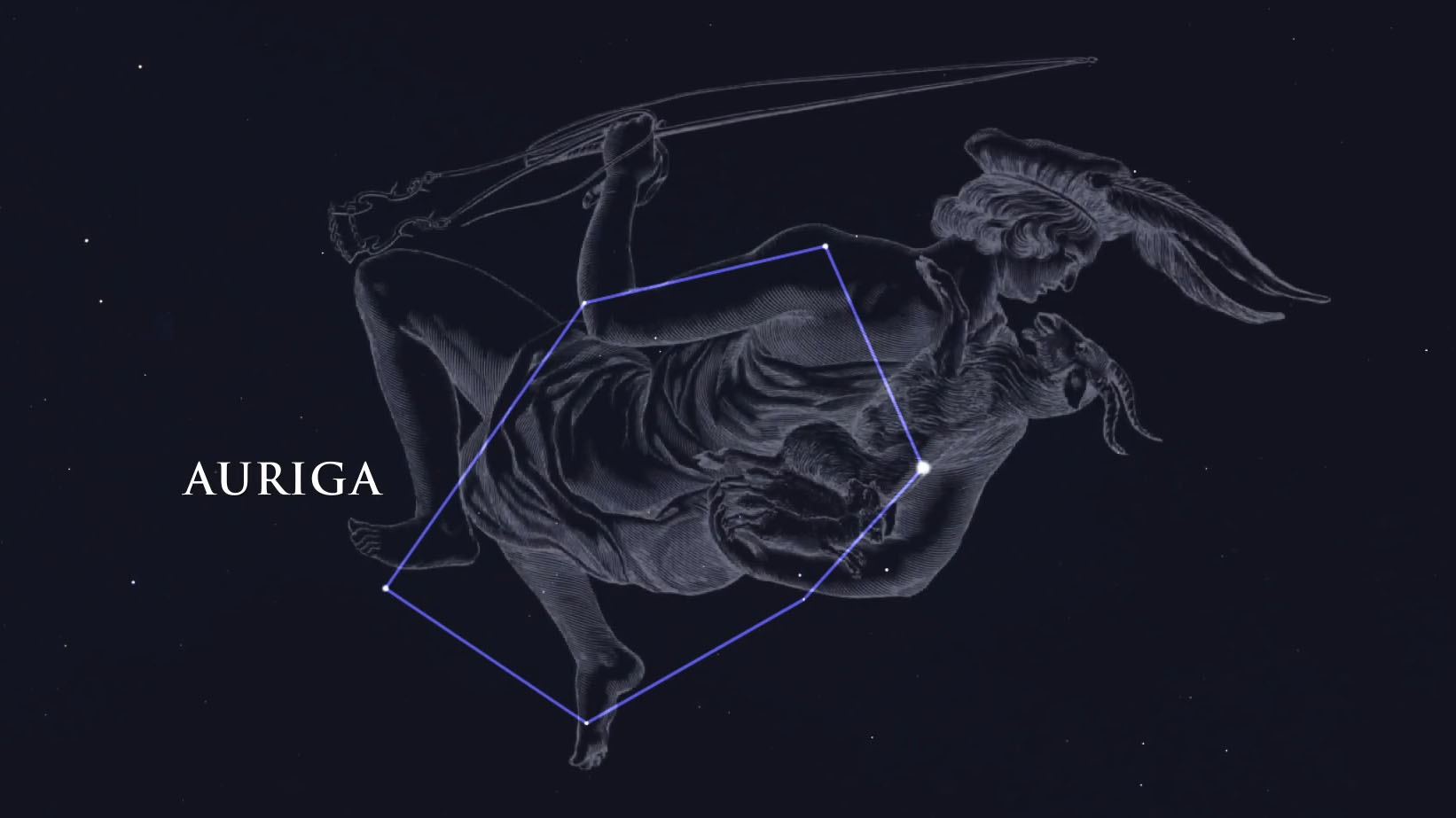
There are many well known chariots and charioteers in ancient Hellenic mythology. All of the Theoi have one, and Helios and Apollon use one to bring light to the world. Hades kidnapped Persephone with His. Kastor and Polideukes were very skilled at driving the fast, light, open, two-wheeled conveyance drawn by two or more horses. Helios lost a son when he let his son Phaethon (Φαέθων) drive his chariot for its morning track through the sky. Phaethon flew too close to the earth and scorched it all; Zeus then cast him down with a lightning-bolt. Yet, these are not the charioteers the constellation is associated with. In this next installment of the constellation series, we will look at the Divine child the constellation refers to... and a few others, because the constellation Auriga has had many interpretations over the years.


For a very long time, war chariots were pulled by two horses only. The charioteer of the constellation is therefor most likely Erichthonios (Ἐριχθόνιος), child of Hēphaistos and Athena, through Gaea, as he invented a chariot pulled by four horses. 

As the myth of his birth goes; Athena went to Hēphaistos' workshop for weaponry, but Hēphaistos--overcome with lust--tried to rape Her instead. Athena fled, but could not flee fast enough. Hēphaistos caught up to Her. Athena fought off Her attacker, but could not prevent Hēphaistos from ejaculating on Her thigh. She wiped Hēphaistos' semen away with a scrap of wool (ἔριον, erion) and flung it to the earth (χθών, chthôn). From it was born Erichthonios, who was part man, and part snake.

In my post about the many legends of Médousa, I posed the following about Athena and the source of Erichthonius' myth and birth as part-snake:

"Athena's role as a snake and fertility Goddess is still visible in the myth about the child she had with Hephaestus; Erichthonios (Ἐριχθόνιος), who was half man, half snake. It's even posed that in the early days, Athena was married to Hephaestus and had His child willingly. As Athena was stripped of Her roles as a fertility and snake Goddess, Médousa's myth came into being, where Athena distances Herself from sex and snakes, by punishing an epithet of herself (Athena Tritogeneia, perhaps: 'born of Trito', a lake which was supposedly located in Libya), or the Libyan snake Goddess Médousa, who may have still been attached to Her worship. By placing Médousa's head on Her breastplate or shield, Athena's mythology is continuously linked to Her Libyan heritage, but harmlessly so, to Her new image of a virginal warrior."

No matter the source, Erichthonios was born, and placed in a box by Athena. She placed the box in the care of three of Her attendants at the Acropolis, with clear instructions not to open the box. They did, of course, and were scared so by the sight of either a snake in the box, or Erichthonios' deformities, they cast themselves off of the Acropolis in terror. Yet, despite his deformities, Erichthonios became king of Athens and ruled it long and well.

He married Praxithea (Πραξιθέα), a naiad, and had a son, Pandion I. He founded the Panathenaiac Festival in the honor of Athena, and set up a wooden statue of her on the Acropolis. He taught his people to yoke horses and use them to pull chariots, to smelt silver, and to till the earth with a plough. His deformities and lameness inspired him to invent the quadriga--or four-horse chariot--to get around easier. He was very skilled as a charioteer, and won many games. Zeus was said to have been so impressed with his skill that he raised him to the heavens to become the constellation Auriga after his death.

There are also other charioteers to whom the constellation could refer; Myrtilus (Μυρτίλος), for example, who was Hermes's son and the charioteer of Oenomaus. Myrtilus's chariot was destroyed in a race intended for suitors to win the heart of Oenomaus's daughter Hippodamia. Myrtilus earned his position in the sky when Hippodamia's successful suitor, Pelops (Πέλοψ), killed him, although he helped him win the woman's hand. After his death, Myrtilus's father Hermes placed him in the sky. 

The constellation could also represent Theseus's son Hippolytos who was rejected from Athens after he refused the romantic advances of his stepmother Phaedra, who committed suicide as a result. He was killed when his chariot was wrecked, but revived by Asklepios. Another possibility is that the constellation does not represent a whole person at all, but is a limb of Mēdeia's brother after she killed and dismembered him.

Occasionally, Auriga is also seen as the Charioteer but as Bellerophon (Βελλεροφῶν), the mortal rider of Pegasus who dared to approach Mount Olympus. In this version of the tale, Zeus pitied Bellerophon for his foolishness and placed him in the stars.

Whomever--or whatever--it represents, Auriga reminds us that the chariot had an important place in ancient Hellenic society. As for the constellation, it is visible at latitudes between +90° and −40°, and best visible at 21:00 (9 p.m.) during the month of late February to early March.

The fifth constellation Ptolemy made famous was the constellation Aries: the ram. Obviously, this constellation is still recognized by modern astronomers. For the story of the constellation Aries, we have to go back to the Argo Navis: the ran the constellation resembles was the very same ram that carried the young king Phrixos to the palace of Helios before he could be killed in a plot by his step-mother.


The myth of the ram with the golden wool is part of the myth of Iásōn. Phrixos (Φρίξος) was the son of Athamas, king of Boiotia, and Nephele (a goddess of clouds). His twin sister Helle and he were hated by their stepmother, Ino. So hated, in fact, that Ino burned the local crops and asked for an oracular message to see if the Theoi were angry at her husband's people. She bribed the messengers to tell her husband that the Theoi were, indeed, angry at him. To appease Them, Phrixos and Helle had to be sacrificed. Pious Athamas did as he was told, but just before they could be killed, a ram with golden wool appeared by order of Nephele, and carried the children off.

The ram flew over the ocean and Helle looked down. Spooked by the height, she fell off of the back of the ram, leading to her death. The stretch of water she fell into was called the Hellespontos (Ἑλλήσποντος), literally 'Sea of Helle', a narrow strait in northwestern Turkey connecting the Aegean Sea to the Sea of Marmara. It was later renamed Dardanellia (Δαρδανέλλια).

The ram, unfortunately did not get to live a long, healthy life. As soon as the ram delivered Phrixos to the palace of King Aeëtes--the son of the sun god Helios--on Colchis, it was sacrificed to Zeus. It's golden fleece was hung from a tree in a sacred grove of Ares, guarded night and day by a dragon that never slept. Iásōn eventually slew the dragon with Mēdeia's help and took the fleece back to Iolkos. The ram, after being sacrificed, was placed into the sky by Zeus.

The constellation Aries is visible at latitudes between +90° and −60° and is best visible at 21:00 (9 p.m.) during the month of December.
Welcome to another installment of the constellation series. I'm on a mythology binge so I thought it was time. As the fourth constellation, I have for you Argos Navis, a collection of constellations which together form the ship Argo, on which the Argonauts (Argonautai, Ἀργοναῦται) sailed to find the Golden Fleece.


The Argo Navis was an ancient constellation which has since been disband. It was a huge constellation, the largest in existence.  In 1752, the French astronomer Nicolas Louis de Lacaille subdivided it into Carina (the keel of the ship), Puppis (the stern), and Vela (the sails). Back in ancient Hellas, it was still one, large, constellation and it represented the ship on which one of Hellas' greatest heroic journeys was undertaken: Iásōn's (Ἰάσων, Jason) quest for the Golden Fleece.

The Argo (Ἀργώ), meaning 'swift', was built by the shipwright Argus. He was a member of the Argive royal house, and his fmily was favored by Hera. Becasue of this, anyone who sailed on the Argo, would have Her aid. Argus was aided in the planning and construction of the Argo by Athena, and possessed in its prow, a magical piece of wood from the sacred forest of Dodona, which could speak and render prophecies.

The tale of the Argonautai is long, and complicated. As so many kings in ancient Hellas, Pelias (Πελίας) unrightfully laid claim to his half-brother's throne. He became the king of Iolkos in Thessaly, and fell in disfavor of the Theoi because of his actions. It was prophesied that a member of the rightfully royal bloodline would one day punish him, and he was likewise warned to watch out for a man with only one sandal.

Pelias didn't believe in half measures and murdered every prominent descendant of Aeolus he could, but spared his mother Tyro's youngest son, Aeson. Instead, he imprisoned him and forced him to renounce his claim to the throne. Aeson complied, and eventually was set free. He married  Alcimede, who bore him a son named Diomedes. Alcimede successfully saved her son from certain death by having her nursemaids keen as if the boy had been stillborn. She secretly packed him off to Mount Pelion, where he was raised by the kéntauros Kheiron (Χείρων), who changed the boy's name to Iásōn.

From Kheiron, Iásōn learned the arts of combat, sports, medicine and music. When he reached adulthood, he was send back to Iolkos with proof of his royal birth. On the way there, he had to cross a river and found an old woman on the bank of it, who begged everyone who passed by to carry her through the water. All but Iásōn ignored her. He took her onto his back and he helped her across, although he found the journey tougher than he had ever thought possible. He also lost one of his sandals in the mud. As he put down the old woman, she turned into the magnificent Hera, of whom he would continue to receive support now he had passed her test.

As soon as Pelias laid eyes on the youth with one sandal, he knew what would happen now. And thus, he devised a plot to get rid of Iásōn. As Iásōn presented him with an offer to keep some farms and cattle, while Iásōn claimed his rightful place on the throne, Pelias happily accepted, but warned Iásōn that one task had to be completed first: the proper burial of king Phrixos.

Phrixos, thus told Pelias, Iásōn, had been saved from being sacrificed to the Theoi by a ram with golden wool. The Theoi had not demanded this sacrifice, but his step-mother Ino had paid off messengers from the oracle of Delphi to demand so of her husband out of hatred for the boy. The ram had carried him off to Helios' palace, where he was accepted into the household. The ram was sacrificed to Zeus, and the fleece was hung from a tree in a sacred grove of Ares, guarded night and day by a dragon that never slept. Pelias was haunted by Phrixos, and swore to Iásōn Phrixos would not rest until his ghost was taken back to Iokos, along with the Golden Fleece. If Iásōn did this, he swore by Zeus, to relinquish his throne to him.

Iásōn jumped at the chance. Kheiron had taught him well, and a chance to prove himself was all he desired. And so, he hired Argus to build him a ship, and send out messages to the various royal families to send them their young heroes for this voyage. Many jumped at the chance, although it's unclear how many, exactly. Argus may have undertaken the journey himself, as did Atalanta, Bellerophon, Kastor and Polideukes, Hēraklēs, Nestor, Orpheus, Perseus and Theseus. The number of Argonautai lay somewhere between forty and fifty.

The journey would take the brave Argonautai to many dangerous places. The first was Lemnos, where the women had been struck with madness by Aphrodite for failing to properly honor her. they had killed all men on the island, and all slave women as well. When the Argonautai reached the island, Aphrodite enchanted the women to seduce them, and thus halt their journey. Hēraklēs was the only one who did not go off of the ship, so he was able to convince the others to ship out after a long, long wait.

The next challenge came in the form of the Gegeines; Earthborn giants with six arms. The Argo sailed to Doliones where king Cyzicus ruled. In search of supplies, he allowed then to look for supplies on Bear Mountain, but failed to warn the crew of its inhabitants. When most of the crew left for the mountains, the Gegeines attempted to raid the ship, but Hēraklēs, along with a few others, held them off long enough for Iásōn and his men to return. They set sail int he dead of night but got turned about. They ended up on the same shore where the Argonautai and the people of king Cyzicus failed to recognize each other and many of them were killed, the king amongst them. When morning came, the Argonautai were shocked and ashamed, and organized a burial for the dead king. Hēraklēs took his leave here, as his tasks were not yet completed.

For twelve, long, days, the weather was so bad that the Argo could not set sail. The crew waited and grew hungry and thirsty. Mopsos, a bird auger, eventually deduced that the men should sacrifice to Rhea, mother of the Theoi. They did, and food and drink came to them by way of animals and low hanging fruit. The wind also died down, and the expedition was saved.

Next, they reached Bebryken, where they were challenged to a fist fight by king Amykos. He was so strong, he killed every opponent with one hit, and tossed those who refused to fight into the sea to die there. It was Pollux, son of Zeus, who accepted the challenge. He managed to win his fight gloriously, but the followers of the king were furious and wanted revenge. They fought the Argonautai, but were no match.

Soon they reached the court of Phineus of Salmydessus in Thrace. The king had been blessed with the gift of prophecy, but had shared too much of Zeus' secrets. For that, Zeus send Harpies to his door every day to take his food. The starving king begged the Argonautai for help, and received it. The Harpies were killed (or, in some versions of the myth, chased off) and the expedition continued.

The only way to reach their destination was to sail through the Symplegades, or Clashing Rocks. These huge rock cliffs came together and crushed anything that traveled between them. Phineas told the crew to release a dove when they approached these islands, and if the dove made it through, to row with all their might. If the dove was crushed, he was doomed to fail. Iásōn released the dove as advised, which made it through, losing only a few tail feathers. They went for it and, with the aid of Athena, made it through with only minor damage to the stern of the Argo. The clashing rocks were forever joined, leaving the way free for others to travel.

Before reaching Kolchis, their destination, the Argonautai would halt twice more. Once in the land of the Mariandyn, where they lost their navigator to illness, and Hera just barely saved the expedition by making Ankaios speak winged words of confidence that he could steer the ship. And he did. The second wait came in the form of a terrible storm for which the Argo needed to be protected. When the storm died down, they found the shipwrecked nephews of Iásōn, who had been on their way back from Kolchis, and were accepted into the Argonautai right away.

Once the Argonautai reached Kolchis, their struggle wasn't over. King Aeetes was unwilling to part with the Fleece, as it had brought great prosperity to his lands. He devised three tasks for Iásōn: to plow a field with fire-breathing oxen, to sow the teeth of a dragon into the field, and to overcome the sleepless dragon guarding the Fleece. Aided by Mēdeia (Μήδεια)--who was made to fall in love with Iásōn by Athena and Hera, who convinced Aphrodite to convince Eros to shoot his arrow--Iásōn completed his tasks and fled with Mēdeia and her younger brother Absyrtus, aboard the Argus.

As king Aeetes' war fleet hunted them down, Mēdeia did the unthinkable: she killed her brother and, in some versions of the myth, dismembered him, throwing his body parts into the sea one by one. His father made sure all parts were recovered and the Argo was able to get away. In all versions of the myth, Iásōn is shocked by this act, as well as the magick she implored to aide him in his other quests, but in some, he takes Mēdeia onto dry land to allowed her to cleanse herself of the miasma incurred by the murder she had committed.

After this, the Argo makes it home safely, after first passing by the Sirens who are so well known from the Odysseia--harmless because of Orpheus' louder and more beautiful music--and the boulder throwing Taltos, a bronze man with one blood vessel which ran from his neck to his toe. The blood vessel was held closed by a single nail. Mēdeia practiced her magick again, and put the giant to sleep. Then, she removed the nail, and Taltos bled to death.

Again, it was Mēdeia who saved the expedition, as Pelias refused to give in. Yet, he had become an old man in the time Jason had been gone, and when Mēdeia offered to make him young again, his daughters jumped at the chance. Mēdeia told the women that they should kill and cut up their father and put them in her cooking pot. This way, she would be able to perform her magick and the king would be reborn in his prime. The girls did as told but Mēdeia did not add the magickal herbs needed to complete the spell, and Pelias remained quite dead. Iásōn and Mēdeia were exiled for their crime by Pelias' son.

Yet the story of the Argo is not quite over. According to playwright Euripides, Iásōn betrayed Mēdeia, and wedded Kreousa (Κρέουσα), daughter of king Kreon of Korinth, instead of her. Mēdeia recounted all the help she had given him, and reminded him of his vow to marry her, but he told her that she should not be angry at him, but at Aphrodite, who had made her fall in love with him. Angered and ashamed, Mēdeia enchanted the dress Kreousa would wear for her wedding, and it caught fire as soon as she put it on. The fire killed both her and her father. Out of fear for retaliation, or out of a desire to hurt Iásōn even further, Mēdeia killed the two sons she had with Iásōn and fled.

Iásōn was punished for his treachery: Hera abandoned him and the mast of the Argo squashed him as he lay sleeping on the Argo one night late into his lonely and tortured life. The Argo was consecrated to Poseidon in the Isthmus, and was later placed into the sky and turned into the constellation of Argo Navis. The constellation has fallen apart over the years. Carina is visible at latitudes between +20° and −90°. It is best visible at 21:00 (9 p.m.) during the month of March. Puppis is visible at latitudes between +40° and −90°, and is best visible at 21:00 (9 p.m.) during the month of February. Vela is visible at latitudes between +30° and −90° and is best visible at 21:00 (9 p.m.) during the month of March.