Every day, the average human utters about 16.000 words. A good portion of those are idioms and figures of speech--the use of a word or words diverging from its usual meaning--or sayings. Today, I wanted to share some of the figures of speech and sayings that can be traced back to ancient Hellas and/or Hellenic myth. Some of these I have posted before, but I've collected another few in the mean time. These are marked with a *.
"Caught between a rock and a hard place"
Source: In Hellenic mythology, Midas was the king of Pessinus. It seems some of the peasants under Midas' commands brought the king the unconscious satyr Seilenos, who had drunk himself into a stupor. Alternatively, Seilenos toppled over in Midas' garden. No matter how he got there, Midas took good care of him, and as a token of appreciation, Dionysos--Seilenos' student--offered Midas a wish. Midas wished that everything he touched, turned to gold. This is where the saying comes from.
"Hounds of Hell"
Meaning: something frightening, or evil.
Source: Guarding the entrance to Underworld is a great dog, either with just one head, or three, or fifty. His name is Kerberos, and you can pass him once, on your way in, but never again, as there is no way out.
"Leave No Stone Unturned"
Meaning: search everywhere.
Source: The catch-phrase was first recorded by Euripides in his tragedy 'Heracleidae'. The play focusses on King Eurystheus, who hunts the children of Hēraklēs after he passes away. The actual quote comes from the line: "Now, after he was taken hence, was I not forced, by reason of these children's hatred, and because I was conscious of an hereditary feud, to leave no stone unturned by slaying, banishing, and plotting against them?"
"Pandora's box"
Meaning: to perform an action that may seem small or innocuous, but that turns out to have severe and far-reaching consequences.
Source: I've written quite a bit about Pandôra on this blog. Pandôra was created by the Theoi as punishment on humanity after Prometheus stole fire from the Gods. Pandôra showed up on the doorstep of Prometheus' brother Deukalion, with a pithos she was told never to open. Eventually, curiosity got the better of her,a nd she opened the jar. In some versions of the myth, all evils of the word flew out, but Pandôra managed to trap hope in the jar. There are many, many inconsistencies in the myth, but the figure of speech stuck.
"Pregnant with thought" *
Meaning: to be about to put forth a (great) idea.
Source: Potentially, this idiom comes from Greek mythology--namely the birth of Athena from the head of Zeus. Athena, as Goddess of wisdom represents a literal birth of ideas--which is pretty much the meaning.
"Siren's song" *
Meaning: an alluring utterance or appeal, especially one that is seductive or deceptive.
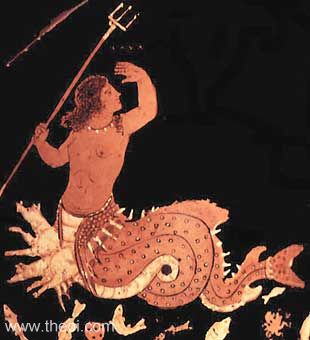
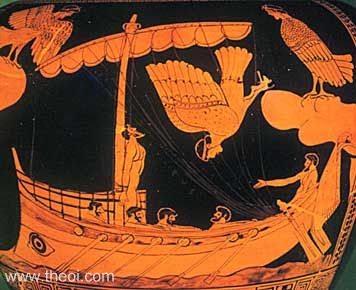
Source: In the Odysseia, Circe warned Odysseus not to listen to the Sirens--mythological mermaids--because their haunting music would drive him mad. Or if he did, at least have his sailors tie him to the mast to keep him from throwing himself overboard, and to plug his rowers ears’ with beeswax so they would be impervious to the sweet high song.
"Stygian darkness" *
Meaning: pitch black, sometimes dreary, darkness.
Source: The river Styx was the boundary between the upper world of the living and the underworld of the dead. It was so inky black that anything under its surface disappeared from sight.
"The face that launched a thousand ships"
Meaning: one person causing a terrible event.
Source: One fateful day, three Goddesses got into an argument about whom was most beautiful. Hera, Aphrodite, and Athena, all laid claim to a golden apple tossed into the crowd at a banquet held on honor of Peleus and Thetis. Eris had thrown the apple, which was labeled 'for the most beautiful'. The Goddesses could not decide who was the fairest, and so They asked Zeus. Zeus appointed Paris, A Trojan mortal, to choose in his stead. All three Goddesses undressed for Paris when asked, and all offered him gifts, if he would choose them. Aphrodite, however, promised him the most beautiful of wives, and PAris chose Her. Aphrodite picked Helen of Sparta as Paris' new wife, but Helen was already married, to Menelaus, who would eventually bring war down upon Troy to reclaim the wife he lost. Helen became the woman whose face 'launched a thousand ships' in war.
"To rise from the ashes"
Meaning: to be reborn
Source: No singular myth about the famous bird survives, but the phoenix was know to the ancient Hellenes. It was a mythical bird that lived its life, immolated, and was reborn from the ashes of its previous incarnation.
"A Herculean Effort"
Meaning: a great effort.
Source: Hēraklēs, son of Zeus and the mortal Alcmene--who was a bane in Hera's life, simply for being born--was stricken mad by the Queen of the Gods and killed his five sons by his wife Megara, oldest daughter of Kreōn of Thebes. When he was released from his madness by a hellebore potion--provided by Antikyreus--and realized what he had done, he cried out in anguish, and went on a long journey to cleanse himself of the miasma caused by these killings. First, he visited the oracle at Delphi, who, unbeknownst to him, was whispered to by Hera. The Oracle told Hēraklēs to serve the king of Tiryns, Eurystheus, for ten years and do everything Eurystheus told him to do. Eurystheus gladly provided Hēraklēs with these labors--ten of them, one for each year--and eventually ended up adding two more, resulting in the Twelve Labors of Hēraklēs. Hēraklēs was told to: slay the Nemean Lion, slay the nine-headed Lernaean Hydra, capture the Golden Hind of Artemis, capture the Erymanthian Boar, clean the Augean stables in a single day, slay the Stymphalian Birds, capture the Cretan Bull, steal the Mares of Diomedes, obtain the girdle of Hippolyta, Queen of the Amazons, obtain the cattle of the monster Geryon, steal the apples of the Hesperides, and to capture and bring back Kerberos. All of these tasks were incredibly hard, and required every ounce of strength Hēraklēs possessed.
"A Sisyphean task"
Meaning: (performing) an endless or repetitive task.
Source: Sísyphos was a scheming and conniving king, who tried to pull a fast one on the Gods many times over. He betrayed Zeus, tried to trick Thanatos, Persephone and Hades, and killed innocent travelers on his roads--an offense against xenia. For all these offenses, Sísyphos was sentenced to push a boulder uphill for all eternity, as the boulder would roll down the slope again the second he reached the top.
"Achilles' heel"
Meaning: one's weakness or weak spot.
Source: Achilles was a great warrior, destined to live one of two lives: a long and boring one, or a short but heroic one. Knowing her son would choose the latter, his divine mother Themis tried to limit the risk of Achilles dying a premature death by dipping him in the river Styx. As such, Achilles became impenetrable to harm, save for his heel, where his mother had held him as she dipped him in the water. This spot eventually became his downfall, and Achilles died on the battlefield of Troy. The stories of his invulnerability were a later invention, around the first century AD. Before that, the myth simply stated that Achilles was shot in the heel with an arrow, and he eventually died of that wound, because it would not heal.
"Bearing the weight of the world (on one's shoulders)" *
Meaning: a very heavy burden of worry or responsibility.
Source: This is a reference to Atlas, the Titan who was forced to carry the heavens on his shoulders after he and his brethren rebelled against Zeus in the Titanomachy. Depending on the source, however, it was actually a great honour to be asked to protect the whole of the earth from being crushed under the weight of the sky.
"Bearing the weight of the world (on one's shoulders)" *
Meaning: a very heavy burden of worry or responsibility.
Source: This is a reference to Atlas, the Titan who was forced to carry the heavens on his shoulders after he and his brethren rebelled against Zeus in the Titanomachy. Depending on the source, however, it was actually a great honour to be asked to protect the whole of the earth from being crushed under the weight of the sky.
"Beware of Greeks bearing gifts"
Meaning: be weary of those with something to offer, they may have ulterior motives.
Source: In the war for Troy, the Hellenes needed a way to conquer the walls of the city. They tried to fight for it, but were unable to. In Virgil's Aeneid, it is written that the Hellenes built a wooden horse, and hid away in it. The horse was offered to the Trojans as a gift, and the structure was accepted into the city. At night, the Hellenes snuck out of the horse, attacked the city, and conquered Troy.
Meaning: making a hard choice; choosing between two undesirable options.
Source: During Odysseus' travels to get home, he must run his ship through a narrow passage. One the one side are rocks with a cavern. In this cavern, Skylla, sea monster with six heads, lived, and she would take one of Odysseus' men with each of her heads. On the other side lay Kharybdis, a great whirlpool which would suck in any ship that came too close. It is up to Odysseus to choose one or the other. Eventually, he chooses Skylla, and looses many brave men, his ship, however, is in tact. As such, Odysseus had to choose between a rock and a hard place.
"Cupid's arrows" *
Meaning: rapidly falling in love--as if struck.
Source: The ancient Hellenes were just as mystified by love as we are today--more so, perhaps, because a least we know what happens chemically in our bodies when it happens. Their answer to the mystery of falling in love was that the arrow of Eros struck. Eros had two types of arrows: the golden-tipped arrow brought love and attraction, the lead-tipped arrow brought hate and repulsion. Cupid is the Roman version of Eros.
"Cupid's arrows" *
Meaning: rapidly falling in love--as if struck.
Source: The ancient Hellenes were just as mystified by love as we are today--more so, perhaps, because a least we know what happens chemically in our bodies when it happens. Their answer to the mystery of falling in love was that the arrow of Eros struck. Eros had two types of arrows: the golden-tipped arrow brought love and attraction, the lead-tipped arrow brought hate and repulsion. Cupid is the Roman version of Eros.
"Dog is man's best friend"
Meaning: the loyalty of dogs is undisputed
Source: In the Odysseia, Odysseus finally returns home after many, many long years of travel, and long years of war. He is in disguise when he reaches his house, which is overrun by suiters of his wife. His fateful hunting dog, Argos, has waited for him all these years, and recognizes his master right away. Finally reunited with his master, the old dog dies, happy, and at peace.
"Food of the Gods"
Meaning: food so delicious, it is almost divine
Source: Nectar--the drink of the Gods--and ambrosia--the food of the Gods--are the dish of choice on Olympos. If a mortal man or woman would eat or drink either of the two, they, too, would become immortal, or at least their aging would stop for a while.
"Gordian knots"
Meaning: an extremely perplexing puzzle or problem.
Source: It seems that king Gordius of Phrygia laid out a task for whomever wanted to be the ruler of Asia Minor: he tied a know so complex, no one managed to untie is. Eventually, Alexander the Great came to the land, and cut the know with his sword, thus 'passing' the test. 'Cutting the knot' became a saying for taking something by force, or making a decisive action.
"Having the Midas touch"
Meaning: a fortunate person, someone able to make everything a success.Source: In Hellenic mythology, Midas was the king of Pessinus. It seems some of the peasants under Midas' commands brought the king the unconscious satyr Seilenos, who had drunk himself into a stupor. Alternatively, Seilenos toppled over in Midas' garden. No matter how he got there, Midas took good care of him, and as a token of appreciation, Dionysos--Seilenos' student--offered Midas a wish. Midas wished that everything he touched, turned to gold. This is where the saying comes from.
"Hounds of Hell"
Meaning: something frightening, or evil.
Source: Guarding the entrance to Underworld is a great dog, either with just one head, or three, or fifty. His name is Kerberos, and you can pass him once, on your way in, but never again, as there is no way out.
"Leave No Stone Unturned"
Meaning: search everywhere.
Source: The catch-phrase was first recorded by Euripides in his tragedy 'Heracleidae'. The play focusses on King Eurystheus, who hunts the children of Hēraklēs after he passes away. The actual quote comes from the line: "Now, after he was taken hence, was I not forced, by reason of these children's hatred, and because I was conscious of an hereditary feud, to leave no stone unturned by slaying, banishing, and plotting against them?"
"Oedipus Complex"
Meaning: a child's unnatural desire of their parent of the opposite sex, and jealousy of the parent of the same sex. Freudian theory.
Source: Oedipus was born to King Laius and Queen Jocasta. King Laius was fortold his son would kill him and marry his mother, and so he left him to die on a mountainside. The child was found, however, and raised by King Polybus and Queen Merope. Oedipus eventually heard of the prophecy about him and fled, not wanting to hurt his adoptive parents, who he believed to be his biological ones. Fate would have him end up on the same road as King Laius, and in an argument over whom would step out of the way, Oedipus killed his father. He then traveled on and eventually met and married his mother. The myth continues on, but this is the part where the figure of speech comes from.
Meaning: to perform an action that may seem small or innocuous, but that turns out to have severe and far-reaching consequences.
Source: I've written quite a bit about Pandôra on this blog. Pandôra was created by the Theoi as punishment on humanity after Prometheus stole fire from the Gods. Pandôra showed up on the doorstep of Prometheus' brother Deukalion, with a pithos she was told never to open. Eventually, curiosity got the better of her,a nd she opened the jar. In some versions of the myth, all evils of the word flew out, but Pandôra managed to trap hope in the jar. There are many, many inconsistencies in the myth, but the figure of speech stuck.
"Pregnant with thought" *
Meaning: to be about to put forth a (great) idea.
Source: Potentially, this idiom comes from Greek mythology--namely the birth of Athena from the head of Zeus. Athena, as Goddess of wisdom represents a literal birth of ideas--which is pretty much the meaning.
"Siren's song" *
Meaning: an alluring utterance or appeal, especially one that is seductive or deceptive.
Source: In the Odysseia, Circe warned Odysseus not to listen to the Sirens--mythological mermaids--because their haunting music would drive him mad. Or if he did, at least have his sailors tie him to the mast to keep him from throwing himself overboard, and to plug his rowers ears’ with beeswax so they would be impervious to the sweet high song.
"Stygian darkness" *
Meaning: pitch black, sometimes dreary, darkness.
Source: The river Styx was the boundary between the upper world of the living and the underworld of the dead. It was so inky black that anything under its surface disappeared from sight.
"The face that launched a thousand ships"
Meaning: one person causing a terrible event.
Source: One fateful day, three Goddesses got into an argument about whom was most beautiful. Hera, Aphrodite, and Athena, all laid claim to a golden apple tossed into the crowd at a banquet held on honor of Peleus and Thetis. Eris had thrown the apple, which was labeled 'for the most beautiful'. The Goddesses could not decide who was the fairest, and so They asked Zeus. Zeus appointed Paris, A Trojan mortal, to choose in his stead. All three Goddesses undressed for Paris when asked, and all offered him gifts, if he would choose them. Aphrodite, however, promised him the most beautiful of wives, and PAris chose Her. Aphrodite picked Helen of Sparta as Paris' new wife, but Helen was already married, to Menelaus, who would eventually bring war down upon Troy to reclaim the wife he lost. Helen became the woman whose face 'launched a thousand ships' in war.
"To rise from the ashes"
Meaning: to be reborn
Source: No singular myth about the famous bird survives, but the phoenix was know to the ancient Hellenes. It was a mythical bird that lived its life, immolated, and was reborn from the ashes of its previous incarnation.