Showing posts with label Dionysos. Show all posts

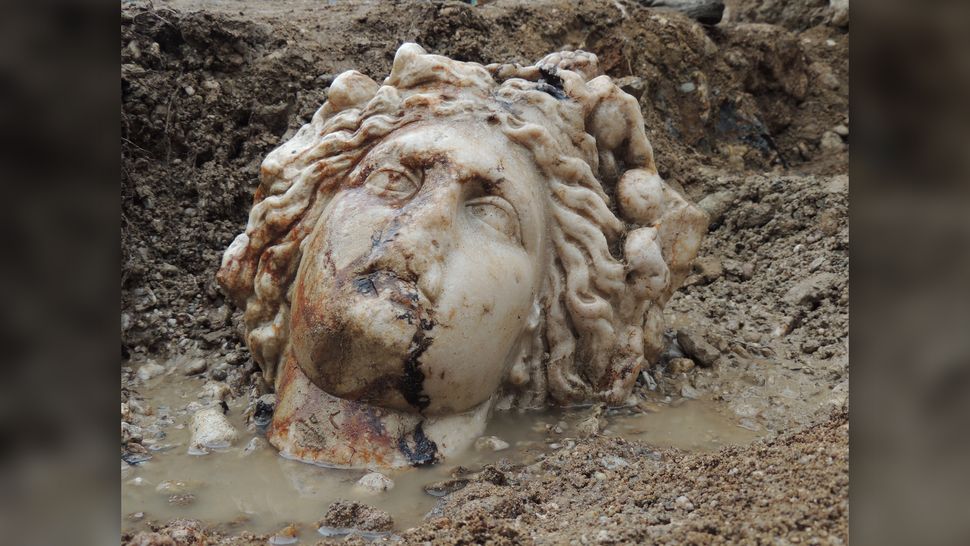
According to Hellenic mythology, the deities Aphrodite and Dionysos had a grand love affair. So, perhaps it's fitting that archaeologists found the ancient statuary heads of the Goddess of love and the reveler near each other during a dig in the ancient city of Aizanoi, in western Turkey.


The discovery of the deities' heads helps top off a previous find; on an earlier dig, archaeologists found the statues' headless bodies, Gokhan Coskun, an archaeologist at Kütahya Dumlupınar University in Turkey and the excavation coordinator, told Anadolu Agency, a Turkish state-run news organization. 

"These are important findings for us, as they show that the polytheistic culture of ancient Greece existed for a long time without losing its importance in the Roman era," Coskun said. "The findings suggest that there may have been a sculpture workshop in the region."

The ancient city of Aizanoi has a rich history filled with ancient Greek and Roman period settlements. Its earliest settlement dates to the second millennium B.C., but many of its remaining ruins date to the Roman Empire, including its Roman baths, Zeus temple and macellum, or Roman indoor market. Aizanoi is listed as a "tentative" World Heritage Site by the United Nations Educational, Scientific and Cultural Organization (UNESCO). 

Archaeologists found the Roman-era heads of Aphrodite and Dionysos buried in a creek bed in the ancient city. Each head is made of limestone, with Aphrodite's head measuring 19 inches (50 centimeters) and Dionysus' head measuring 17 inches (45 cm) tall, according to the news site GEO. It's unknown how the statues' heads became separated from their bodies.

Previously, archaeologists in Aizanoi uncovered the statue of Hygieia, Goddess of health, cleanliness and hygiene, according to GEO. 

 Poseideon is the sixth month of the Hellenic calendar and we are slowly moving towards it. Poseideon is a special month; it was the month that would have been repeated (in a minor way) should the ancient calendar not line up with the phases of the moon (which it didn't, after a while). You can read more about that here as it is beyond the scope of this post. What I would like to talk to you about today is the divine triad that oversaw Poseideon (the quartet, actually, but we'll get to that) and its significance.

Poseideon was ruled by Poseidon (honoured during the Poseideia), Zeus (during the Plerosia and a seperate sacrifice to Zeus Horios) and Dionysos (during the Lesser Dionysia and secondarily during the Haloa). Poseideon is the first true winter month; the first harvest was over, seafaring had ceased and thus war had come to an end. The focus was on the home and preparation for true, deep winter: the weather turned and the crops needed protecting. Because of this, it was also a month of threat; if the crops failed, if the seas became too rough when a daring fisherman was out on it, or if a river went out of bounds and flooded a well populated area there would be death.

I get on my soapbox a lot on my blog. One of my main points is that everything is connected in the ancient Hellenic religion. That everything was constructed the way it was for a reason; the pantheon, the calendar, the festivals, the way festivals were celebrated--if you spend time to sort out the why, you will discover it's all part of an intricate web that formed an entire civilization. Nothing--absolutely nothing--in our religion and in the ancient civilization it was formed in ended up in it by accident. We have lost a lot of knowledge and understanding of this society but we can try to piece things together if we put in the effort. So today I will put in a little effort to explain why Poseideon was ruled by Poseidon, Zeus and Dionysos. And why it mattered that it were Them.

During the Poseideia, Poseidon as savior of ships, protector of those who voyage in ships, and God of the lapping waters both salt and fresh important for agriculture, is thanked for the many gifts that came from faraway places that were likely given at that time. The immense trade and distribution was nearly all through shipping, relatively little overland, whether it be perfume from Cyprus or pottery from Corinth. One of Poseidon’s epithets is prosklystios, 'of the lapping water'. He is also invoked as Poseidon phytalmios which implies natural fertility and human procreation.

The Plerosia is a harvest festival of sorts. It was held to honour Zeus but presumably als Demeter. Poseideon marks the time to return home, take stock, and stay warm. It's a time to thank the Theoi for all that has been recieved and all that will get us through the winter. The word ‘plerosis’ means fulfillment, satiated, filled. Important note: the Plerosia seems to have been a women-only festival, perhaps because now that winter is upon us, we turn to the domain of the women: the house(hold). As such, it is her prerogative to thank the Gods for the food she can feed her family with.

The lesser Dionysia, a vintage festival, was celebrated in the various demes of Attica in the month of Poseideon. It was probably a very ancient festival, perhaps not originally associated with Dionysos. The Dionysia was a time when classes came together in order to celebrate their shared origins in the natural world; it was a vintage festifal for all.

The Haloa was held in honor of Demeter, Dionysos and a little bit in honor of Persephone. Like all festivals of Demeter and Persephone's 'Kore' persona, women were the only ones who were allowed to handle the religious and sacrificial side of it. The Haloa is assumed to be a celebration of the pruning of the vines and the tasting of the wine after its first fermentation, or it may be to encourage the growth of corn from the seed.

A few links between Poseidon, Zeus and Dionysos are clear instantly from the descriptions of these festivals. Poseidon and Dionysos are linked through water--moisture, actually. Plutarch already noted that Dionysos was a God of moisture--in particular the moisture associated with life and vigour as can be seen in plants and trees and most telling in the wine produced from the fruits of the vine. Poseidon is all but the personification of water of all kinds. Furthermore, one of the epithets of Dionysos is Dendrites, ‘of the trees’, connects him to branching life. The tree was similarly a metaphor for rivers whose branching nature was morphologically similar. This links Dionysos to Poseidon even more.

And what of Poseidon and Zeus? Poseidon is the brother of Zeus and Hades, and together they form a triumvirate who represents the dominion of the sea, the sky and the underworld respectively. In Hellenic mythology, the underworld is seen as an exact mirror and equally valid version of the ‘celestial’ world. In other words: Zeus is Hades inverted and Poseidon is the synthesis of both. Dionysos therefore unifieds these god-themes and manifested them in the mundane world.

This brings us to Hades, the fourth member of this triad. He is worshipped too, just not directly--never directly. the ancient Hellenes very rarely honoured Hades, not even Plouton, His ouranic epithet. But Hades' influence was most definitely felt; he's the third of the triumvirate, He is prevalent in the threat of death that hangs over the month and He is appeased though a medium who is perhaps unlikely: Demeter.

Mythological and epithological links exist between Demeter and Hades. Hades was celebrated as an important divine figure in the Eleusinian Mysteries. The seasonal drama of nature was said to depend on her annual passage into the underworld in the depths of winter when fruitfulness and vegetation dies back. Through Kore (Persephone) Hades and Demeter rule over the harvest. Hades takes and Demeter gives--or more accurately: Hades causes Demeter to take instead of give. In praying for fruitfulness of the earth to Demeter, it is also Hades who is spoen to and appeased, which makes Him an unofficial member of the triad (this is likewise true for Demeter and even Kore/Persephone).

To compelete the circle, Dionysos and Demeter are worshipped together during the Haloa, which drives home the agricultural ties all these five deities have  and the way they link to the mundane issues of this time of year; Demeter and Hades (Plouton) through the fruitful earth (underworld), Zeus through mild weather (sky) and Poseidon and Dionysos through sweet water (the intermediate). Because of Their links and domains, it can be only these deities that govern Poseideon.

 Swamped, sorry! It seems like my life has been ruled by Dionysos this week and I'm going to spend my Saturday unraveling some of the mess. So, for what it's worth, here's a tribute to Dionysos for you. May he be kind!


Euripides’ Bacchae, First Chorus (part 1): 64-119

From the Asian land
After leaving sacred Tmôlos I speed—
A toil for Bromios that is sweet,
And a worn but happy weariness—
Crying out to the Bacchic god.

Who is in the road? Who is on the road?
Who is in the palace? Have every person come out!
Have each one hold a quiet tongue in sacred silence. 

I am hymning Dionysus
In the customs that are always used.
You are blessed if you are lucky
To know the rites of the gods
And lead a pure life;
And join your soul to the band
Of Bacchic revelers on the mountains
In the sacred cleansing worship.

Taking care of the Great mother’s mysteries
Shaking the thyrsus all about
once you are wreathed in ivy,
you tend to Dionysus!

Go, Bacchae, Go Bacchae,
Lead on this Bromios, a divine child of a god,
Dionysus

From the Phrygian mountains on
To the streets of Greece, wide-enough for dances.
Once, his mother went
Into the forced labors of birth
From Zeus’ thunder in flight
She released him from her womb
Too early, and lost her life
At the lightning’s strike.
But Zeus, Kronos’ son
Immediately welcomed him
Into his hands
And hid him in his thigh—

He sewed him up with golden pins
To keep him a secret from Hera.
When the Fates made him grow,
He gave birth
To a bull-horned god
And crowned him with wreaths of snakes.
This is why the Maenads weave
Beast-eating serpents in their hair.
Thebes, the nurse of Semele,
Crown yourselves with ivy!
Flourish, Grow with the green
Leaves flush with fruit.
Make yourselves Bacchae too
With branches of oak or pine.

Adorn your clothes of stitched fawn
With strands of white wool.
Make sacred the arrogant wands.

Right now the whole earth will dance
As Bromios leads out his bands
To the mountain, to the mountain where
the woman-born mob stands
driven mad from their shuttles and looms
by Dionysus.

How about a little overview today? An overview of the fertility gods of Hellenismos. I'm going to start off with a lesser known deity: Priapos (Πριαπος), protector of sheep, goats, bees, the vine and of all garden produce. He was depicted with a huge male member, and can be petitioned for aid with any issues regarding the male genitalia. He was native to the Mysian city of Lampsakos on the Hellespont but the ancient Hellenes adopted the God as the son of either Hermes or Dionysos. His mother was usually Aphrodite. Fun fact: primitive statues of Priapos were traditionally set-up in vegetable plots to promote fertility with the added benefit of functioning as a type of 'scarecrow' scaring away birds.


Rhea (Ρεα), wife of Kronos, is a female fertility Goddess--amongst other things. She also looks after mothers and children, and is one of the great mother Goddesses in the pantheon having obviously given birth to the Olympians. Anything female-related (including issues with fertility) can be put before Her. Hera, by the way, has many of the same domains as Her mother--logical as she is the new generation's mother figure.

Aphrodite is also a fertility Goddess. She along with Zeus, Hera, Eileithyia and Hymenaios were the Theoi Gamelioi (Gods of Marriage) who presided over the wedding rites. She was invoked as the Goddess of the consummation of marriage and the fertility of the bride.

Speaking of which, Eileithyia (Ειλειθυια) is the Goddess of childbirth and labour pains. According to some there were two Eileithyiai, one who furthered birth and one who protracted the labour. Her name means 'she who comes to aid'.

Demeter and Persephone were regarded as fertility Goddesses in the Eleusinian Tradition, and during Their Thesmophoria festival, women actively asked for fertility from Them. Demeter, especially, is obviously also very important for the growth of plant life.

Dionysos is mostly associated with the fertility of the soil, and especially in regards to the grape vine, but human fertility is amongst His descriptors. Pan is regarded as much the same, as are many of the Satyrs and daimons connected to Them--like Tykhon, Konisalos, and Orthannes.

Phanes (Φανης) is the Protogenos of procreation in the Orphic cosmogony. He is the primal generator of life, and was the driving force behind reproduction in the early cosmos. Phanes was hatched from the world egg when it was split into its constituent parts by the ancient gods Khronos and Ananke. Arguably, He still drives the process of reproduction, be it in plants, animals, or humans.

Exorcisms have a long and varied history, and the best known version of it is the 'Major Exorcism' as performed by a Catholic priest. This rite is recorded in the Rituale Romanum which seems to date from around 1600 AD. How old the ritual itself is, I am not sure, but the concept of possession is most certainly ancient. The idea of the Major Exorcism is to establish that a demon has taken possession of a person--which should be measurable by certain signs like speaking in tongues and convulsing--and then to drive out the possessor by reciting ritual texts and presenting the creature with holy iconography. I was asked if there was something like an exorcism in Hellenismos.


The question makes a few assumptions that need to be addressed before answering your question:
  1. Did the ancient Hellenes believe in possession?
  2. Did they believe it was a bad thing?
  3. Did the ancient Hellenes believe creatures which classically possess humans and/or animals existed?
  4. Did they believe these creatures would, indeed, possess humans and/or animals?
  5. Was it possible to cast out these creatures through religious (or even secular) rites?
The short answer to the first question is yes, they did. Certain Gods--especially wilder Gods like Dionysos and Pan were said to influence their followers in such a way that they became unaware of their surroundings and actions. The Maenads--followers of Dionysos, often female--in mythology at least are often portrayed as tearing people apart in their fit of madness and to see things while doing so. Most often, this is the way they are tricked into committing these acts. Almost always, they are inspired to do so by Dionysos Himself. The longer answer is a debate on if this constitutes possession as laid out by the Roman Catholic church. In the Rituale Romanum, the signs of possession are described as follows:

"[The] ability to speak with some facility in a strange tongue or to understand it when spoken by another; the faculty of divulging future and hidden events; display of powers which are beyond the subject's age and natural condition; and various other indications which, when taken together as a whole, build up the evidence."

As you can see, it leave a lot of room for interpretation. While the actions of the Maenads might fit part of the bill, it is more interesting to look at oracles as subjects of possession, as they tended to speak in tongues or riddles, divulge hidden events, and would often show physical signs of not being in control of their bodies. The oracle at Delphi is a classic example, and indeed, the ancient Hellenes believed the oracle possessed--not by an evil entity, but by a God; in this case, Apollon (for the majority of history anyway).

As such, I don't believe possession in these forms was considered a bad thing; it was the way the Theoi spoke to or through their followers, and in general, it was a much sought-out and desired skill of both mystery cults and divination.

Classical creatures who possess people according to the church are mostly demons, malevolent beings sent by the Devil or acting on their own accord. In general, their only goal is to bring pain and suffering to humanity. The word 'demon' comes from the ancient Greek root 'δαίμων'--'daímōn'. Hesiod gives us our first glimpse into daímōns as he writes about the five Ages of Man in 'Works and Days'. He gives us the following references:

"First of all the deathless gods who dwell on Olympus made a golden race of mortal men who lived in the time of Kronos when he was reigning in heaven. [...] But after earth had covered this generation -- they are called pure spirits dwelling on the earth, and are kindly, delivering from harm, and guardians of mortal men; for they roam everywhere over the earth, clothed in mist and keep watch on judgments and cruel deeds, givers of wealth; for this royal right also they received.

[...] then they who dwell on Olympus made a second generation which was of silver and less noble by far. It was like the golden race neither in body nor in spirit. [...] But when earth had covered this generation also -- they are called blessed spirits of the underworld by men, and, though they are of second order, yet honour attends them also." [ll. 109-120]

Hesiod's Ages speak of only one race who became daímōns; those of the Golden Age, yet those of the Silver and Heroic Age also received many honors after their passing, and they were held in high regard. Hesiod makes clear distinction between the Theoi and daímōns: the Theoi are Gods, daímōns are members of the Gold Age who gained immortality. This differentiation is much less pronounced in the writings of Hómēros, where God and daímōn are used virtually interchangeably.

This difference led to a misinterpretation of the nature of the race of the Silver Age: they became dangerous daímōns in the eyes of later writers (like Plato), and eventually the demons of Christianity. Yet, neither Hómēros or Hesiod ever intended them to be so: all daímōns were pure and Deathless; they acted as a policing force for humanity. Especially through Neo-Platonics comes the placement of daímōns between the Theoi and mankind. They are less powerful than the Theoi, with lesser domains; more concerned with the daily happenings of life than the Theoi are, but they, too, are immortal, and deserve honors. Daímōns fulfill an important role in mythology and life: all aspects of life can be overseen by Deathless beings, without taking away from--or needlessly adding to--the portfolio of the Gods.

A daímōn could also be a personal guardian spirit or the personification of a person's conscious--or even their muse--this idea seems to be a Neo-Platonic evolution of Hesiod's classical daímōns, popularized by Socrates (and his followers), who described his personal daímōn in his trial. From Plato's 'Apology':
 
"You have often heard me speak of an oracle or sign which comes to me, and is the divinity which Meletus ridicules in the indictment. This sign I have had ever since I was a child. The sign is a voice which comes to me and always forbids me to do something which I am going to do, but never commands me to do anything, and this is what stands in the way of my being a politician."

Daímōns had been separated from their Hesiodic cousins by then, but they were still considered positive forces. The later corruption of the term came from the Christians. The ancient Hellenes did not know demons in the way we know them now; the earliest mention I know of is from the Papyri Graecae Magicae, which also includes an exorcism rite. Note that this document can be dated anywhere from the 2nd century BC to the 5th century AD, and that it was Graeco-Roman/Egyptian in origin. It was a rather obscure document even in its time, but for this search, it might suffice. Note that it is in essence a Christian rite, though, and adresses the Christian God and pantheon.

Now, I would like to focus a moment on 'evil' entities the ancient Hellenes did believe in: ghosts. Ghosts were the people who could not find the entrance to the Underworld or who didn't have the money to pay Kharon for their passage. Those who were not properly buried were also doomed to wander the Earth for a hundred years. Interestingly enough, Hellenic heroes were also considered ghosts and were honored in the same type of rites as other types of ghosts.

The ancient Hellens held festivals in honor of ghosts, and the Theoi that presided over them, so they would be sated and appeased and would not haunt them. Most of these festivals included a holókaustos--a sacrificial offering given in its entirety to the Gods--and were solemn affairs, conducted at night and without an offering of wine.

This fear of spirits and other supernatural entities was named 'deisidaimonia' (δεισιδαιμονία). The ceremonies of riddance were known to the Hellenes as apopompai (ἀποποπμαί), 'sendings away'. There isn't a single word in the English language that conveys the practice. Closest would be, indeed, 'exorcism'.

It is important to note here that these 'exorcisms' weren't performed on people, but on the ghosts themselves and in short, they consisted of rites to ask the Gods (especially Hekate) to keep these unfortunate souls away from their homes and families, because the ghosts could bring misery down upon them. Possession was not part of the fear. Many rites in the ancient Hellenic religion--including monthly ones like the Deipnon--were apotropaic. Many of these rites were also linked to miasma.

Within Hellenic practice, miasma describes the lingering aura of uncleanliness in regards to a person or space through which contact is made with the Gods. Next to piety, being ritually clean is one of the most important things to adhere to within Hellenismos. Severe miasma needs to be cleansed by the Gods, and these rites were apotropaic in nature.

The answer to the question at hand is thus that it depends on the time period and your definition. Strictly speaking, the ancient Hellenes in general did not believe in possession, but did have specific rites to ward off the evil and miasmic. Later on, especially in cult worship, some forms of demon possession became a known issue, but by and large, demon possession did not occur until the Roman empire and the rise of Christianity. Perhaps it was a different understanding of the same thing, but the concept would have been foreign to the ancient Hellenes. By extension, exorcisms were too.

I get a lot of questions from readers, and most of the time, the answers are fairly short. When I feel the question or the reply would be valuable to others as well, I make a post with a collection of them and post them in one go. Today is one of those posts.


"This is a rather personal question but does your girlfriend participate in your festivals ans libations?"

My wife doesn't believe in the existence of any Gods. She supports my worship but she does not understand it, nor does she join in. If I ask her to do something simple like touch something to cleanse her of miasma, she will, but that is about where her involvement ends :)

***

"Is it appropriate to do nighttime daily rituals standing up next to the main household altar? Or have they got a more chthonic character?"

'Khthonic', when it comes to ritual and worship in general, has to do with the Gods being worshipped, not the time of day. Yes, the Khthonic Gods frequently received nighttime worship but not all nighttime worship is khthonic. As such, what you should look at are the Gods. Are they ouranic? Then the ritual should be ouranic in nature as well. Khthonic? Then a Khthonic rite. Khthonic rites should not take place on or even near the household altar, but household worship for ouranic deities performed at night is perfectly suited for the household altar.

I always do my nighttime rites to Selene, Hypnos, Morpheus, etc. before I go to bed, so at night, at my household altar. It is an ouranic rite. I invoke Hestia.

***

"In this time of the year, when I generally come home after sunset, I can still hold the daily ritual to the Ouranic Gods, which I do at daytime in other months?"

Well, sort of. The ancient Hellenes started the new day at dusk--so once it started getting dark. My nighttime rituals are my first rituals of the day, followed by my morning rituals. Technically, your nighttime rituals 'count' for the day after. If you would like to transition to this system now you come home after dark, do them twice on a day you are off, once in the daylight hours for that day and then once in the nighttime hours for the day after. Then you're caught up :)
 
***
 
"Hello I was wondering if Dionysus and Persephone count as Kthonic Theoí? If so in their festivals and libations should one worship and honour them in a kthonik way or a uranic way? Thank you."
 
Both Dionysos and Persephone are Ouranic deities with Kthonic epithets. An epithet is an attachment to the name of a God or Goddess, used to indicate either a specific domain of the Deity, a specific origin myth or region from which the Deity came, or an entirely different entity, through either domain or origin. Their worship, on the whole, is Ouranic, but in very, very speciffic cases, it can be Kthonic. Overall, you can safely assume that any God that has access to Mount Olypos in mythology is Ouranic and should be worshipped that way, unless the rite involves the underworld or the dead.
 
 
***
 
"Hello! Do you have any elaborate ritual to Athena and/or Apollo? :)"
 
I have a couple!
 
Apollon:
 
Athena:
 
For all currently avaialble rituals by Elaion, go here.
 
***
 
"Is it possible to be a hellenic polytheist and worship norse gods as well!? I've been going back and again between the two for almost 5 years and i feel a strong conection with the Theoi and hellenic way of life as well as with Yggdrasil and the norse gods. Is there any historical evidence of greeks adopting northern gods or vice versa? Thank you!"
 
Yes, it is. Pure Recon on either might be troublesome, but it's possible to worship two pantheons and perform their worship in a traditional manner.  As for adoption of either by other side, I have not found any. The problem seems to be in the timeline. The Germanic people who were tied to the ancient Norse Gods rose to greatness about 200 BC, a lot later than the Hellenic age. Ceasar reached that territory during his (Roman age) campaign but I don't have any evidence at hand that the ancient Hellenes made contact with the Germanic people at all.

 I get a lot of questions from readers, and most of the time, the answers are fairly short. When I feel the question or the reply would be valuable to others as well, I make a post with a collection of them and post them in one go. Today is one of those posts.


"Which theoi can be invoked in regards to friendship? Has Dionysus got any connection with friendship?"

There is actually a Goddess in charge of friendship (and sexual intercourse): Philotes (or Philia). Not much is known about Her, but you can pray to Her for sure. Theoi.com has a small article about Her. Not surprisingly, 'philia' is also the word used by the ancient Hellenes to denote friendhsip. As for Dionysos... He does not have a direct link to Philotes, but when there is drinking involved, friendship tend to be easily born (and broken!), so I would not be surprised if Dionysos would be open to listen to issues concerning friendships.

~~~

"I managed to watch the documentary. While its very interesting, many things bother me. About the fact they keep saying our gods are archetypes, for example. And at one point it's said that in ancient Greek religion 'we say we created the gods at our image'. That made me cringe. Am I wrong in thinking this?"

That would be this documentary. The woman who explained these things, explained them very simplisticly. She ditched all 'minor' Gods and put all major domains with the dodekatheon. She also integrated ancient Hellenic philosophy into her story when she spoke of mankind creating the Theoi. Her thought process is largely influenced by Socrates, and later Plato and Xenophanes (him especially). These philosophers, in turn, were influenced by the Jewish prophets Jeremiah and Ezekiel, who interpreted parts of the Old Testament to reflect the idea that man created the Gods as a way to feel safer (simplifying here).

During the sixth and fifth centuries BC, the traditional Olympian religion began to lose its hold on some aristocratic Athenian citizens. A small number of poets and philosophers began to question popular views of the Gods (Socrates, famously, was put to death for that). They shifted their interest away from the role of Gods in mythical stories, supernatural events, and everyday life and instead towards the search for a single rational principle at the heart of the universe. They pushed religion from deities to divinity, from divine interventions to physical causes, and from tangible images to invisible forces. Xenophanes (570-478 BC) famously said:

"Ethiopians make their gods snub-nosed and black; the Thracians make theirs blue-eyed and red-haired ... Mortals imagine that the gods are begotten, and that the gods wear clothes like their own and have language and form like the voice and form of mortals. But if oxen or lions had hands and could draw and do the work with their hands that men do, horses would have drawn the form of gods like horses and oxen gods like oxen and they would represent the bodies of the gods just like their own forms."

Plato had much the same idea:

"The gods are human contrivances, they do not exist in nature but only by custom and law, which moreover differ from place to place according to the agreement made by each group when they laid down their laws."

As did Athenian playwright-poet Critias (460-403 BC), who had the leading character in his play Sisyphus, promoting a related idea:

"... a man of shrewd and subtle mind invented for men the fear of the gods, so that there might be something to frighten the wicked even if they acted, spoke or thought in secret. From this motive he introduced the notion of divinity. There is, he said, a spirit enjoying endless life, hearing and seeing with his mind, exceeding wise and all-observing, bearer of a divine nature. He will hear everything spoken among men and can see everything that is done."

Xenophanes and Plato believed in the Gods, though, and questioned only Their form--most ancient philosophers did. So the views expressed in the documentary definitely have ancient foundations. I don't agree with this way of thinking as the roots of my religious view lie earlier, with writers like Hesiod and Homeros. But to view the Gods as archetypes and created by humanity is definitely a valid form of thought and worship within Hellenismos. That said, I think philosophy and religion are not the same thing and while they influence each other, you can have one without the other as well. For more on that, please see here. I hope this puts your mind to rest a little.

~~~
 
"Hello Elani! I have a devotional necklace I wear constantly for Apollon. Is there a time when I shouldn't wear it? Like sex or sleeping or working or showering?"

Personally, I do not feel that a devotional necklace or anything you wear to show your dedication to the Theoi needs to be taken off for anything. It's a personal gesture that--while very important to you--is not tied directly to the Theoi, nor does it automatically draw Their gazd. It's something that shows other people what (and who) you stand for--it's not an extention of the Theoi.

~~~

"Do you have any resource on Oracle of Delphi?"

What sort of resources are you looking for? I have quite a few posts up on the subject on my blog?
I hope this helps!

~~~

"Do you speak/read ancient Greek? If so how did you learn and how would you recommend others learn? Have you ever been to Greece?"

I don't, actually. I would love to learn, but I suck at languages. English and Dutch is about all I can manage. I hope to one day get the hang of it, though. I have been to Greece, though. As a child, but still. I went there twice. Would you like to see pictures?

An extremely expressive terracotta mask, thought to represent the Hellenic god Dionysos, was recently unearthed during excavations of the ancient Hellenic city of Daskyleion in Western Turkey. The newly-discovered treasure, which appears to represent a rather tipsy God, was located in the city’s acropolis, and is thought to have served as a votive offering of gratitude to Dionysos, according to archaeologists.

Widely known as the God of wine and revelry, Dionysos was also the God of theater and of ritual madness — the term “bacchanal” comes from his Latin name, “Bacchus” — and he served an important role in the development of ancient Hellenic theater.

In myth, Dionysos is known to free his followers from social and cultural restraints through wine or ritual, most notably in Euripides’ tragic play “The Bacchae.”

In the development of theater, it is believed that Dionysos’ freeing influence allowed actors to fully embody their roles, transforming into the characters on stage. Ancient Hellenic theater itself is thought to originate from early Dionysian festivals.

The Dionysia, a yearly festival honoring the God in Attica, featured ritual processions followed by theatrical competitions, including dramatic performances of plays written by the best playwrights of the day. Works by Sophocles, Aeschylus, and Euripides were known to have been performed at the festival.

Just last year, archaeologists uncovered an ancient cellar in a kitchen at the archaeological dig of Daskyleion. Scholars hope to use their finds to study ancient cuisine and eating habits. Surviving images on countless works of art, including pottery, frescoes, wine cups, and sculptures, frequently depict ancient Hellenes reclining on one side to eat and drink at a symposium. The habit of reclining to dine in ancient Hellas began at least as early as the 7th century B.C. and was later picked up by the Romans. 

Strangely, Hellenes are always pictured lying on their left side — never their right. The reason for this tradition is not entirely clear, but historians and classicists have debated the topic for decades.

The site of the ancient city of Daskyleion, which was first inhabited during the Bronze Age, was discovered in 1952. Since then, it has routinely produced important finds from many different historical periods. Located in the ancient region of Lydia, Daskyleion received its name around 750 BC from the king Daskylos, father of Gyges, a figure found in both history and myth.

Because it's been a while since the last constellation, and yesterday's blog post hardly counted, I'm going to give you not one but two constellations today (also because it's much easier to describe both in one post, seeing as the mythology surrounding these two has mixed throughout the years, so I'm really just making it easier on myself).


The Corona Australis, the southern crown, is located in the southern hemisphere, next to the constellation Sagittarius. As such, it is often linked to that constellation and regarded as the wreath that fell off of the head of one of the kéntauros that particular constellation is linked to. In the same regard, it is also linked to the kéntauros 'Centaurus'.

Corona Australis is most often regarded as a wreath, but in some descriptions and depictions, the Corona Australis is a crown. There is, however, one myth in which the Corona Australis does not depict a wreath or crown: in this myth, the constellation represents Ixion, king of the Lapits, who fell in love with Hera after being invited up to Olympos by Zeus. Zeus decided to test his integrity after He discovered His guest' lust for Hera, but Ixion failed miserably. Ixion was expelled from Olympus and blasted with a thunderbolt for failing his test. Zeus then ordered Hermes to bind Ixion to a winged fiery wheel that was always spinning. Therefore, Ixion is bound to a burning solar wheel for all eternity, at first spinning across the heavens, then into Tartaros. The Corona Australis is this very wheel, with Ixion tied to it.

The most famous of myths associated with the Corona Australis is the story of the birth of Dionysos, and the death of His mother Semele. In this version of the myth, Dionysos is born from Semele and Zeus, and while Semele is pregnant with Him, Hera plants seeds of doubt in her mind about the father of the child truly being Zeus. Semele asks Zeus to reveal Himself to her in His true form, and when He is left with no other option, He does so, killing her in the process. Zeus takes pity on His child, and takes Him into either His thigh or testicle, where He is eventually born from. When Dionysos grows up, He raises Semele to Olympos and grants her eternal life. He also places a wreath into the sky to honor her. The wreath would be made of myrtle leaves, for Dionysos left a gift of myrtle in the Underworld in return for His mother, and the followers of Dionysos wore crowns of myrtle.

Interestingly enough, Roman author Hyginus ascribes this myth to the Corona Borealis, and adds that Dionysos first received this wreath--now a golden crown--from Aphrodite. He gave it to His beloved Ariadne, daughter of Minos. According to Hyginus, it was the light that reflected off of this crown, that led Theseus from the labyrinth after slaying the minotaur. Hyginus then goes on to retell the story above, and says that Dionysos did not want to take the crown into the Underworld in fear of it being contaminated with miasma. When He returned from the Underworld, he threw the golden crown into the sky as a memorial.

Hyginus also gives another account for the the northern crown, the Corona Borealis:

"It is said that when Theseus came to Crete to Minos with seven maidens and six youths, Minos, inflamed by the beauty of one of the maidens, Eriboea by name, wished to lie with her. Theseus, as was fitting for a son of Neptune[Poseidon], and one able to strive against a tyrant for a girl’s safety, refused to allow this. So when the dispute became one not about the girl but about the parentage of Theseus, whether he was the son of Neptune or not, Minos is said to have drawn a gold ring from his finger and cast it into the sea. 

He bade Theseus bring it back, if he wanted him to believe he was a son of Neptune; as for himself, he could easily show he was a son of Jove [Zeus]. So, invoking his father, he asked for some sign to prove he was his son, and straightway thunder and lightning gave token of assent. For a similar reason, Theseus, without any invoking of his father or obligation of an oath, cast himself into the sea. And at once a great swarm of dolphins, tumbling forward over the sea, led him through gently swelling waves to the Nereids. 

From them he brought back the ring of Minos and a crown, bright with many gems, from Thetis, which she had received at her wedding as a gift from Venus [Aphrodite]. Others say that the crown came from the wife of Neptune, and Theseus is said to have given it to Ariadne as a gift, when on account of his valor and courage she was given to him in marriage. After Ariadne’s death, Liber [Dionysos] placed it among the constellations."

As you can see, there are many myths surrounding the two crowns. The Hellenic poet Aratos named them 'Stephanoi' (Στεφάνοι) around 300 BC, but did not differnetiate between the two, although they are not placed close together. As such, the Stephanoi are visible and best viewed at different times throughout the year. The Corona Australis is visible at latitudes between +40° and −90°, and best visible at 21:00 (9 p.m.) during the month of August. The Corona Borealis, located near the constellations of Hēraklēs and Boötes, is visible at latitudes between +90° and −50°, and best visible at 21:00 (9 p.m.) during the month of July.

I'm sorry this post is late. Our cat Hugo is very ill and it's been a long and sad few days. Some things fall by the wayside a bit, but I'm trying to keep up. A repost then, in honor of Hugo.

As you are probably all well aware, the ancient Egyptians were big fans of cats, and one of their main Goddesses, Bastet, Goddess of protection and motherhood, carried the head of one. Alexandria had a temple to Bastet, for example, so the ancient Hellenes would have come in contact with Her. Most likely not everyone, but at least a few of the ancient Hellenes would have equated Bastet with Artemis--especially in Late Antiquity. Bast was a lioness goddess of the sun throughout most of Ancient Egyptian history, but later she was changed into the cat goddess Bastet. She also was changed to a Goddess of the moon by Hellenes occupying Ancient Egypt toward the end of its civilization. In Hellenic mythology, Bast also is known as Ailuros. Hyginus, for example, in his 2nd century AD 'Astronomica' writes:


"Egyptian priests and some poets say that once when many gods had assembled in Egypt, suddenly Typhon, an exceedingly fierce monster and deadly enemy of the gods, came to that place. Terrified by him, they changed their shapes into other forms: Mercurius [Hermes] became an ibis [the god Thoth], Apollo [Apollon], the bird that is called Thracian [the god Horus], Diana [Artemis], a cat [the goddess Bastet]. For this reason they say the Egyptians do not permit these creatures to be injured, because they are called representations of gods." [2.28]

You can read more about this bit of mythology here.

Returning to ancient Hellas--and not so much the Roman era--the question of the cat as a pet in ancient Hellas is rather vexing. Modern Athens is home to countless feral cats, however, the status of the cat in ancient Hellas is unclear, as images of cats are fairly rare. This is obviously a sign that even if there is a God or Goddess of cats in the ancient Hellenic pantheon cats are most likely a side-line.

Cats were probably kept by Greek households as liminal animals--animals who were free to come and go as they pleased, roaming houses and streets alike. This may account for the fact that few cat bones have been found in domestic situations. Historically, the main reason to keep cats is to get rid of mice, only in ancient Hellas the job of 'mouser' seems to have been handled by weasels and ferrets, many of which were also considered liminal pets. Yet some clear representations of cats do exist, primarily on funeral stele. These show caps on leashes, or being shown off as prized possessions, so we do know that some cats were updated to the status of 'pet'. The comic playwright Aristophanes liked to include cats in his productions and often used the phrase 'the cat did it' for comic effect, as cats were blamed for things breaking in the household.

So no, there isn't a God or Goddess of cats, but there is a Goddess associated with cats: Hekate. There is one single piece of mythology I have to base this on: the myth of Galinthias, the nurse of Alkmene, transformed by the angry Eileithyia, but received by Hekate as her animal. Again, I have only late sources, second century AD again, although this time recorded by Antoninus Liberalis in his 'Metamorphoses':

"At Thebes Proitos had a daughter Galinthias. This maiden was playmate and companion of Alkmene, daughter of Elektryon. As the birth throes for Herakles were pressing on Alkmene, the Moirai (Fates) and Eileithyia (Birth-Goddess), as a favour to Hera, kept Alkmene in continuous birth pangs. They remained seated, each keeping their arms crossed. Galinthias, fearing that the pains of her labour would drive Alkmene mad, ran to the Moirai and Eleithyia and announced that by desire of Zeus a boy had been born to Alkmene and that their prerogatives had been abolished.

At all this, consternation of course overcame the Moirai and they immediately let go their arms. Alkmene’s pangs ceased at once and Herakles was born. The Moirai were aggrieved at this and took away the womanly parts of Galinthias since, being but a mortal, she had deceived the gods. They turned her into a deceitful weasel (or polecat), making her live in crannies and gave her a grotesque way of mating. She is mounted through the ears and gives birth by bringing forth her young through the throat. Hekate felt sorry for this transformation of her appearance and appointed her a sacred servant of herself." [29]

And Dionysos, He is God of wild, predatory, felines--of those felines who pose a wild threat, who can rip flesh and inspire fear. I doubt He looks out for the smaller felines as well, although of course you could ask if you have a feline companion you are worried about. Your best bet, though, would seem Hekate to me, as She has taken mercy on felines before.

One of Hellenismos' most important festivals is the Anthesteria. It is held in honour of Dionysos Limnaios; of wine, and the dead. Elaion will hold a PAT ritual for the festival every day from 23 to 25  February at 10 am EST. Will you join us?


The Anthesteria was held annually for three days, the eleventh to thirteenth of the month of Anthesterion. It is an ancestral festival, the oldest of the festivals for Dionysos in Athens, a time of reflection and trust in the new growing season to come, a time to celebrate with the spirits of the departed the indefatigable resurgence of life. The festival centered around the celebration of the maturing of the wine stored at the previous vintage, whose pithoi were now ceremoniously opened, and the beginning of spring. The three days of the feast were called Pithoigia (after πίθοι 'storage jars'), Khoes (χοαί 'libations') and Khytroi (χύτροι 'pots').

On the first day, the pithoi were brought to the city of Athens and opened in the temple of Dionysos. Everyone from age three and up wore garlands of new flowers, and many were present when the pithoi of new wine were opened, and a libations was offered to Dionysos before drinking of it. It was a truly celebratory day.

On the second day, all temples were closed, except the temple of Dionysos. Social order broke down on this day--as slaves were permitted to celebrate alongside everyone else--and there was a drinking contest in the afternoon where three liters of wine were drunk in complete silence, from khoes. Whomever finished first, won. At the end of the day, the garlands that had been worn were wound around their khoes which they then took to the priestess in charge of the sanctuary at the Limnaios (the marsh) to be dedicated. The wife of the Archōn Basileus--the Archon in charge of religious and artistic festivals--the Basilinna might have taken part in a sacred marriage with Dionysos, either with her husband acting as a conduit for Dionysos, or one of His priests. Geriai, priestesses or followers of Dionysos, might have assisted in this ritual, or would have held their own cult rituals on this day. Young women swung in trees and decorated them to commemorate the death of Erigone, as chronicled below.

On day three, everyone joined in a procession to the temple of Dionysos. It was a somber day consisting of the preparation of a mixture of a panspermia, grains and beans boiled together (a good recipe can be found here), along with honey which was offered to Hermes Khthonios on behalf of the spirits of the dead, especially those who died in Deukalion’s flood. The slaves, as well as the dead, were then told to go home, as 'the Anthesteria had ended'.

The origins of the Anthesteria are based in myth. After the battle of Troy, King Agamemnon returns home to his wife Klytaemnestra (Κλυταιμνήστρα). When Agamemnon returns, playwright Aeschylus in his Oresteia, writes Klytaemnestra as not having been faithful to her husband. She has taken as her new lover and husband Aegisthos (Αἴγισθος), cousin of Agamemnon, and when Agamemnon and his young slave come home, Klytaemnestra kills them both. Orestes (Ὀρέστης), son of Agamemnon and Klytaemnestra ends up killing Aegisthos, as well as his mother for her crime, under orders of Apollon. Yet, the matricide is a terrible offense in the eyes of the Theoi, and the Erinyes--Khthonic deities of vengeance--are sent to kill Orestes. They chased him relentlessly and upon reaching Delphi he is told by Apollon that he should go to Athens to seek Athena's aid.

Phanodemus (Athenaeus 10.437c-d) describes what happens to Orestes next, as it is this practice that was reenacted again and again, during the second day of the Anthesteria:

“When Orestes arrived at Athens after killing his mother, Demophon [king of Athens] wanted to receive him, but was not willing to let him approach the sacred rites [to Dionysos] nor share the libations, since he had not yet been put on trial [and had not yet been cleansed of miasma]. So he ordered the sacred things to be locked up and a separate pitcher of wine to be set beside each person [instead of sharing a drinking vessel as usual], saying that a flat cake would be given as a prize to the one who drained his first. He also ordered them, when they had stopped drinking, not to put the wreathes with which they were crowned on the sacred objects, because they had been under the same roof with Orestes. Rather each one was to twine them around his own pitcher and take the wreathes to the priestess at the precinct in Limnai, and then to perform the rest of the sacrifices in the sanctuary.”

As mentioned, Orestes arrives at Athens during an existing festival to Dionysos. It is posed that this festival was the Aiora, a festival instituted to commemorate the death of Erigone, her father, and their dog Maera. The story goes that Ikários (Ἰκάριος) was such a fine winemaker that he could produce wine so strong, those who drank it appeared to be poisoned. His skill turned out to be his undoing; Íkaros was killed by those who drank his wine, thinking the wine maker was out to kill them. His daughter Erigone was taken to his body by the family hound, Maera, whereupon both she and the dog committed suicide by hanging. It may have been that Dionysos was so angry over the murder and the following suicides, He punished Athens by making all of the city's maidens (or only the daughters of those who had killed Ikários) commit suicide in the same way. The citizens of Athens turned to the oracle of Delphi to stop these suicides, and the oracle told them to burry the three with honors, and appease their spirits. The Athenians buried the bodies with full honors, and a festival was founded where young Athenian women swung in swings, and hung ribbons, cups, and dolls in trees.

The Anthesteria might sound like a confusing festival, and it was, in a way. The three days were almost completely separate events, but have a few things in common. It's a fertility festival, but birth is linked to death. All life is linked to death, after all, and both birth and death were miasmic events. After the rough winter, everything was dead: the soil, the remaining food stores, people... miasma tainted everything. So, as new life began from the ashes of the old, Dionysos was invoked and sacrificed to, to cleanse the old, to remove the miasma resting upon the earth and the people. It is not odd to find mythology connected to this festival which is so strongly linked to miasma, birth and death.

How does a modern Hellenist celebrate the Anthesteria? The first day should focus upon the fertility aspects of the festival: the coming abundance of flowers, wine, and fruit now the spring is almost upon us. Day two began at night, and was filled with... well... sex. People were intoxicated, enthusiastic about the upcoming spring and the end of winter, and they tended to find each other in the dark of night. I would suggest starting there for day two, if you have the option.

On this second day, I cover all other shrines I have in the house but the one on which I will honor Dionysos, to prevent them from becoming tainted with miasma. This is optional, of course. Do think about Orestes, and what he was forced to do--fail either his father by not punishing his killer, or fail his mother by killing her, and dooming himself, regardless--and think about hard decisions you have had to make, and ask forgiveness for them. If you are of legal age and have the opportunity to do so, empty a glass of wine, and feel it swirl in your stomach, as restless as the spirits of the mythic dead who will come up from the Underworld tomorrow. Swing on a swing, as high as you can, and revel in the feeling. Decorate trees with knick-knacks. If you made yourself a garland, take it outside, preferably somewhere wet, and beg that Dionysos accept it and cleanse you of the pollution you carry within you. Again, this night is perfect for making love, especially in honor of Dionysos.
Keep your shrines covered for the third day if you chose to do this, as miasma has not yet been lifted, and the dead roam the earth freely. Give honors to family members and others who were close to you, who have died. Speak with them and try to find closure. Make them a meal; a panspermia is best, but eggs, leeks and garlic also work well. There are different stories surrounding the eating of the panspermia yourself. Some say no one was to eat from it, but Walter Burkert in 'Greek Religion' notes:

"On the 13th Anthesterion, the day of the Pots, grains of all kinds are boiled together in a pot along with honey. This is the most primitive cereal dish of the early farmers, older than the discovery of flour-milling and bread-baking; in funeral customs it has survived down to the present day. But the idea of food for the dead, conjoined to an abridged version of an ancient source, has lead to the mistaken view that the living were actually prohibited from eating from the Pots. According to the full text, it is only the priests who are barred from eating this food, in accordance with the fact that all sanctuaries are closed on the Choes day. The meal of pottage is linked to the myth of the flood: once the water had subsided, the survivors threw everything they could find into a pot and cooked it as their first meal after the cataclysm, an occasion for summoning up new courage and yet in memory of the dead. One sacrifices to the chthonic Hermes for the sake of the dead and eats from the Pots in the certainty of life regained. The day of defilement is over, the masks and the dead lose their rights: 'Out you Keres, the Anthesteria are over' became a proverbial saying."

Yet, Harrison in 'Themis: A Study of the Social Origins of Greek Religion' has the following to say:
"The panspermia has not, I think, been rightly understood. In commenting on it before, misled by the gift-theory of sacrifice, I took it to be merely a 'supper for the souls.' No doubt as such it was in later days regarded when primitive magical rites had to be explained on Olympian principles. But it was, to begin with, much more. The ghosts had other work to do than to eat their supper and go. They took that 'supper', that panspermia, with them down to the world below and brought it back in the autumn a pankarpia. The dead are Chthonioi, 'earth people', Demetreioi, 'Demeter's people,' and they do Demeter's work, her work and that of Kore the Maiden, with her Kathodos and Anodos."

Where you stand, you must decide for yourself. Personally, I will not taste of the panspermia. Like with the Deipnon, however, setting outside the meal will lift the miasma from your person and the house, so afterwards, you can uncover your shrines again if you covered them in the first place.

The Anthesteria is a festival of deep, emotional, involvement, and it is best celebrated by emerging yourself as completely as you can. As with any rites to Dionysos, transformation within yourself is almost always a consequence. The Anthesteria is a heavy festival, but filled with joy, regardless, because you are working towards spring. Burdens will be lifted from you. Rejoice with us and you will get through these festivals just fine. You can find the rituals here and join the community here. Enjoy!

 Ladies and gentlemen, this is going to be a short one again. Canis Minor is... well... minor. The picture below gives a good overview of its position in the sky, completely surrounded by constellations a lot bigger than it is. In fact, there are only two stars in the recognized constellation. One of them, however, is the seventh brightest star in our sky. 


Canis Minor is, unsurprisingly, closely linked to the constellation Canis Major. Like Canis Major, Canis Minor may represent one of Orion's hunting dogs. The Ancient Hellens called the brightest star of the constellation 'Procyon' (προκυων), 'coming before the dog', because it rises an hour before the 'dog star', Sirius, of Canis Major. Canis Minor may thus also represent the Teumessian fox, a fox that could never be caught. With just two stars, there is a lot of leeway, after all. As I wrote in my post about Canis Major, Canis Major may represent Laelaps, a dog who would always catch his pray. The fox was a prey that could never be caught. Zeus, stunned by the display, rewarded them both and placed them in the sky.

The constellation may also be linked to the constellation Boötes, the herdsman. From that post:

A second interpretation for the source of Boötes is given to us by Latin author, Gaius Julius Hyginus (64 BC – AD 17) is that of Ikários (Ἰκάριος), a grape farmer from Athens who was trained by Dionysos. Ikários is not to be confused with Íkaros from mythology, the son of Daidalos. This Ikários was such a fine winemaker that he could produce wine so strong, those who drank it appeared to be poisoned. His skill turned out to be his undoing; Íkaros was killed by those who drank his wine, thinking the wine maker was out to kill them. His daughter Erigone was taken to his body by the family hound, Maera, whereupon both she and the dog committed suicide by hanging. It may have been that Dionysos was so angry over the murder and the following suicides, He punished Athens by making all of the city's maidens commit suicide in the same way. Zeus, stricken by the events, placed all of them in the sky; Ikários as Boötes, Erigone as Virgo, and Maera as Canis Major, Canis Minor or the star, Procyon.

Canis Minor's size is one of the reasons I'm a big fan. Throwing professionalism out the window: it's just so cute. If you want to observe it for yourself, it's visible at latitudes between +90° and −75°, and best visible at 21:00 (9 p.m.) during the month of March.

On 14 February, at 10 am EST, Elaion hosts a PAT ritual to Dionysos in compliance with the Erkhian calendar, which mentions one such sacrifice on 2 Anthesterion. Will you join us?


Dionysos is a very varied Theos. His domains range from fertility and exuberance, to death and dying. He is both an Ouranic Theos and a Khthonic one. He is a Year-Daímōn and the God of wine. He is associated with ecstatic rites, sex, and madness. He can bring on obsession and cure you of it. He does not shy away from either the light or dark and speaks to the side of us that will always be wild, that chafes against the restraints of polite and societal living.

Help us honour Dionysos in His many guises on 14 February, at 10 am EST. You can visit the community page here and download the ritual from here.

In this part of the constellation series, we'll talk about the unclear constellation of Boötes (Boōtēs, Βοώτης), the herdsman. The ö (or ō) serves as a diaeresis, not an umlaut, meaning that each 'o' is to be pronounced separately. Who the constellation represents is about as clear as who the constellation Auriga represents: not clear at all. The options: Arcas, Ikários, and a random ploughman who drove the oxen in the constellation Ursa Major, are the most likely contestants.


The constellation's name means 'oxen-driver'; the ancient Hellens saw the constellation we now call the 'Big Dipper' as a cart with oxen. Logically, this view influenced the meaning given to the constellation by Ptolomy. Who this ox-driver was, is unclear, though. It may have been Boötes himself, but in a society where agriculture was a way of life, the ox-driver stands for every ox-driver of ancient Hellas; the base workman of society. Boötes may also have been the man who invented the plow and was placed in the sky for his contribution to ancient Hellenic society.

A second interpretation for the source of Boötes is given to us by Latin author, Gaius Julius Hyginus (64 BC – AD 17) is that of Ikários (Ἰκάριος), a grape farmer from Athens who was trained by Dionysos. Ikários is not to be confused with Íkaros from mythology, the son of Daidalos. This Ikários was such a fine winemaker that he could produce wine so strong, those who drank it appeared to be poisoned. His skill turned out to be his undoing; Íkaros was killed by those who drank his wine, thinking the wine maker was out to kill them. His daughter Erigone was taken to his body by the family hound, Maera, whereupon both she and the dog committed suicide by hanging. It may have been that Dionysos was so angry over the murder and the following suicides, He punished Athens by making all of the city's maidens commit suicide in the same way. Zeus, stricken by the events, placed all of them in the sky; Ikários as Boötes, Erigone as Virgo, and Maera as Canis Major, Canis Minor or the star, Procyon.

The third explanation on the story behind the constellation, is that the constellation represents Arcas (Ἀρκάς), son of Zeus and Kallistô (Καλλιστω). After Arcas was born, Hera caught wind of the affair and turned Kallistô into a bear. Alternatively, Kallistô was a priestess of Artemis, and Artemis punished her for losing her virginity by turning her into a bear. Because of the metamorphosis, the boy was raised by his maternal grandfather Lycaon. Due to his close relation with the Theos Zeus, it came to be that Zeus ate at his table one night. Lycaon decided to test the King of the Theoi, to see if He was worth the title. To accomplish this, Lycaon killed his grandson and prepared a meal with his remains. Zeus realized what had happened as soon as he was served the meal and was beyond angry. Lycaon was transformed into a (were-)wolf and Zeus restored His son's body and life. When Arcas grew up, he went out to hunt and found a beautiful bear. He chased her through the woods. The bear--his transformed mother Kallistô--ran towards him as soon as she recognized her son. Arcas was terrified and raised his bow to shoot her. Zeus intervened swiftly and placed Kallistô and her son in the sky. Kallistô became Ursa Major and Arcas either Ursa Minor or Boötes. A furious Hera asked Tethys to chain the two to the night's sky, so that the constellations would never sink below the horizon and receive water. The Hellenic name for Boötes, 'Arctophylax', can also mean 'Bear Watcher'.

Boötes is visible at latitudes between +90° and −50°. It is best visible at 21:00 (9 p.m.) during the month of June.

On the first day of the Lênaia (Λήναια), Elaion is hosting a PAT ritual for it. This three-day festival honours Dionysos and has a multitude of links to the Lesser Dionysia. In fact, it's been described as an urban version of the Lesser Dionysia, but without the grander of the greater Dionysia. Will you join us for a nighttime ritual on 25 January (or 10 am on 26 January)?


The Lênaia is held--roughly--at the coldest time of year in Hellas. It's dedicated to Dionysos Lênaios (Ληναιος, of the wine press), and is almost undoubtedly a fertility festival, which was celebrated to encourage the earth to thaw and soften, and become ready for sowing. It is said that the Lênaia celebrates the birth of Dionysos--or at least the version of His birth from Zeus's thigh, but this is most definitely not a supported theory by the whole of the scholastic community. This festival is tied to Dionysos' role as Year-Daímōn in which He was conceived at Agrai, located on the banks of the Ilissus River on the Hellenic peninsula near Athens. The word 'Agrai', pertains to both the place name and the rites of Dionysos held there--most commonly referred to as the 'lesser Mysteries' (20-26 Anthesterion). Another reason for the name of the festival might be the female revelers that often partook of Dionysos' worship and were named Maenads, or Lenai.

The Lênaia starts at the twelfth and ends either on the fourteenth or fifteenth of the month. At Elaion, we feel it ends at dusk on the fifteenth, as that would make up the full three days attested to (from dusk on the twelfth, to dusk on the fifteenth).

The Lênaia was an ancient, local, mostly Athenian, festival, although it was locally celebrated elswhere as well. In Athens, no one from another city could attend. This was partly an inevitability, seeing as the seas at this time were the most dangerous of the year. It's documented that the Lenaion--most likely a theatre outside of the city or a section of the Agora--was the stage for the Lênaia, and might have been the earliest shrine of Dionysos at Athens. Eventually, the Theatre of Dionysos was built, and the Greater Dionysia became the main festival for the performance of drama, but tragedies and comedies were also put on during the Lênaia. In fact, they were the main event.

At the public level this was primarily a theatrical and civic affair, and the city invoked the god Dionysos in his role as bringer of wealth and the blessings of civilization. The festival might have started with a procession from the wilds outside of Athens, into the civilization of Athens itself. During the procession, the Daidukhos (Torch-bearer) yelled, “Invoke the God!” and the celebrants responded, "Son of Semele, Iakkhos, Giver of Wealth!”. (Parke, Festivals of the Athenians, p 104–4) This procession might have played out (parts of) the early myths surrounding Dionysos, where He and his revelers came to His cousin Pentheus, but were imprisoned. Dionysos broke Himself and His revelers out, and tried to explain His worship to His cousin. Yet, Pentheus would not listen, so Dionysos left him to his anger. He took His followers--including many local women, including Pentheus' mother and sister--to the hills. When Pentheus pursued Him, He drove the women mad. To them Pentheus appeared to be a moutain lion. In a berserk rage, they attacked him, and his mother--who was first to reach him--ripped his head off, while the others tore off his limbs.

At midnight on at least one of the days, revellers took to an all-night ecstatic dance, dressed up and bearing various musical instruments (the thyrsus, castanets, tambourines and flutes, primarily). They danced in front of a representation of Dionysos, usually a simple post, dressed in a man’s tunic, with garlanded branches like upraised arms, and with a bearded mask of Dionysos. It's this bear that often discourages scholars from interpreting the Lênaia as a festival to celebrate Dionysos' birth. Wine was a large part of the dance and stood on a table in front of the idol; generally, this wine was the last of the old.

There were massive parades through the streets during the days, which were led by the Archōn Basileus and the officials who oversaw the sacred ceremonies of the Eleusinian mysteries. There were speeches by political figures, awards were given to outstanding citizens, veterans and their families, and business was discussed in the open, and with gusto. Tragedies and comedies were performed, but comedies were the main focus. While the plays were wonderful, many people looked forward to the household part of the festival more, though, as it was encouraged to get at least somewhat tipsy and ward off the cold in bed with your partner.

It's interesting to note that during the midwinter celebrations of Dionysos, a group of revelers roamed Mount Parnassos at Delphi (we mostly know this from an account where they had to be rescued off of the mountain when a blizzard struck), and it is attested that every second year, the Delphic women were joined by women from Athens. The Lênaia might have been the main Dionysian festival for these Athenian women.

You can join the community for the event here, and download the ritual here. We look forward to having you participate!