Showing posts with label kybele. Show all posts

I get a lot of questions from readers, and most of the time, the answers are fairly short. When I feel the question or the reply would be valuable to others as well, I make a post with a collection of them and post them in one go. Today is one of those posts.


"What is the difference between hellenic recon, hellenic reform, and hellenic revival? I haven't really been able to find good explanations of these terms in relation to their differences."
 
In general, I consider 'Revival' and 'Reformed' the same thing. Others probably don't, but I'll explain the difference between 'Recon' (which we call 'Traditional') and 'Reformed' Hellenismos. To start, there is no hard line—not in as far as can be defined beforehand; the distinction between 'Traditional' and 'Reformed' is a matter of intent.

The ancient Hellenes worshipped their Gods in a way they did not even have to think about. They were taught by their parents how a ritual was supposed to be conducted and what a festival looked like. Kids learned how to act in temples, and they played their parts in the sacrifice. The ancient religion varied from place to place and when details of a festival or rite changed, they changed because the polis wanted them to. The ancient Hellenic religion(s) were greatly tied to the ancient Hellenic culture(s). Yet, there were overarching ideals and ritual acts that a man traveling from Athens to Kos would recognize if he walked in on a festival there. In fact, it's likely he would have recognized the festival and could share in its intent. Perhaps not its execution, and perhaps not all the time (because of local mythology and deities), but most of the time, and in most of its execution.
 
'Traditional' thus means to practice Hellenismos in the spirit of the ancients. I keep in mind that man from ancient Athens and with everything I do, we wonder if he would recognize what I am doing as the worship of the Gods he worships at home. That does not mean you need a big altar out in your garden (although I do encourage it), and this doesn't mean you need to hold daily ritual (although I do encourage it), and it doesn't mean that you always have to worship in a group or with your family (but I do encourage it) in order to be Traditional. It means that whatever you do, you keep that man in mind and wonder if he would recognize what you are doing as an adapted and modernized version of his faith.
 
'Traditional', as such, has nothing to do with practices that link back directly to ancient Hellas; no one is claiming to trace a lineage back or to in any other way have a direct line into the ancient Hellenic religion. We take what we know from scholarly and original work and make a generalized framework that can be built off of and adapt that to modern culture. Then we flesh out our practice with ancient practices and ancient ways of thought that resonate with us.
 
'Reformed', then, is the incorporation of practices that are either completely new or were derived from ancient Hellas with so many steps in-between that it's become completely unrecognizable. The incorporation of modern witchcraft, for example, or patron Gods as defined by modern Paganism. Wiccan elements are also part of Reformed Hellenismos.
 
To get back to the intent I mentioned earlier; your practice is Traditional to the typical Hellenist if you adhere to the above: ancient practices in a modern context where the bare bones are as close to the generalized ancient religion as we can make them. If you wilfully bring in modern elements from other religions or traditions, we consider those parts of your practice Reformed, and there is no value judgement in that. One is not better than the other. they both have vlue. It's a personal choice.
  
I hope this makes the distinction between the two clearer, and that it gives substance and context to the terms. For me, the value in using these terms lies in more easily finding likeminded people to share worship with. Using these terms prevents a lot of hassle and aggravation, but in the end, they are just words. It's your practice that matters and in the end, we all worship the Theoi.

~~~

"I read your articles on the Kronia. Can you please tell me, what day it falls this year. Has anything been discovered that would need me to worship differently from your article. And how should I pay homage to the Kronos this year?"

As far as I am aware, the article is still accurate. The Kronia will be held from dusk on July 27 to dusk on July 28 in 2016. you can find last year's ritual for the event here.

If you are interested in honouring Kronos, next month, from dusk on March 23 to March 24, the Galaxia takes place. This rather obscure festival was held in many places in ancient Hellas, but most notably at Olympia. It was closely linked to the vernal equinox, which was used to date it. The Galaxia is a festival held in honour of the Mother (of the Gods), who in Hellenic mythology is Rhea, although the title is also strongly associated with Gaia and Kybele, who have similar functions. She was worshipped as the mother of Zeus and the Galaxia celebrated His birth just as much as Her giving birth to him. Kronos--as Her consort and His father--was most likely also sacrificed to, along with Hera, who as Zeus' wife deserved honour alongside Him. Our ritual for that can be found here.

~~~

"As I have been ordered by my doctor to lose a great deal of weight, I was wondering if you had any suggestions for which Gods or Goddesses I should pray to (I assume Heracles would be one of these) or which Hymn's of Homer I should recite. If you could get back to me, I would greatly appreciate your input."

Herakles would be a great hero to pray to, as would any Gods and Goddesses connected to battle, struggle and physical health. Ares and Athena come to mind, along with Asklepios and even Niké. Especially Ares is a God I pray a lot to when it comes to working out and getting in shape, Demeter might also be a good option to help make healthy food choices.

~~~

"I see that you have ideas about honoring certain gods, which can include their families..ie, Apollo, Artemis, Leto, and zeus , etc. Do you have any ideas of honoring Hera, daily and just to do something special for her, offerings or a devotional."

Do you do daily ritual now? Hera is included in mine. If you only wish to honour Hera, however, you can with a simple ritual.

- Set out a bowl of water
- Set out a bowl of wine and dilute it with water
 - Light a candle to Hestia with a match
- Drop the match into the bowl of water and use it as khernips to cleanse
- Wash your hands and face and flick the access water off over your shrine to cleanse it.
-  Recite the Homeric Hymn 24 to Hestia:
 
"Blessed Goddess Hestia, you who tend the holy house of the lord Apollo, the Far-shooter at goodly Pytho, with soft oil dripping ever from your locks, come now into this house, come, having one mind with Zeus the all-wise—draw near, and withal bestow grace upon my song."
 
- Pour some wine out to Hestia
- Light an incense burner with aromatic herbs like bay-leaf, chamomile, chrysanthemum, jasmine flowers, laurel, lavender, myrtle,  rose, sandalwood, verbana, etc. or add it to a sacrificial fire
- Recite a hymn to Hera, like Homeric Hymn 12 to Hera:
 
"I sing of golden-throned Hera whom Rhea bare. Queen of the Immortals is she, surpassing all in beauty: she is the sister and wife of loud-thundering Zeus,--the glorious one whom all the blessed throughout high Olympos reverence and honour even as Zeus who delights in thunder."
 
- Pour some wine out to Hera
- Say your prayers
- Blow out the candle and clean up

 ~~~

"Do you know any artist that does drawing or paintings or even statuary. Commissioned pieces. I have been looking for a long time now and figured to ask because I have been meaning to commission some pieces of Hera or other gods as I become more financially able."

About commissioning pieces... I only know of Lykeia. Any readers interested....? Leave your contact info in the comments!
On 20 March, at 10 AM EDT, Elaion hosts a PAT ritual for the Galaxia. This rather obscure festival was held in many places in ancient Hellas, but most notably at Olympia. The Galaxia was closely linked to the vernal equinox, which was used to date it and was (amongst others) in honor of Kronos and Rhea.


The Galaxia is a festival held in honor of the Mother (of the Gods), who in Hellenic mythology is Rhea, although the title is also strongly associated with Gaia and Kybele, who have similar functions. She was worshipped as the mother of Zeus and the Galaxia celebrated His birth just as much as Her giving birth to him. Kronos--as Her consort and His father--was most likely also sacrificed to, along with Hera, who as Zeus' wife deserved honor alongside Him. In our ritual, we have included Helios and the Horai as well, as the Galaxia was associated so closely with the Spring Equinox.

The Galaxia had a special beverage attached to it--well, a special food item: a milk and barley porridge that may have been sacrificed to the Mother, but which was at least consumed at the festival. Pliny the Elder names the porridge a 'puls', which seems to have been a more general term which included pastes made from lentils and beans as well as from grain. On barley-based porridge, he has the following to say in his 'Natural History':

"There are several ways of making barley porridge: the Greeks soak some barley in water and then leave it for a night to dry, and next day dry it by the fire and then grind it in a mill. Some after roasting it more thoroughly sprinkle it again with a small amount of water and dry it before milling; others however shake the young barley out of the ears while green, clean it and while it is wet pound it in a mortar, and wash it of husk in baskets and then dry it in the sun and again pound it, clean it and grind it. But whatever kind of barley is used, when it has been got ready, in the mill they mix in three pounds of flax seed, half a pound of coriander seed, and an eighth of a pint of salt, previously roasting them all. Those who want to keep it for some time in store put it away in new earthenware jars with fine flour and its own bran. Italians bake it without steeping it in water and grind it into fine meal, with the addition of the same ingredients and millet as well." [XVIII-XIV]

Sources which mention the festival speak only of a milk and barley beverage that can be poured. Fundamentally, porridge is made by mixing oats with a fluid (normally water and or milk) and then heating it. Combine barley, water, and salt in a heavy saucepan. Cover, and bring to a boil over high heat, stirring continuously. Turn the heat to low and steam until grains are soft and all the liquid is absorbed. Add the milk once the water level drops below the level of the barley. Cooking time depends on the form of barley used. Use one cup dry barley on three cups of water.

- Hulled barley is unprocessed and takes the longest to boil, about an hour and 15 minutes before it's soft.
- Pearl Barley or Pearled Barley is the most common form of barley available and is sold in most supermarkets. Because the outer hulls including the bran have been removed, the grains have a pearly white color. Cooking time: 50-60 minutes.
- Quick Barley, or instant barley is pearl barley that is pre-steamed then dried, shortening the cooking time considerably, about 10 to 12 minutes.
- Barley Grits are processed similar to bulghur wheat. The grain is cracked, and toasted or parboiled, then dried, making it a quick-cooking product--about 2-3 minutes. As such, add a little less water or milk.
- Barley Flakes, Pressed Barley, or Rolled Barley have the appearance of rolled oats and are often included in muesli-type cereals. The cooking time is about 30 minutes.
- Barley Flour is hulled barley that is finely ground and has a lightness and delicate sweetness. It can be stirred into milk until the right consistency is reached.
To get a consistency where the puls can be poured, add milk or water to thin the porridge. If you want to sweeten the porridge a little, add warmed honey to the mixture.

We hope you will join us today, on March 20 at the usual 10 AM. The ritual can be found here and you can join the community here.
On 21 March, at 10 AM EDT, Elaion hosts a PAT ritual for the Galaxia. This rather obscure festival was held in many places in ancient Hellas, but most notably at Olympia. The Galaxia was closely linked to the vernal equinox, which was used to date it and was (amongst others) in honor of Kronos and Rhea.


The Galaxia is a festival held in honor of the Mother (of the Gods), who in Hellenic mythology is Rhea, although the title is also strongly associated with Gaia and Kybele, who have similar functions. She was worshipped as the mother of Zeus and the Galaxia celebrated His birth just as much as Her giving birth to him. Kronos--as Her consort and His father--was most likely also sacrificed to, along with Hera, who as Zeus' wife deserved honor alongside Him. In our ritual, we have included Helios and the Horai as well, as the Galaxia was associated so closely with the Spring Equinox.

The Galaxia had a special beverage attached to it--well, a special food item: a milk and barley porridge that may have been sacrificed to the Mother, but which was at least consumed at the festival. Pliny the Elder names the porridge a 'puls', which seems to have been a more general term which included pastes made from lentils and beans as well as from grain. On barley-based porridge, he has the following to say in his 'Natural History':

"There are several ways of making barley porridge: the Greeks soak some barley in water and then leave it for a night to dry, and next day dry it by the fire and then grind it in a mill. Some after roasting it more thoroughly sprinkle it again with a small amount of water and dry it before milling; others however shake the young barley out of the ears while green, clean it and while it is wet pound it in a mortar, and wash it of husk in baskets and then dry it in the sun and again pound it, clean it and grind it. But whatever kind of barley is used, when it has been got ready, in the mill they mix in three pounds of flax seed, half a pound of coriander seed, and an eighth of a pint of salt, previously roasting them all. Those who want to keep it for some time in store put it away in new earthenware jars with fine flour and its own bran. Italians bake it without steeping it in water and grind it into fine meal, with the addition of the same ingredients and millet as well." [XVIII-XIV]

Sources which mention the festival speak only of a milk and barley beverage that can be poured. Fundamentally, porridge is made by mixing oats with a fluid (normally water and or milk) and then heating it. Combine barley, water, and salt in a heavy saucepan. Cover, and bring to a boil over high heat, stirring continuously. Turn the heat to low and steam until grains are soft and all the liquid is absorbed. Add the milk once the water level drops below the level of the barley. Cooking time depends on the form of barley used. Use one cup dry barley on three cups of water.

- Hulled barley is unprocessed and takes the longest to boil, about an hour and 15 minutes before it's soft.
- Pearl Barley or Pearled Barley is the most common form of barley available and is sold in most supermarkets. Because the outer hulls including the bran have been removed, the grains have a pearly white color. Cooking time: 50-60 minutes.
- Quick Barley, or instant barley is pearl barley that is pre-steamed then dried, shortening the cooking time considerably, about 10 to 12 minutes.
- Barley Grits are processed similar to bulghur wheat. The grain is cracked, and toasted or parboiled, then dried, making it a quick-cooking product--about 2-3 minutes. As such, add a little less water or milk.
- Barley Flakes, Pressed Barley, or Rolled Barley have the appearance of rolled oats and are often included in muesli-type cereals. The cooking time is about 30 minutes.
- Barley Flour is hulled barley that is finely ground and has a lightness and delicate sweetness. It can be stirred into milk until the right consistency is reached.
To get a consistency where the puls can be poured, add milk or water to thin the porridge. If you want to sweeten the porridge a little, add warmed honey to the mixture.

We hope you will join us tomorrow, on March 21 at the usual 10 AM. The ritual can be found here and you can join the community here.
On Monday, 27 March, at 10 AM EDT, Elaion hosts a PAT ritual for the Galaxia. This rather obscure festival was held in many places in ancient Hellas, but most notably at Olympia. The Galaxia was closely linked to the vernal equinox, which was used to date it and was (amongst others) in honor of Kronos and Rhea.


The Galaxia is a festival held in honor of the Mother (of the Gods), who in Hellenic mythology is Rhea, although the title is also strongly associated with Gaia and Kybele, who have similar functions. She was worshipped as the mother of Zeus and the Galaxia celebrated His birth just as much as Her giving birth to him. Kronos--as Her consort and His father--was most likely also sacrificed to, along with Hera, who as Zeus' wife deserved honor alongside Him. In our ritual, we have included Helios and the Horai as well, as the Galaxia was associated so closely with the Spring Equinox.

The Galaxia had a special beverage attached to it--well, a special food item: a milk and barley porridge that may have been sacrificed to the Mother, but which was at least consumed at the festival. Pliny the Elder names the porridge a 'puls', which seems to have been a more general term which included pastes made from lentils and beans as well as from grain. On barley-based porridge, he has the following to say in his 'Natural History':

"There are several ways of making barley porridge: the Greeks soak some barley in water and then leave it for a night to dry, and next day dry it by the fire and then grind it in a mill. Some after roasting it more thoroughly sprinkle it again with a small amount of water and dry it before milling; others however shake the young barley out of the ears while green, clean it and while it is wet pound it in a mortar, and wash it of husk in baskets and then dry it in the sun and again pound it, clean it and grind it. But whatever kind of barley is used, when it has been got ready, in the mill they mix in three pounds of flax seed, half a pound of coriander seed, and an eighth of a pint of salt, previously roasting them all. Those who want to keep it for some time in store put it away in new earthenware jars with fine flour and its own bran. Italians bake it without steeping it in water and grind it into fine meal, with the addition of the same ingredients and millet as well." [XVIII-XIV]

Sources which mention the festival speak only of a milk and barley beverage that can be poured. Fundamentally, porridge is made by mixing oats with a fluid (normally water and or milk) and then heating it. Combine barley, water, and salt in a heavy saucepan. Cover, and bring to a boil over high heat, stirring continuously. Turn the heat to low and steam until grains are soft and all the liquid is absorbed. Add the milk once the water level drops below the level of the barley. Cooking time depends on the form of barley used. Use one cup dry barley on three cups of water.

- Hulled barley is unprocessed and takes the longest to boil, about an hour and 15 minutes before it's soft.
- Pearl Barley or Pearled Barley is the most common form of barley available and is sold in most supermarkets. Because the outer hulls including the bran have been removed, the grains have a pearly white color. Cooking time: 50-60 minutes.
- Quick Barley, or instant barley is pearl barley that is pre-steamed then dried, shortening the cooking time considerably, about 10 to 12 minutes.
- Barley Grits are processed similar to bulghur wheat. The grain is cracked, and toasted or parboiled, then dried, making it a quick-cooking product--about 2-3 minutes. As such, add a little less water or milk.
- Barley Flakes, Pressed Barley, or Rolled Barley have the appearance of rolled oats and are often included in muesli-type cereals. The cooking time is about 30 minutes.
- Barley Flour is hulled barley that is finely ground and has a lightness and delicate sweetness. It can be stirred into milk until the right consistency is reached.
To get a consistency where the puls can be poured, add milk or water to thin the porridge. If you want to sweeten the porridge a little, add warmed honey to the mixture.

We hope you will join us next week, on March 27 at the usual 10 AM. The ritual can be found here and you can join the community here.
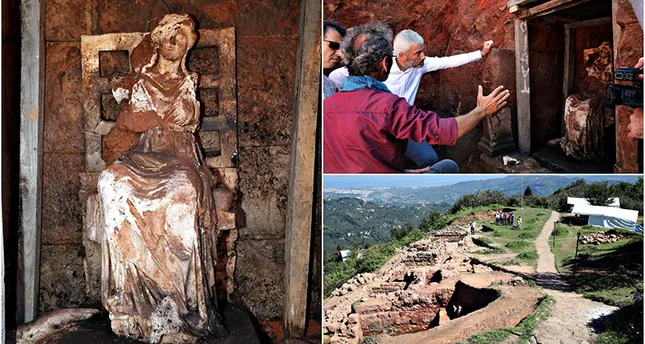
A Turkish site where a 2,100-year-old statue of Kybele was once unearthed is now in danger of being dynamited by a quarry dig.


Kurul Castle in the Turkish Black Sea port city of Ordu is close to the construction of an andesite quarry. The dynamite used to quarry also damages or even destroys historic sepulchers--or rock tombs in the area. further threatening the remaining areas, including Kurul Castle, Turkish daily Hurriyet reports. Local environmentalists are speaking up:

"We don’t know who to complain to, or what to do. Every day, those responsible for the stone quarry destroy the historic castle’s foothills with dynamite. We are anxiously waiting to see if the castle will crumble."

In 2016, excavations revealed an ancient marble mother goddess sculpture of Kybele in Kurul Castle, one of the first archaeological digs in the region. Kybele, sometimes referred to Cybele in Hellenic and Roman writings after her worship spread west across the Mediterranean, is an Anatolian mother Goddess thought to have been revered by the Phrygians: a civilization which inhabited central Turkey not far from the Black Sea.

Dominant in the region from circa 1200 BCE to 700 BCE, the Phrygian civilization has many ties to ancient Western mythology. The famous King Midas, whose touch was able to turn ordinary objects to gold, was said to have been a Phrygian king. Other notable mythological figures include King Gordias, the man who created the Gordian Knot that Alexander the Great so famously unraveled; while in the Iliad, the Phrygians were said to have been allies of the Trojans, coming to their aid during the Trojan War.

I am quite sure the statue has since been removed from the site, but it was only discovered in 2016. Who knows what else hasn't been discovered yet in the area that is now being destroyed.
Five sculptures of gods and goddesses have been found in the sanctuary of Mēn Askaenos in the ancient city of Pisidia Antiokheia in Turkey.


Excavations close to the ancient city, located in the southern province of Isparta’s Yalvaç district, unearthed the five intact sculptures in one of the previously unearthed prestigious chambers.

Excavations head Professor Mehmet Özhanlı said the sculptures of the Goddesses Hekate, Kybele, Athena and the Gods Mēn and Apollon were found together in the excavation field. Özhanlı added that such an example had never before been found in any excavations in Anatolia.

"All the gods of Greek, Roman and Anatolian Pantiona were brought together to create a cult. The local Anatolian god Mēn is on an altar in the center of the other gods, in front of Kybele and Apollo. Next to Mēn is Athena. This is the first time in the history of archaeology that these gods have been found together in a prestigious chamber. That is why this year’s excavation works present very good data about ancient beliefs in the area."

For more images, please see here, at The Archaeological News Network.

Mēn, by the way, is a lunar God worshipped in the western interior parts of Anatolia. He is attested in various localised variants, such as Mēn Askaenos in Antioch in Pisidia, or Mēn Pharnakou at Ameria in Pontus. Strabo describes Him as a local God of the Phrygians.

On Monday, 20 March, at 10 AM EDT, Elaion hosts a PAT ritual for the Galaxia. This rather obscure festival was held in many places in ancient Hellas, but most notably at Olympia. The Galaxia was closely linked to the vernal equinox, which was used to date it and was (amongst others) in honor of Kronos and Rhea.


The Galaxia is a festival held in honour of the Mother (of the Gods), who in Hellenic mythology is Rhea, although the title is also strongly associated with Gaia and Kybele, who have similar functions. She was worshipped as the mother of Zeus and the Galaxia celebrated His birth just as much as Her giving birth to him. Kronos--as Her consort and His father--was most likely also sacrificed to, along with Hera, who as Zeus' wife deserved honour alongside Him. In our ritual, we have included Helios and the Horai as well, as the Galaxia was associated so closely with the Spring Equinox.

The Galaxia had a special beverage attached to it--well, a special food item: a milk and barley porridge that may have been sacrificed to the Mother, but which was at least consumed at the festival. Pliny the Elder names the porridge a 'puls', which seems to have been a more general term which included pastes made from lentils and beans as well as from grain. On barley-based porridge, he has the following to say in his 'Natural History':

"There are several ways of making barley porridge: the Greeks soak some barley in water and then leave it for a night to dry, and next day dry it by the fire and then grind it in a mill. Some after roasting it more thoroughly sprinkle it again with a small amount of water and dry it before milling; others however shake the young barley out of the ears while green, clean it and while it is wet pound it in a mortar, and wash it of husk in baskets and then dry it in the sun and again pound it, clean it and grind it. But whatever kind of barley is used, when it has been got ready, in the mill they mix in three pounds of flax seed, half a pound of coriander seed, and an eighth of a pint of salt, previously roasting them all. Those who want to keep it for some time in store put it away in new earthenware jars with fine flour and its own bran. Italians bake it without steeping it in water and grind it into fine meal, with the addition of the same ingredients and millet as well." [XVIII-XIV]

Sources which mention the festival speak only of a milk and barley beverage that can be poured. Fundamentally, porridge is made by mixing oats with a fluid (normally water and or milk) and then heating it. Combine barley, water, and salt in a heavy saucepan. Cover, and bring to a boil over high heat, stirring continuously. Turn the heat to low and steam until grains are soft and all the liquid is absorbed. Add the milk once the water level drops below the level of the barley. Cooking time depends on the form of barley used. Use one cup dry barley on three cups of water.

- Hulled barley is unprocessed and takes the longest to boil, about an hour and 15 minutes before it's soft.
- Pearl Barley or Pearled Barley is the most common form of barley available and is sold in most supermarkets. Because the outer hulls including the bran have been removed, the grains have a pearly white color. Cooking time: 50-60 minutes.
- Quick Barley, or instant barley is pearl barley that is pre-steamed then dried, shortening the cooking time considerably, about 10 to 12 minutes.
- Barley Grits are processed similar to bulghur wheat. The grain is cracked, and toasted or parboiled, then dried, making it a quick-cooking product--about 2-3 minutes. As such, add a little less water or milk.
- Barley Flakes, Pressed Barley, or Rolled Barley have the appearance of rolled oats and are often included in muesli-type cereals. The cooking time is about 30 minutes.
- Barley Flour is hulled barley that is finely ground and has a lightness and delicate sweetness. It can be stirred into milk until the right consistency is reached.
To get a consistency where the puls can be poured, add milk or water to thin the porridge. If you want to sweeten the porridge a little, add warmed honey to the mixture.

We hope you will join us a week from now, on March 20 at the usual 10 AM. The ritual can be found here and you can join the community here.
Oh my, look at that beauty--both the Goddess and the statue itself. News broke that an estimated 2,100-year-old rare marble statue of Cybele, the mother goddess of Anatolia, has been unearthed in excavations in northwestern Ordu province located on the Black Sea coast. The historic sculpture of Cybele sitting on her throne weighs a whopping 200 kilograms and is about 110 centimeters tall. The statue is also the first marble statue found in Turkey in its original place.


Cybele (or Kybele) is originally a primal nature Goddess worshipped in the mountains of central and western Anatolia. Ancient Hellenes who settled in those regions identified her most often with Rhea but also with Gaia, Demeter, Artemis and even Hekate. Her original cult was too barbaric for the ancient Hellenes to adopt whole. As such, I do not usually include Her in my worship; I honour Rhea, Demeter, Artemis and Hekate Themselves instead. Still, I know many who include Her in their worship and rightly so!

The ancient artifact was unearthed in excavations launched by a team of 25 archeologists led by the head of the Department of Archeology in Gazi University, Prof. Dr. Süleyman Yücel Şenyurt, in the 2,300-year-old Kurul Kalesi, or the Council Fortress. He stated:

"We are continuing our work non-stop. Two days ago we found an extraordinary artifact. According to our research, the statue remained intact after the walls of the entrance of the fortress of Kurul collapsed during an invasion by Roman soldiers. This statue has also shown us that the fortress of Kurul in Ordu was a very important settlement [in ancient times]."

Saying that it was an incredibly rare find, the professor said that they were proud to unearth such an artifact in Turkey. He also said that the priceless statue would be later on transferred to the archeology museum in Ordu. The professor also said that the first attempts to conduct excavations in the area were made ​​about 6 years ago, but had been postponed for various reasons.

Mayor Enver Yılmaz pledged to provide TL 500,000 in funds to all excavations in the fortress of Kurul. He also said that the fortress will be turned into an open air museum in the near future and hopes the excavations will contribute to tourism in the region as well as in Turkey.
I get a lot of questions from readers, and most of the time, the answers are fairly short. When I feel the question or the reply would be valuable to others as well, I make a post with a collection of them and post them in one go. Today is one of those posts.


"I'm wondering if the goddess Kybele plays a part in your worhsip/practice of Hellenismos. If so, can you point the way to any hymns or prayers? I'm having a very hard time finding anything. I found something from Pindar but only in Greek... which is Greek to me. Other than that option, are you familiar with any other epithets than mistress of the animals (of which she was one of many apparently) or mother of gods? I read that she was invoked in Athens as a protector of the city, but no hymns..."

Kybele is originally a primal nature Goddess worshipped in the mountains of central and western Anatolia. Ancient Hellenes who settled in those regions identified her most often with Rhea but also with Gaia, Demeter, Artemis and even Hekate. Her original cult was too barbaric for the ancient Hellenes to adopt whole. As such, I do not usually include Her in my worship; I honour Rhea, Demeter, Artemis and Hekate Themselves instead.

Perhaps there have been Hellenic hymns written especially for Kybele, but I don't know of any. The same goes for Her epithets. I am sure She had more local ones but in general, I assume many of those to Rhea, Gaia, Demeter, Artemis and Hekate apply or can at least be used to honour Kybele. I do know of Roman Emperor Julian's Oration to the Mother of Gods from which you might draw some inspiration? It can be found here.

~~~

"Hello! I was just wondering if you could explain the difference between a shrine and an altar. Thank you!"

An altar is one of the basic necessities within Hellenismos, and it differs from a shrine. Where an altar is a 'work space', dedicated not so much to a specific deity but used to do the bulk of the (daily) rituals, a shrine is a devotional area where an altar might be located. In ancient Hellas, the shrine was usually a temple, the altar an actual altar, standing outside of it. Household worship took place at a multitude of shrines. Labelling something a shrine does not mean you can't sacrifice at these spots in your home. In general, you decorate a shrine but leave the altar rather bare.

~~~

"Are there sins in Hellenic polytheism similar to Christian sins? I understand that hubris is condemned but is there some list of defined sins? Or is it more obscure and up to interpretation. Thank you."

Sin is defined as a 'transgression of a religious or moral law, especially when deliberate', often regarded as either 'deliberate disobedience to the known will of [the Abrahamic] God, or 'a condition of estrangement from [the Abrahamic] God resulting from such disobedience'.

Sin is a Christian issue, which is made clearest in the punishment of sin: once sinned, a devotee is barred from Heaven--the supreme goal--until he or she repents. Repenting is 'to feel remorse, contrition, or self-reproach for what one has done or failed to do', and includes 'an admission of guilt for committing a wrong or for omission of doing the right thing; a promise or resolve not to repeat the offense; an attempt to make restitution for the wrong, or in some way to reverse the harmful effects of the wrong or the omission where possible'.

The concept of sin has no place in Hellenismos. There are things you can 'do wrong' in Hellenism, but because of the way the concept of sin works, it can never be applied to the Hellenic religion: we are not working towards the goal of an afterlife. Mythologically speaking, we know that we will inevertably end up a shade in the realm of Hades. Only if you have done something incredibly inexcusable (kill, chop up and serve your son to the Theoi, for example, as Tantalos did), you might be punished in Tartaros. In general, we will walk the dreary Fields forever, while some of us--those who have done extraordinary deeds in life--will end up in Elysium, but that is a rare honor indeed.

Within Hellenismos, we try not to do wrong--or better, we always try to do right--by the Gods. They are the major influence over our lives and we live largely by Their will. As such, fear of the Gods is a cornerstone of the faith, but it is not meant in the Christian sense where any sin committed is seen by God and jeopardizes you place in heaven; here it is meant as a reminder of kharis: that the Gods look favorably upon those who honor Them properly. The implication here is, of course, that they do not look favorably upon those who do not honor Them properly, and this is correct. Yet, committing hubris does not automatically mean that you will be punished by the Theoi; it simply means a drop in kharis. A drop in kharis is restored by fostering more kharis.

Sin is an important concept but it is unrelated to Hellenismos. One should never feel guilt for doing wrong by the Gods--only, perhaps, sadness for not doing right. Sin and guilt have no place in our religion, although they have a place in many of us as our Western societies are often drenched with Christian values and morals. It's important to untangle yourself from these subconcious influences to live an authentic Hellenistic life, which is not better than an Abrahamic one, only different. And the differences count.

~~~

"I often follow the monthly calendar you have based off of HMEPA. Most often, that lines up in a lunar sense even though I'm on the other side of the ocean. However, the new moon on September 30th is before sundown for you and after sundown for me. I believe that would mean that I would celebrate the Deipnon one night after you if going by the moon. If I'm trying to be recon, would it be inappropriate to just go with your calendar instead of customizing,moving everything for the month a day off?"

Every once in a while, we run into ‘Reconstructionist problems’. In general, these are issues that would not have been an issue in ancient Hellas, but are one now because of societal, practical, or economical reasons.

A little background: Hekate’s Deipnon is a religious celebration that takes place on Hene kai Nea. Hene kai Nea basically mean 'old and new’, and takes place any time before the first sliver of the new moon is visible. In practice, this is the day after the new moon. The Noumenia is held the day after that, when the moon has become visible again, and Agathós Daímōn the day after that. It is important to note that the ancient Hellens started a new day at sundown the day before. Instead of starting a new day at midnight–or in the morning–like we do today, they started it at sundown of the previous day. This means that–when applied to modern practice–the Deipnon starts on the day of the suspected new moon, and the rest follows after, to the total of four days. For more information on this, please see here. For those of you who have issues reading the Hellenic calendar at all, please see here.

In general, the placement of Hene kai Nea is easy: check the date and time of the dark moon, and at sundown afterwards, the Deipnon starts. Every once in a while, though, there is a complication: because of the moon’s cycle we end up with a situation where,if we hold the Deipnon at the time of the dark moon, we are a little too early and if we hold it the night after, we are a little too late. There is an added complication: many of us follow the HMEPA calendar as a basis for our practice and as a concensus, the HMEPA calendar is divided equally in 29 day months and 30 day months. This was much less applicable in ancient Hellas (especially Athens) where days were dropped or added where needed to accommodate festivals, wars, public events, and anything else. If the ancient Hellenes needed a little time before the fourth of the month, they just repeated the third day.

Because we all work off of the same calendar, we can’t just drop or add days in our practice, or at least if we do, we need to reallign ourselves somewhere, preferably right away. Where the ancient Hellenes would have pushed the entire month back if they needed an other day and taken off a day at the end, we would like to celebrate festivals together in a way, so if we remain out of tune, we will end up with three possible dates for a single festival; one on the actual date, one a day earlier because of a dropped day, and one a day later for an added day.

So, let’s look at this practically. If you follow the HMEPA calendar, you’ll be a little early but you’ll automatically be aligned with the rest of the world. If you push the Hene kai Nea back, you need to cut a day in the beginning of the month to fit the month into the 29 day/30 day cycle we stick to in modern times. The third day of the month is set, so you would have to drop the Noumenia to make a 30 day month fit.

The choice, really, is yours. There is no right or wrong answer, there are only practical ones. If you want three full days like usual, you need to put the Hene kai Nea early. If you don’t mind being out of alignment with the rest of the word from now on, just push it back and don’t remove the Noumenia. If you want to push the Hene kai Nea back and you don’t want to be out of alignment, drop the Noumenia (or, alternatively, a day later in the month but you’ll be out of alignment until then, including festival days). The perfect example of a Reconstructionist problem, isn’t it?

~~~

"Is there a way to properly dispose of khernips? For some reason I decided my first batch ever should have essential oils in it and now the khernips' smell is extremely overwhelming. I have to dispose of it but I don't know how without disrespecting the gods."

Dispose of khernips--lustral water used in ritual to cleanse yourself with--in a pot or outdoor pit. Use the same spot every time. You can also use this spot to dispose of other offerings. Ancient temples had these pits as well (and they are now our main sources of information about the types of sacrifices that took place there).
On Thursday, 24 March, at 10 AM EDT, Elaion is hosting a PAT ritual for the Galaxia. This rather obscure festival was held in many places in ancient Hellas, but most notably at Olympia. The Galaxia was closely linked to the vernal equinox, which was used to date it and was (amongst others) in honor of Kronos and Rhea.


The Galaxia is a festival held in honour of the Mother (of the Gods), who in Hellenic mythology is Rhea, although the title is also strongly associated with Gaia and Kybele, who have similar functions. She was worshipped as the mother of Zeus and the Galaxia celebrated His birth just as much as Her giving birth to him. Kronos--as Her consort and His father--was most likely also sacrificed to, along with Hera, who as Zeus' wife deserved honour alongside Him. In our ritual, we have included Helios and the Horai as well, as the Galaxia was associated so closely with the Spring Equinox.

The Galaxia had a special beverage attached to it--well, a special food item: a milk and barley porridge that may have been sacrificed to the Mother, but which was at least consumed at the festival. Pliny the Elder names the porridge a 'puls', which seems to have been a more general term which included pastes made from lentils and beans as well as from grain. On barley-based porridge, he has the following to say in his 'Natural History':

"There are several ways of making barley porridge: the Greeks soak some barley in water and then leave it for a night to dry, and next day dry it by the fire and then grind it in a mill. Some after roasting it more thoroughly sprinkle it again with a small amount of water and dry it before milling; others however shake the young barley out of the ears while green, clean it and while it is wet pound it in a mortar, and wash it of husk in baskets and then dry it in the sun and again pound it, clean it and grind it. But whatever kind of barley is used, when it has been got ready, in the mill they mix in three pounds of flax seed, half a pound of coriander seed, and an eighth of a pint of salt, previously roasting them all. Those who want to keep it for some time in store put it away in new earthenware jars with fine flour and its own bran. Italians bake it without steeping it in water and grind it into fine meal, with the addition of the same ingredients and millet as well." [XVIII-XIV]

Sources which mention the festival speak only of a milk and barley beverage that can be poured. Fundamentally, porridge is made by mixing oats with a fluid (normally water and or milk) and then heating it. Combine barley, water, and salt in a heavy saucepan. Cover, and bring to a boil over high heat, stirring continuously. Turn the heat to low and steam until grains are soft and all the liquid is absorbed. Add the milk once the water level drops below the level of the barley. Cooking time depends on the form of barley used. Use one cup dry barley on three cups of water.

- Hulled barley is unprocessed and takes the longest to boil, about an hour and 15 minutes before it's soft.
- Pearl Barley or Pearled Barley is the most common form of barley available and is sold in most supermarkets. Because the outer hulls including the bran have been removed, the grains have a pearly white color. Cooking time: 50-60 minutes.
- Quick Barley, or instant barley is pearl barley that is pre-steamed then dried, shortening the cooking time considerably, about 10 to 12 minutes.
- Barley Grits are processed similar to bulghur wheat. The grain is cracked, and toasted or parboiled, then dried, making it a quick-cooking product--about 2-3 minutes. As such, add a little less water or milk.
- Barley Flakes, Pressed Barley, or Rolled Barley have the appearance of rolled oats and are often included in muesli-type cereals. The cooking time is about 30 minutes.
- Barley Flour is hulled barley that is finely ground and has a lightness and delicate sweetness. It can be stirred into milk until the right consistency is reached.
To get a consistency where the puls can be poured, add milk or water to thin the porridge. If you want to sweeten the porridge a little, add warmed honey to the mixture.

We hope you will join us on Thursday. The ritual can be found here and you can join the community here.
I get a lot of questions from readers, and most of the time, the answers are fairly short. When I feel the question or the reply would be valuable to others as well, I make a post with a collection of them and post them in one go. Today is one of those posts.


"What is the difference between hellenic recon, hellenic reform, and hellenic revival? I haven't really been able to find good explanations of these terms in relation to their differences."
 
In general, I consider 'Revival' and 'Reformed' the same thing. Others probably don't, but I'll explain the difference between 'Recon' (which we call 'Traditional') and 'Reformed' Hellenismos. To start, there is no hard line—not in as far as can be defined beforehand; the distinction between 'Traditional' and 'Reformed' is a matter of intent.

The ancient Hellenes worshipped their Gods in a way they did not even have to think about. They were taught by their parents how a ritual was supposed to be conducted and what a festival looked like. Kids learned how to act in temples, and they played their parts in the sacrifice. The ancient religion varied from place to place and when details of a festival or rite changed, they changed because the polis wanted them to. The ancient Hellenic religion(s) were greatly tied to the ancient Hellenic culture(s). Yet, there were overarching ideals and ritual acts that a man traveling from Athens to Kos would recognize if he walked in on a festival there. In fact, it's likely he would have recognized the festival and could share in its intent. Perhaps not its execution, and perhaps not all the time (because of local mythology and deities), but most of the time, and in most of its execution.
 
'Traditional' thus means to practice Hellenismos in the spirit of the ancients. I keep in mind that man from ancient Athens and with everything I do, we wonder if he would recognize what I am doing as the worship of the Gods he worships at home. That does not mean you need a big altar out in your garden (although I do encourage it), and this doesn't mean you need to hold daily ritual (although I do encourage it), and it doesn't mean that you always have to worship in a group or with your family (but I do encourage it) in order to be Traditional. It means that whatever you do, you keep that man in mind and wonder if he would recognize what you are doing as an adapted and modernized version of his faith.
 
'Traditional', as such, has nothing to do with practices that link back directly to ancient Hellas; no one is claiming to trace a lineage back or to in any other way have a direct line into the ancient Hellenic religion. We take what we know from scholarly and original work and make a generalized framework that can be built off of and adapt that to modern culture. Then we flesh out our practice with ancient practices and ancient ways of thought that resonate with us.
 
'Reformed', then, is the incorporation of practices that are either completely new or were derived from ancient Hellas with so many steps in-between that it's become completely unrecognizable. The incorporation of modern witchcraft, for example, or patron Gods as defined by modern Paganism. Wiccan elements are also part of Reformed Hellenismos.
 
To get back to the intent I mentioned earlier; your practice is Traditional to the typical Hellenist if you adhere to the above: ancient practices in a modern context where the bare bones are as close to the generalized ancient religion as we can make them. If you wilfully bring in modern elements from other religions or traditions, we consider those parts of your practice Reformed, and there is no value judgement in that. One is not better than the other. they both have vlue. It's a personal choice.
  
I hope this makes the distinction between the two clearer, and that it gives substance and context to the terms. For me, the value in using these terms lies in more easily finding likeminded people to share worship with. Using these terms prevents a lot of hassle and aggravation, but in the end, they are just words. It's your practice that matters and in the end, we all worship the Theoi.

~~~

"I read your articles on the Kronia. Can you please tell me, what day it falls this year. Has anything been discovered that would need me to worship differently from your article. And how should I pay homage to the Kronos this year?"

As far as I am aware, the article is still accurate. The Kronia will be held from dusk on July 27 to dusk on July 28 in 2016. you can find last year's ritual for the event here.

If you are interested in honouring Kronos, next month, from dusk on March 23 to March 24, the Galaxia takes place. This rather obscure festival was held in many places in ancient Hellas, but most notably at Olympia. It was closely linked to the vernal equinox, which was used to date it. The Galaxia is a festival held in honour of the Mother (of the Gods), who in Hellenic mythology is Rhea, although the title is also strongly associated with Gaia and Kybele, who have similar functions. She was worshipped as the mother of Zeus and the Galaxia celebrated His birth just as much as Her giving birth to him. Kronos--as Her consort and His father--was most likely also sacrificed to, along with Hera, who as Zeus' wife deserved honour alongside Him. Our ritual for that can be found here.

~~~

"As I have been ordered by my doctor to lose a great deal of weight, I was wondering if you had any suggestions for which Gods or Goddesses I should pray to (I assume Heracles would be one of these) or which Hymn's of Homer I should recite. If you could get back to me, I would greatly appreciate your input."

Herakles would be a great hero to pray to, as would any Gods and Goddesses connected to battle, struggle and physical health. Ares and Athena come to mind, along with Asklepios and even Niké. Especially Ares is a God I pray a lot to when it comes to working out and getting in shape, Demeter might also be a good option to help make healthy food choices.

~~~

"I see that you have ideas about honoring certain gods, which can include their families..ie, Apollo, Artemis, Leto, and zeus , etc. Do you have any ideas of honoring Hera, daily and just to do something special for her, offerings or a devotional."

Do you do daily ritual now? Hera is included in mine. If you only wish to honour Hera, however, you can with a simple ritual.

- Set out a bowl of water
- Set out a bowl of wine and dilute it with water
 - Light a candle to Hestia with a match
- Drop the match into the bowl of water and use it as khernips to cleanse
- Wash your hands and face and flick the access water off over your shrine to cleanse it.
-  Recite the Homeric Hymn 24 to Hestia:
 
"Blessed Goddess Hestia, you who tend the holy house of the lord Apollo, the Far-shooter at goodly Pytho, with soft oil dripping ever from your locks, come now into this house, come, having one mind with Zeus the all-wise—draw near, and withal bestow grace upon my song."
 
- Pour some wine out to Hestia
- Light an incense burner with aromatic herbs like bay-leaf, chamomile, chrysanthemum, jasmine flowers, laurel, lavender, myrtle,  rose, sandalwood, verbana, etc. or add it to a sacrificial fire
- Recite a hymn to Hera, like Homeric Hymn 12 to Hera:
 
"I sing of golden-throned Hera whom Rhea bare. Queen of the Immortals is she, surpassing all in beauty: she is the sister and wife of loud-thundering Zeus,--the glorious one whom all the blessed throughout high Olympos reverence and honour even as Zeus who delights in thunder."
 
- Pour some wine out to Hera
- Say your prayers
- Blow out the candle and clean up

 ~~~

"Do you know any artist that does drawing or paintings or even statuary. Commissioned pieces. I have been looking for a long time now and figured to ask because I have been meaning to commission some pieces of Hera or other gods as I become more financially able."

About commissioning pieces... I only know of Lykeia. Any readers interested....? Leave your contact info in the comments!
A while ago, I decided that on the day of the Hene kai Nea, I'd post a monthly update about things that happened on the blog, and today I am adding an Elaion PAT ritual announcement for Sunday and an announcement of some exciting things to come for Elaion and its members.

Changes to the blog:
  • I don't think it can have escaped anyone's notice, but I recently started a new series on the blog, the (Elaion) Beginner's guide to Hellenismos. This ongoing project strives to create a concise yet informational, practical guide to the practice of Hellenismos. It is an attempt to standardize the worship of the ancient Hellenic Gods and to provide members of Hellenic organisation Elaion with the basics to start their worship. So far published are an introduction, an article on Ouranic versus Khthonic Gods and practices, and an article on Traditional versus Reformed Hellenismos, which are terms that are in use by Elaion to specify our particular 'brand' of Hellenismos.

Statistics:

Anything else?
Pandora's Kharis, a charity circle for and by Hellenistic Polytheists Pandora's Kharis members have selected the Wounded Warriors project as its cause for Anthesterion 2015. If you want to donate, you have until tomorrow! Join us on Facebook if you would like to pitch a cause for next month!

---

On Sunday, 22 March, at 10 AM EDT, Elaion is hosting a PAT ritual for the Galaxia. This rather obscure festival was held in many places in ancient Hellas, but most notably at Olympia. The Galaxia was closely linked to the vernal equinox, which was used to date it. As such, it should take place tomorrow, but as that is the Hene kai Nea, the ancient Hellenes would have likely considered it auspicious to hold the festival on that date.

The Galaxia is a festival held in honour of the Mother (of the Gods), who in Hellenic mythology is Rhea, although the title is also strongly associated with Gaia and Kybele, who have similar functions. She was worshipped as the mother of Zeus and the Galaxia celebrated His birth just as much as Her giving birth to him. Kronos--as Her consort and His father--was most likely also sacrificed to, along with Hera, who as Zeus' wife deserved honour alongside Him. In our ritual, we have included Helios and the Horai as well, as the Galaxia was associated so closely with the Spring Equinox.

The Galaxia had a special beverage attached to it--well, a special food item: a milk and barley porridge that may have been sacrificed to the Mother, but which was at least consumed at the festival. Pliny the Elder names the porridge a 'puls', which seems to have been a more general term which included pastes made from lentils and beans as well as from grain. On barley-based porridge, he has the following to say in his 'Natural History':

"There are several ways of making barley porridge: the Greeks soak some barley in water and then leave it for a night to dry, and next day dry it by the fire and then grind it in a mill. Some after roasting it more thoroughly sprinkle it again with a small amount of water and dry it before milling; others however shake the young barley out of the ears while green, clean it and while it is wet pound it in a mortar, and wash it of husk in baskets and then dry it in the sun and again pound it, clean it and grind it. But whatever kind of barley is used, when it has been got ready, in the mill they mix in three pounds of flax seed, half a pound of coriander seed, and an eighth of a pint of salt, previously roasting them all. Those who want to keep it for some time in store put it away in new earthenware jars with fine flour and its own bran. Italians bake it without steeping it in water and grind it into fine meal, with the addition of the same ingredients and millet as well." [XVIII-XIV]

Sources which mention the festival speak only of a milk and barley beverage that can be poured. Fundamentally, porridge is made by mixing oats with a fluid (normally water and or milk) and then heating it. Combine barley, water, and salt in a heavy saucepan. Cover, and bring to a boil over high heat, stirring continuously. Turn the heat to low and steam until grains are soft and all the liquid is absorbed. Add the milk once the water level drops below the level of the barley. Cooking time depends on the form of barley used. Use one cup dry barley on three cups of water.
  • Hulled barley is unprocessed and takes the longest to boil, about an hour and 15 minutes before it's soft.
  • Pearl Barley or Pearled Barley is the most common form of barley available and is sold in most supermarkets. Because the outer hulls including the bran have been removed, the grains have a pearly white color. Cooking time: 50-60 minutes.
  • Quick Barley, or instant barley is pearl barley that is pre-steamed then dried, shortening the cooking time considerably, about 10 to 12 minutes.
  • Barley Grits are processed similar to bulghur wheat. The grain is cracked, and toasted or parboiled, then dried, making it a quick-cooking product--about 2-3 minutes. As such, add a little less water or milk.
  • Barley Flakes, Pressed Barley, or Rolled Barley have the appearance of rolled oats and are often included in muesli-type cereals. The cooking time is about 30 minutes.
  • Barley Flour is hulled barley that is finely ground and has a lightness and delicate sweetness. It can be stirred into milk until the right consistency is reached.
To get a consistency where the puls can be poured, add milk or water to thin the porridge. If you want to sweeten the porridge a little, add warmed honey to the mixture.

We hope you will join us on Sunday. The ritual can be found here.

---

Now, I have one more thing to say in relation to Elaion: this month, Robert and I are planning to roll out a few changes that will renovate, invigorate and renew Elaion as a whole. I am very excited about these changes, but unfortunately, I can only tell you to give us a little more time to figure out the details and set things up. I'll--of course--keep you informed.

---

Are you looking for an online shop to buy incenses and other Hellenistic basics from? Try The Hellenic Handmaid on Etsy.

That is it for the last month's updates, as far as I can remember. Have a blessed Deipnon!
I think I mentioned before that priesthood in ancient Hellas was a lot different from priesthood as we understand it now. In the modern (Pagan) interpretation, priests serve a mostly spiritual role; they serve the religious community as a vessel for or to a God or Goddess. The primary tasks of a modern day priest(ess) seem to be to serve the community, to spread the gospel of the God(ess) in question and to offer access to the God(dess) in question.

In ancient Hellas, the role of priest(ess) was a largely temporary, governmental, function. The profession of priest could be bought, and usually only lasted a few years at best. Minding a temple was almost exactly like minding a house; clean-up, clean-up, clean-up. In fact, religious celebrations weren't led by the priest(ess), but by the magistrate or other high ranking government official. The sole task of the priest(ess) was the animal sacrifice, but that was vitally important.

During most festivals, an animal was sacrificed. It was the job of the priest(ess) to pick out the animal, lead it to the altar and bless the animal. Especially the latter was a job only a priest(ess) could perform, because they were especially well versed in liturgy, and because a failure to preform the exact rites would result in a failure of the sacrifice.

After the blessing, the priest(ess) would slaughter the animal, skin it, cut it up and distribute the meat between the altar and the participants. He or she would see to it that the meat was cooked up properly and divided fairly, although he or she might leave the actual butchering and cooking to the mageiroi, ritual helpers.

What stands out from this practice is that the priest(ess) is not a representative of the Gods, but of the supplicants. Because of this, his or her presence during the ritual was indispensable. Because of their dual task, the ancient Hellens used two words to describe priests: hiereus, meaning 'sacrificer', and arètèr, meaning 'supplicant'. One of the most beautiful examples of a sacrefice comes from Hómēros. In the Illias, we find this:

"Meanwhile Odysseus had touched at Chryse, bearing the sacrifice. Entering the deep harbour, they furled the sail and stowed it in the black ship, dropped the mast by lowering the forestays, and rowed her to her berth. Then they cast out the anchor stones, made fast the hawsers, and leapt on shore. Next, the offering of cattle for far-striking Apollo was disembarked, and Chryses’ daughter landed from the sea-going boat. It was Odysseus, that man of resource, who led her to the altar, and handed her to her dear father, saying: ‘Chryses, our leader Agamemnon commanded me to return your daughter, and make holy sacrifice to Phoebus for all the Greeks, and propitiate your lord Apollo, who has brought the Argives pain and mourning.’ With this, he handed her to her father who joyfully clasped her in his arms.

Swiftly now they tethered the offering of cattle around the well-built altar, rinsed their hands and took handfuls of sacrificial barley grains. Then Chryses raised his arms and prayed on their behalf: ‘Hear me, God of the Silver Bow, protector of Chryse and holy Cilla, lord of Tenedos. Just as once before when I prayed to you, you honoured me and struck the Achaeans a fierce blow, so grant my new plea, and avert this dreadful scourge from the Danaans.’ So he prayed, and Apollo listened.

When they had offered their petition and scattered grains of barley, they drew back the victims’ heads, slit their throats and flayed them. Then they cut slices from the thighs, wrapped them in layers of fat, and laid raw meat on top. These the old man burnt on the fire, sprinkling over them a libation of red wine, while the young men stood by, five-pronged forks in their hands. When the thighs were burnt and they had tasted the inner meat, they carved the rest in small pieces, skewered and roasted them through, then drew them from the spits. Their work done and the meal prepared, they feasted and enjoyed the shared banquet, and when they had quenched their first hunger and thirst, the young men filled the mixing-bowls to the brim with wine and pouring a few drops first into each cup as a libation served the gathering. All that day the Achaeans made music to appease the god, singing the lovely paean, praising the god who strikes from afar; while he listened with delight."

In this beautiful written piece, Chryses is a priest of Apollon. He had previously begged Apollon to curse those who had taken his daughter, but performed the proper rites to Apollon to appease him as his daughter was returned to him.

There were other tasks a priest(ess) or the mageiroi performed. Depending on the temple, examples include oracular practices, the singing of oracles (usually by a thespiode), and dancers (especially for Artemis and Kybele, known as melissai).

Priests and priestesses were drawn from almost every hierarchical position, but mostly came from royalty. Still, coming from high birth was not enough. The priest(ess) had to be without deformities and if they were of particular beauty, they had a better chance of filling the position. Votes or lots are cast in order to choose the right priest(ess) for the temple at that time. 

Clergy lived 'off of the altar'; from every sacrifice, they received a large, good, piece of meat. For their services, they often received extra gifts of bread, other baked goods, and wine for the libations. As a counter, the priest(ess) brought the wood, oil and honey for the sacrifice, but these were paid back to the temple with interest. This practice led to a society where temples slowly accumulated wealth and could expand, bringing prosperity to the city or town around it.

As modern Hellenics, we need to decide where we will place priests and priestesses in our hierarchy. Which tasks will they be charged with? Will we add animal sacrifice to our practice? How will be pick our clerics, then? Will our priesthood be automatically made up by those who are legally allowed to sacrifice these animals, or would they have needed to build a physical temple? If so, will we sustain these priests and priestesses with gifts or money, or will we only make use of them at festivals and leave them a nine to five job to fend for themselves? How many clerics do we need and for how large a group do we need them? These are the questions that come to mind when thinking about priesthood in a modern Hellenic context. I have no answers for these, although I have my preferences. I would love to hear about yours.