Showing posts with label Kheiron. Show all posts

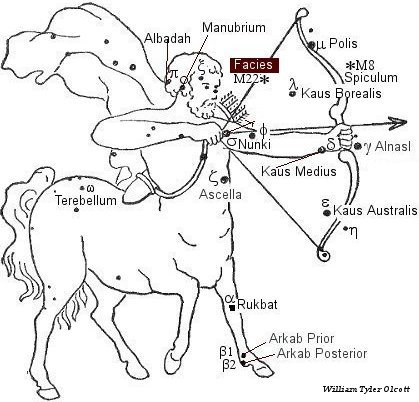
It's been a while since we have tackled a constellation, so let's look at the next one today: Sagittarius, the archer. It was named 'Toxotes' (Τοξότης) in Greek, and is one of the 48 constellations listed by the 2nd-century astronomer Ptolemy and remains one of the 88 modern constellations. It lies between Scorpius and Ophiuchus to the west and Capricornus to the east.


http://www.constellationsofwords.com/stars/Facies.html

In Hellenic mythology, Sagittarius is usually identified as a centaur: half human, half horse. Who, exactly, Sagittarius is, exactly, is unclear. Kheiron (Chiron, Χείρων), the wise and educated Centaur who taught heroes like Achilles, Theseus, Iásōn, and Hēraklēs, is a very good candidate, mostly because he died a very tragic death.

Hēraklēs' fourth labour is to capture the Erymanthian Boar, which got his name from the mountainside and swamp it roamed on. It is a difficult task; a boar is a ferocious animal, and even modern day hunters take care when hunting boar. This labour became even harder to complete for Hēraklēs when he met the centaurs on his way to the boar. Our hero went the long way to visit Phontus, a kéntaur who dwelt in a cave on Mount Pholoe, who was the son of Seilenus and the nymph Melia.

Having heard of Hēraklēs, Phontus entertained him in his cave, and provided him with food. Hēraklēs, thirsty from the savory meat dish, asked for wine, but Phontus said he only had the wine that was communal to all the kéntauroi, and he did not dare touch it. Hēraklēs convinced him to do so, regardless, and the kéntauroi came galloping to the cave. Hēraklēs fought them, and many died. Phontus, inspecting one of Hēraklēs' arrows dipped in hydra poison, which the hero had used to kill one of the kéntauros, dropped it onto his foot and he died of the poison as well. Hēraklēs, grieving for the death of Phontus, buried him near his cave. Hyginus, in his 'Astronomica' writes:

"He is said to be Chiron, son of Saturn and Philyra, who surpassed not only the other Centauris but also men in justice, and is thought to have reared Aesculapius and Achilles. By his conscientiousness and diligence, therefore, he won inclusion among the stars. When Hercules was once visiting Chiron, and while sitting with him was examining his arrows, one of them is said to have fallen on the foot of Chiron, and thus brought about his death. Others say that when the Centaur wondered at his being able to kill such huge creatures as Centauri with such slight arrows, he himself tried to draw the bow, and the arrow, slipping from his hand, fell on his foot. For this reason Jupiter, pitying him, put him among the constellations with a victim which he seems to hold above the altar for sacrifice. Others have said that he is Pholus the Centaurus, who was more skilled in augury that the rest. Consequently, by the will of Jove, he was represented coming to the altar with a victim." [II.38]

It is important to note, though, that this could also relate to the constellation Centaurus--Hyginus seems to think so, although he also wonders if it's a Centaur at all...

"Many have called this sign the Centaurus; others deny the name, for the reason that no Centaurus makes use of arrows. The question is raised, too why he is formed with horse flanks but a Satyr’s tail." [II.27]

A competing mythological tradition, as espoused by Eratosthenes, identified the Archer not as a centaur but as the satyr Krotos (Κροτος), son of Pan, who the ancient Hellenes credited with the invention of archery. According to myth, Krotos often went hunting on horseback and lived among the Muses, who requested that Zeus place him in the sky, where he is seen demonstrating archery. Hyginus again, in his 'Fabulae' on mortals who were made immortal mentions Krotos:

"Crotos, son of Pan and Eupheme, foster-brother of the Muses, put into the constellation Sagittarius" [224]

The arrow of this constellation points towards the star Antares, the 'heart of the scorpion', and Sagittarius stands poised to attack should Scorpius ever attack the nearby Hēraklēs, or to avenge Scorpius' slaying of Orion. The constellation Sagittarius is visible at latitudes between +55° and −90°, and best visible at 21:00 (9 p.m.) during the month of August.

Before we get started on this one, I need to tell you that the interpretation of 'wolf' is a Roman one; The romans translated Ptolemy's work from Greek to Latin, and translated the constellation named 'Therion' as 'wolf', instead of the more general 'beast' or 'animal'. As such, the constellation did not actually represent a wolf until Roman times, but we are stuck with the Roman names, so I went with 'wolf' for the post's title.

The stars of the constellation Lupus were once considered to be part of the constellation Centaurus, where they represented an animal being impaled on a pole by the centaur, who was holding it toward the constellation Ara, the altar, as though he were about to sacrifice it. The Hellenic astronomer Hipparch separated the constellation from Centaurus and named it Therion in the second century BC.


Because the separation came so late, many references to Lupus are in connection to Centaurus and Ara. Aratos, for example, in his 'Phaenomena':

"The constellation of Centaur [Centaurus] thou wilt find beneath two others. For part in human form lies beneath Scorpio, but the rest, a horse’s trunk and tail, are beneath the Claws. He ever seems to stretch his right hand towards the round Altar, but though his hand is drawn and firmly grasped another sign – the Beast [Fera], for so men of old have named it." [436]

Hyginus, in his 'Astronomica' echoes this, linking Lupus to the constellation Centaurus. In his version, the Centaur holding out a sacrifice is either Kheiron or Pholus; Kheiron because he dropped a poisoned arrow on his foot and perished, and Pholus for his Gods-given powers of divination:

"When Hercules was once visiting Chiron, and while sitting with him was examining his arrows, one of them is said to have fallen on the foot of Chiron, and thus brought about his death. Others say that when the Centaur wondered at his being able to kill such huge creatures as Centauri with such slight arrows, he himself tried to draw the bow, and the arrow, slipping from his hand, fell on his foot. For this reason Jupiter [Zeus], pitying him, put him among the constellations with a victim which he seems to hold above the altar for sacrifice. Others have said that he is Pholus the Centaurus, who was more skilled in augury that the rest. Consequently, by the will of Jove [Zeus], he was represented coming to the altar with a victim." [II.38]
 
The constellation Lupus is a minor constellation, and in ancient writings, you won't be able to connect it to the wolf at all, especially because wolves--if they ever ended up being sacrificed on an altar at all--would most likely only be sacrificed in cult worship. It was not a regular sacrificial animal, but may have been a part of the worship of Gods with the 'Lykaion' epithet--like Zeus and Apollon.

The constellation is visible at latitudes between +35° and −90°, and best visible at 21:00 (9 p.m.) during the month of June.

It's time for a new constellation post! This one is going to be all about horses, so if you're a horse lover, rejoice. If not, well, then there is at least some interesting mythology here.

 
Equuleus, or 'little horse' is the second smallest of all of Ptolemy's constellations. It is depicted by solely a horse's head, and seems almost hidden away behind the much larger horse constellation Pegasus. There is a mythological reason for this hiding behavior: Equuleus is said to represent Hippe (Ἵππη), or Melanippe (Εὐίππη), daughter of the kéntauros Kheiron. She became pregnant and could not let her father know. As such, she begged the Gods to be transformed into a mare. From Hyginus's Astronomica:
 
"Euripides in his Melanippe, says that Melanippe, daughter of Chiron the Centaur, was once called Thetis. Brought up on Mount Helicon, a girl especially fond of hunting, she was wooed by Aeolus, son of Hellen, and grandson of Jove, and conceived a child be him. When her time drew near, she fled into the forest, so that her father, who supposed her a virgin, might not see that she had given birth to a grandchild. And so when her father was looking for her, she is said to have begged the power of the gods not to let her father see her in childbirth. After the child was born, by the will of the gods she was changed into a mare which was placed among the stars."
 
He also gives another reason for her change:
"Some say that she was a prophetess, and because she used to reveal the plans of the gods to men, she was changed into a mare. Callimachus says that because she ceased hunting and worshipping Diana [Artemis], Diana changed her into the shape we have mentioned. For the reason above, too, she is said to be out of sight of the Centaur, who some say is Chiron, and to show only half her body, since she didn’t want her sex to be known."
 
The constellation is also known as Eguus Primus, the 'first horse' because it rises just before Pegasus. Because it rises first, it is sometimes identified as the offspring of Pegasus, Celeris, whom he had with his wife, Euippe (or Ocyrrhoe). The second child out of that marriage was Melanippe, a common female name when associated with horses, as it means 'mare'.
 
The third and last horse that this constellation is connected to it the horse that was born the moment Poseidon's trident struck the ground in the battle for patronage of the city of Athens:
 
"The common tradition about Poseidon creating the horse is as follows : -- when Poseidon and Athena disputed as to which of them should give the name to the capital of Attica, the gods decided, that it should receive its name from him who should bestow upon man the most useful gift. Poseidon their created the horse, and Athena called forth the olive tree, for which the honour was conferred upon her. [Serv. ad Virg. Georg. 1.12.]
 
The constellation Equuleus is visible at latitudes between +90° and −80°, and best visible at 21:00 (9 p.m.) during the month of September.

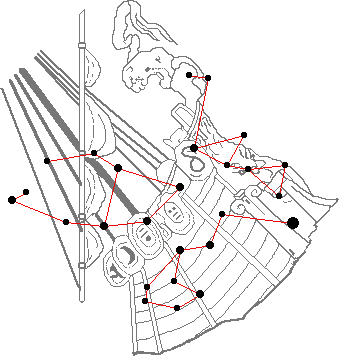
Welcome to another installment of the constellation series. As the fourth constellation, I have for you Argos Navis, a collection of constellations which together form the ship Argo, on which the Argonauts (Argonautai, Ἀργοναῦται) sailed to find the Golden Fleece.


The Argo Navis was an ancient constellation which has since been disband. It was a huge constellation, the largest in existence.  In 1752, the French astronomer Nicolas Louis de Lacaille subdivided it into Carina (the keel of the ship), Puppis (the stern), and Vela (the sails). Back in ancient Hellas, it was still one, large, constellation and it represented the ship on which one of Hellas' greatest heroic journeys was undertaken: Iásōn's (Ἰάσων, Jason) quest for the Golden Fleece.

The Argo (Ἀργώ), meaning 'swift', was built by the shipwright Argus. He was a member of the Argive royal house, and his fmily was favored by Hera. Becasue of this, anyone who sailed on the Argo, would have Her aid. Argus was aided in the planning and construction of the Argo by Athena, and possessed in its prow, a magical piece of wood from the sacred forest of Dodona, which could speak and render prophecies.

The tale of the Argonautai is long, and complicated. As so many kings in ancient Hellas, Pelias (Πελίας) unrightfully laid claim to his half-brother's throne. He became the king of Iolkos in Thessaly, and fell in disfavor of the Theoi because of his actions. It was prophesied that a member of the rightfully royal bloodline would one day punish him, and he was likewise warned to watch out for a man with only one sandal.

Pelias didn't believe in half measures and murdered every prominent descendant of Aeolus he could, but spared his mother Tyro's youngest son, Aeson. Instead, he imprisoned him and forced him to renounce his claim to the throne. Aeson complied, and eventually was set free. He married  Alcimede, who bore him a son named Diomedes. Alcimede successfully saved her son from certain death by having her nursemaids keen as if the boy had been stillborn. She secretly packed him off to Mount Pelion, where he was raised by the kéntauros Kheiron (Χείρων), who changed the boy's name to Iásōn.

From Kheiron, Iásōn learned the arts of combat, sports, medicine and music. When he reached adulthood, he was send back to Iolkos with proof of his royal birth. On the way there, he had to cross a river and found an old woman on the bank of it, who begged everyone who passed by to carry her through the water. All but Iásōn ignored her. He took her onto his back and he helped her across, although he found the journey tougher than he had ever thought possible. He also lost one of his sandals in the mud. As he put down the old woman, she turned into the magnificent Hera, of whom he would continue to receive support now he had passed her test.

As soon as Pelias laid eyes on the youth with one sandal, he knew what would happen now. And thus, he devised a plot to get rid of Iásōn. As Iásōn presented him with an offer to keep some farms and cattle, while Iásōn claimed his rightful place on the throne, Pelias happily accepted, but warned Iásōn that one task had to be completed first: the proper burial of king Phrixos.

Phrixos, thus told Pelias, Iásōn, had been saved from being sacrificed to the Theoi by a ram with golden wool. The Theoi had not demanded this sacrifice, but his step-mother Ino had paid off messengers from the oracle of Delphi to demand so of her husband out of hatred for the boy. The ram had carried him off to Helios' palace, where he was accepted into the household. The ram was sacrificed to Zeus, and the fleece was hung from a tree in a sacred grove of Ares, guarded night and day by a dragon that never slept. Pelias was haunted by Phrixos, and swore to Iásōn Phrixos would not rest until his ghost was taken back to Iokos, along with the Golden Fleece. If Iásōn did this, he swore by Zeus, to relinquish his throne to him.

Iásōn jumped at the chance. Kheiron had taught him well, and a chance to prove himself was all he desired. And so, he hired Argus to build him a ship, and send out messages to the various royal families to send them their young heroes for this voyage. Many jumped at the chance, although it's unclear how many, exactly. Argus may have undertaken the journey himself, as did Atalanta, Bellerophon, Kastor and Polideukes, Hēraklēs, Nestor, Orpheus, Perseus and Theseus. The number of Argonautai lay somewhere between forty and fifty.

The journey would take the brave Argonautai to many dangerous places. The first was Lemnos, where the women had been struck with madness by Aphrodite for failing to properly honor her. they had killed all men on the island, and all slave women as well. When the Argonautai reached the island, Aphrodite enchanted the women to seduce them, and thus halt their journey. Hēraklēs was the only one who did not go off of the ship, so he was able to convince the others to ship out after a long, long wait.

The next challenge came in the form of the Gegeines; Earthborn giants with six arms. The Argo sailed to Doliones where king Cyzicus ruled. In search of supplies, he allowed then to look for supplies on Bear Mountain, but failed to warn the crew of its inhabitants. When most of the crew left for the mountains, the Gegeines attempted to raid the ship, but Hēraklēs, along with a few others, held them off long enough for Iásōn and his men to return. They set sail int he dead of night but got turned about. They ended up on the same shore where the Argonautai and the people of king Cyzicus failed to recognize each other and many of them were killed, the king amongst them. When morning came, the Argonautai were shocked and ashamed, and organized a burial for the dead king. Hēraklēs took his leave here, as his tasks were not yet completed.

For twelve, long, days, the weather was so bad that the Argo could not set sail. The crew waited and grew hungry and thirsty. Mopsos, a bird auger, eventually deduced that the men should sacrifice to Rhea, mother of the Theoi. They did, and food and drink came to them by way of animals and low hanging fruit. The wind also died down, and the expedition was saved.

Next, they reached Bebryken, where they were challenged to a fist fight by king Amykos. He was so strong, he killed every opponent with one hit, and tossed those who refused to fight into the sea to die there. It was Pollux, son of Zeus, who accepted the challenge. He managed to win his fight gloriously, but the followers of the king were furious and wanted revenge. They fought the Argonautai, but were no match.

Soon they reached the court of Phineus of Salmydessus in Thrace. The king had been blessed with the gift of prophecy, but had shared too much of Zeus' secrets. For that, Zeus send Harpies to his door every day to take his food. The starving king begged the Argonautai for help, and received it. The Harpies were killed (or, in some versions of the myth, chased off) and the expedition continued.

The only way to reach their destination was to sail through the Symplegades, or Clashing Rocks. These huge rock cliffs came together and crushed anything that traveled between them. Phineas told the crew to release a dove when they approached these islands, and if the dove made it through, to row with all their might. If the dove was crushed, he was doomed to fail. Iásōn released the dove as advised, which made it through, losing only a few tail feathers. They went for it and, with the aid of Athena, made it through with only minor damage to the stern of the Argo. The clashing rocks were forever joined, leaving the way free for others to travel.

Before reaching Kolchis, their destination, the Argonautai would halt twice more. Once in the land of the Mariandyn, where they lost their navigator to illness, and Hera just barely saved the expedition by making Ankaios speak winged words of confidence that he could steer the ship. And he did. The second wait came in the form of a terrible storm for which the Argo needed to be protected. When the storm died down, they found the shipwrecked nephews of Iásōn, who had been on their way back from Kolchis, and were accepted into the Argonautai right away.

Once the Argonautai reached Kolchis, their struggle wasn't over. King Aeetes was unwilling to part with the Fleece, as it had brought great prosperity to his lands. He devised three tasks for Iásōn: to plow a field with fire-breathing oxen, to sow the teeth of a dragon into the field, and to overcome the sleepless dragon guarding the Fleece. Aided by Mēdeia (Μήδεια)--who was made to fall in love with Iásōn by Athena and Hera, who convinced Aphrodite to convince Eros to shoot his arrow--Iásōn completed his tasks and fled with Mēdeia and her younger brother Absyrtus, aboard the Argus.

As king Aeetes' war fleet hunted them down, Mēdeia did the unthinkable: she killed her brother and, in some versions of the myth, dismembered him, throwing his body parts into the sea one by one. His father made sure all parts were recovered and the Argo was able to get away. In all versions of the myth, Iásōn is shocked by this act, as well as the magick she implored to aide him in his other quests, but in some, he takes Mēdeia onto dry land to allowed her to cleanse herself of the miasma incurred by the murder she had committed.

After this, the Argo makes it home safely, after first passing by the Sirens who are so well known from the Odysseia--harmless because of Orpheus' louder and more beautiful music--and the boulder throwing Taltos, a bronze man with one blood vessel which ran from his neck to his toe. The blood vessel was held closed by a single nail. Mēdeia practiced her magick again, and put the giant to sleep. Then, she removed the nail, and Taltos bled to death.

Again, it was Mēdeia who saved the expedition, as Pelias refused to give in. Yet, he had become an old man in the time Jason had been gone, and when Mēdeia offered to make him young again, his daughters jumped at the chance. Mēdeia told the women that they should kill and cut up their father and put them in her cooking pot. This way, she would be able to perform her magick and the king would be reborn in his prime. The girls did as told but Mēdeia did not add the magickal herbs needed to complete the spell, and Pelias remained quite dead. Iásōn and Mēdeia were exiled for their crime by Pelias' son.

Yet the story of the Argo is not quite over. According to playwright Euripides, Iásōn betrayed Mēdeia, and wedded Kreousa (Κρέουσα), daughter of king Kreon of Korinth, instead of her. Mēdeia recounted all the help she had given him, and reminded him of his vow to marry her, but he told her that she should not be angry at him, but at Aphrodite, who had made her fall in love with him. Angered and ashamed, Mēdeia enchanted the dress Kreousa would wear for her wedding, and it caught fire as soon as she put it on. The fire killed both her and her father. Out of fear for retaliation, or out of a desire to hurt Iásōn even further, Mēdeia killed the two sons she had with Iásōn and fled.

Iásōn was punished for his treachery: Hera abandoned him and the mast of the Argo squashed him as he lay sleeping on the Argo one night late into his lonely and tortured life. The Argo was consecrated to Poseidon in the Isthmus, and was later placed into the sky and turned into the constellation of Argo Navis. The constellation has fallen apart over the years. Carina is visible at latitudes between +20° and −90°. It is best visible at 21:00 (9 p.m.) during the month of March. Puppis is visible at latitudes between +40° and −90°, and is best visible at 21:00 (9 p.m.) during the month of February. Vela is visible at latitudes between +30° and −90° and is best visible at 21:00 (9 p.m.) during the month of March.
Pelion (Πήλιον) is a mountain at the southeastern part of Thessaly in central Greece. It forms a hook-like peninsula between the Pagasetic Gulf and the Aegean Sea. Its highest summit, Pourianos Stavros, is 1,610 metres (5,280 ft) above sea level. It remains beautiful all year round with its pristine and diverse beaches, lush forests with miles of hiking trails, skiing in the winter, and picturesque villages. Every year it's visited by thousands of tourists and locals enchanted by the beauty of the region. Amongst them was Canadian director Christopher Dormoy who decided to make a video to highlight its outstanding landscape.


So, why should you be interested in this video? Well, you don't have to do anything, but Mount Pelion is a much featured location in Hellenic mythology and it might be nice to have an image in your head to go with it, right?

According to mythology, two giants piled Mount Pelion on Ossa (Kíssavos or Óssa), another mountain in Thessaly, in order to scale Olympos, but Apollon killed the giants before they could make the attempt. On the high peaks and the dense vegetation of Pelion, the Centaurs found their shelter.

On the peak of the same mountain, in the foliage, the ancient cave of Zeus Ombrios was hidden, visited by the residents of the area, carying animal skins, during the hottest and driest day of the year, in mid July, in order to ask Zeus to rain. Iason was raised in Pelion and was a student of Kheiron the Centaur. When he turned twenty, he left Pelion and went to claim the throne from his uncle Pelias. The ship Argo of the Argonauts allegedly was built of wood from the mountain’s trees.

Pelion is one of those locations that has a story around every curve and tree, and seeing it portrayed with this kind of beautiful cinematography brings them to life with ease. Enjoy!
The imposing mountains of the Greek nature have always played an important part in the life of Greeks, who incorporated them in their myths and legends as sacred places full of spiritual energy.
Since ancient times, the mysterious rocky peaks of the Greek landscape were thought of as the abode of Gods and mythical creatures that drew their power from the clear sky, the rocks and the lush vegetation covering them. Protothema recently posted the following list of the most beautiful Greek mountains featured in Hellenic mythology.

Olympos

Nowadays, the Greek mountains are popular destinations among outdoor enthusiasts, as they offer the ideal environment for hiking, fishing, four wheeling, cross-country skiing, snowshoeing, canoeing, climbing and camping. However, their spiritual energy can still be felt by those who visit them with an open mind and a desire to escape from the hectic life of the city.

Mount Olympus
The highest mountain peak in Greece, it was regarded in ancient times as the home of the Hellenic Gods. It was also considered the site of the War of the Titans, where Zeus and his siblings defeated the Titans.

Mount Othrys
This beautiful mountain in Central Greece was believed to be the home of the Titans during the ten-year war with the Gods of Mount Olympus.

Mount Ida
Located in the Rethymno regional unit in Crete, this mountain was sacred to the Hellenic Titaness Rhea, and on its slopes lies one of the caves, Idaion Andron, in which, according to legend, Zeus was born.

Mount Parnassus
This mountain of limestone in central Greece towers above Delphi, north of the Gulf of Corinth, and offers stunning views of the surrounding olive groves. According to Greek mythology, this mountain was sacred to Dionysus and the Dionysian mysteries; it was also sacred to Apollo and the Corycian nymphs, and it was the home of the Muses.

Mount Pelion
Located at the south-eastern part of Thessaly in central Greece, it forms a hook-like peninsula between the Pagasetic Gulf and the Aegean Sea. In Hellenic mythology, Mount Pelion was the homeland of Kheiron the Centaur, tutor of many ancient Greek heroes, such as Iásōn, Achilles, Theseus and Hēraklēs.
It's been a while since we have tackled a constellation, so let's look at the next one today: Sagittarius, the archer. It was named 'Toxotes' (Τοξότης) in Greek, and is one of the 48 constellations listed by the 2nd-century astronomer Ptolemy and remains one of the 88 modern constellations. It lies between Scorpius and Ophiuchus to the west and Capricornus to the east.

http://www.constellationsofwords.com/stars/Facies.html

In Hellenic mythology, Sagittarius is usually identified as a centaur: half human, half horse. Who, exactly, Sagittarius is, exactly, is unclear. Kheiron (Chiron, Χείρων), the wise and educated Centaur who taught heroes like Achilles, Theseus, Iásōn, and Hēraklēs, is a very good candidate, mostly because he died a very tragic death.

Hēraklēs' fourth labour is to capture the Erymanthian Boar, which got his name from the mountainside and swamp it roamed on. It is a difficult task; a boar is a ferocious animal, and even modern day hunters take care when hunting boar. This labour became even harder to complete for Hēraklēs when he met the centaurs on his way to the boar. Our hero went the long way to visit Phontus, a kéntaur who dwelt in a cave on Mount Pholoe, who was the son of Seilenus and the nymph Melia.

Having heard of Hēraklēs, Phontus entertained him in his cave, and provided him with food. Hēraklēs, thirsty from the savory meat dish, asked for wine, but Phontus said he only had the wine that was communal to all the kéntauroi, and he did not dare touch it. Hēraklēs convinced him to do so, regardless, and the kéntauroi came galloping to the cave. Hēraklēs fought them, and many died. Phontus, inspecting one of Hēraklēs' arrows dipped in hydra poison, which the hero had used to kill one of the kéntauros, dropped it onto his foot and he died of the poison as well. Hēraklēs, grieving for the death of Phontus, buried him near his cave. Hyginus, in his 'Astronomica' writes:

"He is said to be Chiron, son of Saturn and Philyra, who surpassed not only the other Centauris but also men in justice, and is thought to have reared Aesculapius and Achilles. By his conscientiousness and diligence, therefore, he won inclusion among the stars. When Hercules was once visiting Chiron, and while sitting with him was examining his arrows, one of them is said to have fallen on the foot of Chiron, and thus brought about his death. Others say that when the Centaur wondered at his being able to kill such huge creatures as Centauri with such slight arrows, he himself tried to draw the bow, and the arrow, slipping from his hand, fell on his foot. For this reason Jupiter, pitying him, put him among the constellations with a victim which he seems to hold above the altar for sacrifice. Others have said that he is Pholus the Centaurus, who was more skilled in augury that the rest. Consequently, by the will of Jove, he was represented coming to the altar with a victim." [II.38]

It is important to note, though, that this could also relate to the constellation Centaurus--Hyginus seems to think so, although he also wonders if it's a Centaur at all...

"Many have called this sign the Centaurus; others deny the name, for the reason that no Centaurus makes use of arrows. The question is raised, too why he is formed with horse flanks but a Satyr’s tail." [II.27]

A competing mythological tradition, as espoused by Eratosthenes, identified the Archer not as a centaur but as the satyr Krotos (Κροτος), son of Pan, who the ancient Hellenes credited with the invention of archery. According to myth, Krotos often went hunting on horseback and lived among the Muses, who requested that Zeus place him in the sky, where he is seen demonstrating archery. Hyginus again, in his 'Fabulae' on mortals who were made immortal mentions Krotos:

"Crotos, son of Pan and Eupheme, foster-brother of the Muses, put into the constellation Sagittarius" [224]

The arrow of this constellation points towards the star Antares, the 'heart of the scorpion', and Sagittarius stands poised to attack should Scorpius ever attack the nearby Hēraklēs, or to avenge Scorpius' slaying of Orion. The constellation Sagittarius is visible at latitudes between +55° and −90°, and best visible at 21:00 (9 p.m.) during the month of August.
Before we get started on this one, I need to tell you that the interpretation of 'wolf' is a Roman one; The romans translated Ptolemy's work from Greek to Latin, and translated the constellation named 'Therion' as 'wolf', instead of the more general 'beast' or 'animal'. As such, the constellation did not actually represent a wolf until Roman times, but we are stuck with the Roman names, so I went with 'wolf' for the post's title.


The stars of the constellation Lupus were once considered to be part of the constellation Centaurus, where they represented an animal being impaled on a pole by the centaur, who was holding it toward the constellation Ara, the altar, as though he were about to sacrifice it. The Hellenic astronomer Hipparch separated the constellation from Centaurus and named it Therion in the second century BC.

Because the separation came so late, many references to Lupus are in connection to Centaurus and Ara. Aratos, for example, in his 'Phaenomena':

"The constellation of Centaur [Centaurus] thou wilt find beneath two others. For part in human form lies beneath Scorpio, but the rest, a horse’s trunk and tail, are beneath the Claws. He ever seems to stretch his right hand towards the round Altar, but though his hand is drawn and firmly grasped another sign – the Beast [Fera], for so men of old have named it." [436]

Hyginus, in his 'Astronomica' echoes this, linking Lupus to the constellation Centaurus. In his version, the Centaur holding out a sacrifice is either Kheiron or Pholus; Kheiron because he dropped a poisoned arrow on his foot and perished, and Pholus for his Gods-given powers of divination:

"When Hercules was once visiting Chiron, and while sitting with him was examining his arrows, one of them is said to have fallen on the foot of Chiron, and thus brought about his death. Others say that when the Centaur wondered at his being able to kill such huge creatures as Centauri with such slight arrows, he himself tried to draw the bow, and the arrow, slipping from his hand, fell on his foot. For this reason Jupiter [Zeus], pitying him, put him among the constellations with a victim which he seems to hold above the altar for sacrifice. Others have said that he is Pholus the Centaurus, who was more skilled in augury that the rest. Consequently, by the will of Jove [Zeus], he was represented coming to the altar with a victim." [II.38]
 
The constellation Lupus is a minor constellation, and in ancient writings, you won't be able to connect it to the wolf at all, especially because wolves--if they ever ended up being sacrificed on an altar at all--would most likely only be sacrificed in cult worship. It was not a regular sacrificial animal, but may have been a part of the worship of Gods with the 'Lykaion' epithet--like Zeus and Apollon.

The constellation is visible at latitudes between +35° and −90°, and best visible at 21:00 (9 p.m.) during the month of June.
The Spartoi (Σπαρτοι, or Sparti (Σπαρτος)), were a mythological race of fighters, born from the earth out of the teeth of a Drakon who was sacred to Ares. They were grown twice; first by Kadmos, then by Iásōn. While there are more stories of earth-born people in Hellenic mythology, the Spartoi are quite unique, and that is why we discuss them today.

The name 'Spartoi' literally means 'the sown men'. Starting with the myth of Kadmos, the Spartoi were involved in the founding of the city of Thebes. In short, Kadmos was the brother of Europe, who got taken by Zeus. During his quest to recover her, he was ordered, by the oracle in Delphi, to follow a cow with a half moon on her flank and to built a town on the spot where the cow laid down. The animal led him to Boeotia, where he founded the city of Thebes. Hygenus has written a nice summary of the myth in his Fabulae:

"Cadmus in his wanderings came to Delphi. There the oracle told him to buy from farmers an ox which had a moon-shaped mark on its side, and to drive it before him. Where it lay down it was fated that he found a town and rule. When Cadmus heard the oracle, he did as he was told. While seeking water he came to the fountain of Castalia [N.B. Hyginus' error, it was actually the Ismenian spring], which a Dracon, the offspring of Mars [Ares], was guarding. It killed the comrades of Cadmus, but was killed by Cadmus with a stone. Under Minerva's [Athena's] instructions he sowed the teeth and ploughed them under. From them sprang the Sparti. These fought themselves, but from them five survived, namely, Chthonius, Udaeus, Hyperenor, Pelorus, and Echion. Moreover, Boeotia was named from the ox Cadmus followed." [179]

Apollonius Rhodius, in his 'Argonautica', however, says that Kadmos only got half of the teeth from Athena:

"But the teeth the Tritonian goddess tore away from the dragon's jaws and bestowed as a gift upon Aeetes and the slayer. And Agenor's son, Cadmus, sowed them on the Aonian plains and founded an earthborn people of all who were left from the spear when Ares did the reaping; and the teeth Aeetes then readily gave to be borne to the ship, for he deemed not that Jason [Iásōn] would bring the contest to an end, even though he should cast the yoke upon the oxen." [1188 - 1190]

The second portion of the teeth came into the posession of Iásōn in his quest for the Golden Fleece, which I have described before. As so many kings in ancient Hellas, Pelias unrightfully laid claim to his half-brother's throne. He became the king of Iolkos in Thessaly, and fell in disfavor of the Theoi because of his actions. It was prophesied that a member of the rightfully royal bloodline would one day punish him, and he was likewise warned to watch out for a man with only one sandal.

Pelias didn't believe in half measures and murdered every prominent descendant of Aeolus he could, but spared his mother Tyro's youngest son, Aeson. Instead, he imprisoned him and forced him to renounce his claim to the throne. Aeson complied, and eventually was set free. He married  Alcimede, who bore him a son named Diomedes. Alcimede successfully saved her son from certain death by having her nursemaids keen as if the boy had been stillborn. She secretly packed him off to Mount Pelion, where he was raised by the kéntauros Kheiron, who changed the boy's name to Iásōn.

From Kheiron, Iásōn learned the arts of combat, sports, medicine and music. When he reached adulthood, he was send back to Iolkos with proof of his royal birth. On the way there, he had to cross a river and found an old woman on the bank of it, who begged everyone who passed by to carry her through the water. All but Iásōn ignored her. He took her onto his back and he helped her across, although he found the journey tougher than he had ever thought possible. He also lost one of his sandals in the mud. As he put down the old woman, she turned into the magnificent Hera, of whom he would continue to receive support now he had passed her test.

As soon as Pelias laid eyes on the youth with one sandal, he knew what would happen now. And thus, he devised a plot to get rid of Iásōn. As Iásōn presented him with an offer to keep some farms and cattle, while Iásōn claimed his rightful place on the throne, Pelias happily accepted, but gave Iásōn a tasks to complete first, of which one was the retrieval of the Golden Fleece, which Iásōn set out to do with the Argonautai.

The journey to the lands where the Fleece was kept--Kolchis--was long and hard, and once the Argonautai reached Kolchis, their struggle wasn't over. King Aeetes was unwilling to part with the Fleece, as it had brought great prosperity to his lands. He devised three tasks for Iásōn: to plow a field with fire-breathing oxen, to sow the teeth of a dragon into the field, and to overcome the sleepless dragon guarding the Fleece.

Iásōn managed the first of the quests, and yoked the oxen. From Apollonius Rhodius' 'Argonautica' comes the following account of the planting and rising of the Spartoi:

"The bulls meantime raged exceedingly, breathing forth furious flame of fire; and their breath rose up like the roar of blustering winds, in fear of which above all seafaring men furl their large sail. But not long after that they moved on at the bidding of the spear; and behind them the rugged fallow was broken up, cloven by the might of the bulls and the sturdy ploughman. Then terribly groaned the clods withal along the furrows of the plough as they were rent, each a man's burden; and Jason followed, pressing down the cornfield with firm foot; and far from him he ever sowed the teeth along the clods as each was ploughed, turning his head back for fear lest the deadly crop of earthborn men should rise against him first; and the bulls toiled onwards treading with their hoofs of bronze.

But when the third part of the day was still left as it wanes from dawn, and wearied labourers call for the sweet hour of unyoking to come to them straightway, then the fallow was ploughed by the tireless ploughman, four plough-gates though it was; and he loosed the plough from the oxen. Them he scared in flight towards the plain; but he went back again to the ship, while he still saw the furrows free of the earthborn men. And all round his comrades heartened him with their shouts. And in the helmet he drew from the river's stream and quenched his thirst with the water. Then he bent his knees till they grew supple, and filled his mighty heart with courage, raging like a boar, when it sharpens its teeth against the hunters, while from its wrathful mouth plenteous foam drips to the ground. By now the earthborn men were springing up over all the field; and the plot of Ares, the death-dealer, bristled with sturdy shields and double-pointed spears and shining helmets; and the gleam reached Olympus from beneath, flashing through the air. And as when abundant snow has fallen on the earth and the storm blasts have dispersed the wintry clouds under the murky night, and all the hosts of the stars appear shining through the gloom; so did those warriors shine springing up above the earth.

But Jason bethought him of the counsels of Medea full of craft, and seized from the plain a huge round boulder, a terrible quoit of Ares Enyalius; four stalwart youths could not have raised it from the ground even a little. Taking it in his hands he threw it with a rush far away into their midst; and himself crouched unseen behind his shield, with full confidence. And the Colchians gave a loud cry, like the roar of the sea when it beats upon sharp crags; and speechless amazement seized Aeetes at the rush of the sturdy quoit. And the Earthborn, like fleet-footed hounds, leaped upon one another and slew with loud yells; and on earth their mother they fell beneath their own spears, likes pines or oaks, which storms of wind beat down.

And even as a fiery star leaps from heaven, trailing a furrow of light, a portent to men, whoever see it darting with a gleam through the dusky sky; in such wise did Aeson's son rush upon the earthborn men, and he drew from the sheath his bare sword, and smote here and there, mowing them down, many on the belly and side, half risen to the air -- and some that had risen as far as the shoulders -- and some just standing upright, and others even now rushing to battle. And as when a fight is stirred up concerning boundaries, and a husbandman, in fear lest they should ravage his fields, seizes in his hand a curved sickle, newly sharpened, and hastily cuts the unripe crop, and waits not for it to be parched in due season by the beams of the sun; so at that time did Jason cut down the crop of the Earthborn; and the furrows were filled with blood, as the channels of a spring with water. And they fell, some on their faces biting the rough clod of earth with their teeth, some on their backs, and others on their hands and sides, like to sea- monsters to behold.

And many, smitten before raising their feet from the earth, bowed down as far to the ground as they had risen to the air, and rested there with the damp of death on their brows. Even so, I ween, when Zeus has sent a measureless rain, new planted orchard-shoots droop to the ground, cut off by the root the toil of gardening men; but heaviness of heart and deadly anguish come to the owner of the farm, who planted them; so at that time did bitter grief come upon the heart of King Aeetes. And he went back to the city among the Colchians, pondering how he might most quickly oppose the heroes. And the day died, and Jason's contest was ended." [1326 - 1404]

The Spartoi who remained for Kadmos assisted him in founding Thebes, and one of them--Ekhiôn--even married Kadmos' daughter Agave. I suspect the Spartoi--especially in the case of Kadmos--were a form of the 'God-born King' line of thinking which Athens was also famous for. This way, the five most powerful and most ancient family lines in Thebes could trace their line back to extraordinary men. Through the myth of the Spartoi, not only Apollon (through the oracle at Delphi), but also Athena was tied to the wellbeing of the city of Thebes and the powerful family lines. Kadmos ended up paying a hefty prize for sowing slaying the Drakon, but that is a tale for another time. For now, I leave you to ponder the Spartoi who were the offspring of Ares, and helped found one of the most powerful cities in ancient Hellas, and made life miserable for Iásōn.
The last I wrote of Hēraklēs, our hero had successfully navigated Eurystheus' scheme of getting him killed by help of Artemis. Hēraklēs completed another labour, made Artemis happy, and saved the day. All was well in the world of Hēraklēs. At this point, Hēraklēs is aware he still has eight labours ahead of him: he completed three successfully, but the labour with the Lernaean Hydra was disqualified because he had accepted the help of his nephew and lover Iolaus. It was most certainly an unfair ruling, but nothing can be done about it: Hēraklēs must continue with his quest in hopes of cleansing himself of his crime.

The fourth labour is to capture the Erymanthian Boar, which got his name from the mountainside and swamp it roamed on. It seems Eurystheus realized that capturing something can be a lot more deadly than killing something, especially when that something is bigger and badder than any of its peers. That said, Hyginus in his Fabulae describes that the task was not to capture the boar, but to kill it, which Hēraklēs accomplished. As far as I am aware, though, he is the only one. Pausanias mentions the boar in his 'Description of Greece', saying:

"There is also a legend that Heracles at the command of Eurystheus hunted by the side of the Erymanthus a boar that surpassed all others in size and in strength. The people of Cumae among the Opici say that the boar's tusks dedicated in their sanctuary of Apollo are those of the Erymanthian boar, but the saying is altogether improbable." [8.24.5]

All who write about the labour agree that it is a difficult one. A boar is a ferocious animal, and even modern day hunters take care when hunting boar. Diodorus explains why this labour might have been the hardest so far:

"This Command was thought to be exceedingly difficult, since it required of the man who fought such a beast that he possess such a superiority over it as to catch precisely the proper moment in the very heat of the encounter. For should he let it loose while it still retained its strength he would be in danger from its rushes, and should he attack it more violently than was proper, then he would have killed it and so the Labour would remain unfulfilled." [4.12.1]

This labour became even harder to complete for Hēraklēs when he met the kéntauroi (or 'centaurs') on his way to the boar. Our hero went the long way to visit Phontus, a kéntaur who dwelt in a cave on Mount Pholoe, who was the son of Seilenus and the nymph Melia. Having heard of Hēraklēs, Phontus entertained him in his cave, and provided him with food. Hēraklēs, thirsty from the savory meat dish, asked for wine, but Phontus said he only had the wine that was communal to all the kéntauroi, and he did not dare touch it. Hēraklēs convinced him to do so, regardless, and the kéntauroi came galloping to the cave. Hēraklēs fought them, and many died. Phontus, inspecting one of Hēraklēs' arrows dipped in hydra poison, which the hero had used to kill one of the kéntauros, dropped it onto his foot and he died of the poison as well. Hēraklēs, grieving for the death of Phontus, buried him near his cave. There are many accounts of this, but the most beautiful--abide lengthy--description in my opinion is from Diodorus:

"About this time that Heracles was performing these Labours, there was a struggle between him and the Centaurs, as they are called, the reason being as follows. Pholus the Centaur, from whom the neighbouring mountain came to be called Pholoê, and receiving Heracles with the courtesies due to a guest he opened for him a jar of wine which had been buried in the earth. This jar, the writers of myths relate, had of old been left with a certain Centaur by Dionysus, who had given him orders only to open it when Heracles should come to that place. And so, four generation after that time, when Heracles was being entertained as a guest, Pholus recalled the orders of Dionysus.

Now when the jar had been opened and the sweet odour of the wine, because of its great age and strength, came to the Centaurs dwelling near there, it came to pass that they were driven mad; consequently they rushed in a body to the dwelling of Pholus and set about plundering him of the wine in a terrifying manner.

At this Pholus hid himself in fear, but Heracles, to their surprise, grappled with those who were employing such violence. He had indeed to struggle with beings who were gods on their mother’s side, who possessed the swiftness of horses, who had the strength of two bodies, and enjoyed in addition the experience and wisdom of men. The Centaurs advanced upon him, some with pine trees which they had plucked up together with the roots, others with great rocks, some with burning firebrands, and still others with axes such as are used to slaughter oxen.

But he withstood them without sign of fear and maintained a battle which was worthy of his former exploits. The Centaurs were aided in their struggle by their mother Nephelê, who sent down a heavy rain, by which she gave no trouble to those who had four legs, but for him who was supported upon two made the footing slippery. Despite all this Heracles maintained an astonishing struggle with those who enjoyed such advantages as these, slew the larger part of them, and forced the survivors to flee.

Of the Centaurs which were killed the most renowned were Daphnis, Argeius, Amphion, also Hippotion, Oreius, Isoples, Malanchaetes, and Thereus, Doupon, and Phrixus. As for those who escaped the peril by flight, every one of them later received a fitting punishment: Homadus, for instance, was killed in Arcadia when he was attempting to violate Alcyonê, the sister of Eurystheus. And for this feat it came to pass that Heracles was marveled at exceedingly; for though he had private grounds for hating his enemy, yet because he pitied her who was being outraged, he determined to be superior to others in humanity.

A peculiar thing also happened in the case of him who was called Pholus, the friend of Heracles. While he was burying the fallen Centaurs, since they were his kindred, and was extracting an arrow from one of them, he was wounded by the barb, and since the wound could not be healed he came to his death. Heracles gave him a magnificent funeral and buried him at the foot of the mountain, which serves better than a gravestone to preserve his glory; for Pholoê makes known the identity of the buried man by bearing his name and no inscription is needed." [4.12.3 - 4.12.8]

Apollodorus gives an extended account where the fight claims another casualty besides poor Pholus: the kéntauros Kheiron, teacher of heroes and kings:

"Thence they took refuge with Chiron, who, driven by the Lapiths from Mount Pelion, took up his abode at Malea. As the centaurs cowered about Chiron, Hercules shot an arrow at them, which, passing through the arm of Elatus, stuck in the knee of Chiron. Distressed at this, Hercules ran up to him, drew out the shaft, and applied a medicine which Chiron gave him. But the hurt proving incurable, Chiron retired to the cave and there he wished to die, but he could not, for he was immortal. However, Prometheus offered himself to Zeus to be immortal in his stead, and so Chiron died. The rest of the centaurs fled in different directions, and some came to Mount Malea, and Eurytion to Pholoe, and Nessus to the river Evenus. The rest of them Poseidon received at Eleusis and hid them in a mountain." [2.5.4]

Moving on, Hēraklēs finally reached the Erymanthian Boar's territory, and unlike the Golden Hind of Artemis, he did not have to chase after the boar at all. At the first challenging shout, the beast charged him, and Hēraklēs frightened him off so he could pursue and capture him more easily. In the words of Apollodorus:

"And when he had chased the boar with shouts from a certain thicket, he drove the exhausted animal into deep snow, trapped it, and brought it to Mycenae." [4.12.2]

Apollodorius Rhodius, a Hellenic epic poet and scholar of the Library of Alexandria who flourished in the third century BC writes the ending even better in his 'Argonautica':

"...he [Hēraklēs] carried the boar alive that fed in the thickets of Lampeia, near the vast Erymanthian swamp, the boar bound with chains he put down from his huge shoulders at the entrance to the market-place of Mycenae" [122]

Another little tidbit by Diodorus, to which the image at the top of his post relates:

"...when it came to the struggle he kept so careful an eye on the proper balance that he brought back the boar alive to Eurystheus; and when the king saw him carrying the boar on his shoulders, he was terrified and hid himself in a bronze vessel." [4.12.2]

This labour was quite costly to Hēraklēs, who not only singlehandedly slew most of the kéntauroi, but also killed two good men--and all over a bottle of wine, I might add. Hēraklēs still has many labours ahead of him, and his adventure is far from over. For now, though, we will let our hero recover from this ordeal.


Image property: here.
I have a fascination with caves, and I have visited many of them in my relatively short life. I have been to narrow natural caves full of stalagmites and stalactites, to huge caved in domes where upon emerging into the light was a truly spiritual experience, to man-made loam caves with the bloody scratch marks still etched in the soft stone, left by lost explorers, looking to get out. I have visited tiny caves known for their beautiful sediment, and caves only known for the concerts held there. Some of the caves I visited weren't interesting at all, but the guide managed to share its lore so convincingly that these caves have a special place in my heart, regardless. The one thing I have not done, but always wanted to do, is worship in them.


There is something primal about caves, especially natural ones. They take years upon years to develop, being etched out one grain of sand at a time by stubborn streams of water. Some caves have been around since the age of mankind, and often long before that. Caves had a special place in ancient Hellenic worship, and were often devoted to the ancient Gods, such as Zeus, Apollo, and Cybele and particularly to Pan and the Nymphs. Caves in Their honor could and can still be found all over the Greek countryside. They were dark places full of votive offerings and altars, which would come to life during rituals attended by the ancient followers of the Gods.

We have quite a bit of information on cave worship in ancient Hellas, and Krete in particular. Caves were important to the inhabitants of Krete since Neolithic times, first as homes, then as burial places, and eventually places of worship by the Middle Minoan period. We distinguish three categories of cave sanctuaries: the grotto (mainly a large niche), the simple cave (deep, but usually consisting of one large space), and the complex cave with multiple rooms, possibly reminiscent of a maze. The majority of the latter two contain elaborate stalagmites and stalactites, as well as water sources, making them mystical and otherworldly places per excellence, as well as practical places to worship in a religion where the sprinkling of water-made-sacred is a staple.

Caves in the ancient Hellenic religion often connect to the wild and unknowable: not only do they often house 'monsters' (like the Cyclops in the Odysseia, and the Centaur Kheiron), but they are the houses of 'wild' women like Calypso, as well as of the Nymphs, and Pan. Yet, these are not completely wild; they occupy the space between the untamed wild and the carefully tended field of civilized life. Their places of worship--when they attracted cult worship, like the Nymphs and Pan--including caves, but also actual gardens, do not represent the rule of mankind over nature; it is better to say that these places represent ideal nature--untamed, yet safe, comfortable, and full of beauty. A true natural sanctuary. Jennifer Larson, in the excellent essay 'A Land Full of Gods: Nature Deities in Greek Religion' speaks of this connection to the idea of the 'divine garden' and caves, saying:

"During the archaic and classical periods, the nymphs were credited with the ability to 'seize' individuals and inspire them. These nympholepts [persons seized by the Nymphs] sometimes withdrew to cave shrines and spent their lives communing with the nymphs and other resident gods. They welcomed visitors and may have acted as prophets. One such nympholept was Archedamus, an immigrant from Thera, who devoted his life to the maintenance of a sanctuary of the nymphs at Vari in Attica (Figure 3.1). At the instruction of the nymphs, he cut stairs, sculptures, and inscriptions into the rock of a cave, and outside it cultivated a garden. At a cave near Pharsalus, Pantalces left a long inscription inviting worshipers to enjoy themselves and take pleasure in the sanctuary. He refers twice to the growing things that he planted, and tells how the nymphs made him an overseer of the place. He lists the resident gods: the nymphs, Pan, and Hermes are mentioned first, then a number of gods concerned with the health and nurture of youths: Apollo, Heracles, Chiron, Asclepius, and Hygieia. Archedamus’ and Pantalces’ shared conception of the proper way to honor the nymphs includes the idea that their dwelling is not a temple but a cave, a natural shelter with certain analogies to human structures, but distinct from them. It is permissible, even necessary, for the human worshiper to improve on the natural contours of the cave." [59]

Divination is attested to cave worship more often. In Minoan times, caves were places one visited to go on a type of vision-quest ritual, whereby the worshipper went into a trance to encounter a deity. In the later Hellenic periods, this type of ritual use seems to have faded, but divination still played a large part in the ritualized function of caves. Pilgrims to the oracle of Delphi brought hundreds of seashells from the Corinthian gulf as gifts for the Nymphs, who were said to share a cave with Pan at the sanctuary. In the cave, knucklebones from sheep and goats were used in an old divinatory tradition called 'astragaloi'. Oracular forms of knowledge were inspired by Apollo and the Muses, and they often came from the bottom of a cave, like at Delphi. There are many other testaments to caves where visitors flocked to the receive prophetic dreams, oracular messages or other divine messages.

Besides an oracular function, caves were also sometimes considered entrances to the Underworld--indeed, the Underworld itself, located under the surface of the Earth, is an immense cave. At Eleusis is a shallow cave, the Cave of Hades, or as it was known then, the Precinct of Plouton. The would be initiates of the Mysteries would have visited this cave as part of their preparation. Most likely, there were sacrifices made here, and perhaps rites of purification. The cave was considered the exact place where Kore was abducted, and for the initiates, it would have been a place to of death, from which only the purified would return to 'live again', like Persephone.

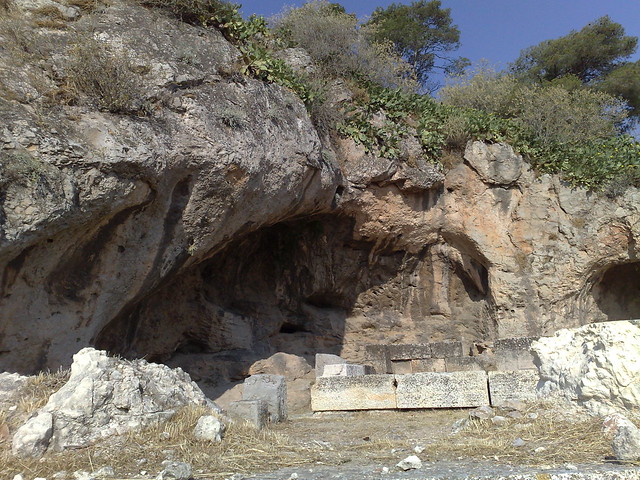
Interestingly enough, many Gods were born in caves: Maia (a Nymph) lived in a cave when she gave birth to Hermes, Zeus was hidden, if not birthed, in a cave on mount Ida (pictured right), where He and His mother Rhea were worshipped, Dionysos spent His infancy in a cave, and I am sure there are more examples. In fact, the cave sanctuary of Eileithyia at Amnissos was wholly dedicated to birth, and the Goddess of childbirth, who was said to have been born in the cave herself was given offerings of honey. Within the cave, there is a large stone resembling a pregnant belly, and a stalagmite resembling a female body. Eileithyia’s cave is mentioned in the Odysseia:

"He anchored at Amnisus, a tricky harbour, near the cave of Eileithyia, and barely escaped shipwreck." [19.188]

Birth and death both opened up passageways to the Underworld, this is why both carried miasma. That both passageways are connected to caves--which can most certainly appear as passageways themselves, as we have seen with the Cave of Hades--does not feel at all like a coincidence to me.

Caves did not always have a religious function: they were also used as places of punishment, and sometimes a tool of capital punishment, where the captured died a slow death by starvation and thirst. This process is documented by Sophocles in 'Antigone', as Creon condemns Antigone to death in exactly such a cave for trying to recover the body of her brother from outside the city walls against Creon's wishes. It is certainly feasible that non-mythological persons were condemned to death in much the same way. From 'Antigone':

"CREON: Know ye not that songs and wailings before death would never cease, if it profited to utter them? Away with her-away! And when ye have enclosed her, according to my word, in her vaulted grave, leave her alone, forlorn-whether she wishes to die, or to live a buried life in such a home. Our hands are clean as touching this maiden. But this is certain-she shall be deprived of her sojourn in the light.

ANTIGONE: Tomb, bridal-chamber, eternal prison in the caverned rock, whither go to find mine own, those many who have perished, and whom Persephone hath received among the dead! Last of all shall I pass thither, and far most miserably of all, before the term of my life is spent. But I cherish good hope that my coming will be welcome to my father, and pleasant to thee, my mother, and welcome, brother, to thee; for, when ye died, with mine own hands I washed and dressed you, and poured drink-offerings at your graves; and now, Polyneices, 'tis for tending thy corpse that I win such recompense as this."

Caves were often focal points of local worship, and not every cave was considered sacred. Some, however, had mythology connected to it, and this made them excellent places for worship. The sober atmosphere of natural caves, coupled with their unique beauty, set them apart from the civilized world. This makes it easier to connect to the spirit of the wilderness, to Nymphs and Pan. The fact that their darkness can hide even the most gruesome of monsters makes them just a touch more dangerous--unless they are dedicated to the Nymphs or Gods, then they are quite safe to enter and worship at; a practice most certainly wide-spread in ancient Hellas.

Image source Cave of Zeus: Wikipedia Commons
Yesterday's post about female physicians in ancient Hellas, sparked the desire to discuss the Goddesses presiding over the healing process today. Asklēpiós may be one of the major Theoi associated with healing, but His daughters do much of the heavy lifting. Hygeia (Ὑγεια) is the Goddess of health, cleanliness, and sanitation, Iasô (Ιασω) the Goddess of recuperation from illness, Akeso (Ἀκεσώ) the Goddess of the healing process, Aiglê (Αιγλη) the Goddess of beauty, splendor, glory, magnificence, and adornment, and Panakeia (Πανακεια) the Goddess of universal remedy.

Chaos ----------------------- Gaea
                             |                      |       
      Ouranos --- | ----------------- | 
                      |                      |
                     Kronos --- Rhea  Koios --- Phoibê
                      |                      |
Phlegyantis     Zeus -------- Leto
|                     |
      Korônis ------- Apollon
      |
                        Asklēpiós --- Êpionê
                             |
                            Hygeia, Iasô, Akeso, Aiglê, Panakeia

Asklēpiós was born to a human mother and a divine father: Apollon, a great healer Himself. Apollon, however, kills his mother when she commits adultery, and Asklēpiós is brought up by Kheiron, the Kentauros. His mother was Korônis, and she is associated with the mythology surrounding the constellation Corvus: the raven. Apollodorus wrote about this event, and the events that followed:

"Besides them Leucippus begat Arsinoe: with her Apollo had intercourse, and she bore Aesculapius. But some affirm that Aesculapius was not a son of Arsinoe, daughter of Leucippus, but that he was a son of Coronis, daughter of Phlegyas in Thessaly. And they say that Apollo loved her and at once consorted with her, but that she, against her father's judgment, preferred and cohabited with Ischys, brother of Caeneus. Apollo cursed the raven that brought the tidings and made him black instead of white, as he had been before; but he killed Coronis. As she was burning, he snatched the babe from the pyre and brought it to Chiron, the centaur, by whom he was brought up and taught the arts of healing and hunting." [3:10:3]

After His training is complete, Asklēpiós receives the blood of Médousa from Athena. Drawn from two different blood vessels in Médousa's neck, some of it can kill, and some of it can heal even the dead. Asklēpiós uses the blood to resurrect the dead, but this is against the wishes of Zeus, who kills Him. He is either placed amongst the stars as the constellation Ophiuchus, the Serpent Holder, or revived by Zeus as a God to satisfy a furious Apollon. No matter his disputed revival, Asklēpiós does get a chance to father children. With his wife Êpionê (Ηπιονη), He begets seven children, two boys and five girls. The men are mortal, the women immortal. Machaon (Μαχάων) and Podaleirios (Ποδαλείριος), His male children fought in the Trojan war on the side of the Hellens. Podaleirios survived the war. Hygeia, Iaso, Akeso, Aiglê, and Panakeia assist Asklēpiós in guarding over mankind.

Hygeia is the Theia of health, cleanliness, and sanitation, and a companion of the goddess Aphrodite. She is perhaps the best known of Asklēpiós' daughters, and has been so since ancient times. She is mentioned alongside her father, grandfather, and sister Panakeia in the original Hippocratic oath. the ancient Hellenes regarded Her as one of the most revered of all Theoi, because without her blessings (good health), nothing could be accomplished in life, and life itself would cease. In fact, She has her own Orphic hymn [67], and in it, She is solely responsible for averting all disease. She is depicted with a snake, usually curled around Her arm.

Iasô is the Theia of cures, remedies and modes of healing. In the temple of Amphiaraus at Oropus a part of the altar was dedicated to Her, along with many of Her sisters and other Theoi petitioned for healing. Recovery is Her domain, and as such, She is one of Asklēpiós' most valued attendants. She is depicted with a mirror.

Akeso is the Theia who oversees the healing of wounds and the curing of illness. She does not bring the cure itself, but oversees the process of healing. Not much is known about Her, but She is a faithful attendant of Her father.

Aiglê is the Theia of the beauty, splendor, glory, magnificence, and adornment that comes with good health. She represents radiance, and Her blessings are very much sought after, because they allow a person to live up to their full potential.

Panakeia is the Theia of cures and panaceas--healing aids in the form of medicines, salves and other curatives. After Hygeia, She is perhaps the best known of Her sisters. Her gifts of medicine are of great value, and she is mentioned in the original Hippocratic oath along with Apollon, Asklēpiós, and Hygeia.

There are other children of Asklēpiós, most notably the dwarf God Telesphoros (Τελεσφόρος) who is the recovery from illness. His daughters, however, are best known and provide mankind with health, beauty, and a full and long life.
As promised two days ago, it's finally time for a new constellation post! This one is going to be all about horses, so if you're a horse lover, rejoice. If not, well, then there is at least some interesting mythology here.

 
Equuleus, or 'little horse' is the second smallest of all of Ptolemy's constellations. It is depicted by solely a horse's head, and seems almost hidden away behind the much larger horse constellation Pegasus. There is a mythological reason for this hiding behavior: Equuleus is said to represent Hippe (Ἵππη), or Melanippe (Εὐίππη), daughter of the kéntauros Kheiron. She became pregnant and could not let her father know. As such, she begged the Gods to be transformed into a mare. From Hyginus's Astronomica:
 
"Euripides in his Melanippe, says that Melanippe, daughter of Chiron the Centaur, was once called Thetis. Brought up on Mount Helicon, a girl especially fond of hunting, she was wooed by Aeolus, son of Hellen, and grandson of Jove, and conceived a child be him. When her time drew near, she fled into the forest, so that her father, who supposed her a virgin, might not see that she had given birth to a grandchild. And so when her father was looking for her, she is said to have begged the power of the gods not to let her father see her in childbirth. After the child was born, by the will of the gods she was changed into a mare which was placed among the stars."
 
He also gives another reason for her change:
"Some say that she was a prophetess, and because she used to reveal the plans of the gods to men, she was changed into a mare. Callimachus says that because she ceased hunting and worshipping Diana [Artemis], Diana changed her into the shape we have mentioned. For the reason above, too, she is said to be out of sight of the Centaur, who some say is Chiron, and to show only half her body, since she didn’t want her sex to be known."
 
The constellation is also known as Eguus Primus, the 'first horse' because it rises just before Pegasus. Because it rises first, it is sometimes identified as the offspring of Pegasus, Celeris, whom he had with his wife, Euippe (or Ocyrrhoe). The second child out of that marriage was Melanippe, a common female name when associated with horses, as it means 'mare'.
 
The third and last horse that this constellation is connected to it the horse that was born the moment Poseidon's trident struck the ground in the battle for patronage of the city of Athens:
 
"The common tradition about Poseidon creating the horse is as follows : -- when Poseidon and Athena disputed as to which of them should give the name to the capital of Attica, the gods decided, that it should receive its name from him who should bestow upon man the most useful gift. Poseidon their created the horse, and Athena called forth the olive tree, for which the honour was conferred upon her. [Serv. ad Virg. Georg. 1.12.]
 
The constellation Equuleus is visible at latitudes between +90° and −80°, and best visible at 21:00 (9 p.m.) during the month of September.
Welcome to another installment of the constellation series. I'm on a mythology binge so I thought it was time. As the fourth constellation, I have for you Argos Navis, a collection of constellations which together form the ship Argo, on which the Argonauts (Argonautai, Ἀργοναῦται) sailed to find the Golden Fleece.


The Argo Navis was an ancient constellation which has since been disband. It was a huge constellation, the largest in existence.  In 1752, the French astronomer Nicolas Louis de Lacaille subdivided it into Carina (the keel of the ship), Puppis (the stern), and Vela (the sails). Back in ancient Hellas, it was still one, large, constellation and it represented the ship on which one of Hellas' greatest heroic journeys was undertaken: Iásōn's (Ἰάσων, Jason) quest for the Golden Fleece.

The Argo (Ἀργώ), meaning 'swift', was built by the shipwright Argus. He was a member of the Argive royal house, and his fmily was favored by Hera. Becasue of this, anyone who sailed on the Argo, would have Her aid. Argus was aided in the planning and construction of the Argo by Athena, and possessed in its prow, a magical piece of wood from the sacred forest of Dodona, which could speak and render prophecies.

The tale of the Argonautai is long, and complicated. As so many kings in ancient Hellas, Pelias (Πελίας) unrightfully laid claim to his half-brother's throne. He became the king of Iolkos in Thessaly, and fell in disfavor of the Theoi because of his actions. It was prophesied that a member of the rightfully royal bloodline would one day punish him, and he was likewise warned to watch out for a man with only one sandal.

Pelias didn't believe in half measures and murdered every prominent descendant of Aeolus he could, but spared his mother Tyro's youngest son, Aeson. Instead, he imprisoned him and forced him to renounce his claim to the throne. Aeson complied, and eventually was set free. He married  Alcimede, who bore him a son named Diomedes. Alcimede successfully saved her son from certain death by having her nursemaids keen as if the boy had been stillborn. She secretly packed him off to Mount Pelion, where he was raised by the kéntauros Kheiron (Χείρων), who changed the boy's name to Iásōn.

From Kheiron, Iásōn learned the arts of combat, sports, medicine and music. When he reached adulthood, he was send back to Iolkos with proof of his royal birth. On the way there, he had to cross a river and found an old woman on the bank of it, who begged everyone who passed by to carry her through the water. All but Iásōn ignored her. He took her onto his back and he helped her across, although he found the journey tougher than he had ever thought possible. He also lost one of his sandals in the mud. As he put down the old woman, she turned into the magnificent Hera, of whom he would continue to receive support now he had passed her test.

As soon as Pelias laid eyes on the youth with one sandal, he knew what would happen now. And thus, he devised a plot to get rid of Iásōn. As Iásōn presented him with an offer to keep some farms and cattle, while Iásōn claimed his rightful place on the throne, Pelias happily accepted, but warned Iásōn that one task had to be completed first: the proper burial of king Phrixos.

Phrixos, thus told Pelias, Iásōn, had been saved from being sacrificed to the Theoi by a ram with golden wool. The Theoi had not demanded this sacrifice, but his step-mother Ino had paid off messengers from the oracle of Delphi to demand so of her husband out of hatred for the boy. The ram had carried him off to Helios' palace, where he was accepted into the household. The ram was sacrificed to Zeus, and the fleece was hung from a tree in a sacred grove of Ares, guarded night and day by a dragon that never slept. Pelias was haunted by Phrixos, and swore to Iásōn Phrixos would not rest until his ghost was taken back to Iokos, along with the Golden Fleece. If Iásōn did this, he swore by Zeus, to relinquish his throne to him.

Iásōn jumped at the chance. Kheiron had taught him well, and a chance to prove himself was all he desired. And so, he hired Argus to build him a ship, and send out messages to the various royal families to send them their young heroes for this voyage. Many jumped at the chance, although it's unclear how many, exactly. Argus may have undertaken the journey himself, as did Atalanta, Bellerophon, Kastor and Polideukes, Hēraklēs, Nestor, Orpheus, Perseus and Theseus. The number of Argonautai lay somewhere between forty and fifty.

The journey would take the brave Argonautai to many dangerous places. The first was Lemnos, where the women had been struck with madness by Aphrodite for failing to properly honor her. they had killed all men on the island, and all slave women as well. When the Argonautai reached the island, Aphrodite enchanted the women to seduce them, and thus halt their journey. Hēraklēs was the only one who did not go off of the ship, so he was able to convince the others to ship out after a long, long wait.

The next challenge came in the form of the Gegeines; Earthborn giants with six arms. The Argo sailed to Doliones where king Cyzicus ruled. In search of supplies, he allowed then to look for supplies on Bear Mountain, but failed to warn the crew of its inhabitants. When most of the crew left for the mountains, the Gegeines attempted to raid the ship, but Hēraklēs, along with a few others, held them off long enough for Iásōn and his men to return. They set sail int he dead of night but got turned about. They ended up on the same shore where the Argonautai and the people of king Cyzicus failed to recognize each other and many of them were killed, the king amongst them. When morning came, the Argonautai were shocked and ashamed, and organized a burial for the dead king. Hēraklēs took his leave here, as his tasks were not yet completed.

For twelve, long, days, the weather was so bad that the Argo could not set sail. The crew waited and grew hungry and thirsty. Mopsos, a bird auger, eventually deduced that the men should sacrifice to Rhea, mother of the Theoi. They did, and food and drink came to them by way of animals and low hanging fruit. The wind also died down, and the expedition was saved.

Next, they reached Bebryken, where they were challenged to a fist fight by king Amykos. He was so strong, he killed every opponent with one hit, and tossed those who refused to fight into the sea to die there. It was Pollux, son of Zeus, who accepted the challenge. He managed to win his fight gloriously, but the followers of the king were furious and wanted revenge. They fought the Argonautai, but were no match.

Soon they reached the court of Phineus of Salmydessus in Thrace. The king had been blessed with the gift of prophecy, but had shared too much of Zeus' secrets. For that, Zeus send Harpies to his door every day to take his food. The starving king begged the Argonautai for help, and received it. The Harpies were killed (or, in some versions of the myth, chased off) and the expedition continued.

The only way to reach their destination was to sail through the Symplegades, or Clashing Rocks. These huge rock cliffs came together and crushed anything that traveled between them. Phineas told the crew to release a dove when they approached these islands, and if the dove made it through, to row with all their might. If the dove was crushed, he was doomed to fail. Iásōn released the dove as advised, which made it through, losing only a few tail feathers. They went for it and, with the aid of Athena, made it through with only minor damage to the stern of the Argo. The clashing rocks were forever joined, leaving the way free for others to travel.

Before reaching Kolchis, their destination, the Argonautai would halt twice more. Once in the land of the Mariandyn, where they lost their navigator to illness, and Hera just barely saved the expedition by making Ankaios speak winged words of confidence that he could steer the ship. And he did. The second wait came in the form of a terrible storm for which the Argo needed to be protected. When the storm died down, they found the shipwrecked nephews of Iásōn, who had been on their way back from Kolchis, and were accepted into the Argonautai right away.

Once the Argonautai reached Kolchis, their struggle wasn't over. King Aeetes was unwilling to part with the Fleece, as it had brought great prosperity to his lands. He devised three tasks for Iásōn: to plow a field with fire-breathing oxen, to sow the teeth of a dragon into the field, and to overcome the sleepless dragon guarding the Fleece. Aided by Mēdeia (Μήδεια)--who was made to fall in love with Iásōn by Athena and Hera, who convinced Aphrodite to convince Eros to shoot his arrow--Iásōn completed his tasks and fled with Mēdeia and her younger brother Absyrtus, aboard the Argus.

As king Aeetes' war fleet hunted them down, Mēdeia did the unthinkable: she killed her brother and, in some versions of the myth, dismembered him, throwing his body parts into the sea one by one. His father made sure all parts were recovered and the Argo was able to get away. In all versions of the myth, Iásōn is shocked by this act, as well as the magick she implored to aide him in his other quests, but in some, he takes Mēdeia onto dry land to allowed her to cleanse herself of the miasma incurred by the murder she had committed.

After this, the Argo makes it home safely, after first passing by the Sirens who are so well known from the Odysseia--harmless because of Orpheus' louder and more beautiful music--and the boulder throwing Taltos, a bronze man with one blood vessel which ran from his neck to his toe. The blood vessel was held closed by a single nail. Mēdeia practiced her magick again, and put the giant to sleep. Then, she removed the nail, and Taltos bled to death.

Again, it was Mēdeia who saved the expedition, as Pelias refused to give in. Yet, he had become an old man in the time Jason had been gone, and when Mēdeia offered to make him young again, his daughters jumped at the chance. Mēdeia told the women that they should kill and cut up their father and put them in her cooking pot. This way, she would be able to perform her magick and the king would be reborn in his prime. The girls did as told but Mēdeia did not add the magickal herbs needed to complete the spell, and Pelias remained quite dead. Iásōn and Mēdeia were exiled for their crime by Pelias' son.

Yet the story of the Argo is not quite over. According to playwright Euripides, Iásōn betrayed Mēdeia, and wedded Kreousa (Κρέουσα), daughter of king Kreon of Korinth, instead of her. Mēdeia recounted all the help she had given him, and reminded him of his vow to marry her, but he told her that she should not be angry at him, but at Aphrodite, who had made her fall in love with him. Angered and ashamed, Mēdeia enchanted the dress Kreousa would wear for her wedding, and it caught fire as soon as she put it on. The fire killed both her and her father. Out of fear for retaliation, or out of a desire to hurt Iásōn even further, Mēdeia killed the two sons she had with Iásōn and fled.

Iásōn was punished for his treachery: Hera abandoned him and the mast of the Argo squashed him as he lay sleeping on the Argo one night late into his lonely and tortured life. The Argo was consecrated to Poseidon in the Isthmus, and was later placed into the sky and turned into the constellation of Argo Navis. The constellation has fallen apart over the years. Carina is visible at latitudes between +20° and −90°. It is best visible at 21:00 (9 p.m.) during the month of March. Puppis is visible at latitudes between +40° and −90°, and is best visible at 21:00 (9 p.m.) during the month of February. Vela is visible at latitudes between +30° and −90° and is best visible at 21:00 (9 p.m.) during the month of March.