Showing posts with label Calypso. Show all posts
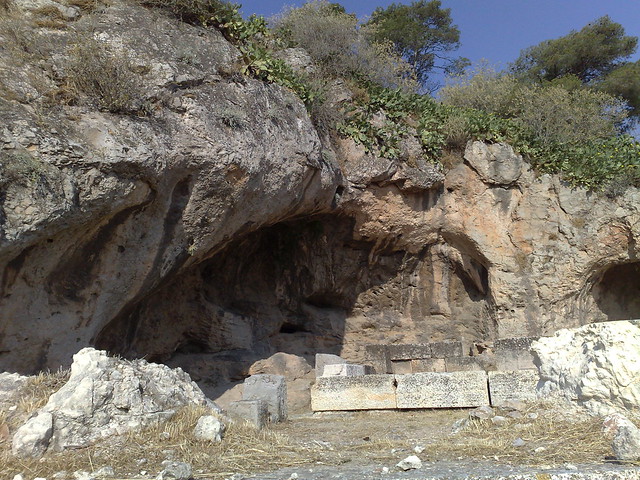
The islet of Gavdos (Γαύδος) located opposite Sfakia, Krete, is the southern-most border of Greece and Europe. According to Callimachus, this is the ancient isle of Ogygia where, as Homeros claims in The Odysseia, the nymph Kalypso lived. In fact, if you ask a local to show you the way, local legend will bring you to her cave and an adjoining abode that was alledgedly hers.

In Homeros' Odysseia Kalypso detained Odysseus on Ogygia for seven years and kept him from returning to his home of Ithaca, wanting to marry him. Athena complained about Kalypso's actions to Zeus, who sent the messenger Hermes to Ogygia to order Kalypso to release Odysseus. Hermes is Odysseus' great grandfather on his mother's side, through Autolycos. Kalypso finally, though reluctantly, instructed Odysseus to build a small raft, gave him food and wine, and let him depart the island. The Odysseia describes Ogygia as follows:

"...and he (Hermes) found her within. A great fire was burning in the hearth, and from afar over the isle there was a fragrance of cleft cedar and juniper as they burned. But she within was singing with a sweet voice as she went to and fro before the loom, weaving with a golden shuttle. Round about the cave grew a luxuriant wood, alder and poplar and sweet-smelling cypress, wherein birds long of wing were wont to nest, owls and falcons and sea-crows with chattering tongues, who ply their business on the sea. And right there about the hollow cave ran trailing a garden vine, in pride of its prime, richly laden with clusters. And fountains four in a row were flowing with bright water hard by one another, turned one this way, one that. And round about soft meadows of violets and parsley were blooming..."

Beyond mythological glamour, visitors can also see the tombs found in Lavraka Bay, in northwest of Gavdos, which are dated back to the Minoan age, even though edifices of the same period have not been found.

As frequent visitors of this blog are well aware, Baring the Aegis is as much a source of information on modern Hellenism as it is a reference on ancient Hellas. Secondary to those goals, Baring the Aegis is a lovesong to the places that made up ancient Hellas, Gavados included. So when I discovered a new video by Dimitris Koulelis on Vimeo that captures the beauty of Gavdos, I couldn't resist sharing it. It is, perhaps, interesting to note that the Roman empire was active on the island. During that time the flora of the island was overexploited and that started a process of erosion which has continued to this day. As such, in Kalypso's time--were there such a thing--the island would have been as lush as described by Homeros. Enjoy!


I am of the rather strong opinion that modern witchcraft has no place in Hellenismos--especially when that witchcraft is defined as acts which allow humanity influence over their lives and those of others, outside of the realm of the Gods. I call anything else 'praying', and if you need tools for that, than I take no issue besides the fact that it's non-Traditional--save for when it is. As a blogger with that opinion, I sometimes get asked 'but what about all the witchcraft in the classics?', and it's a good question. I shall attempt to explain today why I feel the two are not the same, and how these displays of magical abilities are actually proving my point for me. Before I do so, though, I want to stress that I take no issue with witchcraft itself; I practiced it for years--abide sporadically--and think it's a beautiful, powerful, thing. This post is about witchcraft in Hellenismos, nothing else.

The most famous witch in Hellenic mythology is undoubtedly Kirkê (Κιρκη)--better known by her Roman name, Circe. She is the woman whom Odysseus comes upon on the island Aiaia, who turns his men into pigs, and keeps Odysseus with her--and in her bed, no less--for a year before she helps him get back to his quest to return home. The account of Kirkê is one of the founding myths for the modern witch stereotypes: she is the evil temptress, free with her sexuality, and freeer with the magic that women possess by nature. She seduces Odysseus while beguiling his men, transforming them into docile animals--de-humanizing them, and stripping them of their masculinity. In the end, Odysseus overcomes her, and leaves, outside of her grasp forever. At least, that is the modern interpretation of her character.

Kirkê, in the time of Hómēros was not evil at all, yet she was dangerous. Like all men of his time, Hómēros understood very little of women, knowing mostly that they did strange things to the minds and body's of men when men laid their eyes upon them. Remember; ancient Hellas was a place where adult men and adult women rarely happened upon each other in a setting where they were allowed to interact. For men, women were almost an entitrely different species.

Kirkê, when looked at through the lens of ancient Hellenic society, is Odysseus' superior by far. It may seem a bit off-topic to go into this, but I must to make my point. Kirkê is the daughter of the Sun God Helios--which makes her a Goddess in her own right, but a more accurate term would be 'Nymph', putting her in control of nature. Her pedigree--by default--means that Odysseus can never master her, as Odysseus may be the favorite of the Gods, but he is not divine himself. Looking into the account in book ten of the Odysseia, there are a variety of ways in which Odysseus is established as respecting and enjoying Kirkê's influence in his life, and even more ways in which it is established Kirkê is his superior:
  • Kirkê is of divine blood, while Odysseus is human
  • Odysseus needs moly, a herb which acts as a potion, provided by Hermes in warning, to counter the effects of Kirkê's potion
  • Kirkê is established as an expert in her craft, while Odysseus is unskilled enough to need the help of the Gods
  • Kirkê is shown as a good woman--and a good wife--by stressing her expertise in crafts
  • When Kirkê lifts her rod to Odysseus, he takes it as a thread, bringing out his sword to meet her--in short, he finds her powerful and worthy enough to percieve her as a threat
  • The two come to an agreement and an oath which they can both live with, with the purpose of establishing thrust between them
  • Kirkê is shown as keeping her oath--something very honorable in ancient Hellenic mythology and society
  • Odysseus is shown enjoying the time he has spent with Kirkê, as equals
  • Kirkê keeps her word, and lets Odysseus and his men go without harm; she even gives him good advice
  • When she transforms his men back, they are younger and more powerful than before
So, what of her magic? Kirkê is a Goddess whose powers manifest through herbs; what she does to men is not much different as many other--more powerful--Gods do unto humans as well with just a thought; Hellenic mythology is full of humans who get turned into animals (or plants) for their protection, or for the protection of the God in question. It's important to note that in the Odysseia, Kirkê's 'victims' are happy and domesticated; they are friendly and curious to visitors and Kirkê alike.

Kirkê's superiority to Odysseus matters, because it takes her away from her being a 'temptress' and inherently evil. Being allowed to spend a year with her is an honor to Odysseus in the same way sexual advances of a (male) God upon a mortal was considered an honor--or at least a privilege of the deity in question. In fact; Kirkê's status over Odysseus takes her away from being a witch in the modern sense; she is a Goddess, and as someone lower in standing, Odysseus' wishes are something she can take into advisement but only needs to agree upon out of a sense of honor, not because her magical hold over him has broken. She never controls Odysseus--the moly establishes that--and they work out an agreement where they are on roughly equal footing, with Kirkê forever having the upper hand, but bound by her personal honor and oath to Odysseus. Her magic--her divinity--is made a moot point between them.

If we look at Kalypsô (Καλυψω), another Nymph-Goddess in the Odysseia, we can see the similarities between her and Kirkê, but also the obvious differences. Like with Kirkê, Odysseus makes Kalipsô swear an oath for his safety, but their truce is shaky one; Kalypsô is not a better witch, though, she is a worse woman. It is not her magic that Odysseus mistrusts, but her. Kalipsô is over-emotional and willing to push the boundaries of her oath whenever she can. Kirkê, on the other hand, is emotionally stable, and does not burden Odysseus with her sadness at his leaving. She helps him along, makes him and his men better, and offers advice and prayers to the Gods. Kalipsô only cares about keeping Odysseus with her, and she keeps him for a much longer period of time. She also curses the Gods for her faith in life. She is a trickster, and Odysseus does not trust her--but again, this is not to do with her witchcraft, but her person. By ancient Hellenic standards, Kalipsô is an undesirable woman due to her emotions and trickery, but it is separated from her powers, both in her character, as in the way she is viewed by Odysseus.

There are also male characters in the Odysseia who possess 'magic'. Aeolus (Αἴολος) is the son of Hippotes, who was the son of Mimas, who was the son of the first Aeolus, who, in turn, was the son of Hellen, the daughter of Deukalion and Pyrrha. He was the Keeper of the Winds in Hellenic mythology, and in the Odysseia, he is first welcoming to Odysseus and offers him the power of the winds. When he squanders it, however, Aeolus refuses any further help and nearly de-humanizes Odysseus by focusing on his humanity in a highly negative way--something Kirkê never needed to do, because her status was already well established--and so was his. Aeolus is technically human, but his power is established as divine, not magical by today's standards; in later works, he is even made into a minor God so the link between his powers and divinity is more obvious.Again, his personality is not tied to his power; Aeolus is a petty man, not because of his magic, but despite of it.

Proteus (Πρωτεύς) in the Odysseia is already a God, but Herodotos traces his line back to the kings of ancient Egypt. In the Odysseia, Proteus has the power to transform himself into frightening shapes--a trait he shares with many Gods who can and will change their shape at will--and thus his powers are not magical either, but divine.

In conclusion, the Odysseia gives plenty of reasons why the words 'witch' and 'witchcraft' are dangerous for modern interpretation. These powers--and those that use them--are established as divine, taking these powers fully outside of the realm of humanity. Yes, there was 'magic' and 'witchcraft' in ancient Hellas and its mythology, but not in the way we know it now; this was divine magic; a manifestation of a trait major Gods manifest with a thought. These lesser deities require a medium to manifest their powers--especially in the case of Kirkê and Kalipsô--but their powers are still the powers of a God. This is exactly why I feel we, as Hellenists, should pray to the Gods for any aid we might require, and blessings we would wish upon our lives; to practice magic ourselves would be to equate ourselves with the (minor) Gods, and Hellenismos is clear upon the status of humans: we are human, not divine. To practice magic, is to practice hubris, and that is decidedly dangerous in a Hellenistic context.
I have a fascination with caves, and I have visited many of them in my relatively short life. I have been to narrow natural caves full of stalagmites and stalactites, to huge caved in domes where upon emerging into the light was a truly spiritual experience, to man-made loam caves with the bloody scratch marks still etched in the soft stone, left by lost explorers, looking to get out. I have visited tiny caves known for their beautiful sediment, and caves only known for the concerts held there. Some of the caves I visited weren't interesting at all, but the guide managed to share its lore so convincingly that these caves have a special place in my heart, regardless. The one thing I have not done, but always wanted to do, is worship in them.


There is something primal about caves, especially natural ones. They take years upon years to develop, being etched out one grain of sand at a time by stubborn streams of water. Some caves have been around since the age of mankind, and often long before that. Caves had a special place in ancient Hellenic worship, and were often devoted to the ancient Gods, such as Zeus, Apollo, and Cybele and particularly to Pan and the Nymphs. Caves in Their honor could and can still be found all over the Greek countryside. They were dark places full of votive offerings and altars, which would come to life during rituals attended by the ancient followers of the Gods.

We have quite a bit of information on cave worship in ancient Hellas, and Krete in particular. Caves were important to the inhabitants of Krete since Neolithic times, first as homes, then as burial places, and eventually places of worship by the Middle Minoan period. We distinguish three categories of cave sanctuaries: the grotto (mainly a large niche), the simple cave (deep, but usually consisting of one large space), and the complex cave with multiple rooms, possibly reminiscent of a maze. The majority of the latter two contain elaborate stalagmites and stalactites, as well as water sources, making them mystical and otherworldly places per excellence, as well as practical places to worship in a religion where the sprinkling of water-made-sacred is a staple.

Caves in the ancient Hellenic religion often connect to the wild and unknowable: not only do they often house 'monsters' (like the Cyclops in the Odysseia, and the Centaur Kheiron), but they are the houses of 'wild' women like Calypso, as well as of the Nymphs, and Pan. Yet, these are not completely wild; they occupy the space between the untamed wild and the carefully tended field of civilized life. Their places of worship--when they attracted cult worship, like the Nymphs and Pan--including caves, but also actual gardens, do not represent the rule of mankind over nature; it is better to say that these places represent ideal nature--untamed, yet safe, comfortable, and full of beauty. A true natural sanctuary. Jennifer Larson, in the excellent essay 'A Land Full of Gods: Nature Deities in Greek Religion' speaks of this connection to the idea of the 'divine garden' and caves, saying:

"During the archaic and classical periods, the nymphs were credited with the ability to 'seize' individuals and inspire them. These nympholepts [persons seized by the Nymphs] sometimes withdrew to cave shrines and spent their lives communing with the nymphs and other resident gods. They welcomed visitors and may have acted as prophets. One such nympholept was Archedamus, an immigrant from Thera, who devoted his life to the maintenance of a sanctuary of the nymphs at Vari in Attica (Figure 3.1). At the instruction of the nymphs, he cut stairs, sculptures, and inscriptions into the rock of a cave, and outside it cultivated a garden. At a cave near Pharsalus, Pantalces left a long inscription inviting worshipers to enjoy themselves and take pleasure in the sanctuary. He refers twice to the growing things that he planted, and tells how the nymphs made him an overseer of the place. He lists the resident gods: the nymphs, Pan, and Hermes are mentioned first, then a number of gods concerned with the health and nurture of youths: Apollo, Heracles, Chiron, Asclepius, and Hygieia. Archedamus’ and Pantalces’ shared conception of the proper way to honor the nymphs includes the idea that their dwelling is not a temple but a cave, a natural shelter with certain analogies to human structures, but distinct from them. It is permissible, even necessary, for the human worshiper to improve on the natural contours of the cave." [59]

Divination is attested to cave worship more often. In Minoan times, caves were places one visited to go on a type of vision-quest ritual, whereby the worshipper went into a trance to encounter a deity. In the later Hellenic periods, this type of ritual use seems to have faded, but divination still played a large part in the ritualized function of caves. Pilgrims to the oracle of Delphi brought hundreds of seashells from the Corinthian gulf as gifts for the Nymphs, who were said to share a cave with Pan at the sanctuary. In the cave, knucklebones from sheep and goats were used in an old divinatory tradition called 'astragaloi'. Oracular forms of knowledge were inspired by Apollo and the Muses, and they often came from the bottom of a cave, like at Delphi. There are many other testaments to caves where visitors flocked to the receive prophetic dreams, oracular messages or other divine messages.

Besides an oracular function, caves were also sometimes considered entrances to the Underworld--indeed, the Underworld itself, located under the surface of the Earth, is an immense cave. At Eleusis is a shallow cave, the Cave of Hades, or as it was known then, the Precinct of Plouton. The would be initiates of the Mysteries would have visited this cave as part of their preparation. Most likely, there were sacrifices made here, and perhaps rites of purification. The cave was considered the exact place where Kore was abducted, and for the initiates, it would have been a place to of death, from which only the purified would return to 'live again', like Persephone.

Interestingly enough, many Gods were born in caves: Maia (a Nymph) lived in a cave when she gave birth to Hermes, Zeus was hidden, if not birthed, in a cave on mount Ida (pictured right), where He and His mother Rhea were worshipped, Dionysos spent His infancy in a cave, and I am sure there are more examples. In fact, the cave sanctuary of Eileithyia at Amnissos was wholly dedicated to birth, and the Goddess of childbirth, who was said to have been born in the cave herself was given offerings of honey. Within the cave, there is a large stone resembling a pregnant belly, and a stalagmite resembling a female body. Eileithyia’s cave is mentioned in the Odysseia:

"He anchored at Amnisus, a tricky harbour, near the cave of Eileithyia, and barely escaped shipwreck." [19.188]

Birth and death both opened up passageways to the Underworld, this is why both carried miasma. That both passageways are connected to caves--which can most certainly appear as passageways themselves, as we have seen with the Cave of Hades--does not feel at all like a coincidence to me.

Caves did not always have a religious function: they were also used as places of punishment, and sometimes a tool of capital punishment, where the captured died a slow death by starvation and thirst. This process is documented by Sophocles in 'Antigone', as Creon condemns Antigone to death in exactly such a cave for trying to recover the body of her brother from outside the city walls against Creon's wishes. It is certainly feasible that non-mythological persons were condemned to death in much the same way. From 'Antigone':

"CREON: Know ye not that songs and wailings before death would never cease, if it profited to utter them? Away with her-away! And when ye have enclosed her, according to my word, in her vaulted grave, leave her alone, forlorn-whether she wishes to die, or to live a buried life in such a home. Our hands are clean as touching this maiden. But this is certain-she shall be deprived of her sojourn in the light.

ANTIGONE: Tomb, bridal-chamber, eternal prison in the caverned rock, whither go to find mine own, those many who have perished, and whom Persephone hath received among the dead! Last of all shall I pass thither, and far most miserably of all, before the term of my life is spent. But I cherish good hope that my coming will be welcome to my father, and pleasant to thee, my mother, and welcome, brother, to thee; for, when ye died, with mine own hands I washed and dressed you, and poured drink-offerings at your graves; and now, Polyneices, 'tis for tending thy corpse that I win such recompense as this."

Caves were often focal points of local worship, and not every cave was considered sacred. Some, however, had mythology connected to it, and this made them excellent places for worship. The sober atmosphere of natural caves, coupled with their unique beauty, set them apart from the civilized world. This makes it easier to connect to the spirit of the wilderness, to Nymphs and Pan. The fact that their darkness can hide even the most gruesome of monsters makes them just a touch more dangerous--unless they are dedicated to the Nymphs or Gods, then they are quite safe to enter and worship at; a practice most certainly wide-spread in ancient Hellas.

Image source Cave of Zeus: Wikipedia Commons
I really didn't want to go here. I was taught by my mom to steer clear of topics I don't know enough about to give an informed opinion. Well, I'm still poking the hornets nest today because three topics are everywhere, they keep touching my life and practice and I do have an opinion about them and/or the people who have an opinion on it. I'm talking about the act of religiously veiling, either your hair, your face or your entire body, the Pagan online community pet 'favorite'; body-fat, and rejecting Jesus Christ.

Veiling is not part of my religious practice, no one in my offline community does it, and I really couldn't care less who does or does not do it of the people in my online community. It's become this new thing in the community and I'm completely fine with it. Lots of Goddesses veiled, especially within the Hellenic pantheon; Hekate, Hestia, Rhea, Calypso, Persephone, Aphrodite, even Athena. Lots of  mortal men and women in myths and life veiled as well; Helena, for example oh--and people like Emperor Augustus. It was a matter of peity. You covered your head when you entered ritual or--as is becoming more normal in the (Neo-)Wiccan and some Eclectic practices--you veil everywhere except during ritual. Sometimes, you just veiled because it was damn hot out and it was part of life--because everyone did it.

I will say it now, for once and for all, I do not veil but I support every person's right to veil. For cetain rituals and festivals, I would be completely open to veiling. I do not support forced veiling, nor do I support the oppression of women. I support the free choice to veil but I will not actively support the cause by celebrating Covered in Light's International Veiling Day on September 21th. This is not my fight. I was not going to talk about it, write about it, do anything with it. Yet, I am. Because everyone is talking about it and it's now lodged in my mind.

Issue number two is the recent body-fat and health thing. For those who don't follow the online Pagan community very well; it all started when Peter Dybing, a Pagan blog writer of average body type, decided to write a blog post addressing a 'major concern' (for him) in Paganism; the 'trend of obesity' within its members. Somewhat understandably, any Pagan blogger who is even marginally overweight took his head off. Not so much for addressing obesity but for assuming that anyone who is overweight is unhealthy and needs to be saved by someone of average weight. I'm not sure if that's exactly what Dybing meant to say, but it's certainly how it was interpreted by the Pagan blogosphere at large.

Obviously, I am not a doctor. I know zip about obesity and health. It doesn't look healthy to me but I'm also well aware that some people are just more prone to being overweight, no matter how much they work out and no matter how healthy they eat. It's just part of them. I'm not obese, nor overweight. Of course, there are parts of my body I think could stand to lose a few pounds. My hips, for example, and my upper arms do that flubbery thing on occasion that worries me a little. I think any woman (and man, probably) living in this photoshop age worries about those unruly parts of their body that don't fit the magazines. We do this, no matter how adamantly we tell the world we don't.

A person's body is their own responsibility. It's not up to me to advice anyone on their health or even to have an opinion about it. And so I don't. That's my two cents on this topic; unless you're sharing your story or you are a doctor or researcher into the link between health and obesity, don't judge. Don't 'fat-hate'. It's not your life and if your sensibilities are hurt by someone else's body... well... you need to take a good look at yourself.

The third, admittedly emerging, topic is the rejection of Jesus Christ. I understand a lot of people, especially in America, came to Paganism after leaving some form of Christianity. I also understand this must be hard. It must be hard abandoning something you have spent your youth believing. It must be hard to have to deal with family, friends and neigboors who still believe in this and assume you will be coming back to Christianity or, at least, still believe in Jesus Christ. I understand the need to make clear, once and for all, that you no longer believe in Jesus Christ and/or reject His teachings.

But I also think there is far too much Christianity in Paganism and justifying your Pagan faith by rejecting everything else is not, or should not be, our way. I believe in everything. I'm not sure if Jesus-the-man existed as such, but I believe in His Divine form. I chose not to worship Him, because His teachings, although commendable at its foundation, don't speak to me. I worship the Theoi and all that comes with Them, yet I greatly respect Jesus.

I understand that most of the fallout is over the word 'reject'. I'm taking it to mean 'an active removal from daily thought and practice', not 'Jesus does not exist and everyone who believes in Him is stupid'. With that in mind, there should be no issue. Yet, I sense the Pagan online community might go nuts over this. So here is to hoping they don't. I would much prefer my Paganism with a lot less Christianity on the side.

In fact, I hope all three issues blow over fast so we can go back to the things that matter most in Paganism; religion and (daily) practice. This is a rant and my two cents. Do with it what you will. I don't believe in remaining silent as a way of avoiding taking a stance. So this is where I stand on these subject; at the sidelines, realizing these are not my battles.
Alright, I feel better so lets move on to a lighter topic, shall we? Gender-roles in Hellenic mythology. Hellenic myth isn't the most balanced or forward mythological system when it comes to gender roles. In fact, I strongly believe it's a gender package no one comes out of, looking better. Women have three choices; rejoicing their femininity and inherent sexuality and leaving themselves open to kidnap and/or rape, tempting and/or raping in return or becoming warrior virgins who (only go through attempted rape but) will never know love. Men have two choices; either they become brutes who chase every bit of tail that comes their way or they become tricksters, harmless to the females around them as well as the egos and reputations of the males. I've seen better options.

Lets look at the women first; The first option is to be so beautiful and/or innocent and/or conveniently available that the male God or hero can not restrain himself. He must have her and so he takes her from her home and (often) has sex with her. Persephone is a textbook example of this. These rapes (although the sex sometimes is concensual) often end in pregnancy and the birth of a new hero. Examples include Perseus and Kastor and/or Polideukes. Often the women get punished severely for their part in the sex/rape. Just look at Médousa.

The second option is to be in control of one's beauty and sexual prowess but eternally alone. The Odysee is full of examples of this one; the sorceress Circe, Calypso as well as the Sirens. All tempt Odysseus to various degrees of success, sometimes taking his faculties from him so they can take from him what they want.

The last category for the women is to become a warrior and remain a virgin. The only way to find love is to revert to one of the other two options. The Goddesses Artemis and Athena are amongst these, as well as the Amazons.

The men have different options but it comes down to two words; power or trickery (or a combination of both). The men-who-become-brutes tend to be the ones who chase women down in lust until they have her and can make love to her or rape her or until she is taken from them by the intervention of another deity. See Médousa for the former and Daphne and Minthe for the latter.

The tricksters include Gods like Hermes and perhaps even Apollon; They find love but only by avoiding the men and women that the brutes are attracted to. More often than not, the tricksters get assigned their partners by the brutes.

Now, this is an overgeneralization. There are many shades of grey here. Rape, in Hellenic myth shouldn't even be interpreted as rape as we know it; in myths it's the pouring out of Divinity over mortals. In general, it can even be seen as a blessing, of sorts.

I do not condone rape in any way, shape or form. I am merely saying that women in ancient Hellens were considered to be property of the men in their lives. Any sexual encounters they had was rape, by definition, as it was a property crime. So consensual sex was still rape... well... a property crime, because the word 'rape' did not exist in ancient Hellas. Of course, this whole thing is still a tangled web of hurt that is beyond the scope of this blog post. Perhaps when we get to 'R'. For now, I will limit myself to the gender-roles listed above.

There are lessons to be learned in these stories. While the Theoi are fully fleshed out entities, who are perfectly capable of thinking for Themselves, most of Them did get pigeonholed into certain stereotypes in the myths that survived the ages. There are many, many cases of UPG and SPG that give light to a whole other side of these Gods and Goddesses. Often, Their stories also distract us from what They did have and from the stories that were never told or not often focussed upon. Zeus, for example, has children with many mortal (and immortal) women but he returns to the bed He shares with Hera every night. While She may spurn him for his dalliances, She seems to be very aware (as is He) that His needs are really only sated with Her and Hera rules the daily going on's on Olympus in His stead. Persephone might not hate the time She spends with Hades at all; She seems to have taken Her rightful place by His side as Queen of the Underworld and who knows? Perhaps She ate those pomegranate seeds of Her own free will?

I admit that the gender roles of ancient Hellas bother me. Reading these myths can leave a sour taste in my mouth that only washes away when I look beyond the words, to the messages themselves. By filling the gaps between myths, one can often reconcile their worries about the myths with their personal creed as well as moral guidelines like the Delphic Maxims. It's also very important to note the time period in which these myths were formed; Hellenic culture has its source in Mycenaean Hellas, starting roughly 3900 years ago. That's a lot of time to go by and women's rights weren't really a part of ancient living. Men were expected to provide, and healthy, powerful man simply had more prowess. It's not odd to think the Gods mirrored these societal bounds.

I doubt many (if any) Modern Hellenics long back for a time when men ruled over women in the way that is portrayed in myth. Rape is not condoned. Modern Hellenics try to read beyond the words to get to the message(s). The myths tell us something about the Gods but, like us, They have had a lot of time to evolve. This is a thought that must not be forgotten.