Showing posts with label bloggers I admire. Show all posts

I love learning about women's hair from the ancient Hellenic period. Hair has long had an important role in society and religion. During the classical period female citizens wore their hair long except when they were in mourning during which they cut their hair short. Before the fifth century BC women's hair was allowed to fall over the shoulders and back, but it was often fastened by a headband or diadem, and the front section of the hair was restrained. After that, hair was often restrained.  Female citizens, especially, wore their hair long, and after their marriage--usually at a very early age--they wore their hair up in elaborate styles. Typically, only their immediate family and servants saw Hellenic women with their hair undone.

This video (link here in case the embed function craps out) shows some of the ellaborate hairstyles for women from the classical age. Enjoy! 

 I'm low on time today, but I would like to share a beautiful translation of a piece of the Greek Anthology. The Greek Anthology (Anthologia Graeca) is a collection of poems, mostly epigrams, that span the classical and Byzantine periods of Greek literature. Most of the material of the Greek Anthology comes from two manuscripts, the Palatine Anthology of the 10th century and the Anthology of Planudes (or Planudean Anthology) of the 14th century. Needless to say, they are not ancient Hellenic, but use themes from its mythology and I enjoy sampling them.


Now, the Greek Anthology has been translated many times and I am not a fan of most. Take this translation, for example, of the part I'd like to share today:

"Even like unto a storm in springtime, Diodorus, 
is my love, determined by the moods of an uncertain sea. 
At one time you display heavy rain-clouds, 
at another again the sky is clear 
and your eyes melt in a soft smile. 

And I, like a shipwrecked man in the surge, 
count the blind waves as I am whirled 
hither and thither at the mercy of the mighty storm. 

But show me a landmark either of love or of hate, 
that I may know in which sea I swim."
[12.156]

Perfectly fine, but it doesn't flow for me. Here is today's offering, and I love it! From Sententiae Antiquae:

"Just like a spring storm, Diodoros,
My love is decided by an uncertain sea.
Sometimes you show pouring rain, but at others
You are clear, and you pour a soft smile from your eyes.

So I, like the shipwrecked on the swell,
Measure out the blind waves as I spin,
Drawn here and there by the great storm.

But you, shine me a beacon of love or even hate
So I can know by which wave we should swim."
[12.156]

 Did you know Greece has things called "dragon houses" that are thousands of years old? I actually did not, until Ancient Origins wrote a post about it. You're going to have to head over to them for the full story (because they are awesome and write great content!), but I'll give you a little sample here.


"Likely dating to the Preclassical period of ancient Greece, the dragon houses of Euboea are among the mysteries of the past which have yet to be understood. Resembling the stepped pyramid of Djoser in Pre-Dynastic Egypt and the temple complexes of Pre-Columbian Teotihuacan, these megalithic houses are structures built without mortar. Small, thin, mostly flat stones make up the buildings, stacked atop one another, kept in place with the uses of jambs and lintels. Large megaliths are used in various places throughout the structures, usually toward the roofs, positioned in a fashion that is similar to what is seen at Stonehenge.

While little is understood of these dragon houses, the number of the structures is far more than expected. Around twenty-three of these houses exist on the island of Euboea—most between Mounts Ochi and Styra—each building made of megaliths. In fact, scholars are constantly boggled by the sheer size and weight of the single megalith resting on two equally large post stones, together forming a doorway. How this megalith could have been lifted and placed atop the posts is as much a mystery as the reason behind the building of these structures.

Some theories have arisen that the structures might have been shrines to Hera, Zeus, or Herakles. Theories regarding the rituals that might have taken place within, however, are few. Another popular belief is that these megalithic buildings were either stations at which guards were positioned during the Hellenistic period, or they were warehouses in which supplies may have been stored."

Read more here.

Borrowed, with gratitude from Sententiae Antiquae as I have very limited time to put a blog together today. A swan song (κύκνειον ᾆσμα) is a metaphorical phrase for a final gesture, effort, or performance given just before death or retirement. And its origins in text are found in ancient Hellas. 


“The Swan, which the poets and many prose authors make an attendant to Apollo, has some other relationship to music and song I do not understand. But it was believed by those before us that the swan died after he sang what was called its “swan-song”. Nature truly honors it more than noble and good men and for good reason: for while others praise and morn people, the swans take care of themselves, if you will.”

[Aelian, History of Animals 2.32]

“Singing the swan song”: [this proverb] is applied to those who are near death. For swans sing as they die and they know then the end of life is coming upon them and so, in this way, they face that arrival bravely. But human beings fear what they do not know and think that it is the greatest evil. But swans sing out at death the kind of song sung at a funeral…”

[Michael Apostolios, Proverbs 10.18]


“Chrysippos was writing about something like this again in the same work. When someone who loved to make fun of people was about to be killed by the executioner, he said that he wanted one thing, to die after singing his ‘swan-song’. After the executioner agreed, the man made fun of him.”

[Athenaeus, Deipnosophists 14 (616b)]

The economics of the illicit trade in antiquities is no different from standard market economics—the price of commodities in relation to demand and supply govern the market. Leila Amineddoleh, a lawyer who deals with art crime, in her paper titled “The role of museums in the trade of black market cultural heritage property”, sums this up as follows: “The market for illegal goods is driven by buyers’ wants, as the trade in looted antiquities is a demand-driven crime. 


There is a well-documented link between the demand for looted items and museums. To eliminate black market demand, legislation is necessary to prosecute and regulate buyers, such as museums.” What is often conveniently forgotten is the fact that most source nations (as culture-rich countries are called) have passed legislations in the late 19th-20th century nationalising their cultural property (yes, even those that are still inside the ground), which eventually culminated in the 1970 UNESCO convention—meaning there is no “fresh” supply.

However, even 50 years after the UNESCO convention, there is a thriving market for antiquities, creating an unsatiated demand for sacred objects. The main supply valve has been closed but yet for 50 years, the tap continues to dispense! The New Indian Express [October 17, 2020] examines one of the key consumers of this miracle tap—museums—and studied their major acquisition routes and policies connected to those. They divided this into two main categories: 1. Direct museum purchases and 2. Gifts and donations, and focus here on the second route—via cases that throw up serious concerns on the ethics, responsibility and legitimacy of such acquisitions by museums.

How do you measure competence when there are no extant benchmarks? There have been feeble attempts at proposing guidelines, for example by the AAMD (Association of Art Museum Directors) in the past for the US and for ICOM (International Council of Museums) recently.

Gary Vikan, former director of the Walters Art Museum and columnist, in his piece ‘Why US museums and the antiquities trade should work together’, starts off rather interestingly: 

“For years, the AAMD required of its members that they only ‘not knowingly’ acquire or accept as gifts works of art that had been exported from their country of origin in violation of national laws. This put a premium on ignorance of the truth, and invited museum directors not to ask those difficult questions for which they did not want to hear the answers. A decisive blow to America’s antiquities-collecting ecosystem came in 2008 with the rewrite of the AAMD’s acquisition guidelines, which now includes this critical passage: ‘AAMD members normally should not acquire a work unless research substantiates that the work was outside the country of probable modern discovery before 1970.’” 

I would like to critically analyse this.

Though the AAMD revised guidelines move from “don’t ask, don’t tell” to “research”, parking the goalpost at 1970 has lulled major museums and collectors into a false sense of security. It doesn’t take a legal brain to understand laws relating to ownership and possession pale in comparison to clear title and no amount of passage of time vests good title to a stolen object. In our context, this is especially true. India has had its antiquities law from 1878.

And it was India and Italy, faced with looting on such a drastic scale, that championed the UN to come up with the 1970 Convention. So the AAMD guidelines seem to hint that a pre-1970 provenance would miraculously wash clean a stolen object and secure good title? Let us now look at a particular sculpture originally from Madhya Pradesh, the 11th century Chandela period Celestial Dancer currently housed in The Metropolitan Museum of Art (MMA), New York.

This “extraordinary rendering of a heavenly celebrant performing in honour of the Gods”, as the museum labels it, hides a rather shady past. The current provenance (record of past ownership) shared by the MMA is interesting: “Gift of Florence and Herbert Irving, 2015”. The devil is however in the details. The Apsara’s acquisition detail is split into two parts: bust and lower torso, which were joined by the MMA in 1992. We shall come to this aspect shortly but more interestingly, the bust’s provenance presented by the museum does not extend to 1970 even as per the revised guidelines.

Further, soon after buying the bust in 1986, the Irvings seem to have loaned it to the MMA. Now comes the interesting detail, the lower torso’s acquisition in fine print [“Art of the Past, Inc., New York, until 1992, sold to the Irvings”]. Yes, the same Art of the Past gallery of the arrested Subhash Kapoor! Again, the lower torso was immediately offered as loan to the MMA by the Irvings.

Now, for those studying the illicit trafficking of antiquities, having seen the multitude of cases of artefacts being deliberately sawn off and shipped as different sections to obscure their origin and fool customs, this innocuous line in the MMA’s website makes it self-evident: “The work was acquired by Florence and Herbert Irving in two parts, bust and lower torso, and joined by MMA in 1992”.

Kapoor was arrested in Germany via an Interpol Red Corner Notice in the September of 2011 and the press release by Homeland Security Investigations, US, dated 12/04/2012, said: “Investigators urge collectors and museums to further scrutinise their collections and contact HSI with any additional information.” 

Despite all these obvious red flags, the MMA went ahead and accepted the donation in 2015! The MMA has so far not released any research of the bust provenance prior to 1970 and the lower torso’s prior to 1992, has not revealed information of how the MMA/Irvings realised the lower torso and the bust matched (something not easy to do unless you have prior knowledge) or detailed conservation photos on whether the breakage was induced or accidental!

It is important to mention that the MMA still continues to display unprovenanced antiquities from Chandraketugarh in West Bengal as gifts directly received from Kapoor in honour of his daughter, mother, etc. It’s pertinent here to mention that despite the extent of pan-India looting by Kapoor and his associates, only the state of Tamil Nadu has filed cases against him In the next column, we will look at a more sinister and dangerous aspect of these gifts— something that archaeologist and criminology professor Donna Yates elaborates in her paper “Museums, collectors, and value manipulation: tax fraud through donation of antiquities”. 

Thera is an archaeological site and ancient city located on the Greek island of Santorini, also called Thera. The city was founded by Dorian colonists sometime from the 9th century BC. According to mythology – Theras (a descendant of the Phoenician ruler Cadmus and son of the king of Thebes, Autesion) established the city, naming the island and his new settlement, Thera.


The city grew over the centuries into a trading hub, connected to other Greek cities such as Athens, Corinth, Ionia and Rhodes.

By the 3rd century BC, Thera was converted into a major maritime station for the Ptolemaic Navy, and the city was rebuilt using a linear urban grid layout with peristyle houses and mansions for the Navy crews and commanders.

Most of the contemporary buildings excavated by archaeologist’s date from around this period, which includes an Agora (the main square of the city), a large Basilike Stoa (a covered walkway or portico, commonly for public use), a gymnasium of the epheboi, a theatre (with seating for 1,500 people) and several temples and sanctuaries.

By the Roman period, Thera was absorbed into the Roman province of Asia and was maintained as a relatively prosperous settlement. Many existing buildings saw extensive repair, with other Hellenistic buildings such as the Agora expanded with a new Roman bathhouse.

Occupation was maintained through to the Byzantine period, but Thera was in a social and economic decline. The site became abandoned after AD 726, when an eruption of the Santorini volcano buried Thera in pumice and ash.
I'm short on time today but of course I'll leave you with something, and how about something extremely cute? These are by the incredibly talented Rudy Siswanto, and they are his interpretation of young mythological creatures. Break out the awwww's and check out his ArtStation for more! 


More than a generation of learners have grown up with accessing and manipulating texts online with Perseus or the TLG. Now there is something that provides us with new tools and the contents of both: the Scaife viewer. The Scaife Viewer, https://scaife.perseus.org, is an interface for the next version of the Perseus Digital Library.


Here are some distinctive aspects of this new tool for reading and research:

1) The majority of the texts visible through Scaife are in Ancient Greek and Latin, but there are also texts in Persian, Chinese, Hebrew, and, as time goes on, other classical languages. All of the primary texts in the corpus are open and freely available in a variety of formats for the general public. There is a list of the several sources with links for downloading here: https://scaife.perseus.org/about/.

Among the links is the ongoing First1KGreek Project, https://opengreekandlatin.github.io/First1KGreek/, which is intended to complete and supplement the Greek texts available from the current version of Perseus for the first thousand years of Greek from Homer to the Third Century CE, though it also includes later texts that are standard research tools for classics (like the Suda or Stobaeus). The plan is to complete this particular corpus by June, 2021.

2) The project aims to provide multiple editions of primary texts, multiple translations of primary texts into the same or different languages, and searchable apparatus critici of texts when copyright law allows. All of the texts in Greek and Latin have been tagged as to their parts of speech and forms, and several have also been treebanked, in other words, have embedded in them the results of morpho-syntactic analysis. As a result of this data, it will be possible to align translations, word-for-word, with the texts, so that anyone can survey what are the various ways of translating a specific word in a primary source, or what any given word in a translation goes back to in the original. All of these features are in various stages of development — some are, others are not yet available but will start to become so.

3) The Scaife viewer has two parts, a reading environment (Browse Library, on the home page, screen shot above), and a search environment (Text Search, on the home page. In the reading environment, users can call up translations alongside primary sources (“add parallel version” in screen shot, top of middle pane), and the software automatically generates word lists with vocabulary for the primary source on display in Greek as well as morphological and lexical information for any word in Greek or Latin (in Highlight mode, just click on the word). For Homeric texts, there is access to the New Alexandria commentaries (lower right pane in screen shot)— more is forthcoming in this space. Readers can also search within a given text, with lemmatized search — in other words, search for all the forms of a given word given its base form — available at the moment only for Ancient Greek. Any passage being read can be exported as a text file or with its XML markup (whole texts can be downloaded from the list of repositories given above under #1).

4) The search environment (screen shot above) of the Scaife Viewer is sophisticated: users can search for a group of words (by putting double quotes around them), combinations of words (“and” or “or” searches), partial word searches whose initial letters are known (with the rest indicated by *), and so forth. For Greek, lemmatized searches, for example, for phrases or combinations of words, can return helpful results. The interface allows for elasticity in the search terms as well, on a scale of 1-10; they can turn up thematic as well as dictional associations that you might not anticipate.

5) The Scaife viewer is an interface to a corpus that is in ongoing development, but also, the viewer itself is in ongoing development. In other words, neither of these is complete, and there are bugs in the software. The teams sponsoring the development of both projects, a consortium of institutions in the USA and Europe, is also developing tools and manuals for participation in the development of the corpus of texts by people everywhere. Another consequence of the incompleteness of the corpus and the software is that there are significant gaps in coverage and functionality, but many common texts and some exceptionally helpful functions are already for the public to use.

Please give it a try.


Text and imagery borrowed from Sententiae Antiquae, as penned by Leonard Muellner, Emeritus Professor at Brandeis University. Thank you!
A golden age captures the best and greatest virtues of human achievements. These accomplishments, however, must have the potential of uplifting humanity to a higher plane of living and be sufficiently moral for building civilization. Greece had two golden ages. Their legacies, especially in science, made Western civilization.


The first Hellenic golden age took place after the Greeks defeated the Persians in early fifth century BCE. During the fifty years between the Persian Wars and the Peloponnesian War, Athens in particular shone with a flourishing and confident Greek culture: democracy, building of the Parthenon, philosophy, science, classical architecture, theater, athletic games, and military strength.

The second golden age was the result of another Greek military victory over the Persians. This happened in the second half of the fourth century BC when Alexander the Great conquered the Persian Empire and spread Hellenic culture throughout the world.

This is a summary of an article by vaggelos Vallianatos, a historian and environmental theorist. He worked on Capitol Hill and the US Environmental Protection Agency for several years. He is the author of hundreds of articles and 6 books. The author’s blog: https://vallianatos.blogspot.com. You can find the full article here.

Alexander and Aristotle
Alexander, 356 – 323 BC, was the son of King Philip II of Macedonia. Philip hired Aristotle to tutor his thirteen-year old son. For about seven years Aristotle taught Alexander Greek history, philosophy, politics, ethics, science and international relations, focusing on the Persian threat and the need for a united Greece to revenge the Persian invasion of Greece in the early fifth century BC. His message to Alexander was this: knowledge about the workings of the world matters, but so does knowing oneself.

Alexandria
In 336 BC, a soldier assassinated King Philip II. Immediately, the twenty-year old Alexander became a king and launched his invasion and conquest of Persia. With Aristotle in mind, Alexander founded Alexandria in Egypt, making clear to his generals Alexandria was to be the Greek Aristotelian capital of his empire. Alexander appointed one of his generals and close friends, Ptolemy, son of Lagos, 367 – 282 BC, to be the governor of Egypt. When Alexander died in 323 BC in Babylon, Ptolemy consolidated his power in Egypt. In 305 BC, he made himself king of Egypt and took the name Ptolemy I Soter (Savor). He started translating Alexander’s Aristotelian dream into reality.

Ptolemy was fortunate to have the assistance of Demetrios of Phaleron, a student of Aristotle who was also author of philosophical works. Demetrios convinced him to replicate Aristotle’s school in Athens in Alexandria, first of all, by building a Library and a Mouseion, Shrine of the Muses (university-institute for advanced studies). Ptolemy was also a student of Aristotle. He encouraged Demetrios to implement the Aristotelian proposal.

Ptolemy I died in 283 BC. His successor, Ptolemy II Philadelphos (of Brotherly Love), 308 – 246, continued his father’s tradition and lavished money and political support to the Mouseion and its staff, famous scientists, poets, and scholars recruited from all over the Greek world.

The Ptolemies also established a Library of about 500,000 volumes in the Broucheion section of the palace and a sister Library of probably 42,000 volumes in the temple of Zeus Serapis or Serapeion / Serapeum.

Alexandria surpassed Athens in scientific and technological achievements. It became the center of knowledge and civilization for Greece and the world.

Science and scholarship
The Greek kings of Alexander’s empire, especially the Ptolemies of Egypt, created the foundations for a rational commonwealth characterized by scientific exploration, state-funded research, the scholarly study of earlier Greek culture and the editing of Homer, Hesiod and the Greek classics. The scholars of Alexandria pioneered the techniques of scholarly research and painstaking study, which spread all over the civilized world. They continue to be the model for classical and scientific studies.

In late fourth century BC, Euclid codified Greek mathematics in his masterpiece, The Elements. Archimedes of Syracuse was such a great third century BC genius in mathematics and mechanics-engineering that, in a real sense, he set the foundations of modern science. Galileo and Newton relied on him.

In the second century BC, Hipparchos, the greatest Greek astronomer, set shop in Rhodes where he invented mathematical astronomy and left his fingertips on the Greek computer.

Antikythera Mechanism
This computer, which archaeologists of the National Archaeological Museum in Athens dubbed Antikythera Mechanism, is a marvel of heavens and Earth. For about half a century, scientists, Greek and foreign, were shocked with an ancient Greek astronomical machine that worked with gears, the first gears that made it from antiquity to modern times. So, not knowing what to make of it, they described it as astrolabe, also ancient Greek invention, but of limited astronomical capabilities. It could identify planets and stars and measure the altitude of a celestial body above the horizon. The Antikythera computer could accurately predict the eclipses of the Sun and the Moon as well as track the movements and position of the planets.

The Antikythera computer was a reliable religious, athletic, and agricultural calendar. It connected celestial phenomena to a calendar of the seasons, sowing and harvest, sacrifices to the gods, and the two and four-year cycles of religious and athletic celebrations in the Greek world. Because of its predictive function, it served astronomers, farmers, priests, and athletes. It revealed the secrets of the stars by exhibiting the order of the whole heavens: it predicted the will of the gods.

A Greek ecumene
Alexander’s successors spread Hellenic, not Hellenic-like or Hellenistic, civilization throughout Asia and the Middle East while uniting Greece for the first time.

Strabo, a Greek geographer whose life covered the violent transformation of the Roman Republic to the Roman Empire, 63 BC to 23 AD, visited Alexandria. He was impressed by its wide streets crossing each other at right angles and suitable for horses and carriages.


Greek education was the badge of civilization. Reading Homer, Plato, and Sophocles and enjoying the comedies of Menander was essential to being a citizen of the Alexandrian Age. Failure in this Greek education was the equivalent to being a barbarian.
Sententiae Antique put up a lovely translation of Galen recently that I would like to share with you. Galen was a doctor and medical researcher who lived from 129 to around 216 CE. He studied medicine by dissecting apes and made some important discoveries, among them that arteries do not carry air, but blood. His work remained influential into the Middle Ages. Of course, like most ancient Hellenes who wrote things down, he was also a bit of a philosopher, including this beautiful bit on keeping the door open (but, you know, mentally and emotionally).


“Always be on guard against the matter which is greatest in this, once you choose to honor yourself. For it is possible always to keep at hand the memory of the hideousness of the soul of those who get angry and the beauty of those who are untroubled by rage.

For whoever, thanks to being accustomed to a mistaken behavior over time, has developed a stain of emotions which cannot be washed away,  must for as great an amount of time attend to each of those beliefs by which a man might become noble and good, should he heed them. We lose sight of a thing that falls easily from our minds because they have been previously filled by these emotions.

Therefore this must be pursued by each of those who want to be saved as if there were no proper season for taking it easy; and all of us must turn toward accusing ourselves, and we must listen to [others] gently, not for the sake of castigating them but for shaping them in turn.

Keep the door of your home open all the time and permit those who understand to enter at every opportune moment. If you are prepared in this way, be bold enough to be discovered as overcome by any of the major mistakes by none of those who enter. Just as it is possible to banish a bad feeling for one who is unwilling, it is easy to banish great ones for one who has made this decision.

When your door is open all the time, as I said, then let there be plenty of time for people who understand to enter. As all the other people who enter a public space attempt to act properly, so too act in the same way in your private home. But those who are ashamed before others only because they might be caught, do not feel shame before themselves alone: but you, feel shame before yourself especially, if you follow this precept.”

[Affections 5.25–26]
Ancient Origins has a new, and very lovely, article up on Apollonia. Apollonia was a city founded by Hellenic colonists from Corfu and Corinth sometime in the 6 th century BC. It was originally named after its semi-legendary founder, Gylax, but was later renamed in honor of Apollon and widely known as Apollonia of Illyria as this area was dominated by the war-like Illyrians at the time. Apollonia became a renowned center of learning and the young Augustus studied philosophy in the city. 

For a full run-down of its history and the beautiful archaeological discoveries made there, visit Ancient Origins.


I'm going to send you over to Ancient Origins today, as they have an awesome new article up about the Myrmidons. These were allegedly fierce warriors from Thessaly that fought during the Trojan War with Achilles as their leader. The Myrmidons were considered the among the best warriors in Greece. They also were known for wearing black armor, according to some accounts. The origin of the legend of the Myrmidons is a mixture of myth and history which reflects stereotypes that the Greeks and many other cultures have about ants.


Read the article here.
What is it with these busy days this week? I'm going to leave you with this very interesting podcast about life as a woman in ancient Hellas. More tomorrow!

"Ancient Greece is notorious for keeping women silent, veiled, and firmly fixed beside the loom. But was life for the ladies in places like Athens really so restrictive? What did they get up to behind those veils and shaded screens? Let's time travel back to the Classical period to find out what it was like to be them."


Ever so often, I repost something I published years ago, for the new generation of readers. This video is one of the things I'd like people coming into Hellenismos to view.

This is a video by Cara Schulz; a Google chat session where she spoke to The Order of Hekate about how Hekate was worshipped in ancient times, as well as the basics of Hellenismos. Her talk incorporates Hekate's Deipnon, Noumenia, Agathós Daímōn, household worship, household worship vs. state worship, the future of Hellenismos and interfaith work. It might look like a long video, but it's very worth it, especially once Cara gets on a roll.

Cara, for those unfamiliar with her, is a member of Hellenion, the largest Hellenic polytheist organization in the United States. Her workshops on Hellenismos have been held at some of the largest Pagan gatherings in the United States, including Pagan Spirit Gathering and Sacred Harvest Festival. She is also the Managing editor of the Pagan Newswire Collective and founder of International Pagan Coming Out Day.


I'm low on time today, but I stumbled upon a beautiful translation of a piece of a piece of the Greek Anthology yesterday that I would like to share. The Greek Anthology (Anthologia Graeca) is a collection of poems, mostly epigrams, that span the classical and Byzantine periods of Greek literature. Most of the material of the Greek Anthology comes from two manuscripts, the Palatine Anthology of the 10th century and the Anthology of Planudes (or Planudean Anthology) of the 14th century. Needless to say, they are not ancient Hellenic, but use themes from its mythology and I enjoy sampling them.

Now, the Greek Anthology has been translated many times and I am not a fan of most. Take this translation, for example, of the part I'd like to share today:

"Even like unto a storm in springtime, Diodorus, 
is my love, determined by the moods of an uncertain sea. 
At one time you display heavy rain-clouds, 
at another again the sky is clear 
and your eyes melt in a soft smile. 

And I, like a shipwrecked man in the surge, 
count the blind waves as I am whirled 
hither and thither at the mercy of the mighty storm. 

But show me a landmark either of love or of hate, 
that I may know in which sea I swim."
[12.156]

Perfectly fine, but it doesn't flow for me. Here is today's offering, and I love it! From Sententiae Antiquae:

"Just like a spring storm, Diodoros,
My love is decided by an uncertain sea.
Sometimes you show pouring rain, but at others
You are clear, and you pour a soft smile from your eyes.

So I, like the shipwrecked on the swell,
Measure out the blind waves as I spin,
Drawn here and there by the great storm.

But you, shine me a beacon of love or even hate
So I can know by which wave we should swim."
[12.156]


I don't frequent Patheos, so I'm always grateful when someone points me to an article on there that is a must-read. Angelo Nasios recently wrote about "The heart of Hellenism," and it's a beautiful piece that reflects everything Elaion is about. I'll post the introduction here. Go read the rest over at Patheos, please.

"Are you waiting for an invitation to worship a God? If so, please stop – go worship! I say this because I have noticed that many pagans have a tendency to wait for the “call” to worship or, as many say, to “work with a God.” Some avoid certain Gods out of a notion that there is no connection between them and a particular God. I read one time how someone said they could not pray to Athena since they were ‘dedicated’ to another God. All of this is deeply problematic and within Hellenism could be understood as un-Hellenic behavior."

https://www.patheos.com/blogs/agora/2019/04/hearth-of-hellenism-are-you-waiting-for-an-invitation
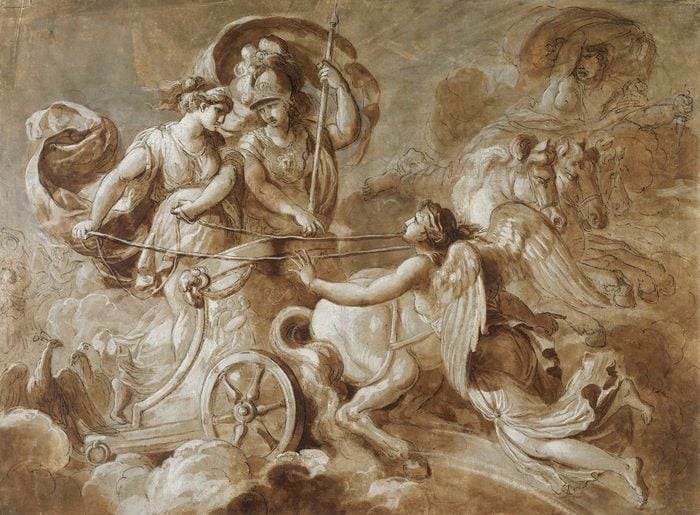
Hera, Athena, and Iris in the Trojan War, attributed to Jacques Reattu. Image via Wikimedia.


I came across this interesting article yesterday that you might be interested in reading as well. It's about gossip and women's rights in ancient Hellas, basically.


At the heart of the greatest works of Ancient Greek literature are mighty acts of revenge. Revengers overcome their enemies through superior physical prowess, as when Achilles kills Hector in…
At the heart of the greatest works of Ancient Greek literature are mighty acts of revenge. Revengers overcome their enemies through superior physical prowess, as when Achilles kills Hector in a single combat to avenge the death of his comrade Patroclus; or through their employment of trickery and deceit, as when Medea slays Creon and his daughter by using poisoned clothing in revenge against Jason, her unfaithful husband. But how could a person lacking in physical strength, magical abilities or supportive friends take revenge? Low-status women without strong family connections were among the weakest in Ancient society but they wielded a powerful weapon in ensuring the demise of a hated enemy: gossip.

Idle gossip or rumour is personified by the Ancient poets. In Homeric epic, rumour is said to be a messenger of Zeus, rushing along with the crowds of soldiers as they muster, conjuring an image of the way she speeds among people from mouth to mouth, spreading through crowds. Hesiod also portrays her as in some way divine, but equally something of which to be wary, ‘mischievous, light, and easily raised, but hard to bear and difficult to be rid of’. The fourth-century Athenian orator Aeschines alludes to gossip about private matters being spread seemingly spontaneously through the city. Ancient people from all walks of life, men and women, free and slave, young and old, were thought to indulge in gossip, ensuring its swift passage to all corners of the city. The propensity for a huge range of members of society to gossip opened up conduits between the lowliest and the mightiest, the weakest and the most powerful.

While Aristotle suggests that gossiping was frequently a trivial, enjoyable pastime, he also makes clear that gossiping could have malicious intent when spoken by someone who has been wronged. This evaluation of words as weapons in the hands of the wronged is particularly pertinent when thinking about how the Athenians made use of gossip in the law courts in Athens, because Ancient court cases were based heavily on character evaluation of those involved in the case rather than on hard evidence. In the absence of professional judges, the aim of the speakers was to discredit their opponents’ characters in the eyes of the jurors, while presenting themselves as upstanding citizens. The power of gossip was feared by ancient litigants, so they carefully outlined how the negative stories the jurors might have heard about them weren’t true, and had been spread intentionally by their mendacious opponents.

From the Ancient orators, we learn that public places such as shops and marketplaces were useful locations to spread false rumours aimed at discrediting an opponent because of the crowds that gathered there. In one case, written down by Demosthenes, Diodorus alleges that his enemies spread false information by sending newsmongers into marketplaces in the hopes of swaying public opinion in their favour. Demosthenes himself accused his opponent Meidias of spreading malicious rumours. And Callimachus is said to have repeatedly told the crowds gathered in the workshops a sorry tale of his harsh treatment at his opponent’s hands. In these instances, the intention of the gossipers is to spread false information across the city to generate an impression of the individuals involved that will help them win their legal cases.

The law courts in Athens were the preserve of men, so women needed to rely on male relatives to act for them. However, the Ancient sources make clear that women’s ability to gossip could be a useful tool in attacking an enemy. In order to demonstrate his opponent’s bad character in court, the speaker of Against Aristogeiton 1 describes an incident involving Aristogeiton’s violent and ungrateful behaviour towards a resident alien woman named Zobia, who had apparently helped him when he was in trouble but, as soon as he regained his strength, he physically abused her and threatened to sell her into slavery. Because she was a non-citizen, Zobia had no access to the official legal channels in Athens. She did, however, make full use of the unofficial channels by telling her acquaintances about her maltreatment. Despite her gender and lowly status, Zobia’s use of gossip to complain about how Aristogeiton treated her meant that his reputation as untrustworthy and abusive spread through the city. This gossip was employed in court by a male litigant in order to display Aristogeiton’s poor character to a jury made up of men. So women’s gossip could be used effectively to discredit the character of an opponent in court – and a low-status woman, with no access to legal modes of retribution could, through gossip, achieve a form of vengeance.

Another example of women’s gossip being cited in court appears in Lysias 1 On the Murder of Eratosthenes. In this speech, the defendant Euphiletus claims to have legally killed Eratosthenes because he caught him committing adultery with his wife. Euphiletus tells a story about how an old woman approached him near his house to inform him of his wife’s affair with Eratosthenes. This story functions in part to highlight the supposedly naïve character of Euphiletus, who needs someone to point out his wife’s infidelity explicitly, and in part to demonstrate the appalling behaviour of Eratosthenes who is cast by the old woman as a serial adulterer.

According to Euphiletus, the old woman did not come of her own accord, but was sent by a jilted lover of Eratosthenes. In composing this part of the speech, Lysias draws on the vocabulary associated with revenge acts in Ancient Greek literature when he characterises the deserted woman as angry and hostile towards her lover, and wronged by his behaviour towards her. The implication is that this woman intentionally passed on gossip about Eratosthenes’ involvement with Euphiletus’ wife in order to urge on someone with the ability to act against Eratosthenes either through official legal channels or through his own strength. A woman with no ability to seek retribution for such a wrong, and no power to act against her enemy, can achieve revenge through the power of her speech.
Athenians were well-aware of the calculated use of gossip to launch attacks on their enemies, and they made careful use of gossip in rhetoric to cast aspersions about their opponents in the law courts. The presence in legal cases of women’s gossip, including gossip spread by low-status members of society, demonstrates that the Athenians did not discriminate about the source, but took advantage of all kinds of gossip in their attempts to defeat their adversaries. Through calculated use of gossip, women, non-citizens or slaves with no access to official legal channels wielded a potent weapon in their attempts to attain revenge against those who wronged them.


This article was originally published at Aeon and has been republished under Creative Commons.
Menander (Μένανδρος Menandros) was alive from 342/41 to around 290 BC. He was a Hellenic dramatist and the best-known representative of Athenian New Comedy. He wrote 108 comedies and took the prize at the Lenaia festival eight times. His record at the City Dionysia is unknown but may well have been similarly spectacular. One of the most popular writers of antiquity, his work was lost during the Middle Ages and is known in modernity in highly fragmentary form, much of which was discovered in the 20th century. Only one play, Dyskolos, has survived almost entirely.

Dyskolos (Δύσκολος) translates as The Grouch, The Misanthrope, The Curmudgeon, The Bad-tempered Man or Old Cantankerous. It's an ancient Hellenic comedy that won Menander the first-place prize at the Lenaian festival in 317–316 BCE. It was long known only through fragmentary quotations; but a papyrus manuscript of the nearly complete Dyskolos, dating to the 3rd century, was recovered in Egypt in 1952 and forms part of the Bodmer Papyri and Oxyrhynchus Papyri.
In it, Menander has his character say the following that I stumbled upon recently.

“I would like to tell you a few things about me and my character.
If everyone were like me, there wouldn’t be any courts at all,
They wouldn’t take each other to prison.
There would be no war and everyone would be happy because they had enough.
Ah, maybe the way things are is more pleasing. Act as you will.
This old cranky grump will be out of your way.”
[Menander, Dyskolos 742-746]

I love these lines, as they make clear something very prudent: that we all look at life from our own perspective, and with only a small level of ability to incorporate the views of others into it. We are, especially in the eyes of the Gods, very human. The Theoi don't have these limitations, which is why we place divine justice and retribution into their hands and work hard to better ourselves, not others in our lifetimes. To me, this is a message of hope and I wanted to share it with you today.
Swamped again, sorry! I watched this video a while ago and found it informative. I hope you enjoy it as well! More tomorrow, promise!


So, I won't be watching Meghan Fox's (pseudo)archaeology show, but since this week's episode was about Troy, there might be a few amongst you who did/will do. Archaeology Review reviewed the episode (so you don't have to watch it!) and they very expertly pointed out a few things you should know before you take Meghan at her word.


"Legends of the Lost," previously entitled "Mysteries and Myths," is presented, produced, and co-created by Fox, who has stated she has always had an interest in Archaeology. Back when the show was announced, archaeologists weren't amused

Well, they still aren't amused. For the full review, please go here. It also includes an overall opinion on the show that I am sure I echo, even without watching the show. Thank you for saving me the frustration, Carl!