Showing posts with label pederasty. Show all posts

It's the season of gift-giving! Even while socially distanced, this is possible, and of course encouraged. Who doesn't like gifts? And spreading some joy? Order online and have it delivered, or drop gifts off at the door. Why not buy someone a subscription to a service they might enjoy? Options galore! But where does the practice come from and is it important in Hellenism?

Giving gifts to friends, family members, or even acquaintances and complete strangers is a long standing tradition. It existed long before ancient Hellas, but was, indeed, a vital part of its culture. It was tied to both kharis and xenia. Gifts were exchanged between monarchs of city-states to create good will, and were thus an important part of diplomacy. All votives, thank-offerings, and pinakes were gifts from mortals to Theoi. Athletic competitions always concluded with a price--a gift--awarded to the winner. Gifts were given to the submissive partner in a pederastic relationship, and to favored prostitutes and serfs. Gifts played a much more significant role in ancient Hellenic society as a whole than they do in ours today. The giving of gifts in ancient Hellas was not just a social event, however. There was far more to the practice than one might assume, and today, we will look at the tradition of gift giving in greater detail.
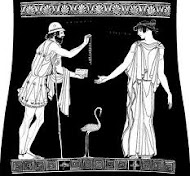

I have spoken of the importance of gifts in xenia before. A gift given as part of ritual hospitality was called a xenion (ξεινήιον). This xenion was expected to be expensive, and was presented to the guest upon departure. Needless to say, this practice was mostly executed by nobility, or at least the elite, and happened mostly when a man of equal social standing from another nation or city-state came to visit. In the Odysseia, Telemachos, son of Odysseus, receives from Menelaus a cup made by Hēphaistos Himself:

"But stay here in the palace, till the eleventh or the twelfth day, and I will send you off with honours, and fine gifts, a shining chariot with a trio of horses, and a glorious cup with which to pour libations to the deathless gods, while remembering me all your days."

The practice of gift giving to someone of another nation whom you might never see again, might seem counter-intuitive, but it's actually quite the opposite. By presenting a foreign equal with a great gift, not only do you establish kharis between the two of you, you also indebt the other person to you: they can not repay your kindness at this time, but they will compensate you for it when you visit, or when you are in need. On top of that, the recieving party will go home with tales of your hospitality, and your wealth, providing a boost in stature to the family and the land. It increases the honor of both, something very important to the ancient Hellenes. Gifts, in this context, functioned as a means of communication, legitimization, and mediation between benefactors and cities.

Beyond the elite, gift-giving was still very important, especially between men. The practice was a feature of the symposion, where it was displayed between men in a pederastic relationship, as well as between men of equal standing. Pederasty was where a mature male would take a young boy as his pupil and lover. The relationship was not about love: it was a social construct that allowed to boy time to get to know influential men, and to work himself up into their ranks. Because of this, there were many ritual acts connected to the practice, amongst which the giving of gifts, from mentor to pupil. Three gifts were traditional: military attire, an ox, and a drinking cup, but the youth most certainly received more expensive gifts.

One of the places the young lover would have been taken was the symposion. By allowing the young boy into the symposion it enabled the adults to prepare them for adult life and war in particular. Once the boys grew up, they became one of the men, taking young boys as lovers themselves, and teaching them the ropes of adult malehood. Gift giving in this context allows for a community to become closer, and for a young boy to prepare for his life as a man. Giving gifts--to their young lovers, as well as to those of equal age and standing--allowed men to teach the importance of equal distribution and redistribution of wealth, which was a founding factor of (mostly Athenian) society. It was also a status symbol: if one had time to visit the symposia, and give expensive gifts, they were not only citizens, but wealthy citizens, a clear mark that they were fit for greater responsibility within the political landscape of the city.

Most of these examples are from wealthy city-states like Athens, but there is evidence of gift-giving in other city-states as well. Sparta, for example, greatly frowned upon the flaunting of wealth, but they, too, gave gifts. These, however, were mostly practical in nature between the citizens themselves--fresh game, honey, perhaps a hunting dog--and were honors bestowed upon the person in the case of big events, or an a-symmetrical relationship. A Spartan winner of important sporting events, for example, would be allowed a place in the royal guard of the King, where Athenian winners would be set up for life, including food, housing, and status.

Another form of gift-giving was from a wealthy citizen to the community. This practice was dubbed 'Euergetism', from the Hellenic 'εὐεργετέω': 'I do good things'. While the money spent this way was, indeed a voluntary action on the part of the citizen, he was socially obligated to participate in the practice. Many roads and public buildings were funded this way, and thus bore the name of the citizen that had donated the funds--something we find archeological evidence for to this day.

Gift giving was of vital importance in the Archaic and Early Classical times, most notably in a social, ethical, economic, and political context. In the Classical period--which witnessed the development of elaborate monetary and law systems--the giving of gifts, and the associated benefits, became less prominent in economic and political contexts, though it did remain central in social and religious systems. Gift-giving and reciprocity did return to the Athenian stage, however, in the Hellenistic age, when much of the previously described took place.

Gift giving was of unparalleled important to the ancient Hellenes, but has lost much of its standing today. For those who reconstruct the ancient Hellenic religion, it might be a good exercise to examine these practices, and implement a symbolic exchange. Lavish gifts would not be necessary, but a parting gift by the host on days then the group comes together might make a nice, ritualistic, reminder that the contributions of the group were welcomed, and the effort to travel to the meeting place recognized--after the pandemic, of course!

This Christmas, we'll do door drop-offs with the family and then we're all meeting on Zoom from the safety of our own homes to unwrap the gifts we've gotten and read the poems we write along with them out loud to one another. You make do in a pandemic! 

Stay safe this season and stay smart. It's just one Christmas, the risks are not worth it.

Image taken from: Sparta Reconsidered
All right, we're going to tackle this before it gets picked up and you, as a Hellenist, find yourself without an answer. A summary of the issue at hand: A group of students at the University of Texas are calling for the firing of a classics professor who has written extensively on pederasty in ancient Hellas. Students claim Thomas Hubbard’s academic work “advocates for violent crime against teen boys” and is being celebrated in online communities that promote pedophilia. Read a whole, long article summarizing it all here.


So, pederasty. Yes, it existed. Yes, it often included sex between an adult male and a teenage male. Yes, technically, that makes it pedophilia. Do I condone it? No. Was it part of ancient Hellenic culture? Yes. Is it something any true Hellenist should want to bring back? Hell no! And if anyone ever uses ancient Hellenic culture as an excuse to break a modern law, they are missing the point of Hellenism.

So, now, let me explain pederasty so you can explain it to others, and tell you how modern Hellenist views these practices.

Hellenic society revolved around the household, and the household was founded upon the husband and wife. The ancient Hellenes knew of no other household foundation as this combination alone produced children. As many children died of illness, accidents and war and the continuation of the family line was one of the--if not the--most important desire and responsibility of every citizen. 

The ancient Hellenes seemed to have viewed all social interactions (so male-male, female-female and even male-female interactions) not only through a gender filter but also through a power filter. Male citizens had more power than slaves, for example, and female citizens had more power than male slaves, even though women were bound by other social structures than any man was. Older men had more power than younger men and the same held true for women. Married people even had more power than unmarried people. Gender was, if you will, merely a factor in the equation of who had more power during the exchange.

The one with more power was the active party and he (or she) was to be obeyed. When it came to the law, this partner was punished less severely for a crime both partook of (like adultery)--the complete opposite of how we'd view it today. The passive party was usually younger, a slave, or a woman. 

This power equation also dictated sexual relations. The ancient Hellenes viewed male-female relationships not solely as defined by gender but as a relationship of active versus passive and applied that theorum to male-male (and most likely female-female) relationships as well. One partner was always the clear submissive and became, through that, the 'female' while the other always assumed the active role and through that became the 'male'. They equated any relationship that applied these roles and rejected (heavily!) any that did not. And they did not consider these relationships true relationships in a marriage sense because, as I said above, a household could not be formed around it as the union could not provide children--which was the main function of a marriage.

Pederasty was a socially acknowledged erotic relationship between an adult male and a younger male usually in his teens, and was practiced mostly in the Archaic and Classical ages of Hellenic history. The courtship of the younger male (although the age difference could be neglectable in some cases) started with a ritual abduction of the younger male. The older male selected a youth and enlisted the chosen one's friends to help him, and carried off the object of his affections to his andreion, a sort of men's club or meeting hall. The whole group spent one or two months out in the countryside where they feasted, hunted and simply spent time together, enjoying life.

The next step in the process was to court the youth with gifts. Three gifts were traditional: military attire, an ox, and a drinking cup, but the youth most certainly received more expensive gifts. When the youth returned to the city, the ox was sacrificed to Zeus and the youth and his friends feasted. The young man also received special clothing that in adult life marked him as kleinos, 'famous, renowned.' The young man was called a parastatheis, 'he who stands beside', and served as cup bearer for the older male, the philetor, during meals in the andreion. Sex was part of this relationship, although the younger male rarely carried any love for the older male. Semen was said to transfer wisdom, so this is why younger boys accepted the practice. The rise in status also helped. There was a female version of this practice, but it's much less documented.

In ancient Hellas, what mattered was the role you played in bed. The males, especially when older or higher up in the hierarchy, were supposed to be the dominant ones, the active ones, while the women, the young, and those lower in the hierarchy, the passive ones. Because of the age difference and the difference in social standing, the young male assuming a passive role was permitted in pederasty, but a grown man assuming that role was a social and sexual taboo. 

Taboos say a lot about a culture and the people in it. The boundaries of what is, and what is not, socially accepted bind people together. They also give clues about Hellenistic Reconstruction. I have said before that reconstruction separates religion from culture, but when reconstructing a religion where religion defined the culture, one is invariably bound to it by some extend. While pederasty was a big thing in ancient Hellas, no one is saying we need to bring it back today. There are laws against it, and those are justly in place.

Pederasty played a social role in ancient Hellas. It provided boys with a mentor, it allowed them to make friends in high places, for many, a pederastic relationship was the only way to qualify for military service, which was an all but mandatory part of being a citizen. None of these reasons exist today and so there is absolutely no reason to bring the practice back. Anyone who uses the ancient practice of it as a cover for sexual wrongdoings today is not a member of our tradition.
A small addendum to yesterday's post on homosexuality in ancient Hellas today. In it I mention that the topic goed through the news cycle, often with a lot of misinformation. I didn't have room to include a little pet-peeve of mine in that post: namely that Solon had made laws against homosexuality.

Solon (Σόλων) was an Athenian statesman, lawmaker, and poet, who lived from 638 BC to 558 BC. He spent most of his adult life trying to legislate against political, economic, and moral decline in archaic Athens. His ideologies are often credited with having laid the foundations for Athenian democracy. As a statesman, Solon put principles before expediency. In a time when Athens was struggling under the burden of civil war, his reforms strove to bridge the gap between the rich an the poor. Solon's reforms created a system where the power was in the hands of the people, if they were willing to work hard for it. For those without political aspirations, Solon's reforms provided judicial safety and a sense of power. His efforts brought into being many laws on a large variety of topics.

According to many news outlets (and subsequently many blogs and other interest sites) Solon was said to have made laws against homosexuality that stated the folllowing: any man practising homosexuality was

- banned from becoming a member of the council of nine
- banned from standing for elections as a priest
- banned from being a citizen’s advocate
- not allowed to exercise power in or outside the city of Athens
- not permitted to be sent an emissary of war
- banned from expressing his opinions
- banned from entering public temples
- banned from being wreathed in races
- not allowed to enter the agora

The only place where these bans are mentioned  is in Aeschines' 'The Speeches of Aeschines, Speech I, Against Timarchus'. Against Timarchus (Κατὰ Τιμάρχου) was a speech to the Assembly by Aeschines in which he accused a man named Timarchus of being unfit to involve himself in public life. The speech provides evidence of a number of actions which, according to Aeschines, would cause a citizen to lose the right of addressing the Assembly. Aeschines accuses Timarchus of two of these forbidden acts: prostituting himself, and wasting his inheritance. Aeschines, a Hellenic statesman, provides no evidence that any of Timarchus' lovers ever paid him, nor does he have a single witness who will testify that Timarchus had any sexual relationship with the men in question at all. Despite this, he won the case and Timarchus was punished by disenfranchisement. The quote is as follows:

"And I beg you, fellow citizens, to remember this also, that here the lawgiver [Solon] is not yet addressing the person of the boy himself, but those who are near him, father, brother, guardian, teachers, and in general those who have control of him. But as soon as the young man has been registered in the list of citizens, and knows the laws of the state, and is now able to distinguish between right and wrong, the lawgiver no longer addresses another, Timarchus, but now the man himself. And what does he say?

"If any Athenian," he says, "shall have prostituted his person, he shall not be permitted to become one of the nine archons," because, no doubt, that official wears the wreath ; "nor to discharge the office of priest," as being not even clean of body ; " nor shall he act as an advocate for the state," he says, "nor shall he ever hold any office whatsoever, at home or abroad, whether filled by lot or by election ; nor shall he be a herald or an ambassador " — nor shall he prosecute men who have served as ambassadors, nor shall he be a hired slanderer — "nor ever address senate or assembly," not even though he be the most eloquent orator in Athens.

And if any one act contrary to these prohibitions, the lawgiver has provided for criminal process on the charge of prostitution, and has prescribed the heaviest penalties therefor. (To the Clerk.) Read to the jury this law also, that you may know, gentlemen, in the face of what established laws of yours, so good and so moral, Timarchus has had the effrontery to speak before the people — a man whose character is so notorious." [17-20]

Aeschines recites Solon's laws about male prostitution, not homosexuality. That Timarchus is accused of prostituting himself to men is of secondary importance when it comes to the actual laws. So, please, always research your sources, my friends. Especially when it comes to a subject as complicated as this one, things are only very rarely cut and dry.
Every few months, about three quarters of a year, the press seems to cycle back to a single subject when it comes to ancient Hellas: homosexuality. Most glorify (or condemn) the ancient Hellenes for their support of it. Some--in my opinion, better informed--messages nuance the statement some by saying that, despite the artistic examples of it,there were laws against it as well. The problem is in the terminology.

Homosexuality is defined as: 'of, relating to, or characterized by a tendency to direct sexual desire toward another of the same sex', or 'of, relating to, or involving sexual activity between persons of the same sex'.

The first definition is subjective; we can't objectively know if there was genuine attraction. There certainly was appreciation for the naked form in ancient Hellas, but did that translate to attraction? The ancient Hellens were very proud of their bodies. Both men and women worked hard to retain or attain beauty. The men were warriors and athletes, women could be athletes as well. Both had the highest beauty ideals one could ever look to live up to: the Theoi themselves. There were very strict social rules about what was considered proper and improper when it came to nudity--very strict rules that dictated when nudity was permitted and where. The social rules concerning displays of the body depended on the intent of the nudity: either natural or erotic. Erotic nudity had no function in public, and was heavily frowned upon. Natural nakedness went accepted.

The second definition: we know from literary works as well as art at least men engaged in sexual activity with each other. Even if these pottery cases represent a minute percentage of the thousands of ancient Hellenic items found, there is no denying sex between men and men (and potentially women and oher women) happened. So yes, by this definition there was homosexuality. Now, here is the crux: for me personally, homosexuality is about more than the physical act of sex with someone of the same gender. What defines homosexuality for me is having a meaningful relationship with them in line with a heterosexual relationship. And that, in ancient Hellas, was very much frowned upon.

All three of the greatest Hellenic philosophers, Socrates, Plato, and Aristotle, regarded homosexual conduct intrinsically immoral. Plato went so far as to deny that homosexual behavior occured in nature and thus considered the practice of men (very few of the ancient philosophers ever considered or wrote about women) as especially unnatural. He actively criticised any man who looked at the male form not just as something aesthetically pleasing but sexually arousing. These believes were founded upon the following three theses:

- the commitment of a man and a woman to each other in the sexual union of marriage is intrinsically good and reasonable, and is incompatible with sexual relations outside of marriage
- homosexual acts are radically and peculiarly non-martial, and for that reason intrinsically unreasonable and unnatural.
- homosexual acts have a special similarity to solitary masturbation, and both types of radically non-martial act are manifestly unworthy of the human being and immoral

Hellenic society revolved around the household, and the household was founded upon the husband and wife. The ancient Hellenes knew of no other household foundation as this combination alone produced children. As many children died of illness, accidents and war and the continuation of the family line was one of the--if not the--most important desire and responsibility of every citizen. This was also why adultery was frowned upon so greatly: birth control was available in ancient Hellas, but rarely applied. To bring an illegitimate child into the household was a terrible offense, and one for which the male was blamed. that said, a man could only commit legally punishable adultery if he had sex with a married woman, and even then she had to be a citizen for the full punishment to be enacted upon them--often death. Husbands were free to find pleasure with any woman who was not married. As such, prostitution (with women, male prostitution was actually punishable by death) was common and men tended to have concubines. Some even lived at the house. Plato, Socrates and Aristotle were against this practice, too.

Now, the ancient Hellenes seemed to have viewed all social interactions (so male-male, female-female and even male-female interactions) not only through a gender filter but also through a power filter. Male citizens had more power than slaves, for example, and female citizens had more power than male slaves, even though women were bound by other social structures than any man was. Older men had more power than younger men and the same held true for women. Married people even had more power than unmarried people. Gender was, if you will, merely a factor in the equation of who had more power during the exchange.

The one with more power was the active party and he (or she) was to be obeyed. When it came to the law, this partner was punished less severely for a crime both partook of (like adultery)--the complete opposite of how we'd view it today. The passive party was usually younger, a slave or a woman. This power equation also dictated sexual relations. The ancient Hellenes viewed male-female relationships not solely as defined by gender that but as a relationship of active vs passive and applied that theorum to male-male (and most likely female-female) relationships as well. One partner was always the clear submissive and became, through that, the 'female' while the other always assumed the active role and through that became the 'male'. They equated any relationship that applied these roles and rejected (heavily!) any that did not. And they did not consider these relationships true relationships in a marriage sense because, as I said above, a household could not be formed around it as the union could not provide children--which was the main function of a marriage.

So if that was the case, what's with all the artwork of men giving each other gifts and having sexual intercourse? They portray a very specific type of relationship known as pederasty. Pederasty was a socially acknowledged but illegal erotic relationship between an adult male and a younger male usually in his teens, which was practiced mostly in the Archaic and Classical ages of Hellenic history. Due to the age difference and the societal function the practice served, this type of relationship was accepted and not considered homosexual. The younger partner was always the passive party and performed to role of 'woman' in the exchange, thus making it a heterosexual relationship between two men (as contradictory as that may sound).

In ancient Hellas, what mattered was the role you played in bed. The males, especially when older or higher up in the hierarchy, were supposed to be the dominant ones, the active ones, while the women, the young and those lower in the hierarchy, the passive ones. Because of the age difference and the difference in social standing, the young male assuming a passive role was permitted in pederasty, but a grown man assuming that role was a social and sexual taboo. A wife who took charge in the bedroom would have been frowned upon as well. Especially within the marriage, sex served to make babies, nothing more. Prostitutes and concubines were still supposed to assume a passive, female, role, even if they were male. Prostitutes were lower in power than citizen women, though, and they performed the lowliest and most frowned upon of sexual acts--like fellatio--that even wives were not allowed (or required) to perform. For a husband to force his wife to perform these acts would have been considered extremely shameful upon the husband.

So, to conclude this very long and complicated post: yes, men had sex with men. In that way homosexuality existed. But there were strict social and even legal rules against it and it was only barely condoned--and only under very specific circumstances. It was not an accepted practice at all. Sadly, I suppose, but not surprisingly: even today homosexuality is only barely accepted socially, let alone legally.
I am twenty-eight years old cis-female, and I identify as a lesbian. These labels mean very little onto themselves, but when it comes to my bedroom, they have quite the influence. Next Tuesday, I will have been together with my girlfriend for nine years, and we will have been living together for six and a half (give or take). She wasn't the first woman I dated (my one and only boyfriend was around age six), but she was the first I slept with. My girlfriend is the only person I have ever slept with.

Star Foster recently wrote a wonderful piece about the Sacredness of Sex, which had me thinking about my own sex life and the sacredness of it. My girlfriend is everything I could ever want in a woman and sexual partner, and I realize every day how incredibly lucky I am to have found someone who not only matches me, but who puts up with my occasional bullshit and who can always make me laugh. I have no desire for another partner--sexual or otherwise--and I am confidant she feels the same way.

Perhaps because of my religious views, or maybe despite it, I don't ascribe a sacredness to sex. I think it's a wholly human endeavor that is mirrored from the Gods, but should not be levelled with Them, or shared. That said, I am not a prude by any stretch of the imagination. What I do have, however, is a healthy dose of respect for myself (and the luck not to have the choice to remain a virgin taken from me) and before I met my girlfriend, I felt no desire to share my body with my partners (of which there weren't many, because I was also picky in that regard). I have said before how--coming into Hellenism--I realized how wired for the religion I actually was, and my views about sex (and nudity) are reflective of that.

Hellenic society was complicated when it came to sex; adultery was frowned upon, but most marriages were arranged and love was not a guarantee. The ancients saw sex as completely natural and--unlike many today--had no inhibitions and very few taboos when it came to straight up heterosexual sex. Anything else had societal stigma's attached to it. Heterosexual sex was defined by an active male and a passive female. Penetration was active, being penetrated was passive. Getting oral sex was active, while performing oral sex was a passive activity. There is a pattern there that is important, as it limited the socially acceptable interactions one could have. For example, men were stimulated to take on only an active roll and thus avoided performing oral sex on a woman (or man, but see below). Due to this dynamic, homosexuality was frowned upon as well; here were twe men (or women, but that's an entirely different dynamic and a longer story for which there is very little evidence) who alternated an active and passive roll--something very much against society's rules.

Men often took mistresses and visited prostitutes--both accepted practices that put an even greater taboo on adultery (which was obviously not included in the aforementioned practices. In fact, a man could only commit adultery if he had sex with a married woman, and even then she had to be a citizen for the full punishment to be enacted upon them--often death.

Pederasty was a socially acknowledged erotic relationship between an adult male and a younger male usually in his teens, and was practiced mostly in the Archaic and Classical ages of Hellenic history. Due to the age difference and the societal function the practice served, this type of relationship was accepted and not considered homosexual. The younger partner was always the passive party and performed to role of 'woman' in the exchange, thus making it a heterosexual relationship between two men (as contradictory as that may sound).

Women--perhaps somewhat obviously--had far fewer freedoms when it came to sex outside of the marital bed, and their lives were far less often discussed. I highly doubt ancient Hellenic men had any idea what happened in the almost completely separate lives of their wives--especially in the richer layers of society, and especially in the big cities like Athens and Corinth. It would not surprise me at all if women found sexual comfort with each other or themselves on a regular basis, but evidence of that is slim to none-existent outside of Sparta from where there is even evidence of pederastic relationship between older and younger women in high societal circles.

I think sex is a beautiful part of life that needs to be celebrated and indulged in when the mood strikes. I see this view reflected not only in evidence from ancient Hellenic society, but the stories of its Gods as well. Sex is a huge part of our mythology, and not just in the famous rape stories (and please read the article that link leads to before interpreting the term). My eternally favourite passage about sex and the Theoi comes from Hómēros' Iliad:

"Meanwhile Hera soon reached Gargarus, the summit of lofty Ida. Zeus, the Cloud-Driver, saw her, and instantly his sharp mind was overwhelmed by longing, as in the days when they first found love, sleeping together without their dear parents’ knowledge. Standing there he called to her: ‘Hera, what brings you speeding from Olympus? And where are your chariot and horses?’

Queen Hera replied, artfully: ‘I am off to the ends of fruitful earth, to visit Oceanus, source of all the gods, and Mother Tethys. They nursed and cherished me lovingly in their halls. I will visit them and bring their ceaseless quarrel to an end. They have been estranged for a long time now, from love and the marriage bed, ever since their hearts were embittered. My horses wait at the foot of Ida of many streams, and they will take me over dry land and sea. But I am here from Olympus to see you, lest you harbour anger towards me later if I go to deep-flowing Oceanus’ house without first telling you.’

Zeus the Cloud-Driver answered: ‘Hera, you shall go: later. But for now let us taste the joys of love; for never has such desire for goddess or mortal woman so gripped and overwhelmed my heart, not even when I was seized by love for Ixion’s wife, who gave birth to Peirithous the gods’ rival in wisdom; or for Acrisius’ daughter, slim-ankled Danaë, who bore Perseus, greatest of warriors; or for the far-famed daughter of Phoenix, who gave me Minos and godlike Rhadamanthus; or for Semele mother of Dionysus, who brings men joy; or for Alcmene at Thebes, whose son was lion-hearted Heracles; or for Demeter of the lovely tresses; or for glorious Leto; or even for you yourself, as this love and sweet desire for you grips me now.’

Queen Hera replied, artfully once more: ‘Dread son of Cronus, what words are these? You indeed may be eager to make love on the heights of Ida in broad daylight, but what if an immortal saw us together, and told the others? I’d be ashamed to rise again, and go home. But if you really wish for love, if your heart is set on it, you have that room your dear son Hephaestus built you, with solid tightly-fitting doors. Let us go and lie there, since love-making is your wish.’

‘Hera, have no fear: no god or man will see us through the golden cloud in which I’ll hide us. Not even Helios could spy us then, though his is the keenest sight of all.’

With that the son of Cronus took his wife in his arms and beneath them the bright earth sent up fresh grass-shoots, dewy lotus, crocus and soft clustered hyacinth, to cushion them from the ground. There they lay, veiled by the cloud, lovely and golden, from which fell glistening drops of dew." [Bk XIV:292-351]

This passage sums up my views about sex perfectly: it should be between those who consent to it, filled with both love and lust, and private. I have no desire to go back to the ways of ancient Hellas when it comes to sex, but I do like their willingness to admit that sexual desires are a part of our nature. There is no reason to deny that consenting adults have sexual intercourse, because it is not only a natural extension of love, but a natural extension of life itself. It should not be discussed as a brag or boast, but can serve as a way to express the affection between two (or more, I don't judge as long as anyone is of consenting age and mind) people. Most of all, it should be enjoyed, and if you find someone who gives you sexual pleasure, then it would be very, very, right to thanks the Gods for that.
Giving gifts to friends, family members, or even acquaintances and complete strangers is a long standing tradition. It existed long before ancient Hellas, but was, indeed, a vital part of its culture. It was tied to both kharis and xenia. Gifts were exchanged between monarchs of city-states to create good will, and were thus an important part of diplomacy. All votives, thank-offerings, and pinakes were gifts from mortals to Theoi. Athletic competitions always concluded with a price--a gift--awarded to the winner. Gifts were given to the submissive partner in a pederastic relationship, and to favored prostitutes and serfs. Gifts played a much more significant role in ancient Hellenic society as a whole than they do in ours today. The giving of gifts in ancient Hellas was not just a social event, however. There was far more to the practice than one might assume, and today, we will look at the tradition of gift giving in greater detail.

I have spoken of the importance of gifts in xenia before. A gift given as part of ritual hospitality was called a xenion (ξεινήιον). This xenion was expected to be expensive, and was presented to the guest upon departure. Needless to say, this practice was mostly executed by nobility, or at least the elite, and happened mostly when a man of equal social standing from another nation or city-state came to visit. In the Odysseia, Telemachos, son of Odysseus, receives from Menelaus a cup made by Hēphaistos Himself:

"But stay here in the palace, till the eleventh or the twelfth day, and I will send you off with honours, and fine gifts, a shining chariot with a trio of horses, and a glorious cup with which to pour libations to the deathless gods, while remembering me all your days."

The practice of gift giving to someone of another nation whom you might never see again, might seem counter-intuitive, but it's actually quite the opposite. By presenting a foreign equal with a great gift, not only do you establish kharis between the two of you, you also indebt the other person to you: they can not repay your kindness at this time, but they will compensate you for it when you visit, or when you are in need. On top of that, the recieving party will go home with tales of your hospitality, and your wealth, providing a boost in stature to the family and the land. It increases the honor of both, something very important to the ancient Hellenes. Gifts, in this context, functioned as a means of communication, legitimization, and mediation between benefactors and cities.

Beyond the elite, gift-giving was still very important, especially between men. The practice was a feature of the symposion, where it was displayed between men in a pederastic relationship, as well as between men of equal standing. Pederasty was where a mature male would take a young boy as his pupil and lover. The relationship was not about love: it was a social construct that allowed to boy time to get to know influential men, and to work himself up into their ranks. Because of this, there were many ritual acts connected to the practice, amongst which the giving of gifts, from mentor to pupil. Three gifts were traditional: military attire, an ox, and a drinking cup, but the youth most certainly received more expensive gifts.

One of the places the young lover would have been taken was the symposion. By allowing the young boy into the symposion it enabled the adults to prepare them for adult life and war in particular. Once the boys grew up, they became one of the men, taking young boys as lovers themselves, and teaching them the ropes of adult malehood. Gift giving in this context allows for a community to become closer, and for a young boy to prepare for his life as a man. Giving gifts--to their young lovers, as well as to those of equal age and standing--allowed men to teach the importance of equal distribution and redistribution of wealth, which was a founding factor of (mostly Athenian) society. It was also a status symbol: if one had time to visit the symposia, and give expensive gifts, they were not only citizens, but wealthy citizens, a clear mark that they were fit for greater responsibility within the political landscape of the city.

Most of these examples are from wealthy city-states like Athens, but there is evidence of gift-giving in other city-states as well. Sparta, for example, greatly frowned upon the flaunting of wealth, but they, too, gave gifts. These, however, were mostly practical in nature between the citizens themselves--fresh game, honey, perhaps a hunting dog--and were honors bestowed upon the person in the case of big events, or an a-symmetrical relationship. A Spartan winner of important sporting events, for example, would be allowed a place in the royal guard of the King, where Athenian winners would be set up for life, including food, housing, and status.

Another form of gift-giving was from a wealthy citizen to the community. This practice was dubbed 'Euergetism', from the Hellenic 'εὐεργετέω': 'I do good things'. While the money spent this way was, indeed a voluntary action on the part of the citizen, he was socially obligated to participate in the practice. Many roads and public buildings were funded this way, and thus bore the name of the citizen that had donated the funds--something we find archeological evidence for to this day.

Gift giving was of vital importance in the Archaic and Early Classical times, most notably in a social, ethical, economic, and political context. In the Classical period--which witnessed the development of elaborate monetary and law systems--the giving of gifts, and the associated benefits, became less prominent in economic and political contexts, though it did remain central in social and religious systems. Gift-giving and reciprocity did return to the Athenian stage, however, in the Hellenistic age, when much of the previously described took place.

Gift giving was of unparalleled important to the ancient Hellenes, but has lost much of its standing today. For those who reconstruct the ancient Hellenic religion, it might be a good exercise to examine these practices, and implement a symbolic exchange. Lavish gifts would not be necessary, but a parting gift by the host on days then the group comes together might make a nice, ritualistic, reminder that the contributions of the group were welcomed, and the effort to travel to the meeting place recognized.

Image taken from: Sparta Reconsidered
Society is an ever-chancing construct, influenced by the people living (in) it and changing those people in return. What was socially acceptable as little as ten years ago, may not be socially acceptable today. Smoking in public spaces, for example. Imagine going back hundreds of years to a society much unlike our own. Most of what we do today would have been taboo then, and much of what was daily practice then, is taboo today. This post will serve to highlight some of these taboos, from both sides of the coin. Please, remember this post is all in good fun; some of these practices may seem barbaric, but that's your culture speaking. For the ancient Hellens, it was absolutely normal: it was their culture and no modern Hellenist would try to bring back practices which are now against the law.

Animal sacrifice: at this point, even I realize I talk about animal sacrifice too much, so I'll just leave you with a few sentences on it, and a link to more information about the practice in ancient Hellas and modern Hellenistic Reconstruction. Animal sacrifice is a controversial practice these days, although many religions, even within Paganism, practice it. Back in ancient Hellas, it was a very common practice. While I have never been to a ritual which included the sacrifice of an animal, I am not morally opposed to it in a religious setting where it makes sense and when it is done in a way that is quick and painless for the animal.

Pederasty (παιδεραστία): pederasty was a socially acknowledged erotic relationship between an adult male and a younger male usually in his teens, and was practiced mostly in the Archaic and Classical ages of Hellenic history. The courtship of the younger male (although the age difference could be neglectable in some cases) started with a ritual abduction of the younger male. The older male selected a youth and enlisted the chosen one's friends to help him, and carried off the object of his affections to his andreion, a sort of men's club or meeting hall. The whole group spent one or two months out in the countryside where they feasted, hunted and simply spent time together, enjoying life.
The next step in the process was to court the youth with gifts. Three gifts were traditional: military attire, an ox, and a drinking cup, but the youth most certainly received more expensive gifts. When the youth returned to the city, the ox was sacrificed to Zeus and and the youth and his friends feasted. The young man also received special clothing that in adult life marked him as kleinos, 'famous, renowned.' The young man was called a parastatheis, 'he who stands beside', and served as cup bearer for the older male, the philetor, during meals in the andreion. Remind you of someone? Sex was part of this relationship, although the younger male rarely carried any love for the older male. Semen was said to transfer wisdom, so this is why younger boys accepted the practice. The rise in status also helped. There was a female version of this practice, but it's much less documented.

Homosexuality: although the practice of pederasty is often interpreted as a 'homosexual practice', no ancient Greek in their right mind would see it as such. If they had known the term 'bisexual', they would not have used it. Marriage was to someone of the opposite gender. You were heterosexual. Period. While members of both sexes may have shared their beds with someone of the same gender, this had nothing to do with the way they identified on the Kinsey scale. In ancient Hellas, what mattered was the role you played in bed. The males, especially when older or higher up in the hierarchy, were supposed to be the dominant ones, the active ones, while the women, the young and those lower in the hierarchy, the passive ones. Because of the age difference and the difference in social standing, the young male assuming a passive role was permitted in pederasty, but a grown man assuming that role was a social and sexual taboo. A wife who took charge in the bedroom would have been frowned upon as well. Especially within the marriage, sex served to make babies, nothing more. Prostitutes and concubines were still supposed to assume a passive, female, role, but I am willing to bet there were some exceptions to that rule.

Adultery: although it's not exactly cheered on in modern times, both partners tend to walk away with emotional and financial pain only. In ancient Greece, the punishment was a tad more severe. If a married woman had intercourse with a man other than her husband, she could be killed. Another option was to divorce. She was then sent back to her father. If he rejected her (and he usually did), she was left to fend for herself, which often led to a life of slavery. The man she cheated with was often worse off. He was also liable to get killed, especially if caught in the act, because the husband had the right to kill him, without getting punished for it. There is another reported punishment for a man who slept with a free woman who was married: rhaphanidosis. Rhaphanidosis is the act of inserting the root of a horseradish into the anus. A mulletfish could also be inserted. The act of rhaphanidosis is part of the comic play 'Nephelai' (Νεφέλαι) of Aristophanes, but no one knows for sure if the punishment was ever really applied.
It makes sense that the male involved with the adultery was more severely punished than the woman; birth control was available in ancient Hellas, but rarely applied. To bring an illegitimate child into the oikos was a terrible offense, and one for which the male was blamed. Needless to say, the husband was free to find pleasure with any woman who was not married. Prostitution was common, and men tended to have concubines. Some even lived at the house. Demosthenes, a Hellenic writer from ancient Athens, was recorded as saying: 'we have courtesans for pleasure, concubines to provide for our daily needs, and our spouses to give us legitimate children and to be the faithful guardians of our homes'.

Slavery: I have already written about slavery in ancient Hellas, so let me copy/paste the basics and direct you to the post for further reading. A Greek slave was called a doûlos (δούλος), which would translate best as a 'servant' or 'serf'.  In ancient Greece, doûlos were the working class. They were teachers, farmers, shop owners, herders, doctors, city militia, cleaners, etc. Because many performed a public service, they had a house of their own as well as a salary. Household serfs were called oikétês (οἰκέτης). The female head of the household was charged with teaching--and keeping order amongst--the household serfs. Slavery as it is known today is a lot different than slavery in ancient Hellas. In fact, if I had the money, I could still hire a nanny for my children, a gardner for my garden, a cook for my supper and farmers to tend to my farm. All could come to life at my house if it was big enough. The only difference is that I do not have to buy these people, nor would I own them.

Nudity: the ancient Hellens were very proud of their bodies. Both men and women worked hard to retain or attain beauty. The men were warriors and athletes, women could be athletes as well. Both had the highest beauty ideals one could ever look to live up to: the Theoi themselves. Men went to school at a gymnasium. A large part of the curriculum consisted of sports, and these were practiced in the nude. Most often, the young men didn't dress again for the lectures on mathematics, astronomy and other sciences that were taught afterwards; the climate didn't require it, nor did society. Even women were fully or partially naked when practicing sports. Nudity--especially for men--was completely normal in ancient Hellas. When they felt the urge to dance, make music or practice sports, they threw off the loosely draped cloth they wore as clothing and went for it. Measuring how free women were with their nudity is more difficult as ancient Hellenic women rarely left the house, except for religious festivals. It is recorded, however, that nudity during festivals happened quite often. Although there were undoubtedly situations in which nudity was frowned upon, public nudity was very much an accepted practice.

Minor taboos: although these were not minor back in the day, to write an entire paragraph on each would make this post entirely too long. Fallatio was a big taboo in ancient Hellas. It was performed, on occasion, but the young boy, prostitute or lover would always refuse to do it, get beaten about some, and then surrender. To just perform the act was shaming for both, so the ritual needed to be included. A man never made his wife perform the act. Sex before marriage was also frowned upon. Eating meat from domesticated animals and drinking milk was also taboo. Eating meat from an animal which was not sacrificed to the Gods was also not done. Not performing the proper rituals to purify yourself for the Gods was also a big taboo.

There were a lot of other taboos in ancient Hellas, but since many of these prevail to this day, I have not listed them. Incest is one that comes to mind. Taboos say a lot about a culture and the people in it. The boundaries of what is, and what is not, socially accepted bind people together. They also give clues about Hellenistic Reconstruction. I have said before that reconstruction separates religion from culture, but when reconstructing a religion where religion defined the culture, one is invariably bound to it by some extend. While pederasty was a big thing in ancient Hellas, no one is saying we need to bring it back today. There are laws against it, and those are justly in place. Yet, taking a second look at our bodies--especially in this age of prudishness, distorted body images and obesity--and our reaction to it, may not be such a bad thing.

This was a small sampling of ancient Hellenic taboos and modern practices which would have shocked the ancient Hellens. I hope it was a source of information and amusement. Take from it what you will, and--perhaps--take a look at our modern taboos and practices to say what it says about our culture and society. Which taboos and practices will future humans frown, laugh or gawk at? What will we change or leave behind... and what will--and should--we hold on to as long as possible?