Showing posts with label labrys. Show all posts
The Labrys Religious Community aims to preserve, promote and practice the Hellenic polytheistic religious tradition through public rituals, lectures, publications, theatrical and musical events, and other forms of action. Their vision is to restore the Hellenic religious tradition and by extension the Hellenic Kosmotheasis and lifestyle to its rightful place, as a respected, acknowledged and fully functional spiritual path. Labrys posts videos of the many rituals it organizes and I tend to share them. I haven't done so in a while and they have posted some beautiful videos of their City (or Greater) Dionysia celebration.

The Dionysia ta en Astei (Διονύσια τὰ ἐν Ἄστει), Dionysia ta Megala (Διονύσια τὰ Μεγάλα), Great(er) Dionysia, or City Dionysia, was and is a true theatric festival of Dionysos. The City Dionysia is held on the 10th to 17th days of Elaphebolion.

According to myth, the festival was established after Eleutherae, a border-town between Attica and Boeotia, chose to become part of Attica. The Eleuthereans had an established festival of Dionysos--which then became the rural Dionysia--and celebrated to occasion by bringing a statue of Dionysos to Athens. The Athenians, by then not big on the worship of Dionysos, initially rejected the statue, but Dionysos punished the Athenians with a plague affecting the male genitalia. The Athenians, rightfully spooked, accepted the statue and honor of Dionysos, and the plague was cured. These events were recalled each year by two processions, the first, carrying the statue of Dionysos from His temple outside of the city of Athens into the city, and the second where various groups proceeded through the city to the theater, arrayed in groups distinguishable by color or other articles of dress.


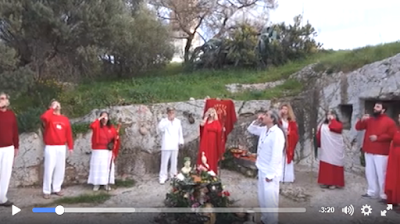


I am very happy to share with you Labrys' ritual for the Mounikhia. The Labrys Religious Community aims to preserve, promote and practice the Hellenic polytheistic religious tradition through public rituals, lectures, publications, theatrical and musical events, and other forms of action. Their vision is to restore the Hellenic religious tradition and by extension the Hellenic Kosmotheasis and lifestyle to its rightful place, as a respected, acknowledged and fully functional spiritual path.

The Mounikhia (Μουνιχιας), the festival after which the month was named, is celebrated on the sixteenth of Mounichion. On this day of the full moon, Artemis Mounikhia (Αρτεμις Μουνυχια) was honored at the hill of Munikhia, for granting the Hellenes victory in the Battle of Salamis (Ναυμαχία τῆς Σαλαμῖνος). Please click on the image below to get taken to the video. Enjoy!

https://www.facebook.com/groups/596804250439931/permalink/948683841918635/
I am very happy to share with you Labrys' ritual for the Anthesteria. The Labrys Religious Community aims to preserve, promote and practice the Hellenic polytheistic religious tradition through public rituals, lectures, publications, theatrical and musical events, and other forms of action. Their vision is to restore the Hellenic religious tradition and by extension the Hellenic Kosmotheasis and lifestyle to its rightful place, as a respected, acknowledged and fully functional spiritual path.

The Anthesteria was held annually for three days, the eleventh to thirteenth of the month of Anthesterion. It is an ancestral festival, the oldest of the festivals for Dionysos in Athens, a time of reflection and trust in the new growing season to come, a time to celebrate with the spirits of the departed the indefatigable resurgence of life. The festival centered around the celebration of the maturing of the wine stored at the previous vintage, whose pithoi were now ceremoniously opened, and the beginning of spring. Please click on the image below to get taken to the video. Enjoy!

https://www.facebook.com/LabrysCommunity/videos/943181595778636/?fref=nf
I am very happy to share with you Labrys' ritual for the Theogamia. The Labrys Religious Community aims to preserve, promote and practice the Hellenic polytheistic religious tradition through public rituals, lectures, publications, theatrical and musical events, and other forms of action. Their vision is to restore the Hellenic religious tradition and by extension the Hellenic Kosmotheasis and lifestyle to its rightful place, as a respected, acknowledged and fully functional spiritual path.

We know very little about the actual Theogamia festival. In ancient sources it's sometimes called 'hieros gamos', the sacred marriage, and was referred to as a domestic festival. A day to spend at home, with your wedded partner. Hera Teleia was the primary deity of the festival, with Zeus Teleios being of secondary importance. It was celebrated for sure in Athens, and most likely also in city-states around Athens. It included a shared dinner, and presumably lovemaking, between husband and wife. Please click on the image below to get taken to the video. Enjoy!

https://www.facebook.com/groups/HellenicPagan/permalink/1120332531318667/
I am very happy to share with you Labrys' ritual for the Lênaia. The Labrys Religious Community aims to preserve, promote and practice the Hellenic polytheistic religious tradition through public rituals, lectures, publications, theatrical and musical events, and other forms of action. Their vision is to restore the Hellenic religious tradition and by extension the Hellenic Kosmotheasis and lifestyle to its rightful place, as a respected, acknowledged and fully functional spiritual path.

They have a large variety of rituals and festivals documented, including their 2016 Lênaia festival in honour of Dionysos. As it is not an official Labrys video, please click on the image below to get taken to the video. Enjoy!

https://www.facebook.com/groups/596804250439931/permalink/887664811353872/
I am very happy to share with you Labrys' ritual for the Maimakteria. The Labrys Religious Community aims to preserve, promote and practice the Hellenic polytheistic religious tradition through public rituals, lectures, publications, theatrical and musical events, and other forms of action. Their vision is to restore the Hellenic religious tradition and by extension the Hellenic Kosmotheasis and lifestyle to its rightful place, as a respected, acknowledged and fully functional spiritual path.

They have a large variety of rituals and festivals documented, including their 2015 Maimakteria festival in honour of Zeus Maimaktes ('Blustering') to be gentle come winter. Enjoy!

I am very happy to share with you Labrys' ritual for the Mounikhia. The Labrys Religious Community aims to preserve, promote and practice the Hellenic polytheistic religious tradition through public rituals, lectures, publications, theatrical and musical events, and other forms of action. Their vision is to restore the Hellenic religious tradition and by extension the Hellenic Kosmotheasis and lifestyle to its rightful place, as a respected, acknowledged and fully functional spiritual path.

They have a large variety of rituals and festivals documented, including their 2015 Mounikhia festival in honour of Artemis. Enjoy!


Hear us, O' Goddess, light-bearing Queen, divine Selene;
bull-horned Mene, night-roaming, airborne,
nocturnal, torch-bearing, dark maiden; Mene,
who waxes and wanes, masculine and feminine;
illuminating, horse-loving, mother of time; fruit-bearing,
amber, atmospheric, all-shining, each night;

You, the all-seeing, vigilant, filled with beautiful stars,
joyful in the silence and the fortunate night;
bright, joy-bringing, full-cycled, jewel of the night;
O' star-queen, long-veiled, variable, all-wise maid,
approach with bliss and delight; rich with stars and shining
light three-fold; protect your new suppliants, O' Maid.
I am very happy to share with you Labrys' ritual for the Theogamia. The Labrys Religious Community aims to preserve, promote and practice the Hellenic polytheistic religious tradition through public rituals, lectures, publications, theatrical and musical events, and other forms of action. Their vision is to restore the Hellenic religious tradition and by extension the Hellenic Kosmotheasis and lifestyle to its rightful place, as a respected, acknowledged and fully functional spiritual path.

They have a large variety of rituals and festivals documented, including their 2015 Lênaia festival in honour of Zeus Teleios and Hera Teleia. Enjoy!


I am very happy to share with you Labrys' ritual for the Lênaia. The Labrys Religious Community aims to preserve, promote and practice the Hellenic polytheistic religious tradition through public rituals, lectures, publications, theatrical and musical events, and other forms of action. Their vision is to restore the Hellenic religious tradition and by extension the Hellenic Kosmotheasis and lifestyle to its rightful place, as a respected, acknowledged and fully functional spiritual path.

They have a large variety of rituals and festivals documented, including their 2015 Lênaia festival in honour of Dionysos. Enjoy!


The Labrys Religious Community aims to preserve, promote and practice the Hellenic polytheistic religious tradition through public rituals, lectures, publications, theatrical and musical events, and other forms of action. Their vision is to restore the Hellenic religious tradition and by extension the Hellenic Kosmotheasis and lifestyle to its rightful place, as a respected, acknowledged and fully functional spiritual path. To bring this goal closer, they have released a new book, previously only published in Greek: 'Hellenic Polytheism: Household Worship'. To quote:


"A long awaited effort to make available for the first time abroad, the realities of Hellenic worship as practiced in the birth place of our religion. Our hope is that with this publication newer but also older followers of Hellenismos will find all the basic information to practice household worship in a traditional manner.
 
Within this publication, the reader is presented with explanations for the central concepts and basic guidelines to the ceremonies that form a part of Hellenic Household Worship as has been established and is currently practiced by the LABRYS Polytheistic Community in Hellas (Greece).
 
It serves as a useful introductory manual for the newcomer to contemporary Hellenic Polytheism as they take the first steps on their journey to worship the Hellenic Gods in a traditional manner."


The book is available on Amazon store (both US and UK) but purchasing directly through our CreateSpace online store will be appreciated since that will give the LABRYS Polytheistic community a higher portion of the royalties (without changing the price for you) which in return will help them fund our second publication that is currently in research/writing stage concerning the public aspects of worship with all the major city/community celebrations.
I'm feeling very romantic today. I think it's because my girl is leaving for a two week trip on Monday and I already miss her. In nine and a half years, it's the longest we will have been separated. When I found the video below yesterday, I knew I was sharing it with you today. It's a compilation of images of a recent Hellenic wedding, and yes, it's giving me a lot of warm fuzzies. It was put online by Labrys.


I have described the ancient Hellenic idea of marriage before: marriage in ancient Hellas was a family affair. The father of the son--who was often in his thirties by the time he got married--opened negotiations with the family of a bride in her teens. The two families came to an agreement about dowry, a contract was signed by the father of the groom and the father of the bride in front of witnesses, and the groom met his new wife--often for the first time--before taking her to bed.

A wedding in ancient Hellas--and Athens, specifically--was dedicated to a large number of deities. Zeus Teleios, Hera Teleia, Aphrodite and Artemis would have received sacrifice the night before the wedding. Artemis was offered the girl's toys and playthings, so as to signal the end of her childhood. Hestia was honoured once the husband's new wife joined the household.

For these two young lovebirds, their marriage was obviously entirely voluntary, and I wish them the best together. As for me, I'll have my sweetheart back soon enough once she leaves, and soon, we'll have our wedding ceremony as well.

I may have mentioned once or twice how much I adore and respect the Hellenic organization Labrys. The Labrys Religious Community aims to preserve, promote and practice the Hellenic polytheistic religious tradition through public rituals, lectures, publications, theatrical and musical events, and other forms of action. Their vision is to restore the Hellenic religious tradition and by extension the Hellenic Kosmotheasis and lifestyle to its rightful place, as a respected, acknowledged and fully functional spiritual path.

They have a large variety of rituals and festivals documented, including their 2014 Phallephoria in Athens. The phallephoria was a procession undertaken usually as part of the Dionysia. It was a celebration of freedom, solidarity, and rebellion and was one of the only public assembly's that everyone could attend--women, children, slaves and métoikos included. Men carried huge phalloi through the streets and into the theater and directed ridicule and abuse at the honorands. As with many Dionysian rituals, the phallephoria showed two sides of the theater world: the tragedies that depicted the disasters that befell the heroes of ancient Hellas, and the comedies where these heroes were ridiculed.

According to tradition, the City Dionysia was established after Eleutherae, a town on the border between Attica and Boeotia, had chosen to become part of Attica. The Eleuthereans brought a statue of Dionysos to Athens, which was initially rejected by the Athenians. Dionysus then punished the Athenians with a plague affecting the male genitalia, which was cured when the Athenians accepted the cult of Dionysus. This was recalled each year by a procession of citizens carrying phalloi, and the practice has now been brought back to life.

So, what is better than one video of Dionysian rites? That's right, a video of five of their Dionysia festival celebrations combined. You're welcome!
I may have mentioned once or twice how much I adore and respect the Hellenic organization Labrys. Two days after the Spring equinox, they held a celebration at the temple of Zeus at Nemea, and of course, there is a video that I would love to share with everyone.


The actual astronomical Spring equinox, also called the Vernal equinox, is the moment in spring when the nights and days appear to be equal. The name comes from a combination of the Latin words 'equal' and 'night', which are 'aequus' and 'nox'. The word 'nox' in Latin probably comes from the Greek "Nyx", the Goddess of the night. In astronomical terms Spring equinox varies each year but generally occurs about March 21st.

My Greek is still abysmal, I fear, but judging from the video and whatever I did understand, I am assuming we are privy to the opening words and the Blessing by Plethon (a Greek scholar of Neoplatonic philosophy) before we see bits of a hymn to Zeus and Apollon. Assuming they are relatively the same in all Labrys ceremonies, here are the first two as taken from their Summer solstice ritual from 2011:

"Opening words:
Come o MAKARES THEOI, illustrious friends of mortals. Mighty support of the Kosmos, come Immortal THEOI and rejoice in the libations. Grant to us mortals, all teachings of Arete, great happiness and much desired prosperity, here wine is poured as libation."

"Blessing by Plethon:
Let me never cease, o' MAKARES THEOI, to owe my gratitude to You for all the good things which I have received and still receive from You with Great Zeus as the sponsor.  Let me not neglect, in accordance with my capabilities, the good of my nation. To serve willingly the common good, and to view that as of great benefit to myself. Not to become the cause of anything bad, of the kind which befall humans but only of the good, for as far as I am able, that I may be happy, in likeness of You."

According to this account of events--again, in Greek--the main recipient of worship was Asklēpiós, and he was celebrated with libations, praise, hymns, and many stories about his deeds.

As far as I am aware, the ancient Hellenes did not have a festival that focussed particularly on the equinox. They celebrated many festivals in the month of Elaphebolion, dedicated mostly to Dionysos and Zeus, and in the beginning of the month, to Asklēpiós. Apollon is traditionally associated with this time of year as He returns from Hyperborea--a region far to the north of Thrace--where Apollon was said to stay the winter. It's not hard to imagine that the time around the Spring equinox was when the ancient Hellenes assumed He returned to Delphi. For more information about this event, please visit Beloved in Light.

This celebration is a modern one, but I welcome every single ritual if it brings Hellenes together in the spirit of the ancient Tradition. It look absolutely beautiful, and I would have loved to be there--as always with Labrys celebrations.
Labrys, the Hellenic Polytheistic group located in Greece who recently performed the Phallephoria, have started another initiative to aid the Hellenistic community: a reading list on LibraryThings. The Labrys Religious Community aims to preserve, promote and practice the Hellenic polytheistic religious tradition through public rituals, lectures, publications, theatrical and musical events, and other forms of action. Their vision is to restore the Hellenic religious tradition and by extension the Hellenic Kosmotheasis and lifestyle to its rightful place, as a respected, acknowledged and fully functional spiritual path.


The focus of the booklist is on modern books and papers, dealing with the ancient Hellenic people, ancient Hellenic mythology, or modern Hellenism. The list is made up of modern works, so you won't find Plato on the list. Well-represented, however, are authors like Walter Burkert, Drew Campbell, Robert Graves, Sarah Iles Johnston, Carl Kerenyi, Julia Kindt, Jon D. Mikalson, and many, many, others. To date, the list contains 236 books by a large variety of authors.

LibraryThings allows you to browse by book or authors, add books to your own library to give an indication of how many people own it, and perhaps most importantly, LibraryThings allows the user to leave a review of the book in question. I feel this is one of most important aspects fo this reading list, as it will help those new or searching in determining if the book will be of value to them. I thus encourage everyone to leave reviews of the books they have read, wether you have found them valuable or not.

As I am fortunate enough to have access to a good portion of the books on this list, I plan to leave reviews in the coming weeks. I will also go through it to find some of the pearls I might have missed. I greatly applaud this Labrys initiative and hope it finds traction with many Hellenists around the world. As a reminder: if you are looking for an alternative list that also includes ancient titles, Baring the Aegis has its own reading list as well. Enjoy the read!

Image source: here.
Labrys, a Hellenic Polytheistic group located in Greece, recently performed the Phallephoria, the carrying of a phallus in procession in honor of Dionysus through the streets of Athens for the first time after almost two thousand years.


The video is completely in Greek, but well worth the watch even if you don't understand a word of it. Seeing people celebrate the Gods is always beautiful to behold, and everyone was lavishly dressed up for the occassion. Fair warning, the video is not entirely suitable for work, as there are many reprisentations of penises to be found in it--as it should be for the Phallephoria.

The phallephoria was a procession undertaken usually as part of the Dionysia. It was a celebration of freedom, solidarity, and rebellion and was one of the only public assembly's that everyone could attend--women, children, slaves and métoikos included. Men carried huge phalloi through the streets and into the theater and directed ridicule and abuse at the honorands. As with many Dionysian rituals, the phallephoria showed two sides of the theater world: the tragedies that depicted the disasters that befell the heroes of ancient Hellas, and the comedies where these heroes were ridiculed.

According to tradition, the City Dionysia was established after Eleutherae, a town on the border between Attica and Boeotia, had chosen to become part of Attica. The Eleuthereans brought a statue of Dionysos to Athens, which was initially rejected by the Athenians. Dionysus then punished the Athenians with a plague affecting the male genitalia, which was cured when the Athenians accepted the cult of Dionysus. This was recalled each year by a procession of citizens carrying phalloi, and the practice has now been brought back to life.

The Labrys Religious Community aims to preserve, promote and practice the Hellenic polytheistic religious tradition through public rituals, lectures, publications, theatrical and musical events, and other forms of action. Their vision is to restore the Hellenic religious tradition and by extension the Hellenic Kosmotheasis and lifestyle to its rightful place, as a respected, acknowledged and fully functional spiritual path.

For more rituals captured on video, visit the group's website. The City Dionysia will take place from March 11 to March 19 this year.