Showing posts with label Rhadamanthys. Show all posts
I get a lot of questions from readers, and most of the time, the answers are fairly short. When I feel the question or the reply would be valuable to others as well, I make a post with a collection of them and post them in one go. Today is one of those posts.


"Do you think that, everytime people with Hellenic blogs reblog an aeshetic/moodboard of a certain deity or reblog a hymn, then that counts as a form of devotion? Kinda like an indirect prayer? Or maybe even buying new crystals for altars or something small like that? I like to think that when I reblog a post for my gods it's a way of showing my devotion without actually praying or pouring libations."

The traditional manner of prayer is accompanied by physical sacrifice and is performed in a ritual context. A sacrifice to the Gods is a way of bonding, of kharis. It's a way of showing our devotion to the Gods and bringing Them, actively, into our homes and lives. It's a way of acknowledging Their greatness and recognizing our loyalty to Them.

Traditionally, dedicating activity is not a way to honour the Gods. After all, it does not relate to Them directly, does not strengthen our bond with Them and They get nothing out of it. The energy is directed at other people, not upwards to the Gods. A small portion of that energy might 'bleed' up to Them but it's not going to establish kharis in the same way as sacrifice does.

Being actively engaged with your worship through blogging, shopping, prettying and cleaning shrines and even talking about Them with others, in my opinion, is something you do for you, not for the Theoi, but it does have value. It keeps the Theoi at the forefront of your mind and helps you practice arete, the act of living up to one's full potential.

If you are actively engaged with the Theoi on a day to day basis, you'll have an easier time motivating and reminding yourself of your actual practice. Daily sacrifices become easier to integrate, the Theoi become a priority much more easily than when you are not actively engaged with Them, and you'll simply feel more... Hellenistic. It helps. But I do feel like you do it for you; the Theoi get nothing out of it directly. They do, however, end up with a more engaged worshipper and that most certainly has its own (great) value!

~~~

"I frequently hear the list of Olympians ending in "either Hestia or Hermes (or Dionysus)" and this kind of confuses me. I know it doesn't matter that specifically if I worship all 12 (or 14 it seems) of the small part of the pantheon that compiles the Olympians, but personally I'd like to and I'm unsure how this roster is decided I guess?"

The ancient Hellenes did not have a consensus on the Dodekatheon; what mattered was that there was a council of twelve, the Dodekatheon, at all. Who resided on the golden thrones atop Snowy Olympos was subject to debate and varied per location.

The most canonical version of the Dodekatheon is represented in a relief currently located at the Walters Art Museum. The relief dates back to the 1st century BC to the 1st century AD and depicts the Twelve Olympians carrying their attributes in procession: from left to right, Hestia (scepter), Hermes (winged cap and staff), Aphrodite (veiled), Ares (helmet and spear), Demeter (scepter and wheat sheaf), Hēphaistos (staff), Hera (scepter), Poseidon (trident), Athena (owl and helmet), Zeus (thunderbolt and staff), Artemis (bow and quiver), and Apollon (cithara). No mention of Dionysos.

There is a story floating about the internet and even some modern texts on Hellenic mythology, that Hestia gave up Her throne to Dionysos. Apparently, this is an ancient myth, and the ancient Hellenes would have believed this as well. It's a story so frequently told, one that is so common-knowledge, that very few people bother to check the source. Well, the source is Robert Graves' 'The Greek Myths', written in 1955. From that book (27.12):

"Finally, having established his worship throughout the world, Dionysus ascended into Heaven, and now sits at the right hand of Zeus as one of the Twelve Great Gods. The self-effacing goddess Hestia resigned her seat at the high table in his favour; glad of any excuse to escape the jealous wranglings of her family, and knowing that she could always count on a quiet welcome in any Greek city which it might please her to visit."

Graves provides two sources for this story: Apollodoros’ Bibliotheka 3.5.3, and and Pausanias’ Hellados Periegesis 2.31.2. As you can read for yourself, there is no mention what so ever of Hestia giving up Her throne. In fact, the sources only address the part of Graves' text that follows afterwards, about Dionysos bringing His mother Semele up to Olympos as well.
 
So, did Graves lie? Well, yes and no. Graves is a storyteller; he spun stories based on facts he could find. If he could not find a fact, he made it up to fit the story. Because of this, his books are a great read but they are not reliable as far as ancient mythology goes.
 
Obviously, Theoi who were held in high regard in a certain city-state would have held the thrones, according to the people who lived in that city-state. This means that it's quite likely there were people in ancient Hellas who firmly believed that Dionysos occupied one of the thrones of the Dodekatheon. Most likely, there were also people who believed Hestia did not occupy one of the thrones. It's entirely possible that some people--perhaps even the same people who believed Dionysos was part of the Dodekatheon, but not Hestia--believed that Hestia gave up Her seat to Dionysos. The problem is that there are no ancient sources to support this, and there was most certainly not a wide-spread myth to this effect that held sway in ancient Hellas.

In my personal practice, who hold the thrones of the Dodekatheon is nearly irrelevant. I follow the festival calendar and have my daily ritual practice. through that, all 'major' Theoi are honoured and many of the 'lesser' as well. The pantheon, after all, is much larger than just the children of Kronos and Rhea.

~~~

"I wanted to ask you, if you could make a post about the Underworld and how the judges judge exactly. Because I cannot find anything about it."

I actually did write about that twice, both in a long post about the Hellenic Underworld and in a post specifically dedicated to the Judges of the Underworld. I did not go into detail, however, about how judgement is passed. Mostly because we don't know exactly how and what we do know, well, except for being naked pretty much matches the (ancient Hellenic) court proceedings.

Naked? Yep! You are judged in your birthday suit. Why? Let Plato, in his Gorgias, enlighten you:

"The cases [of the dead] are now indeed judged ill and it is because they who are on trial are tried in their clothing, for they are tried alive. Now many,' said he, `who have wicked souls are clad in fair bodies and ancestry and wealth, and at their judgment appear many witnesses to testify that their lives have been just. Now, the judges are confounded not only by their evidence but at the same time by being clothed themselves while they sit in judgment, having their own soul muffled in the veil of eyes and ears and the whole body. Thus all these are a hindrance to them, their own habiliments no less than those of the judged.
 
Well, first of all,' he said, 'we must put a stop to their foreknowledge of their death; for this they at present foreknow. However, Prometheus has already been given the word to stop this in them. Next they must be stripped bare of all those things before they are tried; for they must stand their trial dead. Their judge also must be naked, dead, beholding with very soul the very soul of each immediately upon his death, bereft of all his kin and having left behind on earth all that fine array, to the end that the judgment may be just.
 
Now I, knowing all this before you, have appointed sons of my own to be judges; two from Asia, Minos and Rhadamanthus, and one from Europe, Aiakos. These, when their life is ended, shall give judgment in the meadow at the dividing of the road, whence are the two ways leading, one to the Isles of the Blest, and the other to Tartaros. And those who come from Asia shall Rhadamanthys try, and those from Europe, Aiakos; and to Minos I will give the privilege of the final decision, if the other two be in any doubt; that the judgment upon this journey of mankind may be supremely just." 
 
It seems the dead were allowed to plead their case, explaining why they felt they had lived as good people. If the judges agreed, they judged favourably. If not, well...
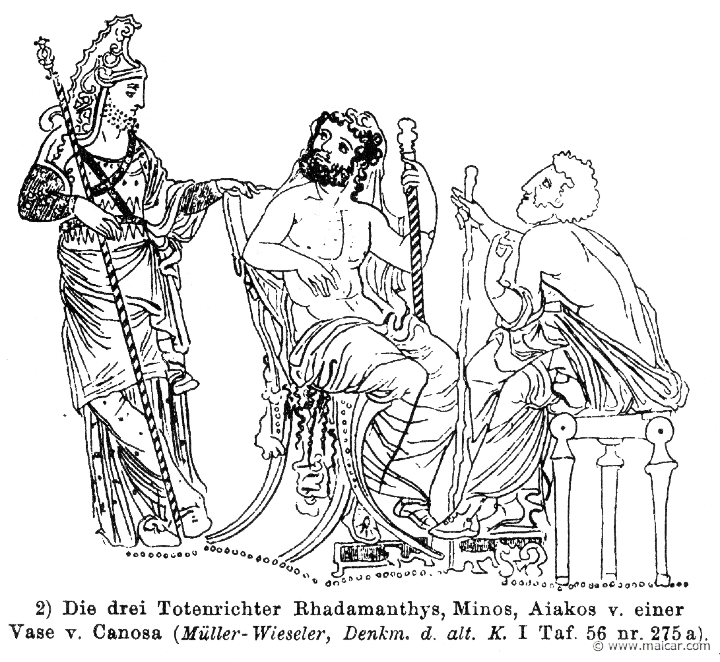
At the end of last year, I wrote a long and detailed post about the Hellenic Underworld. In it, I mentioned the judges of the dead: Minos, Rhadamanthys and Aiakos. All three of the judges were human once, and all three were selected for certain unique qualities. As these three are some of the most powerful demi-Gods who will ever touch our lives, I want to discuss them further today.


Thanks to the ancient writers, we know quite well who the judges are and why they were appointed to the position. From Plato's Gorgias comes this long but very clear description:
 
"Now in the time of Kronos there was a law concerning mankind, and it holds to this very day amongst the gods, that every man who has passed a just and holy life departs after his decease to the Isles of the Blest, and dwells in all happiness apart from ill; but whoever has lived unjustly and impiously goes to the dungeon of requital and penance which, you know, they call Tartaros. Of these men there were judges in Kronos' time, and still of late in the reign of Zeus--living men to judge the living upon the day when each was to breathe his last; and thus the cases were being decided amiss.
So Plouton [Haides] and the overseers from the Isles of the Blest came before Zeus with the report that they found men passing over to either abode undeserving.
 
Then spake Zeus: 'Nay,' said he, 'I will put a stop to these proceedings. The cases are now indeed judged ill and it is because they who are on trial are tried in their clothing, for they are tried alive. Now many,' said he, `who have wicked souls are clad in fair bodies and ancestry and wealth, and at their judgment appear many witnesses to testify that their lives have been just. Now, the judges are confounded not only by their evidence but at the same time by being clothed themselves while they sit in judgment, having their own soul muffled in the veil of eyes and ears and the whole body. Thus all these are a hindrance to them, their own habiliments no less than those of the judged.
 
Well, first of all,' he said, 'we must put a stop to their foreknowledge of their death; for this they at present foreknow. However, Prometheus has already been given the word to stop this in them. Next they must be stripped bare of all those things before they are tried; for they must stand their trial dead. Their judge also must be naked, dead, beholding with very soul the very soul of each immediately upon his death, bereft of all his kin and having left behind on earth all that fine array, to the end that the judgment may be just.
 
Now I, knowing all this before you, have appointed sons of my own to be judges; two from Asia, Minos and Rhadamanthus, and one from Europe, Aiakos. These, when their life is ended, shall give judgment in the meadow at the dividing of the road, whence are the two ways leading, one to the Isles of the Blest, and the other to Tartaros. And those who come from Asia shall Rhadamanthys try, and those from Europe, Aiakos; and to Minos I will give the privilege of the final decision, if the other two be in any doubt; that the judgment upon this journey of mankind may be supremely just." 

And so we have three judges, Rhadamanthys for those from Asia Minor, Aiakos for those from Europe, and Minos to make the final decision. And so the question remains, who are these three, and why were they worthy enough to become a judge of the dead?

Minos (Μίνως) was a king of Krete, son of Zeus and Europa. He is most famous for the labyrinth of the Minotaur under his fantastic palace where Daidalos and Íkaros were kept until their escape. He died in pursued of them, killed while taking a bath--either by Daidalos, or by the daughters of King Kokalus with whom Minos was staying. How can a man as cruel as Minos become a fair judge of the dead? Plutarch, in Perseus, says the following about it:

"Hesiod called him [Minos] 'most royal,' or that Homer styled him 'a confidant of Zeus,' but the tragic poets prevailed, and from platform and stage showered obloquy down upon him, as a man of cruelty and violence. And yet they say that Minos was a king and lawgiver, and that Rhadamanthys was a judge under him, and a guardian of the principles of justice defined by him."

Rhadamanthys (Ραδαμανθυς) was Minos' brother in most versions of mythology, although he could also have been the son of Hēphaistos. During his life, he was a lawmaker, judge and ruler in the court of Minos. In some versions of the myth, he was Ariadne's husband, instead of Dionysos. It seems Minos may have been jealous of Rhadamanthys' popularity, and Rhadamanthys was forced to flee the island of Krete. During his exile, he met and married Alkmene, mother of Hēraklēs, who had been left without a husband after Amhitryon passed. After his death, he went to Elysium, and became a judge, as a reward for living a just and lawful life. From Pindar's Olympian Ode comes the following praise:

"Those [of the dead] who had good courage, three times on either side of death, to keep their hearts untarnished of all wrong, these travel along the road of Zeus to Kronos’ tower. There round the Islands of the Blest, the winds of Okeanos play, and golden blossoms burn, some nursed upon the waters, others on land on glorious trees; and woven on their hands are wreaths enchained and flowering crowns, under the just decrees of Rhadamanthys, who has his seat at the right hand of the great father [Kronos], Rhea’s husband, goddess who holds the throne highest of all." [2.63]

Aiakos (Αἰακός) was the son of Zeus and Aegina, a daughter of the river-god Asopus. He was born on the island of Oenopia--later renamed Aegina--to which Aegina had been carried by Zeus to secure her from the anger of her parents. Aiakos is also sometimes mentioned as a son of Europa. While he reigned in Aegina, he was renowned in all of Hellas for his justice and piety, and was frequently called upon to settle disputes not only among men, but even among the gods themselves. After his death, Aiakos became one of the three judges in Hades, and according to Plato especially for the shades of Europeans. Apollodorus in his Bibliotheca describes Aiakos:

"Aiakos was the most religious of all men . . . and Aiakos, even after death, is honoured in the company of Plouton [Haides], and has charge of the keys of Haides’ realm."

And so, these are the three judges who rule over us in death. Let me end this with a little Hellenic advice, noted down by Seneca, Roman Stoic philosopher and playwright, from his tragedy 'Hercules Furens':

"Is the report true that in the underworld justice, though tardy, is meted out, and that guilty souls who have forgot their crimes suffer due punishment? Who is that lord of truth, that arbiter of justice? Not one inquisitor alone sits on the high judgment-seat and allots his tardy sentences to trembling culprits. In yonder court they pass to Cretan Minos’ presence, in that to Rhadamanthus’, here [Aiakos] the father of Thetis’ spouse gives audience. What each has done, he suffers; upon its author the crime comes back, and the guilty soul is crushed by its own form of guilt. I have seen bloody chiefs immured in prison; the insolent tyrant’s back torn by plebeian hands. He who reigns mildly and, though lord of life, keeps guiltless hands, who mercifully and without bloodshed rules his realm, checking his own spirit, he shall traverse long stretches of happy life and at last gain the skies, or else in bliss reach Elysium’s joyful land and sit in judgment there. Abstain from human blood, all ye who rule: with heavier punishment your sins are judged." [2.731]
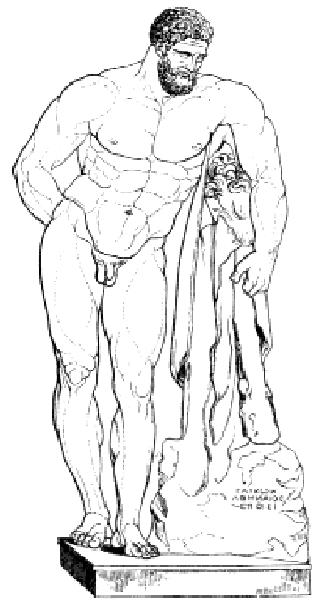
Some of the best epics are not told in a single story, so therefor, I will kick off a mini series today: the labours of Hēraklēs. Hēraklēs (Ἡρακλῆς), from 'Hera' and kleos, 'glory', was born as Alkaios (Ἀλκαῖος) or Alkeidēs (Ἀλκείδης). He became one of the greatest of the divine heroes in Hellenic mythology, and was born the son of Zeus and Alkmene (Ἀλκμήνη), foster son of Amphitryon (Ἀμφιτρύων), king of Tiryns in Argolis. By Alkmene, he is the great-grandson of Perseus, and by Zeus, his half-brother. He is perhaps better known as Hercules, his Roman counterpart. In this first part, I will introduce Hēraklēs and describe his life up until the labours, and then tackle the labours one at a time in coming editions.

Hēraklēs was conceived by Zeus upon Alkmene, as He disguised Himself as her husband, returning early from war. Alkmene accepted Him in her bed gladly, as she was happy to see her husband again. When The real Amphitryon did return later that night, Alkmene realized what had happened, and told her husband. Amphitryon accepted her in his bed, regardless, and so she became pregnant with twins, one fathered by Zeus, and one by her mortal husband. In the words of Apollodorus:

"But before Amphitryon reached Thebes, Zeus came by night and prolonging the one night threefold he assumed the likeness of Amphitryon and bedded with Alcmena and related what had happened concerning the Teleboans. But when Amphitryon arrived and saw that he was not welcomed by his wife, he inquired the cause; and when she told him that he had come the night before and slept with her, he learned from Tiresias how Zeus had enjoyed her. And Alcmena bore two sons, to wit, Hercules, whom she had by Zeus and who was the elder by one night, and Iphicles, whom she had by Amphitryon." [2.4.8]

Hera, hearing of the affair, took an instant disliking to the unborn child. When it became time for Alkmene to give birth, Hera made Zeus swear a vow that a child born in the line of Perseus on this day would become King. Zeus agreed, and Hera hurried off to delay the birth of Hēraklēs and Iphikles, and hurry along the birth of Eurystheus (Εὐρυσθεύς), grandson of Perseus. The two had unknowingly become part of a contest of wills between Zeus and Hera, to decide who would be the hero to drive off the last of the great monsters and pave the way for the Olympians.

Eventually, Hera was tricked into allowing the children born, as She would have postponed their delivery indefinitely. Alkmene, aware of the divine spark in one of her sons, took her distance from him, but the young Hēraklēs was taken up by Athena and taken to Hera, who did no recognize the newborn nemesis of Her candidate, and took pity on him. She fed him from Her breast, but when he suckled so hard that he caused Her pain, She realized who he was, and cast him off. Athena rescued the infant and took him back to his mortal parents. Alkmene took him back and raised him with her husband.

What happens next is a famous bit, here in the words of Apollodorus again:
 
"When the child was eight months old, Hera desired the destruction of the babe and sent two huge serpents to the bed. Alcmena called Amphitryon to her help, but Hercules arose and killed the serpents by strangling them with both his hands. However, Pherecydes says that it was Amphitryon who put the serpents in the bed, because he would know which of the two children was his, and that when Iphicles fled, and Hercules stood his ground, he knew that Iphicles was begotten of his body." [2.4.8]
 
 Hēraklēs was a strong child, so strong, in fact, that he inadvertently killed his music teacher Linos (Λῖνος) with a lyre, for which he was tried and found not guilty. He was still made to leave the city:
 
"Hercules was taught to drive a chariot by Amphitryon, to wrestle by Autolycus, to shoot with the bow by Eurytus, to fence by Castor, and to play the lyre by Linus.85 This Linus was a brother of Orpheus; he came to Thebes and became a Theban, but was killed by Hercules with a blow of the lyre; for being struck by him, Hercules flew into a rage and slew him.86 When he was tried for murder, Hercules quoted a law of Rhadamanthys, who laid it down that whoever defends himself against a wrongful aggressor shall go free, and so he was acquitted. But fearing he might do the like again, Amphitryon sent him to the cattle farm; and there he was nurtured and outdid all in stature and strength. Even by the look of him it was plain that he was a son of Zeus; for his body measured four cubits,87 and he flashed a gleam of fire from his eyes; and he did not miss, neither with the bow nor with the javelin." [2.4.9]
 
 What happens next is an account that was added in the fourth century BC, by the sophist Pródikos (Pródikos) and reported in Xenophon's Memorabilia; Hēraklēs is visited by two women, representing two very different paths in life, and he must choose between them. The first names Herself Happiness, "but they that hate me have their own nicknames for me, Vice and Naughtiness". She explains the path in life she represents as follows:
 
"I see you, Heracles, in doubt and difficulty what path of life to choose; make me your friend, and I will lead you to the pleasantest road and easiest. This I promise you: you shall taste all of life's sweets and escape all bitters. In the first place, you shall not trouble your brain with war or business; other topics shall engage your mind; your only speculation, what meat or drink you shall find agreeable to your palate; what delight of ear or eye; what pleasure of smell or touch; what darling lover's intercourse shall most enrapture you; how you shall pillow your limbs in softest slumber; how cull each individual pleasure without alloy of pain; and if ever the suspicion steal upon you that the stream of joys will one day dwindle, trust me I will not lead you where you shall replenish the store by toil of body and trouble of soul. No! others shall labour, but you shall reap the fruit of their labours; you shall withhold your hand from nought which shall bring you gain. For to all my followers I give authority and power to help themselves freely from every side."
 
The other, Virtue, offers Hēraklēs a far different path:
 
"Heracles, I too am come to you, seeing that your parents are well known to me, and in your nurture I have gauged your nature; wherefore I entertain good hope that if you choose the path which leads to me, you shall greatly bestir yourself to be the doer of many a doughty deed of noble emprise; and that I too shall be held in even higher honour for your sake, lit with the lustre shed by valorous deeds. I will not cheat you with preludings of pleasure, but I will relate to you the things that are according to the ordinances of God in very truth. Know then that among things that are lovely and of good report, not one have the gods bestowed upon mortal men apart from toil and pains. Would you obtain the favour of the gods, then must you pay these same gods service; would you be loved by your friends, you must benefit these friends; do you desire to be honoured by the state, you must give the state your aid; do you claim admiration for your virtue from all Hellas, you must strive to do some good to Hellas; do you wish earth to yield her fruits to you abundantly, to earth must you pay your court; do you seek to amass riches from your flocks and herds, on them must you bestow your labour; or is it your ambition to be potent as a warrior, able to save your friends and to subdue your foes, then must you learn the arts of war from those who have the knowledge, and practise their application in the field when learned; or would you e'en be powerful of limb and body, then must you habituate limbs and body to obey the mind, and exercise yourself with toil and sweat."
 
Hēraklēs accepts the latter offer. Having taken up his mantle as future-hero, Hēraklēs sets out to perform feats of strength, starting by defeating the lion of Kithairon, which had been a bane to his stepfather for far too long. Thespios, King of Thespiae, housed Hēraklēs for fifty days as he hunted for the lion, and every night Thespios placed one of his fifty daughters in his bed, although Hēraklēs thought he was only sleeping with one. Hēraklēs eventually vanquished the lion. He dressed himself in the skin, and wore the scalp as a helmet. The Gods lavished him with gifts: a sword from Hermes, bow and arrows from Apollon, a golden breastplate from Hēphaistos, and a robe from Athena. His famous club he made himself at Nemea.
 
Next, Hēraklēs was drawn into a war between the Thebans and the Minyans. He happened upon heralds from King Klymenos, who had won a previous battle with Thebes and now demanded tribute from them. Hēraklēs, who had been living in Thebes, cut the ears, noses and hands off of all but one of the heralds and told the last remaining one to take them back to his king as tribute. In the battle that followed, Hēraklēs fought bravely with the king's army, and his side eventually won, earning him his wife Megara, eldest daughter of King Kreōn of Thebes.
 
Due to Hera's jealousy, was stricken mad and killed the five sons he had by his wife. When he was released from his madness by a hellebore potion--provided by Antikyreus--and realized what he had done, he cried out in anguish, and went on a long journey to cleanse himself of the miasma caused by these killings. First, he visited the oracle at Delphi, who, unbeknownst to him, was whispered to by Hera. The Oracle told Hēraklēs to serve the king of Tiryns, Eurystheus, for ten years and do everything Eurystheus told him to do. Eurystheus gladly provided Hēraklēs with these labors--ten of them, one for each year--and eventually ended up adding two more, resulting in the Twelve Labors of Hēraklēs. Hēraklēs was told to:
  • Slay the Nemean Lion
  • Slay the nine-headed Lernaean Hydra
  • Capture the Golden Hind of Artemis
  • Capture the Erymanthian Boar
  • Clean the Augean stables in a single day
  • Slay the Stymphalian Birds
  • Capture the Cretan Bull
  • Steal the Mares of Diomedes
  • Obtain the girdle of Hippolyta, Queen of the Amazons
  • Obtain the cattle of the monster Geryon
  • Steal the apples of the Hesperides,
  • Capture and bring back Kerberos.
All of these tasks were incredibly hard, and required every ounce of strength Hēraklēs possessed. In the continuation of this series, we will discuss each of them in turn.

Image source: Encyclopædia Iranica
"Death came suddenly and it was mercilessly painful. You are aware you have passed: you can hear the keening of the women in your family, taste the metal of the oboloi in your mouth. You are no longer cold, or hot, and there is no pain. Sensation is for the living, and your memories start to fade already. You are no longer part of the living. You are dead, and your guide is waiting for you. 

Hermes Psychopompos, the winged guide of the newly dead, descends and takes your hand. Below you is the ocean: Oceanos' divine body. You used to watch it glisten in Helios' bright rays, but today, everything is dull and lifeless. You are speeding west, guided by the blessed Immortal. Below you, you can see land again and a mighty river. The land draws you down, and you stand on the ground without feeling it. It is here that Hermes Psychopompos leaves you, in the capable hands of Kharon, on the bank of the river Acheron. 

The ferryman looks old and ageless at the same time. He holds out his hand, but you can't understand what he wants from you. Then, his hand closes around a coin, and he steps aside to let you into his boat. Without moving, you are suddenly on the boat, looking to the shore where shadowy figures of the dead gather, longing to make the journey with you. But they have no coin to hand over, and are forced to wander the bank of the Kokytos river year after year, until the ferryman takes pity on them. Today is not their day.

The river fades into the darkness of a cave. The river of woe joins with the river of hate; the river Styx that seems to have no end. Kharon moves the boat forward in a steady rhythm. You reach the dock sooner than you expected to. Kharon waits silently for you to get off of his boat. You dare not move. Beyond is a field of grey, a sunless cavern filled with the shadows of the dead. The fields of Asphodel; the dreary resting place of the common Hellen. Before the fields stand a huge gate, and an equally huge dog, with three growling heads, foaming at each mouth. Kharon waits, and then you are in the field. The gate stands behind you, Kerberos a constant reminder you can never go back.

You wander, still remembering much of your life. The fall you took as a child that gave you a weak knee, the smile of your spouse on your wedding day. You remember your child being born. It makes being here impossible to bear. The memories will not fade, because before your judgement, you are not allowed to forget. You hold on to them as long as you can, but then you walk through the field, to the compound in the distance. Hades' compound, where the Dread Lord and His beautiful wife live. You walk to forget. Thus, you come upon the judges. 

Rhadamanthys, Minos and Aiakos wait for you at the trivium in the courtyard of the compound; the trivium, Hekate's sacred crossroads. If you still had a heart, you would feel it beating in your throat now. But you do not. Any decision the judges make is alright. The memories hurt. You are cut off from your loved ones, from Helios' powerful rays. Tartaros is not your place, you know that much. You have honored the Theoi, you have done right by your family. You do not fear judgement. You wish to go back to the Asphodel meadows and drink from the river Lethe; you wish to forget. More, you wish to reach Elysium, the island of the blessed. In the distance, the Lord of the Dead and his Queen Persephone must be.

Your life is judged, you are judged. You wait, and look to each side. Left for Tartaros, where the river Phlegethon burns, but leaves everything it touches intact. Right for Elysium, where the ghosts of the blessed reside amongst the blameless heroes. Or back the way you came for the meadows where Lethe flows free, where the dead flutter around like bats, and those initiated into the Mysteries drink from Mnemosyne, so they will not forget their previous life when they reincarnate. You wait, and are judged."

For the ancient Hellens, this is what dying would look like. This is how I see my 'life' after death. When I pass, I will walk to my judgement. Sadly, life after death may be the closes I will ever get to the ancient Hellens, and the Theoi, so because of that, I have a great bit of interest in the Hellenic Underworld. So lets look at the short story I wrote--I won't call it a meditation, because traveling to the Underworld is something one should not attempt in any way, shape or form--to learn a bit more about the last resting place of the ancient Hellens and modern Hellenists.

The Underworld is described as lying in the west in the Odysseia, and there is an entrance that can be reached overseas. Yet, the dead enter the Underworld through one of five rivers surrounding the Underworld.

Acheron (Αχέρων) - The river of woe. This is the river that Kharon ferries the dead across, from the land of the living, to the realm of Hades.
Kocytus (Κωκυτός) - The river of lamentation. Those who could not pay Kharon, were destined to walk the banks of this river--a side river to the river Acheron--for one hundred years.
Phlegethon (Φλεγέθων) - The river of fire in the Underworld. It's a side river of the river Styx and is said to be permanently on fire, yet never burn anything it touches. It's located in Tartaros.
Lethe (Λήθη) - The river of forgetfulness. It runs through the Asphodel meadows, and the dead have to drink from it to completely forget about their lives on Earth. Those who were initiated in the Eleusinian Mysteries--linked to Demeter and Persephone--were allowed to drink from Mnemosyne and are allowed to remember.
Styx (Στύξ) - The river of hate. The Acheron joins with the Styx at the moment the land of the living makes way for the Underword, and as such, She is a portal, and the most famous of the five rivers. It is said to wrap around the Underworld nine times. Styx was also the river upon which the Theoi, and mankind, swore oaths which could not be broken, an arrangement agreed upon by Zeus and the Goddes Styx in return for her aid in the Titan Wars. If a Theos or Theia did break an oath made upon the river Styx, they were forced by Zeus to drink from the river, upon which They fell into a deep coma for a year, and were then cut off from Their worshippers for nine more. For mortals, breaking an oath on the river Styx was something you simply did not do, and it's the gravest vow to make, one that is not made lightly.

The Underworld has various areas where the dead are housed, but also where the various Gods and Goddesses of the Underworld--called 'Theoi Khthonioi'--reside. Several of the Gods and Goddesses have already been discussed; all the rivers are Gods or Goddesses who have their home in the Underworld, and there are Kharon, Kerberos, and the judges: Rhadamanthys, Minos and Aiakos. Yet, there are a lot more. The most well known are Hades and His consort, Persephone.

Hades, brother of Zeus, son of Kronos, is the Lord of the Dead. The Underworld is His domain. He rules it with his beautiful wife--and niece--Persephone, whom He stole away. She resides with Him in their home, a large mansion at the crossroads between the Asphodel meadows, Tartaros and Elysium. This crossroads is sacred to Hekate, and located in the courtyard of the mansion. The maiden Goddess Hekate is a companion of Persephone, whom she led out of the Underworld after Zeus decreed it to be so. She vowed to Demeter to stay with Persephone in the months She spent under the earth, and takes this vow very seriously.

Kronos is an Underworld deity as well: Zeus eventually released His father and made Him king of the Elysian Islands. Other Gods, like Hypnos, Erebos, Nyx, Makaria (daughter of Hades and Persephone, who watched over the blessed dead, who had been initiated into the Mysteries), and the Erinyes (three Goddesses of vengeance and retribution) also make their home in (a part of) the Underworld. The Moirai, the three Goddesses of fate, have their own space in the Underworld as well. Other Immortals who share the Underworld are deamons and nymphs.

In the daímōn-section, we have the the Arai (daímōnes of curses), Askalaphos (who tended to the orchards of Hades and was transformed into a screech owl by Demeter for bringing Her bad news about Her daughter), Kakodaimones (Deamones which cause all kinds of harm), Empousa (a daímōn with flaming hair, the leg of a goat and a leg of bronze, who parents vowed would come after their children if they didn't behave), the Oneiri (dream spirits) and Epiales (the daímōn of nightmares). Other daímōnes include: Eurynomos (who stripped the flesh off of the corpses of the dead), the Lamiai and Mormolykeia (vampiric, succubus-like, daímōnes in the following of Hekate), Melinoe (who led the souls of the dead back to earth to haunt the living). Menoites, furthermore, herds the black-skinned cattle of Hades, and Thanatos, the winged daímōn of death, is Hades' minister.

There are also a few Underworld nymphs: Daeira (a companion of Persephone), the Lampades (torch bearing nymphs in Hekate's following who may have looked over the blessed dead on their way to Elysium), Leuke (a nymph abducted by Hades and transformed into a white poplar which stands in the Elysian fields), Mynthe (a beowed nymph of Hades, who Persephone turned to dust and Hades turned into the mint plant), and Orphne (wife of Acheron).

As for the dead, they had three places to go in the Underworld: Tartaros, where those who were punished for all eternity remained, the Asphodel meadows, where everyone who had lived a good life wandered about endlessly, and the Elysian fields, where the children of Gods, the blessed dead and those who had lead extraordinarily honorable, brave or otherwise well-respected lives resided.

The ancient Hellens believed the Underworld was a neutral place. One did not desire to go there in the least, but it was part of life, and as far as the afterlife went, it was dull and sunless but nothing like the hell of Christianity. The worst part about it is being without the touch of loved ones, and forgetting who you were. In the Odysseia, Odysseus meets his mother's spirit at one of the entrance points to the Underworld. She tells him:

"Oh, my child, most unfortunate of men, Persephone, Zeus’ daughter, does not deceive you: this is the way it is with mortals after death. The sinews no longer bind flesh and bone, the fierce heat of the blazing pyre consumes them, and the spirit flees from our white bones, a ghost that flutters and goes like a dream."

Nobody wants to think about dying and the dead for too long, so I will end this post here. May it have given you some insight into the workings of the Underworld.