Showing posts with label Krete. Show all posts


The Minoan civilization was an Aegean Bronze Age civilization that arose on the island of Crete and other Aegean islands and flourished from approximately 3650 to 1400 BC. It was rediscovered at the beginning of the 20th century through the work of British archaeologist Arthur Evans. Historian Will Durant referred to it as "the first link in the European chain."

It was not until roughly 5000 BC in the late Neolithic period, that the first signs of advanced agriculture appeared in the Aegean, marking the first signs of civilization. The term "Minoan" refers to the mythic King Minos. Minos was associated in Greek myth with the labyrinth and the minotaur, which Evans identified with the site at Knossos, the largest Bronze Age Minoan site. The poet Homer recorded a tradition that Crete once had 90 cities.

The Minoans were primarily a mercantile people engaged in overseas trade. Their pottery provides the best means of dating. As traders and artists, their cultural influence reached far beyond the island of Crete — throughout the Cyclades, to Egypt's Old Kingdom, to copper-bearing Cyprus, Canaan, and the Levantine coasts beyond, and to Anatolia. Some of its best art is preserved in the city of Akrotiri, on the island of Santorini, very near the Thera eruption.

Though we cannot read their language (Linear A), and there is much dispute, it is generally assumed there was little internal armed conflict in Minoan Crete itself, until the following Mycenaean period. The armed Mycenaeans or the eruption at Thera are two popular theories for the eventual demise of Minoan civilization around 1,400 BC.

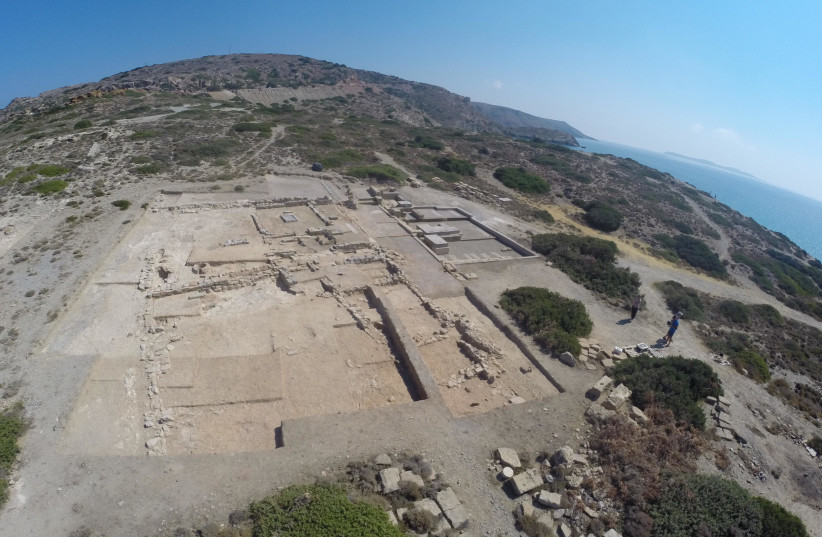
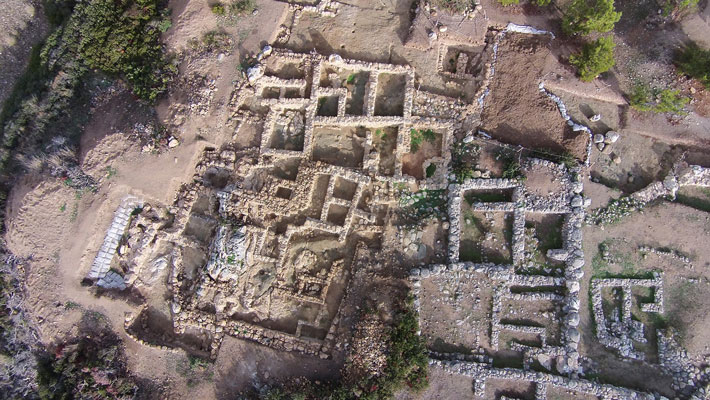
The discovery of a ceremonial building, burial monuments, cultic vessels and manipulated tombs has bolstered confidence that ancient worship was taking place 2,500 years ago at Itanos, an archaeological site of extreme importance on the island of Crete with a well situated harbor and a key place for trade roads.


Professor Didier Viviers, who is the co-director of the excavations alongside Professor Athena Tsingarida states:

“The fact that we have erected cenotaphs (burial monuments) and a concentration of cultic and drinking vessels clearly indicates that the activity within this necropolis was not daily life, but ritual practice. It was a place where the community gathered to honor their ancestors." 

The archaic building consisted of a large reception hall, adjoining a storeroom, where members of the family clan could hold a funeral banquet. But most of the surface area was devoted to a large courtyard, in which offerings to the dead were made around a erected cenotaph built on an ancient tomb. A separate room, where, probably more intimate, rites were performed, was used for another equipment also related to an ancient tomb.

“At the time of the construction of this funerary complex, some of the ancient burials were manipulated. They were emptied of their contents which were replaced with a pot (chytra), containing olive leaves, which may have been used during the preparation of ritual meals addressed to the dead.”

The discoveries at the communal burial ground at Itanos have rekindled a longstanding academic brawl over the lack of burials on Crete during this period which had been interpreted as a sign of austerity and decline of the Cretan society.

The excavators exploring Itanos are not saying that the cemetery was necessarily used to inhumed or incinerated the inhabitants per se. But they are now confident: Cretan ritual festivities worship took place there to honor the ancestors while the lack of burials does not necessary signify a decline of the society but rather reflects a change of social practices attesting frequent visits and tributes to the dead.

“This exceptional discovery helps to understand the political and social use of the cemeteries in Crete during this very important period for the construction of the Cretan city-states.”

Itanos is situated at the eastern tip of Crete and was established in the 9th century BCE but quickly rose to prominence thanks to its trade with purple dye that was obtained from shellfish or mollusks. Purple-dye was highly sought after in ancient times and became a mark of wealth since the amount of fluid acquired from each shellfish was small and a time-consuming process to extract. It is therefore easy to understand how Itanos quickly could rise to wealth and fame from selling this luxurious dye. Its fair harbor also made it a great international port where merchants from the Aegean, Anatolia, Egypt and other parts of the Mediterranean traded various commodities such as wine, perfume and ceramic wares.

Its vast material prosperity is also attested by the fact that the city-state minted its own coins which often depicts mythical sea creatures, such as Glaukos, a bearded god with a trident who was the protector of fishermen as well as coins with the sea-god Triton.

Many Itanian coins carry the image of Athena, the main divinity of the city which had a sanctuary on the western Acropolis. All good things come to an end and Itanos started to decline from the mid-7th century CE due to earthquakes that partly but repeatedly destroyed the town that was eventually abandoned.

The site of Itanos has been under excavations by the École Belge d´Athenes (Belgian School in Athens) since 2011, apart from the necropolis the excavations have uncovered numerous buildings dating from the 7th century BCE and downwards. 

The recent discovers in Itanos have forced archaeologists to rethink their ideas of Cretan burial sites in the 6th and 5th centuries BCE but also how the society at that time reinforced its social structure. At the edge of the necropolis, on top of a hill, the excavators discovered a cultic site featuring ritual feasting, a building complex sporting altar, offering pits and cultic opulent and imported objets d'art.

The ceremonial hall that was discovered, a spacious building, 6 meters long and 4,50 meters width, and was partly erected in clay on a stone foundation and had a hearth in its center used for burnt offerings. Numerous archaeobotanical remains such as grains and grapes were discovered in the courtyard in the several burnt offering pits that were used during the ritual ceremonies. Cultic, drinking and storage vessels such as goblets and chalices, perfume vases and amphoras which were used during ritual ceremonies honoring the dead were also found inside the building.

Professor Athena Tsingarida comments:

“This ceramic material is mostly imported (especially from Attica but also from the Aegean and East Greece). This international profile of imports is relatively exceptional in Crete and probably serves the family clan's desire to demonstrate its social status.”

Since no bodies was discovered in these tombs (that was converted into cenotaphs for worship), cults were dedicated to all the ancestors of the clan rather than to a single member suggests prof Viviers.

“The nature of these rituals and ceremonies suggests that the lack of actual burials or cremations in the necropolis of Itanos in the 6th and 5th centuries BCE, also known in other Cretan necropolis, was not necessarily a sign of recession or decline in the Cretan society but rather the result of a voluntary change in social behavior towards death and the rituals that go with it.”

Itanos was a port city that still has much to teach us about the burial practices in Crete from the Geometric to the Roman period. Therefore, Itanos is an excellent site for understanding the evolution of Cretan societies during these periods, which were in constant contact with the Greek world and the Eastern Mediterranean. Professor Didier Vivier concludes:

“The excavations taking place on the site allow us to highlight the leading role played by the port of Itanos in the maritime exchanges but also in the understanding of the trade circuits inland (for instance, through the distribution networks of locally maid ceramic products)."

The Belgian archaeological mission plans to resume excavations in summer of 2021, to explore the early necropolis more widely and reconstruct its topographical organization and the funerary landscape.

Archaeologists in Greece have located a "major treasure" of Minoan origin in a Bronze Age settlement on a small island in the Libyan Sea, the culture ministry said Friday.


A team excavating on the tiny island of Chrysi south of Crete for over a decade have unearthed a 3,800-year-old Bronze Age compound containing gold jewels, glass beads and the remains of bronze talents, the common unit of value of ancient Greece.

Some of the beads are of Egyptian origin, the culture ministry said in a statement.

The archaeologists also found ancient fish tanks and large amounts of porphyry -- a prized purple pigment of the ancient world derived from sea snails, and later the colour exclusively reserved for Roman emperors.

"The amount of broken shells found...show a very early Mediterranean production of porphyry dye. The cache constitutes one of the most important (Minoan treasures) ever found in Crete until now."

The Minoan civilisation, a naval superpower of the Bronze Age era, flourished on Crete and other Aegean islands until about 1500 BCE.
The archives of the palace of Zominthos on the plateau of Mount Psiloritis on Crete were discovered at the sprawling site during this year's excavation season, the Ministry of Culture said on Thursday.


The archives area is identified on the basis of a clay tablet in the hieroglyphics of Linear A, which lists 217 three-footed vessels. "The tablet looks like a ledger, definitely comprising a list of objects," which it said points to the fact the palace complex was well organized, the ministry said in a statement. Supporting evidence for the area being used for the archives includes its location and other circumstantial evidence.

Besides the multitude of vessels found throughout the site, discoveries included a hallway with pillars leading to a possible throne room. The remains of a seat were found in the latter room, with uses from earlier periods recorded as well (Protopalatial period, 1900 BC to Mycenaean times, ca. 1400 BC).

The remnants of clay pipes from a sophisticated drainage system were also discovered, as were an area of obsidian carving, and another area by the north facade of the main building - joined to it - that contained hundreds of clay vessels, including rhyta, the characteristic Cretan vessels used in rituals. According to research scientists, the whole area provides evidence of extensive metalwork carried out in workshops in the complex.

In addition, the ministry said, an earthquake in the Neopalatial era led to extensive changes, including the creation of a ramp.

This season's excavations were supervised by Efi Sapouna-Sakellaraki, who began excavating the area with her late husband Yiannis Sakellarakis. This season's results confirmed the existence of an older building under the current complex which is built in the Neopalatial period (1700-1600 BC).
"This year's excavations focused on examining the area around the central palatial building and yielded a lot new facts. A basic one is the confirmation that there was an older building under that of the Neopalatial period that was founded on the rock outcrop, occupied a larger area and contained a major number of this period," the ministry said.

I would like to share with you the The Palaikastro Hymn to Cretan Zeus. At the end of May in 1904 a fragmentary inscription bearing a Hymn to Zeus was discovered at Palaikastro in East Crete, during the excavation of the sanctuary of Dictaean Zeus, on top of the ruins of a Minoan harbour town which contained this hymn. From the very informative, and very well researched paper by Mark Alonge on the subject:

"The Palaikastro Hymn—better known as the Hymn of the Kouretes—does not celebrate a god of pre-Hellenic pedigree, who is Zeus in name only, as scholars have believed with virtual unanimity. Rather, an understanding of the conventions of Greek hymnic performance in its ritual context goes far to elucidating many of the ostensibly peculiar features of the Hymn. Moving out from Palaikastro, in eastern Crete, to survey the island as a whole, I show that the Cretan iconographic and epigraphic records contradict the widely accepted theory of a special, Minoan 'Cretan Zeus.' "

 The hymn goes as follows:

"O supreme son of Kronos, salutations! All-powerful over refreshment, you stand at the head of the gods. Come to Dicte at the turn of the year and take pleasure in our song. We weave it for you with lyres, having blended it with pipes, and we sing having taken our places around your well-walled altar.

O supreme son of Kronos, salutations! All-powerful over refreshment, you stand at the head of the gods. Come to Dicte at the turn of the year and take pleasure in our song. For on this very spot, your shield-bearing guardians received you, an immortal child, from Rhea and beating their foot, kept you hidden.

O supreme son of Kronos, salutations! All-powerful over refreshment, you stand at the head of the gods. Come to Dicte at the turn of the year and take pleasure in our song. [two verses missing]…of the beautiful dawn.

O supreme son of Kronos, salutations! All-powerful over refreshment, you stand at the head of the gods. Come to Dicte at the turn of the year and take pleasure in our song. The Seasons teemed year by year and Justice held mortals in her power, and Peace, who loves prosperity, governed all creatures.

O supreme son of Kronos, salutations! All-powerful over refreshment, you stand at the head of the gods. Come to Dicte at the turn of the year and take pleasure in our song. But, lord, leap to our wine jars, and leap to our fleecy flocks, and to our fields of fruit leap, and to our homes made thereby productive.

O supreme son of Kronos, salutations! All-powerful over refreshment, you stand at the head of the gods. Come to Dicte at the turn of the year and take pleasure in our song. And leap to our cities and leap to our seafaring ships, and leap to our new citizens and leap to fair Themis.

O supreme son of Kronos, salutations! All-powerful over refreshment, you stand at the head of the gods. Come to Dicte at the turn of the year and take pleasure in our song."

The Minoan civilization was an Aegean Bronze Age civilization that arose on the island of Crete and other Aegean islands and flourished from approximately 3650 to 1400 BC. It was rediscovered at the beginning of the 20th century through the work of British archaeologist Arthur Evans. Historian Will Durant referred to it as "the first link in the European chain."

It was not until roughly 5000 BC in the late Neolithic period, that the first signs of advanced agriculture appeared in the Aegean, marking the first signs of civilization. The term "Minoan" refers to the mythic King Minos. Minos was associated in Greek myth with the labyrinth and the minotaur, which Evans identified with the site at Knossos, the largest Bronze Age Minoan site. The poet Homer recorded a tradition that Crete once had 90 cities.

The Minoans were primarily a mercantile people engaged in overseas trade. Their pottery provides the best means of dating. As traders and artists, their cultural influence reached far beyond the island of Crete — throughout the Cyclades, to Egypt's Old Kingdom, to copper-bearing Cyprus, Canaan, and the Levantine coasts beyond, and to Anatolia. Some of its best art is preserved in the city of Akrotiri, on the island of Santorini, very near the Thera eruption.

Though we cannot read their language (Linear A), and there is much dispute, it is generally assumed there was little internal armed conflict in Minoan Crete itself, until the following Mycenaean period. The armed Mycenaeans or the eruption at Thera are two popular theories for the eventual demise of Minoan civilization around 1,400 BC.
Pottery making in ancient Hellas was a male-dominated profession, but about 3000 years ago, one woman from the island of Crete broke the mold to become the only known female master ceramicist in antiquity. The finding, based on a lengthy biomechanical analysis of her skeletal remains, sheds light on the elevated roles played by women in at least some parts of the classical world.


The master potter, who lived to be about 45 or 50, was buried in the city of Eleutherna on the slopes of Mount Ida, the legendary birthplace of Zeus. Ornate pottery in nearby graves suggests she lived between 900 B.C.E. and 650 B.C.E., after the fall of the Minoan and Mycenean civilizations (depicted above) and toward the end of the so-called Greek Dark Ages.

On closer examination of her bones, archaeologists noticed some intriguing details: Compared with other women at the Orthi Petra burial site, she was unusually muscular, especially on the right side of her body. She had also worn out the cartilage in her knee and hip joints, which would have made moving a painful, bone-scraping affair.

Curious as to what repetitive, lifelong motions would have led to that kind of wear, the researchers began to analyze the biomechanics behind the different professions of ancient women, pantomiming the motions with a human skeletal model and observing which muscles were involved. They tried clothes washing, bread baking, harvesting, and loom weaving—nothing panned out. Expanding their search beyond traditional female roles, they tried throwing pottery.

As luck would have it, the daughter of a modern-day master ceramicist—and a potter in her own right—just minutes from Eleutherna agreed to model for the scientists. Analyzing her muscles as she worked, they were convinced that her profession was a match for their ancient artisan. Constantly flexing her leg to turn the kick wheel would have worn out her joints; repeatedly leaning to one side of the spinning clay to shape and sculpt it would have developed the muscles on that side of her body, the researchers reported at a May conference on Crete.

Her lifetime devotion to the craft likely meant she was a master, the researchers say, blazing a trail for female ceramicists that continues on the island today.
Since the late nineteenth century, archaeologists, documentary-makers and novelists have asserted that the Cretan Labyrinth – the lair of the terrifying Minotaur – was a real place. But now a major paper suggests that the legendary maze was just that – legend, a figment of collective imagination.


The labyrinth is popularly held to have been in the Palace of Knossos, built around 1950 BCE, the ruins of which stand near the city of Heraklion on the north coast of Crete. This is wrong, according to Antonis Kotsonas, a classical archaeologist from the University of Cincinnati, US. In a paper published in the American Journal of Archaeology, the researcher, using a cross-disciplinary study, points to the absence of any actual evidence that Iron Age Cretans built any form of monumental labyrinth in Knossos. Kotsonas suggests the Cretan Labyrinth is a monument only in memory, regardless of it being “considered a monument that once actually existed”. Yet the search for a maze under or the near the very real Bronze Age Knossos site has taken on legendary proportions.

As myth has it, Daedalus, the head architect of the tyrannical King Minos of Crete, built a complex maze under his palace. The maze housed the Minotaur, the monstrous half-man-half-bull that fed on seven virgin men and seven virgin girls from Athens every three years. Theseus kills the Minotaur and ends the tradition.

Kotsonas notes that the earliest surviving versions of the story – from Homer, Herodotus and Pherecydes – make no mention of a Cretan Labyrinth. For Plato and beyond, the term labyrinth is used only to describe “structures and metaphorically situations that are hard to escape”. Kallimachos, a third century BCE writer from Alexandria in Ptolemaic Egypt, is the first source Kotsonas cites that specifically links the Minotaur with the Cretan Labyrinth. He suggests that Kallimachos kne of the Egyptian labyrinth – an undoubtedly real structure built by King Amenemhet III sometime before his death in 1770 BCE – and simply “spread … the term in Cretan mythology”.

Two later Hellenistic references to the Cretan Labyrinth also come from scholars in Ptolemaic Egypt.
The real currency of the Cretan Labyrinth rose after the Roman annexation of Crete around 66 BCE. The Romans treated its existence as real, and placed its location explicitly in Knossos. It was essentially a political decision. Romans anchored their imperial power on their own re-imagined vision of themselves as inheritors of Classical Greece.

However, there are real labyrinthine cave structures carved out of limestone near the ancient Roman city of Gortyn, in the heartland of Crete, which also add to speculation. Possibly pre-Hellenic mines, the caves were used as hiding places for Christians during various Ottoman Turkish massacres – a fact frequently ignored by classicists and antiquarians determined to place the labyrinth in Knossos.

In the end, though, there is no conclusive evidence that a labyrinth, much less the fearsome bull-hybrid, ever existed in Knossos. Kotsonas weaves a detailed account of how Western anxieties, values, and politics, melded with a newly created Greek national identity in the battle against Ottoman imperialism, may have given birth to a monument that lives only in memory.
However, despite the fact that it never existed, the Cretan Labyrinth will no doubt maintain its role as a place of fear and dread, wonder and enlightenment – as a reference in popular culture from Disney to Coke, featuring the Minotaur and his lair.

For the full article, please visit Cosmos Magazine.
We all know mythology is not reality. Ancient mythology, however, is always based on at least a little truth--an event, a person, etc. Especially when it comes to the ancient Hellenic heroes and their deeds, there is a lot of embelished truth, but truth none the less. The difficulty is in finding it--and archeological finds are our best bet.

Take Theseus and the minotaur: Theseus (Θησεύς) was fathered by Aegeus and Poseidon, whom had both slept with his mother Aethra, and was thus destined to become a hero. All heroes were given at least one divine parent--usually one connected to their later deeds. The same held true for kings. When he heard about the Minotaur of Krete, and the nine-yearly sacrifices to it--a punishment by King Minos of Krete for the death of his son Androgeus, at the hands of Athenian assassins--Theseus offered to be one of the youths who sailed for Krete. Once there, Ariadne, daughter of the king, fell for him and offered him a ball of yarn so he would be able to find his way out off the labyrinth that housed the Minotaur the youths would be sacrificed to. With Ariadne's aid, Theseus defeated the Minotaur, and brought the sacrificial children home.

It is very difficult to sort out fact from fiction with legends from such a long time ago. The palace at Knossos, where the labyrinth was supposed to have been built, certainly existed. Knossos was undeniably the capital of Minoan Krete. The ruins of the palace are located about twenty minutes south of the modern port town of Iraklio. Knossos was inhabited for several thousand years, from the neolithic to 1375 BC, when it was abandoned after its destruction. The first palace on the low hill beside the Krairatos river was built around 1900 BC on the ruins of previous settlements. It--and many of the other buildings--were destroyed around 1700 BC by an earthquake or invaders. It was rebuild and destroyed or damaged again and again by earthquakes, volcano eruption, invaders and fires, until its abandonment. With its demise came the demise of the Minoan civilization.
Knossos has been an archeological treasure trove--and amongst its ruins was a chilling find: a collection of bones, belonging to eight to eleven children aged ten to fifteen, of which about a third bore the marks of flesh being cut from them with a knife. We don't know what happened to them, but given the myth, it's tempting to leap to the obvious conclusion--as many scientists have done with me: human sacrifice. This possibility is made even more probabable when taken into account a very grim find in the Anemospilia, an ancient Minoan temple on the island.

The temple was destroyed by a volcanic eruption in 2000 BC from Thera and the resulting earthquakes. Traces of ash and charcoal were found on the ground, and from this, one can postulate that the building was burnt down. The temple is set out with three chambers and one annex that leads into them, and inside, archaeologists have found something somewhat unusual.

The east chamber held an altar and various pithoi with sacrificial itmes like honey and milk. In the central chamber was anther altar--this was the main worship room. What has my attention, however, is the western chamber. In the western chamber, two skeletons were found on the floor, one in the south west corner of the room This body was of a 28 year old female; because the average life expectancy in ancient civilisations was around 55, she would have been a middle aged woman. She could have been a high priestess of some sort. The other skeleton was that of a male, he was aged in his late thirties, and 183 cm tall, and powerfully built, he was lying on his back with his hands covering his face, as if to protect it.

On top of the platform another body was found. This was a body of an 18-year-old male; he was found in the foetal position, lying on his right side. Amongst the bones was found an ornately engraved knife, it was 40 cm long and weighing more than 400g. Each side of the blade had an incised rendering of an animal head, the snout and tusks of a boar, ears like butterfly wings and slanted eyes like a fox. His legs were forced back so that his heels were almost touching his thigh, indicating that they were tied there.

Just like the bones of the cut up children found in one of the ruined houses, we do not know if this youth was truly about to be sacrificed, or if it was some sort of other, non lethal, rite, but the possibility is certainly there. So who were these youths? Could this be Athenian children sacrificed in vengance? Could this be the practice Theseus came to put an end to? Then what about the minotaur? Some authors and scholars assume that the minotaur was a priest who wore a bull mask--the sacred aminal of the Minoans. Theseus could have killed him in the escape (possibly aided by Ariadne) and saved the children from human sacrifice. It certainly sounds plausible at least.

We don't know what happened at Knossos. We will never know for sure what happened at Knossos. But we do know that mythology is oh so often based in fact, and there are facts that support a very grizzly truth--one that Theseus might have ended.
The Greek Reporter has a lovely little portrait up about the  oldest olive tree in the world, which happens to be on Crete.


The Vouves ancient tree is more than 3000 years old, has a trunk circumference of 12.5 meters, a diameter of 4.6 meters and belongs to the local variety of tsounati grafted at a height of 3 meters on a wild olive tree. Because of the grafting, its trunk is so beautifully shaped by nature that it resembles a sculpture. It's located in the village of Ano Vouves of Kissamos in Chania, Crete.In 1990, according to a unanimous decision of the prefecture of Chania, the Vouves Olive Tree was declared a Natural Monument of great importance.

The fruits of the evergreen olive tree make the best olive oil in the world, making the area the cradle of olive cultivation in Crete. The trunk of the tree is hollow as there is no heartwood, so the olive is renewed outward and the heartwood gradually rots. Since the olive tree is constantly renewing its wood, it is essentially a symbol of immortality.

Thousands of tourists visit the stunning tree every summer to marvel at it and learn its history. Mostly they are impressed by its enormous shape and the imposing volume of the trunk, but also by the fact that it remains alive and fruitful for 3000 years without pause.

The location of the olive tree, as well as the whole hill that hosts some villages, has thousands of olive trees and the villages produce the best olive oil in the world.


Sorry dear readers, I'm absolutely swamped! Can I interest you in a reconstruction video of the ancient Minoan palace of Knossos, Krete?


The Minoan civilization was an Aegean Bronze Age civilization that arose on the island of Crete and other Aegean islands and flourished from approximately 3650 to 1400 BC. It was rediscovered at the beginning of the 20th century through the work of British archaeologist Arthur Evans. Historian Will Durant referred to it as "the first link in the European chain."

It was not until roughly 5000 BC in the late Neolithic period, that the first signs of advanced agriculture appeared in the Aegean, marking the first signs of civilization. The term "Minoan" refers to the mythic King Minos. Minos was associated in Greek myth with the labyrinth and the minotaur, which Evans identified with the site at Knossos, the largest Bronze Age Minoan site. The poet Homer recorded a tradition that Crete once had 90 cities.

The Minoans were primarily a mercantile people engaged in overseas trade. Their pottery provides the best means of dating. As traders and artists, their cultural influence reached far beyond the island of Crete — throughout the Cyclades, to Egypt's Old Kingdom, to copper-bearing Cyprus, Canaan, and the Levantine coasts beyond, and to Anatolia. Some of its best art is preserved in the city of Akrotiri, on the island of Santorini, very near the Thera eruption.

Though we cannot read their language (Linear A), and there is much dispute, it is generally assumed there was little internal armed conflict in Minoan Crete itself, until the following Mycenaean period. The armed Mycenaeans or the eruption at Thera are two popular theories for the eventual demise of Minoan civilization around 1,400 BC.
Oh my Gods, they are so beautiful! A very important find was unearthed at the archaeological site of Aptera, Chania on the Greek island of Krete: two small sized sculptures (approx 0.54cm height), one of Artemis made of copper and a second of her brother Apollo made of marble.

The statue of Artemis, guardian Goddess of Aptera, is in excellent condition and was standing on a square, ornate, copper base. She is wearing a short chiton and is ready to shoot Her arrow. Extremely spectacular is the preservation of the white material used for the iris of Her eyes.

Apollon's statuette is simpler and in total contrast with the emphatic depiction of the dominating protector Goddess. However, the sculpture is of excellent artistic execution with apparent the use of red colour.

Both statuettes were probably imported from artistic centers outside Krete in order to decorate the altar of a Roman luxury residence. First estimates date both of the statuettes to the late 1st - early 2nd century AD.

Here are the images, found on The Archaeology News Network:


We all know mythology is not reality. Ancient mythology, however, is always based on at least a little truth--an event, a person, etc. Especially when it comes to the ancient Hellenic heroes and their deeds, there is a lot of embelished truth, but truth none the less. The difficulty is in finding it--and archeological finds are our best bet.

Take Theseus and the minotaur: Theseus (Θησεύς) was fathered by Aegeus and Poseidon, whom had both slept with his mother Aethra, and was thus destined to become a hero. All heroes were given at least one divine parent--usually one connected to their later deeds. The same held true for kings. When he heard about the Minotaur of Krete, and the nine-yearly sacrifices to it--a punishment by King Minos of Krete for the death of his son Androgeus, at the hands of Athenian assassins--Theseus offered to be one of the youths who sailed for Krete. Once there, Ariadne, daughter of the king, fell for him and offered him a ball of yarn so he would be able to find his way out off the labyrinth that housed the Minotaur the youths would be sacrificed to. With Ariadne's aid, Theseus defeated the Minotaur, and brought the sacrificial children home.

It is very difficult to sort out fact from fiction with legends from such a long time ago. The palace at Knossos, where the labyrinth was supposed to have been built, certainly existed. Knossos was undeniably the capital of Minoan Krete. The ruins of the palace are located about twenty minutes south of the modern port town of Iraklio. Knossos was inhabited for several thousand years, from the neolithic to 1375 BC, when it was abandoned after its destruction. The first palace on the low hill beside the Krairatos river was built around 1900 BC on the ruins of previous settlements. It--and many of the other buildings--were destroyed around 1700 BC by an earthquake or invaders. It was rebuild and destroyed or damaged again and again by earthquakes, volcano eruption, invaders and fires, until its abandonment. With its demise came the demise of the Minoan civilization.
Knossos has been an archeological treasure trove--and amongst its ruins was a chilling find: a collection of bones, belonging to eight to eleven children aged ten to fifteen, of which about a third bore the marks of flesh being cut from them with a knife. We don't know what happened to them, but given the myth, it's tempting to leap to the obvious conclusion--as many scientists have done with me: human sacrifice. This possibility is made even more probabable when taken into account a very grim find in the Anemospilia, an ancient Minoan temple on the island.

The temple was destroyed by a volcanic eruption in 2000 BC from Thera and the resulting earthquakes. Traces of ash and charcoal were found on the ground, and from this, one can postulate that the building was burnt down. The temple is set out with three chambers and one annex that leads into them, and inside, archaeologists have found something somewhat unusual.

The east chamber held an altar and various pithoi with sacrificial itmes like honey and milk. In the central chamber was anther altar--this was the main worship room. What has my attention, however, is the western chamber. In the western chamber, two skeletons were found on the floor, one in the south west corner of the room This body was of a 28 year old female; because the average life expectancy in ancient civilisations was around 55, she would have been a middle aged woman. She could have been a high priestess of some sort. The other skeleton was that of a male, he was aged in his late thirties, and 183 cm tall, and powerfully built, he was lying on his back with his hands covering his face, as if to protect it.

On top of the platform another body was found. This was a body of an 18-year-old male; he was found in the foetal position, lying on his right side. Amongst the bones was found an ornately engraved knife, it was 40 cm long and weighing more than 400g. Each side of the blade had an incised rendering of an animal head, the snout and tusks of a boar, ears like butterfly wings and slanted eyes like a fox. His legs were forced back so that his heels were almost touching his thigh, indicating that they were tied there.

Just like the bones of the cut up children found in one of the ruined houses, we do not know if this youth was truly about to be sacrificed, or if it was some sort of other, non lethal, rite, but the possibility is certainly there. So who were these youths? Could this be Athenian children sacrificed in vengance? Could this be the practice Theseus came to put an end to? Then what about the minotaur? Some authors and scholars assume that the minotaur was a priest who wore a bull mask--the sacred aminal of the Minoans. Theseus could have killed him in the escape (possibly aided by Ariadne) and saved the children from human sacrifice. It certainly sounds plausible at least.

We don't know what happened at Knossos. We will never know for sure what happened at Knossos. But we do know that mythology is oh so often based in fact, and there are facts that support a very grizzly truth--one that Theseus might have ended.
The black market for ancient items is huge. No one knows quite how huge but it is obviously a multi million dollar industry. Thankfully not all items destined for this market get there--sometimes they are found and brought back to light. I would like to share two triumphant stories today.


Four arrested trying to sell priceless Minoan statuette
The Archaeological News Netword rapports that Greek authorities have announced the arrest of four people in Iraklio, Crete, on charges of attempting to sell a priceless 3,500-year-old statuette of a young man, dated to the mid-Minoan era for the princely sum of one million euros. The 30 centimeter high bronze statuette is of a young man in worship, his hands folded across his chest, making it a unique find of its type throughout the island of Crete. The figure has long hair, a gold-plated belt and remains of gold leaf on its calves and left knee. At the base is a peg indicating that it was probably set on a pedestal in an area of worship. Archaeologists at the Lasithi Antiquities Ephorate have dated the statuette to the 16-15 century B.C.

The case was cracked as a result of a coordinated Hellenic Police (ELAS) operation that culminated in the arrests of four men, two aged 35 and two aged 41 years old. Police initially stopped one of the 35-year-olds driving a car, in which they found an ancient bronze artifact. The other three men were following behind in two private trucks and also arrested. The police inquiry revealed that the suspects had illegal possession of the statuette and that two of them had shown this to unknown prospective buyers, while the other two were acting as lookouts along the route. The statuette was handed over the antiquities ephorate and the car confiscated as evidence, while police are continuing the inquiry. The four suspects were led to the Lasithi misdemeanors' court prosecutor.


Bulgarian police seize rare classical Greek vase
Bulgarian police officers have confiscated a unique 5th century BC ancient Greek krater, a special vessel used for mixing wine, from a treasure hunter in the southern town of Susam, Haskovo District. A 33-year-old man has been arrested after the local police were tipped off, and searched his home and car. The extremely rare ancient krater was found in the man’s car, the press center of Bulgaria’s Ministry of Interior has announced. The ceramic vessel features a ritual scene from ancient Greek mythology.
The Minoan civilization was an Aegean Bronze Age civilization that arose on the island of Krete and flourished from approximately 2000 to 1450 BC. Although not Hellenic per se, the Minoans had a great influence on Hellenic society, as well as it's mythology.

As the article says: Krete has long been known as the subject of myth and legend. Fearing the wrath of her husband Kronos, who had devoured his other children, the Goddess Rhea secretly gave birth to Her son Zeus in the Dikteon Cave in the mountains of central Krete. It was back to Krete, too, that Zeus, in the form of a white bull, took the Phoenician woman Europa, where she became queen of the island and mother to King Minos. And for the Athenians of the Golden Age, their great hero and king, Theseus, also had a Kretan past, for it was on the island that he slew the Minotaur and escaped the prison of King Minos’ labyrinth.

Archaeology.org has a very interesting piece up on the discovery and subsequent research done on Minoan society and one of its major towns: 'Gournia'. The article focusses on how Harriet Boyd and her colleague Blanche Wheeler were brought to Gournia by a local farmer who was aware of a multitude of 'old things' to be found at the site.

Over several hours on May 19, 1901, Boyd collected a few potsherds and located the tops of several ancient walls, enough to convince her it was worth sending a team of workmen to the site the next morning. When she arrived at Gournia on the afternoon of the 20th, Boyd was astonished to see the men holding a bronze spear and sickle and numerous fragments of stone and pottery vessels, and clearing the threshold of a house and a well-paved road complete with a clay gutter. The following day Boyd returned with 51 workmen, and within three days, additional houses and roads had been uncovered, as well as more vases and bronze tools, making her certain that she had found what she was seeking—a Bronze Age settlement of what she called 'the best period of Cretan civilization'.

During three seasons ending in 1904, Boyd and her team, which averaged more than a hundred workmen along with a number of local girls whose job was to wash the finds, excavated the remains of an ancient town that had lain buried and unknown for nearly 3,500 years. Of all the sites in the prehistoric Aegean, Gournia gives the best idea of what a Minoan town looked like, which Harriet Boyd understood after just three years of working there. She wrote in her site publication:

“The chief archaeological value of Gournia is that it has given us a remarkably clear picture of the everyday circumstances, occupations, and ideals of the Aegean folk at the height of their true prosperity.”

The entire article is a very interesting read about the history of excavations and discoveries on the island. If you are interested in the Minoan culture, please head over to Archaeology.org for a very interesting read.

Image: The well-preserved remains of the ancient Minoan town of Gournia in eastern Krete still stand after more than 3,500 years. Copyright: Chronis Papanikolopoulos.
Archaeologists and students from North Carolina and across the US, as well as local Cretan workers, are studying the findings of Azoria, a city destroyed by fire about 2,500 years ago. The Azoria Project is the excavation of an Early Iron Age and Archaic site (ca. 1200-500 B.C.) on the island of Crete in the Greek Aegean. The project is spearheaded by Donald Haggis, an archaeology professor at the University of North Carolina-Chapel Hill. Haggis and his team have been working on the project since 2002. Greek officials monitor the excavation as all antiquities found must remain in Greece.

2014 excavations at Azoria concluded
Monumental Civic Building excavated at Azoria in 2006 [Credit: Azoria Project/
University of North Carolina at Chapel Hill]
The Archaeology News Network reports that the team is currently working on gathering historical clues from the remnants of buildings, personal items, implements and food. In the past, the Azoria Project excavations have recovered evidence of an Archaic Greek city, established c. 600 BC, following a long period of continuous occupation throughout the Early Iron Age or Greek Dark Age (1200-700 BC) and Early Archaic (700-600 BC) (or Orientalizing) periods. The city was destroyed by fire early in the 5th century BC, to be subsequently reoccupied on a limited scale c. 200 BC—probably a single tower constructed on the peak of the South Acropolis.

Although the site has a long history of use, the most visible remains are the houses and communal buildings of Archaic date (600-500 BC). The Archaic rebuilding expanded the settlement to its maximum size (c. 15 hectares), created a zone of communal buildings—discovered have been a  communal dining building, a monumental civic building, and an Archaic shrine.

The Azoria project excavations took place between 2002 and 2006 and there was a hiatus from 2007 until 2012, when conservation work was done. Excavations resumed last year and they are scheduled to continue through 2017, followed by additional years of study.

Fieldwork is conducted by permission of the Greek Ministry of Culture under the auspices of the American School of Classical Studies at Athens and the Archaeological Service of Eastern Crete (24th Ephorate of Prehistoric and Classical Antiquities). The main supporting institutions are the Department of Classics at the University of North Carolina at Chapel Hill, the Classical Studies Program at Iowa State University, the Curriculum in Archaeology and the Research Laboratories of Archaeology at UNC, the Institute for Aegean Prehistory Study Center for East Crete (INSTAP-SCEC), and the Duke-UNC Consortium for Classical and Mediterranean Archaeology (CCMA).
I feel a little like the white rabbit from Alice in Wonderland today, so I fear I must keep this short. Today, I would like to share with you the The Palaikastro Hymn to Cretan Zeus. At the end of May in 1904 a fragmentary inscription bearing a Hymn to Zeus was discovered at Palaikastro in East Crete, during the excavation of the sanctuary of Dictaean Zeus, on top of the ruins of a Minoan harbour town which contained this hymn. From the very informative, and very well researched paper by Mark Alonge on the subject:

"The Palaikastro Hymn—better known as the Hymn of the Kouretes—does not celebrate a god of pre-Hellenic pedigree, who is Zeus in name only, as scholars have believed with virtual unanimity. Rather, an understanding of the conventions of Greek hymnic performance in its ritual context goes far to elucidating many of the ostensibly peculiar features of the Hymn. Moving out from Palaikastro, in eastern Crete, to survey the island as a whole, I show that the Cretan iconographic and epigraphic records contradict the widely accepted theory of a special, Minoan 'Cretan Zeus.' "

 The hymn goes as follows:

"O supreme son of Kronos, salutations! All-powerful over refreshment, you stand at the head of the gods. Come to Dicte at the turn of the year and take pleasure in our song. We weave it for you with lyres, having blended it with pipes, and we sing having taken our places around your well-walled altar.
 
O supreme son of Kronos, salutations! All-powerful over refreshment, you stand at the head of the gods. Come to Dicte at the turn of the year and take pleasure in our song. For on this very spot, your shield-bearing guardians received you, an immortal child, from Rhea and beating their foot, kept you hidden.
 
O supreme son of Kronos, salutations! All-powerful over refreshment, you stand at the head of the gods. Come to Dicte at the turn of the year and take pleasure in our song. [two verses missing]…of the beautiful dawn.
 
O supreme son of Kronos, salutations! All-powerful over refreshment, you stand at the head of the gods. Come to Dicte at the turn of the year and take pleasure in our song. The Seasons teemed year by year and Justice held mortals in her power, and Peace, who loves prosperity, governed all creatures.
 
O supreme son of Kronos, salutations! All-powerful over refreshment, you stand at the head of the gods. Come to Dicte at the turn of the year and take pleasure in our song. But, lord, leap to our wine jars, and leap to our fleecy flocks, and to our fields of fruit leap, and to our homes made thereby productive.
 
O supreme son of Kronos, salutations! All-powerful over refreshment, you stand at the head of the gods. Come to Dicte at the turn of the year and take pleasure in our song. And leap to our cities and leap to our seafaring ships, and leap to our new citizens and leap to fair Themis.
 
O supreme son of Kronos, salutations! All-powerful over refreshment, you stand at the head of the gods. Come to Dicte at the turn of the year and take pleasure in our song."
This news is a little bit older, but since the news has been rather sad and trying lately, how about a pick-me-up? The Archaeology News Network reports that the Archaeological Museum of Heraklion (Iraklio) on Krete, which hosts the world’s best collection of Minoan artefacts, reopened on Tuesday after more than seven years of repairs and refurbishment.

[Credit: Haniotika Nea]

The Heraklion Archaeological Museum, considered as the museum of Minoan culture
par excellence worldwide, is one of the largest and most important museums in Greece,
and among the most important museums in Europe. It will be open to visitors daily from 8 a.m. to 8 p.m.

The museum closed in November 2006 for a revamp. Most pieces in the museum’s collection are examples of the island’s Minoan civilization, which thrived from around 2,700 to 1,450 BC, but exhibits date from the Neolithic period to Roman times.

For an overview of the collection and far more detailed background information, go here.
It's been a little while since we last met Hēraklēs for a labour. Last time, he managed to fashuion a rattle to scare off the blood thirsty Stymphalian Birds, completing that labour rather effortlessly thanks to the Gods. Now, Hēraklēs is sent on a mission which--in theory--is far tougher: to capture the Cretan Bull.

To many, the Cretan Bull will be familiar, either because of it's own part in the tale or the fallout, namely the Minotaur. The classic myth goes as follows: Minos, king of Krete, requested Poseidon raise a bull from the sea, which the King promised to sacrifice; but when Minos refused to do so, Poseidon caused his wife Pasiphaê to fall in love with the bull. The child that came from this union was deformed in such a way that he had the head of a bull and the body of a man. In the labours of Hēraklēs, the story changes a little depending on the source. Diodorus agrees with the myth, saying in his 'Library of History':

"The next Labour which Heracles undertook was to bring back from Crete the bull of which, they say, Pasiphaê had been enamoured." [4.13.4]

Apollodorus, for example, has a different story to tell, not just about the Cretan Bull, but also about the story of King Minos. It seems the Bull had become feral, terrorizing the land and scaring the inhabitants of the island. From his 'Library':

"The seventh labour he enjoined on him was to bring the Cretan bull. Acusilaus says that this was the bull that ferried across Europa for Zeus; but some say it was the bull that Poseidon sent up from the sea when Minos promised to sacrifice to Poseidon what should appear out of the sea. And they say that when he saw the beauty of the bull he sent it away to the herds and sacrificed another to Poseidon; at which the god was angry and made the bull savage." [2.5.7]

From Philostratus the Elder we get a description of the bull, based off of the description of his second Image Book:

"Pasiphaë outside the workshop in the cattlefold gazes on the bull, thinking to draw him to her by her beauty and by her robe, which is divinely resplendent and more beautiful than any rainbow. She has a helpless look – for she knows what the creature is that she loves – and she is eager to embrace it, but takes no notice of her and gazes at its own cow. The bull is depicting with proud mien, the leader of the herd, with splendid horns, white, already experienced in love, its dewlap low and its neck massive, and it gazes fondly at the cow; but the cow in the herd, ranging free and all white but for a black head, disdains the bull. For its purpose suggests a leap, as of a girl who avoids the importunity of a lover." [1.16]

Contrary to the other labours, there is actually not alot known about how Hēraklēs managed to wrangle in the bull and take him back to the main land. Both versions, however, agree that Minos helped him do it, or at least offered Hēraklēs assistance. If I was Minos, I would want that bull away from my wife and people too! Diodorus literally suffices with a single line on the capture of the Bull:

"[A]nd sailing to the island he secured the aid of Minos the king and brought it back to the Peloponnesus, having voyaged upon its back over so wide an expanse of sea." [4.13.4]

Apollodorus is a little bit more forthcoming:

"To attack this bull Hercules came to Crete, and when, in reply to his request for aid, Minos told him to fight and catch the bull for himself, he caught it and brought it to Eurystheus, and having shown it to him he let it afterwards go free. But the bull roamed to Sparta and all Arcadia, and traversing the Isthmus arrived at Marathon in Attica and harried the inhabitants." [2.5.7]

How Hēraklēs captured the Bull will most likely always remain a mystery. I like to envision him wrestling it down and tying it like the bull capturers; risking life and limb in a heroic effort to make better the lives of the citizens of Krete. And so another labour is completed. Next time we will cover the little break that follows the seventh labour in which Hēraklēs establishes the Olympic Games and frees the Titan Prometheus--amongst other things.

Image Source: Wikipedia Commons.
The reviews are finally all caught up, so welcome to the third episode of Altantis, which is not doing well ratings-wise, by the way. This is of lesser consequence as it's a British show, but still. I've taken a look around the web and the biggest issues so far seem to be the lack of blood and nudity for the timeslot it is aired, the dialogue, and Jason's rise to glory without much of a reason to. While I can understand all points, I quite like at least one of my shows to be a little bloodless and where all characters are fully clothed most of the time. It reminds me of the shows I watched when I was younger and which inspired me. The dialogue is heavily unbelievable, but fitting with the feel the show is going for and Jason's rise to glory does not trouble me at all: after all, he is a Hellenic hero! I quite like Atlantis, actually. It's quaint and friendly. That said, I am obviously biased due to the subject material--as mangled as it is. What are your thoughts on Atlantis?

Previously on Atlantis, Jason searched for his father on the ocean floor and found a lost city, he met his two new best friends Pythagoras and Hercules, as well as a princess, and battled a minotaur, Satyrs and Maenads. He also freed a girl named Medusa, who at this time does not seem to be involved with snakes. Hercules would love to be involved with her, however.


In what is perhaps its biggest unintentional failure to represent history yet, Atlantis opens with Pythagoras and Jason asking Hercules--who is oogling Medusa from a distance--if the woman is not 'a little young for you'. I assume Medusa is supposed to be younger than the actress who plays her (Jemima Rooper will be 32 in two weeks) but even if she is supposed to be half her age, she would have been married in ancient Hellas.

At any rate, Hercules denies that they are age-incompatible as well as waste-line incompatible, and says their bond goes beyond physical appearance, even though Medusa seems to be oblivious to his affections. Their light banter halts when they come across a cart on the road which has shed a wheel, and a bully of a man who hits the elderly owner of the cart for it being in his way. Jason jumps up to defend the man and while he manages to win over the bully, he is also captured by city guards--along with Pythagoras and Hercules. Turns out the man he punched down to defend the cart driver is Heptarian (Oliver Walker), who has the 'protection of Poseidon'--which means he is wealthy, powerful, and the Queen's nephew. Didn't I tell you to watch out for her, Jason?

 
Before long, the three are on their knees in front of the king, his wife, his daughter, Lord Heptarian, and the entire royal court. Minos asks if Jason struck Heptarian and there is only one answer to give: yes. He's screwed, even more when Jason speaks up about the cause of the assault and Heptarian lies. Jason yells at him and Minos treathens to kill him where he kneels. Hercules--in his first heroic action yet--speaks up to remind the king of the Minotaur that Jason slew, and Minos decided that Poseidon will rull over their lives instead: they will be 'called before the bulls'.
 
Ariadne--as well as Pythagoras and Hercules--don't take the news well, and Queen Pasiphaê notices. She confronts her daughter about her feelings for Jason, but Ariadne denies them, and reminds Pasiphaê that she is, in fact, not her mother. Pasiphaê reminds Ariadne that she is, in fact, promised to Heptarian. Uh-oh. Ariadne tries to get Pasiphaê to speak to her father on Jason's behalf, but Pasiphaê says there is nothing she can do. His faith is in the hands of the Gods--and so Ariadne vows to pray for his well-being every day.
 

Pellos (Richard Dillane), master of the bull court, explains what happens next: the three friends will be trained as 'bull leapers', which means they will enter the arena with a very big bull in seven days. There will be a team of them--which we are introduced to after this dialogue--and only if all of them are alive at the end of the ordeal, will they walk away with their freedom. Pythagoras doesn't see this happening, and even optimistic Jason does not look convinced.

Time to meet the others. From left to right: Cyrus (Ciaran Griffiths), a thief, Elpis (Emily Taaffe), and Shabaka (Christopher Obi), a barbarian prince with three wives and seven children. They don't seem to get along, and Heracles eats their stew.


Queen Pasiphaê and Heptarian appear to have plans for the future; plans which involve Ariadne marrying Heptarian. She invites him into her chambers and warns him that if Heptarian can't get the job done of wooing Ariadne, she will find another in his place. Heptarian vows he will get the job done.

At the bull court, Pellos explains the rules of bull leaping, which are decievingly simple: the match ends when every person on the team has vaulted over the bull. If anyone dies, they all die. That is problematic. Hercules is told to jump the wooden training bull first but stumbles before he even gets there--to great amusement of the crowd. The King and Queen come to assess the team, looking to see if they should place a bet. Pythagoras reveals that Pasiphaê may possess the power of witchcraft, and an already weary Jason becomes even wearier of the Queen.

Jason vaults the bull easily, and even Pasiphaê is worried. She speaks to Heptarian in private, saying she does not trust the Gods to kill Poseidon, but must instead take matters into their own hands. The next thing we know, Elpis is sneaking up to Jason with a knife in her hands as he sleeps. She cuts a lock of his hair while Cyrus looks on. She passes the lock off to someone and it eventually ends up with Pasiphaê, who will use it to sabotage Jason during the competition.

As a bit of reverse motivation, the new team watches how a leaper from another team gets mauled by the bull. Jason says they must pull together if they want to survive, but Shabaka and Cyrus would rather throw insults at each other. Next thing we know, we are in a practice match between the team  and the bull. Jason draws the bull away from Hercules and gets hurt while jumping it. Elpis makes a decission: she draws the bull away from the defenceless Jason and before long, everyone joins in distracting the bull; Pythagoras and Hercules get Jason out of the arena. It seems Jason is just fine: he faked getting hurt so the team would band together. Pythagoras seems impressed.


The group does seem to bond: mostly over Hercules' fear in the face of the bull. Hercules denies everything, of course. They go on to bond over missing wives (Shabaka) and lovers they did not visit again after a night (Hercules), and Jason goes to bring some food to Elpis, who is grateful to Jason, and being eaten by guilt. One look by Cyrus, however, and she quiets down. The power dynamics in this group are still a mystery to me.

Back in the castle, it appears that Pasiphaê is, indeed, a practicioner of some form of magic. She makes a 'voodoo doll', which is a practice native to hoodoo (not Voodoo), and if I remember well, only entered Europe around 1800-something AD. While I can't be sure some of the ancient Hellenes did not practice some form of sympathetic magic, I am quite sure 'voodoo' dolls were most likely not it. Katadesmoi would have been much more true to the time. At any rate, Pasiphaê rejoins Heptarian to tell him they are ready for their plans to move forward as soon as Jason faces the bull.

In the dungeons, Elpis is not sleeping. She's huddled in the shade, wondering if she can keep her mouth shut much longer. Cyrus goes to confront her. Elpis tries to run away, but realizes she has to come clean. Before she can, however, Pellos swoops in. Elpis fears him, but Cyrus trusts him; he tells Pellos what he saw, and gets a knife in the back for it. He's found in the bull's pen the next morning. Someone wanted to make it appear as if the bull attacked him when he went to bring it a treat. Elpis feels even guiltier, but Pythagoras doesn't believe it; Cyrus was lazy, he wouldn't have gone down to feed the bull at dawn. Something is up, and Cyprus just lost his life over it.

 
Jason goes to talk to a distraught Elpis. It seems she and Cyrus had a history; when they were taken as slaves and brought to Atlantis, they weren't cared for very well. Cyprus stole food for her from the guards. He kept her alive. Finally making a decission, Elpis tells Jason that Pellos most likely killed Cyrus, and that she stole a lock of Jason's hair for the Queen, through Pellas. Heptarian promised her her freedom if she did, but she says she does not want it if this is the cost. Jason comforts her, as a good hero should.
 
At meal time, Jason, Pythagoras and Hercules discuss the situation. Pythagoras guesses correctly what the lock of hair can be used for, and how she came to wanting Jason die. Jason is at a loss for words. Meanwhile, Heptarian again strikes out with Ariadne. His failure is even amusing to Pasiphaê.
 
Back in the group, everyone is now up-to-date. Pythagoras has a plan, and it's a crappy one. It's also the only one that seems to have any chance of succeeding. A former sweetheart of Hercules works in the dungeons, and Hercules must sweettalk her into giving Medusa a note. Medusa must then steal back the lock of hair so the Queen can't curse Jason during the bull fight, and in that way they at least have a shot at getting out there. It seems Medusa now works in the kitchens of the castle, and she does, indeed, recieve the note. She only has a short time to get the job done, however, and there is no way to get a message back to the group. As everyone prepares to face the bull, they have no idea if Medusa was successful or not. Meanwhile, Medusa is on a mission for a lock of hair and searches the Queen's chambers.
 
Elpis gets pulled aside by Pellos; whatever the outcome of the dance, she is free to go. All she has to do it keep herself away from the dance. Elpis' stress levels are almost as high as Medusa's. She can't find the lock of hair and she is running out of time and options. Before she can escape the chambers, however, the Queen and Princess come walking up. Medusa overhears their conversation, which comes down to Ariadne saying that she thinks Heptarian is a sadistic ass, and while she will show up to the dance as she is supposed to, she will not pretend to enjoy it for her stepmom's sake. Pasiphaê remains sweet and civil for a while but then reminds Ariadne of her impending marriage to Heptarian in a forceful manner. That will happen, after all. No matter how she longs for Jason.
 
 
In both the most stupid and the most brave thing a person can ever do, Medusa then followes Pasiphae into a hidden part of her chambers where she practices her magic. The Queen has started her chanting as Jason and the others walk to the arena. Medusa tries to decide what, by all the Gods, she is supposed to do now; what can she do to save her friends while keeping her life?
 
The arena is packed and Jason reminds the group to never show fear. Ariadne looks on dismayed as her father announces the coming dance, and the group performes a well-practiced feat of synchronised talking to proclaim that if they die, they are an offering to Poseidon. Then they find their marks and the bull is released. The Queen begins her attack on Jason and he falters. The group saves him by calling the bull and Shabaka is the first to succesfully jump the bull. Pasiphaê inserts the second pin and Jason cumbles to the ground. Hercules--miraculously and without grace--jumps the bull. Elpis sees the bull charging Jason once more, who is being helped by Pythagoras. She looks back at Pellos and then makes a choice: her freedom is not worth her newfound friends dying. She challenges the bull, rushes him, and jumps.
 
 
Three down, two to go. Bull leaping, by the way, was an actual thing in bronze age Minoan Crete. the rules were similar but differed a little in that the leaper had to rush the bull from the front, jump, grab the horns and let the momemtum of the bull throwing his head back propel him further. Alternatively, he was allowed to jump over the head, but had to land with his hands on the bull's back for a backwards summersault. Actually touching the bull seems to have been a requirement.
 
Anyway, now only Pythagoras and Jason are  left, and Medusa really, really has to hurry. She buys them a reprieve by opening the door, worrying the Queen. Medusa sneaks past her to get the doll and when Pasiphaê sees a fire in front of her door, with the only fuel source being a piece of clothing, she realizes something is up. As she returns to her work table, she sees the doll missing, and Medusa escapes with the doll carefully in hand. Pasiphaê is furious, but Jason realizes he can breath again, and stand. It's time to leap a damn bull. Pythagoras goes first, and while it's not pretty, he makes it.
 
Heptarian is not pleased; he realizes what has happened. Jason doesn't care, though. All that stands between freedom and his friends is the bull, and he leaps it easily. Everyone is overjoyed and while we don't actually see it happen, the bull must have been returned to his pen, because no one gets mauled as they stand before the king who declares them free men and woman. He seems genuinly happy that Poseidon has spared them, and so is Ariadne. The only one not happy is Heptarian, but who cares about him, right? Medusa makes it to the games in time to call out to Hercules, who applauds her.
 
 
Pasiphaê and Ariadne meet up again in the castle. It seems Ariadne did not grant Heptarian an audience with her; she says this is true, because she went to the temple of Poseidon to give an offering of thanks. Pasiphaê warns Ariadne that the King must never know about her love for Jason, and Ariadne promises to give the King no reason to suspect anything. Pasiphaê tries to convince Ariadne that she is on her side and only looking out for her, but Ariadne is having none of it. Dejected, the Queen watches Ariadne stride away.
 
Outside the dungeons, the group hugs it out and says goodbye. Hercules is sure that Medusa's efforts mean that she has fallen for him as well, but the others remain unconvinced. She is still to young for him, they say, and too slim. Then they are on their way home, and it's all good, no matter Medusa's feeling and Hercules' waistline: they are alive and free.
 
 
Next time on Atlantis: Hercules almost kills a baby with a spear, Medusa's maternal instincts come to the surface, and somehow, the royal court is involved. Saturday on BBC One, recap on Monday.