Showing posts with label Gaea. Show all posts

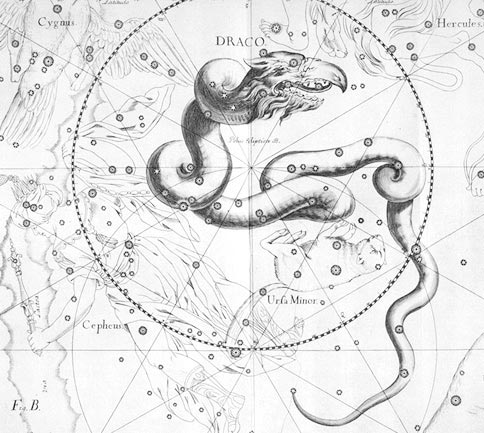
The constellation Draco (from the Greek Drakon, meaning dragon) is identified--funnily enough--with some dragons in Hellenic myth but not others. There are quite a few creatures, after all, who would qualify as a dragon in Hellenic myth. For a dragon or hydra not connected to the constellation, think of the one Kadmos vanquished, for example, or the one Apollon vanquished at Delphi, or even the dragon who guarded the Golden Fleece and was slain by Iásōn. In truth, only two dragons were associated with the myth in ancient times, most notably by Hyginus in his Astronomica: Drakon Hesperios, the Hesperian Dragon, and Drakon Gigantomakhios, the Gigantomachian Dragon.


The first of the myths associated with the constellation is the legend of the Drakon Hesperios (Δρακων Ἑσπεριος), who was slain by Hēraklēs during one of his Labours. I will tell the whole myth of the labour soon enough, but I will share what Hyginus wrote about this labour, and Hēraklēs' encounter with Ladôn (Λαδων), as the dragon was often called.

"This huge serpent is pointed out as lying between the two Bears. He is said to have guarded the golden apples of the Hesperides, and after Hercules killed him, to have been put by Juno [Hera] among the stars, because at her instigation Hercules set out for him. He is considered the usual watchman of the Gardens of Juno. Pherecydes says that when Jupiter [Zeus] wed Juno, Terra [Gaea] came, bearing branches with golden applies, and Juno, in admiration, asked Terra to plant them in her gardens near distant Mount Atlas. When Atlas’ daughters kept picking the apples from the trees, Juno is said to have placed this guardian there. Proof of this will be the form of Hercules above the dragon, as Eratosthenes shows, so that anyone may know that for this reason in particular it is called the dragon." [II.3]

The sole other dragon this myth is linked to is Drakon Gigantomakhios (Δρακων Γιγαντομαχιος), who rose up during the Gigantomachy. When the Olympians rose to power, they first fought the Titans during the Titanomachy. Vanquishing them, the Theoi thought They had won. Yet, there was one who sought revenge for the defeat of his father: Typhôeus, the most-feared son of Tartaros and Gaea. Some versions of the myth say that Typhôeus was actually the Drakon Gigantomakhios, or one of his offspring. Hyginus shares what happened to the dragon:

"Some also say this dragon was thrown at Minerva [Athena] by the Giants, when she fought them. Minerva, however, snatched its twisted form and threw it to the stars, and fixed it at the very pole of heaven. And so to this day it appears with twisted body, as if recently transported to the stars."

The constellation Draco is visible at latitudes between +90° and −15°, and best visible at 21:00 (9 p.m.) during the month of July. Tomorrow, we will talk a little more about the types of dragons in Hellenic myth, because I suddenly realized the association with medieval dragons is very easily made when reading 'dragon', but I assure you, the ancient Hellenes were unaccustomed to giant, fire breathing, lizards.

Near the end of the month of Boedromion, there was a singular sacrifice organized in Erkhia, a deme of Attica. It was held in honor of the river God Achelous, his intended wife ('alochos') Deianeira, the Nymphs, Hermes, and Gaea. We will be holding a PAT ritual for this sacrifice on the 15th of September at 10 AM EDT.


In Hellenic mythology, Achelous (Ἀχελῷος Achelōios) is the patron deity of the 'silver-swirling' Achelous River, which is the largest river of Greece, and thus the chief of all river deities. His name is pre-Hellenic, its meaning unknown. His parents are generally believed to be Tethys and Okeanos. Very few of the river Gods have mythology about Them, but Achelous was featured heavily in the legends surrounding the hero Hēraklēs. In fact, we believe the origins for this sacrifice lie exactly there. The myth goes as follows:

Achelous, God of the most powerfully flowing river in Hellas, fell in love with the daughter of the king who ruled the land along the river. Deianeira, daughter of Oeneus king of Calydon came to age as the most beautiful woman in the land. For her hand, her father announced a contest: the strongest of her suitors would win her. Achelous, as a God, was by far the strongest in the region and was sure He would win her. But Hēraklēs had also heard of her beauty so in the end it came down to the two of them.

Hēraklēs was the strongest mortal in the world, but Achelous, being a God, had some advantages over him. He could change his shape at will. He could become a snake that curved like the winding river. He could become a bull that roared like the roaring river. And when He was a bull He could tear the very earth with His massive horns, just as the river carved away the land when it overflowed its banks. Even in the shape of a man, He had the horns of the bull on His head.

The fight was terrible. Achelous thrashed and fought Hēraklēs in all his shapes. When Hēraklēs pinned him, he became a snake and slithered loose. But Hēraklēs gripped him again and this time Achelous tried to shake free by changing into a bull. He bucked and raged, but Hēraklēs drove his horns into the Earth and with a mighty heave, he tore one off. Achelous howled and was forced to submit. As such, Hēraklēs won the match and won Deianeira's hand in marriage. And the people of Calydon won as well as the Nymphs hollowed out the horn and good Earth fills it with all the fruits and vegetables of the harvest. It became the Cornucopia, or Horn of Plenty.

This sacrifice, timed well with the reaping of the final fruits of the Earth before winter, includes all involved with the myth: Gaea's inclusion, as the source of all the fruits of harvest, speaks for Herself, Achelous (as the largest, life giving, river) was included because of His waters and the myth of the Cornucopia. That myth included his intended wife Deianeira and the manifestations of Achelous as the sacred bull, the serpent and the Minotaur--all creatures associated with Gaea. Because of their close connection to water, a fertilizing element, and the creation of the Cornucopia itself, the Nymphs were worshiped as daimons of fertility and vegetation. Hermes, as the Bringer of All that is Good helped bridge the divide between myth and humanity.

We hope you join us for this event on Facebook, and the ritual can be found here.
As legend goes, a shepherd herded his flock up the side of Mount Parnassus. The sheep came upon a chasm and seemed to lose their minds. They started jumping around, and darting about. When the shepherd went to inspect the chasm, he fell under the influence of gasses that welled up from it. He lost all his worries and cared not about the time. He simply wished to remain there and gleam the knowledge he felt at the edges of his mind.

When he did not return, his family went to look for him. They took him home and put him to bed. Everyone was worried by his strange behavior, but he seemed to be calmer when the morning came. Yet, the shepherd's behavior had not returned to normal. He was able to foretell the future. Soon, word of the shepherd's ability, and the chasm, spread. People came from far away to either talk to the man or go to the source. Yet, those who visited the chasm lost their minds as well, and sometimes even jumped in the chasm.

A decision was made: this chasm, which must send up messages from Gaea, needed to be managed so no one would get hurt. A woman was chosen and introduced to the vapors, and given servants to keep her safe and healthy. She spoke with the voice of Gaea, and spoke her prophecies for anyone who would visit. It is said that the chasm was protected by a serpent, Python (Πύθωνος), who was put there by Gaea to protect the chasm.

The chasm was seen as the center of the known world, as Zeus himself had once let two eagles fly at the far reaches of the world, and they met over the chasm. It was Gaea's sacred site, but it didn't remain that way for long. Apollon was born, and he soon moved to find the perfect site for His temple. In the Homeric hymn to Pythian Apollon, we find His arrival at the site of Gaea's oracle, and an account of His battle with the serpent:

"In this place I am minded to build a glorious temple to be an oracle for men, and here they will always bring perfect hecatombs, both they who dwell in rich Peloponnesus and the men of Europe and from all the wave-washed isles, coming to question me. And I will deliver to them all counsel that cannot fail, answering them in my rich temple."

"...Whosoever met the dragoness, the day of doom would sweep him away, until the lord Apollo, who deals death from afar, shot a strong arrow at her. Then she, rent with bitter pangs, lay drawing great gasps for breath and rolling about that place. An awful noise swelled up unspeakable as she writhed continually this way and that amid the wood: and so she left her life, breathing it forth in blood. Then Phoebus Apollo boasted over her:

"Now rot here upon the soil that feeds man! You at least shall live no more to be a fell bane to men who eat the fruit of the all-nourishing earth, and who will bring hither perfect hecatombs. Against cruel death neither Typhoeus shall avail you nor ill-famed Chimera, but here shall the Earth and shining Hyperion make you rot."

Thus said Phoebus, exulting over her: and darkness covered her eyes. And the holy strength of Helios made her rot away there; wherefore the place is now called Pytho, and men call the lord Apollo by another name, Pythian; because on that spot the power of piercing Helios made the monster rot away."

And so, the site became sacred to Apollon. At first, young virgins spoke the word of the Lord Apollon, but later on, it was decreed that the oracle--called the Pythia--had to be over fifty years of age. The site was at the epicenter of important travel routes; the road leading from northeastern and eastern Hellas to the plain of Amfissa--where it met the road joining northern Hellas with Naupactus--passed through Delphi. From the beach of Itea, it was easy to pass to nearby Peloponnesus. This not only made Delphi an important religious site, but a commercial one, and it was one of the major keys to its success.

Delphi is no more. The entire site is in ruins. While you can still walk a large part of the grounds, there is no longer an oracle who breaths in the vapors and gives prophesy. Hellenists lost that line to the Theoi.

Most of us know how to work a divinatory tool; we come from other Neo-Pagan paths that encourage it, or developed systems of our own. Some of us are just naturally gifted. I feel the Hellenistic community--when it becomes larger and more standardized and organized--could greatly benefit from another Oracle; someone whom we trust to speak the words of the Theoi and whom we pay for their efforts. A new Pythia, dedicated to the Hellenistic community, who is supported by said community. I honestly hope we get there some day. Delphi is not gone; it lives on in each of us. It's legacy drives us forward as a religion. One day, we may have it again.
As legend goes, a shepherd herded his flock up the side of Mount Parnassus. The sheep came upon a chasm and seemed to lose their minds. They started jumping around, and darting about. When the shepherd went to inspect the chasm, he fell under the influence of gasses that welled up from it. He lost all his worries and cared not about the time. He simply wished to remain there and gleam the knowledge he felt at the edges of his mind.

When he did not return, his family went to look for him. They took him home and put him to bed. Everyone was worried by his strange behavior, but he seemed to be calmer when the morning came. Yet, the shepherd's behavior had not returned to normal. He was able to foretell the future. Soon, word of the shepherd's ability, and the chasm, spread. People came from far away to either talk to the man or go to the source. Yet, those who visited the chasm lost their minds as well, and sometimes even jumped in the chasm.

A decision was made: this chasm, which must send up messages from Gaea, needed to be managed so no one would get hurt. A woman was chosen and introduced to the vapors, and given servants to keep her safe and healthy. She spoke with the voice of Gaea, and spoke her prophecies for anyone who would visit. It is said that the chasm was protected by a serpent, Python (Πύθωνος), who was put there by Gaea to protect the chasm.

The chasm was seen as the center of the known world, as Zeus himself had once let two eagles fly at the far reaches of the world, and they met over the chasm. It was Gaea's sacred site, but it didn't remain that way for long. Apollon was born, and he soon moved to find the perfect site for His temple. In the Homeric hymn to Pythian Apollon, we find His arrival at the site of Gaea's oracle, and an account of His battle with the serpent:

"In this place I am minded to build a glorious temple to be an oracle for men, and here they will always bring perfect hecatombs, both they who dwell in rich Peloponnesus and the men of Europe and from all the wave-washed isles, coming to question me. And I will deliver to them all counsel that cannot fail, answering them in my rich temple."

"...Whosoever met the dragoness, the day of doom would sweep him away, until the lord Apollo, who deals death from afar, shot a strong arrow at her. Then she, rent with bitter pangs, lay drawing great gasps for breath and rolling about that place. An awful noise swelled up unspeakable as she writhed continually this way and that amid the wood: and so she left her life, breathing it forth in blood. Then Phoebus Apollo boasted over her:

"Now rot here upon the soil that feeds man! You at least shall live no more to be a fell bane to men who eat the fruit of the all-nourishing earth, and who will bring hither perfect hecatombs. Against cruel death neither Typhoeus shall avail you nor ill-famed Chimera, but here shall the Earth and shining Hyperion make you rot."

Thus said Phoebus, exulting over her: and darkness covered her eyes. And the holy strength of Helios made her rot away there; wherefore the place is now called Pytho, and men call the lord Apollo by another name, Pythian; because on that spot the power of piercing Helios made the monster rot away."

And so, the site became sacred to Apollon. At first, young virgins spoke the word of the Lord Apollon, but later on, it was decreed that the oracle--called the Pythia--had to be over fifty years of age. The site was at the epicenter of important travel routes; the road leading from northeastern and eastern Hellas to the plain of Amfissa--where it met the road joining northern Hellas with Naupactus--passed through Delphi. From the beach of Itea, it was easy to pass to nearby Peloponnesus. This not only made Delphi an important religious site, but a commercial one, and it was one of the major keys to its success.

Delphi is no more. The entire site is in ruins. While you can still walk a large part of the grounds, there is no longer an oracle who breaths in the vapors and gives prophesy. Hellenists lost that line to the Theoi.

Most of us know how to work a divinatory tool; we come from other Neo-Pagan paths that encourage it, or developed systems of our own. Some of us are just naturally gifted. I feel the Hellenistic community--when it becomes larger and more standardized and organized--could greatly benefit from another Oracle; someone whom we trust to speak the words of the Theoi and whom we pay for their efforts. A new Pythia, dedicated to the Hellenistic community, who is supported by said community. I honestly hope we get there some day. Delphi is not gone; it lives on in each of us. It's legacy drives us forward as a religion. One day, we may have it again.
Near the end of the month of Boedromion, there was a singular sacrifice organized in Erkhia, a deme of Attica. It was held in honor of the river God Achelous, his intended wife ('alochos') Deianeira, the Nymphs, Hermes, and Gaea. We will be holding a PAT ritual for this sacrifice on the 7th of October at 10 AM EDT.


In Hellenic mythology, Achelous (Ἀχελῷος Achelōios) is the patron deity of the 'silver-swirling' Achelous River, which is the largest river of Greece, and thus the chief of all river deities. His name is pre-Hellenic, its meaning unknown. His parents are generally believed to be Tethys and Okeanos. Very few of the river Gods have mythology about Them, but Achelous was featured heavily in the legends surrounding the hero Hēraklēs. In fact, we believe the origins for this sacrifice lie exactly there. The myth goes as follows:

Achelous, God of the most powerfully flowing river in Hellas, fell in love with the daughter of the king who ruled the land along the river. Deianeira, daughter of Oeneus king of Calydon came to age as the most beautiful woman in the land. For her hand, her father announced a contest: the strongest of her suitors would win her. Achelous, as a God, was by far the strongest in the region and was sure He would win her. But Hēraklēs had also heard of her beauty so in the end it came down to the two of them.

Hēraklēs was the strongest mortal in the world, but Achelous, being a God, had some advantages over him. He could change his shape at will. He could become a snake that curved like the winding river. He could become a bull that roared like the roaring river. And when He was a bull He could tear the very earth with His massive horns, just as the river carved away the land when it overflowed its banks. Even in the shape of a man, He had the horns of the bull on His head.

The fight was terrible. Achelous thrashed and fought Hēraklēs in all his shapes. When Hēraklēs pinned him, he became a snake and slithered loose. But Hēraklēs gripped him again and this time Achelous tried to shake free by changing into a bull. He bucked and raged, but Hēraklēs drove his horns into the Earth and with a mighty heave, he tore one off. Achelous howled and was forced to submit. As such, Hēraklēs won the match and won Deianeira's hand in marriage. And the people of Calydon won as well as the Nymphs hollowed out the horn and good Earth fills it with all the fruits and vegetables of the harvest. It became the Cornucopia, or Horn of Plenty.

This sacrifice, timed well with the reaping of the final fruits of the Earth before winter, includes all involved with the myth: Gaea's inclusion, as the source of all the fruits of harvest, speaks for Herself, Achelous (as the largest, life giving, river) was included because of His waters and the myth of the Cornucopia. That myth included his intended wife Deianeira and the manifestations of Achelous as the sacred bull, the serpent and the Minotaur--all creatures associated with Gaea. Because of their close connection to water, a fertilizing element, and the creation of the Cornucopia itself, the Nymphs were worshiped as daimons of fertility and vegetation. Hermes, as the Bringer of All that is Good helped bridge the divide between myth and humanity.

We hope you join us for this event on Facebook, and the ritual can be found here.
I've been thinking about and researching the myth of Pandora lately. I'm fairly certain most--if not all--of you know the myth of Pandôra. For those who may not, or not know it completely, I will retell it first:

After the Titanomachy ends, Zeus claims His throne as rightful King to the Deathless Ones. Humanity did not yet exist. While most Titans were locked away in Tartarus by Zeus, Prometheus and Epimetheus--who were brothers--had been either neutral or on the side of Zeus during the Titan War and were therefor given a task. Prometheus was given the task of creating man and Epimetheus was ordered go give good qualities to all creatures of earth. So did Prometheus and Epimetheus. Prometheus shaped man out of clay and Athena breathed life into him. Epimetheus spread swiftness, cunning, fur and wings but ran out of gifts when he came to man. Prometheus remedied the situation by allowing men to walk upright and gave them fire.

It soon became apparent that Prometheus loved man more than the Olympians. When Zeus decreed that man must give sacrifice to the Deathless Ones, Prometheus stood ready to aid humanity. He butchered an animal and divided it in to piles; the bones and fat formed one of them, the good meat wrapped in the hide of the animal, the other. Zeus vowed that he would abide by the choice He made now, and picked the tasty looking pile of bones. Zeus was angered but could not take back his vow. What he could take back, was the gift of fire, and this he did.

Mankind suffered greatly without fire and Prometheus traveled either to the sun or Olympus to reclaim fire for his beloved mankind. This, of course, angered Zeus even further and so he devised a plan. First, he imprisoned Prometheus. He ordered Hermes to tie Prometheus to a mountain and had a giant Eagle come every day to eat his liver. As an immortal, Prometheus' liver grew back over night so his torment was endless. Before Prometheus had been taken prisoner, however, he had told his brother Epimetheus never to accept a gift from Zeus, as Zeus' wrath would undoubtedly also extend to the mortal race He had created. 

And Zeus, indeed, was not done with His punishment. After imprisoning Prometheus, Zeus assembled the Theoi. He told Hēphaistos to fashion a woman out of water and clay. Hēphaistos did and brought the statue before Zeus. Zeus then asked Aphrodite to bless the woman with a beauteous face and feminine whiles. He asked Athena to dress her modestly and give her the ability to weave and craft, Demeter taught her to tend the garden. From Apollon, she received the ability to make music and sing. All Gods gave her treacherous gifts, including Hera, who made her curious, and Hermes, who made her cunning and quick of the tongue. Then, Zeus named her Pandôra (Πανδωρα), All-Giving, and breathed life into her. He then bade Hermes to deliver her to Epimetheus, along with a vase (pithos) Pandôra was never allowed to open.

Epimetheus had been warned by Prometheus never to open or accept a gift from Zeus, but he laid eyes on Pandôra's beauty and fell in love too deeply to reject her. He took her into his home amongst men and wedded her right away. And Pandôra loved Epimetheus, because he was a good man and good husband. She worked tirelessly to please him and helped him keep the home. Yet, she found herself drawn to the pithos she was told never to open. Her eyes would wander to it constantly and Hera's gift eventually prevented her from holding to her promise. 

On a day when Epimetheus was away from the home, Pandôra decided to risk a sneak peak at the contents she had fantasized about so often. She pulled the lid off of the pithos and out flew dark spirits of disease, death and the destruction of humanity. Pandôra hastened to seal the jar but managed to trap only Hope (Elpis)--by Zeus' decree or by mere accident.

Mankind was now plagued with illness, with failing crops, with all that make life hard. But they had Hope and soon, Pyrrha (Fire) was born to Epimetheus and Pandôra. Years later, when Zeus would flood the earth, Pyrrha and her husband Deukalion would survive and re-create the human race by throwing pebbles behind themselves as they walked; Deukalion would create the men and Pyrrha the women.

There are countless versions of this tale. It's featured heavily in Hesiod's Theogony and Works & Days but there seem to be older versions of the myth in which Pandôra was not made by Zeus but was an epithet of Demeter or Gaea who became a separate Deity. As such, Pandôra was a harvest Goddess, a Goddess risen from the earth to bestow gifts upon humanity. This would certainly seem closer to the meaning of her name; All-Giving.

The problem with the 'Pandôra's Box' myth as written above is in the inconsistencies. If Zeus wanted to punish mankind, why give them a beautiful woman? Why not drop the jar in front of some poor farmer and have him open it? Was there no curiosity in men at all? Why give Pandôra the ability to craft, sing and work diligently when she's there solely to punish mankind? If the pithos was a prison for the evils of the world, why was Hope locked in there as well? And if the pithos was, indeed, a prison, shouldn't we be without hope now? The same is true for a scenario in which there were actual gifts in the jar; why was Hope kept from humanity?

Scholars have tried valiantly to answer these questions but it doesn't become much clearer. There is a very old reference to pithos and Zeus in Hómēros' Illiad:

"There are two urns (pithoi) that stand on the door-sill of Zeus. They are unlike for the gifts they bestow: an urn of evils (kakoi), an urn of blessings (dôroi). If Zeus who delights in thunder mingles these and bestows them on man, he shifts, and moves now in evil, again in good fortune. But when Zeus bestows from the urn of sorrows, he makes a failure of man, and the evil hunger drives him over the shining earth, and he wanders resepected neither of gods nor mortals."

Could one of these have been given to Pandôra? And if so, which one? Was it the pithos holding the kakoi or the pithos holding the dôroi? Her name seems to indicate the latter, the myth the former. If it's the pithos holding the kakoi, why was hope in that jar? Shouldn't hope have been in the other jar? If it was the pithos holding the dôroi, why was it a good thing hope stayed behind? Don't we need hope? And if hope is a bad thing, why was it in the jar of blessings? Another possibility is that, when opening the jar, the blessings--because this theory works only if the pithos that was given to Pandora was a pithos of blessings--Pandôra caused mankind to lose the blessings Prometheus had bestowed upon them. All that was left, was hope.

Aeschylus, writer of a Hellenic tragedy dating back to C5th B.C. indicated that it was not Zeus, but Prometheus, who saved Hope from leaving the jar and, as Aeschylus explains it, our hearths:

Prometheus: Yes, I caused mortals to cease foreseeing their doom.
Chorus: Of what sort was the cure that you found for this affliction? 
Prometheus: I caused blind hopes to dwell within their breasts.
Chorus: A great benefit was this you gave to mortals.

If this was the case, the jar would have, indeed, contained blessings which were lost upon opening of the jar. Prometheus kept hope alive for humanity, allowing us to weather the evils already in the world even now we had lost most of our ability to withstand it. 

This idea is not as weird as it may sound; I spoke earlier of the Ages of Man. Every new age, we lost more gifts from the Gods because our gifts gave us hubris. Because this myth is set before the flood of Deukalion, it's set in the Bronze Age. Hesiod had this to say about the Bronze Age:

Zeus the Father made a third generation of mortal men, a brazen race, sprung from ash-trees, and it was in no way equal to the silver age, but was terrible and strong. They loved the lamentable works of Ares and deeds of violence; they ate no bread, but were hard of heart like adamant, fearful men. Great was their strength and unconquerable the arms which grew from their shoulders on their strong limbs. Their armour was of bronze, and their houses of bronze, and of bronze were their implements: there was no black iron. These were destroyed by their own hands and passed to the dank house of chill Hades, and left no name: terrible though they were, black Death seized them, and they left the bright light of the sun.

Parts of it come close to a world void of hope, full of evils and/or void of all goodness but hope. It was a bad age and the people who lived in it, destroyed themselves--perhaps due to whatever was in that pithos?--and remained forever nameless spirits. Of course, the creation myth part of this age doesn't fit the myth at all.

Perhaps, Pandôra was an invention of her time, following a shift in culture towards a patriarchal society. Perhaps, her myth got mangled when it came in contact with the story of Adam and Eve, which it resembles. It is said that the Theoi cannot impede on humanity's free will and so they created a creature with the will to do as they pleased. Quite a nice loop in that clause, hm? Whatever happened, I don't think Pandôra meant any harm. She was made to be a certain way, to reach a certain goal, and she did. 
Near the end of the month of Boedromion, there was a singular sacrifice organized in Erkhia, a deme of Attica. It was held in honor of the river God Achelous, his intended wife ('alochos') Deianeira, the Nymphs, Hermes, and Gaea. We will be holding a PAT ritual for this sacrifice on the 18th of September, at 10 AM EDT.


In Hellenic mythology, Achelous (Ἀχελῷος Achelōios) is the patron deity of the 'silver-swirling' Achelous River, which is the largest river of Greece, and thus the chief of all river deities. His name is pre-Hellenic, its meaning unknown. His parents are generally believed to be Tethys and Okeanos. Very few of the river Gods have mythology about Them, but Achelous was featured heavily in the legends surrounding the hero Hēraklēs. In fact, we believe the origins for this sacrifice lie exactly there. The myth goes as follows:

Achelous, God of the most powerfully flowing river in Hellas, fell in love with the daughter of the king who ruled the land along the river. Deianeira, daughter of Oeneus king of Calydon came to age as the most beautiful woman in the land. For her hand, her father announced a contest: the strongest of her suitors would win her. Achelous, as a God, was by far the strongest in the region and was sure He would win her. But Hēraklēs had also heard of her beauty so in the end it came down to the two of them.

Hēraklēs was the strongest mortal in the world, but Achelous, being a God, had some advantages over him. He could change his shape at will. He could become a snake that curved like the winding river. He could become a bull that roared like the roaring river. And when He was a bull He could tear the very earth with His massive horns, just as the river carved away the land when it overflowed its banks. Even in the shape of a man, He had the horns of the bull on His head.

The fight was terrible. Achelous thrashed and fought Hēraklēs in all his shapes. When Hēraklēs pinned him, he became a snake and slithered loose. But Hēraklēs gripped him again and this time Achelous tried to shake free by changing into a bull. He bucked and raged, but Hēraklēs drove his horns into the Earth and with a mighty heave, he tore one off. Achelous howled and was forced to submit. As such, Hēraklēs won the match and won Deianeira's hand in marriage. And the people of Calydon won as well as the Nymphs hollowed out the horn and good Earth fills it with all the fruits and vegetables of the harvest. It became the Cornucopia, or Horn of Plenty.

This sacrifice, timed well with the reaping of the final fruits of the Earth before winter, includes all involved with the myth: Gaea's inclusion, as the source of all the fruits of harvest, speaks for Herself, Achelous (as the largest, life giving, river) was included because of His waters and the myth of the Cornucopia. That myth included his intended wife Deianeira and the manifestations of Achelous as the sacred bull, the serpent and the Minotaur--all creatures associated with Gaea. Because of their close connection to water, a fertilizing element, and the creation of the Cornucopia itself, the Nymphs were worshiped as daimons of fertility and vegetation. Hermes, as the Bringer of All that is Good helped bridge the divide between myth and humanity.

We hope you join us for this event on Facebook, and the ritual can be found here.
Alright, forgive me for this one. So, I came across the video below on YouTube, 'ugh'ed at the images, clicked away. Then clicked back because why the heck? What were the criteria for this list? What was the grading based on? Who judged? Did they know Hellenic mythology? I mean, I agree these Gods are powerful, but if we're really doing something as horrible as ranking Them, at least look a little beyond the obvious, please. Here's the list discussed, with the description:


"The stories of gods and goddess from the ancient Greek mythology are immensely popular in pop culture. Their characters were popularized and subsequently immortalized by some famous play writers in ancient Greece that included the likes of Homer and Hesiod. What makes the folklore behind these ancient Greek deities stand apart is the way their stories deviated from that of other contemporary ancient religions. The Greek gods resembled humans not only in their form but also in their nature and emotions. [...] As for the majestic Gods of ancient Greece, lets see how many of your favorites make it on our top 10 list."

Okay, so, yes. All of these Olympians (because They are all Olympians) are powerful. They're Gods, so of course They are. But I'm not exactly sure that I would have held fast to this list. Since watching the video, I've been thinking about my 'ranking', which isn't so much a question of 'who is more powerful', but one of 'are there any Gods who can command Zeus or otherwise hold power over Him'? Mythologically speaking, I would say 'yes'. I'm not going to rank them, but here are six Gods (well, They turned out to be only Goddesses) who hold sway over Zeus, King of the Gods, and are thus, well, pretty darn powerful.

Gaia
All the Protogenoi, as the First Born Deities of the Hellenic Kosmos, are essential to our survival and thus are held in high regard by the Olympians--Zeus included. Still, Gaia, as the earth Herself is rather critical. On top of that, Gaia was at the head of the rebellion against Her husband Ouranos who had imprisoned several of Her giant-sons within her womb and later, when Her son Kronos defied Her by imprisoning these same sons, she sided with Zeus in His rebellion against Him. Finally She came into conflict with Zeus because She was angered by His binding of Her Titan-sons in Tartaros. She birthed a tribe of Gigantes and later the monster Typhoeus to overthrow Him, but both failed in their attempts. So technically Zeus is stronger than Her, but He needed every single other God and Goddess he could get on His side to pull it off, which brings us to...

Hekate
After the Titanomachy, Zeus bestowed upon Her the highest of honors. As Hesiod writes in his 'Theogony: "Again, Phoebe came to the desired embrace of Coeus. [...] And she conceived and bare Hecate whom Zeus the son of Cronos honoured above all. He gave her splendid gifts, to have a share of the earth and the unfruitful sea. She received honour also in starry heaven, and is honoured exceedingly by the deathless gods. [...] For as many as were born of Earth and Ocean amongst all these she has her due portion. The son of Cronos did her no wrong nor took anything away of all that was her portion among the former Titan gods: but she holds, as the division was at the first from the beginning, privilege both in earth, and in heaven, and in sea. [...] Also, because she is an only child, the goddess receives not less honour, but much more still, for Zeus honours her."

Styx
Styx is a river Goddess, one of many. Hers is the river of hatred. Styx was a firm ally of Zeus in the Titan Wars, who brought Her children Nike, Zelos, Bia and Kratos to stand beside the God in battle. Zeus rewarded Her by making Her stream the agent of oaths which bind the Gods. Read that again: if the Gods swear an oath an They break it, They answer to Styx.

Demeter
When Hades kidnapped Demeter's daughter Kore, Demeter marched right up to Zeus and told Him to get her daughter back ASAP. Zeus, in very short, told Her it was not His problem, even though Kore was His daughter. Bereft (and possibly mightily pissed off), Demeter stopped performing her divine duties and humanity nearly starved. Since the Gods need humans if They want to receive sacrifices, Zeus caved and got Hades to release Kore.

Themis
Themis was an early bride of Zeus and His first counsellor. She was often represented seated beside His throne advising Him on the precepts of divine law and the rules of fate. Not odd, considering Themis is the Titan Goddess of divine law and order--the traditional rules of conduct first established by the gods. She is also a prophetic Goddess who presided over the most ancient oracles, including Delphi. In this role, She was the divine voice who first instructed mankind in the primal laws of justice and morality, such as the precepts of piety, the rules of hospitality, good governance, conduct of assembly, and pious offerings to the Gods. In short: Themis is a Goddess who can see the future, advices Zeus on what to do based on Her insights, taught humankind the rules on which the Gods would judge them and, oh yes, she also does the actual judging.

Metis
She is one of the elder Okeanides and the Titan-Goddess of good counsel, planning, cunning and wisdom. If you haven't  heard much about Her it's because Zeus swallowed Her whole when a prophecy was revealed that She was destined to bear a son greater than His father. Metis afterwards bore a daughter, Athena, from Zeus' head and Her wisdom and powers of judgement were entirely absorbed by Zeus, basically making Smarter and a lot more powerful. Without swallowing Metis, things could have turned out very different in the Hellenic pantheon!
Near the end of the month of Boedromion, there was a singular sacrifice organised in Erkhia, a deme of Attica. It was held in honour of the river God Achelous, his intended wife ('alochos') Deianeira, the Nymphs, Hermes, and Gaea. We will be holding a PAT ritual for this sacrifice on the 29th of September, at 10 AM EDT.


In Hellenic mythology, Achelous (Ἀχελῷος Achelōios) is the patron deity of the 'silver-swirling' Achelous River, which is the largest river of Greece, and thus the chief of all river deities. His name is pre-Hellenic, its meaning unknown. His parents are generally believed to be Tethys and Okeanos. Very few of the river Gods have mythology about Them, but Achelous was featured heavily in the legends surrounding the hero Hēraklēs. In fact, we believe the origins for this sacrifice lie exactly there. The myth goes as follows:

Achelous, God of the most powerfully flowing river in Hellas, fell in love with the daughter of the king who ruled the land along the river. Deianeira, daughter of Oeneus king of Calydon came to age as the most beautiful woman in the land. For her hand, her father announced a contest: the strongest of her suitors would win her. Achelous, as a God, was by far the strongest in the region and was sure He would win her. But Hēraklēs had also heard of her beauty so in the end it came down to the two of them.

Hēraklēs was the strongest mortal in the world, but Achelous, being a God, had some advantages over him. He could change his shape at will. He could become a snake that curved like the winding river. He could become a bull that roared like the roaring river. And when He was a bull He could tear the very earth with His massive horns, just as the river carved away the land when it overflowed its banks. Even in the shape of a man, He had the horns of the bull on His head.

The fight was terrible. Achelous thrashed and fought Hēraklēs in all his shapes. When Hēraklēs pinned him, he became a snake and slithered loose. But Hēraklēs gripped him again and this time Achelous tried to shake free by changing into a bull. He bucked and raged, but Hēraklēs drove his horns into the Earth and with a mighty heave, he tore one off. Achelous howled and was forced to submit. As such, Hēraklēs won the match and won Deianeira's hand in marriage. And the people of Calydon won as well as the Nymphs hollowed out the horn and good Earth fills it with all the fruits and vegetables of the harvest. It became the Cornucopia, or Horn of Plenty.

This sacrifice, timed well with the reaping of the final fruits of the Earth before winter, includes all involved with the myth: Gaea's inclusion, as the source of all the fruits of harvest, speaks for Herself, Achelous (as the largest, life giving, river) was included because of His waters and the myth of the Cornucopia. That myth included his intended wife Deianeira and the manifestations of Achelous as the sacred bull, the serpent and the Minotaur--all creatures associated with Gaea. Because of their close connection to water, a fertilizing element, and the creation of the Cornucopia itself, the Nymphs were worshiped as daimons of fertility and vegetation. Hermes, as the Bringer of All that is Good helped bridge the divide between myth and humanity.

We hope you join us for this event on Facebook, and the ritual can be found here.
The month of Boedromion is an interesting one. It has barely any large festivals--the huge exception are the Greater Eleusinian Mysteries--but it has a very large number of small sacrifices, minor festivals, and commemorative events. It is a trend that seems to have continued from the previous month where the second half of the month--at least in Erkhia, but also Athens--was dotted with them, far more than is usual in any of the other months. I want to risk a guess on why this is, but more on that later.

Today, I want to have a small discussion about six festivals celebrated the third to the seventh of the month. This post is a repost from last year, as my readers come and go and this information is important to have. The festivals and sacrifices we discuss today were largely celebrated in Athens and Erkhia, but there are clues that at least one of these was a panhellenic event. These festivals and the dates they were celebrated on this month are:

4 - Plataia
4 - Sacrifice to Basile in Erkhia
5 - Genesia
5 - Sacrifice to Epops at Erkhia
6 - Kharisteria
7 - Boedromia

Plataia - The Plataia (or Plataea) seems to have been a commemorative festival, for the Hellenes fallen at the battle of Plataea. The Battle of Plataea was the final land battle during the second Persian invasion of Hellas. It took place in 479 BC near the city of Plataea in Boeotia, and was fought between an alliance of the Greek city-states, including Sparta, Athens, Corinth and Megara, and the Persian Empire of Xerxes I. Some 38,700 Hellenes stood their ground against 300.000 Persians. The Hellenes marched out of the Peloponnesus and the Persians retreated to Boeotia and built a fortified camp near Plataea. The Hellenes surrounded the camp, but refused to enter the bare terrain surrounding the camp. They waited for eleven days, and then found their supplies driddled. They attempted to retreat, and Persian general Mardonius ordered his forces to pursue them. The Hellenes, however--particularly the Spartans, Tegeans and Athenians--stood their ground, and won a great victory over the Perians. The Persian infantry was slaughtered, and Mardonius killed. Plutarch gives the date for the battle to be the fourth of this month, but also attested that the Athenians commemorated the event on the third. In Boeotia (and especially in Plataea), the rememberance seems to have been held on the fourth.

Herodotus, in his Histories (9. 52. 1), and Plutarch, in his 'Life of Arestides' both remark the following about what is most likely this battle:

"The seer slew victim after victim, Pausanias turned his face [historical general of the Persian Wars], all tears, toward the Heraion, and with hands uplifted prayed Kithaironion Hera and the other gods of the Plataian land that, if it was not the lot of the Hellenes to be victorious, they might at least do great deeds before they fell."[Life of Aristides, 18. 1]

As such we can assume that, besides the fallen, a sacrifice to Hera was also made.

Sacrifice to Basile in Erkhia - In the calendar from Erkhia the heroine Basile was given a holókaustos on the 4th of the month of Boedromion. The sacrifice to Basile consisted of a white, female, lamb and was followed by a wineless libation. The colour of the animal is noteworthy, since holókaustoi have commonly been classified as khthonian sacrifices, and it is usually assumed that the victims used in such rituals were black. Basile was also worshipped elsewhere in Attica, but nothing is known of the kind of sacrifices she received at those locations. Basile seems to have been a local heroine. Nothing survives about her deeds, as far as I have been able to find, but she was important enough to warrant her own personal sacrifice--the Erkhian calendar also makes note of collective sacrifices to 'the heroines'.

Genesia - The Genesia seems to have been a festival of the dead--especially of dead parents. It was celebrated on the fifth of the month of Boudromion in Athens, but that is all we know for sure. There is reason to believe that the Genesia was panhellenic--although we do not know if all city-states performed the rites on the same day. We are also unsure if the Genesia was a set day for all children to visit their parents' grave and perform sacrifices there, or if there was a public commemoration of all parents. The day is also sacred to Gaea, who housed the remains of the dead, and brought fertility and wealth to the living.

Sacrifice to Epops at Erkhia - In the calendar from Erkhia, the hero Epops received two holókaustoi on the fifth of Boedromion. The victims of the two holókaustoi to Epops were piglets and the sacrifices were to be followed by wineless libations designated. Sacrifices to Epops are known only from the Erkhia calendar. The mythological context of Epops is not clear, but he was a hero, perhaps linked (by Kallimachos) to the conflict between the city-states Paiania and Erkhia.

Kharisteria - The Kharisteria takes place on the sixth of the month--a day sacred to Artemis. This festival is another commemoration of a battle, in this case, the battle of Marathon which took place in 490 BC. It was also a festival to pay off a debt to the Theoi. During the battle of Marathon, around 11,000 Hellenes stood their ground against a Persian force between 30.000 and 100.000 men. 203 Hellenes fell, opposite 6,400 Persians. That was quite a victory--especially if you consider that the Hellenes were the attacking side. The casualty numbers are known because the Hellenes set up a memorial for their fallen comrades. The Persian dead were counted for a very speciffic reason: the Hellenes had promised to the Theoi a sacrifice of one goat for ever Persian killed. In the end, they discovered they'd killed so many Persians that they couldn't find enough goats. A payment plan of sorts was divised, and over the course of thirteen years, roughly 500 goats per year were sacrificed, a practice that was still performed in Plutarch’s day. Plutarch also confirms that the sacrifice took place at Artemis Agrotera’s sanctuary at Agrai.

Boedromia - The festival that gives its name to the month. It might have been sacred to Apollon, and was thus most likely held on His sacred day--the seventh of the month. The Boedromia might have been another war commemoration. The epithet of Apollon associated with this festival is 'Boedromios', the helper in distress. The origin of the epithet and festival are explained in different ways. According to Plutarch, the name was awarded to Him (and the festival created) because he had assisted the Athenians in the war with the Amazons, who were defeated on the seventh of Boedromion, the day on which the Boedromia were afterwards celebrated. According to others, the name was awarded after the war of Erechtheus and Ion against Eumolpus, because Apollon had advised the Athenians to rush upon the enemy with a war-shout (Boê), if they wanted to win--and they did.

All these sacrifices have a khthonic character--to me, this is not odd, considering the Mysteries would be held only a few days afterwards. It was a time where death and the afterlife were on the mind, and where the dead were honored--because the Mysteries most likely also included appeasement and remembrances of the dead. Also remember the Niketeria, which was celebrated in the beginning of the month as well, and commemorated another battle.

To a modern Hellenist, none of these events--except perhaps the Genesia--relate to our life. These battles were not exactly in our lifetime, nor our country. Still, it is good to honor the dead, and take a moment to remember that the world would have been a very different place if the Persians had been victorious. Would it have been a worse place? That sort of value judgement is best reserved for the philosophers and historians. I am neither. I will give sacrifice to the dead, and to the heroes and heroines, and I will be thankful that my parents are still alive and I do not have reason to celebrate the Genesia. I will, however, mark the day with a sacrifice for the ancestors, in remembrance of a family line I am not exactly proud of, but am grateful for--because without them, I would not have been here.

As you have come to expect of us, Elaion will host PAT rituals for most of these festivals, to be announced in the coming days. We hope you will join them and find your own link to the past.
Beginning at sundown on the 25th of July, the Kourotrophos (child nurturers) were honoured. Gaea, Artemis, Hekate, Aglauros and Pandrosos shall be sacrificed to. Elaion will be organizing another Practicing Apart Together ritual for this event in the daylight hours of the 26th. Will you join us?


The Kourotrophos are (mostly) female deities who watched over growing children--Gaea, Artemis, Hekate, Eirênê, Aglauros and Pandrosos, especially. This specific offering is known from the demos Erkhia, but duplicates similar offerings on the Acropolis of Athens.

In this ritual, we honor Gaea, Artemis, Hekate, Aglauros and Pandrosos. Artemis is named Kourotrophos by Diodorus Siculus, a Hellenic historian, in book five of his library:

"And Artemis, we are told, discovered how to effect the healing of young children and the foods which are suitable to the nature of babes, this being the reason why she is also called Kourotrophos." [5.73.5]

Hesiod, in his 'Theogony', explains why Hekate is Kourotrophos:

"So, then. albeit her mother's only child, she is honoured amongst all the deathless gods. And the son of Kronos made her a nurse of the young who after that day saw with their eyes the light of all-seeing Eos (Dawn). So from the beginning she is a nurse of the young (kourotrophos), and these are her honours." [404]

Aglauros and her sister Pandrosos seem to have been fertility deities in Athens. They were eventually regarded as daughter of the Athenian king Cecrops, however, and myth tells us the sisters were entrusted with the care for Erichthonios, hidden away in a basket. He was the son of Athena and Hēphaistos, who grew to term in the Earth (Gaea), and would later rule Athens as king. Aglauros had a sanctuary on the Acropolis in which young men of military age swore an oath to her as well as to Zeus and to other deities. Herse, sometimes regarded as a third sister, has no mention in these accounts.

Gaea, as a mother and raiser of many children, of course receives honors as well during the Kourotrophos. Pausanias, in his 'Description of Greece' says:

"There is also a sanctuary of Ge (Earth) Kourotrophe (Nurse of the Young) [at Athens], and of Demeter Khloe (Green). You can learn all about their names by conversing with the priests." [1.22.3]

We are also considering adding Eirene, as Euripides, in Bacchae says the following about Her:

"The god [Dionysos], the son of Zeus, delights in banquets, and loves Eirene (Peace), giver of riches (olbodotes), goddess who nourishes youths (thea kourotrophos). To the blessed and to the less fortunate, he gives an equal pleasure from wine that banishes grief." [420] 

You can find the full version of the ritual here and you can follow the event of Facebook here.


I get a lot of questions from readers, and most of the time, the answers are fairly short. When I feel the question or the reply would be valuable to others as well, I make a post with a collection of them and post them in one go. Today is one of those posts.


"I would have a question about ancestor worship. As ancestors are chthonic beings, must they be sacrificed to outdoors by being poured libations onto the ground directly, or can they be worshipped  on an indoor altar and may the libations be poured into a libation vessel? If so, would it be appropriate to use the same one I use when I honor the ouranic theoi on my household altar?"

Ancestor worship was performed in Khthonic state festivals and as hero worship when at home. That is a generalization, of course, but it seems to mostly hold true.
 
There were regular state festivals organized for the dead (nekysia) and for the forefathers (genesia). On such days, graves were adorned, offerings of barley broth, milk, honey, unmixed wine, oil, water and the blood of animal sacrifices were given in the form of khoai--fully poured out libations. Graves often had bottomless amphorae placed on it on hollow columns. The libation was poured into this and seeped down into the dirt to 'feed the dead'.
 
The Genesia seems to have been a festival of the dead--especially of dead parents. It was celebrated on the fifth of the month of Boudromion in Athens, but that is all we know for sure. There is reason to believe that the Genesia was panhellenic--although we do not know if all city-states performed the rites on the same day. We are also unsure if the Genesia was a set day for all children to visit their parents' grave and perform sacrifices there, or if there was a public commemoration of all parents. The day is also sacred to Gaea, who housed the remains of the dead, and brought fertility and wealth to the living.
 
These rites were to commemorate specific people. It was also possible to honour the family line and it was actually a part of the celbration of Agathós Daímōn, the third day of the month. The goal was not to honour the people in the family line but to express pride in your blood and bring about good fortune as stemming from the family line. This type of worship was closer to hero worship and was performed at a separate shrine or at an offering pit outside. These sarcifices were generally wholely given as well and could either be an animal or, more commenly, unmixed wine.
 
~~~

"I am fortunate enough to live on a fairly large piece of property and while we have gardened in the past, this year we are making an effort to expand our gardening efforts quite a bit. I was wondering if it would be appropriate to make some sort of offering, possibly to Demeter, at the start of our planting season to ask for a plentiful harvest. Any suggestions you might have on how to go about this and which Theoi I should include would be greatly appreciated."

It is always appropriate to make offerings to the Theoi, at any time and for any reason. In fact, I greatly encourage it as this kharis will undoubtedly help with the growth and protection of your crops. The ancient Hellenic festival calendars always included and followed the cycle of achriculture. There were festivals for specific crops, like barley, but als grander festivals like those of the Eleusinian Mysteries that were celebrated to ensure a good harvest. The cycle started with the pre-ploughing festival Proerosia, continued into the Thesmophoria, then the Haloa. In general, fertility rituals were the domain of women and women only.
 
I assume every family practiced some sort of agricultural and fertility rite before plouging but we don't know exactly hat happened and who was sacrificed to. But, as always, we have clues because we know that what happened in state festivals usually also happened in private household worship, just at a smaller scale.
 
From this we can conclude that Gaea, Demeter, Kore and Dionysos were most likely the Theoi sacrificed to primarily. Gaea, as the earth, and Demeter as Goddess of the harvest make sense. Kore is the Goddess of growth, especially of new plants. Dionysos is also an agrarian deity as he is in charge of the growth of the grapevine. Then there are a few deities that come to me that I would definitely give sacrifice to before planting: the Hoirae as rulers of the seasons and weather, Helios as the Lord of the Sun (because you want enough of it but not too much) and Zeus Ombrios as Lord of the rain (because, again, you want enough of it but not too much).
 
Judging by the rites in the Eleusinian cycle, a pre-ploughing ritual may have had a symbolic (hand) ploughing of a portion of the soil. Onto this, barley groats would have been tossed as purification and sacrifice and copious libations of milk, honey and water would have been poured out in their entirety to the above mentioned Gods. Hymns and prayers would have been called up to the sky and prayers would have been said to ask for good growth, good weather and protection from crop diseases. In ancient times, an animal sacrifice might also have been a part of the rites.
 
~~~

"One more question about honoring the ancestors--even though ancestor worship in a domestic setting is like hero worship in manner, one does still kneel to the ancestors when at home, is that right?"

There is very little evidence that the ancient Hellenes prayed on their knees at all but if they did, it were almost always women and the situation was incredibly dire. Kneeling was percieved as a ritual act of last resort, pursued by those in victim positions, who fall down on their knees in desperation. Kneeling is above all a sign of hiketeia, submission, appropriate for girls and women, inappropriate in most cases for free men. It's not odd, then that kneeling was almost solely connected to the rites around mourning and death where women were charged with the loud wailing and obvious signs of anguish to honour the departed. This is evident in, for example, the Iliad:

"Meleager lay there, nursing his anger, embittered by his mother’s curse. For he had killed an uncle, her brother, and she had knelt and beat on the fertile earth with her fists, and drowned her breast with tears, and called on Hades and dread Persephone to destroy her son. And the Fury that walks in the darkness of Erebus heard her, she of the pitiless heart." [Bk IX:565]

There is a difference between kneeling in prayer and gestures connected to the Khthonic rites to the Gods. Or, perhaps more accurately, between the rites to the dead and the rites to the Khthonic deities. Those are very much not the same thing. The ancient Hellenes, when praying, stood upright with both hands raised above the head, palms facing upward and forward. Plato asserts that if you preferred to raise only one hand in prayer, you would raise the right to pray to the Olympians and the left to pray to the Khthonians. Kneeling was connected to the recently deceased, not the Khthonic Gods or the rites to the ancestors.

Now, I do not know exactly if you would raise your palms up or turn them down for rites to the ancestors. I'm nto even sure about sacrifice to the heroes. But I can make an educated guess. I assume that for both, the palms would be turned upwards. Many heroes were raised to the status of Gods and rites to the family line were performed to express pride in your blood and bring about good fortune as stemming from the family line. This is decidedly Ouranic in nature and thus the palms would be turned upwards.

~~~

"On the website of Labrys, which I'm certain you've heard of, I read that altars cannot be moved after dedication. However, as I have had a toddler in my house for three years now, I've been moving my statues, candles and other altar pieces to a safe location somewhere else simply for safety. Would you say that is alright?"

Yeah, I read that too. The short answer: that only held true for temple altars and I assume mostly for practical reasons: the altar was aligned to the temple, so unless the temple moved, there was no reason to move the altar and if you moved the altar, well, you had to move the entire temple. Not practical. What happened when worship was moved to a temple in another location was often that a new altar was built. It was just more practical.

Residential altars established for family worship or the altars at state buildings could be moved without issue. Remember, the altar is not a holy place in and of itself. A pile of stones or a heap of dirt could be an altar. Anything raised from the ground could serve as an altar. It's the rites performed on it that are sacred and that does not change if the altar is moved.