Showing posts with label Nemesis. Show all posts
Administering justice is often placed in the sphere of influence of either Athena of Nemesis, and both Goddesses do, indeed, have connections to it. There is one Theia, however, who is the personification of the phenomenon of justice. Dikē (Δικη) is the Goddess of justice placed upon mortals, fair judgements and the rights established by custom and law. According to Hesiod, She was born from a joining of Zeus and Themis, the Titan Goddess of divine law, custom and prophecy. She has five sisters, Eunomia (Ευνομια, Goddess of good order and lawful conduct) and Eirênê (Ειρηνη, Goddess of peace and spring), with whom Dikē forms the Horai (Ὡραι), the Goddesses of the seasons and the natural portions of time; and the Moirai, the Goddesses of fate. Their names are Kloto (Κλωθώ, spinner), Atropos (Ἄτροπος, unturnable), and Lakhesis (Λάχεσις, Alotter).


Dikē was born to Zeus and Themis in a coupling before He took Hera as his wife and queen. Hellenic didactic poet Aratos (Ἄρατος) regarded Her as Astraia (Αστραια), who is either a sepatarte Theia to Dikē, or as an epithet of Her who took to the earth, where the Golden Age ruled. This age, long before the age of heroes, was a just age, and there were no wars. there was no famine. No man coveted possessions of another. Much of this was attributed to Dikē, who kept the inhabitants of this age ethically strong and morally fair. When those of the Golden Age passed, they were morally pure, and became daímōns, guarding over those of later ages. Dikē remained on earth for the Silver Age, but those of the silver age were more corruptible. She wished for the race of the Golden Age, and more and more, the silver race became diseased with lawlessness and strife. Dike gathered the beings of the silver race and told them the following:

"Behold what manner of race the fathers of the Golden Age left behind them! Far meaner than themselves! But ye will breed a viler progeny! Verily wars and cruel bloodshed shall be unto men and grievous woe shall be laid upon them." (96)

With that, she left earth for the stars, where she watches over the earth as the constellation Virgo. Aratos goes on to say that Dikē hated the bronze age men, 'who were the first to forge the sword of the highwayman, and the first to eat of the flesh of the ploughing-ox'. Other writers like playwright Aeschylus in his 'Papyri Oxyrhynchus', Hellenic rhetorician Demosthenes in 'Against Aristogeiton', within the Orphic Hymns, and by Hesiod himself in Works and Days place Dikē next to the throne of mighty Zeus, Her father, where she can tell Zeus of those whom break her teachings.

Returning to Dikē's genealogy: her family tree would look as follows:


It should be noted that Aratos' Astraia was born not to Zeus and Themis, but to Astraios (Ἀστραῖος) and Eos (Ἠώς). Eos's family line is quite clear, as She is said to have Hyperion and Euryphaessa as Her parents. Astraisos' family line is less clear, with options ranging from Krios and Eurybia to Tartaros and Gaea. As such, it is far more logical to place Her into the sky after Her departure from earth than at Zeus's feet.

Aeschylus wrote of the fucntion and tasks of Dikē the best, I feel, although the final lines are mostly lost to us:

"Dike: And he [Zeus] has his seat upon his father's very throne, having overcome Kronos by means of Justice (Dike); for Zeus can now boast, since his father began the quarrel, that he paid him back with Justice on his side. That is why Zeus has done me great honour, because after being attacked he paid him back, not unjustly. I sit in glory by the throne of Zeus, and he of his own will sends me to those he favours; I mean Zeus, who has sent me to this land with kind intent. And you shall see for yourselves whether my words are empty.
Chorus: How then shall we rightly address you?
Dike: By the name of Dike, her who is greatly revered in heaven.
Chorus: And of what privilege are you the mistress?
Dike: As for the just, I reward their life of justice.
Chorus: (...) this ordinance among mortals.
Dike: But in the reckless I implant a chastened mind.
Chorus: By Persuasion's [Peitho] spells, or in virtue of your might?
Dike: I write their offences on the tablet of Zeus.
Chorus: And at what season do you unroll the list of crimes?
Dike: When the proper time brings the fulfilment of what is theirs by right.
Chorus: Eagerly, I think, should the host welcome you.
Dike: Much would they gain, should they receive me kindly." (part of frag. 282)

Dikē is regarded as a great Goddess whom no one mortal man or woman would defy openly. We all claim our actions are justified (even when they are not so in the eyes of others), and in an argument, even opposites call upon Her, because they are sure She will favor them. Both the oppressors in a war, as the oppressed will say Dikē is on their side, and even thieves and murderers are sure that what they did was just. We had to do it, in order to feed our families, protect our spouse, etc. All are right to call upon Dikē--whose Roman equivalent Iustice became Lady Justice--but it is up to Zeus to pass the final judgement. At that time, He will send Nemesis to strike down the unjust party.

While Lady Justice is often depicted with scales, a sword, and a blindfold, Dikē was depicted solely with scales. The sword is attributed to the Roman Iustice, who combined attributes of both Dikē, and Her mother Themis. As such, Iustice administered justice to all, not just mortals. The sword may have been inherited from Nemesis. The blindfold came much later, in the fifteenth century, to indicate that justice is or should be placed upon one objectively, without fear or favour, regardless of identity, money, power, or weakness; blind justice and impartiality. In ancient times, Dikē was sometimes depicted with a cornucopia, to indicate that those who follow Her teachings are rewarded richly, something echoed in Hesiod's writing:

"There is a noise when Dike is being dragged in the way where those who devour bribes and give sentence with crooked judgements, take her. And she, wrapped in mist, follows to the city and haunts of the people, weeping, and bringing mischief to men, even to such as have driven her forth in that they did not deal straightly with her. But they who give straight judgements to strangers and to the men of the land, and go not aside from what is just, their city flourishes, and the people prosper in it: Eirene, the nurse of children, is abroad in their land, and all-seeing Zeus never decrees cruel war against them. Neither famine nor disaster ever haunt men who do true justice; but light-heartedly they tend the fields which are all their care. The earth bears them victual in plenty, and on the mountains the oak bears acorns upon the top and bees in the midst. Their woolly sheep are laden with fleeces; their women bear children like their parents. They flourish continually with good things, and do not travel on ships, for the grain-giving earth bears them fruit." (220 - 237)

All mortals do well to honor Dikē. She can be petitioned for guidance in times when moral and ethical questions weigh heavily upon you. Dikē can not be bribed, however, and unlike us mortals, She knows exactly when an action is just. Petition Her for counsel, but never expect Her to lie to Zeus about your actions. If you must request something as extreme as that, you can be sure Nemesis will not be on your side.
For those of you who, like me, are not blessed with the ability to write poetry beyond the level of an eight-grader, or for those who simply wish to draw they eyes of the Theoi by reciting poetry--or actually singing the hymns if your mastery of the Greek language allows it--which is familiar to Them, hymns form a wonderful addition to your practice. The oldest, and most well know, of the hymns are undoubtedly the Homeric ones, with the Orphic ones a close second, but there are many more out there.

  • Homeric Hymns - a collection of thirty-three Hellenic hexameter poems in epic style well known from Hómēros' Iliad and Odysseia. They range in length from three to five-hundred lines, and were composed in various time periods, by a variety of--now largely anonymous--authors. Hómēros might have actually written some of them, Pamphos might have penned the 'Hymn to Demeter', and Cynaethus of Chios might have penned the 'Hymn to Apollon'. Most of the poems were written between 800 and 300 BC, a few of the shorter poems are clearly from the Hellenistic (third or second century BC) period, and the Hymn to Ares was probably added to the whole in Roman times. Who actually combined the thirty-three is unclear. The first and second hymns ('To Dionysos', and 'To Demeter') were lost for a long time, until a chance discovery in Moscow in 1777 unearthed a fifteenth century manuscript with the two poems largely intact. The 'Hymn to Apollon' was noted down on the walls of Artemis' temple at Delos, and was most likely a large part of the festivals held there for Apollon. For all Homeric Hymns, go here.
  • Orphic Hymns - a collection of eighty-seven short religious poems composed in either the late Hellenistic or early Roman (first or second century AD) era. They are based on the beliefs of Orphism, a mystery cult or religious philosophy which claimed descent from the teachings of the mythical hero Orpheus. The Mysteries were mostly connected to Demeter, Persephone, life after death and reincarnation. From the Orphic Hymns also comes a list of which incenses to offer to which deity. For all Orphic Hymns, go here.
  • Hymns of Kallimachos (Καλλίμαχος) - a lesser known collection of poems, written by Kallimachos of Kyrēnē (Κυρήνη, Cyrene), who was a Hellenic poet and scholar of the Library of Alexandria. He rose to greatness around the third century BC and was the author of a large number of works. Unfortunately, only six hymns and sixty-three epigrams have survived to this day. Kallimachos despised the 'outdated' poetry type of Hómēros and wrote many testimonials against it. His hymns are, therefor, different to the eye than the Homeric and Orphic ones. For the complete hymns, go here.
  • Delphic Hymns - two musical compositions from ancient Hellas, dating back to 128 BC. They were recovered from the walls of the treasury of Apollon at Delphi, and were most likely performed in His worship at the Pythian festival. The first of the hymns was written and composed by Athenios, son of Athenios, the second by Limenios, son of Thoinos. For the first hymn, go here, for the second, go here.
  • Hymns of Proklos - Proclus (Πρόκλος) was a Greek Neoplatonist philosopher, one of the last major Classical philosophers. He was alive from 8 February 412 AD to 17 April 485 AD), and while a very late addition to this list, he wrote five beatiful hymns about the Roman Gods, which can be interpreted for the Hellenic ones as well. The surviving works consist of two hymns to Venus (Aphrodite), one to the Sun (Helios), one to the Muses, and one to Minerva (Athena). The surviving hymns can be found here, in both Greek and English.
  • Hymns of Mesomedes - Mesomedes of Krete (Μεσομήδης ὁ Κρής) was a Roman-era Hellenic lyric poet and composer of the early second century AD.  He was a freedman and court musician to the emperor Hadrian (reigned 117-138 CE), and created  three hymns and fifteen poems which have survived to this day. The hymns to Nemesis, the muse Calliope, and the Sun can be read here and listened to here. I am partial to this translation of the 'Hymn to Nemesis'.
  • Hymn to Aphrodite - This most wonderful hymn was written by Sappho (Σαπφώ) as she was struggling with love. It's unique in that it shows both petitioner and Aphrodite Herself. I am partial to this translation.
An ancient Hellenic temple dedicated to the Nemesis has been discovered in the ruins of an ancient theater in Mytilene, AMNA news agency reported on Thursday. The remains of the temple were found in the south entry passage (párodos in Greek) of the theater, under a series of large limestone blocks.


According to experts who are conducting archaeological excavations in the area, the theater was completed in two different phases of construction, during the Hellenistic era (in the third century BC) and the Roman era (in the first century AD).

Its vast size leads the experts to believe that the theater had room for more than 10,000 spectators.
The temple itself dates to the first century AD and was identified by the existence of a stone altar, created for offerings, and a series of dedicatory inscriptions by priests and prominent personalities of the era.

Pavlos Triantafyllides, the leading excavator and head of the Lesvos Ephorate, noted that the temple’s location in the southern párodos was not arbitrary, since an arena for gladiator combat was built in the orchestra area of the theater during Roman times.

"As their contests had to conclude with the serving of justice and the awarding of victory to the best gladiator, the existence of a temple dedicated to Nemesis was obligatory."

The excavation is continuing, with the contribution of Italy’s University of Bari and its school of civil engineering.

Nemesis, to which the temple discovered was dedicated is the Goddess who exacted retribution against those who succumb to hubris, the sin described as extreme or foolish pride and dangerous overconfidence, which often occurs in combination with arrogance. Her name is related to the Greek word ”némein,” which is means “to give what is due.”
Many people--myself included--sometimes forget how extensive the ancient Hellenic empire was. It wasn't just what is now modern Greece. It extended all the way down to, for example, Russia, Italy, Spain and the Ukraine. But, of course, there were ancient Hellenic cities in modern day Greece too that no longer exist today. One of these is Rhamnous.


Rhamnous (Ραμνούς), also Ramnous or Rhamnus or Rhamnounda, was a remote Attic deme center on a small sheltered bay along the rocky north-eastern Attic coast. It was named for the local prickly bush called ramnos and was the most important sanctuary of Nemesis in ancient Hellas.

Rhamnous was strategically important because it overlooked a narrow stretch of the Euboean channel. After Athens lost the city of Dekelia in 412 B.C., it also became important as the main harbor for import of food supplies from Euboea. The deme center at Rhamnous was fortified in the 5th or 4th century B.C. and probably received a permanent garrison because of its strategic position.

The temple of Nemesis in Rhamnous was renowned even before the fortified settlement acquired importance in the 5th century BC. Rhamnous also had a cult of Themis. A temple smaller and earlier than the temple of Nemesis, build around 480 BC may have been dedicated to both Gods. The later temple (ca. 420 BC) was dedicated to Nemesis alone, but was left unfinished. The worship of Nemesis ended in 382 BC when the Byzantine emperor Arcadius ordered that all pagan temples be destroyed.

The hamlet at Rhamnous also had a gymnasium and a small theater which may have served for civic assemblies as well as performances. Within the town's fortifications a hill top was enclosed in a second circuit of walls and may have held a permanent Athenian garrison. A route led from the town, through the necropolis and up to the Sanctuary of Nemesis and Themis situated on an artificial terrace facing the sea. The temenos was entered from the south-east and contained two small, closely adjacent temples and a number of sculptures and dedications.


For images and artist's impressions of the city, temples and sites, please go here.
"Would you mind writing a bit about the eleventh delphic maxim? "Think as a mortal". Have you already written about that one? I just find it very interesting, but I would like to hear your thoughts on it as well..... :))"

I actually wrote about this maxim in my third post ever on this blog, although I didn't go very deep into it then. The post boiled down to the following meaning: remember your place, especially in relation to the Gods. Porphyrios (Πορφύριος) (234 - 305 AD), a Neoplatonist, said in his 'Introduction to the logical categories of Aristotle' that:

"...difference is that by which each singular thing differs, for man and horse do not differ as to genus, for both we and horses are animals, but the addition of rational separates us from them; again, both we and the gods are rational, but the addition of mortal separates us from them." [Ch 3, par 4]

Human kind is said to be a step above animals because we have the ability to think about our actions and predict the consequences of those actions, but we are below the Gods, because we are mortal, and the Gods are deathless. As such, we are encouraged to use our ability to think logically about our actions and choose wisely, but always to keep in mind that life is ending for us, and we have only a limited span in which to accomplish what we want to accomplish. Unlike the Gods, we do not plan centuries ahead; we have only a limited number of years, and our goals should reflect this.

'Think as a mortal' is a reminder that we must not overstep our bounds. Like Arachne in the post I wrote before on this topic, we must remember our place and be content with it. We have been given a mind to think, and years to spend on this earth before Haides claims us, and we should make the most of that, without ever aspiring to be like the Gods. We are not Gods, we are human, and we must never, ever, forget that or risk hubris. Hubris--to recap--can be described as the act of willful or ignorant refusal to comply by the will of the Gods. It's a serious offense to the Theoi, and the Theia Nemesis had and has a full time job in punishing those who commit it.

The Theoi are always greater than us, and when we step out of line, They will put us back into it. Fear of the Gods has become something dirty--outdated--in the Pagan world, but within Hellenismos, fear of the Gods is not outdated at all; it's a cornerstone of the faith. Fear of the Gods, here, is not meant in the Christian sense where any sin committed is seen by God, and jeopardizes you place in heaven; here it is meant as a reminder of kharis: that the Gods look favourably upon those who honour Them properly. The implication here is, of course, that they do not look favourably upon those who do not honor Them properly, and this is correct, yet, committing hubris does not automatically mean that you will be punished by the Theoi; it simply means a drop in kharis.

Remembering our place as 'mortal rational animals' is exactly the goal of the maxim, in my opinion, and of all the maxims, I think it's one of the most important because it ties into both kharis and hubris; cornerstones of Hellenismos.
I literally have five minutes to put something up today due to bad planning on my part, so forgive me when I leave you with another poetry post. I chose this because you guys seemed to really like the not-so-well-known 'Hymn to Athena' by Proklos. Forgive me, I will actually write you something tomorrow. It is most definitely one of those weeks.

Mesomedes of Krete (Μεσομήδης ὁ Κρής) was a Roman-era Hellenic lyric poet and composer of the early second century AD. He was a freedman and court musician to the emperor Hadrian (reigned 117-138 CE), and created  three hymns and fifteen poems which have survived to this day. The hymns to Nemesis, the muse Calliope, and the Sun can be read here and listened to here. I am partial to this translation of the 'Hymn to Nemesis', copied from here, as translated by AZ Foreman.


Nemesis, winged tilter of scales and lives,
Justice-spawned Goddess with steel-blue eyes!
Thou bridlest vain men who roil in vain 
Against Thy harsh adamantine rein.
Great hater of hubris and megalomania,
Obliterator of black resentment,
By Thy trackless, churning, wracking wheel
Man's glinting fortunes turn on earth.
Thou comest in oblivion's cloak to bend
The grandeur-deluded rebel neck,
With forearm measuring out lifetimes
With brow frowning into the heart of man
And the yoke raised sovereign in Thy hand. 
Hail in the highest, O justice-queen
Nemesis, winged tilter of scales and lives,
Immortal Resenter! I sing Thy song,
Almighty Payback on proud-spread wings,
Lieutenant of fairness, Requiter of wrongs.
Despise the lordly with all Thine art
And lay them low in the Nether-dark.
I think it's time I dedicate a full post to the subject of the worship of Hekate in ancient Hellas. Most of the information a Google search will pull up about this magnificent Goddess is based upon later sources, or are moderately recent inventions. I have no problem with that: I believe the Theoi can change, especially in the eyes of the people who worship Them. One of the ways They do so is by the development of epithets. In the time of the ancient Hellenes, Hekate's domains were entirely re-invented, so to say She would not have changed after the fall of the Hellenic empire seems not only futile to me, but disrespectful to a very adaptable Titan Goddess. Let's look at a timeline of her development.

Hekate's (Ἑκατη) worship was most likely imported from Thrace or Anatolia, where—especially at the latter—records were found of children being named after Her. This version of Her is single-faced, rules in heaven, on the earth, and in the sea, is a Theia of childbirth, to both animals and humans, and it is She who bestows wealth on mortals; victory, wisdom, good luck to sailors and hunters; and prosperity to youth and to the flocks of cattle. Yet, if mortals do not deserve Her gifts, she can withhold them just as easily. After the Titanomachy, Zeus bestowed upon Her the highest of honors. This is the Hekate found in Hesiod's Theogony, written around 700 BC:

"Again, Phoebe came to the desired embrace of Coeus. [...] And she conceived and bare Hecate whom Zeus the son of Cronos honoured above all. He gave her splendid gifts, to have a share of the earth and the unfruitful sea. She received honour also in starry heaven, and is honoured exceedingly by the deathless gods. For to this day, whenever any one of men on earth offers rich sacrifices and prays for favour according to custom, he calls upon Hecate. Great honour comes full easily to him whose prayers the goddess receives favourably, and she bestows wealth upon him; for the power surely is with her. For as many as were born of Earth and Ocean amongst all these she has her due portion. The son of Cronos did her no wrong nor took anything away of all that was her portion among the former Titan gods: but she holds, as the division was at the first from the beginning, privilege both in earth, and in heaven, and in sea. 

Also, because she is an only child, the goddess receives not less honour, but much more still, for Zeus honours her. Whom she will she greatly aids and advances: she sits by worshipful kings in judgement, and in the assembly whom she will is distinguished among the people. And when men arm themselves for the battle that destroys men, then the goddess is at hand to give victory and grant glory readily to whom she will. Good is she also when men contend at the games, for there too the goddess is with them and profits them: and he who by might and strength gets the victory wins the rich prize easily with joy, and brings glory to his parents. 

And she is good to stand by horsemen, whom she will: and to those whose business is in the grey discomfortable sea, and who pray to Hecate and the loud-crashing Earth-Shaker, easily the glorious goddess gives great catch, and easily she takes it away as soon as seen, if so she will. She is good in the byre with Hermes to increase the stock. The droves of kine and wide herds of goats and flocks of fleecy sheep, if she will, she increases from a few, or makes many to be less. So, then. albeit her mother's only child, she is honoured amongst all the deathless gods. And the son of Cronos made her a nurse of the young who after that day saw with their eyes the light of all-seeing Dawn. So from the beginning she is a nurse of the young, and these are her honours." (ll. 404-452)

Epithets associated with this version of Her are:
- Krataeis (the Mighty One)
- Kourotrophos (nurse of children)
- Soteira ("Saviour")
It is speculated that Hesiod hailed from a region where Hekate was heavily worshipped, and as such, his views upon Her power and stature were not reflected in the rest of Hellas, where other—Olympian—divinities took up her role. Artemis as the protector of animals, Nemesis as the administrator of justice, Selene as Theia of the moon, etc. As such, it was only logical that Her power was dwindled down some or, more accurately, focused into darker territories like the night, the (new) moon, spirits, the underworld, and sorcery when her cult spread throughout Hellas.

The Homeric Hymn to Demeter, composed somewhere in the late seventh century BC or the sixth century BC, sets this in motion, and makes an Underworld Goddess out of Her. Homeros gives Her a Khthonius character. She becomes linked to caves, to torches, to night, and to the Underworld itself. This transitional Hekate—still a protector of youth, and a bringer of plenty, but a more mysterious Goddess, linked to both the upper- and lower world—aids Persephone by being a torchbearer to Her mother, and by watching over Persephone when She is in the Underworld. When it is time for Persephone to leave, it is Hekate who guides Her out. It is this Hekate that is linked to the Eleusinian Mysteries.

Epithets associated with these events are:
- Propolos (the attendant who leads)
- Phosphoros (the light-bringer)

Hellenic tragedians felt drawn to the Khthonic side of Hekate, and slowly Hekate transformed into a Titan Goddess of the night, the moon, and (protection against) witchcraft, ghosts and necromancy. In this period, roughly around the fifth century BC, She also became the Goddess associated with crossroads, and Her triple form was born. Pausanias' 'Description of Greece' wrote of this form:

"Of the gods, the Aeginetans worship most Hecate, in whose honor every year they celebrate mystic rites which, they say, Orpheus the Thracian established among them. Within the enclosure is a temple; its wooden image is the work of Myron, and it has one face and one body. It was Alcamenes, in my opinion, who first made three images of Hecate attached to one another, a figure called by the Athenians Epipurgidia (on the Tower); it stands beside the temple of the Wingless Victory." [2.30.2] 

There are two versions of this depiction. Both forms—when made into a statue—are called 'Hekataia'. The first are three women, beautiful and young, usually around a pillar, holding various attributes. A version of Her in this depiction can be found on the right. Statues like these used to stand at crossroads in ancient Hellas, as well as near the gates to a home, which was just as much a crossroads. Hekate, in this form, became a Goddess of purification, expiation, and protection, associated with thresholds and gates, both reaching back to the Underworld association. Very rarely, She was represented with a single body and three heads, all looking different ways.

In another, scarier, and more bestial version, Hekate is depicted similarly as above, but with the heads of various animals. The Greek Magical Papyri, or Papyri Graecae Magicae, name the three as such, but variations exist:

"Take a Lodestone and on it have carved a Three-faced Hekate. And let the Middle Face be that of a Maiden wearing Horns, and the Left Face that of a Dog, and the One on the Right that of a Goat."

It is this Hekate that is appeased with the Deipnon, at the new moon: the last day of the month. These days, when the nights kept getting darker and darker, were some of the scariest days of the month, and were considered impure. The night when the moon completely disappeared was sacred to Hekate, as Hekate was able to placate the souls in Her wake, and could purify the household of miasma accumulated during the month. Removing this miasma allowed the members of the household to call on Hekate during the following month in times of need—as we have seen was common practice—and be more likely to have Her look favorably upon the supplicant.

Epithets associated with this version of Her are:
- Apotropaia (that turns away/protects)
- Enodia (Goddess of the paths)
- Klêidouchos (Keeper of the Keys)
- Propylaia (the one before the gate)
- Tricephalus or Triceps (The Three-Headed)
- Triodia/Trioditis (who frequents crossroads)
- Trimorphe (three-formed)

The spell above, taken from the Papyri, is used to make a protective amulet, and offers protection much in the same way as her three-formed appearance at crossroads and entrances does. Yet, the Hekate in the Papyri is not a gentile being. The materials in the Papyri—which are Graeco-Roman Egyptian in origin—stem from anywhere between the second century BC to the fifth century AD, and show a much darker, although highly honored, part of Her, still linked to many other Goddesses:

"To You, wherefore they call You Hekate, Many-named, Mene, cleaving Air just like
Dart-shooter Artemis, Persephone, Shooter of Deer, night shining, triple-sounding,
Triple-headed, triple-voiced Selene, Triple-pointed, triple-faced, triple-necked,
And Goddess of the Triple Ways, who hold untiring Flaming Fire in Triple Baskets,
And You who oft frequent the Triple Way and rule the Triple Decades, unto me
Who'm calling You be gracious and with Kindness give Heed, You who protect the Spacious World
At night, before whom Daimons quake in Fear and Gods Immortal tremble, Goddess who
Exalt Men, You of Many Names, who bear Fair Offspring, Bull-eyed, Horned, Mother of Gods
And Men, and Nature, Mother of All Things, for You frequent Olympos, and the broad
And boundless Chasm You traverse. Beginning and End are You, and You Alone rule All.
For All Things are from You, and in You do all Things, Eternal One, come to their End.
As Everlasting Band around Your Temples you wear Great Kronos' Chains, unbreakable
And unremovable, and You hold in Your Hands a Golden Scepter. Letters 'round
Your Scepter Kronos wrote Himself and gave to You to wear that All Things stay steadfast:
Subduer and subdued, Mankind's Subduer, and Force-subduer; Chaos, too, You rule.
Hail, Goddess, and attend Your Epithets, I burn for You this Spice, O Child of Zeus,
Dart-shooter, Heav'nly One, Goddess of Harbors, who roam the Mountains, Goddess of Crossroads,
O Nether and Nocturnal, and Infernal, Goddess of Dark, Quiet and Frightful One,
O You who have Your Meal amid the Graves, Night, Darkness, Broad Chaos: Necessity
Hard to escape are You; You're Moira and Erinys, Torment, Justice and Destroyer,
And You keep Kerberos in Chains, with Scales of Serpents are You dark, O You with Hair
Of Serpents, Serpent-girded, who drink Blood, who bring Death and Destruction, and who feast
On Hearts, Flesh Eater, who devour Those Dead untimely, and You who make Grief resound
And spread Madness, come to my Sacrifices, and now for me do You fulfill this Matter."

Epithets associated with this version of Her are:
- Antania (Enemy of mankind)
- Khthonian (Earth/Underworld goddess)
- Prytania (invincible Queen of the Dead)

I'm going to go beyond the scope of this post's title and summarize what happened next to Hekate and Her image. Throughout the following centuries, especially with the rise of Christianity, Hekate lost many of Her domains, and a greater focus was placed upon Her darker features. Slowly, she became a sorceress, a witch, out to destroy the common man. By this time, she also became a crone. Around 1600 AD, William Shakesear describes the common opinion of Her best in his Macbeth:

"Have I not reason, beldams as you are? Saucy and overbold, how did you dare to trade and traffic with Macbeth in riddles and affairs of death, and I, the mistress of your charms, the close contriver of all harms, was never called to bear my part, or show the glory of our art?"

Hekate as the Queen of Witches, teacher of magick, ready to deal with desperate souls. This version of Hekate, especially combined with the Papyri Graecae Magicae, inspired occultist Aleister Crowley to write his Hymn for Her, and describe Her as a maiden-mother-crone trinity with Persephone and Demeter—the Goddesses with whom she was identified at Eleusis—in his 1917 novel 'Moonchild':

"...and thirdly, she is Hecate, a thing altogether of Hell, barren, hideous and malicious, the queen of death and evil witchcraft. [...] Hecate is the crone, the woman past all hope of motherhood, her soul black with envy and hatred of happier mortals; the woman in the fullness of life is the sublime Persephone, for whose sake Demeter cursed the fields that they brought forth no more corn, until Hades consented to restore her to earth for half the year."

Gerald Gardner, as all whom have been around the Neo-Pagan circles for a while undoubtedly know, was a great fan of Crowley, and used much of his teachings to create Wicca. This is how the modern image of Hekate entered modern Neo-Paganism, and how Hekate changed from a benign and helpful Goddess of animals, childbirth and victory into a Goddess associated with the dead, with magic(k), and sorcery.

For those of you reading this who are not Hellenistic, perhaps this post will help you understand why Hellenists are usually not so happy with Hekate's current image—if you weren't already aware of those reasons.

For Hellenists reading this, perhaps this post sheds some light on the modern incarnation of Hekate, and helps you figure out in what incarnation you want to worship Her at your home. Whatever the case, to my knowledge there isn't a single other Hellenic Goddess who managed to reinvent Herself as much as Hekate did. In a changing time, Hekate found a way to stay current, and be revered by many around the globe: a divine skill, indeed, and one worthy of honors and respect.

Image source: Hekate with dogHekataia, 'Hekate: Wanderer of Tombs' by superboy783
I should have posted this yesterday, but yesterday, I couldn't find the words. I also didn't know if it was my place to comment. I don't know anyone from or in Boston, and I live way across the pond, so in all fairness, there is nothing that binds me to the events that unfolded there, and to the victims. Nothing but common decency and human empathy. As such, I will still comment--like every blogger--because I want to be a voice that speaks out against the crazy, the destructive, and the cowardly. I will not be silent in the face of fear mongering and murder. As such, I offer a prayer today, to the Theoi, with my wishes for Their involvement in the resolution of this terrible event.

"May Hermes Psychopompos carry the souls of the dead safely cross the river Styx.
May Hades accept them favorably, and may the judges judge them fairly.
May Asklēpiós tend to the wounds of the injured
May Ares instill in them the passion of life, and the strength of a thousand warriors.
May Hypnos sooth their weary minds, and cloud them in sleep
May Dionysos calm their terror.
May They offer the same to emergency personnel and passers-by who were witnesses.
May Dikē who weeps at the injustice done upon all touched by this tragedy, clutch the strong thigh of Zeus the All-wise, and beg of Him the severest of punishment.
May All-Mighty Zeus send winged Nemesis to administer swift judgement.
May Her judgement take from the guilty parties an equal or greater price than their victims have had to pay.
May Hēlios the All-seeing whisper truths to law enforcement, and guide the investigation swiftly towards those who conceived and executed this terrible crime.
May Athena led Her aid to them.
May Zeus the All-mighty bless those who ran not from the area, but towards it, in an attempt to offer aid to those wounded or dead.
May he look favorably upon those who ran away as well, as the will to live is at the core of every mortal's life.
To all Theoi: a last plea. To protect those whom the media will persecute, but are innocent of the crime.
To protect the innocent scapegoat from the actions of a species in the grips of fear and revenge."

This is my prayer, may it echo in your.
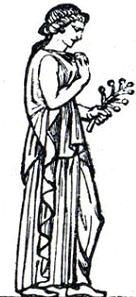
Administering justice is often placed in the sphere of influence of either Athena of Nemesis, and both Goddesses do, indeed, have connections to it. There is one Theia, however, who is the personification of the phenomenon of justice. Dikē (Δικη) is the Goddess of justice placed upon mortals, fair judgements and the rights established by custom and law. According to Hesiod, She was born from a joining of Zeus and Themis, the Titan Goddess of divine law, custom and prophecy. She has five sisters, Eunomia (Ευνομια, Goddess of good order and lawful conduct) and Eirênê (Ειρηνη, Goddess of peace and spring), with whom Dikē forms the Horai (Ὡραι), the Goddesses of the seasons and the natural portions of time; and the Moirai, the Goddesses of fate. Their names are Kloto (Κλωθώ, spinner), Atropos (Ἄτροπος, unturnable), and Lakhesis (Λάχεσις, Alotter).

The Horai, Eirênê, Eunomia, and Dikē

Dikē was born to Zeus and Themis in a coupling before He took Hera as his wife and queen. Hellenic didactic poet Aratos (Ἄρατος) regarded Her as Astraia (Αστραια), who is either a sepatarte Theia to Dikē, or as an epithet of Her who took to the earth, where the Golden Age ruled. This age, long before the age of heroes, was a just age, and there were no wars. there was no famine. No man coveted possessions of another. Much of this was attributed to Dikē, who kept the inhabitants of this age ethically strong and morally fair. When those of the Golden Age passed, they were morally pure, and became daímōns, guarding over those of later ages. Dikē remained on earth for the Silver Age, but those of the silver age were more corruptible. She wished for the race of the Golden Age, and more and more, the silver race became diseased with lawlessness and strife. Dike gathered the beings of the silver race and told them the following:

"Behold what manner of race the fathers of the Golden Age left behind them! Far meaner than themselves! But ye will breed a viler progeny! Verily wars and cruel bloodshed shall be unto men and grievous woe shall be laid upon them." (96)

With that, she left earth for the stars, where she watches over the earth as the constellation Virgo. Aratos goes on to say that Dikē hated the bronze age men, 'who were the first to forge the sword of the highwayman, and the first to eat of the flesh of the ploughing-ox'. Other writers like playwright Aeschylus in his 'Papyri Oxyrhynchus', Hellenic rhetorician Demosthenes in 'Against Aristogeiton', within the Orphic Hymns, and by Hesiod himself in Works and Days place Dikē next to the throne of mighty Zeus, Her father, where she can tell Zeus of those whom break her teachings.

Returning to Dikē's genealogy: her family tree would look as follows:

  Chaos ------------ Gaea
             |                |
      Ouranos   ---   |
              Themis -- Kronos --- Rhea 
                 |              |
                      |            Zeus
                  |     ---     |
                  | 
                    Dikē

It should be noted that Aratos' Astraia was born not to Zeus and Themis, but to Astraios (Ἀστραῖος) and Eos (Ἠώς). Eos's family line is quite clear, as She is said to have Hyperion and Euryphaessa as Her parents. Astraisos' family line is less clear, with options ranging from Krios and Eurybia to Tartaros and Gaea. As such, it is far more logical to place Her into the sky after Her departure from earth than at Zeus's feet.

Aeschylus wrote of the fucntion and tasks of Dikē the best, I feel, although the final lines are mostly lost to us:

"Dike: And he [Zeus] has his seat upon his father's very throne, having overcome Kronos by means of Justice (Dike); for Zeus can now boast, since his father began the quarrel, that he paid him back with Justice on his side. That is why Zeus has done me great honour, because after being attacked he paid him back, not unjustly. I sit in glory by the throne of Zeus, and he of his own will sends me to those he favours; I mean Zeus, who has sent me to this land with kind intent. And you shall see for yourselves whether my words are empty.
Chorus: How then shall we rightly address you?
Dike: By the name of Dike, her who is greatly revered in heaven.
Chorus: And of what privilege are you the mistress?
Dike: As for the just, I reward their life of justice.
Chorus: (...) this ordinance among mortals.
Dike: But in the reckless I implant a chastened mind.
Chorus: By Persuasion's [Peitho] spells, or in virtue of your might?
Dike: I write their offences on the tablet of Zeus.
Chorus: And at what season do you unroll the list of crimes?
Dike: When the proper time brings the fulfilment of what is theirs by right.
Chorus: Eagerly, I think, should the host welcome you.
Dike: Much would they gain, should they receive me kindly." (part of frag. 282)

Dikē is regarded as a great Goddess whom no one mortal man or woman would defy openly. We all claim our actions are justified (even when they are not so in the eyes of others), and in an argument, even opposites call upon Her, because they are sure She will favor them. Both the oppressors in a war, as the oppressed will say Dikē is on their side, and even thieves and murderers are sure that what they did was just. We had to do it, in order to feed our families, protect our spouse, etc. All are right to call upon Dikē--whose Roman equivalent Iustice became Lady Justice--but it is up to Zeus to pass the final judgement. At that time, He will send Nemesis to strike down the unjust party.

While Lady Justice is often depicted with scales, a sword, and a blindfold, Dikē was depicted solely with scales. The sword is attributed to the Roman Iustice, who combined attributes of both Dikē, and Her mother Themis. As such, Iustice administered justice to all, not just mortals. The sword may have been inherited from Nemesis. The blindfold came much later, in the fifteenth century, to indicate that justice is or should be placed upon one objectively, without fear or favour, regardless of identity, money, power, or weakness; blind justice and impartiality. In ancient times, Dikē was sometimes depicted with a cornucopia, to indicate that those who follow Her teachings are rewarded richly, something echoed in Hesiod's writing:

"There is a noise when Dike is being dragged in the way where those who devour bribes and give sentence with crooked judgements, take her. And she, wrapped in mist, follows to the city and haunts of the people, weeping, and bringing mischief to men, even to such as have driven her forth in that they did not deal straightly with her. But they who give straight judgements to strangers and to the men of the land, and go not aside from what is just, their city flourishes, and the people prosper in it: Eirene, the nurse of children, is abroad in their land, and all-seeing Zeus never decrees cruel war against them. Neither famine nor disaster ever haunt men who do true justice; but light-heartedly they tend the fields which are all their care. The earth bears them victual in plenty, and on the mountains the oak bears acorns upon the top and bees in the midst. Their woolly sheep are laden with fleeces; their women bear children like their parents. They flourish continually with good things, and do not travel on ships, for the grain-giving earth bears them fruit." (220 - 237)

All mortals do well to honor Dikē, she can be petitioned for guidance in times when moral and ethical questions weigh heavily upon you. Dikē can not be bribed, however, and unlike us mortals, She knows exactly when an action is just. Petition Her for counsel, but never expect Her to lie to Zeus about your actions. If you must request something as extreme as that, you can be sure Nemesis will not be on your side.

Image property: clipart.com.
For those of you who, like me, are not blessed with the ability to write poetry beyond the level of an eight-grader, or for those who simply wish to draw they eyes of the Theoi by reciting poetry--or actually singing the hymns if your mastery of the Greek language allows it--which is familiar to Them, hymns form a wonderful addition to your practice. The oldest, and most well know, of the hymns are undoubtedly the Homeric ones, with the Orphic ones a close second, but there are many more out there.

  • Homeric Hymns - a collection of thirty-three Hellenic hexameter poems in epic style well known from Hómēros' Iliad and Odysseia. They range in length from three to five-hundred lines, and were composed in various time periods, by a variety of--now largely anonymous--authors. Hómēros might have actually written some of them, Pamphos might have penned the 'Hymn to Demeter', and Cynaethus of Chios might have penned the 'Hymn to Apollon'. Most of the poems were written between 800 and 300 BC, a few of the shorter poems are clearly from the Hellenistic (third or second century BC) period, and the Hymn to Ares was probably added to the whole in Roman times. Who actually combined the thirty-three is unclear. The first and second hymns ('To Dionysos', and 'To Demeter') were lost for a long time, until a chance discovery in Moscow in 1777 unearthed a fifteenth century manuscript with the two poems largely intact. The 'Hymn to Apollon' was noted down on the walls of Artemis' temple at Delos, and was most likely a large part of the festivals held there for Apollon. For all Homeric Hymns, go here.
  • Orphic Hymns - a collection of eighty-seven short religious poems composed in either the late Hellenistic or early Roman (first or second century AD) era. They are based on the beliefs of Orphism, a mystery cult or religious philosophy which claimed descent from the teachings of the mythical hero Orpheus. The Mysteries were mostly connected to Demeter, Persephone, life after death and reincarnation. From the Orphic Hymns also comes a list of which incenses to offer to which deity. For all Orphic Hymns, go here.
  • Hymns of Kallimachos (Καλλίμαχος) - a lesser known collection of poems, written by Kallimachos of Kyrēnē (Κυρήνη, Cyrene), who was a Hellenic poet and scholar of the Library of Alexandria. He rose to greatness around the third century BC and was the author of a large number of works. Unfortunately, only six hymns and sixty-three epigrams have survived to this day. Kallimachos despised the 'outdated' poetry type of Hómēros and wrote many testimonials against it. His hymns are, therefor, different to the eye than the Homeric and Orphic ones. For the complete hymns, go here.
  • Delphic Hymns - two musical compositions from ancient Hellas, dating back to 128 BC. They were recovered from the walls of the treasury of Apollon at Delphi, and were most likely performed in His worship at the Pythian festival. The first of the hymns was written and composed by Athenios, son of Athenios, the second by Limenios, son of Thoinos. For the first hymn, go here, for the second, go here.
  • Hymns of Proklos - Proclus (Πρόκλος) was a Greek Neoplatonist philosopher, one of the last major Classical philosophers. He was alive from 8 February 412 AD to 17 April 485 AD), and while a very late addition to this list, he wrote five beatiful hymns about the Roman Gods, which can be interpreted for the Hellenic ones as well. The surviving works consist of two hymns to Venus (Aphrodite), one to the Sun (Helios), one to the Muses, and one to Minerva (Athena). The surviving hymns can be found here, in both Greek and English.
  • Hymns of Mesomedes - Mesomedes of Krete (Μεσομήδης ὁ Κρής) was a Roman-era Hellenic lyric poet and composer of the early second century AD.  He was a freedman and court musician to the emperor Hadrian (reigned 117-138 CE), and created  three hymns and fifteen poems which have survived to this day. The hymns to Nemesis, the muse Calliope, and the Sun can be read here and listened to here. I am partial to this translation of the 'Hymn to Nemesis'.
  • Hymn to Aphrodite - This most wonderful hymn was written by Sappho (Σαπφώ) as she was struggling with love. It's unique in that it shows both petitioner and Aphrodite Herself. I am partial to this translation.
If you were a citizen of ancient Hellas, you strove for honor. It was earned through hard work, through arete, through excelling in combat (usually for men), athletics (men and women), science (mostly men, some women) and/or exacting vengeance upon those who wronged you, your family, or your country/city state.

We will look at large scale war--as described in the Iliad--first. Failure to bring a foe to justice was truly dishonorable to the ancient Hellens. Just the thought of leaving Troy without victory after nine years was impossible to bear for the Hellenic warriors who had come all this way.

"Doesn’t a sailor in his benched ship fret, when the winter gales and roaring seas keep him from wife and home for even a month; while we are still held here after nine long years? Small blame then to you Achaeans, impatient by your beaked ships, yet how shameful it would be after this to return empty-handed! My friends endure a little longer, so we may know the truth of Calchas’ prophecy."

The entire Trojan war is based upon honor and vengeance. The Trojans stole Helen away and bringing her back was unavoidable. To make it worth while, however, the grievance to every single man and the family he left behind had to be avenged, doubly so for those who stayed behind on the battlefield. As Nestor says:

"So no scrambling for home till each has slept with a Trojan woman, as reward for the pain and toil Helen brings him. If any man proves anxious to be gone, let him lay hands on his black benched ship, and meet his fated death before the others."

To stay with Hómēros; the link between honor and vengeance applies not just to large-scale wars, but also--or even more so--to the home. Take Odysseus' homecoming for example. Before he even reveals himself to his grieving wife, he plots to kill all her suitors. When he draws sword upon the suitors, he shouts:

"You dogs! You thought I’d never return from the land of Troy, so you laid waste my house, forced my maids, and wooed my wife in secret though I was still alive, without fearing the gods who rule the wide sky, or that mortal vengeance would find you. Now the net of fate is thrown over you all."

Before he can reclaim his wife, Odysseus must redeem himself in front of the men who have dishonored his oikos and all that is tied to it. By killing the suitors, Odysseus reclaims his honor before his son, his wife, his serfs, his deceased family line, everyone in Ithaca he rules over, and anyone who will ever hear his story.

Several  daímōns and Theoi preside over vengeance, either from mortal upon mortal, or from the Theoi upon mortals. The latter is firmly the domain of Nemesis (Νέμεσις). Nemesis destroys those who commit hubris. She takes from those who have too much. She crushes those who boast about skill, power or items they do not possess. She's a powerful Goddess, feared by mortals, respected by the Deathless Ones.

As for the former: the first are the Erinyes (Ερινυες). Although there are other stories about Their birth, the most common is the one where these three Khthonic deities were born from Gaea, from the blood of Ouranos, as Kronos cut off His testicles and threw them over His shoulder, into the ocean. According to ancient Roman poet Virgil, They are three sisters: Alecto ('the angry'), Megaera ('the grudging') and Tisiphone ('the avenger'). They can be petitioned by victims--or family of victims--of homicide, unfilial conduct, crimes against the gods, perjury and crimes committed by a child upon their parent(s). They are famous for continuing their unrelenting punishments until the perpetrator shows remorse. Due to their ability to enter and leave the Underworld at will, they will even continue Their punishment after the perpetrator is dead.

Then there is also the daímōn Alastôr (Αλαστωρ), daímōn of family blood feuds and the inflicton of vengeance upon a new generation for the crimes of their fathers. Where the Erinyes go after the perpetrator of the crime, Alastôr goes after the family of the perpetrator. In this regard, he is close to an epithet of a very familiar Theos: Zeus.

Zeus Meilichios (Ζεύς Μειλίχιος) is a Khthonic epithet of Zeus, who received only nighttime sacrifices, and only by way of a holókaustos. Zeus seems to have adopted the Meilichios epithet from an older Khthonic serpent daímōn or Theos. He is--like the Erinyes and Alastôr--an avenger of blood feuds between families. Yet, unlike the others, Zeus Meilichios is also a purifier. When someone avenged the murder of a family member by killing the killer--or even someone else from that family line--they could petition Zeus Meilichios with a holókaustos of sheep (although another four-legged creature would also suffice) and be cleansed of miasma caused by this murder. As a personal note, I would say that appeasing Zeus Meilichios would also get the Erinyes and/or Alastôr off of your back.

The vendettas Zeus Meilichios presided over were common in Homeric Hellas; like scholar John Gwyn Griffiths has stated: "Vendetta is a war, just as war is an indefinite series of vendettas; and such acts of vengeance are sanctioned by the gods". In a society where family matters often overruled the law, or where local law was set by local communities, it's understandable that taking vengeance into one's own hands makes sense. And so, the closest male relative to the murdered family member took it upon himself to reclaim the honor of the slain family member. This was usually the brother of the deceased, or their son.

How often this act was actually performed is unknown. If one counts the victims of war amongst those who died because of blood feuds, the number is huge; the Hellens fought a huge amount of wars. My gut instinct says that this practice was prevalent in ancient Hellas, and was most likely executed more often than we would like to accept in our current law-regulated society.

As I have said before: reconstruction of a religion is exactly that: reconstruction of a religion, not the full culture in which that religion was placed. This is not a call for Hellenics to go about murdering people (obviously!). Yet, the Erinyes and/or Alastôr can still be petitioned when seeking (judicial) vengeance upon someone who has wronged you or your family. The downfall of someone else is not a pretty thing to wish for, but there can still be situations in which it is called for--the decision to kill someone was most likely not taken lightly either--and Zeus Meilichios can still be petitioned to get rid of the miasma of the act of said vengeance.

Vengeance has become an ugly word. I'm not a vengeful person myself, and following the Rule of Three for nearly twelve years didn't help that any. Yet, in ancient Hellas, vengeance was seen as justice served. It was a punishment for a crime committed. It was serious business and was presided over by Theoi and daímōns who were not to be messed with. They still aren't. I have spoken about wishing things for yourself, and how that is perfectly alright within Hellenismos. Sometimes, we wish for dark things, and that's also alright.

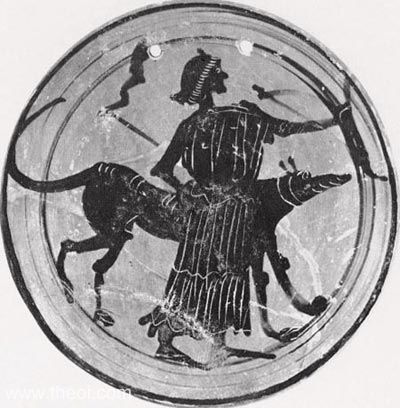
Image credit: Nemesis, Zeus Meilichios