Showing posts with label Hades. Show all posts

I get a lot of questions from readers, and most of the time, the answers are fairly short. When I feel the question or the reply would be valuable to others as well, I make a post with a collection of them and post them in one go. Today is one of those posts.


"Another Hades/Plouton ask: why is it kind of taboo to actively worship/invoke Hades? I understand His association with death, but He is not the god of death in the way Thanatos is, nor did he choose to be lord of the dear. I've always been very interested in Him both as Hades and as Plouton. I suppose my question is, why is this not really encouraged? Have I interpreted Him all long? Does He prefer not to be invoked by us?"

As king of the Underworld, the ancient texts tell us Hades became quite cut off from the world above. It were only the oaths and curses of men that reached His ears, as they reached those of the Erinyes. This is why when people invoked Him, they dug a pit to sacrifice in and struck the earth with their hands to get His attention. Black male sheep were offered to Him and the person who offered the sacrifice had to turn away his face.

Pausanias wrote in his 'Description of Greece' about the one temple (at Elis) where Hades was worshipped as Lord of the Dead:

"The sacred enclosure of Hades and its temple (for the Eleans have these among their possessions) are opened once every year, but not even on this occasion is anybody permitted to enter except the priest. The following is the reason why the Eleans worship Hades; they are the only men we know of so to do. It is said that, when Heracles was leading an expedition against Pylus in Elis, Athena was one of his allies. Now among those who came to fight on the side of the Pylians was Hades, who was the foe of Heracles but was worshipped at Pylus.
 
Homer is quoted in support of the story, who says in the Iliad:–
And among them huge Hades suffered a wound from a swift arrow,
When the same man, the son of aegis-bearing Zeus,
Hit him in Pylus among the dead, and gave him over to pains. Hom. Il. 5.395-397
 
If in the expedition of Agamemnon and Menelaus against Troy Poseidon was according to Homer an ally of the Greeks, it cannot be unnatural for the same poet to hold that Hades helped the Pylians. At any rate it was in the belief that the god was their friend but the enemy of Heracles that the Eleans made the sanctuary for him. The reason why they are wont to open it only once each year is, I suppose, because men too go down only once to Hades. " [6.25.2]

The only other time Hades as Lord of the Underworld was part of religious services seems to have been at funerals.

Hades was worshipped throughout ancient Hellas, but mostly in His epithet of Plouton; 'Wealth-giver', who was mostly connected to the fruitful earth, not the dead. He had a temple in Elis, near Mount Menthe, at Olympia, and was worshipped at Athens in the grove of the Erinnyes. In ancient Hellenic religion and myth, Ploutōn represents a more positive concept of the God who presides over the afterlife. The name Ploutōn came into widespread usage with the Eleusinian Mysteries, in which Ploutōn was venerated as a stern ruler but the loving husband of Persephone.

Ploutōn and Hades came to differ in character, but they are not distinct figures and share their  mythology. Ploutōn as the name of the ruler of the underworld first appears in Hellenic literature of the Classical period, in the works of the Athenian playwrights and of the philosopher Plato, who is the major Hellenic source on its significance. Under the name Ploutōn, the God appears in other myths in a secondary role, mostly as the possessor of a quest-object, and especially in the descent of Orpheus or other heroes to the underworld.

In general, Khthonic--Underworld--deities have Ouranic epithets that make them less scary and more helpful to humanity. It were these epithets that received worship, not the Kthonic ones. Worhipping Hades in His role as Lord of the Dead is a modern concept. Not wrong, per se, but modern.

~~~

"My husband and I are started looking into Hellenismos recently and we had a question pertaining to the Percy Jackson books. Percy uses a hand gesture described as a claw over the heart being pushed out to ward off evil. We were wondering if this is a real hand gesture and if so what are its origins? And are there any gestures in the Hellenistic religion that we should know about?"

This hand gesture is unknown to me, based on ancient sources. There are a few others I know of:

- During Ouranic sacrifice, the palms of both hands are turned upwards and the arms raised. During Khthonic sacrifices, this is reversed (palms down, arms down).
- Libations for Ouranic deities are poured out from a bowl in the right hand, libations to Khthonic deities are poured out from a bowl in the left hand.
- The 'fig sign', a gesture made with the hand and fingers curled and the thumb thrust between the middle and index fingers was a fertility and good luck charm designed to ward off evil in ancient Hellas, but is often seen as obscene now.
- The 'Mountza sign' was and is a traditional Greek insilt. It's made by extending and spreading all five fingers and presenting the palm or palms toward the person being insulted.
- When you swear an oath to the Theoi, hold up your right hand, bend your pinkie and ringfinger down to your palm and extend all other fingers up.

~~~

"Do you believe that you can consider yourself a practitioner of Traditional Hellenismos if you practice mindfulness, which has its origins in Buddhism? I have issues with anxiety and depression, and I find the techniques of mindfulness immensely helpful."

Yes, I do. The ancient Hellenes were big on meditation and practiced many other self-awareness and tempering techniques as they believed (rightfully so) that it sharpened their minds. Go for it, especially if it helps you! I truly believe that nothing should ever come between you and your mental health, even if it was frowned upon in ancient Hellas.

~~~

"What do you think will happen with your soul when you die? In a Hellenic Polytheistic way."

The ancient Hellenes believed that the moment a person died, their psyche--spirit--left the body in a puff or like a breath of wind. Proper burial was incredibly important to the ancient Hellenes, and to not give a loved one a fully ritualized funeral was unthinkable. It was, however, used as punishment of dead enemies, but only rarely. Funerary rites were performed solely to get the deceased into the afterlife, and everyone who passed away was prepared for burial according to time-honored rituals.

Orphic ideas of the soul and afterlife are most often defined by explicit contrast with the Homeric view of the afterlife, which is taken as the standard view for ancient Hellenic culture. The Homeric afterlife is that of a grim, joyless and tedious existence in the Underworld. The Underworld of Homeros exists solely--at least for the now departed mortal--of the Asphodel meadows. The dead drink from the river Lethe and forget who they were. Sacrifical (animal) blood returns a sense of life to the shades and they recover their memories for a short time. In this tradition, life is lived while you are alive. One you die, you are dead. You might cling to life, but you will never truly be part of it again.

The Orphics were an ancient mystical cult with affinities to Indian religious systems. They believed in reincarnation and the possibility of liberation. Orpheus, the movement's legendary founder, is said to have taught that soul and body are locked together during life; the soul is divine, immortal and aspires to freedom, and during life, the body acts as a prison to the soul. Death releases the soul for a short while, but is then captured by another body until that, too, dies, and so the soul moves from body to body--both human and animal--until it can attain the highest good: liberation. In order to reach liberation, the Orphic way teaches to turn to God by ascetic piety of life and self-purification: the purer the life lived, the higher will be the next reincarnation, until the soul has completed the spiral ascent of destiny to live for ever as God from whom it comes.

The ancient Hellenes called this process 'Metempsychosis' (μετεμψύχωσις). It is a philosophical term which refers to the transmigration of the soul, especially its reincarnation after death. The notion that the human soul enters another body upon death, though unfamiliar in Hellenic religion, was widespread in Hellenic philosophy. The doctrine of transmigration is first associated with the Pythagoreans and Orphics and was later taught by Plato and Pindar. For the former groups, the soul retained its identity throughout its reincarnations; Plato indicated that souls do not remember their previous experiences. Although Herodotus claims that the Hellenes learned this idea from Egypt, most scholars do not believe it came either from Egypt or from India, but developed independently.
 
My personal believes of life after death have shifted over the years. I transitioned into Hellenismos from Eclectic Religious Witchcraft and in my former Tradition, reincarnation was the primary belief. Since the ancient Hellenes had a version of it in metepsychosis, I simply went with that. Now, the older I get and the better my understanding becomes of the ancient Hellenic culture and religion, the more I pull to a more Homeric version of the afterlife. A bit later, perhaps, where Elysium is an option for those who live the highest, purest, of lives. I long for the meadows now. I don't strive for Elysium; I don't think it's for the common folk like me. Give me the meadows and the water of the river Lethe. Let me live life to the fullest. Let me live its up and downs. Give me the completion of my goals and my challenges, and then let me forget and wander in contentment, remembered sometimes--hopefully fondly--by those I leave behind.

 Poseideon is the sixth month of the Hellenic calendar and we are slowly moving towards it. Poseideon is a special month; it was the month that would have been repeated (in a minor way) should the ancient calendar not line up with the phases of the moon (which it didn't, after a while). You can read more about that here as it is beyond the scope of this post. What I would like to talk to you about today is the divine triad that oversaw Poseideon (the quartet, actually, but we'll get to that) and its significance.

Poseideon was ruled by Poseidon (honoured during the Poseideia), Zeus (during the Plerosia and a seperate sacrifice to Zeus Horios) and Dionysos (during the Lesser Dionysia and secondarily during the Haloa). Poseideon is the first true winter month; the first harvest was over, seafaring had ceased and thus war had come to an end. The focus was on the home and preparation for true, deep winter: the weather turned and the crops needed protecting. Because of this, it was also a month of threat; if the crops failed, if the seas became too rough when a daring fisherman was out on it, or if a river went out of bounds and flooded a well populated area there would be death.

I get on my soapbox a lot on my blog. One of my main points is that everything is connected in the ancient Hellenic religion. That everything was constructed the way it was for a reason; the pantheon, the calendar, the festivals, the way festivals were celebrated--if you spend time to sort out the why, you will discover it's all part of an intricate web that formed an entire civilization. Nothing--absolutely nothing--in our religion and in the ancient civilization it was formed in ended up in it by accident. We have lost a lot of knowledge and understanding of this society but we can try to piece things together if we put in the effort. So today I will put in a little effort to explain why Poseideon was ruled by Poseidon, Zeus and Dionysos. And why it mattered that it were Them.

During the Poseideia, Poseidon as savior of ships, protector of those who voyage in ships, and God of the lapping waters both salt and fresh important for agriculture, is thanked for the many gifts that came from faraway places that were likely given at that time. The immense trade and distribution was nearly all through shipping, relatively little overland, whether it be perfume from Cyprus or pottery from Corinth. One of Poseidon’s epithets is prosklystios, 'of the lapping water'. He is also invoked as Poseidon phytalmios which implies natural fertility and human procreation.

The Plerosia is a harvest festival of sorts. It was held to honour Zeus but presumably als Demeter. Poseideon marks the time to return home, take stock, and stay warm. It's a time to thank the Theoi for all that has been recieved and all that will get us through the winter. The word ‘plerosis’ means fulfillment, satiated, filled. Important note: the Plerosia seems to have been a women-only festival, perhaps because now that winter is upon us, we turn to the domain of the women: the house(hold). As such, it is her prerogative to thank the Gods for the food she can feed her family with.

The lesser Dionysia, a vintage festival, was celebrated in the various demes of Attica in the month of Poseideon. It was probably a very ancient festival, perhaps not originally associated with Dionysos. The Dionysia was a time when classes came together in order to celebrate their shared origins in the natural world; it was a vintage festifal for all.

The Haloa was held in honor of Demeter, Dionysos and a little bit in honor of Persephone. Like all festivals of Demeter and Persephone's 'Kore' persona, women were the only ones who were allowed to handle the religious and sacrificial side of it. The Haloa is assumed to be a celebration of the pruning of the vines and the tasting of the wine after its first fermentation, or it may be to encourage the growth of corn from the seed.

A few links between Poseidon, Zeus and Dionysos are clear instantly from the descriptions of these festivals. Poseidon and Dionysos are linked through water--moisture, actually. Plutarch already noted that Dionysos was a God of moisture--in particular the moisture associated with life and vigour as can be seen in plants and trees and most telling in the wine produced from the fruits of the vine. Poseidon is all but the personification of water of all kinds. Furthermore, one of the epithets of Dionysos is Dendrites, ‘of the trees’, connects him to branching life. The tree was similarly a metaphor for rivers whose branching nature was morphologically similar. This links Dionysos to Poseidon even more.

And what of Poseidon and Zeus? Poseidon is the brother of Zeus and Hades, and together they form a triumvirate who represents the dominion of the sea, the sky and the underworld respectively. In Hellenic mythology, the underworld is seen as an exact mirror and equally valid version of the ‘celestial’ world. In other words: Zeus is Hades inverted and Poseidon is the synthesis of both. Dionysos therefore unifieds these god-themes and manifested them in the mundane world.

This brings us to Hades, the fourth member of this triad. He is worshipped too, just not directly--never directly. the ancient Hellenes very rarely honoured Hades, not even Plouton, His ouranic epithet. But Hades' influence was most definitely felt; he's the third of the triumvirate, He is prevalent in the threat of death that hangs over the month and He is appeased though a medium who is perhaps unlikely: Demeter.

Mythological and epithological links exist between Demeter and Hades. Hades was celebrated as an important divine figure in the Eleusinian Mysteries. The seasonal drama of nature was said to depend on her annual passage into the underworld in the depths of winter when fruitfulness and vegetation dies back. Through Kore (Persephone) Hades and Demeter rule over the harvest. Hades takes and Demeter gives--or more accurately: Hades causes Demeter to take instead of give. In praying for fruitfulness of the earth to Demeter, it is also Hades who is spoen to and appeased, which makes Him an unofficial member of the triad (this is likewise true for Demeter and even Kore/Persephone).

To compelete the circle, Dionysos and Demeter are worshipped together during the Haloa, which drives home the agricultural ties all these five deities have  and the way they link to the mundane issues of this time of year; Demeter and Hades (Plouton) through the fruitful earth (underworld), Zeus through mild weather (sky) and Poseidon and Dionysos through sweet water (the intermediate). Because of Their links and domains, it can be only these deities that govern Poseideon.

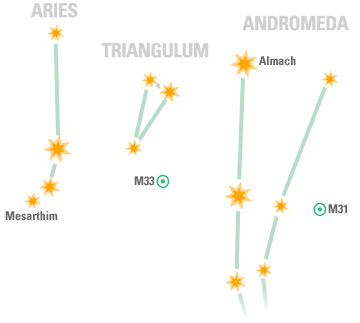
Did you know there was a constellation called 'the triangle'? And that the ancient Hellenes were aware of it, too? Triangulum is a small constellation in the northern sky. It was one of the 48 constellations listed by the second century astronomer Ptolemy, and so named for its three brightest stars, which form a long and narrow triangle. The Ancient Hellenes called Triangulum 'Deltoton' (Δελτωτόν), after the upper-case letter delta (Δ). Hellenic astronomers such as Hipparchos and Ptolemy called it Trigonon (Τρίγωνον).


There is not a lot of mythology connected to this tiny constellation, but the lore that it has is quite important. Hyginus, in his 'Astronomica' explains the options:

"This constellation, which has three angles like the Greek letter Delta, is so named for that reason.
Mercury [Hermes] is thought to have placed it above the head of Aries, so that the dimness of Aries might be marked by its brightness, wherever it should be, and that it should form the first letter in the name of Jove [Zeus] (in Greek, Dis).
Some have said that it pictures the position of Egypt; others, that of Aethiopa and Egypt where the Nile marks their boundaries. Still others think that Sicily is pictured there.
Others, say that three angles were put there because the gods divided the universe into three parts." [II.19]

The latter is the only one that might need some explaining. Zeus, the greatest of the Olympian Gods, and the father of Gods and men, was a son of Kronos and Rhea, a brother of Poseidon, Hades, Hestia, Demeter, Hera. When Zeus and His brothers drew lots for the rule of the world, Poseidon obtained the sea, Hades the lower world, and Zeus the heavens and the upper regions, but the earth belonged to them all. To quote the 'Iliad' by Hómēros:

"Poseidon was very angry and said, "Great heavens! strong as Zeus may be, he has said more than he can do if he has threatened violence against me, who am of like honour with himself. We were three brothers whom Rhea bore to Kronos--Zeus, myself, and Hades who rules the world below. Heaven and earth were divided into three parts, and each of us was to have an equal share. When we cast lots, it fell to me to have my dwelling in the sea for evermore; Hades took the darkness of the realms under the earth, while air and sky and clouds were the portion that fell to Zeus; but earth and great Olympus are the common property of all." [XV.187]

The constellation Triangulum is visible at latitudes between +90° and −60°, and best visible at 21:00 (9 p.m.) during the month of December.

 Some plants in Greece are so deeply connected with Hellenic history, mythology, and tradition that is hard to find a starting point. Perhaps the most prominent is the pomegranate. Maybe the oldest report about the pomegranate bush is by Homer, who first called this beautiful bush ‘Ria’ and this name remained until it was replaced with ‘Rodia’ in modern Greek. Punica granatum, the scientific name of pomegranate may derive from punicum, meaning red color in Latin. The name pomegranate is derived from the Latin words pomum and granum meaning apple and seed respectively.


Homer described this plant in the gardens of king of Faiakon (Kerkira island nowadays). A famous myth featured Persephone, daughter of Demeter and Zeus who was taken to the Underworld by Hades. He offered Persephone seven seeds of pomegranate, which symbolized marriage. In this way, the couple was bonded forever and for six months Persephone was ‘above’ and for six she was ‘down’ in the Underworld Hades. This is how it was explained, in tradition and from mythology to modern art, that some for some months Earth is sleeping and then she is ‘reborn’ in Spring.

For example, it was used by a symbolist poet melodized by Mikis Theodorakis about a lover who left, symbolized as pomegranate. Also, pomegranate was depicted in statues of Hera, Goddess of marriage and fertility, but was also associated with Aphrodite, Goddess of passion and love. Therefore, in ancient Hellas it was cultivated as a shrub of love, fertility, family, and good luck.

When the outer surface is dried, the inner seeds are juicy ready to be consumed, another reason for this fruit’s symbolization of death and life.

Its nutritional value is quite high. Bit its sour taste is undesirable for some palates due to the high amounts of antioxidants, tannins, and vitamins. A great way to consume it raw is in a green salad with kefalotyri or parmesan cheese and some ‘ntakos’, dried Cretan bread or croutons. Also, it can used fresh in every sweet recipe with fresh fruits like strawberries or blueberries.

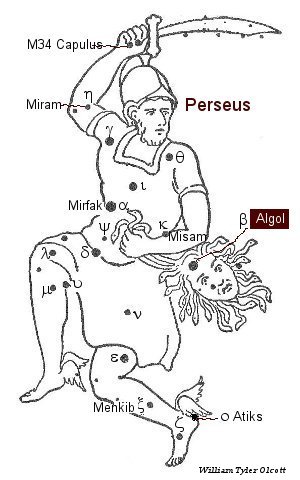
Perseus is one of ancient Hellas' greatest heroes, and it is not odd that he was immortalized in the night's sky. He is--of course--linked to the many constellations dedicated to the rescue of Androméda, but there is far more tot he hero Perseus.

 
http://www.constellationsofwords.com/stars/Algol.html

Perseus was born to Danae, who was locked in a bronze chamber by her father Akrisios, where she was impregnated by Zeus in the form of a golden shower. Akrisios put both mother and child in a chest and set them adrift on the sea, but they washed safely ashore on the island of Seriphos. From Hyginus' 'Fabulae':

"Danaë was the daughter of Acrisius and Aganippe. A prophecy about her said that the child she bore would kill Acrisius, and Acrisius, fearing this, shut her in a stone-walled prison. But Jove, changing into a shower of gold, lay with Danaë, and from this embrace Perseus was born. Because of her sin her father shut her up in a chest with Perseus and cast it into the sea. By Jove’s will it was borne to the island of Seriphus, and when the fisherman Dictys found it and broke it open, he discovered the mother and child. He took them to King Polydectes, who married Danaë and brought up Perseus in the temple of Minerva. When Acrisius discovered they were staying at Polydectes’ court, he started out to get them, but at his arrival Polydectes interceded for them, and Perseus swore an oath to his grandfather that he would never kill him. When Acrisius was detained there by a storm, Polydectes died, and at his funeral games the wind blew a discus from Perseus’ hand at Acrisius’ head which killed him. Thus what he did not do of his own will was accomplished by the gods. When Polydectes was buried, Perseus set out for Argos and took possession of his grandfather’s kingdom." [63]

The story of Perseus is somewhat chaotic; his myths have been told and retold many times--even in ancient times--and what happens to Perseus next is most certainly up for debate. To quote the 'Dictionary of Greek and Roman Biography and Mythology':

"According to a later or Italian tradition, the chest was carried to the coast of Italy, where king Pilumnus married Danaë, and founded Ardea (Virg. Aen. vii. 410; Serv. ad Aen. vii. 372); or Danaë is said to have come to Italy with two sons, Argus and Argeus, whom she had by Phineus, and took up her abode on the spot where Rome was afterwards built (Serv. ad Aen. viii. 345). But, according to the common story, Polydectes, king of Seriphos, made Danae his slave, and courted her favour, but in vain. Another account again states that Polydectes married Danae, and caused Perseus to be brought up in the temple of Athena. When Acrisius learnt this, he went to Polydectes, who, however, interfered on behalf of the boy, and the latter promised not to kill his grandfather. Acrisius. however, was detained in Seriphos by storms, and during that time Polydectes died. During the funeral gaines the wind carried a disk thrown by Perseus against the head of Acrisius, and killed him, whereupon Perseus proceeded to Argos and took possessions of the kingdom of his grandfather (Hygin. Fab. 63)."

No matter the version of the tale, Perseus' greatest heroic deed is what follows: the hunt for Médousa. In the most common versions of the story, Polydektes did not yet marry Danae, but wished to. A now grown up Perseus did not trust Polydektes and tried to keep him away from his mother, so Polydektes had to come up with a plan. He said he would marry Hippodameia--tamer of horses--and asked Perseus for a horse to give as a wedding present. Perseus didn't have one to give, so he told Polydektes to name any other favour, and that he would not refuse. Polydektes then instructed him to cut off and bring back the head of a Gorgon, and Perseus was trapped. From Apollodorus' 'Bibliotheca' we learn the following:

"So with Hermes and Athene as his guides Perseus sought out the Phorkides (daughters of Phorkys), who were named Enyo, Pephredo, and Deino. The three of them possessed only one eye and one tooth among them, which they took turns using. Perseus appropriated these and when they demanded them back, he said he would return them after they had directed him to the Nymphai. These Nymphai had in their possession winged sandals and the kibisis, which they say was a knapsack. (Pindaros and Hesiodos in the Shield of Herakles, describe Perseus as follows : `The head of a terrible monster, Gorgo, covered all his back, and a kibisis held it.’ It is called a kibisis because clothing and food are placed in it.). They also had the helmet of Haides. When the Phorkides had led Perseus to the Nymphai, he returned them their tooth and eye. Approaching the Nymphai he received what he had come for, and he flung on the kibisis, tied the sandals on his ankles, and placed the helmet on his head. With the helmet on he could see whomever he cared to look at, but was invisible to others.

Perseus took flight and made his way to the Okeanos, where he found the Gorgones sleeping. Their names were Stheno, Euryale, and the third was Medousa, the only mortal one : thus it was her head that Perseus was sent to bring back. The Gorgones’ heads were entwined with the horny scales of serpents, and they had big tusks like hogs, bronze hands, and wings of gold on which they flew. All who looked at them were turned to stone. Perseus, therefore, with Athena guiding his hand, kept his eyes on the reflection in a bronze shield as he stood over the sleeping Gorgones, and when he saw the image of Medousa, he beheaded her. (As soon as her head was severed there leaped from her body the winged horse Pegasos and Khrysaor, the father of Geryon. The father of these two was Poseidon.) Perseus then placed the head in the kibisis and headed back again, as the Gorgones pursued him through the air. But the helmet kept him hidden, and made it impossible for them to identify him.” [2. 36 - 42]

With Médousa's head secured, Perseus headed back to Polydektes, but was stopped while on route by the vision of a woman, chained to a rock, about to be devoured by a sea monster. It had been a dark day for Cepheus, king of Aethiopia, when he had heard his wife Cassiopeia boast that her daughter Androméda was more beautiful than the Nereids. Shocked, he had tried to silence his wife, but it was too late. The father of the Nereids, the sea God Nereus, had heard Cassiopeia's prideful boast and had brought his grievance to Poseidon. Poseidon had ruled in favour of Nereus and sent Cetus, a huge sea monster, to ravage the coasts of Aethiopia. Nereus would only be appeased when Cepheus sacrificed his daughter to Cetus. Cepheus had refused, but when the terror continued, Androméda had offered herself up to be sacrificed. Fast forward to Andromeda, chained to the rocks, about to die. Perseus pulled Médousa's head out of his bag and petrified Cetus with it before undoing Androméda's bindings. He fell for the beautiful princess instantly, and desired to take her as his wife. In most versions of the myth, he is allowed, but Hyginus in his 'Fabulae' has a different story to tell:

"When he wanted to marry her, Cepheus, her father, along with Agenor, her betrothed, planned to kill him. Perseus, discovering the plot, showed them the head of the Gorgon, and all were changed from human form into stone. Perseus with Andromeda returned to his country." [64]

Perseus eventually married Androméda and took her off to his native island of Serifos. They had many children; sons Perses, Alcaeus, Heleus, Mestor, Sthenelus, and Electryon, as well as daughters, Autochthe and Gorgophone. According to Hyginus in his 'Astronomica', Perseus was committed to the stars for the following reasons:

"He is said to have come to the stars because of his nobility and the unusual nature of his conception."

The constellation Perseus is visible at latitudes between +90° and −35° and best visible at 21:00 (9 p.m.) during the month of December.

 I get a lot of questions from readers, and most of the time, the answers are fairly short. When I feel the question or the reply would be valuable to others as well, I make a post with a collection of them and post them in one go. Today is one of those posts.


"You recently answered a question about mythology and if it's real or not. You didn't answer if you think monsters are real as well. Do you? How about demi-gods? Are they currently amongst us?"

I feel about monsters the same way I do about all other aspects of mythology: they are real. They are the skeletons of dinosaurs and early mammals. They are the divine challengers of our Gods and heroes, They are the stories of the ancient Hellenes. There is no differnece between them. They are all facets of the same thing. I believe that if the ancient Hellenes had not found a field of mammoth bones, the Titanomachy and then the Gigantomachy would never have (retroactively) taken place in mythology, lending power to the Theoi. I believe  that the rise and fall of sea levels are caused by the combined effects of the gravitational forces exerted by the Moon and the Sun and the rotation of the Earth as much as I believe Kharybdis causes it. Facets.
 
As for demigods... define demigods. Do I think there is a camp in the woods somewhere with the offspring of Gods (even if they are traditionally considered virginal) like in Percy Jackson? No. But then again, what do I know? For Like I said before, I am sure there was someone like Herakles (or many men like Herakles!) who performed amazing feats of strength and endurance. I think those people exist today. On the one hand I think they are mortals, born from mortal parents, who grew up to do amazing, divinely inspired things. On the other hand, I believe they are the offspring of a God and a mortal. Even in ancient Hellas, these views were held. There was almost always a mortal father as well--and in case of twins, sometimes one was divine and the other wasn't. I am absolutely sure the Gods inspire mrtals to do great things, even today. The ancient Hellenes would have included the lives of these people in mythology and would probably have made them offspring of the Gods. In that regard, I believe in demigods with every fiber of my being.

Point is, science is quantifiable. Whether divinely influenced or not, gravity will always pull down the falling apple at the same speed if the apple always weighs the same and water will always boil at 100 degrees celcius in our atmosphere. On Mars, things would be completely different, obviously. I believe in these simple facts. I also believe the Protogenoi and Uranides make up the fabric of our world and are thus directly responsible for these facts being true. For me, they are one and the same and they are equally true whether you look at it from the side of science or religion.

 
***

"In Hellenic Polytheism, what rituals are made when someone has recently died?"

The ancient Hellenes believed that the moment a person died, their psyche--spirit--left the body in a puff or like a breath of wind. Proper burial was incredibly important to the ancient Hellenes, and to not give a loved one a fully ritualized funeral was unthinkable. It was, however, used as punishment of dead enemies, but only rarely. Funerary rites were performed solely to get the deceased into the afterlife, and everyone who passed away was prepared for burial according to time-honoured rituals.

They believed the Underworld was a neutral place. One did not desire to go there in the least, but it was part of life, and as far as the afterlife went, it was dull and sunless but nothing like the hell of Christianity. The worst part about it is being without the touch of loved ones, and forgetting who you were.

A burial or cremation had four parts: preparing the body, the prothesis (Προθησις, 'display of the body'), the ekphorá (ἐκφορά 'funeral procession'), and the interment of the body or cremated remains of the deceased. Preparation of the body was always done by women, and was usually done by a woman over sixty, or a close relative who was related no further away from the deceased than the degree of second cousin. These were also the only people in the ekphorá. The deceased was stripped, washed, anointed with oil, and then dressed in his or her finest clothes. They also received jewelry and other fineries. A coin could be presented to the dead, and laid under or below the tongue, or even on the eyes, as payment to Kharon.

During the actual funeral, a related mourner first dedicated a lock of hair, then provided the deceased with offerings of honey, milk, water, wine, perfumes, and oils mixed in varying amounts. Any libation was a khoe; a libation given in its entirety to the deceased. None was had by the mourners. A prayer to the Theoi--most likely Hermes Khthonios--then followed these libations. It was also possible to make a haimacouria before the wine was poured. In a haimacouria, a black ram or black bull is slain and the blood is offered to the deceased. This blood sacrifice, however, was probably used only when they were sacrificing in honour of a number of men, or for someone incredibly important. Then came the enagismata, which were offerings to the dead that included milk, honey, water, wine, celery, pelanon--a mixture of meal, honey, and oil--and kollyba--the first fruits of the crops and dried fresh fruits.

Unlike the ancient Egyptians, the ancient Hellenes placed very few objects in the grave, but monumental earth mounds, rectangular built tombs, and elaborate marble stelai and statues were often erected to mark the grave and to ensure that the deceased would not be forgotten. Grave gifts were allowed in many places, but could not cost more than a set amount all together. These elaborate burial places served as a place for the family members to visit the grave with offerings that included small cakes and libations. The goal  was to never be forgotten; if the dead was remembered always, and fed with libations and other offerings, their spirit would stay 'alive' forever. That said, especially in Athens, names on grave markers were restricted to women who died in childbirth and men who died in battle.

The epitaphios logos, or funerary oration, was deemed an indispensable component of the funeral ritual, especially in ancient Athens, where it came into practice around 470 BC for the honoured (war) dead. A large part of Hellenic rituals of the dead speak of honouring the dead by name, so their names will never be forgotten, their honour never lost. This practice starts with the epitaphios logos, in which the deceased is remembered for their greatest of deeds. Because Plato was eternally weary of the abilities of others to conduct the oration in the way it was intended, he made a guide for it, describing the four steps. It started with the preamble, which describes why this oration is held and how the audience should behave during it and after it. This part tends to include an apology from the speaker that he or she will never do true justice to the achievements of the dead. Following that, there is a long talk of the origin and ancestors of the deceased, followed by an account of the bravery and other good attributes of the dead. this part tended to include they devotion to the Athenian Polity. Finally, there was an epilogue, which constitutes a consolation and an encouragement for the families of the dead. The epilogue employs a traditional dismissal of the mourners.

Not surprisingly, perhaps, but many modern, western, funeral rites bear striking resemblance to the customs of the ancient Hellenes.


***

"I would really love to hear whatever you have to say on the subject of Elysium."

The ancient Hellens believed the Underworld was a neutral place. One did not desire to go there in the least but it was part of life, and as far as the afterlife went, it was dull and sunless but nothing like the hell of Christianity. The worst part about it is being without the touch of loved ones, and forgetting who you were.

The ancient Hellenes believed the dead have three places to go in the Underworld: Tartaros, where those who are punished for all eternity remained, the Asphodel meadows, where everyone who had lived a good life wandered about endlessly, and the Elysian Fields, where the children of Gods, the blessed dead and those who had lead extraordinarily honorable, brave or otherwise well-respected lives resided.

The Elysian Fields were typically divided into two sections: the Island of the Blessed and the Lethean Fields of Hades. The Elysian Fields, or 'White Island' is the final resting place for the souls of heroes. It was an island paradise located in the far western streams of the river Okeanos and ruled over by either Kronos or Rhadamanthys, a Judge of the Dead. The second Elysium, the Lethean Fields of Hades, is a netherworld realm. It's located in the depths of Haides beyond the river Lethe. Its fields were promised to initiates of the Mysteries who had lived a virtuous life. When the concept of reincarnation emerged and spread in ancient Hellas the two Elysian realms were sometimes tiered--a soul which had thrice won passage to the Lethean Fields, would, with the fourth, be transferred permanently to the Islands of the Blessed to reside with the heroes.

It's important to note that over the course of time, Elysium evolved. Hómēros didn't mention anything like it and refers only to the Meadows for all those noble souls who have died. Hesiod mentions a special realm for heroes. Pindar, by the 5th century BC, seperates the two in his Odes. By Roman times, writers such as Virgil combine the two Elysia. Many views of the same place survive and many more most likely existed. Such is the nature of something only discoverable after death.


***

"Do you have any info, holidays, special activities, etc. on Hera?"

There are a few festivals of Hera that were celebrated in ancient Athens and Erchia, a demos near Athens. There were most likely others but much of that information has been lost. This is the list I have, in sequence of the festival year:

Metageitnion 20 – Sacrifice to Hera ‘Telkhinia’ at Erchia
Boedromion 3 – Plataia – festival of reconciliation, sacred to Hera Daidala
Gamelion 27 – Theogamia/Gamelia – celebrating the sacred marriage of Zeus Teleios and Hera Telei
Gamelion 27 – Sacrifice to Kourotrophos, Hera, Zeus Teleius, and Poseidon at Erchia


Note that Hera would also have been honoured during any festival to Zeus and in many rites concerning Her children.

Poseideon is the sixth month of the Hellenic calendar . It was the month that would have been repeated should the ancient calendar not line up with the phases of the moon (which it didn't, after a while). We're in that repeat month now. You can read more about the process here as it is beyond the scope of this post. What I would like to talk to you about today is the divine triad that oversaw Poseideon (the quartet, actually, but we'll get to that) and its significance. 

Poseideon was ruled by Poseidon (honoured during the Poseideia), Zeus (during the Plerosia and a seperate sacrifice to Zeus Horios) and Dionysos (during the Lesser Dionysia and secondarily during the Haloa). Poseideon is the first true winter month; the first harvest was over, seafaring had ceased and thus war had come to an end. The focus was on the home and preparation for true, deep winter: the weather turned and the crops needed protecting. Because of this, it was also a month of threat; if the crops failed, if the seas became too rough when a daring fisherman was out on it, or if a river went out of bounds and flooded a well populated area there would be death.

I get on my soapbox a lot on my blog. One of my main points is that everything is connected in the ancient Hellenic religion. That everything was constructed the way it was for a reason; the pantheon, the calendar, the festivals, the way festivals were celebrated--if you spend time to sort out the why, you will discover it's all part of an intricate web that formed an entire civilization. Nothing--absolutely nothing--in our religion and in the ancient civilization it was formed in ended up in it by accident. We have lost a lot of knowledge and understanding of this society but we can try to piece things together if we put in the effort. So today I will put in a little effort to explain why Poseideon was ruled by Poseidon, Zeus and Dionysos. And why it mattered that it were Them.

During the Poseideia, Poseidon as savior of ships, protector of those who voyage in ships, and God of the lapping waters both salt and fresh important for agriculture, is thanked for the many gifts that came from faraway places that were likely given at that time. The immense trade and distribution was nearly all through shipping, relatively little overland, whether it be perfume from Cyprus or pottery from Corinth. One of Poseidon’s epithets is prosklystios, 'of the lapping water'. He is also invoked as Poseidon phytalmios which implies natural fertility and human procreation. 

The Plerosia is a harvest festival of sorts. It was held to honour Zeus but presumably als Demeter. Poseideon marks the time to return home, take stock, and stay warm. It's a time to thank the Theoi for all that has been recieved and all that will get us through the winter. The word ‘plerosis’ means fulfillment, satiated, filled. Important note: the Plerosia seems to have been a women-only festival, perhaps because now that winter is upon us, we turn to the domain of the women: the house(hold). As such, it is her prerogative to thank the Gods for the food she can feed her family with.

The lesser Dionysia, a vintage festival, was celebrated in the various demes of Attica in the month of Poseideon. It was probably a very ancient festival, perhaps not originally associated with Dionysos. The Dionysia was a time when classes came together in order to celebrate their shared origins in the natural world; it was a vintage festifal for all.

The Haloa was held in honor of Demeter, Dionysos and a little bit in honor of Persephone. Like all festivals of Demeter and Persephone's 'Kore' persona, women were the only ones who were allowed to handle the religious and sacrificial side of it. The Haloa is assumed to be a celebration of the pruning of the vines and the tasting of the wine after its first fermentation, or it may be to encourage the growth of corn from the seed.

A few links between Poseidon, Zeus and Dionysos are clear instantly from the descriptions of these festivals. Poseidon and Dionysos are linked through water--moisture, actually. Plutarch already noted that Dionysos was a God of moisture--in particular the moisture associated with life and vigour as can be seen in plants and trees and most telling in the wine produced from the fruits of the vine. Poseidon is all but the personification of water of all kinds. Furthermore, one of the epithets of Dionysos is Dendrites, ‘of the trees’, connects him to branching life. The tree was similarly a metaphor for rivers whose branching nature was morphologically similar. This links Dionysos to Poseidon even more.

And what of Poseidon and Zeus? Poseidon is the brother of Zeus and Hades, and together they form a triumvirate who represents the dominion of the sea, the sky and the underworld respectively. In Hellenic mythology, the underworld is seen as an exact mirror and equally valid version of the ‘celestial’ world. In other words: Zeus is Hades inverted and Poseidon is the synthesis of both. Dionysos therefore unifieds these god-themes and manifested them in the mundane world.

This brings us to Hades, the fourth member of this triad. He is worshipped too, just not directly--never directly. the ancient Hellenes very rarely honoured Hades, not even Plouton, His ouranic epithet. But Hades' influence was most definitely felt; he's the third of the triumvirate, He is prevalent in the threat of death that hangs over the month and He is appeased though a medium who is perhaps unlikely: Demeter. 

Mythological and epithological links exist between Demeter and Hades. Hades was celebrated as an important divine figure in the Eleusinian Mysteries. The seasonal drama of nature was said to depend on her annual passage into the underworld in the depths of winter when fruitfulness and vegetation dies back. Through Kore (Persephone) Hades and Demeter rule over the harvest. Hades takes and Demeter gives--or more accurately: Hades causes Demeter to take instead of give. In praying for fruitfulness of the earth to Demeter, it is also Hades who is spoen to and appeased, which makes Him an unofficial member of the triad (this is likewise true for Demeter and even Kore/Persephone).

To compelete the circle, Dionysos and Demeter are worshipped together during the Haloa, which drives home the agricultural ties all these five deities have  and the way they link to the mundane issues of this time of year; Demeter and Hades (Plouton) through the fruitful earth (underworld), Zeus through mild weather (sky) and Poseidon and Dionysos through sweet water (the intermediate). Because of Their links and domains, it can be only these deities that govern Poseideon.
Some plants in Greece are so deeply connected with Hellenic history, mythology, and tradition that is hard to find a starting point. Perhaps the most prominent is the pomegranate. Maybe the oldest report about the pomegranate bush is by Homer, who first called this beautiful bush ‘Ria’ and this name remained until it was replaced with ‘Rodia’ in modern Greek. Punica granatum, the scientific name of pomegranate may derive from punicum, meaning red color in Latin. The name pomegranate is derived from the Latin words pomum and granum meaning apple and seed respectively.


Homer described this plant in the gardens of king of Faiakon (Kerkira island nowadays). A famous myth featured Persephone, daughter of Demeter and Zeus who was taken to the Underworld by Hades. He offered Persephone seven seeds of pomegranate, which symbolized marriage. In this way, the couple was bonded forever and for six months Persephone was ‘above’ and for six she was ‘down’ in the Underworld Hades. This is how it was explained, in tradition and from mythology to modern art, that some for some months Earth is sleeping and then she is ‘reborn’ in Spring.

For example, it was used by a symbolist poet melodized by Mikis Theodorakis about a lover who left, symbolized as pomegranate. Also, pomegranate was depicted in statues of Hera, Goddess of marriage and fertility, but was also associated with Aphrodite, Goddess of passion and love. Therefore, in ancient Hellas it was cultivated as a shrub of love, fertility, family, and good luck.

When the outer surface is dried, the inner seeds are juicy ready to be consumed, another reason for this fruit’s symbolization of death and life.

Its nutritional value is quite high. Bit its sour taste is undesirable for some palates due to the high amounts of antioxidants, tannins, and vitamins. A great way to consume it raw is in a green salad with kefalotyri or parmesan cheese and some ‘ntakos’, dried Cretan bread or croutons. Also, it can used fresh in every sweet recipe with fresh fruits like strawberries or blueberries.
"I know you aren't supposed to kneel to the Ouranic Gods, but what about the Chthonic Gods? I've seen that their altars are meant to be ground/floor level so would we kneel but still raise our arms? Or how would that go really? Because I see them needing to be praised as well, but technically they are Underworld Gods and would be metaphorically below us, so by raising our arms would that be offensive to the Ouranic Gods?"

Khthonic (from Greek χθόνιος khthonios, 'in, under, or beneath the earth', from χθών khthōn 'earth') literally means 'subterranean'. It refers both to earth deities like Gaea as to underworld deities like Hades. earth deities usually received worship like the Ouranic Gods (although not always) while Underworld Gods received a different type of worship (although not always).

For these Khthonic Theoi, an offering pit--'bothros' (βόθρος) in Greek texts--was used. Bothroi were usually dug when the occasion called for it, and closed up afterwards. Khthonic Theoi received special nighttime offerings of black animals, unmixed wine and special libations of milk and honey. Animal sacrifice was always done in a holókaustos--a sacrifice where the entire animal was burned and none of the meat was saved for human consumptions.

Hómēros in the Odysseia writes Circe advising Odysseus how to perform a libation to the dead:
"Draw near then, as I bid you, hero, and dig a trench two feet square, then pour a libation all around to the dead, first of milk and honey, then of sweet wine, thirdly of water, sprinkled with white barley meal."

The ancient Hellenes shaped a 'negative' (part of a) ritual by a reversal of normal practices. As normal practices dictated the practitioner stand before an altar with their hands raised, it's quite logical that they performed ritual to the Khthonic deities on their knees, hands down on the soil, sometimes beating down on it to draw the attention of the deities residing below. Where women wore their hair up or covered for standard ritual, they wore their hair down in Khthonic ritual.

Worship of the Underworld Khthonic deities was reserved for special occasions--mostly vengeance, death, and purification surrounding both. If the Underworld Khthonic Gods were worshipped in a state festival, They were generally worshipped in their Ouranic epithets.
Christmas shenanigans stole my time! ;-)  Have a lecture on the Eleusinian Mysteries, Demeter and the Hellenic afterlife instead!

Short one today, but it made me happy: As part of a restoration project, a replica of the marble statue of Plouton, the Ouranic incarnation of Hades, and his three-headed dog Kerberos has been placed in its original place in the Gate of Hell in Pamukkale’s ancient city of Hierapolis. The statue is known to have been there in ancient times.


Hierapolis (Ἱεράπολις, "Holy City") was an ancient city located on hot springs in classical Phrygia in southwestern Anatolia. Its ruins are adjacent to modern Pamukkale in Turkey and currently comprise an archaeological museum designated as a UNESCO World Heritage Site. 

The so-called "Gate of Hell" is not a gate as such, it's a grotto near the Ploutonium which was sacred to Plouton and which could be quite deadly, especially for birds.
For years, any beast or bird that came in contact with the portal in the ancient Hellenic archaeological site of Hierapolis, or Pammukale, in modern-day Turkey reportedly dropped dead. During Ancient Hellenic and Roman times, people were also said to have been cut down if they dared to approach. In ancient Hellenic times, it was said they were killed by the deadly breath of Hades. Scientists have now discovered the cause of the phenomenon, and it's not Hades--not directly, at least.


"When one crosses over the Mesogis, between the Carians and the territory of Nysa, which latter is a country on the far side of the Maeander extending to Cibyratis and Cabalis, one comes to certain cities.

First, near the Mesogis, opposite Laodiceia, to Hierapolis, where are the hot springs and the Plutonium, both of which have something marvelous about them; for the water of the springs so easily congeals and changes into stone that people conduct streams of it through ditches and thus make stone fences consisting of single stones, while the Plutonium, below a small brow of the mountainous country that lies above it, is an opening of only moderate size, large enough to admit a man, but it reaches a considerable depth, and it is enclosed by a quadrilateral handrail, about half a plethrum in circumference, and this space is full of a vapor so misty and dense that one can scarcely see the ground.

Now to those who approach the handrail anywhere round the enclosure the air is harmless, since the outside is free from that vapor in calm weather, for the vapor then stays inside the enclosure, but any animal that passes inside meets instant death. At any rate, bulls that are led into it fall and are dragged out dead; and I threw in sparrows and they immediately breathed their last and fell.

But the Galli, who are eunuchs, pass inside with such impunity that they even approach the opening, bend over it, and descend into it to a certain depth, though they hold their breath as much as they can (for I could see in their countenances an indication of a kind of suffocating attack, as it were),—whether this immunity belongs to all who are maimed in this way or only to those round the temple, or whether it is because of divine providence, as would be likely in the case of divine obsessions, or whether it is, the result of certain physical powers that are antidotes against the vapor.

The changing of water into stone is said also to be the case with the rivers in Laodiceia, although their water is potable. The water at Hierapolis is remarkably adapted also to the dyeing of wool, so that wool dyed with the roots342 rival those dyed with the coccus343 or with the marine purple.344 And the supply of water is so abundant that the city is full of natural baths.
[Strabo, Geography, 13.15]


According, to a Daily Sabah report, a team of German researchers from the University of Duisburg-Essen found what was actually “Hades’ breath”. They discovered that the grotto sits directly above the Babadag fault line from which carbon dioxide escapes the Earth’s crust and fills the cave, at levels that may have been lethal to humans in ancient times. A study published in the journal Archaeological and Anthropological Sciences reported:


​"In a grotto below the temple of Pluto, CO2 was found to be at deadly concentrations of up to 91 percent. Astonishingly, these vapors are still emitted in concentrations that nowadays kill insects, birds and mammals."

The Hierapolis site retains other powerful places as well. Mineral hot springs cascade down the hill near the ruins of the ancient city. The site has been used as a healing spa since the second century BC under the Greek Seleucid Empire.

Visitors can still admire the ancient city and the museum, while at the same time they can swim in its therapeutic hot springs.
I often describe the pantheon of Hellenic Gods like a tapestry. The major displays woven into it are undoubtedly of Zeus and Hera, of Their brothers and sisters, of Their parents and well-known children like Apollon and Artemis. But the fringes of the tapestry are just as colorful as the main display. They hold the "minor" Gods and Goddesses who rule over our emotions, the weather, the stars, rivers and other bodies of water, and literally everything else in your environment. Without these minor Gods and Goddess, the tapestry would not only be plain, it would be threadbare.

I realize that this can be a somewhat theoretical statement. As such, I would like to give you an example of how the ancient Hellenes filled in a part of this tapestry and how the Gods work together to provide us with all we need. The text comes form Porphyry's "On Images". Porphyry of Tyre (Πορφύριος, Porphyrios) lived from 234 to 305 AD. He was a Neoplatonic philosopher who was born in Tyre, in the Roman Empire. He wrote many works on a wide variety of topics.


"The ruling principle of the power of earth is called Hestia, of whom a statue representing her as a virgin is usually set up on the hearth; but inasmuch as the power is productive, they symbolize her by the form of a woman with prominent breasts. The name Rhea they gave to the power of rocky and mountainous land, and Demeter to that of level and productive land. Demeter in other respects is the same as Rhea, but differs in the fact that she gives birth to Kore by Zeus, that is, she produces the shoot from the seeds of plants. And on this account her statue is crowned with ears of corn, and poppies are set round her as a symbol of productiveness.

[...]

But since there was in the seeds cast into the earth a certain power, which the sun in passing round to the lower hemisphere drags down at the time of the winter solstice, Kore is the seminal power, and Pluto the sun passing under the earth, and traversing the unseen world at the time of the winter solstice; and he is said to carry off Kore, who, while hidden beneath the earth, is lamented by her mother Demeter.

The power which produces hard-shelled fruits, and the fruits of plants in general, is named Dionysus. But observe the images of these also. For Kore bears symbols of the production of the plants which grow above the earth in the crops: and Dionysus has horns in common with Kore, and is of female form, indicating the union of male and female forces in the generation of the hard shelled fruits.
But Pluto, the ravisher of Kore, has a helmet as a symbol of the unseen pole, and his shortened sceptre as an emblem of his kingdom of the nether world; and his dog indicates the generation of the fruits in its threefold division - the sowing of the seed, its reception by the earth, its growing up. For he is called a dog, not because souls are his food, but because of the earth's fertility, for which Pluto provides when he carries off Kore.

Attis, too, and Adonis are related to the analogy of fruits. Attis is the symbol of the blossoms which appear early in the spring, and fall off before the complete fertilization; whence they further attributed castration to him, from the fruits not having attained to seminal perfection: but Adonis was the symbol of the cutting of the perfect fruits.

Silenus was the symbol of the wind's motion, which contributes no few benefits to the world. And the flowery and brilliant wreath upon his head is symbolic of the revolution of the heaven, and the hair with which his lower limbs are surrounded is an indication of the density of the air near the earth.
Since there was also a power partaking of the prophetic faculty, the power is called Themis, because of its telling what is appointed and fixed for each person.

In all these ways, then, the power of the earth finds an interpretation and is worshipped: as a virgin and Hestia, she holds the centre; as a mother she nourishes; as Rhea she makes rocks and dwells on mountains; as Demeter, she produces herbage; and as Themis, she utters oracles: while the seminal law which descends into her bosom is figured as Priapus, the influence of which on dry crops is called Kore, and on soft fruits and shellfruits is called Dionysus. For Kore was carried off by Pluto, that is, the sun going; down beneath the earth at seed-time; but Dionysus begins to sprout according to the conditions of the power which, while young, is hidden beneath the earth, yet produces fine fruits, and is an ally of the power in the blossom symbolized by Attis, and of the cutting of the ripened corn symbolized by Adonis.

Also the power of the wind which pervades all things is formed into a figure of Silenus, and the perversion to frenzy into a figure of a Bacchante, as also the impulse which excites to lust is represented by the Satyrs. These, then, are the symbols by which the power of the earth is revealed."
Ysterday was a sad day. Yesterday a very dear friend of mine lost a family member to illness. they had known it was coming and he'd asked a few days ago if I would perform rites once it did. I agreed, of course. He contacted me last night that it had just happened and I went straight to work.

The ancient Hellenes believed that the moment a person died, their psyche--spirit--left the body in a puff or like a breath of wind. Proper burial was incredibly important to the ancient Hellenes, and to not give a loved one a fully ritualized funeral was unthinkable. Funerary rites were performed solely to get the deceased into the afterlife, and everyone who passed away was prepared for burial according to time-honoured rituals.

During the actual funeral, a related mourner first dedicated a lock of hair, then provided the deceased with offerings of honey, milk, water, wine, perfumes, and oils mixed in varying amounts. Any libation was a khoe; a libation given in its entirety to the deceased. None was had by the mourners. A prayer to the Theoi--most likely Hermes Khthonios--then followed these libations. It was important to speak the name of the deceased and their family line. Their character and greatest deeds were also recited, telling the Gods and anyone gathered how special and good the deceased had been. The goal  was to never be forgotten; if the dead was remembered always, and fed with libations and other offerings, their spirit would stay 'alive' forever.

I am not a priestess. I firmly believe there is no such thing anymore in our religion. But I can perform ritual for others when they can't or do not know how to themselves. I've done it before and I will likely do so again in the future. While i was preparing for the ritual, I realized others might want a format to have their own rites of passage into the underworld for when a loved one leaves the world of the living. I decided to put one together for you--a kind of base to adapt and personalize. This is it. you can download a .doc file of it here (so you can edit it easily).


Rite of passage into the Underworld


¨       Perform this rite outside if possible, over a dug hole, else dispose of the offerings outside in a hole afterward

¨       Ritual washing
¨       Ritual washing with invocation to Okeanos

Okeanos whose nature ever flows, from whom at first both Gods and men arose; sire incorruptible, whose waves surround, and earth’s all-terminating circle bound: hence every river, hence the spreading sea, and earth’s pure bubbling fountains spring from thee. Hear, mighty sire, for boundless bliss is thine, greatest cathartic of the powers divine: earth’s friendly limit, fountain of the pole, whose waves wide spreading and circumfluent roll. Approach benevolent, with placid mind, and be forever to thy mystics kind.

¨       Purification – khernips (holy water) sprinkled from a bay branch – Be gone all corruption and evil” (three times).

“Blessed Okeanos, may your bright waters purify this space, and prepare both me, and it, for the rites that are about to unfold.”

¨       Strewing of barley groats around the altar (circling clockwise three times)
¨       To Gaia

First of all, in my prayers, before all other Gods, I call upon the foremost prophetess Gaia. 

Aeschylus – Eumenides (opening lines)

¨       Invocation to Gaia: Gaia, to you who nurtures us into being, who nurtures us through life, and who accepts us once again unto Thee, blessed Kourotrophos, I honor you with khernips . . . . 
¨       Offering of khernips poured out
¨       Orphic Hymn 26 To Earth

Ges
 
[Gaia Thea/], mother of men and of the blessed Gods,
you nourish all, you give all, you bring all to fruition, and you destroy all. 
When the season is fair you are heavy with fruit and growing blossoms;
and, O multiform maiden, you are the seat of the immortal cosmos,
and in the pains of labor you bring forth fruit of all kinds.  
Eternal, reverend, deep-bosomed, and blessed,
you delight in the sweet breath of grass, O Goddess bedecked with flowers. 
Yours is the joy of the rain, and round you the intricate realm of the stars
revolves in endless and awesome flow. 
But, O blessed Goddess, may you multiply the gladsome fruits
and, together with the beautiful seasons, grant me favor.

Translation by Apostolos N. Athanassakis

¨       Invocations and prayers to Themis: To you who sits leaning against Zeus, who consults closely with Zeus, and who are the just order of all things . . . .
¨       Libation of honey sweet wine

Leap for goodly Themis

From the Hymn of the Kouretes

¨       Strike the ground three times with the flat of your hands

“Gods of the Earth, hear me!”

¨       Incense: storax
¨       Invocation to Hermes: Khaire Hermes, who swiftly carries the dead to the river…
¨       Offerings of honey sweet wine to Hermes Khthonios
¨       Orphic Hymn 57 To Khthonic Hermes

To Khthonic Hermes

You dwell on the road all must take, the road of no return, by the Kokytos,
you guide the souls of mortals to the nether gloom.
Hermes, off-spring of Dionysos who revels in dance,
and of Aphrodite, the Paphian maiden of the fluttering eyelids,
you haunt the sacred house of Persephone, as guide throughout the earth of ill-fated souls,
the souls you bring to their destined harbor when their time has come;
you charm them with your sacred wand, you give them sleep
from which you rouse them again. It is to you indeed
that Persephone gave the high office throughout broad Tartaros
to lead the way for the everlasting souls of men.
O blessed one, grant a good end for the labors of the initiates.

Translation by Apostolos N. Athanassakis (revised edition)

 
¨       Prayers

“Blessed Hermes, who guides the souls of the dead into the Afterlife. You who is our final companion. Another comes to You, stripped of all. Take mercy upon who was in life known as [name] of [birth town] and who will always be remembered by that name. Do not strand the [daughter/son] of [name of parents] on the banks of the river but carry [him/her] swift and true to the realm of Haides.”

“Blessed is he who hath seen these things before he goes beneath the hollow earth; for he understands the end of mortal life, and the beginning of a new life given of God.”

Pindar, Dirges Fragment 137

¨       Invocation to Persephone: Khaire Persephone, maiden Goddess of spring’s bounty…
¨       Libation of pure water
¨       Orphic Hymn 29 Hymn To Persephone

Hymn to Persephone

Persephone, blessed daughter of great Zeus, sole offspring
of Demeter, come and accept this gracious sacrifice.
Much honored spouse of Plouton, discreet and life-giving,
you command the gates of Hades in the bowels of the earth,
lovely-tressed Praxidike, pure bloom of Deo,
mother of the Erinyes, queen of the nether world,
secretly sired by Zeus in clandestine union.
Mother of loud-roaring, many-shaped Eobouleus,
radiant and luminous playmate of the Seasons,
revered and almighty, maiden rich in fruits,
brilliant and horned, only-beloved of mortals,
in spring you take your joy in the meadow of breezes,
you show your holy figure in branches teeming with grass-green fruits,
in autumn you were made a kidnapper’s bride.
You alone are life and death to toiling mortals,
O Persephone, you nourish all, always, and kill them, too.
Hearken, O blessed Goddess, send forth the fruits of the earth
as you blossom in peace, and in gentle-handed health
bring a blessed life and a splendid old age to him who is sailing
to your realm, O queen, and to mighty Plouton’s kingdom.


Translation by Apostolos N. Athanassakis (revised edition)


¨       Prayers

“Blessed Persephone, much-honored spouse of Plouton, life-giving, who journeys to and from the underworld where we shall all depart to once it is our time. As you depart, so we suffer and as you rise, so we thrive. You who rules over our lives and whose Mother provides us with all means for our survival. When [name] comes to You and [he/she] is judged, whisper kindly in their ears. Speak of [his/her virtues]. Speak of [his/her best characteristics]. Speak of [his/her strengths or accomplishments]. Lay your hand upon [him/her] once [he/she] arrives and accept [him/her] unto you."

¨       Invocation to Plouton: Khaire Plouton who are the wealth of earth and accepts all to rest
¨       Libation of honey sweet wine to Plouton
¨       Orphic Hymn 18 To Plouton

To Plouton
 
You dwell below the earth, O strong-spirited one,
a meadow in Tartaros, thick-shaded and dark.
Sceptered Chthonic Zeus, please accept this sacrifice,
O Plouton, holder of the keys to the whole earth.
To mankind you give the wealth of the year's fruits,
yours is the third portion, earth, queen of all,
seat of the gods, mighty lap of mortals.
Your throne rests on a dark realm,
the realm of distant, of untiring, of windless, and of impassive Hades;
it does not rest on gloomy Acheron, the river who girds the roots of the earth.
All-receiver, master of death, master of mortals, host of many,
Euboulos, you once took as your bride pure Demeter's daughter:
you took her away from the meadow, and through the sea
you carried her to an Attic cave upon your steeds –
it was the district of Eleusis, where the gates to Hades are.
You alone were born to judge deeds obscure and conspicuous.
Holiest and illustrious ruler of all, frenzied god,
You delight in the respect and in the reverence of your worshipers.
I summon you, come with favor, come with joy to the initiates.

Translation by Apostolos N. Athanassakis (revised edition)

¨       Prayers

“They say that the entire bulk and substance of the earth is dedicated to father Dis, because all things fall back into the earth and also arise from the earth. So as we all fall and arise, may You look upon us kindly. May you bestow upon [name] blessings and kindness. Accept [him/her], please, with open arms.”

¨       Sacrifices of water, milk, wine, fruits or eggs and possibly a lock of hair
¨       Prayers to the deceased

“Blessed [name], may your name be forever spoken. May you forever be remembered. May your stories be forever told by those who knew you in life and who will see you again after death. Accept these sacrifices to strengthen you on your journey.”

¨      Presentation of a coin to Kharon

“May this coin pay your way safely down the rivers and through the gates of Haides. May it guide you safely to the Blessed Isles.”

¨      Extinguishing of the lamp
¨      Either close the hole or take the offerings and coin outside and bury all