Showing posts with label Demeter. Show all posts

 Poseideon is the sixth month of the Hellenic calendar and we are slowly moving towards it. Poseideon is a special month; it was the month that would have been repeated (in a minor way) should the ancient calendar not line up with the phases of the moon (which it didn't, after a while). You can read more about that here as it is beyond the scope of this post. What I would like to talk to you about today is the divine triad that oversaw Poseideon (the quartet, actually, but we'll get to that) and its significance.

Poseideon was ruled by Poseidon (honoured during the Poseideia), Zeus (during the Plerosia and a seperate sacrifice to Zeus Horios) and Dionysos (during the Lesser Dionysia and secondarily during the Haloa). Poseideon is the first true winter month; the first harvest was over, seafaring had ceased and thus war had come to an end. The focus was on the home and preparation for true, deep winter: the weather turned and the crops needed protecting. Because of this, it was also a month of threat; if the crops failed, if the seas became too rough when a daring fisherman was out on it, or if a river went out of bounds and flooded a well populated area there would be death.

I get on my soapbox a lot on my blog. One of my main points is that everything is connected in the ancient Hellenic religion. That everything was constructed the way it was for a reason; the pantheon, the calendar, the festivals, the way festivals were celebrated--if you spend time to sort out the why, you will discover it's all part of an intricate web that formed an entire civilization. Nothing--absolutely nothing--in our religion and in the ancient civilization it was formed in ended up in it by accident. We have lost a lot of knowledge and understanding of this society but we can try to piece things together if we put in the effort. So today I will put in a little effort to explain why Poseideon was ruled by Poseidon, Zeus and Dionysos. And why it mattered that it were Them.

During the Poseideia, Poseidon as savior of ships, protector of those who voyage in ships, and God of the lapping waters both salt and fresh important for agriculture, is thanked for the many gifts that came from faraway places that were likely given at that time. The immense trade and distribution was nearly all through shipping, relatively little overland, whether it be perfume from Cyprus or pottery from Corinth. One of Poseidon’s epithets is prosklystios, 'of the lapping water'. He is also invoked as Poseidon phytalmios which implies natural fertility and human procreation.

The Plerosia is a harvest festival of sorts. It was held to honour Zeus but presumably als Demeter. Poseideon marks the time to return home, take stock, and stay warm. It's a time to thank the Theoi for all that has been recieved and all that will get us through the winter. The word ‘plerosis’ means fulfillment, satiated, filled. Important note: the Plerosia seems to have been a women-only festival, perhaps because now that winter is upon us, we turn to the domain of the women: the house(hold). As such, it is her prerogative to thank the Gods for the food she can feed her family with.

The lesser Dionysia, a vintage festival, was celebrated in the various demes of Attica in the month of Poseideon. It was probably a very ancient festival, perhaps not originally associated with Dionysos. The Dionysia was a time when classes came together in order to celebrate their shared origins in the natural world; it was a vintage festifal for all.

The Haloa was held in honor of Demeter, Dionysos and a little bit in honor of Persephone. Like all festivals of Demeter and Persephone's 'Kore' persona, women were the only ones who were allowed to handle the religious and sacrificial side of it. The Haloa is assumed to be a celebration of the pruning of the vines and the tasting of the wine after its first fermentation, or it may be to encourage the growth of corn from the seed.

A few links between Poseidon, Zeus and Dionysos are clear instantly from the descriptions of these festivals. Poseidon and Dionysos are linked through water--moisture, actually. Plutarch already noted that Dionysos was a God of moisture--in particular the moisture associated with life and vigour as can be seen in plants and trees and most telling in the wine produced from the fruits of the vine. Poseidon is all but the personification of water of all kinds. Furthermore, one of the epithets of Dionysos is Dendrites, ‘of the trees’, connects him to branching life. The tree was similarly a metaphor for rivers whose branching nature was morphologically similar. This links Dionysos to Poseidon even more.

And what of Poseidon and Zeus? Poseidon is the brother of Zeus and Hades, and together they form a triumvirate who represents the dominion of the sea, the sky and the underworld respectively. In Hellenic mythology, the underworld is seen as an exact mirror and equally valid version of the ‘celestial’ world. In other words: Zeus is Hades inverted and Poseidon is the synthesis of both. Dionysos therefore unifieds these god-themes and manifested them in the mundane world.

This brings us to Hades, the fourth member of this triad. He is worshipped too, just not directly--never directly. the ancient Hellenes very rarely honoured Hades, not even Plouton, His ouranic epithet. But Hades' influence was most definitely felt; he's the third of the triumvirate, He is prevalent in the threat of death that hangs over the month and He is appeased though a medium who is perhaps unlikely: Demeter.

Mythological and epithological links exist between Demeter and Hades. Hades was celebrated as an important divine figure in the Eleusinian Mysteries. The seasonal drama of nature was said to depend on her annual passage into the underworld in the depths of winter when fruitfulness and vegetation dies back. Through Kore (Persephone) Hades and Demeter rule over the harvest. Hades takes and Demeter gives--or more accurately: Hades causes Demeter to take instead of give. In praying for fruitfulness of the earth to Demeter, it is also Hades who is spoen to and appeased, which makes Him an unofficial member of the triad (this is likewise true for Demeter and even Kore/Persephone).

To compelete the circle, Dionysos and Demeter are worshipped together during the Haloa, which drives home the agricultural ties all these five deities have  and the way they link to the mundane issues of this time of year; Demeter and Hades (Plouton) through the fruitful earth (underworld), Zeus through mild weather (sky) and Poseidon and Dionysos through sweet water (the intermediate). Because of Their links and domains, it can be only these deities that govern Poseideon.

How about a little overview today? An overview of the fertility gods of Hellenismos. I'm going to start off with a lesser known deity: Priapos (Πριαπος), protector of sheep, goats, bees, the vine and of all garden produce. He was depicted with a huge male member, and can be petitioned for aid with any issues regarding the male genitalia. He was native to the Mysian city of Lampsakos on the Hellespont but the ancient Hellenes adopted the God as the son of either Hermes or Dionysos. His mother was usually Aphrodite. Fun fact: primitive statues of Priapos were traditionally set-up in vegetable plots to promote fertility with the added benefit of functioning as a type of 'scarecrow' scaring away birds.


Rhea (Ρεα), wife of Kronos, is a female fertility Goddess--amongst other things. She also looks after mothers and children, and is one of the great mother Goddesses in the pantheon having obviously given birth to the Olympians. Anything female-related (including issues with fertility) can be put before Her. Hera, by the way, has many of the same domains as Her mother--logical as she is the new generation's mother figure.

Aphrodite is also a fertility Goddess. She along with Zeus, Hera, Eileithyia and Hymenaios were the Theoi Gamelioi (Gods of Marriage) who presided over the wedding rites. She was invoked as the Goddess of the consummation of marriage and the fertility of the bride.

Speaking of which, Eileithyia (Ειλειθυια) is the Goddess of childbirth and labour pains. According to some there were two Eileithyiai, one who furthered birth and one who protracted the labour. Her name means 'she who comes to aid'.

Demeter and Persephone were regarded as fertility Goddesses in the Eleusinian Tradition, and during Their Thesmophoria festival, women actively asked for fertility from Them. Demeter, especially, is obviously also very important for the growth of plant life.

Dionysos is mostly associated with the fertility of the soil, and especially in regards to the grape vine, but human fertility is amongst His descriptors. Pan is regarded as much the same, as are many of the Satyrs and daimons connected to Them--like Tykhon, Konisalos, and Orthannes.

Phanes (Φανης) is the Protogenos of procreation in the Orphic cosmogony. He is the primal generator of life, and was the driving force behind reproduction in the early cosmos. Phanes was hatched from the world egg when it was split into its constituent parts by the ancient gods Khronos and Ananke. Arguably, He still drives the process of reproduction, be it in plants, animals, or humans.

 Some plants in Greece are so deeply connected with Hellenic history, mythology, and tradition that is hard to find a starting point. Perhaps the most prominent is the pomegranate. Maybe the oldest report about the pomegranate bush is by Homer, who first called this beautiful bush ‘Ria’ and this name remained until it was replaced with ‘Rodia’ in modern Greek. Punica granatum, the scientific name of pomegranate may derive from punicum, meaning red color in Latin. The name pomegranate is derived from the Latin words pomum and granum meaning apple and seed respectively.


Homer described this plant in the gardens of king of Faiakon (Kerkira island nowadays). A famous myth featured Persephone, daughter of Demeter and Zeus who was taken to the Underworld by Hades. He offered Persephone seven seeds of pomegranate, which symbolized marriage. In this way, the couple was bonded forever and for six months Persephone was ‘above’ and for six she was ‘down’ in the Underworld Hades. This is how it was explained, in tradition and from mythology to modern art, that some for some months Earth is sleeping and then she is ‘reborn’ in Spring.

For example, it was used by a symbolist poet melodized by Mikis Theodorakis about a lover who left, symbolized as pomegranate. Also, pomegranate was depicted in statues of Hera, Goddess of marriage and fertility, but was also associated with Aphrodite, Goddess of passion and love. Therefore, in ancient Hellas it was cultivated as a shrub of love, fertility, family, and good luck.

When the outer surface is dried, the inner seeds are juicy ready to be consumed, another reason for this fruit’s symbolization of death and life.

Its nutritional value is quite high. Bit its sour taste is undesirable for some palates due to the high amounts of antioxidants, tannins, and vitamins. A great way to consume it raw is in a green salad with kefalotyri or parmesan cheese and some ‘ntakos’, dried Cretan bread or croutons. Also, it can used fresh in every sweet recipe with fresh fruits like strawberries or blueberries.

On 12 Metageitnion, two separate rites were held, one in Erkhia and one in Athens. The first was in honor of Demeter, the other in honor of Zeus Polieus, Athena Polias, and Apollon Lykeios. On 21 August, so today, at 10:00 AM EDT, we will combine both rites into a single PAT ritual.


Demeter, we all know, and she is not listed with a specific epithet. Zeus, Athena, and Apollon, however, are. Zeus Polieus and Athena Polias were protectors of the city. That is literally the translation of their epithet: 'of the city'. Apollon Lykeios means 'of the wolves'.

From the Erkhian ritual calendar, we know that the sacrifices to Apollon, Zeus, and Athena were not to be removed from the site and were thus to be eaten on the spot after part of the offering was sacrificed. In all cases, this offering was a white sheep, male for the male Gods, female for the female Gods. Demeter also got a female sheep, but her entry does not have a note to not remove the meat from the location, meaning the meat could potentially be taken away to be eaten later, or sold at shops founded especially for the purpose.

Will you be joining us in honoring these Gods on 21 August, at 10:00 AM EDT? The ritual can be found here, and you can join our community here.

It's time for a new constellation, and this one is entirely dedicated to two brothers. While there are many twins in Hellenic mythology--Artemis/Apollon, Iphikles/Hēraklēs, Amphion/Zethos, etc., this constellation is almost solely connected to one set of them: Kastor and Polideukes. In fact, the main stars of the constellation are named after them.


Hyginus briefly describes the constellation in his Astronomica, and focusses almost solely on the Dioscuri:

"These stars many astronomers have called Castor and Pollux. They say that of all brothers they were the most affectionate, not striving in rivalry for the leadership, nor acting without previous consultation. As a reward for their services of friendship, Jupiter [Zeus] is thought to have put them in the sky as well-known stars. Neptune [Poseidon], with like intention, has rewarded them for he gave them horses to ride, and power to aid shipwrecked men.
 
Those who speak of Castor and Pollux add this information, that Castor was slain in the town of Aphidnae, at the time when the Lacedaemonians were fighting the Athenians. Others say that when Lynceus and Idas were attacking Sparta, he perished there. Homer states that Pollux granted to his brother one half of his life, so that they shine on alternate days." [2.22]


The twins were born from Leda, Zeus, and mortal king Tyndareus. One of the twins was mortal, the other immortal, and both hatch from an egg. Accounts vary about who was the mortal one, and who was the immortal one; in some accounts they were even both mortal or immortal. During their lifetimes, the Dioscuri became great heroes, joining Iásōn in securing the Golden Fleece, and they both fought the Calydonian Boar.

I will discuss their mythology better another time, but for now, let me suffice in saying that eventually, they aspired to marry Phoebe and Hilaeira, who were already betrothed to cousins of the Dioscuri, a second set of twin brothers named Lynceus and Idas of Thebes, sons of Tyndareus's brother Aphareus. This sparked a feud between the cousins that left Polideukes the only one standing. He was given the choice by Zeus of spending all his time on Mount Olympus or giving half his immortality to his mortal brother. He opted for the latter, and thus the two divided their time between Olympos and the Underworld.

The Dioscuri were regarded as helpers of mankind and held to be patrons of travelers and sailors. Because they excelled in horseback riding and boxing, they were regarded as the patrons of athletes and athletic contests, and in all capacities, they had shrines throughout Hellas, and were worshipped well into the Roman era. As the twins lived on after death, they became emblems of the Eleusinian Mysteries, and were said to have been initiated into it during their lifetimes.

Hyginus also mentions a few other duos connected to the constellation:

"Others have called them Hercules and Apollo; some, even Triptolemus, whom we mentioned before, and Iasion, beloved of Ceres [Demeter] - both carried to the stars." [2.22]


Hēraklēs and Apollon earned this honor because, when Apollon commanded that Hēraklēs be sold into slavery to atone for the murder of his family, Hēraklēs became enraged and wrestled the Theos for the Delphic tripod. Their match was memorialized amongst the stars as the constellation Gemini.

Triptolemos and Iasion are the last candidates. The two were favorites of the Goddess Demeter. Triptolemos was a hero who first instructed mankind in the art of agriculture, while Iasion was said to be Her lover on the island of Samothrace. Demeter must have immortalized them out of love.

Gemini is visible at latitudes between +90° and −60°, and best visible at 21:00 (9 p.m.) during the month of February.

Elaion is proud to announce that on the sixth and seventh of Thargelion, 18 and 19 May, we will be hosting another PAT ritual, this time for the Thargelia. The Thargelia (Θαργήλια) was, as said, held over the course of two days. It was an agricultural festival as well as a kathartic one. The purpose was to purify the city in order to please the Theoi and ensure a successful harvest come harvesting time. It also celebrates the birth of the divine twins Apollon and Artemis.


The first day, a sheep was sacrificed to Demeter Khloe on the Acropolis, and perhaps a swine to the Fates, but most telling about that first day was the following that took place:

In ancient times, two poor, ugly men (or a man and one woman) were chosen each year to be Pharmakoi.  They were fed for a while at public expense and were then paraded around Athens as scapegoats for the people, one wearing a string of black figs to represent the men, the other white figs to represent the women. At the end of the procession, they were driven out of the city by flogging and beaten them with branches and squills (sea onions), and killed. The bodies were burned and the ashes thrown into the sea or land, to fertilize.

This sacrifice became symbolic as time wore on, first with banishment, then with play acting where they were beaten with branches of figs and pelted with squills instead of beaten with branches and stoned to death. What matters was that they were driven out and with them, so was the pollution of ever man and woman in the city.

The first day focused on purification and appeasement but the second day was a lot less gruesome: a great pot of vegetables was prepared as an offering of the first fruits to Apollon. A panspermia was ritually sown into the earth. The Thargelia also featured choral contests among pairs of phratriai, and was recognized by phratriai as a day of festival and sacrifice. An eiresione (olive branch of supplication) with fillets of white wool and first fruits attached was carried in procession along with a winnowing basket full of fruit.

Sources tell us clearly that Apollon was linked to the festival as well as the sun, Helios, and the seasons, the Horai. With Apollon's birth, so came the light that grew the vegetation, that ripened the corn and barley. And in line with Apollon is Helios who journeys across the sky every day and the Horai who precede over the lengthening and shortening of the days, giving Apollon and Helios more or less time with us to ripen our crops.

At its core this festival is a festival of Apollon, but myth tells us Artemis helped bring Him into the world and thus She is honored as well. And we bring Demeter offerings because She taught us how to grow crops and once Persephone leaves for the Underworld again, She will kill them all. Add to that the Horai and Helios and you have a very involved and intricate festival that was absolutely essential to ensure a good harvest. And so we shall celebrate it as well and honor to all these Theoi in appeasement.

You can find the rituals for the events here, for both days, and the community page here.

Of all the mysteries celebrated in ancient times, the mysteries at Eleusis are assumed to be of great importance to a large portion of the ancient Hellenes. The cult itself likely has origins dating back to the Mycenean period of around 1600 to 1100 BC and it is believed that the cult of Demeter Herself was established in 1500 BC. 

The Eleusinian mysteries (Ἐλευσίνια Μυστήρια) had festivals throughout the year, which were tied to agriculture through Demeter's refusal to perform her duties as an agricultural Theia while her daughter Persephone is with Hades, and to the afterlife and Underworld through Persephone's return to the surface of the earth after Her mandatory stay with Hades has ended. Initiation ceremonies were held every year at Eleusis. The Mysteries were mysteries for a reason and revealing information of these involved rituals carried the punishment of death (or at least, that is what the ancient sources say). We still have been able to piece together quite a bit of information however, and I would like to create a masterpost of sorts.


Mythological connections and sources of the Mysteries:
- The Eleusinian Mysteries 
A short introduction to the Mysteries, which includes the mythological reason for the festival and the rewards for being initiated.
- On Persephone and Spring 
A writer's perspective on the myth of Persephone's abduction. 
- Iakkos 
The personification of the ritual cry of joy called ‘iakhe’ of the procession of the initiates. 
- On 'Kore' versus 'Persephone' 
...and why They are not always the same.


Eleusinian festivals:
A summary of the festivals included in the cycle of the Mysteries. It also includes a description of the way the days of the Mysteries would have been spent--as well as we can gather about a mystery tradition, of course. The cycle consists of: the Greater Mysteries (13-23 Boedromion), Proerosia (6 Pyanepsion), Stenia (9 Pyanepsion), Thesmophoria (11-13 Pyanepsion), Haloa (26 Poseideon), the Lesser Mysteries (20-26 Anthesterion), and the Skiraphoria (12 Skirophorion). These are placed in sequence of the Athenian year. Also linked to the Mysteries because they fall during either the Lesser of Greater Mysteries: the Diasia and the Epidauria.


Periferal points of interest connected to the Mysteries:
- On attending women-only festivals as a male
Some of the eleusinian rites are women-only. Can you attend as a male?
- On attending women-only festivals as non-binary
Some of the eleusinian rites are women-only. Can you attend if you identify as non-binary?
- On maidens, the Stenia and the Thesmophoria 
On attending women-only festivals as an unmarried woman.
- On the binding of hair 
As part of Eleusinian ritual.
- Dadoukhoi: torch bearers 
On the importance of torches and torch bearers in the Eleusinian Mysteries.
- The ancient tradition of Martes 
Martes were pieces of string, worn around the wrist. The innitiates of the Mysteries recieved yellow ones on the way to Eleusis.
- On ending the Mysteries
On why the ending rites of the Mysteries matters.
- On fasting for the Eleusinian Mysteries
Fasting is a part of the Greater Mysteries as well as the Thesmophoria. Here is how to do it safely.
- On the forbidden foods of the Eleusinian Mysteries 
Some things not to eat during these days.
- On the 'hiera' of the Eleusinian Mysteries
The heira are the 'sacred objects'.
- On kykeon 
A barley beverage sacred to Demeter and used to break a sacred fast within the Eleusinian Mysteries as well as in preparatory rites for some of the most sacred--and secret--rites within Eleusis. 
- Pelanoi, the cakes of the Athenians 
Athenian sacrifical cakes that were often used in the Lesser mysteries.
- Snakes, the ancient Hellenes and the Eleusinian Mysteries 
Snakes were used in the Lesser Mystery rites. Why?

For the sixth year, Elaion will be hosting the celebration of the Lesser Eleusinian Greater Mysteries. As a basic viewpoint, Elaion believes that the Mysteries need not be pursued; they are not a spiritual ‘formula’ that experimentation will eventually rediscover. That said, we also acknowledge that it's a festival many have been drawn to--both then and now--and we want to give our members a chance to celebrate it in a way that is as Recon as possible once you accept that we know far too little about it to ever accurately be so. Since the proceedings of the Eleusinian Mysteries were kept secret in fear of  the punishment of death, we will never be able to restore these rites. But we do know a few basics and we have formulated our celebration accordingly. Please read through all information as well as the rituals before deciding to join. The Mysteries take place form 4 - 10 March.


The Eleusinian Mysteries (Ἐλευσίνια Μυστήρια) had festivals throughout the year, which were tied to agriculture through Demeter's refusal to perform her duties as an agricultural Goddess while her daughter Persephone is with Hades, and to the afterlife and Underworld through Persephone's return to the surface of the earth after Her mandatory stay with Hades has ended. Initiation ceremonies were held every year at Eleusis. Of all the mysteries celebrated in ancient times, the mysteries at Eleusis were assumed to be of great importance to a large portion of the ancient Hellenes. The cult itself likely had origins dating back to the Mycenean period of around 1600 to 1100 BC, and it is believed that the cult of Demeter Herself was established in 1500 BC.

The Eleusinian Mysteries consist mostly of two festivals, but the worship of Demeter and Persephone consist of a cycle of seven festivals: the Greater Mysteries (13-23 Boedromion), the Proerosia (6 Pyanepsion), the Stenia (9 Pyanepsion), the Thesmophoria (11-13 Pyanepsion), the Haloa (26 Poseideon), the Lesser Mysteries (20-26 Anthesterion), and the Skiraphoria (12 Skirophorion). These are placed in sequence of the Athenian year.

Mythologically, the foundations of the Eleusinian Mysteries can be found in the Homeric Hymn to Demeter. Within the hymn, Demeter travels the globe in her grief over losing Her daughter. She eventually settles at the home of Keleus. Demeter plans to make one of his sons immortal in return for his hospitality but She is interrupted. Instead, she tells Keleus to build Her a temple and altar so she can teach human beings the knowledge they need to have a good life.

The Mysteries were obviously celebrated to honor Demeter--Demeter Eleusinia, specifically. Through the honoring of Demeter, the ancient Hellenes prayed for a good harvest, and through the worship of Persephone--Kore--those who were initiated in the Mysteries assured they would be looked upon favorably in the Afterlife.

The Lesser Mysteries were not always a part of the mysteries; around the middle of the fifth century BC, Eleusinian officials decreed that the Lesser Mysteries could serve as a necessary prerequisite to the Greater Mysteries. From that point on, they took place at a shrine located near the Ilissos river, from 20 to 26 Anthesterion, while they had most likely taken place at a special building at Eleusis, the Telesterion, before that. The river is located between Athens and Eleusis, and served as a meeting point when Athenian and Eleusinian worshippers came together. The location is also important for another reason: it was said to be the place where the first Lesser Mysteries were held; the place where Hēraklēs underwent purification before his initiation, so he could travel to the Underworld and not forget who he was, and through that, make sure he could get back to the surface world.

Hēraklēs, son of Zeus and the mortal Alcmene (Ἀλκμήνη)--who was a bane in Hera's life, simply for being born--was stricken mad by the Queen of the Gods and killed his five sons by his wife Megara (Μεγάρα), oldest daughter of Kreōn (Κρέων) of Thebes. When he was released from his madness by a hellebore potion--provided by Antikyreus--and realized what he had done, he cried out in anguish, and went on a long journey to cleanse himself of the miasma caused by these killings.

First, he visited the oracle at Delphi, who, unbeknownst to him, was whispered to by Hera. The Oracle told Hēraklēs to serve the king of Tiryns (Τίρυνς), Eurystheus (Εὐρυσθεύς), for ten years and do everything Eurystheus told him to do. Eurystheus gladly provided Hēraklēs with these labors--ten of them, one for each year--and eventually ended up adding two more, resulting in the Twelve Labors of Hēraklēs. Hēraklēs was told to: slay the Nemean Lion, slay the nine-headed Lernaean Hydra, capture the Golden Hind of Artemis, capture the Erymanthian Boar, clean the Augean stables in a single day, slay the Stymphalian Birds, capture the Cretan Bull, steal the Mares of Diomedes, obtain the girdle of Hippolyta, Queen of the Amazons, obtain the cattle of the monster Geryon, steal the apples of the Hesperides, and to capture and bring back Kerberos.

This twelfth labor caused a problem for Hēraklēs, because he had to enter the Underworld to capture Kerbaros, and come back up, something that the Underworld was not intended for. Yesterday I explained how the river Lethe, the river of forgetfulness, runs through the Underworld, and all who come to the afterworld are eventually forced to drink from it in order to forget their old lives. Those who were initiated in the Eleusinian Mysteries, however, could drink from the fountain (or well) of Mnemosyne (memory) and were allowed to remember. Hēraklēs had to go through the mysteries, but initiation into the Eleusinian Mysteries excluded those who were guilty of murder, and of course Hēraklēs was quite guilty of that. He was tainted not only with the miasma of killing his family, but also for killing the kentaur Nessus (Νέσσος), the kentaur who carried Hēraklēs' third wife Deïaneira (Δῃάνειρα) over the river Evinos (Εύηνος), and was killed by Hēraklēs for attempting to abduct and rape her.

Hēraklēs traveled to Eleusis in search for a way into the mysteries. Eventually, the officials of the mysteries decided that, in order for Hēraklēs to take part, he would have to be cleansed of the blood of his crimes first. As such, he was put through a rite, most likely at the shrine at the Ilissos river. Hēraklēs was cleansed, and eventually, he was initiated into the mysteries. He traveled to the Underworld--aided by a lot of Theoi--and eventually, he returned successful in his quest. For the ancient regular mortal, returning from the Underworld was not the goal. They did, however, want to be initiated. In order to qualify for initiation, participants would sacrifice a piglet to Demeter and Persephone.

In ancient texts, the rituals of the Lesser Mysteries were often referred to as 'myesis', as opposed to the rites of the Greater, which were referred to as 'epopteia'. The word myesis means 'to teach', as well as 'to initiate', while epopteia has a similar meaning, but with an important difference; it means 'to witness', as well as 'to be initiated'. This difference equates the major difference between the two rites: in the Lesser Mysteries, candidates underwent a teaching course. They were educated on the gifts of Demeter, on the mythology surrounding Her and Her daughter, and on the mysteries. They went through a rite of purification--possibly in the river. Upon completion of the Lesser Mysteries, participants were deemed mystai ('initiates') worthy of witnessing the Greater Mysteries.

While what exactly happens on which day, is completely unknown due to the vow of silence--which was most likely placed upon the seekers the first day. What we do know from artwork is that a pig was sacrificed on a eschára, a low-lying altar to the khthonic deities--most likely Persephone. Also sacrificed by the seeker was a stack of flat cakes called 'pelanoi', although the actual sacrifice is not depicted. A priest gave a libation, and may also have burned poppies, a plant linked to both Demeter and Persephone, as Demeter might have used it to relief the burden of Her grief over losing Her daughter. Other options for offerings include pomegranates, the seeds of the pomegranate, cakes, or cheese.

The seeker was--assumable after this sacrifice--told of Demeter and Persephone, and he or she might have been seated on a chair, coated by a ram's fleece, while these stories were told to them. Again, we know this from artwork, but we do not know why they were seated as such, save that Demeter also sat on a chair with a ram's fleece on it as she grieves over Persephone's abduction. A ram appears to have been a favored sacrificial animal for Persephone, so it might be that the ram--minus its fleece--was sacrificed as well.

Next--and I use this term loosely, because we have no idea about the order of things--the seeker was blindfolded and led on a journey--either physically, or as a meditative exercise. As a journey into the Underworld is also a journey into the darkness, one can assume this was the main goal of the exercise; for the seeker to feel he or she was being led deeper into the mysteries of the Underworld, deeper into a sense of sacredness and trust in the Theoi and priests who overlooked the mysteries, and deeper into him or herself, possibly to face their own crimes and impure actions. Anyone who has ever walked to an initiation in a blindfold knows the power of the act. It brings a finality, a true sense of entering a new world, and a leaving behind of the old. It may be that especially the latter was the goal of this exercise; a continuation of the purification that started with sacrifices.

During the blindfold exercise, a winnowing fan, a 'liknon', which was used to separate wheat from the chaff was held over the head of the seeker. It's a common symbol of Dionysos, and withing the mysteries, it may have signified the separation of the soul from the body--a start of the preparation for the demise of the seeker at the end of life, and the control they would have not to drink from Lethe.

After this ritual, the seeker was purified, and 'brought before Demeter'. This was most likely a priestess representing the Theia for the rite. She was seated on the kiste--a basket which held the ritual items used in the Greater Mysteries--and on her lap (or somewhere close) would be a snake. The seeker had to reach out and touch the snake, to show they had no fear of death, nor dying. It appears this was the final step in completing the Lesser Mysteries, and becoming a mystes, but there may have been be a dozen more rites the seeker would have had to go through that were lost in time.

Because so much is lost of the mysteries, celebrating the Lesser Mysteries as a modern Hellenist is virtually impossible. We'll give it a try, though, while being fully aware that it's a mere shadow of it at best. For those who wish to join us, the Lesser Eleusinian Mysteries will be a seven day event, starting on March 4th and ending on the 10th. Many of the days will be study days with meditations of smaller rituals in order to understand the mythology and reasoning behind the Mysteries. In this regard, the Lesser Mysteries differ from the Greater Eleusinian Mysteries.

To make things easier, we have laid out a time table:

  • March 4: Opening rite (daytime)
  • March 5: Study day: Demeter (daytime)
  • March 6: Purification rite (daytime)
  • March 7: Study day: the Underworld (nighttime)
  • March 8: Study Day: Iakkhos (daytime)
  • March 9: Initiatory rite (nighttime)
  • March 10: Closing rite (daytime)

  • We truly hope you will join us for this event. You can share your experience with the community  here and the rituals can be found here. Note, these are ALL rituals, seven of them in total, one for every day. It is highly encouraged you read through them before the Mysteries start.

    We are very excited about the opportunity of offering this experience to you and we hope you will find a glimmer of what the ancient Hellenes might have experienced during the some of the most anticipated days of the year.

    Poseideon is the sixth month of the Hellenic calendar . It was the month that would have been repeated should the ancient calendar not line up with the phases of the moon (which it didn't, after a while). We're in that repeat month now. You can read more about the process here as it is beyond the scope of this post. What I would like to talk to you about today is the divine triad that oversaw Poseideon (the quartet, actually, but we'll get to that) and its significance. 

    Poseideon was ruled by Poseidon (honoured during the Poseideia), Zeus (during the Plerosia and a seperate sacrifice to Zeus Horios) and Dionysos (during the Lesser Dionysia and secondarily during the Haloa). Poseideon is the first true winter month; the first harvest was over, seafaring had ceased and thus war had come to an end. The focus was on the home and preparation for true, deep winter: the weather turned and the crops needed protecting. Because of this, it was also a month of threat; if the crops failed, if the seas became too rough when a daring fisherman was out on it, or if a river went out of bounds and flooded a well populated area there would be death.

    I get on my soapbox a lot on my blog. One of my main points is that everything is connected in the ancient Hellenic religion. That everything was constructed the way it was for a reason; the pantheon, the calendar, the festivals, the way festivals were celebrated--if you spend time to sort out the why, you will discover it's all part of an intricate web that formed an entire civilization. Nothing--absolutely nothing--in our religion and in the ancient civilization it was formed in ended up in it by accident. We have lost a lot of knowledge and understanding of this society but we can try to piece things together if we put in the effort. So today I will put in a little effort to explain why Poseideon was ruled by Poseidon, Zeus and Dionysos. And why it mattered that it were Them.

    During the Poseideia, Poseidon as savior of ships, protector of those who voyage in ships, and God of the lapping waters both salt and fresh important for agriculture, is thanked for the many gifts that came from faraway places that were likely given at that time. The immense trade and distribution was nearly all through shipping, relatively little overland, whether it be perfume from Cyprus or pottery from Corinth. One of Poseidon’s epithets is prosklystios, 'of the lapping water'. He is also invoked as Poseidon phytalmios which implies natural fertility and human procreation. 

    The Plerosia is a harvest festival of sorts. It was held to honour Zeus but presumably als Demeter. Poseideon marks the time to return home, take stock, and stay warm. It's a time to thank the Theoi for all that has been recieved and all that will get us through the winter. The word ‘plerosis’ means fulfillment, satiated, filled. Important note: the Plerosia seems to have been a women-only festival, perhaps because now that winter is upon us, we turn to the domain of the women: the house(hold). As such, it is her prerogative to thank the Gods for the food she can feed her family with.

    The lesser Dionysia, a vintage festival, was celebrated in the various demes of Attica in the month of Poseideon. It was probably a very ancient festival, perhaps not originally associated with Dionysos. The Dionysia was a time when classes came together in order to celebrate their shared origins in the natural world; it was a vintage festifal for all.

    The Haloa was held in honor of Demeter, Dionysos and a little bit in honor of Persephone. Like all festivals of Demeter and Persephone's 'Kore' persona, women were the only ones who were allowed to handle the religious and sacrificial side of it. The Haloa is assumed to be a celebration of the pruning of the vines and the tasting of the wine after its first fermentation, or it may be to encourage the growth of corn from the seed.

    A few links between Poseidon, Zeus and Dionysos are clear instantly from the descriptions of these festivals. Poseidon and Dionysos are linked through water--moisture, actually. Plutarch already noted that Dionysos was a God of moisture--in particular the moisture associated with life and vigour as can be seen in plants and trees and most telling in the wine produced from the fruits of the vine. Poseidon is all but the personification of water of all kinds. Furthermore, one of the epithets of Dionysos is Dendrites, ‘of the trees’, connects him to branching life. The tree was similarly a metaphor for rivers whose branching nature was morphologically similar. This links Dionysos to Poseidon even more.

    And what of Poseidon and Zeus? Poseidon is the brother of Zeus and Hades, and together they form a triumvirate who represents the dominion of the sea, the sky and the underworld respectively. In Hellenic mythology, the underworld is seen as an exact mirror and equally valid version of the ‘celestial’ world. In other words: Zeus is Hades inverted and Poseidon is the synthesis of both. Dionysos therefore unifieds these god-themes and manifested them in the mundane world.

    This brings us to Hades, the fourth member of this triad. He is worshipped too, just not directly--never directly. the ancient Hellenes very rarely honoured Hades, not even Plouton, His ouranic epithet. But Hades' influence was most definitely felt; he's the third of the triumvirate, He is prevalent in the threat of death that hangs over the month and He is appeased though a medium who is perhaps unlikely: Demeter. 

    Mythological and epithological links exist between Demeter and Hades. Hades was celebrated as an important divine figure in the Eleusinian Mysteries. The seasonal drama of nature was said to depend on her annual passage into the underworld in the depths of winter when fruitfulness and vegetation dies back. Through Kore (Persephone) Hades and Demeter rule over the harvest. Hades takes and Demeter gives--or more accurately: Hades causes Demeter to take instead of give. In praying for fruitfulness of the earth to Demeter, it is also Hades who is spoen to and appeased, which makes Him an unofficial member of the triad (this is likewise true for Demeter and even Kore/Persephone).

    To compelete the circle, Dionysos and Demeter are worshipped together during the Haloa, which drives home the agricultural ties all these five deities have  and the way they link to the mundane issues of this time of year; Demeter and Hades (Plouton) through the fruitful earth (underworld), Zeus through mild weather (sky) and Poseidon and Dionysos through sweet water (the intermediate). Because of Their links and domains, it can be only these deities that govern Poseideon.

    At dusk on January 10th, the Haloa (῾Αλῶα) starts. This ancient Hellenic festival was held in honor of Demeter, Dionysos and a little bit in honor of Persephone. Like all festivals of Demeter and Persephone's 'Kore' persona, women were the only ones who were allowed to handle the religious and sacrificial side of it. Women, will you join me in celebrating freedom and fertility come 10 am EST?


    The Haloa is part of the Mysteries, and thus linked to the festivals of Proerosia (6 Pyanepsion), Thesmophoria (11-13 Pyanepsion), the Lesser Mysteries (20-26 Anthesterion), Stenia (9 Pyanepsion), Skirophoria (12 Skirophorion) and the Greater Mysteries themselves, which were held 13-23 Boedromion. It was a rural festival, meaning it wasn't state-organized and widely spread, so most details are incredibly fuzzy. Here's what we do know about it:

    The Haloa is assumed to be a celebration of the pruning of the vines and the tasting of the wine after its first fermentation, or it may be to encourage the growth of corn from the seed. It is named after the hálōs (ἅλως), which means both threshing floor and garden. Since the first sense of the word would be inapplicable to a festival celebrated in January, scholars--including Nilsson in his 'Greek Popular Religion'--insist it must have been a gardening festival.

    Some time during the festival, the entire population was invited by the priests of Dionysos and the priestesses of Demeter and Kore to give sacrifice to these Theos; to Demeter and Kore for the fertility of the earth in which the grapevines grew, and to Dionysos in remembrance of Ikários, who was such a fine winemaker that he could produce wine so strong, those who drank it appeared to be poisoned. His skill turned out to be his undoing; Íkaros was killed by those who drank his wine, thinking the wine maker was out to kill them. This sense of being poisoned might have come from permanent erections brought on by the wine; they only went away when an oracle told the men to put out clay phallus-shaped objects. When they did so, their limpness returned. This event was celebrated at home, by the men, but the women traveled to Eleusis.

    In the earliest times the religious part of the festival might have been restricted to married women, but after the fourth century BCE its celebration may have been limited to hetairai (ἑταῖραι, female companions, a term used non-sexually for women, about women, but used by men to indicate a woman hired for entertainment, often leading to sex), or they were simply also allowed to hold their own symposium during the Haloa, either at home or at Eleusis. The Haloa would have been the day on which they were initiated into the Mysteries. The Eleusinian Arkhontes (Ἄρχοντες, male magistrates of the Mysteries) prepared a huge banquet on this day, with a huge variety, including phallus- and vagina-shaped cakes, but not foods forbidden in the Mysteries: pomegranates, apples, eggs, fowls, some types of fish were out. Animal sacrifice was also disallowed on this day: Demeter received offerings of fresh fruit.

    After preparing the food, the Arkhontes left, leaving the women to eat, to drink lots and lots of wine, and to celebrate being a woman and fertile (or the wish to be fertile). The Arkhontes went to the men who were waiting outside of Eleusis for their part in the Mysteries, and told them the story of Eleusis, and how the Eleusinians had discovered nourishment for the entire human race. A giant phallus is often assumed to have been set up on the hálōs, and the women would dance around it carrying clay models of phalli and vaginas, but it is more likely the phallus was never there, but depicted on artwork abbot the Haloa to indicate the fertility aspects of the festival and the dances that occurred there. As part of the festivities, the women engaged in sexualized conversation with each other. As part of the sacrifice, the women carried kernoi (κέρνοι, offering dishes) on their heads, containing incense, grains or other offerings, which they tipped onto the giant phallus or, and this is probably far more accurate, onto the altar.

    After the feast and sacrifice, the men who had been waiting were admitted to the grounds, and the women were encouraged by each other--including the priestesses--to take secret lovers for the night. A priest and priestess--with torches representing Demeter and Persephone--apparently sat watch on chests as they presided over the fertility celebration.

    The Haloa is the perfect time to organize an adult 'girl's night' with your closest female friends. Watch a movie with erotic tones, drink wine together, gorge yourselves on chocolate and gossip about your partners. If you have an agreement about it with your partner, you could find a lover for the night. If not, go home to him or her and spend the night together in your own 'fertility rite'. If you're single and have no one to fill your bed... well... a girl can get creative, can't she?

    For the men, the Haloa might have had an extra ritual part as well; honoring Poseidon as an agricultural Theos. There is evidence that the men built a huge bonfire and had their own conversations around it. Afterwards, they joined the women, when possible (and desired). Single men; I'm sure you can be as creative as the single women reading this.

    So, ladies, will you join me on January 10th, at 10 am EST? The community page can be found here and the ritual here. Enjoy your Haloa celebration! Be safe, happy, and sated! 

    After the quiet month off, Poseideon II brings with it a slew of festivals. We'll start today, on December 20th with the Plerosia. Will you be joining us at 10 AM EST? If you are a woman that is; it seems the Plerosia was a women-only festival.


    The Plerosia is a non-Athenian festival. As such, the details of the celebration are somewhat vague. So we extrapolate from the placement of the festival and the little information we have. What we know for sure is that Zeus was worshipped, and that it's often linked to the Proerosia. As such, we can assume Demeter was also honored, and that it was a harvest festival of sorts--the name translates roughly to 'festival of completion'. This is where the assumptions begin, but we get an extra hint of the intended purpose of the festival because of Zeus' inclusion and the name of the festival.

    Poseideon marks the end of the harvesting season, as well as the trading season. The majority of the work is done. Now it's time to return home, take stock, and stay warm. It's a time to thank the Theoi for all that has been received and all that will get us through the winter. The word ‘plerosis’ means fulfillment, satiated, filled, and implies banqueting and celebration of the bounty of the season that is ending. This is also the spirit we have tried to capture in the ritual.

    As a separate--and very important--note: the Plerosia seems to have been a women-only festival, like the Skira(phoria) and the Thesmophoria. We're not sure this is correct, but we'll go with it anyway. Once reason I could think of is that now the winter is upon us, we turn to the domain of the women: the house(hold). As such, it is her prerogative to thank the Gods for the food she can feed her family with.

    The ritual for this sacrifice can be found here and you can join our community page here. We hope you will join us in celebrating this joyous event.

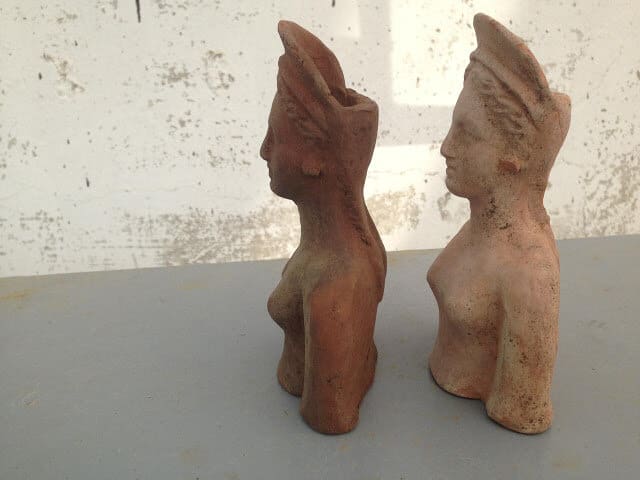
    Statuettes of the ancient Hellenic Goddesses Demeter and Persephone have been discovered in Anapa, a town in Russia.

    The discovery was carried out by the staff of the Institute for History and Mathematics of the Russian Academy of Sciences. The two intact terracotta semi-figures made more than two thousand years ago were found at a swimming pool construction site in a sanatorium in Anapa. They will be donated to the Anapa museum.

    The excavation was carried on the western outskirts of the ancient Greek city of Gorgippia that was there in the 4th-2nd century B.C. Other objects discovered: Turkish smoking pipes, coffee cups, and Russian silver coins dating back to 1818-1913. 


    The Thesmophoria was another harvest festival tied to the Eleusinian Mysteries and the mythology surrounding Demeter and Persephone. This is another female only festival. Will you join us for it from 29 September to 1 October, all at 10 am EDT?


    Two days after the Stenia, the three day festival of Thesmophoria took place. There was a male and female encampment at the Thesmophorian and the division was clearly set; no men were allowed in the female encampment, and no women in the male encampment. Sex was not allowed. From what I have been able to gather, the three days in the female encampment followed a strict regime.

    On the first day, called Anodos ('ascent') and Kathodos ('descent'), the women sacrificed the rotting piglets to Demeter and Persephone. The remains were mixed with seeds and would be ploughed into the earth after the festival to assure a good harvest. The piglets were fertility symbols, but also related to the myth of Demeter, Persephone and Hades, because it is said that, when Hades opened a chasm to swallow up Persephone, a swineherd called Eubouleus was grazing his pigs and they were swallowed up in the chasm as well. The women ate on this day, but only food which would not upset Demeter. Pomegranate fruits were off the menu.

    The second day was called Nēsteia ('feast of lamentation'). On this day, the women did not eat. They recreated the time before Demeter taught humankind to cultivate the fields. It was a dark time, a time of hunger and pain. At the same time, this day was also used to remember the time when Demeter sought her daughter and neglected her duties as a harvest Goddess. This had also been a time of great hunger.

    The third day, Kalligeneia ('she who is of beautiful birth'), was a happy one. The women prayed to Demeter and Persephone for fertility for themselves, their loved ones and the earth. They celebrated the magic of new life, fertility and the kindness of the Gods.

    Needless to say, this festival was huge. All free women, except for maidens, were allowed to participate. While we can never be entirely sure why this is, I dare to wager an educated guess. The Stenia and Thesmophoria were festivals in honour of Demeter Thesmophoros, the law-giver. She was seen as the foundation of law and society: agriculture allowed settlements to thrive, allowed societies to be built, and humanity to evolve into what it was now. In short, Demeter was at the root of modern life. A huge part of that modern life was the institution of marriage, which was far more important then as it was now.

    Demeter is, perhaps, ancient Hellas' most famous mother, and marriage allowed for the continuation of the family line. Children born out of wedlock were frowned upon, and as such, maidens were excluded from a festival intended to raise fertility in the ground and the women who took part in it. As women married young, maidens were often teens, and they would represent Persephone more than Demeter--and since the Stenia and Thesmophoria commemorated Demeter's separation from her daughter, the inclusion of maidens was most likely discouraged because of that fact.

    The Stenia and especially the Thesmophoria were festivals intended for mothers, for those who sought to bear children. They acknowledge the powerful position of women in a patriarchal society. It was because of that that women could say no to their husbands when it came to sex, and why they all left their marital homes. Many women rarely left their homes, and never overnight. To do so for not one but two nights was huge. These were powerful festivals for women because they celebrated their fertility: the one thing they were always respected and honoured for by the men in their lives.

    We don't know what happened for the men on these days (sorry), so this is another female only festival. You can find the rituals here and join the community here.

    On September 27, we'll host a PAT ritual for the Stenia. The Stenia is connected to the Eleusinian Mysteries, Demeter, and Persephone.


    The Stenia is celebrated on 9 Pyanepsion. It was a festival dedicated solely to Demeter and Persephone and was held three days before the Thesmophoria. Not much information about this festival has survived, but because bits and pieces have survived of the Thesmophoria and the preceding Skiraphoria, we can put parts of the festival back together.

    A little background first: On 12 Skirophorion, the Skiraphoria was celebrated. The Skiraphoria was one of the few days when the women of ancient Athens would gather in public to honor Demeter and bless the harvest. They refused to sleep with the men on this day and took part in a very odd tradition: casting piglets down into a chasm where they were left to rot until the Stenia.

    During the Stenia, women came together and begun the extensive purification rituals needed to partake in the Thesmophoria. How, exactly, the women purified themselves is unknown but it is known that the women engaged in Aiskhrologia, insulting each other and using foul language. To understand this practice, it's important to know the mythology behind it. Nearly all festivals where Demeter is included, recount the myth of Kore/Persephone who was abducted by Hades. While Demeter grieved and vowed to get her daughter out, Persephone was seduced to eat of the pomegranate fruit. This decision allowed Hades to keep Persephone in the Underworld for a part of the year, while she was allowed to rejoin her mother for the rest of it. While Demeter grieved, there was only one who could make her laugh: the strange old woman Iambe. From the Homeric Hymn 2: To Demeter:

    "But Demeter bringer of seasons and giver of perfect gifts, would not sit upon the bright couch, but stayed silent with lovely eyes cast down until careful Iambe placed a jointed seat for her and threw over it a silvery fleece. Then she sat down and held her veil in her hands before her face. A long time she sat upon the stool without speaking because of her sorrow, and greeted no one by word or by sign, but rested, never smiling, and tasting neither food nor drink, because she pined with longing for her deep-bosomed daughter, until careful Iambe - who pleased her moods in aftertime also - moved the holy lady with many a quip and jest to smile and laugh and cheer her heart." [188]

    I believe that a large part of the Stenia was to make the other women laugh by shouting witty insults, making crude jokes or any other way they could think of that was out of character and liberal. It's a laughing day. Yet, there was also a serious note to it. At the Stenia, some women, called 'Bailers', hiked to the chasm where the piglets had been thrown into months ago. Then, in a gruesome display of devotion, the women hauled out the rotting corpses of the piglets and carried them to the Thesmophorion, a site probably on the hillside of the Pnyx, in preparation for the Thesmophoria.

    The Stenia is a female only festival, sorry guys! We can't really provide you with laughter and jokes, so here is my suggestion: get all your friends together and have a girl's night. Find Magic Mike on Netflix and break out the wine and popcorn. The ritual will focus on the religious part. You can find the ritual  here and chat amongst yourselves here.