Showing posts with label Cepheus. Show all posts

Perseus is one of ancient Hellas' greatest heroes, and it is not odd that he was immortalized in the night's sky. He is--of course--linked to the many constellations dedicated to the rescue of Androméda, but there is far more tot he hero Perseus.

 
http://www.constellationsofwords.com/stars/Algol.html

Perseus was born to Danae, who was locked in a bronze chamber by her father Akrisios, where she was impregnated by Zeus in the form of a golden shower. Akrisios put both mother and child in a chest and set them adrift on the sea, but they washed safely ashore on the island of Seriphos. From Hyginus' 'Fabulae':

"Danaë was the daughter of Acrisius and Aganippe. A prophecy about her said that the child she bore would kill Acrisius, and Acrisius, fearing this, shut her in a stone-walled prison. But Jove, changing into a shower of gold, lay with Danaë, and from this embrace Perseus was born. Because of her sin her father shut her up in a chest with Perseus and cast it into the sea. By Jove’s will it was borne to the island of Seriphus, and when the fisherman Dictys found it and broke it open, he discovered the mother and child. He took them to King Polydectes, who married Danaë and brought up Perseus in the temple of Minerva. When Acrisius discovered they were staying at Polydectes’ court, he started out to get them, but at his arrival Polydectes interceded for them, and Perseus swore an oath to his grandfather that he would never kill him. When Acrisius was detained there by a storm, Polydectes died, and at his funeral games the wind blew a discus from Perseus’ hand at Acrisius’ head which killed him. Thus what he did not do of his own will was accomplished by the gods. When Polydectes was buried, Perseus set out for Argos and took possession of his grandfather’s kingdom." [63]

The story of Perseus is somewhat chaotic; his myths have been told and retold many times--even in ancient times--and what happens to Perseus next is most certainly up for debate. To quote the 'Dictionary of Greek and Roman Biography and Mythology':

"According to a later or Italian tradition, the chest was carried to the coast of Italy, where king Pilumnus married Danaë, and founded Ardea (Virg. Aen. vii. 410; Serv. ad Aen. vii. 372); or Danaë is said to have come to Italy with two sons, Argus and Argeus, whom she had by Phineus, and took up her abode on the spot where Rome was afterwards built (Serv. ad Aen. viii. 345). But, according to the common story, Polydectes, king of Seriphos, made Danae his slave, and courted her favour, but in vain. Another account again states that Polydectes married Danae, and caused Perseus to be brought up in the temple of Athena. When Acrisius learnt this, he went to Polydectes, who, however, interfered on behalf of the boy, and the latter promised not to kill his grandfather. Acrisius. however, was detained in Seriphos by storms, and during that time Polydectes died. During the funeral gaines the wind carried a disk thrown by Perseus against the head of Acrisius, and killed him, whereupon Perseus proceeded to Argos and took possessions of the kingdom of his grandfather (Hygin. Fab. 63)."

No matter the version of the tale, Perseus' greatest heroic deed is what follows: the hunt for Médousa. In the most common versions of the story, Polydektes did not yet marry Danae, but wished to. A now grown up Perseus did not trust Polydektes and tried to keep him away from his mother, so Polydektes had to come up with a plan. He said he would marry Hippodameia--tamer of horses--and asked Perseus for a horse to give as a wedding present. Perseus didn't have one to give, so he told Polydektes to name any other favour, and that he would not refuse. Polydektes then instructed him to cut off and bring back the head of a Gorgon, and Perseus was trapped. From Apollodorus' 'Bibliotheca' we learn the following:

"So with Hermes and Athene as his guides Perseus sought out the Phorkides (daughters of Phorkys), who were named Enyo, Pephredo, and Deino. The three of them possessed only one eye and one tooth among them, which they took turns using. Perseus appropriated these and when they demanded them back, he said he would return them after they had directed him to the Nymphai. These Nymphai had in their possession winged sandals and the kibisis, which they say was a knapsack. (Pindaros and Hesiodos in the Shield of Herakles, describe Perseus as follows : `The head of a terrible monster, Gorgo, covered all his back, and a kibisis held it.’ It is called a kibisis because clothing and food are placed in it.). They also had the helmet of Haides. When the Phorkides had led Perseus to the Nymphai, he returned them their tooth and eye. Approaching the Nymphai he received what he had come for, and he flung on the kibisis, tied the sandals on his ankles, and placed the helmet on his head. With the helmet on he could see whomever he cared to look at, but was invisible to others.

Perseus took flight and made his way to the Okeanos, where he found the Gorgones sleeping. Their names were Stheno, Euryale, and the third was Medousa, the only mortal one : thus it was her head that Perseus was sent to bring back. The Gorgones’ heads were entwined with the horny scales of serpents, and they had big tusks like hogs, bronze hands, and wings of gold on which they flew. All who looked at them were turned to stone. Perseus, therefore, with Athena guiding his hand, kept his eyes on the reflection in a bronze shield as he stood over the sleeping Gorgones, and when he saw the image of Medousa, he beheaded her. (As soon as her head was severed there leaped from her body the winged horse Pegasos and Khrysaor, the father of Geryon. The father of these two was Poseidon.) Perseus then placed the head in the kibisis and headed back again, as the Gorgones pursued him through the air. But the helmet kept him hidden, and made it impossible for them to identify him.” [2. 36 - 42]

With Médousa's head secured, Perseus headed back to Polydektes, but was stopped while on route by the vision of a woman, chained to a rock, about to be devoured by a sea monster. It had been a dark day for Cepheus, king of Aethiopia, when he had heard his wife Cassiopeia boast that her daughter Androméda was more beautiful than the Nereids. Shocked, he had tried to silence his wife, but it was too late. The father of the Nereids, the sea God Nereus, had heard Cassiopeia's prideful boast and had brought his grievance to Poseidon. Poseidon had ruled in favour of Nereus and sent Cetus, a huge sea monster, to ravage the coasts of Aethiopia. Nereus would only be appeased when Cepheus sacrificed his daughter to Cetus. Cepheus had refused, but when the terror continued, Androméda had offered herself up to be sacrificed. Fast forward to Andromeda, chained to the rocks, about to die. Perseus pulled Médousa's head out of his bag and petrified Cetus with it before undoing Androméda's bindings. He fell for the beautiful princess instantly, and desired to take her as his wife. In most versions of the myth, he is allowed, but Hyginus in his 'Fabulae' has a different story to tell:

"When he wanted to marry her, Cepheus, her father, along with Agenor, her betrothed, planned to kill him. Perseus, discovering the plot, showed them the head of the Gorgon, and all were changed from human form into stone. Perseus with Andromeda returned to his country." [64]

Perseus eventually married Androméda and took her off to his native island of Serifos. They had many children; sons Perses, Alcaeus, Heleus, Mestor, Sthenelus, and Electryon, as well as daughters, Autochthe and Gorgophone. According to Hyginus in his 'Astronomica', Perseus was committed to the stars for the following reasons:

"He is said to have come to the stars because of his nobility and the unusual nature of his conception."

The constellation Perseus is visible at latitudes between +90° and −35° and best visible at 21:00 (9 p.m.) during the month of December.

Remember when I basically said that with Cepheus, we had come to the end of the Andoméda-related constellations? Yeah, I unintentionally lied. There is one more: Cetus, located in the aquatic portion of the sky, where many water-related constellations are places.


Cetus is the Latin spelling of the name; the ancient Greek form was Kētos (Κῆτος), or Kêtos Aithiopios (Κητος Αιθιοπιος, Ethiopian Monster). It was the name of the sea monster sent by Poseidon as a favor to the sea God Nereus, who was insulted by the queen of Ethiopia, Cassiopeia, who boasted that either her daughter, or she, or both were equal or even greater in beauty than Nereus' children, the Nereids.

Cetus tormented the coast of Ethiopia, drowning many and wiping entire towns off of the map. Ethiopia's king, Cepheus, went to an oracle to find out how to stop the suffering of his people, and was told to chain his daughter to a rock on a cliff so Cetus could devour her. The royal family resisted, but eventually did what they were told. What happens next is beautifully told by Roman poet Ovid in his Metamorphoses:

"Chain'd to a rock she stood; young Perseus stay'd his rapid flight, to view the beauteous maid. So sweet her frame, so exquisitely fine, she seem'd a statue by a hand divine, had not the wind her waving tresses show'd, and down her cheeks the melting sorrows flow'd. Her faultless form the heroe's bosom fires; the more he looks, the more he still admires. Th' admirer almost had forgot to fly, and swift descended, flutt'ring from on high. O! Virgin, worthy no such chains to prove, but pleasing chains in the soft folds of love; thy country, and thy name (he said) disclose, and give a true rehearsal of thy woes. 

A quick reply her bashfulness refus'd, to the free converse of a man unus'd. Her rising blushes had concealment found from her spread hands, but that her hands were bound. She acted to her full extent of pow'r, and bath'd her face with a fresh, silent show'r. But by degrees in innocence grown bold, her name, her country, and her birth she told: and how she suffer'd for her mother's pride, who with the Nereids once in beauty vy'd. Part yet untold, the seas began to roar, and mounting billows tumbled to the shore. Above the waves a monster rais'd his head, his body o'er the deep was widely spread.

[...] So when the monster mov'd, still at his back the furrow'd waters left a foamy track. Now to the rock he was advanc'd so nigh, whirl'd from a sling a stone the space would fly. Then bounding, upwards the brave Perseus sprung, and in mid air on hov'ring pinions hung. His shadow quickly floated on the main; the monster could not his wild rage restrain, but at the floating shadow leap'd in vain. As when Jove's bird, a speckl'd serpent spies, which in the shine of Phoebus basking lies, unseen, he souses down, and bears away, truss'd from behind, the vainly-hissing prey. To writh his neck the labour nought avails, too deep th' imperial talons pierce his scales. Thus the wing'd heroe now descends, now soars, and at his pleasure the vast monster gores. Full in his back, swift stooping from above, the crooked sabre to its hilt he drove. The monster rag'd, impatient of the pain, first bounded high, and then sunk low again. Now, like a savage boar, when chaf'd with wounds, and bay'd with opening mouths of hungry hounds, he on the foe turns with collected might, who still eludes him with an airy flight; and wheeling round, the scaly armour tries of his thick sides; his thinner tall now plies: 'Till from repeated strokes out gush'd a flood, and the waves redden'd with the streaming blood. 

At last the dropping wings, befoam'd all o'er, with flaggy heaviness their master bore: a rock he spy'd, whose humble head was low, bare at an ebb, but cover'd at a flow. A ridgy hold, he, thither flying, gain'd, and with one hand his bending weight sustain'd; with th' other, vig'rous blows he dealt around, and the home-thrusts the expiring monster own'd. In deaf'ning shouts the glad applauses rise, and peal on peal runs ratling thro' the skies. The saviour-youth the royal pair confess, and with heav'd hands their daughter's bridegroom bless. The beauteous bride moves on, now loos'd from chains, the cause, and sweet reward of all the heroe's pains"

Cetus was visualized by the ancient Hellenes as a hybrid creature, with enormous gaping jaws and the forefeet of a land animal, attached to a scaly body with huge coils like a sea serpent. In some ancient drawings, Cetus comes out more comical than frightening, but the Cetus of myth was nothing to laugh at. Other visualizations of Cetus are in the form of a whale. This is mostly due to the latinization of the name; Cetus is the Latin word for the order Cetacea which includes the whales, dolphins, and porpoises.

The constellation Cetus is visible at latitudes between +70° and −90°, and best visible at 21:00 (9 p.m.) during the month of November.

When a whole family gets uplifted into the sky, the breakdown of their constellations gets a little repetitive over time, sorry about that. When we last saw the Aethiopia ruling family, we discussed the constellations Androméda and Cassiopeia. Today, we close the trilogy with Capheus, father of Andromeda, and husband to Cassiopeia, and add a good bit of info to the myth.

Cepheus was king of Aethiopia when he heard his wife Cassiopeia boast that her daughter was more beautiful than the Nereids. Shocked, he tried to silence his wife, but it was too late. The father of the Nereids, the sea God Nereus, heard Cassiopeia's prideful boast and brought his grievance to Poseidon. Poseidon ruled in favor of Nereus and sent Cetus, a huge sea monster, to ravage the coasts of Aethiopia. It destroyed villages, kept fishermen off of the sea and caused huge floods that killed hundreds at a time. A cry went up from the people for Cepheus to remedy the situation and to appease the Gods. Cepheus, desperate, traveled to the oracle of Apollon (or Zeus) to hear how he could solve the suffering of his people. The Oracle told him that Nereus would only be appeased when he sacrificed his daughter to Cetus.

Stricken with grief, Cepheus raised his hands to the sky--the position he was immortalized in--and prayed for another resolve of the situation that would not lead to the death of his much beloved daughter. The Theoi, however, remained silent. Cepheus resisted the oracle's message as long as he could, but eventually, the anguish of his people became too much for a king to withstand. In other versions of the myth, Androméda (like Iphigeneia) offered herself up to be sacrificed, as she realized her life was not worth the lives of all those who were dying now.

Androméda was chained to the cliffs near the palace, and awaited her faith there, while both Cepheus and Cassiopeia looked on with immense sadness. Thankfully, Androméda was rescued from her fate by Perseus, on his way back from defeating Médousa. King Cepheus hosted a huge wedding banquet at his palace to celebrate the wedding. There was one problem, however: Androméda had already been promised to Phineus, Cepheus' brother. While the celebrations were in progress, Phineus and his followers bursted in, demanding that Androméda be handed over, which Cepheus refused to do--too grateful to Perseus for rescuing his daughter from certain death. Ovid has described the battle that ensued in the Metamorphoses, but before the battle begins, we first get a speech by Cepheus to his brother, who begs him to let his claim to Androméda go:

"Hold, brother, hold; what brutal rage has made your frantick mind so black a crime conceive? 
Are these the thanks that you to Perseus give? This the reward that to his worth you pay, whose timely valour sav'd Andromeda? Nor was it he, if you would reason right, that forc'd her from you, but the jealous spight of envious Nereids, and Jove's high decree; And that devouring monster of the sea, that ready with his jaws wide gaping stood to eat my child, the fairest of my blood. 

You lost her then, when she seem'd past relief, and wish'd perhaps her death, to ease your grief 
With my afflictions: not content to view Andromeda in chains, unhelp'd by you, her spouse, and uncle; 
will you grieve that he expos'd his life the dying maid to free? And shall you claim his merit? 
Had you thought her charms so great, you shou'd have bravely sought that blessing on the rocks, where fix'd she lay: but now let Perseus bear his prize away, by service gain'd, by promis'd faith possess'd; 
To him I owe it, that my age is bless'd still with a child."

Phineus refused to listen to reason, and threw a spear at Perseus, who barely managed to dodge it. After that, all hell broke loose. Perseus cut down many of his attackers, turning the remainder to stone by showing them the head of Médousa. Eventually, he hailed victorious, and got to carry off his bride. In doing so, he left Cassiopeia and her husband to the fate of Poseidon, who would still have His revenge. As such, He took both Cassiopeia and Cepheus up into the sky and placed them near each other in the heavens. Poseidon placed Cassiopeia close to the North Celestial Pole on her throne, spending half of her time clinging to it so she does not fall off. In old portraits of the constellation, she is seen as either tied to her throne--which most often resembles a torture device--or desperately clinging to it. Later on, she was depicted as holding a mirror (or palm leaf) to show her vanity. 

However, because Cepheus had nothing to do with Cassiopeia's original declaration, because he had done everything in his power to make things right afterwards, and he had plead his case to the Gods again and again, Cepheus was placed into the sky unchained--either regally on his throne or with his hands raised in pious prayer--and a little further away from the pole. He still circles it in punishment, but his position is a lot less precarious than that of his wife. 

The constellation Cepheus is visible at latitudes between +90° and −10°, and best visible at 21:00 (9 p.m.) during the month of November, the same as the constellations of his wife and daughter.

When I was a little girl, my favorite book was the Dutch translation of Michaels Ende's (originally German) 'Momo and The Grey Gentlemen'. Together with the main character from comic series 'Yoko Tsuno', my ethical system and basic personality got its foundation from Ende's main character Momo. If you haven't read this book--it's from the writer of 'The Neverending Story', if that helps--please pick up a copy. It was written in 1974, and describes well... exactly our current society.


At any rate, I wasn't going to talk about the book. I was just reminded of it because this constellation shares its name with one of my favorite characters--after Momo, of course--from the book: Cassiopeia, a tortoise which can communicate through writing on her shell and can see exactly thirty minutes into the future. The Casseopeia this constellation was named after, however, has nothing in common with the lovable tortoise; Cassiopeia (Κασσιόπεια) was the wife of Cepheus, king of Aethiopia and mother of Androméda. She was placed in the sky as a punishment for her boast that her daughter was more beautiful than the Nereids; the father of the Nereids, the sea God Nereus, heard Cassiopeia's prideful boast and brought his grievance to Poseidon. Poseidon ruled in favor of Nereus and sent Cetus, a huge sea monster, to ravage the coasts of Aethiopia. Cepheus, desperate, visited the Oracle of Apollon to hear how he could solve the suffering of his people. The Oracle told his that Nereus would only be appeased when he sacrificed his daughter to Cetus.

Eventually, Androméda was rescued from her fate by Perseus, on his way back from defeating Médousa. He took her off and left Cassiopeia and her husband to the fate of Poseidon, who would still have His revenge. As such, He took both Cassiopeia and Cepheus up into the sky and placed them near each other in the heavens. His fate for Cassiopeia was far crueler than the fate He had in store for Cepheus, however, because Cepheus had had nothing to do with Cassiopeia's original declaration, and he had done everything in his power to make things right afterwards. We will get to Cepheus' fate at a later date, but I'll tell you of Cassiopeia's fate today; Poseidon palace her close to the North Celestial Pole on her throne, spending half of her time clinging to it so she does not fall off. In old portraits of the constellation, she is seen as either tied to her throne--which most often resembles a torture device--or desperately clinging to it. Later on, she was depicted as holding a mirror (or palm leaf) to show her vanity.

As it is near the pole star, the constellation Cassiopeia can be seen the whole year from the northern hemisphere, although sometimes upside down. To use latitudes; the constellation of Cassiopeia is visible at latitudes between +90° and −20°, and best visible at 21:00 (9 p.m.) during the month of November.

Eight years ago, much closer to the start of this blog, I started the Constellation Series; a series aimed at explaining the ancient constellations list by Hellenic astronomer Ptolemy. Ptolemy set out forty-eight constellations, based in Hellenic mythology, of which some are still recognized to this day, and others got broken up or otherwise rearranged or added in the years that followed. Since it's been so long, I've decided to start reposting them for new readers, starting with Andromeda.


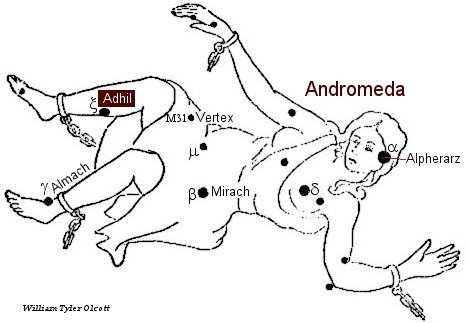
Androméda (Ἀνδρομέδα) is a princess, the daughter of Cepheus, king of Aethiopia, and his wife Cassiopeia. One faithful day, Cassiopeia boasted to an attentive court that her daughter was more beautiful than the Nereids. The father of the Nereids, the sea God Nereus, heard Cassiopeia's prideful boast and brought his grievance to Poseidon. Poseidon ruled in favor of Nereus and sent Cetus, a huge sea monster, to ravage the coasts of Aethiopia. Cepheus, desperate, visited the Oracle of Apollon to hear how he could solve the suffering of his people. The Oracle told his that Nereus would only be appeased when he sacrificed his daughter to Cetus.

Although Cepheus was reluctant, he knew it was the only way to keep his people safe, and so he took Androméda to a cliff overlooking the water and chained her to the rock. It is this image that was immortalized in the sky. Androméda was not sacrificed, though; Perseus, on his way back from defeating Médousa, came upon her and turned Cetus to stone with the Gorgon head. He married Androméda and took her off to his native island of Serifos. They had many children; sons Perses, Alcaeus, Heleus, Mestor, Sthenelus, and Electryon, as well as daughters, Autochthe and Gorgophone. After Androméda's death, Athena placed her among the constellations in the northern sky, near Perseus and Cassiopeia.

The Andromeda constellation is visible at latitudes between +90° and −40°. It is best visible at 21:00 (9 p.m.) during the month of November.

Perseus is one of ancient Hellas' greatest heroes, and it is not odd that he was immortalized in the night's sky. He is--of course--linked to the many constellations dedicated to the rescue of Androméda, but there is far more tot he hero Perseus.
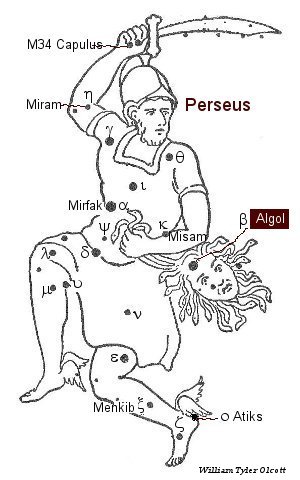
 
http://www.constellationsofwords.com/stars/Algol.html

Perseus was born to Danae, who was locked in a bronze chamber by her father Akrisios, where she was impregnated by Zeus in the form of a golden shower. Akrisios put both mother and child in a chest and set them adrift on the sea, but they washed safely ashore on the island of Seriphos. From Hyginus' 'Fabulae':

"Danaë was the daughter of Acrisius and Aganippe. A prophecy about her said that the child she bore would kill Acrisius, and Acrisius, fearing this, shut her in a stone-walled prison. But Jove, changing into a shower of gold, lay with Danaë, and from this embrace Perseus was born. Because of her sin her father shut her up in a chest with Perseus and cast it into the sea. By Jove’s will it was borne to the island of Seriphus, and when the fisherman Dictys found it and broke it open, he discovered the mother and child. He took them to King Polydectes, who married Danaë and brought up Perseus in the temple of Minerva. When Acrisius discovered they were staying at Polydectes’ court, he started out to get them, but at his arrival Polydectes interceded for them, and Perseus swore an oath to his grandfather that he would never kill him. When Acrisius was detained there by a storm, Polydectes died, and at his funeral games the wind blew a discus from Perseus’ hand at Acrisius’ head which killed him. Thus what he did not do of his own will was accomplished by the gods. When Polydectes was buried, Perseus set out for Argos and took possession of his grandfather’s kingdom." [63]

The story of Perseus is somewhat chaotic; his myths have been told and retold many times--even in ancient times--and what happens to Perseus next is most certainly up for debate. To quote the 'Dictionary of Greek and Roman Biography and Mythology':

"According to a later or Italian tradition, the chest was carried to the coast of Italy, where king Pilumnus married Danaë, and founded Ardea (Virg. Aen. vii. 410; Serv. ad Aen. vii. 372); or Danaë is said to have come to Italy with two sons, Argus and Argeus, whom she had by Phineus, and took up her abode on the spot where Rome was afterwards built (Serv. ad Aen. viii. 345). But, according to the common story, Polydectes, king of Seriphos, made Danae his slave, and courted her favour, but in vain. Another account again states that Polydectes married Danae, and caused Perseus to be brought up in the temple of Athena. When Acrisius learnt this, he went to Polydectes, who, however, interfered on behalf of the boy, and the latter promised not to kill his grandfather. Acrisius. however, was detained in Seriphos by storms, and during that time Polydectes died. During the funeral gaines the wind carried a disk thrown by Perseus against the head of Acrisius, and killed him, whereupon Perseus proceeded to Argos and took possessions of the kingdom of his grandfather (Hygin. Fab. 63)."

No matter the version of the tale, Perseus' greatest heroic deed is what follows: the hunt for Médousa. In the most common versions of the story, Polydektes did not yet marry Danae, but wished to. A now grown up Perseus did not trust Polydektes and tried to keep him away from his mother, so Polydektes had to come up with a plan. He said he would marry Hippodameia--tamer of horses--and asked Perseus for a horse to give as a wedding present. Perseus didn't have one to give, so he told Polydektes to name any other favour, and that he would not refuse. Polydektes then instructed him to cut off and bring back the head of a Gorgon, and Perseus was trapped. From Apollodorus' 'Bibliotheca' we learn the following:

"So with Hermes and Athene as his guides Perseus sought out the Phorkides (daughters of Phorkys), who were named Enyo, Pephredo, and Deino. The three of them possessed only one eye and one tooth among them, which they took turns using. Perseus appropriated these and when they demanded them back, he said he would return them after they had directed him to the Nymphai. These Nymphai had in their possession winged sandals and the kibisis, which they say was a knapsack. (Pindaros and Hesiodos in the Shield of Herakles, describe Perseus as follows : `The head of a terrible monster, Gorgo, covered all his back, and a kibisis held it.’ It is called a kibisis because clothing and food are placed in it.). They also had the helmet of Haides. When the Phorkides had led Perseus to the Nymphai, he returned them their tooth and eye. Approaching the Nymphai he received what he had come for, and he flung on the kibisis, tied the sandals on his ankles, and placed the helmet on his head. With the helmet on he could see whomever he cared to look at, but was invisible to others.

Perseus took flight and made his way to the Okeanos, where he found the Gorgones sleeping. Their names were Stheno, Euryale, and the third was Medousa, the only mortal one : thus it was her head that Perseus was sent to bring back. The Gorgones’ heads were entwined with the horny scales of serpents, and they had big tusks like hogs, bronze hands, and wings of gold on which they flew. All who looked at them were turned to stone. Perseus, therefore, with Athena guiding his hand, kept his eyes on the reflection in a bronze shield as he stood over the sleeping Gorgones, and when he saw the image of Medousa, he beheaded her. (As soon as her head was severed there leaped from her body the winged horse Pegasos and Khrysaor, the father of Geryon. The father of these two was Poseidon.) Perseus then placed the head in the kibisis and headed back again, as the Gorgones pursued him through the air. But the helmet kept him hidden, and made it impossible for them to identify him.” [2. 36 - 42]

With Médousa's head secured, Perseus headed back to Polydektes, but was stopped while on route by the vision of a woman, chained to a rock, about to be devoured by a sea monster. It had been a dark day for Cepheus, king of Aethiopia, when he had heard his wife Cassiopeia boast that her daughter Androméda was more beautiful than the Nereids. Shocked, he had tried to silence his wife, but it was too late. The father of the Nereids, the sea God Nereus, had heard Cassiopeia's prideful boast and had brought his grievance to Poseidon. Poseidon had ruled in favour of Nereus and sent Cetus, a huge sea monster, to ravage the coasts of Aethiopia. Nereus would only be appeased when Cepheus sacrificed his daughter to Cetus. Cepheus had refused, but when the terror continued, Androméda had offered herself up to be sacrificed. Fast forward to Andromeda, chained to the rocks, about to die. Perseus pulled Médousa's head out of his bag and petrified Cetus with it before undoing Androméda's bindings. He fell for the beautiful princess instantly, and desired to take her as his wife. In most versions of the myth, he is allowed, but Hyginus in his 'Fabulae' has a different story to tell:

"When he wanted to marry her, Cepheus, her father, along with Agenor, her betrothed, planned to kill him. Perseus, discovering the plot, showed them the head of the Gorgon, and all were changed from human form into stone. Perseus with Andromeda returned to his country." [64]

Perseus eventually married Androméda and took her off to his native island of Serifos. They had many children; sons Perses, Alcaeus, Heleus, Mestor, Sthenelus, and Electryon, as well as daughters, Autochthe and Gorgophone. According to Hyginus in his 'Astronomica', Perseus was committed to the stars for the following reasons:

"He is said to have come to the stars because of his nobility and the unusual nature of his conception."

The constellation Perseus is visible at latitudes between +90° and −35° and best visible at 21:00 (9 p.m.) during the month of December.
Remember when I basically said that with Cepheus, we had come to the end of the Andoméda-related constellations? Yeah, I unintentionally lied. There is one more: Cetus, located in the aquatic portion of the sky, where many water-related constellations are places.


Cetus is the Latin spelling of the name; the ancient Greek form was Kētos (Κῆτος), or Kêtos Aithiopios (Κητος Αιθιοπιος, Ethiopian Monster). It was the name of the sea monster sent by Poseidon as a favor to the sea God Nereus, who was insulted by the queen of Ethiopia, Cassiopeia, who boasted that either her daughter, or she, or both were equal or even greater in beauty than Nereus' children, the Nereids.

Cetus tormented the coast of Ethiopia, drowning many and wiping entire towns off of the map. Ethiopia's king, Cepheus, went to an oracle to find out how to stop the suffering of his people, and was told to chain his daughter to a rock on a cliff so Cetus could devour her. The royal family resisted, but eventually did what they were told. What happens next is beautifully told by Roman poet Ovid in his Metamorphoses:

"Chain'd to a rock she stood; young Perseus stay'd his rapid flight, to view the beauteous maid. So sweet her frame, so exquisitely fine, she seem'd a statue by a hand divine, had not the wind her waving tresses show'd, and down her cheeks the melting sorrows flow'd. Her faultless form the heroe's bosom fires; the more he looks, the more he still admires. Th' admirer almost had forgot to fly, and swift descended, flutt'ring from on high. O! Virgin, worthy no such chains to prove, but pleasing chains in the soft folds of love; thy country, and thy name (he said) disclose, and give a true rehearsal of thy woes. 

A quick reply her bashfulness refus'd, to the free converse of a man unus'd. Her rising blushes had concealment found from her spread hands, but that her hands were bound. She acted to her full extent of pow'r, and bath'd her face with a fresh, silent show'r. But by degrees in innocence grown bold, her name, her country, and her birth she told: and how she suffer'd for her mother's pride, who with the Nereids once in beauty vy'd. Part yet untold, the seas began to roar, and mounting billows tumbled to the shore. Above the waves a monster rais'd his head, his body o'er the deep was widely spread.

[...] So when the monster mov'd, still at his back the furrow'd waters left a foamy track. Now to the rock he was advanc'd so nigh, whirl'd from a sling a stone the space would fly. Then bounding, upwards the brave Perseus sprung, and in mid air on hov'ring pinions hung. His shadow quickly floated on the main; the monster could not his wild rage restrain, but at the floating shadow leap'd in vain. As when Jove's bird, a speckl'd serpent spies, which in the shine of Phoebus basking lies, unseen, he souses down, and bears away, truss'd from behind, the vainly-hissing prey. To writh his neck the labour nought avails, too deep th' imperial talons pierce his scales. Thus the wing'd heroe now descends, now soars, and at his pleasure the vast monster gores. Full in his back, swift stooping from above, the crooked sabre to its hilt he drove. The monster rag'd, impatient of the pain, first bounded high, and then sunk low again. Now, like a savage boar, when chaf'd with wounds, and bay'd with opening mouths of hungry hounds, he on the foe turns with collected might, who still eludes him with an airy flight; and wheeling round, the scaly armour tries of his thick sides; his thinner tall now plies: 'Till from repeated strokes out gush'd a flood, and the waves redden'd with the streaming blood. 

At last the dropping wings, befoam'd all o'er, with flaggy heaviness their master bore: a rock he spy'd, whose humble head was low, bare at an ebb, but cover'd at a flow. A ridgy hold, he, thither flying, gain'd, and with one hand his bending weight sustain'd; with th' other, vig'rous blows he dealt around, and the home-thrusts the expiring monster own'd. In deaf'ning shouts the glad applauses rise, and peal on peal runs ratling thro' the skies. The saviour-youth the royal pair confess, and with heav'd hands their daughter's bridegroom bless. The beauteous bride moves on, now loos'd from chains, the cause, and sweet reward of all the heroe's pains"

Cetus was visualized by the ancient Hellenes as a hybrid creature, with enormous gaping jaws and the forefeet of a land animal, attached to a scaly body with huge coils like a sea serpent. In some ancient drawings, Cetus comes out more comical than frightening, but the Cetus of myth was nothing to laugh at. Other visualizations of Cetus are in the form of a whale. This is mostly due to the latinization of the name; Cetus is the Latin word for the order Cetacea which includes the whales, dolphins, and porpoises.

The constellation Cetus is visible at latitudes between +70° and −90°, and best visible at 21:00 (9 p.m.) during the month of November.
When a whole family gets uplifted into the sky, the breakdown of their constellations gets a little repetitive over time, sorry about that. When we last saw the Aethiopia ruling family, we discussed the constellations Androméda and Cassiopeia. Today, we close the trilogy with Capheus, father of Andromeda, and husband to Cassiopeia, and add a good bit of info to the myth.
Cepheus was king of Aethiopia when he heard his wife Cassiopeia boast that her daughter was more beautiful than the Nereids. Shocked, he tried to silence his wife, but it was too late. The father of the Nereids, the sea God Nereus, heard Cassiopeia's prideful boast and brought his grievance to Poseidon. Poseidon ruled in favor of Nereus and sent Cetus, a huge sea monster, to ravage the coasts of Aethiopia. It destroyed villages, kept fishermen off of the sea and caused huge floods that killed hundreds at a time. A cry went up from the people for Cepheus to remedy the situation and to appease the Gods. Cepheus, desperate, traveled to the oracle of Apollon (or Zeus) to hear how he could solve the suffering of his people. The Oracle told him that Nereus would only be appeased when he sacrificed his daughter to Cetus.

Stricken with grief, Cepheus raised his hands to the sky--the position he was immortalized in--and prayed for another resolve of the situation that would not lead to the death of his much beloved daughter. The Theoi, however, remained silent. Cepheus resisted the oracle's message as long as he could, but eventually, the anguish of his people became too much for a king to withstand. In other versions of the myth, Androméda (like Iphigeneia) offered herself up to be sacrificed, as she realized her life was not worth the lives of all those who were dying now.

Androméda was chained to the cliffs near the palace, and awaited her faith there, while both Cepheus and Cassiopeia looked on with immense sadness. Thankfully, Androméda was rescued from her fate by Perseus, on his way back from defeating Médousa. King Cepheus hosted a huge wedding banquet at his palace to celebrate the wedding. There was one problem, however: Androméda had already been promised to Phineus, Cepheus' brother. While the celebrations were in progress, Phineus and his followers bursted in, demanding that Androméda be handed over, which Cepheus refused to do--too grateful to Perseus for rescuing his daughter from certain death. Ovid has described the battle that ensued in the Metamorphoses, but before the battle begins, we first get a speech by Cepheus to his brother, who begs him to let his claim to Androméda go:

"Hold, brother, hold; what brutal rage has made your frantick mind so black a crime conceive? 
Are these the thanks that you to Perseus give? This the reward that to his worth you pay, whose timely valour sav'd Andromeda? Nor was it he, if you would reason right, that forc'd her from you, but the jealous spight of envious Nereids, and Jove's high decree; And that devouring monster of the sea, that ready with his jaws wide gaping stood to eat my child, the fairest of my blood. 

You lost her then, when she seem'd past relief, and wish'd perhaps her death, to ease your grief 
With my afflictions: not content to view Andromeda in chains, unhelp'd by you, her spouse, and uncle; 
will you grieve that he expos'd his life the dying maid to free? And shall you claim his merit? 
Had you thought her charms so great, you shou'd have bravely sought that blessing on the rocks, where fix'd she lay: but now let Perseus bear his prize away, by service gain'd, by promis'd faith possess'd; 
To him I owe it, that my age is bless'd still with a child."

Phineus refused to listen to reason, and threw a spear at Perseus, who barely managed to dodge it. After that, all hell broke loose. Perseus cut down many of his attackers, turning the remainder to stone by showing them the head of Médousa. Eventually, he hailed victorious, and got to carry off his bride. In doing so, he left Cassiopeia and her husband to the fate of Poseidon, who would still have His revenge. As such, He took both Cassiopeia and Cepheus up into the sky and placed them near each other in the heavens. Poseidon placed Cassiopeia close to the North Celestial Pole on her throne, spending half of her time clinging to it so she does not fall off. In old portraits of the constellation, she is seen as either tied to her throne--which most often resembles a torture device--or desperately clinging to it. Later on, she was depicted as holding a mirror (or palm leaf) to show her vanity. 

However, because Cepheus had nothing to do with Cassiopeia's original declaration, because he had done everything in his power to make things right afterwards, and he had plead his case to the Gods again and again, Cepheus was placed into the sky unchained--either regally on his throne or with his hands raised in pious prayer--and a little further away from the pole. He still circles it in punishment, but his position is a lot less precarious than that of his wife. 

The constellation Cepheus is visible at latitudes between +90° and −10°, and best visible at 21:00 (9 p.m.) during the month of November, the same as the constellations of his wife and daughter.
When I was a little girl, my favorite book was the Dutch translation of Michaels Ende's (originally German) 'Momo and The Grey Gentlemen'. Together with the main character from comic series 'Yoko Tsuno', my ethical system and basic personality got its foundation from Ende's main character Momo. If you haven't read this book--it's from the writer of 'The Neverending Story', if that helps--please pick up a copy. It was written in 1974, and describes well... exactly our current society.


At any rate, I wasn't going to talk about the book. I was just reminded of it because this constellation shares its name with one of my favorite characters--after Momo, of course--from the book: Cassiopeia, a tortoise which can communicate through writing on her shell and can see exactly thirty minutes into the future. The Casseopeia this constellation was named after, however, has nothing in common with the lovable tortoise; Cassiopeia (Κασσιόπεια) was the wife of Cepheus, king of Aethiopia and mother of Androméda. She was placed in the sky as a punishment for her boast that her daughter was more beautiful than the Nereids; the father of the Nereids, the sea God Nereus, heard Cassiopeia's prideful boast and brought his grievance to Poseidon. Poseidon ruled in favor of Nereus and sent Cetus, a huge sea monster, to ravage the coasts of Aethiopia. Cepheus, desperate, visited the Oracle of Apollon to hear how he could solve the suffering of his people. The Oracle told his that Nereus would only be appeased when he sacrificed his daughter to Cetus.

Eventually, Androméda was rescued from her fate by Perseus, on his way back from defeating Médousa. He took her off and left Cassiopeia and her husband to the fate of Poseidon, who would still have His revenge. As such, He took both Cassiopeia and Cepheus up into the sky and placed them near each other in the heavens. His fate for Cassiopeia was far crueler than the fate He had in store for Cepheus, however, because Cepheus had had nothing to do with Cassiopeia's original declaration, and he had done everything in his power to make things right afterwards. We will get to Cepheus' fate at a later date, but I'll tell you of Cassiopeia's fate today; Poseidon palace her close to the North Celestial Pole on her throne, spending half of her time clinging to it so she does not fall off. In old portraits of the constellation, she is seen as either tied to her throne--which most often resembles a torture device--or desperately clinging to it. Later on, she was depicted as holding a mirror (or palm leaf) to show her vanity.

As it is near the pole star, the constellation Cassiopeia can be seen the whole year from the northern hemisphere, although sometimes upside down. To use latitudes; the constellation of Cassiopeia is visible at latitudes between +90° and −20°, and best visible at 21:00 (9 p.m.) during the month of November.
I greatly enjoy looking at the night's sky although I can barely make out any of the constellations. As a new and regular series on Baring the Aegis, I want to share with you my study of the mythology behind various constellations. Today, I'm starting with Andromeda.


Androméda (Ἀνδρομέδα) is a princess, the daughter of Cepheus, king of Aethiopia, and his wife Cassiopeia. One faithful day, Cassiopeia boasted to an attentive court that her daughter was more beautiful than the Nereids. The father of the Nereids, the sea God Nereus, heard Cassiopeia's prideful boast and brought his grievance to Poseidon. Poseidon ruled in favor of Nereus and sent Cetus, a huge sea monster, to ravage the coasts of Aethiopia. Cepheus, desperate, visited the Oracle of Apollon to hear how he could solve the suffering of his people. The Oracle told his that Nereus would only be appeased when he sacrificed his daughter to Cetus.

Although Cepheus was reluctant, he knew it was the only way to keep his people safe, and so he took Androméda to a cliff overlooking the water and chained her to the rock. It is this image that was immortalized in the sky. Androméda was not sacrificed, though; Perseus, on his way back from defeating Médousa, came upon her and turned Cetus to stone with the Gorgon head. He married Androméda and took her off to his native island of Serifos. They had many children; sons Perses, Alcaeus, Heleus, Mestor, Sthenelus, and Electryon, as well as daughters, Autochthe and Gorgophone. After Androméda's death, Athena placed her among the constellations in the northern sky, near Perseus and Cassiopeia.

The Andromeda constellation is visible at latitudes between +90° and −40°. It is best visible at 21:00 (9 p.m.) during the month of November.