Showing posts with label Mythology 101. Show all posts

There are only three more constellations in the constellation series, and we will be talking about two of them today. But don't worry, I have a few bonus posts lined up around the theme. Today, we'll be talking about Ursa Major and Ursa Minor: the big and little bear.


Ursa Major (from the Latin: 'Larger She-Bear') is also known as the Great Bear and Charles' Wain. It is visible throughout the year in most of the northern hemisphere. Ursa Minor (from the Latin 'Smaller She-Bear') is also known as the Little Bear. Like Ursa Major, the tail of the Little Bear may also be seen as the handle of a ladle, hence the name Little Dipper. Both are amongst the 48 constellations listed by the 2nd century astronomer Ptolemy, and remain two of the 88 modern constellations. Ursa Minor is notable as the location of the north celestial pole, although this will change after some centuries due to the precession of the equinoxes.

The first mention of Ursa Minor in ancient Hellenic texts was by 6th century BC philosopher Thales of Miletus, who pointed out that it was a more accurate guide to finding true north than Ursa Major. This knowledge had reportedly come from the Phoenicians in the eastern Mediterranean, and the constellation bore the term Phoenikē. Homer had previously only referred to one 'bear', leading to speculation over what he saw the stars of Ursa Minor as, or whether they were recognised at all. From Hyginus' 'Astronomica':

"There is a great diversity of opinion, too, as to why the Lesser Bear is called Phoenice, and why those who observe her are said to navigate more exactly and carefully; why, also, if she is more reliable than the Great Bear, al do not watch her. These people do not seem to realize the reason for her being called Phoenice. Thales of Miletus, who searched into these matters carefully, and first called her Bear, was by birth a Phoenician, as Herodotus says. Therefore all those in the Peloponnesus use the first Arctos; the Phoenicians, however, observe the one they received from her discoverer, and by watching her carefully, are thought to navigate more exactly, and suitably call her Phoenice from the race of her discoverer." (II.2)

The ancient Hellenes linked Ursa Minor and Ursa Major to the myth of Kallistô and her son Arcas, both placed in the sky by Zeus. In this myth, Zeus and Kallistô had a son together: Arcas. After Arcas was born, Hera caught wind of the affair and turned Kallistô into a bear. Alternatively, Kallistô was a priestess of Artemis, and Artemis punished her for losing her virginity by turning her into a bear. Because of the metamorphosis, the boy was raised by his maternal grandfather Lycaon. When Arcas grew up, he went out to hunt and found a beautiful bear. He chased her through the woods. The bear--his transformed mother Kallistô--ran towards him as soon as she recognized her son. Arcas was terrified and raised his bow to shoot her. Zeus intervened swiftly and placed Kallistô and her son in the sky. In this interpretation, Kallistô became Ursa Major and Arcas either Ursa Minor or Boötes. A furious Hera asked Tethys to chain the two to the night's sky, so that the constellations would never sink below the horizon and receive water. An alternate myth tells of two bears that saved Zeus from his murderous father Kronus by hiding him on Mount Ida. Later Zeus set them in the sky, but their tails grew long from being swung by the God. Hyginus describes all of this in the following way:

"We begin, then as we said above, with the Great Bear. Hesiod says she is named Callisto [Kallistô], daughter of Lycaon, who ruled in Arcadia. Out of her zeal for hunting she joined Diana [Artemis], and was greatly loved by the goddess because of their similar temperaments. Later, when made pregnant by Jove [Zeus], she feared to tell the truth to Diana. But she couldn’t conceal it long, for as her womb grew heavier near the time of her delivery, when she was refreshing her tired body in a stream, Diana realized she had not preserved her virginity. In keeping with her deep distrust, the goddess inflicted no light punishment. Taking away her maiden features, she changed her into the form of a bear, called arktos in Greek . In this form she bore Arcas.
 
But as Amphis, writer of comedies, says, Jupiter, assuming the form of Diana, followed the girl as if to aid her in hunting, and embraced her when out of sight of the rest. Questioned by Diana as to the reason for her swollen form, she replied that it was the goddess’ fault, and because of this reply, Diana changed her into the shape we mentioned above. When wandering like a wild beast in the forest, she was caught by certain Aetolians and brought into Arcadia to King Lycaon along with her son as a gift, and there, in ignorance of the law, she is said to have rushed into the temple of Jove Lycaeus. Her son at once followed her, and the Arcadians in pursuit were trying to kill them, when Jupiter, mindful of his indiscretion, rescued her and placed her and her son among the constellations. He named her Arctos, and her son Arctophylax. About him we shall speak later.
 
Some, too, have said that when Callisto was embraced by Jove, Juno in anger turned her into a bear; then, when she met Diana hunting, she was killed by her, and later, on being recognized, was placed among the stars.
 
But others say that when Jupiter was pursuing Callisto in the woods, Juno, suspecting what had happened, hurried there so that she could say she had caught him openly. But Jove, the more easily to conceal his fault, left her changed to bear form. Juno, then, finding a bear instead of a girl in that place, pointed her out for Diana, who was hunting, to kill. Jove was distressed to see this, and put in the sky the likeness of a bear represented with stars.
 
This constellation, as many have stated, does not set, and those who desire some reason for this fact say that Tethys, wife of Ocean, refuses to receive her when the other stars come there to their setting, because Tethys was the nurse of Juno, in whose bed Callisto was a concubine.

 Araethus of Tegea, however, writer of histories, says that she wasn’t Callisto, but Megisto, and wasn’t the daughter of Lycaon, but of Ceteus, and so granddaughter of Lycaon. He says, too, that Ceteus himself was called the Kneeler. The other details agree with what has been said above. All this is shown to have taken place on the Arcadian mountain Nonacris.
 
Aglaosthenes, who wrote the Naxica, says that she is Cynosura, one of the nurses of Jove from the number of the Idaean nymphs. He says, too, that in the city called Histoe, founded by Nicostratus and his friends, both the harbour and the greater part of the land are called Cynosura from her name. She, too, was among the Curetes who were attendants of Jove. Some say that the nymphs Helice and Cynosura were nurses of Jove, and so for gratitude were placed in the sky, both being called Bears. We call them Septentriones." (II.1, II.2)

Because Ursa Minor consists of seven stars, the Latin word for "North" (i.e. where Polaris points) is septentrio, from septem (seven) and triones (oxen), from seven oxen driving a plow, which the seven stars also resemble. This name has also been attached to the main stars of Ursa Major. About this, Hyginus also has something to say:

"But many have said that the Great Bear is like a wagon, and the Greeks do call it amaza. This reason has been handed down: Those who, at the beginning, observed the stars and supposed the number of stars into the several constellations, called this group no “Bear” but “Wain,” because two of the seven stars which seemed of equal size and closest together were considered oxen, and the other five were like the figure of a wagon. And so the sign which is nearest to this they wished to be called Boötes. We shall speak of him later on. Aratus, indeed, says that neither Boötes nor the Wain has these names for the reason above, but because the Bear seems, wagon-like, to wheel around the pole which is called North, and Boötes, is said to drive her. In this he seems to be considerably in error, for later, in connection with the seven stars, as Parmeniscus says, twenty-five were grouped by certain astronomers to complete the form of the Bear, not seven. And so the one that followed the wagon and was formerly called Boötes, was now called Arctophylax [Bear Watchter], and she, at the same time that Homer lived, was called Bear. About the Septentriones Homer says that she was called both Bear and Wain; nowhere does he mention that Boötes was called Arctophylax." (II.2)
 
In a variant of the story, in which it is Boötes that represents Arcas, Ursa Minor represents a dog. This is the older tradition, which explains both the length of the tail and the obsolete alternate name of Cynosura (the dog's tail) for Polaris, the North Star. Cynosura is also described as a nurse of Zeus, honoured by the God with a place in the sky.
 
Ursa Major is visible at latitudes between +90° and −30°, and best visible at 21:00 (9 p.m.) during the month of April. Ursa Minor is visible at latitudes between +90° and −10°, and best visible at 21:00 (9 p.m.) during the month of June.

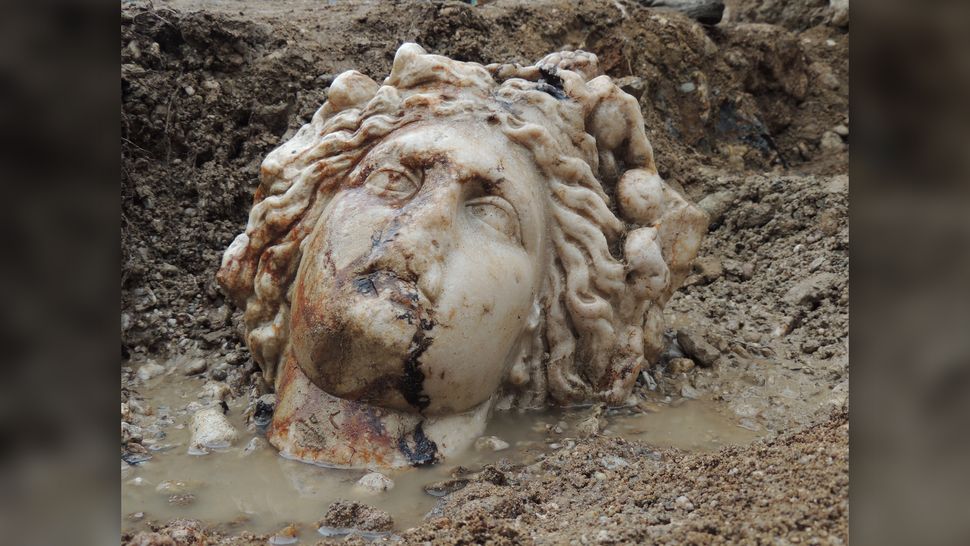
According to Hellenic mythology, the deities Aphrodite and Dionysos had a grand love affair. So, perhaps it's fitting that archaeologists found the ancient statuary heads of the Goddess of love and the reveler near each other during a dig in the ancient city of Aizanoi, in western Turkey.


The discovery of the deities' heads helps top off a previous find; on an earlier dig, archaeologists found the statues' headless bodies, Gokhan Coskun, an archaeologist at Kütahya Dumlupınar University in Turkey and the excavation coordinator, told Anadolu Agency, a Turkish state-run news organization. 

"These are important findings for us, as they show that the polytheistic culture of ancient Greece existed for a long time without losing its importance in the Roman era," Coskun said. "The findings suggest that there may have been a sculpture workshop in the region."

The ancient city of Aizanoi has a rich history filled with ancient Greek and Roman period settlements. Its earliest settlement dates to the second millennium B.C., but many of its remaining ruins date to the Roman Empire, including its Roman baths, Zeus temple and macellum, or Roman indoor market. Aizanoi is listed as a "tentative" World Heritage Site by the United Nations Educational, Scientific and Cultural Organization (UNESCO). 

Archaeologists found the Roman-era heads of Aphrodite and Dionysos buried in a creek bed in the ancient city. Each head is made of limestone, with Aphrodite's head measuring 19 inches (50 centimeters) and Dionysus' head measuring 17 inches (45 cm) tall, according to the news site GEO. It's unknown how the statues' heads became separated from their bodies.

Previously, archaeologists in Aizanoi uncovered the statue of Hygieia, Goddess of health, cleanliness and hygiene, according to GEO. 

Oedipus Rex, also known by its Greek title, Oedipus Tyrannus (Οἰδίπους Τύραννος), or Oedipus the King, is an Athenian tragedy by Sophocles that was first performed around 429 BC. Originally, to the ancient Hellenes, the title was simply Oedipus (Οἰδίπους), as it is referred to by Aristotle in the Poetics. It is thought to have been renamed Oedipus Tyrannus to distinguish it from another of Sophocles' plays, Oedipus at Colonus. In antiquity, the term “tyrant” referred to a ruler with no legitimate claim to rule, but it did not necessarily have a negative connotation.

Of Sophocles' three Theban plays that have survived, and that deal with the story of Oedipus, Oedipus Rex was the second to be written. However, in terms of the chronology of events that the plays describe, it comes first, followed by Oedipus at Colonus and then Antigone. Prior to the start of Oedipus Rex, Oedipus has become the king of Thebes while unwittingly fulfilling a prophecy that he would kill his father, Laius (the previous king), and marry his mother, Jocasta (whom Oedipus took as his queen after solving the riddle of the Sphinx). The action of Sophocles' play concerns Oedipus' search for the murderer of Laius in order to end a plague ravaging Thebes, unaware that the killer he is looking for is none other than himself. At the end of the play, after the truth finally comes to light, Jocasta hangs herself while Oedipus, horrified at his patricide and incest, proceeds to gouge out his own eyes in despair.

Oedipus Rex is regarded by many scholars as the masterpiece of ancient Hellenic tragedy. In his Poetics, Aristotle refers several times to the play in order to exemplify aspects of the genre.

Disney's "Hercules" (1997) is a beloved animated retelling of the classic Hellenic myth, but even die-hard fans may not have caught all these hidden gems. The film is full of references to Hellenic mythology, including the tale of the Titans and the divine guests at Zeus and Hera's party. There are also jokes related to more recent cultural phenomena, like "Buns of Bronze" and the Marilyn Monroe constellation. Did you catch them all? Insider did!


One of the Muses is attracted to Hercules.

The Muses are the musical goddesses who narrate the movie. All of them are fans of Hercules, and throughout the movie they praise him for his heroic feats. However, one of the Muses in particular — Thalia, the muse of comedy — focuses on Hercules' attractiveness and calls him "Hunk-ules." She also says that she'd "like to make some sweet music with him" while lying next to his image before another Muse interrupts her.

Though this movie only shows Megara as Hercules' love interest, in Greek mythology, the demigod had several wives throughout the course of his life. So, this blatant showing of other women's attraction to him could be a subtle acknowledgment of that.

The Muses explain some pretty accurate Titan mythology.

The story of the Titans that the Muses sing about at the beginning of the film is mostly accurate to Greek mythology. They explain that the Titans wreaked havoc until Zeus overthrew them, which follows the Greek myth where Zeus imprisons the Titans and ends their rule over Earth. However, "Hercules" only shows four Titans, and there are actually 12 in the classic myth. 

There's an alcohol reference that kids likely don't understand.

The Muses describe life on Mountain Olympus as "neat and smooth as sweet vermouth." Vermouth is a wine that is used in a variety of mixed drinks. Although the alcohol can be "neat and smooth," so it makes sense in the Muses' metaphor, this reference would presumably go over the heads of the young audience that the movie is aimed at. 

Several recognizable gods and goddesses are shown at Zeus and Hera's party.

There are many gods and goddesses in attendance at the party that  Zeus and Hera throw on Mount Olympus when Hercules is born. Hermes delivers a gift to Zeus, a fitting act for the messenger of Mount Olympus, and he's shown wearing his famous winged cap and sandals. In another brief scene, Narcissus, famous for his self-love, is seen looking at himself in a mirror. There are also several non-speaking gods and goddesses scattered in the background with distinct physical characteristics that make it clear who they're supposed to represent.

A goddess with long, heart-shaped hair and a heart clip on her toga appears to be Aphrodite, the goddess of love. A god with a massive helmet and sword is identified as Ares, the god of war. One god with a fin on his head and a trident in his hand is recognizably Poseidon, the god of the sea. And another goddess in the background of the scene is shown holding an owl, the symbol of Athena, the goddess of wisdom and war. 

Zeus uses the major cloud types when making Pegasus.

Zeus makes Hercules' winged-horse companion, Pegasus, out of clouds, and as he does this, he mentions each cloud type he's using by name. The god of the sky makes Pegasus out of three of the main cloud types: cirrus (high-level ice clouds), nimbostratus (mid-level rain clouds), and cumulus (low-level fair-weather clouds).

Zeus and Hercules have matching medallions.

During Hercules' party scene, viewers can see that Zeus and Hercules are both wearing medallions with the same symbol. Zeus has his pinned to the shoulder of his toga, and Hercules wears his as a necklace. Both medallions show a cloud with a lightning bolt, and this symbol is later described by Hercules' adoptive mother as "the symbol of the gods."

Hades travels across a river of dead souls.

Viewers first see the Underworld when Hades returns after visiting Mount Olympus for the party. He travels across a river, but instead of water, there are floating ghost-like people under his boat — which may have been a little jarring for any child who noticed.

This is reflected in Greek mythology, which depicts the Underworld as having five different rivers that Hades and other gods can travel on by boat. Later, when Hercules rescues Meg from the Underworld, it's clear that the transparent people in the river represent the souls of people who have died. 

The movie makes some odd word choices, such as "lugubriousness" and "furshlugginer."

This movie includes not only references but also words that children aren't likely to know. Two examples of this that particularly stand out are "lugubriousness" and "furshlugginer." Pain, one of Hades' henchmen, calls Hades "your most lugubriousness" the first time he is on screen. Lugubrious means exaggeratedly mournful or brooding, which is certainly fitting for Hades, but it's odd that the word is included offhandedly as though children will understand it.

Later in the film, Phil refers to Achilles' famed weakness as "that furshlugginer heel of his." Furshlugginer, which is a slang word with Yiddish origins that means foolish, is also somewhat out of place in a film geared toward kids.

The Fates kill a woman during their first scene.

The Fates, magical women who can see into the past, present, and future, only have one eye between the three of them. They're typically remembered for the humorous scenes in which they take turns using this eye, but if you pay attention, they have a pretty dark introduction. When viewers are first introduced to the Fates, they are holding and cutting a thread — a symbol traditionally included in the Fates mythology — that they say is connected to a mortal's life. Immediately after they cut this thread, a woman screams and appears in the Underworld, showing that they did indeed kill her.

There are only six planets shown during the prophecy scenes.

The Fates tell Hades that in 18 years, if he releases the Titans while the planets are aligned (and Hercules does not interfere), he will have the chance to usurp Zeus. However, the image that's shown alongside this prophecy only depicts six planets. Later, when the prophecy comes true, six planets are again shown instead of eight. 

The decision to leave out a few of the planets from our modern knowledge of the solar system may have been done to accurately reflect Ancient Greece's understanding of the planets. At that time, Mercury, Earth, Mars, Venus, Jupiter, and Saturn had been identified, but Uranus and Neptune had not. 

Hercules' human parents are accurately named after their mythological counterparts.

In the film, Hercules' adopted mortal parents are his mother, Alcmene, and his father, Amphitryon. Alcmene and Amphitryon are accurate names from the Hercules myth, but their roles are depicted a little differently in the Disney film. In Greek mythology, Zeus cheats on his wife and has Hercules with the human Alcmene — which explains Hercules' demigod status. This differs from the movie, which shows Hercules being born to Zeus and Hera before becoming a demigod when Hades arranges for him to drink a poisonous potion. 

Philoctetes' interaction with the wood nymphs shows classic satyr behavior.

Hercules first finds Philoctetes in a forest where he is watching a group of wood nymphs. Phil runs after the nymphs, trying to catch them, but they turn into flowers and trees before he can reach them. Phil, who appears to be half-goat, half-man, tells Hercules that he is a satyr. In Greek mythology, satyrs are fertility spirits known to engage in sensual acts with nymphs, making Phil's chase scene accurate — but perhaps a bit inappropriate for a kid's movie.

Phil brags about training some major mythological figures.

Phil's home is full of objects related to some of the heroes he used to train. Hercules hits his head on what Phil says is the mast of the Argo — a ship that belonged to Jason, the mortal hero of the Argonauts, in Greek mythology. This head bump is also ironic because Jason died after a rotting beam of the Argo fell on him. Phil then mentions that he trained the Greek legends Odysseus, Perseus, Theseus, and he shows off a giant statue of Achilles, his most promising hero-in-training. 

There's a visual pun to go along with the term "greenhorn."

When Hercules first starts training with Phil, he struggles to complete the practice drills the satyr arranges for him. As part of his big song "One Last Hope," Phil complains about having to work with a "greenhorn," which roughly translates to mean an amateur. As Phil sings the line, "I get the greenhorn," there's a clever visual pun to go along with it. Green olives get stuck on his horns, making him look as though he actually has green horns.

There's also a visual reference to "The Karate Kid" in the training montage.

In the same training montage that takes place during "One Last Hope," Phil, Hercules, and Pegasus stand on wooden posts and strike fighting poses in front of a setting sun, which resembles one of Daniel LaRusso's famed training sequences in "The Karate Kid" (1984). 

The centaur Hercules fights plays into a traditional Greek myth.

Hercules first meets Meg when he saves her from a centaur, and when Meg and Hades are talking afterward, they mention that the centaur's name is Nessus. Nessus the centaur is a creature from Greek mythology who Hercules fights to save one of his wives. But in contrast to the movie, it wasn't Megara, it was his second wife, Deianeira. 

Thebes is compared to New York City multiple times.

Hercules and Phil journey to the city of Thebes, where Hercules can accomplish his heroic feats. As they travel there, Phil calls the city "the Big Olive," a pun that seems to be a take on New York City's nickname, "the Big Apple." In the same scene, Phil tells Hercules, "If you can make it there, you can make it anywhere," a phrase from the popular Frank Sinatra song "New York, New York." Later on in the film, Meg also uses the phrase "in a Peloponnesian minute," which, with all the other references to New York, seems like a play on the phrase "New York minute."

There's a not-so-subtle Roman numeral joke.

While pretending to be trapped under a boulder, Hades henchmen Pain and Panic appear as young boys crying for help, and one of them shouts, "Somebody call IX-I-I!" That's the Roman-numeral equivalent of 9-1-1, which seems like a clever way to include a modern American cry for help in an era-appropriate numerical style. However, the film takes place in ancient Greece, not ancient Rome, so Greek numerals would've been the norm in Thebes.

Modern references are made while describing Hercules' new popularity.

Throughout the film, there are a few allusions to modern culture. While singing about Hercules' popularity, the Muses remark that he can make an arena "SRO," which is usually used as a concert term that stands for "standing room only." Phil also advertises Hercules-themed merchandise, including a "Buns of Bronze" workout scroll, which is likely a reference to the "Buns of Steel" workout videos that were popular in the 1990s when the film was made. Another merch item featured in the film, "Air Hercs," seem to be a take on Nike's famous Air Jordan sneakers. But the reference is even more meaningful when you remember that Nike is the Greek goddess of victory. 

Hercules passes a constellation that imitates a famous Marilyn Monroe scene.

During "Zero to Hero," Hercules rides Pegasus through the sky and we see a constellation in the shape of a woman with short hair wearing a halter-neck dress. When Hercules rides past this group of stars, the woman's dress flies up and she uses her hands to push it back down. This, along with her appearance, makes it clear that the constellation is a recreation of Marilyn Monroe's most famous movie moment from "The Seven Year Itch" (1955).

There's also a reference to Grauman's Chinese Theatre in "Zero to Hero."

After the Marilyn Monroe reference, Hercules and Pegasus are shown leaving their handprints (or hoof prints) in wet cement, much like celebrities do in front of LA's famed TCL Chinese Theatre (also known as Grauman's Chinese Theatre). If you look closely, Hercules' signature is addressed "To Sid," which is likely a reference to the original owner of the Chinese Theatre, Sid Grauman. 

Scar from "The Lion King" makes an unfortunate appearance.

Three years before Hercules hit US theaters, "The Lion King" (1994)introduced the Disney fandom to one of the studio's most despicable villains, Scar. However, the brother-murdering lion seems to have gotten what was coming for him seeing as he makes a brief appearance in the 1997 film as a dead lion's mane that the Hercules wears while he's getting his portrait painted. We get a clear view when Phil uses the thwarted villain as a wipe to remove paint from his face, and it's a little creepy that his pricing green and yellow eyes are still intact. 

Hercules and Meg see a play about Oedipus.

When Hercules and Meg return from spending the day together, they talk about having gone to a restaurant and seeing a play about "that Oedipus thing." This is most likely a reference to the Ancient Greek play "Oedipus Rex." In the play, and classic Greek mythology, Oedipus was the ruler of Thebes, so it makes sense that they would be performing it there. However, the real joke comes with Hercules' next line, "Man, I thought I had problems," which is probably a reference to Oedipus' romantic relationship with his mother. 

The film tries to answer the age-old question of how a famous statue lost its arms.

At the end of his date with Meg, Hercules skips a stone in a fountain and accidentally breaks the arms off of a statue of a woman. The result resembles the famous Venus de Milo statue by Greek sculptor Alexandros of Antioch that is well known for its mysterious lack of arms. As the statue's name refers to the Greek goddess, its appearance in the movie adds another reference to mythology while also providing a fun explanation for why the real statue is armless.

The Muses recreate a scene from Disney's popular Haunted Mansion ride.

During "I Won't Say I'm in Love," the Muses transform themselves into stone busts that are arranged in an eerily similar way to the singing busts on Disney's famed Haunted Mansion attraction. Six years after "Hercules," the busts also made an appearance in Disney's live-action movie, "The Haunted Mansion" (2003). 

Hades uses legal terminology when describing his contract with Hercules that ends up thwarting him in the end.

Hades makes a deal with Hercules in which the demigod agrees to give up his strength for a day as long as Meg is safe. While explaining the contract to Hercules, Hades describes the deal as "boilerplate," which is a legal term that refers to a standard contract format. Interestingly, boilerplate provisions call for rules for how the contract will be interpreted, which in this case should have included a definition of what Meg's safety entailed. Since Meg's injury is what breaks the contract and returns Hercules' strength, Hades probably should have been a bit more careful with the wording of the deal he drew up.

The different monsters Hercules fights at the end of the film include some of his most famous mythological enemies.

Some of Hercules' most famous accomplishments in mythology were part of his 12 Labours. The 12 Labours of Hercules was a series of tasks he completed as part of a punishment. Fighting a Hydra and the three-headed dog Cerberus were two such tasks, both of which are included at the end of the movie. The "Zero to Hero" montage also shows Hercules fighting a boar, a lion, a bird, and a bull — all creatures that were part of his 12 Labours. 

For image proof, visit Insider!

An invocation is a request for the spiritual presence and blessing of a deity during a rite. To invoke is to call upon earnestly, so an “invocation” in the context of prayer is a serious, intentional calling upon a God or Goddess. In Hellenic ritual, it's common for prayers of invocation to be offered every time a new deity is invoked, so we can be sure They will the hymns and prayers of petition offered to Them. Invocations fit into the rite like so:


- Lighting of the incense burner with frankincense
- Invocation to Demeter: Khaire Demeter, you who taught us to work the earth and provides for us so bountifully…
- Libation of a kykeon and sacrifices
- Orphic Hymn 40 To Eleusinian Demeter
- Prayers

A few days ago, I put up a list of invocations from the Iliad. People seemed to like it, so let's do another one today: from the Odysseia, because that is the logical step! The Odyssey (Ὀδύσσεια) is, in part, a sequel to the Iliad, the other work ascribed to Homeros. The Odyssey was composed near the end of the 8th century BC and focuses mainly on the hero Odysseus, king of Ithaca, and his journey home after the fall of Troy. It takes Odysseus ten years to reach Ithaca. In his absence, it is assumed Odysseus has died, and his wife Penelope and son Telemachus must deal with a group of unruly suitors, who compete for Penelope's hand in marriage. Needless to say, Odysseus keeps his lady love! There aren't as many invocation in this story as most of the characters tell their story themselves, but there are a few.

Artemis:
"Great Goddess Artemis, daughter of Zeus..."

Athena:
"Hear me, daughter of Aegis-bearing Zeus, unweariable..."

Eos:
"Rosy-fingered Eos, child of morning..."

Poseidon:
"O thou that encirclest the earth, vouchsafe to grant the prayers of thy servants that call upon thee..."

Themis:
"I pray you by Themis, who is the beginning and the end of councils..."

Zeus:
"Hear me, O King..."
"Father Zeus, and all you other gods who live in everlasting bliss..."
"Father Zeus, you who rule over heaven and earth, you have thundered from a clear sky without so much as a cloud in it, and this means something for somebody; grant the prayer, then, of me your poor servant who calls upon you..."

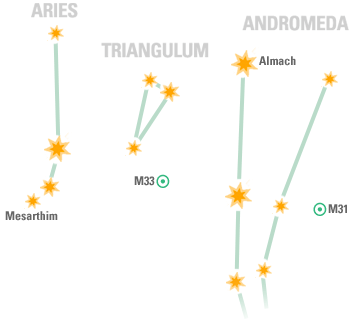
Did you know there was a constellation called 'the triangle'? And that the ancient Hellenes were aware of it, too? Triangulum is a small constellation in the northern sky. It was one of the 48 constellations listed by the second century astronomer Ptolemy, and so named for its three brightest stars, which form a long and narrow triangle. The Ancient Hellenes called Triangulum 'Deltoton' (Δελτωτόν), after the upper-case letter delta (Δ). Hellenic astronomers such as Hipparchos and Ptolemy called it Trigonon (Τρίγωνον).


There is not a lot of mythology connected to this tiny constellation, but the lore that it has is quite important. Hyginus, in his 'Astronomica' explains the options:

"This constellation, which has three angles like the Greek letter Delta, is so named for that reason.
Mercury [Hermes] is thought to have placed it above the head of Aries, so that the dimness of Aries might be marked by its brightness, wherever it should be, and that it should form the first letter in the name of Jove [Zeus] (in Greek, Dis).
Some have said that it pictures the position of Egypt; others, that of Aethiopa and Egypt where the Nile marks their boundaries. Still others think that Sicily is pictured there.
Others, say that three angles were put there because the gods divided the universe into three parts." [II.19]

The latter is the only one that might need some explaining. Zeus, the greatest of the Olympian Gods, and the father of Gods and men, was a son of Kronos and Rhea, a brother of Poseidon, Hades, Hestia, Demeter, Hera. When Zeus and His brothers drew lots for the rule of the world, Poseidon obtained the sea, Hades the lower world, and Zeus the heavens and the upper regions, but the earth belonged to them all. To quote the 'Iliad' by Hómēros:

"Poseidon was very angry and said, "Great heavens! strong as Zeus may be, he has said more than he can do if he has threatened violence against me, who am of like honour with himself. We were three brothers whom Rhea bore to Kronos--Zeus, myself, and Hades who rules the world below. Heaven and earth were divided into three parts, and each of us was to have an equal share. When we cast lots, it fell to me to have my dwelling in the sea for evermore; Hades took the darkness of the realms under the earth, while air and sky and clouds were the portion that fell to Zeus; but earth and great Olympus are the common property of all." [XV.187]

The constellation Triangulum is visible at latitudes between +90° and −60°, and best visible at 21:00 (9 p.m.) during the month of December.

 I get a lot of questions from readers, and most of the time, the answers are fairly short. When I feel the question or the reply would be valuable to others as well, I make a post with a collection of them and post them in one go. Today is one of those posts.


"I really want to start doing daily rituals but I just don't know how to start or who to worship. Can you help me?"

Daily worship can be a very rewarding practice, but it is hard to get into. In ancient Hellas, the courtyard of the home often held a bômos, a free standing, raised, altar where the majority of household worship took place. Some houses also had a wall niche, an indoor worship area, either in a room especially designated for worship, or in the main family room. These altars were used to worship the Ephestioi (Εφεστιοι), the most personal of the household Theoi. These almost always included: Hestia, Zeus Ephestios (Overseer of the Hearth), Zeus Kthesios, and Agathós Daímōn. Worship of these deities was highly personal and many other Theoi could be added to this worship list.
 
If you wish to get into the routine of daily worship, these Theoi can be used as a base for ritual. Add to this short list any Theoi you feel drawn to or whose influence you feel you need in your life. My list can be found here. Pro tip: start with a short list and build up once you feel comfortable and you have found your rhythm.
 
~~~
 
"How should I celebrate the Noumenia?"

The goal of the Noumenia is to start fresh and to honor the household deities. It is a day of family, family meals, and the celebration of the new month. Part of that celebration can be to prepare for the new month by planning out important events--religious or secular--and writing them down, preferably with the whole family present. Offer sacrifices of honey cakes to Apollon Noumenios, Hestia,Hermes and Zeus Kthesios and refill your kathiskos.
 
~~~
 
"Some tragic events occurred and ever since I have felt odd working with Hermes or any gods. What would be a way I could find out if Hermes still wants to work with me, and if so what things would you suggest doing to work with him (altar suggestions, etc)? Thank you."

One thing that is generally hard for people to understand is that the attention the Theoi pay us does not waver and They do not pick favourites. They accept any and all worship and They are always there. What wavers is the level of attention we pay Them or the amount of time and brainpower we have to spare for Their worship. This is miasma, this is the disconnect between the Theoi and us. Think of it as a radio signal where the Theoi are the broadcasting party: They are always on but depending on the amount of interference and obstacles on our receiving end, the reception is clear or muddled. The ancient Hellenes understood this and that is why they were adamant about a daily practice and regular, state funded, festivals. Hermes is there. He is always there. I dislike the term ‘work with’ but if you wish to honour Him, then do so by any way you have already done. Give libations and sacrifices at your household shrine, read His mythology, meditate. He will be receptive.

~~~
 
"Were Elves or Faeries worshiped by the Ancient Hellenes? We know that there was influence from the Celts and maybe even the Nordics in ancient Hellas. Hence the Hyperboreas."

That's a complicated question to answer. And an easy one. No, Tolkien's Elves are not found in Hellenic mythology and neither was Tinkerbell. So, the question is: how do you define 'Elves' and how do you define 'Faeries'?

An elf, mythologically speaking, is a type of supernatural being in Germanic mythology and folklore. Back then mention of them was very uncommon and served as a race to offset the Giants. An elf in classical Eddaic poetry was male and prominently associated with sexual threats, seducing people and causing them harm. Needless to say, the image has changed since then.

The concept of 'fairy' in the narrow sense is unique to English folklore, conflating Germanic elves with influences from Celtic and Romance (French) folklores, and later made 'diminutive' according to the tastes of Victorian era fairy tales for children. These Celtic roots stem mostly from the The Tuatha Dé Danann, a race of supernaturally-gifted people in Irish mythology. They are thought to represent the main deities of pre-Christian Gaelic Ireland. Many of the Irish tales of the Tuatha Dé Danann refer to these beings as fairies, though in more ancient times they were regarded as Goddesses and Gods.

The ancient Hellenic empire was pretty large but Gaul (France and Belgium), Hispania (Spain) and Britannia (Britain) were reached mostly during the Roman occupation of these regions or provinces. Their influence did not carry over to ancient Hellas. That said, ancient Hellenic mythology does have its Dryads and Nymphs, so there are nature spirits that received worship, but no, no elves and no fairies.

~~~
 
"Do you use the Orphic Hymns in your practice?"

I do! I use as many ancient sources as I can, so that includes the Orphic hymns, the Homeric ones and any ohers I can find. I borrow from plays and philosophical texts as well. If it's ancient and about the Theoi, I'll use it in my rites.

 I'm a little short on time, so it's time for a video! This one is called "The Minotaur Island" and it's pretty cool!


"The mysterious island of Crete has always loomed large in imagination, as the home of the Minotaur -- that monstrous creature, half-man half-bull -- imprisoned in Daedalus' labyrinth. Before Crete collapsed in fire and violence, it gave birth to Europe's first civilization nearly 5,000 years ago, and boasted an advanced, prosperous Mediterranean civilization with hinged doors, flush toilets, and magnificent palaces."

Taurus is a large and prominent constellation in the northern hemisphere's winter sky. It is one of the oldest constellations, dating back to at least the Early Bronze Age when it marked the location of the Sun during the spring equinox. It's located in the northern hemisphere's winter sky, between Aries to the west and Gemini to the east; to the north lie Perseus and Auriga, to the southeast Orion, to the south Eridanos, and to the southwest Cetus. This constellation forms part of the zodiac, and hence is intersected by the ecliptic. This circle across the celestial sphere forms the apparent path of the Sun as the Earth completes its annual orbit. As the orbital plane of the Moon and the planets lie near the ecliptic, they can usually be found in the constellation Taurus during some part of each year.


In Hellenic mythology, Taurus was identified with Zeus, who assumed the form of a magnificent white bull to abduct Europa, a legendary Phoenician princess. In illustrations of Hellenic mythology, only the front portion of this constellation are depicted; this was sometimes explained as Taurus being partly submerged as he carried Europa out to sea. From Apollodorus' 'Library':

"...But some say that Europa was a daughter not of Agenor but of Phoenix. Zeus loved her, and turning himself into a tame bull, he mounted her on his back and conveyed her through the sea to Crete. There Zeus bedded with her, and she bore Minos, Sarpedon, and Rhadamanthys; but according to Homer, Sarpedon was a son of Zeus by Laodamia, daughter of Bellerophon. On the disappearance of Europa her father Agenor sent out his sons in search of her, telling them not to return until they had found Europa. With them her mother, Telephassa, and Thasus, son of Poseidon, or according to Pherecydes, of Cilix, went forth in search of her. But when, after diligent search, they could not find Europa, they gave up the thought of returning home, and took up their abode in divers places..." [3.1.1]

A second Hellenic myth portrays Taurus as Io, a mistress of Zeus. To hide his lover from his wife Hera, Zeus changed Io into the form of a heifer. From Hyginus' 'Fabulae':

"Jupiter [Zeus] loved and embraced Io, and changed her to heifer form so that Juno [Hera] would not recognize her. When Juno found out, she sent Argus, who had gleaming eyes all around to guard her. Mercury, at Jove’s command, killed him. But Juno sent a fearful shape to plague her, and out of terror of it she was driven wildly and compelled to cast herself into the sea, which is called Ionian. Thence she swam to Scythia, and the Bosporus is named from that; thence she went to Egypt where she bore Epaphus. When Jove realized that for his sake she had borne such suffering, he restored her to her own form, and made her a goddess of the Egyptians, called Isis." [145]

Greek mythographer Acusilaus marks the bull Taurus as the same that formed the myth of the Cretan Bull, one of The Twelve Labours of Hēraklēs.

There are two more myths linked to this constellation, one that relates to the Hyades, and one to the Pleiades. The Hyades were daughters of Atlas (by either Pleione or Aethra, one of the Oceanides) and sisters of Hyas in most tellings, although one version gives their parents as Hyas and Boeotia. The Hyades are sisters to the Pleiades and the Hesperides. They are a sisterhood of nymphs that bring rain. These five nymphs whose stars outline the face of the bull Taurus. They were nurses of the god Dionysus who were awarded for their service with a place amongst the stars of heaven. Their rising heralded the onset of the rainy season in Greece. Some say they were teary nymphs placed in the heavens following the death of their brother Hyas, who was killed by a lion. Presumably this Hyas and the lion were represented by the constellations Aquarius and Leo. According to Hyginus in his 'Astronomica':
"It faces towards the East, and the stars which outline the face are called Hyades. These, Pherecydes the Athenian says, are the nurses of Liber [Dionysos], seven in number, who earlier were nymphae called Dodonidae. Their names are as follows: Ambrosia, Eudora, Pedile, Coronis, Polyxo, Phyto, and Thyone. They are said to have been put to flight by Lycurgus and all except Ambrosia took refuge with Theits, as Asclepiades says. But according to Pherecydes, they brought Liber to Thebes and delivered him to Ino, and for this reason Jove expressed his thanks to them by putting them among the constellations." [II.21]

The seven nymphs whose stars form the 'tail' of the bull Taurus are called the Pleiades. The sisters were placed amongst the stars by the Zeus, after the lustful giant Orion had pursued them across the earth for seven years. Orion was also set in heaven, but doomed to continue a futile chase for all eternity. Again from Hyginus:

"The Pleiades were so named, according to Musaeaus, because fifteen daughters were born to Atlas and Aethra, daughter of Ocean. Five of them are called Hyades, he shows, because their brother was Hyas, a youth dearly beloved by his sisters. When he was killed in a lion hunt, the five we have mentioned, given over to continual lamentation, are said to have perished. Because they grieved exceedingly at his death, they are called Hyades. The remaining ten brooded over the death of their sisters, and brought death on themselves; because so may experienced the same grief, they were called Pleiades. Alexander says they were called Hyades because they were daughters of Hyas and Boeotia, Pleiades, because born of Pleio, daughter of Ocean, and Atlas.
 
The Pleiades are called seven in number, but only six can be seen. This reason has been advanced, that of the seven, six mated with immortals (three with Jove, two with Neptune, and one with Mars); the seventh was said to have been the wife of Sisyphus. From Electra and Jove, Dardanus was born; from Maia and Jove, Mercury; from Taygete and Jove, Ladedaemon; from Alcyone and Neptune, Hyrieus; from Celaeno and Neptune, Lycus and Nycteus. Mars by Sterope begat Oenomaus, but others call her the wife of Oenomaus. Merope, wed to Sisyphus, bore Glaucus, who, as many say, was the father of Bellerophon. On account of her other sisters she was placed among the constellations, but because she married a mortal, her star is dim. Others say Electra does not appear because the Pleiades are thought to lead the circling dance for the stars, but after Troy was captured and her descendants through Dardanus overthrown, moved by grief she left them and took her place in the circle called Arctic. From this she appears, in grief for such a long time, with her hair unbound, that, because of this, she is called a comet.
 
But ancient astronomers placed these Pleiades, daughters of Pleione and Atlas, as we have said, apart from the Bull. When Pleione once was travelling through Boeotia with her daughters, Orion, who was accompanying her, tried to attack her. She escaped, but Orion sought her for seven years and couldn’t find her. Jove, pitying the girls, appointed a way to the stars, and later, by some astronomers, they were called the Bull’s tail. And so up to this time Orion seems to be following them as they flee towards the west. Our writers call these stars Vergiliae, because they rise after spring. They have still greater honour than the others, too, because their rising is a sign of summer, their setting of winter - a thing is not true of the other constellations." [II.21]
 
The constellation Taurus is visible at latitudes between +90° and −65°, and best visible at 21:00 (9 p.m.) during the month of January.

 Greece has seen much turbulent summer weather with storms, rains and floods lashing different parts of the country.While tourists dash for shelter from the rain, and lightning bolts light up the Acropolis, it is worth considering how the ancient Hellenes explained the weather.


Although Zeus is well known for his thunderbolts, it is the Anemoi which seem to correspond more specifically with the winds and the weather they brought to Greece. Each such God was ascribed a cardinal direction from where they would bring the wind and other weather phenomena.

Boreas is the north wind and bringer of cold winter air. Zephyrus is the west wind and bringer of light spring and early-summer breezes, and Notus is the south wind and bringer of the storms of late summer and autumn. Eurus is another weather God but was not associated with any of the specific ancient Hellenic seasons, of which they had only three.

There were a host of other, more minor, Hellenic deities whose names were gives to the particular winds which would blow at different times of the year. The Romans adopted some of these Gods, giving them new names, but still ascribing to them the power to bring different types of weather.

The Winds were portrayed as either man-shaped, winged Gods who lived together in a cavern on Mount Haimos (Haemus) in Thrake (Thrace), or as horse-shaped divinities stabled by Aiolos Hippotades, "the Reiner of Horses", on the island of Aiolia and set out to graze on the shores of the earth-encircling River Okeanos.

Early poets, such as Homer and Hesiod, drew a clear distinction between the four, relatively benign, seasonal Winds (Anemoi) and the destructive Storm-Winds (Anemoi Thuellai). The latter, spawned by the monster Typhoeus, were either housed in the caverns of Aiolos or guarded by the Hekatonkheires in the pits of Tartaros. Later authors blurred the distinction between the two.

The female counterparts of the Anemoi were the Aellai Harpyiai (Harpies). Mated with the Winds they produced many swift, immortal horses.

Serpens ("the Serpent", Ὄφις) is a constellation of the northern hemisphere. It is one of the 48 constellations listed by the 2nd century astronomer Ptolemy, and remains one of the 88 modern constellations defined by the International Astronomical Union. It is unique among the modern constellations in being split into two non-contiguous parts, Serpens Caput (Serpent's Head) to the west and Serpens Cauda (Serpent's Tail) to the east. Between these two halves lies the constellation of Ophiuchus, the 'Snake-Holder'.

The constellation Ophiuchus (Ὀφιοῦχος) has has had its stars interpreted in a number of ways throughout the years, and the Hellenic-era interpretations are mostly lost to us. Hyginus is our primary source on this constellation, and he was a Roman man. Many men could be represented with the constellation, but for Serpens, only one really applies: the healer-God Asklēpiós.


Asklēpiós splits Serpens into two distinct halves, as he was known for killing a snake that was resurrected because a different snake had placed a certain herb on it before its temporary death.  Hyginus has the following to say about Serpens and the affairs of this uplifting into the sky in his 'Astronomica':

"Many astronomers have imagined that he is Aesculapius, whom Jupiter, for the sake of Apollo, put among the stars. For when Aesculapius was among men, he so fare excelled the rest in the art of medicine that it wasn’t enough for him to have healed men’s diseases unless he could also bring back the dead to life. He is said most recently, according to Eratosthenes to have restored to life Hippolytus who had been killed by the injustice of his stepmother and the ignorance of his father. Some have said that by his skill Glaucus, son of Minos, lived again. Because of this, as for a sin, Jove struck and burned his house with a thunderbolt, but because of his skill, and since Apollo was his father, put him among the constellations holding a snake.
 
Certain people have said that he holds the snake for the following reason. When he was commanded to restore Glaucus, and was confined in a secret prison, while meditating what he should do, staff in hand, a snake is said to have crept on to his staff. Distracted in mind, Aesculapius killed it, striking it again and again with his staff as it tried to flee. Later, it is said, another snake came there, bringing an herb in its mouth, and placed it on its head. When it had done this, both fled from the place. Where upon Aesculapius, using the same herb, brought Glaucus, too, back to life.
 
And so the snake is put in the guardianship of Aesculapius and among the stars as well. Following his example, his descendants passed the knowledge on to others, so that doctors make use of snakes." [II.14]

Serpens is depicted as either winding around Ophiuchus in the night sky or simply passing through him, although the precise reason for either of these is unknown. In some ancient atlases, the constellations Serpens and Ophiuchus were depicted as two separate constellations, although in most they were shown as a single constellation.

Serpens is visible at latitudes between +80° and −80°, and best visible at 21:00 (9 p.m.) during the month of July.

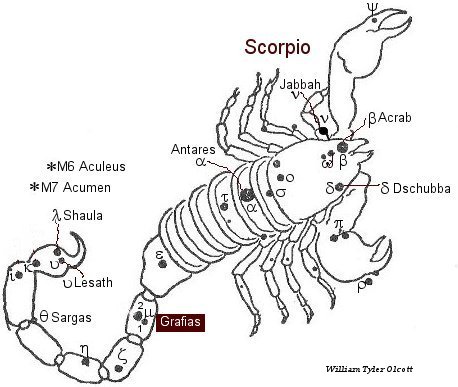
Today I'd like to present you with another constellation as part of my Constellation Series. We have gotten to the constellation Scorpio, the scorpion.


In Hellenic Mythology the myths associated with Scorpio almost invariably also contain a reference to Orion. Orion (Ὠρίων) was a famed hunter who has a lot of mythology to his name. He is the son of Poseidon and has the ability to walk on water. It is said that he once, when drunk, tried to force himself upon Merope, the daughter of Oenopion and was blinded and exiled because of it. Hēlios eventually healed his injury and restored his eyesight. After a failed vengeance attempt, Orion came to Krete and begun  to hunt with Artemis. According to Hyginus' Astromomica, this eventually lead to his downfall:

"Orion since he used to hunt, [...] felt confident that he was most skilled of all in that pursuit, said even to Diana [Artemis] and Latona that he was able to kill anything the produced. Earth [Gaea], angered at this, sent the scorpion which is said to have killed him. Jove [Zeus], however, admiring the courage of both, put the scorpion among the stars, as a lesson to men not to be too self-confident. Diana, then, because of her affection for Orion, asked Jove to show to her request the same favour he had given of his own accord to Earth. And so the constellation was established in such a way that when Scorpion rises, Orion sets." [2.26]

In this scenario, the Scorpion was admitted into the heavens as well, along with his hunting pack and his greatest hunt: the Lepus the hare. In some old descriptions the constellation of Libra is treated as the Scorpion's claws. Libra was known as the Claws of the Scorpion. Hyginus makes the connection between the scorpion and the scales best:

"This sign is divided into two parts on account of the great spread of the claws. One part of it our writers have called the Balance." [II. 26]
 
The constellation Scorpio is visible at latitudes between +40° and −90° and best visible at 21:00 (9 p.m.) during the month of July.

How about a little overview today? An overview of the fertility gods of Hellenismos. I'm going to start off with a lesser known deity: Priapos (Πριαπος), protector of sheep, goats, bees, the vine and of all garden produce. He was depicted with a huge male member, and can be petitioned for aid with any issues regarding the male genitalia. He was native to the Mysian city of Lampsakos on the Hellespont but the ancient Hellenes adopted the God as the son of either Hermes or Dionysos. His mother was usually Aphrodite. Fun fact: primitive statues of Priapos were traditionally set-up in vegetable plots to promote fertility with the added benefit of functioning as a type of 'scarecrow' scaring away birds.


Rhea (Ρεα), wife of Kronos, is a female fertility Goddess--amongst other things. She also looks after mothers and children, and is one of the great mother Goddesses in the pantheon having obviously given birth to the Olympians. Anything female-related (including issues with fertility) can be put before Her. Hera, by the way, has many of the same domains as Her mother--logical as she is the new generation's mother figure.

Aphrodite is also a fertility Goddess. She along with Zeus, Hera, Eileithyia and Hymenaios were the Theoi Gamelioi (Gods of Marriage) who presided over the wedding rites. She was invoked as the Goddess of the consummation of marriage and the fertility of the bride.

Speaking of which, Eileithyia (Ειλειθυια) is the Goddess of childbirth and labour pains. According to some there were two Eileithyiai, one who furthered birth and one who protracted the labour. Her name means 'she who comes to aid'.

Demeter and Persephone were regarded as fertility Goddesses in the Eleusinian Tradition, and during Their Thesmophoria festival, women actively asked for fertility from Them. Demeter, especially, is obviously also very important for the growth of plant life.

Dionysos is mostly associated with the fertility of the soil, and especially in regards to the grape vine, but human fertility is amongst His descriptors. Pan is regarded as much the same, as are many of the Satyrs and daimons connected to Them--like Tykhon, Konisalos, and Orthannes.

Phanes (Φανης) is the Protogenos of procreation in the Orphic cosmogony. He is the primal generator of life, and was the driving force behind reproduction in the early cosmos. Phanes was hatched from the world egg when it was split into its constituent parts by the ancient gods Khronos and Ananke. Arguably, He still drives the process of reproduction, be it in plants, animals, or humans.

 I'm low on time today, but I would like to share a beautiful translation of a piece of the Greek Anthology. The Greek Anthology (Anthologia Graeca) is a collection of poems, mostly epigrams, that span the classical and Byzantine periods of Greek literature. Most of the material of the Greek Anthology comes from two manuscripts, the Palatine Anthology of the 10th century and the Anthology of Planudes (or Planudean Anthology) of the 14th century. Needless to say, they are not ancient Hellenic, but use themes from its mythology and I enjoy sampling them.


Now, the Greek Anthology has been translated many times and I am not a fan of most. Take this translation, for example, of the part I'd like to share today:

"Even like unto a storm in springtime, Diodorus, 
is my love, determined by the moods of an uncertain sea. 
At one time you display heavy rain-clouds, 
at another again the sky is clear 
and your eyes melt in a soft smile. 

And I, like a shipwrecked man in the surge, 
count the blind waves as I am whirled 
hither and thither at the mercy of the mighty storm. 

But show me a landmark either of love or of hate, 
that I may know in which sea I swim."
[12.156]

Perfectly fine, but it doesn't flow for me. Here is today's offering, and I love it! From Sententiae Antiquae:

"Just like a spring storm, Diodoros,
My love is decided by an uncertain sea.
Sometimes you show pouring rain, but at others
You are clear, and you pour a soft smile from your eyes.

So I, like the shipwrecked on the swell,
Measure out the blind waves as I spin,
Drawn here and there by the great storm.

But you, shine me a beacon of love or even hate
So I can know by which wave we should swim."
[12.156]

 The beautiful thing about our religion is that not only do we have a clear way to honor the Theoi, and incentive to do so, we also get to live in a world governed completely by the Theoi. Hellenismos is special in that regards because it also largely matches up with science. To me--and many others with me--that is something very comforting. Now, as you are probably all aware, I live in a world full of Gods and Nymphs; for example, I take great strength in greeting Eos each morning as she paves the way for Helios, but there are many Gods who are, or who control, the cycle of day and night, and I would like to write out this cycle, if I may.


For all things geneological, I will always turn to Hesiod first. In his 'Theogony', he speaks of the birth of the Dawn, Sun and Moon:

"And Theia was subject in love to Hyperion and bare great Helios, and clear Selene, and Eos." [177]

Diodorus Siculus, in his 'Library of History' shares this world vieuw and moves a (pseudo-scientific) step beyond it:

"Of Hyperion we are told that he was the first to understand, by diligent attention and observation, the movement of both the sun and the moon and the other stars, and the seasons as well, in that they are caused by these bodies, and to make these facts known to others; and that for this reason he was called the father of these bodies, since he had begotten, so to speak, the speculation about them and their nature." [5.67.1]

Hyperion (Ὑπερίων), meaning 'The High-One', was a Titanes God born from Gaea and Ouranos. Theia and Euryphaessa (as mentioned in, for example, the Homeric Hymns) are generally regarded as the same Deathless woman: 'Theia' is the Hellenic word for 'Goddess', so it was likely 'Theia Euryphaessa' translated to 'Goddess Euryphaessa'. This means that the family tree is as follows:

     Khaos ------------ Gaea
         |         |
   Ouranos --- |
                       Hyperion --- Euryphaessa
                   |
                  Eos - Helios - Selene

The three of them--put into motion by Hyperion--form the basic cycle of these planets associated with specific times of day. Yet, the ancient Hellenes saw Night and Day as quite seperate from the heavenly bodies that are associated with them today. I have spoken before of the Protogenoi, and how They--contrary to the Olympians--are actually of the world; They, together, form the tapistry of earth and life. They literally make up our universe. As such, the further towards the Big Bang you go, the more abstract the Theoi become; They take on large, mostly unformed, chunks of the material that makes up our world and the further away you go from Khaos, the more specialized the Gods become--as well as numerous.

As such, starting this explination with Hyperion is actually incorrect--I should have started with Khaos itself, but if not there, than at least with Nyx, who is the deep Night, and Her daughter Hêmera (Ἡμερα), who is the Protogenos of the Day and the sister-wife of Aither (Light). In Hellenic mythology, Nyx draws a veil of darkness between the shining atmosphere of the aither and the lower air of earth (aer) at set times in the day, bringing night to man. In the morning, Hêmera removes this veil, and exposed the Earth once more to Light. As Hesiod writes in the Theogony:

"[At the ends of the earth, where lie the roots of earth, sea, Tartaros :] There stands the awful home of murky Nyx wrapped in dark clouds. In front of it [Atlas] the son of Iapetos stands immovably upholding the wide heaven upon his head and unwearying hands, where Nyx and Hemera draw near and greet one another as they pass the great threshold of bronze: and while the one is about to go down into the house, the other comes out at the door. And the house never holds them both within; but always one is without the house passing over the earth, while the other stays at home and waits until the time for her journeying come; and the one holds all-seeing light (phaos) for them on earth." [744]

Once we reach AD times, Hêmera is often identified with Eos, but in centuries prior, she was very much Her own Goddess, and Hêmera was as well. Hómēros, for example, in the 'Odysseia' writes: 

"The ship [of Odysseus] in due course left the waters of the river Okeanos and reached the waves of the spacious sea and the island of Aiaia; it is there [Okeanos] that Eos the early-comer (Erigeneia) has her dwelling place and her dancing grounds, and the sun himself has his risings. We came came in; we beached our vessel upon the sands and disembarked upon the sea-shore; there we fell fast asleep, awaiting ethereal Dawn." [12.1]

So, to recapitulate: Nyx and Hêmera continually work to both create and dissolve darkness on Earth; Selene moves with Nyx, and Helios with Hêmera, as heralded by Eos. In this recap, it is quite obvious we are yet missing a speciffic time of the day: dusk, or the evening. This was in the domain of the Nymphs, in this case the Hesperides (Ἑσπεριδες), who--depending of source--are either the daughters of Nyx or Atlas. Diodorus Siculus, in the 1st Century BC., wrote in his 'Library of History': 

"Now Hesperos (Evening) begat a daughter named Hesperis (Evening), who he gave in marriage to his brother [Atlas] and after whom the land was given the name Hesperitis; and Atlas begat by her seven daughters, who were named after their father Atlantides, and after their mother Hesperides." [4. 26. 2]

Yet, older sources agree that the Hesperides were born from Nyx; Hesiod, for example:

"And Nyx (Night) bare hateful Moros (Doom) and black Ker (Violent Death) and Thanatos (Death), and she bare Hypnos (Sleep) and the tribe of Oneiroi (Dreams). And again the goddess murky Nyx, though she lay with none, bare Momos (Blame) and painful Oizys (Misery), and the Hesperides who guard the rich, golden apples and the trees bearing fruit beyond glorious Okeanos."

Of course, there are more Gods--motly Titans--who are in some way connected to the cycle of night and day, but these are the most important ones and it's quite a hand full already. So perhaps next time when you awake, you will think of Hêmera, and rosy Eos, and when the sun is high in the sky, you will think of Him as well, and when you look upon the Moon before going to bed, you will give honors to Selene and Nyx, who holds Her and Gaea in Her embrace. Our Gods are everywhere; you only have to be aware of Them to notice.

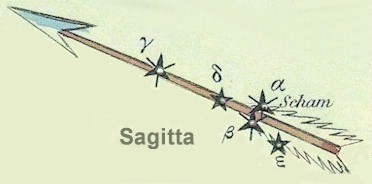
 Today we'll examine a constellation not many people will have heard about. It is called 'Sagitta' and is located beyond the north border of Aquila, the eagle, east of Delphinus, the Dolphin, and north of the constellation of Hercules. The ancient Hellenes called the constellation 'Oistos', and even though it is the third-smallest area of all constellations, it was included among the 48 constellations listed by  Ptolemy. It remains one of the 88 modern constellations defined by the International Astronomical Union. Located to the north of the equator, Sagitta can be seen from every location on Earth except within the Antarctic circle.


Sagitta looks like an arrow, and obviously, it is identified with pretty much every archer in ancient Hellenic mythology. For such a tiny constellation is has a lot written about it, mostly by Hyginus in his 'Astronomica'. Above all, he attributes the flying arrow to Hēraklēs, shot to kill the eagle that ate the liver of Prometheus night after night.

"This arrow, they say, is one of the weapons of Hercules, with which he is said to have killed the eagle which ate the liver of Prometheus. The following reason for the release of Prometheus has been handed down. When Jupiter, moved by the beauty of Thetis, sought her in marriage, he couldn’t win the consent of the timid maiden, but none the less kept planning to bring it about. At that time the Parcae were said to have prophesied what the natural order of events should be. They said that the son of Thetis’ husband, whoever he might be, would be more famous than his father. Prometheus heard this as he kept watch, not from inclination but from necessity, and reported it to Jove. He, fearing that what he had done to his father Saturn in a similar situation, would happened to him, namely, that he would be robbed of his power, gave up by necessity his desire to wed Thetis, and out of gratitude to Prometheus thanked him and freed him from his chains. But he didn’t go so far as to free him from all binding, since he had sworn to that, but for commemoration bade him bind his finger with the two things, namely, with stone and with iron. Following this practice men have rings fashioned of stone and iron, that they may seem to be appeasing Prometheus. Some also have said that he wore a wreath, as if to claim that he as victor had sinned without punishment. And so men began the practice of wearing wreaths at times of great rejoicing and victory. You may observe this in sports and banquets.

But to come back to the beginning of the inquiry and the death of the eagle. Hercules, when sent by Eurystheus for the apples of the Hesperides, out of ignorance of the way came to Prometheus, who was bound on Mount Caucasus, as we have shown above. When victor, he returned to Prometheus to tell him that that dragon we have mentioned was slain, and to thank him for his kindness since he had pointed out the way. Straightway he gave what honour he could to the one that deserved it, for [he killed the eagle?] and since it was slain, men began, when victims were sacrificed, to offer livers on the altars of the gods to satisfy them in place of the liver of Prometheus."

Another explanation Hyginus gives--along with Hesiod, Apollodorus, and Diodorus, amongst others--is that the arrow belongs to Apollon. It was the arrow with which He avenged the death ofHhis son Asklepios, who had been killed by a lightning bolt design by the Kyclopses. Obviously, Apollon could not attack Zeus, so he attacked the Kyklopses instead, and murdered them. To quote Hyginus

"Eratosthenes says about the Arrow, that with this Apollo killed the Cyclopes who forged the thunderbolt by which Aesculapius died. Apollo had buried this arrow in the Hyperborean mountain, but when Jupiter pardoned his son, it was borne by the wind and brought to Apollo along with the grain which at that time was growing. Many point out that for this reason it is among the constellations."

Sagitta is visible at latitudes between +90° and −70°, and best visible at 21:00 (9 p.m.) during the month of August.

 Some plants in Greece are so deeply connected with Hellenic history, mythology, and tradition that is hard to find a starting point. Perhaps the most prominent is the pomegranate. Maybe the oldest report about the pomegranate bush is by Homer, who first called this beautiful bush ‘Ria’ and this name remained until it was replaced with ‘Rodia’ in modern Greek. Punica granatum, the scientific name of pomegranate may derive from punicum, meaning red color in Latin. The name pomegranate is derived from the Latin words pomum and granum meaning apple and seed respectively.


Homer described this plant in the gardens of king of Faiakon (Kerkira island nowadays). A famous myth featured Persephone, daughter of Demeter and Zeus who was taken to the Underworld by Hades. He offered Persephone seven seeds of pomegranate, which symbolized marriage. In this way, the couple was bonded forever and for six months Persephone was ‘above’ and for six she was ‘down’ in the Underworld Hades. This is how it was explained, in tradition and from mythology to modern art, that some for some months Earth is sleeping and then she is ‘reborn’ in Spring.

For example, it was used by a symbolist poet melodized by Mikis Theodorakis about a lover who left, symbolized as pomegranate. Also, pomegranate was depicted in statues of Hera, Goddess of marriage and fertility, but was also associated with Aphrodite, Goddess of passion and love. Therefore, in ancient Hellas it was cultivated as a shrub of love, fertility, family, and good luck.

When the outer surface is dried, the inner seeds are juicy ready to be consumed, another reason for this fruit’s symbolization of death and life.

Its nutritional value is quite high. Bit its sour taste is undesirable for some palates due to the high amounts of antioxidants, tannins, and vitamins. A great way to consume it raw is in a green salad with kefalotyri or parmesan cheese and some ‘ntakos’, dried Cretan bread or croutons. Also, it can used fresh in every sweet recipe with fresh fruits like strawberries or blueberries.

 Two PAT ritual announcements, both for September 10th. We will hold a PAT ritual for the Niketeria, followed by the Plataia.

The Niketeria
We are coming upon another festival celebrated in ancient Athens: the Niketeria. Surviving sources date the festival to the third of Boudromion, and it was in honor of one of the most important events in Athens' history: its naming and tutelage by Athena. We will be celebrating it at the usual 10 AM EDT.


Many of us know there was a contest between Poseidon and Athena over who would rule the growing city of Athens (in the name it had before being called 'Athens'), and it is clear who won that contest. The earliest reference to this event we still have access to is from the fourth century BC by Plato, but it does not quite have the poetic touch Ovid's account has. For that reason, I will give the account of Ovid, and build from there. From the Metamorphoses, (trans. Melville):

"The rock of Mavors [Ares] in Cecrops' citadel is Pallas' [Athena's] picture [in her weaving contest with Arakhne] and that old dispute about he name of Athens. Twelve great gods, Jove [Zeus] in their midst, sit there on lofty thrones, grave and august, each pictured with his own familiar features: Jove [Zeus] in regal grace, the Sea-God [Poseidon] standing, striking the rough rock with his tall trident, and the wounded rock gushing sea-brine, his proof to clinch his claim. Herself she gives a shield, she gives a spear sharp-tipped, she gives a helmet for her head; the aegis guards her breast, and from the earth struck by her spear, she shows an olive tree, springing pale-green with berries on the boughs; the gods admire; and Victoria [Nike] ends the work." [6. 70]

Ancient Hellenic Neoplatonist philosopher Proklos (Πρόκλος) in 'On the Timaeus of Plato' speaks of this event as well, and notes that there is still a festival held to commemorate this event in his time (between 412 and 485 AD)

 "Farther still, the victories of Minerva are celebrated by the Athenians, and there is a festival sacred to the Goddess, in consequence of her having vanquished Neptune, and from the genesiurgic being subdued by the intellectual order, and those that inhabit this region betaking themselves to a life according to intellect, after the procurement of necessaries. For Neptune presides over generation; but Minerva is the inspective guardian of an intellectual life." [p. 153]

When this was celebrated, Proklos does not mention, but Plutarch does. One of these is in the Quaestiones Convivales, from the Moralia. Here, he answers the question: 'What is Signified by the Fable About the Defeat of Neptune? And Also, Why Do the Athenians Omit the Second Day of the Month Boedromion?'.

"While all were making a disturbance, Menephylus, a Peripatetic philosopher, addressing Hylas: You see, he said, how this investigation is no foolery nor insolence. But leave now, my dear fellow, that obstinate Ajax, whose name is ill-omened, as Sophocles says, and side with Poseidon, whom you yourself are wont to tell has often been overcome, once by Athene here, in Delphi by Apollo, in Argos by Here, in Aegina by Zeus, in Naxos by Bacchus, yet in his misfortunes has always been mild and amiable. Here at least he shares a temple in common with Athene, in which there is an altar dedicated to Lethe. And Hylas, as if he had become better tempered: One thing has escaped you, Menephylus, that we have given up the second day of September [Boudromion], not on account of the moon, but because on that day the gods seemed to have contended for the country." [Book 9, question 5]

Because of this, the official view of Elaion is that the festival of Niketeria--'Victory'--was celebrated not on the second of Boudromion as many modern researchers say, but on the third. The second day, after all, was no longer a part of the month. The question remains why the victory of one Goddess over one God was commemorated at all, and there is no adequate ancient explanation. None of the surviving works mention why and how the festival was celebrated. All we know is that it was noted--it might not even have been a true festival at all. We believe that by omitting the second day, the defeat of Poseidon was omitted, so as not to anger Him. A day later--in a somewhat unrelated fashion to Poseidon's defeat--there was a (possibly somewhat subdued) celebration of the victory of Athena, with sacrifices to Athena, Niké, and perhaps even Poseidon for the many wonderful gifts They had provided--and would hopefully continue to provide--for the city of Athens.

We will hold a subdued PAT ritual in honor of the Niketeria at 10 AM EDT on August 22rd. Will you be joining us? The ritual can be found here and you can join the community here.


The Plataia
The Plataia (or Plataea) seems to have been a commemorative festival, for the Hellenes fallen at the battle of Plataea. The Battle of Plataea was the final land battle during the second Persian invasion of Hellas. It took place in 479 BC near the city of Plataea in Boeotia, and was fought between an alliance of the Greek city-states, including Sparta, Athens, Corinth and Megara, and the Persian Empire of Xerxes I. Some 38,700 Hellenes stood their ground against 300.000 Persians. The Hellenes marched out of the Peloponnesus and the Persians retreated to Boeotia and built a fortified camp near Plataea. The Hellenes surrounded the camp, but refused to enter the bare terrain surrounding the camp. They waited for eleven days, and then found their supplies dwindled. They attempted to retreat, and Persian general Mardonius ordered his forces to pursue them. The Hellenes, however--particularly the Spartans, Tegeans and Athenians--stood their ground, and won a great victory over the Perians. The Persian infantry was slaughtered, and Mardonius killed. Plutarch gives the date for the battle to be the fourth of this month, but also attested that the Athenians commemorated the event on the third. In Boeotia (and especially in Plataea), the remembrance seems to have been held on the fourth.

Herodotus, in his Histories (9. 52. 1), and Plutarch, in his 'Life of Arestides' both remark the following about what is most likely this battle:

"The seer slew victim after victim, Pausanias turned his face [historical general of the Persian Wars], all tears, toward the Heraion, and with hands uplifted prayed Kithaironion Hera and the other gods of the Plataian land that, if it was not the lot of the Hellenes to be victorious, they might at least do great deeds  before they fell."[Life of Aristides, 18. 1]

As such we can assume that, besides the fallen, a sacrifice to Hera was also made. For this ritual, you can join us here. The ritual can be found here. We'll perform the ritual at 11 am EDT.