Showing posts with label community. Show all posts

I put a lot of stock in the Hellenic ancient sources, scattered as they may be, because while these were the accounts of one man or one woman, they were copied repeatedly, used in religious settings by many, and traveled the whole of Hellas. These weren't documents stuffed away in some guy's drawer that happened to be preserved for 2000 years; these were copied, copied, and copied again, and one of these many copies has survived to the present day (generalizing, of course). Luck of the draw. As such, we can assume that some of the documents (say, for example, the Orphic hymns) were read and repeated by many, and that is what makes them valuable. Hómēros was a best-seller of his time, and that is why we still have access to his writings. People must have identified with what they read, or they would not have read it and carried it on. 

That said, I take no issue at all with Unverified Personal Gnosis UPG, and that is a sentiment I see reflected in the Hellenistic community quite a lot. What I have an issue with is people passing of UPG as fact. To me, it's wonderful that you have discovered Hermes likes libations of rum, and more power to you for giving it to Him. When you start insisting that I need to give rum libations to Hermes, we have an issue, because I will always take the 'opinion' of the ancient writers over the opinion of a modern practitioner. That is why I am on a Recon path. If I were on a non-Recon path, I might run off to the nearest liquor store in search of rum. 

It's not a matter of who is right, or who does it 'better', it's simply that Recon means following the ways of the ancients as much as possible, and even if no one in ancient Hellas would have agreed with the ancient writer whose work has survived to this day, it is still a description of one ancient person's practice--and for me, ancient trumps modern every single time. So that is why at least the Hellenistic community will always ask for sources when you make a statement; they need to be able to differentiate between ancient and modern--not to instantly dismiss the latter, but to make a well-informed decision if they should or should not.

Ideally the term 'Unverified Personal Gnosis' is used to label one's own experience as a new and untested hypothesis, although further verification from other practitioners or ancient sources may lead to a certain degree of verifiability. Personally, I try to go from Unverified Personal Gnosis to Shared Personal Gnosis to Confirmed (Personal) Gnosis. This is why the Hellenistic community in general is open to the sharing of UPG--generalizing here--because others may have had the same experience (which lends credibility to the experience) or references to source material with which the UPG can be confirmed. There is a certain degree of science about it, when viewed like this, but it requires the receiver of the UPG to be open about his or her experiences and accept the fact that this hypothesis may be false, or at the very least unverifiable. If this is the case, using the UPG for your personal practice is fine, but doling it out as the Holy Word and Ultimate Truth will not get you far.

So, say you have received a piece of UPG, where 'UPG' here refers from anything like information gleamed during meditation to a hunch you have about a subject after coming across a throwaway line in scholarly work; how do you proceed?
  1. Consider your UPG as a hypothesis that can either be confirmed or disproven, or--if it makes you feel better--verifiable or unverifiable.
  2. Collect possible sources. Preferably, you go straight to scholarly work or primary sources for this, but heck, a Google search works wonders these days as a starting point. This is background reading.
  3. Begin reading in detail. Find information that explains, describes, analyzes, contrasts, or gives expert opinion and viewpoints on the subject. You are seeking to form your own judgment, based on what you read from your sources.
  4. Evaluate the sources you use. If it's Wikipedia, go to the sources used to write the page, if it's a blog or website, check their sources as well. Try to go back to primary, ancient, sources for everything; even (or should 'say 'especially'?) scholarly work becomes outdated.
  5. At this point there are a few options: either you have found evidence to support your UG, you have found evidence that discredits your UPG, or you haven't found anything at all. In the first case, you might end your research here: your UPG is now Confirmed (Personal) Gnosis. In all three cases, it is also possible to take it public.
  6. Share your UPG on (Hellenistic) forums, lists, Facebook groups, your thiasos, friends, or any other medium you are comfortable with and ask if others are familiar with this information (Shared Personal Gnosis), or if they can confirm it with ancient sources. Be open with it, and although it might sting a little, try to accept that others do not share this view, or have no sources to confirm (or disprove) your thesis. UPG can feel like your baby, but if you want to apply it outside of your household worship, it needs to be able to take a (research) hit.
  7. This is perhaps the most important one: if your UPG can't be confirmed, don’t let it get you down for long. The fact that our experience or hunch can't be confirmed now, does not men it can't be confirmed later. Even if it's disproven by modern scholarship, this could still change. Even if UPG turns out false, there is no reason not to apply it to your household worship: the experience is yours to do with as you please. If it is unconfirmed or disproven, however, please mention this when referencing it towards other Hellenists.
Our UPG is often very personal, and sometimes hard to share with others. I have a few of those experiences as well, and while I can confirm some of them with scholarly or primary sources, others, I find no mention of. If and when I mention these experiences on this blog, I always explain it is either UPG, my personal opinion, or a stab in the dark by yours truly. That way, you have a means to decide of the statement is relevant to you and your practice.

One more tip (and plea) for those reading and commenting on other people's UPG: you might not agree with it--in fact, you might vehemently disagree--but there are better ways to go about expressing this than an eye-roll and a snarky remark. Comment when you have something helpful to say--either in the affirmative or the negative--and please do so with a bit of tact and decorum. Who knows? That piece of UPG might end up shaping the Tradition.

As new lockdown measures are sweeping the globe, those of you with kids might be running out of things to do with them. I'm going to describe some fun things to do with children to get them in the mood for a Hellenistic festival, and to help make them feel more included.


  • let the children design their own Hellenic clothing, and have a fashion show to show off the designs
  • pick flowers with the children and let them make their own wreath to wear
  • assist the kids in writing a mythologically inspired play, and let them perform it; this play can be inspired by existing plays, of course
  • play '20 questions' with the kids by having them stick a post-it with the name of a Theos or Theia on it on their foreheads and asking each other questions to find out who they are
  • make temples of their own design with the kids; these can be drawn, fashioned out of clay, made out (or inside of) shoe-boxes, or with bricks and wood, if you have the resources at your disposal
  • a similar assignment can be done  for altars, pottery, columns, statues, or ancient Hellenic houses
  • Hellenic shields and helmets can be made out of cardboard
  • how about drawing monsters on cardboard and cutting them out? They can play 'Hēraklēs' with them afterwards and vanquish them
  • collect as many rocks and other markers as you can find and lay out the lines of a temple behind, so they can play at being priests and priestesses
  • alternatively, the kids can make a labyrinth and find the heart of it, like Theseus when he went to hunt for the Minotaur. Having them find their way out is also an option, of course
  • cook as much Hellenic food together as you can stomach and have a tasting party
  • let the kids read and study the Hellenic alphabet, and compose coded messages to each other. Use clay or plaster to create a plaque the students can carve their name into. Use a paperclip as a hanger (apply to the plaster or clay while it hardens) so the plaque can go on the wall. Stone fleck paint or simple gray paint can be used to 'stonify' the plaque afterwards.
  • make ancient Hellenic coins out of clay, carving images into it, or using the clay to make a mold that you can pour tin in. Note, tin fumes are poisonous and is has to be melted! Don't let the kids do this themselves!
  • host Olympics with kids-appropriate sports like long jump, sprints, relay races, and things like frisbee throw, space hopper races, and rope jumping competitions
As you can see, there are a thousand-and-one things to do with children that will teach them about ancient Hellas, and make a festival day extra special. Besides, most of these things, I would love to do myself; the space hopper races, especially!

Image taken from: Culture24
A large part of my Hellenistic household worship consists of tending Hestia's flame. Back in ancient Hellas, most religious activities surrounding the household revolved around the central hearth, which was the physical manifestation of Hestia. The male head of household, the kurios, presented slaves, children and his new wife to the heart fire so they became part of the oikos and fell under the protection of Hestia and the other household Gods.

While Hestia has little mythology to Her name, Her worship was a vital part of ancient Hellenic religion. For one, Her flame connected every single Hellenic oikos to each other and the state. All the household fires were lit with a flame from the prytaneion (Πρυτανεῖον), the structure where state officials met and where the city kept a fire for Hestia burning day and night. Every single heart fire in the city or town was linked to that central one, and that central fire was linked to the city from where the settlers of the new village, town or city came. This network of fires, which were never allowed to go out, brought all Hellens together.

Hestia is a very female-oriented Goddess. Caring for the household was a task solely intended for women and it is because of this, very few stories about Hestia were made or recorded; the male-dominated culture cared little for Her. Yet, it was also the kurios who traveled to the prytaneion for a bit of Hestia's fire when the fire within the oikos flamed out.

Personally, I keep a flame burning on my main shrine for Hestia at all times. I keep a live flame when I'm home and awake, and an electrical one when I'm out or asleep. I would love to keep a live flame at all times, but I don't exactly have a stone building to keep it in. That one's going to have to wait a few years or so. From this flame, I light the candles in my home, and the sacrificial fire I burn twice a day and on festivals.

I truly feel that tending a flame for Hestia should be a vital part of every Hellenistic's practice. A bold statement, I know, but there is so much ancient Hellenic foundation for it that it's hard to ignore. In fact, when Hellenismos gets bigger and starts forming communities, there should be a prytaneion at its center, with a fire being continuously kept.

Hestia's fire is a great way to form a community, to come together and rejoice in the Hellenic faith. When I look at mine, I envision Hestia's fire being tended to around the world, and feel just a bit closer to Her and other Hellenic practitioners. I truly hope tending Hestia's fire is something you'll consider adopting into your own practice, if you haven't done so already.
As legend goes, a shepherd herded his flock up the side of Mount Parnassus. The sheep came upon a chasm and seemed to lose their minds. They started jumping around, and darting about. When the shepherd went to inspect the chasm, he fell under the influence of gasses that welled up from it. He lost all his worries and cared not about the time. He simply wished to remain there and gleam the knowledge he felt at the edges of his mind.

When he did not return, his family went to look for him. They took him home and put him to bed. Everyone was worried by his strange behavior, but he seemed to be calmer when the morning came. Yet, the shepherd's behavior had not returned to normal. He was able to foretell the future. Soon, word of the shepherd's ability, and the chasm, spread. People came from far away to either talk to the man or go to the source. Yet, those who visited the chasm lost their minds as well, and sometimes even jumped in the chasm.

A decision was made: this chasm, which must send up messages from Gaea, needed to be managed so no one would get hurt. A woman was chosen and introduced to the vapors, and given servants to keep her safe and healthy. She spoke with the voice of Gaea, and spoke her prophecies for anyone who would visit. It is said that the chasm was protected by a serpent, Python (Πύθωνος), who was put there by Gaea to protect the chasm.

The chasm was seen as the center of the known world, as Zeus himself had once let two eagles fly at the far reaches of the world, and they met over the chasm. It was Gaea's sacred site, but it didn't remain that way for long. Apollon was born, and he soon moved to find the perfect site for His temple. In the Homeric hymn to Pythian Apollon, we find His arrival at the site of Gaea's oracle, and an account of His battle with the serpent:

"In this place I am minded to build a glorious temple to be an oracle for men, and here they will always bring perfect hecatombs, both they who dwell in rich Peloponnesus and the men of Europe and from all the wave-washed isles, coming to question me. And I will deliver to them all counsel that cannot fail, answering them in my rich temple."

"...Whosoever met the dragoness, the day of doom would sweep him away, until the lord Apollo, who deals death from afar, shot a strong arrow at her. Then she, rent with bitter pangs, lay drawing great gasps for breath and rolling about that place. An awful noise swelled up unspeakable as she writhed continually this way and that amid the wood: and so she left her life, breathing it forth in blood. Then Phoebus Apollo boasted over her:

"Now rot here upon the soil that feeds man! You at least shall live no more to be a fell bane to men who eat the fruit of the all-nourishing earth, and who will bring hither perfect hecatombs. Against cruel death neither Typhoeus shall avail you nor ill-famed Chimera, but here shall the Earth and shining Hyperion make you rot."

Thus said Phoebus, exulting over her: and darkness covered her eyes. And the holy strength of Helios made her rot away there; wherefore the place is now called Pytho, and men call the lord Apollo by another name, Pythian; because on that spot the power of piercing Helios made the monster rot away."

And so, the site became sacred to Apollon. At first, young virgins spoke the word of the Lord Apollon, but later on, it was decreed that the oracle--called the Pythia--had to be over fifty years of age. The site was at the epicenter of important travel routes; the road leading from northeastern and eastern Hellas to the plain of Amfissa--where it met the road joining northern Hellas with Naupactus--passed through Delphi. From the beach of Itea, it was easy to pass to nearby Peloponnesus. This not only made Delphi an important religious site, but a commercial one, and it was one of the major keys to its success.

Delphi is no more. The entire site is in ruins. While you can still walk a large part of the grounds, there is no longer an oracle who breaths in the vapors and gives prophesy. Hellenists lost that line to the Theoi.

Most of us know how to work a divinatory tool; we come from other Neo-Pagan paths that encourage it, or developed systems of our own. Some of us are just naturally gifted. I feel the Hellenistic community--when it becomes larger and more standardized and organized--could greatly benefit from another Oracle; someone whom we trust to speak the words of the Theoi and whom we pay for their efforts. A new Pythia, dedicated to the Hellenistic community, who is supported by said community. I honestly hope we get there some day. Delphi is not gone; it lives on in each of us. It's legacy drives us forward as a religion. One day, we may have it again.
I don't have children, but I can imagine raising any future children in the Hellenistic Tradition. Now the weather is improving, I'm going to describe some fun things to do with children to get them in the mood for a Hellenistic festival, and to help make them feel more included.


While the Hellenistic rituals are pretty fun, and children are easily included--washing their hands and face, throwing barley grains, acting as carriers of water, wine or offerings, etc.--there are most certainly specifically Hellenistic activities that you can undertake with your children to make the day memorable and prepare them for the rituals, should you so desire.
  • let the children design their own Hellenic clothing, and have a fashion show to show off the designs
  • pick flowers with the children and let them make their own wreath to wear for the festival
  • assist the kids in writing a mythologically inspired play, and let them perform it on the day of the festival; this play can be inspired by existing plays, of course
  • play '20 questions' with the kids by having them stick a post-it with the name of a Theos or Theia on it on their foreheads and asking each other questions to find out who they are
  • make temples of their own design with the kids; these can be drawn, fashioned out of clay, made out (or inside of) shoe-boxes, or with bricks and wood, if you have the resources at your disposal
  • a similar assignment can be done  for altars, pottery, columns, statues, or ancient Hellenic houses
  • Hellenic shields and helmets can be made out of cardboard
  • how about drawing monsters on cardboard and cutting them out? They can play 'Hēraklēs' with them afterwards and vanquish them
  • collect as many rocks and other markers as you can find and lay out the lines of a temple behind the altar, so they can play at being priests and priestesses
  • alternatively, the kids can make a labyrinth and find the heart of it, like Theseus when he went to hunt for the Minotaur. Having them find their way out is also an option, of course
  • cook as much Hellenic food together as you can stomach and have a tasting party
  • let the kids read and study the Hellenic alphabet, and compose coded messages to each other. Use clay or plaster to create a plaque the students can carve their name into. Use a paperclip as a hanger (apply to the plaster or clay while it hardens) so the plaque can go on the wall. Stone fleck paint or simple gray paint can be used to 'stonify' the plaque afterwards.
  • make ancient Hellenic coins out of clay, carving images into it, or using the clay to make a mould that you can pour tin in. Note, tin fumes are poisonous and is has to be melted! Don't let the kids do this themselves!
  • host Olympics with kids-appropriate sports like long jump, sprints, relay races, and things like frisbee throw, space hopper races, and rope jumping competitions
As you can see, there are a thousand-and-one things to do with children that will teach them about ancient Hellas, and make a festival day extra special. Besides, most of these things, I would love to do myself; the space hopper races, especially!

Image taken from: Culture24
As legend goes, a shepherd herded his flock up the side of Mount Parnassus. The sheep came upon a chasm and seemed to lose their minds. They started jumping around, and darting about. When the shepherd went to inspect the chasm, he fell under the influence of gasses that welled up from it. He lost all his worries and cared not about the time. He simply wished to remain there and gleam the knowledge he felt at the edges of his mind.

When he did not return, his family went to look for him. They took him home and put him to bed. Everyone was worried by his strange behavior, but he seemed to be calmer when the morning came. Yet, the shepherd's behavior had not returned to normal. He was able to foretell the future. Soon, word of the shepherd's ability, and the chasm, spread. People came from far away to either talk to the man or go to the source. Yet, those who visited the chasm lost their minds as well, and sometimes even jumped in the chasm.

A decision was made: this chasm, which must send up messages from Gaea, needed to be managed so no one would get hurt. A woman was chosen and introduced to the vapors, and given servants to keep her safe and healthy. She spoke with the voice of Gaea, and spoke her prophecies for anyone who would visit. It is said that the chasm was protected by a serpent, Python (Πύθωνος), who was put there by Gaea to protect the chasm.

The chasm was seen as the center of the known world, as Zeus himself had once let two eagles fly at the far reaches of the world, and they met over the chasm. It was Gaea's sacred site, but it didn't remain that way for long. Apollon was born, and he soon moved to find the perfect site for His temple. In the Homeric hymn to Pythian Apollon, we find His arrival at the site of Gaea's oracle, and an account of His battle with the serpent:

"In this place I am minded to build a glorious temple to be an oracle for men, and here they will always bring perfect hecatombs, both they who dwell in rich Peloponnesus and the men of Europe and from all the wave-washed isles, coming to question me. And I will deliver to them all counsel that cannot fail, answering them in my rich temple."

"...Whosoever met the dragoness, the day of doom would sweep him away, until the lord Apollo, who deals death from afar, shot a strong arrow at her. Then she, rent with bitter pangs, lay drawing great gasps for breath and rolling about that place. An awful noise swelled up unspeakable as she writhed continually this way and that amid the wood: and so she left her life, breathing it forth in blood. Then Phoebus Apollo boasted over her:

"Now rot here upon the soil that feeds man! You at least shall live no more to be a fell bane to men who eat the fruit of the all-nourishing earth, and who will bring hither perfect hecatombs. Against cruel death neither Typhoeus shall avail you nor ill-famed Chimera, but here shall the Earth and shining Hyperion make you rot."

Thus said Phoebus, exulting over her: and darkness covered her eyes. And the holy strength of Helios made her rot away there; wherefore the place is now called Pytho, and men call the lord Apollo by another name, Pythian; because on that spot the power of piercing Helios made the monster rot away."

And so, the site became sacred to Apollon. At first, young virgins spoke the word of the Lord Apollon, but later on, it was decreed that the oracle--called the Pythia--had to be over fifty years of age. The site was at the epicenter of important travel routes; the road leading from northeastern and eastern Hellas to the plain of Amfissa--where it met the road joining northern Hellas with Naupactus--passed through Delphi. From the beach of Itea, it was easy to pass to nearby Peloponnesus. This not only made Delphi an important religious site, but a commercial one, and it was one of the major keys to its success.

Delphi is no more. The entire site is in ruins. While you can still walk a large part of the grounds, there is no longer an oracle who breaths in the vapors and gives prophesy. Hellenists lost that line to the Theoi.

Most of us know how to work a divinatory tool; we come from other Neo-Pagan paths that encourage it, or developed systems of our own. Some of us are just naturally gifted. I feel the Hellenistic community--when it becomes larger and more standardized and organized--could greatly benefit from another Oracle; someone whom we trust to speak the words of the Theoi and whom we pay for their efforts. A new Pythia, dedicated to the Hellenistic community, who is supported by said community. I honestly hope we get there some day. Delphi is not gone; it lives on in each of us. It's legacy drives us forward as a religion. One day, we may have it again.
Where does Hellenismos fit in? Are we part of the Pagan banner? Is there a 'we'? I tend to believe in the awesomeness that is a unified Hellenismos; I tend to believe that we all believe the same thing. But we don't, do we? There are so many labels, so many terms, just to figure out a way to tell someone else what you believe in, in a way they might just possibly relate to.

I tend to generalize a lot; I assume everyone thinks about Hellenismos the same way I do, even though I know that's rubbish. Being aware of this flaw, I go out of my way not to impose my views on others. It's a bit of mental gymnastics I don't expect you to even try to follow, so let me suffice with saying that I respect everyone's views on Hellenismos--or anything else--equally, and would never force my opinion of it onto anyone. Then again, this is my blog, so I will share with you the labels I associate with Hellenismos.

Supernatural: supernaturalism is the belief that events and values require supernatural powers or authority for their explanation. It is opposed by naturalism, which is the belief that all objects, events, and even values can be fully explained in terms of factual and/or causal claims about the natural world. Naturalism is on the rise in Paganism and I have no problem with it. I just do not think it has any place at all in Hellenismos. As a religion, I feel it is required to believe in the Theoi as actual being who have actual influence on your life. Else, you are just going through the motions. To put it bluntly: the ancient Hellens believed, thus so should the modern reconstructionist practitioner. Starting out with a shaky faith is fine; you can grow into faith. Going into it with a set mind that the supernatural does not exist? Not so useful, in my opinion.

Hard polytheistic: I'm not sure how, exactly, a soft polytheistic or even monoistic/monotheistic vision on Hellenismos would work, but it doesn't for me. To me, being a hard polytheist is pretty much the only way to believe if you're Hellenistic. A belief that the Theoi are all fragments of a single divine source (monotheistic), or that They can be conglomerated into a set of archetypical deities that span the entirety of the divine world (soft polytheism) is a wonderful thought process and belief system, but I don't see it working in Hellenismos, where worship is based on ancient sources who clearly show that's not how it works.

"Verily at the first Chaos came to be, but next wide-bosomed Earth, the ever-sure foundations of all the deathless ones who hold the peaks of snowy Olympus, and dim Tartarus in the depth of the wide-pathed Earth, and Eros (Love), fairest among the deathless gods, who unnerves the limbs and overcomes the mind and wise counsels of all gods and all men within them."

Pantheism would be another option, were it not for the fact that the Theoi are just as much a part of the world as we are--as Hesiod shows above--not the world itself. They, too, exist within a world frame; They were born into it, and are not part of it. They are a part of everything else that exists within the world frame. I can see, however, that this is a matter of interpretation of the term, and I could be able to understand a pantheistic view of Hellenic Divinity.

Immanence: the Theoi are immanence; partakers of the same world as we reside in. Like us, They make changes to it, steer the course of its development and interact with it constantly. They are a part of it, like us, just on a far larger scale. Some of the Divine are more involved with it than others--those who represent abstracts like Chaos, versus Theoi like Zeus, for example--but all of Them are as much part of the world as we are. Does this mean that the top(s) of Mount Olympus house the Theoi? Yes, in my opinion, it/they do. We just don't have the ability to perceive the world as the Theoi do, and so we can not see it.

Literal: this one is related to the previous three and is probably the most controversial one; Hellenists are called to see the myths of the Theoi as a literal interpretation of the nature of the Divine, as well as history as a whole. What happened in the myths, literally happened. It's called living with the Theoi on a daily basis. It means seeing the divine in everything. Lightning is just as much a scientific phenomenon as Zeus' mighty weapon cast down upon the earth. The little girl who guided Odysseus to the palace of Alcinous was just as much a little girl as the personification of Athena. The two overlap and co-exist. And as such, Hēraklēs' madness was brought on by Hera, and--at an even more basic level--Hēraklēs existed. He may have existed in multiple men, but there was once a man so powerful that he could only be the child of Zeus, and the many extraordinary things he did could only be attributed to a man aided by the Theoi. Literalism is tied to supernaturalism in a way that can not be untied, and as such, I feel it is part of Hellenismos. To chalk the myths up to metaphor is to deny the Theoi.

Orthopraxic: Hellenismos is a religion focussed on orthopraxia; the correct performance of the rituals associated with the religion. Yet, you can not have orthopraxia without orthodoxia; the correct thoughts behind said rituals. And so, it is both, but it is true that great focus is placed upon the proper performance of rituals, devotionals and other practices related to the Theoi. This is why I have portable shrines, so I can do my daily rituals, and it is why I honor the festivals in a way that the Theoi can relate to. What we do, matters, and I still feel very strongly for a standardized Hellenismos. This is also why I don't celebrate modern Hellenistic festivals, but more on that soon.

Reconstructionistic: If you're not doing it like the ancients did it, you're not practicing Hellenismos. Although we're still trying to draw a line where--exactly--the practice loses its reconstructionistic status, a good indication would be the pillars of Hellenismos, and all the above. Just worshipping the Theoi is not enough to adopt the label. I used to 'work' only with the Theoi, but as long as I was still drawing circles and calling quarters, I simply had no business calling myself Hellenistic. And I did not. Again, I call for standardization, in the knowledge it will not happen.

There are so many more terms and thoughts to get into, but they mostly serve to differentiate between the many varieties of Pagan out there. A few examples: I believe that within Hellenismos, humans should not be seen as divine, or holding a spark of the divine. We should not consider ourselves priests and priestesses of our religion, we are simple worshippers. Our lives should be dedicated and ruled by the Theoi, because we believe in Their divinity and feel They deserve our worship simply for being what They are. The list goes on.

Not agreeing with this interpretation of Hellenismos is perfectly alright. It was written to convey my firm belief of the religion, but--again--as we lack standardization, there is no 'right' or 'wrong', nor do I feel my way is the only 'right' way. If Hellenismos was standardized tomorrow and changes were made to any of the above, I would adjust my viewpoint(s) to fall in line, for the greater good of the religion. Until that happens, though, I stay with the terminology that makes the most sense to me. I wonder if it does to you as well.
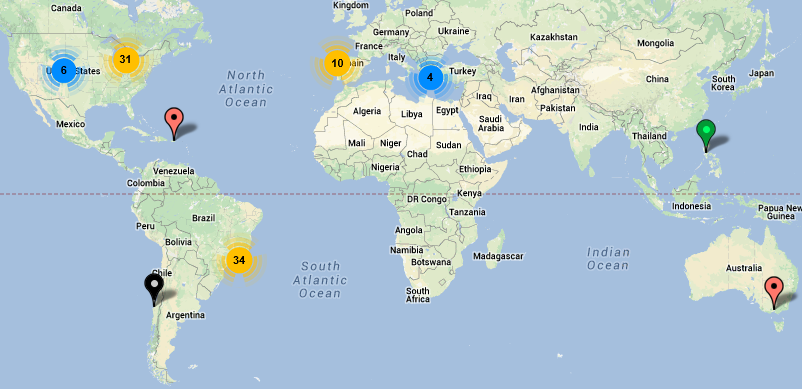
In a beautiful display of community initiative, Jonathan Agathokles and Derek Fletcher have created an interactive world map--hosted by zeemaps.com--where anyone can add their location and find others in their general area.

https://www.zeemaps.com/map?group=836213

As the map is currently an editable one, there is no need to make an account.  Simply select 'Additions' in the top beam and click the first option: 'Add Marker - Simple'. A pop-up window will now appear and ask you for your information. Fill in your name, location, and under 'directions' you can fill in any contact information you wish to leave. I added my e-mail and blog link. You can upload a picture if you want. From the 'Marker' menu, select the 'candle' in honour of Hestia and save your entry by clicking 'submit'.


I would encourage every Hellenist to add their details to the map in an effort to locate each other in some way. Many of us are practicing alone while they would much rather practice with others. These types f initiatives matter, and I applaud them greatly. I hope to see your name show up on the map and I'd be grateful if you would spread the word. Thank you in advance!
The 'Y' is one of those letters that makes me want to drop the Pagan Blog Project, just because there is simply nothing that relates completely to Hellenism. As such, I have to branch out a little and I will write a post I have been meaning to write for a while but never really found the spoons to write.

I came to Paganism through Eclectic Religious Witchcraft (in one form or another). It eventually lost its appeal in favor of something that was more truthful to me, more fitting, but I learned much in my ten+ odd years in the religion and one of them is that I really, really, cannot stand people charging exhorbitant prices for religious teachings. I feel that if there is one thing that should be 'open source', it should be religion. There is nothing wrong with asking for a donation or charging a small fee to cover costs, but as soon as you start charging $15,- for an hour long ritual that cost you nothing to put together but an hour of your time, I break out in hyves.

There is nothing wrong with selling art or books, or doing anything of the sort, especially if your prices are reasonable; this is a wonderful service to the community and something that can add to your practice once you have the funds. I'm talking more about information here, which is hard to be without if you want to practice.

Money makes the world go 'round these days, and it truly sickens me. Money should have no place in the pursuit of truth, faith, and happiness. Again, I have no issue with covering costs or even a little more than that, but I have seen a lot of fuckery (pardon the term) when it comes to money, and I have seen how some people who really want to participate and practice in the way they feel they are told to are left in the cold because they can't cough up the fee.

All of the religions under our banner are small when compared to the mainstream faiths, and as such getting quality information on it is rediculously hard. Some religions and traditions under our banner have a bit more information overturn and talented writers than other, but in general, it is very, very, hard to get your questions answers and if you are just starting out, you are far more likely to be told to do 'your own damn research' than get an answer at all from mroe experienced members of the religion.

What is this, people? Why do we do this? Why do we downlook those who come into the faith eagerly, willing to learn? Have we forgotten how badly we struggled in the beginning, how just figuring out basic ritual structures took a month? How we didn't know what to buy, what to say, how to look at the world? Why make someone else go through that when all it takes is a sentence or two to say: 'look up the word 'khernips', it's the lustral water used for purification. Come talk to me when you have and we'll get you started'.

I believe information is the greatest gift we can give our fellow human beings and fellow religionists. I don't believe in 'you get what you pay for'; I believe in 'you get what you need if you ask me nicely'. Be a decent human being to me, don't treat me like a Magic 8-Ball, and I will spent hours researching your question if I don't know the answer from the top of my head. I do this because I do remember being in your shoes; I remember being stuck with Google only and not having access to any of the books that Google ended up referring to. I remember my frustration.

As someone who gets (and answers) questions about Hellenismos quite often, I have found there are two types of questions: 'please help me because I just can't find any more information and I'm stuck', and 'please help me because I am too lazy to open Google'. In the latter case, I will always reffer you to Google with a few search terms concerning your query. In the first case, you get essays worth of material from me; free of charge, no strings attached, no questions asked (unless I need the answers to properly help you along).

I think I have pledged this before, but I will never charge you for anything. I might ask for donations or eventually put up a donate button, but the information I have, I will always share freely. I will also always be available for questions and I will never judge you for your query. Contact me through e-mail (baring.the.aegis at gmail), or Facebook, or on the Baring the Aegis Facebook page or in any of the groups I frequent. I have Google+, Twitter, and a Youtube channel. I am pretty much everywhere so if you have something to ask, just ask; free of charge, because I love our Gods, and I treasure my tradition. I would love to gift you that gift as well.
This blog post is not late because I got out of  bed too late but because I literally could not get our home internet to function so I had to type this up on my phone. Needless to say, that took a little longer. If any of the links don't work, I'll come back to those when our wifi stops sucking. I'll also spell-check this then. Sorry. I also wrote a 'Z' post on my phone this morning, not realizing we had only just reached the 'Y'-s. Yes, it's one of those days. Unfortunately, I have absolutely no inspiration for a 'Y' post at the moment, plus I need to go. As such, I'm going to leave you with something else that is awesome: a Kickstarter to make a film based on Hellenic mythology that is actually historically accurate.


"Before there was shakespearre’s Romeo and Juliet, before even Britain’s Tristan & Isolde there was Greece’s Hero & Leander. A love story nearly lost to time itself, Absalon Films in Conjunction with Wild Oats media will be bringing one of humanity’s first love stories back to life. Set in it’s actual time period of ancient greece the film will be shot on location in Italy, California and Georgia. Art House film actor Tristan Erwin will produce and star in the film as Leander, and long time collaborator Ryan Droege will be brought on to helm the film as the Director of the picture. The film of Hero & Leander promises to be faithful to the original telling of the myth, with elements taken from the renowned poem of Hero & Leander by Christopher Marlowe circa 1591. With hollywood studios frequently taking liberties with the Greek Myths of antiquity, Absalon Films has turned to kickstarter to avoid the studios taking liberties with the story and allow for a faithful reproduction of the source material so that this classical story may live on in the world of film the way it was originally told."

Tristan Erwin, who started this kickstarter islooking to remake a classic in a truly authentic way. He describes the story as follows:

"Hero and Leander is the Greek myth relating the story of Hero, a priestess of Aphrodite who dwelt in a tower in Sestos on the European side of the Dardanelles, and Leander, a young man from Abydos on the opposite side of the strait. Leander fell in love with Hero and would swim every night across the Hellespont to be with her. Hero would light a lamp at the top of her tower to guide his way. Succumbing to Leander's soft words and to his argument that Venus, as the goddess of love, would scorn the worship of a virgin, Hero allowed him to make love to her. These trysts lasted through the warm summer. But one stormy winter night, the waves tossed Leander in the sea and the breezes blew out Hero's light; Leander lost his way and was drowned. When Hero saw his dead body, she threw herself over the edge of the tower to her death to be with him."

Admitted, it is not the most cheerful of stories, and the ending is already spoilered, but still. I most certainly would like to see this. The Kickstarter goal is set to $10.000,- and there are only 22 days more to go. So far, the pledging has been minimal, and I think that's a shame. Erwin describes where the amount of money that needs to be raised comes from:

"A great deal of time and money is needed to produce any motion picture. Absalon Films promises to keep the production costs as low as possible without damaging the quality of the final product itself. That being said, basic travel, food and lodging will still have to be provided to the cast and crew of the film as well as securing the necessary props and costumes for the production of the film. Film festival costs and advertising have also been taken into account. We hope you will consider contributing to this monumental endeavor of preserving one of humanity's first love stories. Principal photography is scheduled for the summer of 2014."

If you have a little money you can pledge, you can do so here. I love initiatives like these and hope many more are forthcoming in the future.
Every once in a while, I get asked to write about something. Sometimes it's just ad agencies looking for people to write about some completely random project, sometimes it's people who came across something awesome and thought they'd help by getting the creator the exposure of my blog and sometimes, the creator of said project contacts me directly. I don't always say yes. Most of the time, these projects are too far removed from Hellenism or even my brand of it for me to concientiously back it. In this case, however, when Janet contacted me to do so, it felt like an honor to me.

Today, I would like to give my support for a Tarot deck, filled with art inspired by our mythology. Now, divination is a rather loaded subject within Hellenismos, especially when employed to divine the future. After all, a human interpreting the will of the Gods smacks of hubris. Yet, creator Janet D.H. Hinkel seems to have anticipated this kind of trepedation with the divination tool.

The Tarot of Delphi is a full 78-card tarot deck illustrated with Neoclassical fine art from the Victorian era--art from the late 1830s to the early 1910s. Like the paintings used to create the deck, Janet envisions the Tarot deck to tell your stories and give you a tool for interpreting your past, your present, and your dreams for the future.

What I love about this project--and Janet's approach to it--is that it is designed as a tool to get to know yourself better. It's even in the tag line of the deck. The focus is on the present, which is invariably linked to the past and future. With that attitude, the deck comes much closer to the ancient spirit of divination and takes away much of my worry to bring a modern concept into a Hellenistic practice.


Janet has created a short two-miute video to promote the Kickstarted campaign linked to the project, which I think, perfectly illustrates her vision for the project. I will be backing the project and getting my own set of the Tarot deck (once I work out how to get this thing shipped internationally; the Kickstarter is predictably US based). For those of you looking to pledge a little more than the 30 dollars the deck will cost, Stephanie Robb Jewelry Designs and fashion designer Maura Simmonds Price offer gorgeous, handcrafted rewards with Hellenic and Victorian themes inspired directly from the paintings. These rewards have been designed exclusively for the Tarot of Delphi and range from jewelery to clothing, to Tarot bags. There is something for everyone.

The money pledged to the project go towards procuring image rights where nessesary, for printing costs and towards shipping. Speaking of copyright (which can be a great concern when using art created by another), Janet has been hard at work in that departement as well:

"It’s extremely important to respect the copyrights of artists and their estates, so I am working with a copyright lawyer to verify the copyright status of each image. So far, selected paintings are in the public domain in the United States. I have secured about two thirds of the images from open sources. The final third, however, are not available to the general public in high resolution. Private companies, museums, and other organization provide these images for a fee and sometimes sell limited rights to them (this is a slightly gray area of copyright/public domain law). In these cases, I have identified sources and costs for the images."

Janet seems to have it all worked out, and I am inspired by the deck, although it has been at least a year or so since I last touched my Olympos Tarot. I know a lot of my readers enjoy Tarot or divination in general, and I hope some of you will be willing to pledge an amount towards the completion of the project. Janet estimates she needs 8,800 dollars to cover costs, of which a little under $5,000,- is now pledged. There are still 22 days to go on the Kickstarter and I hope the remaining funds are gifted in this time span. Again, here is the link to the Kickstarter, and here to the official website. My best to Janet and once this project is a success, I hope you enjoy your deck!
I am cross-posting with Pandora's Kharis today, seeing as I am very excited: today, we announced the nominees for the very first round of community giving! Naturally, I won't be doing that every time, as I realize quite well that if you are not following Pandora's Kharis, you are not interested in frequent updates here, but this is a special occassion, after all.

I would like to take a moment to thank those who have written about the circle and who help make Pandora's Kharis a success. So far, we are grateful to Ann Hatzakis of the GreekRevivalistMommy blog for her passionate speech on giving, to Terence P. Ward of the Dirty Money PaganSquare blog for his complete support, and to Jason Pitzl-Waters from Pagan news outlet The Wild Hunt for spreading the word about Pandora's Kharis. We are infinitely proud to have such great allies! And now: the nominees!


International Rescue Committee
The International Rescue Committee responds to the world’s worst humanitarian crises and helps people to survive and rebuild their lives. Founded in 1933 at the request of Albert Einstein, the IRC offers lifesaving care and life-changing assistance to refugees forced to flee from war or disaster. At work today in over 40 countries and in 22 U.S. cities, the IRC restores safety, dignity and hope to millions who are uprooted and struggling to endure. The IRC leads the way from harm to home.

"They're well-established (80 years this year) and use >90% of funds for the people they serve. They focus on some of the biggest humanitarian crises around the world, particularly refugee resettlement."


Médicins Sans Frontièrs/Doctors Without Borders
Médecins Sans Frontières (MSF) is an international, independent, medical humanitarian organisation that delivers emergency aid to people affected by armed conflict, epidemics, natural disasters and exclusion from healthcare. MSF offers assistance to people based on need, irrespective of race, religion, gender or political affiliation.

"They have a good rating with >85% of funds going towards program services and provide needed medical care in troubled areas."


The Wild Hunt's Fall Funding Drive
The Wild Hunt is primary destination for those interested in following news relating and of interest to modern Pagan religions and other minority faiths. Founded by Jason Pitzl-Waters in 2004, The Wild Hunt has grown to become one of the most-visited and popular destinations exploring these topics. Recruited to Patheos.com in the Summer of 2011, The Wild Hunt decided to exist as an independent entity once more in the Summer of 2012. In addition, The Wild Hunt has now expanded into a media outlet with paid contributors and two paid staff members.

"[H]aving a Pagan news resource is a valuable thing that we should not take for granted. While it is not a charity per se (the money will be used to pay for writers and server costs, mostly), it would be good [...] a good way to mend some bridges between Pagan and Polytheist camps."


The Hellenic Education and Language Program (H.E.L.P.)
The Hellenic Education and Language Program (H.E.L.P.) is a not-for-profit, community based initiative based in Astoria, NY. It's programs are open to all and none are rejected based on their financial situation. It's purpose is to provide an in-depth Hellenic education in all subjects of learning, from Hellenic history, language (both modern and ancient), mythology, and music. The school's philosophy is firmly embedded in the pre-Christian Hellenic traditions. HELP educates its students through classical instructional methodology, providing a comprehensive curriculum with a pleasant learning environment, and always faithful to Plato's saying " Do not train children to learn by force or harshness; but direct them to it by what amuses their minds, so that you may be better able to discover with accuracy the peculiar bent of the genius of each".  The do not currently have a website.

"HELP is the first and only school founded and ran by Ethnikoi in the United States."


Do you have a favorite out of these four? Vote for your favorite in our poll. If you would like to donate to any of these, or have other causes to pitch for next month? Come join us as well! We will announce this month's winner on the 29th of October.
I am very happy and proud to announce that Elaion now has a presence on Facebook in the form of a group we would love to have you join. Robert and I discussed stepping outside the comfort of the Yahoo groups for a long time, and we decided that a Facebook group would not only allow members to network easier, but also to help us get the word out about Elaion, a group we are both very passionate about--and many with us.

The Facebook group can be found here: https://www.facebook.com/groups/493505187394238/

I joined Elaion a few months ago, and found a home there very quickly. I am a full member now, a moderator, and a partner to group owner Robert Clark. This Facebook move is very exciting for both of us.

I would like to take this opportunity to ask any Elaion member who has an online presence in the form of a group, blog, website, youtube channel, etc. connected to Hellenismos, to share this medium with me. We will make that information available to the new Facebook group, as well as the Yahoo groups so these resources can be more easily found by members and non-members alike. We will also take interesting posts and videos from those mediums and link to them in the Facebook group when we feel our members could benefit from it. To add your medium to the list, please follow the instructions posted in the e-mail distributed through the Yahoo groups. We hope to have the first version of this list up soon.

Until that time, we hope you will join us on Facebook; the list is open to all who are interested in our flavor of Reconstructionism, and it is a place to get help and in-depth discussion about Hellenismos. We hope to see you there!
It seems that the debate about the role of Unverified Personal Gnosis in religion has once more entered the blogosphere. I support the discussion, and I want to add to it somewhat by providing a bit of a guide to proper UPG management today. Please note: this is my view on UPG, and your mileage may vary considerably.


I put a lot of stock in the Hellenic ancient sources, scattered as they may be, because while these were the accounts of one man or one woman, they were copied repeatedly, used in religious settings by many, and traveled the whole of Hellas. These weren't documents stuffed away in some guy's drawer that happened to be preserved for 2000 years; these were copied, copied, and copied again, and one of these many copies has survived to the present day (generalizing, of course). Luck of the draw. As such, we can assume that some of the documents (say, for example, the Orphic hymns) were read and repeated by many, and that is what makes them valuable. Hómēros was a best-seller of his time, and that is why we still have access to his writings. People must have identified with what they read, or they would not have read it and carried it on.

That said, I take no issue at all with UPG, and that is a sentiment I see reflected in the Hellenistic community quite a lot. What I have an issue with is people passing of UPG as fact. To me, it's wonderful that you have discovered Hermes likes libations of rum, and more power to you for giving it to Him. When you start insisting that I need to give rum libations to Hermes, we have an issue, because I will always take the 'opinion' of the ancient writers over the opinion of a modern practitioner. That is why I am on a Recon path. If I were on a non-Recon path, I might run off to the nearest liquor store in search of rum.

It's not a matter of who is right, or who does it 'better', it's simply that Recon means following the ways of the ancients as much as possible, and even if no one in ancient Hellas would have agreed with the ancient writer whose work has survived to this day, it is still a description of one ancient person's practice--and for me, ancient trumps modern every single time. So that is why at least the Hellenistic community will always ask for sources when you make a statement; they need to be able to differentiate between ancient and modern--not to instantly dismiss the latter, but to make a well-informed decision if they should or should not.

Ideally the term 'Unverified Personal Gnosis' is used to label one's own experience as a new and untested hypothesis, although further verification from other practitioners or ancient sources may lead to a certain degree of verifiability. Personally, I try to go from Unverified Personal Gnosis to Shared Personal Gnosis to Confirmed (Personal) Gnosis. This is why the Hellenistic community in general is open to the sharing of UPG--generalizing here--because others may have had the same experience (which lends credibility to the experience) or references to source material with which the UPG can be confirmed. There is a certain degree of science about it, when viewed like this, but it requires the receiver of the UPG to be open about his or her experiences and accept the fact that this hypothesis may be false, or at the very least unverifiable. If this is the case, using the UPG for your personal practice is fine, but doling it out as the Holy Word and Ultimate Truth will not get you far.

So, say you have received a piece of UPG, where 'UPG' here refers from anything like information gleamed during meditation to a hunch you have about a subject after coming across a throwaway line in scholarly work; how do you proceed?
  1. Consider your UPG as a hypothesis that can either be confirmed or disproven, or--if it makes you feel better--verifiable or unverifiable.
  2. Collect possible sources. Preferably, you go straight to scholarly work or primary sources for this, but heck, a Google search works wonders these days as a starting point. This is background reading.
  3. Begin reading in detail. Find information that explains, describes, analyzes, contrasts, or gives expert opinion and viewpoints on the subject. You are seeking to form your own judgment, based on what you read from your sources.
  4. Evaluate the sources you use. If it's Wikipedia, go to the sources used to write the page, if it's a blog or website, check their sources as well. Try to go back to primary, ancient, sources for everything; even (or should 'say 'especially'?) scholarly work becomes outdated.
  5. At this point there are a few options: either you have found evidence to support your UG, you have found evidence that discredits your UPG, or you haven't found anything at all. In the first case, you might end your research here: your UPG is now Confirmed (Personal) Gnosis. In all three cases, it is also possible to take it public.
  6. Share your UPG on (Hellenistic) forums, lists, Facebook groups, your thiasos, friends, or any other medium you are comfortable with and ask if others are familiar with this information (Shared Personal Gnosis), or if they can confirm it with ancient sources. Be open with it, and although it might sting a little, try to accept that others do not share this view, or have no sources to confirm (or disprove) your thesis. UPG can feel like your baby, but if you want to apply it outside of your household worship, it needs to be able to take a (research) hit.
  7. This is perhaps the most important one: if your UPG can't be confirmed, don’t let it get you down for long. The fact that our experience or hunch can't be confirmed now, does not men it can't be confirmed later. Even if it's disproven by modern scholarship, this could still change. Even if UPG turns out false, there is no reason not to apply it to your household worship: the experience is yours to do with as you please. If it is unconfirmed or disproven, however, please mention this when referencing it towards other Hellenists.
Our UPG is often very personal, and sometimes hard to share with others. I have a few of those experiences as well, and while I can confirm some of them with scholarly or primary sources, others, I find no mention of. If and when I mention these experiences on this blog, I always explain it is either UPG, my personal opinion, or a stab in the dark by yours truly. That way, you have a means to decide of the statement is relevant to you and your practice.

One more tip (and plea) for those reading and commenting on other people's UPG: you might not agree with it--in fact, you might vehemently disagree--but there are better ways to go about expressing this than an eye-roll and a snarky remark. Comment when you have something helpful to say--either in the affirmative or the negative--and please do so with a bit of tact and decorum. Who knows? That piece of UPG might end up shaping the Tradition.
Baring the Aegis is a little more than a year old, and I have been Hellenistic for a few hours shorter than that. It's amazing to read back some of the struggles of that first week, starting with my first post, to struggling with my devotion to Brighid, to Brighid letting me go, all in the span of 24 hours. When Baring the Aegis was week old, I was Hellenistic to the core, and I can still recall that feeling effortlessly, just like I can recall every moment of that time I sacrificed Pringles to the Theoi. I can recall lots of favorite moments I wrote about here: my wake for Athena (part one and two), the Anthesteria, moving from English to Dutch for my daily practice, actually having a daily practice (although I have since added the household Gods, Athena, Asklēpiós, and Hygieia to my daytime prayers), and answering your questions. I especially love doing that.

When I wrote that first post, I wasn't sure I would keep blogging. I had tried to blog before, and it never stuck. I didn't have anything interesting to write, nothing that others might want to read. I don't believe in writing things down for prosperity alone; it's the reason I can't keep a journal. I need people to read my words, or I will stop writing them. Yet, that first month especially was such a flurry of learning and sharing that I became hooked. Still, I mean it when I say that I need you guys. Writing Baring the Aegis is a devotional activity for me, but it's also my personal learning tool. I am forced to earn something new about Hellenismos every single day, and that's a great gift.

I want to do more than thank you guys in this post--which will be a bit of a collection of random things about the past and future of the blog--I want to ask you again to tell me what you want to see on Baring the Aegis; topics, specific posts, more or less of something... all feedback is appreciated. I started Baring the Aegis as a learning tool for myself, and it will continue to be so, but you guys make all the early mornings and late nights worth it. 411 posts and 60.000 views (on here alone) in, and writing Baring the Aegis is still one of the highlights of every day.

Silent July
Sannion over at The House of Vines had made a proposal: that polytheist bloggers join in protest over being marginalized and put down by the greater Pagan community and shut down their blogs for the month of July. I have my issues with Sannion, but in essence, he is a really good guy, and I get where he is coming from. That said, I'm not going to participate: Baring the Aegis is staying over for business throughout the month of July.

"Not only would this send a powerful message about what Paganism is like without polytheism but I think it would be very good and healing for everyone involved. Especially if this was used as an opportunity to deepen our practice and relationships with our gods and spirits.

Imagine what you could accomplish if every time you got an itch to make a post or check what other people are saying you instead went to your shrine and prayed or made an offering or created something of beauty to honor your divinities?"

Blogging has never been a reason why I don't get 'actual worship' done: I do get worship done. Twice a day, and because I blog, I also open my books and do my research at least once a day. Even through graduation, through illness, through bad nights with three hours of sleep, and vacation periods, I have blogged on here every single day. That time is precious to me, and it has helped me to be a better Hellenist. Because I blog, I know what I'm doing when I get to my altar. And no, I don't make art, or other things to honor the Theoi: not everyone has to make art. My art (read: gift of devotion) is my blog. So I'm staying here.

As for the 'Pagan vs. Polytheist' thing, in its many incarnations... personally, I think it's rubbish. I couldn't care less if someone else sees the Gods differently than I do, or worships them in another way, or doesn't worship Them at all. This may be hubris talking, but I feel that if the Theoi cared, They would have done something about it. I have stayed out of these debates, and I will continue to do so. I'd rather enjoy my life and religion than worry about someone else's practice. So no, I'm not going dark on Baring the Aegis because of an argument on the internet that I feel should have dies a slow death months ago. Sorry. I practice temperance in everything, and all of this feels very gung-ho.

I did talk to Jonathan Agathokles--who is about an hour's drive from me, I believe--and we have decided to pen pal for at least the duration of the protest. I think it's a good way for us to see if meeting up for any type of worship would benefit us, and I like Jonathan, so it should be fun.

Devotional week
Next week, my girlfriend is going away on work vacation. Separate from the Silent July initiative, I have decided to make this week a bit of a devotional week, especially because this Hellenistic year--and Olympiad--ends on the eighth of July with the Hene kai Nea. Besides libations to Zeus and Athena, I don't think this was a big happening for the ancient Hellenes, but I do want to go into the new year with a good cleanse.

My devotional week will consist of at least a fast, purification, lots of reading, and increased prayer schedules. I haven't figured out how and what I want to do exactly, but this is a head's up that this is going to happen for me, and you might be hearing about it on the blog for a while. In the spirit of Practicing Apart Together, I might set up a date and time for a shared libation to Zeus the Savior and Athena the Savior, but I'll leave it to you guys to say if this is something you would like to participate in.

I look forward greatly to my second year as a Hellenist and a Hellenist blogger. I have met such wonderful people--even if only online and over the phone--and learned so much. The Theoi have such a beautiful place in my life now, that I can only be inspired to discover what comes next. Thank you for making the journey with me. It's been a heck of a wild ride.
Especially for those of us not living in Greece or the United States, finding other Hellenists can be a mighty challenge. I'm sad to report that I'm still pretty sure I'm the only Hellenist living in The Netherlands. Remind me to ask the Young Flemish Hellenist exactly where in Belgium he lives, because he might very well be the closest Hellenist to me. Of course, with modern technology, nothing is preventing us from overcoming this distance with a little help. Today, I want to discuss some possibilities of starting an e-thiasos and Practicing Apart Together (like a LAT relationship but for religion).


The internet--and especially e-mail, Yahoo groups, and social media--have made it possible to connect to anyone, anywhere, anytime. There are forums, groups, and lists aplenty where one can find modern practitioners. Elaion, for example, or Facebook groups like the Hellenic polytheistic Community. Yet, talking with someone is not the same as worshipping with someone, even if the discussions you are having are very in-depth and religious. Religious discussion is--or should be, in my opinion--part of communal worship, communal worship needs something more: shared ritual. That is the basic foundation of group worship, and also of PAT.

There are, of course, various ways to go about this. The simplest way is to find people you connect with and decide on a date, a time, a purpose and a deity to honor in your own way. Hellenion, for example, does this with its monthly libation schedule where--at 12 PM local time--everyone pours a libation to the deity that is honored in that month. It is also possible to match time tables so all participants are executing the libation or ritual at the exact same time.

A step slightly more involved than that is to write the ritual with the group, or taking turns writing the ritual. This ritual can then be performed individually. This requires a bit more shared practice--who receives libations besides the Theoi for whom you are performing the ritual? How do you perform a ritual? What basic steps are observed?--but also gives a greater sense of community. Logistically, you will all be doing the same thing after the same starting time, but it's still impossible to line the worship up exactly, or to take up a specific role in the ritual, although opinions may vary on that.

Beyond this option, there is the option of shared audio/video ritual. Anyone with a laptop, tablet, smart phone or even a PC with a webcam and microphone can start a Google Hangout or other type of video sharing session and point the camera at what they're doing. This interaction will allow roles to be integrated into the ritual; one of the members of the e-thiasos recites the hymn to Hestia, another prays to Apollon, and a third sacrifices honey cakes to Him afterwards, while libations are poured by all. It's not exactly traditional, but it sure helps you to feel included in a group. You might want to announce to the Theoi who, exactly, is taking part in this ritual, and practice a couple of times to get the weight of technology off of you, but for many of us, this kind of elaborate set-up might be the only way in which we can take part in regular group worship. I would suggest sticking to a single continent, though, when forming these Thiasoi, simply because it might be harder to plan daytime or night time specific rituals if the time zones are too far apart.

With such a distinct lack of people to worship with in my neck of the woods, I would love the opportunity of being part of an e-theisos, and I would love to try out a shared video ritual. I've been part of the other three, and it was very satisfying to do. Hellenismos is not a solitary religion, it was never intended as such. For the festivals, especially, I feel a great longing to practice with others. Perhaps the internet will one day allow me to do so.