Showing posts with label Euripides. Show all posts

 Swamped, sorry! It seems like my life has been ruled by Dionysos this week and I'm going to spend my Saturday unraveling some of the mess. So, for what it's worth, here's a tribute to Dionysos for you. May he be kind!


Euripides’ Bacchae, First Chorus (part 1): 64-119

From the Asian land
After leaving sacred Tmôlos I speed—
A toil for Bromios that is sweet,
And a worn but happy weariness—
Crying out to the Bacchic god.

Who is in the road? Who is on the road?
Who is in the palace? Have every person come out!
Have each one hold a quiet tongue in sacred silence. 

I am hymning Dionysus
In the customs that are always used.
You are blessed if you are lucky
To know the rites of the gods
And lead a pure life;
And join your soul to the band
Of Bacchic revelers on the mountains
In the sacred cleansing worship.

Taking care of the Great mother’s mysteries
Shaking the thyrsus all about
once you are wreathed in ivy,
you tend to Dionysus!

Go, Bacchae, Go Bacchae,
Lead on this Bromios, a divine child of a god,
Dionysus

From the Phrygian mountains on
To the streets of Greece, wide-enough for dances.
Once, his mother went
Into the forced labors of birth
From Zeus’ thunder in flight
She released him from her womb
Too early, and lost her life
At the lightning’s strike.
But Zeus, Kronos’ son
Immediately welcomed him
Into his hands
And hid him in his thigh—

He sewed him up with golden pins
To keep him a secret from Hera.
When the Fates made him grow,
He gave birth
To a bull-horned god
And crowned him with wreaths of snakes.
This is why the Maenads weave
Beast-eating serpents in their hair.
Thebes, the nurse of Semele,
Crown yourselves with ivy!
Flourish, Grow with the green
Leaves flush with fruit.
Make yourselves Bacchae too
With branches of oak or pine.

Adorn your clothes of stitched fawn
With strands of white wool.
Make sacred the arrogant wands.

Right now the whole earth will dance
As Bromios leads out his bands
To the mountain, to the mountain where
the woman-born mob stands
driven mad from their shuttles and looms
by Dionysus.

I was asked my opinion about a quote allegedly by Euripides, which reads:


"Is God willing to prevent evil, but not able? Then he is not omnipotent. Is he able, but not willing? Then he is malevolent. Is he both able and willing? Then whence cometh evil? Is he neither able nor willing? Then why call him God?"

Euripides (Εὐριπίδης) was alive from about 480 to 406 BC, and in his lifetime, he wrote about 95 plays, 18 of which have survived completely and many more as fragments. His most known works are Alcestis, Medea and The Bacchus. He is known for his representation of traditional, mythical heroes as ordinary people in extraordinary circumstances--which is a story told many times over in modern day writing.

It's a disputed quote, mostly because it's not at all clear if it was written by Euripides or not. Charles Bray, in his 1863 'The Philosophy of Necessity: Or, Natural Law as Applicable to Moral, Mental, and Social Science' quotes it first, without a source. Afterwards, it got picked up and appeared in many more books on philosophy and ancient Hellenic culture. That said, let's look at the statement itself. Bray's quote is a little different. It reads:

"Is God willing to prevent evil, but not able? Then he is not omnipotent. Is he able but not willing? Then he is malevolent. Is he both able and willing? Whence then is evil?"

He says about the quote:

"It is probable that what we call evil is the best, if not only means of producing and preserving the good. Is our calling it evil then merely a misnomer, or must we not rather admit that we are obligated to limit the power of God, and that He cannot produce the good in its full amount without the evil, an that one is absolutely necessary to the production of the other?"

Evil is such a subjective term. As Brey says, evil is defined by good, and good by evil. You can't have one without the other. Defining both good and evil in relation to humanity is different than defining good and evil in relation to a God. Because there are ethics involved, it means you need to have a grasp of not only the way the subject thinks, but of their ability to understand the consequences of their actions.

I don't think we can understand the way the Gods think or act, and I am very sure that we cannot comprehend life as They do. The Gods are immortal; Their plans span many mortal lifetimes, and what we might consider evil, to Them may be just a link in a chain. Can we judge the Gods by our limited ethics? Personally, I don't think we can--or well, we can, but I don't think it's useful to do so.

I don't think the quote which is allegedly by Euripides is useful in the Hellenic context. It is a human way of looking at the divine, and as such, it will always fall short--in relation to Hellenism or any other religion. I think it's a beautiful quote, but in Hellenism, where very few--if any--actions of the Gods can even be called 'evil' even by human standards, it's meaningless.

The National Theatre of Greece is inaugurating its Research Theatre of Classical Drama with a live-streaming of Euripides’ Medea directed by Martha Frintzila on Sunday (Jan. 10). The main aim of the newly created Research Theatre is to study ancient Greek drama by examining its conventions, investigating modern ways of approaching it, and highlighting its potential in terms of stage practice and performance. 

The 2021 season opens with Medea, performed in a new translation by Nikoletta Frintzila, with English subtitles available. It will be preceded by a short speech from the Artistic Director of the National Theatre, Dimitris Lignadis, inaugurating the Research Theatre of Classical Drama. Afterwards, there will be a live discussion with the actors and creative team, where questions can be asked by text message.

Shaped by passion and revenge, Medea - one of Euripides’ most paradoxical tragic heroines - is an unfathomable dramatic riddle, as she survives her own destruction by committing the unthinkable: the murder of her children.

A complex, impenetrable personality, she hovers between human maternal feelings and the heroic imperatives of honour and justice. In a foreign land, betrayed and faced with unexpected disappointment, the archetype of female strength kills what is dearest to her and becomes the protagonist of the pain caused by her own horrific act.

The livestream will be available at livestream.n-t.gr with the purchase of an electronic ticket (password required).

Price of ticket: €8 Time: 7 p.m.

A digital program, which includes the production text, can be purchased from the National Theatre of Greece website www.n-t.gr or from www.ticketservices.gr.

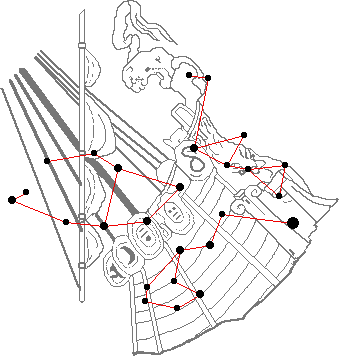
Welcome to another installment of the constellation series. As the fourth constellation, I have for you Argos Navis, a collection of constellations which together form the ship Argo, on which the Argonauts (Argonautai, Ἀργοναῦται) sailed to find the Golden Fleece.


The Argo Navis was an ancient constellation which has since been disband. It was a huge constellation, the largest in existence.  In 1752, the French astronomer Nicolas Louis de Lacaille subdivided it into Carina (the keel of the ship), Puppis (the stern), and Vela (the sails). Back in ancient Hellas, it was still one, large, constellation and it represented the ship on which one of Hellas' greatest heroic journeys was undertaken: Iásōn's (Ἰάσων, Jason) quest for the Golden Fleece.

The Argo (Ἀργώ), meaning 'swift', was built by the shipwright Argus. He was a member of the Argive royal house, and his fmily was favored by Hera. Becasue of this, anyone who sailed on the Argo, would have Her aid. Argus was aided in the planning and construction of the Argo by Athena, and possessed in its prow, a magical piece of wood from the sacred forest of Dodona, which could speak and render prophecies.

The tale of the Argonautai is long, and complicated. As so many kings in ancient Hellas, Pelias (Πελίας) unrightfully laid claim to his half-brother's throne. He became the king of Iolkos in Thessaly, and fell in disfavor of the Theoi because of his actions. It was prophesied that a member of the rightfully royal bloodline would one day punish him, and he was likewise warned to watch out for a man with only one sandal.

Pelias didn't believe in half measures and murdered every prominent descendant of Aeolus he could, but spared his mother Tyro's youngest son, Aeson. Instead, he imprisoned him and forced him to renounce his claim to the throne. Aeson complied, and eventually was set free. He married  Alcimede, who bore him a son named Diomedes. Alcimede successfully saved her son from certain death by having her nursemaids keen as if the boy had been stillborn. She secretly packed him off to Mount Pelion, where he was raised by the kéntauros Kheiron (Χείρων), who changed the boy's name to Iásōn.

From Kheiron, Iásōn learned the arts of combat, sports, medicine and music. When he reached adulthood, he was send back to Iolkos with proof of his royal birth. On the way there, he had to cross a river and found an old woman on the bank of it, who begged everyone who passed by to carry her through the water. All but Iásōn ignored her. He took her onto his back and he helped her across, although he found the journey tougher than he had ever thought possible. He also lost one of his sandals in the mud. As he put down the old woman, she turned into the magnificent Hera, of whom he would continue to receive support now he had passed her test.

As soon as Pelias laid eyes on the youth with one sandal, he knew what would happen now. And thus, he devised a plot to get rid of Iásōn. As Iásōn presented him with an offer to keep some farms and cattle, while Iásōn claimed his rightful place on the throne, Pelias happily accepted, but warned Iásōn that one task had to be completed first: the proper burial of king Phrixos.

Phrixos, thus told Pelias, Iásōn, had been saved from being sacrificed to the Theoi by a ram with golden wool. The Theoi had not demanded this sacrifice, but his step-mother Ino had paid off messengers from the oracle of Delphi to demand so of her husband out of hatred for the boy. The ram had carried him off to Helios' palace, where he was accepted into the household. The ram was sacrificed to Zeus, and the fleece was hung from a tree in a sacred grove of Ares, guarded night and day by a dragon that never slept. Pelias was haunted by Phrixos, and swore to Iásōn Phrixos would not rest until his ghost was taken back to Iokos, along with the Golden Fleece. If Iásōn did this, he swore by Zeus, to relinquish his throne to him.

Iásōn jumped at the chance. Kheiron had taught him well, and a chance to prove himself was all he desired. And so, he hired Argus to build him a ship, and send out messages to the various royal families to send them their young heroes for this voyage. Many jumped at the chance, although it's unclear how many, exactly. Argus may have undertaken the journey himself, as did Atalanta, Bellerophon, Kastor and Polideukes, Hēraklēs, Nestor, Orpheus, Perseus and Theseus. The number of Argonautai lay somewhere between forty and fifty.

The journey would take the brave Argonautai to many dangerous places. The first was Lemnos, where the women had been struck with madness by Aphrodite for failing to properly honor her. they had killed all men on the island, and all slave women as well. When the Argonautai reached the island, Aphrodite enchanted the women to seduce them, and thus halt their journey. Hēraklēs was the only one who did not go off of the ship, so he was able to convince the others to ship out after a long, long wait.

The next challenge came in the form of the Gegeines; Earthborn giants with six arms. The Argo sailed to Doliones where king Cyzicus ruled. In search of supplies, he allowed then to look for supplies on Bear Mountain, but failed to warn the crew of its inhabitants. When most of the crew left for the mountains, the Gegeines attempted to raid the ship, but Hēraklēs, along with a few others, held them off long enough for Iásōn and his men to return. They set sail int he dead of night but got turned about. They ended up on the same shore where the Argonautai and the people of king Cyzicus failed to recognize each other and many of them were killed, the king amongst them. When morning came, the Argonautai were shocked and ashamed, and organized a burial for the dead king. Hēraklēs took his leave here, as his tasks were not yet completed.

For twelve, long, days, the weather was so bad that the Argo could not set sail. The crew waited and grew hungry and thirsty. Mopsos, a bird auger, eventually deduced that the men should sacrifice to Rhea, mother of the Theoi. They did, and food and drink came to them by way of animals and low hanging fruit. The wind also died down, and the expedition was saved.

Next, they reached Bebryken, where they were challenged to a fist fight by king Amykos. He was so strong, he killed every opponent with one hit, and tossed those who refused to fight into the sea to die there. It was Pollux, son of Zeus, who accepted the challenge. He managed to win his fight gloriously, but the followers of the king were furious and wanted revenge. They fought the Argonautai, but were no match.

Soon they reached the court of Phineus of Salmydessus in Thrace. The king had been blessed with the gift of prophecy, but had shared too much of Zeus' secrets. For that, Zeus send Harpies to his door every day to take his food. The starving king begged the Argonautai for help, and received it. The Harpies were killed (or, in some versions of the myth, chased off) and the expedition continued.

The only way to reach their destination was to sail through the Symplegades, or Clashing Rocks. These huge rock cliffs came together and crushed anything that traveled between them. Phineas told the crew to release a dove when they approached these islands, and if the dove made it through, to row with all their might. If the dove was crushed, he was doomed to fail. Iásōn released the dove as advised, which made it through, losing only a few tail feathers. They went for it and, with the aid of Athena, made it through with only minor damage to the stern of the Argo. The clashing rocks were forever joined, leaving the way free for others to travel.

Before reaching Kolchis, their destination, the Argonautai would halt twice more. Once in the land of the Mariandyn, where they lost their navigator to illness, and Hera just barely saved the expedition by making Ankaios speak winged words of confidence that he could steer the ship. And he did. The second wait came in the form of a terrible storm for which the Argo needed to be protected. When the storm died down, they found the shipwrecked nephews of Iásōn, who had been on their way back from Kolchis, and were accepted into the Argonautai right away.

Once the Argonautai reached Kolchis, their struggle wasn't over. King Aeetes was unwilling to part with the Fleece, as it had brought great prosperity to his lands. He devised three tasks for Iásōn: to plow a field with fire-breathing oxen, to sow the teeth of a dragon into the field, and to overcome the sleepless dragon guarding the Fleece. Aided by Mēdeia (Μήδεια)--who was made to fall in love with Iásōn by Athena and Hera, who convinced Aphrodite to convince Eros to shoot his arrow--Iásōn completed his tasks and fled with Mēdeia and her younger brother Absyrtus, aboard the Argus.

As king Aeetes' war fleet hunted them down, Mēdeia did the unthinkable: she killed her brother and, in some versions of the myth, dismembered him, throwing his body parts into the sea one by one. His father made sure all parts were recovered and the Argo was able to get away. In all versions of the myth, Iásōn is shocked by this act, as well as the magick she implored to aide him in his other quests, but in some, he takes Mēdeia onto dry land to allowed her to cleanse herself of the miasma incurred by the murder she had committed.

After this, the Argo makes it home safely, after first passing by the Sirens who are so well known from the Odysseia--harmless because of Orpheus' louder and more beautiful music--and the boulder throwing Taltos, a bronze man with one blood vessel which ran from his neck to his toe. The blood vessel was held closed by a single nail. Mēdeia practiced her magick again, and put the giant to sleep. Then, she removed the nail, and Taltos bled to death.

Again, it was Mēdeia who saved the expedition, as Pelias refused to give in. Yet, he had become an old man in the time Jason had been gone, and when Mēdeia offered to make him young again, his daughters jumped at the chance. Mēdeia told the women that they should kill and cut up their father and put them in her cooking pot. This way, she would be able to perform her magick and the king would be reborn in his prime. The girls did as told but Mēdeia did not add the magickal herbs needed to complete the spell, and Pelias remained quite dead. Iásōn and Mēdeia were exiled for their crime by Pelias' son.

Yet the story of the Argo is not quite over. According to playwright Euripides, Iásōn betrayed Mēdeia, and wedded Kreousa (Κρέουσα), daughter of king Kreon of Korinth, instead of her. Mēdeia recounted all the help she had given him, and reminded him of his vow to marry her, but he told her that she should not be angry at him, but at Aphrodite, who had made her fall in love with him. Angered and ashamed, Mēdeia enchanted the dress Kreousa would wear for her wedding, and it caught fire as soon as she put it on. The fire killed both her and her father. Out of fear for retaliation, or out of a desire to hurt Iásōn even further, Mēdeia killed the two sons she had with Iásōn and fled.

Iásōn was punished for his treachery: Hera abandoned him and the mast of the Argo squashed him as he lay sleeping on the Argo one night late into his lonely and tortured life. The Argo was consecrated to Poseidon in the Isthmus, and was later placed into the sky and turned into the constellation of Argo Navis. The constellation has fallen apart over the years. Carina is visible at latitudes between +20° and −90°. It is best visible at 21:00 (9 p.m.) during the month of March. Puppis is visible at latitudes between +40° and −90°, and is best visible at 21:00 (9 p.m.) during the month of February. Vela is visible at latitudes between +30° and −90° and is best visible at 21:00 (9 p.m.) during the month of March.

 I don't write enough about Hellenic tragedies (or comedies, for that matter). In fact, in nearly two hundred posts, I don't think I've gone in depth on any of the plays, besides a cursory retelling of Euripides' adaption of Mēdeia's myth. I think the reason for this is that tragedies are, firstly, an extension of the ancient rites performed in honor of Dionysos... and while I worship Dionysos as a member of the Hellenic pantheon, I am not drawn to His Mysteries and cults at all. Before I begin this post, I therefor need to give the basics of tragic, Hellenic, theater before I get get to the point of this Pagan Blog Post, namely the Year-Daímōn, or Eniautos-Daímōn.


How tragic theater came to be is unknown. It's an old practice, dating back to the earliest foundations of Hellas. What we do know is that the tradition became intrinsically linked to the the Greater Dionysia, which was celebrated in the month of Elaphebolion; around March. Tragedies were plays--usually sung in their entirety by the chorus, but later also partly spoken--which were often pitted against each other in a contest, with the price for the winner being a goat. The word 'tragus día (τραγῳδία) has its roots in the ancient Hellenic words for 'goat' (tragos, τράγος) and 'sing' (á(i)dô, ᾄδω), which, combined, would be 'song for the goat'.

The name may also stem from 'bleating like a goat' or 'bleating like a child', and indicate that the name was given to the practice to indicate that the actors threw their voice to perform the parts. There are many other explanations, and the inclusion of the goat may simply refer to a goat being sacrificed at the festivals that included the performance of tragedies, or refer to satyr-like behavior as identified with Dionysos and His following.

This satyr-like behavior was most often seen in satyr plays, which are a third form of Hellenic theater, next to comedies and tragedies. Satyr plays were based on Hellenic mythology, and were chock full of mock drunkenness, sexuality, phallic props, pranks, and general merriment. After three days of tragedies, the fourth day of the Greater Dionysia was celebrated with satyr plays.

Like satyr plays, tragedies always focussed on mythology. Favorites were the myths surrounding Demeter, Persephone, and Hades; the 'death' and 'rebirth' of Dionysos; heroes like Herakles, Ajax, and Philoktētēs; and women like Mēdeia, Helèktra, Iphigeneia, and Antigone.

Tragedies often revolved around a central theme: dark versus light, good versus evil, or other variations of the duality. They were always about making ethical decisions. They also had a central structure: Contest (agon), Tearing-asunder/death/defeat (pathos), Messenger (angelos), Lamentation (threnos), Discovery (anagnorisis), Recognition (theophany), and Resurrection (apotheosis). Not all parts had to be included, although the plays were rated higher if they were.

An example: Euripides' Mēdeia starts after Iásōn tells her he will marry Kreousa, daughter of king Kreon of Korinth instead of her. There is a heated discussion, and Mēdeia flees to Athens, vowing to get her revenge (agon). She sends her children to Iásōn and Kreousa with an enchanted dress that kills both Kreousa and her father (pathos). A messenger runs to tell her of this event (angelos), and Iásōn grieves over the woman he has lost and his situation (threnos). Mēdeia returns to kill her two sons, and is discovered by Iásōn. Mēdeia explains her actions to the audience and Iásōn (theophany) and rises above the situation in Helios' chariot, which carries her off (a form of apotheosis). Mēdeia's play is straight-forward, without anagnorisis, something usually interpreted as a plot twist. In this case, Mēdeia knew the children were hers when she killed them. If she hadn't know, the play would have been completely different, and would probably have garnered Euripides more than third place.

With this introduction done, we can move on to the core of this post: the Year-Daímōn and its sacrifice. The Year-Daímōn is a title given to any Theos or hero, whose death and rebirth are tied to the turning of the seasons. These scapegoats 'die' with the old year and are 'reborn' with the new year, setting in motion a cycle of renewal for the plant life that forms the basis of the Hellenic food supply. Dionysos is the prime Eniautos-daímōn, but Theseus, Herakles, Apollon, Odysseus, and Orpheus qualify as well, as They are--in some way--linked closely to death and rebirth, either from visiting the Underworld and leaving it, or experiencing a 'second birth' of sorts.

To stay with Dionysos; for those unaware, there are about a bazillion stories on His birth, but two are of importance to this post. In one, he is born from Semele and Zeus, and while Semele is pregnant with Him, Hera plants seeds of doubt in her mind about the father of the child truly being Zeus. Semele asks Zeus to reveal Himself to her in his true form, and when he is left with no other option, He does so, killing her in the process. Zeus takes pity on His child, and takes Him into either His thigh or testicle, where He is eventually born from.

In the other version of the myth, stemming from Crete, Dionysos is the child of Zeus and Persephone (or Demeter). In this version, Dionysos is born, but ripped to pieces by Titans, under orders of a jealous Hera. Zeus smites the Titans, but is too late to save anything of Dionysos but His heart, which He gets implanted into His thigh like the first myth, or implants in Semele.

In both versions of the myth, Dionysos is twice-born, hence his epithet 'Dimêtôr' (Διμητωρ). Dionysos was considered a fertility God, but also closely related to nature's eternal cycle of birth and death. The ancient Hellens considered the moment a plant--especially the grape--began to grow for the first time after being planted its first birth, and counted its second birth when it became laden with ripened fruit. As Dionysos is so closely related to to the grape vine, it was Dionysos Himself that was considered being born once from the earth and again from the vine.

Dionysos' cult focussed heavily on this part of His mythology, and during the Dionysia, this thought pattern returned heavily, especially within the context of tragedies. From Harrison's pre-Olympic themed 'Themis: a Study of the Social Origins of Greek Religion' comes the following reflection on a procession exhibited by Ptolemy Philadelphos in honour of Dionysos:

"The procession was headed by Silenoi clad, some in purple, some in scarlet, to keep off the multitude; next followed twenty Satyrs bearing lamps; next figures of Nike with golden wings; then Satyrs again, forty of them, ivy-crowned, their bodies painted some purple, some vermilion. So far it is clear we have only the ministrants, the heralds of the god to come. After these heralds comes the first real personage of the procession, escorted by two attendants. His figure will not now surprise us.

"After the Satyrs come two Sileni, the one with petasos and caduceus as herald, the other with trumpet to make proclamation. And between them walked a man great of stature, four cubits tall in the dress and mask of a tragic actor and carrying the gold horn of Amaltheia. His name was Eniautos. A woman followed him, of great beauty and stature, decked out with much and goodly gold; in one of her hands she held a wreath of peach-blossom, in the other a palm-staff, and she was called Penteteris. She was followed by four Horai dressed in character and each carrying her own fruits."

Of note are two things: the reference to Eniautos as linked to Dionysos, and the inclusion of the Horai (the Goddesses of the Seasons). Eniautos, here, is the personification of something we now identify as 'a year' but which in ancient Hellas would have been linked to any pre-defined period of time. In this case--as can be seen with the link to the Horai--the persona identified with the cycle of the seasons we deal with on earth. This procession did not take place during the (Greater) Dionysia, but it does--once more--show the link between Dionysos and Eniautos, and affirm His worship as a Year-Daímōn.

And so, the Year-Daímōn is the personification of the yearly cycle, and is superimposed on existing mythology. To stay with Dionysos--because to include the mythology of the other Theoi and heroes who were considered linked with the Year-Daímōn would make this post even longer than it already is--Dionysos' mystery cult (which eventually grew into (or branched off into) Orphism) saw Dionysos as an Immortal Theos, who took on a Khthonic form--Dionysos Khthonios (Διονυσος Χθονιος)--during the winter months. Dionysos Khthonios took on an oracular role at Delphi while Apollon was 'visiting the Hyperboreans'. Wether this was a result of, or a reason for, His link to the Year-Daímōn is unclear. So he was not 'dead' as we may understand the term, but like the ground on which nothing grew, so Dionysos lay dormant as well. From Murray:

"The ordinary Year-Daimon arrived, grew great and was slain by his successor, who was exactly similar to him. But Dionysos did not die. He seemed to die, but really it was his enemy, in his dress and likeness, it was Pentheus or Lycurgus who died while Dionysos lived on in secret. When the world seemed to be dead and deprived of him, he was there in the ivy and pine and other evergreens; he was the secret life or fire in wine, or other intoxicants. By this train of ideas Dionysos comes to be regarded not as a mere vegetation-spirit, or Year-Daimon, but as representing some secret or mysterious life, persisting through death or after death."

King Lycurgus of Thrance, to clarify, was a mythical figure, who bitterly opposed Dionysos' new religion. After a first encounter, Dionysos retreated into the sea, only to come back and imprison Lycurgus in a rocky cave. Dionysos planned to let him reflect and learn from his mistakes, but Zeus did not care to have the Gods insulted, and blinded, then killed Lycurgus.

More telling; Pentheus was the king of Thebes, and cousin to Dionysos. Pentheus did not believe Dionysos was a new Theos, and ordered His drunken and loud following imprisoned. Dionysos freed them and He tried to explain His worship to His cousin. Yet, Pentheus would not listen, so Dionysos left him to his anger. He took His followers--including many local women, including Pentheus' mother and sister--to the hills. When Pentheus pursued Him, He drove the women mad. To them Pentheus appeared to be a moutain lion. In a berserk rage, they attacked him, and his mother--who was first to reach him--ripped his head off, while the others tore off his limbs.

This myth reach back to  much older--possibly pre-Hellenic--'primitive' tribes which worshipped Dionysos or a God similar to Him with animal and human sacrifices which were torn apart, either before they were killed, or as a means to kill them. The God worshipped this way was also a God of life and death, and these sacrifices were conducted to ensure a good harvest in the coming year. This is the very same culture mentioned in the second paragraph as having founded the basics of tragic plays. This may also explain one of the retellings of the birth of Dionysos where He was torn apart by Titans.

How involved the worship of the Eniautos-Daímōn was, or how far-spread it was, is unclear. Sacrifices for a good harvest were very common, and it's not odd to imagine that the 'first birth' would have fallen somewhere around the Greater Dionysia (as it was celebrated roughly around the Spring Equinox). If all sacrifices to the Year-Daímōn were linked to Dionysos is also unclear, although He did play a huge role in the formation of the ritual style, which often included ecstatic rites brought on by wine, dancing and other aids.

For (Neo-)Pagans reading this, the Year-Daímōn seems to be a reflection of the Horned God's yearly cycle, and there are definitely similarities. The cycle of non-death and rebirth can be found in many Gods throughout the pantheons. Immediately to mind comes Osiris, but also Shiva. The two may, indeed, be linked and as an Eclectic-turned-Recon, it would be easy for me to superimpose the mythology of the Horned God onto Dionysos (and for non-Recons to do it the other way around). But the differences are glaring--as I hope I have explained with this post--and as easy as it would be to link Christmas to the Lesser Dionysia, or the Greater Dionysia to a fertility festival like Ostara, at their base, neither is true.

The Year-Daímōn is a spirit of growth, or renewal, and of life's continuation. Different but the same, every year--year in, year out. The Eniautos-Daímōn formed the basis of life for a civilization which relied heavily on  agriculture for survival, and to see homage and sacrifice in his name during major festivals is hardly surprising.  If the cycle stopped, so did life. And so, the Year-Daímōn's worship continued on and the Hellens were rewarded. Just one more thing to think about now the Lesser Dionysia is nearly upon us and the Greater Dionysia's is coming only a few months away.
Listverse released a list of ten ancient Hellenic writers you should know. It's a good list, and the reasoning why these were chosen is a great read in and of itself. The ten who made the cut are:

10. Hómēros -- writer of the Iliad and the Odysseia
9. Sophocles -- the tragedian who wrote (amongst others) Antigone, Oedipus the King and Electra
8. Herodotos -- whose book The Histories is considered the first work of history in Western literature
7. Euripides -- the tragedian who wrote (amongst others) Alcestis, Medea and The Bacchus
6. Hippokrátēs -- who fathered modern medicine, mostly with his Hippocratic Corpus
5. Aristophanes -- the comic playwright who wrote (amongst others) The Clouds, The Wasps and Lysistrata
4. Plato -- one of the fathers of Western philosophy
3. Aristotle -- the last of the great Hellenic philosophers 
2. Euclid -- a mathematician and the father of geometry, whose main work--The Elements--is still used as a textbook in mathematics 
1. Archimedes -- a mathematician, engineer, inventor, physicist and astronomer whose ideas are as the basics of all these disciplines

I most certainly concur that this list lists some of ancient Hellas' most influential writers, but the list is far from complete. Today, I want to add five more to it, and most of my picks will no surprise you.

5. Sappho
Sappho (Σαπφώ) was a Hellenic lyric poet, born on the island of Lesbos (Λέσβος) around 620 BC, although the exact date is unknown. She wrote beautiful and highly romantic poetry that comes and goes straight to the heart. One of the most famous of her works is her Hymn to Aphrodite.

4. Aeschylos
As the original list includes both Sophocles and Euripides, it seems only fair to include Aeschylos. Aeschylos (Aiskhulos, Αἰσχύλος) was the first of the three Hellenic tragedians whose plays can still be read or performed. According to Aristotle, he expanded the number of characters in plays to allow for conflict amongst them, whereas previously characters had interacted only with the chorus. Aescholos' most famous works are undoubtedly the Seven against Thebes, the Supplicants and the Orestia. 

3. Pythagoras
Pythagoras of Samos ( Πυθαγόρας ὁ Σάμιος) was an Ionian Hellenic philosopher, mathematician, and the father of the religious movement called Pythagoreanism. He lived from about 570 BC to about 495 BC, and made influential contributions to philosophy, religious teaching, math, ethics, and science. His most famous work is, undoubtedly, the Pythagorean theorem (a^2 + b^2 = c^2), that's standard in every math textbook. Interestingly enough, not a single bit of writing has been preserved--if he ever wrote anything down to begin with. His works are mostly quoted by his students, or known through critiques by Aristotle.

2. Plutarch
Plutach (Ploútarkhos, Πλούταρχος) was an ancient Hellenic historian, biographer, and essayist who lived between 46 and 120 AD. He is known primarily for his Parallel Lives and Moralia, but much of his work is lost to us. Plutarch's writings are full of details about people and places, and are therefor a true treasure trove.

1. Hesiod
Hesiod (Hesiodos, Ἡσίοδος) was a Hellenic oral poet who lived between 750 and 650 BC, around the same time as Hómēros. I would dare say that his work--especially 'Works and Days' and the 'Theogony'--has shaped the way scholars and practitioners of Hellenismos view ancient Hellenic society, religion and way of life. This is why I strongly feel that anyone who feels drawn to the Theoi, might benefit from investing some time in reading his words.

Sometimes I find myself very aware of how much text from ancient Hellas we have lost. I was leafing through my collection of ancient Hellenic plays and I wondered how many more there must have been. Well, it seems that Sophocles wrote over 120 plays of which only seven survive in full. We also, however, have fragmentary versions of several others: including from his "Hermione," "Troilus," and "Niobe."

We have eighteen of the ninety-five plays Euripides penned, included the only complete surviving satyr play, "Cyclops" (the satyr play was the comedic play which followed the performance of three tragic plays in Hellenic dramatic festivals). And we have only seven of the ninety-two that Aeschylus penned: including the "Oresteia" ("Agamemnon," "The Libation Bearers," and "The Eumenides") which is the only surviving complete trilogy (three plays meant to be performed together).

It's also worth noting that there's little logic behind why these particular plays survive. We also know of several other playwrights writing at the time, but for some reason their work has not survived. I found myself compiling a list of plays that have survived and I have to admit, that's a very sorry list.

Tragedy:

Aeschylus (525 - 456 BC)
The Persian
The Supplicants
Seven Against Thebes
The Oresteia
Agamemnon, The Libation Bearers, The Eumenides
Prometheus? 

Sophocles (496 - 406 BC)
Ajax
Antigone
Oedipus Rex
Electra
Trachiniae
Philctetes
Oedipoes at Colonus

Euripedes (480 - 407 BC)
Alcestis
Medea
Hippolytus
the Children of Heracles
Andromache
Hecuba
Cyclops
Heracles
The Supplicants
Ion
the Trojan Woman
Electra
Iphigenia in Tauris
Helen
The Phoenician Women
Orestes
The Bacchae
Iphigenia at Aulis

Comedy:

The Acharnians
The Knights
The Clouds
The Wasps
Peace
The Birds
Lysistrata
The Thesmophoriazusae
The Frogs
The Ecclesiazusae
Plutus
'Ion' is a tragedy by the ancient Hellenic playwright Euripides, thought to have been written between about 414 and 412 BCE. It describes the tale of the orphan, Ion, eponymous forefather of the Ionian race, as he discovers his true origins and parentage after being abandoned as a child.

The play begins with a prologue by the messenger god Hermes, who explains some of the background to the play, in particular how he had once rescued a child (at Apollo‘s request) which had been left to die of exposure on a mountainside, and delivered him to the temple of Apollon in Delphi, where he grew up as an orphan under the care of the Pythian Priestess.

Hermes' introduction is followed by a prayer to Apollon, in which he laments his own fate but also reaffirms his loyalty to Apollon. They are beautiful words and I would love to share them with you today. The rest of the play can be read and enjoyed here.


Ion's prayer to Apollon

Already this radiant four-horse chariot, the sun, flames over the earth, and at this fire of heaven the stars flee into the sacred night; the untrod Parnassian cliffs, shining, receive the wheel of day for mortals. The smoke of dry myrtle flies to Phoebus' roof. The woman of Delphi sits on the sacred tripod, and sings out to the Hellenes whatever Apollo cries to her. But you Delphian servants of Phoebus, go to the silver whirlpools of Castalia; come to the temple when you have bathed in its pure waters; it is good to keep your mouth holy in speech and give good words from your lips to those who wish to consult the oracle. But I will labor at the task that has been mine from childhood, with laurel boughs and sacred wreaths making pure the entrance to Phoebus' temple, and the ground moist with drops of water; and with my bow I will chase the crowds of birds that harm the holy offerings.
For as I was born without a mother and a father, I serve the temple of Phoebus that nurtured me.
Come, new-grown, ministering bough, of loveliest laurel, you who sweep the altar under the temple of Apollo; you are from the immortal gardens, where the secred drops water the holy foliage of myrtle, sending forth an ever-flowing stream. With this laurel I sweep the pavement of the god all day, along with the sun's swift wing, my daily service. O Paean, O Paean, may you be fortunate, child of Leto!
Lovely is the labor, o Phoebus, I carry out for you before your house, honoring your prophetic shrine; glorious my labor, to be a slave for gods, not mortal but immortal; I do not tire of laboring over my auspicious work. Phoebus is a father to me; I praise the one who feeds me; the name of father, beneficial to me, I give to Phoebus who rules this temple. O Paean, O Paean, may you be fortunate, child of Leto!
But I will cease from labor with the laurel branch and I wil hurl from golden vases Gaia's fountain, which Castalia's eddies pour out, casting out the moist drops, since I am chaste. May I never cease to serve Phoebus in this manner; or, if I do, may it be with good fortune. Ah, ah! Already the birds of Parnassus have left their nests, and come here. I forbid you to approach the walls and the golden house. I will reach you with my bow, herald of Zeus, though you conquer with your beak the strength of all other birds. Here comes another, a swan, to the rim of the temple. Move your crimson foot elsewhere! Phoebus' lyre, that sings with you, would not protect you from my bow. Alter your wings' course; go to the Delian lake; if you do not obey, you will steep your lovely melody in blood.
Ah, ah! What is this new bird that approaches; you will not place under the cornice a straw-built nest for your children, will you? My singing bow will keep you off. Will you not obey? Go away and bring up your offspring by the eddies of Alpheus, or go to the Isthmian grove, so that the offerings, and the temple of Phoebus, are not harmed. . . . and yet I am ashamed to kill you, for to mortals you bear the messages of the gods; but I will be subject to Phoebus in my appointed tasks, and I will never cease my service to those who nourish me. [82 - 183]
Sorry, sorry, sorry, I ran out of time! Have this beautiful chorus from Euripides’ Bacchae to enjoy for today. It's the second chorus (370-433). Translation borrowed from here.

Sacred queen of the gods
Sacred one who flies
Over the earth on golden wing—
Did you hear these things about Pentheus?
Did you hear
Of his unholy outrage against Bromios
Semele’s son, the first of the gods
Called upon in the finely-wreathed
Feasts? He holds sway here,
To entwine us in the dances
To make us laugh with the flute
To dissolve our worries
Whenever the grape’s shine
Arrives at the feast of the gods
And in the ivy-wound banquets of men
Where the winebowl lets down its sleep.
The fate for unbridled mouths
And lawless foolishness
Is misfortune.
The life of peace
And prudence
Is unshaken and cements together
Human homes. For even though
They live far off in the sky
The gods gaze at human affairs.
Wisdom is not wit;
Nor is thinking thoughts which belong not to mortals.
Life is brief. And because of this
Whoever seeks out great accomplishments
May not grasp the things at hand.
These are the ways of madmen
And wicked fools, I think.
I wish I could travel to Cyprus
The island of Aphrodite
Where the enchanters of mortal minds live,
The Erotes, at Paphos
Where the hundred mouths
Of the barbarian river
Water fertile earth despite no rain;
I wish to go where Pieria
Looms so fair, that seat of the Muses,
The sacred slope of Mount Olympos—
Take me there, Bromios, my Bromios,
Divine master of ecstasy.
There are the Graces, there is Longing, there it is right
For the Bacchants to hold their sacred rites.
The god, the son of Zeus,
He delights in the feast,
He loves wealth-granting peace
The child-rearing goddess.
He has granted equally to the rich
And those below to have
The grief-relieving pleasure of wine.
He hates the person who has no care for these affairs.
During the day and during lovely nights
To live a good life,
To protect wisdom and thoughts and heart
From men who go too far.
Whatever the rather simple-minded mob believes
This is welcome enough belief for me.
The Gods have proclaimed laws; ethical guidelines at least. They can be followed to a tee and if one does, one might expect the Gods to reward that person. I think we all expect that, deep down. Euripides, after all, in 'Elektra' had Castor proclaim the following at the very end:
"As we go through the plains of the air,
we do not come to the aid of those who are polluted;
but we save and release from severe hardships
those who love piety and justice in their ways of life.
And so, let no one wish to act unjustly,
or set sail with perjurers; as a god,
I give this address to mortals." [1341]

And yet, some of the Gods' most loyal followers seem unable to ever catch a break. They struggle with health, money, friendships, love... and along the way, they begin to doubt. They might doubt themselves at first--question if they are, indeed, practicing right, if they are, indeed, pleasing the Gods--and then the Gods. They might question their fairness, Their judgement... and perhaps Their very existence. It is, after all, the age old question: why do the Gods take care of some but not of others? We are not the first to ponder this. Xenophon, in 'Oeconomicos' wrote:'

"I seem to realise that, while the gods have made it im-
possible for men to prosper without knowing and
attending to the things they ought to do, to some of
the wise and careful they grant prosperity, and to
some deny it." [11.8]

No one has a clear cut answer. Even the ancient Hellenes accepted this faith as was. Xenophon goes on to say:

"...and therefore I begin by worshipping
the gods, and try to conduct myself in such a way
that I may have health and strength in answer to
my prayers, the respect of my fellow-citizens, the
affection of my friends, safety with honour in war,
and wealth increased by honest means." [11.8]

So why do we do it? Why do we foollow proper practice? Why do we sacrifice and labour like Xenophon wrote? Antiphon, in his 'On the Choreutes' says it best, I feel:

"Most of the life of man rests upon hope;
and by defying the gods
and committing transgressions against them,
he would rob himself even of hope,
the greatest of human blessings." [5]
Representatives from the Center for Hellenic Studies, the Kosmos Society and Out of Chaos Theatre have been presenting scenes from Greek tragedy in our shared time of isolation to explore how the context of the ‘small screen’ changes the way we understand the genre and its performance, how the themes and concerns of ancient tragedy communicate to us today, especially in a time of crisis, and, most importantly, to stay occupied and engaged with one another.  Each week we select scenes from a play, actors and experts from around the world, and put them all together for 90 minutes or so to see what will happen.

The latest is Euripides’ Orestes, a play that revisits Orestes’ fate after he kills his mother Klytemnestra and her lover Aegisthus to avenge the murder of his father, Agamemnon. If the story sounds familiar, well, it is: the Homeric Odyssey presents Orestes as a model for Telemachus repeatedly. Aeschylus makes his story the topic of our only surviving Greek trilogy, ending in Athens with an aetiology for the trial by jury

But, in typical Eurpidean style, this Orestes is surprising and unsettling. If Aeschylus’ Oresteia is optimistic, projecting a belief in the redemptive or at least balancing powers of human institutions, Euripides’ Orestes is the opposite, showing that human institutions fail to distribute justice when needed most and that individuals give in to the worst excesses of human nature.


Cast
Orestes – Richard Neale
Electra – Tabatha Gayle
Chorus – Tim Delap and Evelyn Miller
Pylades – Martin K Lewis
Menelaus – Robert Matney
Apollo – Paul O’Mahony

Scene Selection and dramaturgy: Emma Pauly

Special Guest: Claire Catenaccio

Upcoming Readings(Wednesdays at 3PM EDT, Unless otherwise noted)
Aeschylus, The Persians May 13th
Euripides, Trojan Women, May 20th
Sophocles, Ajax, May 29th
Euripides, Andromache, June 3rd
Sophocles, Oedipus Tyrannos, June 10th
Euripides, Ion, June 17th [10 AM EDT/3PM GMT]
Euripides, Hecuba, June 24th
Aeschylus, Prometheus Bound, July 1st

Videos of Earlier Sessions
Euripides’ Helen, March 25th
https://www.youtube.com/watch?v=ZxxMaLqYPu4 
Sophocles’ Philoktetes, April 1st
https://www.youtube.com/watch?v=QhRZjWyBfow&t=398s
Euripides’ Herakles, April 8th
https://www.youtube.com/watch?v=MKRnBPDQz60&t=4019s
Euripides’ Bacchae, April 15th
https://www.youtube.com/watch?v=ZAt1FDCF2hQ&t=20s
Euripides’ Iphigenia , April 22nd
https://www.youtube.com/watch?v=GMDN5uHI3CE&t=20s
Sophocles, Trachinian Women, April 29th
https://www.youtube.com/watch?v=tZlF8N5BABc&t=14s
The Greek Anthology (Anthologia Graeca) is a collection of poems, mostly epigrams, that span the classical and Byzantine periods of Greek literature. Most of the material of the Greek Anthology comes from two manuscripts, the Palatine Anthology of the 10th century and the Anthology of Planudes (or Planudean Anthology) of the 14th century.

I'd like to share two of the epigrams with you today, about Ganymede. In Greek mythology, Ganymede or Ganymedes (Γανυμήδης, Ganymēdēs) is a divine hero whose homeland was Troy. Ganymede was abducted by Zeus from Mount Ida, near Troy in Phrygia. Ganymede had been tending sheep, a rustic or humble pursuit characteristic of a hero's boyhood before his privileged status is revealed. Zeus either summoned an eagle or turned into an eagle Himself to transport the youth to Mount Olympus.


Greek Anthology, Antipater 5.77
“Hera twisted by the beauty of Ganymede once spoke
As she suffered the heart-rending stab of jealousy in her heart:
“Troy ignited a male fire for Zeus—and so I will send
A fire at Troy, a pain bearing Paris.
No eagle will come to Troy again, but vultures
Will go to the feast when the Greeks get the spoils for their toils.”

Greek Anthology 12.211
“Go to bright heaven, go carrying the child,
Eagle, keep your twin wings spread wide.
Go holding gentle Ganymede and do not drop
Zeus’ wine-bearer of the sweetest cups.
But be careful not to bloody him with your clawed feet
So that Zeus, upset, won’t hurt you.”


Translation here.
The Dionysia ta en Astei (Διονύσια τὰ ἐν Ἄστει), Dionysia ta Megala (Διονύσια τὰ Μεγάλα), Great(er) Dionysia, Dionysia ta Astika, or City Dionysia, was and is a true theatric festival of Dionysos. The Dionysia runs from 5 - 12 March, at the usual 10 am EST.


The City Dionysia is thought to have been founded, or at least revived, by the tyrant Pisistratus (around 530 BC), and was held in Athens, when the city was once again full of visitors after the winter. The festival honors Dionysos Eleuthereus (Διονυσος Ελευθερευς), who was said to have been introduced into Athens from the village of Eleuterae (Ελευθέραι). The festival focuses on the performance of tragedies, but has included the performing of comedies since 487 BC. It was the second-most important festival after the Panathenaia.

According to myth, the festival was established after Eleutherae, a border-town between Attica and Boeotia, chose to become part of Attica. The Eleuthereans had an established festival of Dionysos--which then became the rural Dionysia--and celebrated to occasion by bringing a statue of Dionysos to Athens. The Athenians, by then not big on the worship of Dionysos, initially rejected the statue, but Dionysos punished the Athenians with a plague affecting the male genitalia. The Athenians, rightfully spooked, accepted the statue and honor of Dionysos, and the plague was cured. These events were recalled each year by two processions, the first, carrying the statue of Dionysos from His temple outside of the city of Athens into the city, and the second where various groups proceeded through the city to the theater, arrayed in groups distinguishable by color or other articles of dress.

Dionysos was a métoikos in a city of Athens, a resident alien, and on the first two days of the festival, the métoikoi of the city got to wear brightly colored festival clothes--mostly purple--and carried trays of offerings in the processions, something métoikoi never got to do otherwise. The Athenian citizens, on the other hand, wore their day-to-day clothes and carried wine and bread with them, or herded the bulls which would be sacrificed. At the end of the processions, the statue of Dionysos was placed in His temple in the theater district, and sacrifices were made to Him. Flute players and poets held contests, and were eager to outdo each other. After all of this, the festival most likely became very Dionysian, indeed.

Singing and dancing had always been a big part of the City Dionysia, but after a while, the structure of the eight day festival became more apparent. Instead of random singing and dancing, from the third day onward, everyone flocked to the theaters to view the plays, whose names and creators had been announced the day prior. The next three days of the festival were devoted to the tragic plays. The three chosen playwrights performed three tragedies and one satyr play each, one set of plays per day. Famous playwrights include Aeschylus, Euripides, and Sophocles. They were judged by judges (agonothetai) chosen on the second day.

On the seventh day of the festival, five comedies by famous playwrights like Philemon, Chionides, and Aristophanes were performed. Comedies were of secondary importance at the Dionysia--the Lenaia was far more important for those--but winning the comedic prize at the Dionysia was still regarded a great honor. It seems that, from the fifth century BC onwards, plays could be recycled, and the audience seemed to have appreciated it. These plays were fan favorites, and were not rushed to completion.

Another procession and celebration was held on the final day and the winners of the competitions were declared. The winning playwrights won a wreath of ivy or a goat, and when old plays were performed, the producer was awarded the prize rather than the long-dead playwright.

For the city Dionysia, we will be reading 'The Bacchae', a play by Euripides. We did it last year as well and we wanted to keep it a tradition. The play premiered posthumously at the Theatre of Dionysus in 405 BC as part of a tetralogy that also included 'Iphigeneia at Aulis' and 'Alcmaeon in Corinth', and which Euripides' son or nephew probably directed. It won first prize in the City Dionysia festival competition.

The Dionysus in Euripides' tale is a young God, angry that his mortal family, the royal house of Cadmus, has denied him a place of honor as a deity. His mortal mother, Semele, was a mistress of Zeus; while pregnant she was killed, through trickery, by Hera, who was jealous of her husband's affair. When Semele died, her sisters said it was Zeus' will and accused her of lying; they also accused their father, Cadmus, of using Zeus as a cover-up. Most of Semele's family refuse to believe Dionysus is the son of Zeus, and the young God is spurned in his home. He has traveled throughout Asia and other foreign lands, gathering a cult of female worshipers (Maenads or Bacchantes).

At the play's start he has returned, disguised as a stranger, to take revenge on the house of Cadmus. He has also driven the women of Thebes, including his aunts, into an ecstatic frenzy, sending them dancing and hunting on Mount Cithaeron, much to the horror of their families. Complicating matters, his cousin, the young king Pentheus, has declared a ban on the worship of Dionysus throughout Thebes. The Bacchae is considered to be not only Euripides' greatest tragedy, but one of the greatest ever written, modern or ancient. You can find links to several versions of the play in the rituals document.

You can find the rituals for the event here and join the community here. The first and last days have larger rituals and we've made a small ritual for the days in-between. The idea is that you read part of the play every day and finish it on the day of the last ritual. We hope you will join us in honoring Dionysos in his many, many forms.
'Ion' is a tragedy by the ancient Hellenic playwright Euripides, thought to have been written between about 414 and 412 BCE. It describes the tale of the orphan, Ion, eponymous forefather of the Ionian race, as he discovers his true origins and parentage after being abandoned as a child.

The play begins with a prologue by the messenger god Hermes, who explains some of the background to the play, in particular how he had once rescued a child (at Apollo‘s request) which had been left to die of exposure on a mountainside, and delivered him to the temple of Apollon in Delphi, where he grew up as an orphan under the care of the Pythian Priestess.

Hermes' introduction is followed by a prayer to Apollon, in which he laments his own fate but also reaffirms his loyalty to Apollon. They are beautiful words and I would love to share them with you today. The rest of the play can be read and enjoyed here.


Ion's prayer to Apollon

Already this radiant four-horse chariot, the sun, flames over the earth, and at this fire of heaven the stars flee into the sacred night; the untrod Parnassian cliffs, shining, receive the wheel of day for mortals. The smoke of dry myrtle flies to Phoebus' roof. The woman of Delphi sits on the sacred tripod, and sings out to the Hellenes whatever Apollo cries to her. But you Delphian servants of Phoebus, go to the silver whirlpools of Castalia; come to the temple when you have bathed in its pure waters; it is good to keep your mouth holy in speech and give good words from your lips to those who wish to consult the oracle. But I will labor at the task that has been mine from childhood, with laurel boughs and sacred wreaths making pure the entrance to Phoebus' temple, and the ground moist with drops of water; and with my bow I will chase the crowds of birds that harm the holy offerings.
For as I was born without a mother and a father, I serve the temple of Phoebus that nurtured me.
Come, new-grown, ministering bough, of loveliest laurel, you who sweep the altar under the temple of Apollo; you are from the immortal gardens, where the secred drops water the holy foliage of myrtle, sending forth an ever-flowing stream. With this laurel I sweep the pavement of the god all day, along with the sun's swift wing, my daily service. O Paean, O Paean, may you be fortunate, child of Leto!
Lovely is the labor, o Phoebus, I carry out for you before your house, honoring your prophetic shrine; glorious my labor, to be a slave for gods, not mortal but immortal; I do not tire of laboring over my auspicious work. Phoebus is a father to me; I praise the one who feeds me; the name of father, beneficial to me, I give to Phoebus who rules this temple. O Paean, O Paean, may you be fortunate, child of Leto!
But I will cease from labor with the laurel branch and I wil hurl from golden vases Gaia's fountain, which Castalia's eddies pour out, casting out the moist drops, since I am chaste. May I never cease to serve Phoebus in this manner; or, if I do, may it be with good fortune. Ah, ah! Already the birds of Parnassus have left their nests, and come here. I forbid you to approach the walls and the golden house. I will reach you with my bow, herald of Zeus, though you conquer with your beak the strength of all other birds. Here comes another, a swan, to the rim of the temple. Move your crimson foot elsewhere! Phoebus' lyre, that sings with you, would not protect you from my bow. Alter your wings' course; go to the Delian lake; if you do not obey, you will steep your lovely melody in blood.
Ah, ah! What is this new bird that approaches; you will not place under the cornice a straw-built nest for your children, will you? My singing bow will keep you off. Will you not obey? Go away and bring up your offspring by the eddies of Alpheus, or go to the Isthmian grove, so that the offerings, and the temple of Phoebus, are not harmed. . . . and yet I am ashamed to kill you, for to mortals you bear the messages of the gods; but I will be subject to Phoebus in my appointed tasks, and I will never cease my service to those who nourish me. [82 - 183]
Today, I would like to present musical fragment from the first stasimon of Orestes by Euripides. It was found in 1892, among a number of papyri from Hermopolis, Egypt, in the collection of Archduke Rainer Ferdinand of Austria. It was published by papyrologist Karl Wessely. The fragment was somewhat mutilated when found, but contained a passage of the famous play with musical notation, allowing modern composers and artists to perform the passage in a way that is at least close to the way Euripides intended it.


Whether this fragment represents the original music Euripides composed in 408 BC is an open question, as we have no 5th century BC musical inscriptions to compare it to (the papyrus is dated to the 3rd century BC). Nevertheless, Plutarch credit Euripides and Agathon with many of the rythm and modes used in this fragment, and Aristophanes described Euripides' work as musically complex.

The rhythm of the song is Dochmius and the mode Lydian in chromatic genus. To those unfamiliar with musical terms--like me--I'll attempt to clarify this. The time it takes to pronounce a syllable in ancient Greek and Latin poetry and verse is called a 'mora'. The time it takes to pronounce a long mora is roughly the time it takes to pronounce two short ones. The shortest musical metrical unit is called a 'foot'; a Dochmius is a foot of five syllables, first and fourth being short and the second, third, and fifth long.

In Hellenic music theory, there was a Lydian scale which described a set of pitches. The technical Lydian scale--originating in Lydia in Anatolia--was equivalent to C D E F G A B C, and C Chalf sharp Ehalf sharp F Fhalf sharp Ahalf sharp Bhalf sharp C, respectively where "half sharp" signifies raising the pitch by approximately a quarter tone. Personally, I have no clue what that means but as I am not well versed in music theory, I can't offer a better explanation in that.

Moving on to something I do know about; the arrangement of the fragmentary text differs from the traditional editions. The setting in the Orestes is the story of Orestes himself, who slays his mother after he slays his father and is hunted down by the Erinyes until he happens upon the temple of Apollon (who told him to kill his mother), who then tells him to let Athena and the people of Athens decide his fate, which they do, in favor of Orestes. this whole epic is laid out in many plays by many authors. The Orestes focusses on Orestes' guilt for murderig his mother--an event not part of the play--and his sister Elektra's continued struggle to keep Orestes sane and alive as the leading political faction of Argos wants to put Orestes to death.

The fragment is set at the moment Orestes wakes up after his first bout of madness inspired by the vengeful Erinyes. He is still tormented by them, and realizes suddenly that his act will lead to his death, and the death of his sister Elektra as she refuses to leave his side. The ancient text begins with materos haima (mother's blood) and katolophyromai appears after brotois (mortals). One translated version goes as follows, as sung by the chorus:

"What deadly struggle is here at hand, hurrying thee on o'er thy path of woe, a victim on whom some fiend is heaping tribulation, by bringing on thy house thy mother's bloodshed which drives thee raving mad? I weep for thee, for thee I weep. Great prosperity abideth not amongst mankind; but some power divine, shaking it to and fro like the sail of a swift galley, plunges it deep in the waves of grievous affliction, boisterous and deadly as the waves of the sea."

In the fragment, the text is as follows:

"κατολοφύρομαι κατολοφύρομαι ματέρος αἷμα σᾶς, ὅ σ’ ἀναβακχεύει, ὁ μέγας ὄλβος οὐ μόνιμος ἐν βροτοῖς, ἀνὰ δὲ λαῖφος ὥς τις ἀκάτου θοᾶς τινάξας δαίμων κατέκλυσεν δεινῶν πόνων ὡς πόντου
λάβροις ὀλεθρίοισιν ἐν κύμασιν."

"I cry, I cry, your mother's blood that drives you mad, great happiness in mortals never lasting, but like a sail of a swift ship, which a god shook up and plunged it with terrible troubles into the greedy and deadly waves of sea."

This version of the fragment is performed by the modern Greek band Daemonia Nymphe (Δαιμονια Νυμφη), live in Graz Austria Helmut-List-Halle on 20 Mar h, 2008. The music was arranged by Spyros Giasafakis and Evi Stergiou. The session musicians were Maria Stergiou, Eleni Efthymiou, Vaggelis Paschalides, and Thodoris Chytiris, and the ancient Hellenic instruments were reproduced by Nikolaos Brass.

I love listening to this. It gives me chills every time. If this was the style of the whole of the play, it must have been a sight to behold. Not only is it visually gripping and the story intense, but the music adds a whole new layer to it, where you can almost feel Orestes' madness. I hope you can appreciate it as well.
The Dionysia ta en Astei (Διονύσια τὰ ἐν Ἄστει), Dionysia ta Megala (Διονύσια τὰ Μεγάλα), Great(er) Dionysia, or City Dionysia, was and is a true theatric festival of Dionysos. The City Dionysia is held on the 10th to 17th days of Elaphebolion and I have realized I have not posted up the PAT ritual yet! Elaion usually hosts an eight day festival for it, which is now two days less. Oops! Apologies! The Dionysia ta en Astei runs from 17 - 24 March, at the usual 10 am EDT.


The City Dionysia is thought to have been founded, or at least revived, by the tyrant Pisistratus (around 530 BC), and was held in Athens, when the city was once again full of visitors after the winter. The festival honors Dionysos Eleuthereus (Διονυσος Ελευθερευς), who was said to have been introduced into Athens from the village of Eleuterae (Ελευθέραι). The festival focuses on the performance of tragedies, but has included the performing of comedies since 487 BC. It was the second-most important festival after the Panathenaia.

According to myth, the festival was established after Eleutherae, a border-town between Attica and Boeotia, chose to become part of Attica. The Eleuthereans had an established festival of Dionysos--which then became the rural Dionysia--and celebrated to occasion by bringing a statue of Dionysos to Athens. The Athenians, by then not big on the worship of Dionysos, initially rejected the statue, but Dionysos punished the Athenians with a plague affecting the male genitalia. The Athenians, rightfully spooked, accepted the statue and honor of Dionysos, and the plague was cured. These events were recalled each year by two processions, the first, carrying the statue of Dionysos from His temple outside of the city of Athens into the city, and the second where various groups proceeded through the city to the theater, arrayed in groups distinguishable by color or other articles of dress.

Dionysos was a métoikos in a city of Athens, a resident alien, and on the first two days of the festival, the métoikoi of the city got to wear brightly colored festival clothes--mostly purple--and carried trays of offerings in the processions, something métoikoi never got to do otherwise. The Athenian citizens, on the other hand, wore their day-to-day clothes and carried wine and bread with them, or herded the bulls which would be sacrificed. At the end of the processions, the statue of Dionysos was placed in His temple in the theater district, and sacrifices were made to Him. Flute players and poets held contests, and were eager to outdo each other. After all of this, the festival most likely became very Dionysian, indeed.

Singing and dancing had always been a big part of the City Dionysia, but after a while, the structure of the eight day festival became more apparent. Instead of random singing and dancing, from the third day onward, everyone flocked to the theaters to view the plays, whose names and creators had been announced the day prior. The next three days of the festival were devoted to the tragic plays. The three chosen playwrights performed three tragedies and one satyr play each, one set of plays per day. Famous playwrights include Aeschylus, Euripides, and Sophocles. They were judged by judges (agonothetai) chosen on the second day.

On the seventh day of the festival, five comedies by famous playwrights like Philemon, Chionides, and Aristophanes were performed. Comedies were of secondary importance at the Dionysia--the Lenaia was far more important for those--but winning the comedic prize at the Dionysia was still regarded a great honor. It seems that, from the fifth century BC onwards, plays could be recycled, and the audience seemed to have appreciated it. These plays were fan favorites, and were not rushed to completion.

Another procession and celebration was held on the final day and the winners of the competitions were declared. The winning playwrights won a wreath of ivy or a goat, and when old plays were performed, the producer was awarded the prize rather than the long-dead playwright.

For the city Dionysia, we will be reading 'The Bacchae', a play by Euripides. We did it last year as well and we wanted to keep it a tradition. The play premiered posthumously at the Theatre of Dionysus in 405 BC as part of a tetralogy that also included 'Iphigeneia at Aulis' and 'Alcmaeon in Corinth', and which Euripides' son or nephew probably directed. It won first prize in the City Dionysia festival competition.

The Dionysus in Euripides' tale is a young God, angry that his mortal family, the royal house of Cadmus, has denied him a place of honor as a deity. His mortal mother, Semele, was a mistress of Zeus; while pregnant she was killed, through trickery, by Hera, who was jealous of her husband's affair. When Semele died, her sisters said it was Zeus' will and accused her of lying; they also accused their father, Cadmus, of using Zeus as a cover-up. Most of Semele's family refuse to believe Dionysus is the son of Zeus, and the young God is spurned in his home. He has traveled throughout Asia and other foreign lands, gathering a cult of female worshipers (Maenads or Bacchantes).

At the play's start he has returned, disguised as a stranger, to take revenge on the house of Cadmus. He has also driven the women of Thebes, including his aunts, into an ecstatic frenzy, sending them dancing and hunting on Mount Cithaeron, much to the horror of their families. Complicating matters, his cousin, the young king Pentheus, has declared a ban on the worship of Dionysus throughout Thebes. The Bacchae is considered to be not only Euripides' greatest tragedy, but one of the greatest ever written, modern or ancient. You can find links to several versions of the play in the rituals document.

You can find the rituals for the event here and join the community here. The first and last days have larger rituals and we've made a small ritual for the days in-between. You can skip two of those to catch up. The idea is that you read part of the play every day and finish it on the day of the last ritual. We hope you will join us in honoring Dionysos in his many, many forms.