Showing posts with label Introduction series. Show all posts
Everyone knows and loves the Twelve Olympians. Heck, everyone knows and loves all Olympians. there are many Theoi, however, that often get overlooked. Today I wanted to introduce a few of the lesser known Theoi to you, if you haven't heard of Them already. I am a firm believer that all the Theoi deserve praise and knowledge of them is the first step towards that goal.


Nereus
Nereus (Νηρευς) is the old man of the sea, and the God of the sea's rich bounty of fish. He dwells in the depths of the Aegean with his wife Doris and his fifty Nereid daughters. Like many of the other sea-Gods Nereus is a master shapeshifter, and speaks with prophetic voice. He is considered a very wise and very old God and the ancient Hellenes depicted him as an old man with a wooden staff accompanied by a host of his Nereid daughters. Sometimes he was depicted with a coiling fish tail in place of legs.

Khionê
Khionê (χιών) is one of the nymphs, a daughter of Boreas, God of the north-wind, and Oreithyia, the lady of mountain gales. Khione is the Goddess of snow. Her name bears a direct link with the ancient Hellenic word for snow: khiôn.

The Astra Planeti
The Astra Planeti (Αστηρ Πλανητων) are the Gods of the five wandering stars or planets. They are named Phainon (the planet of Kronos), Phaethon (the planet of Zeus), Pyroeis (the planet of Ares), Eosphoros (the planet of Aphrodite), and Stilbon (the planet of Hermes). In Hellenic vase painting they were depicted as youths diving into the river Okeanos with the rising of Helios.

Hebe
Hebe (Ἡβη) is the Goddess of youth and the cupbearer of the Gods who served ambrosia at the heavenly feasts. She is also the patron Goddess of the young bride and an attendant of Aphrodite. Her father is Zeus and her mother is Hera. Her husband is the hero Hēraklēs.

Aniketos and Alexiares
Aniketos (Ανικητος) and Alexiares (Αλεξιαρης) are the sons of Hebe and Hēraklēs. Together, They guard the Gates of Olympos and presided over the defence of fortified towns and citadels. Their names mean respectively 'the unconquerable one' and 'he who wards off war'.

Phobos and Deimos
Phobos (Φοβος) is the God of fear, dread and terror, and his twin-brother Deimos (Δειμος) the god of panic fear, flight and battlefield rout. They are sons of Ares and Aphrodite and often accompany their father into battle, driving His chariot and spreading fear in Their wake. As sons of Aphrodite the twins also represented the fear of loss. In classical art the two were usually represented as youths. Phobos was sometimes depicted with a lion or lion-like head.

Iapetos
Iapetos (Ιαπετος) is one of the Titan Gods, sons of Ouranos and Gaia. He is one of four brothers who hold heaven and earth apart. Iapetos Himself was no doubt the pillar of the west, a position which was later and more obviously held by His son Atlas. He may have been regarded as the Titan God of the mortal life-span and His sons Prometheus and Epimetheus were represented as the creators of mankind and other mortal creatures.

Harmonia
Harmonia (Ἁρμονια) is the Goddess of harmony and concord. As a daughter of Aphrodite, she presides over marital harmony, soothing strife and discord; as a daughter of Ares, she represented harmonious action in war. Late Hellenic and Roman writers ascribe cosmic harmony to Her. Her counterpart is Eris.
Administering justice is often placed in the sphere of influence of either Athena of Nemesis, and both Goddesses do, indeed, have connections to it. There is one Theia, however, who is the personification of the phenomenon of justice. Dikē (Δικη) is the Goddess of justice placed upon mortals, fair judgements and the rights established by custom and law. According to Hesiod, She was born from a joining of Zeus and Themis, the Titan Goddess of divine law, custom and prophecy. She has five sisters, Eunomia (Ευνομια, Goddess of good order and lawful conduct) and Eirênê (Ειρηνη, Goddess of peace and spring), with whom Dikē forms the Horai (Ὡραι), the Goddesses of the seasons and the natural portions of time; and the Moirai, the Goddesses of fate. Their names are Kloto (Κλωθώ, spinner), Atropos (Ἄτροπος, unturnable), and Lakhesis (Λάχεσις, Alotter).


Dikē was born to Zeus and Themis in a coupling before He took Hera as his wife and queen. Hellenic didactic poet Aratos (Ἄρατος) regarded Her as Astraia (Αστραια), who is either a sepatarte Theia to Dikē, or as an epithet of Her who took to the earth, where the Golden Age ruled. This age, long before the age of heroes, was a just age, and there were no wars. there was no famine. No man coveted possessions of another. Much of this was attributed to Dikē, who kept the inhabitants of this age ethically strong and morally fair. When those of the Golden Age passed, they were morally pure, and became daímōns, guarding over those of later ages. Dikē remained on earth for the Silver Age, but those of the silver age were more corruptible. She wished for the race of the Golden Age, and more and more, the silver race became diseased with lawlessness and strife. Dike gathered the beings of the silver race and told them the following:

"Behold what manner of race the fathers of the Golden Age left behind them! Far meaner than themselves! But ye will breed a viler progeny! Verily wars and cruel bloodshed shall be unto men and grievous woe shall be laid upon them." (96)

With that, she left earth for the stars, where she watches over the earth as the constellation Virgo. Aratos goes on to say that Dikē hated the bronze age men, 'who were the first to forge the sword of the highwayman, and the first to eat of the flesh of the ploughing-ox'. Other writers like playwright Aeschylus in his 'Papyri Oxyrhynchus', Hellenic rhetorician Demosthenes in 'Against Aristogeiton', within the Orphic Hymns, and by Hesiod himself in Works and Days place Dikē next to the throne of mighty Zeus, Her father, where she can tell Zeus of those whom break her teachings.

Returning to Dikē's genealogy: her family tree would look as follows:


It should be noted that Aratos' Astraia was born not to Zeus and Themis, but to Astraios (Ἀστραῖος) and Eos (Ἠώς). Eos's family line is quite clear, as She is said to have Hyperion and Euryphaessa as Her parents. Astraisos' family line is less clear, with options ranging from Krios and Eurybia to Tartaros and Gaea. As such, it is far more logical to place Her into the sky after Her departure from earth than at Zeus's feet.

Aeschylus wrote of the fucntion and tasks of Dikē the best, I feel, although the final lines are mostly lost to us:

"Dike: And he [Zeus] has his seat upon his father's very throne, having overcome Kronos by means of Justice (Dike); for Zeus can now boast, since his father began the quarrel, that he paid him back with Justice on his side. That is why Zeus has done me great honour, because after being attacked he paid him back, not unjustly. I sit in glory by the throne of Zeus, and he of his own will sends me to those he favours; I mean Zeus, who has sent me to this land with kind intent. And you shall see for yourselves whether my words are empty.
Chorus: How then shall we rightly address you?
Dike: By the name of Dike, her who is greatly revered in heaven.
Chorus: And of what privilege are you the mistress?
Dike: As for the just, I reward their life of justice.
Chorus: (...) this ordinance among mortals.
Dike: But in the reckless I implant a chastened mind.
Chorus: By Persuasion's [Peitho] spells, or in virtue of your might?
Dike: I write their offences on the tablet of Zeus.
Chorus: And at what season do you unroll the list of crimes?
Dike: When the proper time brings the fulfilment of what is theirs by right.
Chorus: Eagerly, I think, should the host welcome you.
Dike: Much would they gain, should they receive me kindly." (part of frag. 282)

Dikē is regarded as a great Goddess whom no one mortal man or woman would defy openly. We all claim our actions are justified (even when they are not so in the eyes of others), and in an argument, even opposites call upon Her, because they are sure She will favor them. Both the oppressors in a war, as the oppressed will say Dikē is on their side, and even thieves and murderers are sure that what they did was just. We had to do it, in order to feed our families, protect our spouse, etc. All are right to call upon Dikē--whose Roman equivalent Iustice became Lady Justice--but it is up to Zeus to pass the final judgement. At that time, He will send Nemesis to strike down the unjust party.

While Lady Justice is often depicted with scales, a sword, and a blindfold, Dikē was depicted solely with scales. The sword is attributed to the Roman Iustice, who combined attributes of both Dikē, and Her mother Themis. As such, Iustice administered justice to all, not just mortals. The sword may have been inherited from Nemesis. The blindfold came much later, in the fifteenth century, to indicate that justice is or should be placed upon one objectively, without fear or favour, regardless of identity, money, power, or weakness; blind justice and impartiality. In ancient times, Dikē was sometimes depicted with a cornucopia, to indicate that those who follow Her teachings are rewarded richly, something echoed in Hesiod's writing:

"There is a noise when Dike is being dragged in the way where those who devour bribes and give sentence with crooked judgements, take her. And she, wrapped in mist, follows to the city and haunts of the people, weeping, and bringing mischief to men, even to such as have driven her forth in that they did not deal straightly with her. But they who give straight judgements to strangers and to the men of the land, and go not aside from what is just, their city flourishes, and the people prosper in it: Eirene, the nurse of children, is abroad in their land, and all-seeing Zeus never decrees cruel war against them. Neither famine nor disaster ever haunt men who do true justice; but light-heartedly they tend the fields which are all their care. The earth bears them victual in plenty, and on the mountains the oak bears acorns upon the top and bees in the midst. Their woolly sheep are laden with fleeces; their women bear children like their parents. They flourish continually with good things, and do not travel on ships, for the grain-giving earth bears them fruit." (220 - 237)

All mortals do well to honor Dikē. She can be petitioned for guidance in times when moral and ethical questions weigh heavily upon you. Dikē can not be bribed, however, and unlike us mortals, She knows exactly when an action is just. Petition Her for counsel, but never expect Her to lie to Zeus about your actions. If you must request something as extreme as that, you can be sure Nemesis will not be on your side.
Every once in a while, I take it upon myself to introduce Gods and Goddesses my readers might not be familiar with. Today, this is the Goddess Hebe.

Hebe (Ἡβη) is the Goddess of youth and the cupbearer of the Gods who serves ambrosia at the heavenly feasts. She is also the patron Goddess of the young bride and an attendant of Aphrodite. This is unsurprising when you know Her father is Zeus and Her mother is Hera. Her husband is the hero Hēraklēs.

       Khaos ------------ Gaea
           |         |
Ouranos --- |
                 Kronos --- Rhea
                      |
                      Zeus --- Hera
                      |
                    Hebe

For a relatively minor Goddess, Hebe has quite a bit of mythology to Her name. Her parentage is mentioned by Hesiod, Apollodorus, Kallimachos, Pausanias and Hyginus. According to the ancient writers, Hebe's day was taken up by to major jobs: be a cupbearer to the Gods and be a handmaiden to her mother Hera. She also tended to Her brother Ares when He returned from war. A few choice selections of Homeros, in 'The Iliad', on these tasks:

"Now the gods at the side of Zeus were sitting in council over the golden floor, and among them the goddess Hebe (Youth) poured them nectar as wine, while they in the golden drinking-cups drank to each other, gazing down on the city of the Trojans." [4. 1]

"Hera, high goddess, daughter of Kronos the mighty, went away to harness the gold-bridled horses. Then Hebe in speed set about the chariot the curved wheels eight-spoked and brazen, with an axle or iron both ways. Golden is the wheel's felly imperishable, and outside it is joined, a wonder to look upon, the brazen running-rim, and the silver naves revolve on either side of the chariot, whereas the car itself is lashed fast with plaiting of gold and silver, with double chariot rails that circle about it, and the pole of the chariot is of silver, to whose extremity Hebe made fast the golden and splendid yoke, and fastened the harness, golden and splendid, and underneath the yoke Hera, furious for hate and battle, led the swift-running horses." [5. 720]

"Hebe washed him [Ares returning from battle] clean and put delicate clothing upon him." [5. 905]

To the ancient Hellenes, youth was of great importance as it was linked to aesthetic beauty--an ideal held very high throughout Hellas. It was said (in part because She poured it) that the nectar of the Gods was what kept Them forever youthful and thus immortal. Hebe was the epitome of subservience and thus was a role model for maidens and an ideal to men. This side of her also aided in Her coming to fulfil another role in ancient Hellenic society: that of a Goddess of pardons and extended forgiveness. Freed prisoners sacrificed to Her in order to restore some of their youthful innocence. In fact, at Hebe's sanctuary at Phlius, prisoners would hang their chains on the branches of the trees in the grove dedicated to her as a form of supplication. This is mentioned by Pausanias in his 'Description of Greece':
 
"On the Phliasian citadel [at Phlios in Argolis] is a grove of cypress trees and a sanctuary which from ancient times has been held to be peculiarly holy. The earliest Phliasians named the goddess to whom the sanctuary belongs Ganymeda; but later authorites call her Hebe, whom Homer mentions in the duel between Menelaos (Menelaus) and Alexandros (Alexander), saying that she was the cup-bearer of the gods; and again he says, in the descent of Odysseus to Haides, that she was the wife of Herakles. Olen [a legendary Greek poet], in his hymn to Hera, says that Hera was reared by the Horai (Horae, Seasons), and that her children were Ares and Hebe. Of the honours that the Phliasians pay to this goddess the greatest is the pardoning of suppliants. All those who seek sanctuary here receive full forgiveness, and prisoners, when set free, dedicate their fetters on the trees in the grove. The Phliasians also celebrate a yearly festival which they call Kissotomoi (Ivy-cutters). There is no image, either kept in secret of openly displayed, and the reason for this is set forth in a sacred legend of theirs though on the left as you go out is a temple of Hera with an image of Parian marble." [2. 13. 3]

Herakles, perhaps the greatest of all ancient Hellenic heroes, received Hebe as his wife once he ascended to Olympos as a God. Homeros mentions it, Hesiod does, it's even in the Homeic Hymns. The best explination of why Herakles was given Hebe especially as his wife is perhaps best given by Philostratos, though, in his 'Images':

"Before long you [Herakles] will live with them in the sky, drinking, and embracing the beautiful Hebe; for you are to marry the youngest of the gods and the one most revered by them, since it is through her that they also are young." [2. 20]
Every once in a while, I take it upon myself to introduce Gods and Goddesses my readers might not be familiar with. Today, this is the God Iakkos or Iakkhos, who is linked to the eleusinian Mysteries.

I am sure you are all well aware that Demeter and Kore are not the only Theoi overlooking the Eleusinian Mysteries. Especially during the Lesser Mysteries, there was another, usually described as the son of Demeter and Zeus who oversaw the proceedings and acted as an attendant to Demeter and Kore. His name is Iakkhos and He is the personification of the ritual cry of joy called ‘iakhe’ of the procession of the initiates.

Iakkhos was sometimes identified with the God Dionysos, in the same way that the Eleusinian Hekate was equated with Artemis. This is especially true for the Orphic Tradition. Iakkhos was depicted as a young man holding the twin torches of the Mysteries, usually in the company of Demeter, Kore and other Eleusinian Gods.

Aristophanes, in his ‘The Frogs’ has the chorus revel in Iakkhos' name, which will tell you all about Iakkos you could ever hope to learn. This play was performed at the Lenaia, one of the Festivals of Dionysus in Athens, in 405 BC, and received first place. It tells the story of the Dionysus, who, despairing of the state of Athens' tragedians, travels to the Underworld to bring the playwright Euripides back from the dead as he had died the year before. Iakkos is not a character, but chanted to by the deceased Dionysian mystics Dionysos and his slave Xanthias encounter in the underworld.


"O Iakkhos! power excelling, here in stately temples dwelling. 
O Iakkhos! O lakkhos! Come to tread this verdant level, come to dance in mystic revel, 
come whilst round thy forehead hurtles many a wreath of fruitful myrtles, 
come with wild and saucy paces mingling in our joyous dance, 
pure and holy, which embraces all the charms of all the Kharites, 
when the mystic choirs advance. 

Come, arise, from sleep awaking, come the fiery torches shaking, 
O Iakkhos! O Iakkhos! Call we now the youthful god, call him hither without delay, 
him who travels amongst his Chorus, dancing along on the Sacred Way. 
O, come with the joy of thy festival song, O, come to the goddess, 
O, mix with our throng untired, though the journey be never so long. 
O Lord of the frolic and dance, lakkhos, beside me advance!  

For fun, and for cheapness, our dress thou hast rent, through thee we may dance
to the top of our bent,  reviling, and jeering, and none will resent. 
O Lord of the frolic and dance, lakkhos, beside me advance! 
A sweet pretty girl I observed in the show, her robe had been torn in the scuffle, 
and lo, there peeped through the tatters a bosom of snow. 
O Lord of the frolic and dance, lakkhos, beside me advance!"
Every once in a while, I take it upon myself to introduce Gods and Goddesses my readers might not be familiar with. Today, this is the Goddess Enyo.

Enyo (Ενυο) is the Goddess of war. She is the female counterpart and close companion of the Ares Enyalios and sometimes described as His lover. She was closely identified with Eris, the Goddess of strife. Hómēros, for example, does not appear to distinguish between the two Goddesses but other ancient writers do--more often as the centuries pass. Her parents are Zeus and Hera, and with Ares, she may be the parents of Enyalios (Ἐνυάλιος).

       Khaos ------------ Gaea
           |         |
Ouranos --- |
                 Kronos --- Rhea
                      |
                      Zeus --- Hera
                      |
                     Enyo --- Ares
                      |
                    Enyalios
 
As Goddess of war, Enyo is responsible for orchestrating the destruction of cities, often accompanying Ares into battle, and depicted as supreme in war. During the fall of Troy, Enyo inflicted terror and bloodshed in the war, along with Eris (Strife), Phobos (Fear) and Deimos (Dread), the two sons of Ares. She, Eris, and the two sons of Ares are depicted on Achilles’s shield.
 
Quintus Smyrnaeus (Kointos Smyrnaios, Κόϊντος Σμυρναῖος) was a Hellenic epic poet whose 'Posthomerica', following 'after Hómēros' continues the narration of the Trojan War. The dates of Smyrnaeus's life are controversial, but they are traditionally placed in the latter part of the 4th century AD. From Smyrnaeus, 'Fall of Troy' comes the following description of Her:
 
"Stalked through the midst [of the battle] deadly Enyo, her shoulders and her hands blood-splashed, while fearful sweat streamed from her limbs. Revelling in equal fight, she aided none, lest Thetis' or Ares' wrath be stirred." [8.286]
 
At Thebes and Orchomenos, a festival called Homolôïa, which was celebrated in honour of Zeus, Demeter, Athena and Enyo, was said to have received the surname of Homoloïus from Homoloïs, a priestess of Enyo. A statue of Enyo, made by the sons of Praxiteles, stood in the temple of Ares at Athens. In poetry, she is almost always described as being covered in blood, and either laughing madly, or smiling coldly as She beholds the battle.
Everyone knows and loves the Twelve Olympians. Heck, everyone knows and loves all Olympians. there are many Theoi, however, that often get overlooked. Today I wanted to introduce a few of the lesser known Theoi to you, if you haven't heard of Them already. I am a firm believer that all the Theoi deserve praise and knowledge of them is the first step towards that goal.


Nereus
Nereus (Νηρευς) is the old man of the sea, and the God of the sea's rich bounty of fish. He dwells in the depths of the Aegean with his wife Doris and his fifty Nereid daughters. Like many of the other sea-Gods Nereus is a master shapeshifter, and speaks with prophetic voice. He is considered a very wise and very old God and the ancient Hellenes depicted him as an old man with a wooden staff accompanied by a host of his Nereid daughters. Sometimes he was depicted with a coiling fish tail in place of legs.

Khionê
Khionê (χιών) is one of the nymphs, a daughter of Boreas, God of the north-wind, and Oreithyia, the lady of mountain gales. Khione is the Goddess of snow. Her name bears a direct link with the ancient Hellenic word for snow: khiôn.

The Astra Planeti
The Astra Planeti (Αστηρ Πλανητων) are the Gods of the five wandering stars or planets. They are named Phainon (the planet of Kronos), Phaethon (the planet of Zeus), Pyroeis (the planet of Ares), Eosphoros (the planet of Aphrodite), and Stilbon (the planet of Hermes). In Hellenic vase painting they were depicted as youths diving into the river Okeanos with the rising of Helios.

Hebe
Hebe (Ἡβη) is the Goddess of youth and the cupbearer of the Gods who served ambrosia at the heavenly feasts. She is also the patron Goddess of the young bride and an attendant of Aphrodite. Her father is Zeus and her mother is Hera. Her husband is the hero Hēraklēs.

Aniketos and Alexiares
Aniketos (Ανικητος) and Alexiares (Αλεξιαρης) are the sons of Hebe and Hēraklēs. Together, They guard the Gates of Olympos and presided over the defence of fortified towns and citadels. Their names mean respectively 'the unconquerable one' and 'he who wards off war'.

Phobos and Deimos
Phobos (Φοβος) is the God of fear, dread and terror, and his twin-brother Deimos (Δειμος) the god of panic fear, flight and battlefield rout. They are sons of Ares and Aphrodite and often accompany their father into battle, driving His chariot and spreading fear in Their wake. As sons of Aphrodite the twins also represented the fear of loss. In classical art the two were usually represented as youths. Phobos was sometimes depicted with a lion or lion-like head.

Iapetos
Iapetos (Ιαπετος) is one of the Titan Gods, sons of Ouranos and Gaia. He is one of four brothers who hold heaven and earth apart. Iapetos Himself was no doubt the pillar of the west, a position which was later and more obviously held by His son Atlas. He may have been regarded as the Titan God of the mortal life-span and His sons Prometheus and Epimetheus were represented as the creators of mankind and other mortal creatures.

Harmonia
Harmonia (Ἁρμονια) is the Goddess of harmony and concord. As a daughter of Aphrodite, she presides over marital harmony, soothing strife and discord; as a daughter of Ares, she represented harmonious action in war. Late Hellenic and Roman writers ascribe cosmic harmony to Her. Her counterpart is Eris.
I was asked to recount the story of Eos and Astraios so it's brought to the attention of a wider audience. Of course, I can do that. No problem. Let's tart with a few basics, though: Eos and Astraios. Eos (Ηως) is the Titanes Goddess of the Dawn, and along with her brother Helios and her sister Selene, She is mainly responsible for the cycles of day and night. For all things geneological, I will always turn to Hesiod first. In his 'Theogony', he speaks of the birth of the Dawn, Sun and Moon:

"And Theia was subject in love to Hyperion and bare great Helios, and clear Selene, and Eos." [177]
 
Hyperion (Ὑπερίων), meaning 'The High-One', was a Titanes God born from Gaea and Ouranos. Theia and Euryphaessa (as mentioned in, for example, the Homeric Hymns) are generally regarded as the same Deathless woman: 'Theia' is the Hellenic word for 'Goddess', so it was likely 'Theia Euryphaessa' translated to 'Goddess Euryphaessa'. This means that the family tree is as follows:

     Khaos ------------ Gaea
         |         |
Ouranos --- |
                       Hyperion --- Euryphaessa
                   |
                  Eos - Helios - Selene

Astraios (Αστραιος) is the Titanes God of the stars and planets, and the art of astrology. He was the son of son of Krios and Eurybia, making His family tree as follows:

                                                 Khaos ---------- Gaea
    |         |       |
   Ouranos --- | --- Pontus
                     | 
            | 
                       Krios --- Eurybia
                   |
                  Astraios

Together, Eos and Astraios are the parents of the seasonal Winds and the Stars. Hesiod, in his 'Theogony' reveals this birth. There is one cardinal direction missing: East, represented by Euros (Ευρος). This is because the ancient Hellenes at the time of Hesiod were aware of only three seasons: Spring, Summer and Winter, and only these had deities presiding over them--in this case Zephyros, Notos and Boreas, respectively.

"And Eos bare to Astraeus [Astraios] the strong-hearted winds, brightening Zephyrus, and Boreas,
headlong in his course, and Notus, -- a goddess mating in love with a god. And after these Erigenia bare the star Heosphorus (Dawn-bringer), and the gleaming Astra (Stars) with which Heaven (Ouranos) is crowned." [ll. 378-382]
 
As with many of the Titans, their love story is simply assumed as truth; connections made to form the universe. They made up important parts of it, however, and had strong children, who--in turn--fathered and birthed strong children as well.
In the category, 'questions I got ages ago and am only now getting to', I want to talk about the Goddess Nyx today. I have received the following reader question:

"Do you know anything about worshiping Nyx in the modern world?"

Nyx (Νυξ) is the deep Night, born from Khaos (Χαος) and the sister-wife of Aither (Αιθηρ, 'Light'). In Hellenic mythology, Nyx draws a veil of darkness between the shining atmosphere of the aither and the lower air of earth (aer) at set times in the day, bringing night to man. In the morning, Her daughter Hêmera (Ἡμερα, 'Day') removes this veil, and exposes the Earth once more to Light. As Hesiod writes in the Theogony:

"[At the ends of the earth, where lie the roots of earth, sea, Tartaros :] There stands the awful home of murky Nyx wrapped in dark clouds. In front of it [Atlas] the son of Iapetos stands immovably upholding the wide heaven upon his head and unwearying hands, where Nyx and Hemera draw near and greet one another as they pass the great threshold of bronze: and while the one is about to go down into the house, the other comes out at the door. And the house never holds them both within; but always one is without the house passing over the earth, while the other stays at home and waits until the time for her journeying come; and the one holds all-seeing light (phaos) for them on earth." [744]
Nyx and Hêmera continually work to both create and dissolve darkness on Earth; Selene (the Goddess of the Moon) moves with Nyx, and Helios (God of the Sun) with Hêmera, as heralded by Eos. In this recap, it is quite obvious we are yet missing a speciffic time of the day: dusk, or the evening. This was in the domain of the Nymphs, in this case the Hesperides (Ἑσπεριδες), who--depending of source--are either the daughters of Nyx or Atlas. Diodorus Siculus, in the 1st Century BC., wrote in his 'Library of History': 

"Now Hesperos (Evening) begat a daughter named Hesperis (Evening), who he gave in marriage to his brother [Atlas] and after whom the land was given the name Hesperitis; and Atlas begat by her seven daughters, who were named after their father Atlantides, and after their mother Hesperides." [4. 26. 2]
Yet, older sources agree that the Hesperides (amongst others like Hypnos and Tartaros) were born from Nyx; Hesiod, for example:
"And Nyx (Night) bare hateful Moros (Doom) and black Ker (Violent Death) and Thanatos (Death), and she bare Hypnos (Sleep) and the tribe of Oneiroi (Dreams). And again the goddess murky Nyx, though she lay with none, bare Momos (Blame) and painful Oizys (Misery), and the Hesperides who guard the rich, golden apples and the trees bearing fruit beyond glorious Okeanos."
In ancient Hellas, Nyx was only rarely the focus of cult worship. Pausanias mentions She had an oracle on the acropolis at Megara, but that is about it. More often, Nyx was worshipped in other major cults, alongside the main deity: there was a statue called 'Nyx' in the Temple of Artemis at Ephesus, the Spartans had a cult of Sleep and Death, conceived of as twins, with Nyx being worshipped as Their mother, etc.
As for modern worship; I have talked before of how I feel all worship is pretty much the same in Hellenismos. The major difference between reconstructive religions and modern ones--especially Pagan ones--is the way worship is conducted. Individual worship of Gods as well as patronage is perfectly acceptable in modern religions, but in Recon religions and the ancient Traditions they were based upon, worship tends to be of the pantheon, not so much the one God or Goddess. What goes for one Olympic God, tends to go for the others as well.
There are five steps to proper, Hellenistic, ritual: procession, purification, prayers and hymns, sacrifice/offerings, prayers of supplication and thanks, usually followed by a feast and/or theatre and sporting events. We can apply this to modern worship quite easily: procession (no matter how short), purification with lustral water (named khernips), a hymn, song or modern poem which praises and draws the Theos in question, a sacrifice of some kind--be it incenses, (mixed) wine, meat or anything else--along with barley seeds tossed on the altar or into the altar fire, prayers or words of thanks, and--in communal rituals--plays, games, or (sports)-competitions. Within communal celebrations, the sacrifice can be some of the (raw) ingredients used to prepare the communal meal that will follow.
Hellenismos is not glamorous; in general, you do the same thing over and over again with minor variations. That is what I love about it. It's simple, clear, and repetitive. As for Nyx, in the Orphic Hymn to Her, torches are prescribed as an offering, and Gods of the night tended to be worshipped at that time as well. Not always, naturally, but the dark night is Her domain. Bring her sacrifices of wine and try to include Her children and husband in your worship as well. Good luck!
A heavily overlooked epithet of Zeus is that of Rain Bringer; Ombrios (Ομβριος), or Hyetios (Ὑετιος). More than likely these two were the same Theos, in a different epithet; 'Ombrios' comes from the Hellenic 'ombros', meaning rain. 'Hyetios' most likely comes from the mountain range of Hymettos, where at the very top, an altar to Zeus Hymêttios (Ὑμηττιος) stood. Oftentimes, the worship of Zeus took place on mountains, but because almost all epithets of Zeus would be worshipped on mountains, it was deemed somewhat inappropriate to favor one aspect of Zeus over another, and give Him a specific title; instead, the sanctuary was dedicated to an epithet of Zeus that gained the name of the mountain itself. This way, Zeus could be worshipped on any mountain by any epithet; so while there is no evidence of other mountain sanctuaries to Zeus Ombrios than the one at Hymettos, that does not mean other mountain sanctuaries would not have attracted pilgrims looking for rain. There might have been a small difference between the two, however, as Zeus Ombrios was seen as the bringer of lasting rain, while Zeus Hyetios brought heavy rain (or storms).

The sanctuary of Zeus in the mountain range of Hymettos (Υμηττός) is located in the Athens area, in East Central Greece. Numerous offerings have been found on the site of the sanctuary that stood near (or on) the very top of the mountain, including a pit full of shards and a large stele with cuttings for a small bronze statue, possibly of Zeus Hymêttios. These offerings have been dated to the 8th-7th centuries BC. Pausanias makes mention of this sanctuary (as well as one on Parnes) in his History of Greece:

"The Athenians have also statues of gods on their mountains. On Pentelicus is a statue of Athena, on Hymettus one of Zeus Hymettius. There are altars both of Zeus Rain-god and of Apollo Foreseer. On Parnes is a bronze Zeus Parnethius, and an altar to Zeus Semaleus (Sign-giving. There is on Parnes another altar, and on it they make sacrifice, calling Zeus sometimes Rain-god, sometimes Averter of Ills. Anchesmus is a mountain of no great size, with an image of Zeus Anchesmius." [1.32.2]

The mountain would, in ancient times, have served as a natural weather station; in fact, it is still regarded in that capacity today. A thick concentration of clouds near the summit would undoubtedly have spelled rain. Zeus in his epithets of Rain Bringer is more than likely an agricultural deity; small shrines to Zeus Ombrios would have dotted the land, often located on or near fields for easy access and as markers: those who sacrificed to him would expect he rain to fall on or near the shrine. That said; sometimes the rain simply did not come. A fictional account noted down by famed writer Alciphron describes a sacrifice to Zeus Ombrios that was in vain:

"A drought is upon us. Not a cloud is to be seen in the sky, and we want a regular downpour. You have only to look at the ploughed land to see how dreadfully parched the soi is. I am afraid all our sacrifixes to Jupiter Pluvius [Zeus Ombrios] hve gone for nothing, and yet all we villagers outdid each other to make a good sacrificial show. Each man brought what he could according to his means and ability. One brought a ram, another a goat, another some fruit, the poor man brought a cake, and the positive pauper some lumps of decidedly mouldy incense. No one could run to a bull, for our Attic soil is thin and cattle are scarce. But we might have saved our expense. Zeus it would seem is 'on a journey' and cannot attend to us."

Sacrifices of the animal kind were not at all scarce in relation to Zeus Ombrios, but there is also mention of human sacrifice. When the Eleans consult the oracle during a prolonged drought, they are instructed to sacrifice a noble boy to Zeus. A youth named Molpis volunteers, rain falls, and the Eleans build a sanctuary of Zeus Ombrios, setting up a statue of Molpis there. Of course, these accounts are old and not altogether trustworthy.

Personally, I rarely pray to Zeus Ombrios for rain; I mostly pray for him to keep the rain away. When I still worked outdoors a lot, I would pray to him every day I went out, to just keep back the rain until I got home--especially during late autumn and winter. In winter, I also prayed to Khionê to keep the snow at bay. Quite recently, I have been praying for rain for a farmer friend of mine every day; he's in Arkansas and dealing with hot and dry weather that are threatening his crops. so far, he has gotten two days of rain, and it looks like he might salvage his harvest. I have a close emotional connection with Zeus Ombrios, and regard Him very fondly. Perhaps you might look into His worship and subsequent aid now too.
Yesterday's post about female physicians in ancient Hellas, sparked the desire to discuss the Goddesses presiding over the healing process today. Asklēpiós may be one of the major Theoi associated with healing, but His daughters do much of the heavy lifting. Hygeia (Ὑγεια) is the Goddess of health, cleanliness, and sanitation, Iasô (Ιασω) the Goddess of recuperation from illness, Akeso (Ἀκεσώ) the Goddess of the healing process, Aiglê (Αιγλη) the Goddess of beauty, splendor, glory, magnificence, and adornment, and Panakeia (Πανακεια) the Goddess of universal remedy.

Chaos ----------------------- Gaea
                             |                      |       
      Ouranos --- | ----------------- | 
                      |                      |
                     Kronos --- Rhea  Koios --- Phoibê
                      |                      |
Phlegyantis     Zeus -------- Leto
|                     |
      Korônis ------- Apollon
      |
                        Asklēpiós --- Êpionê
                             |
                            Hygeia, Iasô, Akeso, Aiglê, Panakeia

Asklēpiós was born to a human mother and a divine father: Apollon, a great healer Himself. Apollon, however, kills his mother when she commits adultery, and Asklēpiós is brought up by Kheiron, the Kentauros. His mother was Korônis, and she is associated with the mythology surrounding the constellation Corvus: the raven. Apollodorus wrote about this event, and the events that followed:

"Besides them Leucippus begat Arsinoe: with her Apollo had intercourse, and she bore Aesculapius. But some affirm that Aesculapius was not a son of Arsinoe, daughter of Leucippus, but that he was a son of Coronis, daughter of Phlegyas in Thessaly. And they say that Apollo loved her and at once consorted with her, but that she, against her father's judgment, preferred and cohabited with Ischys, brother of Caeneus. Apollo cursed the raven that brought the tidings and made him black instead of white, as he had been before; but he killed Coronis. As she was burning, he snatched the babe from the pyre and brought it to Chiron, the centaur, by whom he was brought up and taught the arts of healing and hunting." [3:10:3]

After His training is complete, Asklēpiós receives the blood of Médousa from Athena. Drawn from two different blood vessels in Médousa's neck, some of it can kill, and some of it can heal even the dead. Asklēpiós uses the blood to resurrect the dead, but this is against the wishes of Zeus, who kills Him. He is either placed amongst the stars as the constellation Ophiuchus, the Serpent Holder, or revived by Zeus as a God to satisfy a furious Apollon. No matter his disputed revival, Asklēpiós does get a chance to father children. With his wife Êpionê (Ηπιονη), He begets seven children, two boys and five girls. The men are mortal, the women immortal. Machaon (Μαχάων) and Podaleirios (Ποδαλείριος), His male children fought in the Trojan war on the side of the Hellens. Podaleirios survived the war. Hygeia, Iaso, Akeso, Aiglê, and Panakeia assist Asklēpiós in guarding over mankind.

Hygeia is the Theia of health, cleanliness, and sanitation, and a companion of the goddess Aphrodite. She is perhaps the best known of Asklēpiós' daughters, and has been so since ancient times. She is mentioned alongside her father, grandfather, and sister Panakeia in the original Hippocratic oath. the ancient Hellenes regarded Her as one of the most revered of all Theoi, because without her blessings (good health), nothing could be accomplished in life, and life itself would cease. In fact, She has her own Orphic hymn [67], and in it, She is solely responsible for averting all disease. She is depicted with a snake, usually curled around Her arm.

Iasô is the Theia of cures, remedies and modes of healing. In the temple of Amphiaraus at Oropus a part of the altar was dedicated to Her, along with many of Her sisters and other Theoi petitioned for healing. Recovery is Her domain, and as such, She is one of Asklēpiós' most valued attendants. She is depicted with a mirror.

Akeso is the Theia who oversees the healing of wounds and the curing of illness. She does not bring the cure itself, but oversees the process of healing. Not much is known about Her, but She is a faithful attendant of Her father.

Aiglê is the Theia of the beauty, splendor, glory, magnificence, and adornment that comes with good health. She represents radiance, and Her blessings are very much sought after, because they allow a person to live up to their full potential.

Panakeia is the Theia of cures and panaceas--healing aids in the form of medicines, salves and other curatives. After Hygeia, She is perhaps the best known of Her sisters. Her gifts of medicine are of great value, and she is mentioned in the original Hippocratic oath along with Apollon, Asklēpiós, and Hygeia.

There are other children of Asklēpiós, most notably the dwarf God Telesphoros (Τελεσφόρος) who is the recovery from illness. His daughters, however, are best known and provide mankind with health, beauty, and a full and long life.
I think it's time I dedicate a full post to the subject of the worship of Hekate in ancient Hellas. Most of the information a Google search will pull up about this magnificent Goddess is based upon later sources, or are moderately recent inventions. I have no problem with that: I believe the Theoi can change, especially in the eyes of the people who worship Them. One of the ways They do so is by the development of epithets. In the time of the ancient Hellenes, Hekate's domains were entirely re-invented, so to say She would not have changed after the fall of the Hellenic empire seems not only futile to me, but disrespectful to a very adaptable Titan Goddess. Let's look at a timeline of her development.

Hekate's (Ἑκατη) worship was most likely imported from Thrace or Anatolia, where—especially at the latter—records were found of children being named after Her. This version of Her is single-faced, rules in heaven, on the earth, and in the sea, is a Theia of childbirth, to both animals and humans, and it is She who bestows wealth on mortals; victory, wisdom, good luck to sailors and hunters; and prosperity to youth and to the flocks of cattle. Yet, if mortals do not deserve Her gifts, she can withhold them just as easily. After the Titanomachy, Zeus bestowed upon Her the highest of honors. This is the Hekate found in Hesiod's Theogony, written around 700 BC:

"Again, Phoebe came to the desired embrace of Coeus. [...] And she conceived and bare Hecate whom Zeus the son of Cronos honoured above all. He gave her splendid gifts, to have a share of the earth and the unfruitful sea. She received honour also in starry heaven, and is honoured exceedingly by the deathless gods. For to this day, whenever any one of men on earth offers rich sacrifices and prays for favour according to custom, he calls upon Hecate. Great honour comes full easily to him whose prayers the goddess receives favourably, and she bestows wealth upon him; for the power surely is with her. For as many as were born of Earth and Ocean amongst all these she has her due portion. The son of Cronos did her no wrong nor took anything away of all that was her portion among the former Titan gods: but she holds, as the division was at the first from the beginning, privilege both in earth, and in heaven, and in sea. 

Also, because she is an only child, the goddess receives not less honour, but much more still, for Zeus honours her. Whom she will she greatly aids and advances: she sits by worshipful kings in judgement, and in the assembly whom she will is distinguished among the people. And when men arm themselves for the battle that destroys men, then the goddess is at hand to give victory and grant glory readily to whom she will. Good is she also when men contend at the games, for there too the goddess is with them and profits them: and he who by might and strength gets the victory wins the rich prize easily with joy, and brings glory to his parents. 

And she is good to stand by horsemen, whom she will: and to those whose business is in the grey discomfortable sea, and who pray to Hecate and the loud-crashing Earth-Shaker, easily the glorious goddess gives great catch, and easily she takes it away as soon as seen, if so she will. She is good in the byre with Hermes to increase the stock. The droves of kine and wide herds of goats and flocks of fleecy sheep, if she will, she increases from a few, or makes many to be less. So, then. albeit her mother's only child, she is honoured amongst all the deathless gods. And the son of Cronos made her a nurse of the young who after that day saw with their eyes the light of all-seeing Dawn. So from the beginning she is a nurse of the young, and these are her honours." (ll. 404-452)

Epithets associated with this version of Her are:
- Krataeis (the Mighty One)
- Kourotrophos (nurse of children)
- Soteira ("Saviour")
It is speculated that Hesiod hailed from a region where Hekate was heavily worshipped, and as such, his views upon Her power and stature were not reflected in the rest of Hellas, where other—Olympian—divinities took up her role. Artemis as the protector of animals, Nemesis as the administrator of justice, Selene as Theia of the moon, etc. As such, it was only logical that Her power was dwindled down some or, more accurately, focused into darker territories like the night, the (new) moon, spirits, the underworld, and sorcery when her cult spread throughout Hellas.

The Homeric Hymn to Demeter, composed somewhere in the late seventh century BC or the sixth century BC, sets this in motion, and makes an Underworld Goddess out of Her. Homeros gives Her a Khthonius character. She becomes linked to caves, to torches, to night, and to the Underworld itself. This transitional Hekate—still a protector of youth, and a bringer of plenty, but a more mysterious Goddess, linked to both the upper- and lower world—aids Persephone by being a torchbearer to Her mother, and by watching over Persephone when She is in the Underworld. When it is time for Persephone to leave, it is Hekate who guides Her out. It is this Hekate that is linked to the Eleusinian Mysteries.

Epithets associated with these events are:
- Propolos (the attendant who leads)
- Phosphoros (the light-bringer)

Hellenic tragedians felt drawn to the Khthonic side of Hekate, and slowly Hekate transformed into a Titan Goddess of the night, the moon, and (protection against) witchcraft, ghosts and necromancy. In this period, roughly around the fifth century BC, She also became the Goddess associated with crossroads, and Her triple form was born. Pausanias' 'Description of Greece' wrote of this form:

"Of the gods, the Aeginetans worship most Hecate, in whose honor every year they celebrate mystic rites which, they say, Orpheus the Thracian established among them. Within the enclosure is a temple; its wooden image is the work of Myron, and it has one face and one body. It was Alcamenes, in my opinion, who first made three images of Hecate attached to one another, a figure called by the Athenians Epipurgidia (on the Tower); it stands beside the temple of the Wingless Victory." [2.30.2] 

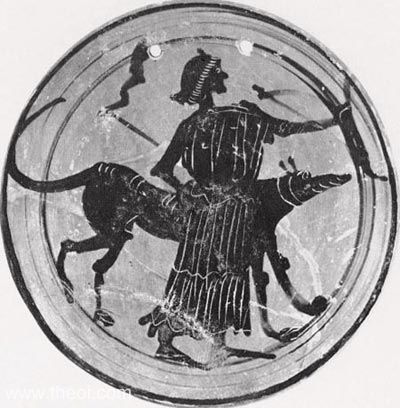
There are two versions of this depiction. Both forms—when made into a statue—are called 'Hekataia'. The first are three women, beautiful and young, usually around a pillar, holding various attributes. A version of Her in this depiction can be found on the right. Statues like these used to stand at crossroads in ancient Hellas, as well as near the gates to a home, which was just as much a crossroads. Hekate, in this form, became a Goddess of purification, expiation, and protection, associated with thresholds and gates, both reaching back to the Underworld association. Very rarely, She was represented with a single body and three heads, all looking different ways.

In another, scarier, and more bestial version, Hekate is depicted similarly as above, but with the heads of various animals. The Greek Magical Papyri, or Papyri Graecae Magicae, name the three as such, but variations exist:

"Take a Lodestone and on it have carved a Three-faced Hekate. And let the Middle Face be that of a Maiden wearing Horns, and the Left Face that of a Dog, and the One on the Right that of a Goat."

It is this Hekate that is appeased with the Deipnon, at the new moon: the last day of the month. These days, when the nights kept getting darker and darker, were some of the scariest days of the month, and were considered impure. The night when the moon completely disappeared was sacred to Hekate, as Hekate was able to placate the souls in Her wake, and could purify the household of miasma accumulated during the month. Removing this miasma allowed the members of the household to call on Hekate during the following month in times of need—as we have seen was common practice—and be more likely to have Her look favorably upon the supplicant.

Epithets associated with this version of Her are:
- Apotropaia (that turns away/protects)
- Enodia (Goddess of the paths)
- Klêidouchos (Keeper of the Keys)
- Propylaia (the one before the gate)
- Tricephalus or Triceps (The Three-Headed)
- Triodia/Trioditis (who frequents crossroads)
- Trimorphe (three-formed)

The spell above, taken from the Papyri, is used to make a protective amulet, and offers protection much in the same way as her three-formed appearance at crossroads and entrances does. Yet, the Hekate in the Papyri is not a gentile being. The materials in the Papyri—which are Graeco-Roman Egyptian in origin—stem from anywhere between the second century BC to the fifth century AD, and show a much darker, although highly honored, part of Her, still linked to many other Goddesses:

"To You, wherefore they call You Hekate, Many-named, Mene, cleaving Air just like
Dart-shooter Artemis, Persephone, Shooter of Deer, night shining, triple-sounding,
Triple-headed, triple-voiced Selene, Triple-pointed, triple-faced, triple-necked,
And Goddess of the Triple Ways, who hold untiring Flaming Fire in Triple Baskets,
And You who oft frequent the Triple Way and rule the Triple Decades, unto me
Who'm calling You be gracious and with Kindness give Heed, You who protect the Spacious World
At night, before whom Daimons quake in Fear and Gods Immortal tremble, Goddess who
Exalt Men, You of Many Names, who bear Fair Offspring, Bull-eyed, Horned, Mother of Gods
And Men, and Nature, Mother of All Things, for You frequent Olympos, and the broad
And boundless Chasm You traverse. Beginning and End are You, and You Alone rule All.
For All Things are from You, and in You do all Things, Eternal One, come to their End.
As Everlasting Band around Your Temples you wear Great Kronos' Chains, unbreakable
And unremovable, and You hold in Your Hands a Golden Scepter. Letters 'round
Your Scepter Kronos wrote Himself and gave to You to wear that All Things stay steadfast:
Subduer and subdued, Mankind's Subduer, and Force-subduer; Chaos, too, You rule.
Hail, Goddess, and attend Your Epithets, I burn for You this Spice, O Child of Zeus,
Dart-shooter, Heav'nly One, Goddess of Harbors, who roam the Mountains, Goddess of Crossroads,
O Nether and Nocturnal, and Infernal, Goddess of Dark, Quiet and Frightful One,
O You who have Your Meal amid the Graves, Night, Darkness, Broad Chaos: Necessity
Hard to escape are You; You're Moira and Erinys, Torment, Justice and Destroyer,
And You keep Kerberos in Chains, with Scales of Serpents are You dark, O You with Hair
Of Serpents, Serpent-girded, who drink Blood, who bring Death and Destruction, and who feast
On Hearts, Flesh Eater, who devour Those Dead untimely, and You who make Grief resound
And spread Madness, come to my Sacrifices, and now for me do You fulfill this Matter."

Epithets associated with this version of Her are:
- Antania (Enemy of mankind)
- Khthonian (Earth/Underworld goddess)
- Prytania (invincible Queen of the Dead)

I'm going to go beyond the scope of this post's title and summarize what happened next to Hekate and Her image. Throughout the following centuries, especially with the rise of Christianity, Hekate lost many of Her domains, and a greater focus was placed upon Her darker features. Slowly, she became a sorceress, a witch, out to destroy the common man. By this time, she also became a crone. Around 1600 AD, William Shakesear describes the common opinion of Her best in his Macbeth:

"Have I not reason, beldams as you are? Saucy and overbold, how did you dare to trade and traffic with Macbeth in riddles and affairs of death, and I, the mistress of your charms, the close contriver of all harms, was never called to bear my part, or show the glory of our art?"

Hekate as the Queen of Witches, teacher of magick, ready to deal with desperate souls. This version of Hekate, especially combined with the Papyri Graecae Magicae, inspired occultist Aleister Crowley to write his Hymn for Her, and describe Her as a maiden-mother-crone trinity with Persephone and Demeter—the Goddesses with whom she was identified at Eleusis—in his 1917 novel 'Moonchild':

"...and thirdly, she is Hecate, a thing altogether of Hell, barren, hideous and malicious, the queen of death and evil witchcraft. [...] Hecate is the crone, the woman past all hope of motherhood, her soul black with envy and hatred of happier mortals; the woman in the fullness of life is the sublime Persephone, for whose sake Demeter cursed the fields that they brought forth no more corn, until Hades consented to restore her to earth for half the year."

Gerald Gardner, as all whom have been around the Neo-Pagan circles for a while undoubtedly know, was a great fan of Crowley, and used much of his teachings to create Wicca. This is how the modern image of Hekate entered modern Neo-Paganism, and how Hekate changed from a benign and helpful Goddess of animals, childbirth and victory into a Goddess associated with the dead, with magic(k), and sorcery.

For those of you reading this who are not Hellenistic, perhaps this post will help you understand why Hellenists are usually not so happy with Hekate's current image—if you weren't already aware of those reasons.

For Hellenists reading this, perhaps this post sheds some light on the modern incarnation of Hekate, and helps you figure out in what incarnation you want to worship Her at your home. Whatever the case, to my knowledge there isn't a single other Hellenic Goddess who managed to reinvent Herself as much as Hekate did. In a changing time, Hekate found a way to stay current, and be revered by many around the globe: a divine skill, indeed, and one worthy of honors and respect.

Image source: Hekate with dogHekataia, 'Hekate: Wanderer of Tombs' by superboy783
Administering justice is often placed in the sphere of influence of either Athena of Nemesis, and both Goddesses do, indeed, have connections to it. There is one Theia, however, who is the personification of the phenomenon of justice. Dikē (Δικη) is the Goddess of justice placed upon mortals, fair judgements and the rights established by custom and law. According to Hesiod, She was born from a joining of Zeus and Themis, the Titan Goddess of divine law, custom and prophecy. She has five sisters, Eunomia (Ευνομια, Goddess of good order and lawful conduct) and Eirênê (Ειρηνη, Goddess of peace and spring), with whom Dikē forms the Horai (Ὡραι), the Goddesses of the seasons and the natural portions of time; and the Moirai, the Goddesses of fate. Their names are Kloto (Κλωθώ, spinner), Atropos (Ἄτροπος, unturnable), and Lakhesis (Λάχεσις, Alotter).

The Horai, Eirênê, Eunomia, and Dikē

Dikē was born to Zeus and Themis in a coupling before He took Hera as his wife and queen. Hellenic didactic poet Aratos (Ἄρατος) regarded Her as Astraia (Αστραια), who is either a sepatarte Theia to Dikē, or as an epithet of Her who took to the earth, where the Golden Age ruled. This age, long before the age of heroes, was a just age, and there were no wars. there was no famine. No man coveted possessions of another. Much of this was attributed to Dikē, who kept the inhabitants of this age ethically strong and morally fair. When those of the Golden Age passed, they were morally pure, and became daímōns, guarding over those of later ages. Dikē remained on earth for the Silver Age, but those of the silver age were more corruptible. She wished for the race of the Golden Age, and more and more, the silver race became diseased with lawlessness and strife. Dike gathered the beings of the silver race and told them the following:

"Behold what manner of race the fathers of the Golden Age left behind them! Far meaner than themselves! But ye will breed a viler progeny! Verily wars and cruel bloodshed shall be unto men and grievous woe shall be laid upon them." (96)

With that, she left earth for the stars, where she watches over the earth as the constellation Virgo. Aratos goes on to say that Dikē hated the bronze age men, 'who were the first to forge the sword of the highwayman, and the first to eat of the flesh of the ploughing-ox'. Other writers like playwright Aeschylus in his 'Papyri Oxyrhynchus', Hellenic rhetorician Demosthenes in 'Against Aristogeiton', within the Orphic Hymns, and by Hesiod himself in Works and Days place Dikē next to the throne of mighty Zeus, Her father, where she can tell Zeus of those whom break her teachings.

Returning to Dikē's genealogy: her family tree would look as follows:

  Chaos ------------ Gaea
             |                |
      Ouranos   ---   |
              Themis -- Kronos --- Rhea 
                 |              |
                      |            Zeus
                  |     ---     |
                  | 
                    Dikē

It should be noted that Aratos' Astraia was born not to Zeus and Themis, but to Astraios (Ἀστραῖος) and Eos (Ἠώς). Eos's family line is quite clear, as She is said to have Hyperion and Euryphaessa as Her parents. Astraisos' family line is less clear, with options ranging from Krios and Eurybia to Tartaros and Gaea. As such, it is far more logical to place Her into the sky after Her departure from earth than at Zeus's feet.

Aeschylus wrote of the fucntion and tasks of Dikē the best, I feel, although the final lines are mostly lost to us:

"Dike: And he [Zeus] has his seat upon his father's very throne, having overcome Kronos by means of Justice (Dike); for Zeus can now boast, since his father began the quarrel, that he paid him back with Justice on his side. That is why Zeus has done me great honour, because after being attacked he paid him back, not unjustly. I sit in glory by the throne of Zeus, and he of his own will sends me to those he favours; I mean Zeus, who has sent me to this land with kind intent. And you shall see for yourselves whether my words are empty.
Chorus: How then shall we rightly address you?
Dike: By the name of Dike, her who is greatly revered in heaven.
Chorus: And of what privilege are you the mistress?
Dike: As for the just, I reward their life of justice.
Chorus: (...) this ordinance among mortals.
Dike: But in the reckless I implant a chastened mind.
Chorus: By Persuasion's [Peitho] spells, or in virtue of your might?
Dike: I write their offences on the tablet of Zeus.
Chorus: And at what season do you unroll the list of crimes?
Dike: When the proper time brings the fulfilment of what is theirs by right.
Chorus: Eagerly, I think, should the host welcome you.
Dike: Much would they gain, should they receive me kindly." (part of frag. 282)

Dikē is regarded as a great Goddess whom no one mortal man or woman would defy openly. We all claim our actions are justified (even when they are not so in the eyes of others), and in an argument, even opposites call upon Her, because they are sure She will favor them. Both the oppressors in a war, as the oppressed will say Dikē is on their side, and even thieves and murderers are sure that what they did was just. We had to do it, in order to feed our families, protect our spouse, etc. All are right to call upon Dikē--whose Roman equivalent Iustice became Lady Justice--but it is up to Zeus to pass the final judgement. At that time, He will send Nemesis to strike down the unjust party.

While Lady Justice is often depicted with scales, a sword, and a blindfold, Dikē was depicted solely with scales. The sword is attributed to the Roman Iustice, who combined attributes of both Dikē, and Her mother Themis. As such, Iustice administered justice to all, not just mortals. The sword may have been inherited from Nemesis. The blindfold came much later, in the fifteenth century, to indicate that justice is or should be placed upon one objectively, without fear or favour, regardless of identity, money, power, or weakness; blind justice and impartiality. In ancient times, Dikē was sometimes depicted with a cornucopia, to indicate that those who follow Her teachings are rewarded richly, something echoed in Hesiod's writing:

"There is a noise when Dike is being dragged in the way where those who devour bribes and give sentence with crooked judgements, take her. And she, wrapped in mist, follows to the city and haunts of the people, weeping, and bringing mischief to men, even to such as have driven her forth in that they did not deal straightly with her. But they who give straight judgements to strangers and to the men of the land, and go not aside from what is just, their city flourishes, and the people prosper in it: Eirene, the nurse of children, is abroad in their land, and all-seeing Zeus never decrees cruel war against them. Neither famine nor disaster ever haunt men who do true justice; but light-heartedly they tend the fields which are all their care. The earth bears them victual in plenty, and on the mountains the oak bears acorns upon the top and bees in the midst. Their woolly sheep are laden with fleeces; their women bear children like their parents. They flourish continually with good things, and do not travel on ships, for the grain-giving earth bears them fruit." (220 - 237)

All mortals do well to honor Dikē, she can be petitioned for guidance in times when moral and ethical questions weigh heavily upon you. Dikē can not be bribed, however, and unlike us mortals, She knows exactly when an action is just. Petition Her for counsel, but never expect Her to lie to Zeus about your actions. If you must request something as extreme as that, you can be sure Nemesis will not be on your side.

Image property: clipart.com.
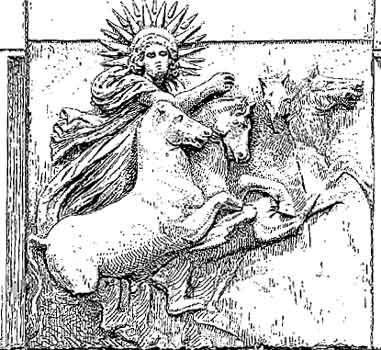
The Hellenic pantheon literally has hundreds of Gods, Goddesses, Titans, nature spirits, heroes, kings and queens. Although Hellenismos focusses mostly on the Big Twelve, Hades, Hestia and Hekate, Hellenic mythology is a true treasure trove of immortals. Most of these 'lesser' immortals get very little attention, and I'd like to change this. So, ever now and again, I'm going to introduce one of the lesser known immortals and  try and find a place for them in modern Hellenistic worship, based off of their ancient Hellenic worship. Today, I'm introducing to you Hēlios (Ἥλιος), personification of the sun.


Hēlios is a Titan, born from Hyperion and Theia (Hesiod, Pindar), or Hyperion and Euryphaessa (Homeric Hyms). Hyperion (Ὑπερίων), meaning 'The High-One', was born from Gaea and Ouranos. He is the Lord of Light, and Titan to the east. Due to his (and Helios') epithets, there is often confusion between the two: Helios is refered to as 'Hyperion' by Homeros in the Odysseia, and one of the well known epithets of Hyperion is 'Helios Hyperion', yet the ancient Hellens distinguished between Them quite rigidly. Hyperion is the observer--and father--of many of the Titans connected to the sky. Diodoros Sikeliotes (Διόδωρος Σικελιώτης), Hellenic historian and writer of the Bibliotheca historica, says the following about Hyperion:

"Of Hyperion we are told that he was the first to understand, by diligent attention and observation, the movement of both the sun and the moon and the other stars, and the seasons as well, in that they are caused by these bodies, and to make these facts known to others; and that for this reason he was called the father of these bodies, since he had begotten, so to speak, the speculation about them and their nature."

Theia and Euryphaessa are generally regarded as the same Deathless woman: 'theia' is the Hellenic word for 'Goddess', so it was likely 'Theia Euryphaessa' translated to 'Goddess Euryphaessa'. This means that Hēlios' family tree is as follows:

Chaos --- Gaea
            |         |
  Ouranos --- |
                          Hyperion --- Euryphaessa
                      |
                     Hēlios

As far as confusion goes, Hēlios is also often confused with Apollon, mostly because of their conglomeration as a single Deity in the Roman era. In ancient Hellas, it was Phoibos (or 'Aiglêtos') Apollon who drove the chariot of the sun through the sky each morning, following the lovely Eos out of the heavenly gates. Phoibos Apollon is associated with carrying sunlight, but He is in no way the sun itself. That honor befalls Hēlios.

Hēlios is the sole Theos described as 'all-seeing' (Panoptes, because His rays reach (almost) everywhere on the Earth's surface. Most famously, He sees Aphrodite' affair with Ares, and warns Hēphaistos of it. As such, Hēlios is regarded as the enforcer of justice and vows. From Orphic Hymn seven:

"Dispensing justice, lover of the stream, the world's great despot, and o'er all supreme.
Faithful defender, and the eye of right, of steeds the ruler, and of life the light"

The most famous piece of mythology concerning Hēlios regards His son Phaethon (Φαέθων), by Klymene (Κλυμένη). The story is told to us by Ovid, a roman poet. In it, Klymene boasts to Phaethon that his father is the sun God Himself, and so, Phaethon goes up to Olympus to confirm. To prove His paternity, Hēlios swears of the river Styx to give Phaëthon anything he desires. Phaëthon grabs this opportunity to demand of his father to let him drive his golden chariot the next time the sun rises.

Hēlios tries to talk His son out of it, claiming that not even Zeus would attempt to drive the chariot, as it is hot with fire and the horses wild and fire breathing. Phaëthon will hear none of it, and so Hēlios must let him get on. He rubs his son's body with magical oil that will protect him from the heat and as Eos and Apollon leave the gates, so does Phaëthon.

The four horses of the chariot--Pyrois, Aeos, Aethon, and Phlegon--sensed Phaëthon's weaker hand and became virtually unsteerable. First, Phaëthon drove them too high, and the Earth below cooled and the people suffered. Then, he flew too low and entire cities burned, lakes and rivers dried up, and even the seas were affected. Mighty Poseidon tried to stop Phaëthon, but had to flee from the heat. It was Zeus who threw His lightning bolt and killed Phaëthon.

Hēlios was inconsolable, and refused to man the solar chariot for days on end. He blamed Zeus for His son's death, but Zeus rightly claimed He had no other choice. The Theoi eventually convinced Him to to take up His responsibility again, but His son's death pained Hēlios greatly. On the epitaph on Phaëthon's tomb was written:

"Here Phaëthon lies who in the sun-gods chariot fared. 
And though greatly he failed, more greatly he dared."

Another piece of Hēlios' mythology comes from Hómēros who writes in the Odysseia:

"we came swiftly to Helios Hyperion’s lovely island, where the sun-god grazed his fine broad-browed cattle, and his flocks of sturdy sheep. I could hear the lowing of cattle as they were stalled and the bleating of sheep from my black ship while I was still at sea, and the blind seer Theban Teiresias’ words came to mind, with those of Aeaean Circe, who both warned me to avoid the isle of Helios who gives mortals comfort."

Yet, not only do they not steer clear of the island, they kill and eat (unbeknownst to Odysseus), some of the sheep in Hēlios' herd as they become stranded on this island for days or even months.

"Now Lampetia of the trailing robes sped swiftly to Helios Hyperion with the news we had killed his cattle, and deeply angered he complained to the immortals: “Father Zeus and you other gods, immortally blessed, take vengeance on the followers of Odysseus, Laertes’ son. In their insolence, they have killed my cattle: creatures I loved to see when I climbed the starry sky, and when I turned back towards earth again from heaven. If they do not atone for their killing, I will go down to Hades and shine for the dead instead.""

"The gods at once showed my men dark omens. The ox-hides crawled about, raw meat and roast bellowed on the spit, and all around sounded the noise of lowing cattle. Nevertheless my faithful comrades feasted for six days on the pick of Helios’ cattle they had stolen. And when Zeus, Cronos’ son, brought the seventh day on us, the tempest ceased, and we embarked, and, raising the mast and hoisting the white sail, we put out into open water.

"It was not till the island fell astern, and we were out of sight of all but sky and sea, that Zeus anchored a black cloud above our hollow ship, and the waves beneath were dark. She had not run on for long before there came a howling gale, a tempest out of the west, and the first squall snapped both our forestays, so that the mast toppled backwards and the rigging fell into the hold, while the tip of the mast hitting the stern struck the steersman’s skull and crushed the bones. He plunged like a diver from the deck, and his brave spirit fled the bones.

"At that same instant Zeus thundered and hurled his lightning at the ship. Struck by the bolt she shivered from stem to stern, and filled with sulphurous smoke. Falling from the deck, my men floated like sea-gulls in the breakers round the black ship. The gods had robbed them of their homecoming."

The worship of Hēlios was quite widespread throughout ancient Hellas, but never in a measure beyond a cult. Athenians observed Helios as a Theos, but had no worship for Him. On the island of Rhodes, Hēlios was revered most, although evidence of His worship has been found in Corinth and Hermoine. The Colossus of Rhodes was dedicated to Him and the acropolis of Corinth was part of His worship as well.

For modern practitioners, there is not a lot to go on if you want to honor Hēlios. One can assume that manna is an acceptable offer because of His close identification with Apollon. There is also vague record of a festival on Rhodes, where a chariot with four horses was driven off of a cliff to commemorate the death of Phaëthon, but I would opt against this in modern day society. I would suggest thinking of Hēlios as He rises, and perhaps offering to Him when offering to Apollon in His solar aspects.

Helios is a beautiful, bright and all-encompassing Theos who deserves the worship of modern day practitioners. I, for one, would love to see a new cult rise on His name.

"O powerful Nike, by men desired, with adverse breasts to dreadful fury fired, thee I invoke, whose might alone can quell contending rage and molestation fell. 'Tis thine in battle to confer the crown, the victor's prize, the mark of sweet renown; for thou rulest all things, Nike divine! And glorious strife, and joyful shouts are thine. Come, mighty Goddess, and thy suppliant bless, with sparkling eyes, elated with success; may deeds illustrious thy protection claim, and find, led on by thee, immortal fame."
- Orphic Hymn 33 to Nike 

Although often considered a minor Goddess, Nike (Νίκη, pronounced 'ni-KÉ', unlike the sport's brand 'NÍ-kee'), winged Goddess of victory, had a privileged position in ancient Hellas; the same position She should have for any modern Hellenist who partakes in any type of competition, battle--medical, moral, political, judicial, social--who is looking for love, or is locked in some other type of struggle.

According to Hesiod, Nike was born one of four siblings: her brothers Kratos (Κράτος, 'strength') and Zelus (Ζῆλος, 'zeal'), and her sister Bia (Βία, 'Force'). Their parents are Pallas and Styx. When the Titanomachy broke out, Zeus called out to everyone to take the side of the Theoi in the war. Styx answered the call and reported for duty along with Her children. Nike became Zeus' charioteer and is often depicted by His side for it. Along with her siblings, Nike, was also a sentinel to Him, standing beside his throne. With Victory on his side, Zeus simply could not lose.

Another deity Nike is closely related to, is Athena. In fact, some say Nike is an epithet of Athena, most commonly referred to as 'Nike Athena'. In this regard, Nike Athena is an epithet of Athena that is closely related to 'winged thought'; a great intellect, and victory through tactical planning of the upcoming battle.

It is not odd to find Nike in the presence of Athena and Zeus: both rarely--if ever--lose. Victory is always on their sides. Other Theoi Nike favors are Ares and Hera; Ares as the victor of battle, Hera--presumably--as the victor of just judgement, like Athena. In some versions of the myth, Nike is the daughter of Ares and an unknown female. This is most notably so in Homeric Hymn 8 to Ares:

"[Ares] father of warlike (eupolemos) Nike, ally of Themis."

Nike is most often portrayed as a young woman with a billowy dress and beautiful wings attached to Her back. Both the statue of Zeus at Olympia and the statue of Athena at the Parthenon held a statue of Her in Their right hand. Two world famous statues of Her have survived more or less intact: the Winged Victory of Samothrace, as pictured above, and the statue of Nike by the hand of Paeonius.

There are also references to other statues of her, most notably one on the Acropolis in Athens where She had her own sanctuary. The temple of Apteros Nike ('Wingless Victory') was a small temple with eight Ionic columns. The wooden statue of Nike that was placed in there was wingless on purpose: the Athenians wanted Nike to stay in their city for ever and never fly away. Nike is also portrayed on the Olympic medals.

We all have struggles in our lives that we could use some divine help on. Especially when there can be only one winner, Nike is a wonderful deity to give sacrifice to. In the Orphic tradition, she was appeased with fumigations from Manna--Frankincense crushed to a powder. She will also accept libations of (red) wine. Speak of the speed with which She flies, the justness of Her judgements and the importance of Her duty.

If you wish to simply honor Her, try to think of Her when you see a competition going on which She will eventually settle, be it the presidential campaign, a sports event or a fight. Remember how often Nike passes just judgement upon mortals--and the Theoi--and how severe Her influence is on our lives. Once you realize that, you will never be able to see her as a 'minor' Goddess again.

Image source