Showing posts with label Seven Sages. Show all posts
Welcome to the last installment of the Seven Sages Series! The weeks have truly flown by. Today, we will be talking about Periander of Corinth, who was the second tyrant of the Cypselid dynasty that ruled over that city-state. He was the son of Cypselus, of the family of the Heraclidae. He married Lyside (whom he called Melissa). She was the daughter of Procles, the tyrant of Epidaurus. He had two sons, Cypselus and Lycophron. The eldest, Cypselus, is said to have been mentally disabled.

Periander continued the policies of his father, which were directed against the hereditary nobility. In the interests of the trading and artisan classes, Periander introduced customs duties and state coinage of money and organized a large-scale building program. Under his rule, many vestiges of the hereditary order were eliminated, hereditary divisions were replaced by territorial divisions, territorial courts were created, and military units of mercenaries were organized. To strengthen the centralized authority, Periander introduced statutes to register the income of the populace and prohibit public banquets, lavish holiday celebrations, and mass gatherings in public squares. He also instituted a law against luxury.

To promote and protect Corinthian trade, Periander established colonies at Potidaea in Chalcidice and at Apollonia in Illyria. He conquered Epidaurus and annexed Corcyra. The diolkos (“portage way”) across the Isthmus of Corinth was perhaps built during his reign. It appears that the commercial prosperity of Periander’s Corinth became so great that the tolls on goods entering its ports accounted for almost all government revenues. Periander cultivated friendly relations with Thrasybulus, tyrant of Miletus, and maintained ties with the kings of Lydia and Egypt. In the cultural sphere he was a patron of art and of literature; by his invitation the poet Arion came to the city from Lesbos.

While his wife Melissa was pregnant with Lycophron, Periander and his wife seem to have gotten into an argument about (false) accusations of infidelity on Priander's part,  during which he either kicked or threw his her down a staircase. Melissa died, and Priander sent Lycophron away to Corcyra because he grieved for his mother. When Priander called Lycophron back to rule in his stead, the Coryreans who had been taking care of him killed the boy. Priander became so angry he sent the Coryreans' children off to be made eunuchs of. The youths were saved, however, and Priander died despondent at eighty years old.

Periander was said to be a patron of literature, who both wrote and appreciated early philosophy. He is said to have written a didactic poem 2,000 lines long. The following is a list of sayings commonly attributed to him:

Never do anything for money; leave gain to trades pursued for gain.
Whoever wishes to wield absolute power in safety should be guarded by the good will of his countrymen, and not by arms.
It is as dangerous to retire voluntarily as to be dispossessed.
Rest is beautiful.
Rashness has its perils.
Gain is ignoble.
Democracy is better than tyranny.
Pleasures are transient, honors are immortal.
Be moderate in prosperity, prudent in adversity.
Be the same to your friends whether they are in prosperity or in adversity.
Whatever agreement you make, stick to it.
Betray no secret.
Correct not only the offenders but also those who are on the point of offending.
Practice makes perfect.
Be farsighted with everything.
Nothing is impossible to industry.
Live according to your income.
The mind still longs for what it has missed, and loses itself in the contemplation of the past.
He who assists the wicked will in time rue it.
He who has once made himself notorious as utterly unprincipled, is not credited even when he speaks the truth.
He who trusts himself for safety to the care of a wicked man, in seeking succour meets with ruin.
However exalted our position, we should still not despise the powers of the humble.
Judge of a tree by its fruit, not by its leaves.
Liars pay the penalty of their own misdeeds.
Relaxation should at times be given to the mind, the better to fit it for toil when resumed.
Success brings many to ruin.
The soft speeches of the wicked are full of deceit.
The success of the wicked tempts many to sin.
Those who plot the destruction of others often perish in the attempt.
To counsel others, and to disregard one's own safety, is folly.
Unless your works lead to profit, vain is your glory in them.
Witty remarks are all very well when spoken at a proper time: when out of place they are offensive.
The useful and the beautiful are never separated.
Pittacus of Mytilene was a statesman and sage who is known as one of the Seven Wise Men of ancient Hellas. He was born around 652-649 BC and died between 578 and 570 BC. Pittacus was the son of Hyrradius and had a son called Tyrrhaeus. Legend says that Tyrrhaeus was killed and when the murderer was brought before Pittacus, he dismissed the man, saying, 'Pardon is better than repentance', or 'Pardon is better than punishment'.

He was a native of Mytilene and the Mytilenaean general who, with his army, was victorious in the battle against the Athenians and their commander Phrynon. By challenging Phrynon to one-on-one combat and beating him, he prevented massive amounts of bloodshed and ended the war. In consequence of this victory the Mytilenaeans held Pittacus in the greatest honour and presented the supreme power into his hands. After ten years of reign he resigned his position and the city and constitution were brought into good order.

 He was a model of prudence and a political figure distinguished for his reason, wisdom, and political honestly. during his reign, he instituted many laws which tried to elevate the etical level of his fellow man, including the law that anyone who committed a crime when drunk should recieve double punishment.

Many of his sayings were preserved although, as always, we can never be sure if these words were ever uttered by him exactly as they are written here (well, in the Greek, of course).

"It is a hard thing to be a good man."
"Forgiveness is better than revenge."
"Whatever you do, do it well."
"Even the Gods cannot strive against necessity."
"Power shows the man."
"Do not say beforehand what you are going to do; for if you fail, you will be laughed at."
"Do not reproach a man with his misfortunes, fearing lest Nemesis may overtake you."
"Forbear to speak evil not only of your friends, but also of your enemies."
"Cultivate truth, good faith, experience, cleverness, sociability, and industry."
"Know thine opportunity"

Pittacus lived to the age of seventy, at least, and remained highly respected by his fellows--and long after he passed.
Cleobulus, or Kleoboulos (Κλεόβουλος) was a native of Lindus, and the son of Evagoras. He studied philosophy in Egypt; and had a daughter named Cleobulina, who used to compose enigmas in hexameter verse, that were said to be of no less significance than his own. It is said that he restored the temple of Athena which had been built by Danaus. He used to compose songs and sayings in verse to the number of three thousand lines. Some claimed that he was a descendant of Hēraklēs.

Clement of Alexandria calls Cleobulus 'king of the Lindians', and Plutarch speaks of him as the tyrant. Whatever the case, the city state of Lindos, which also governed much of it's neighbouring area, reached it's peak in 6th century BC, with him as its governor. At this time, under the reign of Kleoboulos life was very much improved and Lindos became a wealthy and succesful town.

He was known as 'The Wise', and there are several sayings attributed to him. These are the ones the ancient writers tell us were stated by him at some point in time:

"Ignorance and talkativeness bear the chief sway among men."
"Cherish not a thought."
"Do not be fickle, or ungrateful."
"Be fond of hearing rather than of talking."
"Be fond of learning rather than unwilling to learn."
"Seek virtue and eschew vice."
"Be superior to pleasure."
"Instruct one's children."
"Be ready for reconciliation after quarrels."
"Avoid injustice."
"Do nothing by force."
"Moderation is the best thing."

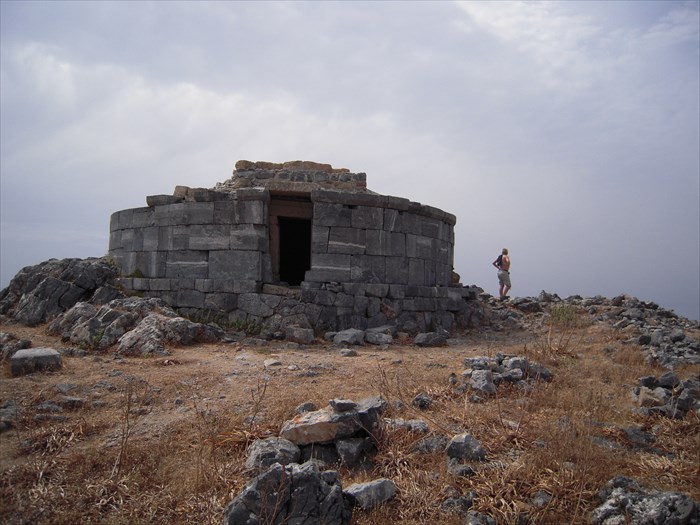
He is said to have lived to the age of seventy, and to have been greatly distinguished, for strength and beauty of person. The tomb of Kleoboulos--he's not actually buried there, but the vieuw is alledgedly beautiful--stands at the Northern tip of Lindos bay just past the remains of a disused windmill.
Like many of the other sages, there's not much we know for certain about Bias of Priene. His biography, written by Diogenes Laertius in the late second century CE, has some length, but does not appear to be very reliablebut since Diogenes Laertius wrote more than seven centuries after Bias' life, we could not have expected something else.

Bias of Priene (Βίας ὁ Πριηνεύς) lived in the 6th century BC. He was a Hellenic sage and renowned for his goodness. Like many of his peer sages, he was active in politics and he appeared in court as a lawyer and was very gifted at it. He also adviced kings and generals about battle strategies and seems to have made very wise decissions here also. We know that his father was named 'Teutamus', and the ancient writer Satyrus puts him at the head of the Seven Wise Men.

An annecdote by Phanodicus says that he ransomed some Messenian maidens who had been taken prisoners, and educated them as his own daughters, gave them dowries, and then sent them back to Messina to their fathers--something seen as very noble and cherishable.

It's said that Bias only pleaded cases of those he truly believed to be innocent and/or in the right. A well known saying quoted by Diogenes Laertius appears to have been: 'If you are a judge, give a Prienian decision'.

We have quite a few of sayings attriuted to him, although we can, of course, never be sure if Bias ever said them out loud:

"The naïve men are easily fooled."
"Most people are evil."
"All men are wicked."
"It is difficult to bear a change of fortune for the worse with magnanimity."
"Choose the course which you adopt with deliberation; but when you have adopted it, then persevere in it with firmness."
"Do not speak fast, for that shows folly."
"Love prudence."
"Speak of the Gods as they are.""Do not praise an undeserving man because of his riches."
"Gain your point by persuasion, not by force."
"Cherish wisdom as a means of traveling from youth to old age, for it is more lasting than any other possession."

Bias is said to have died at a very advanced age while pleading a cause for his client. After he had finished speaking, he rested his head on his grandson. When the advocate on the opposite side had spoken, the judges decided in favor of Bias' client, by which time Bias had died. The city gave him a magnificent funeral and inscribed on his tomb:

"Beneath this stone lies Bias, who was born
In the illustrious Prienian land,
The glory of the whole Ionian race."
Thales of Miletus (Θαλῆς ὁ Μιλήσιος) was a pre-Socratic Hellenic philosopher and mathematician from Miletus in Asia Minor. According to Herodotus, Thales predicted the solar eclipse of May 28, 585 BC. Diogenes Laërtius quotes the chronicle of Apollodorus of Athens as saying that Thales died at the age of 78 during the 58th Olympiad (548–545 BC) and attributes his death to heat stroke while watching the games.

Thales' parents were Examyes and Cleobuline, and his family traced their line back to Kadmus, the mythological Phoenician prince of Tyre. Many, most notably Aristotle, regard him as the first philosopher in the Hellenic tradition. Thales attempted to explain natural phenomena without reference to mythology, and almost all of the other Pre-Socratic philosophers follow him in attempting to provide an explanation of ultimate substance, change, and the existence of the world without reference to mythology. He was not only a philosopher but also a businessman, and he also became involved in politics in his lifetime--like many of the Sages.

If Thales wrote down any ethical guidelines or other works of prose (a treaty entitle 'On the Solstice' and one entitled 'On the Equinox' are mentioned by other ancient writers), they have sadly been lost to us. Proclus acknowledged Thales as the discoverer of a number of specific theorems, both mathematical, geometric, and philosophical, and he is recognised as one of the--if not the--first mathematician.

Thales was esteemed in his times as an original thinker, and one who broke with tradition and not as one who conveyed existing mythologies. He never attributed organization or control of the cosmos to the Gods. Thales hypothized that water had the potentiality to change the myriad of things of which the universe is made, the botanical, physiological, meteorological and geological states--in fact, he proposed that the primary principle is water. He believed that the disk of the earth rests on water. Thales did not mention any of the Gods who were traditionally associated with the simple bodies; we do not hear of Okeanos or Gaea: we read of water and earth.

Thales has been credited with the discovery of five geometric theorems: (1) that a circle is bisected by its diameter, (2) that angles in a triangle opposite two sides of equal length are equal, (3) that opposite angles formed by intersecting straight lines are equal, (4) that the angle inscribed inside a semicircle is a right angle, and (5) that a triangle is determined if its base and the two angles at the base are given. His mathematical achievements are difficult to assess, however, because of the ancient practice of crediting particular discoveries to men with a general reputation for wisdom.
It has been a while since I last talked to you about the Delphic Maxims, but while I will be referencing them today, I won't be talking about any one of them specifically. Today, I want to talk to you about the Seven (Ancient) Sages, or the Seven Wise Men--and introduce a new mini series.


The maxims are said to have been delivered by Apollon Himself to his Oracle at Delphi. They represent a honest, worthy way of living but are not to be taken as commandments. They are guidelines, forming a framework to life, without restraining the mortal soul. Once noted down, they were shared with any who would listen.

Instead (or in addition to) the Oracle of Delphi, the maxims are sometimes contributed to the Seven Sages or the Seven Wise Men (οἱ ἑπτὰ σοφοί, hoi hepta sophoi). This was the title given by ancient Hellenic tradition to seven early 6th century BC philosophers, statesmen and law-givers who were renowned in the following centuries for their wisdom. They are usually identified as: Solon of Athens, Chilon of Sparta, Thales of Miletus, Bias of Priene, Cleobulus of Lindos, Pittacus of Mitylene and Periander of Corinth.

Solon of Athens (Σόλων ὁ Ἀθηναῖος)
Solon was an Athenian statesman, lawmaker, and poet, who lived from 638 BC to 558 BC. He spent most of his adult life trying to legislate against political, economic, and moral decline in archaic Athens. His ideologies are often credited with having laid the foundations for Athenian democracy.

Chilon of Sparta (Χίλων or Χείλων)
Chilon was an early 6th century BC Lacedaemonian (Spartan). Like Solon, he was a politician and a reformer of the way the city-state was ran in the time he was alive. He was part of the Spartan assembly, became an ephor in the 6th Olympiad, and it is clamed that he introduced the system where kings took ephors as their counselors for their term. The ephors (Ἔφορος) were leaders of ancient Sparta and shared power with the Spartan kings. Five ephors were elected annually, who 'swore on behalf of the city', while the kings swore for themselves. Chilon is said to have helped to overthrow the tyranny at Sicyon, which became a Spartan ally. He is also credited with the change in Spartan policy leading to the development of the Peloponnesian League in the sixth century BC.

Thales of Miletus (Θαλῆς ὁ Μιλήσιος)
Thalēs was a pre-Socratic Greek philosopher and mathematician from Miletus in Asia Minor. What made his philosophical musings uniue at the time was that he attempted to explain natural phenomena without reference to mythology. Of his time and of tyhe sages, he was often considered the most wise--which actually spared his life when he became a captive of war. Many commentators state that Thales was named as Sage because of the practical advice he gave to Miletus in particular, and to Ionia in general. Thalens is the only one of the Sages who did not leave behind a body of ethical sayings which can be attributed to him.

Bias of Priene (Βίας ὁ Πριηνεύς)
Bias, along with Thales, Pittacus, and Solon was one of the four men always named amongst the Sages. He was known for his goodness and was an advocate of many who had to appear in ancient Hellenic courts--very succesfully so.

Cleobulus of Lindos (Κλεόβουλος ὁ Λίνδος)
Cleobus (or Kleoboulos) was an ancient Lindosian poet and statesman. He was considered a tyrant but famed for his strength and beauty of person.

Pittacus of Mitylene (Πιττακός ὁ Μυτιλήνη)
Pittacus was a Mytilenaean general who, with his army, was victorious in the battle against the Athenians and their commander Phrynon. As a result, he reigned over Mytilene for ten years before he resigned his position. As a ruler and lawmaker, many of his sayings were recorded.

Periander of Corinth (Περίανδρος ὁ Κόρινθος)
Periander was the Second Tyrant of the Cypselid dynasty that ruled over Corinth. Periander was said to be a patron of literature, who both wrote and appreciated early philosophy. Some scholars have argued that the ruler named Periander was a different person from the sage of the same name.

Four names have become canonical (Thales, Pittacus, Bias, Solon), but there were many candidates for the remaining three positions. Diogenes Laertius, the author of the entertaining Lives of the Philosophers, mentions several writers who had included lists of seven sages in their books on the history of Greek philosophy, like Dicaearchus of Messene (late fourth century), Maeandrius of Miletus (early third century), and three authors whose names are not mentioned. The candidates for inclusion include: Myson, Anacharsis, Pythagoras, Aristodemus, Pamphylus, Epimenides, Leophantes, Acusilaos, Scabras, Pherecydes, Lasus, Aristoxenus, Anaxagoras, Orpheus, Linus, and Epicharmus.

Unlike collections of sages from other (religious) traditions--like the saptarishi from Hindu tradition or the seven apkallū from Babylon--the ancient Hellenic Seven Sages were not (semi-)mythical. The only (semi-)mythical thing about them was their relation to Apollon and the involvement of the Delpic oracle in forming the Delphic Maxims.

Personally, I think these men bundled their own ideals and ideologies into a coherent ethical framework, but that does not negates Apollon's involvement at all, as He would be credited with their wisdom and inspiration--and rightfully so. And Delphi was a meeting place of many people--likeminded or not, especially for the Phyian games. These men could have come together there or anywhere else to discuss philosophy and ethics. They were all essentially practical men who played leading roles in the affairs of their respective states, and were far better known to the earlier GHellenes as lawgivers and statesmen than as profound thinkers and philosophers, althoughn their Maxims were picked up quickly.

The coming seven weeks, every Monday, I would like you to get to know these men better--and the ethical guidelines they brought into the Delphic Maxims. We will be starting tomorrow with Solon, a man who has been featured on this blog before for his wisdom and legistrative skill. See you tomorrow for part one of the Seven Sages Series.
One of my little loves is ethics. I adore figuring out what makes me tick, where I draw the line and how different these lines can be for other people. As a result, I tend to have a fondness for ethical and moral codes placed upon us by our ancestors. Many traditions have a set of these. The Nine Noble Virtues for the Asatru, the Brehon Laws for the Druids, the Ten Commandments for Jews and Christians, the Laws of Ma'at for Kemetics, the Roman Virtues for the Romanitas and for Hellenics, they are the Delphic Maxims and there are a 147 of them.

I've been studying the Maxims for a while now and they hold such a simple and compelling truth that it's been hard to deny most of them. Alright, some are a little outdated (like maxim 95: rule your wife (Γυναικος αρχε)) but in general, it's sound advice for an honest, mortal life.

Throughout this blog, I will undoubtedly work through quite a few of the maxims as I apply them to my life or as they spring up from it. For now, I want to relay a bit about what they are and what they represent.

The maxims are said to be delivered by Apollon Himself to his Oracle at Delphi. They represent a honest, worthy way of living but are not to be taken as commandments. They are guidelines, forming a framework to life, without restraining the mortal soul. Because our ability to think and act for ourselves is a great good, even to the Theoi. In fact, it might have been a logical conclusion after receiving the gifts of Pandora.

The maxims are said to have been written down by the Seven Sages. They are usually identified as: Solon of Athens, Chilon of Sparta, Thales of Miletus, Bias of Priene, Cleobulus of Lindos, Pittacus of Mitylene and Periander of Corinth. Once noted down, they were shared with any who would listen.

I have heard people complain or joke that some of the maxims are virtually the same so there really should be fewer in the list. But the intention behind each and every one is different. An example:
Perceive what you have heard (Ακουσας νοει)
Observe what you have heard (Ακουων ορα)
Both, at first glance mean the same: to notice what is heard. But looking deeper, to perceive means not only to notice but also to discern and understand. To observe means not only to notice but to put into action that which is heard. It's a logical next step to perceiving that which is heard and both steps are equally important. Without perceiving, one could not observe and without observing, what is the point of perceiving? Both teach valuable lessons; in this case lessons that we tend to forget in our busy and hurried lives.

When was the last time you have really listened to someone and acted on it? When was the last time you have let someone truly listen to you without holding back out of fear, lack of time or shame. For me, it's been a while, especially the latter part. So now I blog. And the maxims have played a vital role in that.

Image taken from: Harry's Greece Travel Guide.