Showing posts with label Eros. Show all posts

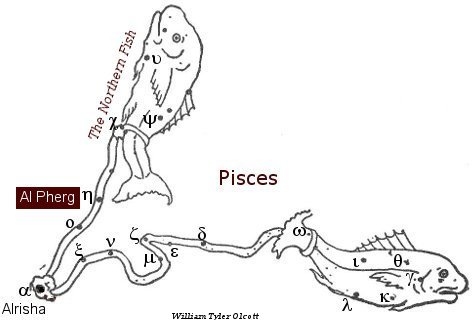
Pisces is a constellation of the zodiac. Its name is the Latin plural for 'fish'. It lies between Aquarius to the west and Aries to the east. The ecliptic and the celestial equator intersect within this constellation and in Virgo.


http://www.constellationsofwords.com/stars/AlPherg.html


During the Titomanchy, the Olympians were in for a rough fight when Zeus led them against the Titans. One of their toughest fights was against the storm-giant Typhôeus (Τυφωευς), a fight so tough, in fact, that the Olympians had to flee from battle. Pisces is associated with Aphrodite and Eros, the who escaped from the monster Typhôeus, the most-feared son of Tartaros and Gaea, by leaping into the sea and transforming themselves into fish. In order not to lose each other, they tied themselves together with rope. Alternatively, the fish represent the Ikhthyes (Ιχθυες), a pair of large Syrian river fish who rescued Aphrodite and Eros when they were fleeing. Thirdly, they may be solely the fishes Aphros and Bythos, the fish-tailed Ikhthyokentauroi (Sea-Centaurs) of late classical art, who pulled Aphrodite to safety after her birth in the ocean. Hyginus says of the first option in his 'Astronomica':

"Diognetus Erythraeus says that once Venus and her son Cupid came in Syria to the river Euphrates. There Typhon, of whom we have already spoken, suddenly appeared. Venus and her son threw themselves into the river and there changed their forms to fishes, and by so doing this escaped danger. So afterwards the Syrians, who are adjacent to these regions, stopped eating fish, fearing to catch them lest with like reason they seem either to oppose the protection of the gods, or to entrap the gods themselves." [II.30]

Roman poet Ovid has an adaption about the second option, noted down in 'Fasti':

"[N]ext in turn do thou, O Fish, receive the heavenly steeds. They say that thou and thy brother (for ye are constellations that sparkle side by side) did support twain gods upon your backs. Once on a time Dione,55 fleeing from the dreadful Typhon, when Jupiter bore arms in defence of heaven, came to the Euphrates, accompanied by the little Cupid, and sat down by the brink of the Palestinian water. Poplars and reeds crowned the top of the banks, and willows offered hope that the fugitives also could find covert there. While she lay hid, the grove rustled in the wind. She turned pale with fear, and thought that bands of foes were near. Holding her child in her lap, “To the rescue, nymphs!” she said, “and to two deities bring help!” Without delay she sprang forward. Twin fish received her on their backs, wherefore they now possess the stars, a guerdon meet. Hence scrupulous Syrians count it sin to serve up such fry upon the table, and will not defile their mouths with fish." [2.458]

In all cases, the fishes were accepted into the heavens for their aid lend, and Aphrodite and Eros were safe, having escaped Typhôeus.

Pisces is visible at latitudes between +90° and −65°, and best visible at 21:00 (9 p.m.) during the month of November.

Not Hellenic, but so cool! Archaeologists in southwestern England have discovered a nearly 2,000-year-old figurine of Cupid along the route of a former Roman road. As Matty Airey reports for the Gloucestershire Gazette, a Highways England team surveying the area ahead of construction discovered the statuette, as well as a bow-shaped brooch and a human skeleton, outside the town of Birdlip in Gloucestershire County.

“It is a rare and exciting find,” says Mel Barge, inspector of ancient monuments at Historic England, in a statement. “It will tell us about the lives and beliefs of the small Roman community that lived alongside this road.”

Per BBC News, fewer than 50 Roman Cupid figurines have been found in the United Kingdom to date. This one is made of solid bronze and shows the winged god of love holding a flaming torch. The statue was unearthed in a charcoal deposit, suggesting it may have been an offering to the gods.

In a separate statement, Highways England notes that worshippers may have left the petite deity in a roadside temple—a common feature in Roman-era England.

Cupid, the Roman version of the Greek god Eros, is known for shooting arrows that cause their targets to fall in love (or lust). Today’s Valentine’s Day cards depict him as a chubby-cheeked winged baby, but as Alice Abler wrote for Vision in 2010, the god was often shown in ancient times as an older boy or young man. He, and his mother, Venus, were associated with Lupercalia, the ancient Roman festival of purification, health and fertility.

The skeleton buried alongside the artifacts proved to be more enigmatic. Though Christian tradition dictates that burials should face east to west, this grave was oriented north to south. The researchers theorize that the individual may have been a Roman buried before the fourth century or an early Saxon from between the fifth and seventh centuries.

Adding to the mystery is the fact that the body was buried facedown, which might have been a sign of disrespect for a criminal or someone otherwise disliked by their local community. The skeleton will be reinterred rather than removed for further research.

The archaeological work is part of the A417 “missing link” project, a planned 3.4-mile connection between the A417 highway and a bypass road. The existing highway is built along the path of a former Roman road; researchers have previously found the remains of villas and temples from the Roman period in the area, as well as settlements dating back to the Neolithic period.

According to Claire Hayhurst of PA Media, the team studied historical records and conducted geophysical surveys to identify likely places for excavations. The archaeologists are not disclosing the precise location of the new finds, but Highways England tells PA that it was on privately owned land close to the planned construction route.

The excavation is one of a number of archaeological projects organized by Highways England in conjunction with its road-building work. Elsewhere in England, the government-owned company has uncovered evidence of early Roman settlements, mammoth tusks, ancient breweries and pothole repairs from the Roman period. Some of its archaeological work has come ahead of construction of a controversial tunnel near Stonehenge, as Gwyn Topham and Steve Morris reported for the Guardian last November.

“It has been fascinating to reveal more about the area and the people who once lived here,” says Jim Keyte, the project’s archaeology lead, in the statement. “Our investigations will continue as the project progresses, and we expect more interesting discoveries to come.”

The excavation conducted this season by the University of Athens at ancient Alasarna (today’s Kardamaina) on Kos is into its 35th year. It is the longest, continuous, systematic archaeological research on the island, as well as one of the most long term university excavations in Greece. Hundreds of Greek and foreign archaeologists have trained there since 1985 to the present, many of whom now are employed at the Archaeological service or teach at Universities in Greece, Cyprus, Poland, Australia and elsewhere.


Ancient Alasarna’s advantageous position by the sea, opposite Nisyros and the Knidos peninsula, had attracted inhabitants since antiquity and was associated with the most ancient cult of the Koans, that of their forefather Apollo Pythaius or Pythaeus. For this reason, magnificent buildings in his honour were erected in Hellenistic times, and numerous inscriptions and statues and other offerings were established.

After the repeated catastrophic earthquakes that hit the island and the prevailing of Christianity, the sanctuary area was taken over by part of a flourishing early Byzantine settlement that grew in the area, while the excellent quality clay and location of the settlement on the wheat sea route from Egypt in Constantinople led to a new flowering, until the settlement was finally abandoned in the 7th century AD due to raids by the Arabs.

This year’s excavation team worked for one month. It was headed by Emeritus women Professors G. Kokkorou- Alevra, S. Kalopisi-Verti and M. Panagiotidou-Kesisoglou and was made up of 45 people; PhD holders, postgraduate and graduate students.

The unearthing continued of the monumental enclosure (Building E) which appears to have surrounded a magnificent Hellenistic temple (Building C), possibly that of Apollo as testified by inscriptions, issues were looked into related to the construction and chronology of the Roman temple (Building D) located outside the enclosure and lastly, selected areas were excavated for a fuller understanding of the early Byzantine settlement that had occupied the sanctuary district since 400 AD and perhaps even earlier.

The unearthing of one more Roman building to the west of the Roman temple (Building D) is of particular interest, testifying to a greater flowering of the sanctuary in Roman times than what excavations had shown to date.

The most distinguished of this year’s finds are a clay Cupid figurine, a Hellenistic skyphos vase with relief decoration, oil lamps, a coin from the times of Augustus, architectural members, fragments of frescoed plaster, early Byzantine amphorae with graffiti and more.

At the same time, movable and immovable finds from the excavation are being studied, as the volumes that make up the Alasarna series (Thales European Programme of Excellence) continue to be published. To date, this places the University excavation of Kardamaina among the few systematic Greek excavations that provides a series of publications, as is usually the case with excavations conducted by foreign archaeological schools in Greece.

The excavation is supervised by the Ephorate of Antiquities of the Dodecanese and is funded annually by the General Secretariat of the Aegean and Island Policy while receiving increasingly warm support from local authorities, the Kardamaina community and educational and cultural institutions of Kos. The ultimate goal is to promote the site and hand it over to the inhabitants and visitors of the island.
Papyri Graecae Magicae, also known as the "Greek Magical Papyri," are a body of papyri from Graeco-Roman Egypt, which each contain a number of magical spells, formulae, hymns and rituals. The materials in the papyri date from the 2nd century BC to the 5th century AD. The manuscripts came to light through the antiquities trade, from the 18th century onwards. As part of the papyri, spells for a variety of things were recorded. One is a prayer to Eros as part of a love spell. I'd like to share that today.


Prayer to Eros
"I call upon you, author of all creation, who spread your own wings over the whole world, you, the unapproachable and unmeasurable who breathe into every soul life-giving reasoning, who fitted all things together by your power, firstborn, founder of the universe, golden-winged, whose light is darkness, who shroud reasonable thoughts and breathe forth dark frenzy, clandestine one who secretly inhabit every soul.

You engender an unseen fire as you carry off every living thing without growing weary of torturing it, rather having with pleasure delighted in pain from the time when the world came into being. You also come and bring pain, who are sometimes reasonable, sometimes irrational, because of whom men dare beyond what is fitting and take refuge in your light which is darkness.

Most headstrong, lawless, implacable, inexorable, invisible, bodiless, generator of frenzy, archer, torch-carrier, master of all living sensation and of everything clandestine, dispenser of forgetfulness, creator of silence, through whom the light and to whom the light travels, infantile when you have been engendered within the heart, wisest when you have succeeded; I call upon you, unmoved by prayer, by your great name

[F]irst-shining, night-shining, night rejoicing, night-engendering, witness, you in the depth, you in the sea, clandestine and wisest. Turn the ‘soul’ of her to me, so that she may love me, so that she may feel passion for me, so that she may give me what is in her power. Let her say to me what is in her soul because I have called upon your great name.”
Archaeologists have discovered a statue of the goddess Hygeia and god Eros in Turkey’s southern province of Adana, according to the Daily Sabbah.


The limestone sculpture; which was broken into two parts and missing a head, was discovered in the Anavarza Antique City, in the Kozan district. Anavarza Antique City dates back to the second century B.C. The city’s ruins are surrounded by 20 bastions and a 1500-meter-long wall with four entrances. Archaeologists believe it dates back to the third or fourth century BC. Nedim Dervisoglu, Director of the Adana Museum, told Dogan News Agency:

“The famous pharmacologist Dioskurides; who worked in the army during the Roman period and who attracted attention with the medicines he made, lived in Anavarza.”

The ancient sculpture has been added to the UNESCO Temporary List of World Heritage Sites. Dervisoglu said archaeologists are continuing the search for the statue’s missing head.
Every day, the average human utters about 16.000 words. A good portion of those are idioms and figures of speech--the use of a word or words diverging from its usual meaning--or sayings. Today, I wanted to share some of the figures of speech and sayings that can be traced back to ancient Hellas and/or Hellenic myth. Some of these I have posted before, but I've collected another few in the mean time. These are marked with a *.


"A Herculean Effort"
Meaning: a great effort.
Source: Hēraklēs, son of Zeus and the mortal Alcmene--who was a bane in Hera's life, simply for being born--was stricken mad by the Queen of the Gods and killed his five sons by his wife Megara, oldest daughter of Kreōn of Thebes. When he was released from his madness by a hellebore potion--provided by Antikyreus--and realized what he had done, he cried out in anguish, and went on a long journey to cleanse himself of the miasma caused by these killings. First, he visited the oracle at Delphi, who, unbeknownst to him, was whispered to by Hera. The Oracle told Hēraklēs to serve the king of Tiryns, Eurystheus, for ten years and do everything Eurystheus told him to do. Eurystheus gladly provided Hēraklēs with these labors--ten of them, one for each year--and eventually ended up adding two more, resulting in the Twelve Labors of Hēraklēs. Hēraklēs was told to: slay the Nemean Lion, slay the nine-headed Lernaean Hydra, capture the Golden Hind of Artemis, capture the Erymanthian Boar, clean the Augean stables in a single day, slay the Stymphalian Birds, capture the Cretan Bull, steal the Mares of Diomedes, obtain the girdle of Hippolyta, Queen of the Amazons, obtain the cattle of the monster Geryon, steal the apples of the Hesperides, and to capture and bring back Kerberos. All of these tasks were incredibly hard, and required every ounce of strength Hēraklēs possessed.

"A Sisyphean task"
Meaning: (performing) an endless or repetitive task.
Source: Sísyphos was a scheming and conniving king, who tried to pull a fast one on the Gods many times over. He betrayed Zeus, tried to trick Thanatos, Persephone and Hades, and killed innocent travelers on his roads--an offense against xenia. For all these offenses, Sísyphos was sentenced to push a boulder uphill for all eternity, as the boulder would roll down the slope again the second he reached the top.

"Achilles' heel"
Meaning: one's weakness or weak spot.
Source: Achilles was a great warrior, destined to live one of two lives: a long and boring one, or a short but heroic one. Knowing her son would choose the latter, his divine mother Themis tried to limit the risk of Achilles dying a premature death by dipping him in the river Styx. As such, Achilles became impenetrable to harm, save for his heel, where his mother had held him as she dipped him in the water. This spot eventually became his downfall, and Achilles died on the battlefield of Troy. The stories of his invulnerability were a later invention, around the first century AD. Before that, the myth simply stated that Achilles was shot in the heel with an arrow, and he eventually died of that wound, because it would not heal.

"Bearing the weight of the world (on one's shoulders)" *
Meaning: a very heavy burden of worry or responsibility.
Source: This is a reference to Atlas, the Titan who was forced to carry the heavens on his shoulders after he and his brethren rebelled against Zeus in the Titanomachy. Depending on the source, however, it was actually a great honour to be asked to protect the whole of the earth from being crushed under the weight of the sky.

"Beware of Greeks bearing gifts"
Meaning: be weary of those with something to offer, they may have ulterior motives.
Source: In the war for Troy, the Hellenes needed a way to conquer the walls of the city. They tried to fight for it, but were unable to. In Virgil's Aeneid, it is written that the Hellenes built a wooden horse, and hid away in it. The horse was offered to the Trojans as a gift, and the structure was accepted into the city. At night, the Hellenes snuck out of the horse, attacked the city, and conquered Troy.

"Caught between a rock and a hard place"
Meaning: making a hard choice; choosing between two undesirable options.
Source: During Odysseus' travels to get home, he must run his ship through a narrow passage. One the one side are rocks with a cavern. In this cavern, Skylla, sea monster with six heads, lived, and she would take one of Odysseus' men with each of her heads. On the other side lay Kharybdis, a great whirlpool which would suck in any ship that came too close. It is up to Odysseus to choose one or the other. Eventually, he chooses Skylla, and looses many brave men, his ship, however, is in tact. As such, Odysseus had to choose between a rock and a hard place.

"Cupid's arrows" *
Meaning: rapidly falling in love--as if struck.
Source: The ancient Hellenes were just as mystified by love as we are today--more so, perhaps, because a least we know what happens chemically in our bodies when it happens. Their answer to the mystery of falling in love was that the arrow of Eros struck. Eros had two types of arrows: the golden-tipped arrow brought love and attraction, the lead-tipped arrow brought hate and repulsion. Cupid is the Roman version of Eros.

"Dog is man's best friend"
Meaning: the loyalty of dogs is undisputed
Source: In the Odysseia, Odysseus finally returns home after many, many long years of travel, and long years of war. He is in disguise when he reaches his house, which is overrun by suiters of his wife. His fateful hunting dog, Argos, has waited for him all these years, and recognizes his master right away. Finally reunited with his master, the old dog dies, happy, and at peace.

"Food of the Gods"
Meaning: food so delicious, it is almost divine
Source: Nectar--the drink of the Gods--and ambrosia--the food of the Gods--are the dish of choice on Olympos. If a mortal man or woman would eat or drink either of the two, they, too, would become immortal, or at least their aging would stop for a while.

"Gordian knots"
Meaning: an extremely perplexing puzzle or problem.  
Source: It seems that king Gordius of Phrygia laid out a task for whomever wanted to be the ruler of Asia Minor: he tied a know so complex, no one managed to untie is. Eventually, Alexander the Great came to the land, and cut the know with his sword, thus 'passing' the test. 'Cutting the knot' became a saying for taking something by force, or making a decisive action. 

"Having the Midas touch"
Meaning: a fortunate person, someone able to make everything a success.
Source: In Hellenic mythology, Midas was the king of Pessinus. It seems some of the peasants under Midas' commands brought the king the unconscious satyr Seilenos, who had drunk himself into a stupor. Alternatively, Seilenos toppled over in Midas' garden. No matter how he got there, Midas took good care of him, and as a token of appreciation, Dionysos--Seilenos' student--offered Midas a wish. Midas wished that everything he touched, turned to gold. This is where the saying comes from.

"Hounds of Hell"
Meaning: something frightening, or evil.
Source: Guarding the entrance to Underworld is a great dog, either with just one head, or three, or fifty. His name is Kerberos, and you can pass him once, on your way in, but never again, as there is no way out.

"Leave No Stone Unturned"
Meaning: search everywhere.
Source: The catch-phrase was first recorded by Euripides in his tragedy 'Heracleidae'. The play focusses on King Eurystheus, who hunts the children of Hēraklēs after he passes away. The actual quote comes from the line: "Now, after he was taken hence, was I not forced, by reason of these children's hatred, and because I was conscious of an hereditary feud, to leave no stone unturned by slaying, banishing, and plotting against them?"

"Oedipus Complex"
Meaning: a child's unnatural desire of their parent of the opposite sex, and jealousy of the parent of the same sex. Freudian theory.
Source: Oedipus was born to King Laius and Queen Jocasta. King Laius was fortold his son would kill him and marry his mother, and so he left him to die on a mountainside. The child was found, however, and raised by King Polybus and Queen Merope. Oedipus eventually heard of the prophecy about him and fled, not wanting to hurt his adoptive parents, who he believed to be his biological ones. Fate would have him end up on the same road as King Laius, and in an argument over whom would step out of the way, Oedipus killed his father. He then traveled on and eventually met and married his mother. The myth continues on, but this is the part where the figure of speech comes from.

"Pandora's box"
Meaning: to perform an action that may seem small or innocuous, but that turns out to have severe and far-reaching consequences.
Source: I've written quite a bit about Pandôra on this blog. Pandôra was created by the Theoi as punishment on humanity after Prometheus stole fire from the Gods. Pandôra showed up on the doorstep of Prometheus' brother Deukalion, with a pithos she was told never to open. Eventually, curiosity got the better of her,a nd she opened the jar. In some versions of the myth, all evils of the word flew out, but Pandôra managed to trap hope in the jar. There are many, many inconsistencies in the myth, but the figure of speech stuck.

"Pregnant with thought" *
Meaning: to be about to put forth a (great) idea.
Source: Potentially, this idiom comes from Greek mythology--namely the birth of Athena from the head of Zeus. Athena, as Goddess of wisdom represents a literal birth of ideas--which is pretty much the meaning.

"Siren's song" *
Meaning: an alluring utterance or appeal, especially one that is seductive or deceptive.
Source: In the Odysseia, Circe warned Odysseus not to listen to the Sirens--mythological mermaids--because their haunting music would drive him mad. Or if he did, at least have his sailors tie him to the mast to keep him from throwing himself overboard, and to plug his rowers ears’ with beeswax so they would be impervious to the sweet high song.

"Stygian darkness" *
Meaning: pitch black, sometimes dreary, darkness.
Source: The river Styx was the boundary between the upper world of the living and the underworld of the dead. It was so inky black that anything under its surface disappeared from sight.

"The face that launched a thousand ships"
Meaning: one person causing a terrible event.
Source: One fateful day, three Goddesses got into an argument about whom was most beautiful. Hera, Aphrodite, and Athena, all laid claim to a golden apple tossed into the crowd at a banquet held on honor of Peleus and Thetis. Eris had thrown the apple, which was labeled 'for the most beautiful'. The Goddesses could not decide who was the fairest, and so They asked Zeus. Zeus appointed Paris, A Trojan mortal, to choose in his stead. All three Goddesses undressed for Paris when asked, and all offered him gifts, if he would choose them. Aphrodite, however, promised him the most beautiful of wives, and PAris chose Her. Aphrodite picked Helen of Sparta as Paris' new wife, but Helen was already married, to Menelaus, who would eventually bring war down upon Troy to reclaim the wife he lost. Helen became the woman whose face 'launched a thousand ships' in war.

"To rise from the ashes"
Meaning: to be reborn
Source: No singular myth about the famous bird survives, but the phoenix was know to the ancient Hellenes. It was a mythical bird that lived its life, immolated, and was reborn from the ashes of its previous incarnation.
"What can you tell me about dedicating sexual intercourse to one of the love gods? Would it be possible to make having sex part of a ritual to someone like Aphrodite or Eros?"

Hellenic society was complicated when it came to sex; the ancients saw sex as completely natural and--unlike many today--had no inhibitions and very few taboos when it came to straight up heterosexual sex. Anything else had societal stigma's attached to it. Nudity was generally accepted by the ancient Hellenes, although social rules had to be observed. Women rarely went completely uncovered in every day life, but displayed their bodies through their clothing. Men could cast off their clothing more readily. If either gender undressed, it was seen as irreverent to do so partly, and thus they appeared either fully clothed or naked. Partial nudity was frowned upon in almost all social settings, while full nudity was often accepted.

Ritual prostitution was a valid form of worship for Aphrodite in Cyprus, the center of her cult, in Cythera, Corinth and in Sicily. The women were called 'hierodoule' (ἱεροδούλη), temple slave, and 'made love' with paying customers. The practice was considered distinctly 'un-Hellenic' by 460 BC, but it made Corinth very wealthy, indeed. The practice seems to have lingered in converted Corinth from earlier worship of Astarte, who was brought into the pantheon as Aphrodite in Hellas. Pindar describes this exact practice beautifully in his 'Eulogies' (Fragment 122):

"Young women visited by many, servants of Peitho in rich Corinth, you who burn the tawny tears of pale frankincense, on many occasions fluttering in thought to the Uranian mother of desires, Aphrodite--To you she has granted without the possibility of refusal, O children, to have the fruit of your soft bloom plucked in lovely beds. And with necessity, everything is beautiful."

Aphrodite is the professional patron, protector and avenger of hierodoule as well as hetairai--female companions, a term used non-sexually for women, about women, but used by men to indicate a woman hired for entertainment, often leading to sex. She passes no judgement on those who enjoy the sanctity of sex and offers protection to those who practice it for money. That said, I don't know if the sexual encounter with the hierodoule were practiced inside the temple, or dedicated to the Goddess at all; it could just be a form of prostitution and a way to enrich the temple and city.

Within the Eleusinian Mysteries, there is also mention of sex--since many of the festivals have to do with fertility and childbirth. Most of those mentions take place at home, however, in the sanctity of the oikos. While this lovemaking was obviously linked to the Mysteries, I am not sure if the Gods were actively asked to witness the events. It was something that happened in the spirit of the festival, yes, but even then, the Mysteries are an old tradition. The cult itself likely has origins dating back to the Mycenean period of around 1600 to 1100 BC, and it is believed that the cult of Demeter Herself was established in 1500 BC. These proceedings were a secret, and although many people were a member of the cult, speaking of anything that happened during the rites was punishable by death.

Now for the practical: within the Hellenic religious practice, miasma describes the lingering aura of uncleanliness in regards to a person or space through which contact is made with the Gods. Miasma occurs whenever the space or person comes into contact with a pollutant--which includes bodily fluids. Mikalson in 'Ancient Greek Religion' mentions that a bath was required before entering a temple after intercourse as a form of katharmos. He, however, does not give a source, and I don't know one either. It is a reoccurring idea, though, mostly centred on the male's excretions during the activity. The Hellenic religious organization 'Labrys' echoes the sentiment, but also without sourcing. Miasma would be one of the reasons I can think of that would support abstinence in a religious setting.

There are five steps to proper, Hellenistic ritual: procession, purification, prayers and hymns, sacrifice/offerings, prayers of supplication and thanks, usually followed by a feast and/or theatre and sporting events. Personally, I don't see a way to include sex in this format. Making love in the spirit of a festival, sure, but seeing as it seems impossible to follow the proper steps and make love--not to mention the very important influence of miasma--I don't think we should include the Gods in our lovemaking. Personally, I don't ask Demeter to watch on for the Haloa--nor would I feel at all comfortable having the eyes of the Gods on me when I make love. My answer to the question would be 'no', but if you come to another conclusion, please fill in your practice as you see fit!
I live with an artist--and by that, I mean someone who went through art school and although it's not what pays the bills right now, because she's aiming for museums, not gallery sales, she slaves away at her art in her studio, hoping for one day--and since we got together a little over nine years ago, I have been exposed to a lot of art. Funny how the universe works out, because as a teen, I found myself desperately wanting to lean more about art. I just never found out how. As it turns out, all it takes is falling in love. At any rate, I have learned one very important thing from my artist girlfriend, namely that it doesn't matter if art is pretty or not. Art is not supposed to be pretty. Art is supposed to move you, it's supposed to reach inside your chest and twist your heart. It's supposed to enter your brain and worm itself inside of it, refusing to ever leave. I like art that is pretty, but most of my favourite pieces are things I wish I'd never have to look at again--and I still look, as often as I can stand it.


I found a collection of modern interpretations of the Gods, currently on display in Modern Eden, a San Francisco based art gallery focussing on illustrative works ranging anywhere from Realism to Surrealism. Until July fifth, art enthusiasts can take a gander at the reimagining of the ancient Hellenic Gods, if they so please.

I took a look at the works in the showing, and I dislike all of them, to be honest. I don't think they're pretty at all, and most have a level of Surrealism I dislike very much (of all the art styles that have come into fruition over the years, Surrealism is by far my least favourite). I am still sharing some of the works, however, because they moved me. they did that thing to me where they are stuck inside my head and heart, and make my stomach uncomfortable. I want to remember I saw there, and that's why you are seeing these as well. From the invitation:

"Modern Eden Gallery is pleased to announce OLYMPUS: Contemporary Portraits of the Ancient Gods, the 3rd annual portrait invitational curated by Bradley Platz. Twenty top contemporary artists have been hand selected for this exhibition. Each artist has chosen a god or goddess from among the Greek Olympians to portray. The epic nature of the subjects are demonstrated through the large scale works of art that range up to 7 feet tall. OLYMPUS will be our most ambitious portrait exhibition to date, in scale and subject matter."

EROS - Rebecca Léveillé-Guay
 
PERSEPHONE - Adam Caldwell
 
ASKLEPIOS - Carrie Ann Baade
(The Healer and the Pharmakon)
So, look who remembered she was doing a constellation series? That's right: me! I'm not sure where along the way I forgot about that one but here we are, with a new instalment: Pisces. Pisces is a constellation of the zodiac. Its name is the Latin plural for 'fish'. It lies between Aquarius to the west and Aries to the east. The ecliptic and the celestial equator intersect within this constellation and in Virgo.

http://www.constellationsofwords.com/stars/AlPherg.html


During the Titomanchy, the Olympians were in for a rough fight when Zeus led them against the Titans. One of their toughest fights was against the storm-giant Typhôeus (Τυφωευς), a fight so tough, in fact, that the Olympians had to flee from battle. Pisces is associated with Aphrodite and Eros, the who escaped from the monster Typhôeus, the most-feared son of Tartaros and Gaea, by leaping into the sea and transforming themselves into fish. In order not to lose each other, they tied themselves together with rope. Alternatively, the fish represent the Ikhthyes (Ιχθυες), a pair of large Syrian river fish who rescued Aphrodite and Eros when they were fleeing. Thirdly, they may be solely the fishes Aphros and Bythos, the fish-tailed Ikhthyokentauroi (Sea-Centaurs) of late classical art, who pulled Aphrodite to safety after her birth in the ocean. Hyginus says of the first option in his 'Astronomica':

"Diognetus Erythraeus says that once Venus and her son Cupid came in Syria to the river Euphrates. There Typhon, of whom we have already spoken, suddenly appeared. Venus and her son threw themselves into the river and there changed their forms to fishes, and by so doing this escaped danger. So afterwards the Syrians, who are adjacent to these regions, stopped eating fish, fearing to catch them lest with like reason they seem either to oppose the protection of the gods, or to entrap the gods themselves." [II.30]

Roman poet Ovid has an adaption about the second option, noted down in 'Fasti':

"[N]ext in turn do thou, O Fish, receive the heavenly steeds. They say that thou and thy brother (for ye are constellations that sparkle side by side) did support twain gods upon your backs. Once on a time Dione,55 fleeing from the dreadful Typhon, when Jupiter bore arms in defence of heaven, came to the Euphrates, accompanied by the little Cupid, and sat down by the brink of the Palestinian water. Poplars and reeds crowned the top of the banks, and willows offered hope that the fugitives also could find covert there. While she lay hid, the grove rustled in the wind. She turned pale with fear, and thought that bands of foes were near. Holding her child in her lap, “To the rescue, nymphs!” she said, “and to two deities bring help!” Without delay she sprang forward. Twin fish received her on their backs, wherefore they now possess the stars, a guerdon meet. Hence scrupulous Syrians count it sin to serve up such fry upon the table, and will not defile their mouths with fish." [2.458]

In all cases, the fishes were accepted into the heavens for their aid lend, and Aphrodite and Eros were safe, having escaped Typhôeus.

Pisces is visible at latitudes between +90° and −65°, and best visible at 21:00 (9 p.m.) during the month of November.
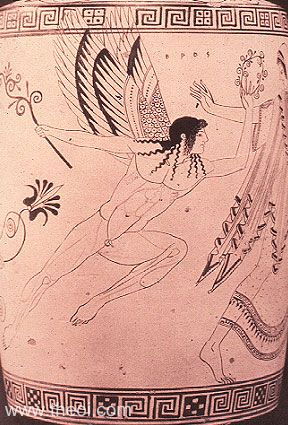
On this Valentine's day, it only seems fair that I give due to Eros (Ερως), God of love and sexual desire, eternal companion of Aphrodite and either Her son or self-born into the cosmos before anyone else, as love is the binding and creative force that makes up the universe. Pausanias, for example, in his 'Description of Greece' writes:

"Most men consider Love [Eros] to be the youngest of the gods and the son of Aphrodite. But Olen the Lycian, who composed the oldest Greek hymns, says in a hymn to Eileithyia that she was the mother of Love. Later than Olen, both Pamphos and Orpheus wrote hexameter verse, and composed poems on Love, in order that they might be among those sung by the Lycomidae to accompany the ritual. I read them after conversation with a Torchbearer. Of these things I will make no further mention. Hesiod, or he who wrote the Theogony fathered on Hesiod, writes, I know, that Chaos was born first, and after Chaos, Earth, Tartarus and Love." [9.27.2] 

Oppianos of Apamea was a third century AD author whose surviving work focusses solely on hunting. The Halieutica is made up of four parts of which the fourth seems incomplete. In this fourth part, however, we find a beautiful description of love as it affects Gods, mankind, and animals alike:

"O cruel Love [Eros], crafty of counsel, of all gods fairest to behold with the eyes, of all most grievous when thou dost vex the heart with unforeseen assault, entering the soul like a storm-wind and breathing the bitter menace of fire, with hurricane of anguish and untempered pain. The shedding of tears is for thee a sweet delight and to hear the deep-wrung groan; to inflame a burning redness in the heart and to blight and wither the bloom upon the cheek, to make the eyes hollow and to wrest all the mind to madness. Many thou dost even roll to doom, even those whom thou meetest in wild and wintry sort, fraught with frenzy; for in such festivals is thy delight. 

Whether then thou art the eldest-born among blessed gods and from unsmiling Chaos didst arise with fierce and flaming torch and didst first establish the ordinances of wedded love and order the rites of the marriage-bed; or whether Aphrodite of many counsels, queen of Paphos, bare thee a winged god on soaring pinions, be thou gracious and to us come gentle and with fair weather and in tempered measure; for none refuses the work of Love. 

Everywhere thou bearest sway and everywhere thou art desired at once and greatly feared; and happy is he who cherishes and guards in his breast a temperate Love. Nor doth the race of Heaven suffice thee nor the breed of men; thou rejectest not the wild beasts nor all the brood of the barren air; under the coverts of the nether deep dost thou descend and even among the finny tribes thou dost array thy darkling shafts; that naught may be left ignorant of thy compelling power, not even the fish that swims beneath the waters."

While Cupid is better know nowadays, Eros has much of the same attributes--including His quiver of arrow. Nonnus of Panopolis was a Greek epic poet, wrote in his Dionysiaca about this quiver of arrows, of which twelve were dedicated and meant for Zeus:

"Now Eros the wise, the self-taught, the manager of the ages, knocked at the gloomy gates of primeval Chaos. He took out the divine quiver, in which were kept apart twelve firefed arrows for Zeus, when his desire turned towards one or another of mortal women for a bride. Right on the back of his quiver of lovebolts he had engraved with letters of gold a sentence in verse for each:
"The first takes Cronion to the bend of heifer-fronted Io.”
"The second shall Europa woo for the bold bull abducting.”
"The third to Pluto’s bridal brings the lord of high Olympos.”
"The fourth shall call to Danaë a golden bed-companion.”
"The fifth shall offer Semele a burning fiery wedding.”
"The sixth shall bring the King of heaven an eagle to Aigina.”
"The seventh joins Antiope to a pretended Satyr.”
"The eighth, a swan endowed with mind shall bring to naked Leda.”
"The ninth a noble stallion gives unto Perrhaibid Dia.”
"The tenth three fullmoon nights of bliss gives to Alcmena’s bedmate.”
"The eleventh goes to carry out Laodameia’s bridal.”
"The twelfth draws to Olympias her thrice-encircling husband.”" [110]

Eros has let loose many an arrow on the Gods of Olympos; whenever a God falls for a mortal--or even another God--Eros is involved. He, however, had his own love story as well, described beautifully and lavishly by Apuleius, in 'The Golden Ass', which I will not post here for length. I can summarize the tale, however. 

Psyche (Psykhê, Ψυχη) was once a mortal princess who was so beautiful, men stated worshipping her instead of Aphrodite. Aphrodite commanded Eros make Psyche fall in love with the most hideous of men, but Eros couldn't; He fell in love with her Himself, and carried her away to His secret palace. He commanded Psyche to never look at His face, and hid His true identity, but of course, Psyche eventually was tricked into looking at the God. Quickly, He abandoned her. In her despair, she searched throughout the world for her lost love, and eventually came into the service of Aphrodite. The goddess commanded her perform a series of difficult labours which culminated in a journey to the Underworld. In the end Psykhe was reunited with Eros and the couple wed in a ceremony attended by the Gods.

I hope you have a beautiful Valentine's day with a loved one, friends, or family, and that Eros may bless you richly in life. Like the God of love itself, I wish you love as well, and hope his arrows touch your life, and guide your heart.

Image source: theoi.com
It's my nine-year anniversary with my girlfriend today and while we won't be celebrating it with anything other than a nice dinner out, I will most likely have Blogger post this one automatically so I can be in bed with my girl a little longer. As such, I am going to keep this short and sweet and leave you with Oppianos's glorious description of Eros--which was hilariously written in an essay about fish and fishes.

Eros is the God of love and sexual desire, eternal companion of Aphrodite and either Her son or self-born into the cosmos before anyone else, as love is the binding and creative force that makes up the universe. Oppianos of Apamea was a third century AD author whose surviving work focusses solely on hunting. The Halieutica is made up of four parts of which the fourth seems incomplete. In this fourth part, however, we find a beautiful description of love as it affects Gods, mankind, and animals alike:


"O cruel Love [Eros], crafty of counsel, of all gods fairest to behold with the eyes, of all most grievous when thou dost vex the heart with unforeseen assault, entering the soul like a storm-wind and breathing the bitter menace of fire, with hurricane of anguish and untempered pain. The shedding of tears is for thee a sweet delight and to hear the deep-wrung groan; to inflame a burning redness in the heart and to blight and wither the bloom upon the cheek, to make the eyes hollow and to wrest all the mind to madness. Many thou dost even roll to doom, even those whom thou meetest in wild and wintry sort, fraught with frenzy; for in such festivals is thy delight. 

Whether then thou art the eldest-born among blessed gods and from unsmiling Chaos didst arise with fierce and flaming torch and didst first establish the ordinances of wedded love and order the rites of the marriage-bed; or whether Aphrodite of many counsels, queen of Paphos, bare thee a winged god on soaring pinions, be thou gracious and to us come gentle and with fair weather and in tempered measure; for none refuses the work of Love. 

Everywhere thou bearest sway and everywhere thou art desired at once and greatly feared; and happy is he who cherishes and guards in his breast a temperate Love. Nor doth the race of Heaven suffice thee nor the breed of men; thou rejectest not the wild beasts nor all the brood of the barren air; under the coverts of the nether deep dost thou descend and even among the finny tribes thou dost array thy darkling shafts; that naught may be left ignorant of thy compelling power, not even the fish that swims beneath the waters."


I'm going back to snuggling with my girlfriend now, so I wish you a fond farewell. May you always have and hold love in your heart.
Yesterday, I had the good fortune to attend a rendition of the opera Orpheo ed Euridice at a former royal palace near my home. This is the trailer of last year's cast performing it, just to give you a sense of the mood.


There are some differences between the opera and the myth of Orpheus and Euridice, most notably that Amore (that would have been Eros, to the Hellens) restores Euridice's life despite Orpheus turning to look at her. In the myth, Orpheus must lead his dead wife from the Underworld to Earth without looking back at her. She is so silent, he eventually starts to doubt and just before they reach the Earth, he can't take it anymore and turns around. In the opera, the two haven't even started their ascend yet, when Euridice bewails her faith that Orpheus won't look at her and refuses to move until he does. When he eventually gives in, she dies again. This is where the myth ends, but in the opera, Orpheus' story goes on. Before he can take his own life so he can be with his love, Amore comes and tells him that his love has saved Euridice and she can return to him, and Earth, after all. 

I have an issue with the opera adaption; the myth ended with Euridice's death for a reason. Life is for the living; those who die should stay dead or be reborn. Hades rules supreme over the dead and once you are dead, you're done. Amore does not have the power to overrule Hades when it comes to the dying. The dying are dead, as they should be. It's the natural order to things and should be preserved. 

The ancient Hellens believed in ghosts; they were the people who could not find the entrance to the Underworld or who didn't have the money to pay Kharon for their passage. Those who were not properly buried were also doomed to wander the Earth for a hundred years. Interestingly enough, Hellenic heroes were also considered ghosts and were honored in the same type of rites as other types of ghosts. 

The Ancient Hellens held festivals in honor of ghosts, and the Theoi that presided over them, so they would be sated and appeased and would not haunt them. Most of these festivals included a holókaustos and were solemn affairs, conducted at night and without an offering of wine. 

This fear of spirits and other supernatural entities was named 'deisidaimonia' (δεισιδαιμονία). The ceremonies of riddance were known to the Hellens as apopompai (ἀποποπμαί), 'sendings away'. There isn't a single word in the English language that conveys the practice. Closest would be 'exorcism'. 

Becoming a ghost was not a good thing. While heroes like Hēraklēs, Theseus and Orpheus head into the Underworld and return from it alive, they never do so without a struggle and the fact that heroes were considered ghosts is food for thought. They have seen the Underworld and have not left the whole of it behind. Ghosts were feared and needed to be appeased, fed with blood to sustain them and/or warded off. 

Orpheus looses his wife for a reason; yes, he doubts the word of Hades but more importantly, I believe Hades knew Orpheus was doomed to fail. He knows that those who have good and properly died, need to stay dead. If He didn't, I doubt He would remain an active participant in sustaining the Underworld. Immortality is reserved for the Theoi alone. Those who strive for it, who are not sufficiently pious or simply need to be honored, become ghosts, who wander the Earth without finding rest, warmth or solace. Some, like the heroes, can be petitioned for aid and counsel but the others, the unfortunate souls, are to be feared and 'send away'.

One of the Delphic Maxims is 'grieve for no one' (Μη επι παντι λυπου). Death is a reward in and of itself, especially if you have lived a pious life. Death is not to be feared and those who die, do so for a reason; all mortal life must end, simply because it sets us apart from the Gods. To mourn the dead or fear death itself, is to question both the will of the Gods and mortal thought.