Showing posts with label astronomy. Show all posts

There are only three more constellations in the constellation series, and we will be talking about two of them today. But don't worry, I have a few bonus posts lined up around the theme. Today, we'll be talking about Ursa Major and Ursa Minor: the big and little bear.


Ursa Major (from the Latin: 'Larger She-Bear') is also known as the Great Bear and Charles' Wain. It is visible throughout the year in most of the northern hemisphere. Ursa Minor (from the Latin 'Smaller She-Bear') is also known as the Little Bear. Like Ursa Major, the tail of the Little Bear may also be seen as the handle of a ladle, hence the name Little Dipper. Both are amongst the 48 constellations listed by the 2nd century astronomer Ptolemy, and remain two of the 88 modern constellations. Ursa Minor is notable as the location of the north celestial pole, although this will change after some centuries due to the precession of the equinoxes.

The first mention of Ursa Minor in ancient Hellenic texts was by 6th century BC philosopher Thales of Miletus, who pointed out that it was a more accurate guide to finding true north than Ursa Major. This knowledge had reportedly come from the Phoenicians in the eastern Mediterranean, and the constellation bore the term Phoenikē. Homer had previously only referred to one 'bear', leading to speculation over what he saw the stars of Ursa Minor as, or whether they were recognised at all. From Hyginus' 'Astronomica':

"There is a great diversity of opinion, too, as to why the Lesser Bear is called Phoenice, and why those who observe her are said to navigate more exactly and carefully; why, also, if she is more reliable than the Great Bear, al do not watch her. These people do not seem to realize the reason for her being called Phoenice. Thales of Miletus, who searched into these matters carefully, and first called her Bear, was by birth a Phoenician, as Herodotus says. Therefore all those in the Peloponnesus use the first Arctos; the Phoenicians, however, observe the one they received from her discoverer, and by watching her carefully, are thought to navigate more exactly, and suitably call her Phoenice from the race of her discoverer." (II.2)

The ancient Hellenes linked Ursa Minor and Ursa Major to the myth of Kallistô and her son Arcas, both placed in the sky by Zeus. In this myth, Zeus and Kallistô had a son together: Arcas. After Arcas was born, Hera caught wind of the affair and turned Kallistô into a bear. Alternatively, Kallistô was a priestess of Artemis, and Artemis punished her for losing her virginity by turning her into a bear. Because of the metamorphosis, the boy was raised by his maternal grandfather Lycaon. When Arcas grew up, he went out to hunt and found a beautiful bear. He chased her through the woods. The bear--his transformed mother Kallistô--ran towards him as soon as she recognized her son. Arcas was terrified and raised his bow to shoot her. Zeus intervened swiftly and placed Kallistô and her son in the sky. In this interpretation, Kallistô became Ursa Major and Arcas either Ursa Minor or Boötes. A furious Hera asked Tethys to chain the two to the night's sky, so that the constellations would never sink below the horizon and receive water. An alternate myth tells of two bears that saved Zeus from his murderous father Kronus by hiding him on Mount Ida. Later Zeus set them in the sky, but their tails grew long from being swung by the God. Hyginus describes all of this in the following way:

"We begin, then as we said above, with the Great Bear. Hesiod says she is named Callisto [Kallistô], daughter of Lycaon, who ruled in Arcadia. Out of her zeal for hunting she joined Diana [Artemis], and was greatly loved by the goddess because of their similar temperaments. Later, when made pregnant by Jove [Zeus], she feared to tell the truth to Diana. But she couldn’t conceal it long, for as her womb grew heavier near the time of her delivery, when she was refreshing her tired body in a stream, Diana realized she had not preserved her virginity. In keeping with her deep distrust, the goddess inflicted no light punishment. Taking away her maiden features, she changed her into the form of a bear, called arktos in Greek . In this form she bore Arcas.
 
But as Amphis, writer of comedies, says, Jupiter, assuming the form of Diana, followed the girl as if to aid her in hunting, and embraced her when out of sight of the rest. Questioned by Diana as to the reason for her swollen form, she replied that it was the goddess’ fault, and because of this reply, Diana changed her into the shape we mentioned above. When wandering like a wild beast in the forest, she was caught by certain Aetolians and brought into Arcadia to King Lycaon along with her son as a gift, and there, in ignorance of the law, she is said to have rushed into the temple of Jove Lycaeus. Her son at once followed her, and the Arcadians in pursuit were trying to kill them, when Jupiter, mindful of his indiscretion, rescued her and placed her and her son among the constellations. He named her Arctos, and her son Arctophylax. About him we shall speak later.
 
Some, too, have said that when Callisto was embraced by Jove, Juno in anger turned her into a bear; then, when she met Diana hunting, she was killed by her, and later, on being recognized, was placed among the stars.
 
But others say that when Jupiter was pursuing Callisto in the woods, Juno, suspecting what had happened, hurried there so that she could say she had caught him openly. But Jove, the more easily to conceal his fault, left her changed to bear form. Juno, then, finding a bear instead of a girl in that place, pointed her out for Diana, who was hunting, to kill. Jove was distressed to see this, and put in the sky the likeness of a bear represented with stars.
 
This constellation, as many have stated, does not set, and those who desire some reason for this fact say that Tethys, wife of Ocean, refuses to receive her when the other stars come there to their setting, because Tethys was the nurse of Juno, in whose bed Callisto was a concubine.

 Araethus of Tegea, however, writer of histories, says that she wasn’t Callisto, but Megisto, and wasn’t the daughter of Lycaon, but of Ceteus, and so granddaughter of Lycaon. He says, too, that Ceteus himself was called the Kneeler. The other details agree with what has been said above. All this is shown to have taken place on the Arcadian mountain Nonacris.
 
Aglaosthenes, who wrote the Naxica, says that she is Cynosura, one of the nurses of Jove from the number of the Idaean nymphs. He says, too, that in the city called Histoe, founded by Nicostratus and his friends, both the harbour and the greater part of the land are called Cynosura from her name. She, too, was among the Curetes who were attendants of Jove. Some say that the nymphs Helice and Cynosura were nurses of Jove, and so for gratitude were placed in the sky, both being called Bears. We call them Septentriones." (II.1, II.2)

Because Ursa Minor consists of seven stars, the Latin word for "North" (i.e. where Polaris points) is septentrio, from septem (seven) and triones (oxen), from seven oxen driving a plow, which the seven stars also resemble. This name has also been attached to the main stars of Ursa Major. About this, Hyginus also has something to say:

"But many have said that the Great Bear is like a wagon, and the Greeks do call it amaza. This reason has been handed down: Those who, at the beginning, observed the stars and supposed the number of stars into the several constellations, called this group no “Bear” but “Wain,” because two of the seven stars which seemed of equal size and closest together were considered oxen, and the other five were like the figure of a wagon. And so the sign which is nearest to this they wished to be called Boötes. We shall speak of him later on. Aratus, indeed, says that neither Boötes nor the Wain has these names for the reason above, but because the Bear seems, wagon-like, to wheel around the pole which is called North, and Boötes, is said to drive her. In this he seems to be considerably in error, for later, in connection with the seven stars, as Parmeniscus says, twenty-five were grouped by certain astronomers to complete the form of the Bear, not seven. And so the one that followed the wagon and was formerly called Boötes, was now called Arctophylax [Bear Watchter], and she, at the same time that Homer lived, was called Bear. About the Septentriones Homer says that she was called both Bear and Wain; nowhere does he mention that Boötes was called Arctophylax." (II.2)
 
In a variant of the story, in which it is Boötes that represents Arcas, Ursa Minor represents a dog. This is the older tradition, which explains both the length of the tail and the obsolete alternate name of Cynosura (the dog's tail) for Polaris, the North Star. Cynosura is also described as a nurse of Zeus, honoured by the God with a place in the sky.
 
Ursa Major is visible at latitudes between +90° and −30°, and best visible at 21:00 (9 p.m.) during the month of April. Ursa Minor is visible at latitudes between +90° and −10°, and best visible at 21:00 (9 p.m.) during the month of June.

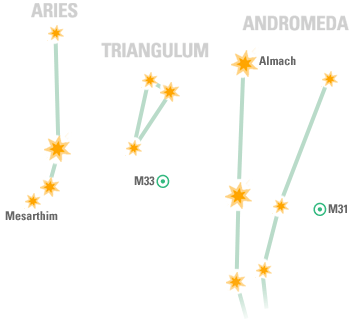
Did you know there was a constellation called 'the triangle'? And that the ancient Hellenes were aware of it, too? Triangulum is a small constellation in the northern sky. It was one of the 48 constellations listed by the second century astronomer Ptolemy, and so named for its three brightest stars, which form a long and narrow triangle. The Ancient Hellenes called Triangulum 'Deltoton' (Δελτωτόν), after the upper-case letter delta (Δ). Hellenic astronomers such as Hipparchos and Ptolemy called it Trigonon (Τρίγωνον).


There is not a lot of mythology connected to this tiny constellation, but the lore that it has is quite important. Hyginus, in his 'Astronomica' explains the options:

"This constellation, which has three angles like the Greek letter Delta, is so named for that reason.
Mercury [Hermes] is thought to have placed it above the head of Aries, so that the dimness of Aries might be marked by its brightness, wherever it should be, and that it should form the first letter in the name of Jove [Zeus] (in Greek, Dis).
Some have said that it pictures the position of Egypt; others, that of Aethiopa and Egypt where the Nile marks their boundaries. Still others think that Sicily is pictured there.
Others, say that three angles were put there because the gods divided the universe into three parts." [II.19]

The latter is the only one that might need some explaining. Zeus, the greatest of the Olympian Gods, and the father of Gods and men, was a son of Kronos and Rhea, a brother of Poseidon, Hades, Hestia, Demeter, Hera. When Zeus and His brothers drew lots for the rule of the world, Poseidon obtained the sea, Hades the lower world, and Zeus the heavens and the upper regions, but the earth belonged to them all. To quote the 'Iliad' by Hómēros:

"Poseidon was very angry and said, "Great heavens! strong as Zeus may be, he has said more than he can do if he has threatened violence against me, who am of like honour with himself. We were three brothers whom Rhea bore to Kronos--Zeus, myself, and Hades who rules the world below. Heaven and earth were divided into three parts, and each of us was to have an equal share. When we cast lots, it fell to me to have my dwelling in the sea for evermore; Hades took the darkness of the realms under the earth, while air and sky and clouds were the portion that fell to Zeus; but earth and great Olympus are the common property of all." [XV.187]

The constellation Triangulum is visible at latitudes between +90° and −60°, and best visible at 21:00 (9 p.m.) during the month of December.

Serpens ("the Serpent", Ὄφις) is a constellation of the northern hemisphere. It is one of the 48 constellations listed by the 2nd century astronomer Ptolemy, and remains one of the 88 modern constellations defined by the International Astronomical Union. It is unique among the modern constellations in being split into two non-contiguous parts, Serpens Caput (Serpent's Head) to the west and Serpens Cauda (Serpent's Tail) to the east. Between these two halves lies the constellation of Ophiuchus, the 'Snake-Holder'.

The constellation Ophiuchus (Ὀφιοῦχος) has has had its stars interpreted in a number of ways throughout the years, and the Hellenic-era interpretations are mostly lost to us. Hyginus is our primary source on this constellation, and he was a Roman man. Many men could be represented with the constellation, but for Serpens, only one really applies: the healer-God Asklēpiós.


Asklēpiós splits Serpens into two distinct halves, as he was known for killing a snake that was resurrected because a different snake had placed a certain herb on it before its temporary death.  Hyginus has the following to say about Serpens and the affairs of this uplifting into the sky in his 'Astronomica':

"Many astronomers have imagined that he is Aesculapius, whom Jupiter, for the sake of Apollo, put among the stars. For when Aesculapius was among men, he so fare excelled the rest in the art of medicine that it wasn’t enough for him to have healed men’s diseases unless he could also bring back the dead to life. He is said most recently, according to Eratosthenes to have restored to life Hippolytus who had been killed by the injustice of his stepmother and the ignorance of his father. Some have said that by his skill Glaucus, son of Minos, lived again. Because of this, as for a sin, Jove struck and burned his house with a thunderbolt, but because of his skill, and since Apollo was his father, put him among the constellations holding a snake.
 
Certain people have said that he holds the snake for the following reason. When he was commanded to restore Glaucus, and was confined in a secret prison, while meditating what he should do, staff in hand, a snake is said to have crept on to his staff. Distracted in mind, Aesculapius killed it, striking it again and again with his staff as it tried to flee. Later, it is said, another snake came there, bringing an herb in its mouth, and placed it on its head. When it had done this, both fled from the place. Where upon Aesculapius, using the same herb, brought Glaucus, too, back to life.
 
And so the snake is put in the guardianship of Aesculapius and among the stars as well. Following his example, his descendants passed the knowledge on to others, so that doctors make use of snakes." [II.14]

Serpens is depicted as either winding around Ophiuchus in the night sky or simply passing through him, although the precise reason for either of these is unknown. In some ancient atlases, the constellations Serpens and Ophiuchus were depicted as two separate constellations, although in most they were shown as a single constellation.

Serpens is visible at latitudes between +80° and −80°, and best visible at 21:00 (9 p.m.) during the month of July.

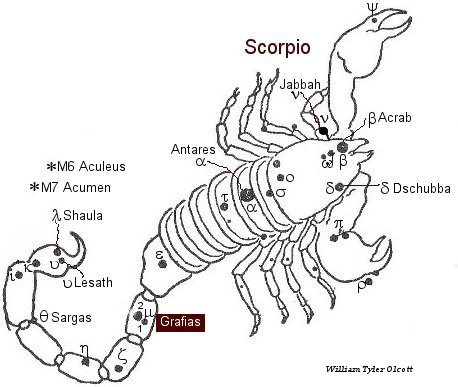
Today I'd like to present you with another constellation as part of my Constellation Series. We have gotten to the constellation Scorpio, the scorpion.


In Hellenic Mythology the myths associated with Scorpio almost invariably also contain a reference to Orion. Orion (Ὠρίων) was a famed hunter who has a lot of mythology to his name. He is the son of Poseidon and has the ability to walk on water. It is said that he once, when drunk, tried to force himself upon Merope, the daughter of Oenopion and was blinded and exiled because of it. Hēlios eventually healed his injury and restored his eyesight. After a failed vengeance attempt, Orion came to Krete and begun  to hunt with Artemis. According to Hyginus' Astromomica, this eventually lead to his downfall:

"Orion since he used to hunt, [...] felt confident that he was most skilled of all in that pursuit, said even to Diana [Artemis] and Latona that he was able to kill anything the produced. Earth [Gaea], angered at this, sent the scorpion which is said to have killed him. Jove [Zeus], however, admiring the courage of both, put the scorpion among the stars, as a lesson to men not to be too self-confident. Diana, then, because of her affection for Orion, asked Jove to show to her request the same favour he had given of his own accord to Earth. And so the constellation was established in such a way that when Scorpion rises, Orion sets." [2.26]

In this scenario, the Scorpion was admitted into the heavens as well, along with his hunting pack and his greatest hunt: the Lepus the hare. In some old descriptions the constellation of Libra is treated as the Scorpion's claws. Libra was known as the Claws of the Scorpion. Hyginus makes the connection between the scorpion and the scales best:

"This sign is divided into two parts on account of the great spread of the claws. One part of it our writers have called the Balance." [II. 26]
 
The constellation Scorpio is visible at latitudes between +40° and −90° and best visible at 21:00 (9 p.m.) during the month of July.

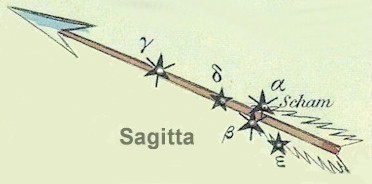
 Today we'll examine a constellation not many people will have heard about. It is called 'Sagitta' and is located beyond the north border of Aquila, the eagle, east of Delphinus, the Dolphin, and north of the constellation of Hercules. The ancient Hellenes called the constellation 'Oistos', and even though it is the third-smallest area of all constellations, it was included among the 48 constellations listed by  Ptolemy. It remains one of the 88 modern constellations defined by the International Astronomical Union. Located to the north of the equator, Sagitta can be seen from every location on Earth except within the Antarctic circle.


Sagitta looks like an arrow, and obviously, it is identified with pretty much every archer in ancient Hellenic mythology. For such a tiny constellation is has a lot written about it, mostly by Hyginus in his 'Astronomica'. Above all, he attributes the flying arrow to Hēraklēs, shot to kill the eagle that ate the liver of Prometheus night after night.

"This arrow, they say, is one of the weapons of Hercules, with which he is said to have killed the eagle which ate the liver of Prometheus. The following reason for the release of Prometheus has been handed down. When Jupiter, moved by the beauty of Thetis, sought her in marriage, he couldn’t win the consent of the timid maiden, but none the less kept planning to bring it about. At that time the Parcae were said to have prophesied what the natural order of events should be. They said that the son of Thetis’ husband, whoever he might be, would be more famous than his father. Prometheus heard this as he kept watch, not from inclination but from necessity, and reported it to Jove. He, fearing that what he had done to his father Saturn in a similar situation, would happened to him, namely, that he would be robbed of his power, gave up by necessity his desire to wed Thetis, and out of gratitude to Prometheus thanked him and freed him from his chains. But he didn’t go so far as to free him from all binding, since he had sworn to that, but for commemoration bade him bind his finger with the two things, namely, with stone and with iron. Following this practice men have rings fashioned of stone and iron, that they may seem to be appeasing Prometheus. Some also have said that he wore a wreath, as if to claim that he as victor had sinned without punishment. And so men began the practice of wearing wreaths at times of great rejoicing and victory. You may observe this in sports and banquets.

But to come back to the beginning of the inquiry and the death of the eagle. Hercules, when sent by Eurystheus for the apples of the Hesperides, out of ignorance of the way came to Prometheus, who was bound on Mount Caucasus, as we have shown above. When victor, he returned to Prometheus to tell him that that dragon we have mentioned was slain, and to thank him for his kindness since he had pointed out the way. Straightway he gave what honour he could to the one that deserved it, for [he killed the eagle?] and since it was slain, men began, when victims were sacrificed, to offer livers on the altars of the gods to satisfy them in place of the liver of Prometheus."

Another explanation Hyginus gives--along with Hesiod, Apollodorus, and Diodorus, amongst others--is that the arrow belongs to Apollon. It was the arrow with which He avenged the death ofHhis son Asklepios, who had been killed by a lightning bolt design by the Kyclopses. Obviously, Apollon could not attack Zeus, so he attacked the Kyklopses instead, and murdered them. To quote Hyginus

"Eratosthenes says about the Arrow, that with this Apollo killed the Cyclopes who forged the thunderbolt by which Aesculapius died. Apollo had buried this arrow in the Hyperborean mountain, but when Jupiter pardoned his son, it was borne by the wind and brought to Apollo along with the grain which at that time was growing. Many point out that for this reason it is among the constellations."

Sagitta is visible at latitudes between +90° and −70°, and best visible at 21:00 (9 p.m.) during the month of August.

 It's been a while since I last tackled a constellation. Sorry about that. I am happy to announce we have reached the 'O''s, which means there are just fourteen left after this one, and thirty-two behind us. There will, however, be a bonus at the end. The constellation Ophiuchus (Ὀφιοῦχος) has has had its stars interpreted in a number of ways throughout the years, and the Hellenic-era interpretations are mostly lost to us. Hyginus is our primary source on this constellation, and he was a Roman man. Lets hope he built upon existing opinion.


Ophiuchus has known many interpretation, but was almost solely called 'Serpent-holder'. In the night's sky, he is located above Scorpio, and holds in his hands a serpent which coils about his body. Hyginus, in his 'Astronomica' gives us five possible men this snake holder could represent: Karnabon, Herakles, Triopas, Phorbas, and Asklēpiós. I will let Hyginus speak for a moment:

"Many have called him Carnabon, king of the Getae, who lived in Thrace. He came into power at the time when it is thought grain was first given to mortals. For when Ceres was distributing her bounties to men, she bade Triptolemus, whose nurse she had been, go around to all the nations and distribute grain, so that they and their descendants might more easily rise above primitive ways of living. He went in a drgon car, and is said to have been the first to use one wheel, so as not to be delayed in his journey. When he came to the king of the Getae, whom we mentioned above, he was at first hospitably received. Later, not as a beneficent and innocent visitor, but as a most cruel foe, he was seized by treachery, and he who was ready to prolong the lives of others, almost lost his own life. For at the order of Carnabon one dragon was killed, so that Tiptolemus might not hope his dragon car could save him when he realized an ambush was being prepared. But Ceres is said to have come there, and restored the stolen chariot to the youth, substituting another dragon, and punishing the king with no slight punishment for his malevolent attempt. For Hegesianax says that Ceres, for men’s remembrance, pictures Carnabon among the stars, holding a dragon in his hands as if to kill it. He lived so painfully that he brought on himself a most welcome death.

Others point out that he is Hercules, killing in Lydia near the river Sagaris a snake which kept destroying many men and stripping the river banks of grain. In return for this deed, Omphale, the queen of that region, sent him back to Argos loaded with gifts, and because of his bravery he was placed by Jove among the constellations.

Some, too, have said that he is Triopas, king of the Thessalians, who, in trying to roof his own house, tore down the temple of Ceres, built by the men of old. When hunger was brought on him by Ceres for this deed, he could never afterward be satisfied by any amount of food. Last of all, toward the end of his life, when a snake was sent to plague him, he suffered many ills, and at last winning death, was put among the stars by the will of Ceres. And so the snake, coiling round him, still seems to inflict deserved and everlasting punishment.

Polyzelus the Rhodian, however, points out that this is Phorbas, who was of great assistance to the Rhodians. The citizens called their island, overrun by a great number of snakes, Ophiussa. In this multitude of beasts was a snake of immense size, which had killed many of them; and when the deserted land began finally to lack men, Phorbas, son of Triopas by Hiscilla, Myrmidon’s daughter, when carried there by a storm, killed all the beasts, as well as that huge snake. Since he was especially favored by Apollo, he was put among the constellations, shown killing the snake for the sake of praise and commemoration. And so the Rhodians, as often as they go with their fleet rather far from their shores, make offerings first for the coming of Phorbas, that such a happening of unexpected valor should befall the citizens as the opportunity for glory which brought Phorbas, unconscious of future praise, to the stars.

Many astronomers have imagined that he is Aesculapius, whom Jupiter [Zeus], for the sake of Apollo, put among the stars. For when Aesculapius was among men, he so fare excelled the rest in the art of medicine that it wasn’t enough for him to have healed men’s diseases unless he could also bring back the dead to life. He is said most recently, according to Eratosthenes to have restored to life Hippolytus who had been killed by the injustice of his stepmother and the ignorance of his father. Some have said that by his skill Glaucus, son of Minos, lived again. Because of this, as for a sin, Jove struck and burned his house with a thunderbolt, but because of his skill, and since Apollo was his father, put him among the constellations holding a snake.
Certain people have said that he holds the snake for the following reason. When he was commanded to restore Glaucus, and was confined in a secret prison, while meditating what he should do, staff in hand, a snake is said to have crept on to his staff. Distracted in mind, Aesculapius killed it, striking it again and again with his staff as it tried to flee. Later, it is said, another snake came there, bringing an herb in its mouth, and placed it on its head. When it had done this, both fled from the place. Where upon Aesculapius, using the same herb, brought Glaucus, too, back to life. And so the snake is put in the guardianship of Aesculapius and among the stars as well. Following his example, his descendants passed the knowledge on to others, so that doctors make use of snakes." [II.14]

The snake that is being wrangled by our mystery man is actually not part of the constellation Ophiuchus: it's a separate one named Serpens, which we will get to a little later on. Linked to Serpens, the constellation Ophiuchus wasn't known under that name in ancient Roman times, but took the title 'Serpentarius', which also means 'Snake-Holder', or 'Snake-Bearer'.

The Sun passes through the constellation between November 30 and December 17, which is why some astrologers consider Ophiuchus to be the thirteenth sign of the zodiac. It is, however, not included in most astrological zodiacs, and the saying confuses sign with constellation. The constellation is visible at latitudes between +80° and −80°, and best visible at 21:00 (9 p.m.) during the month of July.
Welcome to another installment of the Constellation series! This will be short and sweet; quite a feat as the Lyre is actually a complicated constellation.


There are actually a good few interpretations of why the lyre was placed into the sky, but they almost exclusively trace back to Orpheus. Hyginus describes most of the theories in his 'Astronomica'. I'm going to quote the whole thing and then disect it later on:
 
"The Lyre was put among the constellations for the following reason, as Eratosthenes says. Made at first by Mercury [Hermes] from a tortoise shell, it was given to Orpheus, son of Calliope and Oeagrus, who was passionately devoted to music. It is thought that by his skill he could charm even wild beasts to listen. When, grieving for his wife Eurydice, he descended to the Lower World, he praised the children of the gods in his song, all except Father Liber [Dionysos]; him he overlooked and forgot, as Oeneus did Diana [Artemis] in sacrifice. Afterwards, then, when Orpheus was taking delight in song, seated, as many say, on Mt. Olympus, which separates Macedonia from Thrace, or on Pangaeum, as Eratosthenes says, Liber is said to have roused the Bacchanals against him. They slew him and dismembered his body. But others say that this happened because he had looked on the rites of Liber. The Muses gathered the scattered limbs and gave them burial, and as the greatest favour they could confer, they put as a memorial his lyre, pictured with stars, among the constellations. Apollo and Jove consented, for Orpheus had praised Apollo highly, and Jupiter granted this favour to his daughter.
 
Others say that when Mercury first made the lyre on Mount Cyllene in Arcadia, he made it with seven strings to correspond to the number of Atlantides, since Maia, his mother, was of their company. Later, when he had driven away the cattle of Apollo and had been caught in the act, to win pardon more easily, at Apollo’s request he gave him permission to claim the invention of the lyre, and received from him a certain staff as reward. When Mercury, holding it in his hand, was journeying to Arcadia and saw two snakes with bodies intertwined, apparently fighting, he put down the staff between them. They separated then, and so he said that the staff had been appointed to bring peace. Some, in making caducei, put two snakes intertwined on the rod, because this seemed to Mercury a bringer of peace. Following his example, they use the staff in athletic contests and other contests of this kind.

But to return to the subject at hand. Apollo took the lyre, and is said to have taught Orpheus on it, and after he himself had invented the cithara, he gave the lyre to Orpheus."
 
Some also have said that Venus and Proserpina came to Jove for his decision, asking him to which of them he would grant Adonis. Calliope, the judge appointed by Jove, decided that each should posses him half of the year. But Venus, angry because she had not been granted what she thought was her right, stirred the women in Thrace by love, each to seek Orpheus for herself, so that they tore him limb from limb. His head, carried down from the mountain into the sea, was cast by the waves upon the island of Lesbos. It was taken up and buried by the people of Lesbos, and in return for this kindness, they have the reputation of being exceedingly skilled in the art of music. The lyre, as we have said, was put by the Muses among the stars.
 
Some say that because Orpheus first favored love for youths, he seemed to insult women, and for this reason they killed him." [II.7]

According to myth, Orpheus (Ὀρφεύς) was a legendary musician, poet, and prophet, who was literally so good with the lyre, he could charm anyone with his music. He is so good, in fact, that when his wife dies of a snakebite, Orpheus travels to the Underworld, charmes everyone in it, talks to Hades, and brokers a deal: if he trusts Hades to send his wife Euridice after him, up to the surface, he will have her back. Orpheus needs to look straight ahead--never back. He amost makes it to the surface before he does check to see if his wife is there; she is, but has to return to the Underworld now Orpheus broke his end of the deal.

Hyginus describes quite well how the lyre came to be and how it came in Orpheus' possession. The last sentence needs some more explination, though. Hyginus mentions what happens to Orpheus in the first paragraph, but not very clearly.

After his failed attempt to resque his wife, only music brought joy to Orpheus. He rejected the Gods--all but Apollon, whom he saw as the sun. Orpheus became a wanderer, moving about to bring his music to people. One day, he stumbled upon Maenads--female followers of the God Dionysos--who scorned him for not worshipping their God anymore and tore him to shreds. It is said that his head still sung, even after it was torn off.

Orpheus inspired an entire cult movement, and his impact on the ancient Hellenic religion is notable even today. Many of the mystery cult's works--including the Orphic Hymns--remain. I must now return to the plumber, but hope the constellation Lyra can keep you entertained for the time being! 

Before we get started on this one, I need to tell you that the interpretation of 'wolf' is a Roman one; The romans translated Ptolemy's work from Greek to Latin, and translated the constellation named 'Therion' as 'wolf', instead of the more general 'beast' or 'animal'. As such, the constellation did not actually represent a wolf until Roman times, but we are stuck with the Roman names, so I went with 'wolf' for the post's title.

The stars of the constellation Lupus were once considered to be part of the constellation Centaurus, where they represented an animal being impaled on a pole by the centaur, who was holding it toward the constellation Ara, the altar, as though he were about to sacrifice it. The Hellenic astronomer Hipparch separated the constellation from Centaurus and named it Therion in the second century BC.


Because the separation came so late, many references to Lupus are in connection to Centaurus and Ara. Aratos, for example, in his 'Phaenomena':

"The constellation of Centaur [Centaurus] thou wilt find beneath two others. For part in human form lies beneath Scorpio, but the rest, a horse’s trunk and tail, are beneath the Claws. He ever seems to stretch his right hand towards the round Altar, but though his hand is drawn and firmly grasped another sign – the Beast [Fera], for so men of old have named it." [436]

Hyginus, in his 'Astronomica' echoes this, linking Lupus to the constellation Centaurus. In his version, the Centaur holding out a sacrifice is either Kheiron or Pholus; Kheiron because he dropped a poisoned arrow on his foot and perished, and Pholus for his Gods-given powers of divination:

"When Hercules was once visiting Chiron, and while sitting with him was examining his arrows, one of them is said to have fallen on the foot of Chiron, and thus brought about his death. Others say that when the Centaur wondered at his being able to kill such huge creatures as Centauri with such slight arrows, he himself tried to draw the bow, and the arrow, slipping from his hand, fell on his foot. For this reason Jupiter [Zeus], pitying him, put him among the constellations with a victim which he seems to hold above the altar for sacrifice. Others have said that he is Pholus the Centaurus, who was more skilled in augury that the rest. Consequently, by the will of Jove [Zeus], he was represented coming to the altar with a victim." [II.38]
 
The constellation Lupus is a minor constellation, and in ancient writings, you won't be able to connect it to the wolf at all, especially because wolves--if they ever ended up being sacrificed on an altar at all--would most likely only be sacrificed in cult worship. It was not a regular sacrificial animal, but may have been a part of the worship of Gods with the 'Lykaion' epithet--like Zeus and Apollon.

The constellation is visible at latitudes between +35° and −90°, and best visible at 21:00 (9 p.m.) during the month of June.

Today I am doing another constellation post, and this time it is about a bit of an oddity: a constellation that the ancient Hellenes saw only as a part of another constellation. Often the names we use for the constellations are Roman, but the ancient Hellenes at least identified the constellation in the same way. Not so with Libra: to the ancient Romans, Libra represented scales, to the ancient Hellenes, the claws of the constellation Scorpio. As such, it was known by two names: Zyygos (the Scales) or Khêlai (the Claws).


The constellation Scorpio--which we will get to at a later date--was placed into the sky because of mythology that connexts him to Orion, the great hunter. In ancient times, the constellation Libra was almost solely identified with the scorpion, but eventually, another connection came to pass--to the constellation Virgo. The above image represents both connections. Hyginus, in his Astronomica, makes the connection between the scorpion and the scales best:

"This sign is divided into two parts on account of the great spread of the claws. One part of it our writers have called the Balance." [II. 26]

Hyginus (64 BC – AD 17), however, was a Latin author. Earlier work--for example by 3rd century BC poet Aratos, reveals nothing about scales. In his Phaenomena, he discusses the placement of Libra repeatedly:

"Toward the Crown leans the Serpent’s jaw, but beneath his coiling form seek thou for the mighty Claws [Libra]; they are scant of light and nowise briljant. [...] There too are the most swift courses of the Ram [Aries], who, pursued through the longest circuit, runs not a whit slower than the Bear Cynosura – himself weak and starless as on a moonlit night, but yet by the belt of Andromeda thou canst trace him out. For a little below her is he set. Midway he treads the mighty heavens, where wheel the tips of the Scorpion’s Claws and the Belt of Orion. [...] The constellation of Centaur [Centaurus] thou wilt find beneath two others. For part in human form lies beneath Scorpio, but the rest, a horse’s trunk and tail, are beneath the Claws. [...] In it [the equater] are the Belt of the well-starred Orion and the coil of the gleaming Hydra: in it, too, the dim-lit Crater and the Crow and the scanty-starred Claws and the knees of Ophiuchus are borne. [...] In it is the Crag; after the Crab the Lion and beneath him the Maiden; after the Maiden the Claws and the Scorpion himself and the Archer and Aegoceros, and after Aegoceros Hydrochoüs. [...] Nor can the rising Claws [Libra], though faintly shining, pass unremarked, when at a bound the mighty sign of Boötes rises, jeweled with Arcturus. Aloft is risen all of Argo, but the Hydra, shed as she is afar over the heavens, will lack her tail. The Claws bring only the right leg as far as the thigh of that Phantom that is ever On his Knees, ever crouching by the Lyre – that Phantom, unknown among the figures of the heavens, whom we often see both rise and set on the selfsame night. Of him only the leg is visible at the rising of both the Claws: he himself head-downward on the other side awaits the rising Scorpion and the Drawer of the Bow. For they bring him: Scorpion brings his waist and all aforesaid; the Bow his left hand and head. Even so in three portions is he all brought up piecemeal above the horizon. Half the Crown and the tip of the Centaur’s tail are upraised with the rising Claws." [88, 225, 436, 511, 544, 607]

About the connection to the constellation Virgo, many later writers have something to say, although very few of those words are in the public domain. Two Goddesses were identified with the scales by (mostly) the Romans: Astraia (Αστραια), daughter of Zeus and Themis, and Tykhe (Τυχη), daughter of Zeus. There is no Hellenic source to tie either of them to the constellation.

Manilius, a Roman poet, astrologer, and author from the 1st century AD, in his 'Astronomica' spoke of the influence of Libra for those born under it, writing:

"Balancing night with the length of day, the Scales will bestow the employment of weights and measures and a son to emulate the talents of Palamedes, who first assigned numbers, and to these numbers names, fixed magnitudes and individual symbols. He will be acquainted with the tables of law, abstruse legal points, and words denoted by compendious signs; he will know what is permissible and the penalties incurred by doing what is forbidden; in his own house he is a people's magistrate holding lifelong office… Indeed, whatever stands in dispute and needs a ruling the pointer of the balance will determine." [Loeb p.239]

Libra, especially for the Hellenes, was a minor constellation--part of another constellation, and barely connected to mythology. In modern times, however, the failt constellation has gained its share of fame. The constellation Libra is visible at latitudes between +65° and −90°, and best visible at 21:00 (9 p.m.) during the month of June.

 Lepus is a constellation lying just south of the celestial equator, immediately south of the constellation Orion. Its name is Latin for hare. While Hellenic mythology is not chuck full of hares, Lepus was indeed one of the 48 constellations listed by the 2nd century astronomer Ptolemy, and it remains one of the 88 modern constellations recognized today.


The only ancient writer I have found who mentioned the constellation Lepus by name and myth is Hyginus, but to make up for it, he gives us a lot of material to work with. Lets break his words down, shall we? From the Astronomica:

"Some say that it was put there by Mercury [Hermes], and that it had been given the faculty, beyond other kinds of quadrupeds, of being pregnant with new offspring when giving birth to others." [II.33]

Well, there is not much to say against that, now is there? I looked it up, and it seems that hares have about three times three+ young every year, and European hares are, indeed, capable of carrying two litters.

"The hare is said to be fleeing the dog of the hunter Orion, for when, as was proper, they represented Orion as a hunter, they wanted to indicate what he was hunting, and so they put the fleeing hare at his feet. [...] Those who disagree with this reason say that so noble and great a hunter as Orion (we spoke about him in the discussion of Scorpio) shouldn’t be represented hunting hares. Callimachus, too, is blamed, because, when he was singing the praises of Diana [Artemis], he said she delighted in the flesh of hares and hunted them. So they have represented Orion fighting the Bull." [II.33]

Orion (Ὠρίων) was a famed hunter who has a lot of mythology to his name. He is also included in a lot of existing mythology. The constellation Canis Major might represent his entire pack or one of them, who are/is eternally pursuing Lepus the Hare or helping Orion fight Taurus the Bull. In the prime of his life, Orion joined with the Goddess Artemis and Her mother Leto, for an epic hunt in which Orion threatened to kill every beast on Earth. Gaea revolted and sent a giant scorpion to kill Orion. Orion, although very powerful, was overcome by the creature, but Artemis and Leto requested to Zeus he'd be immortalized in the night's sky. The Scorpion was admitted into the heavens as well, along with his hunting pack... and the hare.
Kallimachos' wonderful hymn to Artemis does, indeed, include the hare:

"Artemis we hymn – no light thing is it for singers to forget her – whose study is the bow and the shooting of hares and the spacious dance and sport upon the mountains." [1]

Hyginus has one more story to share, which comes not from the realm of mythology, but the realm of folklore.

"The following story of the hare has been recorded. There were no hares on the island of Leros, and a certain young man of the state, led by a liking for the breed, brought in from another country a pregnant female, and watched over her very carefully as she bore her young. When she had borne them, many of the citizens developed an interest, and by acquiring some for money, some as gifts, they all began to raise hares. In no long time such a multitude of hares was produced that the whole island was swarming with them. When men gave them nothing to eat, they made inroads on the grain fields and devoured everything. The inhabitants, faced with disaster because of this, since they were reduced to hunger, by co-operation of the whole state were said at length to have driven them from the island, through with difficulty. So afterwards they put the image of a hare in the stars, that men should remember that there was nothing so desirable in life but that later they might experience more grief than pleasure from it." [II.33]

The constellation Lepus is visible at latitudes between +63° and −90°, and best visible at 21:00 (9 p.m.) during the month of January.

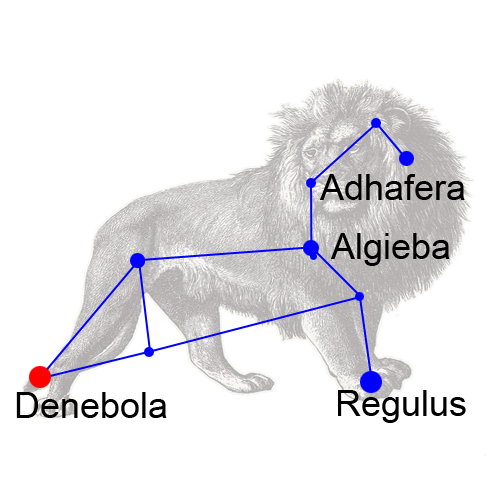
It's been a while since the last constellation! The constellation Leo is one of the most recognizable in the sky, and is obviously one of the constellations tied to the zodiac. Not surprisingly, it is therefor also tied to Hēraklēs.

The lion was considered the King of Beasts by the ancient Hellenic writers. For this reason, Hyginus--our primary source of ancient information on constellations--describes the constellation almost entirely as such, mentioning Hēraklēs in passing only:

"He is said to have been put among the stars because he is considered the king of beasts. Some writers add that Hercules’ first Labor was with him and that he killed him, unarmed. Pisandrus and many others have written about this. " [II.24]

The firs labour of Hēraklēs is, of course, to slay the Nemean lion. You can read about the start of Hēraklēs' life here, but for this constellation, all you need to know is that he was stricken mad by Hera, and killed his wife and children while he was out. As a result, he went on a long journey to cleanse himself of the miasma caused by these killings. First, he visited the oracle at Delphi, who, unbeknownst to him, was whispered to by Hera. The Oracle told Hēraklēs to serve the king of Tiryns, Eurystheus, for ten years and do everything Eurystheus told him to do. Eurystheus gladly provided Hēraklēs with these labors--ten of them, one for each year--and eventually ended up adding two more, resulting in the Twelve Labors of Hēraklēs.

The first of the twelve labours was to slay the Nemean lion. As the lion was terrorizing the area surrounding the mountain, Eurystheus must have seen in the lion a worthy opponent of Hēraklēs, whose tales of bravery and brute strength has proceeded him. He ordered the hero to return with its skin. And so, Hēraklēs went to the cave of the lion after picking up a bow and quiver of arrows, because he was unaware he would not be able to harm the creature with mortal weapons. After a long fight, Hēraklēs eventually chokes the lion, and hails victorious.

The Latin writer Seneca had a beautiful description of the constellation Leo, in the words of our great hero:

"See where the lion, my first toil, glows in no small part of heaven, is all hot with rage, and makes ready his fangs. Forthwith he will seize some star; threatening he stands with gaping jaws, and breathes forth fires, and shakes the mane upon his flaming neck; whatever stars sickly autumn and cold winter with its frozen tracts bring back, with one bound will he o’erleap, and attack and crush the neck of the vernal Bull." [II.942]

I want to add one more thing to he description of this constellation: Hyginus tells another tale about the constellation Leo: the story of Berenikē (Βερενίκη). The name translates to 'bearer of victory', and this version of the story refers to Berenikē II, who lived from about 267 - 221 BC. She was the daughter of Magas of Cyrene and Queen Apama II, and the wife of Ptolemy III, the third ruler of the Ptolemaic dynasty of Egypt. Prior to her marriage to Ptolemy III, she was married to Demetrius the Fair, a Macedonian prince, whom she had killed after he chose to become the lover of her mother Apama. Berenikē was quite the woman, and participated in the Nemean Games even the ancient Olympics. Her own son, Ptolemy IV eventually had her killed, but she was deified and to be honored from that moment on. The following story concerns her, her husband Ptolemy III, and Aphrodite.

"Above his likeness in the sky nearest the Virgin are seven other stars near his tail, arranged in a triangle, which Conon, the mathematician, and Callimachus call the Lock of Berenice. When Ptolemy had married his sister Berenice, daughter of Ptolemy and Arsinoe, and after a few days had set out to attack Asia, Berenice vowed that if Ptolemy returned as victor she would clip off her hair. She placed the lock, consecrated by this vow, in the temple of Venus Arsinoe Zephyritis, but on the following day it couldn’t be seen there. When the king was distressed by this, Conon the mathematician, whom we mentioned above, desiring to win the favor of the king, said that he had seen the lock among the constellations, and pointed out seven stars without definite configuration which he imagined were the lock.

Some authors along with Callimachus have said that this Berenice raised horses, and used to send them to Olympia. Others add that once Ptolemy, Berenice’s father, in panic at the number of the enemy, had sought safety in flight, but his daughter, an accomplished horse woman, leaped on a horse, organized the remaining troops, killed many of the enemy, and put the rest to flight. For this even Callimachus calls her high-souled. Eratosthenes says that she ordered returned to the girls of Lesbos the dowry left to them by their parents, which on one had released, and she established among them right to bring action of recovery."

The constellation Leo is visible at latitudes between +90° and −65°, and best visible at 21:00 (9 p.m.) during the month of April.

It's time for part three of the series-within-a-series featuring the myth of Apollon and the raven. The previous parts were the constellation Corvus: the Raven, and the Constellation Crater: the Cup. This third installment is about the longest constellation we still recognize as a constellation today: Hydra, or the sea-serpent.


To recap the story of Apollon and the raven: the raven (or crow) was in service to Apollon, and was sent out on an errant for the Theos. He was asked to bring water to Him, but instead, he paused in his quest. Most commonly it is assumed is that he stopped for a meal of figs. When the raven returned without water, Apollon questioned him. Instead of giving a straight answer, the raven lied, and said he had been kept from the water by a snake. In some accounts, he actually had a snake in his talons as he said this. Apollon, however, saw that the raven was lying, and flung the raven, the krater with which the raven was supposed to collect water, as well as the snake into the sky, where they remain to this day.

Roman author Gaius Julius Hyginus (64 BC - 17 AD) talks about the serpent's continued function in his Astronomica:

"This is the sign on which the Crow sits and over which the Bowl is placed. [...] As long as the figs are ripening, the crow cannot drink, because on those days he has a sore throat. So when the god wished to illustrate the thirst of the crow, he put the bowl among the constellations, and placed the water-snake underneath to delay the thirsty crow. For the crow seems to peck at the end of its tail to be allowed to go over to the bowl." [2.40]


Another hydra the constellation is associated with is the Hydra vanquished by Hēraklēs as his second labour. After his victory over the Nemean lion, Hēraklēs is send off to handle another sticky problem: the Lernaean Hydra, who was raised from the earth by Hera just to end the life of Hēraklēs. The Lernaean Hydra (Λερναία Ὕδρα) was the offspring of Typhon, and layered in the swampy lake of Lerna. He realized he would need help for this labour, and asked it of his nephew Iolaus (Ἰόλαος). Together they devised a plan: Hēraklēs would cut off the heads, and Iolaus would sear the stumps shut, in this way, the heads could not regenerate. When Hēraklēs returns to Eurystheus after completing the labour, the king decrees that, because Hēraklēs could not have completed the labour without the help of Iolaus, the labour will not count against his total, and he will have to do an extra one to fulfill his debt.

On the hydra, Pausanias writes in his 'History of Greece'. He speaks of the birth place of the hydra, and of his alleged number of heads:

"At the source of the Amymone grows a plane tree, beneath which, they say, the hydra (water-snake) grew. I am ready to believe that this beast was superior in size to other water-snakes, and that its poison had something in it so deadly that Heracles treated the points of his arrows with its gall. It had, however, in my opinion, one head, and not several. It was Peisander76 of Camirus who, in order that the beast might appear more frightful and his poetry might be more remarkable, represented the hydra with its many heads." [2.37.4]


Constellations are often associated with the constellations they are surrounded with, and with no constellation this is clearer than with Hydra. Aratos, a Hellenic poet who flourished in Macedonia in the early third century BC, speaks best of Hydra in regards to his surrounding constellations in his 'Phaenomena':

"Another constellation trails beyond, which men call the Hydra. Like a living creature it winds afar its coiling form. Its head comes beneath the middle of the Crab, its coil beneath the body of the Lion, and its tail hangs above the Centaur himself. Midway on its coiling form is set the Crater, and at the tip the figure of a Raven that seems to peck at the coil." [443]


The constellation Hydra is visible at latitudes between +54° and −83°, and best visible at 21:00 (9 p.m.) during the month of April.

 I have already written quite a lot about the Hellenic hero Hēraklēs, whose name was later Romanized as 'Hercules'. In fact, I am writing a continuing series about his labours. That said, this post will not be just about him, because there were others associated with the myth, despite the name.


The name of the constellation in ancient Hellas was Ἐγγόνασιν, The Kneeler, or On His Knees. That said, the ancient Hllenes already associated the myth with the hero Hēraklēs. Hyginus, for example, in his 'Atronomica' describes:

"Eratosthenes says he is Hercules, placed above the dragon we have already mentioned, and prepared to fight, with his left hand holding his lion skin, and his right the club. He is trying to kill the dragon of the Hesperides, which, it is thought, never was overcome by sleep or closed its eyes, thus offering more proof it was placed there as a guard. Panyassis in the Heraclea says of the sign that Jupiter, in admiration of their struggle, placed it among the stars; for the dragon has its head erect, and Hercules, resting on his right knee, tires to crush the right side of its head with his left foot. His right hand is up and striking, his left extended with the lion skin, and he appears to be fighting with all his strength.

Aeschylus, in the play entitled Prometheus lyomenos, says that he is Hercules, fighting not with the dragon, but with the Ligurians. For he says that at the time Hercules was driving away the cattle of Geryon, he journeyed through the territory of the Ligurians. They joined forces in trying to take the herd from him, and pierced many of the beasts with arrows. But after Hercules’ weapons failed, worn out by the number of the barbarians and lack of arms, he fell to his knees, already suffering from many wounds. Jove, however, out of pity for his son, provided that there should be a great supply of stones around him. With these Hercules defended himself and put the enemy to flight. And so Jove [Zeus] put [t]he image of his fighting form among the constellations." [II.6]

Yet, Hyginus also mentions other possibilities and other noteworthy people who have an opinion on the matter; Araethus, for example, who calls this figure Ceteus, son of Lycaon, and father of Megisto:

"He seems to be lamenting the change of his daughter to bear form, kneeling on one knee, and holding up outstretched hands to heaven, asking for the gods to restore her to him." [II.2]

For those who these names are unfamiliar, Megisto is in some writers another form for Kallistô, the mother of Arcas, who is also called Themisto. I have discussed the happenings with this family before, for the constellation Boötes, but will recap for the unity of this post. Arcas (Ἀρκάς), son of Zeus and Kallistô (Καλλιστω). After Arcas was born, Hera caught wind of the affair and turned Kallistô into a bear. Alternatively, Kallistô was a priestess of Artemis, and Artemis punished her for losing her virginity by turning her into a bear. Because of the metamorphosis, the boy was raised by his maternal grandfather Lycaon, who would later kill and serve up his grandson to the Theoi as dinner, for which he was turned into a (were)wolf. When Arcas grew up, he went out to hunt and found a beautiful bear. He chased her through the woods. The bear--his transformed mother Kallistô--ran towards him as soon as she recognized her son. Arcas was terrified and raised his bow to shoot her. Zeus intervened swiftly and placed Kallistô and her son in the sky. Kallistô became Ursa Major and Arcas either Ursa Minor or Boötes.

Hyginus goes on to quote Hegesianax, who says that:

"...he is Theseus, who seems to be lifting the stone at Troezene. Aegeus is thought to have put [corrupt] and a sword under it, and warned Aethra, the mother, not to send him to Athens until he could lift the stone by his own strength and bring the sword to his father. And so he seems to try to lift the stone as high as he can. In this connection, too, some have said that the Lyre, placed nearest this sign, is the lyre of Theseus, for he was skillful in all the arts and seems to have learned the lyre as well. This, too, Anacreon says: Near Theseus, son of Aegeus, is the Lyre." [II.6]

Theseus was fathered by Aegeus and Poseidon, whom had both slept with his mother Aethra, and was thus destined to become a hero. In order to claim his rightful place as ruler over Athens, he had to uncover his father's sandals and sword from under a stone in his mother's birth land where Theseus grew up, and bring it to his mortal father. Theseus lifting the stone at Troezene would have been his first heroic act, and thus worthy of immortalization in the stars.

Hyginus offers a few more options:

"Others call him Thamyris, blinded by the Muses, kneeling as a suppliant; others, Orpheus, killed by the Thacian women because he looked on the rites of Father Liber. Again, some have said that he is Ixion with his arms bound, because he tried to attack Juno. Others say he is Prometheus, bound on Mt. Caucasus." [II.6]
 
I have written about the affairs with Ixion and Prometheus, so for reference, please visit those posts. I have also written about Orpheus, but with a different constellation: Cygnus: the swan. In it I describe how Orpheus wanders the world after loosing his wife for good, and stumbles upon revelers who rip him apart. His lyre is placed into the sky and Plato describes that Orpheus is turned into the constellation Cygnus because he does not want to be reincarnated as a woman, a risk he would run if he stayed in human form. It seems others thought he was put into the sky as a man regardless, and near his lyre at that.

Thamyris  (Θάμυρις) is new to this blog. He was the son of Philammon and the nymph Argiope, and a Thracian singer who was so proud of his skill that he boasted he could outsing the Muses. He competed against them and lost. As punishment for his presumption they blinded him, and took away his ability to make poetry and to play the lyre. Hómēros outlines the tale in the Iliad:

"From Pylos, and lovely Arene; from the ford of the Alpheius at Thryum, from well-built Aepy, from Cyparisseis, and Amphigeneia, Pteleos, Helos, and Dorium, where Thamyris the Thracian met the Muses, as he came from Eurytus’ house in Oechalia, and they put an end to all his singing: he who had boasted he would win his contest with those aegis-bearing daughters of Zeus, they blinding him in anger, robbing him of his sweet gift of song, so he forgot the cunning of his harp; in their fleet of ninety hollow ships the warriors came, led by Nestor the Gerenian charioteer." [II: 581-644]

It seems there is great variety in the interpretation of the person the constellation depicts, but whomever it is, they are visible at latitudes between +90° and −50°, and best visible at 21:00 (9 p.m.) during the month of July.

It's time for a new constellation, and this one is entirely dedicated to two brothers. While there are many twins in Hellenic mythology--Artemis/Apollon, Iphikles/Hēraklēs, Amphion/Zethos, etc., this constellation is almost solely connected to one set of them: Kastor and Polideukes. In fact, the main stars of the constellation are named after them.


Hyginus briefly describes the constellation in his Astronomica, and focusses almost solely on the Dioscuri:

"These stars many astronomers have called Castor and Pollux. They say that of all brothers they were the most affectionate, not striving in rivalry for the leadership, nor acting without previous consultation. As a reward for their services of friendship, Jupiter [Zeus] is thought to have put them in the sky as well-known stars. Neptune [Poseidon], with like intention, has rewarded them for he gave them horses to ride, and power to aid shipwrecked men.
 
Those who speak of Castor and Pollux add this information, that Castor was slain in the town of Aphidnae, at the time when the Lacedaemonians were fighting the Athenians. Others say that when Lynceus and Idas were attacking Sparta, he perished there. Homer states that Pollux granted to his brother one half of his life, so that they shine on alternate days." [2.22]


The twins were born from Leda, Zeus, and mortal king Tyndareus. One of the twins was mortal, the other immortal, and both hatch from an egg. Accounts vary about who was the mortal one, and who was the immortal one; in some accounts they were even both mortal or immortal. During their lifetimes, the Dioscuri became great heroes, joining Iásōn in securing the Golden Fleece, and they both fought the Calydonian Boar.

I will discuss their mythology better another time, but for now, let me suffice in saying that eventually, they aspired to marry Phoebe and Hilaeira, who were already betrothed to cousins of the Dioscuri, a second set of twin brothers named Lynceus and Idas of Thebes, sons of Tyndareus's brother Aphareus. This sparked a feud between the cousins that left Polideukes the only one standing. He was given the choice by Zeus of spending all his time on Mount Olympus or giving half his immortality to his mortal brother. He opted for the latter, and thus the two divided their time between Olympos and the Underworld.

The Dioscuri were regarded as helpers of mankind and held to be patrons of travelers and sailors. Because they excelled in horseback riding and boxing, they were regarded as the patrons of athletes and athletic contests, and in all capacities, they had shrines throughout Hellas, and were worshipped well into the Roman era. As the twins lived on after death, they became emblems of the Eleusinian Mysteries, and were said to have been initiated into it during their lifetimes.

Hyginus also mentions a few other duos connected to the constellation:

"Others have called them Hercules and Apollo; some, even Triptolemus, whom we mentioned before, and Iasion, beloved of Ceres [Demeter] - both carried to the stars." [2.22]


Hēraklēs and Apollon earned this honor because, when Apollon commanded that Hēraklēs be sold into slavery to atone for the murder of his family, Hēraklēs became enraged and wrestled the Theos for the Delphic tripod. Their match was memorialized amongst the stars as the constellation Gemini.

Triptolemos and Iasion are the last candidates. The two were favorites of the Goddess Demeter. Triptolemos was a hero who first instructed mankind in the art of agriculture, while Iasion was said to be Her lover on the island of Samothrace. Demeter must have immortalized them out of love.

Gemini is visible at latitudes between +90° and −60°, and best visible at 21:00 (9 p.m.) during the month of February.

It's time for another constellation, and we are moving on to one of the larger ones: the sixth largest of Ptolemy's constellations, in fact. This one represents something that definitely exists: the Po river in northern Italy, or the Istros of Hungry, which was located in the mythical northern land of Hyperborea. The ancient Hellenes called the river 'Eridanos', and that's the name of the constellation as well.


Eridanos (Ηριδανος) is a river God, and one mostly identified with the story of Hēlios and His son Phaëton, which I will come to in a bit. This association comes from a possible translation of the name: 'early burnt'. Phaëton's myth, in fact, is the only myth this river s identified with, but not even in a big way. Lets look at the myth first:


The most famous piece of mythology concerning Hēlios regards His son Phaëthon (Φαέθων), by Klymene (Κλυμένη). The story is told to us by Ovid, a roman poet. In it, Klymene boasts to Phaëthon that his father is the sun God Himself, and so, Phaëthon goes up to Olympus to confirm. To prove His paternity, Hēlios swears of the river Styx to give Phaëthon anything he desires. Phaëthon grabs this opportunity to demand of his father to let him drive his golden chariot the next time the sun rises.

Hēlios tries to talk His son out of it, claiming that not even Zeus would attempt to drive the chariot, as it is hot with fire and the horses wild and fire breathing. Phaëthon will hear none of it, and so Hēlios must let him get on. He rubs his son's body with magical oil that will protect him from the heat and as Eos and Apollon leave the gates, so does Phaëthon.

The four horses of the chariot--Pyrois, Aeos, Aethon, and Phlegon--sensed Phaëthon's weaker hand and became virtually unsteerable. First, Phaëthon drove them too high, and the Earth below cooled and the people suffered. Then, he flew too low and entire cities burned, lakes and rivers dried up, and even the seas were affected. Mighty Poseidon tried to stop Phaëthon, but had to flee from the heat. It was Zeus who threw His lightning bolt and killed Phaëthon. In some versions of the myth, Phaëthon's burning body landed in the Eridanos river. The following example is from Philostratus the Elder's 'Imagines', a Greek writer who lived in the third century AD:

"Now the youth is thrown from the chariot and is falling headlong – for his hair is on fire and his breast smouldering with the heat; his fall will end in the river Eridanus and will furnish this stream with a mythical tale." [1.11]

Hygenius identifies Eridanos with another river: the Nile. From his 'Astonomica':

"Some call this the Nile, though many call it Ocean. Those who advocate the Nile point out that it is correctly so called on account of the great length and usefulness of that River, and especially because below the sign is a certain star, shining more brightly than the rest, called Canopus. Canopus is an island washed by the river Nile." [II.32]

Eridanos is visible at latitudes between +32° and −90°, and best visible at 21:00 (9 p.m.) during the month of December.

It's time for a new constellation post! This one is going to be all about horses, so if you're a horse lover, rejoice. If not, well, then there is at least some interesting mythology here.

 
Equuleus, or 'little horse' is the second smallest of all of Ptolemy's constellations. It is depicted by solely a horse's head, and seems almost hidden away behind the much larger horse constellation Pegasus. There is a mythological reason for this hiding behavior: Equuleus is said to represent Hippe (Ἵππη), or Melanippe (Εὐίππη), daughter of the kéntauros Kheiron. She became pregnant and could not let her father know. As such, she begged the Gods to be transformed into a mare. From Hyginus's Astronomica:
 
"Euripides in his Melanippe, says that Melanippe, daughter of Chiron the Centaur, was once called Thetis. Brought up on Mount Helicon, a girl especially fond of hunting, she was wooed by Aeolus, son of Hellen, and grandson of Jove, and conceived a child be him. When her time drew near, she fled into the forest, so that her father, who supposed her a virgin, might not see that she had given birth to a grandchild. And so when her father was looking for her, she is said to have begged the power of the gods not to let her father see her in childbirth. After the child was born, by the will of the gods she was changed into a mare which was placed among the stars."
 
He also gives another reason for her change:
"Some say that she was a prophetess, and because she used to reveal the plans of the gods to men, she was changed into a mare. Callimachus says that because she ceased hunting and worshipping Diana [Artemis], Diana changed her into the shape we have mentioned. For the reason above, too, she is said to be out of sight of the Centaur, who some say is Chiron, and to show only half her body, since she didn’t want her sex to be known."
 
The constellation is also known as Eguus Primus, the 'first horse' because it rises just before Pegasus. Because it rises first, it is sometimes identified as the offspring of Pegasus, Celeris, whom he had with his wife, Euippe (or Ocyrrhoe). The second child out of that marriage was Melanippe, a common female name when associated with horses, as it means 'mare'.
 
The third and last horse that this constellation is connected to it the horse that was born the moment Poseidon's trident struck the ground in the battle for patronage of the city of Athens:
 
"The common tradition about Poseidon creating the horse is as follows : -- when Poseidon and Athena disputed as to which of them should give the name to the capital of Attica, the gods decided, that it should receive its name from him who should bestow upon man the most useful gift. Poseidon their created the horse, and Athena called forth the olive tree, for which the honour was conferred upon her. [Serv. ad Virg. Georg. 1.12.]
 
The constellation Equuleus is visible at latitudes between +90° and −80°, and best visible at 21:00 (9 p.m.) during the month of September.

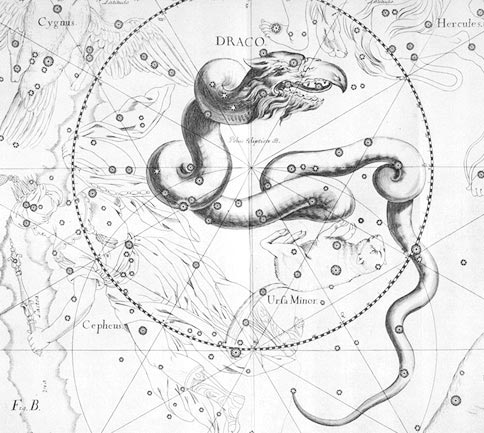
The constellation Draco (from the Greek Drakon, meaning dragon) is identified--funnily enough--with some dragons in Hellenic myth but not others. There are quite a few creatures, after all, who would qualify as a dragon in Hellenic myth. For a dragon or hydra not connected to the constellation, think of the one Kadmos vanquished, for example, or the one Apollon vanquished at Delphi, or even the dragon who guarded the Golden Fleece and was slain by Iásōn. In truth, only two dragons were associated with the myth in ancient times, most notably by Hyginus in his Astronomica: Drakon Hesperios, the Hesperian Dragon, and Drakon Gigantomakhios, the Gigantomachian Dragon.


The first of the myths associated with the constellation is the legend of the Drakon Hesperios (Δρακων Ἑσπεριος), who was slain by Hēraklēs during one of his Labours. I will tell the whole myth of the labour soon enough, but I will share what Hyginus wrote about this labour, and Hēraklēs' encounter with Ladôn (Λαδων), as the dragon was often called.

"This huge serpent is pointed out as lying between the two Bears. He is said to have guarded the golden apples of the Hesperides, and after Hercules killed him, to have been put by Juno [Hera] among the stars, because at her instigation Hercules set out for him. He is considered the usual watchman of the Gardens of Juno. Pherecydes says that when Jupiter [Zeus] wed Juno, Terra [Gaea] came, bearing branches with golden applies, and Juno, in admiration, asked Terra to plant them in her gardens near distant Mount Atlas. When Atlas’ daughters kept picking the apples from the trees, Juno is said to have placed this guardian there. Proof of this will be the form of Hercules above the dragon, as Eratosthenes shows, so that anyone may know that for this reason in particular it is called the dragon." [II.3]

The sole other dragon this myth is linked to is Drakon Gigantomakhios (Δρακων Γιγαντομαχιος), who rose up during the Gigantomachy. When the Olympians rose to power, they first fought the Titans during the Titanomachy. Vanquishing them, the Theoi thought They had won. Yet, there was one who sought revenge for the defeat of his father: Typhôeus, the most-feared son of Tartaros and Gaea. Some versions of the myth say that Typhôeus was actually the Drakon Gigantomakhios, or one of his offspring. Hyginus shares what happened to the dragon:

"Some also say this dragon was thrown at Minerva [Athena] by the Giants, when she fought them. Minerva, however, snatched its twisted form and threw it to the stars, and fixed it at the very pole of heaven. And so to this day it appears with twisted body, as if recently transported to the stars."

The constellation Draco is visible at latitudes between +90° and −15°, and best visible at 21:00 (9 p.m.) during the month of July. Tomorrow, we will talk a little more about the types of dragons in Hellenic myth, because I suddenly realized the association with medieval dragons is very easily made when reading 'dragon', but I assure you, the ancient Hellenes were unaccustomed to giant, fire breathing, lizards.

It's time for another constellation in the series. I am happy to announce we have reached the 'D's! This post makes number twenty-three in the series, with twenty-six more to go. Nearly half way there. Today's constellation is connected to several myths I have spoken about before, but also to a new account, one that is said to be an actual event that took place in ancient Hellas.


The first dolphin myth Delphinus is linked to is to Poseidon's courtship of Amphitrite, Queen of the sea., and mother to all dolphins. I have written about her before, and the myth goes as follows:

"Poseidon saw Her [Amphitrite] dancing with Her Nereids at Naxos (Νάξος), one of the larger islands of Greece. He fell for Her instantly and tried to take Her. She rebuffed His advances and fled to Atlas, the farthest end of the sea. Poseidon, sick with love, sent His dolphin after Her to persuade Her to talk to Him, at least. He eventually found Her and spoke on behalf of His master. His words were so sweet and rang so true, that Amphitrite decided to give Poseidon a chance. It was because of the dolphin, Poseidon eventually got to marry Amphitrite, and He was so grateful, He placed the dolphin in the sky as the constellation Delphinus."

The second dolphin the constellation is connected to is Apollon Delphinios. I have written about this myth before as well, when I discussed the Delphinia festival. In the Homeric Hymn to Apollon, Apollon shows the Kretan colonists the way to Delphi, while riding on a dolphin or metamorphosing Himself into a dolphin.

"I am the son of Zeus; Apollo is my name: but you I brought here over the wide gulf of the sea, meaning you no hurt; nay, here you shall keep my rich temple that is greatly honoured among men, and you shall know the plans of the deathless gods, and by their will you shall be honoured continually for all time. [...] Take out your goods and the gear of the straight ship, and make an altar upon the beach of the sea: light fire upon it and make an offering of white meal. Next, stand side by side around the altar and pray: and in as much as at the first on the hazy sea I sprang upon the swift ship in the form of a dolphin, pray to me as Apollo Delphinius; also the altar itself shall be called Delphinius and overlooking for ever." (474)

In the other myth, it was again Apollon who placed the dolphin among the constellations, this time for saving the life of Arion of Methymna, a poet and musician born on the island of Lesbos, whose skill with the lyre made him famous in the 7th century BC. He was also the first to invent the dithyrambic measure, to give it its name, and to recite in it at Corinth. During the journey home from a tour, there was a mutiny. Arion was allowed to sing one last song, and drew dolphins to the ship. One of them took Arion home. Herodotos described the story:

"He had lived for many years at the court of Periander, when a longing came upon him to sail across to Italy and Sicily. Having made rich profits in those parts, he wanted to recross the seas to Corinth. He therefore hired a vessel, the crew of which were Corinthians, thinking that there was no people in whom he could more safely confide; and, going on board, he set sail from Tarentum. The sailors, however, when they reached the open sea, formed a plot to throw him overboard and seize upon his riches. Discovering their design, he fell on his knees, beseeching them to spare his life, and making them welcome to his money. But they refused; and required him either to kill himself outright, if he wished for a grave on the dry land, or without loss of time to leap overboard into the sea. In this strait Arion begged them, since such was their pleasure, to allow him to mount upon the quarter-deck, dressed in his full costume, and there to play and sing, and promising that, as soon as his song was ended, he would destroy himself. Delighted at the prospect of hearing the very best harper in the world, they consented, and withdrew from the stern to the middle of the vessel: while Arion dressed himself in the full costume of his calling, took his harp, and standing on the quarter-deck, chanted the Orthian. His strain ended, he flung himself, fully attired as he was, headlong into the sea. The Corinthians then sailed on to Corinth.

As for Arion, a dolphin, they say, took him upon his back and carried him to Taenarum, where he went ashore, and thence proceeded to Corinth in his musician's dress, and told all that had happened to him. Periander, however, disbelieved the story, and put Arion in ward, to prevent his leaving Corinth, while he watched anxiously for the return of the mariners. On their arrival he summoned them before him and asked them if they could give him any tiding of Arion. They returned for answer that he was alive and in good health in Italy, and that they had left him at Tarentum, where he was doing well. Thereupon Arion appeared before them, just as he was when he jumped from the vessel: the men, astonished and detected in falsehood, could no longer deny their guilt. Such is the account which the Corinthians and Lesbians give; and there is to this day at Taenarum, an offering of Arion's at the shrine, which is a small figure in bronze, representing a man seated upon a dolphin."

Herodotos' version does not include the addition that Apollon placed the dolphin in the sky for saving one of the best musicians alive at the time, but Roman author Gaius Julius Hyginus (64 BC - 17 AD) does, in his Atronomica. He also describes the creation of the dolphins:

"Aglaosthenes, who wrote the Naxica, says that there were certain Tyrrhenian shipmasters, who were to take Father Liber [Roman God, associated with Dionysos], when a child, to Naxos with his companions and give him over to the nymphs, his nurses. Both our writers and many Greek ones, in books on the genealogy of the gods, have said that he was reared by them. But, to return to the subject at hand, the shipmates, tempted by love of gain, were going to turn the ship off course, when Liber, suspecting their plan, bade his companions chant a melody. The Tyrrhenians were so charmed by the unaccustomed sounds that they were seized by desire even in their dancing, and unwittingly cast themselves into the sea, and were there made dolphins. Since Liber desired to recall thought of them to men’s memory, he put the image of one of them among the constellations."
 
Delphinus is visible at latitudes between +90° and −70°, and best visible at 21:00 (9 p.m.) during the month of September.