Showing posts with label Hippolyta. Show all posts
Did I mention I am vacationing on an island? We'll be visiting the sea today, which always reminds me of Poseidon. Thinking of Poseidon always has me think about Euripides' Hippolytos.

The play is set in Troezen, a coastal town in the northeastern Peloponnese. Theseus, the king of Athens, is serving a year's voluntary exile after having murdered a local king and his sons. His illegitimate son is Hippolytos, whose birth is the result of Theseus's rape of the Amazon Hippolyta. Hippolytos has been trained since childhood by the king of Troezen, Pittheus. In it, Theseus's wife, Phaedra, kills herself because she is in love with her stepson Hippolytos instead. It's not her fault, by the way, Aphrodite made her fall in love with him because Hippolytos refuses to honor Aphrodite and honors Artemis instead.Theseus discovers a letter on Phaedra's body, which falsely asserts that she was raped by Hippolytos. Enraged, Theseus curses his son either to death or at least exile and calls upon his father Poseidon, who has promised to grant His son three wishes. Hippolytos gets in his chariot to leave the kingdom, then a bull roars out of the sea, frightens his horses, which dash his chariot among the rocks, dragging Hippolytos behind. Hippolytos seems to be dying and Artemis comes to tell Theseus he made a mistake, that there was no rape, and Theseus gets to at least beg forgiveness of his son before Hippolytos dies.

In honor of the sea and Poseidon, let me give you the description of that gruesome and majestic charge of the water today.


"Just there an angry sound,
Slow-swelling, like God's thunder underground
Broke on us, and we trembled. And the steeds
Pricked their ears skyward, and threw back their heads.
And wonder came on all men, and affright,
Whence rose that awful voice. And swift our sight
Turned seaward, down the salt and roaring sand.

And there, above the horizon, seemed to stand
A wave unearthly, crested in the sky;
Till Skiron's Cape first vanished from mine eye,
Then sank the Isthmus hidden, then the rock
Of Epidaurus. Then it broke, one shock
And roar of gasping sea and spray flung far,
And shoreward swept, where stood the Prince's car.
   
Three lines of wave together raced, and, full
In the white crest of them, a wild Sea-Bull
Flung to the shore, a fell and marvellous Thing.
The whole land held his voice, and answering
Roared in each echo. And all we, gazing there,
Gazed seeing not; 'twas more than eyes could bear.
   
Then straight upon the team wild terror fell.
Howbeit, the Prince, cool-eyed and knowing well
Each changing mood a horse has, gripped the reins
Hard in both hands; then as an oarsman strains
Up from his bench, so strained he on the thong,
Back in the chariot swinging. But the young
Wild steeds bit hard the curb, and fled afar;
Nor rein nor guiding hand nor morticed car
Stayed them at all. For when he veered them round,
And aimed their flying feet to grassy ground,
In front uprose that Thing, and turned again
The four great coursers, terror-mad. But when
Their blind rage drove them toward the rocky places,
Silent and ever nearer to the traces,
It followed rockward, till one wheel-edge grazed.

The chariot tript and flew, and all was mazed
In turmoil. Up went wheel-box with a din,
Where the rock jagged, and nave and axle-pin.
And there—the long reins round him—there was he
Dragging, entangled irretrievably.
A dear head battering at the chariot side,
Sharp rocks, and rippled flesh, and a voice that cried:
"Stay, stay, O ye who fattened at my stalls,
Dash me not into nothing!—O thou false
Curse of my Father!—Help! Help, whoso can,
An innocent, innocent and stainless man!"

Many there were that laboured then, I wot,
To bear him succour, but could reach him not,
Till—who knows how?—at last the tangled rein
Unclasped him, and he fell, some little vein
Of life still pulsing in him."
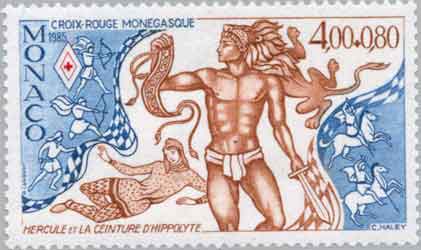
Welcome to another Labour: obtaining the girdle of Hipplyta. Let's set the stage: Eurystheus' daughter Admete wanted the belt of Hippolyta, a gift to the queen of the Amazons from the war god Ares. To please his daughter, Eurystheus ordered  Hēraklēs to retrieve the belt as his ninth labour.


The Amazons (Ἀμαζόνες, Amazónes, singular Ἀμαζών, Amazōn) were all-female warriors legened to have lived in Pontus, which is part of modern-day Turkey near the southern shore of the Euxine Sea (the Black Sea). There they formed an independent kingdom under the government of a queen named Hippolyta or Hippolyte (generally translated as 'unbridled mare'). The Amazons were supposed to have founded many towns, amongst them Smyrna, Ephesus, Sinope, and Paphos. Apollodorus, in his 'Library', writes about the Amazons, and Hippolyta:

"She was queen of the Amazons, who dwelt about the river Thermodon, a people great in war; for they cultivated the manly virtues, and if ever they gave birth to children through intercourse with the other sex, they reared the females; and they pinched off the right breasts that they might not be trammelled by them in throwing the javelin, but they kept the left breasts, that they might suckle." [2.5.9]

Hēraklēs sailed to Paros, and right away, ran into a lot of trouble. Apollodorus, again: 

"[T]aking with him a band of volunteer comrades in a single ship he set sail and put in to the island of Paros, which was inhabited by the sons of Minos, to wit, Eurymedon, Chryses, Nephalion, and Philolaus. But it chanced that two of those in the ship landed and were killed by the sons of Minos. Indignant at this, Hercules killed the sons of Minos on the spot and besieged the rest closely, till they sent envoys to request that in the room of the murdered men he would take two, whom he pleased. So he raised the siege, and taking on board the sons of Androgeus, son of Minos, to wit, Alcaeus and Sthenelus, he came to Mysia, to the court of Lycus, son of Dascylus, and was entertained by him; and in a battle between him and the king of the Bebryces Hercules sided with Lycus and slew many, amongst others King Mygdon, brother of Amycus. And he took much land from the Bebryces and gave it to Lycus, who called it all Heraclea." [2.5.9]

From here on out, Hēraklēs got to focus on completing his task. Hippolyte was a powerful Queen, who cared about doing the best for her people. According to Apollodorus, she would have given her girdle, but unfortunately, the Gods had other plans.

"Having put in at the harbor of Themiscyra, he received a visit from Hippolyte, who inquired why he was come, and promised to give him the belt. But Hera in the likeness of an Amazon went up and down the multitude saying that the strangers who had arrived were carrying off the queen. So the Amazons in arms charged on horseback down on the ship. But when Hercules saw them in arms, he suspected treachery, and killing Hippolyte stripped her of her belt. And after fighting the rest he sailed away and touched at Troy." [2.5.9]

Diodorus Siculus, however, has a different version of events in his 'Library of History':

"And first of all he demanded of them the girdle which he had been commanded to get; but when they would pay no heed to him, he joined battle with them. Now the general mass of the Amazons were arrayed against he main body of the followers of Heracles, but the most honoured of the women were drawn up opposite Heracles himself and put up a stubborn battle. The first, for instance, to join battle with him was Aella, who had been given this name because of her swiftness, but she found her opponent more agile than herself. The second, Philippis, encountering a mortal blow at the very first conflict, was slain. Then he joined battle with Prothoê, who, they said had been victorious seven times over the opponents whom she had challenged to battle. When s he fell, the fourth whom he overcame was known as Eriboea. She had boasted that because of the manly bravery which she displayed in contest of war she had no need of anyone to help her, but she found her claim was false when she encountered her better.

Then next, Celaeno, Eurybia, and Phoebê, who were companions of Artemis in the hunt and whose spears found their mark invariably, did not even graze the single target, but in that fight they were one and all cut down as they stood shoulder to shoulder with each other. After them Deïaneira, Asteria and Marpê, and Tecmessa Alcippê were overcome. The last-named had taken a vow to remain a maiden, and the vow she kept, but her life she could not preserve. The commander of the Amazons, Melanippê, who was also greatly admired for her manly courage, now lost her supremacy.

And Heracles, after thus killing the most renowned of the Amazons and forcing the remaining multitude to turn in flight, cut down the greater number of them, so that he race of them was utterly exterminated. As for the captives, he gave Antiopê as a gift to Theseus and set Melanippê free, accepting her girdle as her ransom." [4.16.2]

Hēraklēs then sailed to Troy--at least according to Apollodorus--he was in for another world of hurt:

"But it chanced that the city was then in distress consequently on the wrath of Apollo and Poseidon. For desiring to put the wantonness of Laomedon to the proof, Apollo and Poseidon assumed the likeness of men and undertook to fortify Pergamum for wages. But when they had fortified it, he would not pay them their wages. Therefore Apollo sent a pestilence, and Poseidon a sea monster, which, carried up by a flood, snatched away the people of the plain. But as oracles foretold deliverance from these calamities if Laomedon would expose his daughter Hesione to be devoured by the sea monster, he exposed her by fastening her to the rocks near the sea. Seeing her exposed, Hercules promised to save her on condition of receiving from Laomedon the mares which Zeus had given in compensation for the rape of Ganymede. On Laomedon's saying that he would give them, Hercules killed the monster and saved Hesione. But when Laomedon would not give the stipulated reward, Hercules put to sea after threatening to make war on Troy.
 
And he touched at Aenus, where he was entertained by Poltys. And as he was sailing away he shot and killed on the Aenian beach a lewd fellow, Sarpedon, son of Poseidon and brother of Poltys. And having come to Thasos and subjugated the Thracians who dwelt in the island, he gave it to the sons of Androgeus to dwell in. From Thasos he proceeded to Torone, and there, being challenged to wrestle by Polygonus and Telegonus, sons of Proteus, son of Poseidon, he killed them in the wrestling match. And having brought the belt to Mycenae he gave it to Eurystheus." [2.5.9]

This was surely not the easiest of Hēraklēs' labours, and it took  long journey and a lot of fighting and killing to get it done. Surely, it was not Hēraklēs' favourite, and it isn't mine either. No matter the reason, the Amazons were hunted down to extinction--a proud, beautiful, tribe--and mythologically speaking, they never recovered. Unfortunately, Hēraklēs' struggle is long from over, and there is much more bloodshed down the line. For now, though, Hēraklēs has another labour under his--well, Hippolyta's--belt.