Showing posts with label Troy. Show all posts
The Dark Ages of Greece, spanning roughly from 1200- 750 BCE, is a period defined by dramatic societal and cultural shifts. In fact, it was one of its most famous periods. Here is a top ten of things that happened at that time.
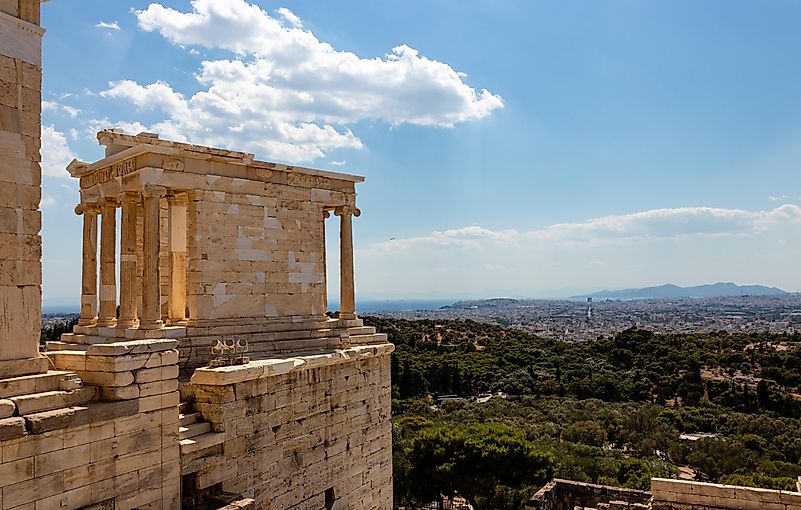

#10 Collapse of Mycenaean Civilization 
The start of the Greek Dark Ages is marked by the fall of the Mycenaean civilization around 1200 BCE. The exact cause of this collapse is not known, though evidence of widespread destruction between 1250-1200 BCE led to the theory of a catastrophic invasion of outsiders, the “Doric Invasion”. More recent evidence has generated arguments that instead climate change or an economic crisis triggered the collapse. Whatever the cause, the collapse of the Mycenaean civilization marked the start of a dramatic societal shift in Greece that led scholars to name the following period as the “Dark Age”.

#9 Settlements Abandoned - Migration and Decentralization
The Mycenaeans had established a thriving, highly centralized early Greek society, with palatial centers across Greece. Following their collapse, centers of power were abandoned and political states vanished. The period was defined by the redistributed of the population to small scattered settlements, and a lack of centralized power. Subsistence farming and sheep herding became the primary modes of life. Beginning around 1050 mainland Greeks moved in large numbers to Athens, perhaps fleeing a northern Dorian invasion, and settled on the Anatolian coast. With no central rule villages became fiercely independent, laying the foundations for the Greek city-states that would define Greece in the following centuries.

#8 A Silent Period – Writing Lost  
It may come as no surprise that one feature of the Dark Age is the loss of writing, which vanished with the Mycenaean civilization. There are no written records to illuminate the period, leaving scholars in the dark, left with the archaeological records alone to piece together the events of the period. The complete lack of written sources from this period has contributed to the sense that there was a dramatic loss of culture following the collapse of the Mycenaean Civilization.

#7 An Impoverished Age?  
Along with the loss of writing, the Dark Age is defined by the disappearance of specialized crafts, luxury goods, and monumental buildings, creating the impression of an “impoverished culture”. In addition, the period saw a marked decrease in population, along with a decline in agricultural production and an apparent loss of trade networks with the outside world.

#6 Protogeometric Art
Thoughts of Ancient Greek pottery typically conjure up images of black vases with painted images depicting gods, heroes, or mystical beasts from Greek mythology. These images disappear from Greek pottery after 1200 BCE, replaced by protogeometric motifs, with zigzags, triangles, and cross-hatching covering the surfaces. Not until the eighth century BCE do motifs of living creatures start to reappear. The Lefkandi centaur (thought to date around 950 BCE) is a fine example of this, and is seen as an indication of the Dark Age in Greece coming to an end, signaling the “rebirth” of Greek culture. 

#5 An Age of Iron  
The Dark Age saw the transition from bronze to iron in Greece, and some prefer to refer to the period as the “Early Iron Age”. While iron ore was plentiful throughout the Mediterranean, and archaeologists have identified iron artifacts dating back as early as 2000 BCE, iron was a rare commodity until the late eleventh and tenth centuries BCE. The techniques for smelting and working iron, which required far higher temperatures than bronze but produced far stronger tools and weapons, were not mastered until the late eleventh century BCE. By 950 BCE, iron objects were no longer a commodity; iron had become the metal of choice.

#4 Diversity
The lack of centralization led to greater cultural diversity. While generalizations are made about the material culture, settlement structures, and burial practices of the time, regions developed their own unique styles and identities. Lefkandi is the best example of this, as it appears to have prospered during the Dark Age, contradicting many of the common conceptions of the period. The unique “Heroon of Eritrea” burial indicates a rich hierarchical society, and alphabetic graffiti suggests that some semblance of literacy remained. There is also evidence that Lefkandi never lost contact with the outside world.

#3 Homer
The famous blind poet Homer, credited as the author of the Iliad and the Odyssey, Greek epic poems which tell of the Trojan War and Odysseus’ tumultuous voyage home in the aftermath, has shaped what many know of the Ancient Greek world. He is thought to have lived around 800-700 BCE. Often described as a travelling bard, it is widely believed that his poems represent a tradition of oral composition; that he was one of many poets who travelled reciting poems composed and passed down without writing. (The composition of the Illiad and the Odyssey is dated to the mid-eighth century BCE, but they were not written down until the sixth or seventh centuries). These travelling bards are thought to have contributed to the spread of Greek language throughout the Mediterranean.

#2 The Trojan War 
Homer’s epic tales of the Trojan War are thought to have some grounding in actual historical events. Scholars point the period of apparent destruction around 1200-1185 BCE, the beginning of the Dark Age, as the source of the legends which bards retold and embellished over the following centuries. Typically associated with the earlier, “heroic” Bronze Age, the “Trojan War” defined the age that followed it.

#1 Nostalgia 
A feature prevalent in the art and culture of the Dark Age, exemplified in Homer’s poems, is a sense of nostalgia, a yearning for an earlier “heroic” past. This is also evident in the continuation of “hero cults” and the emergence of cremation burials in the style of Homeric epics. Surrounded by the massive palatial ruins of their predecessors, the Greeks of this period imagined the lives of larger than life figures and worshipped them.
Busy, busy, busy, so have a video today. This lecture was taught by Professor Eric H. Cline, Ph.D., He is a Professor of Classics and Anthropology and the current Director of The George Washington University (GWU) Capitol Archaeological Institute.

He holds a Ph.D. in Ancient History from the University of Pennsylvania, an M.A. in Near Eastern Languages and Literatures from Yale University, and a B.A. in Classical Archaeology modified by Anthropology from Dartmouth College. He is also a National Geographic Explorer, a Fulbright Scholar, and a National Endowment for the Humanities (NEH) Public Scholar.

In this video you can "Follow the exploits of Heinrich Schliemann, a 19th-century amateur archaeologist who was determined to find the site of Homer’s Troy. Learn about his dig through nine stratified cities, the astonishing finds, and the intense debates concerning which city was the actual Troy. Trace subsequent work at the site and examine the compelling conclusions."


Archaeologists have discovered a new sanctuary preceding the ancient city of Troy in Turkey's western Çanakkale province, which is expected to shed light on the details of ancient civilizations that inhabited the area.


Professor Rüstem Aslan from Çanakkale University's Faculty of Archaeology, who leads the excavations at Troy, told the Anadolu Agency that they found the third sanctuary in the 156th excavation period.

Excavations at Troy, located near the village of Tevfikiye, were launched by Frank Calvert for the first time in 1863, Professor Aslan said, noting that the discovery of the new sanctuary is exciting as it has significant implications in terms of the history of Troy and Anatolia.

"In this year's excavations we have come up with exciting results regarding the southern entrance to the ancient city of Troy," Aslan said and added: "We came to the conclusion that there was a new sanctuary area in Troy especially during the Hellenistic Roman periods."

Aslan said that the excavations prove the existence of a third sanctuary in the area.

The findings at Troy are expected to shed light on the relations of the city with the Anatolian and Hittite cultures, and its function in Western Anatolia.

Turkey's government declared 2018 the "Year of Troy" in honor the 20th anniversary of the ancient city's recognition as a UNESCO World Heritage Site. Hundreds of thousands of guests, including celebrities, have visited the site this year to visit the newly opened Troy Museum and take part in cultural and historical activities.

The 4,000-year-old ancient city of Troy is one of the most famous archeological sites in the world. First excavations at the ancient city were undertaken in 1870 by German businessman Heinrich Schliemann, who is now regarded among the pioneers of archeology.

The historic setting of the Trojan War in which Spartan and Achaean warriors from Hellas besieged the city in 13th century B.C. was immortalized by the Greek poet Homer in his epic poem The Illiad.
So, I won't be watching Meghan Fox's (pseudo)archaeology show, but since this week's episode was about Troy, there might be a few amongst you who did/will do. Archaeology Review reviewed the episode (so you don't have to watch it!) and they very expertly pointed out a few things you should know before you take Meghan at her word.


"Legends of the Lost," previously entitled "Mysteries and Myths," is presented, produced, and co-created by Fox, who has stated she has always had an interest in Archaeology. Back when the show was announced, archaeologists weren't amused

Well, they still aren't amused. For the full review, please go here. It also includes an overall opinion on the show that I am sure I echo, even without watching the show. Thank you for saving me the frustration, Carl! 


It's one of the things everyone who has every heard of Hellenic mythology knows of: the invasion of the city of Troy by the ancient Hellenes. Homeros wrote about it in the Iliad and since then, we've been trying to establish if there is any truth to the myth. Homeros's work dates back to the eighth or ninth century, BC., several hundred years after the war is supposed to have taken place. As such, we can assume some embellishment to the story was necessary to flesh out the story--or even make it a story at all. Archeologists are sure, however, that the Troy existed.

Around 1870, Heinrich Schliemann headed an archeological dig in Turkey. His site was located south of the southwest end of the Hellespont and northwest of Mount Ida. In 1865, an  English archaeologist named Frank Calvert had excavated trial trenches in a field he had bought from a local farmer. The results were promising, and Schliemann took over Calvert's dig--which had since been named 'Hisarlik'--and took sole credit for the future finds at the site, even though Calvert had done the work of locating the site in the first place.

At Hisarlik, Schliemann found evidence of nine cities built on top of each other, as well as evidence of a high wall which must have fortified the town. Schliemann figured that the city of Troy--or Ilion/Ilios (Ἴλιον/Ἴλιος) as it would have been called at the time of the ancient Hellenes--must have been one of the lower, older, cities and thus he blasted his way down to the second city, where he found signs that seemed to corroborate his story--jewelry included, that Schliemann took to be those of Helen--which turned out to be a thousand years older than the time described in the epic. Due to his methodology, much of the later cities was destroyed.

Archeologists today believe that the sixth and seventh oldest cities found in layers at Hisarlik are the best candidates for the Troy of The Iliad. There is, however, no sign to be found of a huge wooden horse--not that odd considering the time that has passed and the fact that wood rots away over said time. Still, modern scholars think the horse was part of Homeros' artistic license as a writer. Archeological evidence suggests that city number six would have fit the setting of Troy described by the writer... but evidence points to its destruction not by the hands of man, but the hands of nature: Troy six was destroyed by a massive earthquake. Troy seven, however, was not as grand as Troy six, but its streets were littered with arrowheads, indicating that this city was, indeed, sacked by human hands.


One thing we can say with certainty: The myth of Troy will always be a source of both entertainment and wonder.


"Lost Worlds investigates the very latest archaeological finds at three remote and hugely significant sites - Angkor Wat, Troy and Persepolis. Lost Worlds travels to each site and through high-end computer graphics, lavish re-enactment and the latest archaeological evidence brings them to stunning televisual life. From the 900-year-old remains of Angkor Wat in the Cambodian jungle the staggering City of the God Kings is recreated. From Project Troia, in North West Turkey, the location of the biggest archaeological expedition ever mounted the lost city is stunningly visualised and finally from Persepolis the city and the great Persian Empire are brought to life."
Every day, the average human utters about 16.000 words. A good portion of those are idioms and figures of speech--the use of a word or words diverging from its usual meaning--or sayings. Today, I wanted to share some of the figures of speech and sayings that can be traced back to ancient Hellas and/or Hellenic myth. Some of these I have posted before, but I've collected another few in the mean time. These are marked with a *.


"A Herculean Effort"
Meaning: a great effort.
Source: Hēraklēs, son of Zeus and the mortal Alcmene--who was a bane in Hera's life, simply for being born--was stricken mad by the Queen of the Gods and killed his five sons by his wife Megara, oldest daughter of Kreōn of Thebes. When he was released from his madness by a hellebore potion--provided by Antikyreus--and realized what he had done, he cried out in anguish, and went on a long journey to cleanse himself of the miasma caused by these killings. First, he visited the oracle at Delphi, who, unbeknownst to him, was whispered to by Hera. The Oracle told Hēraklēs to serve the king of Tiryns, Eurystheus, for ten years and do everything Eurystheus told him to do. Eurystheus gladly provided Hēraklēs with these labors--ten of them, one for each year--and eventually ended up adding two more, resulting in the Twelve Labors of Hēraklēs. Hēraklēs was told to: slay the Nemean Lion, slay the nine-headed Lernaean Hydra, capture the Golden Hind of Artemis, capture the Erymanthian Boar, clean the Augean stables in a single day, slay the Stymphalian Birds, capture the Cretan Bull, steal the Mares of Diomedes, obtain the girdle of Hippolyta, Queen of the Amazons, obtain the cattle of the monster Geryon, steal the apples of the Hesperides, and to capture and bring back Kerberos. All of these tasks were incredibly hard, and required every ounce of strength Hēraklēs possessed.

"A Sisyphean task"
Meaning: (performing) an endless or repetitive task.
Source: Sísyphos was a scheming and conniving king, who tried to pull a fast one on the Gods many times over. He betrayed Zeus, tried to trick Thanatos, Persephone and Hades, and killed innocent travelers on his roads--an offense against xenia. For all these offenses, Sísyphos was sentenced to push a boulder uphill for all eternity, as the boulder would roll down the slope again the second he reached the top.

"Achilles' heel"
Meaning: one's weakness or weak spot.
Source: Achilles was a great warrior, destined to live one of two lives: a long and boring one, or a short but heroic one. Knowing her son would choose the latter, his divine mother Themis tried to limit the risk of Achilles dying a premature death by dipping him in the river Styx. As such, Achilles became impenetrable to harm, save for his heel, where his mother had held him as she dipped him in the water. This spot eventually became his downfall, and Achilles died on the battlefield of Troy. The stories of his invulnerability were a later invention, around the first century AD. Before that, the myth simply stated that Achilles was shot in the heel with an arrow, and he eventually died of that wound, because it would not heal.

"Bearing the weight of the world (on one's shoulders)" *
Meaning: a very heavy burden of worry or responsibility.
Source: This is a reference to Atlas, the Titan who was forced to carry the heavens on his shoulders after he and his brethren rebelled against Zeus in the Titanomachy. Depending on the source, however, it was actually a great honour to be asked to protect the whole of the earth from being crushed under the weight of the sky.

"Beware of Greeks bearing gifts"
Meaning: be weary of those with something to offer, they may have ulterior motives.
Source: In the war for Troy, the Hellenes needed a way to conquer the walls of the city. They tried to fight for it, but were unable to. In Virgil's Aeneid, it is written that the Hellenes built a wooden horse, and hid away in it. The horse was offered to the Trojans as a gift, and the structure was accepted into the city. At night, the Hellenes snuck out of the horse, attacked the city, and conquered Troy.

"Caught between a rock and a hard place"
Meaning: making a hard choice; choosing between two undesirable options.
Source: During Odysseus' travels to get home, he must run his ship through a narrow passage. One the one side are rocks with a cavern. In this cavern, Skylla, sea monster with six heads, lived, and she would take one of Odysseus' men with each of her heads. On the other side lay Kharybdis, a great whirlpool which would suck in any ship that came too close. It is up to Odysseus to choose one or the other. Eventually, he chooses Skylla, and looses many brave men, his ship, however, is in tact. As such, Odysseus had to choose between a rock and a hard place.

"Cupid's arrows" *
Meaning: rapidly falling in love--as if struck.
Source: The ancient Hellenes were just as mystified by love as we are today--more so, perhaps, because a least we know what happens chemically in our bodies when it happens. Their answer to the mystery of falling in love was that the arrow of Eros struck. Eros had two types of arrows: the golden-tipped arrow brought love and attraction, the lead-tipped arrow brought hate and repulsion. Cupid is the Roman version of Eros.

"Dog is man's best friend"
Meaning: the loyalty of dogs is undisputed
Source: In the Odysseia, Odysseus finally returns home after many, many long years of travel, and long years of war. He is in disguise when he reaches his house, which is overrun by suiters of his wife. His fateful hunting dog, Argos, has waited for him all these years, and recognizes his master right away. Finally reunited with his master, the old dog dies, happy, and at peace.

"Food of the Gods"
Meaning: food so delicious, it is almost divine
Source: Nectar--the drink of the Gods--and ambrosia--the food of the Gods--are the dish of choice on Olympos. If a mortal man or woman would eat or drink either of the two, they, too, would become immortal, or at least their aging would stop for a while.

"Gordian knots"
Meaning: an extremely perplexing puzzle or problem.  
Source: It seems that king Gordius of Phrygia laid out a task for whomever wanted to be the ruler of Asia Minor: he tied a know so complex, no one managed to untie is. Eventually, Alexander the Great came to the land, and cut the know with his sword, thus 'passing' the test. 'Cutting the knot' became a saying for taking something by force, or making a decisive action. 

"Having the Midas touch"
Meaning: a fortunate person, someone able to make everything a success.
Source: In Hellenic mythology, Midas was the king of Pessinus. It seems some of the peasants under Midas' commands brought the king the unconscious satyr Seilenos, who had drunk himself into a stupor. Alternatively, Seilenos toppled over in Midas' garden. No matter how he got there, Midas took good care of him, and as a token of appreciation, Dionysos--Seilenos' student--offered Midas a wish. Midas wished that everything he touched, turned to gold. This is where the saying comes from.

"Hounds of Hell"
Meaning: something frightening, or evil.
Source: Guarding the entrance to Underworld is a great dog, either with just one head, or three, or fifty. His name is Kerberos, and you can pass him once, on your way in, but never again, as there is no way out.

"Leave No Stone Unturned"
Meaning: search everywhere.
Source: The catch-phrase was first recorded by Euripides in his tragedy 'Heracleidae'. The play focusses on King Eurystheus, who hunts the children of Hēraklēs after he passes away. The actual quote comes from the line: "Now, after he was taken hence, was I not forced, by reason of these children's hatred, and because I was conscious of an hereditary feud, to leave no stone unturned by slaying, banishing, and plotting against them?"

"Oedipus Complex"
Meaning: a child's unnatural desire of their parent of the opposite sex, and jealousy of the parent of the same sex. Freudian theory.
Source: Oedipus was born to King Laius and Queen Jocasta. King Laius was fortold his son would kill him and marry his mother, and so he left him to die on a mountainside. The child was found, however, and raised by King Polybus and Queen Merope. Oedipus eventually heard of the prophecy about him and fled, not wanting to hurt his adoptive parents, who he believed to be his biological ones. Fate would have him end up on the same road as King Laius, and in an argument over whom would step out of the way, Oedipus killed his father. He then traveled on and eventually met and married his mother. The myth continues on, but this is the part where the figure of speech comes from.

"Pandora's box"
Meaning: to perform an action that may seem small or innocuous, but that turns out to have severe and far-reaching consequences.
Source: I've written quite a bit about Pandôra on this blog. Pandôra was created by the Theoi as punishment on humanity after Prometheus stole fire from the Gods. Pandôra showed up on the doorstep of Prometheus' brother Deukalion, with a pithos she was told never to open. Eventually, curiosity got the better of her,a nd she opened the jar. In some versions of the myth, all evils of the word flew out, but Pandôra managed to trap hope in the jar. There are many, many inconsistencies in the myth, but the figure of speech stuck.

"Pregnant with thought" *
Meaning: to be about to put forth a (great) idea.
Source: Potentially, this idiom comes from Greek mythology--namely the birth of Athena from the head of Zeus. Athena, as Goddess of wisdom represents a literal birth of ideas--which is pretty much the meaning.

"Siren's song" *
Meaning: an alluring utterance or appeal, especially one that is seductive or deceptive.
Source: In the Odysseia, Circe warned Odysseus not to listen to the Sirens--mythological mermaids--because their haunting music would drive him mad. Or if he did, at least have his sailors tie him to the mast to keep him from throwing himself overboard, and to plug his rowers ears’ with beeswax so they would be impervious to the sweet high song.

"Stygian darkness" *
Meaning: pitch black, sometimes dreary, darkness.
Source: The river Styx was the boundary between the upper world of the living and the underworld of the dead. It was so inky black that anything under its surface disappeared from sight.

"The face that launched a thousand ships"
Meaning: one person causing a terrible event.
Source: One fateful day, three Goddesses got into an argument about whom was most beautiful. Hera, Aphrodite, and Athena, all laid claim to a golden apple tossed into the crowd at a banquet held on honor of Peleus and Thetis. Eris had thrown the apple, which was labeled 'for the most beautiful'. The Goddesses could not decide who was the fairest, and so They asked Zeus. Zeus appointed Paris, A Trojan mortal, to choose in his stead. All three Goddesses undressed for Paris when asked, and all offered him gifts, if he would choose them. Aphrodite, however, promised him the most beautiful of wives, and PAris chose Her. Aphrodite picked Helen of Sparta as Paris' new wife, but Helen was already married, to Menelaus, who would eventually bring war down upon Troy to reclaim the wife he lost. Helen became the woman whose face 'launched a thousand ships' in war.

"To rise from the ashes"
Meaning: to be reborn
Source: No singular myth about the famous bird survives, but the phoenix was know to the ancient Hellenes. It was a mythical bird that lived its life, immolated, and was reborn from the ashes of its previous incarnation.
I've entered the last two weeks of my job, meaning that I am entirely swamped. On top of that, it's the holiday season and as a designer employed by a copy shop (my second job) I am scrambling to get through a backlog of holiday cards and other seasonal work. In short, I have time for absolutely nothing else besides work, food, and a bit of sleep. Sorry everyone; two weeks and it'll be much, much better. Today I am going to share a bit of Roman author Gaius Julius Hyginus (64 BC - 17 AD), because the only reading I get to do lately is the Iliad by Hómēros. Why then Hyginus?

Hyginus mentions the Trojan war in his 'Fabulae'; the work consists of some three hundred very brief and plainly, even crudely told myths and celestial genealogies, including the happenings surrounding Troy. What amuses me greatly about Hyginus is that he briefly mentions the happenings, but spends far more time on crunching the numbers of the war. This is information that was obviously very important to him, and I can't help but grin every time I read it. Seeing as I need to do some additional grinning today, you are sharing Hyginus with me.


THOSE WHO WENT TO ATTACK TROY, AND THE NUMBER OF THEIR SHIPS
Agamemnon, son of Atreus and Aërope, from Mycenae, with a hundred ships;
Menelaus, his brother from Mycenae, with 60 ships.
Phoenix, son of Amyntor, and Argive with 50 ships;
Achilles, son of Peleus and Thetis, from the island of Scyros, with 60 ships;
Automedon, tfrom Scyros, with 10 ships;
Patroclus, son of Menoetius and Philomela, from Phthia, with 10 ships.
Ajax, son of Telamon by Eriboea, from Salamis, with 12 ships;
Teucer, his brother by Hesione, daughter of Laomedon, with 12 ships.
Ulysses, son of Laertes and Anticlia, from Ithaca, with 12 ships;
Diomede, son of Tydeus and Deipyla, daughter of Adrastus, from Argos, with 30 ships;
Sthenelus, son of Capaneus and Evadne, from Argos, with 25 ships.
Ajax, son of Oileus and the nymph Rhene, a Locrian, with 20 ships;
Nestor, son of Neleus and Chloris, daughter of Amphion, a Pylian, with 90 ships;
Thrasymedes, his brother, by Eurydice, a Pylian, with 15 ships;
Antilochus, son of Nestor, a Pylian, with 20 ships.
Eurypylus, son of Euaemon and Opis, an Ormenian, with 40 ships;
Machaon, son of Asclepius and Coronis, from Tricca, with 20 ships;
Podalirus, his brother, with 9 ships.
Tlepolemus, son of Hercules and Astyoche, from Mycenae, with 9 ships;
Meriones, son of Molus and *Melphis, from Crete, with 40 ships;
Eumelus, son of Admetus and Alcestis, daughter of Pelias, from Perrhaebia, with 8 ships;
Philoctetes, son of Poeas and Demonassa, from Meliboea, with 7 ships;
Peneleus, son of Hippalcus and Asterope, from Boeotia, with 12 ships.
Leitus, son of Lacritus and Cleobule, from Boeotia, with 12 ships;
Clonius, his brother, from Boeotia, with 9 ships;
Arcesilaus, son of Areilycus and Theobula, from Boeotia, with 10 ships;
Prothoenor, his brother, from Thespia, with 8 ships.
Ialmenus, son of Lycus and Pernis, from Argos, with 30 ships;
Ascalaphus, his brother, from Argos, with 30 ships;
Epistrophus, his brother, from the same place, with 10 ships;
Elephenor, son of Calchodon and Imanerete, from Argos, with 30 ships.
Menestheus son of *oeas, from Athens, with 50 ships;
Agapenor, son of Ancaeus and *Iotis, from Arcadia, with 60 ships;
Amphimachus, son of Cteatus, from Elis, with 10 ships;
Euryalus, son of Pallas and Diomeda, from Argos, with 15 ships;
Amarynceus, son of Onesimachus, from Mycenae, with 19 ships;
Polyxenus, son of Agasthenes and Peloris, from Aetolia, with 40 ships;
Meges, son of Phyleus and Eustyoche, from Dulichium, with 60 ships;
Thoas, son of Andrawmon and gorges, from *Tytus, with 15 ships.
. . . Pdoarces, his brother, from the same place, with 10 ships.
Prothous, son of Tenthredon, from Magnesia, with 40 ships;
* Cycnus, son of Ocitus and *Aurophites, from Argos, with 12 ships;
Nireus, son of Charopus and the nymph Aglaie, from Argos, with 16 ships;
Antiphus, son of Thassalus and Chalciope, from Nisyrus, with 20 ships;
Polypoetes, son of Pirithous and Hippodamia, from Argos, with 20 ships;
Leonteus, son of Coronus, from Sicyon, with 19 ships.
Calchas, son of Thestor, from Mycenae, augur; Phocus, son of Danaus, builder; Eurybates and Talthybius, heralds; Diaphorus, judge; Neoptolemus, son of Achilles and Deidamia, from the island of Scyros; he was called Pyrrhus from his father who was disguised as the girl Pyrrha.
The total number of ships was *245.
SLAYERS ON THE ACHAEAN SIDE AND HOW MANY THEY SLEW
Achilles to the number of 72;
Antilochus, 2;
Protesilaus, 4;
Peneleus, 2;
Eurypylus, 1;
Ajax, son of Oileus, 14;
Thoas, 2;
Leitus, 20;
Thrasymedes, 2;
Agamemnon, 16;
Diomedes, 18;
Menelaus, 8;
Philoctetes, 3;
Meriones, 7;
Ulysses, 12;
Idomeneus, 13;
Leonteus, 5;
Telamonian Ajax, 28;
Patroclus, 54;
Polypoetes, 1;
Teucer, 30;
Neoptolemus, 6;
total, 362.

SLAYERS ON THE TROJAN SIDE AND HOW MANY THEY SLEW
Hector to the number of 31;
Alexander, 3;
Sarpedon, 2;
Panthous, 4;
Gargasus, 2;
Glaucus, 4;
Polydamas, 3;
Aeneas, 28;
Deiphobus, 4;
Clytus, 3;
Acamas, 1;
Agenor, 2;
total, 88.
So, there is this thing happening where maybe the Trojan horse has been found? I am sceptical to say the least but listen to the evidence: according to a report by newsit.gr, Turkish archaeologists excavating on the site of the historical city of Troy on the hills of Hisarlik, have unearthed a large wooden structure. Historians and archaeologists presume that the pieces are remains of the legendary Trojan Horse.


The Trojan horse was called 'Doúreios Híppos' (Δούρειος Ἵππος) by Hómēros, who references the affair in his 'Odysseia'. The Iliad makes no mention of it--although that is the epic that actually takes place on the battlefield--because the horse supposedly came after the end of the Iliad. The Odysseia makes little mention of the horse, however. The only lines that refer to it at all are:

"Yellow-haired Menelaus continued: ‘Wife, indeed you have told it all as it was. I have known before now the thoughts and judgements of many heroes, as I wandered the wide earth, but I have never seen so great hearted a man as enduring Odysseus. That episode too, of the Wooden Horse, how the great man planned it, carried it through, that carved horse holding the Argive leaders, bringing the Trojans death and ruin! Then, summoned it may be by some god who thought to hand victory to the Trojans, you arrived, with godlike Deiphobus on your heels. You circled our hollow hiding-place, striking the surface, calling out the names of the Danaan captains, in the very voices of each of the Argives’ wives.  Diomedes, Tydeus’ son, and I, and Odysseus were there among them, hearing you call, and Diomedes and I were ready to answer within, and leap out, but Odysseus restrained us, despite our eagerness. The rest of the Achaeans kept silent too, though Anticlus wanted to call out, and reply, till Odysseus clapped his strong hands over his mouth, saving all the Achaeans, and he grasped him so till Pallas Athene led you away.’" [Bk IV:260-289]

And:
"[R]esourceful Odysseus spoke to the bard, saying: ‘Demodocus, I praise you above all mortal men, one taught by the Muse, Zeus’ daughter, or perhaps by Apollo, for you sang the Achaeans’ fate with truth and feeling, all of their actions and their suffering, all the efforts they exerted, as if you had been there, or heard it from one who was. Now, come, change your theme, and sing of the making of the Wooden Horse, that Epeius fashioned with Athene’s help, that noble Odysseus contrived to have dragged inside the citadel, filled by cunning with warriors who then sacked Troy. Tell the tale as it happened, and I will say to all mankind that the god has given you freely of the power of divine song.’

At his words the bard, inspired by the god, began, and raising his voice picked up the tale at the point where the Argives had burned their camp, boarded their oared ships, and sailed some way off, leaving glorious Odysseus and the rest sitting inside the Horse, at the Trojan’s meeting place. The Trojans themselves had dragged it into the citadel. There it stood, while the people sat round it, discussing it endlessly to no conclusion. Three suggestions found favour: to cut through the hollow timber with pitiless bronze, or drag it to the edge of the rock and over the cliff, or let it stand there, as a grand offering to the gods, in propitiation, which is what happened in the end. For it was their destiny to be destroyed when the city accepted that huge horse of wood, where the best of the Argives lay hidden, bringing death and ruin to Troy. 

Then he sang how the Achaeans left their hollow hiding place, and poured from the horse, to sack the city. He sang how the other warriors dispersing through the streets, laid waste high Troy, but Odysseus, the image of Ares, together with godlike Menelaus, sought Deiphobus’ house. There, said the tale, Odysseus fought the most terrible of fights, but conquered in the end, with the help of great-hearted Athene." [Bk VIII:469-520]

Later accounts offer a bit more details about the creation of the horse and its subsequent employment to sack the city. The Roman poet Virgil, in the second book of the Aeneid, recounts the entire story in great detail, basing it--most likely--off of Hómēros' account and filling in the blanks himself, along with writers who picked up the tale between Hómēros and his time. The most notable difference between Hómēros and Virgil is that in Virgil's tale, a man named Sinon was left behind along with the horse to sell the lie. He had volunteered for the position and was subsequently captured.

"You, eternal fires, in your invulnerable power, be witness, you altars and impious swords I escaped, you sacrificial ribbons of the gods that I wore as victim: with right I break the Greek’s solemn oaths, with right I hate them, and if things are hidden bring them to light: I’m bound by no laws of their country. Only, Troy, maintain your assurances, if I speak truth, if I repay you handsomely: kept intact yourself, keep your promises intact. All the hopes of the Greeks and their confidence to begin the war always depended on Pallas’s aid. But from that moment when the impious son of Tydeus, Diomede, and Ulysses inventor of wickedness, approached the fateful Palladium to snatch it from its sacred temple, killing the guards on the citadel’s heights, and dared to seize the holy statue, and touch the sacred ribbons of the goddess with blood-soaked hands: from that moment the hopes of the Greeks receded, and slipping backwards ebbed: their power fragmented, and the mind of the goddess opposed them. Pallas gave sign of this, and not with dubious portents, for scarcely was the statue set up in camp, when glittering flames shone from the upturned eyes, a salt sweat ran over its limbs, and (wonderful to tell) she herself darted from the ground with shield on her arm, and spear quivering. Calchas immediately proclaimed that the flight by sea must be attempted, and that Troy cannot be uprooted by Argive weapons, unless they renew the omens at Argos, and take the goddess home, whom they have indeed taken by sea in their curved ships. And now they are heading for their native Mycenae with the wind, obtaining weapons and the friendship of the gods, re-crossing the sea to arrive unexpectedly, So Calchas reads the omens. Warned by him, they’ve set up this statue of a horse for the wounded goddess, instead of the Palladium, to atone severely for their sin. And Calchas ordered them to raise the huge mass of woven timbers, raised to the sky, so the gates would not take it, nor could it be dragged inside the walls, or watch over the people in their ancient rites. Since if your hands violated Minerva’s gift, then utter ruin (may the gods first turn that prediction on themselves!) would come to Priam and the Trojans: yet if it ascended into your citadel, dragged by your hands, Asia would come to the very walls of Pelops, in mighty war, and a like fate would await our children." [BkII:145-194]

So how much is true of the tale? Is there any evidence to support the myth? The Odysseia dates back to the eighth or ninth century, BC., several hundred years after the war is supposed to have taken place. As such, we can assume some embelishment to the story was necessary to flesh out the story--or even make it a story at all. Archaeologists are sure, however, that the Troy existed.

Around 1870, Heinrich Schliemann headed an archaeological dig in Turkey. His site was located south of the southwest end of the Hellespont and northwest of Mount Ida. In 1865, an  English archaeologist named Frank Calvert had excavated trial trenches in a field he had bought from a local farmer. The results were promising, and Schliemann took over Calvert's dig--which had since been named 'Hisarlik'--and took sole credit for the future finds at the site, even though Calvert had done the work of locating the site in the first place.

At Hisarlik, Schliemann found evidence of nine cities built on top of each other, as well as evidence of a high wall which must have fortified the town. Schliemann figured that the city of Troy--or Ilion/Ilios (Ἴλιον/Ἴλιος) as it would have been called at the time of the ancient Hellenes--must have been one of the lower, older, cities and thus he blasted his way down to the second city, where he found signs that seemed to corroborate his story--jewellery included, that Schliemann took to be those of Helen--which turned out to be a thousand years older than the time described in the epic. Due to his methodology, much of the later cities was destroyed.

Archaeologists today believe that the sixth and seventh oldest cities found in layers at Hisarlik are the best candidates for the Troy of The Iliad. Until now, however, there was no sign to be found of a huge wooden horse, leading modern scholars to think the horse was part of Hómēros' artistic license as a writer.

Archaeological evidence suggests that city number six would have fit the setting of Troy described by the writer... but evidence points to its destruction not by the hands of man, but the hands of nature: Troy six was destroyed by a massive earthquake. Troy seven, however, was not as grand as Troy six, but its streets were littered with arrowheads, indicating that this city was, indeed, sacked by human hands.

It's not hard to imagine Hómēros spun the histories of these two overlapping cities together, but why the wooden horse as a dramatic ending to his epic? Earthquakes are in the domain of the Earth Shaker Poseidon, who in Hellenic mythology is also the Tamer of Horses. In the Homeric Hymn to Poseidon, the author describes Poseidon in the following way:

"I begin to sing about Poseidon, the great god, mover of the earth and fruitless sea, god of the deep who is also lord of Helicon and wide Aegae. A two-fold office the gods allotted you, O Shaker of the Earth, to be a tamer of horses and a saviour of ships! Hail, Poseidon, Holder of the Earth, dark-haired lord! O blessed one, be kindly in heart and help those who voyage in ships!" [22]
 
Using his artistic license, modern scholars assumed Hómēros may have used the horse that destroyed Troy as a more exciting explanation of Poseidon's hand in the whole affair when He levelled the town with an earthquake. Poseidon, who in the epic actively took part in the battles and was always--unwaveringly so--at the side of the Hellenes, not the Trojans.

Recent excavations, however, have brought to light dozens of fir planks and beams up to 15 meters long, assembled in a strange form. The wooden assembly was inside the walls of the ancient city of Troy. Fir planks were used for building seafaring ships, archaeologists say. The two archaeologists leading the excavation, Boston University professors Christine Morris and Chris Wilson, say that they have a 'high level of confidence' that the structure is indeed linked to the legendary horse. They say that all the tests performed up to now have only confirmed their theory. Professor Morris:

"The carbon dating tests and other analysis have all suggested that the wooden pieces and other artefacts date from the 12th or 11th centuries B.C. This matches the dates cited for the Trojan War, by many ancient historians like Eratosthenes or Proclus. The assembly of the work also matches the description made by many sources. I don’t want to sound overconfident, but I’m pretty certain that we found the real thing!"
 
I don't mean to be negative, but I am... hesitant to believe the reports. Who knows how many possible explanations for the structure and the wood there can be? It must certainly is an off chance that this is the fabled horse of Troy. That said, wouldn't it be awesome if it was? If we could prove that the ancient Trojans actually accepted a wooden horse into their walls that was left behind by the enemy? Personally, I would find that incredibly amusing. Well, we'll see what comes of it. If I hear anything more, I will let you know.
'The Trojan Women' (Τρῳάδες, Trōiades) is a tragedy by the Hellenic playwright Euripides. It was produced in 415 BC during the Peloponnesian War, and is often considered a commentary on the capture of the Aegean island of Melos and the subsequent slaughter and subjugation of its populace by the Athenians earlier that year.

The play was the third tragedy of a trilogy dealing with the Trojan War. The first tragedy, 'Alexandros', was about the recognition of the Trojan prince Paris who had been abandoned in infancy by his parents and rediscovered in adulthood. The second tragedy, 'Palamedes', dealt with Hellenic mistreatment of their fellow Hellene Palamedes. This trilogy was presented at the Greater Dionysia along with the comedic satyr play 'Sisyphos'.

'The Trojan Women' is the story of Hecuba, the once-great queen of Troy and her daughters Cassandra and Andromache, and to a lesser extent Helen, who 'caused' this war. It's a story of slaughter, loss, and slavery, and the tale is not a happy one. In 1971, a movie was made of the film staring Katharine Hepburn and Vanessa Redgrave, and directed by Michael Cacoyannis. Although technology at the time lacked too much to include the Gods, very little else was changed about the play, and that makes it the most accurate portrayal of the play to date.

In the film, Hecuba (Katharine Hepburn), Queen of the Trojans and mother of Hector, one of Troy's most fearsome warriors, looks upon the remains of her kingdom; Andromache (Vanessa Redgrave), widow of the slain Hector and mother of his son Astyanax, must raise her son in the war's aftermath; Cassandra (Geneviève Bujold), Hecuba's daughter who has been driven insane by the ravages of war, waits to see if King Agamemnon will drive her into concubinage; Helen of Troy (Irene Papas), waits to see if she will live. But the most awful truth is unknown to them until Talthybius (Brian Blessed), the messenger of the Greek king, comes to the ruined city and tells them that King Agamemnon and his brother Menelaus have decreed that Hector's son Astyanax must die — the last of the male royalty of Troy must be executed to ensure the extinction of the line.

The movie is on Youtube, and if you feel like sitting down for a sad but beautiful tale, it's a must-watch. This version is spoken in English, but has Hellenic subtitles, for those of you so inclined. Enjoy!


Around 1870, Heinrich Schliemann headed an archaeological dig in Turkey. His site was located south of the southwest end of the Hellespont and northwest of Mount Ida. In 1865, an  English archaeologist named Frank Calvert had excavated trial trenches in a field he had bought from a local farmer. The results were promising, and Schliemann took over Calvert's dig--which had since been named 'Hisarlik'--and took sole credit for the future finds at the site, even though Calvert had done the work of locating the site in the first place. In this documentary (which is rather old, but a great watch) tells the story of the dig for Troy and of Schliemann himself, and intercuts it with archived videos about the dig.


At Hisarlik, Schliemann found evidence of nine cities built on top of each other, as well as evidence of a high wall which must have fortified the town. Schliemann figured that the city of Troy--or Ilion/Ilios (Ἴλιον/Ἴλιος) as it would have been called at the time of the ancient Hellenes--must have been one of the lower, older, cities and thus he blasted his way down to the second city, where he found signs that seemed to corroborate his story--jewellery included, that Schliemann took to be those of Helen--which turned out to be a thousand years older than the time described in the epic. Due to his methodology, much of the later cities were destroyed.

Archaeologists today believe that the sixth and seventh oldest cities found in layers at Hisarlik are the best candidates for the Troy of The Iliad. Evidence suggests that city number six would have fit the setting of Troy described by Hómēros... but evidence points to its destruction not by the hands of man, but the hands of nature: Troy six was destroyed by a massive earthquake. Troy seven, however, was not as grand as Troy six, but its streets were littered with arrowheads, indicating that this city was, indeed, sacked by human hands. Hómēros, it seems, combined the two (destruction) stories into his great epic.

I will always be grateful to Schliemann for finding the location of Troy, but I don't agree much with his methodology. He was a man of his time, however, and we cannot really blame him for that... and in the end, we walked away with a lot more knowledge about Troy than we ever had--and perhaps ever would have had--without him. Or maybe it would have been Calvert's name in the hitory books; we will never know.
It's one of the things everyone who has every heard of Hellenic mythology knows of: the wooden horse used by the Hellenes to invade the city of Troy. The 'Trojan horse'--as it is best known--is still synonimous with sneaky tactics that lead to mayhem and destruction. Especially in the world of computers, a Trojan horse is a computer program that appears harmless but is, in fact, quite harmful. In the business world, the phenomenon is also known, and tends to mean a business offer that appears to be a good deal but is not. But was there actually a huge wooden horse constructed on the battlefield, and then gifted to the Trojans while the elite warriors of the Hellenic army waited inside?


The Trojan horse was called 'Doúreios Híppos' (Δούρειος Ἵππος) by Hómēros, who references the affair in his 'Odysseia'. The Iliad makes no mention of it--although that is the epic that actually takes place on the battlefield--because the horse supposedly came after the end of the Iliad. The Odysseia makes little mention of the horse, however. The only lines that refer to it at all are:

"Yellow-haired Menelaus continued: ‘Wife, indeed you have told it all as it was. I have known before now the thoughts and judgements of many heroes, as I wandered the wide earth, but I have never seen so great hearted a man as enduring Odysseus. That episode too, of the Wooden Horse, how the great man planned it, carried it through, that carved horse holding the Argive leaders, bringing the Trojans death and ruin! Then, summoned it may be by some god who thought to hand victory to the Trojans, you arrived, with godlike Deiphobus on your heels. You circled our hollow hiding-place, striking the surface, calling out the names of the Danaan captains, in the very voices of each of the Argives’ wives.  Diomedes, Tydeus’ son, and I, and Odysseus were there among them, hearing you call, and Diomedes and I were ready to answer within, and leap out, but Odysseus restrained us, despite our eagerness. The rest of the Achaeans kept silent too, though Anticlus wanted to call out, and reply, till Odysseus clapped his strong hands over his mouth, saving all the Achaeans, and he grasped him so till Pallas Athene led you away.’" [Bk IV:260-289]

And:

"[R]esourceful Odysseus spoke to the bard, saying: ‘Demodocus, I praise you above all mortal men, one taught by the Muse, Zeus’ daughter, or perhaps by Apollo, for you sang the Achaeans’ fate with truth and feeling, all of their actions and their suffering, all the efforts they exerted, as if you had been there, or heard it from one who was. Now, come, change your theme, and sing of the making of the Wooden Horse, that Epeius fashioned with Athene’s help, that noble Odysseus contrived to have dragged inside the citadel, filled by cunning with warriors who then sacked Troy. Tell the tale as it happened, and I will say to all mankind that the god has given you freely of the power of divine song.’

At his words the bard, inspired by the god, began, and raising his voice picked up the tale at the point where the Argives had burned their camp, boarded their oared ships, and sailed some way off, leaving glorious Odysseus and the rest sitting inside the Horse, at the Trojan’s meeting place. The Trojans themselves had dragged it into the citadel. There it stood, while the people sat round it, discussing it endlessly to no conclusion. Three suggestions found favour: to cut through the hollow timber with pitiless bronze, or drag it to the edge of the rock and over the cliff, or let it stand there, as a grand offering to the gods, in propitiation, which is what happened in the end. For it was their destiny to be destroyed when the city accepted that huge horse of wood, where the best of the Argives lay hidden, bringing death and ruin to Troy. 

Then he sang how the Achaeans left their hollow hiding place, and poured from the horse, to sack the city. He sang how the other warriors dispersing through the streets, laid waste high Troy, but Odysseus, the image of Ares, together with godlike Menelaus, sought Deiphobus’ house. There, said the tale, Odysseus fought the most terrible of fights, but conquered in the end, with the help of great-hearted Athene." [Bk VIII:469-520]

Later accounts offer a bit more details about the creation of the horse and its subsequent employment to sack the city. The Roman poet Virgil, in the second book of the Aeneid, recounts the entire story in great detail, basing it--most likely--off of Hómēros' account and filling in the blanks himself, along with writers who picked up the tale between Hómēros and his time. The most notable difference between Hómēros and Virgil is that in Virgil's tale, a man named Sinon was left behind along with the horse to sell the lie. He had volunteered for the position and was subsequently captured.

"You, eternal fires, in your invulnerable power, be witness, you altars and impious swords I escaped, you sacrificial ribbons of the gods that I wore as victim: with right I break the Greek’s solemn oaths, with right I hate them, and if things are hidden bring them to light: I’m bound by no laws of their country. Only, Troy, maintain your assurances, if I speak truth, if I repay you handsomely: kept intact yourself, keep your promises intact. All the hopes of the Greeks and their confidence to begin the war always depended on Pallas’s aid. But from that moment when the impious son of Tydeus, Diomede, and Ulysses inventor of wickedness, approached the fateful Palladium to snatch it from its sacred temple, killing the guards on the citadel’s heights, and dared to seize the holy statue, and touch the sacred ribbons of the goddess with blood-soaked hands: from that moment the hopes of the Greeks receded, and slipping backwards ebbed: their power fragmented, and the mind of the goddess opposed them. Pallas gave sign of this, and not with dubious portents, for scarcely was the statue set up in camp, when glittering flames shone from the upturned eyes, a salt sweat ran over its limbs, and (wonderful to tell) she herself darted from the ground with shield on her arm, and spear quivering. Calchas immediately proclaimed that the flight by sea must be attempted, and that Troy cannot be uprooted by Argive weapons, unless they renew the omens at Argos, and take the goddess home, whom they have indeed taken by sea in their curved ships. And now they are heading for their native Mycenae with the wind, obtaining weapons and the friendship of the gods, re-crossing the sea to arrive unexpectedly, So Calchas reads the omens. Warned by him, they’ve set up this statue of a horse for the wounded goddess, instead of the Palladium, to atone severely for their sin. And Calchas ordered them to raise the huge mass of woven timbers, raised to the sky, so the gates would not take it, nor could it be dragged inside the walls, or watch over the people in their ancient rites. Since if your hands violated Minerva’s gift, then utter ruin (may the gods first turn that prediction on themselves!) would come to Priam and the Trojans: yet if it ascended into your citadel, dragged by your hands, Asia would come to the very walls of Pelops, in mighty war, and a like fate would await our children." [BkII:145-194]

So how much is true of the tale? Is there any evidence to support the myth? The Odysseia dates back to the eighth or ninth century, BC., several hundred years after the war is supposed to have taken place. As such, we can assume some embelishment to the story was necessary to flesh out the story--or even make it a story at all. Archeologists are sure, however, that the Troy existed.

Around 1870, Heinrich Schliemann headed an archeological dig in Turkey. His site was located south of the southwest end of the Hellespont and northwest of Mount Ida. In 1865, an  English archaeologist named Frank Calvert had excavated trial trenches in a field he had bought from a local farmer. The results were promissing, and Schliemann took over Calvert's dig--which had since been named 'Hisarlik'--and took sole credit for the future finds at the site, even though Calvert had done the work of locating the site in the first place.

At Hisarlik, Schliemann found evidence of nine cities built on top of each other, as well as evidence of a high wall which must have fortified the town. Schliemann figured that the city of Troy--or Ilion/Ilios (Ἴλιον/Ἴλιος) as it would have been called at the time of the ancient Hellenes--must have been one of the lower, older, cities and thus he blasted his way down to the second city, where he found signs that seemed to corroborate his story--jewelery included, that Schliemann took to be those of Helen--which turned out to be a thousand years older than the time described in the epic. Due to his methodology, much of the later cities was destroyed.

Archeologists today believe that the sixth and seventh oldest cities found in layers at Hisarlik are the best candidates for the Troy of The Iliad. There is, however, no sign to be found of a huge wooden horse--not that odd considering the time that has passed and the fact that wood rots away over said time. Still, modern scholars think the horse was part of Hómēros' artistic license as a writer. Archeological evidence suggests that city number six would have fit the setting of Troy described by the writer... but evidence points to its destruction not by the hands of man, but the hands of nature: Troy six was destroyed by a massive earthquake. Troy seven, however, was not as grand as Troy six, but its streets were littered with arrowheads, indicating that this city was, indeed, sacked by human hands.

It's not hard to imagine Hómēros spun the histories of these two overlapping cities together, but why the wooden horse as a dramatic ending to his epic? Earthquakes are in the domain of the Earth Shaker Poseidon, who in Hellenic mythology is also the Tamer of Horses. In the Homeric Hymn to Poseidon, the author describes Poseidon in the following way:

"I begin to sing about Poseidon, the great god, mover of the earth and fruitless sea, god of the deep who is also lord of Helicon and wide Aegae. A two-fold office the gods allotted you, O Shaker of the Earth, to be a tamer of horses and a saviour of ships! Hail, Poseidon, Holder of the Earth, dark-haired lord! O blessed one, be kindly in heart and help those who voyage in ships!" [22]
 
Using his artistic license, Hómēros may have used the horse that destroyed Troy as a more exciting explanation of Poseidon's hand in the whole affair when He leveled the town with an earthquake. Poseidon, who in the epic actively took part in the battles and was always--unwaveringly so--at the side of the Hellenes, not the Trojans.

So no, it's very likely the Trojan horse never existed, but it makes for a very good ending to a story about a war that actually took place--perhaps not as written down, but took place none the less. The Battle(s) of Troy are an epic tale of the Gods, of humans at their best and worst, of tradition and of faith. It is a story and a teaching tool and valuable to anyone looking to discover the ways of the ancient Hellenes. The wooden horse of Troy is most likely a myth, but an inspirational one: in overcoming the odds, skill, intelligence, and wisdom are often as valuable or even more valuable as brute strength. Foster both in yourself and your community and you will always succeed.
When I was still an avid D&D player, my group tended to happen or seek out an oracle or diviner quite often. In one campaign, my character famously ended up leading the entire arty to its death because he didn't understand the oracular messages he was receiving in his dreams. No one was mad, though: that character was truly the worst character I ever played to send oracular messages to.

Oracles tend to be vague in some way: either you have a binary oracle, which gives you a 'yes' or 'no' answer but doesn't give you any details or nuance (i.e. "am I going to die?" "yes", but there is no way to discern when it is going to happen), or a conversational oracle like at Delphi, which tended to give a riddle for an answer--one that could be, and often was, misinterpreted.

A beautiful example of this is King Kroisos (Κροῖσος), the king of Lydia from 560 to 547 BC, who asked Apollon at Delphi if he should continue his campaign against the Persians. Apollon answered that, if he did attacked the Persians, "he would destroy a great empire". Kroisos figured this meant he would succeed while, in the end, it was his own that was destroyed.

Us D&D players learned early on that, if we wanted an answer we could use from the oracles we procured, we needed to be crystal clear in the way we asked our question. I'm fairly certain the ancient Hellenes would have realized this too: if there is no room for ambiguity in the question, a lot of hardship can be prevented, after all. If the oracular question is: "Who will be king?", the answer can be quite vague, indeed, but if the question is 'Give us the name of the man who will rule Athens as king after the king who now sits on the throne of Attica is no longer able to", there will be a lot less room for maneuvering. So why, in general, didn't the ancient Hellenes phrase their answers differently?

I, for one, think there are at least two primary reasons: one answer is that the ancient Hellenes might simply have liked riddles and riddling situations. The sage Kleoboulos (Κλεόβουλος) who lived around 600 BC collected more than 3,000 riddles. The most famous heroes of Hellenic myth excelled in solving riddles; Oedipus, for example, who cracked the riddle of the Sphinx. The ancient heroes also excelled in disguising one thing as another, which requires a shrewdness one must also possess to solve a riddle. Most famously, Odysseus did this with the wooden horse at Troy, and again in the cave of the Cyclops where he hid himself away and told the Cyclops his name was 'no one', so that when the Cyclops called out for aid, he could only say that no one was hurting him--and so his fellow Cyclops' did not come to his aid.

Many--if not all--myths are layered with meaning, challenging the reader or listener to go beyond the story to find valuable lessons on life and the Theoi. it seems the ancient Hellenes had a knack for encoding and decoding meaning, and might have enjoyed this so much, they did not want to take away from their oracular messages by forcing a 'yes' or 'no' answer.

A second answer may be that the ancient Hellenes considered riddles as oracular messages acceptable might be destiny. What shall come to pass, will come to pass if the Theoi so desire. The oracular message and the interpretation of the subject and those around him have a part to play in how events are about to unfold. If the subject is destined to 'change his destiny', he will understand the hidden meaning and act accordingly; if he isn't, he will fail to see beyond the hidden meaning and the events will come to pass, regardless. One of the best examples of this is Aegeus, who visited the oracle of Delphi to get an answer on how to beget a son. in the famous words of Apollodorus in his 'Library':

"After the death of Pandion his sons marched against Athens, expelled the Metionids, and divided the government in four; but Aegeus had the whole power. The first wife whom he married was Meta, daughter of Hoples, and the second was Chalciope, daughter of Rhexenor. As no child was born to him, he feared his brothers, and went to Pythia and consulted the oracle concerning the begetting of children. The god answered him:
 
'The bulging mouth of the wineskin, O best of men, loose not until thou hast reached the height of Athens.'
 
Not knowing what to make of the oracle, he set out on his return to Athens. And journeying by way of Troezen, he lodged with Pittheus, son of Pelops, who, understanding the oracle, made him drunk and caused him to lie with his daughter Aethra. But in the same night Poseidon also had connection with her. Now Aegeus charged Aethra that, if she gave birth to a male child, she should rear it, without telling whose it was; and he left a sword and sandals under a certain rock, saying that when the boy could roll away the rock and take them up, she was then to send him away with them."

For those who have no idea of the identity of the child: the child was the great hero Theseus, and the Gods seem to have decreed that Theseus should be born by Aethra, not Chalciope, and those who understood--and did not understand--the oracular message did so for a reason.

Riddles were and are important tools, and they make divination such a difficult--and dangerous--thing to do. When I track the movement of birds, or when I lay down tarot cards, I know that I am perceiving a riddle, not an answer. The answer is in there, somewhere, but never be fooled into thinking that what you see is all there is to see: it might be all you were meant to see, however.
Sometimes, I think pop culture helps us relate far better to the ancient writings than any in-depth discussion ever could. Of course, I would encourage one of those discussions after getting the basics from pop culture, but the point here is: pop culture does one thing very well: filter out the basics. I've been reading the Odysseia again, as a homage to Athena for the Panathenaia and while looking something up, I stumbled upon the TVTropes.org versions of the Iliad and the Odysseia. From Wikipedia:

"TV Tropes, also known as Television Tropes and Idioms, is a wiki that collects and expands on various conventions and devices (tropes) found within creative works. Since its establishment in 2004, the site has gone from covering only television and film tropes to also covering those in a number of other media such as literature, comics, video games, and even things such as advertisements and toys. It is known for approaching topics in a casual and humorous tone—cyberpunk author Bruce Sterling once described its style as a "wry fanfic analysis.""

I love TVTropes, and browse there regularly. I just never realized they had also taken on the Iliad and Odysseia. One thing TVTropes does very well is remove the grey and ambiguous; they put labels on everything and give a reason for that. I know some people will find this incredibly annoying, because a lot of nuance is lost, but it also brings to the foreground a couple of points you might otherwise have missed. I'll give you a few examples for both tomes and then you decide: useful or not?

The Iliad
  • Anti-Hero: At the time of the tale's origin, Achilles was definitely not an antihero, but due to Values Dissonance, many readers see Achilles as a colossal Jerk Ass and are more sympathetic to Hector, who is not a nice guy either.
  • Armor Is Useless: Played with. Oddly enough, whether a warrior's armor protects him or not depends on how much Plot Armor he has; in a sense, the real armor is used as a Handwave for Plot Armor. At any rate, this is a Defied Trope in-universe, considering that every time a warrior dies there is a fight over who gets to keep the armor.
  • Big Brother Instinct: Agamemnon to Menelaus. Seriously, don't hurt his little brother.
  • Bond One-Liner: After spearing Cebriones and causing him to backflip out of his chariot, Patroclus remarks that he'd make a good oyster diver. Of course, this being The Iliad, it's a bit longer than one line.
  • Did You Just Flip Off Cthulhu?: Early on, Helen gives Aphrodite a piece of her mind. Aphrodite puts her in her place shortly afterward, but damn, girl!
  • Due to the Dead: Proper respect towards corpses is very, very, very important in The Iliad. Fights over corpses are common, with the fallen man's allies striving to give the corpse a proper burial and the enemy wanting to desecrate it. There are also occasional truces to allow both sides to recover their dead.
  • Good Cop/Bad Cop: Odysseus and Diomedes were on a night raid and captured the hapless but useful Dolon. Bad cop Diomedes said to stand still or die. Good cop Odysseus said, "Fear not, let no thought of death be in your mind." It went on like that for awhile until Diomedes "struck him in the middle of his neck with his sword and cut through both sinews so that his head fell rolling in the dust while he was yet speaking."
  • Loads and Loads of Characters: And roughly 70% of them get killed off.
  • Sacred Hospitality: One of the more famous examples in literature. Paris steals Helen while he's a guest in her and Menelaus' home. While the act has plenty of political ramifications, it's the breach of hospitality that causes such an uproar, and is used to rouse the entire army of Greece to sack Troy in response.
  • Shipper on Deck: Agamemnon becomes exponentially funnier if you view him as a Helen/Menelaus shipper. It's not even inaccurate.
  • We Are As Mayflies: Homer returns to this idea repeatedly, expressing it through a metaphor likening human beings to leaves as autumn approaches.
  • What Happened to the Mouse?: Aeneas. Just as Achilles is about to kill him, the Gods save his life and declare that after the war, he shall be the leader of all future Trojans. He's rarely mentioned again, and then only in passing. 800 years later, Virgil decided to make this a Brick Joke.
  • Why Don't You Just Shoot Him?: The Trojans could have just given Helen back to avoid total annihilation, but this would have gone completely against Greek culture, and certainly would have made a lousy story. The Trojans are actually ready to do this after Menelaus beats Paris in their duel, but an archer on the Trojan side shoots at Menelaus during the intervening truce, restarting the war.
The Odysseia
  • Accidental Pornomancer: On his way home, Odysseus spends years as the bedmate of two beautiful women: the Hot Witch, Circe, and the sea nymph, Calypso. Neither options were by choice, and Odysseus is typically justified in that he never stopped loving or wishing to return to his wife.
  • Bolt of Divine Retribution: Athena threatens one of these in the last book when Odysseus tries to go to war again.
  • Brains: Evil; Brawn: Good: While Greeks valued Odysseus' cleverness, the rigid he-men Romans hated his deceitfulness and portrayed him much less sympathetically. It helps that he fought against the Trojans, whom Romans believed were forerunners to their own culture.
  • Hachiko: Odysseus' dog predates the trope namer, waiting faithfully for his master before dying shortly after his return. In some interpretations he dies happy, but according to Homer Odysseus is forced to pretend he doesn't know the dog, making this a Tear Jerker.
  • Happiness in Slavery: As described in the epic, slaves and masters were not as far apart as in other ages, for instance the swineherd Eumaios was raised by Odysseus' mother Anticleia almost like a son alongside her daughter Ktimene, and became wealthy enough to buy a slave of his own. And Menelaos makes Megapenthes, his son by a slave, his heir.
  • I Am A Humanitarian: Not only Polyphemus, but also the Lestrigonian, who ate several of Odysseus crewmembers.
  • Impossibly Delicious Food: We know, we know, never refuse free food, but it's probably not a good idea to accept handouts from the Lotus-Eaters.
  • Nice Job Breaking It, Hero: Odysseus and his remaining crew escape from the cyclops, when Odysseus has a fit of hubris and mocks the injured cyclops along with revealing his true identity. Sure, the mountaintop that is thrown at the ship misses. The raging storms, however, do not.
  • Random Events Plot: Odysseus' actual voyage, which is the most famous part of the story. By contrast, the parts about Ithaca, Telemachus, the suitors, etc. have a normal plotline to them.
  • Rocks Fall, Everyone Dies: Helios sics Zeus on your ass, lightning falls, everyone dies.
  • The Thing That Would Not Leave: The suitors, for three years at least.
  • Who's on First?: Possibly the oldest example in the book. Odysseus told Polyphemus his name was "Nobody" (μη τις). When the Cyclops started screaming that he had been blinded, his brothers asked who had done this foul deed. The Cyclops replied that "Nobody has blinded me", so his brothers told him to shut up with the screaming over things that hadn't happened. As an added bit of wordplay, μητις (one word) meant "cunning" in Ancient Greek.
  • You Can't Fight Fate: What we would call an Overused Running Gag.
Every day, the average human utters about 16.000 words. A good portion of those are figures of speech--the use of a word or words diverging from its usual meaning--or sayings. Today, I wanted to share some of the figures of speech and sayings that can be traced back to ancient Hellas and/or Hellenic myth.


"A Herculean Effort"
Meaning: a great effort.
Source: Hēraklēs, son of Zeus and the mortal Alcmene--who was a bane in Hera's life, simply for being born--was stricken mad by the Queen of the Gods and killed his five sons by his wife Megara, oldest daughter of Kreōn of Thebes. When he was released from his madness by a hellebore potion--provided by Antikyreus--and realized what he had done, he cried out in anguish, and went on a long journey to cleanse himself of the miasma caused by these killings. First, he visited the oracle at Delphi, who, unbeknownst to him, was whispered to by Hera. The Oracle told Hēraklēs to serve the king of Tiryns, Eurystheus, for ten years and do everything Eurystheus told him to do. Eurystheus gladly provided Hēraklēs with these labors--ten of them, one for each year--and eventually ended up adding two more, resulting in the Twelve Labors of Hēraklēs. Hēraklēs was told to: slay the Nemean Lion, slay the nine-headed Lernaean Hydra, capture the Golden Hind of Artemis, capture the Erymanthian Boar, clean the Augean stables in a single day, slay the Stymphalian Birds, capture the Cretan Bull, steal the Mares of Diomedes, obtain the girdle of Hippolyta, Queen of the Amazons, obtain the cattle of the monster Geryon, steal the apples of the Hesperides, and to capture and bring back Kerberos. All of these tasks were incredibly hard, and required every ounce of strength Hēraklēs possessed.

"A Sisyphean task"
Meaning: (performing) an endless or repetitive task.
Source: Sísyphos was a scheming and conniving king, who tried to pull a fast one on the Gods many times over. He betrayed Zeus, tried to trick Thanatos, Persephone and Hades, and killed innocent travelers on his roads--an offense against xenia. For all these offenses, Sísyphos was sentenced to push a boulder uphill for all eternity, as the boulder would roll down the slope again the second he reached the top.

"Achilles' heel"
Meaning: one's weakness or weak spot.
Source: Achilles was a great warrior, destined to live one of two lives: a long and boring one, or a short but heroic one. Knowing her son would choose the latter, his divine mother Themis tried to limit the risk of Achilles dying a premature death by dipping him in the river Styx. As such, Achilles became impenetrable to harm, save for his heel, where his mother had held him as she dipped him in the water. This spot eventually became his downfall, and Achilles died on the battlefield of Troy. The stories of his invulnerability were a later invention, around the first century AD. Before that, the myth simply stated that Achilles was shot in the heel with an arrow, and he eventually died of that wound, because it would not heal.

"Beware of Greeks bearing gifts"
Meaning: be weary of those with something to offer, they may have ulterior motives.
Source: In the war for Troy, the Hellenes needed a way to conquer the walls of the city. They tried to fight for it, but were unable to. In Virgil's Aeneid, it is written that the Hellenes built a wooden horse, and hid away in it. The horse was offered to the Trojans as a gift, and the structure was accepted into the city. At night, the Hellenes snuck out of the horse, attacked the city, and conquered Troy.

"Caught between a rock and a hard place"
Meaning: making a hard choice; choosing between two undesirable options.
Source: During Odysseus' travels to get home, he must run his ship through a narrow passage. One the one side are rocks with a cavern. In this cavern, Skylla, sea monster with six heads, lived, and she would take one of Odysseus' men with each of her heads. On the other side lay Kharybdis, a great whirlpool which would suck in any ship that came too close. It is up to Odysseus to choose one or the other. Eventually, he chooses Skylla, and looses many brave men, his ship, however, is in tact. As such, Odysseus had to choose between a rock and a hard place.

"Dog is man's best friend"
Meaning: the loyalty of dogs is undisputed
Source: In the Odysseia, Odysseus finally returns home after many, many long years of travel, and long years of war. He is in disguise when he reaches his house, which is overrun by suiters of his wife. His fateful hunting dog, Argos, has waited for him all these years, and recognizes his master right away. Finally reunited with his master, the old dog dies, happy, and at peace.

"Food of the Gods"
Meaning: food so delicious, it is almost divine
Source: Nectar--the drink of the Gods--and ambrosia--the food of the Gods--are the dish of choice on Olympos. If a mortal man or woman would eat or drink either of the two, they, too, would become immortal, or at least their aging would stop for a while.

"Gordian knots"
Meaning:an extremely perplexing puzzle or problem.  
Source: It seems that king Gordius of Phrygia laid out a task for whomever wanted to be the ruler of Asia Minor: he tied a know so complex, no one managed to untie is. Eventually, Alexander the Great came to the land, and cut the know with his sword, thus 'passing' the test. 'Cutting the knot' became a saying for taking something by force, or making a decisive action. 

"Having the Midas touch"
Meaning: a fortunate person, someone able to make everything a success.
Source: In Hellenic mythology, Midas was the king of Pessinus. It seems some of the peasants under Midas' commands brought the king the unconscious satyr Seilenos, who had drunk himself into a stupor. Alternatively, Seilenos toppled over in Midas' garden. No matter how he got there, Midas took good care of him, and as a token of appreciation, Dionysos--Seilenos' student--offered Midas a wish. Midas wished that everything he touched, turned to gold. This is where the saying comes from.

"Hounds of Hell"
Meaning: something frightening, or evil.
Source: Guarding the entrance to Underworld is a great dog, either with just one head, or three, or fifty. His name is Kerberos, and you can pass him once, on your way in, but never again, as there is no way out.

"Leave No Stone Unturned"
Meaning: search everywhere.
Source: The catch-phrase was first recorded by Euripides in his tragedy 'Heracleidae'. The play focusses on King Eurystheus, who hunts the children of Hēraklēs after he passes away. The actual quote comes from the line: "Now, after he was taken hence, was I not forced, by reason of these children's hatred, and because I was conscious of an hereditary feud, to leave no stone unturned by slaying, banishing, and plotting against them?"

"Oedipus Complex"
Meaning: a child's unnatural desire of their parent of the opposite sex, and jealousy of the parent of the same sex. Freudian theory.
Source: Oedipus was born to King Laius and Queen Jocasta. King Laius was fortold his son would kill him and marry his mother, and so he left him to die on a mountainside. The child was found, however, and raised by King Polybus and Queen Merope. Oedipus eventually heard of the prophecy about him and fled, not wanting to hurt his adoptive parents, who he believed to be his biological ones. Fate would have him end up on the same road as King Laius, and in an argument over whom would step out of the way, Oedipus killed his father. He then traveled on and eventually met and married his mother. The myth continues on, but this is the part where the figure of speech comes from.

"Pandora's box"
Meaning: to perform an action that may seem small or innocuous, but that turns out to have severe and far-reaching consequences.
Source: I've written quite a bit about Pandôra on this blog. Pandôra was created by the Theoi as punishment on humanity after Prometheus stole fire from the Gods. Pandôra showed up on the doorstep of Prometheus' brother Deukalion, with a pithos she was told never to open. Eventually, curiosity got the better of her,a nd she opened the jar. In some versions of the myth, all evils of the word flew out, but Pandôra managed to trap hope in the jar. There are many, many inconsistencies in the myth, but the figure of speech stuck.

"The face that launched a thousand ships"
Meaning: one person causing a terrible event.
Source: One fateful day, three Goddesses got into an argument about whom was most beautiful. Hera, Aphrodite, and Athena, all laid claim to a golden apple tossed into the crowd at a banquet held on honor of Peleus and Thetis. Eris had thrown the apple, which was labeled 'for the most beautiful'. The Goddesses could not decide who was the fairest, and so They asked Zeus. Zeus appointed Paris, A Trojan mortal, to choose in his stead. All three Goddesses undressed for Paris when asked, and all offered him gifts, if he would choose them. Aphrodite, however, promised him the most beautiful of wives, and PAris chose Her. Aphrodite picked Helen of Sparta as Paris' new wife, but Helen was already married, to Menelaus, who would eventually bring war down upon Troy to reclaim the wife he lost. Helen became the woman whose face 'launched a thousand ships' in war.

"To rise from the ashes"
Meaning: to be reborn
Source: No singular myth about the famous bird survives, but the phoenix was know to the ancient Hellenes. It was a mythical bird that lived its life, immolated, and was reborn from the ashes of its previous incarnation.