Showing posts with label Hippolytos. Show all posts

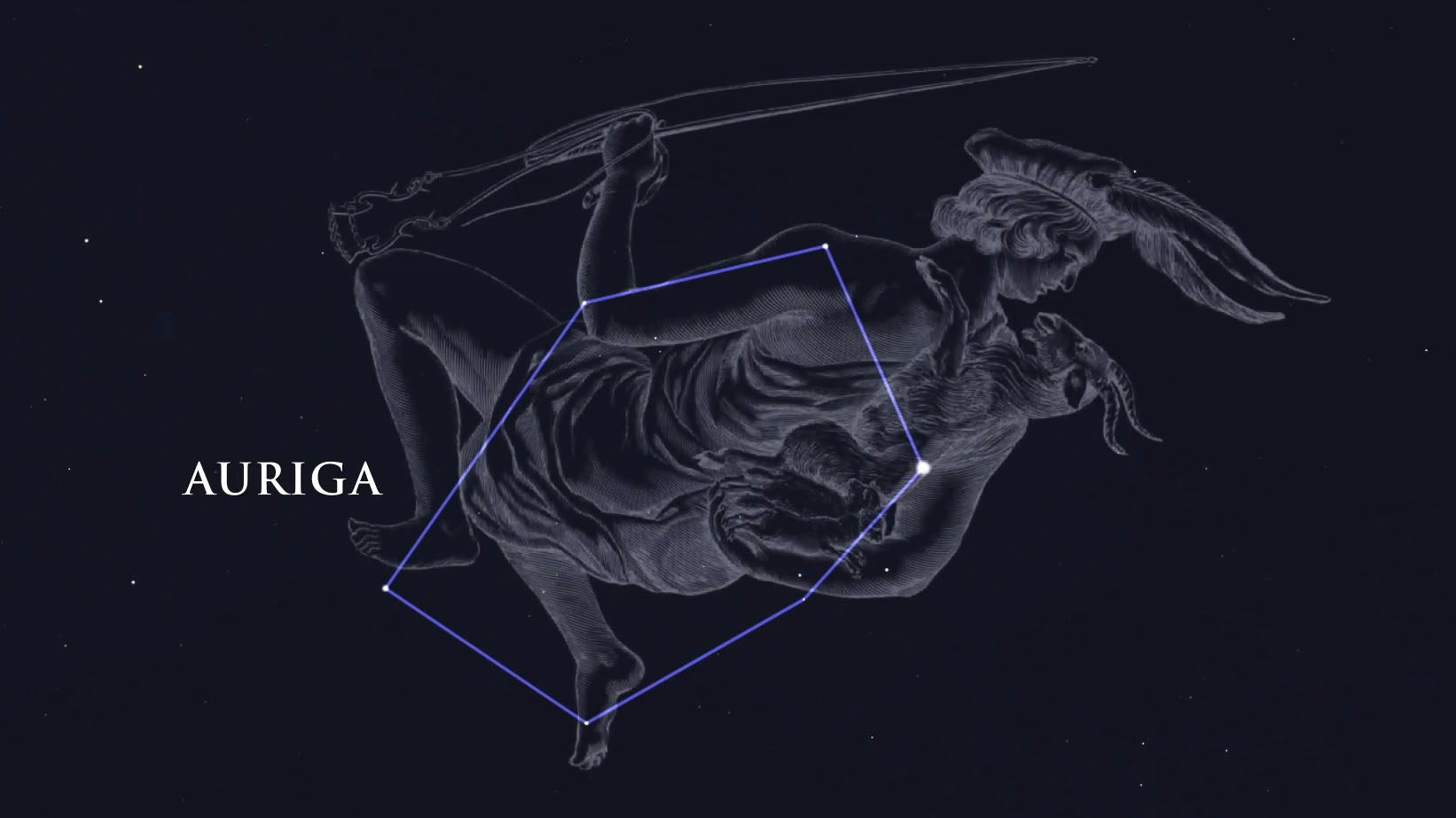
There are many well known chariots and charioteers in ancient Hellenic mythology. All of the Theoi have one, and Helios and Apollon use one to bring light to the world. Hades kidnapped Persephone with His. Kastor and Polideukes were very skilled at driving the fast, light, open, two-wheeled conveyance drawn by two or more horses. Helios lost a son when he let his son Phaethon (Φαέθων) drive his chariot for its morning track through the sky. Phaethon flew too close to the earth and scorched it all; Zeus then cast him down with a lightning-bolt. Yet, these are not the charioteers the constellation is associated with. In this next installment of the constellation series, we will look at the Divine child the constellation refers to... and a few others, because the constellation Auriga has had many interpretations over the years.


For a very long time, war chariots were pulled by two horses only. The charioteer of the constellation is therefor most likely Erichthonios (Ἐριχθόνιος), child of Hēphaistos and Athena, through Gaea, as he invented a chariot pulled by four horses. 

As the myth of his birth goes; Athena went to Hēphaistos' workshop for weaponry, but Hēphaistos--overcome with lust--tried to rape Her instead. Athena fled, but could not flee fast enough. Hēphaistos caught up to Her. Athena fought off Her attacker, but could not prevent Hēphaistos from ejaculating on Her thigh. She wiped Hēphaistos' semen away with a scrap of wool (ἔριον, erion) and flung it to the earth (χθών, chthôn). From it was born Erichthonios, who was part man, and part snake.

In my post about the many legends of Médousa, I posed the following about Athena and the source of Erichthonius' myth and birth as part-snake:

"Athena's role as a snake and fertility Goddess is still visible in the myth about the child she had with Hephaestus; Erichthonios (Ἐριχθόνιος), who was half man, half snake. It's even posed that in the early days, Athena was married to Hephaestus and had His child willingly. As Athena was stripped of Her roles as a fertility and snake Goddess, Médousa's myth came into being, where Athena distances Herself from sex and snakes, by punishing an epithet of herself (Athena Tritogeneia, perhaps: 'born of Trito', a lake which was supposedly located in Libya), or the Libyan snake Goddess Médousa, who may have still been attached to Her worship. By placing Médousa's head on Her breastplate or shield, Athena's mythology is continuously linked to Her Libyan heritage, but harmlessly so, to Her new image of a virginal warrior."

No matter the source, Erichthonios was born, and placed in a box by Athena. She placed the box in the care of three of Her attendants at the Acropolis, with clear instructions not to open the box. They did, of course, and were scared so by the sight of either a snake in the box, or Erichthonios' deformities, they cast themselves off of the Acropolis in terror. Yet, despite his deformities, Erichthonios became king of Athens and ruled it long and well.

He married Praxithea (Πραξιθέα), a naiad, and had a son, Pandion I. He founded the Panathenaiac Festival in the honor of Athena, and set up a wooden statue of her on the Acropolis. He taught his people to yoke horses and use them to pull chariots, to smelt silver, and to till the earth with a plough. His deformities and lameness inspired him to invent the quadriga--or four-horse chariot--to get around easier. He was very skilled as a charioteer, and won many games. Zeus was said to have been so impressed with his skill that he raised him to the heavens to become the constellation Auriga after his death.

There are also other charioteers to whom the constellation could refer; Myrtilus (Μυρτίλος), for example, who was Hermes's son and the charioteer of Oenomaus. Myrtilus's chariot was destroyed in a race intended for suitors to win the heart of Oenomaus's daughter Hippodamia. Myrtilus earned his position in the sky when Hippodamia's successful suitor, Pelops (Πέλοψ), killed him, although he helped him win the woman's hand. After his death, Myrtilus's father Hermes placed him in the sky. 

The constellation could also represent Theseus's son Hippolytos who was rejected from Athens after he refused the romantic advances of his stepmother Phaedra, who committed suicide as a result. He was killed when his chariot was wrecked, but revived by Asklepios. Another possibility is that the constellation does not represent a whole person at all, but is a limb of Mēdeia's brother after she killed and dismembered him.

Occasionally, Auriga is also seen as the Charioteer but as Bellerophon (Βελλεροφῶν), the mortal rider of Pegasus who dared to approach Mount Olympus. In this version of the tale, Zeus pitied Bellerophon for his foolishness and placed him in the stars.

Whomever--or whatever--it represents, Auriga reminds us that the chariot had an important place in ancient Hellenic society. As for the constellation, it is visible at latitudes between +90° and −40°, and best visible at 21:00 (9 p.m.) during the month of late February to early March.
Did I mention I am vacationing on an island? We'll be visiting the sea today, which always reminds me of Poseidon. Thinking of Poseidon always has me think about Euripides' Hippolytos.

The play is set in Troezen, a coastal town in the northeastern Peloponnese. Theseus, the king of Athens, is serving a year's voluntary exile after having murdered a local king and his sons. His illegitimate son is Hippolytos, whose birth is the result of Theseus's rape of the Amazon Hippolyta. Hippolytos has been trained since childhood by the king of Troezen, Pittheus. In it, Theseus's wife, Phaedra, kills herself because she is in love with her stepson Hippolytos instead. It's not her fault, by the way, Aphrodite made her fall in love with him because Hippolytos refuses to honor Aphrodite and honors Artemis instead.Theseus discovers a letter on Phaedra's body, which falsely asserts that she was raped by Hippolytos. Enraged, Theseus curses his son either to death or at least exile and calls upon his father Poseidon, who has promised to grant His son three wishes. Hippolytos gets in his chariot to leave the kingdom, then a bull roars out of the sea, frightens his horses, which dash his chariot among the rocks, dragging Hippolytos behind. Hippolytos seems to be dying and Artemis comes to tell Theseus he made a mistake, that there was no rape, and Theseus gets to at least beg forgiveness of his son before Hippolytos dies.

In honor of the sea and Poseidon, let me give you the description of that gruesome and majestic charge of the water today.


"Just there an angry sound,
Slow-swelling, like God's thunder underground
Broke on us, and we trembled. And the steeds
Pricked their ears skyward, and threw back their heads.
And wonder came on all men, and affright,
Whence rose that awful voice. And swift our sight
Turned seaward, down the salt and roaring sand.

And there, above the horizon, seemed to stand
A wave unearthly, crested in the sky;
Till Skiron's Cape first vanished from mine eye,
Then sank the Isthmus hidden, then the rock
Of Epidaurus. Then it broke, one shock
And roar of gasping sea and spray flung far,
And shoreward swept, where stood the Prince's car.
   
Three lines of wave together raced, and, full
In the white crest of them, a wild Sea-Bull
Flung to the shore, a fell and marvellous Thing.
The whole land held his voice, and answering
Roared in each echo. And all we, gazing there,
Gazed seeing not; 'twas more than eyes could bear.
   
Then straight upon the team wild terror fell.
Howbeit, the Prince, cool-eyed and knowing well
Each changing mood a horse has, gripped the reins
Hard in both hands; then as an oarsman strains
Up from his bench, so strained he on the thong,
Back in the chariot swinging. But the young
Wild steeds bit hard the curb, and fled afar;
Nor rein nor guiding hand nor morticed car
Stayed them at all. For when he veered them round,
And aimed their flying feet to grassy ground,
In front uprose that Thing, and turned again
The four great coursers, terror-mad. But when
Their blind rage drove them toward the rocky places,
Silent and ever nearer to the traces,
It followed rockward, till one wheel-edge grazed.

The chariot tript and flew, and all was mazed
In turmoil. Up went wheel-box with a din,
Where the rock jagged, and nave and axle-pin.
And there—the long reins round him—there was he
Dragging, entangled irretrievably.
A dear head battering at the chariot side,
Sharp rocks, and rippled flesh, and a voice that cried:
"Stay, stay, O ye who fattened at my stalls,
Dash me not into nothing!—O thou false
Curse of my Father!—Help! Help, whoso can,
An innocent, innocent and stainless man!"

Many there were that laboured then, I wot,
To bear him succour, but could reach him not,
Till—who knows how?—at last the tangled rein
Unclasped him, and he fell, some little vein
Of life still pulsing in him."
In a roundabout way, I was asked about sexual abstinence of priests prior to ritual yesterday. As the end of my scholastic career has finally come, I feel inspirationally somewhat deflated, so at this point, I will accept any excuse to borrow someone else's writing subject. If you have any questions about ancient Hellas, Hellenic religion, or mythology--or anything else I cover on this blog--I'd be eternally grateful at this point. Back to the question at hand, though: abstinence. I have tried to find some information on it, but it is sparse. As with my post on the packages of ancient Hellenic statues, there will be lots of euphemisms in this post to prevent my blog from showing up on specific searches by Google.

Honestly, I don't think I have ever come across scholarly work demanding abstinence before ritual. Mikalson in 'Ancient Greek Religion' does mention that intercourse led to 'pollution' (miasma) and that a bath was required before entering a temple after intercourse as a form of katharmos. He, however, does not give a source, and I don't know one either. It is a reoccurring idea, though, mostly centered on the male's excretions during the activity. The Hellenic religious organization 'Labrys' echoes the sentiment, but also without sourcing. Miasma would be one of two reasons I can think of that would support abstinence in a religious setting; power and strength would be the other.

It was common knowledge in ancient Hellas that a male's seed was a source of power for them. In a true 'save it for the game' type of deal, ancient Hellenic athletes were encouraged to abstain before a contest: in this way, they had an extra reserve of (male) power. How this would help them in ritual, I do not know, so I think abstaining for power or strength in ritual would be somewhat counterproductive to the worship part of the rite. That said, 'power' can refer to mean mental strength; in the Symposium, Plato evaluates abstinence as a means to access truth and practice self-control.

Celibacy--a far more extreme form of abstinence--was rarely practiced; that we do know. Priests and priestesses of celibate Theoi would sometimes practice it for the duration of their term, and some even beyond that, but in general, it wasn't a religious requirement, and it wasn't looked upon kindly, even in mythology. As an example, Hippolytos famously forswore his sexuality for the sake of extreme religious devotion to Artemis. When Hippolytos’ step-mother, Phaedra, falls desperately in love with him, he rejects her. Phaedra kills herself in revenge, and accuses Hippolytos of rape in a suicide note. Theseus, the boy's father, reads the note and calls to the Theoi to bring death u;on his son, who is swiftly killed. The playwright Euripides famously brought this story to the stage in his tragedy Hippolytus, which explores this question of suppressing sexual desire in order to access a higher religious objective--namely that his extreme piety is arrogant, as sexual desire and love are gifts from other Theoi.

Total male abstinence is problematic since it paradoxically exemplifies self-control while opposing the Hellenic ideal of moderation. Although elements of sexual restraint are virtuous in certain contexts, permanent abstinence was considered both unnatural and dangerous. From everything I have read, it seems women were even less capable of abstaining, and it was considered especially dangerous to allow women to do so as their wild and primal nature would emerge. Interestingly enough, when women were required religiously to abstain, it was during festivals of Demeter and Persephone. I suspect that this was in large part due to a fertility element linked to the festivals, but I can not help link a certain sense of wildness to the practice as well, especially because these festivals were largely women-only.

Hippocratic writings on health from the fifth century BC address the virtues of self-control and the dangers of being oversexed or undersexed. Hippocrates speaks of 'undersexed women' in (I believe) 'Nature of the Child' or 'The Seed', meaning virgins and celibates, and describes that they display signs of lethargy, numbness, and madness, ascribed to 'a build up of fluid due to a lack of sexual intercourse'. Marriage and the sexual intercourse that surely follows is seen as the ideal cure for such symptoms. For men also, abstinence was seen as unhealthy.  At the other end of the spectrum, excessive sexual activity was considered unhealthy and dangerous. In 'The Seed' sperm is identified to be the most potent and vital part of the body, since 'the body is significantly weakened by its loss'.

It seems that  abstinence was tolerated as a temporary practice, notably during athletic competitions and festivals, but not encouraged as a permanent state of being. The philosophers, specifically Orphics and Pythagoreans, promoted abstinence of meat and sex, but their ideas were on the fringes of Hellenic society, and did not reflect more widely accepted ideas. It is important to note that even they only encouraged male abstinence.

So, do I feel abstaining is necessary for Hellenistic rites? No, unless there is documented evidence that the ancient Hellenes did it for that specific festival. If you do have sexual relations before a rite, take a bath or shower. Present yourself clean and free of miasma. The ancient Hellenes had a very healthy view of sex, and saw the desire for it as completely healthy and divinely inspired. I'm  big proponent of viewing sex in a likewise manner.
There are many well known chariots and charioteers in ancient Hellenic mythology. All of the Theoi have one, and Helios and Apollon use one to bring light to the world. Hades kidnapped Persephone with His. Kastor and Polideukes were very skilled at driving the fast, light, open, two-wheeled conveyance drawn by two or more horses. Helios lost a son when he let his son Phaethon (Φαέθων) drive his chariot for its morning track through the sky. Phaethon flew too close to the earth and scorched it all; Zeus then cast him down with a lightning-bolt. Yet, these are not the charioteers the constellation is associated with. In this next installment of the constellation series, we will look at the Divine child the constellation refers to... and a few others, because the constellation Auriga has had many interpretations over the years.


For a very long time, war chariots were pulled by two horses only. The charioteer of the constellation is therefor most likely Erichthonios (Ἐριχθόνιος), child of Hēphaistos and Athena, through Gaea, as he invented a chariot pulled by four horses. 

As the myth of his birth goes; Athena went to Hēphaistos' workshop for weaponry, but Hēphaistos--overcome with lust--tried to rape Her instead. Athena fled, but could not flee fast enough. Hēphaistos caught up to Her. Athena fought off Her attacker, but could not prevent Hēphaistos from ejaculating on Her thigh. She wiped Hēphaistos' semen away with a scrap of wool (ἔριον, erion) and flung it to the earth (χθών, chthôn). From it was born Erichthonios, who was part man, and part snake.

In my post about the many legends of Médousa, I posed the following about Athena and the source of Erichthonius' myth and birth as part-snake:

"Athena's role as a snake and fertility Goddess is still visible in the myth about the child she had with Hephaestus; Erichthonios (Ἐριχθόνιος), who was half man, half snake. It's even posed that in the early days, Athena was married to Hephaestus and had His child willingly. As Athena was stripped of Her roles as a fertility and snake Goddess, Médousa's myth came into being, where Athena distances Herself from sex and snakes, by punishing an epithet of herself (Athena Tritogeneia, perhaps: 'born of Trito', a lake which was supposedly located in Libya), or the Libyan snake Goddess Médousa, who may have still been attached to Her worship. By placing Médousa's head on Her breastplate or shield, Athena's mythology is continuously linked to Her Libyan heritage, but harmlessly so, to Her new image of a virginal warrior."

No matter the source, Erichthonios was born, and placed in a box by Athena. She placed the box in the care of three of Her attendants at the Acropolis, with clear instructions not to open the box. They did, of course, and were scared so by the sight of either a snake in the box, or Erichthonios' deformities, they cast themselves off of the Acropolis in terror. Yet, despite his deformities, Erichthonios became king of Athens and ruled it long and well.

He married Praxithea (Πραξιθέα), a naiad, and had a son, Pandion I. He founded the Panathenaiac Festival in the honor of Athena, and set up a wooden statue of her on the Acropolis. He taught his people to yoke horses and use them to pull chariots, to smelt silver, and to till the earth with a plough. His deformities and lameness inspired him to invent the quadriga--or four-horse chariot--to get around easier. He was very skilled as a charioteer, and won many games. Zeus was said to have been so impressed with his skill that he raised him to the heavens to become the constellation Auriga after his death.

There are also other charioteers to whom the constellation could refer; Myrtilus (Μυρτίλος), for example, who was Hermes's son and the charioteer of Oenomaus. Myrtilus's chariot was destroyed in a race intended for suitors to win the heart of Oenomaus's daughter Hippodamia. Myrtilus earned his position in the sky when Hippodamia's successful suitor, Pelops (Πέλοψ), killed him, although he helped him win the woman's hand. After his death, Myrtilus's father Hermes placed him in the sky. 

The constellation could also represent Theseus's son Hippolytos who was rejected from Athens after he refused the romantic advances of his stepmother Phaedra, who committed suicide as a result. He was killed when his chariot was wrecked, but revived by Asklepios. Another possibility is that the constellation does not represent a whole person at all, but is a limb of Mēdeia's brother after she killed and dismembered him.

Occasionally, Auriga is also seen as the Charioteer but as Bellerophon (Βελλεροφῶν), the mortal rider of Pegasus who dared to approach Mount Olympus. In this version of the tale, Zeus pitied Bellerophon for his foolishness and placed him in the stars.

Whomever--or whatever--it represents, Auriga reminds us that the chariot had an important place in ancient Hellenic society. As for the constellation, it is visible at latitudes between +90° and −40°, and best visible at 21:00 (9 p.m.) during the month of late February to early March.