Showing posts with label Hēphaistos. Show all posts

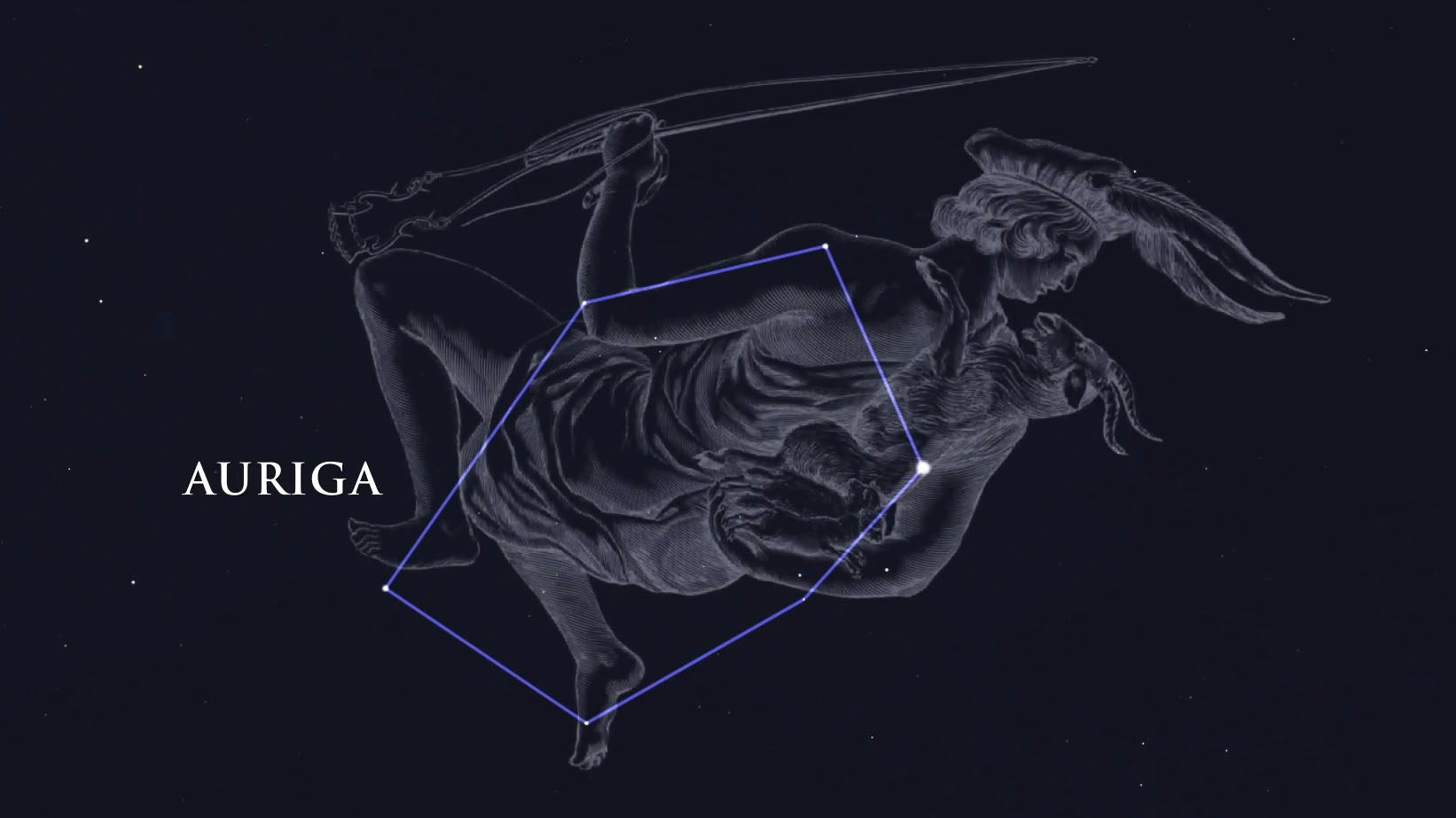
There are many well known chariots and charioteers in ancient Hellenic mythology. All of the Theoi have one, and Helios and Apollon use one to bring light to the world. Hades kidnapped Persephone with His. Kastor and Polideukes were very skilled at driving the fast, light, open, two-wheeled conveyance drawn by two or more horses. Helios lost a son when he let his son Phaethon (Φαέθων) drive his chariot for its morning track through the sky. Phaethon flew too close to the earth and scorched it all; Zeus then cast him down with a lightning-bolt. Yet, these are not the charioteers the constellation is associated with. In this next installment of the constellation series, we will look at the Divine child the constellation refers to... and a few others, because the constellation Auriga has had many interpretations over the years.


For a very long time, war chariots were pulled by two horses only. The charioteer of the constellation is therefor most likely Erichthonios (Ἐριχθόνιος), child of Hēphaistos and Athena, through Gaea, as he invented a chariot pulled by four horses. 

As the myth of his birth goes; Athena went to Hēphaistos' workshop for weaponry, but Hēphaistos--overcome with lust--tried to rape Her instead. Athena fled, but could not flee fast enough. Hēphaistos caught up to Her. Athena fought off Her attacker, but could not prevent Hēphaistos from ejaculating on Her thigh. She wiped Hēphaistos' semen away with a scrap of wool (ἔριον, erion) and flung it to the earth (χθών, chthôn). From it was born Erichthonios, who was part man, and part snake.

In my post about the many legends of Médousa, I posed the following about Athena and the source of Erichthonius' myth and birth as part-snake:

"Athena's role as a snake and fertility Goddess is still visible in the myth about the child she had with Hephaestus; Erichthonios (Ἐριχθόνιος), who was half man, half snake. It's even posed that in the early days, Athena was married to Hephaestus and had His child willingly. As Athena was stripped of Her roles as a fertility and snake Goddess, Médousa's myth came into being, where Athena distances Herself from sex and snakes, by punishing an epithet of herself (Athena Tritogeneia, perhaps: 'born of Trito', a lake which was supposedly located in Libya), or the Libyan snake Goddess Médousa, who may have still been attached to Her worship. By placing Médousa's head on Her breastplate or shield, Athena's mythology is continuously linked to Her Libyan heritage, but harmlessly so, to Her new image of a virginal warrior."

No matter the source, Erichthonios was born, and placed in a box by Athena. She placed the box in the care of three of Her attendants at the Acropolis, with clear instructions not to open the box. They did, of course, and were scared so by the sight of either a snake in the box, or Erichthonios' deformities, they cast themselves off of the Acropolis in terror. Yet, despite his deformities, Erichthonios became king of Athens and ruled it long and well.

He married Praxithea (Πραξιθέα), a naiad, and had a son, Pandion I. He founded the Panathenaiac Festival in the honor of Athena, and set up a wooden statue of her on the Acropolis. He taught his people to yoke horses and use them to pull chariots, to smelt silver, and to till the earth with a plough. His deformities and lameness inspired him to invent the quadriga--or four-horse chariot--to get around easier. He was very skilled as a charioteer, and won many games. Zeus was said to have been so impressed with his skill that he raised him to the heavens to become the constellation Auriga after his death.

There are also other charioteers to whom the constellation could refer; Myrtilus (Μυρτίλος), for example, who was Hermes's son and the charioteer of Oenomaus. Myrtilus's chariot was destroyed in a race intended for suitors to win the heart of Oenomaus's daughter Hippodamia. Myrtilus earned his position in the sky when Hippodamia's successful suitor, Pelops (Πέλοψ), killed him, although he helped him win the woman's hand. After his death, Myrtilus's father Hermes placed him in the sky. 

The constellation could also represent Theseus's son Hippolytos who was rejected from Athens after he refused the romantic advances of his stepmother Phaedra, who committed suicide as a result. He was killed when his chariot was wrecked, but revived by Asklepios. Another possibility is that the constellation does not represent a whole person at all, but is a limb of Mēdeia's brother after she killed and dismembered him.

Occasionally, Auriga is also seen as the Charioteer but as Bellerophon (Βελλεροφῶν), the mortal rider of Pegasus who dared to approach Mount Olympus. In this version of the tale, Zeus pitied Bellerophon for his foolishness and placed him in the stars.

Whomever--or whatever--it represents, Auriga reminds us that the chariot had an important place in ancient Hellenic society. As for the constellation, it is visible at latitudes between +90° and −40°, and best visible at 21:00 (9 p.m.) during the month of late February to early March.

The redesigned lighting for all the major Athenian monuments is now complete, with the new lighting for the temple of Hephaestus and the monument to Philopappos shown for the first time on Tuesday evening in the Greek capital.

The lighting for these treasured historical sites, designed by by Eleftheria Deko, signals the completion of the lighting redesign for the Acropolis and all the monuments associated with the greatest historical sites in the city.

The Greek Ministry of Culture and Sports announced the conclusion of the lighting redesign, which was made possible by the Onassis Foundation and completed under the auspices of the Ministry of Culture and Sports.

According to the Ministry, the two monuments are now illuminated using the same philosophy and technology that was earlier implemented on the Acropolis, so that there is a “common vocabulary” between the buildings as seen from every part of the city.

It was not only a new aesthetic that was part of the plan, however; there was also an upgrade to the monuments’ existing technical infrastructure, including a new wiring and automation system for the lights. This will ensure energy savings, keep maintenance costs at a minimum and avoid light pollution into the skies above the Greek capital.

High-color performance LED floodlights were used throughout, just as in the lighting of the Acropolis monuments, and all lights are adjustable at all levels. According to the Ministry, this offers “considerable flexibility in creating different lighting scenarios and achieving the appropriate lighting depending on the location and point of interest (dome, columns, metope, and pediment).”

The temple of Hephaestus, dedicated to the god Hephaestus and Athena Ergani and commonly referred to as “Thissio,” is located on the hill of Agoraios Kolonos, on the west side of the Ancient Agora in Athens. The monument of Philopappos, which was named after Gaius Julius Antiochus Epiphanes Philopappos, is located on the Hill of the Muses, southwest of the Acropolis.


It's the season of gift-giving! Even while socially distanced, this is possible, and of course encouraged. Who doesn't like gifts? And spreading some joy? Order online and have it delivered, or drop gifts off at the door. Why not buy someone a subscription to a service they might enjoy? Options galore! But where does the practice come from and is it important in Hellenism?

Giving gifts to friends, family members, or even acquaintances and complete strangers is a long standing tradition. It existed long before ancient Hellas, but was, indeed, a vital part of its culture. It was tied to both kharis and xenia. Gifts were exchanged between monarchs of city-states to create good will, and were thus an important part of diplomacy. All votives, thank-offerings, and pinakes were gifts from mortals to Theoi. Athletic competitions always concluded with a price--a gift--awarded to the winner. Gifts were given to the submissive partner in a pederastic relationship, and to favored prostitutes and serfs. Gifts played a much more significant role in ancient Hellenic society as a whole than they do in ours today. The giving of gifts in ancient Hellas was not just a social event, however. There was far more to the practice than one might assume, and today, we will look at the tradition of gift giving in greater detail.

I have spoken of the importance of gifts in xenia before. A gift given as part of ritual hospitality was called a xenion (ξεινήιον). This xenion was expected to be expensive, and was presented to the guest upon departure. Needless to say, this practice was mostly executed by nobility, or at least the elite, and happened mostly when a man of equal social standing from another nation or city-state came to visit. In the Odysseia, Telemachos, son of Odysseus, receives from Menelaus a cup made by Hēphaistos Himself:

"But stay here in the palace, till the eleventh or the twelfth day, and I will send you off with honours, and fine gifts, a shining chariot with a trio of horses, and a glorious cup with which to pour libations to the deathless gods, while remembering me all your days."

The practice of gift giving to someone of another nation whom you might never see again, might seem counter-intuitive, but it's actually quite the opposite. By presenting a foreign equal with a great gift, not only do you establish kharis between the two of you, you also indebt the other person to you: they can not repay your kindness at this time, but they will compensate you for it when you visit, or when you are in need. On top of that, the recieving party will go home with tales of your hospitality, and your wealth, providing a boost in stature to the family and the land. It increases the honor of both, something very important to the ancient Hellenes. Gifts, in this context, functioned as a means of communication, legitimization, and mediation between benefactors and cities.

Beyond the elite, gift-giving was still very important, especially between men. The practice was a feature of the symposion, where it was displayed between men in a pederastic relationship, as well as between men of equal standing. Pederasty was where a mature male would take a young boy as his pupil and lover. The relationship was not about love: it was a social construct that allowed to boy time to get to know influential men, and to work himself up into their ranks. Because of this, there were many ritual acts connected to the practice, amongst which the giving of gifts, from mentor to pupil. Three gifts were traditional: military attire, an ox, and a drinking cup, but the youth most certainly received more expensive gifts.

One of the places the young lover would have been taken was the symposion. By allowing the young boy into the symposion it enabled the adults to prepare them for adult life and war in particular. Once the boys grew up, they became one of the men, taking young boys as lovers themselves, and teaching them the ropes of adult malehood. Gift giving in this context allows for a community to become closer, and for a young boy to prepare for his life as a man. Giving gifts--to their young lovers, as well as to those of equal age and standing--allowed men to teach the importance of equal distribution and redistribution of wealth, which was a founding factor of (mostly Athenian) society. It was also a status symbol: if one had time to visit the symposia, and give expensive gifts, they were not only citizens, but wealthy citizens, a clear mark that they were fit for greater responsibility within the political landscape of the city.

Most of these examples are from wealthy city-states like Athens, but there is evidence of gift-giving in other city-states as well. Sparta, for example, greatly frowned upon the flaunting of wealth, but they, too, gave gifts. These, however, were mostly practical in nature between the citizens themselves--fresh game, honey, perhaps a hunting dog--and were honors bestowed upon the person in the case of big events, or an a-symmetrical relationship. A Spartan winner of important sporting events, for example, would be allowed a place in the royal guard of the King, where Athenian winners would be set up for life, including food, housing, and status.

Another form of gift-giving was from a wealthy citizen to the community. This practice was dubbed 'Euergetism', from the Hellenic 'εὐεργετέω': 'I do good things'. While the money spent this way was, indeed a voluntary action on the part of the citizen, he was socially obligated to participate in the practice. Many roads and public buildings were funded this way, and thus bore the name of the citizen that had donated the funds--something we find archeological evidence for to this day.

Gift giving was of vital importance in the Archaic and Early Classical times, most notably in a social, ethical, economic, and political context. In the Classical period--which witnessed the development of elaborate monetary and law systems--the giving of gifts, and the associated benefits, became less prominent in economic and political contexts, though it did remain central in social and religious systems. Gift-giving and reciprocity did return to the Athenian stage, however, in the Hellenistic age, when much of the previously described took place.

Gift giving was of unparalleled important to the ancient Hellenes, but has lost much of its standing today. For those who reconstruct the ancient Hellenic religion, it might be a good exercise to examine these practices, and implement a symbolic exchange. Lavish gifts would not be necessary, but a parting gift by the host on days then the group comes together might make a nice, ritualistic, reminder that the contributions of the group were welcomed, and the effort to travel to the meeting place recognized--after the pandemic, of course!

This Christmas, we'll do door drop-offs with the family and then we're all meeting on Zoom from the safety of our own homes to unwrap the gifts we've gotten and read the poems we write along with them out loud to one another. You make do in a pandemic! 

Stay safe this season and stay smart. It's just one Christmas, the risks are not worth it.

Image taken from: Sparta Reconsidered

The 29th of Pyanepsion is the date for the Khalkeia. It's the only festival to be held on a Deipnon and we will be celebrating it on 17 October, 10 am EDT.


The Khalkiea was the festival of bronze workers, a religious festival devoted to the God Hēphaistos and the Goddess Athena Ergane (Εργανη, Worker). In ancient Hellas, this was the day priestesses of Athena started work on a special peplos to be presented to Her during the Panathenaia. This festival involved a procession of workers with baskets of grain for offerings as well as meat sacrifices. Originally, it seems to have been a festival for Athena solely but over the centuries the focus shifted to Hēphaistos instead.

Elaion is holding a PAT ritual for the Khalkeia on 17 October, EDT. You can find the ritual here and join the community here. Also, make sure to celebrate the day by doing something crafty!
Unless stated otherwise, nothing in this post is drawn from ancient sources. Most of it isn't even UPG. It's a thought exercise. Way back when I was still doing the Pagan Blog Project posts, I wrote about genealogy of the Gods. I ended that post with the following:

"One sad part of studying Divine genealogy is that there is an end. The lives of the Gods have come to a halt. We rehash the stories but no more children are born, no heroes rise. It makes me wish for the inclusion and revelation of UPG into Hellenismos. New blood, new stories, could really benefit the practice and believes of Hellenic practitioners. A new Divine child to shake up the pantheon, a new child of Zeus who grows up to fight new (or returned) monsters. Sacrilege, some say, and they might be right. But I admit to staring at the pages of genealogy in my book and wishing the lines, somehow, someway, extend to include more of the Divine family. "

I still feel that way. I still wish for a line that continues onto now. But, seeing as we don't have that, I'm going to make another mental leap. I'm going to see who of the Theoi would oversee some of the modern marvels, should They be willing to adopt them.

The internet and the telephone
It's one of humanities greatest achievements; a real-time communication link between every person on the planet who has access to a computer and a subscription. It's not one thing; it's housed on computers everywhere, everyone adding a small part to it, so you can read these words from any place in the world. I'm quite sure who would have this marvel in their portfolio: Iris, rainbow Goddess of communication, who delivers Her messages as fast and the wind and who has always been a connector; in ancient Hellas, She connected the Theoi and mankind. Her speed, Her messenger spirit, and her ability to connect everyone anywhere in the world make Her an excellent candidate for the position of Patroness of the Internet.
For most of the same reasons, I would also place the telephone firmly under Her domain.

Planes, trains and automobiles
I'm staying with the sky Gods on this one; airplanes, trains and cars have cut down travel time, have made goods readily available anywhere in the world, have allowed us to expand modern life to parts of the world where this was absolutely impossible before, and--in the case of airplanes--have given us entrance into Zeus' domain. yet, I don't feel Zeus would oversee flight. I think that would be Hermes' task. Airplanes would be a marvelous novelty for Hermes, who is known to fly everywhere. It's this huge, bulky, thing that miraculously stays in the air. I think Hermes would get a kick out of throwing a few air pockets in the way of a plane--just to see the panic on everyone's faces--before helping the plane land safely. Trains and cars go fast, make a lot of noise and are constantly out on the road. This, too, would make Hermes happy. Hēphaistos may be involved with the construction of these travel aids, but Hermes would watch over your safety while in them.

Computers
As already discussed a bit with the internet, modern life would change dramatically if we lost computers. they help us communicate, solve problems beyond our natural capabilities, provide entertainment, allow us to make a living and that's just scratching the surface of its usefulness. For me, this is another no-brainer: Hēphaistos. If Daidalos had been a Theos, I would have picked him. Athena's analytical mind may have had a part in its creation as well, but the actual tinkering bits would speak to Hēphaistos far more than to Athena. Once the first computer was completed, I would see it likely Athena lost interest, while Hēphaistos would relish the challenge of improving upon it again and again.

The radio and television
A slightly older means of communication, but none the less very valuable. Radio signals connect people, are used in jobs like airport control, security and construction, and bring music to the masses. Because of the broad application of the radio, and especially because of the music, I'm picking Apollon for this one. Anything that brings music all over the world would interest him greatly. Because of its ability to amuse, educate and spread awareness, the television would also fall under Apollon's domain.

Bombs, guns, tanks and other weapons of war
It's a cheap shot, but for their sheer destructive power, I would place any weapon of war under Ares' domain. It may not be honorable, but weapons of war are effective. When His rage reaches the point of no return, I'm sure His hands would itch to just wipe out the enemy. In fact, I think Ares would have felt a whole lot better if He would have been able to decimate the Hellenic army besieging Troy with a few powerful bombs. He is still the Lord of War. As for some of the other war-like Theoi; I think Athena and Zeus would find these methods too crude and/or imprecise. They would like the sniper rifle and, perhaps, to tinker with the missile guidance systems, but actual weapons of mass destruction? Not so much.

This is a top-of-my-head list. Are there others you have ideas about? I'm sure Aphrodite would be happy with the invention of sex toys, and Apollon with electric lights, for example. I'd also really love to hear if you had envisioned other Theoi with these examples. Have fun!
The 29th of Pyanepsion is the date for the Khalkeia. It's the only festival to be held on a Deipnon and we will be celebrating it on 28 October, 10 am EDT.


The Khalkiea was the festival of bronze workers, a religious festival devoted to the God Hēphaistos and the Goddess Athena Ergane (Εργανη, Worker). In ancient Hellas, this was the day priestesses of Athena started work on a special peplos to be presented to Her during the Panathenaia. This festival involved a procession of workers with baskets of grain for offerings as well as meat sacrifices. Originally, it seems to have been a festival for Athena solely but over the centuries the focus shifted to Hēphaistos instead.

Elaion is holding a PAT ritual for the Khalkeia on 28 October, EDT. You can find the ritual here and join the community here. Also, make sure to celebrate the day by doing something crafty!
What follows is the writing of Lucian of Samosata (Λουκιανὸς ὁ Σαμοσατεύς), who lived from 125 to 180 AD. He was a Hellenic rhetorian and satirist. It is from his 'Dialogues of the Gods', which contains some of my favorite passages written by an ancient Hellenic author ever. This version of the text was translated by Fowler, H W and F G. Oxford: The Clarendon Press. 1905. This is the dialogue of Hēphaistos and Apollon about young thieving Hermes. The text is copied--unedited--from Theoi.com.


HEPHAESTUS
Have you seen Maia's baby, Apollo? such a pretty little thing, with a smile for everybody; you can see it is going to be a treasure.

APOLLO
That baby a treasure? well, in mischief, Iapetus is young beside it.

HEPHAESTUS
Why, what harm can it do, only just born?

APOLLO
Ask Posidon; it stole his trident. Ask Ares; he was surprised to find his sword gone out of the scabbard. Not to mention myself, disarmed of bow and arrows.

HEPHAESTUS
Never! that infant? he has hardly found his legs yet; he is not out of his baby-linen.

APOLLO
Ah, you will find out, Hephaestus, if he gets within reach of you.

HEPHAESTUS
He has been.

APOLLO
Well? all your tools safe? none missing?

HEPHAESTUS
Of course not.

APOLLO
I advise you to make sure.

HEPHAESTUS
Zeus! where are my pincers?

APOLLO
Ah, you will find them among the baby-linen.

HEPHAESTUS
So light-fingered? one would swear he had practised petty larceny in the womb.

APOLLO
Ah, and you don't know what a glib young chatterbox he is; and, if he has his way, he is to be our errand-boy! Yesterday he challenged Eros—tripped up his heels somehow, and had him on his back in a twinkling; before the applause was over, he had taken the opportunity of a congratulatory hug from Aphrodite to steal her girdle; Zeus had not done laughing before—the sceptre was gone. If the thunderbolt had not been too heavy, and very hot, he would have made away with that too.
                 
HEPHAESTUS
The child has some spirit in him, by your account.

APOLLO
Spirit, yes—and some music, moreover, young as he is.

HEPHAESTUS
How can you tell that?

APOLLO
He picked up a dead tortoise somewhere or other, and contrived an instrument with it. He fitted horns to it, with a cross-bar, stuck in pegs, inserted a bridge, and played a sweet tuneful thing that made an old harper like me quite envious. Even at night, Maia was saying, he does not stay in Heaven; he goes down poking his nose into Hades—on a thieves' errand, no doubt. Then he has a pair of wings, and he has made himself a magic wand, which he uses for marshalling souls—convoying the dead to their place.

HEPHAESTUS
Ah, I gave him that, for a toy.

APOLLO
And by way of payment he stole—

HEPHAESTUS
Well thought on; I must go and get them; you may be right about the baby-linen.
The 29th of Pyanepsion is the date for the Khalkeia. It's the only festival to be held on a Deipnon and we will be celebrating it on 7 November, 10 am EDT.


The Khalkiea was the festival of bronze workers, a religious festival devoted to the God Hēphaistos and the Goddess Athena Ergane (Εργανη, Worker). In ancient Hellas, this was the day priestesses of Athena started work on a special peplos to be presented to Her during the Panathenaia. This festival involved a procession of workers with baskets of grain for offerings as well as meat sacrifices. Originally, it seems to have been a festival for Athena solely but over the centuries the focus shifted to Hēphaistos instead.

Elaion is holding a PAT ritual for the Khalkeia on 20 October, EDT. You can find the ritual here and join the community here. Also, make sure to celebrate the day by doing something crafty!

I've been thinking about and researching the myth of Pandora lately. I'm fairly certain most--if not all--of you know the myth of Pandôra. For those who may not, or not know it completely, I will retell it first:

After the Titanomachy ends, Zeus claims His throne as rightful King to the Deathless Ones. Humanity did not yet exist. While most Titans were locked away in Tartarus by Zeus, Prometheus and Epimetheus--who were brothers--had been either neutral or on the side of Zeus during the Titan War and were therefor given a task. Prometheus was given the task of creating man and Epimetheus was ordered go give good qualities to all creatures of earth. So did Prometheus and Epimetheus. Prometheus shaped man out of clay and Athena breathed life into him. Epimetheus spread swiftness, cunning, fur and wings but ran out of gifts when he came to man. Prometheus remedied the situation by allowing men to walk upright and gave them fire.

It soon became apparent that Prometheus loved man more than the Olympians. When Zeus decreed that man must give sacrifice to the Deathless Ones, Prometheus stood ready to aid humanity. He butchered an animal and divided it in to piles; the bones and fat formed one of them, the good meat wrapped in the hide of the animal, the other. Zeus vowed that he would abide by the choice He made now, and picked the tasty looking pile of bones. Zeus was angered but could not take back his vow. What he could take back, was the gift of fire, and this he did.

Mankind suffered greatly without fire and Prometheus traveled either to the sun or Olympus to reclaim fire for his beloved mankind. This, of course, angered Zeus even further and so he devised a plan. First, he imprisoned Prometheus. He ordered Hermes to tie Prometheus to a mountain and had a giant Eagle come every day to eat his liver. As an immortal, Prometheus' liver grew back over night so his torment was endless. Before Prometheus had been taken prisoner, however, he had told his brother Epimetheus never to accept a gift from Zeus, as Zeus' wrath would undoubtedly also extend to the mortal race He had created. 

And Zeus, indeed, was not done with His punishment. After imprisoning Prometheus, Zeus assembled the Theoi. He told Hēphaistos to fashion a woman out of water and clay. Hēphaistos did and brought the statue before Zeus. Zeus then asked Aphrodite to bless the woman with a beauteous face and feminine whiles. He asked Athena to dress her modestly and give her the ability to weave and craft, Demeter taught her to tend the garden. From Apollon, she received the ability to make music and sing. All Gods gave her treacherous gifts, including Hera, who made her curious, and Hermes, who made her cunning and quick of the tongue. Then, Zeus named her Pandôra (Πανδωρα), All-Giving, and breathed life into her. He then bade Hermes to deliver her to Epimetheus, along with a vase (pithos) Pandôra was never allowed to open.

Epimetheus had been warned by Prometheus never to open or accept a gift from Zeus, but he laid eyes on Pandôra's beauty and fell in love too deeply to reject her. He took her into his home amongst men and wedded her right away. And Pandôra loved Epimetheus, because he was a good man and good husband. She worked tirelessly to please him and helped him keep the home. Yet, she found herself drawn to the pithos she was told never to open. Her eyes would wander to it constantly and Hera's gift eventually prevented her from holding to her promise. 

On a day when Epimetheus was away from the home, Pandôra decided to risk a sneak peak at the contents she had fantasized about so often. She pulled the lid off of the pithos and out flew dark spirits of disease, death and the destruction of humanity. Pandôra hastened to seal the jar but managed to trap only Hope (Elpis)--by Zeus' decree or by mere accident.

Mankind was now plagued with illness, with failing crops, with all that make life hard. But they had Hope and soon, Pyrrha (Fire) was born to Epimetheus and Pandôra. Years later, when Zeus would flood the earth, Pyrrha and her husband Deukalion would survive and re-create the human race by throwing pebbles behind themselves as they walked; Deukalion would create the men and Pyrrha the women.

There are countless versions of this tale. It's featured heavily in Hesiod's Theogony and Works & Days but there seem to be older versions of the myth in which Pandôra was not made by Zeus but was an epithet of Demeter or Gaea who became a separate Deity. As such, Pandôra was a harvest Goddess, a Goddess risen from the earth to bestow gifts upon humanity. This would certainly seem closer to the meaning of her name; All-Giving.

The problem with the 'Pandôra's Box' myth as written above is in the inconsistencies. If Zeus wanted to punish mankind, why give them a beautiful woman? Why not drop the jar in front of some poor farmer and have him open it? Was there no curiosity in men at all? Why give Pandôra the ability to craft, sing and work diligently when she's there solely to punish mankind? If the pithos was a prison for the evils of the world, why was Hope locked in there as well? And if the pithos was, indeed, a prison, shouldn't we be without hope now? The same is true for a scenario in which there were actual gifts in the jar; why was Hope kept from humanity?

Scholars have tried valiantly to answer these questions but it doesn't become much clearer. There is a very old reference to pithos and Zeus in Hómēros' Illiad:

"There are two urns (pithoi) that stand on the door-sill of Zeus. They are unlike for the gifts they bestow: an urn of evils (kakoi), an urn of blessings (dôroi). If Zeus who delights in thunder mingles these and bestows them on man, he shifts, and moves now in evil, again in good fortune. But when Zeus bestows from the urn of sorrows, he makes a failure of man, and the evil hunger drives him over the shining earth, and he wanders resepected neither of gods nor mortals."

Could one of these have been given to Pandôra? And if so, which one? Was it the pithos holding the kakoi or the pithos holding the dôroi? Her name seems to indicate the latter, the myth the former. If it's the pithos holding the kakoi, why was hope in that jar? Shouldn't hope have been in the other jar? If it was the pithos holding the dôroi, why was it a good thing hope stayed behind? Don't we need hope? And if hope is a bad thing, why was it in the jar of blessings? Another possibility is that, when opening the jar, the blessings--because this theory works only if the pithos that was given to Pandora was a pithos of blessings--Pandôra caused mankind to lose the blessings Prometheus had bestowed upon them. All that was left, was hope.

Aeschylus, writer of a Hellenic tragedy dating back to C5th B.C. indicated that it was not Zeus, but Prometheus, who saved Hope from leaving the jar and, as Aeschylus explains it, our hearths:

Prometheus: Yes, I caused mortals to cease foreseeing their doom.
Chorus: Of what sort was the cure that you found for this affliction? 
Prometheus: I caused blind hopes to dwell within their breasts.
Chorus: A great benefit was this you gave to mortals.

If this was the case, the jar would have, indeed, contained blessings which were lost upon opening of the jar. Prometheus kept hope alive for humanity, allowing us to weather the evils already in the world even now we had lost most of our ability to withstand it. 

This idea is not as weird as it may sound; I spoke earlier of the Ages of Man. Every new age, we lost more gifts from the Gods because our gifts gave us hubris. Because this myth is set before the flood of Deukalion, it's set in the Bronze Age. Hesiod had this to say about the Bronze Age:

Zeus the Father made a third generation of mortal men, a brazen race, sprung from ash-trees, and it was in no way equal to the silver age, but was terrible and strong. They loved the lamentable works of Ares and deeds of violence; they ate no bread, but were hard of heart like adamant, fearful men. Great was their strength and unconquerable the arms which grew from their shoulders on their strong limbs. Their armour was of bronze, and their houses of bronze, and of bronze were their implements: there was no black iron. These were destroyed by their own hands and passed to the dank house of chill Hades, and left no name: terrible though they were, black Death seized them, and they left the bright light of the sun.

Parts of it come close to a world void of hope, full of evils and/or void of all goodness but hope. It was a bad age and the people who lived in it, destroyed themselves--perhaps due to whatever was in that pithos?--and remained forever nameless spirits. Of course, the creation myth part of this age doesn't fit the myth at all.

Perhaps, Pandôra was an invention of her time, following a shift in culture towards a patriarchal society. Perhaps, her myth got mangled when it came in contact with the story of Adam and Eve, which it resembles. It is said that the Theoi cannot impede on humanity's free will and so they created a creature with the will to do as they pleased. Quite a nice loop in that clause, hm? Whatever happened, I don't think Pandôra meant any harm. She was made to be a certain way, to reach a certain goal, and she did.