Showing posts with label Kerberos. Show all posts

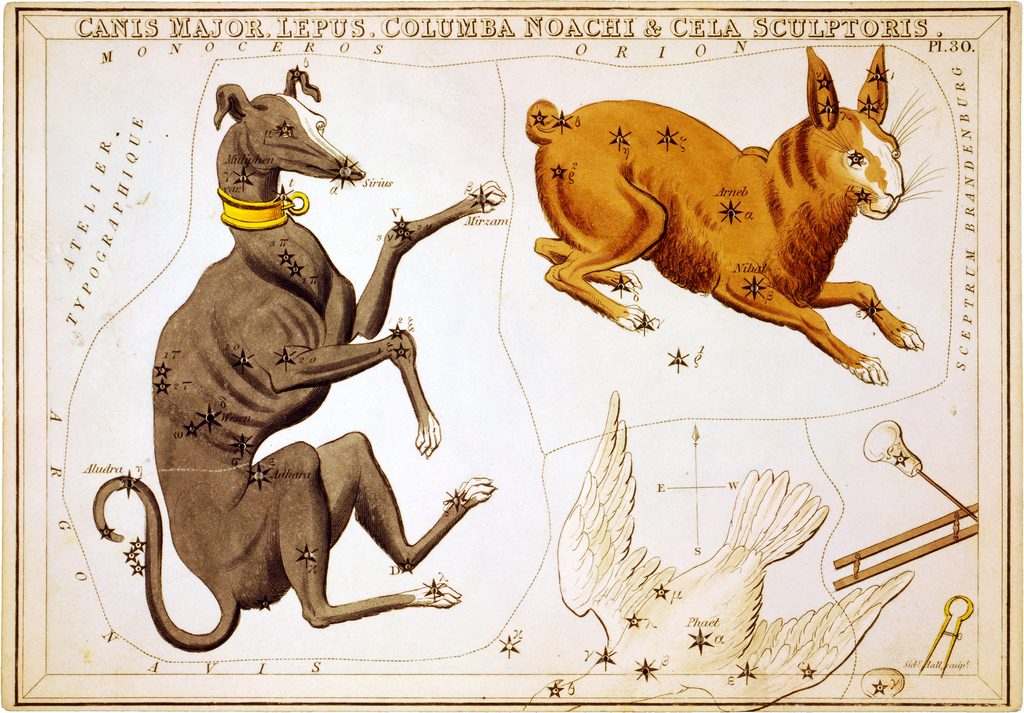
This is not the first time I wrote about dogs on this blog. I wrote about guard and hunting dogs before, in relation to ancient Hellenic society, as well as mythology. Yet, none of the myths I tackled in that post, relate to the constellation of Canis Major.

Canis Major might represent a number of different hounds. The first is Laelaps (Λαῖλαψ), the dog who was gifted to Eurṓpē (Ευρώπη) by Zeus to protect her from mortal and immortal danger as He hid her away, waiting for Hera to give up the scent of His adultery. The same dog, or a namesake of his, was gifted or passed down to Kephalos, who decided to use the hound to hunt the Teumessian fox, a fox that could never be caught. Laelaps was a dog who would always catch his prey and the fox was a pray that could never be caught. Zeus, stunned by the display, rewarded them both and placed them in the sky.

Another explanation is that the dog was one of Orion's hunting dogs. Orion (Ὠρίων) was a famed hunter who has a lot of mythology to his name. He is also included in a lot of existing mythology. The constellation Canis Major might represent his entire pack or one of them, who are/is eternally pursuing Lepus the Hare or helping Orion fight Taurus the Bull. Aratos, Homer and Hesiod support this theory. In the prime of his life, Orion joined with the Goddess Artemis and Her mother Leto, for an epic hunt in which Orion threatened to kill every beast on Earth. Gaea revolted and sent a giant scorpion to kill Orion. Orion, although very powerful, was overcome by the creature, but Artemis and Leto requested to Zeus he'd be immortalized in the night's sky. The Scorpion was admitted into the heavens as well.

That having been said, Sirius was considered a dog in its own right, and even more so, in early Hellenic mythology Sirius was the second head of a two-headed dog. This dog may be the fabled two-headed guard dog Orthus, who guarded the cattle of Geryon and whom Hēraklēs had to surpass for his tenth labor. Sad to say, Hēraklēs batted Kerberos' brother away pretty easily. As a reward for a valid try, Orthus was placed into the sky.

Canis Major is visible at latitudes between +60° and −90°, and best visible at 21:00 (9 p.m.) during the month of February.
Short one today, but it made me happy: As part of a restoration project, a replica of the marble statue of Plouton, the Ouranic incarnation of Hades, and his three-headed dog Kerberos has been placed in its original place in the Gate of Hell in Pamukkale’s ancient city of Hierapolis. The statue is known to have been there in ancient times.


Hierapolis (Ἱεράπολις, "Holy City") was an ancient city located on hot springs in classical Phrygia in southwestern Anatolia. Its ruins are adjacent to modern Pamukkale in Turkey and currently comprise an archaeological museum designated as a UNESCO World Heritage Site. 

The so-called "Gate of Hell" is not a gate as such, it's a grotto near the Ploutonium which was sacred to Plouton and which could be quite deadly, especially for birds.
Today marks the start of the Lesser Mysteries, part of the Eleusinian Mysteries I wrote an introduction about yesterday. Yesterday, I did not go into depth on the execution of the mysteries themselves. This is mostly because revealing the mysteries carried a death sentence, so no one did it. What we know of the mysteries comes to us through late sources, mostly Christian ones, and even those sources hardly mention scraps. There is also some potter to go on. We will discuss more of the festivals connected to the Eleusinian mysteries on friday, but for now, I will only focus on the Lesser Mysteries.

The Lesser Mysteries were not always a part of the mysteries; around the middle of the fifth century BC, Eleusinian officials decreed that the Lesser Mysteries could serve as a necessary prerequisite to the Greater Mysteries. From that point on, they took place at a shrine located near the Ilissos river, from 20 to 26 Anthesterion, while they had most likely taken place at a special building at Eleusis, the Telesterion, before that. The river is located between Athens and Eleusis, and served as a meeting point when Athenian and Eleusinian worshippers came together. The location is also important for another reason: it was said to be the place where the first Lesser Mysteries were held; the place where Hēraklēs underwent purification before his initiation, so he could travel to the Underworld and not forget who he was, and through that, make sure he could get back to the surface world.

Hēraklēs, son of Zeus and the mortal Alcmene (Ἀλκμήνη)--who was a bane in Hera's life, simply for being born--was stricken mad by the Queen of the Gods and killed his five sons by his wife Megara (Μεγάρα), oldest daughter of Kreōn (Κρέων) of Thebes. When he was released from his madness by a hellebore potion--provided by Antikyreus--and realized what he had done, he cried out in anguish, and went on a long journey to cleanse himself of the miasma caused by these killings.

First, he visited the oracle at Delphi, who, unbeknownst to him, was whispered to by Hera. The Oracle told Hēraklēs to serve the king of Tiryns (Τίρυνς), Eurystheus (Εὐρυσθεύς), for ten years and do everything Eurystheus told him to do. Eurystheus gladly provided Hēraklēs with these labors--ten of them, one for each year--and eventually ended up adding two more, resulting in the Twelve Labors of Hēraklēs. Hēraklēs was told to: slay the Nemean Lion, slay the nine-headed Lernaean Hydra, capture the Golden Hind of Artemis, capture the Erymanthian Boar, clean the Augean stables in a single day, slay the Stymphalian Birds, capture the Cretan Bull, steal the Mares of Diomedes, obtain the girdle of Hippolyta, Queen of the Amazons, obtain the cattle of the monster Geryon, steal the apples of the Hesperides, and to capture and bring back Kerberos.

This twelfth labor caused a problem for Hēraklēs, because he had to enter the Underworld to capture Kerbaros, and come back up, something that the Underworld was not intended for. Yesterday I explained how the river Lethe, the river of forgetfulness, runs through the Underworld, and all who come to the afterworld are eventually forced to drink from it in order to forget their old lives. Those who were initiated in the Eleusinian Mysteries, however, could drink from the fountain (or well) of Mnemosyne (memory) and were allowed to remember. Hēraklēs had to go through the mysteries, but initiation into the Eleusinian Mysteries excluded those who were guilty of murder, and of course Hēraklēs was quite guilty of that. He was tainted not only with the miasma of killing his family, but also for killing the kentaur Nessus (Νέσσος), the kentaur who carried Hēraklēs' third wife Deïaneira (Δῃάνειρα) over the river Evinos (Εύηνος), and was killed by Hēraklēs for attempting to abduct and rape her.

Hēraklēs traveled to Eleusis in search for a way into the mysteries. Eventually, the officials of the mysteries decided that, in order for Hēraklēs to take part, he would have to be cleansed of the blood of his crimes first. As such, he was put through a rite, most likely at the shrine at the Ilissos river. Hēraklēs was cleansed, and eventually, he was initiated into the mysteries. He traveled to the Underworld--aided by a lot of Theoi--and eventually, he returned successful in his quest. For the ancient regular mortal, returning from the Underworld was not the goal. They did, however, want to be initiated. In order to qualify for initiation, participants would sacrifice a piglet to Demeter and Persephone.

In ancient texts, the rituals of the Lesser Mysteries were often referred to as 'myesis', as opposed to the rites of the Greater, which were referred to as 'epopteia'. The word myesis means 'to teach', as well as 'to initiate', while epopteia has a similar meaning, but with an important difference; it means 'to witness', as well as 'to be initiated'. This difference equates the major difference between the two rites: in the Lesser Mysteries, candidates underwent a teaching course. They were educated on the gifts of Demeter, on the mythology surrounding Her and Her daughter, and on the mysteries. They went through a rite of purification--possibly in the river. Upon completion of the Lesser Mysteries, participants were deemed mystai ('initiates') worthy of witnessing the Greater Mysteries.

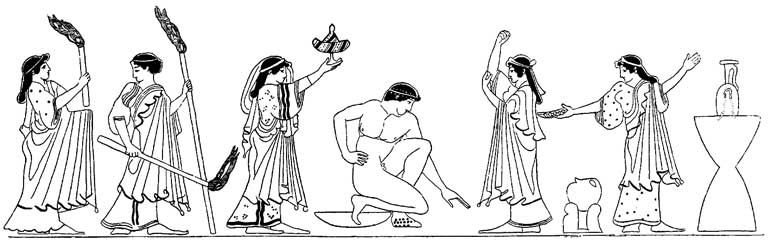
While what exactly happens on which day, is completely unknown due to the vow of silence--which was most likely placed upon the seekers the first day. What we do know from artwork is that a pig was sacrificed on a eschára, a low-lying altar to the khthonic deities--most likely Persephone. Also sacrificed by the seeker was a stack of flat cakes called 'pelanoi', although the actual sacrifice is not depicted. A priest gave a libation, and may also have burned poppies, a plant linked to both Demeter and Persephone, as Demeter might have used it to relief the burden of Her grief over losing Her daughter. Other options for offerings include pomegranates, the seeds of the pomegranate, cakes, or cheese.

The seeker was--assumably after this sacrifice--told of Demeter and Persephone, and he or she might have been seated on a chair, coated by a ram's fleece, while these stories were told to them. Again, we know this from artwork, but we do not know why they were seated as such, save that Demeter also sat on a chair with a ram's fleece on it as she grieves over Persephone's abduction. A ram appears to have been a favored sacrificial animal for Persephone, so it might be that the ram--minus its fleece--was sacrificed as well.

Next--and I use this term loosely, because we have no idea about the order of things--the seeker was blindfolded and led on a journey--either physically, or as a meditative exercise. As a journey into the Underworld is also a journey into the darkness, one can assume this was the main goal of the exercise; for the seeker to feel he or she was being led deeper into the mysteries of the Underworld, deeper into a sense of sacredness and trust in the Theoi and priests who overlooked the mysteries, and deeper into him or herself, possibly to face their own crimes and impure actions. Anyone who has ever walked to an initiation in a blindfold knows the power of the act. It brings a finality, a true sense of entering a new world, and a leaving behind of the old. It may be that especially the latter was the goal of this exercise; a continuation of the purification that started with sacrifices.

During the blindfold exercise, a winnowing fan, a 'liknon', which was used to separate wheat from the chaff was held over the head of the seeker. It's a common symbol of Dionysos, and withing the mysteries, it may have signified the separation of the soul from the body--a start of the preparation for the demise of the seeker at the end of life, and the control they would have not to drink from Lethe.

After this ritual, the seeker was purified, and 'brought before Demeter'. This was most likely a priestess representing the Theia for the rite. She was seated on the kiste--a basket which held the ritual items used in the Greater Mysteries--and on her lap (or somewhere close) would be a snake. The seeker had to reach out and touch the snake, to show they had no fear of death, nor dying. It appears this was the final step in completing the Lesser Mysteries, and becoming a mystes, but there may have been be a dozen more rites the seeker would have had to go through that were lost in time.

Because so much is lost of the mysteries, celebrating the Lesser Mysteries as a modern Hellenist is virtually impossible. Of course, it is possible to see these days as sacred to Demeter and Persephone and to add them to your daily prayers--Persephone at night, Demeter during the day, preferably. Certain foods were forbidden to eat during the Greater Mysteries, and perhaps also during the lesser mysteries--pomegranates, apples, eggs, fowls, and fish come to mind. Refraining from eating these during the days of the Lesser Mysteries would be a way to honor the Theoi. Spent some time meditating on your wrongdoings, or ways to better your life in the eyes of the Theoi, you could even blindfold yourself and simply sit in the dark, outside, preferably, and listen to the world around you. Become aware of the beauty of the surface world through a medium other than your eyes.

Personally, I think the mysteries are a beautiful practice, and I most certainly understand why seekers wished to be initiated. After purification during the Lesser Mysteries, they had to wait until the fall of the following year--at the earliest--to be fully initiated. Seeing as the Greater Mysteries were almost always held every five years, it could take a maximum of four and a half years from purification to full initiation. I'm assuming the mystes was asked to purify him or herself again in the spring before the Greater Mysteries if this was the case.

Whatever the case, the Lesser Mysteries drew people from all corners of ancient Hellas, and they were certainly very sacred. Observing them is some way--even though we could never celebrate them as the mysteries were intended--would do great honor to Demeter and Persephone. The choice is, of course, yours to make as you will. Blessed mysteries, everyone.
This is not the first time I wrote about dogs on this blog. I wrote about guard and hunting dogs before, in relation to ancient Hellenic society, as well as mythology. Yet, none of the myths I tackled in that post, relate to the constellation of Canis Major.


Canis Major might represent a number of different hounds. The first is Laelaps (Λαῖλαψ), the dog who was gifted to Eurṓpē (Ευρώπη) by Zeus to protect her from mortal and immortal danger as He hid her away, waiting for Hera to give up the scent of His adultery. The same dog, or a namesake of his, was gifted or passed down to Kephalos, who decided to use the hound to hunt the Teumessian fox, a fox that could never be caught. Laelaps was a dog who would always catch his prey and the fox was a pray that could never be caught. Zeus, stunned by the display, rewarded them both and placed them in the sky.

Another explanation is that the dog was one of Orion's hunting dogs. Orion (Ὠρίων) was a famed hunter who has a lot of mythology to his name. He is also included in a lot of existing mythology. The constellation Canis Major might represent his entire pack or one of them, who are/is eternally pursuing Lepus the Hare or helping Orion fight Taurus the Bull. Aratos, Homer and Hesiod support this theory. In the prime of his life, Orion joined with the Goddess Artemis and Her mother Leto, for an epic hunt in which Orion threatened to kill every beast on Earth. Gaea revolted and sent a giant scorpion to kill Orion. Orion, although very powerful, was overcome by the creature, but Artemis and Leto requested to Zeus he'd be immortalized in the night's sky. The Scorpion was admitted into the heavens as well.

That having been said, Sirius was considered a dog in its own right, and even more so, in early Hellenic mythology Sirius was the second head of a two-headed dog. This dog may be the fabled two-headed guard dog Orthus, who guarded the cattle of Geryon and whom Hēraklēs had to surpass for his tenth labor. Sad to say, Hēraklēs batted Kerberos' brother away pretty easily. As a reward for a valid try, Orthus was placed into the sky.

Canis Major is visible at latitudes between +60° and −90°, and best visible at 21:00 (9 p.m.) during the month of February.
Two days now, I have tackled very heavy subjects in general, as well as for me personal. It becomes wearisome to write about such topics, so today, I'm writing about puppies. Well, hunting dog, but they were puppies once, so it counts. Also, as this is a Pagan Blog Project post, I should explain that there are no words starting with 'Q' in Greek because the letter does not exist in the language. 'Quarry' is the closest I'm getting so it will have to do.


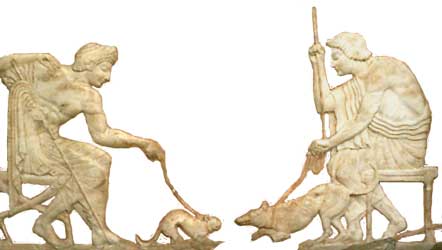
Dogs had a very special and particular place in ancient Hellenic society. The Hellenic word for 'dog' is 'kuón' (κύων), and there were a couple of breeds that were favored. First and foremost, the Molossus, a now extinct species of dog related most to the mastiffs of current times, enjoyed great prestige. Another favorite was the Laconian, which was especially popular in Sparta. The Molossus was most often used as a guard dog, while the Laconian was the go-to hunting dog of the time. Also known were the Cretan, a Laconia probably crossed with the Molossian; and the Melitan, a small long-haired, short-legged lap dog.

Even back then, hunting dogs had to be purebred, which made buying a hunting pack an incredibly costly affair which came with a lot of prestige. Quarries for the Laconian hunting dogs were often wild goats, deer, and hares. For the more dangerous animals like boars and even humans, the Molossus breed was chosen.

Dogs used for the hunt had to have very different qualities than those needed to guard a house, herd, field or person. There are no existing Hellenic sources of traits looked for in either type of dog, but Marcus Nemesianus, a Roman poet, has the following to say about breeding good, strong, dogs which almost certainly applied to Hellens as well:

"... you must choose a bitch obedient to speed forward, obedient to come to heel, native to either the Spartan or the Molossian country-side, and of good pedigree. She must stand high on straight legs; with a comely slope let her carry, under a broad breast, where the ribs end, a width of keel that gradually again contracts in a lean belly: she must be big enough with strong loins, spread at the hips, and with the silkiest of ears floating in air as she runs. Give her a male to match, everywhere similarly well-sized, while strength holds sway, while bodily youth is in its joyous flower and blood abounds in the veins of early life. For burdensome diseases creep on and sluggish age, and they will produce unhealthy offspring without steadfast strength. But for breeding a difference of age in the parents is more suitable: you should release the male, keen for mating, when he has already completed forty months: and let the female be two full years old. Such is the best arrangement in their coupling. Presently when Phoebe has completed the round of two full moons since the birth-giving womb fertilised by the male began to swell, the pregnancy in its due time reveals the fruitful offspring, and straightway you see all round an abundant noisy litter."

For hunting dogs, swiftness was paramount and for guard and shepherding dogs, Marcus Varro, a notable Roman scholar and writer, advised the following: a large head, drooping ears, thick shoulders and neck, wide paws, thick tail, a deep bark, and be white in color so as to be more easily recognized in the dark, were important.

Of course, only the best in the litter were good enough to become hunting or guarding dogs. As such, the first litter of any bitch was done away completely while the second litter was (at least) halved so only the strong survived. After this, Nemesianus advices any breeder or buyer the following:

"You will be able to examine the strength of a puppy by its weight and by the heaviness of each body know in advance which will be light in running. Furthermore, you should get a series of flames made in a wide circuit with the smoke of the fire to mark a convenient round space, so that you may stand unharmed in the middle of the circle: to this all the puppies, to this the whole crowd as yet unseparated must be brought: the mother will provide the test of her progeny, saving the valuable young ones by her selection and from their alarming peril. For when she sees her offspring shut in by flames, at once with a leap she clears the blazing boundaries of the fire-zone, snatches the first in her jaws and carries it to the kennel; next another, next another in turn: so does the intelligent mother distinguish her nobler progeny by her love of merit." 

It sounds a bit harsh but I'm pretty sure no puppies (or their mothers) were harmed in this process. When the proper dog is selected, there is still the matter of naming them, and there was a definite science behind this process. Xenophon, a historian, soldier, mercenary and philosopher who lived in ancient Hellas, advices the following:

"Give the hounds short names, so as to be able to call to them easily. The names are significant of the colour, strength, spirit, sagacity or behaviour of the hounds. Hebe and Psyche are still in the list of bitches' names, and modern equivalents of several of the other names are in use, e.g. Lance (Lonché), Sentinel (Phylax), Ecstasy (Chara), Blueskin (Oenas), Crafty (Medas), Hasty (Sperchon), Vigorous (Thallon), Impetus (Hormé), Counsellor (Noës), Bustler (dog) or Hasty (bitch)."

When you have aptly named your dog, they still need to eat. As they didn't have Pedigree, the ancient Hellens had to improvise. Ordinary pups recieved barley bread softened with cow’s milk or whey, but more valuable puppies eat bread soaked in sheep or goat milk. Puppies who would grow up to hunt game recieved a little blood from the type of animal the pup was supposed to hunt. Grease stained bread, other table scaps and meat broth were also dog food favorites. After a sacrefice, dogs got special treats in the form of roasted ox liver coated in barley meal. Of course, a bit of the meat from any hunted animal was given to the dog who helped hunt it.

There are actually a lot of myths featuring dogs. The most famous are probably Atalanta and her hunting dog Aura (Breeze), Odysseus and his hunting dog Argos (who, after waiting for his master for twenty years, dies after seeing him return home) and Actaeon, who is hunted and killed by his own hunting pack after being transformed into a stag upon seeing Artemis bathe.

Artemis is associated with a lot of dog-related mythology. As the Goddess of the hunt, she is often depicted amongst her own hunting pack. Another Goddess associated with dogs is Hekate. She is often described as being of dog-shape or tended to by dog. The dog was also her favored sacrificial animal and the meat of the dog was eaten solemnly. That it was eaten at all is a testament to Hekate's rule extending even beyond the Underworld, as Khthonic (Underworld) Deities often received their sacrificial offerings in a holókaustos. A famous Underworld dog is, of course, the three-headed Kerberos who guards the entrance gates.

Dogs aren't a requirement for the modern practice of Hellenismos, but they are a nice throw-back to life in ancient Hellas. Modern Hellenists take in a dog for any reason a non-Hellenist might; companionship, guard duty, hunting, education or simply because they are so very, very cute.