Showing posts with label Eos. Show all posts

An invocation is a request for the spiritual presence and blessing of a deity during a rite. To invoke is to call upon earnestly, so an “invocation” in the context of prayer is a serious, intentional calling upon a God or Goddess. In Hellenic ritual, it's common for prayers of invocation to be offered every time a new deity is invoked, so we can be sure They will the hymns and prayers of petition offered to Them. Invocations fit into the rite like so:


- Lighting of the incense burner with frankincense
- Invocation to Demeter: Khaire Demeter, you who taught us to work the earth and provides for us so bountifully…
- Libation of a kykeon and sacrifices
- Orphic Hymn 40 To Eleusinian Demeter
- Prayers

A few days ago, I put up a list of invocations from the Iliad. People seemed to like it, so let's do another one today: from the Odysseia, because that is the logical step! The Odyssey (Ὀδύσσεια) is, in part, a sequel to the Iliad, the other work ascribed to Homeros. The Odyssey was composed near the end of the 8th century BC and focuses mainly on the hero Odysseus, king of Ithaca, and his journey home after the fall of Troy. It takes Odysseus ten years to reach Ithaca. In his absence, it is assumed Odysseus has died, and his wife Penelope and son Telemachus must deal with a group of unruly suitors, who compete for Penelope's hand in marriage. Needless to say, Odysseus keeps his lady love! There aren't as many invocation in this story as most of the characters tell their story themselves, but there are a few.

Artemis:
"Great Goddess Artemis, daughter of Zeus..."

Athena:
"Hear me, daughter of Aegis-bearing Zeus, unweariable..."

Eos:
"Rosy-fingered Eos, child of morning..."

Poseidon:
"O thou that encirclest the earth, vouchsafe to grant the prayers of thy servants that call upon thee..."

Themis:
"I pray you by Themis, who is the beginning and the end of councils..."

Zeus:
"Hear me, O King..."
"Father Zeus, and all you other gods who live in everlasting bliss..."
"Father Zeus, you who rule over heaven and earth, you have thundered from a clear sky without so much as a cloud in it, and this means something for somebody; grant the prayer, then, of me your poor servant who calls upon you..."

 The beautiful thing about our religion is that not only do we have a clear way to honor the Theoi, and incentive to do so, we also get to live in a world governed completely by the Theoi. Hellenismos is special in that regards because it also largely matches up with science. To me--and many others with me--that is something very comforting. Now, as you are probably all aware, I live in a world full of Gods and Nymphs; for example, I take great strength in greeting Eos each morning as she paves the way for Helios, but there are many Gods who are, or who control, the cycle of day and night, and I would like to write out this cycle, if I may.


For all things geneological, I will always turn to Hesiod first. In his 'Theogony', he speaks of the birth of the Dawn, Sun and Moon:

"And Theia was subject in love to Hyperion and bare great Helios, and clear Selene, and Eos." [177]

Diodorus Siculus, in his 'Library of History' shares this world vieuw and moves a (pseudo-scientific) step beyond it:

"Of Hyperion we are told that he was the first to understand, by diligent attention and observation, the movement of both the sun and the moon and the other stars, and the seasons as well, in that they are caused by these bodies, and to make these facts known to others; and that for this reason he was called the father of these bodies, since he had begotten, so to speak, the speculation about them and their nature." [5.67.1]

Hyperion (Ὑπερίων), meaning 'The High-One', was a Titanes God born from Gaea and Ouranos. Theia and Euryphaessa (as mentioned in, for example, the Homeric Hymns) are generally regarded as the same Deathless woman: 'Theia' is the Hellenic word for 'Goddess', so it was likely 'Theia Euryphaessa' translated to 'Goddess Euryphaessa'. This means that the family tree is as follows:

     Khaos ------------ Gaea
         |         |
   Ouranos --- |
                       Hyperion --- Euryphaessa
                   |
                  Eos - Helios - Selene

The three of them--put into motion by Hyperion--form the basic cycle of these planets associated with specific times of day. Yet, the ancient Hellenes saw Night and Day as quite seperate from the heavenly bodies that are associated with them today. I have spoken before of the Protogenoi, and how They--contrary to the Olympians--are actually of the world; They, together, form the tapistry of earth and life. They literally make up our universe. As such, the further towards the Big Bang you go, the more abstract the Theoi become; They take on large, mostly unformed, chunks of the material that makes up our world and the further away you go from Khaos, the more specialized the Gods become--as well as numerous.

As such, starting this explination with Hyperion is actually incorrect--I should have started with Khaos itself, but if not there, than at least with Nyx, who is the deep Night, and Her daughter Hêmera (Ἡμερα), who is the Protogenos of the Day and the sister-wife of Aither (Light). In Hellenic mythology, Nyx draws a veil of darkness between the shining atmosphere of the aither and the lower air of earth (aer) at set times in the day, bringing night to man. In the morning, Hêmera removes this veil, and exposed the Earth once more to Light. As Hesiod writes in the Theogony:

"[At the ends of the earth, where lie the roots of earth, sea, Tartaros :] There stands the awful home of murky Nyx wrapped in dark clouds. In front of it [Atlas] the son of Iapetos stands immovably upholding the wide heaven upon his head and unwearying hands, where Nyx and Hemera draw near and greet one another as they pass the great threshold of bronze: and while the one is about to go down into the house, the other comes out at the door. And the house never holds them both within; but always one is without the house passing over the earth, while the other stays at home and waits until the time for her journeying come; and the one holds all-seeing light (phaos) for them on earth." [744]

Once we reach AD times, Hêmera is often identified with Eos, but in centuries prior, she was very much Her own Goddess, and Hêmera was as well. Hómēros, for example, in the 'Odysseia' writes: 

"The ship [of Odysseus] in due course left the waters of the river Okeanos and reached the waves of the spacious sea and the island of Aiaia; it is there [Okeanos] that Eos the early-comer (Erigeneia) has her dwelling place and her dancing grounds, and the sun himself has his risings. We came came in; we beached our vessel upon the sands and disembarked upon the sea-shore; there we fell fast asleep, awaiting ethereal Dawn." [12.1]

So, to recapitulate: Nyx and Hêmera continually work to both create and dissolve darkness on Earth; Selene moves with Nyx, and Helios with Hêmera, as heralded by Eos. In this recap, it is quite obvious we are yet missing a speciffic time of the day: dusk, or the evening. This was in the domain of the Nymphs, in this case the Hesperides (Ἑσπεριδες), who--depending of source--are either the daughters of Nyx or Atlas. Diodorus Siculus, in the 1st Century BC., wrote in his 'Library of History': 

"Now Hesperos (Evening) begat a daughter named Hesperis (Evening), who he gave in marriage to his brother [Atlas] and after whom the land was given the name Hesperitis; and Atlas begat by her seven daughters, who were named after their father Atlantides, and after their mother Hesperides." [4. 26. 2]

Yet, older sources agree that the Hesperides were born from Nyx; Hesiod, for example:

"And Nyx (Night) bare hateful Moros (Doom) and black Ker (Violent Death) and Thanatos (Death), and she bare Hypnos (Sleep) and the tribe of Oneiroi (Dreams). And again the goddess murky Nyx, though she lay with none, bare Momos (Blame) and painful Oizys (Misery), and the Hesperides who guard the rich, golden apples and the trees bearing fruit beyond glorious Okeanos."

Of course, there are more Gods--motly Titans--who are in some way connected to the cycle of night and day, but these are the most important ones and it's quite a hand full already. So perhaps next time when you awake, you will think of Hêmera, and rosy Eos, and when the sun is high in the sky, you will think of Him as well, and when you look upon the Moon before going to bed, you will give honors to Selene and Nyx, who holds Her and Gaea in Her embrace. Our Gods are everywhere; you only have to be aware of Them to notice.
The beautiful thing about our religion is that not only do we have a clear way to honor the Theoi, and incentive to do so, we also get to live in a world governed completely by the Theoi. Hellenismos is special in that regards because it also largely matches up with science. To me--and many others with me--that is something very comforting. Now, as you are probably all aware, I live in a world full of Gods and Nymphs; for example, I take great strength in greeting Eos each morning as she paves the way for Helios, but there are many Gods who are, or who control, the cycle of day and night, and I would like to write out this cycle, if I may.

For all things geneological, I will always turn to Hesiod first. In his 'Theogony', he speaks of the birth of the Dawn, Sun and Moon:

"And Theia was subject in love to Hyperion and bare great Helios, and clear Selene, and Eos." [177]

Diodorus Siculus, in his 'Library of History' shares this world vieuw and moves a (pseudo-scientific) step beyond it:

"Of Hyperion we are told that he was the first to understand, by diligent attention and observation, the movement of both the sun and the moon and the other stars, and the seasons as well, in that they are caused by these bodies, and to make these facts known to others; and that for this reason he was called the father of these bodies, since he had begotten, so to speak, the speculation about them and their nature." [5.67.1]

Hyperion (Ὑπερίων), meaning 'The High-One', was a Titanes God born from Gaea and Ouranos. Theia and Euryphaessa (as mentioned in, for example, the Homeric Hymns) are generally regarded as the same Deathless woman: 'Theia' is the Hellenic word for 'Goddess', so it was likely 'Theia Euryphaessa' translated to 'Goddess Euryphaessa'. This means that the family tree is as follows:

     Khaos ------------ Gaea
         |         |
   Ouranos --- |
                       Hyperion --- Euryphaessa
                   |
                  Eos - Helios - Selene

The three of them--put into motion by Hyperion--form the basic cycle of these planets associated with specific times of day. Yet, the ancient Hellenes saw Night and Day as quite seperate from the heavenly bodies that are associated with them today. I have spoken before of the Protogenoi, and how They--contrary to the Olympians--are actually of the world; They, together, form the tapistry of earth and life. They literally make up our universe. As such, the further towards the Big Bang you go, the more abstract the Theoi become; They take on large, mostly unformed, chunks of the material that makes up our world and the further away you go from Khaos, the more specialized the Gods become--as well as numerous.

As such, starting this explination with Hyperion is actually incorrect--I should have started with Khaos itself, but if not there, than at least with Nyx, who is the deep Night, and Her daughter Hêmera (Ἡμερα), who is the Protogenos of the Day and the sister-wife of Aither (Light). In Hellenic mythology, Nyx draws a veil of darkness between the shining atmosphere of the aither and the lower air of earth (aer) at set times in the day, bringing night to man. In the morning, Hêmera removes this veil, and exposed the Earth once more to Light. As Hesiod writes in the Theogony:

"[At the ends of the earth, where lie the roots of earth, sea, Tartaros :] There stands the awful home of murky Nyx wrapped in dark clouds. In front of it [Atlas] the son of Iapetos stands immovably upholding the wide heaven upon his head and unwearying hands, where Nyx and Hemera draw near and greet one another as they pass the great threshold of bronze: and while the one is about to go down into the house, the other comes out at the door. And the house never holds them both within; but always one is without the house passing over the earth, while the other stays at home and waits until the time for her journeying come; and the one holds all-seeing light (phaos) for them on earth." [744]

Once we reach AD times, Hêmera is often identified with Eos, but in centuries prior, she was very much Her own Goddess, and Hêmera was as well. Hómēros, for example, in the 'Odysseia' writes: 

"The ship [of Odysseus] in due course left the waters of the river Okeanos and reached the waves of the spacious sea and the island of Aiaia; it is there [Okeanos] that Eos the early-comer (Erigeneia) has her dwelling place and her dancing grounds, and the sun himself has his risings. We came came in; we beached our vessel upon the sands and disembarked upon the sea-shore; there we fell fast asleep, awaiting ethereal Dawn." [12.1]

So, to recapitulate: Nyx and Hêmera continually work to both create and dissolve darkness on Earth; Selene moves with Nyx, and Helios with Hêmera, as heralded by Eos. In this recap, it is quite obvious we are yet missing a speciffic time of the day: dusk, or the evening. This was in the domain of the Nymphs, in this case the Hesperides (Ἑσπεριδες), who--depending of source--are either the daughters of Nyx or Atlas. Diodorus Siculus, in the 1st Century BC., wrote in his 'Library of History': 

"Now Hesperos (Evening) begat a daughter named Hesperis (Evening), who he gave in marriage to his brother [Atlas] and after whom the land was given the name Hesperitis; and Atlas begat by her seven daughters, who were named after their father Atlantides, and after their mother Hesperides." [4. 26. 2]

Yet, older sources agree that the Hesperides were born from Nyx; Hesiod, for example:

"And Nyx (Night) bare hateful Moros (Doom) and black Ker (Violent Death) and Thanatos (Death), and she bare Hypnos (Sleep) and the tribe of Oneiroi (Dreams). And again the goddess murky Nyx, though she lay with none, bare Momos (Blame) and painful Oizys (Misery), and the Hesperides who guard the rich, golden apples and the trees bearing fruit beyond glorious Okeanos."

Of course, there are more Gods--motly Titans--who are in some way connected to the cycle of night and day, but these are the most important ones and it's quite a hand full already. So perhaps next time when you awake, you will think of Hêmera, and rosy Eos, and when the sun is high in the sky, you will think of Him as well, and when you look upon the Moon before going to bed, you will give honors to Selene and Nyx, who holds Her and Gaea in Her embrace. Our Gods are everywhere; you only have to be aware of Them to notice.
I'm going to shamelessly self-promote today. It is my blog, after all, and it's faintly Hellenic. Very faintly, but still. Yesterday, I pre-launched my very own Publishing house, Eos Publishing.


Eos Publishing is an independent publishing house with two missions: to publish the very best in women-fronted fiction, and to make it easy for our authors to do so. Our focus is on stories about women, a term we define as “any character who identifies as such.” Biological gender has nothing to do with that. We welcome stories in any genre, about any sexuality, from anyone, as long as the women are center-stage and kick ass.

Eos is the rosy-fingered Goddess of the dawn. She and her siblings Helios (the Sun) and Selene (the Moon) are numbered amongst the second-generation Titan Gods within the Greek pantheon. Eos rises into the sky from the river Okeanos at the start of each day, and with her rays of light dispersed the mists of night. Her life story is one of great love, great sadness, and great adventure. She had many lovers, stood up against Zeus, head of the Olympic Gods, and was cheated by him into receiving immortality without eternal youth. She loved, lost, and eventually swiveled into a grasshopper.

She was also her own hero.

She lived.

Eos was depicted either driving a chariot drawn by winged horses or borne aloft on her own wings. She doesn’t rely on anything or anyone to provide for her–a rarity in ancient Hellenic mythology.
Through her trials, tribulations, and victories, Eos represents all we look for in both our authors and the stories they write: independence, courage, strength, and a desire to conquer.

I look forward to this new adventure, and the first manuscripts are already in! If you want to keep updated (and maybe support me a little), find and follow us on social media: Twitter, Facebook, Instagram.
An invocation is a request for the spiritual presence and blessing of a deity during a rite. To invoke is to call upon earnestly, so an “invocation” in the context of prayer is a serious, intentional calling upon a God or Goddess. In Hellenic ritual, it's common for prayers of invocation to be offered every time a new deity is invoked, so we can be sure They will the hymns and prayers of petition offered to Them. Invocations fit into the rite like so:

- Lighting of the incense burner with frankincense
- Invocation to Demeter: Khaire Demeter, you who taught us to work the earth and provides for us so bountifully…
- Libation of a kykeon and sacrifices
- Orphic Hymn 40 To Eleusinian Demeter
- Prayers

A few days ago, I put up a list of invocations from the Iliad. People seemed to like it, so let's do another one today: from the Odysseia, because that is the logical step! The Odyssey (Ὀδύσσεια) is, in part, a sequel to the Iliad, the other work ascribed to Homeros. The Odyssey was composed near the end of the 8th century BC and focuses mainly on the hero Odysseus, king of Ithaca, and his journey home after the fall of Troy. It takes Odysseus ten years to reach Ithaca. In his absence, it is assumed Odysseus has died, and his wife Penelope and son Telemachus must deal with a group of unruly suitors, who compete for Penelope's hand in marriage. Needless to say, Odysseus keeps his lady love! There aren't as many invocation in this story as most of the characters tell their story themselves, but there are a few.

Artemis:
"Great Goddess Artemis, daughter of Zeus..."

Athena:
"Hear me, daughter of Aegis-bearing Zeus, unweariable..."

Eos:
"Rosy-fingered Eos, child of morning..."

Poseidon:
"O thou that encirclest the earth, vouchsafe to grant the prayers of thy servants that call upon thee..."

Themis:
"I pray you by Themis, who is the beginning and the end of councils..."

Zeus:
"Hear me, O King..."
"Father Zeus, and all you other gods who live in everlasting bliss..."
"Father Zeus, you who rule over heaven and earth, you have thundered from a clear sky without so much as a cloud in it, and this means something for somebody; grant the prayer, then, of me your poor servant who calls upon you..."
I was asked to recount the story of Eos and Astraios so it's brought to the attention of a wider audience. Of course, I can do that. No problem. Let's tart with a few basics, though: Eos and Astraios. Eos (Ηως) is the Titanes Goddess of the Dawn, and along with her brother Helios and her sister Selene, She is mainly responsible for the cycles of day and night. For all things geneological, I will always turn to Hesiod first. In his 'Theogony', he speaks of the birth of the Dawn, Sun and Moon:

"And Theia was subject in love to Hyperion and bare great Helios, and clear Selene, and Eos." [177]
 
Hyperion (Ὑπερίων), meaning 'The High-One', was a Titanes God born from Gaea and Ouranos. Theia and Euryphaessa (as mentioned in, for example, the Homeric Hymns) are generally regarded as the same Deathless woman: 'Theia' is the Hellenic word for 'Goddess', so it was likely 'Theia Euryphaessa' translated to 'Goddess Euryphaessa'. This means that the family tree is as follows:

     Khaos ------------ Gaea
         |         |
Ouranos --- |
                       Hyperion --- Euryphaessa
                   |
                  Eos - Helios - Selene

Astraios (Αστραιος) is the Titanes God of the stars and planets, and the art of astrology. He was the son of son of Krios and Eurybia, making His family tree as follows:

                                                 Khaos ---------- Gaea
    |         |       |
   Ouranos --- | --- Pontus
                     | 
            | 
                       Krios --- Eurybia
                   |
                  Astraios

Together, Eos and Astraios are the parents of the seasonal Winds and the Stars. Hesiod, in his 'Theogony' reveals this birth. There is one cardinal direction missing: East, represented by Euros (Ευρος). This is because the ancient Hellenes at the time of Hesiod were aware of only three seasons: Spring, Summer and Winter, and only these had deities presiding over them--in this case Zephyros, Notos and Boreas, respectively.

"And Eos bare to Astraeus [Astraios] the strong-hearted winds, brightening Zephyrus, and Boreas,
headlong in his course, and Notus, -- a goddess mating in love with a god. And after these Erigenia bare the star Heosphorus (Dawn-bringer), and the gleaming Astra (Stars) with which Heaven (Ouranos) is crowned." [ll. 378-382]
 
As with many of the Titans, their love story is simply assumed as truth; connections made to form the universe. They made up important parts of it, however, and had strong children, who--in turn--fathered and birthed strong children as well.
Near the beginning of the blog, I posted about my daily rituals. The idea was to inform you about what I do, but I also posted it as a way for me to look back on the journey I have made. The original post can be found here, and an update from a good while later here. I came across that second post yesterday and realized that again much has changed. As such, I wanted to present you guys with another update. Again, please keep in mind that this sounds much better in Dutch.

Night time prayers (before bed):

Preparation:
  • Pour wine in my kylix
  • Empty water bowl and fill anew with water previously prepared by mixing tap water with sea water and asking Okeanos' blessing
  • Empty sacrificial bowl
  • Add ethanol to sacrificial bowl
  • Lay out a match and a hand towel
  • Lay out (dried) herbs or scented wood
Rite:
  • Procession to the shrine
  • Strewing of barley groats on the altar
  • Preparation of khernips 
  • Purification – washing of hands and face, sprinkling the room and altar with fingers
  • Add khernips to wine
"Blessed Okeanos, may your bright waters purify this space, and prepare both me, and it, for the rites that are about to unfold."
  • Lighting of Hestia's candle (if not yet burning, mine almost always is), as well as the ethanol to burn sacrifices in
  • Hymn and prayers to Hestia
"Blessed Goddess Hestia, you who tend the holy house of the lord Apollo, the Far-shooter at goodly Pytho, with soft oil dripping ever from your locks, come now into this house, come, having one mind with Zeus the all-wise—draw near, and withal bestow grace upon my song.
Blessed Goddess Hestia, accept this offering of honey sweet wine, and guard this house as you guard the houses of all who sacrifice to you. As the Gods will it, so shall it be."
"Blessed Nyx, Goddess of night. She who holds the world in her dark embrace, and Selene, Goddess of the moon, who illuminates the night like a torch. Accept this offering of sweetest wine, and come always, as the day follows the night. As the Gods will it, so shall it be."
"Blessed Hypnos, Morpheus, Gods of sleep and dreams, respectively. Accept this offering of honey sweet wine, and grant me equally sweet sleep, and even sweeter dreams. Carry my mind far beyond the limits of my imagination. Accept my prayer, and allow me to rise rested and rejuvenated so I may continue my hard work. As the Gods will it, so shall it be."
  • Libation to Hypnos and Morpheus
  • Hymns, prayers and libations to the night time or Khthonic Theoi whose sacred day it is, or any night time or Khthonic Theoi whom I feel the need to pray and sacrifice to.
  • Hymn and prayer to Hekate
"I call Einodian Hekate, lovely dame, of earthly, wat'ry, and celestial frame, Sepulchral, in a saffron veil array'd. Goddess of the night, companion to Persephone, the Queen of the Underworld. You, key bearer of this world. Accept my offering of honey sweet wine, and guard the borders of this house as you guard the borders of the houses of all who sacrifice to you. As the Gods will it, so shall it be."
  • Libation to Hekate
  • Hymn to Hestia
"Blessed Goddess Hestia, Goddess of home and hearth. To you, I offer last of all, as any pious mortal should. Tend to those whom I love, and guard the houses of the pious. As the Gods will it, so shall it be."
  • Drink remaining wine
  • Extinguishing of the candle or replace with electric one, as I always do.
  • Clean up and off to bed

Day time prayers (after waking up):

Preparation:
  • Pour water in my kylix
  • Add ethanol to sacrificial bowl
  • Lay out a packet of matches and a hand towel
Rite:
  • Procession to the shrine
  • Strewing of barley groats on the altar
  • Purification – washing of hands and face, sprinkling the room and altar with fingers
  • Add khernips to wine
"Blessed Okeanos, may your bright waters purify this space, and prepare both me, and it, for the rites that are about to unfold."
  • Lighting of Hestia's candle, as well as the ethanol to burn sacrifices in, and the incense burner
  • Hymn and prayers to Hestia
"Blessed Goddess Hestia, you who tend the holy house of the lord Apollo, the Far-shooter at goodly Pytho, with soft oil dripping ever from your locks, come now into this house, come, having one mind with Zeus the all-wise—draw near, and withal bestow grace upon my song.
Blessed Goddess Hestia, accept this offering of honey sweet wine, and guard this house as you guard the houses of all who sacrifice to you. As the Gods will it, so shall it be."
"Blessed Goddes Eos, Goddess of the bright dawn. You who speed forth from the gates of heaven before everyone else; Hêmera, blessed Goddess who pulls back the veil of darkest night; and Hēlios, God of the sun; He who brings light and warmth to all on earth, accept this libation of honey sweet wine and come always, as the night follows the day. As the Gods will it, so shall it be."
  • Libation to Eos, Hêmera, and Hēlios
  • Hymns, prayers and libations to the Ouranic Theoi whose sacred day it is, or any Ouranic Theoi whom I feel the need to pray and sacrifice to.
  • Hymns and prayers to Athena
"Come forth, blessed Athena, Sacker of Cities, golden-helmeted, who rejoices in the din of horse and shield. Guard over this house. May your shield protect us always and may your spear slay any who wishes us harm."
"Blessed Asklēpiós, Giver of Health, prophet in the night, You who has the most lovely of daughters, may your blessings forever reach my home."
"And to the household deities I offer libations, to Zeus Kthesios, Zeus Ephestios, Zeus Herkeios, Apollon Aguieus, Hermes Propylaios, and Agathós Daímōn, in gratitude of all you have bestowed upon me."
  • Libations to the household Gods
  • Hymns and prayers to Zeus and Hera
"Blessed Zeus, King of Gods, and protector of the household, and Hera, Queen of the Gods, and protector of unions: guard mankind, and share with us the wisdom and strenth to worship the Theoi as they should be worshipped. Guard those I love, and all who need protection. As the Gods will it, so shall it be."
  • Libations to Zeus and Hera
  • Hymn to Hestia
"Blessed Goddess Hestia, Goddess of home and hearth. To you, I offer last of all, as any pious mortal should. Tend to those whom I love, and guard the houses of the pious. As the Gods will it, so shall it be."
  • Drink remaining wine
  • Extinguish incense burner
  • Clean up and on with the day
The beautiful thing about our religion is that not only do we have a clear way to honor the Theoi, and incentive to do so, we also get to live in a world governed completely by the Theoi. Hellenismos is special in that regards because it also largely matches up with science. To me--and many others with me--that is something very comforting. Now, as you are probably all aware, I live in a world full of Gods and Nymphs; for example, I take great strength in greeting Eos each morning as she paves the way for Helios, but there are many Gods who are, or who control, the cycle of day and night, and I would like to write out this cycle, if I may.

For all things geneological, I will always turn to Hesiod first. In his 'Theogony', he speaks of the birth of the Dawn, Sun and Moon:

"And Theia was subject in love to Hyperion and bare great Helios, and clear Selene, and Eos." [177]

Diodorus Siculus, in his 'Library of History' shares this world vieuw and moves a (pseudo-scientific) step beyond it:

"Of Hyperion we are told that he was the first to understand, by diligent attention and observation, the movement of both the sun and the moon and the other stars, and the seasons as well, in that they are caused by these bodies, and to make these facts known to others; and that for this reason he was called the father of these bodies, since he had begotten, so to speak, the speculation about them and their nature." [5.67.1]

Hyperion (Ὑπερίων), meaning 'The High-One', was a Titanes God born from Gaea and Ouranos. Theia and Euryphaessa (as mentioned in, for example, the Homeric Hymns) are generally regarded as the same Deathless woman: 'Theia' is the Hellenic word for 'Goddess', so it was likely 'Theia Euryphaessa' translated to 'Goddess Euryphaessa'. This means that the family tree is as follows:

     Khaos ------------ Gaea
         |         |
   Ouranos --- |
                       Hyperion --- Euryphaessa
                   |
                  Eos - Helios - Selene

The three of them--put into motion by Hyperion--form the basic cycle of these planets associated with specific times of day. Yet, the ancient Hellenes saw Night and Day as quite seperate from the heavenly bodies that are associated with them today. I have spoken before of the Protogenoi, and how They--contrary to the Olympians--are actually of the world; They, together, form the tapistry of earth and life. They literally make up our universe. As such, the further towards the Big Bang you go, the more abstract the Theoi become; They take on large, mostly unformed, chunks of the material that makes up our world and the further away you go from Khaos, the more specialized the Gods become--as well as numerous.

As such, starting this explination with Hyperion is actually incorrect--I should have started with Khaos itself, but if not there, than at least with Nyx, who is the deep Night, and Her daughter Hêmera (Ἡμερα), who is the Protogenos of the Day and the sister-wife of Aither (Light). In Hellenic mythology, Nyx draws a veil of darkness between the shining atmosphere of the aither and the lower air of earth (aer) at set times in the day, bringing night to man. In the morning, Hêmera removes this veil, and exposed the Earth once more to Light. As Hesiod writes in the Theogony:

"[At the ends of the earth, where lie the roots of earth, sea, Tartaros :] There stands the awful home of murky Nyx wrapped in dark clouds. In front of it [Atlas] the son of Iapetos stands immovably upholding the wide heaven upon his head and unwearying hands, where Nyx and Hemera draw near and greet one another as they pass the great threshold of bronze: and while the one is about to go down into the house, the other comes out at the door. And the house never holds them both within; but always one is without the house passing over the earth, while the other stays at home and waits until the time for her journeying come; and the one holds all-seeing light (phaos) for them on earth." [744]

Once we reach AD times, Hêmera is often identified with Eos, but in centuries prior, she was very much Her own Goddess, and Hêmera was as well. Hómēros, for example, in the 'Odysseia' writes: 

"The ship [of Odysseus] in due course left the waters of the river Okeanos and reached the waves of the spacious sea and the island of Aiaia; it is there [Okeanos] that Eos the early-comer (Erigeneia) has her dwelling place and her dancing grounds, and the sun himself has his risings. We came came in; we beached our vessel upon the sands and disembarked upon the sea-shore; there we fell fast asleep, awaiting ethereal Dawn." [12.1]

So, to recapitulate: Nyx and Hêmera continually work to both create and dissolve darkness on Earth; Selene moves with Nyx, and Helios with Hêmera, as heralded by Eos. In this recap, it is quite obvious we are yet missing a speciffic time of the day: dusk, or the evening. This was in the domain of the Nymphs, in this case the Hesperides (Ἑσπεριδες), who--depending of source--are either the daughters of Nyx or Atlas. Diodorus Siculus, in the 1st Century BC., wrote in his 'Library of History': 

"Now Hesperos (Evening) begat a daughter named Hesperis (Evening), who he gave in marriage to his brother [Atlas] and after whom the land was given the name Hesperitis; and Atlas begat by her seven daughters, who were named after their father Atlantides, and after their mother Hesperides." [4. 26. 2]

Yet, older sources agree that the Hesperides were born from Nyx; Hesiod, for example:

"And Nyx (Night) bare hateful Moros (Doom) and black Ker (Violent Death) and Thanatos (Death), and she bare Hypnos (Sleep) and the tribe of Oneiroi (Dreams). And again the goddess murky Nyx, though she lay with none, bare Momos (Blame) and painful Oizys (Misery), and the Hesperides who guard the rich, golden apples and the trees bearing fruit beyond glorious Okeanos."

Of course, there are more Gods--motly Titans--who are in some way connected to the cycle of night and day, but these are the most important ones and it's quite a hand full already. So perhaps next time when you awake, you will think of Hêmera, and rosy Eos, and when the sun is high in the sky, you will think of Him as well, and when you look upon the Moon before going to bed, you will give honors to Selene and Nyx, who holds Her and Gaea in Her embrace. Our Gods are everywhere; you only have to be aware of Them to notice.
The Fall season, to me, is the season of fog. We might get a little bit of it in the spring and a tiny bit of it once winter truly sets in, but Fall is when I can expect fog at least once every week. While I greatly dislike fog as a driver, there is nothing like waking up to a house encapsulated by fog. All noise is dampened, you can't see beyond a few feet, and suddenly everything in my head gets a little quieter as well. It's like the outside world just fades.

The view from my backyard this morning (and not much beyond it)

Like snow, fog and mist have its own deity presiding over it: He is Notos (Νοτος), God of the South wind, one of the four Anemoi. He is the wet, storm-bringing wind of late summer and early autumn. The Anemoi are the wind Gods who are each ascribed a cardinal direction from which their respective winds come, and are each associated with various seasons and weather conditions. For Notos, these weather conditions are rain, storms, strong gusts of wind, and fog. His rainfall can be heavy enough to destroy crops, and his fog dense enough to run ships ashore. As such, He was a feared God in ancient Hellas.

Roman poet Ovid in his 'Metamorphoses' has a beautiful description of Notos in his description of the great deluge Zeus sent forth to punish mankind:

"And instantly he [Zeus] shut the Northwind in Aeolian caves, and every other wind that might dispel the gathering clouds. He bade the Southwind blow:—the Southwind flies abroad with dripping wings, concealing in the gloom his awful face: the drenching rain descends from his wet beard and hoary locks; dark clouds are on his brows and from his wings and garments drip the dews: his great hands press the overhanging clouds; loudly the thunders roll; the torrents pour; Iris, the messenger of Juno [Hera], clad in many coloured raiment, upward draws the steaming moisture to renew the clouds. The standing grain is beaten to the ground, the rustic's crops are scattered in the mire, and he bewails the long year's fruitless toil." [262]

Notus and His brothers--according to the early poets-- were born of Astraios and Eos. Astraios is the Titan god of the stars and planets, and the art of astrology. Eos the Goddess presiding over the dawn. The stars were also Their children.

Hesiod, in his 'Theogony' reveals this birth. There is one cardinal direction missing: East, represented by Euros (Ευρος). this is because the ancient Hellenes at the time of Hesiod were aware of only three seasons: Spring, Summer and Winter, and only these had dieties presiding over them--in this case Zephyros, Notos and Boreas, respectively.

"And Eos bare to Astraeus [Astraios] the strong-hearted winds, brightening Zephyrus, and Boreas, headlong in his course, and Notus, -- a goddess mating in love with a god." [ll. 378-382]

I am going to go back to enjoying the fog around my home and be content with the Fall season which has now--officially--started for me as this is the first fog of the season I have experienced. I will also offer to Notos in thanks for His arrival into my life. To do so, I will read from the Orphic Hymn to Him:

"Wide coursing gales, whose lightly leaping feet with rapid wings the air's wet bosom beat, approach benevolent, swift-whirling pow'rs, with humid clouds the principles of flow'rs: for flow'ry clouds are portion'd to your care, to send on earth from all surrounding air. Bear, blessed pow'rs, these holy rites attend, and fruitful rains on earth all-parent send."
A little while ago, I posted about my thanks giving rite to the Theoi, and included my actual ritual. Today, I want to share with you my daily prayers, both so those new to Hellenismos might have a bit of a model, as well as for me to look back on later on. I have done this before, writing out more, so if things here are confusing, try the older post. In the near future, I want to include more household Gods in these prayers, specifically Zeus Ephestios, Zeus Herkeios, Apollon Aguieus, and Hermes Propylaios, but for now, this is it. Please keep in mind that this sounds much better in Dutch.

Night time prayers (before bed:

Preparation:
  • Mix wine with water in my kylix
  • Empty water bowl and fill anew with water previously prepared by mixing tap water with sea water and asking Okeanos' blessing
  • Empty sacrificial bowl
  • Add ethanol to sacrificial bowl
  • Lay out two matches and a hand towel (one for khernips, the other to light the candle/ethanol)
Rite:
  • Procession to the shrine
  • Strewing of barley groats on the altar
  • Preparation of khernips 
  • Purification – washing of hands and face, sprinkling the room and altar with fingers
"Blessed Okeanos, may your bright waters purify this space, and prepare both me, and it, for the rites that are about to unfold."
  • Lighting of Hestia's candle (if not yet burning, mine almost always is), as well as the ethanol to burn sacrifices in
  • Hymn and prayers to Hestia
"Blessed Goddess Hestia, you who tend the holy house of the lord Apollo, the Far-shooter at goodly Pytho, with soft oil dripping ever from your locks, come now into this house, come, having one mind with Zeus the all-wise—draw near, and withal bestow grace upon my song.
Blessed Goddess Hestia, accept this offering of honey sweet wine, and guard this house as you guard the houses of all who sacrifice to you. As the Gods will it, so shall it be."
"Blessed Nyx, Goddess of night. She who holds the world in her dark embrace, and Selene, Goddess of the moon, who illuminates the night like a torch. Accept this offering of sweetest wine, and come always, as the day follows the night. As the Gods will it, so shall it be."
"Blessed Hypnos, Morpheus, Gods of sleep and dreams, respectively. Accept this offering of honey sweet wine, and grant me equally sweet sleep, and even sweeter dreams. Carry my mind far beyond the limits of my imagination. Accept my prayer, and allow me to rise rested and rejuvenated so I may continue my hard work. As the Gods will it, so shall it be."
  • Libation to Hypnos and Morpheus
  • Hymns, prayers and libations to the night time or Khthonic Theoi whose sacred day it is, or any night time or Khthonic Theoi whom I feel the need to pray and sacrifice to.
  • Hymn and prayer to Hekate
"I call Einodian Hekate, lovely dame, of earthly, wat'ry, and celestial frame, Sepulchral, in a saffron veil array'd. Goddess of the night, companion to Persephone, the Queen of the Underworld. You, key bearer of this world. Accept my offering of honey sweet wine, and guard the borders of this house as you guard the borders of the houses of all who sacrifice to you. As the Gods will it, so shall it be."
  • Libation to Hekate
  • Hymn to Hestia
"Blessed Goddess Hestia, Goddess of home and hearth. To you, I offer last of all, as any pious mortal should. Tend to those whom I love, and guard the houses of the pious. As the Gods will it, so shall it be."
  • Extinguishing of the candle or replace with electric one, as I always do.
  • Drink remaining wine
  • Clean up and off to bed

Day time prayers (after waking up):

Preparation:
  • Mix wine with water in my kylix
  • Add ethanol to sacrificial bowl
  • Lay out a packet of matches and a hand towel
Rite:
  • Procession to the shrine
  • Strewing of barley groats on the altar
  • Purification – washing of hands and face, sprinkling the room and altar with fingers
"Blessed Okeanos, may your bright waters purify this space, and prepare both me, and it, for the rites that are about to unfold."
  • Lighting of Hestia's candle, as well as the ethanol to burn sacrifices in
  • Hymn and prayers to Hestia
"Blessed Goddess Hestia, you who tend the holy house of the lord Apollo, the Far-shooter at goodly Pytho, with soft oil dripping ever from your locks, come now into this house, come, having one mind with Zeus the all-wise—draw near, and withal bestow grace upon my song.
Blessed Goddess Hestia, accept this offering of honey sweet wine, and guard this house as you guard the houses of all who sacrifice to you. As the Gods will it, so shall it be."
  • Libation to Hestia
  • Hymns and prayers to Eos and Hēlios
"Blessed Goddes Eos, Goddess of the bright dawn. You who speed forth from the gates of heaven before everyone else, and Hēlios, God of the sun; He who brings light and warmth to all on earth, accept this libation of honey sweet wine and come always, as the night follows the day. As the Gods will it, so shall it be."
  • Libation to Eos and Hēlios
  • Hymns, prayers and libations to the Ouranic Theoi whose sacred day it is, or any Ouranic Theoi whom I feel the need to pray and sacrifice to.
  • Hymns and prayers to Zeus and Hera
"Blessed Zeus, King of Gods, and protector of the household, and Hera, Queen of the Gods, and protector of unions: guard mankind, and share with us the wisdom and strenth to worship the Theoi as they should be worshipped. Guard those I love, and all who need protection. As the Gods will it, so shall it be."
  • Libations to Zeus and Hera
  • Hymn to Hestia
"Blessed Goddess Hestia, Goddess of home and hearth. To you, I offer last of all, as any pious mortal should. Tend to those whom I love, and guard the houses of the pious. As the Gods will it, so shall it be."
  • Drink remaining wine
  • Clean up and on with the day
The Hellenic pantheon literally has hundreds of Gods, Goddesses, Titans, nature spirits, heroes, kings and queens. Although Hellenismos focusses mostly on the Big Twelve, Hades, Hestia and Hekate, Hellenic mythology is a true treasure trove of immortals. Most of these 'lesser' immortals get very little attention, and I'd like to change this. So, ever now and again, I'm going to introduce one of the lesser known immortals and  try and find a place for them in modern Hellenistic worship, based off of their ancient Hellenic worship. Today, I'm introducing to you Hēlios (Ἥλιος), personification of the sun.
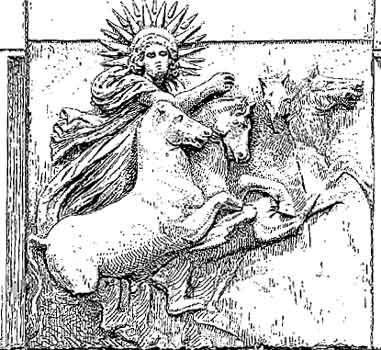

Hēlios is a Titan, born from Hyperion and Theia (Hesiod, Pindar), or Hyperion and Euryphaessa (Homeric Hyms). Hyperion (Ὑπερίων), meaning 'The High-One', was born from Gaea and Ouranos. He is the Lord of Light, and Titan to the east. Due to his (and Helios') epithets, there is often confusion between the two: Helios is refered to as 'Hyperion' by Homeros in the Odysseia, and one of the well known epithets of Hyperion is 'Helios Hyperion', yet the ancient Hellens distinguished between Them quite rigidly. Hyperion is the observer--and father--of many of the Titans connected to the sky. Diodoros Sikeliotes (Διόδωρος Σικελιώτης), Hellenic historian and writer of the Bibliotheca historica, says the following about Hyperion:

"Of Hyperion we are told that he was the first to understand, by diligent attention and observation, the movement of both the sun and the moon and the other stars, and the seasons as well, in that they are caused by these bodies, and to make these facts known to others; and that for this reason he was called the father of these bodies, since he had begotten, so to speak, the speculation about them and their nature."

Theia and Euryphaessa are generally regarded as the same Deathless woman: 'theia' is the Hellenic word for 'Goddess', so it was likely 'Theia Euryphaessa' translated to 'Goddess Euryphaessa'. This means that Hēlios' family tree is as follows:

Chaos --- Gaea
            |         |
  Ouranos --- |
                          Hyperion --- Euryphaessa
                      |
                     Hēlios

As far as confusion goes, Hēlios is also often confused with Apollon, mostly because of their conglomeration as a single Deity in the Roman era. In ancient Hellas, it was Phoibos (or 'Aiglêtos') Apollon who drove the chariot of the sun through the sky each morning, following the lovely Eos out of the heavenly gates. Phoibos Apollon is associated with carrying sunlight, but He is in no way the sun itself. That honor befalls Hēlios.

Hēlios is the sole Theos described as 'all-seeing' (Panoptes, because His rays reach (almost) everywhere on the Earth's surface. Most famously, He sees Aphrodite' affair with Ares, and warns Hēphaistos of it. As such, Hēlios is regarded as the enforcer of justice and vows. From Orphic Hymn seven:

"Dispensing justice, lover of the stream, the world's great despot, and o'er all supreme.
Faithful defender, and the eye of right, of steeds the ruler, and of life the light"

The most famous piece of mythology concerning Hēlios regards His son Phaethon (Φαέθων), by Klymene (Κλυμένη). The story is told to us by Ovid, a roman poet. In it, Klymene boasts to Phaethon that his father is the sun God Himself, and so, Phaethon goes up to Olympus to confirm. To prove His paternity, Hēlios swears of the river Styx to give Phaëthon anything he desires. Phaëthon grabs this opportunity to demand of his father to let him drive his golden chariot the next time the sun rises.

Hēlios tries to talk His son out of it, claiming that not even Zeus would attempt to drive the chariot, as it is hot with fire and the horses wild and fire breathing. Phaëthon will hear none of it, and so Hēlios must let him get on. He rubs his son's body with magical oil that will protect him from the heat and as Eos and Apollon leave the gates, so does Phaëthon.

The four horses of the chariot--Pyrois, Aeos, Aethon, and Phlegon--sensed Phaëthon's weaker hand and became virtually unsteerable. First, Phaëthon drove them too high, and the Earth below cooled and the people suffered. Then, he flew too low and entire cities burned, lakes and rivers dried up, and even the seas were affected. Mighty Poseidon tried to stop Phaëthon, but had to flee from the heat. It was Zeus who threw His lightning bolt and killed Phaëthon.

Hēlios was inconsolable, and refused to man the solar chariot for days on end. He blamed Zeus for His son's death, but Zeus rightly claimed He had no other choice. The Theoi eventually convinced Him to to take up His responsibility again, but His son's death pained Hēlios greatly. On the epitaph on Phaëthon's tomb was written:

"Here Phaëthon lies who in the sun-gods chariot fared. 
And though greatly he failed, more greatly he dared."

Another piece of Hēlios' mythology comes from Hómēros who writes in the Odysseia:

"we came swiftly to Helios Hyperion’s lovely island, where the sun-god grazed his fine broad-browed cattle, and his flocks of sturdy sheep. I could hear the lowing of cattle as they were stalled and the bleating of sheep from my black ship while I was still at sea, and the blind seer Theban Teiresias’ words came to mind, with those of Aeaean Circe, who both warned me to avoid the isle of Helios who gives mortals comfort."

Yet, not only do they not steer clear of the island, they kill and eat (unbeknownst to Odysseus), some of the sheep in Hēlios' herd as they become stranded on this island for days or even months.

"Now Lampetia of the trailing robes sped swiftly to Helios Hyperion with the news we had killed his cattle, and deeply angered he complained to the immortals: “Father Zeus and you other gods, immortally blessed, take vengeance on the followers of Odysseus, Laertes’ son. In their insolence, they have killed my cattle: creatures I loved to see when I climbed the starry sky, and when I turned back towards earth again from heaven. If they do not atone for their killing, I will go down to Hades and shine for the dead instead.""

"The gods at once showed my men dark omens. The ox-hides crawled about, raw meat and roast bellowed on the spit, and all around sounded the noise of lowing cattle. Nevertheless my faithful comrades feasted for six days on the pick of Helios’ cattle they had stolen. And when Zeus, Cronos’ son, brought the seventh day on us, the tempest ceased, and we embarked, and, raising the mast and hoisting the white sail, we put out into open water.

"It was not till the island fell astern, and we were out of sight of all but sky and sea, that Zeus anchored a black cloud above our hollow ship, and the waves beneath were dark. She had not run on for long before there came a howling gale, a tempest out of the west, and the first squall snapped both our forestays, so that the mast toppled backwards and the rigging fell into the hold, while the tip of the mast hitting the stern struck the steersman’s skull and crushed the bones. He plunged like a diver from the deck, and his brave spirit fled the bones.

"At that same instant Zeus thundered and hurled his lightning at the ship. Struck by the bolt she shivered from stem to stern, and filled with sulphurous smoke. Falling from the deck, my men floated like sea-gulls in the breakers round the black ship. The gods had robbed them of their homecoming."

The worship of Hēlios was quite widespread throughout ancient Hellas, but never in a measure beyond a cult. Athenians observed Helios as a Theos, but had no worship for Him. On the island of Rhodes, Hēlios was revered most, although evidence of His worship has been found in Corinth and Hermoine. The Colossus of Rhodes was dedicated to Him and the acropolis of Corinth was part of His worship as well.

For modern practitioners, there is not a lot to go on if you want to honor Hēlios. One can assume that manna is an acceptable offer because of His close identification with Apollon. There is also vague record of a festival on Rhodes, where a chariot with four horses was driven off of a cliff to commemorate the death of Phaëthon, but I would opt against this in modern day society. I would suggest thinking of Hēlios as He rises, and perhaps offering to Him when offering to Apollon in His solar aspects.

Helios is a beautiful, bright and all-encompassing Theos who deserves the worship of modern day practitioners. I, for one, would love to see a new cult rise on His name.