Showing posts with label Temples. Show all posts

In honor of the Olympic Games, I'm posting something every now and again about the ancient version of the Games. Today, I would like to discuss some of the specifics of Olympia, the location of the ancient games.


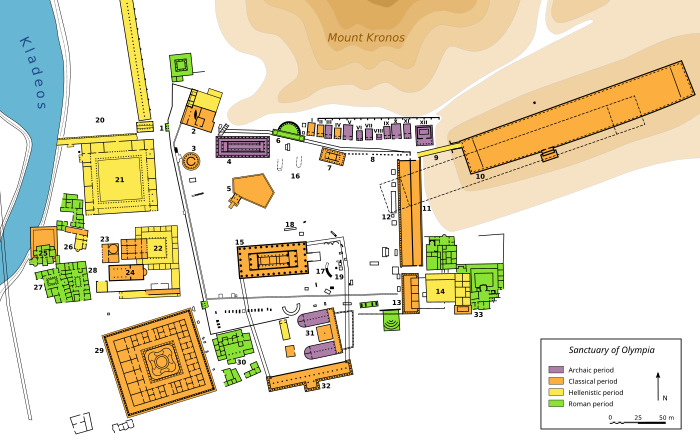
Olympia was a rural sanctuary in a fertile valley between two rivers. It was named for Mount Olympos, home of the Gods. The sanctuary, known as the Altis, consists of an unordered arrangement of various buildings. Enclosed within the temenos (sacred enclosure) are the Temple of Hera (or Heraion/Heraeum), the Temple of Zeus, the Pelopion, and the area of the altar, where the sacrifices were made.

To the north of the sanctuary stood the Prytaneion and the Philippeion, as well as the array of treasuries representing the various city-states. The Metroon lay to the south of these treasuries, with the Echo Stoa to the east. The hippodrome and later stadium were located east of the Echo Stoa. To the south of the sanctuary is the South Stoa and the Bouleuterion, whereas the Palaestra, the workshop of Pheidias, the Gymnasion, and the Leonidaion lie to the west.

The map above displays the location of: 1. Northwest Propylon, 2. Prytaneion, 3. Philippeion, 4. Temple of Hera, 5. Pelopion, 6. Nymphaeum of Herodes Atticus, 7. Metroon, 8. Treasuries, 9. Crypt (arched way to the stadium), 10. Stadium, 11. Echo Stoa, 12. Building of Ptolemy II and Arsinoe II, 13. Hestia stoa, 14. Hellenistic building, 15. Temple of Zeus, 16. Altar of Zeus, 17. Ex-voto of Achaeans, 18. Ex-voto of Mikythos, 19. Nike of Paeonius, 20. Gymnasion, 21. Palaestra, 22. Theokoleon, 23. Heroon, 24. Pheidias' workshop and paleochristian basilica, 25. Baths of Kladeos, 26. Greek baths, 27. and 28. Hostels, 29. Leonidaion, 30. South baths, 31. Bouleuterion, 32. South stoa, 33. Villa of Nero. Treasuries. I. Sicyon, II. Syracuse, III. Epidamnus(?), IV. Byzantium(?), V. Sybaris(?), VI. Cyrene(?), VII. Unidentified, VIII. Altar(?), IX. Selinunte, X. Metapontum, XI. Megara, XII. Gela. [Courtesy of Wikipedia]

Its many foundation myths were emblazoned in sculptures on the fifth-century BC. temple of Olympian Zeus:

- The games were held in celebration of Zeus defeating his father Kronos at Olympia and seized supreme power
- After cleansing the Augean stables and then defeating the local king in battle, Herakles inaugurated the early Games in Zeus’ honor, at this place
- Pelops, Zeus’ grandson, established the games, having won the hand of a local princess, Hippodameia, after sabotaging her father’s chariot to win a race, for which she was the prize. Her father died as a result, and Pelops set up the early competitions in his honor

Whatever the case, the games were a fact and established at Olympia. Most impressive about the temple of Zeus were not the sculptures but the seated statue of Zeus that stood inside the temple. The seated statue, created by the Greek sculptor Phidias, was thirty-nine feet, or twelve meters, tall. Ancient accounts say that, if Zeus would have stood, he would have unroofed the temple.

The statue was richly decorated with ivory and gold-plated bronze. The sculpture was wreathed with golden olive shoots and sat on a grand throne  cedarwood, inlaid with ivory, gold, ebony, and precious stones. He held a small statue of crowned Nike, goddess of victory, in his right hand, and in his left hand, a sceptre inlaid with gold, on which an eagle perched.

The statue was eventually destroyed, either in the fire that also destroyed the temple, or before, when it was carried off by Romans who either used the stone and precious metals to create something new, or to repurpose the statue as a representation of one of their own emperors. While it stood at Olympia, it was the literal seat of Zeus' power, and a focal point of His worship.
As the Roman Stoic philosopher Epictetus wrote:

“You journey to Olympia to gaze on the statue of Zeus and every one of you would think it a great misfortune to die never having seen it.”

The tempe to Hera was used to store some of the key paraphernalia of the Olympic Games, including a discus on which were inscribed the terms of the 'Olympic Truce', proclaimed by itinerant heralds months before the festival began to ensure that participants and spectators could enjoy safe passage.

A man has been arrested on suspicion of antiquities smuggling for trying to sell an ancient marble statue of “exceptional artwork” that once likely adorned a temple on Athens’ famed Acropolis or the slopes around it, Greek authorities said Friday.


Police said the 5th century B.C. statue was recovered following a months-long police operation that involved an investigation by the Cultural Heritage and Antiquities Department.

Measuring only about 37 centimeters (14.5 inches) high, the statue depicts a seated young man who reclines slightly to the right. The head, arms and most of both legs are missing, and two small holes are visible behind the left shoulder, from which rods would likely have attached the statue to a pediment — the triangular gable-end above the short sides of an ancient temple.

“It is an exceptional work of art, of the kind not easily found, not even in systematic excavations,” archaeologist Dimitris Sourlas said during a presentation Friday at police headquarters in Athens. The statue, he said, could have been part of a larger composition, but more research was needed.

Authorities didn’t say why they linked it with the Acropolis area, and what made them suspect it came from a temple — which would narrow down the search for its provenance.

The work was found in the possession of a man in the southern town of Corinth, who was arrested Wednesday on suspicion of seeking a buyer for the statue for the price of 100,000 euros ($119,000), police said.

An investigation is under way into how the piece came into his hands, and whether he had managed to contact potential buyers for it. The statue appears to have been buried for a long time, and bore signs of damage from digging tools.

It is illegal to own, buy, sell or excavate antiquities in Greece without a permit.

A Late Archaic temple was located in a central spot of the sanctuary of Artemis Amarysia in this year’s excavation season taking place from July 20 to August 28, 2020, as part of the five-year programme (2020-2024) of archaeological research. It was led by archaeologist Amalia Karapaschalidou and, on the part of the Swiss School of Archaeology, headed by its director Karl Reber with the participation of only a small number of Greek and Swiss students, due to the coronavirus pandemic.


Reconstruction of the eastern stoa [Credit: MOCAS]

Identifying the archaeological site at Palaioekklisies / Palaiochoria, east of today’s Amarynthos, with the sanctuary of Amarysia Artemis mentioned in various ancient sources as the most important sanctuary of Euboea, was made possible in 2017 as part of a five-year programme of collaboration (2015-2019) between the Euboea Ephorate of Antiquities and the Swiss School of Archaeology in Greece.

The Late Archaic temple discovered during this year’s excavation season is a 10x30 m building with a colonnade on its central axis and preserving its solid foundation, inside which a wall was found from an earlier phase and a grate with traces of fire. Votive offerings of the 7th and 6th centuries were deposited in the building’s foundations during the last quarter of the 6th cent. BC.  

Specifically, these included black figure vessels (among them an amphora depicting a Medusa), clay figurines, scarab shaped signet rings and faience figurines imported from the Eastern Mediterranean, as well as locally produced vessels such as long necked prochous vases and small hydriae, similar with vessels found in large numbers in excavations at Eretria of the Archaic sites of worship of female deities. These findings are evidence both of the Amarysia Artemis sanctuary participating in the religious practices of the Eretrians and the Euboeans in general and of  trade relations of the Amarynthos region with the Eastern Mediterranean.

The excavation of the large Post-Classical-Hellenistic portico was also completed inside the expropriated area. The monumental building with 27 Doric columns on its facade, is 69 m long and surrounded the sanctuary to the east. To the north, a portico and a series of three small buildings set the sanctuary’s boundaries. These are perhaps “treasuries” or small temples, which have a ground plan similar to corresponding buildings in other major Greek sanctuaries. No findings from the buildings revealed their proper use except for the fragment of a statue’s marble base bearing a votive inscription with the first letters of the name of Artemis. One of these buildings was destroyed by a lime kiln being installed, probably in Medieval times.

An earlier building of the 7th cent. BC was located to the west of the portico, 38 m long with a rectangular floor plan. This building probably functioned both as a monumental entrance to the sanctuary from the east and possibly for practices of worship.

Also worth mentioning among this year’s finds  are new fragments of tiles stamped with the name of Artemis, similar to those found in 2017 which then allowed for the sanctuary’s identification. The excavation period just completed was the first in a new five-year programme. In the coming years, research will focus on finding the initial phases of worship in this important sanctuary of Euboea. 

The field research is combined with special analyzes such as micromorphological sampling and archaeobotanical studies, in collaboration with the Wiener laboratory of the American School of Classical Studies at Athens.The Field archaeologists are Olga Kyriazi and Tobias Kraft,from the Euboea Ephorate of Antiquities and the Swiss Archaeological School respectively.

Source and far moe images here.

Far from the town and port of Aegina, on a hill on the northeast side of the island where a pre-Dorian deity was worshipped, the Aeginetans erected the first stone temple to the goddess Aphaia in c. 570 BC. It was a Doric limestone building with a prostyle porch, destroyed by fire around 510 BC.

Following the destruction of the first temple, the Doric limestone peripteral temple which survives today was built in the late 6th–early 5th c. BC. This is one of the best-preserved temples of ancient Greece, now restored. The exceptional marble sculptures on its pediments, depicting the mythical expeditions against Troy in which Aeginetan heroes of the Aeacid dynasty (including Ajax and Telamon) distinguished themselves, are a landmark in the history of ancient Greek sculpture.

Worshippers entered the temple courtyard via a propylon entrance in the south side of the peribolos enclosure delimiting the levelled area. Sacrifices to the goddess were offered by the priests on the altar outside the temple to the east. An inclined paved platform connected the temple to the altar. Votive offerings, such as the tall column topped by a sphinx, adorned the sanctuary.

The temple has 12 columns on the long sides and six on the short sides. It consists of the rectangular cella (inner chamber), the pronaos (portico) and the shallower opisthodomos (rear chamber), with two columns between the pronaos and the opisthodomos. The cella is divided into three parts by two rows of five columns on two levels. The place where the cult statue stood is visible in the central space. There was a doorway between the cella and the opisthodomos. Balustrades with doors blocked the gaps between the four central columns of the narrow façade and the two ends of the long walls, as well as the gaps between the columns of the pronaos and the opisthodomos.

Every visible part of the temple was coated in a painted layer of white plaster to protect the limestone. The metopes were undecorated. The roof was covered with terracotta tiles, apart from the first layer with the palmette-shaped antefixes, which was made of marble. The gutters were carved with lion’s-head spouts. Both the central palmette acroteria were also of marble, with a kore in Ionian dress standing on either side.

The temple, built at the peak of Aegina’s prosperity by an unknown architect, is one of the best examples of the Doric style.


By Sofia Michalopoulou via Archaeology.wiki

 A touch of Roman today. Marcus Vitruvius Pollio (80–70 BC – after c. 15 BC), commonly known as Vitruvius, was a Roman author, architect, civil engineer, and military engineer during the 1st century BC, known for his multi-volume work entitled De architectura. His discussion of perfect proportion in architecture and the human body led to the famous Renaissance drawing by Leonardo da Vinci of Vitruvian Man. He was also the one who, in 40 BCE, invented the idea that all buildings should have three attributes: firmitas, utilitas, and venustas, meaning: strength, utility, and beauty. These principles were later adopted by the Romans. His only surviving work is 'De Architectura.'


De architectura (On architecture, published as Ten Books on Architecture) is a treatise on architecture, dedicated to his patron, the emperor Caesar Augustus, as a guide for building projects. As the only treatise on architecture to survive from antiquity, it has been regarded since the Renaissance as the first book on architectural theory, as well as a major source on the canon of classical architecture. It contains a variety of information on Greek and Roman buildings, as well as prescriptions for the planning and design of military camps, cities, and structures both large (aqueducts, buildings, baths, harbours) and small (machines, measuring devices, instruments). Since Vitruvius published before the development of cross vaulting, domes, concrete, and other innovations associated with Imperial Roman architecture, his ten books are not regarded as a source of information on these hallmarks of Roman building design and technology.

A few paragraphs from Book 1 today.

“The building of temples relies on symmetry and architects need to most carefully understand the reason for this. It comes from proposition, which was called “analogy” in Greek. Proportion derives from fixed segments of the parts of the building and the whole—and the balance of symmetry is achieved through this. For no building can have an order in its design without symmetry and proportion, unless it has something like the precise design of a well-figured human body.  For nature has so composed the human body that the face from the chin to the top of the brow and the roots of the hair is one tenth of the whole and the palm of the hand from the wrist to the end of the middle finger is the same.

The head from the chin to the top is one eighth and the top of the chest where it meets the neck to the hair’s roots is a sixth. From the middle of the chest to the crown is one quarter of the whole. The third part of the length of the face extends from the bottom of the chin to the base of the nostrils. The nose from the nostril base to the space between the brows is the same. From that line to hair forms the forehead, a third part. The foot comprises a sixth of the body’s height and the chest is a quarter. The other limbs all have appropriate measures too. And ancient painters earned great praise by observing all these measures.

In the same way, the limbs of temples should have proportions of their various parts responding appropriately to the general size of the whole construction. Consider that the navel is the natural center of the body. For, if a person should lie on the ground with hands and feet spread wide and a circle has the navel as the center, fingers and toes will touch the line of the circumference. In addition, a square can be traced within the figure in the same way. For, if we take the measure from the sole to the top of the head and compare to measure to the distance from one hand to another, the lengths will be found equal, just like foundations squared with a rule. For this reason, if nature designed the body so that the parts correspond in their dimension to the whole design, then ancient people seem to have decided with good reason that they should keep in their works the exact proportions of the separate components to the design of the whole. Therefore, they have handed down orders in all of their works, especially in temples to the gods, the kinds of accomplishments whose excellence and weakness persist for generations.”

Back in July, I reported on plans by Roberto Sciarratta, director of the archaeological park on Sicily, to build a giant Atlas statue in front of the temple of Zeus. We have some more information!


A reassembled, 26-foot-tall statue of the mythological Titan Atlas will soon stand guard over the Temple of Zeus in Agrigento, Sicily. As Franz Lidz reports for the New York Times, Roberto Sciarratta, director of the Valley of the Temples archaeological park, commissioned the “Franken-Atlas”—which will feature fragments from eight of the temple’s original limestone Atlases within a steel-ribbed contemporary likeness of the Titan—in honor of the 2,600th anniversary of Akragas’ (now known as Agrigento) founding.

Once home to 38 towering Atlas statues, each of which seemingly supported a section of the structure’s architrave, or main beam, the Temple of Zeus was the largest Doric temple ever constructed. Built during the fifth century B.C. but never completed, the architectural wonder is now in ruins.

Speaking with the Guardian’s Lorenzo Tondo in July, when the project was first announced, Sciarratta said, “The re-installment of the statue of Atlas is the culmination of a more comprehensive restoration [of the temple].”

He added, “In the last decade, we’ve recovered and cataloged numerous artifacts that were once a part of the original structure. … The goal is to recompose piece-by-piece the trabeation [beams] of the Temple of Zeus to restore a portion of its original splendor.”

Just one of the 38 Atlases—also known as telamones—remains partially intact today. But excavations over the past 15 years have recovered pieces of the ancient statues, as well as dozens of other artifacts dated to the temple’s heyday, enabling archaeologists to reconstruct a version of the Titan. (A replica of the sole surviving statue currently lies near the ruins, but as park spokesperson Leonardo Guarnieri tells the Times, “It is not authentic.”)

Atlas was a major figure in Greek mythology. One of the Titans, a race of pre-Olympian gods descended from Uranus (the Sky or Heavens) and Gaia (the Earth), he was forced to hold the world atop his shoulders after losing a war against Zeus and the other Olympian gods—a burden mirrored in the Temple of Zeus’ telamones.

“The idea is to reposition one of these Atlases in front of the temple,” Sciarratta told the Guardian. “So that it may serve as a guardian of the structure dedicated to the father of the gods.”

According to Livius’ Joana Lendering, the Temple of Zeus was built around 480 B.C. to commemorate the tyrant Theron’s defeat of the Carthaginians. Theron likely relied on enslaved prisoners of war to construct the enormous structure.

During the fifth century, Akragas hosted more than 100,000 people, per the Guardian. But its fortunes waned over the years, with residents eventually repurposing parts of the ancient monuments for new buildings. The temple’s current state of disrepair is the result of 2,000 years of “earthquakes and pilfering,” notes the Times.

Plans to resurrect one of the Atlas statues have attracted criticism, with some archaeologists arguing that the project is in poor taste because it fails to offer an authentic portrayal of the temple and the objects around it.

“No archaeologist would endorse the use of ancient sculpture, no matter how fragmentary, to create a modern sculpture, even if the purpose is to highlight the site’s antiquity,” C. Brian Rose, an archaeologist at the University of Pennsylvania Museum of Archaeology and Anthropology, tells the Times.

Still, it’s worth noting that Italian news outlet Agrigento Notizie has disputed the claim that the resurrected statue is a “deceptive” reconstruction. In fact, Agrigento Notizie points out, the sheet of steel set to surround the original Atlas fragments will mainly serve to protect the fragile stone from erosion and keep the reassembled blocks in place.

I'd like to share part of a letter written by a famous Hellenic Pagan orator, Libanius, to the Christian Emperor Theodosius. It was written in the late 4th century AD, and describes--from the Pagan perspective--what happened to the temples of the ancient Gods. A teaser:

"But they say, 'We have only punished those who sacrifice, and thereby transgress the law, which forbids sacrifices.' O Emperor, when they say this they lie. For no one is so audacious, and so ignorant of the proceedings of the courts, as to think himself more powerful than the law. When I say the law, I mean the law against sacrificers.

Can it be thought, that they who are not able to bear the sight of a collector's cloak, should despise the power of your government? This is what they say for themselves. And they have been often alleged to Flavian himself, and never have been confuted, no not yet.

For I appeal to the guardians of this law: Who has known any of those whom you have plundered to have sacrificed upon the altars, so as the law does not permit? What young or old person, what man, what woman? Who of those inhabiting the same country, and not agreeing with the sacrificers in the worship of the gods? Who of their neighbours? For envy and jealousy are common in neighbourhoods.

Whence some would gladly come as an evidence if any such thing had been done: and yet no one has appeared, neither from the one nor from the other: [that is, neither from the country, nor from the neighbourhood.] Nor will there ever appear, for fear of perjury, not to say the punishment of it. Where then is the truth of this charge, when they accuse those men of sacrificing contrary to law?"  
Read the rest of the translation here: Libanius, Oration 30: For the temples (Pro templis) (1830) pp.72-96. I promise, it will be a valuable glimpse into the past.
As legend goes, a shepherd herded his flock up the side of Mount Parnassus. The sheep came upon a chasm and seemed to lose their minds. They started jumping around, and darting about. When the shepherd went to inspect the chasm, he fell under the influence of gasses that welled up from it. He lost all his worries and cared not about the time. He simply wished to remain there and gleam the knowledge he felt at the edges of his mind.

When he did not return, his family went to look for him. They took him home and put him to bed. Everyone was worried by his strange behavior, but he seemed to be calmer when the morning came. Yet, the shepherd's behavior had not returned to normal. He was able to foretell the future. Soon, word of the shepherd's ability, and the chasm, spread. People came from far away to either talk to the man or go to the source. Yet, those who visited the chasm lost their minds as well, and sometimes even jumped in the chasm.

A decision was made: this chasm, which must send up messages from Gaea, needed to be managed so no one would get hurt. A woman was chosen and introduced to the vapors, and given servants to keep her safe and healthy. She spoke with the voice of Gaea, and spoke her prophecies for anyone who would visit. It is said that the chasm was protected by a serpent, Python (Πύθωνος), who was put there by Gaea to protect the chasm.

The chasm was seen as the center of the known world, as Zeus himself had once let two eagles fly at the far reaches of the world, and they met over the chasm. It was Gaea's sacred site, but it didn't remain that way for long. Apollon was born, and he soon moved to find the perfect site for His temple. In the Homeric hymn to Pythian Apollon, we find His arrival at the site of Gaea's oracle, and an account of His battle with the serpent:

"In this place I am minded to build a glorious temple to be an oracle for men, and here they will always bring perfect hecatombs, both they who dwell in rich Peloponnesus and the men of Europe and from all the wave-washed isles, coming to question me. And I will deliver to them all counsel that cannot fail, answering them in my rich temple."

"...Whosoever met the dragoness, the day of doom would sweep him away, until the lord Apollo, who deals death from afar, shot a strong arrow at her. Then she, rent with bitter pangs, lay drawing great gasps for breath and rolling about that place. An awful noise swelled up unspeakable as she writhed continually this way and that amid the wood: and so she left her life, breathing it forth in blood. Then Phoebus Apollo boasted over her:

"Now rot here upon the soil that feeds man! You at least shall live no more to be a fell bane to men who eat the fruit of the all-nourishing earth, and who will bring hither perfect hecatombs. Against cruel death neither Typhoeus shall avail you nor ill-famed Chimera, but here shall the Earth and shining Hyperion make you rot."

Thus said Phoebus, exulting over her: and darkness covered her eyes. And the holy strength of Helios made her rot away there; wherefore the place is now called Pytho, and men call the lord Apollo by another name, Pythian; because on that spot the power of piercing Helios made the monster rot away."

And so, the site became sacred to Apollon. At first, young virgins spoke the word of the Lord Apollon, but later on, it was decreed that the oracle--called the Pythia--had to be over fifty years of age. The site was at the epicenter of important travel routes; the road leading from northeastern and eastern Hellas to the plain of Amfissa--where it met the road joining northern Hellas with Naupactus--passed through Delphi. From the beach of Itea, it was easy to pass to nearby Peloponnesus. This not only made Delphi an important religious site, but a commercial one, and it was one of the major keys to its success.

Delphi is no more. The entire site is in ruins. While you can still walk a large part of the grounds, there is no longer an oracle who breaths in the vapors and gives prophesy. Hellenists lost that line to the Theoi.

Most of us know how to work a divinatory tool; we come from other Neo-Pagan paths that encourage it, or developed systems of our own. Some of us are just naturally gifted. I feel the Hellenistic community--when it becomes larger and more standardized and organized--could greatly benefit from another Oracle; someone whom we trust to speak the words of the Theoi and whom we pay for their efforts. A new Pythia, dedicated to the Hellenistic community, who is supported by said community. I honestly hope we get there some day. Delphi is not gone; it lives on in each of us. It's legacy drives us forward as a religion. One day, we may have it again.
I am short on time today, so have a video about the ancient wonders of ancient Hellas! It's an older one but quite enjoyable.

"Greece, a land of breathtaking beauty and light. A land where science, art and inspiration from the gods combined to produce some of the world's greatest marvels of architecture and design. The ancient Greeks used buildings and structures to reflect the variety of life at the core of their civilisation - they built the first theatres, staged the first sports events and worshipped in some of the most spectacular temples ever built.

From prehistoric palaces to bold symbols of victory, this programme explores the Seven Ancient Wonders of Greece - the Theatre of Epidaurus, Olympia, Delphi, the Colossus of Rhodes, Santorini, The Palace of Knossos and the greatest masterpiece of them all - The Parthenon. Revealing the true icons of this incredible civilisation, we explore how and why the seven wonders of Ancient Greece still retain the power to amaze the world today. By recounting the stories behind the people who designed and oversaw their construction and unravelling the tales and myths of those who lived within them, we unearth the secrets behind The Seven Wonders of Ancient Greece."


A touch of Roman today. Marcus Vitruvius Pollio (80–70 BC – after c. 15 BC), commonly known as Vitruvius, was a Roman author, architect, civil engineer, and military engineer during the 1st century BC, known for his multi-volume work entitled De architectura. His discussion of perfect proportion in architecture and the human body led to the famous Renaissance drawing by Leonardo da Vinci of Vitruvian Man. He was also the one who, in 40 BCE, invented the idea that all buildings should have three attributes: firmitas, utilitas, and venustas, meaning: strength, utility, and beauty. These principles were later adopted by the Romans. His only surviving work is 'De Architectura.'

De architectura (On architecture, published as Ten Books on Architecture) is a treatise on architecture, dedicated to his patron, the emperor Caesar Augustus, as a guide for building projects. As the only treatise on architecture to survive from antiquity, it has been regarded since the Renaissance as the first book on architectural theory, as well as a major source on the canon of classical architecture. It contains a variety of information on Greek and Roman buildings, as well as prescriptions for the planning and design of military camps, cities, and structures both large (aqueducts, buildings, baths, harbours) and small (machines, measuring devices, instruments). Since Vitruvius published before the development of cross vaulting, domes, concrete, and other innovations associated with Imperial Roman architecture, his ten books are not regarded as a source of information on these hallmarks of Roman building design and technology.

A few paragraphs from Book 1 today.

“The building of temples relies on symmetry and architects need to most carefully understand the reason for this. It comes from proposition, which was called “analogy” in Greek. Proportion derives from fixed segments of the parts of the building and the whole—and the balance of symmetry is achieved through this. For no building can have an order in its design without symmetry and proportion, unless it has something like the precise design of a well-figured human body.  For nature has so composed the human body that the face from the chin to the top of the brow and the roots of the hair is one tenth of the whole and the palm of the hand from the wrist to the end of the middle finger is the same.

The head from the chin to the top is one eighth and the top of the chest where it meets the neck to the hair’s roots is a sixth. From the middle of the chest to the crown is one quarter of the whole. The third part of the length of the face extends from the bottom of the chin to the base of the nostrils. The nose from the nostril base to the space between the brows is the same. From that line to hair forms the forehead, a third part. The foot comprises a sixth of the body’s height and the chest is a quarter. The other limbs all have appropriate measures too. And ancient painters earned great praise by observing all these measures.

In the same way, the limbs of temples should have proportions of their various parts responding appropriately to the general size of the whole construction. Consider that the navel is the natural center of the body. For, if a person should lie on the ground with hands and feet spread wide and a circle has the navel as the center, fingers and toes will touch the line of the circumference. In addition, a square can be traced within the figure in the same way. For, if we take the measure from the sole to the top of the head and compare to measure to the distance from one hand to another, the lengths will be found equal, just like foundations squared with a rule. For this reason, if nature designed the body so that the parts correspond in their dimension to the whole design, then ancient people seem to have decided with good reason that they should keep in their works the exact proportions of the separate components to the design of the whole. Therefore, they have handed down orders in all of their works, especially in temples to the gods, the kinds of accomplishments whose excellence and weakness persist for generations.”

For those of you who, like me, are not blessed with the ability to write poetry beyond the level of an eight-grader, or for those who simply wish to draw they eyes of the Theoi by reciting poetry--or actually singing the hymns if your mastery of the Greek language allows it--which is familiar to Them, hymns form a wonderful addition to your practice. The oldest, and most well know, of the hymns are undoubtedly the Homeric ones, with the Orphic ones a close second, but there are many more out there.

  • Homeric Hymns - a collection of thirty-three Hellenic hexameter poems in epic style well known from Hómēros' Iliad and Odysseia. They range in length from three to five-hundred lines, and were composed in various time periods, by a variety of--now largely anonymous--authors. Hómēros might have actually written some of them, Pamphos might have penned the 'Hymn to Demeter', and Cynaethus of Chios might have penned the 'Hymn to Apollon'. Most of the poems were written between 800 and 300 BC, a few of the shorter poems are clearly from the Hellenistic (third or second century BC) period, and the Hymn to Ares was probably added to the whole in Roman times. Who actually combined the thirty-three is unclear. The first and second hymns ('To Dionysos', and 'To Demeter') were lost for a long time, until a chance discovery in Moscow in 1777 unearthed a fifteenth century manuscript with the two poems largely intact. The 'Hymn to Apollon' was noted down on the walls of Artemis' temple at Delos, and was most likely a large part of the festivals held there for Apollon. For all Homeric Hymns, go here.
  • Orphic Hymns - a collection of eighty-seven short religious poems composed in either the late Hellenistic or early Roman (first or second century AD) era. They are based on the beliefs of Orphism, a mystery cult or religious philosophy which claimed descent from the teachings of the mythical hero Orpheus. The Mysteries were mostly connected to Demeter, Persephone, life after death and reincarnation. From the Orphic Hymns also comes a list of which incenses to offer to which deity. For all Orphic Hymns, go here.
  • Hymns of Kallimachos (Καλλίμαχος) - a lesser known collection of poems, written by Kallimachos of Kyrēnē (Κυρήνη, Cyrene), who was a Hellenic poet and scholar of the Library of Alexandria. He rose to greatness around the third century BC and was the author of a large number of works. Unfortunately, only six hymns and sixty-three epigrams have survived to this day. Kallimachos despised the 'outdated' poetry type of Hómēros and wrote many testimonials against it. His hymns are, therefor, different to the eye than the Homeric and Orphic ones. For the complete hymns, go here.
  • Delphic Hymns - two musical compositions from ancient Hellas, dating back to 128 BC. They were recovered from the walls of the treasury of Apollon at Delphi, and were most likely performed in His worship at the Pythian festival. The first of the hymns was written and composed by Athenios, son of Athenios, the second by Limenios, son of Thoinos. For the first hymn, go here, for the second, go here.
  • Hymns of Proklos - Proclus (Πρόκλος) was a Greek Neoplatonist philosopher, one of the last major Classical philosophers. He was alive from 8 February 412 AD to 17 April 485 AD), and while a very late addition to this list, he wrote five beatiful hymns about the Roman Gods, which can be interpreted for the Hellenic ones as well. The surviving works consist of two hymns to Venus (Aphrodite), one to the Sun (Helios), one to the Muses, and one to Minerva (Athena). The surviving hymns can be found here, in both Greek and English.
  • Hymns of Mesomedes - Mesomedes of Krete (Μεσομήδης ὁ Κρής) was a Roman-era Hellenic lyric poet and composer of the early second century AD.  He was a freedman and court musician to the emperor Hadrian (reigned 117-138 CE), and created  three hymns and fifteen poems which have survived to this day. The hymns to Nemesis, the muse Calliope, and the Sun can be read here and listened to here. I am partial to this translation of the 'Hymn to Nemesis'.
  • Hymn to Aphrodite - This most wonderful hymn was written by Sappho (Σαπφώ) as she was struggling with love. It's unique in that it shows both petitioner and Aphrodite Herself. I am partial to this translation.
Greece-Is has published an article detailing the restoration work the Parthenon will undergo, including an interview with the woman who has been entrusted with conserving one of the ancient world’s greatest wonders.


The magnificent temple on the Acropolis of Athens, known as the Parthenon, was built between 447 and 438 BC in the Age of Pericles, and it was dedicated to the city’s patron deity Athena.
“This monumental building is filled with symbolism evoking power, struggle and victory,” the article notes.

Architect Vasiliki Eleftheriou, is the director of the Acropolis Restoration Service (YSMA), the special department within the Ministry of Culture and Sports, established in 1999 for the purpose of organising and implementing the conservation and restoration works to be carried out on the Acropolis.

We’re standing on the Acropolis, having just left the Propylaia behind us. Immediately, our gaze is drawn to the greatest achievement of ancient Greek architecture – the Parthenon. Everyone pauses, admiring the temple’s proportions, its harmony of lines, unsurpassed for two and a half thousand years. Most visitors capture this moment with a photograph; I pause to recall the words of Panos Valavanis,archaeology professor, who told me years ago that this monumental building is filled with symbolism evoking power, struggle and victory. Through it, he noted, passed the state ideology of ancient Athens.Construction of the Parthenon took place between 447 BC and 438 BC, using marble from the quarries of Mt Penteli. It comprises 16,500 marble members of different sizes. About 600 skilled laborers and 150 marble workers were involved in the original transport of this material to the Acropolis. Among them was probably Socrates. As a young man, he had worked as a stonemason, like his father, before abandoning this occupation “for the sake of education,” as Lucian wrote.

Today, the area is again a construction site, and again it is full of workers. Inside the monument, dwarfed by the temple’s imposing columns, they look like colorful specks from afar. Among them, a small, lively female figure can be made out. A closer look reveals her to be architect Vasiliki Eleftheriou, director of the Acropolis Restoration Service (YSMA), the special department within the Ministry of Culture and Sports, established in 1999 for the purpose of organizing and implementing the conservation and restoration works to be carried out on the Acropolis. Since 1975, the Committee for the Conservation of the Acropolis Monuments (ESMA), a multidisciplinary committee of academics and governmental officials, has been responsible for the scientific work on the archaeological site.

As with everyone on the team, the excitement and passion she has for the work she’s doing shows on her face, despite the glare of the fierce sun. Now that the restorations of the Erechtheion, Propylaia and Temple of Athena Nike have been completed, YSMA has focused in recent years on the Parthenon and Acropolis walls projects. Eleftheriou notes that the outline, which is still being followed today, for interventions on the Parthenon was first established in 1983 by architect Manolis Korres, current ESMA president.

In the coolness of her Plaka office, on quiet Polygnotou, near the Ancient Agora, we begin our conversation by referring to the “very important” meeting of the Central Archaeological Council (KAS) in early May. After a lengthy discussion, new proposals for the reconstruction of the north wall of the Parthenon’s cella were approved. This, Eleftheriou says, was a historic moment. A cella is the main interior room of an ancient Greek temple, in which the cult statue of the god or goddess was sheltered. In the Parthenon, the cella held the chryselephantine statue of Athena Parthenos, a work by Pheidias. The goddess’ clothes were crafted from gold, while the exposed parts of her body were ivory. Today, the cella walls represent an amazing restoration challenge. A total of 360 ancient stones, many of them with new marble attachments, will be reinstalled, along with 90 completely new marble members. “It was indeed a significant meeting, as decisions reached there will affect how the Parthenon appears in the future,” she tells us.

*Read the article in full here: Greece-is
It's the holiday season, and that means vacationing! For those who are visiting Greece this year--or who are planning to visit it in the future--I would like to give you my top fifteen of sites to visit, things to do, and thing to see as a Hellenist visiting this beautiful country. Let's start the countdown and happy holidays!

15. Klaros
This was an ancient Hellenic sanctuary on the coast of Ionia, an ancient region of central coastal Anatolia in present-day Turkey. It contained a temple and oracle of Apollon, honoured here as Apollo Klarios, and was considered a very important centre of prophecy as in Delphi and Didyma. It may have dated back to the sixth or seventh century BC, and is perhaps even older. It was also the site of ancient games, held every five years.

Aristotle is one of the most famous Greek philosophers and scientists. He was born in Northern Greece in a town called Stagira, in 384 BC. He founded the Peripatetic School (Wandering School), an informal institution where members tried to answer difficult scientific and mostly philosophical questions. After Aristotle’s death, a legend travelled around Greece that he used to walk while teaching, mainly around Stagira. There are various paths for visitors to choose from, depending on difficulty and length, and there are paths for mountain biking also. In addition to the trail, the local community recently opened an Aristotle theme park.

The Athens Festival institution, in collaboration with the Diazoma association, have taken the initiative of opening 25 ancient Greek theatres and archaeological sites to the public in order to promote the country’s cultural heritage. Most are ancient Hellenic theatres will host various theatrical productions during the summer. For an overview of the sites, go here.

12. Samothrake
Samothrake is a Greek island in the northern Aegean Sea. It was the home of the Sanctuary of the Great Gods, site of important Hellenic and pre-Hellenic religious ceremonies. In ancient times, the site served as a worship area to Axieros, a deity related to Cybele and Demeter, Kadmilos, an ithyfallic deity identified with Hermes, and the Cabeiri, ithyfallic demons identified with the Dioskouroi. It was also the site of a Mystery Cult. Currently, the site houses some fo the treasures found at the site, in both a storehouses and a museum.

11. Naxos
Naxos is a Greek island, the largest island in the Cyclades island group in the Aegean. It was the centre of archaic Cycladic culture. According to Hellenic mythology, young Zeus was raised in a cave on Mount Zas ('Zas' meaning 'Zeus'). It boasts ruins of a temple of Apollon, as well as one of Demeter, and it also has many beaches that draw heaps of tourists.

Built c. 330 BC over the remains of an earlier temple, the Temple of Zeus lies in the centre of the Sanctuary of Zeus at Nemea. The 9,240 square foot Temple played a significant role in the Nemea Games, one of the original Pan-Hellenic Games of Ancient Greece. It was before this Temple that, prior to the Nemea Games, the athletes would pay homage to the father of their gods, Zeus. The Temple’s construction included three Greek architectural forms, the Doric, the Corinthian, and the Ionic. 32 limestone columns each standing 42 feet tall, and composed of 13 cylindrical stones, called “drums”, each weighing approximately, 2.5 tons, surrounded the Temple of Zeus.

This is a local community within the regional unit of Messenia, and is located in the far south of modern Greece. Most of the area of Ancient Messene contains the ruins of the large classical city-state of Messene refounded by Epaminondas in 369 BC, after the battle of Leuctra and the first Theban invasion of the Peloponnese. The ancient city can be visited and is a major tourist attraction. In ancient times, it was founded by helots (Spartan slaves) running from Sparta. The defensive wall they built around the city to keep them out still exists in some places. The most important monuments of the archaeological site are the Asklepieion (see 7), the Temple of Poseidon, the Sanctuary of Demeter and the Dioskouroi, the stadium and gymnasium of Heroon where sons of noble families were trained, as well as the Theatre of Messeni, which has recently been cleared for a make-over.

8. The palace of Knossos
The palace of king Minos at Knossos is legendary because it was home to the minotaur who roamed the maze beneath it. In the myth, Theseus--a young, brave, hero--lets himself be amongst those who will be sacrificed to it, and with the help of Ariadne's string, is able to kill the minotaur and leave the maze again, unharmed. It's one of the myths that everyone knows. The palace in which the myth takes place, however, is less well known but equally impressive. It is an architectural marvel, which was incredibly ahead of its time. Even the ruins are impressive. Knossos was undeniably the capital of Minoan Crete. The ruins of the palace are located about twenty minutes south of the modern port town of Iraklio.

7. Epidaurus
Worship places of Asklēpiós were called 'asklepieia'. An asklepieion served as a temple, a hospital, and as a training-institute of the healing arts. The most famous of all the asklepieia was located at Epidaurus, and large parts of it are preserved. The site is open to visitors. In ancient Hellas, the sick would come to an asklepieion and offer a sacrifice to Asklēpiós--amongst the recorded sacrifices are black goats or sheep, gold, silver, or marble sculptures of the body part that required healing, and coins--in hopes of healing. They would then settle into the abaton or enkoimeterion, a restricted sleeping hall, which was occupied by the sick alone, or sometimes by a group of them, as well as a good few snakes.

Epidaurus also boasts a famous theatre. It's was--and is--a huge theatre, seating 15.000 people. The theatre was designed by Polykleitos the Younger in the 4th century BC. In the time of the Hellens, the theatre had thirty-four rows. Another twenty-two were added in the time of the Romans. While there were many theatres in ancient Hellas, the theatre of Epidaurus is famous for its perfect acoustics. Even today, you can hear a match being struck on the stage from any point in the theatre. For a limestone construction that's 2400 years old, that's pretty impressive.

6. Olympia
A sanctuary located in Elis, known for having been the site of the Olympic Games in classical times. The sanctuary consists of an unordered arrangement of various buildings including the Temple of Hera, the Temple of Zeus, the Pelopion (the alleged tomb of Pelops) and the area of the altar where the sacrifices were made. The hippodrome (a stadium for horse racing and chariot racing) and later stadium were also nearby. The Prytaneion (the building where the officials and winners of the Olympic games mets) and the Philippeion (an Ionic circular memorial) are located to the north of the sanctuary, as well as the array of treasuries representing the various city states. In Ancient Hellas, Olympia was sacred ground to the Greeks.

5. Kórinthos
Kórinthos, or Corinth, is a city and former municipality in Corinthia, Peloponnese, Greece. It is located about 78 kilometres (48 miles) southwest of Athens. Ancient Kórinthos was a city-state (polis) on the Isthmus of Corinth, the narrow stretch of land that joins the Peloponnesus to the mainland of Greece, roughly halfway between Athens and Sparta. The modern town of Corinth is located approximately 5 kilometres (3.1 miles) northeast of the ancient ruins. Ancient Corinth was one of the largest and most important cities of Greece, with a population of 90,000 in 400 BC. After the Romans built a new city in its place and made it the provincial capital of Greece in 44 BC, the city population was between 100,000 to 700,000 according to different sources. It boasts many museums filled to the brim with findings from various ancient sites, and boasts the 'Acrocorinthis', the acropolis of ancient Corinth, two ports, a converted a temple to Aphrodite, a temple of Apollon, and many, many, other site to visit.

4. Delos
The island of Delos near Mykonos, near the centre of the Cyclades archipelago, is one of the most important mythological, historical and archaeological sites in Greece. Investigation of ancient stone huts found on the island indicate that it has been inhabited since the 3rd century BC. By the time of the Odyssey the island was already famous as the birthplace of the twin gods Apollo and Artemis. Between 900 BC and AD 100, sacred Delos was a major cult centre where Dionysus is also in evidence as well as the Titaness Leto, mother of the divine twins. Eventually acquiring Panhellenic religious significance, Delos was initially a religious pilgrimage for the Ionians. The island houses the Temple of the Delians (Apollon and Artemis), the famous Terrace of the Lions, several market squares, the Temple of Hera, the House of Dionysus', and much, much, more.

The temple complex at Eleusis was one of the most elaborate and widely used sanctuaries around in ancient Hellas. It was the home of the Eleusinian Mysteries, and thus served as the cult's sanctuary. The Mysteries had festivals throughout the year, which were tied to agriculture through Demeter'srefusal to perform her duties as an agricultural Theia while her daughter Persephone is with Hades, and to the afterlife and Underworld through Persephone's return to the surface of the earth after Her mandatory stay with Hades has ended. Initiation ceremonies were held every year at Eleusis. Of all the mysteries celebrated in ancient times, the mysteries at Eleusis are assumed to be of great importance to a large portion of the ancient Hellens. The cult itself likely has origins dating back to the Mycenean period of around 1600 to 1100 BC, and it is believed that the cult of Demeter Herself was established in 1500 BC.

2. Athens
Athens is a sprawling city established among seven historic hills and surrounded by remarkable mountains. Inhabited for more than 3,000 years, Athens is widely known as the cradle of Western civilization and the birthplace of democracy. As the largest and capital city of Greece, Athens is also the political, commercial, financial and cultural centre of Greece. It boasts a great variety of sites for the Hellenistic tourist to visit, from the Acropolis, to the New Acropolis Museum, to the National Archaeological Museum, to the temple of Olympian Zeus, to Aristotle’s lyceum,and much, much, more. The Acropolis boasts the Parthenon, the Propylaia, the Erechtheion and the Temple of Athena Nike, and the The 'Lyceum' was a gymnasium and before that a public meeting place in a grove of trees in Classical Athens. It was named in honour of Apollo Lyceus. Though best known for its connection with Aristotle, the Lyceum was in existence long before his founding the school there in 334 / 335 BCE, providing a teaching ground for long list of philosophers and sophists, including Prodicus of Ceos, Protagoras, Isocrates, Plato, and Socrates.

1. Delphi
The number one always had to be Delphi. The Delphi complex held the temple of Apollon, the Amphictyonic Council (a council of representatives from six Greek tribes that controlled Delphi and also the sports events), various treasuries where the votive offerings to Apollon and/or the oracle were stored, the altar of the Chians (the main altar, located in front of the temple of Apollon, funded by the people of Chios, the stoa of the Athenians (A series of seven futed columns, used to house Athenian war trophies and collect the stories of freed slaves), Sibyl rock (the rock where the prophet Sibyl sat to deliver her prophecies), a theatre, the Tholos (the sanctuary of Athena Pronaia), a gymnasium, a stadium, the Hippodrome (where the running events took place), the Polygonal wall, the Castalian spring, and a large variety of athletic statues. The complex was also the site of one of the Panhellenic Games.

The site was at the epicenter of important travel routes; the road leading from northeastern and eastern Hellas to the plain of Amfissa--where it met the road joining northern Hellas with Naupactus--passed through Delphi. From the beach of Itea, it was easy to pass to nearby Peloponnesus. This not only made Delphi an important religious site, but a commercial one, and it was one of the major keys to its success.
In ancient times, six karyatides (singular: Καρυάτις, plural: Καρυάτιδες) graced the south column gallery on the Erechtheion (Ἐρέχθειον). The Erechtheion served as a temple to Athena Polias, Poseidon, the hero Erichthonius, and perhaps the legendary king Erechtheus. A karyatis is a support column of a temple, in the form of a woman. While the six on the Erechtheion appear copies, they can, in fact, be distinguished from one another. That is exactly what we'll be looking at today.


The statues are labeled Kore (maiden) A to F. Kore's A through C hold their left leg out, while Kore'sm D through F hold their right leg out. The biggest differences between the karyatides can be found in their clothing, and in their hair. While all six of the women wear an Ionic chiton, subtle differences can be found in its design. Kore B, for example, has a much shallower fold of cloth at her midsection, and their necklines all vary. Needless to say, they also have different bits missing, but as that was not intended by the sculptor, we'll not look into those differences today.

Their hair is most telling, though. Most have fishtail braids down the back, along with regular braids wrapped around the head, but some of the karyatides have sidecurls, while others do not, and their placement differs. o investigate this, Dr. Katherine Schwab created the Caryatid Hairstyling Project at Fairfield University, which laboured to recreate the hairstyles of the six karyatides from the Erechthion. The hairstyles were recreated on models--students in this case--by hairstylist Milexy Torres. You can see the results, and the subtle differences, below:


"The project was an experiment to replicate the hairstyles of the famous Caryatids from the Erechtheion [...] The Caryatids’ hairstyles are a remarkable and fascinating way to learn more about ancient Athenian society, especially during the fifth century B.C. [...] When Milexy made the final version, an adaptation of the general hairstyle, it was extremely comfortable, very light and cool.  I was surprised by how few pins and small plastic bands were needed to keep the different braids in place. "

The six statues currently on display on the Erechtheion are copies; five of the statues were removed during restoration of the building, and are now on in the Acropolis Museum in Athens where they are being restored and preserved. The last of the statues is in the British Museum in London, where it was taken to around 1800 by Lord Elgin. Despite steps to reclaim the statue, the British government has this far refused to return it. As a result, one of the pedestals in the display chamber of the statues in the Acropolis museum remains empty.
As legend goes, a shepherd herded his flock up the side of Mount Parnassus. The sheep came upon a chasm and seemed to lose their minds. They started jumping around, and darting about. When the shepherd went to inspect the chasm, he fell under the influence of gasses that welled up from it. He lost all his worries and cared not about the time. He simply wished to remain there and gleam the knowledge he felt at the edges of his mind.

When he did not return, his family went to look for him. They took him home and put him to bed. Everyone was worried by his strange behavior, but he seemed to be calmer when the morning came. Yet, the shepherd's behavior had not returned to normal. He was able to foretell the future. Soon, word of the shepherd's ability, and the chasm, spread. People came from far away to either talk to the man or go to the source. Yet, those who visited the chasm lost their minds as well, and sometimes even jumped in the chasm.

A decision was made: this chasm, which must send up messages from Gaea, needed to be managed so no one would get hurt. A woman was chosen and introduced to the vapors, and given servants to keep her safe and healthy. She spoke with the voice of Gaea, and spoke her prophecies for anyone who would visit. It is said that the chasm was protected by a serpent, Python (Πύθωνος), who was put there by Gaea to protect the chasm.

The chasm was seen as the center of the known world, as Zeus himself had once let two eagles fly at the far reaches of the world, and they met over the chasm. It was Gaea's sacred site, but it didn't remain that way for long. Apollon was born, and he soon moved to find the perfect site for His temple. In the Homeric hymn to Pythian Apollon, we find His arrival at the site of Gaea's oracle, and an account of His battle with the serpent:

"In this place I am minded to build a glorious temple to be an oracle for men, and here they will always bring perfect hecatombs, both they who dwell in rich Peloponnesus and the men of Europe and from all the wave-washed isles, coming to question me. And I will deliver to them all counsel that cannot fail, answering them in my rich temple."

"...Whosoever met the dragoness, the day of doom would sweep him away, until the lord Apollo, who deals death from afar, shot a strong arrow at her. Then she, rent with bitter pangs, lay drawing great gasps for breath and rolling about that place. An awful noise swelled up unspeakable as she writhed continually this way and that amid the wood: and so she left her life, breathing it forth in blood. Then Phoebus Apollo boasted over her:

"Now rot here upon the soil that feeds man! You at least shall live no more to be a fell bane to men who eat the fruit of the all-nourishing earth, and who will bring hither perfect hecatombs. Against cruel death neither Typhoeus shall avail you nor ill-famed Chimera, but here shall the Earth and shining Hyperion make you rot."

Thus said Phoebus, exulting over her: and darkness covered her eyes. And the holy strength of Helios made her rot away there; wherefore the place is now called Pytho, and men call the lord Apollo by another name, Pythian; because on that spot the power of piercing Helios made the monster rot away."

And so, the site became sacred to Apollon. At first, young virgins spoke the word of the Lord Apollon, but later on, it was decreed that the oracle--called the Pythia--had to be over fifty years of age. The site was at the epicenter of important travel routes; the road leading from northeastern and eastern Hellas to the plain of Amfissa--where it met the road joining northern Hellas with Naupactus--passed through Delphi. From the beach of Itea, it was easy to pass to nearby Peloponnesus. This not only made Delphi an important religious site, but a commercial one, and it was one of the major keys to its success.

Delphi is no more. The entire site is in ruins. While you can still walk a large part of the grounds, there is no longer an oracle who breaths in the vapors and gives prophesy. Hellenists lost that line to the Theoi.

Most of us know how to work a divinatory tool; we come from other Neo-Pagan paths that encourage it, or developed systems of our own. Some of us are just naturally gifted. I feel the Hellenistic community--when it becomes larger and more standardized and organized--could greatly benefit from another Oracle; someone whom we trust to speak the words of the Theoi and whom we pay for their efforts. A new Pythia, dedicated to the Hellenistic community, who is supported by said community. I honestly hope we get there some day. Delphi is not gone; it lives on in each of us. It's legacy drives us forward as a religion. One day, we may have it again.