Showing posts with label Hera. Show all posts

Taurus is a large and prominent constellation in the northern hemisphere's winter sky. It is one of the oldest constellations, dating back to at least the Early Bronze Age when it marked the location of the Sun during the spring equinox. It's located in the northern hemisphere's winter sky, between Aries to the west and Gemini to the east; to the north lie Perseus and Auriga, to the southeast Orion, to the south Eridanos, and to the southwest Cetus. This constellation forms part of the zodiac, and hence is intersected by the ecliptic. This circle across the celestial sphere forms the apparent path of the Sun as the Earth completes its annual orbit. As the orbital plane of the Moon and the planets lie near the ecliptic, they can usually be found in the constellation Taurus during some part of each year.


In Hellenic mythology, Taurus was identified with Zeus, who assumed the form of a magnificent white bull to abduct Europa, a legendary Phoenician princess. In illustrations of Hellenic mythology, only the front portion of this constellation are depicted; this was sometimes explained as Taurus being partly submerged as he carried Europa out to sea. From Apollodorus' 'Library':

"...But some say that Europa was a daughter not of Agenor but of Phoenix. Zeus loved her, and turning himself into a tame bull, he mounted her on his back and conveyed her through the sea to Crete. There Zeus bedded with her, and she bore Minos, Sarpedon, and Rhadamanthys; but according to Homer, Sarpedon was a son of Zeus by Laodamia, daughter of Bellerophon. On the disappearance of Europa her father Agenor sent out his sons in search of her, telling them not to return until they had found Europa. With them her mother, Telephassa, and Thasus, son of Poseidon, or according to Pherecydes, of Cilix, went forth in search of her. But when, after diligent search, they could not find Europa, they gave up the thought of returning home, and took up their abode in divers places..." [3.1.1]

A second Hellenic myth portrays Taurus as Io, a mistress of Zeus. To hide his lover from his wife Hera, Zeus changed Io into the form of a heifer. From Hyginus' 'Fabulae':

"Jupiter [Zeus] loved and embraced Io, and changed her to heifer form so that Juno [Hera] would not recognize her. When Juno found out, she sent Argus, who had gleaming eyes all around to guard her. Mercury, at Jove’s command, killed him. But Juno sent a fearful shape to plague her, and out of terror of it she was driven wildly and compelled to cast herself into the sea, which is called Ionian. Thence she swam to Scythia, and the Bosporus is named from that; thence she went to Egypt where she bore Epaphus. When Jove realized that for his sake she had borne such suffering, he restored her to her own form, and made her a goddess of the Egyptians, called Isis." [145]

Greek mythographer Acusilaus marks the bull Taurus as the same that formed the myth of the Cretan Bull, one of The Twelve Labours of Hēraklēs.

There are two more myths linked to this constellation, one that relates to the Hyades, and one to the Pleiades. The Hyades were daughters of Atlas (by either Pleione or Aethra, one of the Oceanides) and sisters of Hyas in most tellings, although one version gives their parents as Hyas and Boeotia. The Hyades are sisters to the Pleiades and the Hesperides. They are a sisterhood of nymphs that bring rain. These five nymphs whose stars outline the face of the bull Taurus. They were nurses of the god Dionysus who were awarded for their service with a place amongst the stars of heaven. Their rising heralded the onset of the rainy season in Greece. Some say they were teary nymphs placed in the heavens following the death of their brother Hyas, who was killed by a lion. Presumably this Hyas and the lion were represented by the constellations Aquarius and Leo. According to Hyginus in his 'Astronomica':
"It faces towards the East, and the stars which outline the face are called Hyades. These, Pherecydes the Athenian says, are the nurses of Liber [Dionysos], seven in number, who earlier were nymphae called Dodonidae. Their names are as follows: Ambrosia, Eudora, Pedile, Coronis, Polyxo, Phyto, and Thyone. They are said to have been put to flight by Lycurgus and all except Ambrosia took refuge with Theits, as Asclepiades says. But according to Pherecydes, they brought Liber to Thebes and delivered him to Ino, and for this reason Jove expressed his thanks to them by putting them among the constellations." [II.21]

The seven nymphs whose stars form the 'tail' of the bull Taurus are called the Pleiades. The sisters were placed amongst the stars by the Zeus, after the lustful giant Orion had pursued them across the earth for seven years. Orion was also set in heaven, but doomed to continue a futile chase for all eternity. Again from Hyginus:

"The Pleiades were so named, according to Musaeaus, because fifteen daughters were born to Atlas and Aethra, daughter of Ocean. Five of them are called Hyades, he shows, because their brother was Hyas, a youth dearly beloved by his sisters. When he was killed in a lion hunt, the five we have mentioned, given over to continual lamentation, are said to have perished. Because they grieved exceedingly at his death, they are called Hyades. The remaining ten brooded over the death of their sisters, and brought death on themselves; because so may experienced the same grief, they were called Pleiades. Alexander says they were called Hyades because they were daughters of Hyas and Boeotia, Pleiades, because born of Pleio, daughter of Ocean, and Atlas.
 
The Pleiades are called seven in number, but only six can be seen. This reason has been advanced, that of the seven, six mated with immortals (three with Jove, two with Neptune, and one with Mars); the seventh was said to have been the wife of Sisyphus. From Electra and Jove, Dardanus was born; from Maia and Jove, Mercury; from Taygete and Jove, Ladedaemon; from Alcyone and Neptune, Hyrieus; from Celaeno and Neptune, Lycus and Nycteus. Mars by Sterope begat Oenomaus, but others call her the wife of Oenomaus. Merope, wed to Sisyphus, bore Glaucus, who, as many say, was the father of Bellerophon. On account of her other sisters she was placed among the constellations, but because she married a mortal, her star is dim. Others say Electra does not appear because the Pleiades are thought to lead the circling dance for the stars, but after Troy was captured and her descendants through Dardanus overthrown, moved by grief she left them and took her place in the circle called Arctic. From this she appears, in grief for such a long time, with her hair unbound, that, because of this, she is called a comet.
 
But ancient astronomers placed these Pleiades, daughters of Pleione and Atlas, as we have said, apart from the Bull. When Pleione once was travelling through Boeotia with her daughters, Orion, who was accompanying her, tried to attack her. She escaped, but Orion sought her for seven years and couldn’t find her. Jove, pitying the girls, appointed a way to the stars, and later, by some astronomers, they were called the Bull’s tail. And so up to this time Orion seems to be following them as they flee towards the west. Our writers call these stars Vergiliae, because they rise after spring. They have still greater honour than the others, too, because their rising is a sign of summer, their setting of winter - a thing is not true of the other constellations." [II.21]
 
The constellation Taurus is visible at latitudes between +90° and −65°, and best visible at 21:00 (9 p.m.) during the month of January.

I get a lot of questions from readers, and most of the time, the answers are fairly short. When I feel the question or the reply would be valuable to others as well, I make a post with a collection of them and post them in one go. Today is one of those posts.


"What is the difference between hellenic recon, hellenic reform, and hellenic revival? I haven't really been able to find good explanations of these terms in relation to their differences."
 
In general, I consider 'Revival' and 'Reformed' the same thing. Others probably don't, but I'll explain the difference between 'Recon' (which we call 'Traditional') and 'Reformed' Hellenismos. To start, there is no hard line—not in as far as can be defined beforehand; the distinction between 'Traditional' and 'Reformed' is a matter of intent.

The ancient Hellenes worshipped their Gods in a way they did not even have to think about. They were taught by their parents how a ritual was supposed to be conducted and what a festival looked like. Kids learned how to act in temples, and they played their parts in the sacrifice. The ancient religion varied from place to place and when details of a festival or rite changed, they changed because the polis wanted them to. The ancient Hellenic religion(s) were greatly tied to the ancient Hellenic culture(s). Yet, there were overarching ideals and ritual acts that a man traveling from Athens to Kos would recognize if he walked in on a festival there. In fact, it's likely he would have recognized the festival and could share in its intent. Perhaps not its execution, and perhaps not all the time (because of local mythology and deities), but most of the time, and in most of its execution.
 
'Traditional' thus means to practice Hellenismos in the spirit of the ancients. I keep in mind that man from ancient Athens and with everything I do, we wonder if he would recognize what I am doing as the worship of the Gods he worships at home. That does not mean you need a big altar out in your garden (although I do encourage it), and this doesn't mean you need to hold daily ritual (although I do encourage it), and it doesn't mean that you always have to worship in a group or with your family (but I do encourage it) in order to be Traditional. It means that whatever you do, you keep that man in mind and wonder if he would recognize what you are doing as an adapted and modernized version of his faith.
 
'Traditional', as such, has nothing to do with practices that link back directly to ancient Hellas; no one is claiming to trace a lineage back or to in any other way have a direct line into the ancient Hellenic religion. We take what we know from scholarly and original work and make a generalized framework that can be built off of and adapt that to modern culture. Then we flesh out our practice with ancient practices and ancient ways of thought that resonate with us.
 
'Reformed', then, is the incorporation of practices that are either completely new or were derived from ancient Hellas with so many steps in-between that it's become completely unrecognizable. The incorporation of modern witchcraft, for example, or patron Gods as defined by modern Paganism. Wiccan elements are also part of Reformed Hellenismos.
 
To get back to the intent I mentioned earlier; your practice is Traditional to the typical Hellenist if you adhere to the above: ancient practices in a modern context where the bare bones are as close to the generalized ancient religion as we can make them. If you wilfully bring in modern elements from other religions or traditions, we consider those parts of your practice Reformed, and there is no value judgement in that. One is not better than the other. they both have vlue. It's a personal choice.
  
I hope this makes the distinction between the two clearer, and that it gives substance and context to the terms. For me, the value in using these terms lies in more easily finding likeminded people to share worship with. Using these terms prevents a lot of hassle and aggravation, but in the end, they are just words. It's your practice that matters and in the end, we all worship the Theoi.

~~~

"I read your articles on the Kronia. Can you please tell me, what day it falls this year. Has anything been discovered that would need me to worship differently from your article. And how should I pay homage to the Kronos this year?"

As far as I am aware, the article is still accurate. The Kronia will be held from dusk on July 27 to dusk on July 28 in 2016. you can find last year's ritual for the event here.

If you are interested in honouring Kronos, next month, from dusk on March 23 to March 24, the Galaxia takes place. This rather obscure festival was held in many places in ancient Hellas, but most notably at Olympia. It was closely linked to the vernal equinox, which was used to date it. The Galaxia is a festival held in honour of the Mother (of the Gods), who in Hellenic mythology is Rhea, although the title is also strongly associated with Gaia and Kybele, who have similar functions. She was worshipped as the mother of Zeus and the Galaxia celebrated His birth just as much as Her giving birth to him. Kronos--as Her consort and His father--was most likely also sacrificed to, along with Hera, who as Zeus' wife deserved honour alongside Him. Our ritual for that can be found here.

~~~

"As I have been ordered by my doctor to lose a great deal of weight, I was wondering if you had any suggestions for which Gods or Goddesses I should pray to (I assume Heracles would be one of these) or which Hymn's of Homer I should recite. If you could get back to me, I would greatly appreciate your input."

Herakles would be a great hero to pray to, as would any Gods and Goddesses connected to battle, struggle and physical health. Ares and Athena come to mind, along with Asklepios and even Niké. Especially Ares is a God I pray a lot to when it comes to working out and getting in shape, Demeter might also be a good option to help make healthy food choices.

~~~

"I see that you have ideas about honoring certain gods, which can include their families..ie, Apollo, Artemis, Leto, and zeus , etc. Do you have any ideas of honoring Hera, daily and just to do something special for her, offerings or a devotional."

Do you do daily ritual now? Hera is included in mine. If you only wish to honour Hera, however, you can with a simple ritual.

- Set out a bowl of water
- Set out a bowl of wine and dilute it with water
 - Light a candle to Hestia with a match
- Drop the match into the bowl of water and use it as khernips to cleanse
- Wash your hands and face and flick the access water off over your shrine to cleanse it.
-  Recite the Homeric Hymn 24 to Hestia:
 
"Blessed Goddess Hestia, you who tend the holy house of the lord Apollo, the Far-shooter at goodly Pytho, with soft oil dripping ever from your locks, come now into this house, come, having one mind with Zeus the all-wise—draw near, and withal bestow grace upon my song."
 
- Pour some wine out to Hestia
- Light an incense burner with aromatic herbs like bay-leaf, chamomile, chrysanthemum, jasmine flowers, laurel, lavender, myrtle,  rose, sandalwood, verbana, etc. or add it to a sacrificial fire
- Recite a hymn to Hera, like Homeric Hymn 12 to Hera:
 
"I sing of golden-throned Hera whom Rhea bare. Queen of the Immortals is she, surpassing all in beauty: she is the sister and wife of loud-thundering Zeus,--the glorious one whom all the blessed throughout high Olympos reverence and honour even as Zeus who delights in thunder."
 
- Pour some wine out to Hera
- Say your prayers
- Blow out the candle and clean up

 ~~~

"Do you know any artist that does drawing or paintings or even statuary. Commissioned pieces. I have been looking for a long time now and figured to ask because I have been meaning to commission some pieces of Hera or other gods as I become more financially able."

About commissioning pieces... I only know of Lykeia. Any readers interested....? Leave your contact info in the comments!

How about a little overview today? An overview of the fertility gods of Hellenismos. I'm going to start off with a lesser known deity: Priapos (Πριαπος), protector of sheep, goats, bees, the vine and of all garden produce. He was depicted with a huge male member, and can be petitioned for aid with any issues regarding the male genitalia. He was native to the Mysian city of Lampsakos on the Hellespont but the ancient Hellenes adopted the God as the son of either Hermes or Dionysos. His mother was usually Aphrodite. Fun fact: primitive statues of Priapos were traditionally set-up in vegetable plots to promote fertility with the added benefit of functioning as a type of 'scarecrow' scaring away birds.


Rhea (Ρεα), wife of Kronos, is a female fertility Goddess--amongst other things. She also looks after mothers and children, and is one of the great mother Goddesses in the pantheon having obviously given birth to the Olympians. Anything female-related (including issues with fertility) can be put before Her. Hera, by the way, has many of the same domains as Her mother--logical as she is the new generation's mother figure.

Aphrodite is also a fertility Goddess. She along with Zeus, Hera, Eileithyia and Hymenaios were the Theoi Gamelioi (Gods of Marriage) who presided over the wedding rites. She was invoked as the Goddess of the consummation of marriage and the fertility of the bride.

Speaking of which, Eileithyia (Ειλειθυια) is the Goddess of childbirth and labour pains. According to some there were two Eileithyiai, one who furthered birth and one who protracted the labour. Her name means 'she who comes to aid'.

Demeter and Persephone were regarded as fertility Goddesses in the Eleusinian Tradition, and during Their Thesmophoria festival, women actively asked for fertility from Them. Demeter, especially, is obviously also very important for the growth of plant life.

Dionysos is mostly associated with the fertility of the soil, and especially in regards to the grape vine, but human fertility is amongst His descriptors. Pan is regarded as much the same, as are many of the Satyrs and daimons connected to Them--like Tykhon, Konisalos, and Orthannes.

Phanes (Φανης) is the Protogenos of procreation in the Orphic cosmogony. He is the primal generator of life, and was the driving force behind reproduction in the early cosmos. Phanes was hatched from the world egg when it was split into its constituent parts by the ancient gods Khronos and Ananke. Arguably, He still drives the process of reproduction, be it in plants, animals, or humans.

 Two PAT ritual announcements, both for September 10th. We will hold a PAT ritual for the Niketeria, followed by the Plataia.

The Niketeria
We are coming upon another festival celebrated in ancient Athens: the Niketeria. Surviving sources date the festival to the third of Boudromion, and it was in honor of one of the most important events in Athens' history: its naming and tutelage by Athena. We will be celebrating it at the usual 10 AM EDT.


Many of us know there was a contest between Poseidon and Athena over who would rule the growing city of Athens (in the name it had before being called 'Athens'), and it is clear who won that contest. The earliest reference to this event we still have access to is from the fourth century BC by Plato, but it does not quite have the poetic touch Ovid's account has. For that reason, I will give the account of Ovid, and build from there. From the Metamorphoses, (trans. Melville):

"The rock of Mavors [Ares] in Cecrops' citadel is Pallas' [Athena's] picture [in her weaving contest with Arakhne] and that old dispute about he name of Athens. Twelve great gods, Jove [Zeus] in their midst, sit there on lofty thrones, grave and august, each pictured with his own familiar features: Jove [Zeus] in regal grace, the Sea-God [Poseidon] standing, striking the rough rock with his tall trident, and the wounded rock gushing sea-brine, his proof to clinch his claim. Herself she gives a shield, she gives a spear sharp-tipped, she gives a helmet for her head; the aegis guards her breast, and from the earth struck by her spear, she shows an olive tree, springing pale-green with berries on the boughs; the gods admire; and Victoria [Nike] ends the work." [6. 70]

Ancient Hellenic Neoplatonist philosopher Proklos (Πρόκλος) in 'On the Timaeus of Plato' speaks of this event as well, and notes that there is still a festival held to commemorate this event in his time (between 412 and 485 AD)

 "Farther still, the victories of Minerva are celebrated by the Athenians, and there is a festival sacred to the Goddess, in consequence of her having vanquished Neptune, and from the genesiurgic being subdued by the intellectual order, and those that inhabit this region betaking themselves to a life according to intellect, after the procurement of necessaries. For Neptune presides over generation; but Minerva is the inspective guardian of an intellectual life." [p. 153]

When this was celebrated, Proklos does not mention, but Plutarch does. One of these is in the Quaestiones Convivales, from the Moralia. Here, he answers the question: 'What is Signified by the Fable About the Defeat of Neptune? And Also, Why Do the Athenians Omit the Second Day of the Month Boedromion?'.

"While all were making a disturbance, Menephylus, a Peripatetic philosopher, addressing Hylas: You see, he said, how this investigation is no foolery nor insolence. But leave now, my dear fellow, that obstinate Ajax, whose name is ill-omened, as Sophocles says, and side with Poseidon, whom you yourself are wont to tell has often been overcome, once by Athene here, in Delphi by Apollo, in Argos by Here, in Aegina by Zeus, in Naxos by Bacchus, yet in his misfortunes has always been mild and amiable. Here at least he shares a temple in common with Athene, in which there is an altar dedicated to Lethe. And Hylas, as if he had become better tempered: One thing has escaped you, Menephylus, that we have given up the second day of September [Boudromion], not on account of the moon, but because on that day the gods seemed to have contended for the country." [Book 9, question 5]

Because of this, the official view of Elaion is that the festival of Niketeria--'Victory'--was celebrated not on the second of Boudromion as many modern researchers say, but on the third. The second day, after all, was no longer a part of the month. The question remains why the victory of one Goddess over one God was commemorated at all, and there is no adequate ancient explanation. None of the surviving works mention why and how the festival was celebrated. All we know is that it was noted--it might not even have been a true festival at all. We believe that by omitting the second day, the defeat of Poseidon was omitted, so as not to anger Him. A day later--in a somewhat unrelated fashion to Poseidon's defeat--there was a (possibly somewhat subdued) celebration of the victory of Athena, with sacrifices to Athena, Niké, and perhaps even Poseidon for the many wonderful gifts They had provided--and would hopefully continue to provide--for the city of Athens.

We will hold a subdued PAT ritual in honor of the Niketeria at 10 AM EDT on August 22rd. Will you be joining us? The ritual can be found here and you can join the community here.


The Plataia
The Plataia (or Plataea) seems to have been a commemorative festival, for the Hellenes fallen at the battle of Plataea. The Battle of Plataea was the final land battle during the second Persian invasion of Hellas. It took place in 479 BC near the city of Plataea in Boeotia, and was fought between an alliance of the Greek city-states, including Sparta, Athens, Corinth and Megara, and the Persian Empire of Xerxes I. Some 38,700 Hellenes stood their ground against 300.000 Persians. The Hellenes marched out of the Peloponnesus and the Persians retreated to Boeotia and built a fortified camp near Plataea. The Hellenes surrounded the camp, but refused to enter the bare terrain surrounding the camp. They waited for eleven days, and then found their supplies dwindled. They attempted to retreat, and Persian general Mardonius ordered his forces to pursue them. The Hellenes, however--particularly the Spartans, Tegeans and Athenians--stood their ground, and won a great victory over the Perians. The Persian infantry was slaughtered, and Mardonius killed. Plutarch gives the date for the battle to be the fourth of this month, but also attested that the Athenians commemorated the event on the third. In Boeotia (and especially in Plataea), the remembrance seems to have been held on the fourth.

Herodotus, in his Histories (9. 52. 1), and Plutarch, in his 'Life of Arestides' both remark the following about what is most likely this battle:

"The seer slew victim after victim, Pausanias turned his face [historical general of the Persian Wars], all tears, toward the Heraion, and with hands uplifted prayed Kithaironion Hera and the other gods of the Plataian land that, if it was not the lot of the Hellenes to be victorious, they might at least do great deeds  before they fell."[Life of Aristides, 18. 1]

As such we can assume that, besides the fallen, a sacrifice to Hera was also made. For this ritual, you can join us here. The ritual can be found here. We'll perform the ritual at 11 am EDT.

Very few heroes in ancient Hellas had quite the impact of Herakles. Both mythologically speaking and as a practical part of the religion, Herakles has a special place and he is honored during the Herakleia. Will you honor him with us tomorrow, on August 11 at the usual 10 am EDT?


Herakles was conceived by Zeus upon Alkmene, as He disguised Himself as her husband, returning early from war. Alkmene accepted Him in her bed gladly, as she was happy to see her husband again. When the real Amphitryon did return later that night, Alkmene realized what had happened, and told her husband. Amphitryon accepted her in his bed, regardless, and so she became pregnant with twins, one fathered by Zeus, and one by her mortal husband.

Hera, hearing of the affair, took an instant disliking to the unborn child. When it became time for Alkmene to give birth, Hera made Zeus swear a vow that a child born in the line of Perseus on this day would become King. Zeus agreed, and Hera hurried off to delay the birth of Herakles and Iphikles, and hurry along the birth of Eurystheus (Εὐρυσθεύς), grandson of Perseus. The two had unknowingly become part of a contest of wills between Zeus and Hera, to decide who would be the hero to drive off the last of the great monsters and pave the way for the Olympians.

Eventually, Hera was tricked into allowing the children born, as She would have postponed their delivery indefinitely. Alkmene, aware of the divine spark in one of her sons, took her distance from him, but the young Herakles was taken up by Athena and taken to Hera, who did no recognize the newborn nemesis of Her candidate, and took pity on him. She fed him from Her breast, but when he suckled so hard that he caused Her pain, She realized who he was, and cast him off. Athena rescued the infant and took him back to his mortal parents. Alkmene took him back and raised him with her husband.

Herakles was a strong child, so strong, in fact, that he inadvertently killed his music teacher Linos (Λῖνος) with a lyre, for which he was tried and found not guilty. He was still made to leave the city, however. Herakles set out to perform feats of strength, starting by defeating the lion of Kithairon, which had been a bane to his stepfather for far too long. Thespios, King of Thespiae, housed Herakles for fifty days as he hunted for the lion, and every night Thespios placed one of his fifty daughters in his bed, although Herakles thought he was only sleeping with one. Herakles eventually vanquished the lion. He dressed himself in the skin, and wore the scalp as a helmet. The Gods lavished him with gifts: a sword from Hermes, bow and arrows from Apollon, a golden breastplate from Hephaistos, and a robe from Athena. His famous club he made himself at Nemea.

Next, Herakles was drawn into a war between the Thebans and the Minyans. He happened upon heralds from King Klymenos, who had won a previous battle with Thebes and now demanded tribute from them. Herakles, who had been living in Thebes, cut the ears, noses and hands off of all but one of the heralds and told the last remaining one to take them back to his king as tribute. In the battle that followed, Herakles fought bravely with the king's army, and his side eventually won, earning him his wife Megara, eldest daughter of King Kreon of Thebes.

Due to Hera's jealousy, he was stricken mad and killed the five sons he had by his wife. When he was released from his madness by a hellebore potion--provided by Antikyreus--and realized what he had done, he cried out in anguish, and went on a long journey to cleanse himself of the miasma caused by these killings. First, he visited the oracle at Delphi, who, unbeknownst to him, was whispered to by Hera. The Oracle told Herakles to serve the king of Tiryns, Eurystheus, for ten years and do everything Eurystheus told him to do. Eurystheus gladly provided Herakles with these labors--ten of them, one for each year--and eventually ended up adding two more, resulting in the Twelve Labors of Herakles.

The Herakleia (Ἡράκλεια ἐν Κυνοσάργει, Herakleia en Kynosargei) were ancient festivals commemorating the death of Herakles. In Athens, the celebration was held just outside the city walls, in a sanctuary dedicated to Herakles. His priests were drawn from the list of boys who were not full Athenian citizens (nothoi, illegitimate children, like him) and were named 'parasitoi'. The Attic cults of Herakles were often closely connected with youth: at several of his cult sites there was a gymnasion attached, and there was a mythological tradition (perhaps originating in Boeotia) that after Herakles died he was taken up to Olympus, where he married Hebe, the personification of youth. Because of this, Herakles is sometimes worshipped as a God and sometimes as a dead hero.

In Thebes, the center of the cult of Herakles, the festivities lasted a number of days and consisted of various athletic and musical contests (agones), as well as sacrifices. They were celebrated in the gymnasium of Iolaus, the nephew and eromenos of Herakles, and were known as the Iolaeia. The winners were awarded brass tripods.

Will you join us in honoring Herakles on this day? You can join the community here and find the ritual here.

 The vast majority of World Heritage Sites (WHSs) in the Mediterranean are already at risk of irreparable damage due to manmade climate change, according to this study. The findings, published in the journal Nature Communications, analysed 49 locations in Europe and the Middle East and found over 75% of them to be in danger of rising sea levels and coastal erosion. Even more concerningly, that percentage is only projected to rise as time marches on. Unless swift and definitive action is taken to limit our carbon and methane emissions, wonders such as the ancient city of Carthage or the Leaning Tower of Pisa could soon become confined to the depths of the ocean and the annals of history alone.


The research was conducted by a team of scientists from Kiel University in Germany and focused on 49 UNESCO heritage sites in and around the Mediterranean Sea, each of which is located no more than 10m (33ft) above sea level. The country with the most at-risk sites was Italy with 15, while Croatia had seven and both Greece and Tunisia had four.

By using sophisticated computer modelling technology, the team were able to predict what would happen in four different scenarios depending on how our greenhouse gas (GHG) emissions vary over the period from the year 2000 to 2100. Unfortunately, even the most optimistic model showed that the majority of sites are already under threat.

37 of 49 WHSs included in the investigation are already at risk from flooding caused by rising sea levels, with that figure projected to reach 40 in the most pessimistic projection. 42 of the 49 are already threatened by coastal erosion, and all but two (Xanthos-Letoon in Turkey and Medina in Tunisia) are expected to be at risk by the turn of the century.

Venice in Italy, nicknamed the Floating City, is believed to be most at risk from flooding due to its world-famous networks of canals. Indeed, Venice became inundated almost 10 years ago after heavy rains and high winds struck it in December 2008, while late last month, more inclement weather led to around 75% of the city becoming submerged. The experts behind the most recent research say that figure could rise to 98% if a once-in-a-century-strength storm were to hit it.

Meanwhile, the Lebanese city of Tyre - once the capital of the ancient civilisation of Phoenicia - is the most at-risk from coastal erosion. With its location on the Mediterranean coast, the heavy sand composition of its soil and the high waves which strike it (regularly reaching up to 0.7m or 2.3ft), Tyre is at grave risk of irreparable damage. Pythagoreion and Heraion of Samos, an ancient architectural site dedicated to Hera, is next on the list of vulnerable hotspots.

While modern science is continually developing better and more sophisticated ways to anticipate extreme weather events (the recent dry spells which plagued Europe were predicted over six weeks in advance, for example), more affirmative action is needed to limit the effects of global warming. Otherwise, these stunning marvels of the ancient world - and the tourism revenue they bring with them - could soon be a thing of the past.

 I get a lot of questions from readers, and most of the time, the answers are fairly short. When I feel the question or the reply would be valuable to others as well, I make a post with a collection of them and post them in one go. Today is one of those posts.


"You recently answered a question about mythology and if it's real or not. You didn't answer if you think monsters are real as well. Do you? How about demi-gods? Are they currently amongst us?"

I feel about monsters the same way I do about all other aspects of mythology: they are real. They are the skeletons of dinosaurs and early mammals. They are the divine challengers of our Gods and heroes, They are the stories of the ancient Hellenes. There is no differnece between them. They are all facets of the same thing. I believe that if the ancient Hellenes had not found a field of mammoth bones, the Titanomachy and then the Gigantomachy would never have (retroactively) taken place in mythology, lending power to the Theoi. I believe  that the rise and fall of sea levels are caused by the combined effects of the gravitational forces exerted by the Moon and the Sun and the rotation of the Earth as much as I believe Kharybdis causes it. Facets.
 
As for demigods... define demigods. Do I think there is a camp in the woods somewhere with the offspring of Gods (even if they are traditionally considered virginal) like in Percy Jackson? No. But then again, what do I know? For Like I said before, I am sure there was someone like Herakles (or many men like Herakles!) who performed amazing feats of strength and endurance. I think those people exist today. On the one hand I think they are mortals, born from mortal parents, who grew up to do amazing, divinely inspired things. On the other hand, I believe they are the offspring of a God and a mortal. Even in ancient Hellas, these views were held. There was almost always a mortal father as well--and in case of twins, sometimes one was divine and the other wasn't. I am absolutely sure the Gods inspire mrtals to do great things, even today. The ancient Hellenes would have included the lives of these people in mythology and would probably have made them offspring of the Gods. In that regard, I believe in demigods with every fiber of my being.

Point is, science is quantifiable. Whether divinely influenced or not, gravity will always pull down the falling apple at the same speed if the apple always weighs the same and water will always boil at 100 degrees celcius in our atmosphere. On Mars, things would be completely different, obviously. I believe in these simple facts. I also believe the Protogenoi and Uranides make up the fabric of our world and are thus directly responsible for these facts being true. For me, they are one and the same and they are equally true whether you look at it from the side of science or religion.

 
***

"In Hellenic Polytheism, what rituals are made when someone has recently died?"

The ancient Hellenes believed that the moment a person died, their psyche--spirit--left the body in a puff or like a breath of wind. Proper burial was incredibly important to the ancient Hellenes, and to not give a loved one a fully ritualized funeral was unthinkable. It was, however, used as punishment of dead enemies, but only rarely. Funerary rites were performed solely to get the deceased into the afterlife, and everyone who passed away was prepared for burial according to time-honoured rituals.

They believed the Underworld was a neutral place. One did not desire to go there in the least, but it was part of life, and as far as the afterlife went, it was dull and sunless but nothing like the hell of Christianity. The worst part about it is being without the touch of loved ones, and forgetting who you were.

A burial or cremation had four parts: preparing the body, the prothesis (Προθησις, 'display of the body'), the ekphorá (ἐκφορά 'funeral procession'), and the interment of the body or cremated remains of the deceased. Preparation of the body was always done by women, and was usually done by a woman over sixty, or a close relative who was related no further away from the deceased than the degree of second cousin. These were also the only people in the ekphorá. The deceased was stripped, washed, anointed with oil, and then dressed in his or her finest clothes. They also received jewelry and other fineries. A coin could be presented to the dead, and laid under or below the tongue, or even on the eyes, as payment to Kharon.

During the actual funeral, a related mourner first dedicated a lock of hair, then provided the deceased with offerings of honey, milk, water, wine, perfumes, and oils mixed in varying amounts. Any libation was a khoe; a libation given in its entirety to the deceased. None was had by the mourners. A prayer to the Theoi--most likely Hermes Khthonios--then followed these libations. It was also possible to make a haimacouria before the wine was poured. In a haimacouria, a black ram or black bull is slain and the blood is offered to the deceased. This blood sacrifice, however, was probably used only when they were sacrificing in honour of a number of men, or for someone incredibly important. Then came the enagismata, which were offerings to the dead that included milk, honey, water, wine, celery, pelanon--a mixture of meal, honey, and oil--and kollyba--the first fruits of the crops and dried fresh fruits.

Unlike the ancient Egyptians, the ancient Hellenes placed very few objects in the grave, but monumental earth mounds, rectangular built tombs, and elaborate marble stelai and statues were often erected to mark the grave and to ensure that the deceased would not be forgotten. Grave gifts were allowed in many places, but could not cost more than a set amount all together. These elaborate burial places served as a place for the family members to visit the grave with offerings that included small cakes and libations. The goal  was to never be forgotten; if the dead was remembered always, and fed with libations and other offerings, their spirit would stay 'alive' forever. That said, especially in Athens, names on grave markers were restricted to women who died in childbirth and men who died in battle.

The epitaphios logos, or funerary oration, was deemed an indispensable component of the funeral ritual, especially in ancient Athens, where it came into practice around 470 BC for the honoured (war) dead. A large part of Hellenic rituals of the dead speak of honouring the dead by name, so their names will never be forgotten, their honour never lost. This practice starts with the epitaphios logos, in which the deceased is remembered for their greatest of deeds. Because Plato was eternally weary of the abilities of others to conduct the oration in the way it was intended, he made a guide for it, describing the four steps. It started with the preamble, which describes why this oration is held and how the audience should behave during it and after it. This part tends to include an apology from the speaker that he or she will never do true justice to the achievements of the dead. Following that, there is a long talk of the origin and ancestors of the deceased, followed by an account of the bravery and other good attributes of the dead. this part tended to include they devotion to the Athenian Polity. Finally, there was an epilogue, which constitutes a consolation and an encouragement for the families of the dead. The epilogue employs a traditional dismissal of the mourners.

Not surprisingly, perhaps, but many modern, western, funeral rites bear striking resemblance to the customs of the ancient Hellenes.


***

"I would really love to hear whatever you have to say on the subject of Elysium."

The ancient Hellens believed the Underworld was a neutral place. One did not desire to go there in the least but it was part of life, and as far as the afterlife went, it was dull and sunless but nothing like the hell of Christianity. The worst part about it is being without the touch of loved ones, and forgetting who you were.

The ancient Hellenes believed the dead have three places to go in the Underworld: Tartaros, where those who are punished for all eternity remained, the Asphodel meadows, where everyone who had lived a good life wandered about endlessly, and the Elysian Fields, where the children of Gods, the blessed dead and those who had lead extraordinarily honorable, brave or otherwise well-respected lives resided.

The Elysian Fields were typically divided into two sections: the Island of the Blessed and the Lethean Fields of Hades. The Elysian Fields, or 'White Island' is the final resting place for the souls of heroes. It was an island paradise located in the far western streams of the river Okeanos and ruled over by either Kronos or Rhadamanthys, a Judge of the Dead. The second Elysium, the Lethean Fields of Hades, is a netherworld realm. It's located in the depths of Haides beyond the river Lethe. Its fields were promised to initiates of the Mysteries who had lived a virtuous life. When the concept of reincarnation emerged and spread in ancient Hellas the two Elysian realms were sometimes tiered--a soul which had thrice won passage to the Lethean Fields, would, with the fourth, be transferred permanently to the Islands of the Blessed to reside with the heroes.

It's important to note that over the course of time, Elysium evolved. Hómēros didn't mention anything like it and refers only to the Meadows for all those noble souls who have died. Hesiod mentions a special realm for heroes. Pindar, by the 5th century BC, seperates the two in his Odes. By Roman times, writers such as Virgil combine the two Elysia. Many views of the same place survive and many more most likely existed. Such is the nature of something only discoverable after death.


***

"Do you have any info, holidays, special activities, etc. on Hera?"

There are a few festivals of Hera that were celebrated in ancient Athens and Erchia, a demos near Athens. There were most likely others but much of that information has been lost. This is the list I have, in sequence of the festival year:

Metageitnion 20 – Sacrifice to Hera ‘Telkhinia’ at Erchia
Boedromion 3 – Plataia – festival of reconciliation, sacred to Hera Daidala
Gamelion 27 – Theogamia/Gamelia – celebrating the sacred marriage of Zeus Teleios and Hera Telei
Gamelion 27 – Sacrifice to Kourotrophos, Hera, Zeus Teleius, and Poseidon at Erchia


Note that Hera would also have been honoured during any festival to Zeus and in many rites concerning Her children.

 I greatly enjoy watching the Olympics. I enjoy watching sport in general, but this is a competition which started in Greece, by the people who worshipped the same Gods as I do, people whose lives I'm trying to reconstruct. Watching the Olympics is religious for me. Did you know all of this about the Olympics?


An artist's impression of Altis, the sanctuary in Olympia
  1. The Olympic Games were held every four years, like they are now, from 776 B.C. to A.D. 394. They were, however, part of a cycle of sports events, known as the Panhellenic Games. The Olympic Games were dedicated to Zeus, were held in Olympia, Elis, and were held every four years. The Pythian Games were dedicated to Apollon, were held in Delphi and were held every four years, starting three years after the Olympic Games. The Nemean Games were dedicated to Zeus also, were held in Nemea, Corinthia, and were held every two years. Lastly, the Isthmian Games were dedicated to Poseidon, were held in Corinth, and were also held every two years.
  2. The most important events at the Olympic Games weren't the sport events; they were the sacrifices, offerings and other dedicatory practices which were continually performed during the five day event. There were also artistic happenings; writers, sculptures and painters showed what they could do in their given trade. Palmistry was practiced, wine flowed freely and there were a lot of prostitutes, who made more money in these five days than in the whole of a year without the sporting event. The Olympics were a festival unlike any other and every four years Hellas went nuts for it.
  3. The opening ceremony was as spectacular as it is today, but in an entirely different manner; athletes filed into the arena and were presented to the audience. Then, they were presented to a towering statue of Zeus, who carried a thunderbolt and a heft scowl. They swore on a bloody slice of boar's meat that they would obey the rules of the competition and not cheat to gain victory.
  4. The torch relay I take great joy in, was not practiced in Ancient Greece. In fact, it was introduced in 1936 by Hitler in response to an idea by Carl Diem to further the reign of the Nazi's and, in their eyes, glorify the Aryan super race, the Spartans. 
  5. Not everyone was allowed to participate in the games; non-Hellenics and women were unable to compete. There were exceptions made for non-Hellenics, like Roman Emperor Nero, when the situation called for it, but women were never allowed to compete. Married women weren't even allowed to enter the arena. There was, however, a secondary series of sporting events held in honor of Hera where women competed.
  6. The Olympic sport events back then were: chariot racing, wrestling, boxing, pankration, foot races, and the pentathlon which consisted of wrestling, stadion, long jump, javelin throw, and discus throw. Pankration was a fighting sport in which everything went. It was a kind of mixed martial-arts event in which broken bones were the norm, choke holds were encouraged and the only thing that you really couldn't do was gauge someone's eyes out. Everything else went. You won when the other guy went K.O.
  7. Except the chariot races, all Olympic sports were performed naked. This included the Pankration, so you can imagine where most of the pain was inflicted. The woman weren't completely naked, but participated with one breast exposed, in honor of the Amazonian women who were said to be so incredible at sports and warfare alike. 
  8. Over 40.000 people came to watch the Games. Olympia was in the middle of nowhere. If you came from Athens, it meant a 340 kilometer (210 mile) long walk just to get to Altis. Because of the festival and the presence of the Gods, all these people traveled the distance anyway.
  9. The end of the Olympic Games is guestimated to 394 A.D. after a decree to cease all pagan festivals by Christian emperor Theodosius I.
  10. Winners of the Olympic Games got rather minor rewards; Olympic winners received a garland of olives, Pythian winners received a laurel wreath, Nemean winners received a wild celery garland and the Isthmian winner received a pine garland. There was no runner-up; you won or you lost. All athletes were bathed in fame and glory until they lost, but the winner was brought home to his polis a king. He would never have to work again, was covered in riches and women, and his name and family name would be forever remembered and honored.

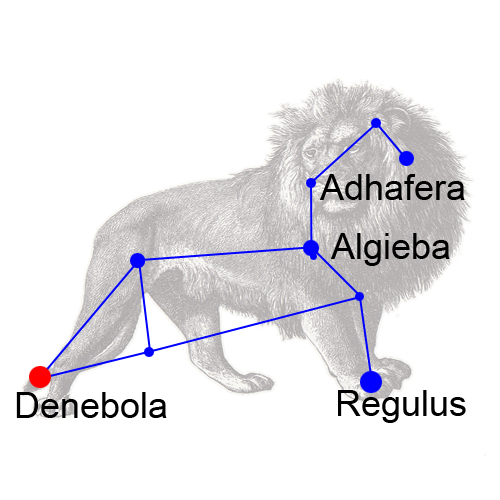
It's been a while since the last constellation! The constellation Leo is one of the most recognizable in the sky, and is obviously one of the constellations tied to the zodiac. Not surprisingly, it is therefor also tied to Hēraklēs.

The lion was considered the King of Beasts by the ancient Hellenic writers. For this reason, Hyginus--our primary source of ancient information on constellations--describes the constellation almost entirely as such, mentioning Hēraklēs in passing only:

"He is said to have been put among the stars because he is considered the king of beasts. Some writers add that Hercules’ first Labor was with him and that he killed him, unarmed. Pisandrus and many others have written about this. " [II.24]

The firs labour of Hēraklēs is, of course, to slay the Nemean lion. You can read about the start of Hēraklēs' life here, but for this constellation, all you need to know is that he was stricken mad by Hera, and killed his wife and children while he was out. As a result, he went on a long journey to cleanse himself of the miasma caused by these killings. First, he visited the oracle at Delphi, who, unbeknownst to him, was whispered to by Hera. The Oracle told Hēraklēs to serve the king of Tiryns, Eurystheus, for ten years and do everything Eurystheus told him to do. Eurystheus gladly provided Hēraklēs with these labors--ten of them, one for each year--and eventually ended up adding two more, resulting in the Twelve Labors of Hēraklēs.

The first of the twelve labours was to slay the Nemean lion. As the lion was terrorizing the area surrounding the mountain, Eurystheus must have seen in the lion a worthy opponent of Hēraklēs, whose tales of bravery and brute strength has proceeded him. He ordered the hero to return with its skin. And so, Hēraklēs went to the cave of the lion after picking up a bow and quiver of arrows, because he was unaware he would not be able to harm the creature with mortal weapons. After a long fight, Hēraklēs eventually chokes the lion, and hails victorious.

The Latin writer Seneca had a beautiful description of the constellation Leo, in the words of our great hero:

"See where the lion, my first toil, glows in no small part of heaven, is all hot with rage, and makes ready his fangs. Forthwith he will seize some star; threatening he stands with gaping jaws, and breathes forth fires, and shakes the mane upon his flaming neck; whatever stars sickly autumn and cold winter with its frozen tracts bring back, with one bound will he o’erleap, and attack and crush the neck of the vernal Bull." [II.942]

I want to add one more thing to he description of this constellation: Hyginus tells another tale about the constellation Leo: the story of Berenikē (Βερενίκη). The name translates to 'bearer of victory', and this version of the story refers to Berenikē II, who lived from about 267 - 221 BC. She was the daughter of Magas of Cyrene and Queen Apama II, and the wife of Ptolemy III, the third ruler of the Ptolemaic dynasty of Egypt. Prior to her marriage to Ptolemy III, she was married to Demetrius the Fair, a Macedonian prince, whom she had killed after he chose to become the lover of her mother Apama. Berenikē was quite the woman, and participated in the Nemean Games even the ancient Olympics. Her own son, Ptolemy IV eventually had her killed, but she was deified and to be honored from that moment on. The following story concerns her, her husband Ptolemy III, and Aphrodite.

"Above his likeness in the sky nearest the Virgin are seven other stars near his tail, arranged in a triangle, which Conon, the mathematician, and Callimachus call the Lock of Berenice. When Ptolemy had married his sister Berenice, daughter of Ptolemy and Arsinoe, and after a few days had set out to attack Asia, Berenice vowed that if Ptolemy returned as victor she would clip off her hair. She placed the lock, consecrated by this vow, in the temple of Venus Arsinoe Zephyritis, but on the following day it couldn’t be seen there. When the king was distressed by this, Conon the mathematician, whom we mentioned above, desiring to win the favor of the king, said that he had seen the lock among the constellations, and pointed out seven stars without definite configuration which he imagined were the lock.

Some authors along with Callimachus have said that this Berenice raised horses, and used to send them to Olympia. Others add that once Ptolemy, Berenice’s father, in panic at the number of the enemy, had sought safety in flight, but his daughter, an accomplished horse woman, leaped on a horse, organized the remaining troops, killed many of the enemy, and put the rest to flight. For this even Callimachus calls her high-souled. Eratosthenes says that she ordered returned to the girls of Lesbos the dowry left to them by their parents, which on one had released, and she established among them right to bring action of recovery."

The constellation Leo is visible at latitudes between +90° and −65°, and best visible at 21:00 (9 p.m.) during the month of April.

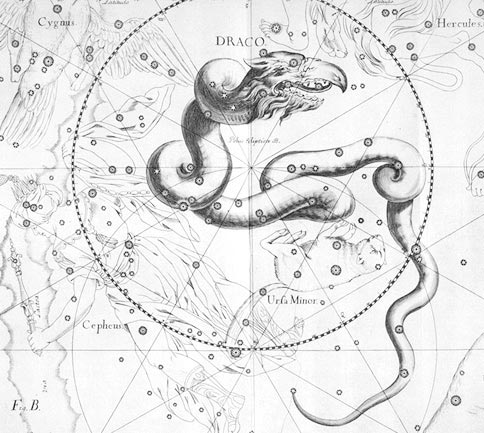
The constellation Draco (from the Greek Drakon, meaning dragon) is identified--funnily enough--with some dragons in Hellenic myth but not others. There are quite a few creatures, after all, who would qualify as a dragon in Hellenic myth. For a dragon or hydra not connected to the constellation, think of the one Kadmos vanquished, for example, or the one Apollon vanquished at Delphi, or even the dragon who guarded the Golden Fleece and was slain by Iásōn. In truth, only two dragons were associated with the myth in ancient times, most notably by Hyginus in his Astronomica: Drakon Hesperios, the Hesperian Dragon, and Drakon Gigantomakhios, the Gigantomachian Dragon.


The first of the myths associated with the constellation is the legend of the Drakon Hesperios (Δρακων Ἑσπεριος), who was slain by Hēraklēs during one of his Labours. I will tell the whole myth of the labour soon enough, but I will share what Hyginus wrote about this labour, and Hēraklēs' encounter with Ladôn (Λαδων), as the dragon was often called.

"This huge serpent is pointed out as lying between the two Bears. He is said to have guarded the golden apples of the Hesperides, and after Hercules killed him, to have been put by Juno [Hera] among the stars, because at her instigation Hercules set out for him. He is considered the usual watchman of the Gardens of Juno. Pherecydes says that when Jupiter [Zeus] wed Juno, Terra [Gaea] came, bearing branches with golden applies, and Juno, in admiration, asked Terra to plant them in her gardens near distant Mount Atlas. When Atlas’ daughters kept picking the apples from the trees, Juno is said to have placed this guardian there. Proof of this will be the form of Hercules above the dragon, as Eratosthenes shows, so that anyone may know that for this reason in particular it is called the dragon." [II.3]

The sole other dragon this myth is linked to is Drakon Gigantomakhios (Δρακων Γιγαντομαχιος), who rose up during the Gigantomachy. When the Olympians rose to power, they first fought the Titans during the Titanomachy. Vanquishing them, the Theoi thought They had won. Yet, there was one who sought revenge for the defeat of his father: Typhôeus, the most-feared son of Tartaros and Gaea. Some versions of the myth say that Typhôeus was actually the Drakon Gigantomakhios, or one of his offspring. Hyginus shares what happened to the dragon:

"Some also say this dragon was thrown at Minerva [Athena] by the Giants, when she fought them. Minerva, however, snatched its twisted form and threw it to the stars, and fixed it at the very pole of heaven. And so to this day it appears with twisted body, as if recently transported to the stars."

The constellation Draco is visible at latitudes between +90° and −15°, and best visible at 21:00 (9 p.m.) during the month of July. Tomorrow, we will talk a little more about the types of dragons in Hellenic myth, because I suddenly realized the association with medieval dragons is very easily made when reading 'dragon', but I assure you, the ancient Hellenes were unaccustomed to giant, fire breathing, lizards.

I'm sorry this post is late. Our cat Hugo is very ill and it's been a long and sad few days. Some things fall by the wayside a bit, but I'm trying to keep up. A repost then, in honor of Hugo.

As you are probably all well aware, the ancient Egyptians were big fans of cats, and one of their main Goddesses, Bastet, Goddess of protection and motherhood, carried the head of one. Alexandria had a temple to Bastet, for example, so the ancient Hellenes would have come in contact with Her. Most likely not everyone, but at least a few of the ancient Hellenes would have equated Bastet with Artemis--especially in Late Antiquity. Bast was a lioness goddess of the sun throughout most of Ancient Egyptian history, but later she was changed into the cat goddess Bastet. She also was changed to a Goddess of the moon by Hellenes occupying Ancient Egypt toward the end of its civilization. In Hellenic mythology, Bast also is known as Ailuros. Hyginus, for example, in his 2nd century AD 'Astronomica' writes:


"Egyptian priests and some poets say that once when many gods had assembled in Egypt, suddenly Typhon, an exceedingly fierce monster and deadly enemy of the gods, came to that place. Terrified by him, they changed their shapes into other forms: Mercurius [Hermes] became an ibis [the god Thoth], Apollo [Apollon], the bird that is called Thracian [the god Horus], Diana [Artemis], a cat [the goddess Bastet]. For this reason they say the Egyptians do not permit these creatures to be injured, because they are called representations of gods." [2.28]

You can read more about this bit of mythology here.

Returning to ancient Hellas--and not so much the Roman era--the question of the cat as a pet in ancient Hellas is rather vexing. Modern Athens is home to countless feral cats, however, the status of the cat in ancient Hellas is unclear, as images of cats are fairly rare. This is obviously a sign that even if there is a God or Goddess of cats in the ancient Hellenic pantheon cats are most likely a side-line.

Cats were probably kept by Greek households as liminal animals--animals who were free to come and go as they pleased, roaming houses and streets alike. This may account for the fact that few cat bones have been found in domestic situations. Historically, the main reason to keep cats is to get rid of mice, only in ancient Hellas the job of 'mouser' seems to have been handled by weasels and ferrets, many of which were also considered liminal pets. Yet some clear representations of cats do exist, primarily on funeral stele. These show caps on leashes, or being shown off as prized possessions, so we do know that some cats were updated to the status of 'pet'. The comic playwright Aristophanes liked to include cats in his productions and often used the phrase 'the cat did it' for comic effect, as cats were blamed for things breaking in the household.

So no, there isn't a God or Goddess of cats, but there is a Goddess associated with cats: Hekate. There is one single piece of mythology I have to base this on: the myth of Galinthias, the nurse of Alkmene, transformed by the angry Eileithyia, but received by Hekate as her animal. Again, I have only late sources, second century AD again, although this time recorded by Antoninus Liberalis in his 'Metamorphoses':

"At Thebes Proitos had a daughter Galinthias. This maiden was playmate and companion of Alkmene, daughter of Elektryon. As the birth throes for Herakles were pressing on Alkmene, the Moirai (Fates) and Eileithyia (Birth-Goddess), as a favour to Hera, kept Alkmene in continuous birth pangs. They remained seated, each keeping their arms crossed. Galinthias, fearing that the pains of her labour would drive Alkmene mad, ran to the Moirai and Eleithyia and announced that by desire of Zeus a boy had been born to Alkmene and that their prerogatives had been abolished.

At all this, consternation of course overcame the Moirai and they immediately let go their arms. Alkmene’s pangs ceased at once and Herakles was born. The Moirai were aggrieved at this and took away the womanly parts of Galinthias since, being but a mortal, she had deceived the gods. They turned her into a deceitful weasel (or polecat), making her live in crannies and gave her a grotesque way of mating. She is mounted through the ears and gives birth by bringing forth her young through the throat. Hekate felt sorry for this transformation of her appearance and appointed her a sacred servant of herself." [29]

And Dionysos, He is God of wild, predatory, felines--of those felines who pose a wild threat, who can rip flesh and inspire fear. I doubt He looks out for the smaller felines as well, although of course you could ask if you have a feline companion you are worried about. Your best bet, though, would seem Hekate to me, as She has taken mercy on felines before.

PAT ritual for the Theogamia

Around Valentine's day, us Hellenists honour a beautiful festival of love and social stability: the Theogamia, also known as the Gamelia or Hieros Gamos. This festival celebrates the anniversary of the marriage (gamos, γάμος) of Zeus Teleios (Τελειος, Of the Marriage Rites) and Hera Teleia (Τέλεια, same). Zeus Teleios and Hera Teleia are considered the patron Gods of marriage. To celebrate this divine marriage and ask for blessings upon the romantic ties we may have in life, Elaion is organising a PAT ritual on 10 February. The time is set for 10 AM EST. Will you join us?


We know very little about the actual Theogamia festival. In ancient sources it's sometimes called 'hieros gamos', the sacred marriage, and was referred to as a domestic festival. A day to spend at home, with your wedded partner. Hera Teleia was the primary deity of the festival, with Zeus Teleios being of secondary importance. It was celebrated for sure in Athens, and most likely also in city-states around Athens. It included a shared dinner, and presumably lovemaking, between husband and wife. Unmarried men were most likely free of religious obligations, and were free to dine out.

There seems to be a suggestion that the gamos of Zeus and Hera was enacted as part of the rituals of a hieros gamos festival, but there is no concrete evidence for this. The closest we get to a Hellenic 'Great Rite' is a ritual performed near Knossos in Krete, but the details are so very vague that we can't be sure about anything.

It doesn't take much imagination to fill in how to best celebrate this festival. If you are married or have a partner, have a nice dinner together, have some romance, spent the night together and bond. Think about ways in which you will help, honor and love your partner in the year to come. And, of course, join our ritual! I want to leave you with a quote from the Ilias that has nothing to do with the Theogamia itself but does describe the eternal love between Zeus and Hera so very beautifully.

“Zeus, the Cloud-Driver, saw her, and instantly his sharp mind was overwhelmed by longing, as in the days when they first found love, sleeping together without their dear parents’ knowledge. [...] ‘Hera, [...] let us taste the joys of love; for never has such desire for goddess or mortal woman so gripped and overwhelmed my heart, not even when I was seized by love for Ixion’s wife, who gave birth to Peirithous the gods’ rival in wisdom; or for Acrisius’ daughter, slim-ankled Danaë, who bore Perseus, greatest of warriors; or for the far-famed daughter of Phoenix, who gave me Minos and godlike Rhadamanthus; or for Semele mother of Dionysus, who brings men joy; or for Alcmene at Thebes, whose son was lion-hearted Heracles; or for Demeter of the lovely tresses; or for glorious Leto; or even for you yourself, as this love and sweet desire for you grips me now.’” (Iliad XIV)

The ritual can be found here and you can join the community here. Enjoy the Theogamia, everyone!


PAT ritual for the Kourotrophos, Hera, Zeus Teleios & Poseidon

On the Erkhian calendar, Kourotrophos, Hera, Zeus, and Poseidon are all sacrificed to on 27 Gamelion, at the same location: the temple of Hera. Also, as Kourotrophos Herself was often honored first with other deities and especially on this occasion, it seems to make sense that it was one ritual with four sacrifices as listed on the calendar. Will you join us for this sacrifice on February 10, after the ritual for the Theogamia? We've set the time at 11 AM EST.


The Kourotrophoi are mostly female deities who watch over growing children. Specific offerings to Them are known from the demos Erkhia (or Erchia), but duplicate similar offerings on the Acropolis of Athens. Especially at Erkhia, it varied per sacrifice which Kourotrophos was/were sacrificed to. In this case, where no specific deity is listed, none of the above were most likely honored. The deity in question was Kourotrophos Herself, a deity whose main function was to watch over nursing children and their mothers.

You can find the ritual here and join the community here.

Some constellations have huge mythological backstories, others do not. Those that are best know--like Aries and Cancer--have tiny backstories while some unknown constellations--like Argo Navis--have huge ones. Cancer's mythological backstory can be found in the myth of Hēraklēs, and today, I'll present you with the whole story.

Cancer is a tiny constellation which consists solely of dim stars. Finding it in the night sky with the naked eye, and unaided by someone who knows where it is is virtually impossible. Yet, the small crustacean must have been important to be immortalized.


In ancient Hellas, Cancer was called Karkinos (Καρκινος), who was an individual crab or crustacean. Hēraklēs, son of Zeus and the mortal Alkmene (Ἀλκμήνη)--who was a bane in Hera's life, simply for being born--was stricken mad by the Queen of the Gods and killed his five sons by his wife Megara (Μεγάρα), oldest daughter of Kreōn (Κρέων) of Thebes. When he was released from his madness by a hellebore potion--provided by Antikyreus--and realized what he had done, he cried out in anguish, and went on a long journey to cleanse himself of the miasma caused by these killings.

First, he visited the oracle at Delphi, who, unbeknownst to him, was whispered to by Hera. The Oracle told Hēraklēs to serve the king of Tiryns (Τίρυνς), Eurystheus (Εὐρυσθεύς), for ten years and do everything Eurystheus told him to do. Eurystheus gladly provided Hēraklēs with these labors--ten of them, one for each year--and eventually ended up adding two more, resulting in the Twelve Labors of Hēraklēs. Hēraklēs was told to: slay the Nemean Lion, slay the nine-headed Lernaean Hydra, capture the Golden Hind of Artemis, capture the Erymanthian Boar, clean the Augean stables in a single day, slay the Stymphalian Birds, capture the Cretan Bull, steal the Mares of Diomedes, obtain the girdle of Hippolyta, Queen of the Amazons, obtain the cattle of the monster Geryon, steal the apples of the Hesperides, and to capture and bring back Cerberus.

On his second labor, slaying the Lernaean Hydra, Hera send Karkinos to distract Hēraklēs while he fought. Unfortunately for the animal, Hēraklēs wasn't very impressed. He either kicked the animal so hard, that Karkinos flew so far into the sky, he can hardly be seen, or he squashed the crab, and Hera placed him into the sky for trying. She did, however, dim his stars because he had failed at his task.

The constellation Cancer is visible at latitudes between +90° and −60°, and best visible at 21:00 (9 p.m.) during the month of March.