Showing posts with label Labours series. Show all posts
It's been a while since we last journeyed with Hēraklēs. In fact, the last time we did, he had just completed the tenth labour: obtain the cattle of the monster Geryon. Geryon (Γηρυών) was the son of Khrysaor and Kallirrhoe and grandson of Medusa, was a fearsome giant who dwelt on the island Erytheia of the mythic Hesperides in the far west of the Mediterranean. Hēraklēs did away with him easily, even though getting to him proved to be quite the journey.

Now, the original mission in order to be cleansed of the act of killing his own children in a rage brought on by Hera was to perform ten heroic labours in ten years for the king of Tiryns, Eurystheus. But Eurystheus discounted two of the labours, labour two: slay the nine-headed Lernaean Hydra, and labour five: clean the Augean stables in a single day because he felt Hēraklēs had cheated on both. Now it is up to Hēraklēs to perform an eleventh labour: to steal the apples of the Hesperides (Ἑσπεριδες).

The Hesperides are nymphs, Goddesses of the evening and golden light of sunset. The three nymphs were daughters of either Nyx or the heaven-bearing Titan Atlas. They were entrusted with the care of the tree of the golden apples which was first presented to the Goddess Hera by Gaia on her wedding day. They were assisted in their task by a hundred-headed guardian drakon named Ladon (Λαδων). As Appolodoros writes in his 'Library':

"When the labours had been performed in eight years and a month, Eurystheus ordered Hercules, as an eleventh labour, to fetch golden apples from the Hesperides, for he did not acknowledge the labour of the cattle of Augeas nor that of the hydra. These apples were not, as some have said, in Libya, but on Atlas among the Hyperboreans. They were presented <by Earth> to Zeus after his marriage with Hera, and guarded by an immortal dragon with a hundred heads, offspring of Typhon and Echidna, which spoke with many and divers sorts of voices. With it the Hesperides also were on guard, to wit, Aegle, Erythia, Hesperia, and Arethusa." [2.5.11]

Of course, nothing is ever easy for our hero. Getting to the apples is harder than getting them! Before he could even get to work, Hēraklēs met Cycnus, a fellow hero, son of Ares . Zeus stopped the battle before it could get out of hand. Traveling on, Hēraklēsfought the sea God Nereus for the location of the garden where the tree of the golden apples stood. He wrestled the location out of the Gods and travelled to Lybia where he was challenged by Antaeus, son of Poseidon, who had the habit of challenging and killing strangers, only Hēraklēs killed him instead. Afterwards, Apollodorus tells us:

"After Libya he traversed Egypt. That country was then ruled by Busiris, a son of Poseidon by Lysianassa, daughter of Epaphus. This Busiris used to sacrifice strangers on an altar of Zeus in accordance with a certain oracle. For Egypt was visited with dearth for nine years, and Phrasius, a learned seer who had come from Cyprus, said that the dearth would cease if they slaughtered a stranger man in honor of Zeus every year. Busiris began by slaughtering the seer himself and continued to slaughter the strangers who landed. So Hercules also was seized and haled to the altars, but he burst his bonds and slew both Busiris and his son Amphidamas.

And traversing Asia he put in to Thermydrae, the harbor of the Lindians. And having loosed one of the bullocks from the cart of a cowherd, he sacrificed it and feasted. But the cowherd, unable to protect himself, stood on a certain mountain and cursed. Wherefore to this day, when they sacrifice to Hercules, they do it with curses.

And passing by Arabia he slew Emathion, son of Tithonus, and journeying through Libya to the outer sea he received the goblet from the Sun. And having crossed to the opposite mainland he shot on the Caucasus the eagle, offspring of Echidna and Typhon, that was devouring the liver of Prometheus, and he released Prometheus, after choosing for himself the bond of olive, and to Zeus he presented Chiron, who, though immortal, consented to die in his stead.

Now Prometheus had told Hercules not to go himself after the apples but to send Atlas, first relieving him of the burden of the sphere; so when he was come to Atlas in the land of the Hyperboreans, he took the advice and relieved Atlas. But when Atlas had received three apples from the Hesperides, he came to Hercules, and not wishing to support the sphere <he said that he would himself carry the apples to Eurystheus>, and bade Hercules hold up the sky in his stead. Hercules promised to do so, but succeeded by craft in putting it on Atlas instead. For at the advice of Prometheus he begged Atlas to hold up the sky till he should put a pad on his head. When Atlas heard that, he laid the apples down on the ground and took the sphere from Hercules. And so Hercules picked up the apples and departed. But some say that he did not get them from Atlas, but that he plucked the apples himself after killing the guardian snake. And having brought the apples he gave them to Eurystheus. But he, on receiving them, bestowed them on Hercules, from whom Athena got them and conveyed them back again; for it was not lawful that they should be laid down anywhere."

According to Hyginus, Ladôn was put into the sky as the constellation Draco.

"This huge serpent is pointed out as lying between the two Bears. He is said to have guarded the golden apples of the Hesperides, and after Hercules killed him, to have been put by Juno [Hera] among the stars, because at her instigation Hercules set out for him. He is considered the usual watchman of the Gardens of Juno. Pherecydes says that when Jupiter [Zeus] wed Juno, Terra [Gaea] came, bearing branches with golden applies, and Juno, in admiration, asked Terra to plant them in her gardens near distant Mount Atlas. When Atlas’ daughters kept picking the apples from the trees, Juno is said to have placed this guardian there. Proof of this will be the form of Hercules above the dragon, as Eratosthenes shows, so that anyone may know that for this reason in particular it is called the dragon." [II.3]
It has been a while since I did a labours of Hēraklēs series installment. When we left off at the end of the ninth labour, Hēraklēs had obtained Hippolyta's belt, at great cost to the Amazons. He returned to Eurystheus with it,  and was promptly sent on another journey: to obtain the cattle of the monster Geryon.
 

Geryon (Γηρυών) was the son of Khrysaor and Kallirrhoe and grandson of Medusa, was a fearsome giant who dwelt on the island Erytheia of the mythic Hesperides in the far west of the Mediterranean. A more literal-minded later generation of Hellenes associated the region with Tartessos in southern Iberia. Flavius Philostratus in his 'The Life of Apollonius' says:

"Now the city of Gadeira is situated at the extreme end of Europe, and its inhabitants are excessively given to religion; so much so that they have set up an altar to old age, and unlike any other race they sing hymns in honor of death; and altars are found there set up to poverty, and to art, and to Heracles of Egypt, and there are others in honor of Heracles the Theban. For they say that the latter advanced against the neighboring town of Erythea, on which occasion he took captive [the mythological giant]Geryon and his cows; the other, they say, in his devotion to wisdom measured the whole earth up to its limits." [5.4]

Geryon was described as a monster with human faces. According to Hesiod, Geryon had one body and three heads, whereas the tradition followed by Aeschylus gave him three bodies. A lost description by Stesichoros said that he has six hands and six feet and is winged; there are some mid-sixth-century Chalcidian vases portraying Geryon as winged. Apart from these bizarre features, his appearance was that of a warrior. He owned a two-headed hound named Orthrus, which was the brother of Cerberus, and a herd of magnificent red cattle that were guarded by Orthrus, and a herder Eurytion, son of Erytheia. From Apollodorus' 'Library':

"As a tenth labour he [Hēraklēs] was ordered to fetch the kine of Geryon from Erythia. Now Erythia was an island near the ocean; it is now called Gadira. This island was inhabited by Geryon, son of Chrysaor by Callirrhoe, daughter of Ocean. He had the body of three men grown together and joined in one at the waist, but parted in three from the flanks and thighs. He owned red kine, of which Eurytion was the herdsman and Orthus, the two-headed hound, begotten by Typhon on Echidna, was the watchdog. " [2.5.10]

Before he could get the cattle of Geryon, though, he had to take care of the journey, and it would be quite a hard one at that as he had to travel from Krete to Libya, to Egypt, and then finally to the lands Geryon roamed. He met quite a lot of trouble and quite a lot of death on the way, but I am going to let Diodorus tell you that part in his 'Library of History':

"Heracles, realizing that this task called for preparation on a large scale and involving great hardships, gathered a notable armament and a multitude of soldiers such as would be adequate for this expedition. For it had bee noised abroad throughout all the inhabited world that Chrysaor, who received this appellation because of his wealth, was king over the whole of Iberia, and that he had three sons to fight at his side, who excelled in both strength of body and the deeds of courage which they displayed in contests of war; it was known, furthermore, that each of these sons had at his disposal great forced which were recruited from warlike tribes. It was because of these reports that Eurystheus, thinking any expedition against these men would be too difficult to succeed, had assigned to Heracles the Labour just described.
 
But Heracles met the perils with the same bold spirit which he had displayed in the deeds which he had performed up to this time. His forces he gathered and brought to Crete, having decided to make his departure from that place; for this island is especially well situated for expeditions against an part of the inhabited world. Before his departure he was magnificently honoured by the natives, and wishing to show his gratitude to the Cretans he cleansed the island of the wild beasts which infested it. And this is the reason why in later times not a single wild animal, such as a bear, or wolf, or serpent, or any similar beast, was to be found on the island. This deed he accomplished for the glory of the island, which, the myths relate, was both the birthplace and the early home of Zeus.
 
Setting sail, then, from Crete, Heracles put in at Libya, and first of all he challenged to a fight Antaeus, whose fame was noised abroad because of his strength of body and his skill in wrestling, and because he was wont to put to death all strangers whom he had defeated in wrestling, and grappling with him Heracles slew the giant. Following up this great deed he subdued Libya, which was full of wild animals, and large parts of the adjoining desert, and brought it all under cultivation, so that the whole land was filled with ploughed fields and such plantings in general as bear fruit, much of it being devoted to vineyards and much to olive orchards; and, speaking generally, Libya, which before that time had been uninhabitable because of the multitude of the wild beasts which infested the whole land, was brought under cultivation by him and made inferior to no other country in point of prosperity.
 
He likewise punished with death such men as defied the law or arrogant rulers and gave prosperity to the cities. And the myths relate that he hated every kind of wild beast and lawless men and warred upon them because of the fact that it had been his lot what while yet an infant the serpents made an attempt on his life, and that when he came to man’s estate he became subject to the power of an arrogant and unjust despot who laid upon him these Laboures.
 
After Heracles had slain Antaeus he passed into Egypt and put to death Busiris,49 the king of the land, who made it his practice to kill the strangers who visited that country. Then he made his way through the waterless part of Libya, and coming upon a land which was well watered and fruitful he founded a city of marvelous size, which was called Hecatompylon, giving it this name because of the multitude of its gates. And the prosperity of this city continued until comparatively recent times, when the Carthaginians made an expedition against it with notable forces under the command of able generals and made themselves its masters." [4.17.1]

When Heracles reached Erytheia, no sooner had he landed than he was confronted by the two-headed dog, Orthrus. With one huge blow from his olive-wood club, Heracles killed the watchdog. Eurytion the herdsman came to assist Orthrus, but Heracles dealt with him the same way. On hearing the commotion, Geryon sprang into action. He pursued Heracles at the River Anthemus but fell victim to an arrow that had been dipped in the venomous blood of the Lernaean Hydra, shot so forcefully by Heracles that it pierced Geryon's forehead. Apollodorus:

"And having reached Erythia he lodged on Mount Abas. However the dog, perceiving him, rushed at him; but he smote it with his club, and when the herdsman Eurytion came to the help of the dog, Hercules killed him also. But Menoetes, who was there pasturing the kine of Hades, reported to Geryon what had occurred, and he, coming up with Hercules beside the river Anthemus, as he was driving away the kine, joined battle with him and was shot dead. And Hercules, embarking the kine in the goblet and sailing across to Tartessus, gave back the goblet to the Sun." [2.5.10]

Of course, the journey back was as complicated as the journey to Erythia. Diodorus again:

"And after Heracles had visited a large part of Libya he arrived at the ocean near Gadeira,51 where he set up pillars on each of the two continents. His fleet accompanied him along the coast and on it he crossed over into Iberia. And finding there the sons of Chrysaor encamped at some distance from one another with three great armies, he challenged each of the leaders to single combat and slew them all, and then after subduing Iberia he drove off the celebrated herds of cattle.
 
He then traversed the country of the Iberians, and since he had received honours at the hands of a certain king of the natives, a man who excelled in piety and justice, he left with the king a portion of the cattle as a present. The king accepted them, but dedicated them all to Heracles and made a practice each year to sacrifice to Heracles the fairest bull of the herd; and it came to pass that the kine are still maintained in Iberia and continue to be sacred to Heracles down to our own time.
 
But since we have mentioned the pillars of Heracles, we deem it to be appropriate to set forth the facts concerning them. When Heracles arrived at the farthest points of the continents of Libya and Europe which lie upon the ocean, he decided to set up these pillars to commemorate his campaign.
 
And since he wished to leave upon the ocean a monument which would be had in everlasting remembrance, he built out both the promontories, they say, to a great distance; consequently, whereas before that time a great space had stood between them, he now narrowed the passage, in order that by making it shallow and narrow he might prevent the great sea-monsters from passing out of the ocean into the inner sea, and that at the same time the fame of their builder might be held in everlasting remembrance by reason of the magnitude of the structures. Some authorities, however, say just the opposite, namely, that the two continents were originally joined and that he cult a passage between them, and that by opening the passage he brought it about that the ocean was mingled with our sea. On this question, however, it will be possible for everyman to think as he may please." [4.18.2]

So, a simple labour, but a hell of a journey. Another one off of the list, and just two more to go. Next, he will be asked to steal the apples of the Hesperides, and to capture and bring back Kerberos from Hades.
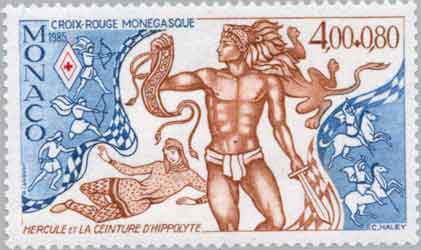
Welcome to another Labour: obtaining the girdle of Hipplyta. Let's set the stage: Eurystheus' daughter Admete wanted the belt of Hippolyta, a gift to the queen of the Amazons from the war god Ares. To please his daughter, Eurystheus ordered  Hēraklēs to retrieve the belt as his ninth labour.


The Amazons (Ἀμαζόνες, Amazónes, singular Ἀμαζών, Amazōn) were all-female warriors legened to have lived in Pontus, which is part of modern-day Turkey near the southern shore of the Euxine Sea (the Black Sea). There they formed an independent kingdom under the government of a queen named Hippolyta or Hippolyte (generally translated as 'unbridled mare'). The Amazons were supposed to have founded many towns, amongst them Smyrna, Ephesus, Sinope, and Paphos. Apollodorus, in his 'Library', writes about the Amazons, and Hippolyta:

"She was queen of the Amazons, who dwelt about the river Thermodon, a people great in war; for they cultivated the manly virtues, and if ever they gave birth to children through intercourse with the other sex, they reared the females; and they pinched off the right breasts that they might not be trammelled by them in throwing the javelin, but they kept the left breasts, that they might suckle." [2.5.9]

Hēraklēs sailed to Paros, and right away, ran into a lot of trouble. Apollodorus, again: 

"[T]aking with him a band of volunteer comrades in a single ship he set sail and put in to the island of Paros, which was inhabited by the sons of Minos, to wit, Eurymedon, Chryses, Nephalion, and Philolaus. But it chanced that two of those in the ship landed and were killed by the sons of Minos. Indignant at this, Hercules killed the sons of Minos on the spot and besieged the rest closely, till they sent envoys to request that in the room of the murdered men he would take two, whom he pleased. So he raised the siege, and taking on board the sons of Androgeus, son of Minos, to wit, Alcaeus and Sthenelus, he came to Mysia, to the court of Lycus, son of Dascylus, and was entertained by him; and in a battle between him and the king of the Bebryces Hercules sided with Lycus and slew many, amongst others King Mygdon, brother of Amycus. And he took much land from the Bebryces and gave it to Lycus, who called it all Heraclea." [2.5.9]

From here on out, Hēraklēs got to focus on completing his task. Hippolyte was a powerful Queen, who cared about doing the best for her people. According to Apollodorus, she would have given her girdle, but unfortunately, the Gods had other plans.

"Having put in at the harbor of Themiscyra, he received a visit from Hippolyte, who inquired why he was come, and promised to give him the belt. But Hera in the likeness of an Amazon went up and down the multitude saying that the strangers who had arrived were carrying off the queen. So the Amazons in arms charged on horseback down on the ship. But when Hercules saw them in arms, he suspected treachery, and killing Hippolyte stripped her of her belt. And after fighting the rest he sailed away and touched at Troy." [2.5.9]

Diodorus Siculus, however, has a different version of events in his 'Library of History':

"And first of all he demanded of them the girdle which he had been commanded to get; but when they would pay no heed to him, he joined battle with them. Now the general mass of the Amazons were arrayed against he main body of the followers of Heracles, but the most honoured of the women were drawn up opposite Heracles himself and put up a stubborn battle. The first, for instance, to join battle with him was Aella, who had been given this name because of her swiftness, but she found her opponent more agile than herself. The second, Philippis, encountering a mortal blow at the very first conflict, was slain. Then he joined battle with Prothoê, who, they said had been victorious seven times over the opponents whom she had challenged to battle. When s he fell, the fourth whom he overcame was known as Eriboea. She had boasted that because of the manly bravery which she displayed in contest of war she had no need of anyone to help her, but she found her claim was false when she encountered her better.

Then next, Celaeno, Eurybia, and Phoebê, who were companions of Artemis in the hunt and whose spears found their mark invariably, did not even graze the single target, but in that fight they were one and all cut down as they stood shoulder to shoulder with each other. After them Deïaneira, Asteria and Marpê, and Tecmessa Alcippê were overcome. The last-named had taken a vow to remain a maiden, and the vow she kept, but her life she could not preserve. The commander of the Amazons, Melanippê, who was also greatly admired for her manly courage, now lost her supremacy.

And Heracles, after thus killing the most renowned of the Amazons and forcing the remaining multitude to turn in flight, cut down the greater number of them, so that he race of them was utterly exterminated. As for the captives, he gave Antiopê as a gift to Theseus and set Melanippê free, accepting her girdle as her ransom." [4.16.2]

Hēraklēs then sailed to Troy--at least according to Apollodorus--he was in for another world of hurt:

"But it chanced that the city was then in distress consequently on the wrath of Apollo and Poseidon. For desiring to put the wantonness of Laomedon to the proof, Apollo and Poseidon assumed the likeness of men and undertook to fortify Pergamum for wages. But when they had fortified it, he would not pay them their wages. Therefore Apollo sent a pestilence, and Poseidon a sea monster, which, carried up by a flood, snatched away the people of the plain. But as oracles foretold deliverance from these calamities if Laomedon would expose his daughter Hesione to be devoured by the sea monster, he exposed her by fastening her to the rocks near the sea. Seeing her exposed, Hercules promised to save her on condition of receiving from Laomedon the mares which Zeus had given in compensation for the rape of Ganymede. On Laomedon's saying that he would give them, Hercules killed the monster and saved Hesione. But when Laomedon would not give the stipulated reward, Hercules put to sea after threatening to make war on Troy.
 
And he touched at Aenus, where he was entertained by Poltys. And as he was sailing away he shot and killed on the Aenian beach a lewd fellow, Sarpedon, son of Poseidon and brother of Poltys. And having come to Thasos and subjugated the Thracians who dwelt in the island, he gave it to the sons of Androgeus to dwell in. From Thasos he proceeded to Torone, and there, being challenged to wrestle by Polygonus and Telegonus, sons of Proteus, son of Poseidon, he killed them in the wrestling match. And having brought the belt to Mycenae he gave it to Eurystheus." [2.5.9]

This was surely not the easiest of Hēraklēs' labours, and it took  long journey and a lot of fighting and killing to get it done. Surely, it was not Hēraklēs' favourite, and it isn't mine either. No matter the reason, the Amazons were hunted down to extinction--a proud, beautiful, tribe--and mythologically speaking, they never recovered. Unfortunately, Hēraklēs' struggle is long from over, and there is much more bloodshed down the line. For now, though, Hēraklēs has another labour under his--well, Hippolyta's--belt.
I'm sure all of you remember who Hēraklēs is, and hopefully most of you will remember that I'm doing a Labours series. Today, I'd like to add another part to it: labour eight: the horses of Diomedes. Hēraklēs had just fought Giants and released Prometheus when he was given a new labour to cleanse his miasma after killing his wife and children in a fit of divine-inspired rage. Diomedes (Διομηδης) was a barbaric king of the Bistonian tribe of Thrake who fed his mares a diet of human flesh. Hēraklēs was commanded to fetch these horses.

http://toistenhistoria.blogspot.nl/2013/02/traakian-tammat.html

Diodorus Siculus writes about Diomedes and his horses in his 'Library of History':

"The next Labour which Heracles undertook was the bringing back of the horses of Diomedes, the Thracian. The feeding-troughs of those horses were of brass because the steeds were so savage, and they were fastened by iron chains because of their strength, and the food they ate was not the natural produce of the soil but they tore apart the limbs of strangers and so got their food from the ill lot of hapless men. Heracles, in order to control them, threw to them their master Diomedes, and when he had satisfied the hunger of the animals by means of the flesh of the man who had taught them to violate human law in this fashion, he had them under his control." [4.15.3]

Apollodorus, in his 'Histories', gives more details about Diomedes' divine heritance, as was ascribed to him.

"Now this Diomedes was a son of Ares and Cyrene, and he was king of the Bistones, a very warlike Thracian people, and he owned man-eating mares." [2.5.8]

There is a beautiful description of the horses in question, too, attributed to Philostratus the Elder, in his 'Imagines'. He tells us a different tale than the one to follow--one that discredits the fact that Hēraklēs had the taking of the horses as his eight labour--but that makes no difference on his vision of the horses:

"Let us not consider the mares of Diomedes to have been a task for Heracles, my boy, since he has already overcome them and crushed them with his club – one of them lies on the ground, another is gasping for breath, a third, you will say, is leaping up, another is falling down; their manes are unkempt, they are shaggy down to their hoofs, and in every way they resemble wild beasts; their stalls are tainted with flesh and bones of the men whom Diomedes used as food for his horses, and the breeder of the mares himself is even more savage of aspect than the mares near whom he has fallen." [2.25]

The task was to bring back the horses to Eurystheus, and that is exactly what Hēraklēs did. In the words of Apolodorus:

"So Hercules sailed with a band of volunteers, and having overpowered the grooms who were in charge of the mangers, he drove the mares to the sea." [2.5.8]

There isn't a heroic description available of the actual theft, but there is Philostratus' accounts, which is the only one who mentions Abderos, a son of Hermes of Opus, who was Hēraklēs friend, squire, and--according to Philostratus--his lover. Once Hēraklēs came to the sea, he was overtaken by the Bistones, and during the ensuing fight he entrusted the mares to Abderos for safekeeping as he fought. during the fight, the horses tore up Abderos and partly ate him. In reaction Hēraklēs killed Diomedes and fed his body to the mares, who instantly became tame. He built the town of Abdera, in honour of his unfortunate friend, and then returned to Mycenae to finish the labour.

"Eros enjoins it upon Heracles in addition to many others, and since the hardship laid upon him was no slight matter. For Heracles is bearing the half-eaten body of Abderus, which he has snatched from the mares; and they devoured him white yet a tender youth and younger than Iphitus, to judge from the portions that are left; for, still beautiful, they are lying on the lion’s skin. The tears he shed over them, the embraces he may have given them, the laments he uttered, the burden of grief on his countenance – let such marks of sorrow be assigned to another lover; for another likewise let the monument placed upon the fair beloved’s tomb carry the same tribute of honour; but, not content with the honours paid by most lovers, Heracles erects for Abderus a city, which we call by his name, and games also will be instituted for him, and in his honour contests will be celebrated, boxing and the pancratium and wrestling and all the other contests except horse-racing."[2.25]

Diodorus ends the tale:

"And when the horses were brought to Eurystheus he consecrated them to Hera, and in fact their breed continued down to the reign of Alexander of Macedon." [4.15.4]
The last we saw of Hēraklēs, he was taking a breather and establishing the Olympic Games after capturing the Cretan Bull. Before Hēraklēs returned to vanquishing monsters to clear his soul of miasma, he became involved with two other, major, events: the war with the giants and the liberation of Prometheus. To quote from a post I did on the Giant and Titans:

The rise to power of the Olympians was not an easy one, in fact, under Zeus' leadership the young Gods had many toils and troubles to overcome before They became the dominant force in the universe. Two of those hurdles were the Gigantomachy and the Titanomachy, two events that were first depicted as separate events but became more entwined as the years went on.

The Gigantes were a tribe of one hundred Giants born of Gaia. Some say their father was Tartaros, others that they were born from the blood of the castrated Ouranos. They aren't considered Gods, but fall under the label of 'monster', like the Gorgons and the Hekatonkheires. Hesiod, in his Theogony describes the birth of the Gigantes:

"Then the son from his ambush stretched forth his left hand and in his right took the great long sickle with jagged teeth, and swiftly lopped off his own father's members and cast them away to fall behind him. And not vainly did they fall from his hand; for all the bloody drops that gushed forth Earth received, and as the seasons moved round she bare the strong Erinyes and the great Giants with gleaming armour, holding long spears in their hands and the Nymphs whom they call Meliae all over the boundless earth." [177]

Hēraklēs was alive and mortal for the Gigantomachy, and of course, he fought on the side of the Olympians, earning him great honour with the Theoi for his skill and bravery. Diodorus Siculus writes in his 'Library of History':

"After this, when the Giants about Pallenê chose to begin the war against the immortals, Heracles fought on the side of the gods, and slaying many of the Sons of Earth he received the highest approbation. For Zeus gave the name of “Olympian” only to those gods who had fought by his side, in order that the courageous, by being adorned by so honourable a title, might be distinguished by this designation from the coward; and of those who were born of mortal women he considered only Dionysus and Heracles worthy of this name, not only because they had Zeus for their father, but also because they had avowed the same plan of life as he and conferred great benefits upon the life of men." [4.15.1]

Afterwards, Hēraklēs has one more task to fulfil before he can return to his quest for redemption: free Prometheus. Prometheus, long before was given the task of creating man and his brother Epimetheus was ordered go give good qualities to all creatures of earth. So did Prometheus and Epimetheus. Prometheus shaped man out of clay and Athena breathed life into him. Epimetheus spread swiftness, cunning, fur and wings to the other animals but ran out of gifts when he came to man. Prometheus remedied the situation by allowing men to walk upright and gave them fire.

It soon became apparent that Prometheus loved man more than the Olympians. When Zeus decreed that man must give sacrifice to the Deathless Ones, Prometheus stood ready to aid humanity. He butchered an animal and divided it in to piles; the bones and fat formed one of them, the good meat wrapped in the hide of the animal, the other. Zeus vowed that he would abide by the choice He made now, and picked the tasty looking pile of bones. Zeus was angered but could not take back his vow. What he could take back, was the gift of fire, and this he did.

Mankind suffered greatly without fire and Prometheus travelled either to the sun or Olympus to reclaim fire for his beloved mankind. This, of course, angered Zeus even further and so he devised a plan. First, he imprisoned Prometheus. He ordered Hermes to tie Prometheus to a mountain and had a giant Eagle come every day to eat his liver. As an immortal, Prometheus' liver grew back over night so his torment was endless--well, nearly endless because many, many, many years later, in one version of the myth Hēraklēs took pity on him. Diodorus Siculus again:

"And Zeus, when Prometheus had taken fire and given it to men, put him in chains and set an eagle at his side which devoured his liver. But when Heracles saw him suffering such punishment because of the benefit which he had conferred upon men, he killed the eagle with an arrow, and then persuading Zeus to cease from his anger he rescued him who had been the benefactor of all." [4.15.2]

Next up on the Labours of Hēraklēs series: the horses of Diomedes!
It has been a while since we last did a Labours post, hasn't it. The last time we saw Hēraklēs, he was capturing the Cretan Bull, the very same bull that got Pasiphaê, wife of Minos, pregnant with the Minotaur. There is an extended break between the completion of this labour and the start of the next, in which quite a few things happened. I'm going to split those events up into two posts. The first is all about the Olympic Games--seeing as the winter Olympics are currently taking place--and the next will be about the war with the giants and the liberation of Prometheus.

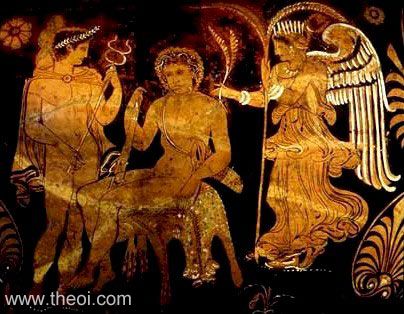
Hermes, Hēraklēs, and Nike

After capturing the bull, Hēraklēs took some time to unwind, feast, and thank the Gods for all he had achieved so far. Hēraklēs has a lot to be thankful for, because bestowed upon him are great gifts from the Gods. Diodorus Siculus writes in his 'Library of History':

"It would also not be right to overlook the gifts which were bestowed upon Heracles by the gods because of his high achievements. For instance, when he returned from the wars to devote himself to both relaxations and festivals, as well as to feasts and contests, each on of the gods honoured him with appropriate gifts; Athena with a robe, Hephaestus with a war-club and coat of mail, these two gods vying with one another in accordance with the arts they practised, the one with an eye to the enjoyment and delight afford in times of peace, the other looking to his safety amid the perils of war. As for the other gods, Poseidon presented him with horses, Hermes with a sword, Apollo gave him a bow and arrows and taught him their use, and Demeter instituted the Lesser Mysteries in honour of Heracles, that she might purify him of the guilt he had incurred in the slaughter of the Centaurs." [4.14.3]

Chief amongst his accomplishments in his time off time period is the founding of the Olympic Games, which even Pausanias attributed to Hēraklēs in the mythological retelling of the practice. He writes in his 'Description of Greece':

"Heracles of Ida, therefore, has the reputation of being the first to have held, on the occasion I mentioned, the games, and to have called them Olympic. So he established the custom of holding them every fifth year, because he and his brothers were five in number." [5.7.9]

Corroborating accounts come from, for example, Diodorus Siculus who writes:

"After the performance of this Labour Heracles established the Olympic Games, having selected for so great a festival the most beautiful of places, which was the plain lying along the banks of the Alpheius river, where he dedicated these Games to Zeus the Father. And he stipulated that he prize in them should be only a crown, since he himself had conferred benefits upon the race of men without receiving any monetary reward.

All the contests were won by himself without opposition by anyone else, since no one was bold enough to contend with him because of his exceeding prowess. And yet the contests are very different one from another, since it is hard for a boxer or one who enters for the “Pankration” to defeat a man who runs the “stadion,” and equally difficult for the man who wins first place in the light contests to wear down those who excel in the heavy. Consequently it was fitting that of all Games the Olympic should be the one most honoured, since they were instituted by a noble man." [4.14.1 - 4.14.2]

That said, of course there are a great many non-mythological accounts of how the Olympics came to be. My favorite, perhaps, is from Diodorus Siculus again, who writes a beautiful line between myth and his reality, speaking of the five Daktyloi, daimones who were appointed by Rhea to guard the infant God Zeus in a cave on Mount Ida in Krete and eventually established the Olympic Games in the age of Kronos. One of them was called Hēraklēs as well:

"Also the greater number of the gods who, because of their benefactions to all men alike, have been accorded immortal honours, had their origin, so their myths relate, in their land; and of the tradition regarding these gods we shall now give a summary account, following the most reputable writers who have recorded the affairs of Crete.

The first of these gods of whom tradition has left a record made their home in Crete about Mt. Idê and were called Idaean Dactyli. These, according to one tradition, were one hundred in number, but others say that there were only ten to receive this name, corresponding in number to the fingers (dactyli) of the hands.

But some historians, and Ephorus is one of them, record that the Idaean Dactyli were in fact born on the Mt. Idê which is in Phrygia and passed over to Europe together with Mygdon; and since they were wizards, they practised charms and initiatory rites and mysteries, and in the course of a sojourn in Samothrace they amazed the natives of that island not a little by their skill in such matters. And it was at this time, we are further told, that Orpheus, who was endowed with an exceptional gift of poesy and song, also became a pupil of theirs, and he was subsequently the first to introduce initiatory rites and mysteries to the Greeks.

However this may be, the Idaean Dactyli of Crete, so tradition tells us, discovered both the use of fire and what the metals copper and iron are, as well as the means of working them, this being done in the territory of the city of Aptera at Berecynthus, as it is called; and since they were looked upon as the originators of great blessings for the race of men, they were accorded immortal honours. And writers tell us that one of them was named Heracles, and excelling as he did in fame, he established the Olympic Games, and that the men of a later period thought, because the name was the same, that it was the son of Alcmenê who had founded the institution of the Olympic Games." [5.64.2 - 5.64.6]

No one knows who actually founded the first Olympics, so I'll take the mythical explination of a hero named Hēraklēs, who founded the Games to honor the Gods and recieve blessings upon himself so he would be able to complete the coming labours.
It's been a little while since we last met Hēraklēs for a labour. Last time, he managed to fashuion a rattle to scare off the blood thirsty Stymphalian Birds, completing that labour rather effortlessly thanks to the Gods. Now, Hēraklēs is sent on a mission which--in theory--is far tougher: to capture the Cretan Bull.

To many, the Cretan Bull will be familiar, either because of it's own part in the tale or the fallout, namely the Minotaur. The classic myth goes as follows: Minos, king of Krete, requested Poseidon raise a bull from the sea, which the King promised to sacrifice; but when Minos refused to do so, Poseidon caused his wife Pasiphaê to fall in love with the bull. The child that came from this union was deformed in such a way that he had the head of a bull and the body of a man. In the labours of Hēraklēs, the story changes a little depending on the source. Diodorus agrees with the myth, saying in his 'Library of History':

"The next Labour which Heracles undertook was to bring back from Crete the bull of which, they say, Pasiphaê had been enamoured." [4.13.4]

Apollodorus, for example, has a different story to tell, not just about the Cretan Bull, but also about the story of King Minos. It seems the Bull had become feral, terrorizing the land and scaring the inhabitants of the island. From his 'Library':

"The seventh labour he enjoined on him was to bring the Cretan bull. Acusilaus says that this was the bull that ferried across Europa for Zeus; but some say it was the bull that Poseidon sent up from the sea when Minos promised to sacrifice to Poseidon what should appear out of the sea. And they say that when he saw the beauty of the bull he sent it away to the herds and sacrificed another to Poseidon; at which the god was angry and made the bull savage." [2.5.7]

From Philostratus the Elder we get a description of the bull, based off of the description of his second Image Book:

"Pasiphaë outside the workshop in the cattlefold gazes on the bull, thinking to draw him to her by her beauty and by her robe, which is divinely resplendent and more beautiful than any rainbow. She has a helpless look – for she knows what the creature is that she loves – and she is eager to embrace it, but takes no notice of her and gazes at its own cow. The bull is depicting with proud mien, the leader of the herd, with splendid horns, white, already experienced in love, its dewlap low and its neck massive, and it gazes fondly at the cow; but the cow in the herd, ranging free and all white but for a black head, disdains the bull. For its purpose suggests a leap, as of a girl who avoids the importunity of a lover." [1.16]

Contrary to the other labours, there is actually not alot known about how Hēraklēs managed to wrangle in the bull and take him back to the main land. Both versions, however, agree that Minos helped him do it, or at least offered Hēraklēs assistance. If I was Minos, I would want that bull away from my wife and people too! Diodorus literally suffices with a single line on the capture of the Bull:

"[A]nd sailing to the island he secured the aid of Minos the king and brought it back to the Peloponnesus, having voyaged upon its back over so wide an expanse of sea." [4.13.4]

Apollodorus is a little bit more forthcoming:

"To attack this bull Hercules came to Crete, and when, in reply to his request for aid, Minos told him to fight and catch the bull for himself, he caught it and brought it to Eurystheus, and having shown it to him he let it afterwards go free. But the bull roamed to Sparta and all Arcadia, and traversing the Isthmus arrived at Marathon in Attica and harried the inhabitants." [2.5.7]

How Hēraklēs captured the Bull will most likely always remain a mystery. I like to envision him wrestling it down and tying it like the bull capturers; risking life and limb in a heroic effort to make better the lives of the citizens of Krete. And so another labour is completed. Next time we will cover the little break that follows the seventh labour in which Hēraklēs establishes the Olympic Games and frees the Titan Prometheus--amongst other things.

Image Source: Wikipedia Commons.
Something about writing these Atlantis recaps makes me want to write about Hēraklēs. It might be a need to redeem the man from myth after his on-screen counterpart Hercules is done with him. So it's time for another labour from ancient Hellas' greatest hero: Hēraklēs.


The last time we met up with Hēraklēs, he had just used a river to clean some very dirty stables--for a reward, no less. Because of the contract for pay, king Eurystheus refuses to count the labour towards Hēraklēs' ten (well, eleven at that point) labours, and to make matters worse, king Augeias with whom Herakles had the contract, refuses to pay Hēraklēs for his efforts. To be fair, the river Alpheius did do all the work.

What follows next is one of the easiest labours for Hēraklēs--but only because of divine intervention. Eurystheus has been called upon to remove a huge flock of birds covering the waters of the Stymphalus, there they are hiding from wolves, it seems. Pausanias, in his 'Description of Greece' describes the birds that came to be known as the Stymphalian Birds:

"The Arabian desert breeds among other wild creatures birds called Stymphalian, which are quite as savage against men as lions or leopards. These fly against those who come to hunt them, wounding and killing them with their beaks. All armour of bronze or iron that men wear is pierced by the birds; but if they weave a garment of thick cork, the beaks of the Stymphalian birds are caught in the cork garment, just as the wings of small birds stick in bird-lime. These birds are of the size of a crane, and are like the ibis, but their beaks are more powerful, and not crooked like that of the ibis. Whether the modern Arabian birds with the same name as the old Arcadian birds are also of the same breed, I do not know. But if there have been from all time Stymphalian birds, just as there have been hawks and eagles, I should call these birds of Arabian origin, and a section of them might have flown on some occasion to Arcadia and reached Stymphalus. Originally they would be called by the Arabians, not Stymphalian, but by another name. But the fame of Heracles, and the superiority of the Greek over the foreigner, has resulted in the birds of the Arabian desert being called Stymphalian even in modern times." [8.22.4]
Naturally, Hēraklēs gets the job. When he reaches the waters, even he is mystified on how he is going to get thousands upon thousands of birds to line up for his arrows; these birds in many of the stories are not only equipped with hard beaks, but some accounts even have them shoot out their feathers like arrows. There are two versions of the story, with variances upon these. The most deity-centered is from Apollodorus' 'Library':

"[W]hen Hercules was at a loss how to drive the birds from the wood, Athena gave him brazen castanets, which she had received from Hephaestus. By clashing these on a certain mountain that overhung the lake, he scared the birds. They could not abide the sound, but fluttered up in a fright, and in that way Hercules shot them."

Others, however, do not include the rattle at all, or do not mention Athena. In some versions, the birds are only scared off. Two examples; Pausanias in his 'Description of Greece':

"There is a story current about the water of the Stymphalus, that at one time man-eating birds bred on it, which Heracles is said to have shot down. Peisander of Camira, however, says that Heracles did not kill the birds, but drove them away with the noise of rattles." [8.22.4]

...and Diodorus in his 'Library of History':

"Now it was not possible to master the animals by force because of the exceptional multitude of them, and so the deed called for ingenuity in cleverly discovering some device. Consequently he fashioned a bronze rattle whereby he made a terrible noise and frightened the animals away, and furthermore, by maintaining a continual din, he easily forced them to abandon their siege of the place and cleansed the lake of them." [4.13.2]

Regardless of the actual details, Hēraklēs wraps up the job easily, and is now half way though his labours: six down, six to go. I can make one guarantee: the next labour will not be so easy: slay the Cretan Bull; a bull who has no intention of staying down.
Fresh from his success in capturing the Erymanthian Boar, Hēraklēs is dealing with the death of two good men and a whole lot of Kentautai, so the next labour would have not only seemed unworthy of him, but also a punch below the belt. Hēraklēs must clear the dung from the stables of Augeias (or Augeas), a king of Elis in the western Peloponnesos who possessed an enormous herd of cattle. He must do this in a single day, and he must also do this alone. Those are the rules of the labour.


Before I recount the story, let us take a minute here to consider the implications: Hēraklēs is a man on a quest to purify himself of a terrible deed, the slaying of his family while in a haze induced by Hera. He is also the son of a God, Zeus, and thus in theory eligible for apotheosis, becoming a God. In order to achieve either, Hēraklēs must, however, perform his labours with honor and pride. Every labour must be something extraordinary that shows his worth. Shoveling dung from a stable does not qualify by a long shot and his quest-giver Eurystheus knows this full well. Diodorus writes on this in his 'Library of History':

"Upon the performance of this Labour he received a Command from Eurystheus to cleanse the stables of Augeas, and to do this without the assistance of any other man. These stables contained an enormous mass of dung which had accumulated over a great period, and it was a spirit of insult which induced Eurystheus to lay upon him the command to clean out this dung. [...] He accomplished the Labour in a single day, and without suffering any insult. Surely, then, we may well marvel at the ingenuity of Heracles; for he accomplished the ignoble task involved in the Command without incurring any disgrace or submitting to something which would render him unworthy of immortality." [4.13.3]

Before he left, Hēraklēs was not aware he would be able to compelte the task with honor, but left to do it anyway. Once he got to Elis, he introduced himself to Augeias and told him he would clean out the stables, if the king would sign over ownership of the cattle afterwards, or--alternatively, depending upon source--a portion of the land of Elis. Obviously, King Augeias was not happy with this arrangement; from Apollodorus' 'Library':

"Now Augeas was king of Elis; some say that he was a son of the Sun, others that he was a son of Poseidon, and others that he was a son of Phorbas; and he had many herds of cattle. Hercules accosted him, and without revealing the command of Eurystheus, said that he would carry out the dung in one day, if Augeas would give him the tithe of the cattle. Augeas was incredulous, but promised." [2.5.5]

With the deal done, Hēraklēs took Augeias' son Phyleus to witness the events that followed, and took to the stables. It was quite apparent the task would not be an easy one, especially if he wanted to get through it with his pride and honor intact. Now, it just happened to be that the stables were close to a river, named 'Alpheios'. It had its headwaters in the south-eastern corner of Arkadia, flowing the length of the country into Elis in the east, past Olympia to reach the Ionian sea. A God by the same name ruled over its waters, and was the son of Okeanos and Thetys. Pausanias, in his 'Description of Greece' says about him:

"The boundary between the territories of Lacedaemon and Tegea is the river Alpheius. Its water begins in Phylace, and not far from its source there flows down into it another water from springs that are not large, but many in number, whence the place has received the name Symbola (Meetings). It is known that the Alpheius differs from other rivers in exhibiting this natural peculiarity; it often disappears beneath the earth to reappear again. So flowing on from Phylace and the place called Symbola it sinks into the Tegean plain; rising at Asea, and mingling its stream with the Eurotas, it sinks again into the earth. Coming up at the place called by the Arcadians Pegae (Springs), and flowing past the land of Pisa and past Olympia, it falls into the sea above Cyllene, the port of Elis. Not even the Adriatic could check its flowing onwards, but passing through it, so large and stormy a sea, it shows in Ortygia, before Syracuse, that it is the Alpheius, and unites its water with Arethusa." [8.54.1 - 8.54.3]

Armed with the knowledge about the river, Hēraklēs sets to work. From Apollodorus:

"Hercules made a breach in the foundations of the cattle-yard, and then, diverting the courses of the Alpheus and Peneus, which flowed near each other, he turned them into the yard, having first made an outlet for the water through another opening." [2.5.5]

Alpheius took the dung away in one go, and I presume Hēraklēs then diverted the stream back to its origional course. By accomplishing such a great feat, Hēraklēs had completed the taks, and had not suffered on bit of dishonor. Happy with his accomplishments, he returned to the king to ask for his reward, but Augeias would not give it. Apollodorus again:

"When Augeas learned that this had been accomplished at the command of Eurystheus, he would not pay the reward; nay more, he denied that he had promised to pay it, and on that point he professed himself ready to submit to arbitration. The arbitrators having taken their seats, Phyleus was called by Hercules and bore witness against his father, affirming that he had agreed to give him a reward. In a rage Augeas, before the voting took place, ordered both Phyleus and Hercules to pack out of Elis. So Phyleus went to Dulichium and dwelt there, and Hercules repaired to Dexamenus at Olenus. He found Dexamenus on the point of betrothing perforce his daughter Mnesimache to the centaur Eurytion, and being called upon by him for help, he slew Eurytion when that centaur came to fetch his bride. But Eurystheus would not admit this labour either among the ten, alleging that it had been performed for hire." [2.5.5]


So it was that Hēraklēs had performed such a great feat of strength and smarts, without any reward: not only had he not gotten what the king had promised him, but because he had made such a contract, Eurystheus refused to pay him as well. As such, it came to be that in order to fulfill his ten labours, Hēraklēs would have to perform twelve of them, as both this one, nor the one in which he slayed the Hydra, counted towards his total.

As for Augeias; Hēraklēs would get his revenge on him after the labours were over, but for now, Hēraklēs let him be. There were many more tasks ahead of him, after all.
The last I wrote of Hēraklēs, our hero had successfully navigated Eurystheus' scheme of getting him killed by help of Artemis. Hēraklēs completed another labour, made Artemis happy, and saved the day. All was well in the world of Hēraklēs. At this point, Hēraklēs is aware he still has eight labours ahead of him: he completed three successfully, but the labour with the Lernaean Hydra was disqualified because he had accepted the help of his nephew and lover Iolaus. It was most certainly an unfair ruling, but nothing can be done about it: Hēraklēs must continue with his quest in hopes of cleansing himself of his crime.

The fourth labour is to capture the Erymanthian Boar, which got his name from the mountainside and swamp it roamed on. It seems Eurystheus realized that capturing something can be a lot more deadly than killing something, especially when that something is bigger and badder than any of its peers. That said, Hyginus in his Fabulae describes that the task was not to capture the boar, but to kill it, which Hēraklēs accomplished. As far as I am aware, though, he is the only one. Pausanias mentions the boar in his 'Description of Greece', saying:

"There is also a legend that Heracles at the command of Eurystheus hunted by the side of the Erymanthus a boar that surpassed all others in size and in strength. The people of Cumae among the Opici say that the boar's tusks dedicated in their sanctuary of Apollo are those of the Erymanthian boar, but the saying is altogether improbable." [8.24.5]

All who write about the labour agree that it is a difficult one. A boar is a ferocious animal, and even modern day hunters take care when hunting boar. Diodorus explains why this labour might have been the hardest so far:

"This Command was thought to be exceedingly difficult, since it required of the man who fought such a beast that he possess such a superiority over it as to catch precisely the proper moment in the very heat of the encounter. For should he let it loose while it still retained its strength he would be in danger from its rushes, and should he attack it more violently than was proper, then he would have killed it and so the Labour would remain unfulfilled." [4.12.1]

This labour became even harder to complete for Hēraklēs when he met the kéntauroi (or 'centaurs') on his way to the boar. Our hero went the long way to visit Phontus, a kéntaur who dwelt in a cave on Mount Pholoe, who was the son of Seilenus and the nymph Melia. Having heard of Hēraklēs, Phontus entertained him in his cave, and provided him with food. Hēraklēs, thirsty from the savory meat dish, asked for wine, but Phontus said he only had the wine that was communal to all the kéntauroi, and he did not dare touch it. Hēraklēs convinced him to do so, regardless, and the kéntauroi came galloping to the cave. Hēraklēs fought them, and many died. Phontus, inspecting one of Hēraklēs' arrows dipped in hydra poison, which the hero had used to kill one of the kéntauros, dropped it onto his foot and he died of the poison as well. Hēraklēs, grieving for the death of Phontus, buried him near his cave. There are many accounts of this, but the most beautiful--abide lengthy--description in my opinion is from Diodorus:

"About this time that Heracles was performing these Labours, there was a struggle between him and the Centaurs, as they are called, the reason being as follows. Pholus the Centaur, from whom the neighbouring mountain came to be called Pholoê, and receiving Heracles with the courtesies due to a guest he opened for him a jar of wine which had been buried in the earth. This jar, the writers of myths relate, had of old been left with a certain Centaur by Dionysus, who had given him orders only to open it when Heracles should come to that place. And so, four generation after that time, when Heracles was being entertained as a guest, Pholus recalled the orders of Dionysus.

Now when the jar had been opened and the sweet odour of the wine, because of its great age and strength, came to the Centaurs dwelling near there, it came to pass that they were driven mad; consequently they rushed in a body to the dwelling of Pholus and set about plundering him of the wine in a terrifying manner.

At this Pholus hid himself in fear, but Heracles, to their surprise, grappled with those who were employing such violence. He had indeed to struggle with beings who were gods on their mother’s side, who possessed the swiftness of horses, who had the strength of two bodies, and enjoyed in addition the experience and wisdom of men. The Centaurs advanced upon him, some with pine trees which they had plucked up together with the roots, others with great rocks, some with burning firebrands, and still others with axes such as are used to slaughter oxen.

But he withstood them without sign of fear and maintained a battle which was worthy of his former exploits. The Centaurs were aided in their struggle by their mother Nephelê, who sent down a heavy rain, by which she gave no trouble to those who had four legs, but for him who was supported upon two made the footing slippery. Despite all this Heracles maintained an astonishing struggle with those who enjoyed such advantages as these, slew the larger part of them, and forced the survivors to flee.

Of the Centaurs which were killed the most renowned were Daphnis, Argeius, Amphion, also Hippotion, Oreius, Isoples, Malanchaetes, and Thereus, Doupon, and Phrixus. As for those who escaped the peril by flight, every one of them later received a fitting punishment: Homadus, for instance, was killed in Arcadia when he was attempting to violate Alcyonê, the sister of Eurystheus. And for this feat it came to pass that Heracles was marveled at exceedingly; for though he had private grounds for hating his enemy, yet because he pitied her who was being outraged, he determined to be superior to others in humanity.

A peculiar thing also happened in the case of him who was called Pholus, the friend of Heracles. While he was burying the fallen Centaurs, since they were his kindred, and was extracting an arrow from one of them, he was wounded by the barb, and since the wound could not be healed he came to his death. Heracles gave him a magnificent funeral and buried him at the foot of the mountain, which serves better than a gravestone to preserve his glory; for Pholoê makes known the identity of the buried man by bearing his name and no inscription is needed." [4.12.3 - 4.12.8]

Apollodorus gives an extended account where the fight claims another casualty besides poor Pholus: the kéntauros Kheiron, teacher of heroes and kings:

"Thence they took refuge with Chiron, who, driven by the Lapiths from Mount Pelion, took up his abode at Malea. As the centaurs cowered about Chiron, Hercules shot an arrow at them, which, passing through the arm of Elatus, stuck in the knee of Chiron. Distressed at this, Hercules ran up to him, drew out the shaft, and applied a medicine which Chiron gave him. But the hurt proving incurable, Chiron retired to the cave and there he wished to die, but he could not, for he was immortal. However, Prometheus offered himself to Zeus to be immortal in his stead, and so Chiron died. The rest of the centaurs fled in different directions, and some came to Mount Malea, and Eurytion to Pholoe, and Nessus to the river Evenus. The rest of them Poseidon received at Eleusis and hid them in a mountain." [2.5.4]

Moving on, Hēraklēs finally reached the Erymanthian Boar's territory, and unlike the Golden Hind of Artemis, he did not have to chase after the boar at all. At the first challenging shout, the beast charged him, and Hēraklēs frightened him off so he could pursue and capture him more easily. In the words of Apollodorus:

"And when he had chased the boar with shouts from a certain thicket, he drove the exhausted animal into deep snow, trapped it, and brought it to Mycenae." [4.12.2]

Apollodorius Rhodius, a Hellenic epic poet and scholar of the Library of Alexandria who flourished in the third century BC writes the ending even better in his 'Argonautica':

"...he [Hēraklēs] carried the boar alive that fed in the thickets of Lampeia, near the vast Erymanthian swamp, the boar bound with chains he put down from his huge shoulders at the entrance to the market-place of Mycenae" [122]

Another little tidbit by Diodorus, to which the image at the top of his post relates:

"...when it came to the struggle he kept so careful an eye on the proper balance that he brought back the boar alive to Eurystheus; and when the king saw him carrying the boar on his shoulders, he was terrified and hid himself in a bronze vessel." [4.12.2]

This labour was quite costly to Hēraklēs, who not only singlehandedly slew most of the kéntauroi, but also killed two good men--and all over a bottle of wine, I might add. Hēraklēs still has many labours ahead of him, and his adventure is far from over. For now, though, we will let our hero recover from this ordeal.


Image property: here.
When we last caught up with Hēraklēs, he had just completed his second labour: to slay the Lernaean Hydra. What his next labour is, depends on the ancient writer you read. Hyginus, for example, remarks that he slew the Erymantian Boar first, while I use the commonly accepted sequence set out by Apollodorus. Speaking of Apollodorus: He has only a few words to spare for this third labour:

"As a third labour he [Eurystheus] ordered him to bring the Cerynitian hind alive to Mycenae. Now the hind was at Oenoe; it had golden horns and was sacred to Artemis; so wishing neither to kill nor wound it, Hercules hunted it a whole year. But when, weary with the chase, the beast took refuge on the mountain called Artemisius, and thence passed to the river Ladon, Hercules shot it just as it was about to cross the stream, and catching it put it on his shoulders and hastened through Arcadia. But Artemis with Apollo met him, and would have wrested the hind from him, and rebuked him for attempting to kill her sacred animal.Howbeit, by pleading necessity and laying the blame on Eurystheus, he appeased the anger of the goddess and carried the beast alive to Mycenae." [2.5.3]

It seems that Euryteus (and Hera, in some versions) were becoming aware that the hope they carried that Hēraklēs would perish at the hands (or teeth) of a monster became a vain hope. If not even the Hydra could end his life, very few other thing would have stood a chance. Changing tactics, Eurystheus gave Hēraklēs a different kind of task: one in which the task itself was not dangerous, and only required a sharp mind. Hēraklēs wasn't a fool: he was well aware that capturing an animal sacred to Artemis was as deadly a task as his previous ones. In fact, it might be more lethal: upsetting the Theia of the hunt had gotten far more powerful men killed.

Unable to refuse, Hēraklēs went off in search of the golden hind of Artemis, which was also known as the Keryneian Hind (Κερυνῖτις ἔλαφος), or Krynites. In his 'Hymn to Artemis', Kallimachos describes the sacred animal, and explains that there were more of these animals--five in total--of which Artemis captured four and yoked them to her chariot. The other escaped:
 
"Thence departing (and thy hounds sped with thee) thou [Artemis] dist find by the base of the Parrhasian hill deer gamboling – a mighty herd. They always herded by the banks of the black-pebbled Anaurus – larger than bulls, and from their horns shone gold. And thou wert suddenly amazed and sadist to thine own heart: “This would be a first capture worthy of Artemis.” Five were there in all; and four thou didst take by speed of foot – without the chase of dogs – to draw thy swift car. But one escaped over the river Celadon, by devising of Hera, that it might be in the after days a labour for Heracles, and the Ceryneian hill received her." [98]

Hēraklēs found a worthy adversary in the hind, which eluded him for almost a year. He chased it to the far corners of Hellas and beyond, and then, eventually, he came upon it. How, exactly, the hind was caught varies, and even varied in ancient times. Diodorus describes:
 
"The next Command which Heracles received was the bringing back of the hart which had golden horns and excelled in swiftness of foot. In the performance of this Labour his sagacity stood him in not less stead than his strength of body. For some say that he captured it by the use of nets, others that he tracked it down and mastered it while it was asleep, and some that he wore it out by running it down. One thing is certain, that he accomplished this Labour by his sagacity of mind, without the use of force and without running any perils."

Whatever the case, the hind is caught, and Hēraklēs hurries to the king to finish the task. On the way back, however, Artemis and Apollon appear, both rady to end his life. Hēraklēs pleads with Them, lying the blame on Eurystheus. Artemis makes him promise to return the hind to Her when he has shown it to the king, and Hēraklēs agrees. The divine twins spare his life, and thus foil Eurystheus' plan to have Hēraklēs killed.

So Hēraklēs returns with the stag on his shoulders. The king is furious, but he is happy he will at least possess the golden hind now. He orders Hēraklēs to put the hind in the stables, but Hēraklēs knows that the hind must be returned to Artemis without delay. Devising a plan of his own, he tells the king to come and take the hind from him. When he releases the animal, he does so slightly too early, and the swift-footed hind escapes into the woods. Hēraklēs has completed another labour, and he has managed to appease Artemis; not bad for someone previously known mostly for his brute strength.

Image source: sculpture
We pick up this third part of the Labours series with the second labour Hēraklēs has to complete: slay the nine-headed Lernaean Hydra. The funny thing about this hydra is that no one is really sure how many heads it actually has. The generally accepted number is nine, but ten, or even a hundred are also mentioned. It's also unclear if there was only one head that was supposed to be immortal (as per Apollodorus) or if the creature itself was immortal. The sequence of events, however, is quite clear.
 
After his victory over the Nemean lion, Hēraklēs is send off to handle another sticky problem: the Lernaean Hydra, who was raised from the earth by Hera just to end the life of Hēraklēs. The Lernaean Hydra (Λερναία Ὕδρα) was the offspring of Typhon, and layered in the swampy lake of Lerna. Hyginus, in his Fabulae, describes the creature so:

"The nine-headed Lernaean Hydra. This monster was so poisonous that she killed men with her breath, and if anyone passed by when she was sleeping, he breathed her tracks and died in the greatest torment."
 
Diodorus Siculus, in his 'Library of History' has a slightly different view of the Hydra:
 
"The second Labour which he undertook was the slaying of the Lernaean hydra, springing from whose single body were fashioned a hundred necks, each bearing the head of a serpent. And when one head was cut off, the place where it was severed put forth two others; for this reason it was considered to be invincible, and with good reason, since the part of it which was subdued sent forth a two-fold assistance in its place."
 
No matter the description, it's clear that Hēraklēs is in for a rough ride. He realizes he needs help for this labour, and asks it of his nephew Iolaus (Ἰόλαος). He is Hēraklēs' charioteer, and was widely considered his lover as well. Hēraklēs sees in him a perfect aid and together they device a plan. From Diodorus:
 
"Against a thing so difficult to manage as this Heracles devised an ingenious scheme and commanded Iolaüs to sear with a burning brand the part which had been severed, in order to check the flow of the blood."
 
Now ready to face his adversary, Hēraklēs steels his resolve, and sets out in his quest. I'm going to let Apollodorus recount the entire labour. From his Library:
 
"...mounting a chariot driven by Iolaus, he came to Lerna, and having halted his horses, he discovered the hydra on a hill beside the springs of the Amymone, where was its den. By pelting it with fiery shafts he forced it to come out, and in the act of doing so he seized and held it fast. But the hydra wound itself about one of his feet and clung to him. Nor could he effect anything by smashing its heads with his club, for as fast as one head was smashed there grew up two. A huge crab also came to the help of the hydra by biting his foot. So he killed it, and in his turn called for help on Iolaus who, by setting fire to a piece of the neighboring wood and burning the roots of the heads with the brands, prevented them from sprouting. Having thus got the better of the sprouting heads, he chopped off the immortal head, and buried it, and put a heavy rock on it, beside the road that leads through Lerna to Elaeus. But the body of the hydra he slit up and dipped his arrows in the gall."

And so, Hēraklēs is victorious once more. On top of that, he now has poisonous arrows, which create wounds that do not heal. The crab that Apollodorus describes, by the way, ends up as the constellation Cancer.

When Hēraklēs returns to Eurystheus after completing the labour, the king scorns him for requiring assistance. He decrees that, because Hēraklēs could not have completed the labour without the help of Iolaus, the labour will not count against his total, and he will have to do an extra one to fulfill his debt. Enraged, but unable to make demands of the king, Hēraklēs agrees, and starts preparing his next labour: capturing the golden hind of Artemis.

Image source: Hēraklēs and the hydra
A little over a week ago, I introduced a new series for the blog: a short series about the labours of Hēraklēs. In that post, I described the life of Hēraklēs up until the point where he set out to complete the tasks. Today, I'm taking you through the first of twelve labours: Hēraklēs' challenge to slay the Nemean lion.

The Leon Nemeios (Λεον Νεμειος), or Nemean lion has been described with a large variety of parents. Selene is mentioned by Aelian and Seneca, amongst others, but one of the drakons is also possible, especially Echidna. Diodorus Siculus, in his Library of History describes the lion so: 

"This was a beast of enormous size, which could not be wounded by iron or bronze or stone and required the compulsion of the human hand for his subduing. It passed the larger part of its time between Mycenae and Nemea, in the neighbourhood of a mountain which was called Tretus from a peculiarity which it possessed; for it had a cleft at its base which extended clean through it and in which the beast was accustomed to lurk." [4.11.3]

As the lion was terrorizing the area surrounding the mountain, Eurystheus must have seen in the lion a worthy opponent of  Hēraklēs, whose tales of bravery and brute strength has proceeded him. He ordered the hero to return with its skin. In the words of Apollodorus:

"When Hercules heard that, he went to Tiryns and did as he was bid by Eurystheus. First, Eurystheus ordered him to bring the skin of the Nemean lion; now that was an invulnerable beast begotten by Typhon. On his way to attack the lion he came to Cleonae and lodged at the house of a day-laborer, Molorchus; and when his host would have offered a victim in sacrifice, Hercules told him to wait for thirty days, and then, if he had returned safe from the hunt, to sacrifice to Saviour Zeus, but if he were dead, to sacrifice to him as to a hero." [2.5.1.]

And so, Hēraklēs went to the cave of the lion after picking up a bow and quiver of arrows, because he was unaware he would not be able to harm the creature with mortal weapons. What comes after is undoubtedly best said by Theocretus in the third century BC. In his 'Idylls', he has Hēraklēs explain his victory himself:

"Now this did Eurystheus make my very first task; he charged me to slay that direful beast. So I took with me my supple bow and a good quiverful of arrows, and in the other hand a stout cudgel, made, without peeling or pithing, of a shady wild-olive which myself had found under holy Helicon and torn up whole and complete with all her branching roots; and so forth and made for those parts where the lion was. Whither when I was come, I took and tipped my string, and straightway notched a bearer of pain and grief, and fell a-looking this way and that way after the pestilent monster, if so be I might espy him ere he should espy me. ‘Twas midday now, yet could I nowhere mark his track nor hear his roaring; neither was there any man set over a plough-team and the toil of the seed-furrow that I could see and ask of him, seeing pale wan fear kept every man at the farmstead. Howbeit, I never gave over to search the leafy uplands till I should behold him and put my strength speedily to the test.
 
Now towards evening he came his ways unto his den full fed both of flesh and gore, his tangled mane, his grim visage and all his chest spattered with blood, and his tongue licking his chaps. To waylay him I hid myself quickly in a brake beside the woody path, and when he came near let fly at his left flank. But it availed me not; the barbèd shaft could not pass the flesh, but glanced and fell on the fresh green sward. Astonished, the beast lift suddenly up his gory head, and looked about him and about, opening his mouth and showing his gluttonous teeth; whereupon I sped another shaft from the string (for I took it ill that the fist had left my hand to no purpose), and smote him clean in the middle of the chest where the lungs do lie. But nay; not even so was the hide of him to be pierced by the sore grievous arrow; there it fell vain and frustrate at his feet.
 
At this I waxed exceedingly distempered and made to draw for the third time. But, ere that, the ravening beast rolled around his eyes and beheld me, and lashing all his tail about his hinder parts bethought him quickly of battle. Now was his neck brimming with ire, his tawny tresses an-end for wrath, his chine arched like a bow, as he gathered him up all together unto flank and loin. Then even as, when a wainwright, cunning man, takes the seasoned wild-fig boughs he hath warmed at the fire and bends them into wheels for an axled chariot, the thin-ringed figwood escapes at the bending from his grasp and leaps at one bound afar, even so did that direful lion from a great way off spring upon me, panting to be at my flesh. Then it was that with the one hand I thrust before me the cloak from my shoulders folded about my bunched arrows, and with the other lift my good sound staff above my head and down with it on his crown, and lo! my hard wild-olive was broke clean in twain on the mere shaggy pate of that unvanquishable beast. Yes as for him, or ever he could reach me he was fallen from the midst of his spring, and so stood with trembling feet and wagging head, his two eyes being covered in darkness because the brains were all-to-shaken in the skull of him.
 
Perceiving now that he was all abroad with the pain and grief of it, ere he might recover his wits I cast my bow and my broidered quiver upon the ground and let drive at the nape of that massy neck. Then from the rear, lest he should tear me with his talons, I gat my arm about his throat, and treading his hind-paws hard into the ground for to keep the legs of them from my sides, held on with might and main till at length I could rear him backward by the foreleg, and vasty Hades received his spirit.
That done, I fell a-pondering how I might flay me off the dead beast’s shag-neckèd skin. ‘What a task!’ thought I; for there was no cutting that, neither with wood nor with stone nor yet with iron. At that moment one of the Immortals did mind me I should cut up the lion’s skin with the lion’s talons. So I to it, and had him flayed in a trice, and cast the skin about me for a defense against the havoc of gashing war. Such, good friend, was the slaying of the Lion of Nemea, that had brought so much and sore trouble both upon man and beast.” [204-280]
 
There are other versions, mostly those where Hēraklēs does not fight the lion outside, but instead pursues the beast into his den, having blocked the other end of it so the lion cannot escape. In the dark, he hits the lion over the head, and then proceeds to strangle it. Depending on the author, Hēraklēs looses a finger in the struggle. Polemy Hephaestion, for example, speaks of the finger in his New Histories 2:

"...Heracles, after the Nemean lion had bitten off one of his fingers had only nine and that there exists a tomb erected for this detached finger; other authors say that he lost his finger following a blow by a dart of a stingray and one can see at Sparta a stone lion erected on the tomb of the finger and which is the symbol of the power of the hero.  It is since then that stone lions have likewise been erected on the tombs of other important people; other authors give different explications of the lion statues."

In my introductory post, I spoke of the first lion who was vanquished by Hēraklēs, the lion at Kithairon, whom Hēraklēs is said to have skinned as well, and whose skin he wore as a cloak. Which famous lion skin cloak Hēraklēs wear in most of the art he is depicted on is unclear, but the properties of the hide of the Nemean lion do make it likely he swapped out the cloaks after cutting the pelt off of the lion with the help of Athena. In some versions of the myth, however, he does no skin the beast, but takes it to Eurysteus in one piece. Apollodorus:

"And when the lion took refuge in a cave with two mouths, Hercules built up the one entrance and came in upon the beast through the other, and putting his arm round its neck held it tight till he had choked it; so laying it on his shoulders he carried it to Cleonae. And finding Molorchus on the last of the thirty days about to sacrifice the victim to him as to a dead man, he sacrificed to Saviour Zeus and brought the lion to Mycenae. Amazed at his manhood, Eurystheus forbade him thenceforth to enter the city, but ordered him to exhibit the fruits of his labours before the gates. They say, too, that in his fear he had a bronze jar made for himself to hide in under the earth, and that he sent his commands for the labours through a herald, Copreus, son of Pelops the Elean. This Copreus had killed Iphitus and fled to Mycenae, where he was purified by Eurystheus and took up his abode."  [2.5.1.]

And so, Hēraklēs vanquishes the lion--in one way or another--and completes the first of what he then thinks will be ten labours. Eurystheus warns him, however, that the labours will only become harder as time passes. For his next labour, he will need to keep all of his wits about him, as he is to slay the nine-headed Lernaean Hydra.

Image source: talariaenterprises.com
Some of the best epics are not told in a single story, so therefor, I will kick off a mini series today: the labours of Hēraklēs. Hēraklēs (Ἡρακλῆς), from 'Hera' and kleos, 'glory', was born as Alkaios (Ἀλκαῖος) or Alkeidēs (Ἀλκείδης). He became one of the greatest of the divine heroes in Hellenic mythology, and was born the son of Zeus and Alkmene (Ἀλκμήνη), foster son of Amphitryon (Ἀμφιτρύων), king of Tiryns in Argolis. By Alkmene, he is the great-grandson of Perseus, and by Zeus, his half-brother. He is perhaps better known as Hercules, his Roman counterpart. In this first part, I will introduce Hēraklēs and describe his life up until the labours, and then tackle the labours one at a time in coming editions.

Hēraklēs was conceived by Zeus upon Alkmene, as He disguised Himself as her husband, returning early from war. Alkmene accepted Him in her bed gladly, as she was happy to see her husband again. When The real Amphitryon did return later that night, Alkmene realized what had happened, and told her husband. Amphitryon accepted her in his bed, regardless, and so she became pregnant with twins, one fathered by Zeus, and one by her mortal husband. In the words of Apollodorus:

"But before Amphitryon reached Thebes, Zeus came by night and prolonging the one night threefold he assumed the likeness of Amphitryon and bedded with Alcmena and related what had happened concerning the Teleboans. But when Amphitryon arrived and saw that he was not welcomed by his wife, he inquired the cause; and when she told him that he had come the night before and slept with her, he learned from Tiresias how Zeus had enjoyed her. And Alcmena bore two sons, to wit, Hercules, whom she had by Zeus and who was the elder by one night, and Iphicles, whom she had by Amphitryon." [2.4.8]

Hera, hearing of the affair, took an instant disliking to the unborn child. When it became time for Alkmene to give birth, Hera made Zeus swear a vow that a child born in the line of Perseus on this day would become King. Zeus agreed, and Hera hurried off to delay the birth of Hēraklēs and Iphikles, and hurry along the birth of Eurystheus (Εὐρυσθεύς), grandson of Perseus. The two had unknowingly become part of a contest of wills between Zeus and Hera, to decide who would be the hero to drive off the last of the great monsters and pave the way for the Olympians.

Eventually, Hera was tricked into allowing the children born, as She would have postponed their delivery indefinitely. Alkmene, aware of the divine spark in one of her sons, took her distance from him, but the young Hēraklēs was taken up by Athena and taken to Hera, who did no recognize the newborn nemesis of Her candidate, and took pity on him. She fed him from Her breast, but when he suckled so hard that he caused Her pain, She realized who he was, and cast him off. Athena rescued the infant and took him back to his mortal parents. Alkmene took him back and raised him with her husband.

What happens next is a famous bit, here in the words of Apollodorus again:
 
"When the child was eight months old, Hera desired the destruction of the babe and sent two huge serpents to the bed. Alcmena called Amphitryon to her help, but Hercules arose and killed the serpents by strangling them with both his hands. However, Pherecydes says that it was Amphitryon who put the serpents in the bed, because he would know which of the two children was his, and that when Iphicles fled, and Hercules stood his ground, he knew that Iphicles was begotten of his body." [2.4.8]
 
 Hēraklēs was a strong child, so strong, in fact, that he inadvertently killed his music teacher Linos (Λῖνος) with a lyre, for which he was tried and found not guilty. He was still made to leave the city:
 
"Hercules was taught to drive a chariot by Amphitryon, to wrestle by Autolycus, to shoot with the bow by Eurytus, to fence by Castor, and to play the lyre by Linus.85 This Linus was a brother of Orpheus; he came to Thebes and became a Theban, but was killed by Hercules with a blow of the lyre; for being struck by him, Hercules flew into a rage and slew him.86 When he was tried for murder, Hercules quoted a law of Rhadamanthys, who laid it down that whoever defends himself against a wrongful aggressor shall go free, and so he was acquitted. But fearing he might do the like again, Amphitryon sent him to the cattle farm; and there he was nurtured and outdid all in stature and strength. Even by the look of him it was plain that he was a son of Zeus; for his body measured four cubits,87 and he flashed a gleam of fire from his eyes; and he did not miss, neither with the bow nor with the javelin." [2.4.9]
 
 What happens next is an account that was added in the fourth century BC, by the sophist Pródikos (Pródikos) and reported in Xenophon's Memorabilia; Hēraklēs is visited by two women, representing two very different paths in life, and he must choose between them. The first names Herself Happiness, "but they that hate me have their own nicknames for me, Vice and Naughtiness". She explains the path in life she represents as follows:
 
"I see you, Heracles, in doubt and difficulty what path of life to choose; make me your friend, and I will lead you to the pleasantest road and easiest. This I promise you: you shall taste all of life's sweets and escape all bitters. In the first place, you shall not trouble your brain with war or business; other topics shall engage your mind; your only speculation, what meat or drink you shall find agreeable to your palate; what delight of ear or eye; what pleasure of smell or touch; what darling lover's intercourse shall most enrapture you; how you shall pillow your limbs in softest slumber; how cull each individual pleasure without alloy of pain; and if ever the suspicion steal upon you that the stream of joys will one day dwindle, trust me I will not lead you where you shall replenish the store by toil of body and trouble of soul. No! others shall labour, but you shall reap the fruit of their labours; you shall withhold your hand from nought which shall bring you gain. For to all my followers I give authority and power to help themselves freely from every side."
 
The other, Virtue, offers Hēraklēs a far different path:
 
"Heracles, I too am come to you, seeing that your parents are well known to me, and in your nurture I have gauged your nature; wherefore I entertain good hope that if you choose the path which leads to me, you shall greatly bestir yourself to be the doer of many a doughty deed of noble emprise; and that I too shall be held in even higher honour for your sake, lit with the lustre shed by valorous deeds. I will not cheat you with preludings of pleasure, but I will relate to you the things that are according to the ordinances of God in very truth. Know then that among things that are lovely and of good report, not one have the gods bestowed upon mortal men apart from toil and pains. Would you obtain the favour of the gods, then must you pay these same gods service; would you be loved by your friends, you must benefit these friends; do you desire to be honoured by the state, you must give the state your aid; do you claim admiration for your virtue from all Hellas, you must strive to do some good to Hellas; do you wish earth to yield her fruits to you abundantly, to earth must you pay your court; do you seek to amass riches from your flocks and herds, on them must you bestow your labour; or is it your ambition to be potent as a warrior, able to save your friends and to subdue your foes, then must you learn the arts of war from those who have the knowledge, and practise their application in the field when learned; or would you e'en be powerful of limb and body, then must you habituate limbs and body to obey the mind, and exercise yourself with toil and sweat."
 
Hēraklēs accepts the latter offer. Having taken up his mantle as future-hero, Hēraklēs sets out to perform feats of strength, starting by defeating the lion of Kithairon, which had been a bane to his stepfather for far too long. Thespios, King of Thespiae, housed Hēraklēs for fifty days as he hunted for the lion, and every night Thespios placed one of his fifty daughters in his bed, although Hēraklēs thought he was only sleeping with one. Hēraklēs eventually vanquished the lion. He dressed himself in the skin, and wore the scalp as a helmet. The Gods lavished him with gifts: a sword from Hermes, bow and arrows from Apollon, a golden breastplate from Hēphaistos, and a robe from Athena. His famous club he made himself at Nemea.
 
Next, Hēraklēs was drawn into a war between the Thebans and the Minyans. He happened upon heralds from King Klymenos, who had won a previous battle with Thebes and now demanded tribute from them. Hēraklēs, who had been living in Thebes, cut the ears, noses and hands off of all but one of the heralds and told the last remaining one to take them back to his king as tribute. In the battle that followed, Hēraklēs fought bravely with the king's army, and his side eventually won, earning him his wife Megara, eldest daughter of King Kreōn of Thebes.
 
Due to Hera's jealousy, was stricken mad and killed the five sons he had by his wife. When he was released from his madness by a hellebore potion--provided by Antikyreus--and realized what he had done, he cried out in anguish, and went on a long journey to cleanse himself of the miasma caused by these killings. First, he visited the oracle at Delphi, who, unbeknownst to him, was whispered to by Hera. The Oracle told Hēraklēs to serve the king of Tiryns, Eurystheus, for ten years and do everything Eurystheus told him to do. Eurystheus gladly provided Hēraklēs with these labors--ten of them, one for each year--and eventually ended up adding two more, resulting in the Twelve Labors of Hēraklēs. Hēraklēs was told to:
  • Slay the Nemean Lion
  • Slay the nine-headed Lernaean Hydra
  • Capture the Golden Hind of Artemis
  • Capture the Erymanthian Boar
  • Clean the Augean stables in a single day
  • Slay the Stymphalian Birds
  • Capture the Cretan Bull
  • Steal the Mares of Diomedes
  • Obtain the girdle of Hippolyta, Queen of the Amazons
  • Obtain the cattle of the monster Geryon
  • Steal the apples of the Hesperides,
  • Capture and bring back Kerberos.
All of these tasks were incredibly hard, and required every ounce of strength Hēraklēs possessed. In the continuation of this series, we will discuss each of them in turn.

Image source: Encyclopædia Iranica