Showing posts with label Erichthonios. Show all posts

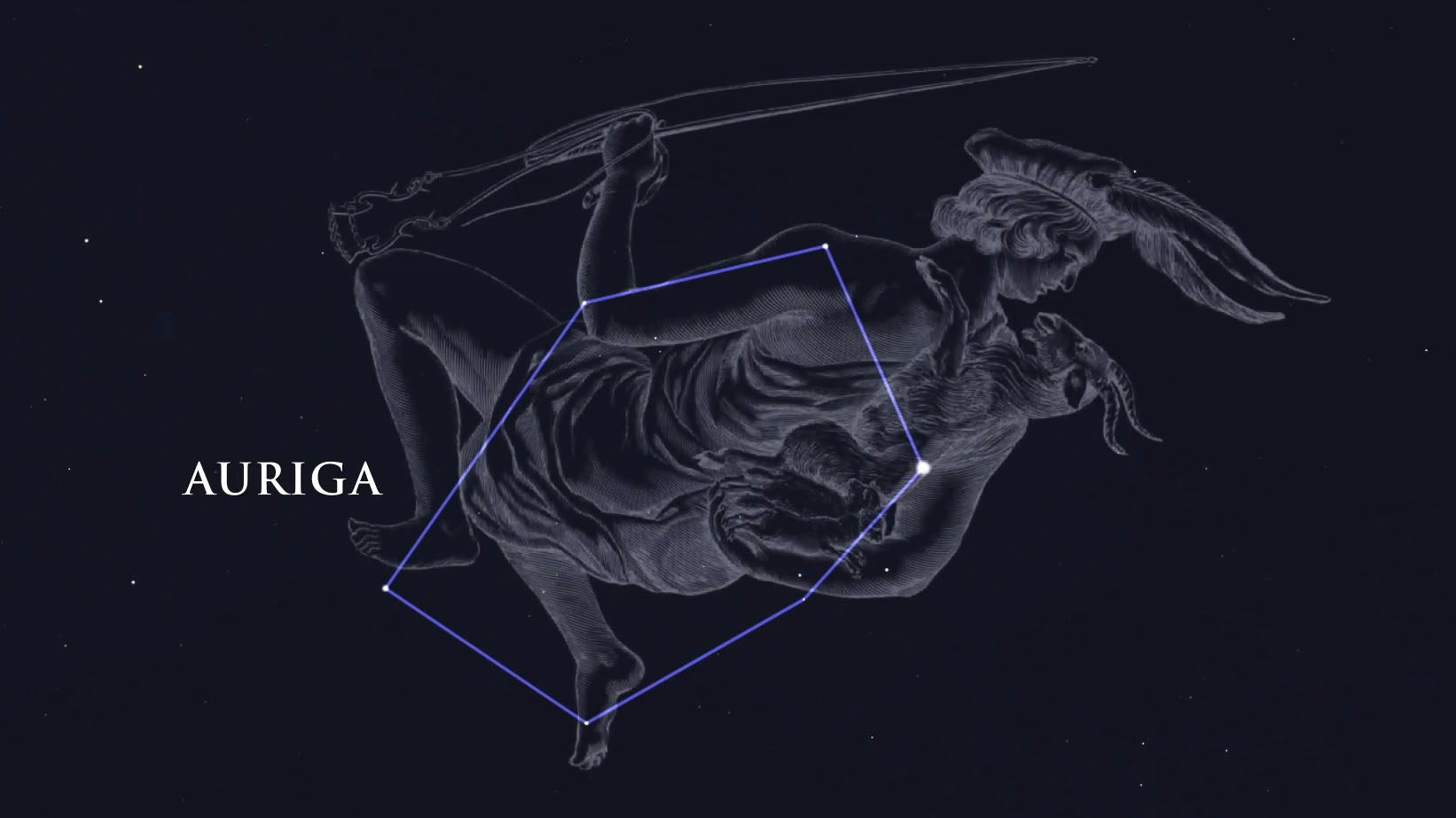
There are many well known chariots and charioteers in ancient Hellenic mythology. All of the Theoi have one, and Helios and Apollon use one to bring light to the world. Hades kidnapped Persephone with His. Kastor and Polideukes were very skilled at driving the fast, light, open, two-wheeled conveyance drawn by two or more horses. Helios lost a son when he let his son Phaethon (Φαέθων) drive his chariot for its morning track through the sky. Phaethon flew too close to the earth and scorched it all; Zeus then cast him down with a lightning-bolt. Yet, these are not the charioteers the constellation is associated with. In this next installment of the constellation series, we will look at the Divine child the constellation refers to... and a few others, because the constellation Auriga has had many interpretations over the years.


For a very long time, war chariots were pulled by two horses only. The charioteer of the constellation is therefor most likely Erichthonios (Ἐριχθόνιος), child of Hēphaistos and Athena, through Gaea, as he invented a chariot pulled by four horses. 

As the myth of his birth goes; Athena went to Hēphaistos' workshop for weaponry, but Hēphaistos--overcome with lust--tried to rape Her instead. Athena fled, but could not flee fast enough. Hēphaistos caught up to Her. Athena fought off Her attacker, but could not prevent Hēphaistos from ejaculating on Her thigh. She wiped Hēphaistos' semen away with a scrap of wool (ἔριον, erion) and flung it to the earth (χθών, chthôn). From it was born Erichthonios, who was part man, and part snake.

In my post about the many legends of Médousa, I posed the following about Athena and the source of Erichthonius' myth and birth as part-snake:

"Athena's role as a snake and fertility Goddess is still visible in the myth about the child she had with Hephaestus; Erichthonios (Ἐριχθόνιος), who was half man, half snake. It's even posed that in the early days, Athena was married to Hephaestus and had His child willingly. As Athena was stripped of Her roles as a fertility and snake Goddess, Médousa's myth came into being, where Athena distances Herself from sex and snakes, by punishing an epithet of herself (Athena Tritogeneia, perhaps: 'born of Trito', a lake which was supposedly located in Libya), or the Libyan snake Goddess Médousa, who may have still been attached to Her worship. By placing Médousa's head on Her breastplate or shield, Athena's mythology is continuously linked to Her Libyan heritage, but harmlessly so, to Her new image of a virginal warrior."

No matter the source, Erichthonios was born, and placed in a box by Athena. She placed the box in the care of three of Her attendants at the Acropolis, with clear instructions not to open the box. They did, of course, and were scared so by the sight of either a snake in the box, or Erichthonios' deformities, they cast themselves off of the Acropolis in terror. Yet, despite his deformities, Erichthonios became king of Athens and ruled it long and well.

He married Praxithea (Πραξιθέα), a naiad, and had a son, Pandion I. He founded the Panathenaiac Festival in the honor of Athena, and set up a wooden statue of her on the Acropolis. He taught his people to yoke horses and use them to pull chariots, to smelt silver, and to till the earth with a plough. His deformities and lameness inspired him to invent the quadriga--or four-horse chariot--to get around easier. He was very skilled as a charioteer, and won many games. Zeus was said to have been so impressed with his skill that he raised him to the heavens to become the constellation Auriga after his death.

There are also other charioteers to whom the constellation could refer; Myrtilus (Μυρτίλος), for example, who was Hermes's son and the charioteer of Oenomaus. Myrtilus's chariot was destroyed in a race intended for suitors to win the heart of Oenomaus's daughter Hippodamia. Myrtilus earned his position in the sky when Hippodamia's successful suitor, Pelops (Πέλοψ), killed him, although he helped him win the woman's hand. After his death, Myrtilus's father Hermes placed him in the sky. 

The constellation could also represent Theseus's son Hippolytos who was rejected from Athens after he refused the romantic advances of his stepmother Phaedra, who committed suicide as a result. He was killed when his chariot was wrecked, but revived by Asklepios. Another possibility is that the constellation does not represent a whole person at all, but is a limb of Mēdeia's brother after she killed and dismembered him.

Occasionally, Auriga is also seen as the Charioteer but as Bellerophon (Βελλεροφῶν), the mortal rider of Pegasus who dared to approach Mount Olympus. In this version of the tale, Zeus pitied Bellerophon for his foolishness and placed him in the stars.

Whomever--or whatever--it represents, Auriga reminds us that the chariot had an important place in ancient Hellenic society. As for the constellation, it is visible at latitudes between +90° and −40°, and best visible at 21:00 (9 p.m.) during the month of late February to early March.
In ancient times, six karyatides (singular: Καρυάτις, plural: Καρυάτιδες) graced the south column gallery on the Erechtheion (Ἐρέχθειον). The Erechtheion served as a temple to Athena Polias, Poseidon, the hero Erichthonius, and perhaps the legendary king Erechtheus. A karyatis is a support column of a temple, in the form of a woman. While the six on the Erechtheion appear copies, they can, in fact, be distinguished from one another. That is exactly what we'll be looking at today.


The statues are labeled Kore (maiden) A to F. Kore's A through C hold their left leg out, while Kore'sm D through F hold their right leg out. The biggest differences between the karyatides can be found in their clothing, and in their hair. While all six of the women wear an Ionic chiton, subtle differences can be found in its design. Kore B, for example, has a much shallower fold of cloth at her midsection, and their necklines all vary. Needless to say, they also have different bits missing, but as that was not intended by the sculptor, we'll not look into those differences today.

Their hair is most telling, though. Most have fishtail braids down the back, along with regular braids wrapped around the head, but some of the karyatides have sidecurls, while others do not, and their placement differs. o investigate this, Dr. Katherine Schwab created the Caryatid Hairstyling Project at Fairfield University, which laboured to recreate the hairstyles of the six karyatides from the Erechthion. The hairstyles were recreated on models--students in this case--by hairstylist Milexy Torres. You can see the results, and the subtle differences, below:


"The project was an experiment to replicate the hairstyles of the famous Caryatids from the Erechtheion [...] The Caryatids’ hairstyles are a remarkable and fascinating way to learn more about ancient Athenian society, especially during the fifth century B.C. [...] When Milexy made the final version, an adaptation of the general hairstyle, it was extremely comfortable, very light and cool.  I was surprised by how few pins and small plastic bands were needed to keep the different braids in place. "

The six statues currently on display on the Erechtheion are copies; five of the statues were removed during restoration of the building, and are now on in the Acropolis Museum in Athens where they are being restored and preserved. The last of the statues is in the British Museum in London, where it was taken to around 1800 by Lord Elgin. Despite steps to reclaim the statue, the British government has this far refused to return it. As a result, one of the pedestals in the display chamber of the statues in the Acropolis museum remains empty.
I am completely swamped, so excuse me when I leave you with the words of another. I actually did not know this, and perhaps you did not either. Enjoy!


I have posted about the strange story of Erichthonios before, but this account not only contains an aetiological myth for the absence of crows but also has some strange details, like Athena trying to bring a mountain to Athens. Antigonus of Carystus allegedly compiled his collections of wonders in the 3rd Century BC.


Antigonus Paradoxographus, Historiae Mirabiles 12

 “Amelêsagoras the Athenian, author of the Atthis, claims that the crow does not fly to the Akropolis and that no one can say he has seen it happen. He provides the cause of this as a myth.

For he says that when Athena was given to Hephaestos that she disappeared right after she laid down with him and Hephaistos ejaculated his seed on the ground. The earth later produced for Hephaestos Erikhthonios whom Athena cared for but then closed in a basket and handed over to the daughters of Kekrops, Agraulos, Pandrosos, and Hersê.  She told them not to open the basket until she returned.
When she left for Pellênê to bring back a mountain in order to make a defensive barrier before the city, two of Kekrops’ daughters—Agraulos and Pandrosos—opened the basket and saw two snakes around Erikhthonios.

[Amelêsagoras] claims that a crow went to Athena as she was carrying the mountain which is now called Lykabettos and told her that Erikhthonios was in the open. When she heard this, she threw the mountain to where it is now, said tat it would no longer right for the crow to go to the Akropolis because of his evil message.”
Welcoem to the Eleusinian Mysteries! the PAT rituals have started so the coming days you will get a few Eleusinian-themed posts. For those interested, I did an Eleusinian Masterpost a while ago. You can find a lot of information on the Mysteries there. Today I would like to talk a bit about the semi non-mythical origins of the Mysteries. Why do I say semi non-mythical? Well, because we are talking about something that happened a long, long time ago and

Mythologically, the foundations of the Eleusinian Mysteries can be found in the Homeric Hymn to Demeter. Within the hymn, Demeter travels the globe in her grief over losing Her daughter. She eventually settles at the home of Keleus. Demeter plans to make one of his sons immortal in return for his hospitality but She is interrupted. Instead, she tells Keleus to build Her a temple and altar so she can teach human beings the knowledge they need to have a good life.

That is the most told story of the origin of the Mysteries. How the Mysteries came to be Athenian, however, has its foundations in another story, which concerns the union of Eleusis with Athens. For this, you must know of Erichthonios (Erechtheus, Ἐριχθόνιος). He was the child of Hēphaistos and Athena, through Gaea, who was half man, half snake, and left in a basket by Athena, to be cared for by three of Her young attendants at the Acropolis, with clear instructions not to open the basket. They did, of course, and were scared so by the sight of either a snake in the basket, or Erichthonios' deformities, they cast themselves off of the Acropolis in terror. Yet, despite his deformities, Erichthonios became king of Athens and ruled it long and well.

Erichthonios was at war with the Eleusinians, who were helped by one Eumolpos. Eumolpos was a legendary Thracian king who established the city of Eumolpias (also called Eumolpiada) around 1200 BC (or 1350 BC, depending on the source). Needless to say, he named it after himself. He was the son of Poseidon and Khione. Khione, daughter of Boreas and Oreithyia, pregnant with Eumolpos by Poseidon, was frightened of her father's reaction so she threw the baby into the ocean. Poseidon looked after him and brought him to shore in Ethiopia where Benthesikyme, a daughter of Poseidon and Amphitrite, raised the child, who then married one of Benthesikyme's two daughters by her Ethiopian husband. Eumolpos, however, loved a different daughter and was banished because of this. He went with his son Ismaros to Thrace. There, he was discovered in a plot to overthrow King Tegyrios and fled to Eleusis.

Under Erichthonios' guidance, Eleusis was conquered and its political leadership fell to Athens. Eumolpos and his family, however, became some of the first priests of Demeter and Eumolpos became one of the founders of the Eleusinian Mysteries. He was also the person who initiated Herakles into the Mysteries. The other family which held a priesthood in the mysteries, the Kerykes, were said to have been descended from Keryx, the son of Eumolpos; though the family itself considered its ancestors to have been Hermes and Aglauros, daughter of Erechtheus, and so genuine Athenians.

Now, this is the distilled version. There are a few variations: it might be that Eumolpos' son was not called Eumolpos but Immarados and that he was killed by King Erichthonios in the war. This could also be a secon son. In some sources, Erichthonios also killed Eumolpos, and Poseidon asked Zeus to avenge His son's death. Zeus killed Erichthonios with a lightning bolt or Poseidon made the earth open up and swallow Erichthonios. As I said: semi non-mythical. Remember these names, though, they will make a reappearance in the days to come.
Beginning at sundown on the 19th of June, the Kourotrophos (child nurturers) were honoured. Gaea, Artemis, Hekate, Aglauros and Pandrosos shall be sacrificed to. Elaion will be organizing another Practicing Apart Together ritual for this event in the daylight hours of the 20th (so today!). You can follow the event of Facebook here.


The Kourotrophos are (mostly) female deities who watched over growing children--Gaea, Artemis, Hekate, Eirênê, Aglauros and Pandrosos, especially. This specific offering is known from the demos Erchia, but duplicates similar offerings on the Acropolis of Athens.

In this ritual, we honor Gaea, Artemis, Hekate, Aglauros and Pandrosos. Artemis is named Kourotrophos by Diodorus Siculus, a Hellenic historian, in book five of his library:

"And Artemis, we are told, discovered how to effect the healing of young children and the foods which are suitable to the nature of babes, this being the reason why she is also called Kourotrophos." [5.73.5]

Hesiod, in his 'Theogony', explains why Hekate is Kourotrophos:

"So, then. albeit her mother's only child, she is honoured amongst all the deathless gods. And the son of Kronos made her a nurse of the young who after that day saw with their eyes the light of all-seeing Eos (Dawn). So from the beginning she is a nurse of the young (kourotrophos), and these are her honours." [404]

Aglauros and her sister Pandrosos seem to have been fertility deities in Athens. They were eventually regarded as daughter of the Athenian king Cecrops, however, and myth tells us the sisters were entrusted with the care for Erichthonios, hidden away in a basket. He was the son of Athena and Hēphaistos, who grew to term in the Earth (Gaea), and would later rule Athens as king. Aglauros had a sanctuary on the Acropolis in which young men of military age swore an oath to her as well as to Zeus and to other deities. Herse, sometimes regarded as a third sister, has no mention in these accounts.

Gaea, as a mother and raiser of many children, of course receives honors as well during the Kourotrophos. Pausanias, in his 'Description of Greece' says:

"There is also a sanctuary of Ge (Earth) Kourotrophe (Nurse of the Young) [at Athens], and of Demeter Khloe (Green). You can learn all about their names by conversing with the priests." [1.22.3]

We are also considering adding Eirene, as Euripides, in Bacchae says the following about Her:

"The god [Dionysos], the son of Zeus, delights in banquets, and loves Eirene (Peace), giver of riches (olbodotes), goddess who nourishes youths (thea kourotrophos). To the blessed and to the less fortunate, he gives an equal pleasure from wine that banishes grief." [420] 

As the ritual is quite lengthy, you can find the full version here.
On the sixteenth of Metageitnion, beginning at sundown on the 22nd of August, the Kourotrophos (κουροτρόφος, child nurturer) honors Gaea the true Kourotrophos and the two Goddesses who protect women and children, Hekate and Artemis. Elaion will be organizing another Practicing Apart Together ritual, which I would love to have you join.

The Kourotrophos was an offering to the Kourotrophos; (mostly) female deities who watched over growing children--and especially boys. This specific offering is known from the demos Erchia, but duplicates similar offerings on the Acropolis of Athens.

In this ritual, we honor Gaea, Artemis, Hekate, Aglauros and Pandrosos. Artemis is named Kourotrophos by Diodorus Siculus, a Hellenic historian, in book five of his library:

"And Artemis, we are told, discovered how to effect the healing of young children and the foods which are suitable to the nature of babes, this being the reason why she is also called Kourotrophos." [5.73.5]

Hesiod, in his 'Theogony', explains why Hekate is Kourotrophos:

"So, then. albeit her mother's only child, she is honoured amongst all the deathless gods. And the son of Kronos made her a nurse of the young who after that day saw with their eyes the light of all-seeing Eos (Dawn). So from the beginning she is a nurse of the young (kourotrophos), and these are her honours." [404]

Aglauros and her sister Pandrosos seem to have been fertility deities in Athens. They were eventually regarded as daughter of the Athenian king Cecrops, however, and myth tells us the sisters were entrusted with the care for Erichthonios, hidden away in a basket. He was the son of Athena and Hēphaistos, who grew to term in the Earth (Gaea), and would later rule Athens as king. Aglauros had a sanctuary on the Acropolis in which young men of military age swore an oath to her as well as to Zeus and to other deities. Herse, sometimes regarded as a third sister, has no mention in these accounts.

Gaea, as a mother and raiser of many children, of course receives honors as well during the Kourotrophos. Pausanias, in his 'Description of Greece' says:

"There is also a sanctuary of Ge (Earth) Kourotrophe (Nurse of the Young) [at Athens], and of Demeter Khloe (Green). You can learn all about their names by conversing with the priests." [1.22.3]

We are also considering adding Eirene, as Euripides, in Bacchae says the following about Her:

"The god [Dionysos], the son of Zeus, delights in banquets, and loves Eirene (Peace), giver of riches (olbodotes), goddess who nourishes youths (thea kourotrophos). To the blessed and to the less fortunate, he gives an equal pleasure from wine that banishes grief." [420]
 
As the ritual is quite lengthy, you can find the full version here. The festival will be held on the 23rd of August, at nine AM EDT, and we would love to have you join.
After writing yesterday's blogpost, I took to Youtube and found the video you see below, explaining a bit more about the Erechteion and the karyatides. It's very informative, and yes, I probably should have Youtubed this before I posted yesterday's blog post about the karyatides. Sorry about that. I was going to go back and edit the blog post, but I don't like doing that, so you're getting it today under the label 'this is not a real blog post'. Better work from me tomorrow, everyone, excuzes moi.

 
The video was made by professor Kenney Mencher as a part of his lecture series. From his website:
 
"Originally from New York, NY, Kenney Mencher earned a BA and MA in Art History from City University of New York and University of California, Davis, respectively, following which he went on to obtain a MFA in painting from the University of Cincinnati in Ohio. He has taught at a number of institutions including the University of Chicago and Texas A&M University, and now teaches at Ohlone College in Fremont, California. He is the author of a text book Liaisons: Readings in Art, Literature and Philosophy. His exposure via solo and group exhibitions is extensive nationwide."
In ancient times, six karyatides (singular: Καρυάτις, plural: Καρυάτιδες) graced the south column gallery on the Erechtheion (Ἐρέχθειον). The Erechtheion served as a temple to Athena Polias, Poseidon, the hero Erichthonius, and perhaps the legendary king Erechtheus. A karyatis is a support column of a temple, in the form of a woman. While the six on the Erechtheion appear copies, they can, in fact, be distinguished from one another. That is exactly what we'll be looking at today.

 
The statues are labeled Kore (maiden) A to F. Kore's A through C hold their left leg out, while Kore'sm D through F hold their right leg out. The biggest differences between the karyatides can be found in their clothing, and in their hair. While all six of the women wear an Ionic chiton, subtle differences can be found in its design. Kore B, for example, has a much shallower fold of cloth at her midsection, and their necklines all vary. Needless to say, they also have different bits missing, but as that was not intended by the sculptor, we'll not look into those differences today.
 
Their hair is most telling, though. Most have fishtail braids down the back, along with regular braids wrapped around the head, but some of the karyatides have sidecurls, while others do not, and their placement differs. o investigate this, Dr. Katherine Schwab created the Caryatid Hairstyling Project at Fairfield University, which laboured to recreate the hairstyles of the six karyatides from the Erechthion. The hairstyles were recreated on models--students in this case--by hairstylist Milexy Torres. You can see the results, and the subtle differences, below:


"The project was an experiment to replicate the hairstyles of the famous Caryatids from the Erechtheion [...] The Caryatids’ hairstyles are a remarkable and fascinating way to learn more about ancient Athenian society, especially during the fifth century B.C. [...] When Milexy made the final version, an adaptation of the general hairstyle, it was extremely comfortable, very light and cool.  I was surprised by how few pins and small plastic bands were needed to keep the different braids in place. "
 
The six statues currently on display on the Erechtheion are copies; five of the statues were removed during restoration of the building, and are now on in the Acropolis Museum in Athens where they are being restored and preserved. The last of the statues is in the British Museum in London, where it was taken to around 1800 by Lord Elgin. Despite steps to reclaim the statue, the British government has this far refused to return it. As a result, one of the pedestals in the display chamber of the statues in the Acropolis museum remains empty.
A few days ago, I spoke about coming of age ceremonies in ancient Athens, and referenced the Arrephoria (Ἀρρηφόρια) festival. Today, I want to take some time to discuss this secret rite to Athena Polias in more detail. The festival wasn't a state festival; young girls in the service performed a ritual for Athena Polias as a public service, but beyond those girls, their mentors, and perhaps their parents, no one was very concerned with it. As with most secret rites, I'm sure people knew a rite was being held, but knew it was not their business to interfere. As long as the rite was performed, all would be well for them.


As said in the post on coming of age ceremonies, young girls rarely had a role to play in household worship. The family only had them with them for thirteen to fifteen years, on average, after that, she joined her rightful place at the oikos of her husband, where she carried more (religious) responsibility. Outside of the home, however, young girls were placed in service of female deities quite often, especially in city-states like Athens. The girls who were selected for this were in service of Athena Polias for an entire year and were called 'Arrephoros' (Ἀρρήφορος), Arrephoroi as a group, consisting of four members.

The Arrephoroi were always girls between the age of seven and eleven, although seven and ten seem to be the ages that are mentioned most often. They were selected from the wealthy and powerful families of Athens, as those families were considered to be especially blessed. Excavations on the Acropolis have led to the discovery of their quarters, and even their playground. It seems even mini-priestesses can't be priestesses all the time. The young girls seem to have favored ball games, and were lodged near the Erechtheion in an area which was the main inhabited area on the Acropolis in Mycenaean times.

The Arrephoroi had three important tasks to perform in their term. One of the tasks the young girls assisted in was the creation of the peplos for Athena Polias, which was presented to Her during the Panathenaia. Secondly, they were almost solely in charge of grounding the meal for the honey cakes which were placed upon the altar of Athena during religious ceremonies. As a special part of their service, they performed the Arrephoria. During the Arrephoria, the priestess of Athena Polias gave the young arrephoroi sealed baskets to carry to a nearby cave. Here, the girls were supposed to enter, walk the corridor, set down their baskets at the end and pick up ones which have stood there for a year. When they returned with the baskets, it signaled the end of their year of service and they were dismissed. They were replaced with new girls who would serve the Theia. Pausanias has the fullest description of the festival described in book one of his 'Description of Greece':

"Two maidens dwell not far from the temple of Athena Polias, called by the Athenians Bearers of the Sacred Offerings. For a time they live with the goddess, but when the festival comes round they perform at night the following rites. Having placed on their heads what the priestess of Athena gives them to carry--neither she who gives nor they who carry have any knowledge what it is--the maidens descend by the natural underground passage that goes across the adjacent precincts, within the city, of Aphrodite in the Gardens. They leave down below what they carry and receive something else which they bring back covered up. These maidens they henceforth let go free, and take up to the Acropolis others in their place." [1.27.4]

Excavations on the north slope of the Acropolis have, indeed, recovered this underground passage. The man who located it was Oscar Broneer. He also discovered the passage had been in use during the Late Helladic times (from 1550 BC on) when it had artificial steps. Most likely, the tunnel led to a well, or had led to a well in the past. In Classical times (5th through 4th centuries BC), it seems the passage led to an open-air precinct of Aphrodite and Eros--the sanctuary Pausanias mentions.

It seems this ritual has ties to the ancient Athenian myth of Erichthonios (Ἐριχθόνιος), child of Hēphaistos and Athena, through Gaea, who was half man, half snake, and left in a basket by Athena, to be cared for by three of Her young attendants at the Acropolis, with clear instructions not to open the basket. They did, of course, and were scared so by the sight of either a snake in the basket, or Erichthonios' deformities, they cast themselves off of the Acropolis in terror. Yet, despite his deformities, Erichthonios became king of Athens and ruled it long and well. Myth tells us it was Erichthonios who founded the Panathenaiac Festival in the honor of Athena.

One thing in Pausanias' passage needs further explanation, namely that the priestesses of Athena themselves also did not know what the young girls carried into the passage. It seems the current Archōn Basileus, as the incarnation of the mythological kings of Athens, was in charge of selecting four Arrephoroi from a list of potential candidates. As soon as the young girls took up the service, he became a father to them, like Kékrops had been the father of the young attendants who had received the basket bearing Erichthonios from Athena. It was his ritual responsibility to make sure the girls wouldn't peak into the basket--although the actual training would have most likely be done by Athena's priestesses who took care of the children throughout the year--and to fill their baskets for the Arrephoria. Most likely, the children also took the retrieved baskets to him, or he collected and emptied them after they were presented to Athena Polias.

The Arrephoria was a rite of passage for a select few girls, but it was not a coming of age rite. The Arrephoria taught these children, often no older than ten years old, the most important aspects of the work of women; weaving (through the peplos), baking (through the cakes), and caring for children (through the carrying of the baskets in secret). They were taught responsibility, and service to the divine. After they were dismissed, the girls were too young to partake in the next step phase of their lives--marriage--and so they went back home, where they waited to be old enough to perform for Artemis and leave their childhood behind.

The rite itself, where the girls journeyed into the cave, was most likely celebrated at the start of Skirophorion. The date of the rite would most likely have varied, although we place it on the third of the month--Athena's sacred day--for convenience sake. The date in ancient times would most likely have changed because of the function it had, a function we have not yet discussed. It seems that there was a certain fertility aspect to the rite, not for humans, but for the olive tree. Erica Simon, in 'Festivals of Attica: An Archaeological Commentary' describes (p. 45-46) that the rite was most likely performed when the first dew settled on the sacred olive tree on top of the Acropolis--very near where the girls were housed--or when dew was about to settle onto it. The theory is based upon the work of Deubner, who first made this connection.

My knowledge on olive trees is limited to the mythical, but it seems that they at least need some water to come to fruition. In climates as dry as Hellas, dew was needed to produce rich fruit. The months following Skiraphorion are crucial to the olive crop, and in ancient times, olive trees--and Athena's sacred olive tree--were vital to the survival of Athens. Olive oil was a main export product, it was used in nearly everything, from cooking to sacred rites, and Athena's olive tree atop the Acropolis had been her gift to the city, which led to her patronage over the city, instead of that of Poseidon. It is said that the sacred olive oil gifted as a reward for winning the Panathenaia te megala was harvested from that very tree. Its survival, and the bearing of good fruit, were therefor essential.

There are a variety of links to dew surrounding this rite; 'arrhephoros' can be translated as 'dew carrier', two of the sisters who were charged to care for the basket were named after dew--Pandrosos and Herse. In some versions of the myth, only two of the sisters opened the basket; Herse and her second sister Aglauros. Pandrosos remained faithful to the Theia's wishes and was rewarded the care of the sacred olive tree. A sanctuary was raised in Pandrosos' honor, the temenos of which encircled the sacred olive tree. It was called the Pandroseion and occupied the space adjacent to the Erechtheum and the old Temple of Athena Polias.

The Arrephoria was performed to appease Athena and to assure the best possible (divine) conditions for the sacred olive tree--and, by proxy, all olive trees--to grow and bear fruit. These young girls performed a vital part of this rite to make up for the failings of Herse and Aglauros, and this would also explain why Pausanias describes only two girls made the journey, while most accounts attest four Arrephoroi were selected each year. I must also make note of the location of the underground tunnel--leading into a sanctuary of Eros and Aphrodite--which strengthens the assertion that this rite was a fertility one, and Aphrodite was asked to take care of the growth of the olive trees, just as much as Athena was. Based on Pausanias' statement alone, the suggestion Aphrodite was involved in the festival at all is shaky, at best, but it does make a lot of sense.

The Arrephoria is an intricate rite, which has lost much of its meaning today, now Athena's sacred olive tree is long gone. Yet, many olive trees remain, and Athena's dominion over them, and us, is still strong to this day. If there are kids in your thaisos, you might turn this into an activity where the oldest male member of the group fills two small baskets, and two female children (preferably) take them to a previously dug pit in the ground, where they bury them. Next year, these can be swapped out for new baskets. A vital part of the rite would be for the children not to look into them, of course. If your thaisos is childless, the two youngest female members of the group could perform the rite. Alternatively, or secondly, libations of wine and/or water can be made to Athena and Aphrodite, who presided over the the growth of the olive tree, and the prosperity of the city that came with it. Requests for good fortune for yourself of the thaisos you belong to can be added, and would be a beautiful modern twist to an ancient rite.
For the last Pagan Blog Project post of the year, I'll be talking about Zeus-born, and other God-bothered kings of ancient Athens. Back in ancient Hellas, if you were a citizen--and especially one from an important family--you could trace your family line back to a Theos. For Athenians, this divine link was first through Gaea (autochthonous, αὐτός χθών, 'earth-born') and/or Athena (with links to Zeus), and then through Poseidon.

The kings of Athens were legendary, mythological, even in the time of ancient Hellas. Roman historian Eusebius of Caesarea (263 – 339 AD) has compiled a list of these kings (the dating took place at a later date):

Kékrops (Κέκροπος) I 1556 - 1506 BC: he is said to have had a top half shaped like a man and a bottom half in serpent or fish-tail form. Kékrops is the first ruler of Athens who was considered a king. He is said to have been the first who deified Zeus, and ordained sacrifices to be offered to him as the supreme Deity. Mythologically speaking, it was in Kékrops' reign, that Athena became the patron Theia of the city, after beating Poseidon in competition, and it were Kékrops' daughters who opened the box holding the child of Athena and Hēphaistos: Erichthonius and were scared so by his appearance (or the presence of two snakes in the box), they threw themselves off of a cliff.

Cranaus (Κραναός) 1506 - 1497 BC: earth-born like his predecessor. The flood in the myth of Deukalion is said to have happened during his reign. Amphictyon, son of Deukalion, is said to have married one of the daughters of Cranaus, and he became the next king.

Amphictyon (Αμφικτυών) 1497 - 1487 BC: son of Deukalion, or earth-born. According to Eustathios of Thessalonike (Εὐστάθιος Θεσσαλονίκης), Dionysos visited Amphictyon in Athens and taught him how to mix water with wine in the proper proportions.

Erichthonius (Ἐριχθόνιος) 1487 - 1437 BC: the fabled son of Athena and Hēphaistos himself, earth-born. With Praxithea (Πραξιθέα), a naiad, he had a son, Pandion I, who went on to become king himself. As an obvious favorite of Athena, She protected him for many years, and in return, he founded the Panathenaic Festival in honor of Athena.

Pandion I (Πανδίων Α') 1437 - 1397 BC: like his father, Pandion married a naiad, Zeuxippe, and they had five children, Erechtheus, Butes, Procne, Philomela, and Cecrops II. According to Pseudo-Apollodorus' Bibliotheca, it was during Pandion I's reign that Demeter and Dionysos came to the city-state of Athens. Before his death, he gave the rule of Athens to Erechtheus, but the priesthoods of Poseidon and Athena to Butes.

Erechtheus (Ἐρεχθεύς) 1397 - 1347 BC: son and heir to King Pandion I, who was the son of Erichthonius. His reign was marked by the war between Athens and Eleusis, when the Eleusinians were commanded by Eumolpus, coming from Thrace. An oracle declared that Athens' survival depended on the death one of the three daughters of Erechtheus. Orithyia, another daughter, was kidnapped by Boreas, the North Wind.

Cecrops II (Κέκρωψ Β') 1347 - 1317 BC: Not the most remarkable of rulers, and not linked to any mythological event.

Chyrasos 1317 - 1292 BC: information about his person and reign have been lost.

Pandion II (Πανδίων Β') 1292 BC - 1291 BC: son and heir of Cecrops II. May not actually have existed, but was invented to fill a gap in succession.

Metion (Μητίων) 1291 BC - 1291 BC: son of Erechtheus of Athens, or a son of Eupalamus, Erechtheus' son. His sons eventually dethroned Pandion II, although the sons of Pandion later overthrew them.

Aegeus (Αἰγεύς) 1291 BC - 1234 BC: son of Pandion II, father of the mythical hero Theseus, who cast himself off the cliffs into the sea below when Theseus failed to chance the ship's sails from black to white upon returning from killing the minotaur at Minos.

Theseus (Θησεύς) 1234 - 1204 BC (or 1213 BC): one of Hellas' greatest hero-kings and son of Poseidon. His greatest adventure comes in the form of the battle against the minotaur of Minos, whom he killed. For this, he is still remembered. The festival of Pyanepsia is linked to his return from Minos.

Menestheus (Μενεσθεύς) 1204 - 1181 BC (or 1213 - 1191 BC): son of Peteus, son of Orneus, son of Erechtheus. He was king during the fabled Trojan war, and was one of Helen of Troy's suitors.Although a good strategist, Menestheus seems to have been a bit of a dishonorable warrior, as he preferred to lead his men from the back of the formation, instead of in front of it. That having been said, he was one of the men inside the Trojan horse.

Demophon (Δημοφῶν ) 1181 - 1147 BC: son of Theseus and Phaedra. He fought in the Trojan war. He granted the children of Herakles, who were fleeing from Eurystheus, refuge in Athens. Upon accidentally killing a fellow Athenian, he was dethroned and tried for the murder.

Oxyntes (Οξύντης) 1147 - 1135 BC: grandson of Theseus, son of Demophon. Very little is known about him, or nothing remarable happened during his reign.

Apheidas (Ἀφείδας) 1135 - 1134 BC: son of Oxyntes. After a short reign of one year, his brother Thymoetes succeeded him on the throne.

Thymoetes (Θυμοίτης) 1134 - 1126 BC: son of Oxyntes. He was the last Athenian king in the line of Theseus.

Melanthus (Μέλανθος) 1126 - 1089 BC: before fleeing to Athens and becoming king, Melanthus was king of Messenia (Μεσσηνία), a regional unit in the southwestern part of the Peloponnese. He was among the descendants of Neleus who were expelled from Messenia by the descendants of Herakles.

Codrus (Κόδρος) 1089 - 1068 BC: he was the lask king of Athens; after his reign, his son Medon rulled the city-state as Archon. Aristotle--in 'constitution of the Athenians'--claims, however, that Medon ruled as king first, before becoming Archon. During the Dorian invasion, the Oracle of Delphi prophecied that the Dorians would win, as long as the king of Athens was not harmed. Hearing of this prophecy, Codrus disguised himself as a peasant and snuck to the Dorian camp. Here, he made a fuss, and was prompty killed. The Dorians retreated upon learning what had happened. It was decreed that no one would be worthy enough to succeed Codrus on the throne, and so, Athens only had Archons afterwards.

As you can see, many of these kings had connections to divinity, either in their bloodline, or through contact during their reign. These kings were the founders of Athens, and of Hellenic civilization. Their close identification with Deity is only logical; someone who had done so much for the city-state and the people of Athens could only be born from the Theoi Themselves.

Friday next week, the PBP starts all over again, and I'll add to this post in my first 'A', linking it to the Archons, and the place of both kings and Archons in Athenian society. For those of you who only follow my Pagan Blog Project posts, until then, otherwise, I'll see you all tomorrow.
There are many well known chariots and charioteers in ancient Hellenic mythology. All of the Theoi have one, and Helios and Apollon use one to bring light to the world. Hades kidnapped Persephone with His. Kastor and Polideukes were very skilled at driving the fast, light, open, two-wheeled conveyance drawn by two or more horses. Helios lost a son when he let his son Phaethon (Φαέθων) drive his chariot for its morning track through the sky. Phaethon flew too close to the earth and scorched it all; Zeus then cast him down with a lightning-bolt. Yet, these are not the charioteers the constellation is associated with. In this next installment of the constellation series, we will look at the Divine child the constellation refers to... and a few others, because the constellation Auriga has had many interpretations over the years.


For a very long time, war chariots were pulled by two horses only. The charioteer of the constellation is therefor most likely Erichthonios (Ἐριχθόνιος), child of Hēphaistos and Athena, through Gaea, as he invented a chariot pulled by four horses. 

As the myth of his birth goes; Athena went to Hēphaistos' workshop for weaponry, but Hēphaistos--overcome with lust--tried to rape Her instead. Athena fled, but could not flee fast enough. Hēphaistos caught up to Her. Athena fought off Her attacker, but could not prevent Hēphaistos from ejaculating on Her thigh. She wiped Hēphaistos' semen away with a scrap of wool (ἔριον, erion) and flung it to the earth (χθών, chthôn). From it was born Erichthonios, who was part man, and part snake.

In my post about the many legends of Médousa, I posed the following about Athena and the source of Erichthonius' myth and birth as part-snake:

"Athena's role as a snake and fertility Goddess is still visible in the myth about the child she had with Hephaestus; Erichthonios (Ἐριχθόνιος), who was half man, half snake. It's even posed that in the early days, Athena was married to Hephaestus and had His child willingly. As Athena was stripped of Her roles as a fertility and snake Goddess, Médousa's myth came into being, where Athena distances Herself from sex and snakes, by punishing an epithet of herself (Athena Tritogeneia, perhaps: 'born of Trito', a lake which was supposedly located in Libya), or the Libyan snake Goddess Médousa, who may have still been attached to Her worship. By placing Médousa's head on Her breastplate or shield, Athena's mythology is continuously linked to Her Libyan heritage, but harmlessly so, to Her new image of a virginal warrior."

No matter the source, Erichthonios was born, and placed in a box by Athena. She placed the box in the care of three of Her attendants at the Acropolis, with clear instructions not to open the box. They did, of course, and were scared so by the sight of either a snake in the box, or Erichthonios' deformities, they cast themselves off of the Acropolis in terror. Yet, despite his deformities, Erichthonios became king of Athens and ruled it long and well.

He married Praxithea (Πραξιθέα), a naiad, and had a son, Pandion I. He founded the Panathenaiac Festival in the honor of Athena, and set up a wooden statue of her on the Acropolis. He taught his people to yoke horses and use them to pull chariots, to smelt silver, and to till the earth with a plough. His deformities and lameness inspired him to invent the quadriga--or four-horse chariot--to get around easier. He was very skilled as a charioteer, and won many games. Zeus was said to have been so impressed with his skill that he raised him to the heavens to become the constellation Auriga after his death.

There are also other charioteers to whom the constellation could refer; Myrtilus (Μυρτίλος), for example, who was Hermes's son and the charioteer of Oenomaus. Myrtilus's chariot was destroyed in a race intended for suitors to win the heart of Oenomaus's daughter Hippodamia. Myrtilus earned his position in the sky when Hippodamia's successful suitor, Pelops (Πέλοψ), killed him, although he helped him win the woman's hand. After his death, Myrtilus's father Hermes placed him in the sky. 

The constellation could also represent Theseus's son Hippolytos who was rejected from Athens after he refused the romantic advances of his stepmother Phaedra, who committed suicide as a result. He was killed when his chariot was wrecked, but revived by Asklepios. Another possibility is that the constellation does not represent a whole person at all, but is a limb of Mēdeia's brother after she killed and dismembered him.

Occasionally, Auriga is also seen as the Charioteer but as Bellerophon (Βελλεροφῶν), the mortal rider of Pegasus who dared to approach Mount Olympus. In this version of the tale, Zeus pitied Bellerophon for his foolishness and placed him in the stars.

Whomever--or whatever--it represents, Auriga reminds us that the chariot had an important place in ancient Hellenic society. As for the constellation, it is visible at latitudes between +90° and −40°, and best visible at 21:00 (9 p.m.) during the month of late February to early March.