Showing posts with label Médousa. Show all posts

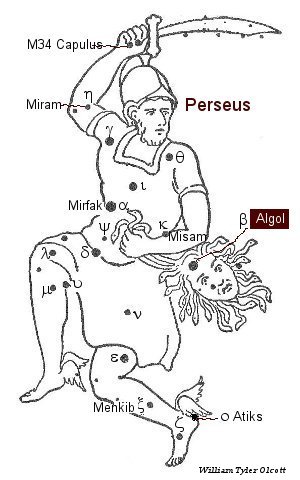
Perseus is one of ancient Hellas' greatest heroes, and it is not odd that he was immortalized in the night's sky. He is--of course--linked to the many constellations dedicated to the rescue of Androméda, but there is far more tot he hero Perseus.

 
http://www.constellationsofwords.com/stars/Algol.html

Perseus was born to Danae, who was locked in a bronze chamber by her father Akrisios, where she was impregnated by Zeus in the form of a golden shower. Akrisios put both mother and child in a chest and set them adrift on the sea, but they washed safely ashore on the island of Seriphos. From Hyginus' 'Fabulae':

"Danaë was the daughter of Acrisius and Aganippe. A prophecy about her said that the child she bore would kill Acrisius, and Acrisius, fearing this, shut her in a stone-walled prison. But Jove, changing into a shower of gold, lay with Danaë, and from this embrace Perseus was born. Because of her sin her father shut her up in a chest with Perseus and cast it into the sea. By Jove’s will it was borne to the island of Seriphus, and when the fisherman Dictys found it and broke it open, he discovered the mother and child. He took them to King Polydectes, who married Danaë and brought up Perseus in the temple of Minerva. When Acrisius discovered they were staying at Polydectes’ court, he started out to get them, but at his arrival Polydectes interceded for them, and Perseus swore an oath to his grandfather that he would never kill him. When Acrisius was detained there by a storm, Polydectes died, and at his funeral games the wind blew a discus from Perseus’ hand at Acrisius’ head which killed him. Thus what he did not do of his own will was accomplished by the gods. When Polydectes was buried, Perseus set out for Argos and took possession of his grandfather’s kingdom." [63]

The story of Perseus is somewhat chaotic; his myths have been told and retold many times--even in ancient times--and what happens to Perseus next is most certainly up for debate. To quote the 'Dictionary of Greek and Roman Biography and Mythology':

"According to a later or Italian tradition, the chest was carried to the coast of Italy, where king Pilumnus married Danaë, and founded Ardea (Virg. Aen. vii. 410; Serv. ad Aen. vii. 372); or Danaë is said to have come to Italy with two sons, Argus and Argeus, whom she had by Phineus, and took up her abode on the spot where Rome was afterwards built (Serv. ad Aen. viii. 345). But, according to the common story, Polydectes, king of Seriphos, made Danae his slave, and courted her favour, but in vain. Another account again states that Polydectes married Danae, and caused Perseus to be brought up in the temple of Athena. When Acrisius learnt this, he went to Polydectes, who, however, interfered on behalf of the boy, and the latter promised not to kill his grandfather. Acrisius. however, was detained in Seriphos by storms, and during that time Polydectes died. During the funeral gaines the wind carried a disk thrown by Perseus against the head of Acrisius, and killed him, whereupon Perseus proceeded to Argos and took possessions of the kingdom of his grandfather (Hygin. Fab. 63)."

No matter the version of the tale, Perseus' greatest heroic deed is what follows: the hunt for Médousa. In the most common versions of the story, Polydektes did not yet marry Danae, but wished to. A now grown up Perseus did not trust Polydektes and tried to keep him away from his mother, so Polydektes had to come up with a plan. He said he would marry Hippodameia--tamer of horses--and asked Perseus for a horse to give as a wedding present. Perseus didn't have one to give, so he told Polydektes to name any other favour, and that he would not refuse. Polydektes then instructed him to cut off and bring back the head of a Gorgon, and Perseus was trapped. From Apollodorus' 'Bibliotheca' we learn the following:

"So with Hermes and Athene as his guides Perseus sought out the Phorkides (daughters of Phorkys), who were named Enyo, Pephredo, and Deino. The three of them possessed only one eye and one tooth among them, which they took turns using. Perseus appropriated these and when they demanded them back, he said he would return them after they had directed him to the Nymphai. These Nymphai had in their possession winged sandals and the kibisis, which they say was a knapsack. (Pindaros and Hesiodos in the Shield of Herakles, describe Perseus as follows : `The head of a terrible monster, Gorgo, covered all his back, and a kibisis held it.’ It is called a kibisis because clothing and food are placed in it.). They also had the helmet of Haides. When the Phorkides had led Perseus to the Nymphai, he returned them their tooth and eye. Approaching the Nymphai he received what he had come for, and he flung on the kibisis, tied the sandals on his ankles, and placed the helmet on his head. With the helmet on he could see whomever he cared to look at, but was invisible to others.

Perseus took flight and made his way to the Okeanos, where he found the Gorgones sleeping. Their names were Stheno, Euryale, and the third was Medousa, the only mortal one : thus it was her head that Perseus was sent to bring back. The Gorgones’ heads were entwined with the horny scales of serpents, and they had big tusks like hogs, bronze hands, and wings of gold on which they flew. All who looked at them were turned to stone. Perseus, therefore, with Athena guiding his hand, kept his eyes on the reflection in a bronze shield as he stood over the sleeping Gorgones, and when he saw the image of Medousa, he beheaded her. (As soon as her head was severed there leaped from her body the winged horse Pegasos and Khrysaor, the father of Geryon. The father of these two was Poseidon.) Perseus then placed the head in the kibisis and headed back again, as the Gorgones pursued him through the air. But the helmet kept him hidden, and made it impossible for them to identify him.” [2. 36 - 42]

With Médousa's head secured, Perseus headed back to Polydektes, but was stopped while on route by the vision of a woman, chained to a rock, about to be devoured by a sea monster. It had been a dark day for Cepheus, king of Aethiopia, when he had heard his wife Cassiopeia boast that her daughter Androméda was more beautiful than the Nereids. Shocked, he had tried to silence his wife, but it was too late. The father of the Nereids, the sea God Nereus, had heard Cassiopeia's prideful boast and had brought his grievance to Poseidon. Poseidon had ruled in favour of Nereus and sent Cetus, a huge sea monster, to ravage the coasts of Aethiopia. Nereus would only be appeased when Cepheus sacrificed his daughter to Cetus. Cepheus had refused, but when the terror continued, Androméda had offered herself up to be sacrificed. Fast forward to Andromeda, chained to the rocks, about to die. Perseus pulled Médousa's head out of his bag and petrified Cetus with it before undoing Androméda's bindings. He fell for the beautiful princess instantly, and desired to take her as his wife. In most versions of the myth, he is allowed, but Hyginus in his 'Fabulae' has a different story to tell:

"When he wanted to marry her, Cepheus, her father, along with Agenor, her betrothed, planned to kill him. Perseus, discovering the plot, showed them the head of the Gorgon, and all were changed from human form into stone. Perseus with Andromeda returned to his country." [64]

Perseus eventually married Androméda and took her off to his native island of Serifos. They had many children; sons Perses, Alcaeus, Heleus, Mestor, Sthenelus, and Electryon, as well as daughters, Autochthe and Gorgophone. According to Hyginus in his 'Astronomica', Perseus was committed to the stars for the following reasons:

"He is said to have come to the stars because of his nobility and the unusual nature of his conception."

The constellation Perseus is visible at latitudes between +90° and −35° and best visible at 21:00 (9 p.m.) during the month of December.

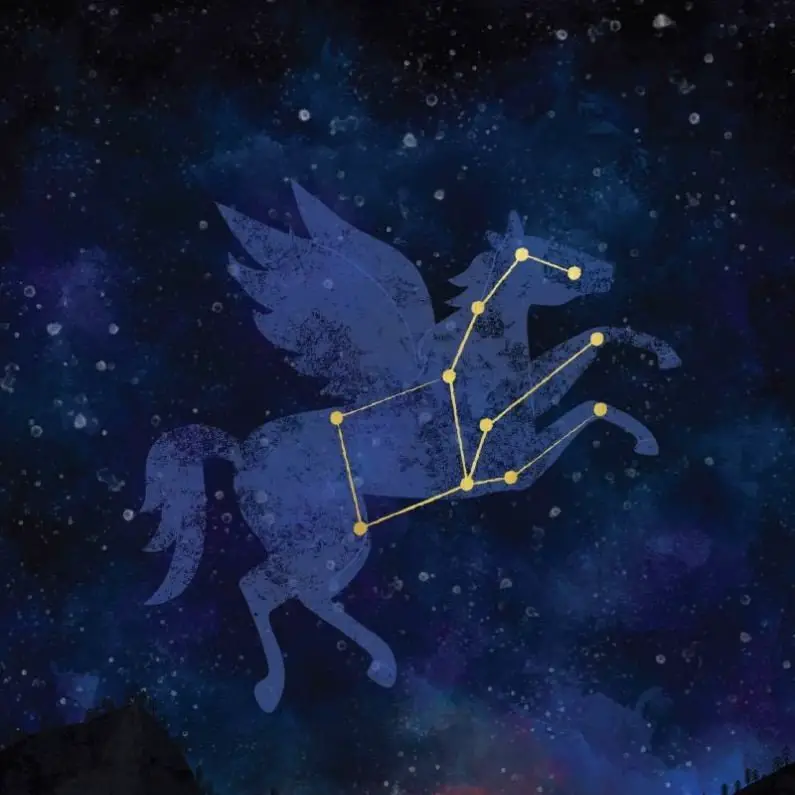
Welcome to another constellation post; this one is one of my favourites. Who doesn't love a winged horse? The constellation is called 'Hippos' (the Horse) in Greek and has some badass mythology attached to it.


Pegasos was originally only one winged horse, born from the neck of Médousa when she was beheaded by the hero Perseus. Poseidon, Tamer of Horses, is his father. Hesiod describes in his 'Theogony' the curious circumstances of his birth:


"...Medusa who suffered a woeful fate: she was mortal, but the two [of her Gorgon sisters] were undying and grew not old. With her lay the Dark-haired One [Poseidon] in a soft meadow amid spring flowers. And when Perseus cut off her head, there sprang forth great Chrysaor and the horse Pegasus who is so called because he was born near the springs [pegae] of Ocean [Okeanos]; and that other, because he held a golden blade [aor] in his hands. Now Pegasus flew away and left the earth, the mother of flocks, and came to the deathless gods: and he dwells in the house of Zeus and brings to wise Zeus the thunder and lightning." [ll 270-294]

Pegasos was tamed by Bellerophon, a Korinthian hero, who rode him into battle against the fire-breathing Khimaira. Pindar, in his beautiful Olympian Odes describes this cooperation wonderfully:

"Bellerophon, who once suffered greatly when beside the spring he wanted to harness Pegasus, the son of the snake-entwined Gorgon; until the maiden Pallas brought to him a bridle with golden cheek-pieces. The dream suddenly became waking reality, and she spoke: “Are you sleeping, king, son of Aeolus? Come, take this charm for the horse; and, sacrificing a white bull, show it to your ancestor, Poseidon the Horse-Tamer.” The goddess of the dark aegis seemed to say such words to him as he slumbered in the darkness, and he leapt straight up to his feet. He seized the marvellous thing that lay beside him, and gladly went to the seer of the land,  and he told the son of Coeranus the whole story: how, at the seer's bidding, he had gone to sleep for the night on the altar of the goddess, and how the daughter herself of Zeus whose spear is the thunderbolt had given him the spirit-subduing gold. The seer told him to obey the dream with all speed; and, when he sacrificed a strong-footed bull to the widely powerful holder of the earth, straightaway to dedicate an altar to Athena, goddess of horses. The power of the gods accomplishes as a light achievement what is contrary to oaths and expectations. And so mighty Bellerophon eagerly stretched the gentle charmed bridle around its jaws and caught the winged horse. Mounted on its back and armored in bronze, at once he began to play with weapons. And with Pegasus, from the chilly bosom of the lonely air,7 he once attacked the Amazons, the female army of archers, [90] and he killed the fire-breathing Chimaera, and the Solymi. I shall pass over his death in silence; but Pegasus has found his shelter in the ancient stables of Zeus in Olympus." [13. 63]

As a constellation, it's arrival in the sky notes the arrival of the warmer weather of spring and seasonal rainstorms, which is also why it got the job and title of thunderbolt-bearer of Zeus. Hyginus in his 'Astronomica' speaks of the events that led up to Pegasos' immortalization in the sky:

"Others say that at the time Bellerophon came to visit Proetus, son of Abas and king of the Argives, Antia, the king’s wife, smitten with love for the guest, begged to visit him, promising him her husband’s kingdom. When she couldn’t obtain this request, out of fear that he would accuse her to the king, she anticipated him by telling Proetus that he had offered violence to her. Proetus, who had been fond of Bellerophon, was reluctant to inflict punishment himself, but knowing that he had the horse Pegasus, sent him to the father of Antia (some call her Sthenoboea), for him to defend his daughter’s chastity and send the youth against the Chimera, which at that time was laying waste with flames the country of the Lycians.

Bellerophon was victor, and escaped, but after the creation of the spring, as he was attempting to fly to heaven, and had almost reached it, he became terrified looking down at the earth, and fell off and was killed. But the horse is said to have flown up and to have been put among the constellations by Jove [Zeus]. Others have said that Bellerophon fled from Argos not because of Antia’s accusations, but so as not to hear any more proposals which were distasteful to him, or to be distressed by her entreaties." [II.18]

Although most would agree that it is Pegasos whom the constellation denotes, there is one other explanation, there because her mythology is usually tied to the constellation Equuleus: the little horse. Her name is Melanippe (Εὐίππη), daughter of the kéntauros Kheiron. She became pregnant and could not let her father know. As such, she begged the Gods to be transformed into a mare. Also from Hyginus's Astronomica:
 
"Euripides in his Melanippe, says that Melanippe, daughter of Chiron the Centaur, was once called Thetis. Brought up on Mount Helicon, a girl especially fond of hunting, she was wooed by Aeolus, son of Hellen, and grandson of Jove, and conceived a child be him. When her time drew near, she fled into the forest, so that her father, who supposed her a virgin, might not see that she had given birth to a grandchild. And so when her father was looking for her, she is said to have begged the power of the gods not to let her father see her in childbirth. After the child was born, by the will of the gods she was changed into a mare which was placed among the stars."

He also gives another reason for her change:

"Some say that she was a prophetess, and because she used to reveal the plans of the gods to men, she was changed into a mare. Callimachus says that because she ceased hunting and worshipping Diana [Artemis], Diana changed her into the shape we have mentioned. For the reason above, too, she is said to be out of sight of the Centaur, who some say is Chiron, and to show only half her body, since she didn’t want her sex to be known."

The constellation is visible at latitudes between +90° and −60°, and best visible at 21:00 (9 p.m.) during the month of October.

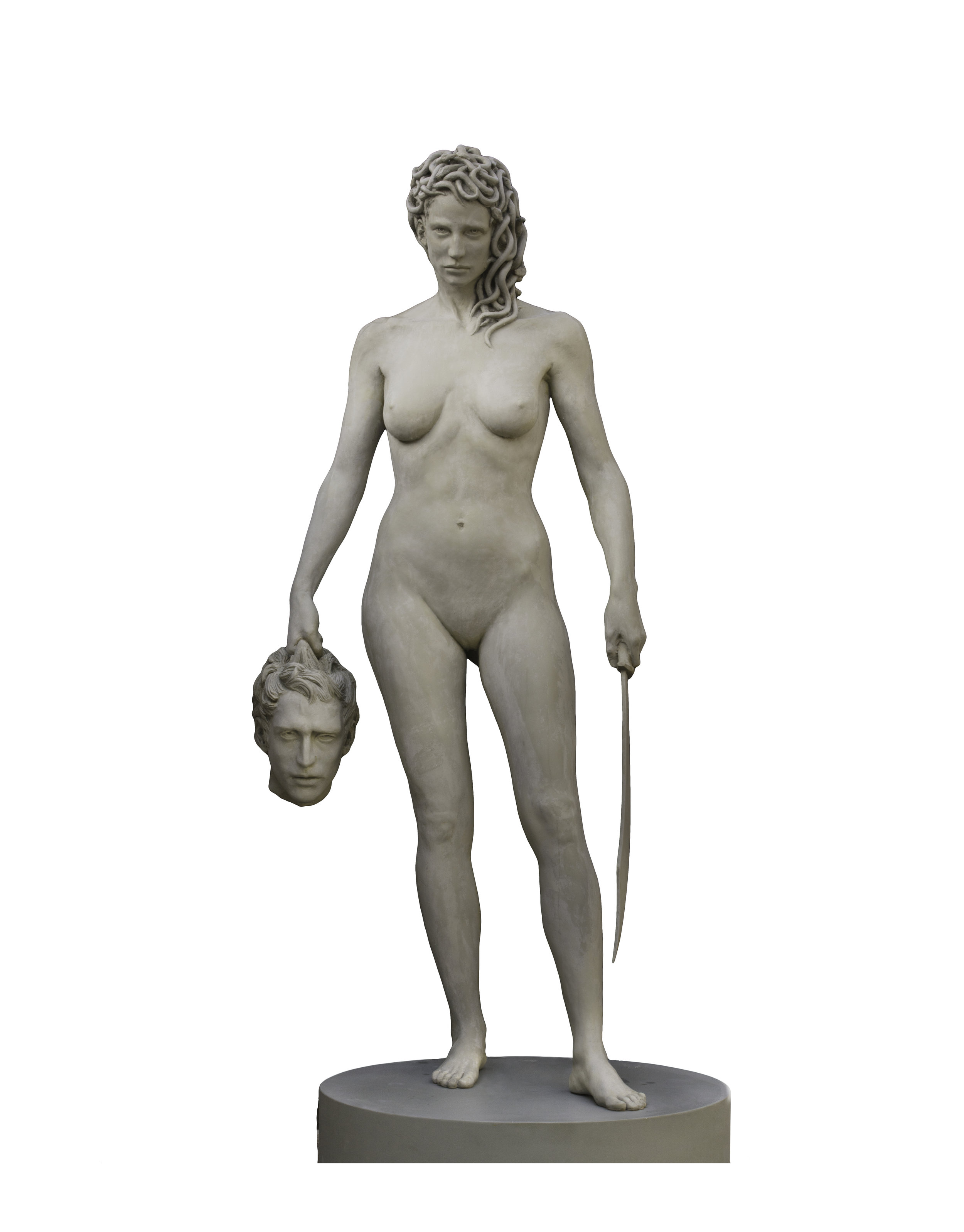
Do you know MWTH, short for Medusa With The Head (of Perseus)? A seven foot bronze version of it will be installed in Collect Pond Park, located on Centre St, Lower Manhattan, as part of NYC Parks’ Art in the Parks program. In 2018, Garbati posted a photograph of his original sculpture to social media. This re-imagined Medusa went viral and became a symbol of resistance worldwide, inspiring thousands of women to reach out and share their own stories. Garbati’s Medusa questions the mythic figure’s characterization as a monster, and investigates the woman behind the myth.


From the site:

"MWTH (Medusa With The Head) is a project entangled in the narrative habits of classical imaginaries, their foundational role in present culture and visions of the future. MWTH seeks to reorient androcentric lore, to queer iconography, to re-reformulate antiquity’s heroic center and its modes of (re)production. 

Through stories that are told and retold over centuries, our iconography shapes our ideology.
MWTH is an artist run project. We are working in collaboration with artist Luciano Garbati, to share his sculpture, Medusa With The Head of Perseus, with the world.

MWTH Project was (immaculately) conceived by Bek Andersen in the immediate wake of the Kavanaugh hearings. The day Kavanaugh was confirmed to the highest court of the land, we were feeling pretty low. Bek came across the viral image of Medusa with the Head of Perseus by Luciano Garbati, an inversion of Cellini’s Perseus With the Head of Medusa. She was inspired to contact the artist in Argentina and bring the sculpture to New York. "

For the record, I love the sentiment, and I love the statue. I just don't like the appropriation.

The legend of Médousa (Μέδουσα) is one of the hardest myths to deal with out of ancient Hellenic mythology. It tells the story of a beautiful woman, who got raped by Poseidon, and gets transformed into a hideous monster who can turn people to stone just by looking at them, by Athena, because of it. She spends the rest of her life trapped on an island, in isolation, while brave warriors try to kill her for her head, which will still turn people to stone once cut off. Perseus eventually does so and gives the head to Athena to place on her shield. The circle is complete and Médousa is dead, after a lifetime of horror which was not her fault to begin with. It's one of the best known Hellenic myths, and the movies, series, books, comics and other mediums which feature it--or Médousa--are endless. Percy Jackson comes to mind, and Clash of the Titans, but there are many others. What's less well known is that this particular myth doesn't date back to ancient Hellas, but ancient Rome: it was written by the Roman poet Ovid, in 8 B.C., in his Metamorphosis.

Yet, Médousa was a well known figure in ancient Hellas, so well known that the images of her cut off head adorned everything from armors to stoves. Her name meant 'guardian', and her head frightened off enemies as well as little children who would otherwise have burned their hands. The blood from the veins on the left side of Médousa's head was allegedly capable of killing, but Asclepius, a great healer, used the blood from the veins on the right side of the head for saving lives.

In ancient Hellenic mythology, Médousa was one of three sisters, Khthonic daímōns called Gorgons. They were named Médousa, Stheno (Σθεννω), and Euryale (Ευρυαλη), and were born to the ancient marine deities Phorkys (Φόρκυς) and Keto (Κητώ), his sister. They were part of the Phorcides (Φόρκιδες), the offspring of Phorkys. Their sisters were Echidna (Ἔχιδνα, half woman, half snake), the Graiai (Γραῖαι, 'old women', sharing one tooth and one eye), and Ladon (Λάδων, the dragon serpent who guarded the golden apples in the garden of the Hesperides). This view comes from Hesiod:

"And to Phorkys, Keto bore the Graiai, with fair faces and gray from birth, and these the gods who are immortal and men who walk on the earth call Graiai, the gray sisters, Pemphredo robed in beauty and Enyo robed in saffron, and the Gorgones who, beyond the famous stream of Okeanos, live in the utmost place toward night, by the singing Hesperides: they are Sthenno, Euryale, and Medousa, whose fate is a sad one, for she was mortal, but the other two immortal and ageless both alike. Poseidon, he of the dark hair, lay with one of these, in a soft meadow and among spring flowers. But when Perseus had cut off the head of Medousa there sprang from her blood great Khrysaor and the horse Pegasos so named from the springs (pegai) of Okeanos, where she was born."

According to Apollodorus, Médousa and her sisters came into the world with snakes on their heads, instead of hair, with yellow wings and brazen hands. Their bodies were also covered with impenetrable scales, and their very looks had the power of killing or turning to stones. Médousa was the only mortal of the three, and in nearly all versions of the myth, has her head cut off by Perseus, who gifts it to Athena. The big difference? In the Hellenic version of the myth, Médousa was never a beautiful maiden who served as a priestess to Athena and was punished for being raped.

There is a third version of the myth, inspired, it seems, by Hesiod, in which Médousa was a very beautiful maiden who lived far to the north where the sun did not reach. She begged Athena to allow her to leave and see the sun, but Athena refused. Médousa got angry and shouted at Athena that she was only disallowing her request because she was jealous at her beauty. Athena, angered, turned her into the monster she is so famous as today. There is a variation of this myth where Médousa tells the sculpture of a statue of Athena that he would have done better making a sculpture of her, because she was far more beautiful. The result is the same; Athena takes her beauty and forces her into isolation as punishment for her hubris (and was thus a valuable lesson/example for humans to remember their place. Same goes for Ariadne and Niobe, for example). Apollodorus, interestingly enough, also confirms this:

"It is affirmed by some that Medousa was beheaded because of Athene, for they say the Gorgon had been willing to be compared with Athene in beauty."

Archaeologists suspect that Athena, Médousa and Poseidon found their origins in Libya. They came to Hellas through Crete at the dawn of Hellas. In the beginning of Her rein, Athena may have been a snake and fertility Goddess--a trait she shared with her Libyan counterpart, who had Her own cult--and may have either had a priestess who fit the Médousa myth or--and this is more likely--Médousa had her own cult as a snake, fertility and (menstrual) blood Goddess. Especially the latter may be linked to the myths concerning Médousa's blood.

Athena's role as a snake and fertility Goddess is still visible in the myth about the child she had with Hēphaistos; Erichthonios (Ἐριχθόνιος), who was half man, half snake. It's even posed that in the early days, Athena was married to Hēphaistos and had His child willingly. As Athena was stripped of Her roles as a fertility and snake Goddess, Médousa's myth came into being, where Athena distances Herself from sex and snakes, by punishing an epithet of herself (Athena Tritogeneia, perhaps: 'born of Trito', a lake which was supposedly located in Libya), or the Libyan snake Goddess Médousa, who may have still been attached to Her worship. By placing Médousa's head on Her breastplate or shield, Athena's mythology is continuously linked to Her Libyan heritage, but harmlessly so, to Her new image of a virginal warrior.

Few references remain to Médousa's Libyan cult. There's vague reference to Médousa being a patron of Libya as a whole, or that she was the Goddess most worshipped by the Amazons. She was linked to protection, snakes, menstrual blood, blood, fertility, and femininity in general. If this is true, it's understandable why her worship did not match the Hellenic religion: for one, she's most likely a very powerful female deity. This did not match the hierarchy of the ancient Hellens, and so, Médousa became a monster, and was dealt with accordingly. Blood was one of the fluids that caused serious miasma, and menstrual fluid wasn't even spoken of in ancient Hellas, let alone revered. Not a single Goddess would have it in their portfolio.

I don't like Ovid's version of the Médousa myth. In my view, it's an embellished version of the myth which overshoots its purpose. It also puts both Poseidon and Athena in a very bad light, and takes a lot away from Médousa. It also introduces an element to the story that has nothing to do with Hellenic mythology and that makes no sense within the context of ancient Hellenic society.

The Roman empire came up about a thousand years after the rise of the Hellenes. the Hellenes valued physical prowess, but it were poets and scholars who were held in the highest regards. For Rome, it were the warriors who received the most attention. This reflected in the Gods of both people as well: the Roman Gods resemble the Hellenic Gods, but they are stricter, harder, and possess more bloodlust. At the same time, they were also pruder when it came to excesses of any kind. Ares, temperamental God of War, has his Roman counterpart in Mars, yet, Mars is a much stabler God, who is also in charge of agriculture and fertility. Baccus, the Roman equivalent of Dionysos, lost all ecstatic rites that made the worship of Dionysos so famous. Romans tried becoming Gods their whole lives, while the Hellens accepted their lot as mortals, and respected the Theoi as all-powerful and all-ruling. A frame of mind like that shows in Gods that get neatly packaged, made non-threatening and can be rivaled by mortals. Yet, because of the warrior mentality of the Romans, the Gods that became more predictable and less formed, also became harder. They punished socially unacceptable behavior more severely and myths from the Hellenic period got retold from the viewpoint of a warrior's society. Médousa's myth is one of the most classical examples of this shift.

Medusa With The Head of Perseus will be installed directly across from the New York County Criminal Court, the location of high profile abuse cases including the recent Harvey Weinstein trial. Garbati’s Medusa stands facing the courthouse, as an icon of justice and the power of narrative.

The statue cast in Bronze by Vanessa Solomon of Carbon Sculpt Studios in Red Hook, Brooklyn, New York and Laran Bronze Foundry in Philadelphia. 

Medusa With The Head of Perseus will be on view from October 13, 2020 - April 30, 2021.
One of the classic stories in Hellenic mythology is the beheading of the Gorgon Medusa by Perseus. This intricate story in which Perseus finds his way, with the help of the Gods, to the lair of the gorgon sisters and decapitates the most evil of the three – Medusa. This is one story, anyway. You can read a lot more about that here. According to tradition, the myth appears to have been set within the confines of the Strait of Gibraltar and adjacent regions of North Africa.


Today, scientists have revealed at the 2019 Calpe Conference, the discovery of fragments of a Gorgoneion, a ceramic representation of the Gorgon Medusa, from Gorham’s Cave in Gibraltar. The location of the finds, in the deepest part of the cave, appears to give support to the myth and its location.

The discovery is a major breakthrough in the link between classical mythology and archaeology. It indicates that, in the eyes of ancient mariners of the 8th and 7th Centuries BCE, Gorham’s Cave, situated at the base of one of the Pillars of Herakles, was the home of the Gorgon Medusa.
The ancient Hellenes were not fearful of snakes. They might have been cautious of poisonous ones, but in general, happening across a snake was a good omen. Unlike in Jewish and Christian mythology, where the Devil working though a snake got Eve to eat the apple, Hellenic mythology usually reserves a very positive place for snakes. Today, I'm giving some examples of the positive images surrounding serpents and snakes, although there are, surely, also negative ones to take into account.
Asklēpiós was, and is, a much beloved Theos. He started out being honored as a hero--the son of Apollon and Koronis--but became a God in His own right because of his healing skill. Worship places of Asklēpiós were called 'asklepieia' (Ἀσκληπίεια). An asklepieion (Ἀσκληπιεῖον) served as a temple, a hospital, and as a training-institute of the healing arts. In ancient Hellas, the sick would come to an asklepieion and offer a sacrifice to Asklēpiós--amongst the recorded sacrifices are black goats or sheep, gold, silver, or marble sculptures of the body part that required healing, and coins--in hopes of healing. They would then settle into the abaton (άβατον) or enkoimeterion (εγκοιμητήριοn), a restricted sleeping hall, which was occupied by the sick alone, or sometimes by a group of them, as well as a good few snakes, which are considered sacred animals of Asklēpiós.

In mythology, after His training is complete, Asklēpiós receives the blood of Médousa from Athena. Drawn from two different blood vessels in Médousa's neck, some of it can kill, and some of it can heal even the dead. Asklēpiós uses the blood to resurrect the dead, but this is against the wishes of Zeus, who kills Him. He is either placed amongst the stars as the constellation Ophiuchus, the Serpent Holder, or revived by Zeus as a God to satisfy a furious Apollon.

The Drakones were named after the Greek 'drakein' and 'derkomai, meaning 'to see clearly' or 'gaze sharply'. These were guardians, usually of wells and springs, groves, Gods, or treasure. As guardians, they were usually equipped with sharp fangs, deadly poison and/or multiple heads. In essence, they were however seen as giant snakes which--and this is wholly a personal observation--makes sense when most protective and purifying Theoi were depicted as snakes.

All sources but the ones where Agathós Daímōn is identified as Theos, represent the Agathós Daímōn as a snake; this applies to both artwork as assumed physical appearance. The Agathós Daímōn was always a positive in one's life, and was generally seen as the source of personal or familial good fortune. Libations of (unmixed) wine were given to Him with each newly opened case of wine, and during feasts and symposium, Agathós Daímōn received the first libation. When crossing a snake on the road, it was also customary to pour out a libation, just in case it was a herald of Agathós Daímōn, or Agathós Daímōn Himself.

It should be said that Harrison believes Zeus Meilichios is an epithet of Zeus superimposed over an existing snake God: Meilichios, a 'home-grown, autochtonous [deity, from] before the formulation of Zeus'. Even more telling: the cult of Meilichios was very pronounced in Boeotia, where He was worshipped as a provider of wealth (Harrison, p. 21). I pose that, at the same time Zeus became equated with Meilichios, so did the Agathós Daímōn; a daímōn of good fortune (most likely through fertility and good harvest, the two greatest blessings from the Theoi), superimposed over the snake God Meilichios, exchanging positive qualities while assuming immortality for Himself. Zeus Meilichios adopted Meilichios' cleansing and purifying qualities.

In some cult worship, Agathós Daímōn was a male deity, who was married to the Theia (daímōn?) Agathe Tyche. Their worship was known in Athens, and They had a temple at Lebadeia, in Boeotia, where one could visit the oracle of Trophonios--but only after spending a fixed number of days in a building, which was sacred to the 'Agathei Theoi'--which probably refers to Agathe Tyche and Agathós Daímōn together--and most likely housed one or several snake(s). It was this building the suplicant was brought back to when he returned from the oracle--usually passed out from the experience--in order to recover.

Archaeologists suspect that Athena, Médousa and Poseidon found their origins in Libya. They came to Hellas through Crete at the dawn of Hellas. In the beginning of Her rein, Athena may have been a snake and fertility Goddess--a trait she shared with her Libyan counterpart, who had Her own cult--and may have either had a priestess who fit the Médousa myth or--and this is more likely--Médousa had her own cult as a snake, fertility and (menstrual) blood Goddess. Especially the latter may be linked to the myths concerning Médousa's blood.

Athena's role as a snake and fertility Goddess is still visible in the myth about the child she had with Hēphaistos;  Erichthonios (Ἐριχθόνιος), who was half man, half snake. It's even posed that in the early days, Athena was married to Hēphaistos and had His child willingly. As Athena was stripped of Her roles as a fertility and snake Goddess, Médousa's myth came into being, where Athena distances Herself from sex and snakes, by punishing an epithet of herself (Athena Tritogeneia, perhaps: 'born of Trito', a lake which was supposedly located in Libya), or the Libyan snake Goddess Médousa, who may have still been attached to Her worship. By placing Médousa's head on Her breastplate or shield, Athena's mythology is continuously linked to Her Libyan heritage, but harmlessly so, to Her new image of a virginal warrior.

Few references remain to Médousa's Libyan cult. There's vague reference to Médousa being a patron of Libya as a whole, or that she was the Goddess most worshipped by the Amazons. She was linked to protection, snakes, menstrual blood, blood, fertility, and femininity in general. If this is true, it's understandable why her worship did not match the Hellenic religion: for one, she's most likely a very powerful female deity. This did not match the hierarchy of the ancient Hellens, and so, Médousa became a monster, and was dealt with accordingly. Blood was one of the fluids that caused serious miasma, and menstrual fluid wasn't even spoken of in ancient Hellas, let alone revered. Not a single Goddess would have it in their portfolio.
Of course, this is not a complete list, but it is a starting point, and one I might build further on. Now our snake season is about to start again (and my girlfriend is fearfully eying the pond in our garden) I figured it would be good to have a reminder of the important mythology and customs surrounding snakes.
So, there is this art project. It might be too feminist for you. If so, all good. I'm on the edge because of the appropriation of the myth, but I stand by the sentiment. This project is MWTH, short for Medusa With The Head.


From the site:

"MWTH (Medusa With The Head) is a project entangled in the narrative habits of classical imaginaries, their foundational role in present culture and visions of the future. MWTH seeks to reorient androcentric lore, to queer iconography, to re-reformulate antiquity’s heroic center and its modes of (re)production. 

Through stories that are told and retold over centuries, our iconography shapes our ideology.
MWTH is an artist run project. We are working in collaboration with artist Luciano Garbati, to share his sculpture, Medusa With The Head of Perseus, with the world.

MWTH Project was (immaculately) conceived by Bek Andersen in the immediate wake of the Kavanaugh hearings. The day Kavanaugh was confirmed to the highest court of the land, we were feeling pretty low. Bek came across the viral image of Medusa with the Head of Perseus by Luciano Garbati, an inversion of Cellini’s Perseus With the Head of Medusa. She was inspired to contact the artist in Argentina and bring the sculpture to New York. "

For the record, I love the sentiment, and I love the statue. If I had a spare $750, I'd buy one. I might get the shirt. I just don't like the appropriation.

The legend of Médousa (Μέδουσα) is one of the hardest myths to deal with out of ancient Hellenic mythology. It tells the story of a beautiful woman, who got raped by Poseidon, and gets transformed into a hideous monster who can turn people to stone just by looking at them, by Athena, because of it. She spends the rest of her life trapped on an island, in isolation, while brave warriors try to kill her for her head, which will still turn people to stone once cut off. Perseus eventually does so and gives the head to Athena to place on her shield. The circle is complete and Médousa is dead, after a lifetime of horror which was not her fault to begin with. It's one of the best known Hellenic myths, and the movies, series, books, comics and other mediums which feature it--or Médousa--are endless. Percy Jackson comes to mind, and Clash of the Titans, but there are many others. What's less well known is that this particular myth doesn't date back to ancient Hellas, but ancient Rome: it was written by the Roman poet Ovid, in 8 B.C., in his Metamorphosis.

Yet, Médousa was a well known figure in ancient Hellas, so well known that the images of her cut off head adorned everything from armors to stoves. Her name meant 'guardian', and her head frightened off enemies as well as little children who would otherwise have burned their hands. The blood from the veins on the left side of Médousa's head was allegedly capable of killing, but Asclepius, a great healer, used the blood from the veins on the right side of the head for saving lives.

In ancient Hellenic mythology, Médousa was one of three sisters, Khthonic daímōns called Gorgons. They were named Médousa, Stheno (Σθεννω), and Euryale (Ευρυαλη), and were born to the ancient marine deities Phorkys (Φόρκυς) and Keto (Κητώ), his sister. They were part of the Phorcides (Φόρκιδες), the offspring of Phorkys. Their sisters were Echidna (Ἔχιδνα, half woman, half snake), the Graiai (Γραῖαι, 'old women', sharing one tooth and one eye), and Ladon (Λάδων, the dragon serpent who guarded the golden apples in the garden of the Hesperides). This view comes from Hesiod:

"And to Phorkys, Keto bore the Graiai, with fair faces and gray from birth, and these the gods who are immortal and men who walk on the earth call Graiai, the gray sisters, Pemphredo robed in beauty and Enyo robed in saffron, and the Gorgones who, beyond the famous stream of Okeanos, live in the utmost place toward night, by the singing Hesperides: they are Sthenno, Euryale, and Medousa, whose fate is a sad one, for she was mortal, but the other two immortal and ageless both alike. Poseidon, he of the dark hair, lay with one of these, in a soft meadow and among spring flowers. But when Perseus had cut off the head of Medousa there sprang from her blood great Khrysaor and the horse Pegasos so named from the springs (pegai) of Okeanos, where she was born."

According to Apollodorus, Médousa and her sisters came into the world with snakes on their heads, instead of hair, with yellow wings and brazen hands. Their bodies were also covered with impenetrable scales, and their very looks had the power of killing or turning to stones. Médousa was the only mortal of the three, and in nearly all versions of the myth, has her head cut off by Perseus, who gifts it to Athena. The big difference? In the Hellenic version of the myth, Médousa was never a beautiful maiden who served as a priestess to Athena and was punished for being raped.

There is a third version of the myth, inspired, it seems, by Hesiod, in which Médousa was a very beautiful maiden who lived far to the north where the sun did not reach. She begged Athena to allow her to leave and see the sun, but Athena refused. Médousa got angry and shouted at Athena that she was only disallowing her request because she was jealous at her beauty. Athena, angered, turned her into the monster she is so famous as today. There is a variation of this myth where Médousa tells the sculpture of a statue of Athena that he would have done better making a sculpture of her, because she was far more beautiful. The result is the same; Athena takes her beauty and forces her into isolation as punishment for her hubris (and was thus a valuable lesson/example for humans to remember their place. Same goes for Ariadne and Niobe, for example). Apollodorus, interestingly enough, also confirms this:

"It is affirmed by some that Medousa was beheaded because of Athene, for they say the Gorgon had been willing to be compared with Athene in beauty."

Archaeologists suspect that Athena, Médousa and Poseidon found their origins in Libya. They came to Hellas through Crete at the dawn of Hellas. In the beginning of Her rein, Athena may have been a snake and fertility Goddess--a trait she shared with her Libyan counterpart, who had Her own cult--and may have either had a priestess who fit the Médousa myth or--and this is more likely--Médousa had her own cult as a snake, fertility and (menstrual) blood Goddess. Especially the latter may be linked to the myths concerning Médousa's blood.

Athena's role as a snake and fertility Goddess is still visible in the myth about the child she had with Hēphaistos; Erichthonios (Ἐριχθόνιος), who was half man, half snake. It's even posed that in the early days, Athena was married to Hēphaistos and had His child willingly. As Athena was stripped of Her roles as a fertility and snake Goddess, Médousa's myth came into being, where Athena distances Herself from sex and snakes, by punishing an epithet of herself (Athena Tritogeneia, perhaps: 'born of Trito', a lake which was supposedly located in Libya), or the Libyan snake Goddess Médousa, who may have still been attached to Her worship. By placing Médousa's head on Her breastplate or shield, Athena's mythology is continuously linked to Her Libyan heritage, but harmlessly so, to Her new image of a virginal warrior.

Few references remain to Médousa's Libyan cult. There's vague reference to Médousa being a patron of Libya as a whole, or that she was the Goddess most worshipped by the Amazons. She was linked to protection, snakes, menstrual blood, blood, fertility, and femininity in general. If this is true, it's understandable why her worship did not match the Hellenic religion: for one, she's most likely a very powerful female deity. This did not match the hierarchy of the ancient Hellens, and so, Médousa became a monster, and was dealt with accordingly. Blood was one of the fluids that caused serious miasma, and menstrual fluid wasn't even spoken of in ancient Hellas, let alone revered. Not a single Goddess would have it in their portfolio.

I don't like Ovid's version of the Médousa myth. In my view, it's an embellished version of the myth which overshoots its purpose. It also puts both Poseidon and Athena in a very bad light, and takes a lot away from Médousa. It also introduces an element to the story that has nothing to do with Hellenic mythology and that makes no sense within the context of ancient Hellenic society.

The Roman empire came up about a thousand years after the rise of the Hellenes. the Hellenes valued physical prowess, but it were poets and scholars who were held in the highest regards. For Rome, it were the warriors who received the most attention. This reflected in the Gods of both people as well: the Roman Gods resemble the Hellenic Gods, but they are stricter, harder, and possess more bloodlust. At the same time, they were also pruder when it came to excesses of any kind. Ares, temperamental God of War, has his Roman counterpart in Mars, yet, Mars is a much stabler God, who is also in charge of agriculture and fertility. Baccus, the Roman equivalent of Dionysos, lost all ecstatic rites that made the worship of Dionysos so famous. Romans tried becoming Gods their whole lives, while the Hellens accepted their lot as mortals, and respected the Theoi as all-powerful and all-ruling. A frame of mind like that shows in Gods that get neatly packaged, made non-threatening and can be rivaled by mortals. Yet, because of the warrior mentality of the Romans, the Gods that became more predictable and less formed, also became harder. They punished socially unacceptable behavior more severely and myths from the Hellenic period got retold from the viewpoint of a warrior's society. Médousa's myth is one of the most classical examples of this shift.

I think I've lost most of my trail of thought at this point, but let me end by saying that I don't condone rape, and while we can frown upon the Roman empire for the more brutal depiction of violence against women, it really serves no purpose to get retroactively angry over something that happened nearly 2000 years ago. So many years later, our attitudes have changed. Women's rights have come a long way, and with them, the criminalization and social rejection of rape. The current resurgence of male-driven legislation can trigger anger at the ancient sources, but it's important to note that those stories came to fruition in a society where this practice was accepted, and were told in myths that were cautionary. Rape is not accepted in modern society, and anger should be directed that way, not towards the ancient stories that (except for one Roman example) didn't even include rape.
Ancient Hellenic mythology is full of creatures, and many of them are part human, part animal. A short overview of the most prominent today. We don't know, exactly, why hybrid creatures are so often depicted in (Hellenic) mythology, by the way. Some say it's just entertainment, others that it's a way to relate with our more "animalistic" side. The ancient Hellenes were very aware of the fact that societal rules were all that distinguished humans from animals, which might explain why these hybrids were considered so terrifying!


The Centaur
Centaurs are depicted as half man, half horse; having the torso of a man extending where the neck of a horse should be. They were said to be wild, savage, and lustful, and in very old Hellenic artwork, they were often depicted as fully human, with a horse's end added to them. Somehow (prior to Harry Potter, anyway), Centaurs ended up being regarded as cute and cuddly, but most Centaurs in the ancient myths were very scary, and very dangerous.

The Chimera The Chimera is described as a composite creature, with the body and maned head of a lion, a goat's head rising from its back, a set of goat-udders, and a serpentine tail. There was only one, and it was slain by Bellerophon, but that does not have to mea anything in dreams.

Echidna
In Hellenic mythology, Echidna was a half-woman and half-snake who lived alone in a cave. She was the mate of the fearsome monster Typhon, and known primarily for being the mother of monsters, including many of the most famous monsters of Hellenic myth.

Harpy
The Harpyiai (Ἁρπθιαι) were the spirits of sudden, sharp gusts of wind. They were known as the hounds of Zeus and were despatched by the god to snatch away (harpazô) people and things from the earth. Sudden, mysterious dissappearances were often attributed to the Harpyiai. They are (most often) consdered the daughters of Thaumas and Elektra. They are depicted as birds with the head of a woman.

The Gorgons
The most famous of Gorgons is undoubtedly Médousa (Μέδουσα). In ancient Hellas, however, Médousa was one of three sisters, Khthonic daímōns called Gorgons. They were named Médousa, Stheno (Σθεννω), and Euryale (Ευρυαλη), and were born to the ancient marine deities Phorkys (Φόρκυς) and Keto (Κητώ), his sister. They were part of the Phorcides (Φόρκιδες), the offspring of Phorkys. Their sisters were Echidna (Ἔχιδνα, half woman, half snake), the Graiai (Γραῖαι, 'old women', sharing one tooth and one eye), and Ladon (Λάδων, the dragon serpent who guarded the golden apples in the garden of the Hesperides).

The Hippalectryon The Hippalectryon was a beast with the foreparts of a horse and the tail, wings and hind-legs of a rooster.The creature occurs only in early Athenian vase painting, and may be based on an early artistic rendering of the winged horse Pegasos. It is awesome, however, and you cannot tell me that a creature that looked like that would not scare you half to death if it came upon you.

Manticores
Mantikhoras (Μαντιχορας) were Persian monsters with the body of a lion, the face of a man, and a spike-tipped arrow-shooting tail. The name 'Manticore' may have been derived from a Persian word meaning 'man-eater', and that did seem to be a favored past time of the creature.

Minotaur
Minos, king of Krete, requested Poseidon raise a bull from the sea, which the king promised to sacrifice; but when Minos refused to do so, Poseidon caused his wife Pasiphaê to fall in love with the bull. The child that came from this union was deformed in such a way that he had the head of a bull and the body of a man. It was locked in the labyrinth beneath the the palace, and eventually vanquished by Theseus.

Ophiotaurus, or Tauros OphisThis serpent-bull is a terrifying monster that deserves mention on the list. It was born with the foreparts of a black bull and the tail of a serpent and was slain by an ally of the Titanes in their search for a victory against Zeus during the Titanomachy.

Satyrs
Satyrs weren't considered evil, but they were definitely dangerous and wild. The satyrs were considered constant companions of Dionysos and had goat-like features and often permanent erections.

Siren
The Sirens are dangerous creatures who lured nearby sailors with their enchanting music and voices to shipwreck on the rocky coast of their island. Sirens were believed to combine women and birds in various ways. In early Greek art, Sirens were represented as birds with large women's heads, bird feathers and scaly feet. Later, they were represented as female figures with the legs of birds, with or without wings, playing a variety of musical instruments, especially harps.

Sphinx
A sphinx is a mythical creature with the head of a human, the haunches of a lion, and sometimes the wings of a bird. It is mythicised as treacherous and merciless. Those who cannot answer its riddle are killed and eaten. This deadly version of a sphinx appears in the myth and drama of Oedipus, for example.
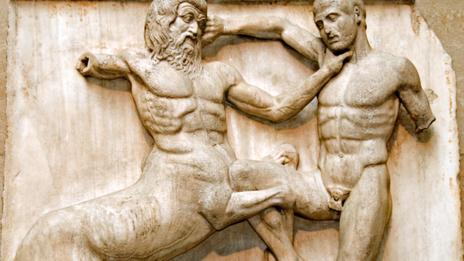
The BBC recently published an article entitled 'The fantastical beasts of ancient Greece', which is a wonderful read about ancient Hellenic art and the mythological monsters depicted in it, including Centaurs and Médousa. They also make a very good attempt in explaining the ancient Hellenic viewpoint on these monsters.

(Peter Horree / Alamy)    
The Metopes of the Parthenon depicts battle between Centaurs and men (Peter Horree / Alamy)

According to Peter Stewart, director of the Classical Art Research Centre at the University of Oxford:

"I don’t believe that Greeks really expected to meet a centaur or sphinx, or even a satyr, out in the countryside, and maybe they were always regarded as the stuff of legend. But a recurring trait of Greek art is that monstrous creatures seem to be held up as a foil to the Greeks’ concept of civilization – a sort of distorting mirror in which the Greeks could look at themselves. The Greeks seem to have found these monstrous or semi-human creatures useful to explore and express their world-view, their ideas about humanity and civilization, the mortal and divine. Fantastical beings were part of the furniture of the Greek mind."

Read more over at the BBC.
Okay, guys, I am in for a world of hurt with far too many deadlines coming up, so today, I am taking the day off so I can work for a while longer and hopefully get things done. I quote from Pindar and hope his words will inspire you as his words do me.

Pindar (Pindaros, Πίνδαρος) was alive from around 522 BC to 443 BC and was an Ancient Hellenic lyric poet from Thebes. Of the canonical nine lyric poets of ancient Hellas, his work is the best preserved. He was a very reverent poet, and because of that, I greatly enjoy his work. He was alive in a time of religious reforms, but he clung to the old ways and views--the ways and views I adhere to myself. Pindar wrote many odes to winners of sporting events and battles, and often he included the Gods in his praise. One of these odes today: as a little pick-me-up for myself and anyone who might need it.

The following ode is dedicated to Midas of Akras, who was the winner in the Pythian flute-playing match 494 or 450. It was to be sung, it would seem, at Akragas, and very probably in a procession to the shrine of the tutelar divinity of the city, who seems to be addressed at the start.


I pray thee, lover of splendour, most beautiful among the cities of
men, haunt of Persephone, thou who by the banks of Akragas' stream
that nourisheth thy flocks, inhabitest a citadel builded pleasantly--
O queen, graciously and with goodwill of gods and men welcome this crown
that is come forth from Pytho for Midas' fair renown; and him too
welcome therewithal who hath overcome all Hellas in the art which once
on a time Pallas Athene devised, when she made music of the fierce
Gorgon's death-lament.
That heard she pouring from the maiden heads and heads of serpents
unapproachable amidst the anguish of their pains, when Perseus had
stricken the third sister, and to the isle Seriphos and its folk bare
thence their doom.
Yea also he struck with blindness the wondrous brood of Phorkos,
and to Polydektes' bridal brought a grievous gift, and grievous
eternally he made for that man his mother's slavery and ravished bed:
for this he won the fair-faced Medusa's head, he who was the son of
Danaë, and sprung, they say, from a living stream of gold.
But the Maiden, when that she had delivered her well-beloved from
these toils, contrived the manifold music of the flute, that with such
instrument she might repeat the shrill lament that reached her from
Euryale's ravening jaws.
A goddess was the deviser thereof, but having created it for
a possession of mortal men, she named that air she played the
many-headed air, that speaketh gloriously of folk-stirring games,
as it issueth through the thin-beat bronze and the reeds which grow by
the Graces' city of goodly dancing-ground in the precinct of Kephisos'
nymph, the dancers' faithful witnesses.
But if there be any bliss among mortal men, without labour it is not
made manifest: it may be that God will accomplish it even to-day, yet
the thing ordained is not avoidable: yea, there shall be a time that
shall lay hold on a man unaware, and shall give him one thing beyond
his hope, but another it shall bestow not yet.
My girlfriend is very fearful of snakes. They're completely alien to her, and when a common European adder decided to investigate our rural vacation home a few years ago, I was very glad I watch too watch Discovery Channel; I was suddenly in the questionably envious position to wrangle a snake who is not exactly deadly, but definitely poisonous.

The actual adder, and my actual hand

The ancient Hellenes were not fearful of snakes. They might have been cautious of poisonous ones, but in general, happening across a snake was a good omen. Unlike in Jewish and Christian mythology, where the Devil working though a snake got Eve to eat the apple, Hellenic mythology usually reserves a very positive place for snakes. Today, I'm giving some examples of the positive images surrounding serpents and snakes, although there are, surely, also negative ones to take into account.
  • Asklēpiós was, and is, a much beloved Theos. He started out being honored as a hero--the son of Apollon and Koronis--but became a God in His own right because of his healing skill. Worship places of Asklēpiós were called 'asklepieia' (Ἀσκληπίεια). An asklepieion (Ἀσκληπιεῖον) served as a temple, a hospital, and as a training-institute of the healing arts. In ancient Hellas, the sick would come to an asklepieion and offer a sacrifice to Asklēpiós--amongst the recorded sacrifices are black goats or sheep, gold, silver, or marble sculptures of the body part that required healing, and coins--in hopes of healing. They would then settle into the abaton (άβατον) or enkoimeterion (εγκοιμητήριοn), a restricted sleeping hall, which was occupied by the sick alone, or sometimes by a group of them, as well as a good few snakes, which are considered sacred animals of Asklēpiós.
  • In mythology, after His training is complete, Asklēpiós receives the blood of Médousa from Athena. Drawn from two different blood vessels in Médousa's neck, some of it can kill, and some of it can heal even the dead. Asklēpiós uses the blood to resurrect the dead, but this is against the wishes of Zeus, who kills Him. He is either placed amongst the stars as the constellation Ophiuchus, the Serpent Holder, or revived by Zeus as a God to satisfy a furious Apollon.
  • The Drakones were named after the Greek 'drakein' and 'derkomai, meaning 'to see clearly' or 'gaze sharply'. These were guardians, usually of wells and springs, groves, Gods, or treasure. As guardians, they were usually equipped with sharp fangs, deadly poison and/or multiple heads. In essence, they were however seen as giant snakes which--and this is wholly a personal observation--makes sense when most protective and purifying Theoi were depicted as snakes.
  • All sources but the ones where Agathós Daímōn is identified as Theos, represent the Agathós Daímōn as a snake; this applies to both artwork as assumed physical appearance. The Agathós Daímōn was always a positive in one's life, and was generally seen as the source of personal or familial good fortune. Libations of (unmixed) wine were given to Him with each newly opened case of wine, and during feasts and symposium, Agathós Daímōn received the first libation. When crossing a snake on the road, it was also customary to pour out a libation, just in case it was a herald of Agathós Daímōn, or Agathós Daímōn Himself.
  • It should be said that Harrison believes Zeus Meilichios is an epithet of Zeus superimposed over an existing snake God: Meilichios, a 'home-grown, autochtonous [deity, from] before the formulation of Zeus'. Even more telling: the cult of Meilichios was very pronounced in Boeotia, where He was worshipped as a provider of wealth (Harrison, p. 21). I pose that, at the same time Zeus became equated with Meilichios, so did the Agathós Daímōn; a daímōn of good fortune (most likely through fertility and good harvest, the two greatest blessings from the Theoi), superimposed over the snake God Meilichios, exchanging positive qualities while assuming immortality for Himself. Zeus Meilichios adopted Meilichios' cleansing and purifying qualities.
  • In some cult worship, Agathós Daímōn was a male deity, who was married to the Theia (daímōn?) Agathe Tyche. Their worship was known in Athens, and They had a temple at Lebadeia, in Boeotia, where one could visit the oracle of Trophonios--but only after spending a fixed number of days in a building, which was sacred to the 'Agathei Theoi'--which probably refers to Agathe Tyche and Agathós Daímōn together--and most likely housed one or several snake(s). It was this building the suplicant was brought back to when he returned from the oracle--usually passed out from the experience--in order to recover.
  • Archaeologists suspect that Athena, Médousa and Poseidon found their origins in Libya. They came to Hellas through Crete at the dawn of Hellas. In the beginning of Her rein, Athena may have been a snake and fertility Goddess--a trait she shared with her Libyan counterpart, who had Her own cult--and may have either had a priestess who fit the Médousa myth or--and this is more likely--Médousa had her own cult as a snake, fertility and (menstrual) blood Goddess. Especially the latter may be linked to the myths concerning Médousa's blood.

    Athena's role as a snake and fertility Goddess is still visible in the myth about the child she had with Hēphaistos;  Erichthonios (Ἐριχθόνιος), who was half man, half snake. It's even posed that in the early days, Athena was married to Hēphaistos and had His child willingly. As Athena was stripped of Her roles as a fertility and snake Goddess, Médousa's myth came into being, where Athena distances Herself from sex and snakes, by punishing an epithet of herself (Athena Tritogeneia, perhaps: 'born of Trito', a lake which was supposedly located in Libya), or the Libyan snake Goddess Médousa, who may have still been attached to Her worship. By placing Médousa's head on Her breastplate or shield, Athena's mythology is continuously linked to Her Libyan heritage, but harmlessly so, to Her new image of a virginal warrior.

    Few references remain to Médousa's Libyan cult. There's vague reference to Médousa being a patron of Libya as a whole, or that she was the Goddess most worshipped by the Amazons. She was linked to protection, snakes, menstrual blood, blood, fertility, and femininity in general. If this is true, it's understandable why her worship did not match the Hellenic religion: for one, she's most likely a very powerful female deity. This did not match the hierarchy of the ancient Hellens, and so, Médousa became a monster, and was dealt with accordingly. Blood was one of the fluids that caused serious miasma, and menstrual fluid wasn't even spoken of in ancient Hellas, let alone revered. Not a single Goddess would have it in their portfolio.
Of course, this is not a complete list, but it is a starting point, and one I might build further on. Now our snake season is about to start again (and my girlfriend is fearfully eying the pond in our garden) I figured it would be good to have a reminder of the important mythology and customs surrounding snakes.
Perseus is one of ancient Hellas' greatest heroes, and it is not odd that he was immortalized in the night's sky. He is--of course--linked to the many constellations dedicated to the rescue of Androméda, but there is far more tot he hero Perseus.
 
http://www.constellationsofwords.com/stars/Algol.html

Perseus was born to Danae, who was locked in a bronze chamber by her father Akrisios, where she was impregnated by Zeus in the form of a golden shower. Akrisios put both mother and child in a chest and set them adrift on the sea, but they washed safely ashore on the island of Seriphos. From Hyginus' 'Fabulae':

"Danaë was the daughter of Acrisius and Aganippe. A prophecy about her said that the child she bore would kill Acrisius, and Acrisius, fearing this, shut her in a stone-walled prison. But Jove, changing into a shower of gold, lay with Danaë, and from this embrace Perseus was born. Because of her sin her father shut her up in a chest with Perseus and cast it into the sea. By Jove’s will it was borne to the island of Seriphus, and when the fisherman Dictys found it and broke it open, he discovered the mother and child. He took them to King Polydectes, who married Danaë and brought up Perseus in the temple of Minerva. When Acrisius discovered they were staying at Polydectes’ court, he started out to get them, but at his arrival Polydectes interceded for them, and Perseus swore an oath to his grandfather that he would never kill him. When Acrisius was detained there by a storm, Polydectes died, and at his funeral games the wind blew a discus from Perseus’ hand at Acrisius’ head which killed him. Thus what he did not do of his own will was accomplished by the gods. When Polydectes was buried, Perseus set out for Argos and took possession of his grandfather’s kingdom." [63]

The story of Perseus is somewhat chaotic; his myths have been told and retold many times--even in ancient times--and what happens to Perseus next is most certainly up for debate. To quote the 'Dictionary of Greek and Roman Biography and Mythology':

"According to a later or Italian tradition, the chest was carried to the coast of Italy, where king Pilumnus married Danaë, and founded Ardea (Virg. Aen. vii. 410; Serv. ad Aen. vii. 372); or Danaë is said to have come to Italy with two sons, Argus and Argeus, whom she had by Phineus, and took up her abode on the spot where Rome was afterwards built (Serv. ad Aen. viii. 345). But, according to the common story, Polydectes, king of Seriphos, made Danae his slave, and courted her favour, but in vain. Another account again states that Polydectes married Danae, and caused Perseus to be brought up in the temple of Athena. When Acrisius learnt this, he went to Polydectes, who, however, interfered on behalf of the boy, and the latter promised not to kill his grandfather. Acrisius. however, was detained in Seriphos by storms, and during that time Polydectes died. During the funeral gaines the wind carried a disk thrown by Perseus against the head of Acrisius, and killed him, whereupon Perseus proceeded to Argos and took possessions of the kingdom of his grandfather (Hygin. Fab. 63)."

No matter the version of the tale, Perseus' greatest heroic deed is what follows: the hunt for Médousa. In the most common versions of the story, Polydektes did not yet marry Danae, but wished to. A now grown up Perseus did not trust Polydektes and tried to keep him away from his mother, so Polydektes had to come up with a plan. He said he would marry Hippodameia--tamer of horses--and asked Perseus for a horse to give as a wedding present. Perseus didn't have one to give, so he told Polydektes to name any other favour, and that he would not refuse. Polydektes then instructed him to cut off and bring back the head of a Gorgon, and Perseus was trapped. From Apollodorus' 'Bibliotheca' we learn the following:

"So with Hermes and Athene as his guides Perseus sought out the Phorkides (daughters of Phorkys), who were named Enyo, Pephredo, and Deino. The three of them possessed only one eye and one tooth among them, which they took turns using. Perseus appropriated these and when they demanded them back, he said he would return them after they had directed him to the Nymphai. These Nymphai had in their possession winged sandals and the kibisis, which they say was a knapsack. (Pindaros and Hesiodos in the Shield of Herakles, describe Perseus as follows : `The head of a terrible monster, Gorgo, covered all his back, and a kibisis held it.’ It is called a kibisis because clothing and food are placed in it.). They also had the helmet of Haides. When the Phorkides had led Perseus to the Nymphai, he returned them their tooth and eye. Approaching the Nymphai he received what he had come for, and he flung on the kibisis, tied the sandals on his ankles, and placed the helmet on his head. With the helmet on he could see whomever he cared to look at, but was invisible to others.

Perseus took flight and made his way to the Okeanos, where he found the Gorgones sleeping. Their names were Stheno, Euryale, and the third was Medousa, the only mortal one : thus it was her head that Perseus was sent to bring back. The Gorgones’ heads were entwined with the horny scales of serpents, and they had big tusks like hogs, bronze hands, and wings of gold on which they flew. All who looked at them were turned to stone. Perseus, therefore, with Athena guiding his hand, kept his eyes on the reflection in a bronze shield as he stood over the sleeping Gorgones, and when he saw the image of Medousa, he beheaded her. (As soon as her head was severed there leaped from her body the winged horse Pegasos and Khrysaor, the father of Geryon. The father of these two was Poseidon.) Perseus then placed the head in the kibisis and headed back again, as the Gorgones pursued him through the air. But the helmet kept him hidden, and made it impossible for them to identify him.” [2. 36 - 42]

With Médousa's head secured, Perseus headed back to Polydektes, but was stopped while on route by the vision of a woman, chained to a rock, about to be devoured by a sea monster. It had been a dark day for Cepheus, king of Aethiopia, when he had heard his wife Cassiopeia boast that her daughter Androméda was more beautiful than the Nereids. Shocked, he had tried to silence his wife, but it was too late. The father of the Nereids, the sea God Nereus, had heard Cassiopeia's prideful boast and had brought his grievance to Poseidon. Poseidon had ruled in favour of Nereus and sent Cetus, a huge sea monster, to ravage the coasts of Aethiopia. Nereus would only be appeased when Cepheus sacrificed his daughter to Cetus. Cepheus had refused, but when the terror continued, Androméda had offered herself up to be sacrificed. Fast forward to Andromeda, chained to the rocks, about to die. Perseus pulled Médousa's head out of his bag and petrified Cetus with it before undoing Androméda's bindings. He fell for the beautiful princess instantly, and desired to take her as his wife. In most versions of the myth, he is allowed, but Hyginus in his 'Fabulae' has a different story to tell:

"When he wanted to marry her, Cepheus, her father, along with Agenor, her betrothed, planned to kill him. Perseus, discovering the plot, showed them the head of the Gorgon, and all were changed from human form into stone. Perseus with Andromeda returned to his country." [64]

Perseus eventually married Androméda and took her off to his native island of Serifos. They had many children; sons Perses, Alcaeus, Heleus, Mestor, Sthenelus, and Electryon, as well as daughters, Autochthe and Gorgophone. According to Hyginus in his 'Astronomica', Perseus was committed to the stars for the following reasons:

"He is said to have come to the stars because of his nobility and the unusual nature of his conception."

The constellation Perseus is visible at latitudes between +90° and −35° and best visible at 21:00 (9 p.m.) during the month of December.
Welcome to another constellation post; this one is one of my favourites. Who doesn't love a winged horse? The constellation is called 'Hippos' (the Horse) in Greek and has some badass mythology attached to it.

http://mail.colonial.net/~hkaiter/zodiacconstellations.html

Pegasos was originally only one winged horse, born from the neck of Médousa when she was beheaded by the hero Perseus. Poseidon, Tamer of Horses, is his father. Hesiod describes in his 'Theogony' the curious circumstances of his birth:

"...Medusa who suffered a woeful fate: she was mortal, but the two [of her Gorgon sisters] were undying and grew not old. With her lay the Dark-haired One [Poseidon] in a soft meadow amid spring flowers. And when Perseus cut off her head, there sprang forth great Chrysaor and the horse Pegasus who is so called because he was born near the springs [pegae] of Ocean [Okeanos]; and that other, because he held a golden blade [aor] in his hands. Now Pegasus flew away and left the earth, the mother of flocks, and came to the deathless gods: and he dwells in the house of Zeus and brings to wise Zeus the thunder and lightning." [ll 270-294]

Pegasos was tamed by Bellerophon, a Korinthian hero, who rode him into battle against the fire-breathing Khimaira. Pindar, in his beautiful Olympian Odes describes this cooperation wonderfully:

"Bellerophon, who once suffered greatly when beside the spring he wanted to harness Pegasus, the son of the snake-entwined Gorgon; until the maiden Pallas brought to him a bridle with golden cheek-pieces. The dream suddenly became waking reality, and she spoke: “Are you sleeping, king, son of Aeolus? Come, take this charm for the horse; and, sacrificing a white bull, show it to your ancestor, Poseidon the Horse-Tamer.” The goddess of the dark aegis seemed to say such words to him as he slumbered in the darkness, and he leapt straight up to his feet. He seized the marvellous thing that lay beside him, and gladly went to the seer of the land,  and he told the son of Coeranus the whole story: how, at the seer's bidding, he had gone to sleep for the night on the altar of the goddess, and how the daughter herself of Zeus whose spear is the thunderbolt had given him the spirit-subduing gold. The seer told him to obey the dream with all speed; and, when he sacrificed a strong-footed bull to the widely powerful holder of the earth, straightaway to dedicate an altar to Athena, goddess of horses. The power of the gods accomplishes as a light achievement what is contrary to oaths and expectations. And so mighty Bellerophon eagerly stretched the gentle charmed bridle around its jaws and caught the winged horse. Mounted on its back and armored in bronze, at once he began to play with weapons. And with Pegasus, from the chilly bosom of the lonely air,7 he once attacked the Amazons, the female army of archers, [90] and he killed the fire-breathing Chimaera, and the Solymi. I shall pass over his death in silence; but Pegasus has found his shelter in the ancient stables of Zeus in Olympus." [13. 63]

As a constellation, it's arrival in the sky notes the arrival of the warmer weather of spring and seasonal rainstorms, which is also why it got the job and title of thunderbolt-bearer of Zeus. Hyginus in his 'Astronomica' speaks of the events that led up to Pegasos' immortalization in the sky:

"Others say that at the time Bellerophon came to visit Proetus, son of Abas and king of the Argives, Antia, the king’s wife, smitten with love for the guest, begged to visit him, promising him her husband’s kingdom. When she couldn’t obtain this request, out of fear that he would accuse her to the king, she anticipated him by telling Proetus that he had offered violence to her. Proetus, who had been fond of Bellerophon, was reluctant to inflict punishment himself, but knowing that he had the horse Pegasus, sent him to the father of Antia (some call her Sthenoboea), for him to defend his daughter’s chastity and send the youth against the Chimera, which at that time was laying waste with flames the country of the Lycians.

Bellerophon was victor, and escaped, but after the creation of the spring, as he was attempting to fly to heaven, and had almost reached it, he became terrified looking down at the earth, and fell off and was killed. But the horse is said to have flown up and to have been put among the constellations by Jove [Zeus]. Others have said that Bellerophon fled from Argos not because of Antia’s accusations, but so as not to hear any more proposals which were distasteful to him, or to be distressed by her entreaties." [II.18]

Although most would agree that it is Pegasos whom the constellation denotes, there is one other explanation, there because her mythology is usually tied to the constellation Equuleus: the little horse. Her name is Melanippe (Εὐίππη), daughter of the kéntauros Kheiron. She became pregnant and could not let her father know. As such, she begged the Gods to be transformed into a mare. Also from Hyginus's Astronomica:
 
"Euripides in his Melanippe, says that Melanippe, daughter of Chiron the Centaur, was once called Thetis. Brought up on Mount Helicon, a girl especially fond of hunting, she was wooed by Aeolus, son of Hellen, and grandson of Jove, and conceived a child be him. When her time drew near, she fled into the forest, so that her father, who supposed her a virgin, might not see that she had given birth to a grandchild. And so when her father was looking for her, she is said to have begged the power of the gods not to let her father see her in childbirth. After the child was born, by the will of the gods she was changed into a mare which was placed among the stars."

He also gives another reason for her change:

"Some say that she was a prophetess, and because she used to reveal the plans of the gods to men, she was changed into a mare. Callimachus says that because she ceased hunting and worshipping Diana [Artemis], Diana changed her into the shape we have mentioned. For the reason above, too, she is said to be out of sight of the Centaur, who some say is Chiron, and to show only half her body, since she didn’t want her sex to be known."

The constellation is visible at latitudes between +90° and −60°, and best visible at 21:00 (9 p.m.) during the month of October.
Oh gentile readers... this one is going to be rough. Please, before we get into this, get your tissues out and maybe a stuffed animal or two. By the time we are done, you are going to need them. What you need to know so far: Hercules is in love with Medusa, and so he had a witch cast a spell on her so she would fall in love with him too. Medusa was slowly working towards forgiving him for that one, and they have been building towards a good thing (even though Medusa is way out of Hercules' league). Hold on to that image as long as you can, okay? Comfort at the ready? Good! Here we go!

Medusa is sneaking through the market square... or maybe over a rooftop, or somewhere else with a lot of scarves... or are those rugs? I'm confused. She looks worried, though, and I've heard such terrible things about this episode, my heart is already in my throat. When she gets yanked out of frame, I panic, but it's just Hercules who gently throws her down onto some rugs? A bed? Details, people, details! It doesn't matter, though: Medusa is happy and so am I. Hercules leans in for the kiss, but Medusa turns her head away. She tells him she has 'such feelings for him' and he's happy to hear it. It's not really a positive comment, though. She says she's heard so many stories about him and--goof that he is, Hercules totally misses this isn't about all his good deeds and general awesomeness. It's about all the women he bedded, his drinking, his gambling, and all the other wonderful things that make Herc, Herc.

Finally catching on to the fact that this conversation requires more than his continued attempts to kiss Medusa, he calls all the rumors lies and goes in for the kiss again. BBC, I am really trying to root for Hercules and Medusa, but if you keep this up, I will fail.

Medusa makes him promise to speak the truth and he says he does drink, and gamble, and all the other things, but that it's all in the past now. Now there is only Medusa, because he's in love. She promises to put the stories from her mind and all is well. Then, before Hercules can claim his kiss, he gets hits over the head by something and someone, and Medusa screams in terror.


Hercules is brought to on his knees in front of Kyros (Anton Lesser), somewhere in a hallway or tunnel. Seriously, Atlantis, what is it with the vagueness this week? It seems Hercules still owes Kyros a debt, and now it's time to pay up: with his life. Or, you know, by braving the Underworld to retrieve 'a box' he is not to open. After all, the man who boasts about slaying the Minotaur should have no problem figuring this task out. Hercules is not really feeling it, but when Kyros' thugs bring out Medusa, there is really not a lot he can say but 'deal'. He has until midnight tomorrow. Hercules tries to attack Kyros but is once more knocked out for his trouble. Sigh.

The next morning, Pythagoras discovers they are all out of non-moldy bread and ushers Jason towards the door so they can visit the market. They find Hercules on the doorstep, bound and gagged, and he tells him about Medusa, the box, and the deal. He also drops the 'Hades'-thing, and Pythagoras would like to point out that rescuing Medusa is probably wiser. Unfortunately, Kyros already told Hercules that if he tries that, she will die. Jason wonders how to actually get into the Underworld. Hercules tells them there are a few ways, actually: dying is the least preferable one, and he knows no other. Pythagoras has a lead, however: Eunapius (Julian Glover), a servant of Persephone, who sometimes divulges the way into Hades to the most loyal of Her subjects.

Eunapius is praying at the shrine to Persephone when the boys shake him out of it. As a note, Hellenic praying is done standing up, not kneeling down. The boys ask for a way into Hades and Eunapius (whom I take an immediate liking to) says there are many ways to die and many people willing to kill. When Hercules describes he would also like to come back out, Eunapius agrees that that is, indeed, a bit more difficult. He also says he can't help them and Hercules pulls a sword on him. If my girlfriend was held hostage, I would most likely also be beyond reason, but it still  irks me to see him talk to a priest like this. That said, the priest can take excellent care of himself: out of nowhere a couple of archers appear and suddenly the boys are far outnumbered and outgunned. Nicely played, my dear priest. Nicely played. As a sidenote, Pythagoras' hair is wonderfully fluffy today.


Jason has another verbal go at it but is nearly shot for his efforts. His awesome swordsmanship allows him to deflect the arrow and the priest is impressed enough to at least hear him out. He takes a bit of convincing--something that comes with a lot of warnings against the plan--but eventually Eunapius agrees. They must purify themselves first, then burn a lock of hair as an offering to Persephone, and then sip down a kykeon potion that will put them in a state of near-death. Once they are ready to leave the underworld, they must sound a horn Pythagoras--who is going to stay behind--won't hear but he will be 'alerted by crows'. At that time, Pythagoras must feed both Jason and Hercules his own blood and they will awaken. Pythagoras must also provide both Hercules and Jason with a coin to pay for their way into the Underworld. So said, so done in the comfort of their oikos, and it sounds like a terrible plan.

A note to say that both washing as a way to cleanse and offering locks of hair are authentic traditional practices tiet to burial customs, although not exactly tied to journeys into the Underworld. Perhaps even more interesting to note is that kykeon (κυκεών)--a barley beverage preferred by Demeter, and drank by peasants--was used to break a sacred fast within the Eleusinian Mysteries. Kykeon was also used in preparatory rites for some of the most sacred--and secret--rites within Eleusis, and tied to Persephone, Demeter and Hades. The kykeon was made of barley, water, herbs, and ground goat cheese. Sometimes honey was added. Herbs that are described as part of the kykeon are mint, pennyroyal and thyme, although it seems any herb that was found to flavor the drink was acceptable. It wasn't lethal, and it also didn't put you into a coma, but at least it existed and had ties to the Eleusinian Mysteries.

The plan works: the boys end up at a pretty dreadful place: misty, full of boulders, and a little blue. Dead tree trunks and animal carcasses are everywhere. Greeting them is Charon (Trevor Allan Davies), who pushes his boat towards the shore and holds out his hand for coins. Both boys pay and they are off. Pythagoras is stupendously worried and suddenly hears a bird--just three seconds or so after the boys drift off to sleep. Thankfully he goes to check what kind of bird it is first, though. It isn't a crow and Pythagoras is relieved--only to fall off of the building, get a crate thrown upon him, and then the house is set on fire. What, by Hades, is happening?!


Meanwhile in the land of dreary mist, the boat ride is taking forever. It seems the dead are usually not in a hurry. They arrive eventually and wade to shore. It looks pretty much the same as where they left from and Hercules is not looking forward to returning here for all eternity one day. Suddenly, they are visited upon by husks of people, looking very much like mindless wanderers. They boys are worried enough to grab swords, but Cyrus (Ciaran Griffiths), who got mauled by a bull in episode three, chases the dead off. He says he will be their guide into Tartaros where the box is supposed to be.

Pythagoras is awoken by a neighbor and rushes inside when he hears the word 'flames'. The fire is out, but it seems the corpse bearers have taken the bodies to be buried. Oops! Pythagoras rushes off to stop the burial, because that would make things very, very, complicated.

In the mean time, Hercules, Pythagoras, and Cyrus are on their way. They are following the 'crack in the sky' to get there. Sky? In the Underworld? Alright, suspension of disbelief is a powerful thing. There is a lot of ominous talk as the men make torches to light their way. Once the boys reach a pit, they light their torches and descend... for a long, long time.


Pythagoras rushes through the streets of Atlantis to retrieve the bodies of his friends. He finds the corpse bearer's place and rushes in. Unfortunately, it's the wrong one. He has to cross the entire city again.

The boys finally reach the deepest part of the pit and come upon a grave-like contraption and a staircase leading further down. They make it in with their everburning torches still brightly burning and move on into low and dark tunnels. This does not look like a place where you would want to spend eternity, which is why it's a place reserved for the worst of the worst... and they are not alone in the tunnels. They come upon... something I can't identify. Whatever it is, it/they mustn't be awakened, so I'm sure we will find out soon.

Eventually, the boys reach Campe's lair, where the box should be. Campe--who is better known to us as Kampê (Καμπη)--actually resides/resided in the Underworld. She is a Drakaina, a she-drakon, who guards the Hekatonkheires and Cyclopes. In Hellenic mythology, she is described as having the body of a serpentine-haired woman from waist up, and the body of a scaly drakon with a thousand vipers for feet from the waist down. Sprouting from her waist are the heads of fifty of the most terrifying of beasts, and dark wings rise from her shoulders and above her head she lifted a furious scorpion's tail. Good luck, boys!

The box is easily located; it sits on a pillar in the middle of the cave. So far no she-drakon, but Jason doesn't trust this. It's too easy. As soon as he reaches out towards the box, he hears something... on the ceiling. And I must say: Campe's appearance doesn't quite fit the myth, but it's close enough and very, very, scary.


Cue the mandatory epic fight that ends with a game of 'toss the box' and the rather anti-climactic defeat of Campe--who shares that this box is actually the fabled Pandora's Box (which wasn't a box at all, by the way), and it must not be opened under any circumstances. If someone opens it, the entire world is doomed. Campe, by the way, is voiced very effectively by Gemma Jones, and she won't let the boys leave; the temptation to open the box is simply too great for human beings. Before dying (or passing out), Campe screams and awakens the things that should not have been awakened. Cyrus freaks the hell out.


Cyrus shouts at Hercules and Jason to sound the damn horn. They don't want to leave him alone, but Cyrus says that if they don't, the life will be sucked out of them and Medusa will be dead. Jason sounds the horn... but Pythagoras has just heard that the bodies of his friends have already been send off to burial... on the far side of town. Poor guy. The speed with which burials seem to take place in Atlantis actually is not reflective of general Hellenic practices, as you can read here. While on his way to his next waypoint, Pythagoras sees a raven and double-times it.

The guys realize they need to start running again. Pythagoras discovers the bodies were buried already and while he desperately digs, Jason and Hercules desperately blow the horn. I'm still not entirely sure what is coming for the boys, but it's not going to be good, that is for sure. Pythagoras has opened the graves and cuts his hand. He feeds the both of them a drop of blood and Jason and Hercules quickly say goodbye to Cyrus before being transported into their bodies.


Back at the (charred) oikos, the three of them debate what to do now. The box can't be given to Kyros (who will open it on the spot) so what then? Jason says they will have an identical box made with a surprise inside to give them time to get Medusa out. Hercules thinks it's too dangerous but Jason reminds him that Medusa would never want them to unleash terror upon the world in her name by having the box opened. Hercules can't argue with that, but he is very unhappy.

The fake box is done quickly (like seriously, how many hours are in this day?) and Jason promises Hercules no harm will befall Medusa. They hit the streets and are intercepted by Kyros' thugs. They ask to get taken to him. In the underground tunnels (hallways?), Hercules has Kyros produce Medusa and he hands her over unharmed. Jason then hands over the box--and Kyros happily accepts it. Of course, he opens it right away... and there is a snake in it that is not so much a distraction as a... sorry, I have no idea what use that snake was. What happened to explosions? Angry wasps? Chocolate? All would have been more effective, honestly.

Hercules sends Medusa out of the hallways (tunnels?) and towards home before rejoining his friends in the fight. Medusa does not want to leave but eventually does go. Hercules says that after this, they will be together forever and I watch enough television to know that never ends well. Fighting ensues and the hero of the day is Pythagoras, who manages to down not one but two of the thugs by hitting them over the head with a jug. Jason kills Kyros and wishes him a fond farewell into the dark of Hades.


As soon as Jason hears Medusa is on her way to the house, he realizes the box is there, hidden under a floorboard under the table. Medusa, indeed, is called to it. It's not so much a call but a whisper of something... a promise, an attraction. As the boys rush through the streets, Medusa finds the box. She takes it out and runs her hand over it, enchanted by its whispers. Overcome, she opens the lid.

The boys come home to find the box closed on the floor and Medusa gone. They hear a scream and rush out, finding a bunch of human-looking statues on the way towards the sound. Pythagoras is worried, and so is Jason. Jason is from our world and knows the myth of Medusa--he told the Oracle so before--so he knows that it has happened: Medusa has been turned into the monster she was destined to become.

Hercules demands to know what has happened, but doesn't wait to find out. Jason runs after him, because he knows that if he lays eyes on Medusa, he'll turn into a statue too. He instructs Pythagoras never to look at Medusa while picking up a shiny shield. Hercules finds Medusa, who is hidden in the darkest corner she can find. She's terrified but Hercules doesn't understand how bad the situation is--and how dangerous. Thankfully, Medusa has covered her head, and Jason is in time to hand Hercules the shield. He pleads her to show him what has happened but she takes a lot of convincing. Again, my hat off to Jemima Rooper for selling Medusa's terror. She eventually shows him her head--covered in snakes.


Medusa says she is running away. She says Hercules must forget about her, think she is dead. Hercules tells her he can't, he won't. He says it's his fault and he will find a way to lift the curse. Medusa runs away and Hercules is heartbroken.

Jason takes the box to the Oracle and says she must store it somewhere no one will ever find it. She says it will be done and picks up the box. Before she can leave, however, a tearful Jason grabs her arm and asks if she knew this was going to happen. She reminds him they both knew what would happen to Medusa, but tells him she didn't know how or when it would happen. Jason asks her how the curse can be lifted and she says it can't be. She reminds Jason that he knew the box contained a great evil and that this is Medusa's faith. Destiny can't be escaped... because Medusa's fate is tied to his. Jason catches her slip-up and questions her on it. Realizing she has said too much, the Oracle tries to think before speaking this time and decided not saying anything is the best course of action. Jason doesn't allow her. The Oracle formulates her next words very carefully. Eventually she tells Jason a terrible truth: there will come a time when he will have no other choice than to kill Medusa. If he doesn't, thousands will die and Atlantis will be destroyed. Jason says he will let Atlantis be destroyed if it means breaking this fate decided for him. He curses her and the Gods and heads out of the temple, leaving a shocked Oracle behind. "Do your worst." He tells the sky, and thunder and lightning roll overhead.


Next on Atlantis: Pythagoras thinks there is a cure, there is talk of hope, people fight, and a gorgeous woman with a bow tries to shoot someone. Saturday on BBC One and a new recap on Monday. How are we doing, everyone? Did the tissues come in handy? I'm officially shattered, so there. Next week had better fork up some hope for our sweet Medusa, Atlantis, and I really hope the Gods don't take too much offense at Jason's words. Are you looking forward to next week?