Showing posts with label Corinth. Show all posts

The Ancient Diolkos of Corinth, one of the greatest technical works of antiquity, is being restored. Over the last year, the Corinth Ephorate of Antiquities is conducting works of enhancement and protection on the ancient stone paved road on which ships were transported overland from the Corinthian Gulf to the Saronic Gulf and vice versa. Once completed and when allowed by the pandemic situation, the iconic monument will be ready to welcome the general public through on-site tours being planned.

Archaeologist Georgios Spyropoulos, deputy head of Corinth Ephorate of Antiquities to the AMNA, states:

“The Diolkos of Corinth has been recorded in research as the first systematic attempt to transport goods and warships from the Saronic Gulf to the Corinthian Gulf and vice versa, to avoid the approximately 190 miles long circumnavigation of the Peloponnese. The monument’s first excavator, archaeologist Nikolaos Verdelis places its construction either at the end of the 7th cent. or the beginning of the 6th cent. BC. The idea of its construction is attributed to the tyrant of Corinth Periandros, whose rule is considered as a period of great economic and artistic prosperity for Corinth.”  

Mr. Spyropoulos supervises the project that has been included in the Regional Operational Programme “Peloponnese 2014-2020” of the NSRF, implemented by the Corinth Ephorate of Antiquities, the Ephorate of Underwater Antiquities and the Region of the Peloponnese and supervised on behalf of the Corinth Ephorate by Mr Spyropoulos himself, its head Panagiota Kasimi and archaeologist Aglaia Koutrombi. The monument is situated on the boundaries of the municipalities of Corinth and Loutraki-Perachora-Agioi Theodoroi.

With an “S” shaped course and a gradient of no more than 1.5%, the stone paved road had a total length of about 8 km from coast to coast, while its width ranged from between approximately 3.4 m to 6 m. What survives of the road today? “On the road surface, there are two main wheel ruts, about 1.5 m wide, as well as several secondary ones. A total of 1,100 meters have been uncovered and the course of the Diolkos has become known both on the west end, west of the Canal, on the Peloponnese, and at the School of Engineering, on the mainland. There is no evidence today however of its east end on the Saronic side, which written sources place in the area of ancient Schinounta (today’s Kalamaki)”, Mr. Spyropoulos informs us.

The Diolkos, used over many centuries from archaic times to the Roman period, was an innovative and inspiring technical achievement. Its mode of operation proves it: 

“According to the monument’s first excavator, the ships arrived at the NW end of the Diolkos, in the current location of Poseidonia, Corinth, where there was a paved platform for their towing onto dry land. They were then placed with the help of cranes on wheeled structures pulled along by slaves. In this way the ship was transported from one end of the Corinthian gulf to the Saronic or vice versa. The route was not easy and there was always the risk of derailment due to the bends of the Diolkos. So as to avoid accidents, additional small walls were constructed in hazardous spots such as the one inside today’s School of Engineering.”

So was the Diolkos the first known means of wheeled transport in the world? 

“The Diolkos was indeed a means of wheeled transport with a specific route. The same function, however, was ensured by the carriage roads, the principles of which precede the Diolkos. What makes the Diolkos important however is that it was made with the aim of swiftly and safely moving ships, meant for sea transport, by land. It was not built in a straight line but followed the terrain so as to save resources and energy. As the Belgian archaeologist Rapsaet points out, the excavated parts of the Diolkos display technical features that make it an admirable work. The precision of its course and its meticulous construction, as well as its relatively long length regarding a permanent facility, suggest an emphasis on a ‘formal’ road network, with obviously important implications for the topography of the time.”

The ancient work provided resources for Corinth and control of trade and sea routes in both the Ionian (west) and the Aegean (east). At the same time, Corinth had two important, active ports, Lechaio to the west and Kechries to the east, to support this intense commercial activity. 

“Undoubtedly, the Diolkos played a key part in Corinth’s place as monarch of the seas at the beginning of the Archaic period, regarding its achievements and know-how in shipbuilding and navigation, but also its wealth, famed in antiquity, precisely because of its maritime trading supremacy. I should remind you that the triremes, the most important warships in antiquity, are a Corinthian invention. Thucydides, specifically, also mentions the name of the Corinthian Amenoklis as a builder of triremes.”

The restoration and enhancement of the Diolkos includes a set of complex works, earth removal, research and restoration to make the monument easier to interpret, the use of modern means to document its features and making it accessible to the public at large.

In 2007, the crew of a Dutch ship crossing the Mediterranean Sea unearthed a well-preserved ancient Greek helmet near the Israeli city of Haifa. As required by local law, the dredging vessel’s owner promptly handed the find over to archaeologists from the Israel Antiquities Authority (IAA). Now, reports the Greek City Times, researchers have offered new insights on the object, which is the only intact helmet of its kind found along Israel’s coast.

Crafted in the sixth century B.C., the Corinthian armor was likely used during the Persian Wars, which pitted Greek city-states against the Persian Empire in a series of clashes between 492 and 449 B.C.  Kobi Sharvit, director of the IAA’s Marine Archaeology Unit, said in a statement:

“[It] probably belonged to a Greek warrior stationed on one of the warships of the Greek fleet that participated in the naval conflict against the Persians who ruled the country at the time.”

After spending 2,600 years on the seafloor, the helmet’s cracked surface is heavily rusted. But scholars could still discern a delicate, peacock-like pattern above its eyeholes. This unique design helped archaeologists determine that craftsmen made the armor in the Greek city-state of Corinth.

According to Ancient Origin’s Nathan Falde, metalworkers would have fashioned the piece to fit tightly around the head of a particular person—but not so tightly that it couldn’t be swiftly and safely removed in the heat of battle.

“The helmet was expertly fabricated from a single sheet of bronze by means of heating and hammering,” notes the statement. “This technique made it possible to reduce its weight without diminishing its capacity for protecting the head of a warrior.”

As Owen Jarus wrote for Live Science in 2012, archaeologists excavated a similar helmet near the Italian island of Giglio, which is about 1,500 miles from where the crew found the recently analyzed artifact, during the 1950s. That headgear—also around 2,600 years old—helped modern scholars determine when craftspeople manufactured the Haifa Bay armor.

Experts speculate that the headpiece’s owner was a wealthy individual, as most soldiers wouldn’t have been able to afford such elaborate gear. Sharvit and scholar John Hale stated in a research summary quoted by UPI:

“The gilding and figural ornaments make this one of the most ornate pieces of early Greek armor discovered.” 

One theory raised by researchers speculates that the helmet belonged to a mercenary who fought alongside the Egyptian Pharaoh Necho II, per the Express’ Sebastian Kettley. Another explanation posits that a Greek soldier stationed in the Mediterranean donned the headpiece, only to drop it into the water or lose it when his ship sank.

Though archaeologists aren’t sure exactly who owned the artifact, they do know that the warrior sailed the seas at a time when Persia controlled much of the Middle East. As Live Science’s Jarus explains in a more recent article, the Persians attempted to invade Greece around 490 B.C. but were defeated near Athens during the Battle of Marathon.

A second attack by the Persians culminated in the Battle of Thermopylae, which saw a heavily outnumbered group of Spartans led by King Leonidas mount a doomed last stand against Xerxes’ Persian forces. (The 480 B.C. clash is heavily dramatized in the film 300.) But while Thermopylae ended in a Greek loss, the tides of war soon turned, with the Greeks forcing the Persians out of the region the following year.

In the decades after the Persians’ failed invasions, the Greek military continued the fight by campaigning against enemy troops stationed in the eastern Mediterranean. Ancient Origins notes that the helmet’s owner was likely active during this later phase of the war—“when the Persians were often on the defensive” rather than offensive—and may have served on either a patrol ship or a battleship.

A Corinthian helmet was found in a 5th century BC grave in the Taman Peninsula, southwest Russia, according to RIA Novosti news agency. Made of bronze, Corinthian helmets covered the entire head and neck, with slits for the eyes and mouth, protruding cheek covers (paragnathides) and a curved protrusion in the back to protect the nape of the neck.


The helmet has a padded interior made of fabric or leather to protect the warrior’s skull. These helmets were essential for the Greek hoplites, the famous foot soldiers of the phalanxes.
The one found is corroded and highly fragmented, but its discovery is extremely important for historical purposes. The Corinthian helmet is the only one of its kind discovered north of the Black Sea. Corinthian helmets appeared in Greece around the 6th century BC and is one of the symbols of ancient Hellas. Athena and Pericles are frequently depicted wearing them.

When a warrior died, his helmets would be buried next to him. According to Roman Mimohod, director of the expedition of the Institute of Archaeology of the Russian Academy of Sciences (IA RAS), “the helmet of the Taman peninsula belongs to the Corinthian Hermione-type and would date back to the first quarter of the fifth century BC,” an Archaeology News Network report says.

For two years now, Russian archaeologists study a necropolis of 600 burial mounds where many Greek warriors of the Bosporus kingdom are buried. Several Greek colonies were established in the region. Their settlement extends from the end of the 7th century BC until the second quarter of the 4th century BC.

The Greeks founded large cities on the northern coast of the Black Sea. The main ones were Olbia, at the mouth of the Dnieper; Panticapaion, today’s Kerch, in the extreme west of the Crimea, and Chersonese (Sevastopol); on the Russian bank, one found Phanagoria (Taman), also the name given to the peninsula on which the Corinthian helmet was discovered.

According to the Archaeology News Network report, the Kingdom of the Bosporus was created in 480 BC around the Kerch Strait and the Taman Peninsula, west of the Bosporus.

The kingdom, with Panticapaion as its capital, lasted almost a millennium, the last written traces going back to the 5th century AD. It was a place where the Greek culture merged with the successive nomadic cultures of the steppe, be it the Scythians or the Sarmatians. Between the 6th and 3rd centuries BC, Greeks and Scythians maintained extremely close cultural as well as commercial ties.
As part of the world’s largest three-dimensional digital archive of endangered monuments to be created by Google Arts & Culture and the non-profit company CyArk, ancient Corinth will be digitalized. It is an initiative – on the occasion of the World Heritage Day on 18 April – to preserve the world’s civilization.

cor

Google provides everyone through Google Arts & Culture with digital access to the data base of CyArk data collected around the world. So everyone can get in touch with the great works of world culture either through Google Arts & Culture’s “Open Heritage” website or through the iOS or Android free app.

The three-dimensional representation of more than 25 monuments from various parts of the Earth is already available. It has been accomplished with the use of sophisticated digital archeology techniques, such as laser scanners and drones.
Archaeologists in Greece have uncovered rare jewels, coins and other artefacts while excavating tombs near the ruins of the classical city of Corinth dating to between the fourth and first centuries A.D. The team of experts, working with the Greek Ministry of Culture, made the discoveries in eastern Corinthia, at the site of the ancient village of Tenea, while excavating a burial ground with two distinctive chambers built when Greece was part of the Roman Empire.


The Greek Ministry of Culture said in a statement that the Roman burial monuments appeared to have been built into a preexisting Hellenic substructures from the period between the death of Alexander the Great in 323 B.C. up until the Roman conquest in B.C. 146. Five of the most well-appointed tombs, the experts said, would have belonged to wealthy inhabitants of Roman Greece. Bodies were found alongside elaborate gilded bronze leaves, a golden ring, precious stones and gold and bronze coins from the surrounding region.

Among the other ritualistic items buried with the dead were perfumes, artefacts made of gold, gold foil and elaborately crafted glassware, as well as items of pottery. Also within the dig site the archaeologists recovered items from a series of different burial plots. Fourteen graves, organized in circles, as was Roman convention, yielded a number of gold and silver coins, vases and a series of lamps, the most striking of which bore depictions of the Roman Goddess Venus and two cupids.

Of particular interest to the excavation team, led by Elena Korka, were the older Hellenic parts of the structures. One side of the Roman burial monument was built above an typical rectangular Hellenistic basement made of limestone and then coated in a thick layer of mortar.

In other areas they found evidence of graves from the earlier Hellenic period, pottery including a figurine in the shape of a dove and other ritual items such as perfume. It also appeared some of the lower vaults in the buildings would have been associated with other Greco-Roman rituals.
The period of Roman rule in Hallas began following the destruction of Corinth, when the Roman Empire annexed the Hellenic heartlands and crushed the Peloponnesians, the Hellenic peoples living in the southern part of the country.

The ancient Hellenes were able to maintain relative autonomy from their Roman rulers during the early period of empire with sophisticated Hellenic culture, its philosophy and literature having a profound influence on Rome’s educated elite.
Greek and Danish archaeologists investigating Lechaion’s harbour areas are finding that the town appears to have been much more important than previously thought. In the course of three excavation seasons, they have delineated major offshore structures, a monumental entrance canal and several inland canals connecting at least four harbour basins.


In total, the area is greater than 500.000 m2 – bringing it on par with other major harbour towns of the age, such as Athens’ harbours in the Piraeus and Roman Portus. Co-director of the Lechaion Harbour Project Bjørn Lovén stated:

"This season topographical and geophysical surveys have made it possible for us to successfully delineate the canal zone between the inner and outer harbours. In the process we discovered that the entrance canal connecting the Inner and Outer Harbours was up to 30 m wide in the 4th and 3rd century BC, then grew narrower in later centuries. The precise reason why remains to be discovered."

The team mapped the full extent of the mole flanking the eastern side of the entrance canal as far as 46 meters offshore in 1–3 meters of water. Working carefully and methodically for 35 days, divers defined the eastern side of the canal. At the harbour entrance, and interconnected with this mole, they discovered strong stone foundations, perhaps for a tower that would protect the entrance. Nearby were found two column drums. Their precise purpose remains unknown, but such drums found at other excavated Roman harbours supported porticoes on the harbour front. Future explorations promise more discoveries. Bjørn Lovén:

“The extremely rare wooden structures we’ve found in the early stages at Lechaion give us hope that we’ll find other organic materials, such as wooden tools, furniture, wooden parts of buildings and shipwrecks – the potential is immense and it is important to stress that we almost never find organic material on land in the central Mediterranean region.”

Located on the isthmus connecting the Peloponnese and the rest of mainland Greece, Corinth and Lechaion served as a perennial nexus of land and sea routes. From an early date Lechaion’s wharves swelled with trading goods, helping Corinth to become fabulously wealthy. Ancient authors comment that transhipping goods at Lechaion was far preferable to sailing around the bottom of the Peloponnese, a kind of mini Cape Horn. One of them, the first-century BC author Strabo, quoted a timeworn proverb: 'If you see Cape Malea [at the southeast tip of the Peloponnese], forget your home.'

Throughout antiquity, Lechaion played a crucial role in supporting Corinth's function as a cultural metropolis. Beginning in the 8th century BC her waterfront saw Corinthian colonists set out for Corfu and Sicily and elsewhere as they sowed the seeds of Hellenism to the rest of southern Europe. By the Late Roman period Lechaion, while still linked with Corinth, had developed her own identity as a town and religious centre. In the 6th century AD the town showcased one of the largest Christian churches of the time, the 180 meter long Leonidas Basilica.

Visit this link for more images and videos.
Underwater excavations of Lechaion, ancient Corinth’s partially submerged harbour town, have revealed the infrastructure of more than a thousand years of flourishing maritime trade. Researchers from the Greek Ministry of Culture and Sports and the University of Copenhagen are using cutting-edge methods to uncover the configuration and scale of the harbour, thus reports the Archaeological News Network.


Corinth ranked among the most economically and militarily powerful, and enduring, cities of the Greek, Roman and Byzantine periods. The city had an exceptional geographical advantage in the North East corner of the Peloponnese and controlled the Isthmus that facilitated land travel between Northern and Southern Hellas, and travel by sea between the Western and Eastern Mediterranean.

Corinth, which lay some three kilometres from the sea, built on this natural advantage by constructing two harbour towns--the main harbour Lechaion on the Corinthian Gulf to the West, and Kenchreai on the Saronic Gulf to the East. According to ancient sources, most of the city's wealth derived from the maritime trade that passed through her two harbours, eventually earning her the nickname ‘Wealthy Corinth’.

The moles and warehouses of Lechaion saw vibrant maritime activity for over a thousand years, from the 6th century BC to the 6th century AD. Ships and fleets departed from here laden with cargoes, colonists and marines destined for ports all over the Mediterranean and beyond.

Lechaion’s extensive underwater ruins lie nearly untouched, but that picture is changing. The Lechaion Harbour Project (LHP), a collaboration between the Ephorate of Underwater Antiquities in Greece, the University of Copenhagen, and the Danish Institute at Athens, has undertaken an exploration of the submerged main harbour of ancient Corinth.

The research team has initiated full-scale excavations and a digital and geophysical survey of the seaward side of the harbour using various innovative technologies, including a newly-developed 3D parametric sub-bottom profiler. To date they have uncovered two monumental moles constructed of ashlar blocks, along with a smaller mole, two areas of wooden caissons, a breakwater, and an entrance canal that leads into Lechaion’s three inner harbour basins.

The 2015 excavations focused on two areas. The first is a unique, early Byzantine mole constructed of six well-preserved wooden caissons together stretching 57 meters in length. The second is the stone-lined entrance canal to the little-explored Inner Harbour of Lechaion. According to archeaologist Bjørn Lovén from the University of Copenhagen and co-director of the Lechaion Harbour Project (LHP):

“We have found and documented several monumental architectural structures, built at great expense, showing that Lechaion was developed as a grand harbour to match the importance of her powerful metropolis, Corinth."

The discovery of well-preserved wooden caissons, however, caught everyone off guard. The wooden caissons acted as single-mission barges, built for the express purpose of being sunk together with their concrete cargoes, all of which were designed to form a solid foundation to hold back the force of the sea along this highly exposed stretch of coast. Roman imperial engineers employed a similar technology on a large scale at Caesarea Maritima in Israel in the late first century BC, but these are the first of their kind ever discovered in Greece with their wooden elements still preserved.

A preliminary C-14 carbon date places the caissons in the time frame of the Leonidas Basilica, the largest Christian church of its time. Construction of the basilica began in the middle of the 5th century AD. It was 180 meters long – about the same size as the first building phase of St. Peter’s Basilica in Rome. Scholars generally assume that harbour facilities in the Mediterranean were built in the Greek and Roman period, then simply repaired and maintained during the Byzantine period. The discovery of the mole constructed of wooden caissons challenges this picture.

The mole is a rare example of major harbour construction in this later era, but it may be indicative of a larger pattern of more ambitious harbour construction in this period, such as the Theodosian harbour (modern Yenikapi) at Constantinople which has recently been excavated. Sadly, Lechaion and its basilica were destroyed by a massive earthquake in the late 6th or early 7th century AD.

Vestiges of the ancient entrance canal have been exposed on the modern beach for years, so there has been little doubt of its location. The scale, however, was surprising. So far, the team has uncovered some 55 meters of its sides, which protected ships coming into and exiting the three inner harbours of the town. And the team has also found evidence that the ancient harbour was likely located much farther to seaward, perhaps as far as 45 meters from the modern shore. A geophysical study is underway to understand how the site has evolved over time as a result of sea-level change and possible coastal subsidence.

According to Bjørn Lovén, the Lechaion Harbour Project is endeavouring to advance our understanding of how this bustling harbour evolved over time and enabled the development of Corinth as a major economic and military power during the Greek, Roman and Byzantine periods.

Go to The Archaeological News Network for more images and the project's Facebook page for more information.
Welcome to the last installment of the Seven Sages Series! The weeks have truly flown by. Today, we will be talking about Periander of Corinth, who was the second tyrant of the Cypselid dynasty that ruled over that city-state. He was the son of Cypselus, of the family of the Heraclidae. He married Lyside (whom he called Melissa). She was the daughter of Procles, the tyrant of Epidaurus. He had two sons, Cypselus and Lycophron. The eldest, Cypselus, is said to have been mentally disabled.

Periander continued the policies of his father, which were directed against the hereditary nobility. In the interests of the trading and artisan classes, Periander introduced customs duties and state coinage of money and organized a large-scale building program. Under his rule, many vestiges of the hereditary order were eliminated, hereditary divisions were replaced by territorial divisions, territorial courts were created, and military units of mercenaries were organized. To strengthen the centralized authority, Periander introduced statutes to register the income of the populace and prohibit public banquets, lavish holiday celebrations, and mass gatherings in public squares. He also instituted a law against luxury.

To promote and protect Corinthian trade, Periander established colonies at Potidaea in Chalcidice and at Apollonia in Illyria. He conquered Epidaurus and annexed Corcyra. The diolkos (“portage way”) across the Isthmus of Corinth was perhaps built during his reign. It appears that the commercial prosperity of Periander’s Corinth became so great that the tolls on goods entering its ports accounted for almost all government revenues. Periander cultivated friendly relations with Thrasybulus, tyrant of Miletus, and maintained ties with the kings of Lydia and Egypt. In the cultural sphere he was a patron of art and of literature; by his invitation the poet Arion came to the city from Lesbos.

While his wife Melissa was pregnant with Lycophron, Periander and his wife seem to have gotten into an argument about (false) accusations of infidelity on Priander's part,  during which he either kicked or threw his her down a staircase. Melissa died, and Priander sent Lycophron away to Corcyra because he grieved for his mother. When Priander called Lycophron back to rule in his stead, the Coryreans who had been taking care of him killed the boy. Priander became so angry he sent the Coryreans' children off to be made eunuchs of. The youths were saved, however, and Priander died despondent at eighty years old.

Periander was said to be a patron of literature, who both wrote and appreciated early philosophy. He is said to have written a didactic poem 2,000 lines long. The following is a list of sayings commonly attributed to him:

Never do anything for money; leave gain to trades pursued for gain.
Whoever wishes to wield absolute power in safety should be guarded by the good will of his countrymen, and not by arms.
It is as dangerous to retire voluntarily as to be dispossessed.
Rest is beautiful.
Rashness has its perils.
Gain is ignoble.
Democracy is better than tyranny.
Pleasures are transient, honors are immortal.
Be moderate in prosperity, prudent in adversity.
Be the same to your friends whether they are in prosperity or in adversity.
Whatever agreement you make, stick to it.
Betray no secret.
Correct not only the offenders but also those who are on the point of offending.
Practice makes perfect.
Be farsighted with everything.
Nothing is impossible to industry.
Live according to your income.
The mind still longs for what it has missed, and loses itself in the contemplation of the past.
He who assists the wicked will in time rue it.
He who has once made himself notorious as utterly unprincipled, is not credited even when he speaks the truth.
He who trusts himself for safety to the care of a wicked man, in seeking succour meets with ruin.
However exalted our position, we should still not despise the powers of the humble.
Judge of a tree by its fruit, not by its leaves.
Liars pay the penalty of their own misdeeds.
Relaxation should at times be given to the mind, the better to fit it for toil when resumed.
Success brings many to ruin.
The soft speeches of the wicked are full of deceit.
The success of the wicked tempts many to sin.
Those who plot the destruction of others often perish in the attempt.
To counsel others, and to disregard one's own safety, is folly.
Unless your works lead to profit, vain is your glory in them.
Witty remarks are all very well when spoken at a proper time: when out of place they are offensive.
The useful and the beautiful are never separated.
We have reached the dreaded 'X's in the Pagan Blog Project, but the 'X's are actually quite doable for Hellenists, I feel. Today, I would like to talk a bit about a very special type of statue the ancient Hellenes had access to: xoana (ξόανα), or xoanon (ξόανον), when speaking of the singular. The word comes from the verb 'xeein' (ξέειν), which means 'to carve' or 'to scrape', in relation to wood. In the field of classical archaeology, the term is conventionally used to denote a wooden statue of great age and sanctity. In general, these statues were aniconic cult-statues and thus bore very little--if any--likeness to the deity they represented. Due to the materials they were made from, xoana have not survived into the modern age, unless they were reproduced in marble in the late Hellenic era, or the Roman one, or a reproduction was made.

In general, we can deduce that the ancient Hellenes did not really think their deities lived in the temples they created for them; too many temples were not completed, despite being a bustling temenos The temenos of Zeus at Stratos, for example, is a good example. Construction on the temple on the Temenos grounds was started in the fifth century BC, and while the altar was completed fairly quickly, construction on the temple itself was stopped long before worship at the altar did. The site functioned as a religious site for over 700 years, and the temple never even had a roof. There are a few examples of older temples where the temple was actually said to house a deity--these were the temples that housed xoana. The Erechtheion on the north side of the Acropolis of Athens is a good example of this.

Built between 421 and 406, the Erechtheion was associated with some of the most ancient and holy relics of the Athenians: the Palladion, which was a xoanon of Athena Polias, the marks of Poseidon's trident and the salt water well that resulted from Poseidon's strike, the sacred olive tree that sprouted when Athena struck the rock with her spear in her successful rivalry with Poseidon for the city, the supposed burial places of the mythical kings Cecrops and Erechtheus, the sacred precincts of Cecrops' three daughters--Herse, Pandrosus and Aglaurus--and those of the tribal heroes Pandion and Boutes. It's interesting to note that this large building was constructed in only 15 years, while the Temple of Zeus sat uncompleted 700 years into its use.

The Palladion was the centerpiece of the worship of Athena in Athens. The xoanon was the holiest image of the Goddess the ancient Hellenes knew of, and was thus regarded with the highest respect. It was placed under a bronze likeness of a palm tree and a gold oil lamp burned in front of it. The centerpiece of the grand feast of the Panathenaia was the replacement of this statue's woolen peplos with a newly woven one. It was also carried to the sea by the priestesses and ceremonially washed once a year, in the feast called the Plynteria. Church Father Tertullian mentioned the Palladion in a late 2nd century AD writing, described it as being nothing but 'a rough stake, a shapeless piece of wood'.

It was this characteristic of the Palladion that made it so holy: all xoanon were considered not a man-made artefact but of divine provenance, typically having fallen from the sky after being fashioned by the master crafter Daidalos. Smilis (Σμῖλις), another sculptor and master craftsman, was honored for crafting a number of other xoana. Pausanias, in his 'Description of Greece' describes many xoana. This quote, for example, concerns the wooden xoanon of Hēraklēs at Corinth:

"Now the sanctuary of Athena Chalinitis is by their theater, and near is a naked wooden image of Heracles, said to be a work of Daedalus. All the works of this artist, although rather uncouth to look at, are nevertheless distinguished by a kind of inspiration." [2.4.5]

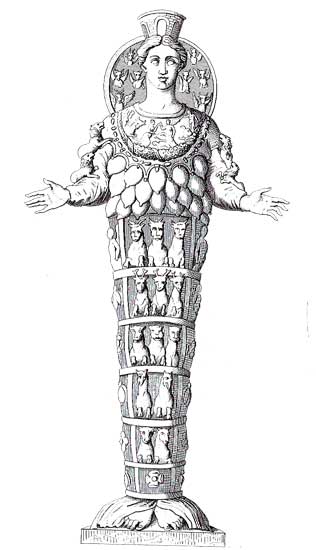
In rare instances, the aniconic cult-statues were reshapen in later times, making them more human in form. Why this was done is unknown. There are many mentions of xoana in the ancient writing. The statue of Samian Hera at Samos, and the 'Hera of Delos', for example. Pausanias mentions five in one breath: two in Boeotia (a Herakles in Thebes and the Trophonios at Lebadeia), two other xoana in Crete (a Britomartis at Olous and an Athena at Knossos), and a small xoanon of Aphrodite at Delos. The cult-statue of Artemis of Ephesus (depicted above)--which was assumed to be 'many breasted' but in reality was probably decorated with abstract bull's testicles--was another example of a recarved xoanon.

A xoanon could be from any timeframe; Hómēros already wrote about fully fleshed-out Gods with very defined apperances. Yet, xoana were focal points of worship in ancient Hellas, long after his works came out. It was their divine spark that set them apart, not their age or looks. Pausanias suggested that xoana were not only religious statues, but statuaries onto themselves with the ability to have the spirits of Gods or heroes dwelling within them. This made these objects decidedly valuable for the ancient Hellenes and also defnes the diference between a statue and a xoanon: a statue is a gift to the Theoi; a xoanon has the potential to house one.

Image source: Wikipedia Commons.