Showing posts with label Kastor and Polideukes. Show all posts

It's time for a new constellation, and this one is entirely dedicated to two brothers. While there are many twins in Hellenic mythology--Artemis/Apollon, Iphikles/Hēraklēs, Amphion/Zethos, etc., this constellation is almost solely connected to one set of them: Kastor and Polideukes. In fact, the main stars of the constellation are named after them.


Hyginus briefly describes the constellation in his Astronomica, and focusses almost solely on the Dioscuri:

"These stars many astronomers have called Castor and Pollux. They say that of all brothers they were the most affectionate, not striving in rivalry for the leadership, nor acting without previous consultation. As a reward for their services of friendship, Jupiter [Zeus] is thought to have put them in the sky as well-known stars. Neptune [Poseidon], with like intention, has rewarded them for he gave them horses to ride, and power to aid shipwrecked men.
 
Those who speak of Castor and Pollux add this information, that Castor was slain in the town of Aphidnae, at the time when the Lacedaemonians were fighting the Athenians. Others say that when Lynceus and Idas were attacking Sparta, he perished there. Homer states that Pollux granted to his brother one half of his life, so that they shine on alternate days." [2.22]


The twins were born from Leda, Zeus, and mortal king Tyndareus. One of the twins was mortal, the other immortal, and both hatch from an egg. Accounts vary about who was the mortal one, and who was the immortal one; in some accounts they were even both mortal or immortal. During their lifetimes, the Dioscuri became great heroes, joining Iásōn in securing the Golden Fleece, and they both fought the Calydonian Boar.

I will discuss their mythology better another time, but for now, let me suffice in saying that eventually, they aspired to marry Phoebe and Hilaeira, who were already betrothed to cousins of the Dioscuri, a second set of twin brothers named Lynceus and Idas of Thebes, sons of Tyndareus's brother Aphareus. This sparked a feud between the cousins that left Polideukes the only one standing. He was given the choice by Zeus of spending all his time on Mount Olympus or giving half his immortality to his mortal brother. He opted for the latter, and thus the two divided their time between Olympos and the Underworld.

The Dioscuri were regarded as helpers of mankind and held to be patrons of travelers and sailors. Because they excelled in horseback riding and boxing, they were regarded as the patrons of athletes and athletic contests, and in all capacities, they had shrines throughout Hellas, and were worshipped well into the Roman era. As the twins lived on after death, they became emblems of the Eleusinian Mysteries, and were said to have been initiated into it during their lifetimes.

Hyginus also mentions a few other duos connected to the constellation:

"Others have called them Hercules and Apollo; some, even Triptolemus, whom we mentioned before, and Iasion, beloved of Ceres [Demeter] - both carried to the stars." [2.22]


Hēraklēs and Apollon earned this honor because, when Apollon commanded that Hēraklēs be sold into slavery to atone for the murder of his family, Hēraklēs became enraged and wrestled the Theos for the Delphic tripod. Their match was memorialized amongst the stars as the constellation Gemini.

Triptolemos and Iasion are the last candidates. The two were favorites of the Goddess Demeter. Triptolemos was a hero who first instructed mankind in the art of agriculture, while Iasion was said to be Her lover on the island of Samothrace. Demeter must have immortalized them out of love.

Gemini is visible at latitudes between +90° and −60°, and best visible at 21:00 (9 p.m.) during the month of February.

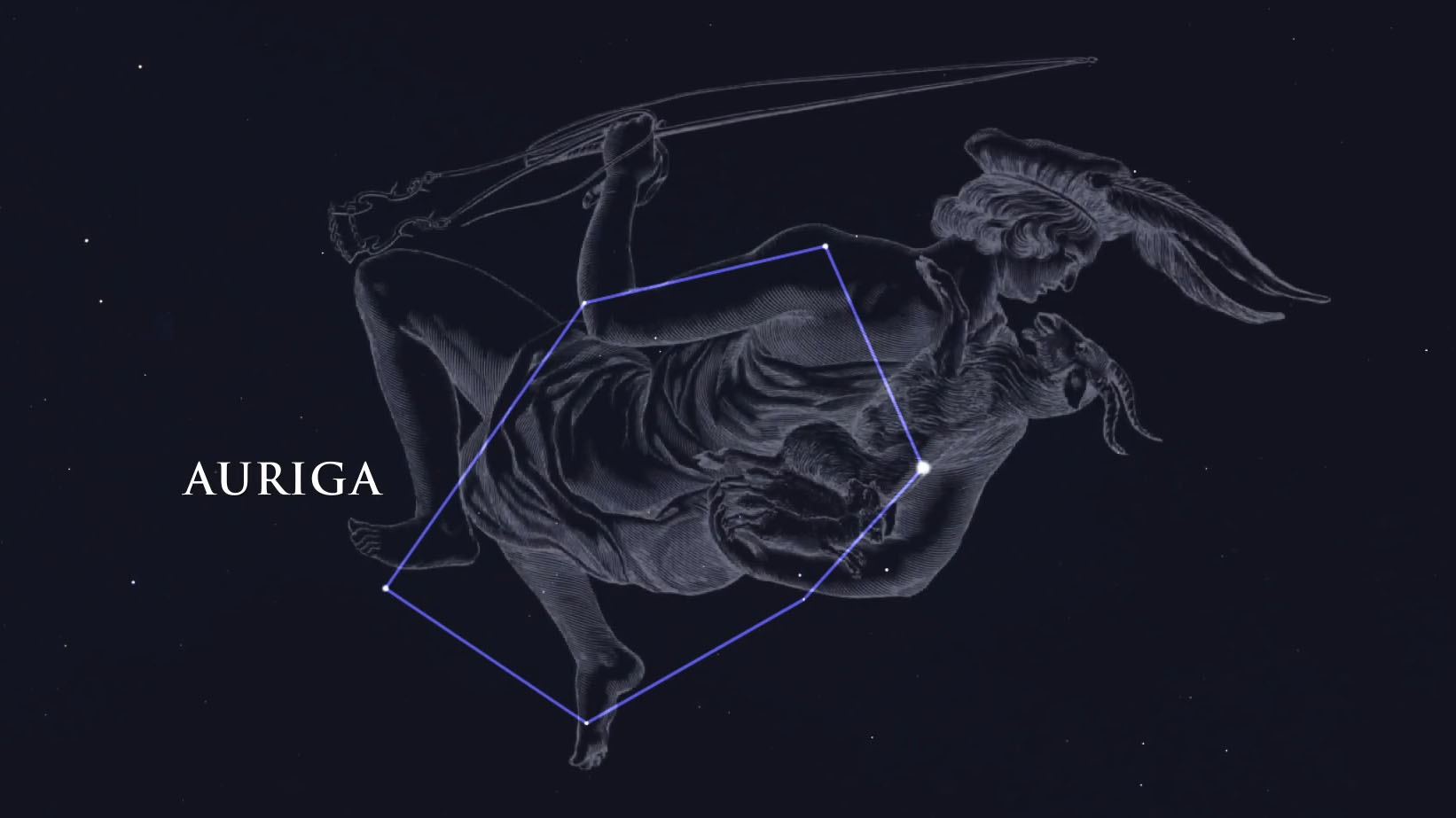
There are many well known chariots and charioteers in ancient Hellenic mythology. All of the Theoi have one, and Helios and Apollon use one to bring light to the world. Hades kidnapped Persephone with His. Kastor and Polideukes were very skilled at driving the fast, light, open, two-wheeled conveyance drawn by two or more horses. Helios lost a son when he let his son Phaethon (Φαέθων) drive his chariot for its morning track through the sky. Phaethon flew too close to the earth and scorched it all; Zeus then cast him down with a lightning-bolt. Yet, these are not the charioteers the constellation is associated with. In this next installment of the constellation series, we will look at the Divine child the constellation refers to... and a few others, because the constellation Auriga has had many interpretations over the years.


For a very long time, war chariots were pulled by two horses only. The charioteer of the constellation is therefor most likely Erichthonios (Ἐριχθόνιος), child of Hēphaistos and Athena, through Gaea, as he invented a chariot pulled by four horses. 

As the myth of his birth goes; Athena went to Hēphaistos' workshop for weaponry, but Hēphaistos--overcome with lust--tried to rape Her instead. Athena fled, but could not flee fast enough. Hēphaistos caught up to Her. Athena fought off Her attacker, but could not prevent Hēphaistos from ejaculating on Her thigh. She wiped Hēphaistos' semen away with a scrap of wool (ἔριον, erion) and flung it to the earth (χθών, chthôn). From it was born Erichthonios, who was part man, and part snake.

In my post about the many legends of Médousa, I posed the following about Athena and the source of Erichthonius' myth and birth as part-snake:

"Athena's role as a snake and fertility Goddess is still visible in the myth about the child she had with Hephaestus; Erichthonios (Ἐριχθόνιος), who was half man, half snake. It's even posed that in the early days, Athena was married to Hephaestus and had His child willingly. As Athena was stripped of Her roles as a fertility and snake Goddess, Médousa's myth came into being, where Athena distances Herself from sex and snakes, by punishing an epithet of herself (Athena Tritogeneia, perhaps: 'born of Trito', a lake which was supposedly located in Libya), or the Libyan snake Goddess Médousa, who may have still been attached to Her worship. By placing Médousa's head on Her breastplate or shield, Athena's mythology is continuously linked to Her Libyan heritage, but harmlessly so, to Her new image of a virginal warrior."

No matter the source, Erichthonios was born, and placed in a box by Athena. She placed the box in the care of three of Her attendants at the Acropolis, with clear instructions not to open the box. They did, of course, and were scared so by the sight of either a snake in the box, or Erichthonios' deformities, they cast themselves off of the Acropolis in terror. Yet, despite his deformities, Erichthonios became king of Athens and ruled it long and well.

He married Praxithea (Πραξιθέα), a naiad, and had a son, Pandion I. He founded the Panathenaiac Festival in the honor of Athena, and set up a wooden statue of her on the Acropolis. He taught his people to yoke horses and use them to pull chariots, to smelt silver, and to till the earth with a plough. His deformities and lameness inspired him to invent the quadriga--or four-horse chariot--to get around easier. He was very skilled as a charioteer, and won many games. Zeus was said to have been so impressed with his skill that he raised him to the heavens to become the constellation Auriga after his death.

There are also other charioteers to whom the constellation could refer; Myrtilus (Μυρτίλος), for example, who was Hermes's son and the charioteer of Oenomaus. Myrtilus's chariot was destroyed in a race intended for suitors to win the heart of Oenomaus's daughter Hippodamia. Myrtilus earned his position in the sky when Hippodamia's successful suitor, Pelops (Πέλοψ), killed him, although he helped him win the woman's hand. After his death, Myrtilus's father Hermes placed him in the sky. 

The constellation could also represent Theseus's son Hippolytos who was rejected from Athens after he refused the romantic advances of his stepmother Phaedra, who committed suicide as a result. He was killed when his chariot was wrecked, but revived by Asklepios. Another possibility is that the constellation does not represent a whole person at all, but is a limb of Mēdeia's brother after she killed and dismembered him.

Occasionally, Auriga is also seen as the Charioteer but as Bellerophon (Βελλεροφῶν), the mortal rider of Pegasus who dared to approach Mount Olympus. In this version of the tale, Zeus pitied Bellerophon for his foolishness and placed him in the stars.

Whomever--or whatever--it represents, Auriga reminds us that the chariot had an important place in ancient Hellenic society. As for the constellation, it is visible at latitudes between +90° and −40°, and best visible at 21:00 (9 p.m.) during the month of late February to early March.

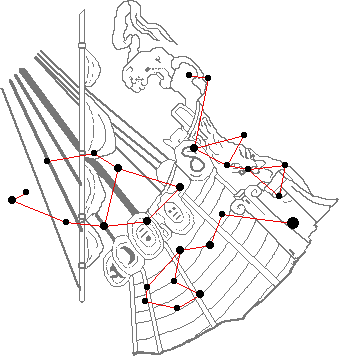
Welcome to another installment of the constellation series. As the fourth constellation, I have for you Argos Navis, a collection of constellations which together form the ship Argo, on which the Argonauts (Argonautai, Ἀργοναῦται) sailed to find the Golden Fleece.


The Argo Navis was an ancient constellation which has since been disband. It was a huge constellation, the largest in existence.  In 1752, the French astronomer Nicolas Louis de Lacaille subdivided it into Carina (the keel of the ship), Puppis (the stern), and Vela (the sails). Back in ancient Hellas, it was still one, large, constellation and it represented the ship on which one of Hellas' greatest heroic journeys was undertaken: Iásōn's (Ἰάσων, Jason) quest for the Golden Fleece.

The Argo (Ἀργώ), meaning 'swift', was built by the shipwright Argus. He was a member of the Argive royal house, and his fmily was favored by Hera. Becasue of this, anyone who sailed on the Argo, would have Her aid. Argus was aided in the planning and construction of the Argo by Athena, and possessed in its prow, a magical piece of wood from the sacred forest of Dodona, which could speak and render prophecies.

The tale of the Argonautai is long, and complicated. As so many kings in ancient Hellas, Pelias (Πελίας) unrightfully laid claim to his half-brother's throne. He became the king of Iolkos in Thessaly, and fell in disfavor of the Theoi because of his actions. It was prophesied that a member of the rightfully royal bloodline would one day punish him, and he was likewise warned to watch out for a man with only one sandal.

Pelias didn't believe in half measures and murdered every prominent descendant of Aeolus he could, but spared his mother Tyro's youngest son, Aeson. Instead, he imprisoned him and forced him to renounce his claim to the throne. Aeson complied, and eventually was set free. He married  Alcimede, who bore him a son named Diomedes. Alcimede successfully saved her son from certain death by having her nursemaids keen as if the boy had been stillborn. She secretly packed him off to Mount Pelion, where he was raised by the kéntauros Kheiron (Χείρων), who changed the boy's name to Iásōn.

From Kheiron, Iásōn learned the arts of combat, sports, medicine and music. When he reached adulthood, he was send back to Iolkos with proof of his royal birth. On the way there, he had to cross a river and found an old woman on the bank of it, who begged everyone who passed by to carry her through the water. All but Iásōn ignored her. He took her onto his back and he helped her across, although he found the journey tougher than he had ever thought possible. He also lost one of his sandals in the mud. As he put down the old woman, she turned into the magnificent Hera, of whom he would continue to receive support now he had passed her test.

As soon as Pelias laid eyes on the youth with one sandal, he knew what would happen now. And thus, he devised a plot to get rid of Iásōn. As Iásōn presented him with an offer to keep some farms and cattle, while Iásōn claimed his rightful place on the throne, Pelias happily accepted, but warned Iásōn that one task had to be completed first: the proper burial of king Phrixos.

Phrixos, thus told Pelias, Iásōn, had been saved from being sacrificed to the Theoi by a ram with golden wool. The Theoi had not demanded this sacrifice, but his step-mother Ino had paid off messengers from the oracle of Delphi to demand so of her husband out of hatred for the boy. The ram had carried him off to Helios' palace, where he was accepted into the household. The ram was sacrificed to Zeus, and the fleece was hung from a tree in a sacred grove of Ares, guarded night and day by a dragon that never slept. Pelias was haunted by Phrixos, and swore to Iásōn Phrixos would not rest until his ghost was taken back to Iokos, along with the Golden Fleece. If Iásōn did this, he swore by Zeus, to relinquish his throne to him.

Iásōn jumped at the chance. Kheiron had taught him well, and a chance to prove himself was all he desired. And so, he hired Argus to build him a ship, and send out messages to the various royal families to send them their young heroes for this voyage. Many jumped at the chance, although it's unclear how many, exactly. Argus may have undertaken the journey himself, as did Atalanta, Bellerophon, Kastor and Polideukes, Hēraklēs, Nestor, Orpheus, Perseus and Theseus. The number of Argonautai lay somewhere between forty and fifty.

The journey would take the brave Argonautai to many dangerous places. The first was Lemnos, where the women had been struck with madness by Aphrodite for failing to properly honor her. they had killed all men on the island, and all slave women as well. When the Argonautai reached the island, Aphrodite enchanted the women to seduce them, and thus halt their journey. Hēraklēs was the only one who did not go off of the ship, so he was able to convince the others to ship out after a long, long wait.

The next challenge came in the form of the Gegeines; Earthborn giants with six arms. The Argo sailed to Doliones where king Cyzicus ruled. In search of supplies, he allowed then to look for supplies on Bear Mountain, but failed to warn the crew of its inhabitants. When most of the crew left for the mountains, the Gegeines attempted to raid the ship, but Hēraklēs, along with a few others, held them off long enough for Iásōn and his men to return. They set sail int he dead of night but got turned about. They ended up on the same shore where the Argonautai and the people of king Cyzicus failed to recognize each other and many of them were killed, the king amongst them. When morning came, the Argonautai were shocked and ashamed, and organized a burial for the dead king. Hēraklēs took his leave here, as his tasks were not yet completed.

For twelve, long, days, the weather was so bad that the Argo could not set sail. The crew waited and grew hungry and thirsty. Mopsos, a bird auger, eventually deduced that the men should sacrifice to Rhea, mother of the Theoi. They did, and food and drink came to them by way of animals and low hanging fruit. The wind also died down, and the expedition was saved.

Next, they reached Bebryken, where they were challenged to a fist fight by king Amykos. He was so strong, he killed every opponent with one hit, and tossed those who refused to fight into the sea to die there. It was Pollux, son of Zeus, who accepted the challenge. He managed to win his fight gloriously, but the followers of the king were furious and wanted revenge. They fought the Argonautai, but were no match.

Soon they reached the court of Phineus of Salmydessus in Thrace. The king had been blessed with the gift of prophecy, but had shared too much of Zeus' secrets. For that, Zeus send Harpies to his door every day to take his food. The starving king begged the Argonautai for help, and received it. The Harpies were killed (or, in some versions of the myth, chased off) and the expedition continued.

The only way to reach their destination was to sail through the Symplegades, or Clashing Rocks. These huge rock cliffs came together and crushed anything that traveled between them. Phineas told the crew to release a dove when they approached these islands, and if the dove made it through, to row with all their might. If the dove was crushed, he was doomed to fail. Iásōn released the dove as advised, which made it through, losing only a few tail feathers. They went for it and, with the aid of Athena, made it through with only minor damage to the stern of the Argo. The clashing rocks were forever joined, leaving the way free for others to travel.

Before reaching Kolchis, their destination, the Argonautai would halt twice more. Once in the land of the Mariandyn, where they lost their navigator to illness, and Hera just barely saved the expedition by making Ankaios speak winged words of confidence that he could steer the ship. And he did. The second wait came in the form of a terrible storm for which the Argo needed to be protected. When the storm died down, they found the shipwrecked nephews of Iásōn, who had been on their way back from Kolchis, and were accepted into the Argonautai right away.

Once the Argonautai reached Kolchis, their struggle wasn't over. King Aeetes was unwilling to part with the Fleece, as it had brought great prosperity to his lands. He devised three tasks for Iásōn: to plow a field with fire-breathing oxen, to sow the teeth of a dragon into the field, and to overcome the sleepless dragon guarding the Fleece. Aided by Mēdeia (Μήδεια)--who was made to fall in love with Iásōn by Athena and Hera, who convinced Aphrodite to convince Eros to shoot his arrow--Iásōn completed his tasks and fled with Mēdeia and her younger brother Absyrtus, aboard the Argus.

As king Aeetes' war fleet hunted them down, Mēdeia did the unthinkable: she killed her brother and, in some versions of the myth, dismembered him, throwing his body parts into the sea one by one. His father made sure all parts were recovered and the Argo was able to get away. In all versions of the myth, Iásōn is shocked by this act, as well as the magick she implored to aide him in his other quests, but in some, he takes Mēdeia onto dry land to allowed her to cleanse herself of the miasma incurred by the murder she had committed.

After this, the Argo makes it home safely, after first passing by the Sirens who are so well known from the Odysseia--harmless because of Orpheus' louder and more beautiful music--and the boulder throwing Taltos, a bronze man with one blood vessel which ran from his neck to his toe. The blood vessel was held closed by a single nail. Mēdeia practiced her magick again, and put the giant to sleep. Then, she removed the nail, and Taltos bled to death.

Again, it was Mēdeia who saved the expedition, as Pelias refused to give in. Yet, he had become an old man in the time Jason had been gone, and when Mēdeia offered to make him young again, his daughters jumped at the chance. Mēdeia told the women that they should kill and cut up their father and put them in her cooking pot. This way, she would be able to perform her magick and the king would be reborn in his prime. The girls did as told but Mēdeia did not add the magickal herbs needed to complete the spell, and Pelias remained quite dead. Iásōn and Mēdeia were exiled for their crime by Pelias' son.

Yet the story of the Argo is not quite over. According to playwright Euripides, Iásōn betrayed Mēdeia, and wedded Kreousa (Κρέουσα), daughter of king Kreon of Korinth, instead of her. Mēdeia recounted all the help she had given him, and reminded him of his vow to marry her, but he told her that she should not be angry at him, but at Aphrodite, who had made her fall in love with him. Angered and ashamed, Mēdeia enchanted the dress Kreousa would wear for her wedding, and it caught fire as soon as she put it on. The fire killed both her and her father. Out of fear for retaliation, or out of a desire to hurt Iásōn even further, Mēdeia killed the two sons she had with Iásōn and fled.

Iásōn was punished for his treachery: Hera abandoned him and the mast of the Argo squashed him as he lay sleeping on the Argo one night late into his lonely and tortured life. The Argo was consecrated to Poseidon in the Isthmus, and was later placed into the sky and turned into the constellation of Argo Navis. The constellation has fallen apart over the years. Carina is visible at latitudes between +20° and −90°. It is best visible at 21:00 (9 p.m.) during the month of March. Puppis is visible at latitudes between +40° and −90°, and is best visible at 21:00 (9 p.m.) during the month of February. Vela is visible at latitudes between +30° and −90° and is best visible at 21:00 (9 p.m.) during the month of March.
On the fourth of Thargelion, in the deme of Erkhia, located approximately twenty kilometers (twelve miles) east of Athens, a series of sacrifices were held. Most likely, these were in relation to the Thargelia which was soon to follow. Preporatory rites, of a sort. Elaion will hold a PAT ritual to follow in their footsteps on 20 May at the usual 10 am EDT. Will you be joining us?


The Thargelia was one of the major festivals of Athens, and most of ancient Hellas. It celebrates the birthday of Apollon and Artemis and was held over the course of two days, one with the focus on Artemis--the first, as she was born first--and Apollon on the second day, held on the sixth and seventh day of the month of Thargelion, respectively. The thargelia was both an agricultural and a purifying festival: it was a festival intended to lift miasma from the city of Athens (and anywhere else it was celebrated) in order to ensure a good harvest. It was of vital importance and it could be that the people of Erkhia hosted these sacrifices in order to feel entitled to have Erkhia's harvest fall under the results of the katharthic rites of Athens once they would be held a few days later.

The ancient Erkhians would have held separate rituals for (almost) all of the listed deities, more often than not at different locations. It could therefore be that not all of these sacrifices are linked to the Thargelia. The sacrifices to Leto, Apollon and Zeus most likely were. Hermes, perhaps, but it is more likely that He, along with the Dioskuri was honoured due to the influence of Sparta, of whom all three were patrons. Perhaps the sacrifice to Zeus had a joined function as the father of all (Depending on the mythological account, of course).

We won't be distinguishing between the two 'branches' and have made a single rite to be performed on the 20th, at 10 am EDT. You can join the community here and find the ritual here. We hope you will join us!
On the fourth of Thargelion, in the deme of Erkhia--located near the modern Spata, approximately twenty kilometers (twelve miles) east of Athens, with the deme center located at Magoula--a series of sacrifices were held. Most likely, these were in relation to the Thargelia which was soon to follow and to which I will soon dedicate a full blog post. Preporatory rites, of a sort. Elaion will hold a PAT ritual to follow in their footsteps on Monday 1 May, 2016 at the usual 10 am EDT. Will you be joining us?


The Thargelia was one of the major festivals of Athens, and most of ancient Hellas. It celebrates the birthday of Apollon and Artemis and was held over the course of two days, one with the focus on Artemis--the first, as she was born first--and Apollon on the second day, held on the sixth and seventh day of the month of Thargelion, respectively. The thargelia was both an agricultural and a purifying festival: it was a festival intended to lift miasma from the city of Athens (and anywhere else it was celebrated) in order to ensure a good harvest. It was of vital importance and it could be that the people of Erkhia hosted these sacrifices in order to feel entitled to have Erkhia's harvest fall under the results of the katharthic rites of Athens once they would be held a few days later.

The ancient Erkhians would have held separate rituals for (almost) all of the listed deities, more often than not at different locations. It could therefore be that not all of these sacrifices are linked to the Thargelia. The sacrifices to Leto, Apollon and Zeus most likely were. Hermes, perhaps, but it is more likely that He, along with the Dioskuri was honoured due to the influence of Sparta, of whom all three were patrons. Perhaps the sacrifice to Zeus had a joined function as the father of all (Depending on the mythological account, of course).

We won't be distinguishing between the two 'branches' and have made a single rite to be performed on the 1th, at 10 am EDT. You can join the community here and find the ritual here. We hope you will join us!
On the fourth of Thargelion, in the deme of Erkhia--located near the modern Spata, approximately twenty kilometers (twelve miles) east of Athens, with the deme center located at Magoula--a series of sacrifices were held. Most likely, these were in relation to the Thargelia which was soon to follow and to which I will soon dedicate a full blog post. Preporatory rites, of a sort. Elaion will hold a PAT ritual to follow in their footsteps on Wednesday 11 May, 2016 at the usual 10 am EDT. Will you be joining us?


The Thargelia was one of the major festivals of Athens, and most of ancient Hellas. It celebrates the birthday of Apollon and Artemis and was held over the course of two days, one with the focus on Artemis--the first, as she was born first--and Apollon on the second day, held on the sixth and seventh day of the month of Thargelion, respectively. The thargelia was both an agricultural and a purifying festival: it was a festival intended to lift miasma from the city of Athens (and anywhere else it was celebrated) in order to ensure a good harvest. It was of vital importance and it could be that the people of Erkhia hosted these sacrifices in order to feel entitled to have Erkhia's harvest fall under the results of the katharthic rites of Athens once they would be held a few days later.

The ancient Erkhians would have held separate rituals for (almost) all of the listed deities, more often than not at different locations. It could therefore be that not all of these sacrifices are linked to the Thargelia. The sacrifices to Leto, Apollon and Zeus most likely were. Hermes, perhaps, but it is more likely that He, along with the Dioskuri was honoured due to the influence of Sparta, of whom all three were patrons. Perhaps the sacrifice to Zeus had a joined function as the father of all (Depending on the mythological account, of course).

We won't be distinguishing between the two 'branches' and have made a single rite to be performed on the 11th, at 10 am EDT. You can join the community here and find the ritual here. We hope you will join us!
It's time for a new constellation, and this one is entirely dedicated to two brothers. While there are many twins in Hellenic mythology--Artemis/Apollon, Iphikles/Hēraklēs, Amphion/Zethos, etc., this constellation is almost solely connected to one set of them: Kastor and Polideukes. In fact, the main stars of the constellation are named after them.


Hyginus briefly describes the constellation in his Astronomica, and focusses almost solely on the Dioscuri:

"These stars many astronomers have called Castor and Pollux. They say that of all brothers they were the most affectionate, not striving in rivalry for the leadership, nor acting without previous consultation. As a reward for their services of friendship, Jupiter [Zeus] is thought to have put them in the sky as well-known stars. Neptune [Poseidon], with like intention, has rewarded them for he gave them horses to ride, and power to aid shipwrecked men.
 
Those who speak of Castor and Pollux add this information, that Castor was slain in the town of Aphidnae, at the time when the Lacedaemonians were fighting the Athenians. Others say that when Lynceus and Idas were attacking Sparta, he perished there. Homer states that Pollux granted to his brother one half of his life, so that they shine on alternate days." [2.22]

The twins were born from Leda, Zeus, and mortal king Tyndareus. One of the twins was mortal, the other immortal, and both hatch from an egg. Accounts vary about who was the mortal one, and who was the immortal one; in some accounts they were even both mortal or immortal. During their lifetimes, the Dioscuri became great heroes, joining Iásōn in securing the Golden Fleece, and they both fought the Calydonian Boar.

I will discuss their mythology better another time, but for now, let me suffice in saying that eventually, they aspired to marry Phoebe and Hilaeira, who were already betrothed to cousins of the Dioscuri, a second set of twin brothers named Lynceus and Idas of Thebes, sons of Tyndareus's brother Aphareus. This sparked a feud between the cousins that left Polideukes the only one standing. He was given the choice by Zeus of spending all his time on Mount Olympus or giving half his immortality to his mortal brother. He opted for the latter, and thus the two divided their time between Olympos and the Underworld.

The Dioscuri were regarded as helpers of mankind and held to be patrons of travelers and sailors. Because they excelled in horseback riding and boxing, they were regarded as the patrons of athletes and athletic contests, and in all capacities, they had shrines throughout Hellas, and were worshipped well into the Roman era. As the twins lived on after death, they became emblems of the Eleusinian Mysteries, and were said to have been initiated into it during their lifetimes.

Hyginus also mentions a few other duos connected to the constellation:

"Others have called them Hercules and Apollo; some, even Triptolemus, whom we mentioned before, and Iasion, beloved of Ceres [Demeter] - both carried to the stars." [2.22]

Hēraklēs and Apollon earned this honor because, when Apollon commanded that Hēraklēs be sold into slavery to atone for the murder of his family, Hēraklēs became enraged and wrestled the Theos for the Delphic tripod. Their match was memorialized amongst the stars as the constellation Gemini.

Triptolemos and Iasion are the last candidates. The two were favorites of the Goddess Demeter. Triptolemos was a hero who first instructed mankind in the art of agriculture, while Iasion was said to be Her lover on the island of Samothrace. Demeter must have immortalized them out of love.

Gemini is visible at latitudes between +90° and −60°, and best visible at 21:00 (9 p.m.) during the month of February.
At dusk today, one of Hellenismos' most important festivals (if one can give classifications to the festivals at all) starts. It's the Anthesteria, and held in honor of Dionysos Limnaios, wine, and the dead. The Anthesteria was held annually for three days, the eleventh to thirteenth of the month of Anthesterion. It is an ancestral festival, the oldest of the festivals for Dionysos in Athens, a time of reflection and trust in the new growing season to come, a time to celebrate with the spirits of the departed the indefatigable resurgence of life. The festival centered around the celebration of the maturing of the wine stored at the previous vintage, whose pithoi were now ceremoniously opened, and the beginning of spring. The three days of the feast were called Pithoigia (after πίθοι 'storage jars'), Khoes (χοαί 'libations') and Khytroi (χύτροι 'pots').


On the first day, the pithoi were brought to the city of Athens and opened in the temple of Dionysos. Everyone from age three and up wore garlands of new flowers, and many were present when the pithoi of new wine were opened, and a libations was offered to Dionysos before drinking of it. It was a truly celebratory day.

On the second day, all temples were closed, except the temple of Dionysos. Social order broke down on this day--as slaves were permitted to celebrate alongside everyone else--and there was a drinking contest in the afternoon where three liters of wine were drunk in complete silence, from khoes. Whomever finished first, won. At the end of the day, the garlands that had been worn were wound around their khoes which they then took to the priestess in charge of the sanctuary at the Limnaios (the marsh) to be dedicated. The wife of the Archōn Basileus--the Archon in charge of religious and artistic festivals--the Basilinna might have taken part in a sacred marriage with Dionysos, either with her husband acting as a conduit for Dionysos, or one of His priests. Geriai, priestesses or followers of Dionysos, might have assisted in this ritual, or would have held their own cult rituals on this day. Young women swung in trees and decorated them to commemorate the death of Erigone, as chronicled below.

On day three, everyone joined in a procession to the temple of Dionysos. It was a somber day consisting of the preparation of a mixture of a panspermia, grains and beans boiled together (a good recipe can be found here), along with honey which was offered to Hermes Khthonios on behalf of the spirits of the dead, especially those who died in Deukalion’s flood. The slaves, as well as the dead, were then told to go home, as 'the Anthesteria had ended'.

The origins of the Anthesteria are based in myth. After the battle of Troy, King Agamemnon returns home to his wife Klytaemnestra (Κλυταιμνήστρα). When Agamemnon returns, playwright Aeschylus in his Oresteia, writes Klytaemnestra as not having been faithful to her husband. She has taken as her new lover and husband Aegisthos (Αἴγισθος), cousin of Agamemnon, and when Agamemnon and his young slave come home, Klytaemnestra kills them both. Orestes (Ὀρέστης), son of Agamemnon and Klytaemnestra ends up killing Aegisthos, as well as his mother for her crime, under orders of Apollon. Yet, the matricide is a terrible offense in the eyes of the Theoi, and the Erinyes--Khthonic deities of vengeance--are sent to kill Orestes. They chased him relentlessly and upon reaching Delphi he is told by Apollon that he should go to Athens to seek Athena's aid.

Phanodemus (Athenaeus 10.437c-d) describes what happens to Orestes next, as it is this practice that was reenacted again and again, during the second day of the Anthesteria:

“When Orestes arrived at Athens after killing his mother, Demophon [king of Athens] wanted to receive him, but was not willing to let him approach the sacred rites [to Dionysos] nor share the libations, since he had not yet been put on trial [and had not yet been cleansed of miasma]. So he ordered the sacred things to be locked up and a separate pitcher of wine to be set beside each person [instead of sharing a drinking vessel as usual], saying that a flat cake would be given as a prize to the one who drained his first. He also ordered them, when they had stopped drinking, not to put the wreathes with which they were crowned on the sacred objects, because they had been under the same roof with Orestes. Rather each one was to twine them around his own pitcher and take the wreathes to the priestess at the precinct in Limnai, and then to perform the rest of the sacrifices in the sanctuary.”

As mentioned, Orestes arrives at Athens during an existing festival to Dionysos. It is posed that this festival was the Aiora, a festival instituted to commemorate the death of Erigone, her father, and their dog Maera. The story goes that Ikários (Ἰκάριος) was such a fine winemaker that he could produce wine so strong, those who drank it appeared to be poisoned. His skill turned out to be his undoing; Íkaros was killed by those who drank his wine, thinking the wine maker was out to kill them. His daughter Erigone was taken to his body by the family hound, Maera, whereupon both she and the dog committed suicide by hanging. It may have been that Dionysos was so angry over the murder and the following suicides, He punished Athens by making all of the city's maidens (or only the daughters of those who had killed Ikários) commit suicide in the same way. The citizens of Athens turned to the oracle of Delphi to stop these suicides, and the oracle told them to burry the three with honors, and appease their spirits. The Athenians buried the bodies with full honors, and a festival was founded where young Athenian women swung in swings, and hung ribbons, cups, and dolls in trees.

The Anthesteria might sound like a confusing festival, and it was, in a way. The three days were almost completely separate events, but have a few things in common. It's a fertility festival, but birth is linked to death. All life is linked to death, after all, and both birth and death were miasmic events. After the rough winter, everything was dead: the soil, the remaining food stores, people... miasma tainted everything. So, as new life began from the ashes of the old, Dionysos was invoked and sacrificed to, to cleanse the old, to remove the miasma resting upon the earth and the people. It is not odd to find mythology connected to this festival which is so strongly linked to miasma, birth and death.

How does a modern Hellenist celebrate the Anthesteria? Sannion has a wonderful solitary Anthesteria ritual, but you can, of course, create your own. The first day should focus upon the fertility aspects of the festival: the coming abundance of flowers, wine, and fruit now the spring is almost upon us. Day two began at night, and was filled with... well... sex. People were intoxicated, enthusiastic about the upcoming spring and the end of winter, and they tended to find each other in the dark of night. I would suggest starting there for day two, if you have the option.

On this second day, cover any other shrine you may have in the house, but the one on which you will honor Dionysos, to prevent them from becoming tainted with miasma. Think about Orestes, and what he was forced to do--fail either his father by not punishing his killer, or fail his mother by killing her, and dooming himself, regardless--and think about hard decisions you have had to make, and ask forgiveness for them. If you are of legal age and have the opportunity to do so, empty a glass of wine, and feel it swirl in your stomach, as restless as the spirits of the mythic dead who will come up from the Underworld tomorrow. Swing on a swing, as high as you can, and revel in the feeling. Decorate trees with knick-knacks. If you made yourself a garland, take it outside, preferably something wet, and beg that Dionysos accept it and cleanse you of the pollution you carry within you. Again, this night is perfect for making love, especially in honor of Dionysos.

Keep your shrines covered for the third day, as miasma has not yet been lifted, and the dead roam the earth freely. Give honors to family members, and others who were close to you, who have died. Speak with them and try to find closure. Make them a meal; a panspermia is best, but eggs, leeks and garlic also work well. There are different stories surrounding the eating of the panspermia yourself. Some say no one was to eat from it, but Walter Burkert in 'Greek Religion' notes:

"On the 13th Anthesterion, the day of the Pots, grains of all kinds are boiled together in a pot along with honey. This is the most primitive cereal dish of the early farmers, older than the discovery of flour-milling and bread-baking; in funeral customs it has survived down to the present day. But the idea of food for the dead, conjoined to an abridged version of an ancient source, has lead to the mistaken view that the living were actually prohibited from eating from the Pots. According to the full text, it is only the priests who are barred from eating this food, in accordance with the fact that all sanctuaries are closed on the Choes day. The meal of pottage is linked to the myth of the flood: once the water had subsided, the survivors threw everything they could find into a pot and cooked it as their first meal after the cataclysm, an occasion for summoning up new courage and yet in memory of the dead. One sacrifices to the chthonic Hermes for the sake of the dead and eats from the Pots in the certainty of life regained. The day of defilement is over, the masks and the dead lose their rights: 'Out you Keres, the Anthesteria are over' became a proverbial saying."

Yet, Harrison in 'Themis: A Study of the Social Origins of Greek Religion' has the following to say:

"The panspermia has not, I think, been rightly understood. In commenting on it before, misled by the gift-theory of sacrifice, I took it to be merely a 'supper for the souls.' No doubt as such it was in later days regarded when primitive magical rites had to be explained on Olympian principles. But it was, to begin with, much more. The ghosts had other work to do than to eat their supper and go. They took that 'supper', that panspermia, with them down to the world below and brought it back in the autumn a pankarpia. The dead are Chthonioi, 'earth people', Demetreioi, 'Demeter's people,' and they do Demeter's work, her work and that of Kore the Maiden, with her Kathodos and Anodos."

Where you stand, you must decide for yourself. I will not taste of the panspermia. Like with the Deipnon, however, setting outside the meal will lift the miasma from your person and the house, so afterwards, you can uncover your shrines again.

The Anthesteria is a festival of deep, emotional, involvement, and it is best celebrated by emerging yourself as completely as you can. As with any rites to Dionysos, transformation within yourself is almost always a consequence. The Anthesteria is a heavy festival, but filled with joy, regardless, because you are working towards spring. Burdens will be lifted from you. Rejoice with all that is left behind in mind, and you will get through these festivals just fine. Enjoy!
Well, the government might be having some trouble, but Greece is not forgetting the ancient monuments. News of the continuation of not one, not two, but three restoration projects recently came over The Archeology News Network; Delphi, the Sanctuary of the Great Gods and the Medieval castle of Samothrace, and the Temple of Apollo in the ancient city of Side are all getting make-overs.


Delphi:
The Operational Program Thessaly will invest €600,000,- ($803,000,-) to enhance and preserve the ancient holy site of Apollon. The restoratory work will focus mostly on the Temple of Apollo, the sanctuary of Athena Pronaia, the Gymnasium and Castalia.

After the site is thoroughly surveyed, the work will focus on cleaning up and restoring several key features of Delphi's survived monuments. The mosaics will be cleaned, the fixation of surfaces of monuments will be checked and restored where needed, and an ancient bronze column will be constructed and placed at the Hippodrome of Constantinople. Another primary focus will be the improvement of the functionality and aesthetics of the site as well as some interventions which aim at a better serving of disabled people. 

Samothrace:
The National Strategic Reference Framework (NSRF)-- the reference document for the programming of European Union Funds at national level for the 2007–2013 period--will fund the conservation works at the Sanctuary of the Great Gods and the Medieval castle of Samothrace. In ancient times, the site served as a worship area to Axieros, a deity related to Cybele and Demeter, Kadmilos, an ithyfallic deity identified with Hermes, and the Cabeiri, ithyfallic demons identified with the Dioskouroi. Surrently, the site houses some fo the treasures found at the site, in both storehouses and a museum.

The Archeology News Network reports that excavations at the area have ceased since 1995.  There are, nevertheless, some areas where conservation works are urgent. The work will be carried out in two phases, both taking three years. From the article:

"The first phase of the project includes the reconstruction of the terraces, the conservation of the architectural members and the rest of the monuments at the Easter Sector. Among them is the Propylon of Ptolemy II. In the second phase, the monuments on the western side of the Sanctuary will be restored, and in the third phase the works will focus on the central area of the site, where the most significant buildings of the Great Gods’ worship are."

Another feature of Samothrace is its castle. The aim of the renovations is to make the castle visitable, which means that work on the fortification of the walls will continue, the last of the surfaces of structural members with decayed plaster will be jointed, and when summer arrives, the area surrounding the castle will be cleaned up and made safe, opening the way for tourists and other interested parties to wander the castle itself, and not just look upon it from a distance.

Side:
The Turkish Ministry of Culture and Tourism has launched a restoration project for the historic Temple of Apollo in the ancient city of Side, stating that the project is undertaken to preserve the cultural and historic assets of the ancient city of Side, which has great importance as a tourist attraction in the country. The temple's remainig columns suffer from corrosion from the moisture and saltwater right next to the temple, and are in need of some fortification.

The Ministry of Culture attempts to cycle through restoration and preventitive work on its national treasures, being well aware of the national value of these monuments. The 2000 year old temple to Appollon is next on the list, after a 35 year waiting period since its last restauration.

The Networt reports that the project is being led by Assistant Professor Hüseyin Alanyalı and his wife, Assistant Professor Feriştah Alanyalı, who also launched a landscaping project around the restored sites in Side--the Temple of Apollo, the Temple of Tyche, the Temple of Dionysus, the Temple of Athena and a basilica--last year. It seems ot me the temple of Apollo is in good hands, indeed.


All images taken from their respective articles, as linked to in this post.
Three people, who are made of absolute win, have created a visualization of Zeus' affairs and the offspring that came from those unions, based on classical authors. You can click on the 'play' button below to get taken directly to the interactive map where you can explore for yourself.


I've spend a good bit of time on this intriguing creation yesterday, and I would like to share some of my findings. General findings first: for one, the people who created this--Ilaria Pagin, Viviana Ferro, and Elisa Zamarian--put a lot of time and effort into this. The schematic is easy to read, which is a huge bonus. I would have liked to have the authors listed by (approximate) date of publication instead of alphabetically, but that's just for my personal research purposes.

For me, the Hellenic authors are of greatest interest. I care about the time when they wrote what they wrote. Through them, the lives of the Theoi can be followed. While some of the Roman myths relate to the Theoi, most don't. In this case, they apply to Jupiter, not Zeus. They muddle the mythology of the Gods I worship. Because of this, I dilute from the diagram a list of authors of interest to my research, and exclude those who are not. 
  • Homer (Hómēros, Ὅμηρος) [c. 800/700 - c. 701/601 BC]
  • Hesiod (Hēsíodos, Ἡσίοδος) [c. 750 - c. 650 BC]
  • Aeschylus (Aiskhulos, Αἰσχύλος) [c. 525/524 BC – c. 456/455 BC]
  • Pindar (Pindaros, Πίνδαρος) [c. 522 – c. 443 BC]
  • Orphic Hymns [c. 600/500 - c. 500/400 BC]
  • Apollonius Rhodius (Apollṓnios Rhódios, Ἀπολλώνιος Ῥόδιος)  [c. 300 - c. 201 BC]'
  • Diodorus Siculus (Diodoros Sikeliotes, Διόδωρος Σικελιώτης) [c. 60 - c. 30 BC]
  • Strabo (Strabōn, Στράβων) [c. 64/63 BC – c. 24 AD]
  • (Pseudo-)Apollodorus (Ἀπολλόδωρος) [c. 201 - 300 c. AD]
  • Pausanias (Pausanías, Παυσανίας) [c. 201 - c. 300 AD]
  • Eustathius of Thessalonica (Eustathios of Thessalonike, Εὐστάθιος Θεσσαλονίκης) [c. 1115 – c. 1195/6 AD]
Note that Titus Flavius Clemens is missing; his works were about the Hellenic Gods, but placed in such a strong Christian light that, for the purpose of 'finding out that the Hellenes believed', I'm going to discount him for now. I have the same problem with Eustathius of Thessalonica, but because he references many Hellenic writers in a way that seems more focused on historic accuracy than Clemens, he's in. I have included only his quotes, not his own remarks. Nonnus of Panopolis is also out, not because he did not write about the Theoi, but because Hellenic myths from his time (around the first half of the 5th century AD) have been criticized for giving a misleading overview of genuine classical mythology.

This graphic is a great tool to gleam some understanding of the King of the Theoi. Especially when we start at the beginning. Hómēros came first, giving us Zeus' marriage with Hera and the birth of their daughter Eris, and their son Ares. Hómēros also records and affair with Demeter which results in the birth of Persephone, his marriage to Themis before Zeus married Hera, and the birth of his daughter Nemesis. Zeus may have fathered a child with Nemesis: the tragically beautiful Helene. Hómēros also makes note of Zeus' affair with Mnemosyne, Goddess of memory and remembrance, who happens to be Zeus' aunt. From their union came the nine Muses. 

In Hómēros' version of the birth of Aphrodite, she is the child of Zeus and Dione, a Titan and Zeus' cousin. With the moon Goddess Selene, Zeus had Pandeia, Goddess of the full moon, and Dionysos was born from a union with Thyone (Semele). With Maia, Zeus had Hermes, and with Leto the Divine archers Artemis and Apollon. Homeros also records a union with the harpy Podarge, from which came Xanthus and Balius, the immortal horses of Achilles. With the human queen Leda, Zeus had Kastor and Polideukes. Leda also fostered Helene.

Hómēros has a few more affairs on record. From a union with Laodamia (sometimes called Deidamia), daughter of Bellerophon, came Sarpedon, one of the great heroes of Troy. With the human princess Danae, Zeus fathered Perseus, and with the princess Hyria, he fathered Amphion and Zethos.

Hesiod adds to Zeus' relations and children Hebe, Hēphaistos, and Eileithyia by Hera, and Limos by Eris. Through Themis, he grants paternity to Zeus for the Horai and Moirae. Through Metis--a new lover in the list, but listed as His first wife--Athena is born. Hesiod also adds Eurynome to Zeus' list of lovers, and adds three children: the Kharites. Another four newcommers are Elektra and her son Dardanos, Aegina and her son Aikos, Io and her son Epaphus, and Kallisto and her son Arcas.

Another new affair of Zeus is recorded by Hesiod as Thyia, daughter of Deukalion, with whom Zeus has two strong sons: Makedon and Magnes. Pandora II, grandchild of Pandora is also given as a lover of Zeus. The child that resulted from that union is Graecus. Hesiod also adds Calyce and Cassiopea to the list. With Calyce, Zeus had Aethlius, and with Cassiopea, Atymnius. From Hesiod also come Alcmene and her son Hēraklēs, and Europa, with whom he had three children: Rhadamanthys, Sarpedon and Minos.

Aeschylus offers a retelling of some of the affairs (most notably Maia, Europa and Io) but does not add new affairs or children to the list. Pindar does. He adds a new affair with Aegina, which results in the birth of Damocrateia and Aiakos, and through Protogenia, he adds Opus to the list of Zeus' children. Of note in Pindar's writing is that he gives parentage to Zeus of the Horai, but not the Moirae, and of Kastor, but not Polideukes.

The Orphic Hymns add a new lover and two children to the list: his daughter Persephone, who grants him two children: Zagreus, the 'first-born' Dionysos and Melinoe, frightful Underworld Goddess who presides over the propitiations offered to the spirits. Apollonius Rhodius adds two new affairs and an equal amount of children to the list: Orchomenos through Isomoe, and Myrmidon through Eurymedousa. Apollonius also grants paternity of both Dioscuri to Zeus.

Unlike his predecessors, Diodorus Siculus describes only one child by Persephone (Zagreus), but add one to his union with Elektra: Harmonia. He also adds a new lover: the nymph of Samothrace, with whom Zeus has a son named Saon. New to the list are also the demi-Goddess Karme and the nymph Himalia. With Karme, he has one of his few female offspring: Britomartix, the virgin Goddess of hunting and netting. Kytos, Kronios and Sprataios are listed as the sons of Himalia and Zeus. 

Strabo adds three new affairs and nine children to the list: Tántalos, though his mother Plouto, the seven daimons of the Korybantic dance through Kalliope, and Olenus through Anaxithea. The last of these is attributed by Strabo to Hómēros.

(Pseudo-)Apollodorus gives a great many affairs, most of which reach back to older writers. He makes a few adaptations to the list: Eris is not listed as a child of Zeus through Hera. Through Themis, Zeus only fostered the Horai, Styx is given as the mother of Persephone (which gives the myth about Her abduction by Hades a whole other spin I must come back to some day), Leda is--like in the writings of Hesiod--the (foster) mother of Kastor, Polideukes and Helene, and he gives a second child from Zeus' union with Eurynome: the river God Asopos. 

New on the list are Hekate through the Titan Asteria, and Argos and Pelasgos through Niobe. Note that this is a different Niobe than the Niobe who was punished by Leto for hubris committed against Her. Also new is Zeus' lover Elare, who gifted Zeus the Phokian giant Tityos.

The notable absences by Pausanias first: Hebe, Eris and Haphaestus are not amongst Zeus's children, and neither is Asopos through Eurynome. Helene is not listed as a child of Zeus, and neither are Rhadamanthys, Sarpedon and Minos by Europa, but he does make her the mother by Zeus of Alagonia and Carnus. Also new is Agaedistis through Gaea, although the original text spoke only of a 'Sky-father', and Ouranos would be much more logical. Another new child is Megarus by the Sithnis Nymph. 

Eustathius of Thessalonica is last on the list, but gives us references from Hómēros: through Eustathius, Hómēros describes an affair with the mortal woman Maera, from which a son came forth: Locrus. In the same way, we learn of Euryodeia and her son Arcesius.

Please note that I have only listed missing children where another of the children was obviously admitted. Most unions are only listed by one to three writers. More unions can be found in the myths told by the writers I have omitted.

Which conclusions can we draw from this listing-by-date? For one, the oldest myths are also the ones that are most famous today. They have been retold (and sometimes rewritten) by a variety of classical authors, and they form a basis for worship. Especially Hesiod and Hómēros have had this influence. The newer the writings get, the more 'one shot'-affairs are added to Zeus' history. This speaks of a distinct need or trend within the Hellenic people(s)--although these myths were probably localized!--which led to the birth of a new Divine child within that community, or as an example from another place. Harmonia is a good example for this as her domains include harmony and concord, and She gives a counterbalance to Eris, another of Zeus' children, but one much older. Tántalos, and his punishment in the Underworld, is another example.

Regardless of dating, the diagram gives a fantastic overview of the values and events of life that meant the most to the ancient Hellenes, and it is a roadmap to the birth of the Immortals--from Chaos all the way down to the nymphs and heroes.

I would greatly encourage anyone interested in Hellenic mythology to spend some time with this diagram. It's a wonderful tool to make sense of the genealogy of the Theoi. Remember, though, that there are often other, non-Zeus, versions of the myths which offer an entirely new perspective. This shows once more that mythology most likely developed locally, from common source material, and was then spread out by travelers or writings. Some myths or Gods existed already, and were adopted into the pantheon, making for loose ties and conflicting mythology. Aphrodite is a good example, as Her worship began with a cult of Astarte in Phoenicia. Aphrodite--to me--is Her own Goddess, separate from Astarte, but Her adoption was not without conflicting mythos. Here, she is born from Zeus, but there are myths--mostly by or based on Hesiod--which set Her paternity with Ouranos.

Enjoy this lovely creation!
There are many well known chariots and charioteers in ancient Hellenic mythology. All of the Theoi have one, and Helios and Apollon use one to bring light to the world. Hades kidnapped Persephone with His. Kastor and Polideukes were very skilled at driving the fast, light, open, two-wheeled conveyance drawn by two or more horses. Helios lost a son when he let his son Phaethon (Φαέθων) drive his chariot for its morning track through the sky. Phaethon flew too close to the earth and scorched it all; Zeus then cast him down with a lightning-bolt. Yet, these are not the charioteers the constellation is associated with. In this next installment of the constellation series, we will look at the Divine child the constellation refers to... and a few others, because the constellation Auriga has had many interpretations over the years.


For a very long time, war chariots were pulled by two horses only. The charioteer of the constellation is therefor most likely Erichthonios (Ἐριχθόνιος), child of Hēphaistos and Athena, through Gaea, as he invented a chariot pulled by four horses. 

As the myth of his birth goes; Athena went to Hēphaistos' workshop for weaponry, but Hēphaistos--overcome with lust--tried to rape Her instead. Athena fled, but could not flee fast enough. Hēphaistos caught up to Her. Athena fought off Her attacker, but could not prevent Hēphaistos from ejaculating on Her thigh. She wiped Hēphaistos' semen away with a scrap of wool (ἔριον, erion) and flung it to the earth (χθών, chthôn). From it was born Erichthonios, who was part man, and part snake.

In my post about the many legends of Médousa, I posed the following about Athena and the source of Erichthonius' myth and birth as part-snake:

"Athena's role as a snake and fertility Goddess is still visible in the myth about the child she had with Hephaestus; Erichthonios (Ἐριχθόνιος), who was half man, half snake. It's even posed that in the early days, Athena was married to Hephaestus and had His child willingly. As Athena was stripped of Her roles as a fertility and snake Goddess, Médousa's myth came into being, where Athena distances Herself from sex and snakes, by punishing an epithet of herself (Athena Tritogeneia, perhaps: 'born of Trito', a lake which was supposedly located in Libya), or the Libyan snake Goddess Médousa, who may have still been attached to Her worship. By placing Médousa's head on Her breastplate or shield, Athena's mythology is continuously linked to Her Libyan heritage, but harmlessly so, to Her new image of a virginal warrior."

No matter the source, Erichthonios was born, and placed in a box by Athena. She placed the box in the care of three of Her attendants at the Acropolis, with clear instructions not to open the box. They did, of course, and were scared so by the sight of either a snake in the box, or Erichthonios' deformities, they cast themselves off of the Acropolis in terror. Yet, despite his deformities, Erichthonios became king of Athens and ruled it long and well.

He married Praxithea (Πραξιθέα), a naiad, and had a son, Pandion I. He founded the Panathenaiac Festival in the honor of Athena, and set up a wooden statue of her on the Acropolis. He taught his people to yoke horses and use them to pull chariots, to smelt silver, and to till the earth with a plough. His deformities and lameness inspired him to invent the quadriga--or four-horse chariot--to get around easier. He was very skilled as a charioteer, and won many games. Zeus was said to have been so impressed with his skill that he raised him to the heavens to become the constellation Auriga after his death.

There are also other charioteers to whom the constellation could refer; Myrtilus (Μυρτίλος), for example, who was Hermes's son and the charioteer of Oenomaus. Myrtilus's chariot was destroyed in a race intended for suitors to win the heart of Oenomaus's daughter Hippodamia. Myrtilus earned his position in the sky when Hippodamia's successful suitor, Pelops (Πέλοψ), killed him, although he helped him win the woman's hand. After his death, Myrtilus's father Hermes placed him in the sky. 

The constellation could also represent Theseus's son Hippolytos who was rejected from Athens after he refused the romantic advances of his stepmother Phaedra, who committed suicide as a result. He was killed when his chariot was wrecked, but revived by Asklepios. Another possibility is that the constellation does not represent a whole person at all, but is a limb of Mēdeia's brother after she killed and dismembered him.

Occasionally, Auriga is also seen as the Charioteer but as Bellerophon (Βελλεροφῶν), the mortal rider of Pegasus who dared to approach Mount Olympus. In this version of the tale, Zeus pitied Bellerophon for his foolishness and placed him in the stars.

Whomever--or whatever--it represents, Auriga reminds us that the chariot had an important place in ancient Hellenic society. As for the constellation, it is visible at latitudes between +90° and −40°, and best visible at 21:00 (9 p.m.) during the month of late February to early March.

Welcome to another installment of the constellation series. I'm on a mythology binge so I thought it was time. As the fourth constellation, I have for you Argos Navis, a collection of constellations which together form the ship Argo, on which the Argonauts (Argonautai, Ἀργοναῦται) sailed to find the Golden Fleece.


The Argo Navis was an ancient constellation which has since been disband. It was a huge constellation, the largest in existence.  In 1752, the French astronomer Nicolas Louis de Lacaille subdivided it into Carina (the keel of the ship), Puppis (the stern), and Vela (the sails). Back in ancient Hellas, it was still one, large, constellation and it represented the ship on which one of Hellas' greatest heroic journeys was undertaken: Iásōn's (Ἰάσων, Jason) quest for the Golden Fleece.

The Argo (Ἀργώ), meaning 'swift', was built by the shipwright Argus. He was a member of the Argive royal house, and his fmily was favored by Hera. Becasue of this, anyone who sailed on the Argo, would have Her aid. Argus was aided in the planning and construction of the Argo by Athena, and possessed in its prow, a magical piece of wood from the sacred forest of Dodona, which could speak and render prophecies.

The tale of the Argonautai is long, and complicated. As so many kings in ancient Hellas, Pelias (Πελίας) unrightfully laid claim to his half-brother's throne. He became the king of Iolkos in Thessaly, and fell in disfavor of the Theoi because of his actions. It was prophesied that a member of the rightfully royal bloodline would one day punish him, and he was likewise warned to watch out for a man with only one sandal.

Pelias didn't believe in half measures and murdered every prominent descendant of Aeolus he could, but spared his mother Tyro's youngest son, Aeson. Instead, he imprisoned him and forced him to renounce his claim to the throne. Aeson complied, and eventually was set free. He married  Alcimede, who bore him a son named Diomedes. Alcimede successfully saved her son from certain death by having her nursemaids keen as if the boy had been stillborn. She secretly packed him off to Mount Pelion, where he was raised by the kéntauros Kheiron (Χείρων), who changed the boy's name to Iásōn.

From Kheiron, Iásōn learned the arts of combat, sports, medicine and music. When he reached adulthood, he was send back to Iolkos with proof of his royal birth. On the way there, he had to cross a river and found an old woman on the bank of it, who begged everyone who passed by to carry her through the water. All but Iásōn ignored her. He took her onto his back and he helped her across, although he found the journey tougher than he had ever thought possible. He also lost one of his sandals in the mud. As he put down the old woman, she turned into the magnificent Hera, of whom he would continue to receive support now he had passed her test.

As soon as Pelias laid eyes on the youth with one sandal, he knew what would happen now. And thus, he devised a plot to get rid of Iásōn. As Iásōn presented him with an offer to keep some farms and cattle, while Iásōn claimed his rightful place on the throne, Pelias happily accepted, but warned Iásōn that one task had to be completed first: the proper burial of king Phrixos.

Phrixos, thus told Pelias, Iásōn, had been saved from being sacrificed to the Theoi by a ram with golden wool. The Theoi had not demanded this sacrifice, but his step-mother Ino had paid off messengers from the oracle of Delphi to demand so of her husband out of hatred for the boy. The ram had carried him off to Helios' palace, where he was accepted into the household. The ram was sacrificed to Zeus, and the fleece was hung from a tree in a sacred grove of Ares, guarded night and day by a dragon that never slept. Pelias was haunted by Phrixos, and swore to Iásōn Phrixos would not rest until his ghost was taken back to Iokos, along with the Golden Fleece. If Iásōn did this, he swore by Zeus, to relinquish his throne to him.

Iásōn jumped at the chance. Kheiron had taught him well, and a chance to prove himself was all he desired. And so, he hired Argus to build him a ship, and send out messages to the various royal families to send them their young heroes for this voyage. Many jumped at the chance, although it's unclear how many, exactly. Argus may have undertaken the journey himself, as did Atalanta, Bellerophon, Kastor and Polideukes, Hēraklēs, Nestor, Orpheus, Perseus and Theseus. The number of Argonautai lay somewhere between forty and fifty.

The journey would take the brave Argonautai to many dangerous places. The first was Lemnos, where the women had been struck with madness by Aphrodite for failing to properly honor her. they had killed all men on the island, and all slave women as well. When the Argonautai reached the island, Aphrodite enchanted the women to seduce them, and thus halt their journey. Hēraklēs was the only one who did not go off of the ship, so he was able to convince the others to ship out after a long, long wait.

The next challenge came in the form of the Gegeines; Earthborn giants with six arms. The Argo sailed to Doliones where king Cyzicus ruled. In search of supplies, he allowed then to look for supplies on Bear Mountain, but failed to warn the crew of its inhabitants. When most of the crew left for the mountains, the Gegeines attempted to raid the ship, but Hēraklēs, along with a few others, held them off long enough for Iásōn and his men to return. They set sail int he dead of night but got turned about. They ended up on the same shore where the Argonautai and the people of king Cyzicus failed to recognize each other and many of them were killed, the king amongst them. When morning came, the Argonautai were shocked and ashamed, and organized a burial for the dead king. Hēraklēs took his leave here, as his tasks were not yet completed.

For twelve, long, days, the weather was so bad that the Argo could not set sail. The crew waited and grew hungry and thirsty. Mopsos, a bird auger, eventually deduced that the men should sacrifice to Rhea, mother of the Theoi. They did, and food and drink came to them by way of animals and low hanging fruit. The wind also died down, and the expedition was saved.

Next, they reached Bebryken, where they were challenged to a fist fight by king Amykos. He was so strong, he killed every opponent with one hit, and tossed those who refused to fight into the sea to die there. It was Pollux, son of Zeus, who accepted the challenge. He managed to win his fight gloriously, but the followers of the king were furious and wanted revenge. They fought the Argonautai, but were no match.

Soon they reached the court of Phineus of Salmydessus in Thrace. The king had been blessed with the gift of prophecy, but had shared too much of Zeus' secrets. For that, Zeus send Harpies to his door every day to take his food. The starving king begged the Argonautai for help, and received it. The Harpies were killed (or, in some versions of the myth, chased off) and the expedition continued.

The only way to reach their destination was to sail through the Symplegades, or Clashing Rocks. These huge rock cliffs came together and crushed anything that traveled between them. Phineas told the crew to release a dove when they approached these islands, and if the dove made it through, to row with all their might. If the dove was crushed, he was doomed to fail. Iásōn released the dove as advised, which made it through, losing only a few tail feathers. They went for it and, with the aid of Athena, made it through with only minor damage to the stern of the Argo. The clashing rocks were forever joined, leaving the way free for others to travel.

Before reaching Kolchis, their destination, the Argonautai would halt twice more. Once in the land of the Mariandyn, where they lost their navigator to illness, and Hera just barely saved the expedition by making Ankaios speak winged words of confidence that he could steer the ship. And he did. The second wait came in the form of a terrible storm for which the Argo needed to be protected. When the storm died down, they found the shipwrecked nephews of Iásōn, who had been on their way back from Kolchis, and were accepted into the Argonautai right away.

Once the Argonautai reached Kolchis, their struggle wasn't over. King Aeetes was unwilling to part with the Fleece, as it had brought great prosperity to his lands. He devised three tasks for Iásōn: to plow a field with fire-breathing oxen, to sow the teeth of a dragon into the field, and to overcome the sleepless dragon guarding the Fleece. Aided by Mēdeia (Μήδεια)--who was made to fall in love with Iásōn by Athena and Hera, who convinced Aphrodite to convince Eros to shoot his arrow--Iásōn completed his tasks and fled with Mēdeia and her younger brother Absyrtus, aboard the Argus.

As king Aeetes' war fleet hunted them down, Mēdeia did the unthinkable: she killed her brother and, in some versions of the myth, dismembered him, throwing his body parts into the sea one by one. His father made sure all parts were recovered and the Argo was able to get away. In all versions of the myth, Iásōn is shocked by this act, as well as the magick she implored to aide him in his other quests, but in some, he takes Mēdeia onto dry land to allowed her to cleanse herself of the miasma incurred by the murder she had committed.

After this, the Argo makes it home safely, after first passing by the Sirens who are so well known from the Odysseia--harmless because of Orpheus' louder and more beautiful music--and the boulder throwing Taltos, a bronze man with one blood vessel which ran from his neck to his toe. The blood vessel was held closed by a single nail. Mēdeia practiced her magick again, and put the giant to sleep. Then, she removed the nail, and Taltos bled to death.

Again, it was Mēdeia who saved the expedition, as Pelias refused to give in. Yet, he had become an old man in the time Jason had been gone, and when Mēdeia offered to make him young again, his daughters jumped at the chance. Mēdeia told the women that they should kill and cut up their father and put them in her cooking pot. This way, she would be able to perform her magick and the king would be reborn in his prime. The girls did as told but Mēdeia did not add the magickal herbs needed to complete the spell, and Pelias remained quite dead. Iásōn and Mēdeia were exiled for their crime by Pelias' son.

Yet the story of the Argo is not quite over. According to playwright Euripides, Iásōn betrayed Mēdeia, and wedded Kreousa (Κρέουσα), daughter of king Kreon of Korinth, instead of her. Mēdeia recounted all the help she had given him, and reminded him of his vow to marry her, but he told her that she should not be angry at him, but at Aphrodite, who had made her fall in love with him. Angered and ashamed, Mēdeia enchanted the dress Kreousa would wear for her wedding, and it caught fire as soon as she put it on. The fire killed both her and her father. Out of fear for retaliation, or out of a desire to hurt Iásōn even further, Mēdeia killed the two sons she had with Iásōn and fled.

Iásōn was punished for his treachery: Hera abandoned him and the mast of the Argo squashed him as he lay sleeping on the Argo one night late into his lonely and tortured life. The Argo was consecrated to Poseidon in the Isthmus, and was later placed into the sky and turned into the constellation of Argo Navis. The constellation has fallen apart over the years. Carina is visible at latitudes between +20° and −90°. It is best visible at 21:00 (9 p.m.) during the month of March. Puppis is visible at latitudes between +40° and −90°, and is best visible at 21:00 (9 p.m.) during the month of February. Vela is visible at latitudes between +30° and −90° and is best visible at 21:00 (9 p.m.) during the month of March.
Alright, I feel better so lets move on to a lighter topic, shall we? Gender-roles in Hellenic mythology. Hellenic myth isn't the most balanced or forward mythological system when it comes to gender roles. In fact, I strongly believe it's a gender package no one comes out of, looking better. Women have three choices; rejoicing their femininity and inherent sexuality and leaving themselves open to kidnap and/or rape, tempting and/or raping in return or becoming warrior virgins who (only go through attempted rape but) will never know love. Men have two choices; either they become brutes who chase every bit of tail that comes their way or they become tricksters, harmless to the females around them as well as the egos and reputations of the males. I've seen better options.

Lets look at the women first; The first option is to be so beautiful and/or innocent and/or conveniently available that the male God or hero can not restrain himself. He must have her and so he takes her from her home and (often) has sex with her. Persephone is a textbook example of this. These rapes (although the sex sometimes is concensual) often end in pregnancy and the birth of a new hero. Examples include Perseus and Kastor and/or Polideukes. Often the women get punished severely for their part in the sex/rape. Just look at Médousa.

The second option is to be in control of one's beauty and sexual prowess but eternally alone. The Odysee is full of examples of this one; the sorceress Circe, Calypso as well as the Sirens. All tempt Odysseus to various degrees of success, sometimes taking his faculties from him so they can take from him what they want.

The last category for the women is to become a warrior and remain a virgin. The only way to find love is to revert to one of the other two options. The Goddesses Artemis and Athena are amongst these, as well as the Amazons.

The men have different options but it comes down to two words; power or trickery (or a combination of both). The men-who-become-brutes tend to be the ones who chase women down in lust until they have her and can make love to her or rape her or until she is taken from them by the intervention of another deity. See Médousa for the former and Daphne and Minthe for the latter.

The tricksters include Gods like Hermes and perhaps even Apollon; They find love but only by avoiding the men and women that the brutes are attracted to. More often than not, the tricksters get assigned their partners by the brutes.

Now, this is an overgeneralization. There are many shades of grey here. Rape, in Hellenic myth shouldn't even be interpreted as rape as we know it; in myths it's the pouring out of Divinity over mortals. In general, it can even be seen as a blessing, of sorts.

I do not condone rape in any way, shape or form. I am merely saying that women in ancient Hellens were considered to be property of the men in their lives. Any sexual encounters they had was rape, by definition, as it was a property crime. So consensual sex was still rape... well... a property crime, because the word 'rape' did not exist in ancient Hellas. Of course, this whole thing is still a tangled web of hurt that is beyond the scope of this blog post. Perhaps when we get to 'R'. For now, I will limit myself to the gender-roles listed above.

There are lessons to be learned in these stories. While the Theoi are fully fleshed out entities, who are perfectly capable of thinking for Themselves, most of Them did get pigeonholed into certain stereotypes in the myths that survived the ages. There are many, many cases of UPG and SPG that give light to a whole other side of these Gods and Goddesses. Often, Their stories also distract us from what They did have and from the stories that were never told or not often focussed upon. Zeus, for example, has children with many mortal (and immortal) women but he returns to the bed He shares with Hera every night. While She may spurn him for his dalliances, She seems to be very aware (as is He) that His needs are really only sated with Her and Hera rules the daily going on's on Olympus in His stead. Persephone might not hate the time She spends with Hades at all; She seems to have taken Her rightful place by His side as Queen of the Underworld and who knows? Perhaps She ate those pomegranate seeds of Her own free will?

I admit that the gender roles of ancient Hellas bother me. Reading these myths can leave a sour taste in my mouth that only washes away when I look beyond the words, to the messages themselves. By filling the gaps between myths, one can often reconcile their worries about the myths with their personal creed as well as moral guidelines like the Delphic Maxims. It's also very important to note the time period in which these myths were formed; Hellenic culture has its source in Mycenaean Hellas, starting roughly 3900 years ago. That's a lot of time to go by and women's rights weren't really a part of ancient living. Men were expected to provide, and healthy, powerful man simply had more prowess. It's not odd to think the Gods mirrored these societal bounds.

I doubt many (if any) Modern Hellenics long back for a time when men ruled over women in the way that is portrayed in myth. Rape is not condoned. Modern Hellenics try to read beyond the words to get to the message(s). The myths tell us something about the Gods but, like us, They have had a lot of time to evolve. This is a thought that must not be forgotten.