Showing posts with label Circe. Show all posts
Hómēros' 'Odysseia' recounts the adventures of the Hellenic hero Odysseus during his journey home from the Trojan War. Though some parts may be based on real events, the encounters with monsters, giants and magicians are considered to be complete fiction. But might there be more to these myths than meets the eye? Matt Kaplan explains why there might be more reality behind the Odysseia than many realize.


Kaplan is not the first or only one to believe so. Over the years, scholars have established that Troy--from which Odysseus sailed--was an actual city. The Trojan Horse may have been discovered. The route Odysseus took has been meticulously recreated. Cyclopses weren't real, but they might have been based on the skulls of mammoths.

The Odysseia will forever speak to our imagination, as it did to the ancient Hellenes. Like much of mythology, I suspect we will continue to discover truths in the writing, lending more and more credibility to the underlying ethical and philosophical framework of them. I have always said that science and mythology are intrinsically linked. They mash together, not disprove the other. I am happy to hear Kaplan seems to agree.
I am of the rather strong opinion that modern witchcraft has no place in Hellenismos--especially when that witchcraft is defined as acts which allow humanity influence over their lives and those of others, outside of the realm of the Gods. I call anything else 'praying', and if you need tools for that, than I take no issue besides the fact that it's non-Traditional--save for when it is. As a blogger with that opinion, I sometimes get asked 'but what about all the witchcraft in the classics?', and it's a good question. I shall attempt to explain today why I feel the two are not the same, and how these displays of magical abilities are actually proving my point for me. Before I do so, though, I want to stress that I take no issue with witchcraft itself; I practiced it for years--abide sporadically--and think it's a beautiful, powerful, thing. This post is about witchcraft in Hellenismos, nothing else.

The most famous witch in Hellenic mythology is undoubtedly Kirkê (Κιρκη)--better known by her Roman name, Circe. She is the woman whom Odysseus comes upon on the island Aiaia, who turns his men into pigs, and keeps Odysseus with her--and in her bed, no less--for a year before she helps him get back to his quest to return home. The account of Kirkê is one of the founding myths for the modern witch stereotypes: she is the evil temptress, free with her sexuality, and freeer with the magic that women possess by nature. She seduces Odysseus while beguiling his men, transforming them into docile animals--de-humanizing them, and stripping them of their masculinity. In the end, Odysseus overcomes her, and leaves, outside of her grasp forever. At least, that is the modern interpretation of her character.

Kirkê, in the time of Hómēros was not evil at all, yet she was dangerous. Like all men of his time, Hómēros understood very little of women, knowing mostly that they did strange things to the minds and body's of men when men laid their eyes upon them. Remember; ancient Hellas was a place where adult men and adult women rarely happened upon each other in a setting where they were allowed to interact. For men, women were almost an entitrely different species.

Kirkê, when looked at through the lens of ancient Hellenic society, is Odysseus' superior by far. It may seem a bit off-topic to go into this, but I must to make my point. Kirkê is the daughter of the Sun God Helios--which makes her a Goddess in her own right, but a more accurate term would be 'Nymph', putting her in control of nature. Her pedigree--by default--means that Odysseus can never master her, as Odysseus may be the favorite of the Gods, but he is not divine himself. Looking into the account in book ten of the Odysseia, there are a variety of ways in which Odysseus is established as respecting and enjoying Kirkê's influence in his life, and even more ways in which it is established Kirkê is his superior:
  • Kirkê is of divine blood, while Odysseus is human
  • Odysseus needs moly, a herb which acts as a potion, provided by Hermes in warning, to counter the effects of Kirkê's potion
  • Kirkê is established as an expert in her craft, while Odysseus is unskilled enough to need the help of the Gods
  • Kirkê is shown as a good woman--and a good wife--by stressing her expertise in crafts
  • When Kirkê lifts her rod to Odysseus, he takes it as a thread, bringing out his sword to meet her--in short, he finds her powerful and worthy enough to percieve her as a threat
  • The two come to an agreement and an oath which they can both live with, with the purpose of establishing thrust between them
  • Kirkê is shown as keeping her oath--something very honorable in ancient Hellenic mythology and society
  • Odysseus is shown enjoying the time he has spent with Kirkê, as equals
  • Kirkê keeps her word, and lets Odysseus and his men go without harm; she even gives him good advice
  • When she transforms his men back, they are younger and more powerful than before
So, what of her magic? Kirkê is a Goddess whose powers manifest through herbs; what she does to men is not much different as many other--more powerful--Gods do unto humans as well with just a thought; Hellenic mythology is full of humans who get turned into animals (or plants) for their protection, or for the protection of the God in question. It's important to note that in the Odysseia, Kirkê's 'victims' are happy and domesticated; they are friendly and curious to visitors and Kirkê alike.

Kirkê's superiority to Odysseus matters, because it takes her away from her being a 'temptress' and inherently evil. Being allowed to spend a year with her is an honor to Odysseus in the same way sexual advances of a (male) God upon a mortal was considered an honor--or at least a privilege of the deity in question. In fact; Kirkê's status over Odysseus takes her away from being a witch in the modern sense; she is a Goddess, and as someone lower in standing, Odysseus' wishes are something she can take into advisement but only needs to agree upon out of a sense of honor, not because her magical hold over him has broken. She never controls Odysseus--the moly establishes that--and they work out an agreement where they are on roughly equal footing, with Kirkê forever having the upper hand, but bound by her personal honor and oath to Odysseus. Her magic--her divinity--is made a moot point between them.

If we look at Kalypsô (Καλυψω), another Nymph-Goddess in the Odysseia, we can see the similarities between her and Kirkê, but also the obvious differences. Like with Kirkê, Odysseus makes Kalipsô swear an oath for his safety, but their truce is shaky one; Kalypsô is not a better witch, though, she is a worse woman. It is not her magic that Odysseus mistrusts, but her. Kalipsô is over-emotional and willing to push the boundaries of her oath whenever she can. Kirkê, on the other hand, is emotionally stable, and does not burden Odysseus with her sadness at his leaving. She helps him along, makes him and his men better, and offers advice and prayers to the Gods. Kalipsô only cares about keeping Odysseus with her, and she keeps him for a much longer period of time. She also curses the Gods for her faith in life. She is a trickster, and Odysseus does not trust her--but again, this is not to do with her witchcraft, but her person. By ancient Hellenic standards, Kalipsô is an undesirable woman due to her emotions and trickery, but it is separated from her powers, both in her character, as in the way she is viewed by Odysseus.

There are also male characters in the Odysseia who possess 'magic'. Aeolus (Αἴολος) is the son of Hippotes, who was the son of Mimas, who was the son of the first Aeolus, who, in turn, was the son of Hellen, the daughter of Deukalion and Pyrrha. He was the Keeper of the Winds in Hellenic mythology, and in the Odysseia, he is first welcoming to Odysseus and offers him the power of the winds. When he squanders it, however, Aeolus refuses any further help and nearly de-humanizes Odysseus by focusing on his humanity in a highly negative way--something Kirkê never needed to do, because her status was already well established--and so was his. Aeolus is technically human, but his power is established as divine, not magical by today's standards; in later works, he is even made into a minor God so the link between his powers and divinity is more obvious.Again, his personality is not tied to his power; Aeolus is a petty man, not because of his magic, but despite of it.

Proteus (Πρωτεύς) in the Odysseia is already a God, but Herodotos traces his line back to the kings of ancient Egypt. In the Odysseia, Proteus has the power to transform himself into frightening shapes--a trait he shares with many Gods who can and will change their shape at will--and thus his powers are not magical either, but divine.

In conclusion, the Odysseia gives plenty of reasons why the words 'witch' and 'witchcraft' are dangerous for modern interpretation. These powers--and those that use them--are established as divine, taking these powers fully outside of the realm of humanity. Yes, there was 'magic' and 'witchcraft' in ancient Hellas and its mythology, but not in the way we know it now; this was divine magic; a manifestation of a trait major Gods manifest with a thought. These lesser deities require a medium to manifest their powers--especially in the case of Kirkê and Kalipsô--but their powers are still the powers of a God. This is exactly why I feel we, as Hellenists, should pray to the Gods for any aid we might require, and blessings we would wish upon our lives; to practice magic ourselves would be to equate ourselves with the (minor) Gods, and Hellenismos is clear upon the status of humans: we are human, not divine. To practice magic, is to practice hubris, and that is decidedly dangerous in a Hellenistic context.
Doing a weekly series sure makes you realize how fast the week goes by. With the latest recap just done, we are already back for a new one. Again, there was no 'previously on', so for those needing a reminder: Jason dove from our world/time into Atlantis, made friends with Pythagoras and Hercules, saved the city or at least those in it a couple of time, and helped out a bunch of girls they have promptly fallen for. Hercules is up to his eyeballs in love with Medusa, and Jason carried a torch for Ariadne. Also, the Oracle of Poseidon has made many predictions thus far and all were ominous. On to the fun!

In today's episode, the fun starts with a shot of a half naked Hercules being scrubbed down and oiled up by Pythagoras. Is anyone shipping these two? Because I still have minor Jason/Pythagoras feels. Anyway, there is not enough oil to fully cover Hercules' impressive body, but Hercules doesn't care: he is about to fight Lysis, who looks like he'd make an awesome WBA fighter (the actor who plays him, David Garrick, has been an amateur boxer for most of his life and was in the Special Forces) and he is not the least bit worried. Not even because the guy's nickname is 'The Destroyer'. Medusa is plenty worried for him, though, and when they try to figure out a nickname for Hercules, she volunteers 'The Hero'. Cough.


Anyway, the 'Horrid Smelling' one eventually fights The Destroyer and while he makes it through the first few rounds of wrestling quite nicely, eventually gets destroyed. Medusa is shouting wonderful encouragements along the way like 'rip his head off', but it's no good. Hercules looses and has a nasty shoulder injury to boot. The friends rush to his side and Medusa tells him it was noble to let the other guy win. Hercules' heart soars for a minute, but then The Destroyer swoops Medusa up like she weighs nothing (and as if the loser's girlfriend automatically becomes yours when you beat him, which I am assuming is not the case) and Medusa laughs while Hercules asks his buddies to take him home. Enough stabs to the ego for the day.

Once at the oikos, Jason and Pythagoras wonder if there isn't an easier way for Hercules to get Medusa's attention; ones that do not involve the risk of bodily harm. Hercules says that was not at all why he did it, but no one believes him. While Hercules rests, the boys quietly discuss the situation: they had hoped Hercules' infatuation would pass, but Hercules is like a bull; he's not giving up so easily. They both feel Medusa is out of his league, and they hate it. Hercules, unfortunately, overhears.

 
In the morning, Jason is out on the town when the Oracle's right hand man finds him. He asks Jason to come with him to visit the Oracle, and he does. There is more chicken blood in water divining and the Oracle is annoyed because the dreams and visions she has been having for the last couple of days aren't clear enough for her to tell Jason more than that a powerful woman will come into his life, and it won't be a good thing. Jason wonders if the woman is Queen Pasiphaê, but while the Oracle warns him about her as well, that is not the woman from her visions. Jason is worried.

Back at the oikos, Hercules wakes up in a suspiciously good mood and indicates to Pythagoras he overheard last night's discussion. Pythagoras tried to apologize but Hercules will have none of it. He's far too chipper to listen. Instead he heads out to the temple, making a small offering, but not before eating all of Pythagoras' breakfast except for a single black olive. Those he doesn't like apparently. Once he comes out, a vendor who seems to know Hercules pretty well warns him that with his lack of appealing offerings to women, Aphrodite may never answer his prayers. Unless, of course, he is willing to try something different... One moment here to say that ancient Hellas had arranged marriages, so that while Medusa may not have been in the cards for Hercules, a wife surely would have been.

The salesman, named Elias (Jeffery Kissoon) tells him about the witches of Colchis, who create enchantments for the right price: the person's most prized possession. And one of their numbers can currently be found in the nearby mountains, living in a cave. I am fairly certain this is the woman Jason was just warned about, but who knows.

Jason returns to the oikos to find that Pythagoras has bought and made Hercules a proper I'm-sorry-for-talking-behind-your-back-meal, but Hercules has no intention of coming home: He's out in the hills, looking for a cave. Which he finds. Along with Circe of Colchis (Lucy Cohu) who not only promises not to hurt him, but knows his name. This--rightfully--freaks Hercules out. He's sticking with his quest, though, and declares he wishes to capture the heart of the woman he loves. She says she can't help him with that but he offers her a gift: the last remaining link to his father, a tooth from Cerberus ('or so he said'). Circe accepts the offering but questions why Hercules came here alone. Circe--who lets Hercules see the disfigured right side of her face--offers Hercules a jar that holds 'the song of the Sirens' (which she conveniently has on hand next to her cooking utensils). The sound will make Medusa fall for the first person she sees. She warns him, though; the enchantment is a powerful one.


A short time-out for the mythological Circe--or in the Greek: Kirkê--who was a pharmakeia, a sorceress, on the island of Aiaia. If her name sounds familiar, it's probably because she plays an important role in the Odysseia by Hómēros, where she turned Odysseus' men into pigs and forces Odysseus to stay with her for a year before he can convince her to turn them back. She is most often regarded as the daughter of Helios by the Oceanid Perse, but may have been the daughter of Hyperion as well, or even Hekate. The Argonauts on their way home also encountered her and she prayed to Zeus in their name to get the miasma of murder off of Iásōn and Mēdeia. By Roman times, her actions became a lot more spiteful and she was often depicted as jealous and petty--a view not share by Hellenic predecessors. Just something to keep in mind.

Hercules returns to Atlantis and his home, and digs into his still available meal, still happy. Korinna (who I really like, by the way) allows Hercules to visit Medusa in the palace of king Minos. This sounds like the absolute worst of plans, by the way. Why not visit her at home? Or drag her into some dark alley on the way to it? Chances are, both locations would be a lot more private than the palace kitchens. Anyway... Medusa is making bread in a conveniently abandoned kitchen and Hercules releases the Siren song. He steps into the kitchen and into her field of vision. She doesn't fall instantly into his arms--which throws Hercules quite a bit--so he has to find a way to answer her question of why he came here. He warns her about a storm that is most likely not coming and then asks her out. She agrees and Hercules becomes a rambling idiot, which Medusa seems to find endearing. He lays her hand on Hercules' cheek for a moment, leaving a flour stain, and he rushes out of the kitchen, happy as a clam.

That night, Hercules prepares for his big date while Jason and Pythagoras fuss over him. Hercules blames them for his nerves so it's only right one of them sniffs his armpits. Pythagoras gets drafted for that one, and Jason looks on in horror. Hercules' scent must be quite nice, though, because Pythagoras rattles off a list of herbs and fruits to describe the scent. Huh, good on Hercules. Medusa shows up on the doorstep looking lovely with her hair down and a dark dress on, and Pythagoras and Jason are shocked beyond words at the current turn of events.


Out on the town, Medusa twirls the flower she has gotten from Hercules and asks after his injuries. He assures her he is fine and she is relieved to hear it. They banter back and forth for a while and then visit the (walls of the) palace courtyard, completely deserted at night. In the distance, the sea can be seen. They're bonding and it's cute in a very mind bending a la Willow sort of way. Jemima Rooper delivers some of the strongest acting to date as she relates how lonely she has been in the city and how she almost didn't stay. Her ability to convey Medusa's vulnerability as spurned on by the enchantment is wonderful to watch, and Mark Addy's performance is spot on as the guy whose dreams have just come true while trying to convince himself he did not do something awful to make it so. This is especially true after the two share a kiss in front of Medusa's home.

In the morning, Jason is rudely awoken by Medusa, who is pounding on the door. I have a feeling Helios has barely left the gates at this point. She's carrying the world's largest basket of food and soon the gang is gathered about the table where Hercules eats like a king, Medusa fawns over him in fan girl fashion and the boys are trying to decide if they are actually awake or not. It seems Medusa stole the food from the palace and also has a rash on her hands. Both are not exactly good signs. An even worse sign is when Medusa and Hercules are out on the town and Medusa collapses. The rash has spread to her shoulders and chest and Hercules takes her home so Pythagoras can have a look at her. She's still completely out--never a good sign.


Pythagoras is worried, but not as worried as Hercules whom Pythagoras sends on an errand for herbs. By the time night falls, Medusa is still sick--perhaps even sicker--and the boys are devastated. Hercules sits by her bedside throughout the night and Pythagoras shares his fears with Jason: she is getting worse and witchcraft is to blame. If this is the case, only an enchantment will be able to heal Medusa. Medusa, meanwhile, has woken up but looks horrible. She says she wouldn't change anything about the past few days--anything--and Hercules finally can't stand the lies anymore. He comes clean to his friends as Medusa rests.

The rash has spread to Medusa's face and Hercules cares for her rapidly wilting body while Jason and Pythagoras go through notes and herbs like madmen, trying to figure out a way to save Medusa. Another night passes with Hercules by Medusa's bedside and when the boys find nothing to cure Medusa, he visits Circe again in the morning. Circe toys with him for a while and then divulges her true plan: get Jason to her. Korinna comes to take care of Medusa while the boys go after Hercules.

En route to the cave, Jason and Pythagoras realize they are being followed... by a pig. Which continues to follow them, despite Pythagoras trying to get the pig to sod off. Jason muses that it almost seems like the pig is trying to tell them something...


At night, in the camp, Jason tells Pythagoras about the Oracle's warning and Pythagoras nearly orders him to go home. Jason, obviously, does not. In the mean time, the pig drinks all the wine and eats all the food. Save for one, black, olive. Realization suddenly dawns on Pythagoras and he tries to convince Jason that that pig is, in fact, Hercules. Jason doesn't buy it until the pig farts. He'd recognize that smell anywhere. Jason is a little amused at the situation, but it is worrying.

The tree of them--pig first--head to Circe's cave. Circe sees them coming, obviously, and awaits them after enchanting the water to reveal a freaking dragon! She sends a dragon after them! A flying one! I'd be into it if a flying dragon was not completely outside of Hellenic lore. Jason makes short work of it though--in a very impressive manner--and I try to scrub the affair from my brain. Pythagoras is injured, forcing Jason to go on alone--exactly what the Oracle warned him against.

 
In the dark of the cave, Circe and Jason converse. She tried to convince Jason that they are allies. She will heal both Medusa and Hercules if Jason fulfills a request. She explains she once had a home and husband, before it all got taken away and she was reduced to living in a cave. She wants Jason to kill her sister--the woman who took everything away from her. She ensures Jason that this is the only way to save Hercules and Medusa. Back in the camp, Pythagoras understands if Jason will not do it.

Circe is not surprised when Jason returns to her. Circe lays an oath on Jason in name of Hekate, ensuring that he will fulfill his end of the bargain, and she will hers. I'm not sure how, exactly, but it looks like it hurts. The kicker comes afterwards, though: Circe's sister? None other than Pasiphaê. Aren't you glad I saved that bit of family history for the big reveal?

Back home, Medusa's illness is going away and Hercules is back to his human self. Even in her weakened state, Medusa is livid at Hercules for what he has done and made her go through, and Hercules is heartbroken. He understands, though; he can hardly blame her. He's eternally hopeful for a happy ending.

Jason, trapped in his oath, visits the Oracle for guidance. She sits with him and gets him to tell the whole story. He shows her a burn on his arm, which the Oracle rightly interprets as an oath, and he tells her what he promised Circe. The Oracle is distraught, knowing full well that this can only end badly. She covers his hand with both of hers in a sign of sympathy and Jason can only look on--spooked.

 
Next week on Atlantis: Minos announces Ariadne's marriage to Heptarian, Jason and Heptarian duel, and Ariadne is stupendously worried about her hero. Saturday on BBC One, recap on Monday.
This post is the first of a new series, a series on places where worship took place. In future installments, I will talk about the household, about temples, about caves, springs, and other special places. I'm starting today with 'groves' in a cross post between the Pagan Blog Project and this new series. A little while ago, I spoke about nature religions, and how I feel Hellenismos is not a nature religion in the Neo-Pagan sense. Because I like to make life difficult for myself, I will now write a post which basically says that the ancient Hellenes practiced much of their worship in nature, partly in sacred groves. Before reading this post, it might be good to read the post about Hellenismos and nature religions first.

For me, the most famous of groves is one written about by Sophocles, in Oedipus at Colonus, amongst others, the grove of the Erinyes, which is entered by a spiritually polluted Oedipus, for a rest, and to relieve his suffering. It is here that his daughters tend to him and perform sacrifice to the Erinyes in his name:

"My daughter, if thou seest a resting place 
On common ground or by some sacred grove, 
Stay me and set me down."

Sacred groves, for which the ancient Hellenic term is 'alsos' (αλσος), plural 'aseelio' (ασυλιο) or 'alse', are religious sanctuaries. They are places of contact between the divine and human worlds. Theoretically, sacred groves differs from wild woods, flower and vegetable gardens, vineyards, and orchards, but their exact nature is hard to define, as little was written about them, and even more was lost, including many of the groves themselves. There is a description of the Roman version of the alsos, however, described by the grammarian Servius:

"The lucus [alsos] is a grouping of trees, possessed of a religious nature, the well grouping of trees, while silva [a natural forest] grows thick with trees and is not groomed."

This description is woefully inadequate; however, it does give a glimpse into their purpose. Sacred groves are often but not always associated with temples. There might be archeological bias in this, however, as temples attract archeologists, where patches of trees without (m)any ancient stone structures tend to get overlooked. A description of the grove of Asklēpiós near the asklepieion at Epidaurus can be found in Pausanias' 'Description of Greece'. It gives us another clue of the use and importance of sacred groves:

"The sacred grove of Asclepius is surrounded on all sides by boundary marks. No death or birth takes place within the enclosure the same custom prevails also in the island of Delos. All the offerings, whether the offerer be one of the Epidaurians themselves or a stranger, are entirely consumed within the bounds. At Titane too, I know, there is the same rule." (2.27.1)

It's important to note, for those not well versed in the ways of the ancient Hellenes, that 'no death of birth...' refers to a practice linked to miasma. Within Hellenic practice, miasma describes the lingering aura of uncleanliness in regards to a person or space through which contact is made with the Gods. It occurs whenever the space or person comes into contact with death, sickness, birth, sex, excessive negative emotions and bodily fluids. It also comes from a lack of contact with the Theoi. With deaths and births, it is not so much the actual acts of dying and giving birth that pollute, but the opening up of the way to the Underworld. Note that not all groves seemed to have this rule of miasma linked to death. Pausanias describes the sanctuary of Saronian Artemis at Aegina, for example, which became the burial place of the man who founded it:

"After Althepus, Saron became king. They said that this man built the sanctuary for Saronian Artemis by a sea which is marshy and shallow, so that for this reason it was called the Phoebaean lagoon. Now Saron was very fond of hunting. As he was chasing a doe, it so chanced that it dashed into the sea and he dashed in alter it. The doe swam further and further from the shore, and Saron kept close to his prey, until his ardor brought him to the open ocean. Here his strength failed, and he was drowned in the waves. The body was cast ashore at the grove of Artemis by the Phoebaean lagoon, and they buried it within the sacred enclosure, and after him they named the sea in these parts the Saronic instead of the Phoebaean lagoon." (2.30.5)

Groves were sacred places, places where ritual was held to the Theoi. The alsos was either part of the temenos surrounding the temple, or a functioning temenos in and of itself, as is hinted at by Pausanias when he discussed the offering that must be eaten within the bounds of the grove in its entirety; an attribute also of the temenos surrounding the temple. It seems that groves near temples had two ways of developing: either from a naturally wooded tract of land with sacred attributes up, where an altar was added to the grove, boundary markers were added, and eventually a temple arose, or as a designed landscape deliberately planted to accompany an existing temple or altar.

It is, of course, also possible that parts of the natural landscape were marked as sacred due to the influence of deity, and begun to attract a cult. The grove might have eventually received an altar, but a temple structure was most certainly not always feasable or required. Especially in more rural areas of ancient Hellas, groves would have existed on their own, without the need for a temple. On top of that, some altars might not have had groves or temples, and not all temples had groves.

Many groves have been discovered--again, mostly near temples--but to name a few the temple of Zeus at Nemea had cypresses; tree pits, neatly arranged in rows, were found at the sanctuary of Hephaestus above the agora in Athens; the gymnasia of Plato, Aristotle, and Epicurus had one, and part of that grove has since been replanted; the temple of Apollo Hylates at Kourion in Cyprus, where excavated channels and pits show clearly where trees were planted; and so on.

The main function of a grove was to give sacrifice to the Theoi, both blood sacrifice, as well as bloodless. Yet, sacrifice was not limited to groves, although if a grove was present at a temple, the sacrificial altar could have very likely stood inside of it. Another primary function of a grove--beyond the religious--was to serve as asyla, a safe haven. For a person to receive asylia, asylum, at the sanctuary, he or she had to openly declare what crime they had committed, and perform a special rite: the rite of hiketeia. In the context of this rite, the person in need of help sat down at the altar or at a statue of the Theos or Theia to which the temple, sanctuary or grove was sacred, while holding a certain symbol identifying him as a suppliant, either a freshly broken off twig or a strand of wool. From this moment on, he or she (male: hikétes; female: hikétis) became a supplicant, and entitled to protection from prosecution. To break asylia was a heinous crime, and was punished almost always by death. It did happen, on occasion. Pausanias, again, describes how Kleomenes--King of Sparta in the late sixth and early fifth centuries BC--violated asylia at the grove of Argos:

"Near the battlefield was a grove sacred to Argus, son of Niobe, and on being routed some five thousand of the Argives took refuge therein. Cleomenes was subject to fits of mad excitement, and on this occasion he ordered the Helots to set the grove on fire, and the flames spread all over the grove, which, as it burned, burned up the suppliants with it." (3.4.1)

Who could enter a sacred grove depended greatly on who the grove was dedicated to, and if it was a festival day or not. Gendered rules of admittance were common. Only women were allowed in the groves of Hera at Aigion and of Demeter at Megalopolis, for example, while only men were allowed to enter the grove of Ares at Geronthrai. Some groves could only be entered by initiates, while others only allowed clergy. Domesticated animals were hardly ever permitted on the grounds, even if the grove was the only shady spot available.

For a last, but so beautiful, description of a grove, I will again turn to Pausanias. It is part of a wonderful description of the sanctuary of Despoinê in Arkadia, which I will most likely quote more of in a later post within this series about sanctuaries. In it, Pausanias touches upon the last point I want to make about groves:

"Beyond what is called the Hall is a grove, sacred to the Mistress and surrounded by a wall of stones, and within it are trees, including an olive and an evergreen oak growing out of one root, and that not the result of a clever piece of gardening. Beyond the grove are altars of Horse Poseidon, as being the father of the Mistress, and of other gods as well. On the last of them is an inscription saying that it is common to all the gods.
Thence you will ascend by stairs to a sanctuary of Pan. Within the sanctuary has been made a portico, and a small image; and this Pan too, equally with the most powerful gods, can bring men's prayers to accomplishment and repay the wicked as they deserve. Beside this Pan a fire is kept burning which is never allowed to go out. It is said that in days of old this god also gave oracles, and that the nymph Erato became his prophetess, she who wedded Arcas, the son of Callisto." (8.37.10, 8.37.11)

In Ancient Hellas, the Alseids (Ἀλσηΐδες) were nymphs associated with groves. Hómēros calls them 'Alsea'. Alseids did not gather as much interest from classical authors and poets as did other nymphs. They were often described in reference to the groves they were linked to. In the Odysseia, four Alseids can be found in the presence of Circe:

"Meanwhile her four handmaids, who serve her round the house, were busy in the hall. One of those children of springs, groves and sacred rivers that run to the sea threw linen covers over the chairs and spread fine purple fabrics on top. Another drew silver tables up to the chairs, and laid out golden dishes, while a third mixed sweet honeyed wine in a silver bowl, and served it in golden cups. The fourth fetched water and lit a roaring fire beneath a huge cauldron. When the water boiled in the shining bronze, she sat me in a bath, and bathed me with water from the great cauldron mixed with cold to suit, pouring it over my head and shoulders till she drew the deep weariness from my limbs."

Sacred groves were special places of worship, guarded by nature spirit and Theoi alike. They offered protected, enclosed, places of worship, often with shade and a source of water--the value of which can not be underestimated while worshipping under the hot rays of Hēlios. Groves offered shelter for those of need, and sometimes even an alternative source of income for the temple associated with it, as some of the trees grew fruit. Much of that fruit would be sacrificed, or consumed by clergy and supplicants, but most likely not all.

In ancient Hellas as in modern day, groves provide places of worship that are affordable, relatively easy to set up and keep, and which are still very rewarding in a day-to-day practice. A grove does not even need to be huge: it can be of any size. Adding an altar means the opportunity to perform one's daily rituals in a space dedicated to one of more Gods, while still keeping the space inconspicuous. The possibilities are endless.
Ancient Hellas is one of the oldest and most important wine-producing civilizations, with evidence of production dating back 6,500 years. Because of the climate, soil and the native vine stocks of the Hellenic islands, ancient Hellenic wine was of great quality. It was a major trade good throughout Europe, and was grown throughout the Hellenic nation--in what is now modern day Italy, Iberia, Sicily, and the south of France. People as far away as modern-day Austria and Russia, as well as many other ancient societies--like the Etruscans, the Phoenicians, the Celts, the Scythians and the Romans--were influenced to some extent by the ancient Hellenic wine making business and culture.

Ancient Hellenic wine was sweet and aromatic. One form--called Retsina--includes pine resin and has a very special, although acquired, taste. In ancient Hellas, the resin was only added to the wine because the lid of the amphorae were sealed with it, but modern Retsina has the resin added to it directly. The range of ancient Hellenic wine was broad; from inky black to dark red, red, light red, or white. It was never drunk undiluted; the ancient Hellens considered the drinking of undiluted wine to be barbaric.

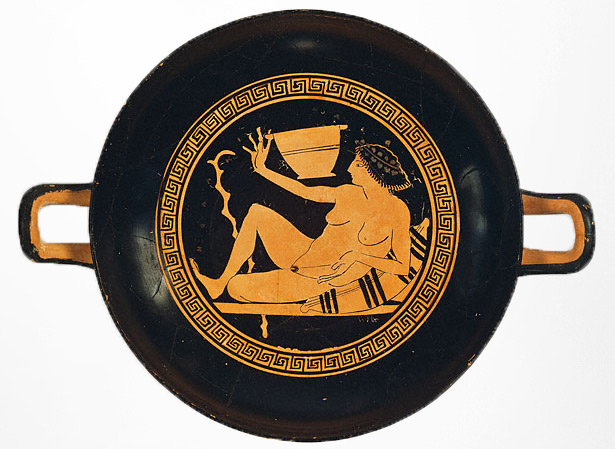
Drinking was usually done by men at a symposion (συμπόσιον). A symposiarch (συμποσίαρχος), a wine-mixer, was put in charge of mixing the wine. He made sure to keep an eye on the intoxication levels of those attending and adjusted the mix accordingly. Mixing was done in a krater (κρατήρ). The name comes from the word 'kerannmi': 'to mix'. Sources state that the best mix--depending on the wine, of course--was one part wine to about three or four parts water, but a dilution of 1/20 appears in the writings of Hómēros. In the wintertime, wine was diluted with pristine snow for a cleaner taste.

The art of winemaking was not perfected in ancient Hellenic times. The quality of the wine was variable; there were wines which stayed fresh for at least a decade, but a lot of wines turned moldy very fast. Most of the wines lasted around a year. Because the wines were drunk soon after they were made, most wines gave the drinker a pretty severe headache in the morning. This was another reason the wine was diluted.

As drinking water was often stagnant, wine was also used to purify it, and mask the taste. All men, women and children drank water which had some wine added to it. Wine was believed to be a healer--and it is--so everyone drank it, sometimes more when they were sick.

Wine was rarely drunk during dinner, but only after. Drunkenness was frowned upon, and three small kylix' of diluted wine was often all that was allowed for a grown man. In general, that is less undiluted wine than a single standard wineglass of modern time. Around 375 BC, the Hellenic comic poet Eubulus’, in his play 'Semele or Dionysos', made Dionysos state:

"Three bowlfuls only for the wise I measure,
The first to Health, second to Love and Pleasure,
Third Sleep--this those believed to know what's what
Go home to bed after; the fourth is not
Our own but outrage's, the fifth uproar's,
The sixth is mixed for serenading whores,
The seventh for two black eyes, eigth for a writh,
Ninth for the blues, tenth for a raving-fit
So bad you're outlawed. Thus one little cup
Too often filled can trip the drinker up."

The etiquette of the symposium required that when the first krater of wine was served, a libation was made to Zeus (or the Agathós Daímōn) and the Olympian gods. Heroes received a libation from the second krater served, and Zeus Teleios--the Finisher--(or Hermes) from the third, which was supposed to be the last. Plato, in his 'Symposium', addresses the proper place of wine in relation to the worship of the Theoi:

"Socrates took his place on the couch, and supped with the rest; and then libations were offered, and after a hymn had been sung to the god, and there had been the usual ceremonies, they were about to commence drinking."

As a Hellenist, I tend to ponder the details. It's clear that these types of regular household libations were done with mixed wine. In the Odysseia, Echeneus states:

"Come, Alcinous, it is not right and proper that a stranger should sit there in the ashes of the hearth, while we all hold back awaiting your lead. Raise the stranger to his feet, and seat him on a silver-embossed chair, and let the heralds mix the wine, so that we may pour libations to Zeus as well, who hurls the lightning and follows the footsteps of holy suppliants."

Yet, what about the more formal rituals? In 'A Companion to Archaic Greece' by Kurt A. Raaflaub and Hans van Wees, it is mentioned that unmixed wine is reserved for the Theoi, yet A. Henrichs states (p. 47):

"...Greeks shaped a 'negative' (part of a) ritual by a reversal of normal practices. Other means would be the absence of wreaths; libations of unmixed wine, water or oil instead of mixed wine; or the dark colour and/or holocaust of the sacrificial victim instead of a sacrifice ending in a banquet."

This seems to indicate that rituals and sacrifices to the Ouranic deities and/or positive occasions were performed with mixed wine, while Khthonic deities and/or negative occasions were performed with unmixed wine. This view is supported by Hómēros who writes Circe advising Odysseus how to perform a libation to the dead:

"Draw near then, as I bid you, hero, and dig a trench two feet square, then pour a libation all around to the dead, first of milk and honey, then of sweet wine, thirdly of water, sprinkled with white barley meal. "

When Odysseus does as he is told, nowhere is it mentioned that the wine is mixed. It is simply offered up as sacrifice, straight out of the jug. It makes sense that a khoe should be unmixed; same as with a holókaustos, all of the sacrifice--in its purest form--should be offered. Taking Henrichs' theory about reversed rituals--something also discussed in Harrison's 'Prolegomena to the Study of Greek Religion'--it would then seem that libations within Ouranic festivals were performed with mixed wine.

One can not write about wine in ancient Hellas and not mention the Theos of Wine Himself: Dionysos. Throughout the year, four major festivals are dedicated to Him, and one in particular was full of wine. The Anthesteria was held annually for three days, the eleventh to thirteenth of the month of Anthesterion. The festival centered around the celebration of the maturing of the wine stored at the previous vintage, whose pithoi were now ceremoniously opened, and the beginning of spring. The three days of the feast were called Pithoigia (after πίθοι 'storage jars'), Choes (χοαί 'libations') and Chytroi (χύτροι 'pots').

On the first day, the pithoi were brought to the city and opened in the temple of Dionysos. On the second day, all temples were closed, except that of Dionysos. Social order broke down on this day--as slaves were permitted to celebrate alongside everyone else--and there was a drinking contest in the afternoon where three liters of wine were drunk in complete silence. Whomever finished first, won. On day three, everyone joined in a procession to the temple of Dionysos, where the festival ended with the wicker burning of a huge phallus. The slaves were also told to go home, as 'the Anthesteria had ended'.

All in all, wine was a social, religious, and economic highlight of Hellenic society. I'm not a big wine drinker, as it's usually too strong for me, and I don't drink alcohol outside of ritual anyway. Yet, I have tried diluted wine, and the more watered down it is, the more I like it. I get why the ancient Hellens were looking forward to their symposions so much; wine, women and good music. What was not to like?


Image source: kylix
Alright, I feel better so lets move on to a lighter topic, shall we? Gender-roles in Hellenic mythology. Hellenic myth isn't the most balanced or forward mythological system when it comes to gender roles. In fact, I strongly believe it's a gender package no one comes out of, looking better. Women have three choices; rejoicing their femininity and inherent sexuality and leaving themselves open to kidnap and/or rape, tempting and/or raping in return or becoming warrior virgins who (only go through attempted rape but) will never know love. Men have two choices; either they become brutes who chase every bit of tail that comes their way or they become tricksters, harmless to the females around them as well as the egos and reputations of the males. I've seen better options.

Lets look at the women first; The first option is to be so beautiful and/or innocent and/or conveniently available that the male God or hero can not restrain himself. He must have her and so he takes her from her home and (often) has sex with her. Persephone is a textbook example of this. These rapes (although the sex sometimes is concensual) often end in pregnancy and the birth of a new hero. Examples include Perseus and Kastor and/or Polideukes. Often the women get punished severely for their part in the sex/rape. Just look at Médousa.

The second option is to be in control of one's beauty and sexual prowess but eternally alone. The Odysee is full of examples of this one; the sorceress Circe, Calypso as well as the Sirens. All tempt Odysseus to various degrees of success, sometimes taking his faculties from him so they can take from him what they want.

The last category for the women is to become a warrior and remain a virgin. The only way to find love is to revert to one of the other two options. The Goddesses Artemis and Athena are amongst these, as well as the Amazons.

The men have different options but it comes down to two words; power or trickery (or a combination of both). The men-who-become-brutes tend to be the ones who chase women down in lust until they have her and can make love to her or rape her or until she is taken from them by the intervention of another deity. See Médousa for the former and Daphne and Minthe for the latter.

The tricksters include Gods like Hermes and perhaps even Apollon; They find love but only by avoiding the men and women that the brutes are attracted to. More often than not, the tricksters get assigned their partners by the brutes.

Now, this is an overgeneralization. There are many shades of grey here. Rape, in Hellenic myth shouldn't even be interpreted as rape as we know it; in myths it's the pouring out of Divinity over mortals. In general, it can even be seen as a blessing, of sorts.

I do not condone rape in any way, shape or form. I am merely saying that women in ancient Hellens were considered to be property of the men in their lives. Any sexual encounters they had was rape, by definition, as it was a property crime. So consensual sex was still rape... well... a property crime, because the word 'rape' did not exist in ancient Hellas. Of course, this whole thing is still a tangled web of hurt that is beyond the scope of this blog post. Perhaps when we get to 'R'. For now, I will limit myself to the gender-roles listed above.

There are lessons to be learned in these stories. While the Theoi are fully fleshed out entities, who are perfectly capable of thinking for Themselves, most of Them did get pigeonholed into certain stereotypes in the myths that survived the ages. There are many, many cases of UPG and SPG that give light to a whole other side of these Gods and Goddesses. Often, Their stories also distract us from what They did have and from the stories that were never told or not often focussed upon. Zeus, for example, has children with many mortal (and immortal) women but he returns to the bed He shares with Hera every night. While She may spurn him for his dalliances, She seems to be very aware (as is He) that His needs are really only sated with Her and Hera rules the daily going on's on Olympus in His stead. Persephone might not hate the time She spends with Hades at all; She seems to have taken Her rightful place by His side as Queen of the Underworld and who knows? Perhaps She ate those pomegranate seeds of Her own free will?

I admit that the gender roles of ancient Hellas bother me. Reading these myths can leave a sour taste in my mouth that only washes away when I look beyond the words, to the messages themselves. By filling the gaps between myths, one can often reconcile their worries about the myths with their personal creed as well as moral guidelines like the Delphic Maxims. It's also very important to note the time period in which these myths were formed; Hellenic culture has its source in Mycenaean Hellas, starting roughly 3900 years ago. That's a lot of time to go by and women's rights weren't really a part of ancient living. Men were expected to provide, and healthy, powerful man simply had more prowess. It's not odd to think the Gods mirrored these societal bounds.

I doubt many (if any) Modern Hellenics long back for a time when men ruled over women in the way that is portrayed in myth. Rape is not condoned. Modern Hellenics try to read beyond the words to get to the message(s). The myths tell us something about the Gods but, like us, They have had a lot of time to evolve. This is a thought that must not be forgotten.