Showing posts with label Ganymēdēs. Show all posts

It's time for part three of the constellation series, and this time I'm tackling a constellation I had never heard of before: Aquila. It's one of the medium sized constellations, located a little 'above' Sagittarius.
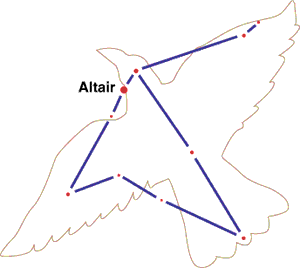


Aquila is aptly named 'the eagle'. The shape it was given, as well as the mythology attached to it all relate to the bird. Aquila is the Latin for 'eagle', and from mythology, we are well aware that Zeus's favorite animal is this very bird.

This constellation is heavily linked to the constellation of Aquarius: the water carrier. This constellation is often said to represent Ganymēdēs, who was carried to Olympus by an eagle; this very eagle, in fact. It is also said that Zeus's thunderbolts are carried down by the eagle. In the Odysseia, Odysseus' son Telemachos receives oracular message from Zeus by way of the eagle:

"So Telemachus spoke, and Far-Seeing Zeus sent out two eagles from a high mountain peak. They flew for a while with outspread wings, side by side in the currents of air, but when they were above the voice-filled assembly they swiftly slanted their wings, circling round, gazing down on the heads below, and death was in their gaze. Then they clawed at each other’s head and neck with their talons, and soared away eastward over the roofs of the town. The people saw them and wondered, and considered what this might foreshadow. Then the old hero Halitherses, Mastor’s son, spoke out, for he was the wisest man of his day in bird-lore and prophecy. With goodwill in his heart he addressed the assembly:

‘Men of Ithaca, listen to me: and I say these words to the Suitors especially, since disaster approaches them. Odysseus will not be far from his friends much longer, and I believe even now he is near, sowing the seeds of dark death for all these men. Yes, and he will bring trouble to many another of us, who live in clear-skied Ithaca. Let us think in advance how we might prevent all this, or let them prevent it of their own accord, easily their best option. I am not unskilled in prophecy, but have true knowledge. I say that all things for that man will be fulfilled, just as I told him when the Argives sailed for Troy, he among them, resourceful Odysseus. I declared that, suffering many troubles, losing all comrades, he would return in the twentieth year, unknown to all: and now it is coming to pass.’"

Another prominent myth in which the eagle of Zeus features is the myth of Prometheus, who stole fire from the Gods and gave it to humanity. For his efforts, he was tied to a rock by Hermes who was under orders from Zeus. Zeus then tormented him every day for the longest time, by sending an eagle to peck out his liver again and again, because as an immortal, Prometheus' liver grew back every night. In some stories, Prometheus is eventually freed by the hero Hēraklēs, after Zeus takes mercy on him.  

For all his hard work, the eagle was placed into the sky by Zeus, so it could soar through the skies for eternity. The constellation Aguila is visible at latitudes between +90° and −75°. It is best visible at 21:00 (9 p.m.) during the month of August.

Welcome to part two of the constellation series reposts. The second sign we'll be looking at is Aquarius.


Aquarius is the eleventh sign of of the zodiac and is therefor pretty well know. In fact, it is amongst the oldest known constellations. The constellation is said to represent a number of people; for one, it can be Zeus himself, pouring down water onto the Earth. It could also be Ganymēdēs (Γανυμήδης), the beautiful male from Troy, who caught Zeus' eye and served as cup bearer to the Gods. The third explanation would be that the constellation represents Deukalion, son of Prometheus.

The latter two deserve a bit more explanation. Before her marriage to Hēraklēs, Hebe, daughter of Zeus and Hera, acted as cup bearer to the Gods. When she wedded, Zeus cast his eyes about and took a shining to a young boy from Troy: Ganymēdēs. There are various versions of the myth. In one, Zeus transforms himself into an eagle and swoops up the boy, carrying him off to Olympus. In another, he pays Ganymēdēs' father Tros with 'horses beautiful and strong enough to carry the Gods themselves'. In all versions, Ganymēdēs is made immortal and his father is comforted by that knowledge. All Gods were overjoyed to have the young man serve them, except for Hera, who saw a rival for her husband's affection in the boy. It was Zeus who later put Ganymēdēs into the sky as the constellation Aquarius.

The other option is that the constellation represents Deukalion. He and his wife Pyrrha, daughter of Pandôra, recreated humanity by tossing stones behind them as they walked, after Zeus flooded the Earth and killed humanity for its hubris. You can read the full story here, as I have blogged about it before. According to myth, Zeus put Deukalion into the sky to honor his contribution to humanity. Sadly, Pyrrha was not awarded this honor.

Whomever the constellation is supposed to represent, the constellation is very old and--as it's there in every horoscope, ever--very powerful. The Aquarius constellation is visible at latitudes between +65° and −90°. It is best visible at 21:00 (9 p.m.) during the month of October.

 The Greek Anthology (Anthologia Graeca) is a collection of poems, mostly epigrams, that span the classical and Byzantine periods of Greek literature. Most of the material of the Greek Anthology comes from two manuscripts, the Palatine Anthology of the 10th century and the Anthology of Planudes (or Planudean Anthology) of the 14th century.


I'd like to share two of the epigrams with you today, about Ganymede. In Greek mythology, Ganymede or Ganymedes (Γανυμήδης, Ganymēdēs) is a divine hero whose homeland was Troy. Ganymede was abducted by Zeus from Mount Ida, near Troy in Phrygia. Ganymede had been tending sheep, a rustic or humble pursuit characteristic of a hero's boyhood before his privileged status is revealed. Zeus either summoned an eagle or turned into an eagle Himself to transport the youth to Mount Olympus.


Greek Anthology, Antipater 5.77
“Hera twisted by the beauty of Ganymede once spoke
As she suffered the heart-rending stab of jealousy in her heart:
“Troy ignited a male fire for Zeus—and so I will send
A fire at Troy, a pain bearing Paris.
No eagle will come to Troy again, but vultures
Will go to the feast when the Greeks get the spoils for their toils.”

Greek Anthology 12.211
“Go to bright heaven, go carrying the child,
Eagle, keep your twin wings spread wide.
Go holding gentle Ganymede and do not drop
Zeus’ wine-bearer of the sweetest cups.
But be careful not to bloody him with your clawed feet
So that Zeus, upset, won’t hurt you.”


Translation here.
The Greek Anthology (Anthologia Graeca) is a collection of poems, mostly epigrams, that span the classical and Byzantine periods of Greek literature. Most of the material of the Greek Anthology comes from two manuscripts, the Palatine Anthology of the 10th century and the Anthology of Planudes (or Planudean Anthology) of the 14th century.

I'd like to share two of the epigrams with you today, about Ganymede. In Greek mythology, Ganymede or Ganymedes (Γανυμήδης, Ganymēdēs) is a divine hero whose homeland was Troy. Ganymede was abducted by Zeus from Mount Ida, near Troy in Phrygia. Ganymede had been tending sheep, a rustic or humble pursuit characteristic of a hero's boyhood before his privileged status is revealed. Zeus either summoned an eagle or turned into an eagle Himself to transport the youth to Mount Olympus.


Greek Anthology, Antipater 5.77
“Hera twisted by the beauty of Ganymede once spoke
As she suffered the heart-rending stab of jealousy in her heart:
“Troy ignited a male fire for Zeus—and so I will send
A fire at Troy, a pain bearing Paris.
No eagle will come to Troy again, but vultures
Will go to the feast when the Greeks get the spoils for their toils.”

Greek Anthology 12.211
“Go to bright heaven, go carrying the child,
Eagle, keep your twin wings spread wide.
Go holding gentle Ganymede and do not drop
Zeus’ wine-bearer of the sweetest cups.
But be careful not to bloody him with your clawed feet
So that Zeus, upset, won’t hurt you.”


Translation here.
It's time for part three of the constellation series, and this time I'm tackling a constellation I had never heard of before: Aquila. It's one of the medium sized constellations, located a little 'above' Sagittarius.


Aquila is aptly named 'the eagle'. The shape it was given, as well as the mythology attached to it all relate to the bird. Aquila is the Latin for 'eagle', and from mythology, we are well aware that Zeus's favorite animal is this very bird.

This constellation is heavily linked to the constellation of Aquarius: the water carrier. This constellation is often said to represent Ganymēdēs, who was carried to Olympus by an eagle; this very eagle, in fact. It is also said that Zeus's thunderbolts are carried down by the eagle. In the Odysseia, Odysseus' son Telemachos receives oracular message from Zeus by way of the eagle:

"So Telemachus spoke, and Far-Seeing Zeus sent out two eagles from a high mountain peak. They flew for a while with outspread wings, side by side in the currents of air, but when they were above the voice-filled assembly they swiftly slanted their wings, circling round, gazing down on the heads below, and death was in their gaze. Then they clawed at each other’s head and neck with their talons, and soared away eastward over the roofs of the town. The people saw them and wondered, and considered what this might foreshadow. Then the old hero Halitherses, Mastor’s son, spoke out, for he was the wisest man of his day in bird-lore and prophecy. With goodwill in his heart he addressed the assembly:

‘Men of Ithaca, listen to me: and I say these words to the Suitors especially, since disaster approaches them. Odysseus will not be far from his friends much longer, and I believe even now he is near, sowing the seeds of dark death for all these men. Yes, and he will bring trouble to many another of us, who live in clear-skied Ithaca. Let us think in advance how we might prevent all this, or let them prevent it of their own accord, easily their best option. I am not unskilled in prophecy, but have true knowledge. I say that all things for that man will be fulfilled, just as I told him when the Argives sailed for Troy, he among them, resourceful Odysseus. I declared that, suffering many troubles, losing all comrades, he would return in the twentieth year, unknown to all: and now it is coming to pass.’"

Another prominent myth in which the eagle of Zeus features is the myth of Prometheus, who stole fire from the Gods and gave it to humanity. For his efforts, he was tied to a rock by Hermes who was under orders from Zeus. Zeus then tormented him every day for the longest time, by sending an eagle to peck out his liver again and again, because as an immortal, Prometheus' liver grew back every night. In some stories, Prometheus is eventually freed by the hero Hēraklēs, after Zeus takes mercy on him.  

For all his hard work, the eagle was placed into the sky by Zeus, so it could soar through the skies for eternity. The constellation Aguila is visible at latitudes between +90° and −75°. It is best visible at 21:00 (9 p.m.) during the month of August.
Welcome to part two of the constellation series. As you can see, I'm trying for an alphabetical order in these but I might sneak one in if I forget one of them. Which I will. Anyway, the second sign we'll be looking at is Aquarius.


Aquarius is the eleventh sign of of the zodiac and is therefor pretty well know. In fact, it is amongst the oldest known constellations. The constellation is said to represent a number of people; for one, it can be Zeus himself, pouring down water onto the Earth. It could also be Ganymēdēs (Γανυμήδης), the beautiful male from Troy, who caught Zeus' eye and served as cup bearer to the Gods. The third explanation would be that the constellation represents Deukalion, son of Prometheus.

The latter two deserve a bit more explanation. Before her marriage to Hēraklēs, Hebe, daughter of Zeus and Hera, acted as cup bearer to the Gods. When she wedded, Zeus cast his eyes about and took a shining to a young boy from Troy: Ganymēdēs. There are various versions of the myth. In one, Zeus transforms himself into an eagle and swoops up the boy, carrying him off to Olympus. In another, he pays Ganymēdēs' father Tros with 'horses beautiful and strong enough to carry the Gods themselves'. In all versions, Ganymēdēs is made immortal and his father is comforted by that knowledge. All Gods were overjoyed to have the young man serve them, except for Hera, who saw a rival for her husband's affection in the boy. It was Zeus who later put Ganymēdēs into the sky as the constellation Aquarius.

The other option is that the constellation represents Deukalion. He and his wife Pyrrha, daughter of Pandôra, recreated humanity by tossing stones behind them as they walked, after Zeus flooded the Earth and killed humanity for its hubris. You can read the full story here, as I have blogged about it before. According to myth, Zeus put Deukalion into the sky to honor his contribution to humanity. Sadly, Pyrrha was not awarded this honor.

Whomever the constellation is supposed to represent, the constellation is very old and--as it's there in every horoscope, ever--very powerful. The Aquarius constellation is visible at latitudes between +65° and −90°. It is best visible at 21:00 (9 p.m.) during the month of October.